‘Men In Black’ and ’21 Jump Street’ Crossover?

Creative Commons

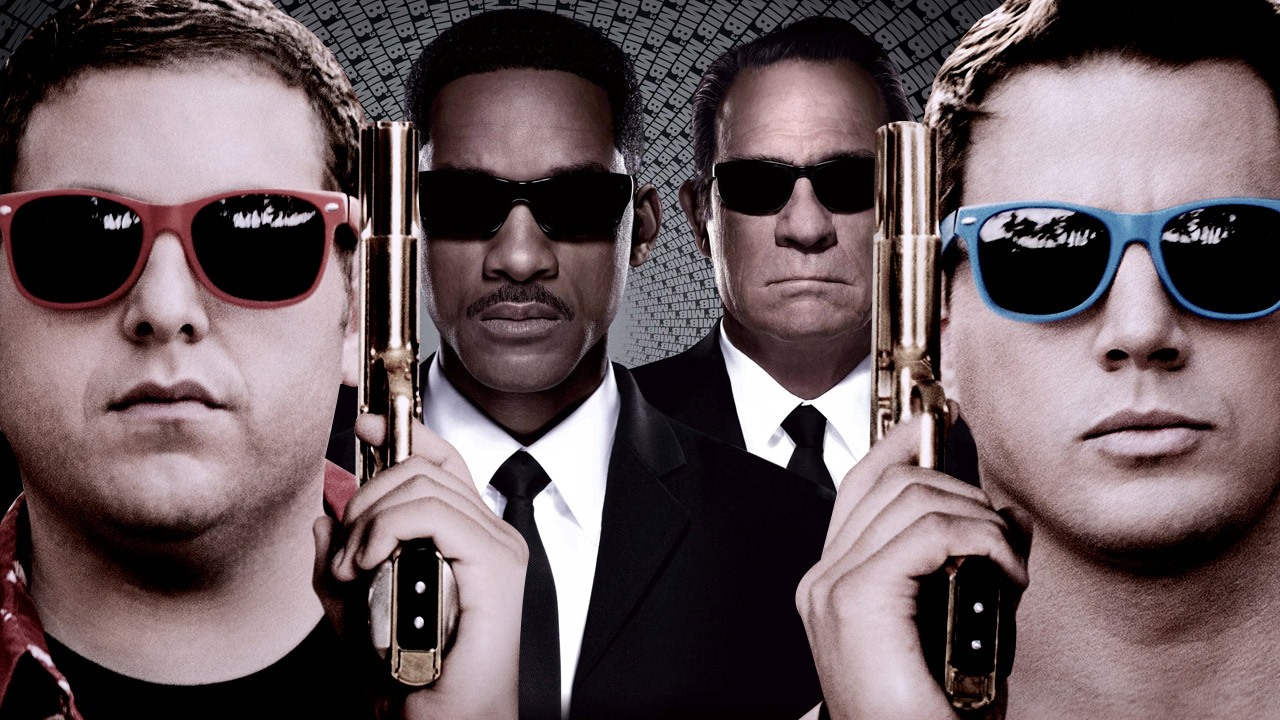
News emerged earlier today on the state of two franchises: the sci-fi action comedy Men In Black and the action comedy 21 Jump Street. It looks like they’re soon going to be part of the same universe.

This information has been swirling around for some time since December, where the infamous Sony email hack revealed that the company was initially planning to do a series crossover. The confirmation, however, came a few hours ago from the entertainment website IGN, which reported that Sony would be working on two 21 Jump Street properties: one being a female-driven action-comedy, and the other being a cross-over/sequel with officers Schmidt and Jenko teaming up with agents J and K. There’s no word on whether actors Will Smith, Tommy Lee Jones or Josh Brolin will reprise their roles for the film, but writer-directors Phil Lord and Chris Miller would return to spearhead the film.

Rumored to be titled 23 Jump Street, the movie would play off the concept of the end credits from 22 Jump Street. If your life is so sad that you weren’t able to watch 22 Jump Street, and therefore, weren’t able to watch the end credits, it was basically a parody of multiple sequel ideas, ranging from medical dramas to martial arts movies. Now, it looks like one of those parody ideas are coming to life as the 21 Jump Street boys will be teaming up with the agents from M.I.B.

If it’s parodying the science-fiction series of films with this crossover movie, it might work. 22 Jump Street was a hilarious film, and the end credits sequence was arguably the best part of the movie. But if it is a true “crossover” at the level of, say, The Avengers or Who Framed Roger Rabbit, I don’t see how the two universes fit. 21 Jump Street is profane and violent slapstick. Men In Black is wacky PG-13 sci-fi action. I don’t see how the two line up with each other, let alone what they have in common to constitute a shared universe.

I’m not saying that the two can’t work in a movie. Miller and Lord alike are both very smart, creative directors, evidenced also by their work with last year’s The Lego Movie. I’m just saying that there isn’t much of a strong connection between the two series, and the filmmakers will have to work to find one in order to make another solid entry in both of the franchises. Maybe agents K and J can just show up as a surprise cameo?

What do you guys think? Do you want to see the Men In Black go head-to-head with the guys from 21 Jump Street? Do you think it will work? Why or why not?

Comment below and let me know… if you don’t get neuralyzed first.

– David Dunn

SOURCE: IGN, Uproxx

Winnie The Pooh Is Getting The Live Action Treatment

Disney is taking a trip back to the Hundred Acre Wood.

Deadline reported earlier today that independent writer-director Alex Ross Perry was hired to write and direct a live-action adaption of the Winnie The Pooh book series created by A.A. Milne. The latest Disney property to be adapted to live-action alongside the likes of Beauty and the Beast and Mulan, Winnie The Pooh tells the wondrous stories of the creatures of the Hundred Acre Wood, a young boy named Christopher Robin, and his many adventures with his animal friends, one of which is a very hungry yellow bear.

Directing a handful of small-budget projects such as 2011’s The Color Wheel and 2014’s Listen Up Philip, Perry’s version of Winnie The Pooh reportedly involves a significantly older Christopher Robin returning to the Hundred Acre Wood years after growing up, and will aim to appeal both towards children and the adults who grew up with Winnie the Pooh.

What do you guys think? Are you excited to see Pooh Bear once again on the big screen? Do you think it should be live-action, or should Disney just stick with producing the animated films? Chime in on your thoughts below.

– David Dunn

SOURCE: Deadline, Screenrant

Deadpool’s Movie Officially Gets An R-rating

The merc with a mouth himself announced it while murdering television personality Mario Lopez on air during an “Extra” segment April 1st while Lopez interviewed actor Ryan Reynolds, who is set to portray Deadpool in the upcoming film directed by Tim Miller.

Originally thought to be an April fools day joke due to when the segment aired, officials have since confirmed that Lopez was indeed killed by the mercenary during the segment. Details on Lopez’s funeral service will be announced sometime next week.

Oh, and yes, Deadpool’s movie is going to be rated R. I tried reaching out to Deadpool’s office for a statement, but when I emailed a media request, the email response I got was this:

deadpool-real


So in case you were wondering, Deadpool did not respond by press time.

– David Dunn

“’71” Review (✫✫✫)

A boy trapped in a soldier’s life. 

We’re always looking for someone to blame in war. Most of the time, the blame is directed at the soldier. Rarely do we blame the military, or the government, or those we are fighting, and even more rarely do we blame the people living stateside, in the warmth and comfort of their blanket and home and far away from the battlefield. No, if we are angered at travesties such as the Vietnam or the Afghan war, we don’t point at the general who gave the order to shoot. We point at the soldier who was following orders.

In ’71, the soldier is treated not as a cold-hearted, emotionless machine, but as a young man, a flesh-and-blood being full of heart and consciousness, but who is equally confused, hurt, alone, and afraid of the people he’s trying to protect. The controversy around another war film called American Sniper released a few months ago argued if we glorify war and the military too much. Those same people need to watch ’71 and realize there is nothing to glorify about it.

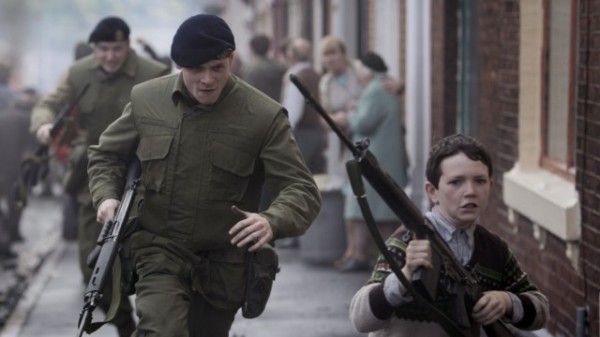
Taking place during the height of civil unrest in the Troubles, ’71 follows a young British army recruit named Gary Hook (Jack O’Connell), who gets deployed into Belfast during his first few weeks of training. Him and his squad is warned of the great dangers in entering the territory. Protestant and Catholic Irishmen are living side-by-side at each other’s throats, each with starkly different ideas of what is better for them. The protestants believe that the United Kingdom is their home and it is their best interests to remain with them. The catholics believe Ireland can be it’s own land and wants to secede from Europe. Hook and his fellow soldiers are just looking to keep the peace.

On the day of deployment, Hook watches as both sides come to a boil. The KGB is entering houses, threatening and beating people with their billy clubs, while an angry crowd of catholics gather outside in retaliation against the military. One of the rioting crowd members throws a rock and knocks a soldier out cold. A kid no older than ten grabs the soldier’s rifle and runs. Hook and another soldier chase after him when the crowd assaults them and beats viciously. Hook watches as the soldier is shot in the face. Hook only narrowly escapes with his life intact.

Trapped in Belfast with no way to find his comrades, Hook must fight through the night to survive against the city that’s hunting him.

Functioning more as a survivalist-thriller than as a pure-blooded war movie, ’71 strikes the viewer with sharp imagery and intelligence alike, filling them with a deepening sense of dread as we watch this young man crumble into desperation as he tries to escape from the people who are seeking to kill him. One of the things I love so much about this movie is how expertly it orchestrates itself and its emotions. French director Yann Demange, who before this directed British television shows such as “Dead Set” and “Top Boy”, debuts here as a talented filmmaker, crafting an exciting thriller that efficiently balances action with context.

I am reminded of another film similar in direction and subject, and that is Ben Affleck’s 2012 film Argo. In both films, the main character evades their pursuer through the chaos of a collapsing political climate. The camera captures the essence of both perspectives, with the pursuer desperately chasing their target while the pursued is equally as desperate trying to get away. And through both highly exciting and pulse-pounding features, both directors have deeper things to say about those societies and what impact they’re leaving on the people around them.

To me, ’71 is the British version of Argo, with one big difference: coherency. In Argo, everything is crystal-clear and straightforward. We know who the characters are, why they are there, what they are doing, who is after them, and how and why they plan to get away. In ’71, all of that is focused in towards one character only, and that is Gary Hook. We know everything we can know about a novice soldier, we just don’t know the same of everyone else around him.

For instance, the leaders of both factions, the catholics and the British Military Reaction force, are both skinny gingers with mustaches as thick as their hair. How can you tell who is who under the dim view of the street light? A young boy helps Hook towards a bar after his initial attack, but he’s on the same side as the people who are hunting him. Why is he helping Hook when he so clearly has so much disregard for British soldiers? In another scene, a Protestant seeks to help Hook when minutes earlier he had the cold, direct eyes of a killer with purpose. What inspired him to switch sides so easily? And then, near the end of the movie, there is a twist that didn’t make much sense to me at all.

Still though, the movie is there, and Demange handles the senses of unease and desperation well with the film, especially when trusting Jack O’Connell to portray all of these emotions at once. O’Connell is really having a strong career packing in for himself. In the past year, for instance, he created a very compelling presence in the prison-drama Starred Up and in the Angelina Jolie-directed biopic Unbroken. He makes a very strong case for choosing acting as a career in all of these films, and in ’71 he clearly shows that he can pull off the role of a young, desperate, and inexperienced soldier who just wants to go home. Demange was wise to cast him in this role and trust him with the emotional complexity of the character: O’Connell was the best part of the film.

I’ll admit, I didn’t understand everything I probably needed to understand in the movie, perhaps the biggest one being more aware of what the Troubles were in the 1970’s. Take that out of it. Take all of the political facets out of the movie, and what do you have? You have a raw, emotionally-charged war thriller that challenges the viewer to see it not from their perspective, but from the soldier’s perspective. Everyone hurts during the times of war. ’71 makes me wonder who war hurts the most.

Tagged , , , , , , , , , , , , , , , , , , , , , , , , , , , , , , , , , ,

“AMERICAN SNIPER” Review (✫✫✫1/2)

And hero, husband, and father.

Chris Kyle was an American sniper. Serving four tours in Iraq, with 160 confirmed kills and approximately 95 more unconfirmed, Kyle earned the title of being called the most lethal sniper in American history. More than being a soldier, though, he’s a father, a husband, and a friend. He was killed in 2013 at age 38. He was shot by a soldier suffering from PTSD that he was trying to help.

We know all these details going into Clint Eastwood’s American Sniper. We already know how it ends, we just don’t know everything leading up to it. Eastwood understands this, and uses it to his advantage as his film not only gives an honorable tribute to one of America’s most committed soldiers, but also foreshadows to a sad fate that we already know is coming. Gee, thanks a lot Clint. I didn’t even bring my tissues.

The film opens on the same startling scene that the book does: with Kyle looking down the scope of his sniper rifle at an Iraqi mother and her child, both of whom were aiming to suicide bomb a battalion of soldiers on the street. Eastwood sets up the tension of the scene perfectly here, with Kyle’s sweaty, darting eyes surveying the scene and desperately trying to see any way out of the tormenting choice he has to make. He soon dreadfully realizes there is no way out: it’s either the mother and her child, or the 15 soldiers and the suffering of their families back at home.

Think about being given that situation, about how devastating the experience must be and how haunting it must be to the person who has to make it. Now imagine having to make that same choice day, after day, after day, with your numbers climbing up until you’ve reached over 250 kills.

That’s the life of a soldier that Kyle has lived.

Kyle is portrayed in the film by Bradley Cooper, and both Cooper and Eastwood do a wonderful job representing Kyle here. They show that before he was a soldier, he was a citizen, an American with strong ideals and opinions and unafraid to show them or fight for them. Before he was shipped out and went on tour, they showed how normal Kyle was.

They showed that before he was a soldier, he was a man.

After having to make those difficult decisions day after day, how do you think that affects a man? In interviews, the real-life Kyle has said that he would not take back a single shot because every one that he took was to defend his brothers in uniform. I believe him when he says that, but I don’t believe that it didn’t leave an impact on him. Some soldiers suffer PTSD from killing just one man. How do you think more than 200 may have impacted Kyle?

Both Eastwood and Cooper do a great job humanizing Kyle here, and show that he’s more than the record kills he’s garnered. They show that Kyle is a man of coarse humor and blunt honesty, a man with a thick Texan accent and ideals, a man who tries to show that he’s strong and dependable, but who deep down is hurting and alone. The film is intimate in the ways that it shows Kyle, both in the chaos of battle and in the quietness of being home.

Cooper especially does a skillful job in portraying the iconic war hero. He expresses trauma and subtlety with the character so masterfully that the only differences I can tell between him and Kyle are minor facial features.

This movie has stirred controversy as of late for being “pro-war,” and for glorifying a man who was essentially labeled a murderer. I’m convinced these same people haven’t seen the same movie I saw, because the movie I watched unabashedly looks at the miseries of war and how the deaths Kyle could and couldn’t prevent affected him. The movie does suffer some slight pacing issues (not to mention the infamous “fake baby” seen in one of the shots), but when Eastwood resurrects a war hero to show the man behind the legacy, how can you look at this movie’s scope and not feel something for all of the physical and moral sacrifices Kyle had to give for his home? When the trumpet plays proudly over the solemnity in the end credits, you know that Eastwood represented a warrior in heart and a human in spirit.

Tagged , , , , , , , , , , , , , , , , , , , , , , , , , , , , ,

“WHIPLASH” Review (✫✫✫✫)

You won’t know what hit you.

I was a junior in high school when my dad took me out to a cabin in Montana for a “vacation.” I put “vacation” in quotations because we practiced music for nearly three hours every single day. I was a tuba player back then, and I practiced with my dad so I could make it into the All-Region band. One day, I wasn’t playing a single measure correctly. The notes I was supposed to play were on the downbeat, and I kept playing them on the upbeat. My dad made me play that verse over, and over, and over, and over again. He would get frustrated at me, yell at me, and push me harder and harder until I played that verse perfectly 100 times. I played that same frothy, infuriating verse for all three hours that day.

I say this to show you that the stuff you see in Whiplash isn’t fiction. It’s as feasible as the music you see, as vibrant as the drum beats you hear in a song, and as real as the passion that drives any musician, writer, and aspiring artist out there. Whiplash is special not just because it’s unique, but because it carries an uncanny truth for those who aspire to greatness. Perfection is never good enough. You’re pushing yourself over the edge just as much as the people around you are.

The kid aspiring to greatness in this story is Andrew Neiman (Miles Teller), a mild-mannered college musician who aspires to be the next Charlie Parker or Buddy Rich on the drums. The man he thinks can make him great is Terrence Fletcher (J.K. Simmons), a brilliant but brash and at times violent instructor who will throw a chair at you if you’re either rushing or dragging the tempo.

If you think I’m saying that figuratively, I’m not. That literally happens to Neiman during his first rehearsal with Fletcher in the movie.

Neiman aims to be the best drummer out in the world. Fletcher aims to be the best instructor in the world. These two men and their intense passions for their goals builds into a riveting, thrilling, and emotionally vigorous journey that is more involving and exciting than most of the year’s biggest action blockbusters. Yes, I am placing this above the likes of Transformers, Godzilla, and Guardians of the Galaxy. It’s that good.

How is it that this movie leaves such a lasting impact, when most people haven’t seen it, let alone heard about it? One of the biggest reasons, I think, is conflict. This is writer/director Damien Chazelle’s sophomore effort into film, his debut feature being the 2009 jazz film Guy and Madeline on a Park Bench. Both films are about jazz musicians, both are about people aspiring to other’s aspirations, and both are about never being good enough for those end goals.

There, however, is a sharp difference in tone between both pictures. One is a romantic drama about two lovers struggling to reconnect after slowly growing apart from each other. The other is an unconventional thriller that poses two musicians opposite one another to build a steady sense of unease and tension between the two. The result is a severely nail-biting, teeth-grating, and heart-pounding experience because of it.

Again, going back to conflict. My college screenwriting professor once told us that conflict is what compels story, and character’s struggling with conflict compels their development in the story. I am reminded of this no better than when I watch Whiplash, and that’s just because Chazelle sets up conflict really well in the movie. In the film, Neiman is desperate to prove himself as a musician. He moves his bed out of his dorm room in the place of a drum set. When he goes to sleep, he listens to the music that he’s practicing in his ipod. When he knows he’s not playing fast enough, he pushes harder until his hand bleeds. When his hand bleeds, he puts a bandaid on and keeps playing. When his bandaid falls off, he presses his hand in ice water, turning the clean liquid into an ugly shade of red.

Yet, despite all of his passion and initiative, Fletcher continues to press him and push him harder not necessarily to make him a better musician, but just because it’s never good enough for him. The level of intensity Fletcher shows in the movie makes you wonder where all of this anger comes from. Did he have his own version of Fletcher when he was a music major in college?

Which brings me to the next point: the performances. Teller and Simmons give two of the best performances out of the year in their roles, fully inhabiting their characters to the point where we become entranced in full immersion. Teller, who before this has starred in a string of bad raunchy comedies (Project X, 21 and Over, That Awkard Moment), re-establishes himself as a finer actor here. He shows that he has more acting chops than he lets on and proves that he’s more than just a pretty face. Simmons is on a whole another level. He was so scary, intimidating and maddening as this arrogant, hard-headed music professor that he made wind ensemble feel like drill camp.

I can only name one moment I didn’t like in the film, and that is that the ending is far too abrupt. It’s a perfect film otherwise. Chazelle wrote and directed this film as a reaction to writer’s block, and while he pulled inspiration from being a drummer in high school, I think the film is universal as far as its language and messages go. We are both Neiman and Fletcher for the things that we are passionate about. We aspire to do great things, and we beat ourselves up when we don’t do those great things. We will push ourselves to and over the edge when we don’t measure up to our own expectations. But what’s the point of doing all of those great things if you’ve lost the joy in doing them? I quote my dad, who has always pushed me in a better way than Fletcher has: “You don’t have to be number one to be amazing.”

Post-script: In defense of my dad, some people might say he was going too hard on me, or that I didn’t deserve all of the strain that he would put me through. You would be wrong. I made third chair in the Texas All State band because he didn’t give up on me.

Tagged , , , , , , , , , , , , , , , , , , , , , , , , , , , ,

A Reflection On My Racial History

How do you think it feels knowing that your race caused decades of inhuman suffering and cruelty on a group of people that didn’t deserve it?

It’s the end of Black History Month, and after African-American citizens spent four weeks reflecting on their own history, I thought it was important that I took a moment to reflect on my own.

When I was thirteen, my great grandmother informed me that her father was a member of the Ku Klux Klan. Wearing the white robe of evil and judgement as if he were as clean as snow, he marched with his brothers in uniform against those of a different color from him with a sign filled with spite in one hand, and a torch burning with hatred in the other. She never learned if her father quit the organization or not. She found his uniform in the attic later on when she was an adult.

The rest of my family’s history isn’t much better. My dad’s uncles thought African Americans were selfish, lazy human beings, sputtering racial slurs at them while they drank their glasses full of whisky. Friends of my mother’s parents jokingly called them “jungle buddies.” Things only started getting better for my family when my mother stood up to her white classmates for her black friends when she was eight years old in elementary school. She was ridiculed and called by her classmates a “nigger lover.”

Bad as that is, I know it isn’t half as bad as what some of her friends had to face during that time.

Nowadays, with everything that has been going on in Ferguson and Staten Island, I sometimes find some people judging me and labeling me as a racist just because of the color of my skin. They don’t say this in words, but in silence: in the eerie, guarded ways they stare at you and in the sharpness in their breathing that feels like blades to your character.

I understand their contempt, and if I were in their shoes, I would probably judge myself too.

I’m not proud of the things my ancestors has done. I’m not proud of the things my entire race has done. In fact, I have to live with the fact that I’m living in a former slave state back when the south was considered the Confederate States of America. How can I say I’m proud to be a Texan, when I know all of the gross, unforgivable things we’ve done as a state?

But here’s what I need to keep reminding myself: it’s not me. I am not my family. I am not my origin. I am a passionate citizen of the United States of America. I love my brothers and sisters of all ethnicities and cultural backgrounds. I smile when I see them exercising their rights of freedom of expression, and I cry when I see them discriminated for their beliefs and appearances. I am filled with joy when their voices are heard, and I am filled with grief when their voices are silenced.

I am not my history, and for that matter, neither are you. We all should be proud, equal citizens of the United States. It’s high time we start acting like it.

– David Dunn

Tagged , , , , , , , , , , , , ,

The Real Problem With ‘Fifty Shades of Grey’

When a woman is screaming, crying and shouting at you to stop, I think there are at least a few indicators that she stopped enjoying it quite some time ago.

In recent additional controversy surrounding the sexually shameless movie 50 Shades of Grey, a recent sexual assault case came out linked with the motion picture. A 19 year-old University of Illinois at Chicago freshman was arrested for sexually assaulting a female he was formerly romantically associated with. After entering his dorm room and stripping down to her bra and underwear, the student proceeded to tie her wrists and legs to both edges of his bed, stuff a necktie in her mouth, blindfold her, take off her clothes, then viciously beat her with his fists and a belt before holding her hands behind her back and forcing her to have sex with him.

The excuse he told police when he was arrested? “He was re-enacting scenes from Fifty Shades of Grey.”

And people have the nerve to say the movie is as harmless as B-grade pornography (it’s actually C-grade, for those who were wondering).

Unfortunately, sexual assault is nothing new to America. According to a study conducted by the White House Council on Women and Girls, women make up the majority of victims, with one in five women reported to have been raped in their lifetimes. 98% of the perpetrators are male, with most of the victims previously knowing their assailants before they were assaulted.

However, the issue exists deeper than what can be printed on paper: it exists in the messages that the media is sending.

Take 50 Shades of Grey as an example. In the movie, the male character is a smooth-talking masculinist that angrily domineers over his sexual partner. The female character is an overly passive dimwit who is supposed to (literally) bend over and tend to her male master’s every desire.

Sex isn’t treated like a romantic act in 50 Shades of Grey. It’s treated like a service.

With that in mind, what message does the movie send to the masses that can’t think and act for themselves? One: that men are entitled to sex and that women should provide it to them because it is their role in life, and two: that if women don’t serve in this role, they deserve to be physically and verbally punished for their actions. It doesn’t matter what the filmmaker’s intentions were: what messages were viewers receiving when they saw a man being sexually aggressive and the woman enjoying it?

I am not placing the blame on either the man or the movie. What I am saying is that the gender stereotyping has to stop. Whether it’s in a movie theater or in a bedroom doesn’t matter. Women have the right to say “yes” or “no” just like any man does. We need to learn to respect that and acknowledge that so we can move on and improve the shabby society that we live in.

And before you say anything, yes, I am saying this as a 21-year old male college student. Look more at the words and less at the person writing them.

– David Dunn

Tagged , , , , , , , , ,

‘Birdman’ Sweeps At The 87th Academy Awards

You can’t say the night wasn’t a wild ride.

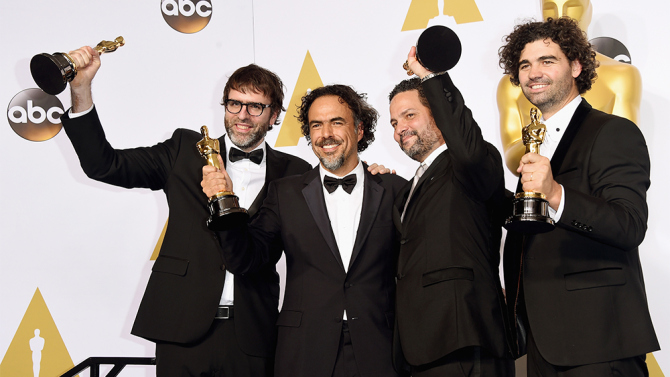
Every time I prepare myself for the Academy Awards, I end up getting usurped in every single angle possible. At the start of this season’s Awards race, Boyhood was getting the most attention and seemed the most likely to win the ceremony’s biggest awards. But by the end of the night, Birdman and Grand Budapest Hotel took the most awards from the night while Boyhood only walked away with one acting award for Patricia Arquette.

This is the one thing I love about the Academy Awards, if I even loved anything about it in the first place: it always finds a way to surprise you.

Even though the films I loved the most didn’t win the night’s most major awards, I’m mostly not upset. The Academy Awards was a night where some dreams were realized and others were crushed, but it nevertheless gave everyone something to aspire to. As I remember Matthew McConaughey’s speech from last year, “I’m always trying to be better than myself ten years from now.”

Anyhow, on to the winners. I predicted 18 out of the 24 categories correct, which is surprising for me because I expected to get more wrong. Regardless, the night held it’s own fair amount of shocks and surprises, so let’s hop right into them.

Best Picture: I was correct in predicting Birdman would win best picture, even though I would have preferred it gone to the likes of Selma, Whiplash, or even Boyhood. Still, it is a unique film, and it’s achievements are unmistakable. I was happy to see Alejandro Gonzalez Inarritu win for his hard work.

Best Director: Alejandro also won the Academy Award in directing for Birdman. No surprise there, considering he won the DGA. I am annoyed that Richard Linklater wasn’t honored for his 12-year commitment that was Boyhood, but I have to recognize that both films were works of high art and achievement. To pick one over the other is like picking apples to oranges, so I don’t judge the Academy for being given such a difficult decision to choose from.

Best Actor: Eddie Redmayne won the best acting Oscar for portraying Stephen Hawking in the most tragically grounded of ways in The Theory of EverythingHis acceptance speech was one of the cutest to have seen from the night.

Best Actress: Julianne Moore won the Academy Award for best actress as a mother suffering from early onset altzheimer’s in Still Alice. 

Best Supporting Actor: J.K. Simmons won best supporting actor as a music professor from hell in Damien Chazelle’s Whiplash

Best Supporting Actress: Patricia Arquette won in her role as an aging mother losing her children to adulthood in the brilliantly made Boyhood

Best Original Screenplay: Surprisingly, I got this category right by predicting that Birdman was going to win best original screenplay. After the WGA’s, I honestly though Grand Budapest was going to win the award for best original screenplay. Just goes to show you can’t trust all Awards ceremonies.

Best Adapted Screenplay: Since Whiplash can’t technically be considered an adapted work, Graham Moore rightfully deserved the award for The Imitation Game. Moore’s speech was my absolute favorite of the night.

Best Animated Feature:  The first category I got wrong was a category I shouldn’t have gotten wrong at all: Big Hero 6 won best animated feature over the genius of How To Train Your Dragon 2. As you can see, I was not happy about this. Not. One. Bit.

Best Documentary Feature: Citizenfour won the Academy Award for best documentary feature. If I didn’t want to see the award so badly before, I definitely wanted to see it even more now.

Best Foreign-Language Feature: Ida won best foreign language film. 

Best Film Editing: I got this category wrong, but it was wrong I was happy to get wrong: Tom Cross beat out Sandra Adhair from Boyhood with Whiplash, and that’s so appropriate considering how many smash cuts he has to conduct from the film at such precise moments for it to work.

Best Cinematography: Another one extremely deserving in the award: Emanuel Lubeski won for the second year in a row for Birdman

Best Original Score: I got this category wrong too, but this is another one where I was happy to lose it: Alexandre Deplat won best original score for The Grand Budapest Hotel. After being nominated six times prior, I’d say the award was long overdue. He certainly was more deserving than The Theory of Everything was, at least.

Best Original Song: John Legend and Common both rightfully won the Academy Award for best original song with “Glory”. Members from the audience started crying after they finished their performance.

Best Costume Design: The Grand Budapest Hotel won the Academy Award for best costume design. 

Best Makeup and Hairstyling: Grand Budapest also won the Oscar for it’s makeup, though I felt it wasn’t the most deserving nominee. 

Best Production Design: Grand Budapest won it’s fourth award for production design, but as you can see, I was still so distraught by How To Train Your Dragon 2’s horrible loss that I barely even cared. 

Best Sound Editing and Mixing: American Sniper and Whiplash won in these categories, respectivelyI incorrectly predicted it would be Interstellar, but how on Earth would you know considering how flippantly the Oscars switches sides?

Best Visual Effects: Christopher Nolan’s space epic Interstellar won the award for best visual effects. 

Feast, The Phone Call, and Crisis Hotline: Veterans Press 1 won in all of the short categories. Since nobody even watches those nominees, however, do you really even care?

At the end of the night, it was the live-action short, film editing, original score, animated feature (ugh), and sound editing and mixing categories that cost me losing to my mother at the Academy Awards predictions. Don’t remind me on how embarrassing that is.

Next year, I’ll work to refine my predictions so that I’ll be so accurate at guessing the Oscars, the Academy Award voters will think I stole the results beforehand.

On that note, you’re wrong Academy. Lego Movie should have been nominated. How To Train Your Dragon 2 should have won.

I’ll leave you to ponder on the great mistakes you’ve made this year.

– David Dunn.

Neill Blomkamp To Helm An ‘Alien’ Movie

Fifty Shades of Grey is getting at least two sequels, Ryan Reynolds revealed Deadpool’s movie mask, and Spider-man is now going to be part of the Avengers. What else can happen in the same month of February?

How about a new Alien movie?

Yup, that is not a joke ladies and gentlemen. Earlier in January, filmmaker Neill Blomkamp (District 9, Elysium) revealed some sweet-looking Alien concept art showing Ellen Ripley in an alien exoskeleton, a prometheus-like spaceship covered in webs, and a mean-looking xenomorph queen who looks unhappy that somebody took her sandwich. Many have speculated during that time whether Blomkamp would pick up a new Alien movie or not, including from the lips of Ripley herself, Sigourney Weaver.

Until today.

Why? Because Blomkamp confirmed himself that he will be directing the next Alien sequel with Weaver reprising her role as Ellen Ripley.

Yes, you heard that right. Alien is coming back.


Blomkamp has had a pretty sweet career building up for the past few years now. Since bowing out of the then-failed Halo film adaptation of the video game in 2007, Blomkamp has since pursued some of his own passion projects, all with three things in common. 1) They were all science-fiction movies. 2) They all take place in Africa. 3) They all explore themes of equality, acceptance, and the flawed idea of elitism. Oh, and Sharlto Copley is in his films too.

Point being, Blomkamp is well-versed in the sci-fi genre, and not only has the chops for gritty and authentic visual effects, but also for solid storytelling with deep, significant meaning behind it. That’s the stuff that made the original Alien a classic, and the fact that he’s teaming up with Weaver to bring this back to the big screen? Oh. The inner nerd in me is exploding with joy.

No word yet on what is the planned release for the film, but it is slated to release and take place after Ridley Scott’s sequel to the Alien prequel Prometheus. I loved both Alien and Prometheus, and am looking forward to both sequels. However, I think we can all guess which one audiences will be more excited for.

What do you think? Are you more excited for Neill Blomkamp’s new Alien movie, or Ridley Scott’s Prometheus sequel?

Comment below, let me know. And whatever you do, don’t hug a facehugger.

– David Dunn

SOURCE: The Verge, Collider