Oscar Predictions 2014

There is no such thing as the best picture.

That’s what I keep thinking year after year when I make my Oscar predictions. Why? Because everyone has a different idea of what the best picture means.

There were many great movies that wasn’t nominated from this year that left a profound impact on the people who watched them. The Fault In Our Stars is one of those pictures. Guardians of the Galaxy filled people with as many laughs and energy as it did with tears and quivering lips. Christopher Nolan’s Interstellar is the most liked movie of 2014 according to the Internet Movie Database. God forbid, there are people out there who even liked Inherent Vice.

My point in saying all of this is that different movies have different effects on people. It doesn’t matter what the Academy thinks is the best picture: it matters what you think is the best picture to you.

Regardless, the Oscars are unfortunately still a thing. With the 87th Academy Awards coming up in a few weeks, people are going to be scrambling to guess who is going to win which awards this year. Here are the movies I think are going to win big this year at the Oscars:

Best Picture: The big category. Good God, how do you predict this one? Boyhood and Birdman have been at each other’s throats since the beginning of awards season. Since Boyhood‘s best picture win at the Golden Globes, it at first seemed like the frontrunner for best picture. Since then, however, Birdman has gone on to win the Screen Actors Guild award for best overall cast, the Directors Guild of America award for best feature and the Producers Guild Awards award for best picture. At this point, Birdman would be most poised to win the award, and it would be wise to opt for it.

Best Director: The nominee most deserving of this award is Richard Linklater for following with his passion project 12 years straight for Boyhood, a wonderfully ambitious project that shows the joys and heartbreaks alike of growing up. Unfortunately, Linklater didn’t win the DGA award for best director. The Oscar, then, is going to go to Alejandro Gonzalez Inarritu for Birdman, which was an innovative, creative, and darkly clever film in it’s own right. Neither filmmaker is a bad nomination, as both of them delivered the most unique and memorable pictures of the year. The award can only go to one of them, but both Linklater and Inarritu are undeniably the best filmmakers of the year.

Best Actor: Another close one. Which is it going to be: Eddie Redmayne for The Theory of Everything or Michael Keaton for Birdman? Redmayne has the Screen Actors Guild award and the Golden Globe for best actor. Keaton also has a Golden Globe and the Screen Actors Guild award for best overall cast. So who’s going to take it? Redmayne or Keaton? My bet is on Redmayne, but don’t be surprised if either actor takes home the award. This is going to be a close one.

On that note, honorable mention to Benedict Cumberbatch for his brilliant, heartbreaking, passionate, intelligent, and wonderfully unique performance as physicist Alan Turing in The Imitation Game. You sir gave the best performance of the year, and are most deserving of the Oscar for best actor this year. Unfortunately, the Oscars is not a game of talent. It’s a game of politics.

Best Actress: Everyone (including myself) has been praising Rosamund Pike’s work in Gone Girl and has been saying that she deserves this award most. The charts don’t lie, however, and Julianne Moore has won award after award for her heartbreaking performance as a mother suffering from early onset alzheimer’s in Still Alice. She’s locked for the award. Don’t bet on anyone else except her.

Best Supporting Actor: J.K. Simmons for Whiplash. If you have any objections to that, you haven’t seen the movie.

Best Supporting Actress: It takes a lot of dedication not only to play the role of an aging mother losing her children to adulthood, but to return to that role year after year for 12 years straight. The award for best supporting actress rightfully goes to Patricia Arquette for her stunning decade-long performance that she melted so wonderfully into year after year in Boyhood. It will be a huge upset if she doesn’t get the award.

Best Original Screenplay: This year was borderline impossible to make a clear prediction of who was going to win in the best original screenplay category. First, critics predicted it would be Boyhood due to it’s massive popularity in the best picture race. Then, people switched sides and said Wes Anderson would win for The Grand Budapest HotelBirdman won the Golden Globe and a slew of other state critics awards. Since I don’t have the luxury of waiting for the WGA’s next week to claim which is the best screenplay of the year, I’m going with the only nomination that has the physical accolades to back up their nomination: Birdman is going to win best original screenplay. 

Side Note: I will never cease to get angry at the Academy for profusely snubbing Christopher Nolan multiple times. If Interstellar was not deemed one of the best movies of the year, it definitely is considered one of the best stories of the year. Nolan deserved a nomination in this category, but like all other the Oscar ceremonies, he got snubbed because he’s Christopher Nolan. Typical.

Best Adapted Screenplay: This category is messed up from the start, because how in God’s name is Whiplash considered an adapted screenplay? I get it that it was first made into a short film before a feature release, thank you for pointing that out Academy. That doesn’t change the fact that it was an original idea conceived by Damien Chazelle, and that both properties were projects that he worked on. Whiplash was, in every definition, an original work. To put it in the adapted category is pish posh.

On that note, Graham Moore’s The Imitation Game IS an adapted work, and it so wonderfully brings interest and awareness to this secretive story that only a few have known about for quite some time. The Imitation Game is most poised to take home the best adapted screenplay award, unless Whiplash snabs it from them first. 

Another side note: Did the Academy just work to have the worst nominations in this category this year? Is there seriously nothing for The Fault In Our Stars? Nothing for Gone Girl? Shoot, I’d even take a nomination for Guardians of the Galaxy over the confusing Inherent Vice and insipid Theory of Everything. These awards should not be nominated for the Academy’s opinion, but rather, on the impact these films have had on the public. All of the films I’ve mentioned above were movies the public had very strong reactions to, and each of them deserve nominations over the other films recognized. This is the Oscar category I am most frustrated with this year.

Best Animated Feature: Let’s get over the frustration that The Lego Movie wasn’t nominated for just one second, shall we? The biggest competition is between Disney’s Big Hero 6 and Dreamwork’s How To Train Your Dragon 2. Since How To Train Your Dragon 2 has won the Golden Globe, the Annie Award, and the National Board of Review for best animated feature of the year, the best bet is on that film. It is the best animated film of the year, and matches it’s predecessor in almost every way. If it does win, it is a very deserving one.

On that note, shame on you Academy for taking out The Lego Movie. Everything is not awesome for you.

Best Documentary Feature: Were Steve James’ wonderful documentary Life Itself on film critic Roger Ebert’s life nominated, it might have posed a challenge to the frontrunner for this category. Since it isn’t however, the award is most poised for Laura Poitras’ Citizenfour, a documentary about Poitras’ investigation in U.S. surveillance programs until her research brings her face-to-face with former NSA contractor Edward Snowden. Keep this one on your radar, folks. This is one of those films that needs to be sought out.

Best Foreign-Language Film: The Academy loves movies that are not only politically challenging, but are also based around events surrounding World War II. The frontrunner, then, is Ida, a polish film about a young nun who discovers a dark secret about her family from the Nazi occupation before taking her vows. Wild Tales has also been widely talked about, but don’t expect anything big from it. Ida is most positioned to win the award.

Best Film Editing: The film with the best editing of the year isn’t even nominated in this category, and that is Birdman. The shots were so seamlessly blended together in between takes that it gave off the illusion that the film was shot in one take, even though it wasn’t. The work done with Birdman is both innovative and revolutionary, and it’s flat out disrespectful that it’s not even nominated here.

The next best work is from Tom Cross on Whiplash, which editing together the film so perfectly that it gave off an heart-pounding, unnerving sensation better than most thriller’s you’d see in theaters. Neither one will win. The award will go to Boyhood for it’s compilation of 12-years worth of footage into one film, even though the editing dragged out at times and it had to handle the same amount of footage any other film would have to. Even though Boyhood is a great movie, it’s editing is average at best.

Best Cinematography: Emmanuel Lubeski for Birdman. If he wins, he will be one of the few cinematography nominees to have won the award two years in a row. It’s not undeserved. Lubeski is a great cinematographer, and has done great work for years for films such as Children of Men, The Tree of Life, and last year’s Oscar winner Gravity. He deserves the award for cinematography if he does wins it.

Best Original Score: I waited until the last possible second to write down my prediction for this, because the nominee everyone is talking about is also the one least deserving. Alexandre Desplat has been nominated year-after-year at the Academy Awards for scoring movies like The Curious Case of Benjamin Button, The King’s Speech, Argo, and Philomena. This year, he deserves the award the most not only for his nomination with The Imitation Game, but also with Wes Anderson’s The Grand Budapest Hotel. He’s going to lose both of his nominations to Johann Johannssons’ The Theory of Everything, a theme that is as average, annoying, and repetitive as its movie is. I didn’t like The Theory of Everything, and I liked its music even less. But all critics and accolades point towards that movie, so that’s the one I’m begrudgingly going with.

Best Original Song: “Glory” from Selma will win and deserve this award the most. No song fills you with as much power and proclamation as this song does. It fills you with the same energy and captivation that the movie does, and it’s a shame that the film wasn’t nominated in more categories this year.

Best Costume Design: I doubt that Colleen Atwood is going to take home the award yet again for Into The Woods, despite her great track record with the Academy. My bet is on Milena Canonero for The Great Budapest Hotel, mostly because 1) The film’s costume work is as lovable and quirky as the movie itself is, and 2) She hasn’t won the award since her work with Marie Antoinette in 2006. It’s her year to win the award.

Best Makeup and Hairstyling: This is such a difficult category to decide for, because what on Earth is the Academy’s criteria for this ungaudy award? A few years ago, movies like Star Trek beat out films like The Young Victoria in this category. In 2011, the boring, mundane, and insipid Iron Lady beat out Harry Potter. What is going on?! How on Earth are you supposed to predict this category when the Academy keeps flipping the standard???

If I was going off of the best makeup work out of the nominees, it’s no competition: Guardians of the Galaxy. Yet, keep in mind from previous years that films have won for the exaggerated minimalist work seen from The Grand Budapest Hotel. I’m keeping my bets on The Grand Budapest Hotel, but don’t be surprised if either film takes home the award.

(Post-script: The makeup work for The Iron Lady was awful.)

Best Production Design: The Grand Budapest Hotel. If any film other than that wins for best production design, the Academy officially hates Wes Anderson.

Best Sound Editing: Normally, I couldn’t care less for the sound editing awards, because who has enough patience to dissect the sound bit-by-bit in each feature film? This year though, there is a frontrunner in this category that doesn’t deserve to be nominated. Great a film as it is, Interstellar has some of the worse sound editing and mixing I’ve heard in years. The music overwhelmed the dialogue at times, character’s couldn’t be heard that well at certain parts of the movie, and the sound got so loud at times that I felt like I was at a Daft Punk concert. For all of the accomplishments Interstellar has made, sound is definitely not one of them.

Unfortunately, I think Interstellar is going to be the one to take this award home. Christopher Nolan’s movies have a good track record for getting sound awards at the Oscars (Ex. The Dark Knight and Inception)and I don’t think the Academy has any intent of stopping his good run anytime soon. The film most deserving in this category is American Sniper. It’s going to Interstellar.

Best Sound Mixing: Whiplash had the most impressive sound mixing out of any of the other nominees. The Oscar, however, is going to go to Interstellar. See above for my reasoning.

Best Visual Effects: I’m partial towards X-men: Days of Future Past because it had great visual effects, costuming, and set design to make not only a convincing portrayal of a post-apocalyptic future, but also to show the slow dissolution of American society in the mid-1970’s. However, Interstellar was also an amazing movie, and accomplished visual spectacles unseen since Avatar and Inception. It will win the award, and it is also the most deserving. 

And now finally, my most-dreaded predictions for the categories I never know how to predict: the shorts. Let’s play a game of Eenie-Minie-Moe, shall we?

Best Animated Short: Feast. It’s the only film out of any of these categories that I’ve seen anyway.

Best Documentary Short: Crisis Hotline: Veterans Press 1. Because why not?

Best Live-Action Short: Aya? The Phone Call? Boogaloo and Graham? What kind of titles are these???

Screw it. Boogaloo and whats-it’s-face is going to get it, because reasons.

That’s all I have for now, folks. I’ll see you and Barney Stinson on Feb. 22.

– David Dunn

Tagged , , , , , , , , , , , , , , , , , , , , , , , , , , , , , , , , , , , , , , , , , , , , ,

’50 Shades of Grey’ Is Getting Darker

Well, depending on your views for the new movie, what follows is either good news or bad news.

During a press screening Friday of the new film 50 Shades of Grey to an audience full of fans, stars Jamie Dornan, Dakota Johnson, director Sam Taylor-Johnson, and author E.L. James revealed that the sequels 50 Shades Darker and 50 Shades Freed would be quickly on their way. The sequels, while have not been confirmed when they would be released, will most likely have the cast reprising their roles and with Taylor-Johnson returning as well.

Based on James’ erotic novels of the same names, 50 Shades of Grey tells the story of Anastasia Steele, a 21-year old college student who is immediately interested in a 27-year old multi-million entrepreneur named Christian Grey after she interviews him for a story. As they continue to encounter each other more and more, their relationship deepens from mutual interest, to sex, to intense experimentation in sexual acts such as bondage, dominance, submission, and BDSM. The book has equally received praise and criticism for it’s depiction of sex and sadomasochism.

I have my opinions on both the book series and of the movie. I will reserve those opinions for when I write my review. What I will say is that it is far too early to be releasing statements for when sequels will be released when you don’t even know how the first one will fare. Haven’t I mentioned this before with other projects? Sony and Warner Bros. has both released announcements on the future film projects of Green Lantern and The Amazing Spider-man 2 before those films were released. Now both of those franchises are in trouble. How do you know for sure that you’re going to make these projects in the near future when you don’t even know what the reaction is going to be to the first one yet?

I won’t go much further into this for now, as too much has to be speculated in order to form a cohesive opinion. For now, let’s either excitefully or dreadfully look forward to 50 Shades of Grey’s release on Feb. 14 and let’s laugh as we look at people’s reactions to the announced sequels:


– David Dunn

SOURCE: Cosmopolitan, The Verge

“THE LEGO MOVIE” Review (✫✫✫1/2)

Bricks, businessmen, and Batman.

The last thing I expected from anything titled The Lego Movie was anything good. How could I? The trailer had the reeking stench of an advertisement, barely differentiating itself from the Lego set commercials that air on children’s cartoon networks. Believe me, I went into this movie expecting an artificial, brainless experience looking only to profit itself from the name of it’s toy line. Boy, do I love it when I am proved wrong.

Based in a colorful world full of Lego bricks, buildings, and set pieces, The Lego Movie follows Emmett (Chris Pratt), an average, regular, 100% ordinary minifigure who loves coffee, people, Taco Tuesdays, cats, cars, work, television, and just about everything else under the orange Lego-bricked sun. If any of the characters in the film knew that they were in a movie, none of them would expect Emmett to be the main character: he has the personality and the appearance of a background character if anything.

One day, while working at his construction job, Emmett comes into contact with a strange red object called “The Piece of Resistance”, and passes out. When he wakes up, he is recruited by Wyldstyle (Elizabeth Banks), a punky and feisty master builder who tells Emmett that he is part of a prophecy that declares that a powerful being called “The Special” will find the Piece of Resistance and use it to overthrow Lord Business (Will Ferrell) and his plans to conquer the Lego-verse. As a result, Emmett gets catapulted into a decade-long conflict between wizards, robots, businessmen, DC superheroes, crazy cats, cyborg pirates, spacemen, and Batman.

Good God, where do I start with this? The Lego Movie is by every definition, a surprise; a fun and wacky little adventure that is just as original and audacious as it is clever and funny. Written and directed by Phil Lord and Chris Miller, the same guys who co-wrote and co-directed Cloudy With A Chance of Meatballs, these filmmakers worked to instill the same sense of energy, youth, and entertainment from that movie into this one. It’s surprising that the movie is not just good: it’s borderline great.

One of the things I love most about the movie is the animation. Like any great animated film, it reaches out to you in vivid, eye-catching detail, it’s beautiful colors and visuals striking out to you like a panel on a beautifully-crafted graphic novel. But it’s not just how the animation looks in itself: it’s also in how Lord and Miller achieved the effects they were going for. Nearly everything in the film was modeled from lego bricks and pieces, and I do mean everything. The buildings, the vehicles, the space stations: even seemingly trivial things such as the water, lava, and clouds are all made out of lego pieces, with explosions literally showing red-and-orange lego studs as they blow up. It would be so easy just to be cheap and give basic effects for the wind, the water, fire, sky, and everything else in the film, but Miller and Lord didn’t want to go that route. They wanted to make an authentic, accurate world jam-packed with lego pieces and objects. To put anything else in there would just cheapen the effects, and their persistence made for the best visual result that they could possibly have had.

Just as much though, I love the characters Lord and Miller wrote for this movie. Like the animation and lego bricks, they all have variety to them, and they all have colorful, unique personalities that make you want to relate to each character. You have Benny, a 1980’s space astronaut who is so obsessed with spaceships that he could build one from a pile of garbage bricks if you dared him to. You have UniKitty, a unicorn/kitten that has such a split sweet/violent personality that she would scare little children if they were locked in the same room with her. There’s Metal Beard, a pirate-turned-cyborg whose body literally blows up like a amalgam of lego bricks like a real lego mini figure. Also, Batman is in the movie.

The key character here, however, is Emmett, a sweet and charming little mini figure with intentions so pure, he at times can seem like a child with his quirky little antics. Emmett is the epitome of childhood in this movie: innocent, curious, creative, passionate, and at times a little too immature for his own good. His strengths and his flaws both make up for a very interesting character, a mini figure that we can all relate to because of his average nature and his desire to be greater than he already is. He may be made out of Lego pieces, but Emmett is more human than most of the live-action actors you’ve seen in motion pictures this year.

The movie does suffer from a slight drag in run time, and like it’s protagonist, the movie is at times too childish for it’s own good. That doesn’t change the fact that this movie is a clever, funny, original, and heartfelt take on childhood and what it means to be grown up, but always remain young at heart. The Lego Movie is much more than just a movie. It’s a celebration of creativity.

Post-script: Did I forget to mention that Batman is in the movie?

Tagged , , , , , , , , , , , , , , , , , , , , , , , , , , , , , , , , , , , , , , , , , , , , , , , , ,

For The Man Who Died So I Could Write This.

Chris Kyle was not a murderer. He was a hero.

The military sniper’s story came under fire last week after Clint Eastwood’s biographical war drama American Sniper was released in theaters. Critics have called it many things, many of which I am not fond of. Some have called it pro-war. Others have called it “bigoted.” Filmmakers Michael Moore and Seth Rogan also fired shots at the film, with Rogan comparing the film to the Nazi propaganda seen in the third act of Quentin Tarantino’s Inglorious Basterds.

Coming from the guy who almost blew America up with his controversial film The Interview, which fantasized about killing North Korean leader Kim Jong-un, I can’t say I care much for his opinion.

Since the conversation sparked intense debate over the nation, Moore and Rogan has since redacted their statements, apologizing and claiming they were taken out of context. Their supporters, however, have not silenced themselves, and continue to persist saying that the film is a dishonest piece of propaganda that glorifies a murderer that shot and killed not only Iraqi men, but also women and children during the Iraq war.

It’s important to note, both sides have merit to their opinions. Both sides have their perspectives, and both have evidence to back up their claims.

The critics have claimed that Kyle was not as remorseful in real-life as he was depicted in the movie. That he felt no shame in killing Iraqi men, women and children, and would probably kill more if he needed to. This is supported by the fact that he used very blunt descriptions and vocabulary in his book, with one sentence reading “I hate the damn savages.”

He’s been confirmed as the most lethal sniper in American history with an estimated 255 kills, 160 of them being confirmed by the Pentagon. His first few pages in the book opens on him shooting a child and his mother. There is no fighting the horrible things he’s done in Iraq: Kyle has described the events himself in text.

At the same time though, the supporters of Kyle’s story have equal leverage on their perspectives. He felt no remorse with his kills because he was always shooting in defense of his brothers in uniform. The woman and her child that he shot were both going to blow up a convoy with a hidden grenade, which blew up shortly after they dropped it. The many seemingly-innocent Iraqi’s after that were also visibly going to initiate violence against the military, whether they were picking up a bomb, or aiming an RPG.

If you’re focused on how many kills he’s made, think also about how many lives he’s saved. He shot an estimated 255 enemy kills in Iraq. If each one was going to attack a group of military soldiers, how many fathers do you think were able to go home because of him?

We have a much bigger issue at hand here than just who is right. Our culture is so quick to attack and criticize our military, when they’re the ones fighting so that we can have the right to attack and criticize. In the midst of moral ambiguity and political correctness, men and women are on the other side of the world fighting and dying for our rights. Their last concern is being politically correct. Freedom isn’t free.

So if you want to criticize Kyle or the book and movie, American Sniper, be my guest. But understand that Kyle shot from the barrel and died from the barrel so you could have that right.

– David Dunn

Tagged , , , , , , , , , , , , , , , , , , ,

Emma Watson Is The Beauty In The Beast

Hermione will be starring in the Disney tale as old as time.

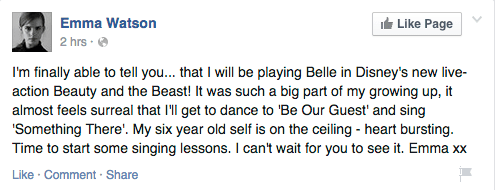
Harry Potter actress Emma Watson took to Facebook earlier today to make an exciting announcement: she will be portraying Belle in the upcoming live-action remake of Disney’s Beauty and the Beast.

https://www.facebook.com/emmawatson/posts/1011543655531191

The film is directed by Bill Condon, writer-director behind films such as Gods and Monsters and Twilight: Breaking Dawn parts one and two, and produced by Mandeville Films’ David Hoberman and Todd Lieberman, who co-produced The Fighter in 2010 and Warm Bodies in 2013 . The movie will begin filming later this year.

Are you guys excited that Emma Watson is going to be Belle in Beauty In The Beast? Who else are you wanting to see star in this upcoming fantasy classic? Comment below, let me know.

– David Dunn

Source: TIME, Facebook

The Unexpected Virtue of Being Nominated

I am never more conflicted with myself than when Oscar nominations are released. It’s the same time every single year, and every time I look at them I feel a strange combination of pride and disappointment. Of course many actors and filmmakers are nominated across the board, and most of them are well deserved. But then there are always a good amount of snubs that are equally undeserved. Example: Since when does The Fault In Our Stars, Interstellar and The Lego Movie deserve zero nominations in any of the major categories?

Snubs happen every year. I expect it at this point. But what I find particularly interesting is that this year’s ceremonies are more well-rounded in their nominations. The eight best picture nominees, for instance, are also the pictures with the most nominations in the show. I think that reflects well on the Academy, especially because the best picture award isn’t won by only being nominated for best original song.

Regardless, the nominees have been released and the Oscars race has officially begun. Here are all of the best picture nominees.

Birdman

Otherwise known as The Unexpected Virtue of Ignorance, Alejandro Gonzalez Inarritu’s black comedy epic stars Michael Keaton as Riggan Thompson, a struggling stage actor who is desperately trying to escape his image as formerly portraying a superhero. Considering the irony that Keaton has been most known for playing Batman in Tim Burton’s movies, I can’t help but think he relates more to the film than he lets on. Birdman is nominated in nine categories, including best picture, best director, best original screenplay, best cinematography, best sound editing and mixing, and best acting awards for Keaton, Edward Norton, and Emma Stone.

The Grand Budapest Hotel

A surprise standout out of the other nominees, The Grand Budapest Hotel is a comedic escapade about Concierge Gustave H. (Ralph Fiennes), who is framed for the murder of one of his hotel guests and for stealing her most cherished painting. As he tries to outrun law enforcement and the family assassins that are after him, he teams up with his lobby boy Zero (Tony Revolori) to set out and prove his innocence. Written and directed by Wes Anderson (The Royal Tennenbaums, Moonrise Kingdom), The Grand Budapest Hotel has already won best comedy at the Golden Globes, so it is off to a good start in the Oscars race. The film ties with Birdman with nine nominations, including best picture, best director, best original screenplay, best cinematography, best costume design, best editing, best makeup and hairstyling, best original score, and best production design.

The Imitation Game

This historical epic stars Benedict Cumberbatch as Alan Turing, a brilliant physicist during WWII who worked with a team to crack Enigma, a German processing machine which masks German messages through cryptographic messages. Directed by Norwegian filmmaker Morten Tyldum and also starring Keira Knightly, Matthew Goode, and Mark Strong, The Imitation Game is nominated for eight academy awards, including best picture, best director, best adapted screenplay, best editing, best original score, best production, best actor for Benedict Cumberbatch and best supporting actress for Keira Knightly.

American Sniper

Based on the true story of Chris Kyle (Bradley Cooper), American Sniper tells his story working for the U.S. military, and the 120 kills he garnered throughout his military career. Directed by Clint Eastwood and written by Jason Hall, American Sniper is a late entry to the Oscars race, but it came out strong regardless. American Sniper is nominated for best picture, best adapted screenplay, best sound editing and mixing, and best actor for Bradley Cooper.

Boyhood

The 12 year epic that everyone is talking about, and the movie everyone is dying to see. Boyhood follows the story of Mason (Ellar Coltrane) from childhood to adulthood, through puberty, love, heartache, loss, and life. Richard Linklater directs Coltrane among others through this masterfully crafted drama, filmed over the period of 12 years. Ambitious both in production and vision, Boyhood was nominated for best picture, best director, best original screenplay, best film editing, and best supporting actor and actress for Ethan Hawke and Patricia Arquette.

The Theory of Everything

The fluffy, inspirational adaptation of Stephen Hawking’s life, The Theory of Everything stars Eddie Redmayne as King and Felicity Jones as his wife Jane, and follows their relationship from college to their marriage, and covers the issues that they’ve had to face together. I personally didn’t find this film to be as imposing as the other nominees, but Redmayne’s performance and the film’s intentions are definitely something to be admired. The film is nominated for best picture, best adapted screenplay, best original score, and best actor and best actress for Redmayne and Jones.

Whiplash

One of the best under-the-radar films of the year. Whiplash follows Andrew (Miles Teller), a young college student who is enrolled in an orchestra and is working to be the best drummer there is. His teacher is Terence Fletcher (J.K. Simmons), a narcissist conductor who treats his students like he is Gunnery Sergeant Hartman. As their rivalrous relationship builds to a tense climax, both men learn more about themselves as artists and teachers to each other. Written and directed by independent filmmaker Damien Chazelle, Whiplash is one of the year’s most standout films. Featuring strong performances from its leads and masterful direction from Chazelle, Whiplash is nominated for best picture, best editing, best sound mixing, and best supporting actor for J.K. Simmons. The movie is also nominated for best adapted screenplay, even though it’s an original idea crafted by Chazelle.

Selma

Directed by Ava Duvernay and starring David Oyewolo as Martin Luther King Jr., Selma follows the civil rights movement as it builds to a climax in the march from Selma to Montgomery, Alabama. The interesting thing about this film is that it only has two nominations for the evening: best picture and best original song for John Legend and Common’s “Glory.” If that is the logic behind the nominations, should Selma even be nominated for best picture? It’s more than deserving of the nomination, but it certainly isn’t great just because of the song that’s in it. Where’s the best director nomination? Best actor? Best screenplay? I feel like this movie had potential in many different categories at the Oscars, and it was snubbed for mostly all of them. It’s an utter shame to see so many great films get snubbed at the Academy Awards, and this film perhaps has been snubbed the most out of all of them.

Other films that were nominated in other categories include Foxcatcher, Interstellar, Mr. Turner, Into The Woods, Unbroken, The Lego Movie and Guardians of the Galaxy. We can gripe more about which films deserved which nominations later on, but for now, let’s be excited that Barney Stinson is hosting the awards.

– David Dunn

Tagged , , , , , , , , , , , , , , , , , , , , , , , , , , , , , , , , , ,

Sylvester Stallone Draws His ‘Last Blood’

Rambo is coming back for one last hunt.

Last week, actor-director Sylvester Stallone took to Twitter to make a formal announcement about the upcoming Rambo sequel: the script has been completed and the title is officially called Last Blood.

Stallone has been involved with the series since portraying the Vietnam veteran in his 1972 film debut First Blood. Since evolving from it’s origins as a thriller to a heavy action series, the franchise is notorious for its violence and body count, with its most recent installment clocking in at about 236 kills.

Admittedly, I haven’t seen any of the Rambo films since First Blood, but considering the franchise has earned a total worldwide gross of $727 million, I know at least a few people will be excited at this news.

What about you guys? Are you excited that John Rambo is returning to the big screen, or do you think he should just go back into hiding? Comment below, let me know.

– David Dunn

Source: Empire, Variety

Top Ten Films Of 2014

Has anyone ever stopped to wonder why all of the best of the year lists have to be in the top ten? Like, what sort of critic was working on his list and thought that ten would be the magic number? Why ten and not twelve? Or fifteen? Five? Twenty? Eight? Why was ten specifically chosen as the big number? Was it chosen at random, or was it actually chosen for some relevant, significant reason?

Regardless of whatever the case may be, I’m choosing to be a little rebellious this year. For the past few years, I’ve seen enough films to make a “Top 15″ list if I wanted to, but if I had done that, my site viewership would go down by about twenty views.

So this year, to battle the preconceived notion that “best of the year” lists have to have ten movies, I’m doing two different things. 1) I’m adding an “honorable mentions” selection that while those films aren’t necessarily in my top ten, they are still significant films that have contributed to the year’s industry regardless. 2) In honor of our first full year without the wise, sometime snarky, words of film critic Roger Ebert, I’m offering a special Grand Jury Prize, which honors a film from the year which has made a notable accomplishment that fits outside of my year’s top ten.

As always, there is a few things you need to know before I get into my year’s best. First of all, I haven’t seen all of the films the year has had to offer. I’ve heard from so many people how Jean-Marc Vallee’s Wild was emotionally stirring, with Reese Witherspoon’s performance being the greatest highlight of the film. I’ve also read from critics that Selma, A Most Violent Year, and American Sniper were great movies as well, but guess what? None of those movies get a wide release until after Dec. 31, so I’m not able to even see those films until after the year anyway. So what am I going to do? Release a revision to my current list, or add those films to 2015 if they’re good enough? I’ll make a decision when it comes to that. It’s the studio’s faults for releasing those movies so late into the year anyway. Blasted film mongers.

Secondly, and perhaps more significantly, this is my list for the best films of 2014. Not yours. There has been high praise from many notable films of the year, including Edge of Tomorrow, The Theory of Everything, and Captain America: The Winter Soldier. None of those films will be on my top ten list because I didn’t deem them worthy enough to be on there. It’s nothing against the films or the filmmakers: I just didn’t think they were good enough.

If you’re not satisfied with that, then please, make your own top ten list. I’d love to read it, and if your reasonings are sound enough, I’d like to share it with others.

Now then, let’s hop to it, shall we? Here are my top ten films of 2014:

10. Interstellar 

A mesmerizing, breathtaking, and exhilarating journey that may have only slightly exceeded it’s grasp. Based on an idea by physicist Kip Thorne and directed by Christopher Nolan, Interstellar takes place in the future on a dying planet Earth, where the only source of sustainable food is by growing corn. When former aircraft pilot Cooper (Matthew McConaughey) stumbles upon a secret station that has been hiding NASA for so many years, Cooper enlists in a daring space mission to find a new planet that will be able to sustain and save the human race. A testament to the quality of film that Nolan is consistent in making, Interstellar is a brilliantly woven, thought-provoking plot, invoking the same themes of humanity and identity that Nolan exercises in all of his films. McConaughey reaches an emotional depth much deeper than past “Nolan” actors, and succeeds in making his character more human than hero. This is Nolan’s most emotional movie yet, but it’s also his most complicated and convoluted. But if Nolan’s only real flaw with this film is being overly ambitious, I don’t consider that a flaw at all. Three and a half stars.

9. The Grand Budapest Hotel

A crafty and artsy film that acts as a homage to the early days of cinema. After being framed for a violent murder of one of his former hotel guests, Concierge Gustave (Ralph Fiennes) teams up with his young apprentice Zero (Tony Revolori) to set out and prove his innocence through a series of weird, wacky, and crazy adventures. Written and directed by Wes Anderson, who was nominated for an Academy Award for The Royal Tenenbaums and Moonrise Kingdom, The Grand Budapest Hotel is a peculiar, quirky film, a fun and enjoyable ride in it’s own singular way. Anderson is very specific with the direction of the film, using practical effects and set pieces that gives the film a very distinct visual style and aesthetic. The antics Gustave and Zero go through are the stuff of slapstick gold, with these guys doing silly stunts and chase sequences that reminds me of the silent film days of Buster Keaton and Charlie Chaplin. It’s definitely seasoned for the art house crowd, and it’s definitely more difficult to appeal to the masses. But if you allow yourself to be lost in it and have fun with it, you’ll find that it is easily the most unique film of the year. Three and a half stars.

8. How To Train Your Dragon 2

A wildly exciting and entertaining animated ride that appeals to both kids and adults. When a crusade of dragon-hunters reach the land of Berk and begin their hunt for the flying beasts, Hiccup (Jay Baruchel) must team up once again with his dragon Toothless to stop the brigade and save Berk’s dragons and dragon riders. Written and directed by Dean DuBlois, who returned from directing the first film, How To Train Your Dragon 2 is a near-perfect follow-up. It hits on every note it needs to, from the comedy, to the animation, to the action, to the emotion. Hiccup is a much stronger, yet more vulnerable, character now, and needs to face more mature situations now as a grown man rather than as he did when he was a boy. In many ways, How To Train Your Dragon 2 is to it’s first counterpart as Hiccup is to his younger self: they both grew. Three and a half stars.

7. Gone Girl

A brilliantly frustrating thriller that exercises themes of infidelity and media harassment. When Nick Dunne’s (Ben Affleck) wife Amy (Rosamund Pike) goes missing, all eyes turn to Nick for what happened to his wife. When clues slowly surface and more details surrounding the disappearance reveal themselves, everyone is asking the same question: did Nick Dunne kill his wife? Directed by David Fincher and written by author Gillian Flynn, Gone Girl is a masterfully orchestrated thriller, equal parts daring, inventive, intelligent, and unpredictable. Fincher propels Flynn’s brilliant plot forward with expert direction, eye-striking camerawork, and a cast that Fincher pulls the best from. This movie is like a game of cat and mouse, except no one really knows who is the cat or mouse. There is not one note in the film that you can guess is coming. Three and a half stars.

6. Dawn of the Planet of the Apes

A compelling and exciting survivalist-drama that looks at the human/primate condition as two sides to one coin. After the chemical attack on planet Earth that took place at the end of Rise of the Planet of the Apes, Dawn of the Planet of the Apes follows the story of Caesar (Andy Serkis) and Malcolm (Jason Clarke), the leaders of the apes and the humans, respectively. As the human-primate war rages on violently, Caesar and Malcolm begin to see that the apes and the humans aren’t so different from each other, and they begin to explore any possibilities of peace between two races. Matt Reeves builds an intelligent, in-depth story around Dawn of the Planet of the Apes, and handles its premise with skill and precision.  It surprising that the basis of this film wasn’t grounded in action or ridiculous CGI stunts, but rather in small, intimate moments of conversation and ape-sign-language that characters share with each other. Serkis is a revelation in the movie, and deserves an Oscar nomination for both his physical and emotional performance. Four stars.

5. Birdman

One of the most mesmerizing, unique, disturbing, shocking, and darkly funny films I’ve ever seen. Alejandro Gonzalez Inarritu writes and directs this ingenious dramedy starring Michael Keaton as Riggan Thompson, a washed-up movie actor trying to escape his image in a former superhero role by adapting his favorite broadway play to the stage. Keaton is a natural in the role, relating his own experience to portraying Batman in order to further authenticity for the character. Cinematographer Emanuel Lubeski contributes to the visual design of the film, shooting and editing it to look like one, continuous shot rather than multiple longer takes. But Inarritu is the most essential storyteller here, making a visual and emotional masterpiece that is so distinct in its own language that it is impossible to define it, let alone replace it. Four stars.

4. Whiplash

One of the most edgy, thrilling, and provocative films of the year. Miles Teller stars as Andrew, an upcoming college student who is majoring in music and dreams of becoming one of the best drummers in the country. A series of events lands him in the top jazz orchestra of Shaffer Conservatory and under the tutelage of Terrence Fletcher (J.K. Simmons), a brilliant but harsh and antagonistic instructor who is known to go very hard on his students. Andrew and Fletcher both develop an intense rivalry that both hurts Andrew, angers Fletcher, and yet equally compels them both to become the very best they can be. Writer/director Damien Chazelle conducts both actors through his sophomore effort, and does a great job in producing a tense, electric vibe consistently throughout the film. Teller and Simmons’ chemistry with each other is equally perfect, with the both of them bouncing off of each other’s words and emotions as perfectly as a drum beat. This film is about more than just music. It’s about the human desire to be great and what sacrifices we’d make to get there. Four stars.

3. Boyhood

The most revolutionary film of the year, ambitious in both production and vision. A twelve-year project pioneered by writer/director Richard Linklater, Boyhood tells the story of Mason’s (Ellar Coltrane) childhood, chronicling his entire life from when he was six years old, up until when he turns 18 and leaves for college. The movie isn’t so much a story as it is a scrapbook of memories, and Linklater is pulling each photograph out of it just to show it to us. When he is younger, Ellar isn’t acting but living, behaving like any other child would in the moment because he is in the moment. As he gets older, his performance gets more stagnant and Coltrane becomes more of a surrogate for us to express our emotions through, rather than experiencing his own. In this day and age, it’s rare to find a film as real and honest as Boyhood is. Four stars.

2. X-men: Days of Future Past

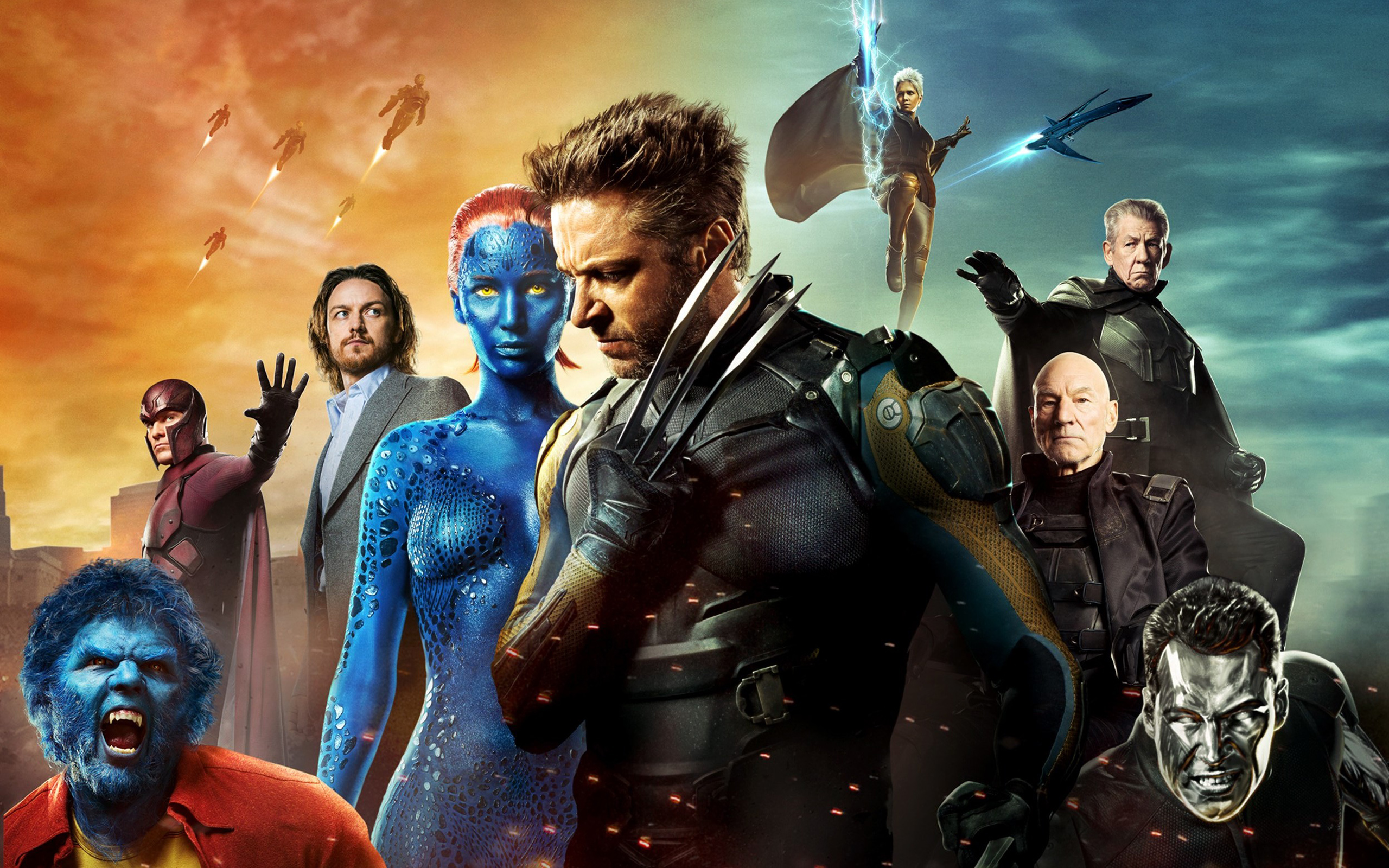
The best entry out of the X-men franchise, and the best superhero movie of the year. Serving as a sequel to both 2011’s X-men: First Class and 2006’s X-men: The Last Stand, X-men: Days of Future Past is set in the apocalyptic future where mutants are being exterminated by humanoid robots called “Sentinels”. Having only one chance to go back in time and stop this future from ever happening, Charles Xavier (Patrick Stewart) and Magneto (Ian McKellen) send Wolverine (Hugh Jackman) through time to their younger selves (Portrayed by James McAvoy and Michael Fassbender) so they can stop the triggering event and save the future. Directed by Bryan Singer, who formerly helmed the first two entries in the franchise, X-men: Days of Future Past is a game changer. It is not only a visually-dazzling and highly climactic sci-fi blockbuster: it is a vastly intelligent and contemplative story that focuses on its recurring themes of racism and xenophobia, once again bringing the consequences of discrimination to the forefront. X-men: Days of Future Past is one of those movies that restores your faith in the superhero genre. Four stars.

And finally, my number one film of the year is —

1. The Fault In Our Stars

Surprised? I’m not. The Fault In Our Stars is one of the most magical, heartbreaking, and genuine films you will ever see, and is more than worthy of being called the most emotional film of the year. Based off of the novel by John Green, The Fault In Our Stars follows the love story of two Cancer-stricken teenagers: the shy and book-loving Hazel Grace (Shailene Woodley) and the optimistic amputee Gus (Ansel Elgort). Written and directed by independent filmmaker Josh Boone, The Fault In Our Stars is one of the best stories ever translated from book to film. I initially was skeptical on seeing this film, considering how much it seemed to have been doused in rom-com syndrome. The reality couldn’t be further from the truth. Boone adapts Green’s story perfectly to the big screen, retaining everything in the novel from the visual details to the words that were written. But its Woodley and Elgort that sells it so well, their chemistry that vibrates so wonderfully with each other and leaves such an impression on you. Trust me when I say this isn’t your typical rom-com: it’s a heartfelt drama disguised as a tween movie, and it is the best of it’s kind. Four stars.

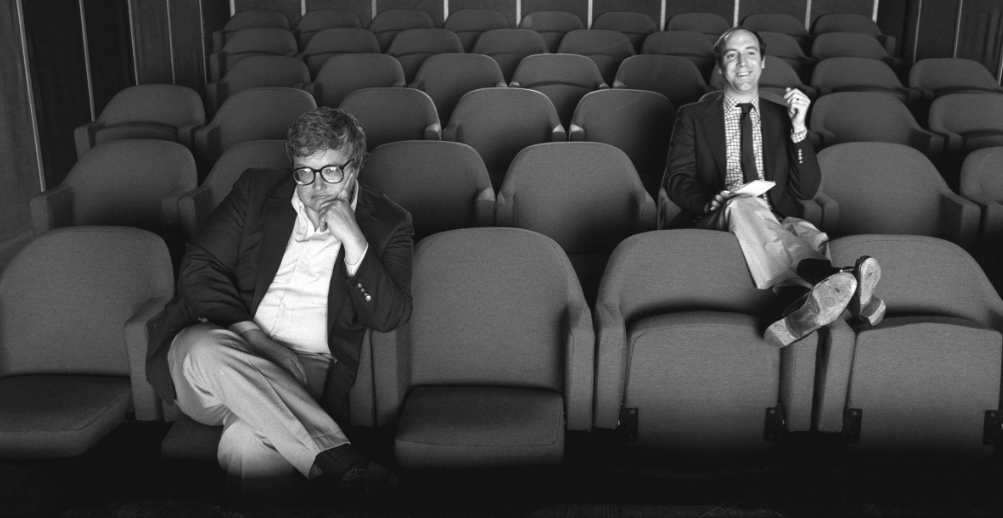
And finally, this year’s first Grand Jury Prize appropriately goes to Steve James’ documented biography Life Itself. Following Roger Ebert’s life and career from him growing up in Chicago, to when he got his first reporting job, to when he won the Nobel Prize for film criticism, to when he lost his best friend, to when he got Thyroid cancer, this film is everything that Roger Ebert is: funny, honest, heartfelt, unabashed, unflinching, and real. It doesn’t give you a peppered-up look at his life: it’s whole and accurate, as genuine as any of the reviews he’s written. I’m probably biased towards this subject, but the subject doesn’t count as long as it is handled well. James’ handles this story with respect and humility, and ends up telling a story about life itself rather than just limiting it to Roger’s story. It’s my favorite documentary of the year, and it brings me great pleasure to award my first Grand Jury Prize to this wonderful film tribute.

Honorable mentions include the creepy and morally ambiguous Nightcrawler, the funny yet stylish Guardians of the Galaxy, the humorously innovative The Lego Movie, and the quietly thrilling The Imitation Game, featuring the year’s best performance from actor Benedict Cumberbatch. Not all films can be honored at the end of the year compilations, but this year I was glad to have seen so many films and give each of them a chance to shine in their own way.

All the same, if you feel differently about some of the films on my list, or you have seen another film that deserves to be recognized, please comment about it. Or make your own list. Movies are deemed as great films not from individuals, but from the masses, and the only way you can tell if a movie has truly accomplished something is if it has the same effect on all its viewers.

On that note, my fellow moviegoers, I end with a classic line from my favorite film critic: “I’ll see you at the movies.”

– David Dunn

Tagged , , , , , , , , , , , , , , , , , , , , , , , , , , , , , , , , , , , , , , , , , , , , , , , , , , , , , , , , , , , , , , , , , , , , , , , , , , , , , , , , , ,

“THE HOBBIT: THE BATTLE OF THE FIVE ARMIES” Review (✫✫✫)

And the Dwarf King: The Battle for Himself. 

Here it is, at last: the end of Peter Jackson’s Hobbit trilogy. It hasn’t arrived without it’s challenges. Originally, the series was supposed to be directed by Hellboy director Guillermo del Toro before he dropped out and let Peter Jackson hop back in the director’s chair. Then, Jackson decided to turn it from two movies into three because he wanted to “expand the story.” Then in April, he decided to retitle the third film from There and Back Again to The Battle of the Five Armies. Every indication from the production of this film has shown that the movie was going to be either the weakest entry or the most unnecessary film out of the series. Jackson, however, has overcome every obstacle in his path and made a film that is just as exciting, enduring, and memorable as any other film in the series. Jackson’s persistence is something to be admired.

Picking up after that horrible cliffhanger of an ending we got from The Desolation of Smaug, The Battle of the Five Armies opens with Smaug the Dragon (Benedict Cumberbatch) laying waste to the village of Laketown shortly after he was set free by Bilbo Baggins (Martin Freeman) and Thorin Oakenshield (Richard Armitage). After setting the village on fire and killing many of the villagers, Bard the bowman (Luke Evans) escapes from prison, climbs the highest tower he can find, and kills the dragon with the black arrow he inherited from his father.

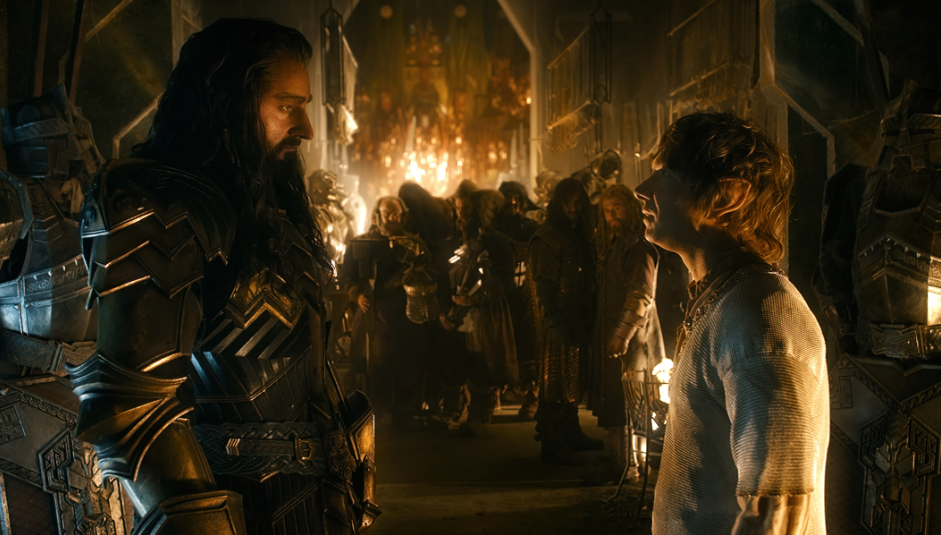
With Smaug dead, the dwarves have taken possession of the Lonely Mountain. However, something strange is happening to Thorin. He has become more greedy, violent, and eager to find the Arkenstone in the chamber and become the next king of the mountain. Bilbo has noticed his new attitude, and finds it disturbingly similar to that of Smaug’s personality. As tensions grow inside the mountains, things heat up with elven, eagle, orc, and human armies assembling outside of the mountains as well. Now with the four armies gathering to take the mountain from the dwarves, Thorin gathers his own dwarf (and hobbit) army to protect their inheritance and keep it from unworthy hands.

The third movie in any trilogy is always the most crucial. It either makes or breaks the series, making it just as memorable as The Lord of the Rings trilogy, or as half-baked as the Matrix trilogy. Part of me wonders why they even had to make a third movie at all, and why they couldn’t just combine this with The Desolation of Smaug. That was originally the plan, after all, but I guess if they did that, they would run the risk of shoehorning two plots into one film.

Honestly though, I don’t know if it would have been that big of an issue. The Hobbit: The Battle of Five Armies offers exactly what the title suggests: a battle which is bigger and bolder than any other fight in the Lord of the Rings movies. Yes, that includes the final siege on Sauron in Return of the King and the fight against Smaug in Desolation of Smaug. The scale and scope is bigger here than any other Lord of the Rings movie, with elves, dwarves, eagles, orcs, villagers, trolls, wizards, spirits, and a hobbit crashing, slashing, and colliding into each other like nobody’s business. This is the most action-packed Lord of the Rings movie yet, with it’s final lengthy action sequence clocking in at about over an hour.

Some of the action runs rampant and gets repetitive now and then. In one scene, for instance, Legolas the elf fights against an orc on a tumbling castle. The scene ran for well over 20 minutes, with them clashing swords and fists against each other, and I sat there wondering to myself “Why couldn’t he just trip him off and be done with it?”

But here’s the interesting thing: no matter how long the action ran, it kept me engaged. If this were a Michael Bay or a John Woo picture, the action would have ran wild and I would have gotten bored about 10 minutes into it. But Jackson is more talented than most filmmakers. He understands that in order for your audience to be invested in the action, they need to be invested in the characters first, because what’s the point of having characters go through these epic fights if you don’t care about them?

With this movie, I noticed that the character I cared most for was not Bilbo Baggins, but Thorin Oakenshield. He has the most interesting arc out of any other character in the movie, spending one half of the film fighting orcs, and the other half fighting himself. His character in the film reminds me a lot of Gollum: his conflict isn’t so much with others trying to take the things precious to him, but with himself in how the things he values most changes him. He especially serves a crucial part in the film’s final climatic battle scene, which is so nerve-wrecking and heart-pounding that it brought me just as much excitement as the climax in Return of the King did. The impressive part? Return of the King’s climax featured an entire armada of warriors, while The Battle of the Five Armies’ climax only needed two.

All in all, The Battle of the Five Armies did to The Hobbit what The Return of the King did to The Lord of the Rings: it wrapped it up nicely into a tight, satisfying conclusion, bringing excitement, emotion, and resolution to these characters that we’ve cared so much for so long now. Granted, it didn’t do as well as The Return of the King did with this, and I personally would have wished that Jackson would have made it less messy and cluttered than it already was. Does that ultimately matter, though, if I had fun watching it? Let’s just be glad that Bilbo made it there and back again in one piece.

Tagged , , , , , , , , , , , , , , , , , , , , , , , , , , , , , , , , , , , , , , , ,