A Meeting With Aaron Sorkin

I can now say two things about my journalism career: that I have interviewed two Academy Award winners, and I have met the man responsible for me even writing in the first place.

Last week, I got to interview screenwriter Aaron Sorkin for his upcoming film Steve Jobs. He’s also been behind a lot of Hollywood’s more intelligent and well-crafted films, including A Few Good Men, Moneyball, and The Social Network, of which he won an Oscar for.

The Social Network in particular is special to me. It was my senior year in high school the year it came out, and I knew almost nothing about which direction I wanted to go with my life. I knew two things: that I had a creative mind, and that I enjoyed reading and writing.

While I had these skills, however, I didn’t know how I could translate that into a career. Yes I was writing my own short stories and poems, but I saw those more as hobbies than I did as a means of sustainment.

That is, until I saw The Social Network.

I saw the film in November. It was a cold, chilly day, and I walked up to the movie theater in my sweats and hoodie like I was Mark Zuckerberg walking across his campus. Sitting in the theater, watching the film, I felt like Zuckerberg did when he realized the potential of his future creation of Facebook. The genius of the idea came rushing into his head all at once, like lightning when it struck Ben Franklin’s kite. So too did the craftsmanship of the film hit me all at once like I was flying my own kite in the movie theater.

The movie played out like a Greek tragedy of sorts. You had this character embodied with a mortal flaw (in this case, Zuckerberg’s social anxiety) which eventually leads to his downfall and, ultimately, his undoing. With the character of Mark Zuckerberg, however, his undoing is not the loss of his life, like it is in those old Shakespeare plays. His undoing comes in the form of social seclusion: with him being alone with only his genius and his ego to keep him company.

Oh, I had seen great movies before, but this one was different. It wasn’t great in the contemporary sense of going from plot point A to plot point B. This showed craftsmanship in which I hadn’t seen before. It’s uniqueness didn’t come from its premise or its ideas, but in how it told and expressed its premise and ideas. The intricate, witty dialogue. The complex and interesting characters. The closeness of its shots and the tightness in its editing. I had come to love and appreciate The Social Network in a way that I hadn’t appreciated even the most exciting and action-packed blockbusters.

It showed me that true excitement didn’t come from special effects. It came from interesting and compelling characters.

After watching the movie, I had one thought in my head: “I have to write about this.” So I went home, created a Facebook account (which is ironic, because the movie was clearly critical of social media) and wrote and published my first reviews online.

I didn’t know the first thing about film criticism. In fact, to this day, I attest the one that was written the worst was The Social Network (And also The Shawshank Redemption, which I had published previous to The Social Network for practice). But the quality of those reviews almost doesn’t matter. I had found a reason to write, and I initiated that ambition myself. I can always rewrite my reviews for The Shawshank Redemption and The Social Network, but my first experience at writing and publishing my own work is something I will never get to experience again. It is one of my greatest memories of being a writer.

Enter 2015, and I’m sitting down across from the man who more or less takes credit for being the writer who inspired me to become one myself. His most recent film, Steve Jobs, sports a lot of similarities to The Social Network. Both center on geniuses in their respective crafts. Both have character with social discomforts that make them seem more like aliens than human beings. But both go through these brilliant arcs in the film that shows changes to their characters and to their relationships with the supporting cast. The only difference is Steve Jobs ends on a more lighthearted note. The Social Network does not.

So there we were, Aaron Sorkin and myself, talking about the film and his processes in researching and writing the picture. The most interesting thing he said to me was that he wasn’t interested in telling Steve Jobs’ biography: he was interested in telling his story, and to do that required making inferences to the facts rather than writing just the facts themselves.

“It’s not a piece of journalism,” he said. “It’s a piece of art.”

While talking, I don’t think it dawned on him at how much of an influence he’s been on me, on how much his writing inspired me to write myself, or even that his screenplay had gotten me interested in writing about movies in the first place. Then again, maybe he didn’t need to know. He was an artist talking about his art, and we might have had a different conversation if he realized he was talking to a fan instead of a journalist.

Sorkin probably will never read this post, and it’s just as well. He revealed his brilliant mind to me, and that was a gift in itself. Maybe one day some young, aimless artist will read one of my reviews or stories and realize that they want to write their own reviews and stories too.

One day, but until then, I’m going to keep enjoying perfecting my craft. Just like Sorkin is perfecting his.

– David Dunn

Tagged , , , , , , ,

“STEVE JOBS” Review (✫✫✫)

Creator. Entrepreneur. Father.

Steve Jobs is defined by three years of his life: 1984, 1988 and 1998.

The movie, Steve Jobs, covers these years of his life. So will this review.

1984

Steve Jobs (Michael Fassbender) is on edge. The Macintosh is malfunctioning. He is told by his technicians that the computer won’t say “Hello” to him. It’s 40 minutes before the product launches. His ex-girlfriend is waiting in the other room with her daughter, who Jobs insists isn’t his, wondering why they are both living on welfare while he is making millions. He paces back and forth in between his professional and personal problems. He tells his technician to fix it and walks off stage.

Fassbender is mesmerizing as Jobs. He’s ecstatic, energetic, passionate. He’s tense, egotistical, confrontational. He’s at peace when thinking about how many people’s lives this new computer will impact. He’s angry at people who come up to him, trying to stop him from completing his mission. His expression shows that they’ll fail. He’s too determined to let his ambitions die.

The filming in this sequence is enclosed, personal. It uses tracking shots to follow Jobs as he paces back and forth, looking at TIME Magazines, drinking his sparkling water, his mind racing with everything that needs to get done. The reel itself has a texture to it that I couldn’t quite point out until it hit me: this sequence is shot on celluloid film, reminiscent of the decade that it’s reflecting. A great choice of stylistic direction from Danny Boyle (Slumdog Millionaire, 127 Hours), but just like the time period we’re in, we know that it won’t last long.

Jobs handles his personal issues. The technical issues are resolved. He steps out onto the stage and introduces the Apple Macintosh.

1988

The Macintosh underperformed in sales. Jobs is let go by Apple, the company that he helped start. He feels betrayed by his closest friends, alone in his struggle for significance.

He meets a few of his former colleagues who want to wish him well. Steve Wozniak (Seth Rogen) starts acting friendly to him, but then confronts him on not giving him enough credit on the launch of the Macintosh. He asks him what he does.

“I play the orchestra, and you’re a good musician,” Jobs says. “You sit right there and you’re the best in your row.”

The scene switches to another where Jobs is confronting a former confidant. The editing is off, choppy. It’s cross-cutting between this scene and a flashback so rapidly it’s hard to keep track of the two conversations. I don’t know what Boyle was trying to do here. Maybe he thought he was adding tension to the scene. I thought he was adding confusion.

Jobs visits his daughter in the next room, who is skipping class to come and see him. She’s in middle school. He tells her she needs to go to school before she rushes up to him and hugs his legs.

“I want to live with you, daddy,” she whispers to him.

She and her mother leave. Jobs is shaken. He steps out onto the stage.

1998

This is it: the launch that has come to define both Apple and Jobs for years to come. This is the most important act of the film, and the one I will talk less about for the sake of spoilers.

Jobs looks different. He looks older. His hair is whiter. He’s sporting the iconic glasses and turtleneck that most people recognize Jobs in. Fassbender is no longer just acting like Steve Jobs. He has become Steve Jobs.

The framing of shots is similar to the beginning. It tracks Jobs while he walks from one place to another. He’s more sure of himself in relationship to Apple, less sure of himself in relationship to his daughter. Boyle captures the panic on his face, the fear recognizing his failings as a person and as a father.

It’s nearing the end of the film, and I realize the thing that I love most about the movie is its screenplay. Screenwriter Aaron Sorkin captures both the genius and fragility of Jobs, the sharpness in his words and the intimacy of his emotions. This is a good change of pace for Sorkin. From a filmography of lightning-quick, witty characters and dialogue from A Few Good Men to The Social Network, this is his most emotive work yet. It makes you feel more than it makes you think.

I exit the theater. I call my dad on my iPhone and tell him I love him. Steve Jobs too realizes that the greatest thing he ever made wasn’t an Apple product. It was his daughter.

Tagged , , , , , , , , , , , , , , , , , , , , , , , , , ,

Boycotting #BoycottStarWarsVII

The dark side doesn’t refer to skin color.

A social media campaign was started yesterday to protest the highly anticipated science-fiction film Star Wars: The Force Awakens. The movement is called #BoycottStarWarsVII, and it’s campaigning against the film for being “anti-white” by casting a black actor in the film — British actor John Boyega.

They must have forgotten that Darth Vader was voiced by actor James Earl Jones in the original trilogy.

And that Billy Dee Williams portrayed Lando Calrissian in The Empire Strikes Back.

And that Samuel L. Jackson was a Jedi knight with his own awesome purple lightsaber in episodes one through three.

I cannot look at this campaign and honestly believe that this was a serious effort to start some controversy about Star Wars. The whole thing reeks of a conspiracy spawned from the Internet hell called 4Chan.

Regardless of its authenticity, #BoycottStarWarsVII is bringing up a serious ongoing issue in modern-day Hollywood: politicizing our entertainment.

In 2013, back when it was announced that director J.J. Abrams was on board for this project, he made it clear that he wanted a racially diverse cast for the film after attending a few Emmy awards television ceremonies and seeing they were completely whitewashed.

“It’s just unbelievably white,” Abrams said. “I just thought, ‘We’re casting this show, and we have an opportunity to do whatever we want. Why not cast the show with actors of color?’ ”

My question is this: Why should race even be a factor in the first place?

James Earl Jones wasn’t cast as the voice of Darth Vader because he was black. He was cast because he had a deep, imposing voice that perfectly fit the role. Williams wasn’t cast because he was black. He was cast because he had charisma that mixed well with Harrison Ford’s Han Solo. Jackson wasn’t cast because he was black. He was cast because he’s a certified badass.

None of these actors were put into their roles because of their race. They were put there because of their talent. Why should we put down Boyega by questioning him about either?

Movies are supposed to bring us together as a people, not tear us apart. Let’s boycott the stupidity of #BoycottStarWarsVII by going to the movie theater together Dec. 18.

Tagged , , , , , ,

“SICARIO” Review (✫✫✫✫)

Your time has come, hombre.

A bleak, haunting scent looms over the frames of Sicario: like decaying bodies that have laid in a drug dealer’s basement for a few days. It’s permanent and disturbing, and remains with you long after you’ve left the theater. In the opening slide, it is explained to us that Sicario is Spanish for hitman. I don’t know what disturbs me more in the movie: who the Sicario is, or who are the people that he’s hunting.

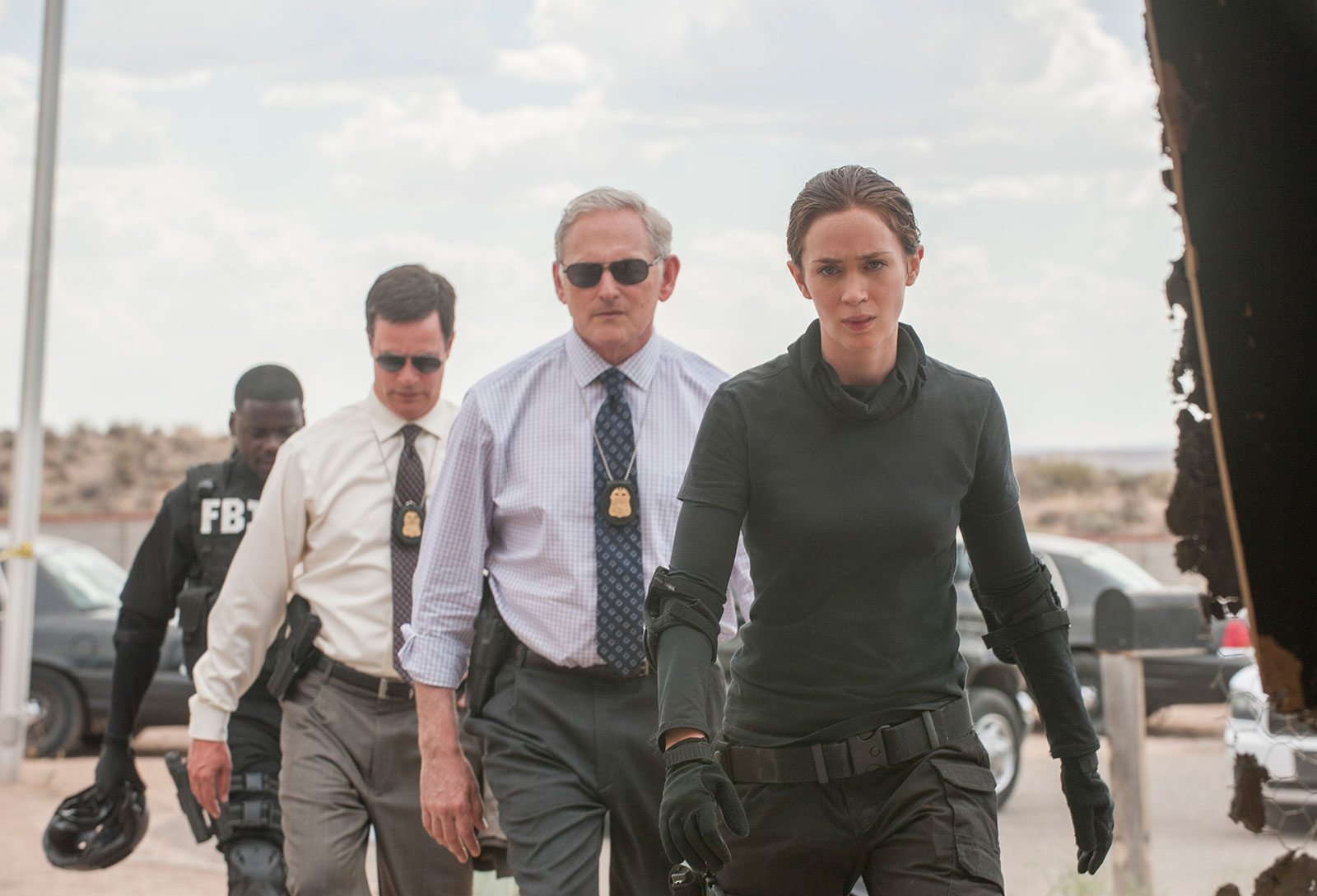
As the movie begins, we watch as a SWAT team is gearing up to raid a house in Chandler, Arizona. The neighborhood is relatively quiet. It’s serene. Calm. Normal. You would never have expected that the cartel was living in the midst of this slight, unsuspecting town.

FBI agent Kate Mercer (Emily Blunt) is one of the members on this team. After breaking into the house and engaging in a brief firefight, Mercer discovers the horrible fate of what the tenants did to a group of people they were holding hostage. As the team investigates the property, they go into the backyard and are killed after a bomb blows up from inside the shed. We don’t know how experienced an officer Mercer is, but after the raid, she’s obviously shaken and disturbed by what she saw. This mission has served as sort of a wake up call for her.

Despite her emotions, her superiors were so impressed by her performance that they recommend her for a special op with Matt Graver (Josh Brolin), a CIA officer tasked with finding Manuel Diaz (Bernardo P. Saracino), the cartel boss responsible for the drug plant in Arizona. Matt is offering Kate a chance to get back at the man who killed many of her men. Eager for a chance at payback, she accepts the offer.

When the film begins, I thought the movie was aiming to be a pro-imigration film, pausing and drawing out focus on the many darker sides of illegal immigration near the beginning of the film. This was interesting, I thought, because its rare for liberal Hollywood to go against the grain. As the film went on, however, I realized that the movie doesn’t have a stance on illegal immigration. It shows both sides of the issue, and how each side of the system is manipulating the other in this never-ending cycle of deceit and violence.

Meanwhile, innocents are getting dragged into this never-ending conflict like ants to an extermination. In one of the most pivotal scenes of the film, a kid is playing football in Mexico until he, along with his classmates and their parents, hear screams and gunshots a few blocks away from them. It’s something most of us can’t even imagine in rural America. It’s something children face every day in modern Mexico.

This is the greatest strength of the film, in that it functions in realism, not politics. It’s not interested in taking sides on the issue, because how would that lend to the story? What we have here is a morally-charged drama about characters trying to do the right thing in a world where “the right thing” doesn’t exist. Kate believes a line exists to maintain integrity and order. Matt believes a line exists for integrity and order, and can be manipulated to maintain that idea as such.

There’s one character I haven’t mentioned yet, and his name is Alejandro (Benicio Del Toro). He doesn’t believe a line even exists. Whatever ideas of order and chaos other people have doesn’t matter to him. In his eyes, they’re all one and the same.

Del Toro’s character fascinates me. In many ways, he is the heart of the film. He’s elusive. Mysterious. Unforgiving. Empathetic. Dangerous. He’s helping Matt and Kate, but we sense he’s not here for their end purposes as much as he is for his own. He’s manipulative, yet sympathetic, extending kindness to Kate as if she’s just a little kid suddenly thrown into a grown-up’s world. The third act of the film focuses more on him than it does Kate, and it should. What we’re seeing here is not a progression of character, but a progression of events. The climax itself provides one of the most exciting and unnerving thrills I’ve seen this year: yes, even more so than The Martian and Mad Max. That’s because the stakes are set up masterfully well, and by the end of the film, we understand the characters and the quiet motives that compel them.

This is a nearly perfect film in which all of the elements form together into an excellent scope of filmmaking. The actors are brilliant and could catch your attention just by reading their lines. Director Dennis Villeneuve evokes a sense of hopelessness and desperation from its setting. The cinematography by Roger Deakins captures this aesthetic perfectly and with great focus to detail, while the editor Joe Walker knows how to cut in between angles and shots to help construct coherent ideas in the viewer’s minds. In short, my only complaint is that the film is violent and disturbing. But then again, it’s supposed to be violent and disturbing. What service would that do the viewer if you hid from them the truth?

In one of my favorite scenes from the film, Alejandro tells Kate that there is no book for her to go by anymore. That it’s only a world full of wolves now. I believe him when he says that, and I think Kate ends up believing him as well. The question, then, is this: who are the sheep, and who are the wolves?

Tagged , , , , , , , , , , , , , , , , , , ,

It’s Only A Game

One man’s life isn’t worth a football game.

This past weekend, the Dallas Cowboys lost to the New England Patriots in a disheartening final score of 30-6. Cowboys fans left the AT&T stadium in a disarray of rage and disappointment, with two fans getting into a physical altercation outside in the parking lot.

43-year-old resident Richard Sells stepped in to try and break up the fight. A few minutes later, he was shot in the neck.

Sells died 8:44 p.m. Wednesday at the Texas Health Harris Methodist Hospital in Fort Worth, according to the Tarrant County medical examiner’s office. His family decided to take him off of life support earlier in the day. Even if he had survived, he would not have lived well. His sister Victoria Gunning wrote in a Facebook post that a neural surgeon said her brother would live the rest of his life in a nursing home with a respirator and a feeding tube, never waking up and never being able to move his body.

In a way, Sells had already died.

“Today, my mother and his family are going to go say our final goodbyes to the greatest man I’ve ever known and could ever know,” Gunning said.

Sells was supposed to get married in a month and was looking forward to the birth of his daughter.

It’s easy to place the blame of this incident on the shooter. It’s easy to point at him and say he’s responsible not only for this man’s loss of life, but for his family’s loss of life.

But the truth is the shooter is not the only person to blame for this incident. It’s the fans.

How many games have you attended and seen people get visibly angry at each other? How frequent a sight is it to see fans yelling at each other, shouting profanities, shaking their fists and eventually breaking out into a physical fight? This behavior happens far too often at any sporting event.

If the two fans hadn’t fought on Sunday, Sells might still be alive today.

We need to do more than just change who we’re blaming. We need to change the culture. Sports is no longer just a game. It’s become almost a religion to some fans, and people are willing to hurt and kill each other simply because of their zealousness.

No one should die for being a sports fan. The loss of one life is too many for a football game.

– David Dunn

Tagged , ,

“THE MARTIAN” Review (✫✫✫)

Again with this, Matt?

Hollywood has spent too much money trying to bring Matt Damon home. I’m sorry, but someone had to say it. Our first venture to bring him home was in Steven Spielberg’s Saving Private Ryan. Then, we brought him home from Syriana. His most recent attempt was in last year’s Christopher Nolan epic Interstellar. And now we have The Martian.

Don’t worry, it’s a good movie. The story is thorough, the visual effects are convincing, and Damon does a great job evoking tension and sympathy from his viewers. I swear to God though, if he gets himself trapped on another distant planet or war zone anytime soon, I’m leaving his ass behind and joining a traveling circus with Jimmy Kimmel.

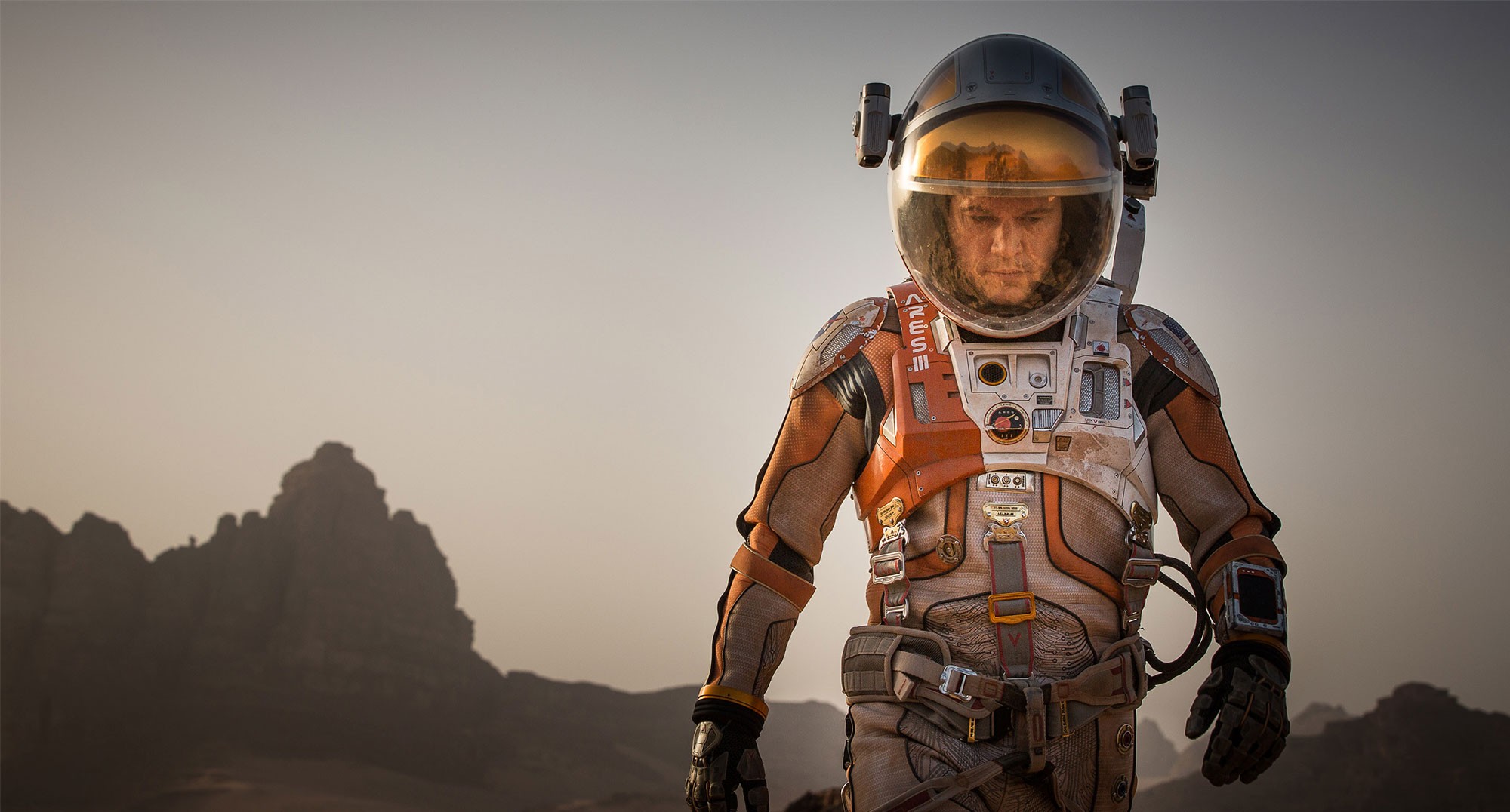
Based on the novel of the same name, The Martian tells the story of the Ares III crew, an astronaut team sent to scout and research the planet Mars. While there, the team gets hit by an intense sand storm and is forced to initiate an emergency evacuation from the planet. While making their escape, however, one of their teammates, Mark Watney (Matt Damon), is struck by debris and separated from his team. Believing he was killed, his teammates board the ship and launch away from the planet.

The Ares III team forgot to account for one thing, however. Mark Watney is played by Matt Damon, so of course he’s going to survive. He didn’t last through war zones, conspiracy theories, and elaborate heists just to let one planet do him in.

Now alone on a planet that is incapable of sustaining life, Mark Watney needs to figure out how to survive and eventually escape from the planet Mars.

This film is directed by Ridley Scott. You can see that as either a good or bad thing depending on what part of his filmography you’re looking at. It’s true, he’s known for science-fiction classics including Alien and Blade Runner, as well as the Academy Award-winning Gladiator. But in recent years, he’s also been responsible for a number of duds. For example, has anyone seen, and liked, Robin Hood, The Counselor, and Exodus: Gods and Kings?

Well, don’t worry dear reader: Scott is back in his prime, and he orchestrates his environments beautifully here. However, I don’t think it’s necessarily just because of him. This world was crafted from the mind of author Andy Weir, who before writing The Martian was a software engineer for Sandia National Laboratories, AOL Inc. and Blizzard Entertainment. When he originally published The Martian on his website, he conducted extensive research on Mars’ geography, astrodynamics, and botany to make the book as scientifically accurate as possible.

By the time Ridley Scott and writer Drew Godard read the book, they didn’t have to adapt it so much as reproduce it.

The thing I love most about The Martian is the research that went into it. When it starts, you think this is going to be another survival story in space, not too dissimilar to Gravity or Apollo 13. The surprising thing, though, is that The Martian isn’t so much thrilling as it is fascinating.

Picture being stuck on a planet with no water, no oxygen, and no food. Seems hopeless, right? And indeed it is, but Watney was trained for environments like this. He adapts. He learns to deal with what he is given. So how does he react to having no water, oxygen, or food? He creates his own water by super-heating Mars’ humidity, he tears apart NASA machinery to stockpile on oxygen resources, and he learns to artificially grow his own potato garden by planting them in (don’t vomit) his own feces.

These are just a few of the problems Watney faces in the film. How does he create transportation? How is he going to communicate with NASA? What does he do if a sandstorm blows open a hole in his space station? What if his crops suddenly die out? What if he runs out of oxygen? What then?

This is how the film builds tension: by throwing impossible survival situations at our poor hero and watching as he dissects for a solution. Does his methods get outlandish? Of course they do, but they are reasonably outlandish, and that’s because of the reality Weir grounded Watney in while writing his novel.

Scott’s visual prowess lends well to the film’s scientific applications. In terms of scale, this film operates on a smaller budget than his other recent films (Robin Hood and Exodus: Gods and Kings’ budgets were $200 million and $145 million, respectively. The Martian’s was $108 million). Yet, in comparison, I’m inclined to say this is his most visually authentic film yet. The reason is because of Scott’s use of practical effects. For science-fiction films, it’s so easy to place your character in front of a blue screen and plaster generic Mars footage in the background. That wasn’t good enough for Scott. For the background alone, he went and filmed the production in the Wadi Rum Valley in Jordan, which has the appropriate sandy landscapes and shade of red that is accurate to the geography of Mars. He constructed 20 sets for the many areas Watney traverses. His production crew grew legitimate potato crops so they could capture the process of photosynthesis on film. For any other director, they would have settled for the easy way out, plastering CGI around your actor and having them react to what isn’t there. That wouldn’t do The Martian justice. Scott knew that and created the best visuals possible for a movie that deserved it.

I have one gripe with the film, and that is its climax, which ironically is supposed to be the high point of the film. I can’t say exactly what happens with the end, but I will say it went on for too long. By the time we arrive at the climax, we know what’s going to happen to Watney. What kind of a movie would this be if it ended any other way than what we were expecting? The thing is that Scott treats us as if we’re too oblivious to it, and he draws it out to a ridiculous length in an attempt to further thrill his audience. It doesn’t work. By the time the ending rolled around, I was looking at my watch, wondering how much longer this scene was going to drag out. Climaxes aren’t supposed to do that. They’re supposed to keep you further engaged with the film: not waiting, impatiently wondering when its going to end.

So does Mark Watney survive? You tell me. He is played by Matt Damon.

Tagged , , , , , , , , , , , , , , , , , , , , , , , , , , , , , , ,

“TRANSFORMERS: AGE OF EXTINCTION” Review (Zero Stars)

It damn well better be.

Transformers: Age of Extinction is a strong candidate for the worst movie I’ve ever seen. Not one of the worst. The worst. I detested every moronic minute of this obnoxious, illogical, idiotic, unfunny, offensive, trite, annoying, and prolonged experience that is more resemblant of a Chinese torture chamber than a form of entertainment. You couldn’t have binged watched a 24-hour marathon of Uwe Boll movies and shit out something as awful as this.

The plot. What is the plot of this monstrosity? I couldn’t tell you, and I’ve seen the film. I remember bits and pieces like a horrible morning hangover. Autobots and Decepticons destroyed Chicago in an epic battle. Decepticons came to Earth and caused the extinction of the dinosaurs. The government is teaming up with the Decepticons to take down the Autobots. Mark Wahlberg discovers and reanimates Optimus Prime. The government attacks and blows up his house. An orgy of metal clanging and exploding ensues for two hours and 45 minutes.

I’m not going to spend much time thinking about the movie’s plot. Why should I, when the writer doesn’t bother to put in that much thought himself? Ehren Kruger has been the worst part of the Transformers movies for a long time now. Revenge of the Fallen was the first time where his mind-numbingly dumb and unfunny screenwriting infested the series like the bubonic plague. Dark of the Moon showed slight hope for him and his career.

Now he has written Age of Extinction. For his sake, I hope his career becomes just that.

Transformers: Age of Extinction is a truly mortifying and abominable experience. I am so disgusted and repulsed by its stench, I don’t know where to begin. The movie isn’t just bad. It transcends a level of stupidity and tastelessness to the point where it seems intentional. Stanley Tucci’s character, for instance, discovers an element called “Transformium” (Yes, that is the actual name). Dinosaurs, through some form of flawed logic, become Transformers. Mark Wahlberg kills a guy with a football. It’s like Michael Bay wasn’t just not trying: it’s like he was aggressively trying to make the dumbest, most disillusioned film he possibly could to alienate what few followers he has.

Oh, don’t get me wrong. I’ve seen bad Michael Bay movies before, including Pearl Harbor and the last two Transformers movies. But in those films, he at least seemed innocently clueless or ignorant to making a cohesive film, more interested in explosions and sexual innuendo to fuel his audience’s desperate need for testosterone. Here, he seems fully driven just to piss people off. There is nothing even slightly resembling story, plot, character development, or a conscious intelligence with this film. The film is literally it’s explosive trailer, except it extends for a nearly exasperating three hours instead of three minutes.

Is there any reason to talk about the actors? We know none of them are in here to act. They’re all here just so the film can have star power, but the film absolutely wastes and squanders all of their talents.

Wahlberg, for instance, needs no explanation. He was heartbreaking in Lone Survivor. He was a powerhouse in The Fighter. He was charismatic and intimidating in The Departed. He can be great in action movies. He’s done it before. How is it, then, that he gets stuck in the same tragic fate as Shia Labeouf did and just get stuck with running away from giant, convoluted machines and screaming loudly?

But its not just Wahlberg. Everyone suffers from stupid characterizations in the movie. T.J. Miller is killed off in the first 30 minutes. Kelsey Grammar’s character is the biggest idiot in an action movie since Paul Gleason’s character in Die Hard. For Pete’s sake, even Stanley Tucci’s unique charisma is completely erased and replaced with this cartoon of a character. What does that say about your film when you make Stanley Tucci look like a bad actor?

I’ve played this movie over and over again in my head, scanning it, desperately looking for any redeeming quality, if any, that I can find to give this movie even half of a star. I couldn’t. The first half of this film was bad enough, but for it to keep going with its obnoxious explosions, loud sound effects, terrible scripting, bad acting and even worse directing, I felt like I was getting punished for continuing to watch the movie. I have to believe that even if you like the Transformers movies, you still don’t like this movie.

To those reading this review, I plea to you: do not watch this movie. I know my plea will fall on deaf ears, and some of you will be unfortunate enough to give this movie a chance. I won’t be making that mistake again.

Tagged , , , , , , , , , , , , , , , , , , , , , , , , , , , , ,

We’re getting four more ‘Transformers’ sequels

We’re about to get a whole lot more of Transformers.

The announcement came from Hasbro Studios president Stephen Davis, who announced during a Q&A session at the MIP Junior Conference 2015 that Hasbro, along with Paramount Pictures, director Michael Bay, and writer Akiva Goldsman (A Beautiful Mind) finished up a 10 year plan expanding the Transformers film franchise.

“They plotted out the next 10 years of ‘Transformers,'” Davis said. “Similarly, we are doing the same in television and digital. So stay tuned: ‘Transformers 5’ is on its way. And 6. And 7. And 8.”

That’s it. I’m done.

– David Dunn

SOURCE: ComicBook.com, Cinemablend

Tom Cruise and Doug Liman Are Heading To Luna Park

Tom Cruise and Doug Liman are at it again.

The actor and director team collaborated on last year’s Edge of Tomorrow, which starred Cruise as an army major who gains the ability to respawn and relive experiences after being killed. The team’s second collaboration, Mena, stars Cruise as a former airline pilot turned drug smuggler, and is scheduled for release in January 2017. Now, they’re teaming up for their third project together called Luna Park, which functions as a science-fiction heist picture about a group of people who venture to the moon to steal a highly-valued energy source.

Luna Park has been a passion project of Liman’s for quite some time. Stuck in development since 2011, Luna Park was attracting names like Chris Evans and Andrew Garfield to the project and was originally green lit for release by Paramount. However, the project ended up going over budget and was eventually canned.

With Cruise now on board for the project, that helps the movie a lot with financing. His production company Cruise/Wagner has funded plenty of films that were box office successes in past years, including the Mission Impossible movies and 2012’s Jack Reacher. With Cruise on board as producer, that will definitely help get the track moving on Luna Park for Liman and Paramount.

No word yet on whether Cruise will star in the film too or not. Stay tuned for updates.

– David Dunn

SOURCE: Variety, Screenrant

Danny Boyle is Trainspotting, Again

Academy Award-winning filmmaker Danny Boyle is at it again. This time with a sequel, no less.

In a sit-down interview with Deadline, Boyle revealed that he wants to take another crack at Trainspotting 2. With a sequel stuck in development hell since 2013, news that the sequel is on its way initially came as a shock. But as Boyle described it, not only does he fully intend to make Trainspotting 2: he intends for it to be his next project.

“All the four main actors want to come back and do it,” Boyle said. “Now it is only a matter of getting all their schedules together, which is complicated by two of them doing American TV series’.” 

The two he’s referring to, of course, is Jonny Lee Miller and Robert Carlyle, who respectively star in the shows “Elementary” and “Once Upon A Time.” The other two actors, Ewan McGregor and Ewen Bremner, are available and have expressed their interests in returning for a sequel.

Taking place ten years after the events of Trainspotting, the crew consisting of Rent Boy (McGregor), Spud (Bremner), Sick Boy (Miller) and Franco (Carlyle) join up again to make a porn film after their drug-induced adventures in Trainspotting. While Boyle has said that the book’s not-so-subtly-titled sequel Porno by Irvine Welsh is not as strong as Trainspotting was, he said he would like to follow the same events in Trainspotting 2 and stick to the same realms that the characters were written in.

Boyle currently has his hand’s full with the upcoming biopic Steve Jobs, starring Michael Fassbender and scripted by Aaron Sorkin (A Few Good Men, The Social Network). Boyle also directed 28 Days Later, 127 Hours, and best picture winner Slumdog Millionaire.

Steve Jobs will be released October 9, 2015.

– David Dunn

SOURCE: Deadline, Screenrant