“STAR WARS” Review (✫✫✫✫)

The force is strong with George Lucas.

What is your favorite piece of science fiction of all time? Nine times out of ten, most people’s answer will be Star Wars. Not Star Trek. Not Terminator. Not Alien, or Blade Runner, or Metropolis, or 2001: A Space Odyssey. It’s always Star Wars. Why is that?

I think it’s because, unlike Gene Roddenberry, James Cameron, Ridley Scott, Fritz Lang, and yes, even the great Stanley Kubrick, George Lucas succeeded in making characters that were not only believable, but loveable. We didn’t just accept them. We embraced them as we found a piece of ourselves in each of them. If I bring up the name David Bowman, many of you might ask “Who?” If I mention Nyota Uhura, most of you would stare at me in puzzlement. But if I mention the letters and numbers of C-3PO and R2-D2, your ears would most likely perk up in excitement as you realize I’m talking about Star Wars.

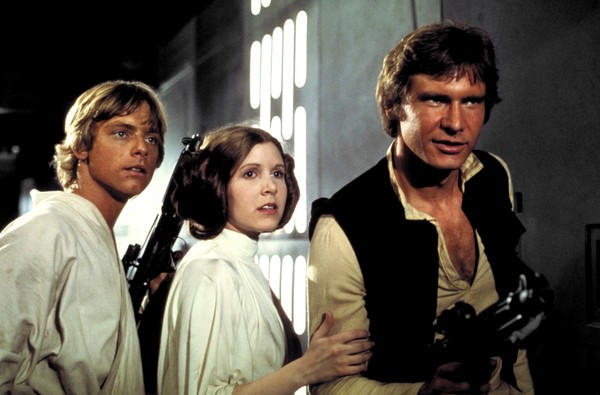
That’s what happened to me in my small living room in Brownsville, Texas when I was just a little boy. When the opening credits and theme song for Star Wars opened up, my attention was immediately caught. When the vast imperial fighter boarded the small rebel ship and the tall figure of Darth Vader (James Earl Jones) entered the deck, I stared at the screen in bewilderment and amazement. But when those two geeky droids entered the frame, as R2 slid around beeping and 3PO clumsily blundered about, I knew I had found something special, as we all did when Star Wars hit the theaters in 1977.

The droids escape the rebel ship and soon land on the dusty planet of Tatooine, where they are soon captured and sold to a small plantation family outside of the city. It is here where we meet our hero Luke Skywalker (Mark Hamill), and we watch as he grows from being a desert farmer to a jedi warrior.

After spending years apart from this picture, I wondered if its appeal would still hold up to today’s standards. Yes, I had grown up with the characters, but that was when I was a child. I had grown away from many things as I grew into adulthood. Would I grow away from Star Wars too?

The answer is no, I didn’t, and I don’t think anyone can grow away from Star Wars. Star Wars appeals to a very specific part of the moviegoing experience: imagination. Yes, plenty of science-fiction films existed prior to the release of Star Wars, but none left the impact on the genre that Star Wars did. And every time I view Star Wars, watching as the droids beep and the aliens groan and the stormtroopers march, I ask what was it that this movie had that all of the others didn’t? My answer is the same every time: George Lucas.

From the writing to the visual design, George Lucas was heavily involved with the film’s concept and creation. How could Lucas come up with such creative and dynamic characters? From the droids to the humans, every character is completely fascinating and appealing, reaching a deep part of our mind from when we were excited at those swashbuckling serials we read when we were kids. It’s almost childlike in its appeal, and its heroes and villains alike are people we learn to root for not because we are asked to as viewers, but because we want to as fans.

Luke is the well-intentioned hero of the story, the knight in shining armor so to speak that is looking for his own adventure out there, all while trying to help anyone he can along the way. 3PO and R2 are the Abbott and Costello of robots here, and provide some of the more comedic moments of the picture without trying too hard or seeming exaggerated. Then there’s Darth Vader, whose visual scope and deep, imposing voice sets a new standard of villainy altogether. James Earl Jones wasn’t a relatively popular actor before Star Wars’ release. Yet, when Star Wars hit the theater, Jones’ personification of the character summoned such a powerful sense of intimidation for Darth Vader that it emboldened his status as a movie villain forever.

In retrospect, these characters don’t do anything in Star Wars that other characters haven’t done in other movies before. A princess is captured, a dashing hero (or two) comes in to save her, a climactic duel builds between its two leads, and somewhere, in one place or another, an explosion happens.

Doesn’t that sound like something you’ve seen before? Indeed, in most classic westerns and swashbuckling pictures, this was the template for your typical motion picture. What places Star Wars above the standard is its characters, in their funny, witty remarks, their moments of lighthearted comedy, and their deepened sense of adventure that survives past the stars and beyond. Yes, the cast gets credit for servicing their characters well, but not as much credit as the man who created the characters.

The other technical elements of the motion picture are astounding and contribute to the overall vision of this science-fiction fantasy. The visual effects were groundbreaking for its time, its elaborate art direction, set design, costuming and make up creating this authentic and aged environment that makes it feel like an age long lost. The technology and the weapons they use make for some of the most exciting action sequences, with one light saber battle between two jedi in the movie serving as one of its high points. And the musical composition by John Williams is simply beautiful, with the horns and the strings switching from moments of ease and reflection to moments of excitement and anticipation. Williams demonstrated his mastery of handling different aesthetics from his Academy Award-winning score for Jaws. Here is another film where he arguably contributed just as much to the film as its creator did.

But a film can be technically well made and fail on the whole. What makes Lucas’ work stand out is, once again, his characters. We share the young farmer’s dreams as he wants to travel to different worlds and become a jedi. We share the droid’s frustration at each other as their situation quickly crumbles into shambles, and we share the rebel’s fear and gloom as the shadowy figure of Darth Vader approaches them. This is a film that is strong in both production and concept, as it makes us deeply care for the characters that exist from a long time ago in a galaxy far, far away.
Tagged , , , , , , , , , , , , , , , , , , , , , , , , , , , , , , , , , , , , , , ,

“SPOTLIGHT” Review (✫✫✫✫)

“Shine a light, and let the whole world see.”

In the Boston Globe story on the 1990 Church abuse scandal, the Spotlight team reported that there were over 130 sexual assault victims from just one Catholic priest. In the film Spotlight, we eventually learn that over 80 Boston priests were sexual predators, and were being continuously circulated from parish to parish. If those numbers are consistent, how many victims of sexual assault does that spell out for Boston? My math came down to over 10,000.

I don’t know if that’s accurate because I haven’t dug much further into the Boston Globe’s reporting, but I don’t think that matters. What matters is that Spotlight made me think of those victims. It made me think about the people that you don’t normally think about, the problems that you don’t think exist, and the secrets that you don’t think are being hidden behind prayers and confession booths. Like any great piece of reporting, Spotlight brings importance, urgency, and truth that needs to be known about. If Spotlight isn’t the best film of the year, it is definitely the most important.

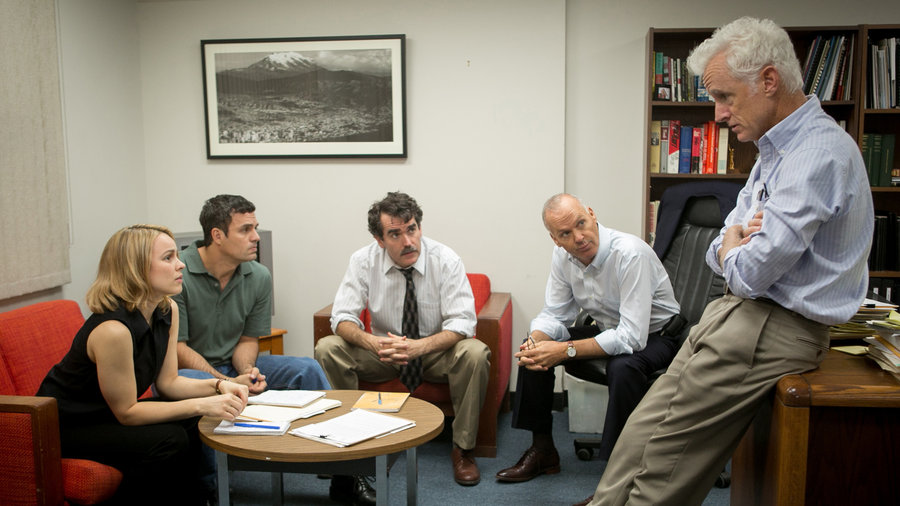
The Spotlight team consists of lead editor Walter Robinson (Michael Keaton) and reporters Matt Carol (Brian d’Arcy James), Sacha Pfeiffer (Rachel McAdams), and Michael Rezendes (Mark Ruffalo). The team is specifically reserved for investigative reporting, previously breaking stories on transit mismanagement and political corruption in Massachusetts. At the time when they were given this assignment, it was not as a follow-up to a news story, but to a column written and published by one of the Globe’s staffers.

At first, no one really thought much of the project. When originally pitched, it had to do with the Catholic church finding out that one priest had sexually assaulted children in six different churches, and did nothing about it. But when the team kept digging, they found out that it was bigger than they anticipated. Much bigger.

While watching Spotlight, I was thrusted upon an early memory of one of my first major news assignments. It was a story called “Seconds Away,” and it was about a university alumna who was just seconds from crossing the finish line before it blew up during the Boston Marathon bombings in 2013. The story wasn’t that she survived. It was that she went back the following year to finish crossing the line that she never did.

While getting ready for our interview, I was excited, nervous, and petrified all at once. This was a woman who had survived a near-death experience. She had faced something few other people have had to face, myself included. I didn’t know how to approach it. Was she comfortable with me talking to her? Would I be insensitive by asking serious questions? Would I be disrespectful by asking what was going through her mind? What would that say of me as a person, by asking her to relive something traumatic that she already went through?

The reporters and editors behind Spotlight face these same questions and concerns of morality every day they step into the office. Yet, they handled this difficult subject in the same way that the movie does: with grace and respect.

The greatest thing that can be said about Spotlight is its transparency: in how its characters charge towards this groundbreaking story and the emotions and conflicts they experience while doing their jobs. Writer-director Tom McCarthy, who was raised Catholic, juggles this behind-the-scenes story with real people’s traumas and emotions in mind. The result is a portrait that is genuine, astounding, mind-blowing, and heartbreaking all at once.

Take the interview scenes as a demonstration of this. During the film’s first scenes, Spotlight reporters sit down with a few sex abuse survivors, their brokenness and vulnerability made evident on the spot. The interesting thing you’ll find in between these intercut scenes is that it’s not Rachel McAdam’s mannerisms we’re noticing. It’s not Mark Ruffalo’s reactions or face of shock we’re noticing. It’s the supporting actors playing these victims, whom I can’t even identify off of the film’s cast list. Every detail of them is absorbing and introspective.

We notice the gay man in a coffee shop as he twiddles his thumbs nervously on his coffee cup. We notice the skinny drug addict sweating, entering the room cautiously, seeing scars up his arms from when he injected himself with heroin. We notice that while their testimonies are overwhelmingly tragic, they talk about it casually and on a whim; like it’s a scar that has already been healed, but will never go away. We listen to their silence as they quietly relive their traumas, the quivering in their voice as they slowly speak, the tears building up in their eyes as they come to once again realize what they are. I find that so compelling, that one of the best things in this film are the actors that I can’t even name.

The rest of the film is like that: finding value in the areas that you can’t exactly point out, but you know they are there. For instance, who’s the main protagonist? You could argue Rezendes, because he has the most visible reaction from working on this story. In reality though, this story is impacting the entire Spotlight team and more. It impacts everyone, in ways that nobody realizes until it walks right up to their doorstep.

This movie takes time and dedication to build up its story and collect the necessary information, just like Spotlight’s reporters do. In doing that, this is undeniably a slow film, but the pace doesn’t matter as much as the payoff. Spotlight deserves to be sought out. It is one of those rare films that not only makes us better viewers, but also better human beings.

Tagged , , , , , , , , , , , , , , , , , , , , , , , , , , , , , , , , , , , , , , ,

“CREED” Review (✫✫✫1/2)


Donnie’s, not Apollo’s, legacy.

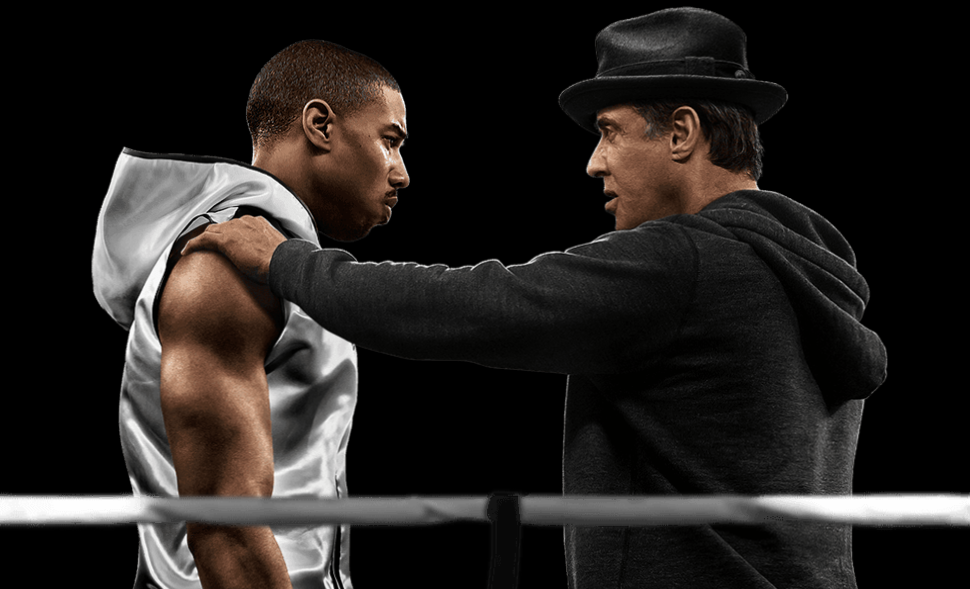
I find it interesting how much Creed lives in the shadows of its predecessors, just like its main subject does. Creed is not trying to be a movie like Rocky, and likewise, Donnie Johnson-Creed (Michael B. Jordan) isn’t trying to be a boxer like Rocky. Creed really isn’t even a movie about Rocky’s rival, Apollo Creed, and it’s just as well because Donnie doesn’t want to be remembered as Apollo Creed’s son. Both the movie and the character are aspiring to leave their own marks on a world where pretty big marks have already been left by key figures from their past. The fact that the movie is trying to do this with Sylvester Stallone reprising the role of Rocky Balboa makes its challenge all the more difficult, but Creed pulls it off with plenty of emotion and style to spare.

You know exactly how Creed is going to play out. Or do you? When the movie begins, you think this is going to be another rags-to-riches story similar to Rocky or The Fighter, and indeed, the opening scenes makes it look like it’s going to play out that way. But Donnie starts his story with the riches, then backtracks to the rags in order to train and become a pro boxer. Why would he sacrifice all of his money and his high-class lifestyle in order to become a fighter? His motivation is not explained until much later, but when it is, it’s nonetheless heartbreaking.

He moves to Philadelphia and seeks out Rocky for training, who as you remember from his last film quit boxing and now owns an Italian restaurant. He insists to Donnie that he doesn’t do that anymore, and he doesn’t even want to be involved with fighting from the ringside. Yet, he eventually suspends his discontent and commits to training this new kid for the ring. Why? He never says why in the movie, although I suspect it’s for the same reasons that Micky decided to train an Italian nobody in the original Rocky.

Creed is a hot-blooded sports drama, ripe with all of the adrenaline, action, and emotion that you’d come to expect in boxing movies. Like its main character, it works independently from its inspirations, despite having very deep ties with the rest of the Rocky franchise. When I first heard that this movie was coming out, the one thing I did not want it to be was another Rocky picture. Of course, it’s going to sell itself as a spinoff, but as a film, I did not want it to focus on Rocky, nor did I want it to try and mimic the franchise formula. It’s called Creed. I wanted its emphasis on that character’s story specifically.

Luckily, so did writer-director Ryan Coogler, who approached in telling this story not as a sequel to a popular franchise, but rather as an intimate, personal story about one fighter’s deep aspirations. Does the movie fall for some of the genre conventions? Of course it does, but the conventions don’t matter as much as the intentions behind them. When Donnie steps into the ring, you don’t want him to win the fight because he’s the main character, but because of all of the hurt and pain he’s gone through up until this point. When he and Rocky talk, you don’t want the conversations to be meaningful because he’s talking to the Italian Stallion, but because the words they’re exchanging are genuine, honest, and real to each other. Coogler succeeds in not only making a powerful fighting drama, but a powerful drama period. He throws quite a few emotional punches in there that I wasn’t expecting.

Of course, for this dynamic to work, Jordan and Stallone need to have the chemistry to make these characters feel real. They have it in spades, and I would even challenge this dynamic to be as likeable as the one between Rocky and Mick in the original. Jordan is electric as Creed, a young rebellious sort who is full of energy, vigor, and passion, not letting any punk young or old telling him what he can or can’t do as a fighter. Do we need to go into Stallone? He’s done the character for years now, and he’s just as great now as he was nearly 40 years ago. Again, he throws a few emotional jabs I wasn’t expecting, but I’ll stop there so that you can experience it for yourself in the theater.

This is simply one of the most motivating films of the year, let alone one of the best Rocky films, if you can call it that. It takes its characters and their emotions seriously. The actors service their roles well and make them believable and real. My only complaint is that this movie has to suffer for being called a “franchise film”, but what do you expect? Let’s face it: the title wouldn’t have been as interesting if it was called Johnson.

Tagged , , , , , , , , , , , , , , , , , , ,

“BLACK MASS” Review (✫✫✫)

Fear him. Fear Whitey Bulger.

I would not recommend to any of my friends that they watch Black Mass. It’s not for everyone. In fact, I would argue that it’s not for most. It’s violent, twisted, bleak, convoluted, and has little sense of purpose other than to show us the dark depths of human depravity. In that regard, it is not a worthwhile moviegoing experience. But man, is Johnny Depp’s performance mesmerizing.

In Black Mass, Johnny Depp portrays Jimmy “Whitey” Bulger, a notorious gangster who ruled the south streets of Boston for nearly 30 years. When he was finally captured by the FBI in 2011, he faced a 33-count indictment, including multiple counts of extortion, money laundering, selling drugs, corrupting law enforcement, and committing 19 murders. That number surprises me. After watching the movie, it almost seems low.

How was Bulger able to get away with all of this for almost three decades? Simple. He had help. When his childhood friend John Connolly (Joel Edgerton) was hired by the FBI, Connolly believed he and Bulger could help each other out. As an employed FBI informant, Bulger could provide information to Connolly on rival gangs so the FBI could clean house for Bulger. Meanwhile, Connolly could provide protection for Bulger’s operations as a result of him being an informant. They both end up agreeing to each others terms and Bulger officially enlists himself as an FBI informant.

While watching this movie, I was wondering where I had heard this story before about an FBI informant using the bureau to protect himself from his own criminal operations. Then I remembered Martin Scorsese’s 2006 crime film The Departed, which involved Jack Nicholson’s character also using the FBI to his own purposes. I came to find out that his character was actually largely based around Whitey Bulger’s circumstances. The only difference is that The Departed is somewhat watered down compared to the actual accounts.

Yes, I just wrote that. The Departed is watered down compared to Black Mass. What is the world coming to when Martin Scorsese looks tame?

Black Mass is a sickening, deplorable film, one that outlines one man’s lifetime of crime in disturbing detail. Yet, the film is reasonably sickening because it isn’t actively advocating for Bulger. Indeed, in most of the film, he seems more like the movie’s villain rather than its hero.

So who is the main protagonist then? The movie doesn’t have one. It’s unusual, but it works for this sort of film. This isn’t a story we’re watching, but a report: an account on real-life events that is driven to inform on every detail as accurately as possible. The writers of the original novel, Boston Globe reporters Dick Lehr and Gerard O’Neill, served as consultants on the film, working specifically with director Scott Cooper on what did or didn’t happen based on their experiences.

It is reasonable to say they’re credible sources. Lehr and O’Neill have written numerous books on Boston crime, and Bulger was a key figure in all of their research. Their reporting was thorough and in-depth. They’ve met John Connolly on numerous occasions. Next to the gangsters that have lived alongside Bulger, these two would be the next best accountants on him and his life.

Bringing them on as consultants was wise of Cooper, and his attention to their details brings authenticity to the picture. In one of the most disturbing scenes of the film, Bulger is choking a hooker to death inside of a house. Cooper paused filming this scene because Lehr and O’Neill said one of the gangster that was present in the original events was not present on the set. The fact that Cooper paused filming for such a small detail impresses me. The fact that Bulger wipes his feet, shrugs, and says he’s taking a nap so non-chalantly after killing her disturbs me on how true this is.

Depp is another story altogether. He is completely and utterly eerie as Bulger, perfect in capturing the character’s details and relentless in portraying his acts of violence and cruelty. It’s not just that Depp gives a convincing performance: I literally can’t see any indication that Depp is even in the movie. His being is erased into Bulger’s existence, in his cold, steady stare and his fixed, stoic posture. He’s disturbing in the slurred, snaky voice he speaks in, and how he so casually inflicts pain and death as if he were the Grim Reaper himself. Depp is the highlight of the film, with his portrayal of Bulger evoking memory of Hannibal Lecter from Silence of the Lambs or Jack Torrence from The Shining. His performance isn’t just the best of the year: it’s a challenger for the best of the decade. It’s that momentous and memorable.

If I were reviewing Depp’s performance alone, he would be given four stars, because the truth is his performance is perfect. However, I am not reviewing one actor’s performance. I’m reviewing the movie, and the truth is the movie is sloppy. The camerawork by Masanobu Takayangi is smooth and steady, but everything else in the film is lopsided and rocky. The editing by David Rosenbloom is scattered and choppy. The chronology of events is non-linear and hard to follow. And the screenwriters of the film Jez Butterworth and Mark Mallouk skip an important part of Bulger’s story, which is his upbringing. It doesn’t have to be a flashback either; just simply explaining where the character came from and why he acts the way he does would have sufficed. We’re given clues throughout the movie, but no answers. We are asked to fill in the holes as the movie skips over important questions and just goes to Bulger’s tirades of violence.

Why is the movie called Black Mass? In the 19th Century, a Black Mass was secretly held by a Roman Catholic Church for Satan worship and in mockery of the Christian faith. A Black Mass is a crooked sermon concealing evil intentions. I believe a black mass was made when the FBI enlisted one of history’s most notorious gangsters as an informant. A black mass is also made when we enter the movie theater. The devil’s name is the same in both cases: Whitey Bulger.

Tagged , , , , , , , , , , , , , , , , , , ,

Ryan Gosling Is On For ‘Blade Runner 2’

Hey girl.

(Or guy, I don’t judge.)

Guess what?

Ryan Gosling is the new Blade Runner.

The 35-year-old actor confirmed that his next film would Blade Runner 2, although he refused to go into any more details beyond that.

“There’s a chip in me, and if I say anything more, I’ll explode if I say anything else,” Gosling joked.

The project as a whole has been heavily kept under wraps. We know that filmmaker Dennis Villeneuve (Prisoners, Sicario) is slated to direct the project, while cinematographer Roger Deakins (Skyfall, True Grit, The Shawshank Redemption) is set to shoot the picture. The director of the original film Ridley Scott is set to produce, and Harrison Ford is expecting to reprise his role as well. All othere elements of the plot, however, are a complete mystery. We don’t know what the premise is, nor how Ford or Gosling play into it.

We’re expected to hear more about it once production rolls around. Until then, are you excited to see Gosling entering the fray of Blade Runner? Comment below, let me know.

– David Dunn

SOURCE: Collider

Remembering (And Remaking) ‘Memento’

This is one piece of news I wish I could forget.

The Hollywood Reporter recently broke the news that Christopher Nolan’s critically acclaimed 2000 masterpiece, Memento, was greenlit for a remake. The announcement came from AMBI Pictures co-founders Andrea Iervolino and Monika Bacardi, who said they were going to finance and produce the picture.

“‘Memento’ is a masterpiece that leaves audiences guessing not just throughout the film, but long after as well, which is a testament to its daring approach,” Bacardi said in a statement. “We intend to stay true to Christopher Nolan’s vision and deliver a memorable movie that is every bit as edgy, iconic and award-worthy as the original.”

Good luck with that.

For those of you unfamiliar, Memento tells the story of a man suffering from amnesia while trying to find and kill his wife’s murderer. What’s most unique about the motion picture is that it is narrated in reverse-chronological order, meaning it starts at the end and it ends at the beginning. It’s slightly confusing, but when you begin to piece events together, you notice a pattern and Nolan’s mastery at telling this incredibly fascinating story.

The fact that AMBI Pictures is remaking it is revolting, confounding, and absolutely unnecessary. Hey, let’s not stop there, guys! Why don’t we remake The Godfather next? How about Shawshank Redemption? Schindler’s List? Lord of the Rings? What about Batman Begins? It’s only been ten years, that’s enough time for a remake!

The fact these studio execs are remaking a masterpiece like Memento is 110% sickening and maddening. Masterpieces do not need to be remade. Their existence by themselves is timeless. Why would you lessen the value of this work by recycling it through the production process for profit?

The studio is currently searching for a director and writer to take on the project. They’re also looking for a soul, because clearly, they don’t already have one.

– David Dunn

SOURCE: The Hollywood Reporter, Screenrant

“SPECTRE” Review (✫✫✫)

Back to Bond, baby.

The opening tracking shot in Spectre is masterfully filmed and beautifully consistent, following our subjects smoothly through the chaos of a celebratory crowd like an artist’s hand running down his sculpture. What follows after that is a film less consistent, less smooth, and less artistic, but to hell with being artistic. This is a fun movie.

Following up a few months after Skyfall, Spectre places our hero, James Bond, a.k.a. 007 (Once again portrayed by Daniel Craig) in the middle of a hidden conspiracy of overthrowing the world government and taking over the planet. We can’t go a few decades without Bond dealing with one of those every once in a while, now can’t we?

This time, Bond is after the villainous organization called S.P.E.C.T.R.E., which we’re never told what it stands for in the film (Although in Dr. No, it stood for Special Executive for Counter-intelligence, Terrorism, Revenge and Extortion). At first, Bond doesn’t know exactly what he’s looking for, only having a clue by the deceased M (Judi Dench) to go by. But as he continues to investigate the organization further and further, he finds deeper connections to S.P.E.C.T.R.E. in his enemies from the past, until finally, he finds the deepest connection to S.P.E.C.T.R.E. of all: himself.

What do you think of when you think of James Bond? When I think of Bond, I think of a movie icon who is the penultimate vision of the masculine fantasy. He’s physically astute and sexually appealing. He’s smooth, suave, and has a way with words that is both comforting and edgy. He drinks a lot, but he can hold his liquor. He can fire a gun better than any marksman, throw a punch better than most fighters. He dresses up in nice suits and bow ties, although he does a great job at mucking them up on missions. When I think of Bond, I think of a character that women secretly desire and men not-so-secretly idolize. If he were any more larger than life, he would be a superhero.

Spectre continues the trend of Bond being a stylish action hero, and it continues the trend well. I mentioned in my lead that the film isn’t very artistic. That’s because it doesn’t need to be. After the impressive tracking shot at the beginning, Bond gets into a firefight, dodges a falling building, chases a suspect through the streets, gets into a fist fight, then highjacks a helicopter after it flips over on its axis in the air. And it’s not even the first 15 minutes.

This is something I’m impressed by in a lot of Bond movies, which is the action sequences. Minus the mediocrity of Quantum of Solace, the most recent Bond films have always found new ways to make old conventions interesting. For instance, how many times have you seen Bond take a sip of a martini? How many times have we seen him charm a young woman into the bedroom? How many times have we seen him get into chase, fighting, and action sequences involving all sorts of weaponry and vehicular manslaughter? You think we’d get sick of it by now, and yet, the series has lasted past 24 films. The series is doing something right.

I think part of it is because of how well Craig inherits the role of of James Bond. Sean Connery is always going to be regarded as the most significant Bond actor, because he was the first to take on the role and the one to exemplify most of Bond’s characteristics. Yet, Craig is nearly equal in iconic status because he too portrays Bond with multiple layers, and he does all of those layers well. He’s charming and sincere when he needs to be, manipulative and deceptive when otherwise.

Most impressive to me is that, even in the action sequences, the biggest thing I notice is Craig’s mannerisms. Not the explosions. Not the gunfire. Not the people he’s punching in the face. I’m noticing Craig. Why? Because I’m buying him as a character, not as an actor. I see the anger in his face when someone hits him and he’s getting ready to hit back. I see the cold calculation in his eyes as he’s deciding which targets to shoot first. I’m noticing the surprise on his face as his eyes widen, the panic that sets in when he’s discovered, and the fear piercing through his body when someone he loves is in danger. It’s hard to notice someone’s performance in the middle of an action sequence. Craig makes it seem like a cakewalk.

Of course, director Sam Mendes is also credited for the style of the film as well, with the action and the incredible set pieces making up for most of the excitement of the film. Yet, I’m a little disappointed that, after making one of the most definitive Bond films ever in Skyfall, Mendes reverted to a few conventions of the franchise that worked against it.

Take the characters as a primary example. Who do we have here? A secretive baddie hiding in the shadows, a big, burly baddie that walks and fights like a tank, a figure from Bond’s past that ushers him a profound warning, and the Bond girl, who is as beautiful and striking as ever. Their actors deliver just what is expected of them and what has been delivered before. The secretive baddie hides in the shadows, the big, burly baddie beats up Bond before he is killed, the figure from his past dies, and the girl hooks up with Bond. Not very original, now is it?

And this isn’t a criticism so much as it is a notice. Casino Royale and Skyfall were significant entries to the series because they saw Bond not as an action hero, but as a human being, dealing with his own hurts and pains by taking it out on the mission and his enemies. Here, Bond goes back to hero mode while we just tag along for the ride. That’s not necessarily a bad thing, but when you’re used to seeing one thing, it’s a little bit of a let down to see the franchise take a step back on itself.

In the end, Spectre is like Bond’s rebuilt Ashton Martin after it blew up in Skyfall: It may have the same frame, but it doesn’t have the same ride.

Tagged , , , , , , , , , , , , , , , , , , , , , , , , , , , , ,

‘Steve Jobs’ Crashes

After a month of its release, Sony Pictures has decided to pull Steve Jobs from over 2,000 movie theaters across the nation.

Since its release in October, the Danny Boyle-directed biopic has grossed a measly $16 million. The James Bond epic Spectre, in comparison, has grossed over $73 million in its opening weekend.

With the total budget for Steve Jobs being $30 million dollars, that means Sony Pictures lost over $14 million on the project.

It’s safe to say that Steve Jobs is officially a box office bomb.

There’s no clear reason as to why Steve Jobs tanked so badly at the box office. I wrote in my review that Steve Jobs …captures both the genius and fragility of Jobs, the sharpness in his words and the intimacy of his emotions.” I continue to attest to that despite the financial failure of the project. Steve Jobs was not a perfect film, but it was written well, the drama and tension was built excellently between its characters, and Michael Fassbender especially was mesmerizing in the lead role. The movie did not deserve to fail as much as it did.

So what happened? In my interview with screenwriter Aaron Sorkin, he attested that while the film took liberties on what events took place, it was wholly accurate to the emotions that were being felt at the time. The film as a whole is aesthetically accurate to Steve Jobs. It is not literally accurate.

“This is a painting and not a photograph,” Sorkin said to me. “It’s not a piece of journalism. It’s a piece of art.” 

I think that, in the midst of hearing that Steve Jobs was not entirely factual, audiences were deterred by Steve Jobs and were prompted to spend their weekend differently. That is very sad if that is the case, because The Social Network was written similarly, yet no one judged Sorkin when he wrote that script. Indeed, he won the Academy Award for best adapted screenplay for the liberties he took in writing that film. Along with that, The Social Network performed very well at the box office, grossing over $220 million during its theatrical run.

The Social Network and Steve Jobs are both very similar films. They both tell stories about eccentric geniuses who struggle with their personalities and with having human relationships with the people closest to them. Yet, one flourished and one tanked. Why?

Steve Jobs is in early talks to be nominated for many accolades during awards season. It is currently playing in only 421 theaters.

– David Dunn

SOURCE: Box Office Mojo, Cult of Mac

Ill Fan sees ‘Star Wars 7’ early, dies happy

May the force be with you, Daniel.

Texas resident Daniel Fleetwood, the driving force behind the twitter campaign #forceforDaniel, passed away today to spindle cell carcinoma, a cancer that eats away at the tissues surrounding internal organs. He and his wife started the campaign in order to get Daniel to see Star Wars: The Force Awakens early before its December release.

Last week, director J.J. Abrams himself called him to tell him that he’s going to see the film. Daniel passed away a few days after, happy and content that he got to see his favorite characters, droids and jedi one last time.

“Daniel put up an amazing fight to the very end,” his wife Ashley said in a Facebook post. “He is now one with God and with the force. He will always be my idol and my hero. Rest in peace my love.”

– David Dunn

SOURCE: ABC Online, ScreenCrush

Police Hate for ‘The Hateful Eight’

Poor Quentin Tarantino. The guy just can’t catch a break.

In 2012, the filmmaker got heat for the controversial violence and racial slurs in the Academy Award-winning Django Unchained. Then in early 2014, Tarantino’s screenplay for The Hateful Eight was leaked onto the internet. Now, Tarantino is catching heat from police officers all around the country as they protest Tarantino’s newest film after his recent activism against police brutality came to light.

Last month, at a rally being held in Washington Square Park, New York, Tarantino referred to multiple officers as “murderers” in response to the recent killings of unarmed civilians at the hands of police. Tarantino later clarified his statement, saying that he is not “anti-cop”, but that the instances he cited does constitute murder.

The police didn’t take too kindly to his activism. Jim Pasco, President of the Fraternal Order of Police, said that himself and 330,000 officers will be gathering to give Tarantino a “surprise” before the premiere of The Hateful Eight. 

“The right time and place will come up, and we’ll try to hurt him in the only way that seems to matter to him,” Pasco said. “And that’s economically.”

Pasco would not elaborate any further as to what the police force is planning. The Hateful Eight is scheduled to premiere on Christmas Day.

– David Dunn

SOURCE: Cinemablend, The Hollywood Reporter