Tag Archives: Satire

“TRAINWRECK” Review (✫✫✫1/2)

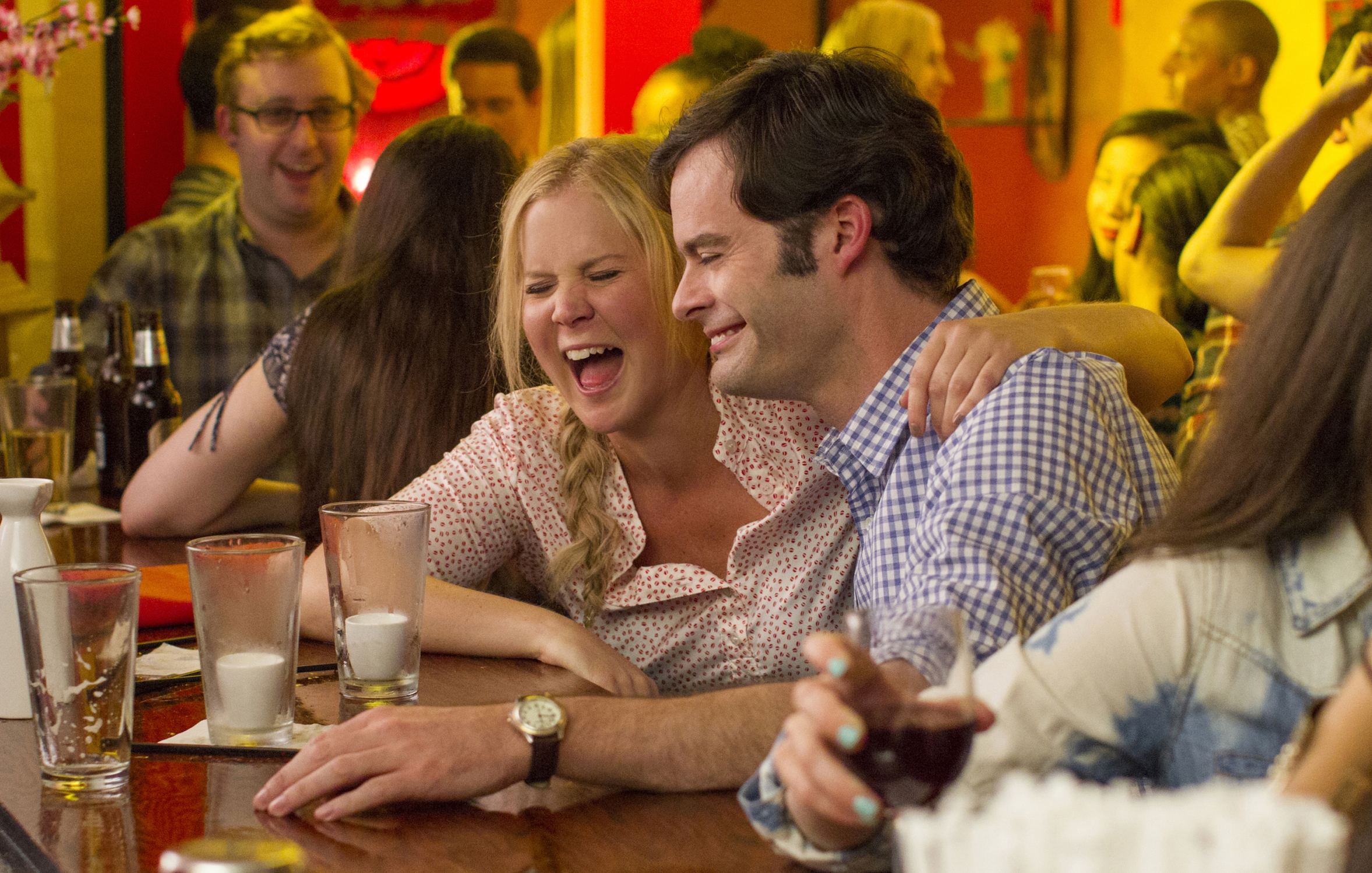
Trainwreck-Amy-Schumer-and-Bill-Hader 2

Not as much of one as you thought.

I wonder how many women will look at Amy Townsend in Trainwreck and relate to her from personal experience. If any of them do, I question how they are still breathing, or speaking in coherent sentences. Amy is the opitamy of a disaster in this movie. She’s a woman who drinks a lot, smokes a lot, lies a lot, and has sex a lot, with way too many sexual partners for comfort. If this woman was an airship, she’d be the Hindenburg.

There’s only one person to blame for Amy’s behavior besides herself: her father Gordon (Colin Quinn), who humorously compares sexual partners to toy dolls while explaining to Amy and her sister Kim (Brie Larson) why he’s getting divorced with their mother. He tells them to repeat after him as if he’s conducting an orchestra: “Monogamy isn’t realistic! Monogamy isn’t realistic!”

Twenty years later, Amy is practicing her father’s advice. Our first glimpse at seeing Amy Schumer as the character involves her making out with a man and taking her clothes off, only to see him take his pants off and realize she’s taking on too much for her own good. This isn’t Amy’s first rodeo. She’ll hit-it-and-quit-it with guys like she’s skeet-shooting clay at a shooting range, and she’s an expert marksman. Once she’s had her fill, she dumps them quicker than Sunday’s recycling. Her excuses after being asked out: “Oh, I’m sorry, but I have plans!”, “Sorry, but I don’t think you’re my type.”, and “Sorry, but I’m not really into that.” That last one is true.

Suddenly, she meets this one guy that seems completely different. Aaron Conners (Bill Hader) is a sports doctor who tends to players such as LeBron James and Amar’e Stoudemire. Amy gets assigned by her magezine to write a profile on Conners, but she ends up taking Conners home instead. But when she does, she also does something she never does with another guy: she stays the night. Now questioning her own lifestyle and what she really wants, Amy decides whether or not she wants to remain a trainwreck for the rest of her life.

I’ll start with the best thing about this movie: Amy. No, not the character, the actor. Amy Schumer not only portrays the lead role in the film: she wrote her. Schumer is credited for the film’s concept just as much as she is for the film’s character. In a way, I think she wrote this film for herself. The script is written with an honesty and integrity that is rare with most of Hollywood’s screenplays, but with a humor and lightheartedness to it that is equally as rare and refreshing. I asked a friend of mine what the movie was about before going in to see it. Was it a love story? Was it a cautionary tale about substance and alcohol abuse? Was it about the struggle of being a middle-aged woman in America?

My friends response was “Yes.”

Oh, don’t get me wrong. The movie is incredibly profane and inappropriate. It deserves it’s R rating in every sense and fashion of the word. F words fly out as frequently as oxygen does. Drug use and excessive drinking follows Amy everywhere like a bad, never-ending hangover. Cleavage is the movie’s guilty pleasure. Sex, even more so.

If this were any other movie, I would knock off points for this movie’s unabashedly loose image and dirty humor. I do the same thing with excessive, over-the-top action and unnecessary violence. Yet, I raved about Mad Max: Fury Road a few months ago for the very things I usually hate in films. Here is another movie subverting my expectations and surprising me in ways that I wasn’t expecting.

How exactly does it do that? Well, the language is bad, definitely, but it’s honest. It’s reflective of this day and age’s mentality, and the clever and genuine dialogue shows that the script is smart enough to substantiate the bad language. The drugs and alcohol usually imply a bad mentality, but does it really when it shows us how much of a toll it takes on its main character? Other movies use drugs and alcohol for offensively comedic effect: this one uses it to show another side to it that is less funny. And the sexual content, while inappropriate, also has something important to say about human relationships. I.e. what would you rather have: multiple temporary romances, or one lasting affection?

This is what is so special about this movie: it pretends to be dumber than it actually is. It disguises itself as a stupid and obnoxious comedy, like The Change-Up or The Hangover, but then you watch it and you see the many truths that it carries with it. It’s not only funny and entertaining to watch: it’s also morally and emotionally binding. To me, that’s the most important kind of entertainment out there: the kind that leaves an impact.

This is, of course, a romantic comedy. What’s all in romantic comedies? Cheesy endings, that’s what. And just like all romantic comedies, this movie is just as guilty for having one as well. But the movie itself is not cheesy, and it’s main star carries the weight of the film well all by herself with both heart and humor. Trainwreck is a good title for this movie. Beautiful disaster would be another.

Tagged , , , , , , , , , , , , , , , , , , ,

“ANT-MAN” Review (✫✫)

Fear me! I control ants! 

Here’s the perfect example of expectation affecting outcome. Let’s be honest: who was expecting anything out of Ant-Man? I know I wasn’t. I went in expecting a complacent, by-the-books, predictable superhero thriller. I left after getting that exact same thing.

Okay, maybe I’m being a little rough. The movie does have its moments, and it did at times give me slight enjoyment and chuckles. But how can individual moments replace an entire movie? If you compare Ant-Man to its other giant-sized movie counterparts (The Avengers, Iron Man, Captain America: The Winter Soldier), you will always arrive to the same word to describe it: smaller.

Taking place after the events of The Avengers: Age of Ultron, Ant-Man introduces Hank Pym (Michael Douglas), a genius scientist that rivals the intellect of Iron Man’s father Howard Stark (John Slattery). After realizing that the government was seeking his Pym particles, which allows him to turn into Ant-Man, to be weaponized, Pym goes into retirement, hoping to protect his particles from the world so that they would never be used for nefarious purposes.

Enter Daniel Cross (Corey Stoll), Pym’s ex prodigy. In modern day, Cross re-created Pym’s particles in the form of Yellowjacket, a suit similarly designed to Ant-Man and outfitted with the same capabilities. Desperate to get the suit and to further protect his invention, Pym enlists the only individual who can help take up the Ant-Man mantle: Scott Lang (Paul Rudd), a notorious thief who has a knack for getting into places he doesn’t belong, and a daughter he’d do anything to see again after separating from her mother.

It’s true, most probably didn’t think much about a superhero named Ant-man when this project was originally announced. But to be fair, this film does have some merit, despite its low expectations. The best thing I can say about Ant-Man is this: its fun. Meagerly fun, yes, but it still counts.

Honestly though, that doesn’t surprise me much. The film was originally written and was supposed to be directed by Edgar Wright, who is most known for his comedic action films Shaun of the Dead, Hot Fuzz, The World’s End, and Scott Pilgrim vs. the World. If you’ve seen any of those films, you know that he’s a clever and well-versed filmmaker who knows how to balance action and comedy with drama. If I were a studio head, I would have taken one look at his filmography, thrown all of my money at him, and shouted “Take it! Take it all! Take it and make more!”

So what happened? Simply put, Marvel happened. After a few creative disagreements between himself and Marvel, Wright left and Peyton Reed was hired in his place. Reed directed The Break Up and Yes Man before helming Ant-Man. Yeesh.

Luckily, Ant-Man survived it’s lop-sided pre-production into release. Well, maybe “survived” isn’t an appropriate word. Dragged by its insect legs is more accurate.

The biggest complaint about Ant-Man is that it’s inconsistent. Moments of heartfelt drama collide with out-of-place comedy. Comedy is bogged down by moments of forced emotion. The only thing that is consistent in the film is its action, which is surprisingly innovative to its premise.

For instance: in the first scene where Scott shrinks as Ant-Man, he falls into a bathtub. Who would have thought falling in between droplets of water and cracks in the floor would be so exciting and interesting? The details we see when Scott shrinks are extraordinarily eye-popping, immersing us in this whole new world we didn’t see before in regular proportion. Seeing Scott traverse into ant hills that turn big when he shrinks, communicating with insects his size when he’s small, and finding new locations inside smaller ones are among some of the fantasies we see when he’s Ant-Man. Seeing him fight as Ant-Man is the most fun. Who knew that a Thomas the Train set could be so dangerous to two miniature super-beings?

Other than the visuals though, the movie is sub-standard. It’s cookie-cutter in about every sense of the word. The comedy, the drama, and the acting is all forced for effect, and in the process, it has none. For Pete’s sake, even the movie’s villain is so bland. Who cares about some bratty little business executive who steals a powered suit for money, fame, and power? That was Obadiah Stane in 2007’s Iron Man, and he was a much more compelling villain than this standard archetype of an antagonist.

It’s true, this film didn’t have much to go on when originally announced, but the idea doesn’t count as much as the execution. People doubted Guardians of the Galaxy when that came out, and people reversed their opinions and said it was greater than The Avengers after they saw the film. I believe those same people will watch Ant-Man with no reaction as he flies in the air and goes “splat” across their window pane.

Footnote: If you do decide to watch Ant-Man, do not watch it in 3D. It has some of the worst particle effects I’ve ever seen in a 3D conversion, and I had to lift my glasses every five minutes to see how much brighter the film was without the glasses. I didn’t know that Ant-Man was supposed to be such a dark picture.

Tagged , , , , , , , , , , , , , , , , , , , , , , , , , , , , , , , , , ,

“KINGSMAN: THE SECRET SERVICE” Review (✫✫)

The name’s Eggsy. Agent Eggsy. 

For any of you who are planning on going into the moviemaking business, always keep one thing in mind: your audience. While most of them might be fairly desensitized and will enjoy senseless amounts of gore and violence, one or two of your audience members might not enjoy it as much, and indeed, might be so revolted by it that it affects their view of the whole picture. Does it really ruin all of the fun for everyone if you just tone down the blood and gore one or two notches? Just a few scenes can ruin a whole movie for your viewer, just like it did with me.

I know, I know, the movie probably wasn’t made for me since I’m being Mr. poopy pants by saying “ew” to blood. Can you blame me though? The MPAA rated Kingsman: The Secret Service R for “sequences of strong violence, language and some sexual content.” They didn’t indicate how disturbing it was, or even how frequent and over-the-top it was either. Adding the word “intense” to any of the film’s rating descriptors would not have been inaccurate.

The plot is based on a Mark Millar comic series The Secret Service. A young man named Gary “Eggsy” Unwin (Taron Egerton) is a troublemaking rebel who steals cars and gets into fights when his mother’s jerk of a boyfriend isn’t beating him up. His many delinquencies land him in jail, where he is told he’s going to spend the next 18 years of his life.

Yes, I know his name is Eggsy. Go ahead and laugh. I’ll give you a minute.

Eventually, he is freed by Harry Hart (Colin Firth), a tailor who has a thing for good manners and tall pints. What Eggsy doesn’t know is that Hart isn’t really a tailor at all: he’s a british spy, working for a secret service called “The Kingsman”, the same service Eggsy’s father worked with before he died saving Harry’s life. Now feeling a need to repay Eggsy’s father, Harry gives Eggsy a chance to become a Kingsman himself: to change his destiny and become the “gentleman” his father always wanted him to be.

The film is written and directed by Matthew Vaughn. If you know anything about Vaughn, its that his films have a very strong reception to his core audience, which I guess is… who, exactly? Masochists? His films have received an equal amount of both support and controversy in the past, including among them Kick-Ass and X-men: First Class. I myself am not a fan of him. Kick-Ass was a morally degenerate and violent escapade even worse than this movie, including horrific scenes of torture and child violence. First Class on the whole wasn’t controversial as it was incoherent, ignoring the rest of the series canon like it was a reboot instead of the self-purported prequel it was selling itself as.

But I don’t look at the director as much as I look at the film itself. What was this movie trying to be? An action-comedy. Did it succeed in that? On the whole, yes. Kingsman: The Secret Service is a humorous and stylish escapade with cartoonish violence and action equivalent to that of a Mortal Kombat video game. It had two goals here: being funny and exciting. It fulfilled both.

There was a lot I liked here with Kingsman. First off, the film was casted well. Egerton’s spunky rebellious attitude clashes well with Firth’s firm sense of structure and order, and makes for some good scenes with strong comedic dialogue in them. Mark Strong is a solid supporting character here, serving here as an adept tech assistant instead of the usual villainous roles that he does in his movies. Samuel L. Jackson was perhaps the funniest as the film’s main antagonist. In a career where Jackson spitballs lines of dialogue like bullets in films like Jungle Fever, Pulp Fiction and The Avengers, it’s both unexpected and refreshing to see him here talking with a lisp and with a sour distaste for blood. What kind of baddie doesn’t like to look at blood and give lengthy villainous monologues?

The action, while preposterous, is both stylish and exciting. Characters punch, stab, flip, grab, kick, and shoot each other in skillfully choreographed positions and movements, taking each other out in uniquely different styles that I haven’t seen before. Imagine a cross between the usual James Bond martial-arts fighting with the gunplay you’d see in a Die Hard movie. That’s the type of combat you see in Kingsman: The Secret Service, and its a rare visual treat that got me really engaged into some of the movie’s greater fighting sequences.

All in all, I was really enjoying Kingsman: The Secret Service until it got into the third act. Then it took a nosedive straight into the pavement.

I’ll try as hard as I can to describe this without giving many spoilers. In one scene, a church congregation starts slaughtering each other after the pastor delivers an incredibly racist and prejudiced sermon that I think is supposed to resemble the ramblings of Fred Phelps from the Westboro Baptist Church. This is one of the more violent and disturbing sequences in the movie, with neck snapping and people stabbings and body contortions into convoluted shapes that I didn’t even think was possible for a dead human being. The scene, while stylish and entertaining, was also equally disturbing and out of place. I laughed out loud, but I didn’t know if it was out of enjoyment or shock.

Another scene involved a mother stabbing a door in a Jack Torrance-Shining style, trying to kill her one-year-old crying daughter. That one was too much for me. I don’t like seeing child violence or distress in movies. Unless you’re having it in there to make a point about parentage or childhood trauma, scenes like that aren’t ever necessary to a movie.

Overall, we have a really cohesive film that on the whole works really well. What backfired was simply one or two scenes that severely clashed with the film’s overall vision, moments that took me out of the fun I was having to make me insanely sickened and disgusted at what was going on the screen.

The last out-of-place scene was one where a woman was asking Eggsy for anal sex. I think that’s a metaphor for something.

Tagged , , , , , , , , , , , , , , , , , , , , , , , ,

“INSIDE OUT” Review (✫✫✫✫)

A lot going on inside Riley’s head.

Pixar movies have a way of transcending fantasy and translating it into a form of reality. Does that make any sense? Of course it does, because you’ve seen many of Pixar’s masterpieces before. Up’s fantasy is about a man building a floating house about balloons, but the reality it’s portraying is an elder man dealing with personal loss and finding happiness in unexpected places. WALL-E’s fantasy is about a clumsy dumpster robot, but its reality is about discovering humanity and protecting our home and history. And Toy Story. Ooff. That’s a fantasy about one boy’s childhood with his toys and how they’ve impacted him into his adulthood. That is also its reality.

Here we have another colorful Pixar masterpiece that uses reality as its springboard for creativity and fantasy, using a human being as a setting, and her emotions as its characters. The human is Riley Anderson (Kaitlyn Dias), an 11-year-old girl who just recently moved from Minnesota to San Francisco. Her emotions are Joy (Amy Poehler), Sadness (Phyllis Smith), Fear (Bill Hader), Disgust (Mindy Kaling), and Anger (Lewis Black), and their memories with her make up the core of Riley’s personality and how she reacts in different situations. After the move-in, Riley gets all shaken up from all of the new adjustments she has to get used to, from being the new kid at school, to moving in to a home smaller than her old one. It’s up to her vibrant and unique emotions to try and keep Riley together and make her new life a happy, sad, fearful, disgusted, and angry one.

Written and directed by Pete Docter, who also helmed Pixar’s Monsters Inc. and Up, Inside Out is a clever, original animated feature that uses the human psyche as its playground. The best thing about the movie is seeing how creative it is in re-creating the human brain for a child’s mind, and seeing children react to all of the colorful adventures going on in this infinite cranial wonderland.

The first thing you notice with the film is its animation: vibrant colors and character models reach out to you in vivid details, even more so without the dimmed effects of 3D. Memories come in the form of small bowling ball spheres, colored after the fashion of each of Riley’s emotions. Different parts of her life are modeled into vast theme-park-like islands, from Family Land all the way to Goofball Island. Each island is also jam-packed with its own sleek features and gadgets that make you feel like you’re in the wonderful landscape of Disney land. Be honest: you would love to ride the literal “Train of thought” if it existed, wouldn’t you?

The film’s creative landscape, though, is to be expected. We’ve seen dozens of vast, colorful settings from many of Pixar’s films before. Andy’s room in Toy Story. Paradise Falls in Up. The AXIOM in WALL-E. You can probably name one setting that struck your eye in each movie, from the world of self-aware automobiles in Cars to the anthill in A Bug’s Life. Pixar has never failed in creativity, and I doubt anyone expects them to start failing now.

What I’m most impressed with is how the film handles its vastly ambitious premise, even with the film’s somewhat purported flaws. For instance, in Riley’s mind, a lot of childish, silly things go on that might make adults go on “offline” mode while the kids laugh at the overt goofiness going on the screen, like double rainbows and processed boyfriend machines. The characters are mostly one-dimensional, and for a film that has five emotions in it, the movie primarily focuses on only two of them: Joy and Sadness.

In any other movie, these quote-unquote “flaws” would make the film a weaker experience for me. It didn’t here. Why? The film’s premise, setting, and execution constitutes a need for each of these elements, making them contributors to the plot instead of distractions degrading from the experience. I would knock the film for being really silly and goofy at times, but it’s taking place in a kid’s mind. What else would be in the ecstatic and excited mind of a child? Doom, gloom, and misery? The characters are mostly one-dimensional and go through little change in the motion picture, but isn’t that kind of expected? I mean, what emotions do you think characters named Joy, Sadness, Fear, Disgust, and Anger are going to feel? Woe, Delight, Calm, Desire, and Peace? That would break their characters, and detract from the personalities and make them who they are. Finally, there’s the greater focus of using Joy and Sadness as the film’s key players instead of the others. There’s a specific reason for doing this. It’s because those are the core emotions any human being is going to experience: positive and negative.

In the film, Joy and Sadness conflict with each other with their contrasting personalities, each one trying to help Riley in the best ways that they can. Joy wants everything to be happy and optimistic, and for Riley to feel the enjoyment out of every situation. Sadness focuses on the reality of each situation and on the raw reactions one may feel from those that are less than happy. While both emotions conflict with each other in the ways they want to help Riley, they are ultimately the most essential for her. They allow her to express her emotions in their purest forms: in either pure Joy, or pure Sadness.

This is the ultimate meaning of the film, in that there are different things that make up each human being. Some has more anger in their bodies than others. Some may be filled with more Fear than others as well. But like the animated, wacky emotions in Riley’s curious little head, we’re all unique to each other and in the ways that we handle life’s problems. It’s how a baby will react differently to a traffic jam in how a taxi driver would. It’s how a fully-grown man will react differently to broccoli-covered pizza than a toddler would. It’s how a young, maturing boy will react differently to meeting a girl for the first time, and visa-versa.

As human beings, we are all made up of different emotions and personalities, but being different doesn’t mean being bad. Sometimes we need to experience the rawness of certain emotions for certain situations, and that’s not a bad thing. Sometimes, we need the help of Joy, Sadness, Fear, Disgust, and Anger to get through life. How we express those emotions is what makes us who we are, and we end up being human beings as unique and diverse as Riley’s wonderful emotions are because of them.

Tagged , , , , , , , , , , , , , , , , , , , , , , , , , , , , , , , , , , , , , , ,

“MAD MAX: FURY ROAD” Review (✫✫✫1/2)

A lovely day and a flaming guitar. 

I’ve never seen a movie break as many rules as Mad Max: Fury Road does and get away with it. I’ve never seen a movie so loud, obnoxious and over-the-top that still manages to impress me by the time the end credits roll. Previous movies have done the same thing Fury Road has done and failed spectacularly. Transformers. Resident Evil. Underworld. G.I. Joe. Fast and Furious. All of those films are every bit as explosive and stupid as Mad Max: Fury Road is, and yet I don’t love them as much as I do Mad Max. Why is that?

I think its because the movie knows its just that: a movie. It knows that it’s loud, obstinate and stupidly explosive. It knows that its a blockbuster of exceedingly epic proportions that shakes the theater so much, it makes viewers shat in their pants. And more than anything else, it knows it is an action movie, with all of the fun and flaws alike bundled with it.

So what does a director like George Miller decide to do with that, knowing this is the fourth film in his own franchise? Fix the mistakes that are present in all of his predecessors?

No. Instead, he decided to embrace them, like a soldier throwing himself onto a hot grenade.

The end result is exactly how it sounds: bloody awesome.

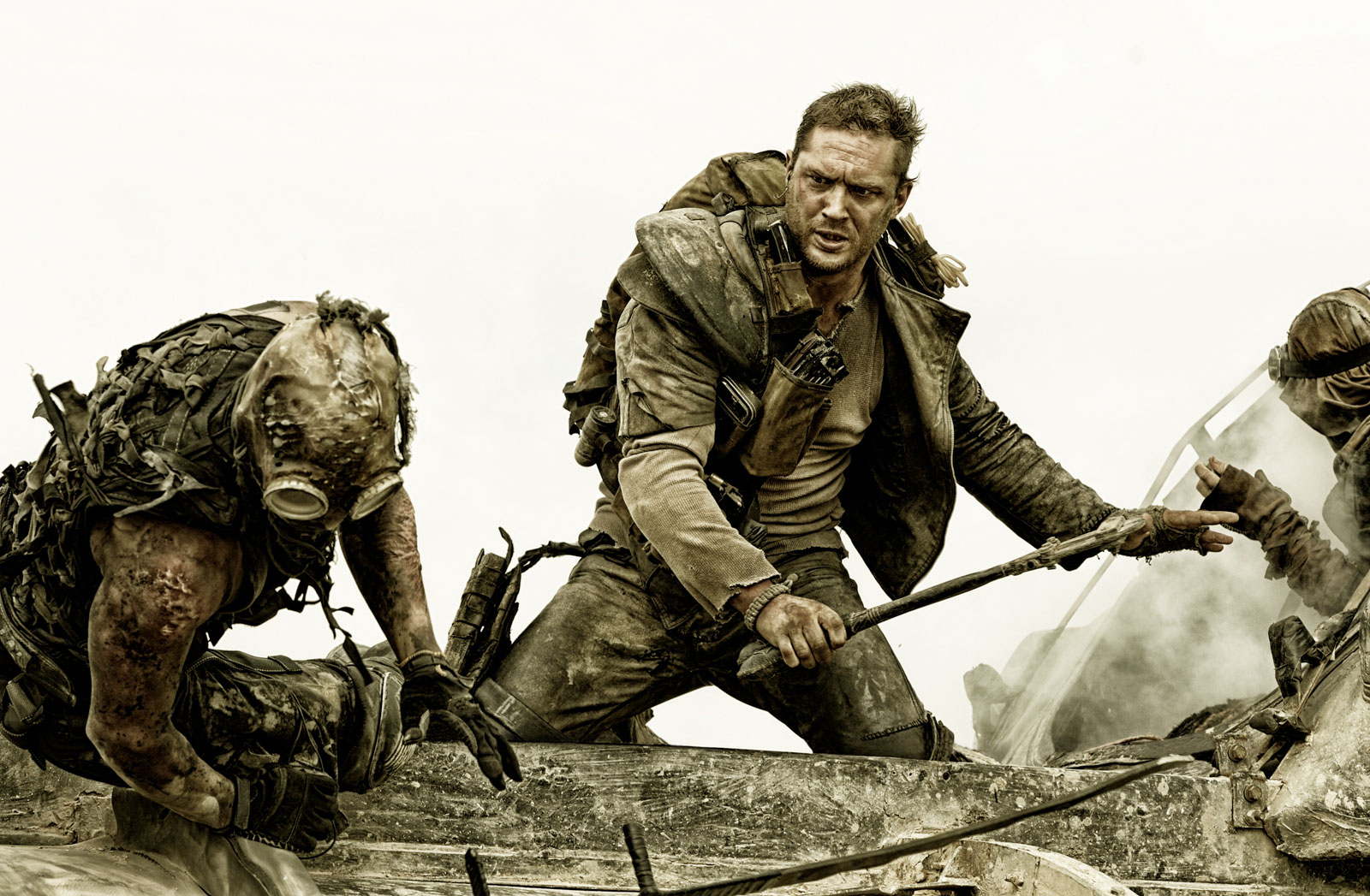
The plot (if you can call it that) follows Max Rockatansky (this time portrayed by Tom Hardy) after the events of Road Warrior and before Beyond Thunderdome. In this desolate landscape called planet Earth, Max is a survivor of Nuclear war, traveling dry and sandy deserts in silence and solitude. Everyone else around him is either dead or has signed up in the mad crusade of Immortan Joe (Hugh Keays-Byrne), a tyrannical warlord who has idolized himself as a god and has labeled everyone under him as his followers. Considering he has control over the only water source over hundreds of miles, the survivors have little choice but to submit to him.

One of these followers is Furiosa (Charlize Theron), a fierce female warrior who is charged with transporting Joe’s water to a nearby town with her small battalion. Little to Joe’s knowledge, however, Furiosa is transporting something else: all of Joe’s wives. Now on the hunt from Joe and all of his maniacal followers, Furiosa needs to team up with Max to escape the desert landscape and free the wives that have been under Joe’s cruel control for so long.

Is the plot as stupid as it sounds? The answer is no, because the film really doesn’t have a plot, only the resemblance of one. The narrative is a weakness all of the films in the series share with each other. While other science-fiction movies have a rich amount of lore and backstory behind them, Mad Max doesn’t have as much to boast about in its own series. Really, as far as story goes, all of the Mad Max movies are kind of weak in narrative scope. Here’s the plot for all of them: a guy is trying to survive against a homicidal maniac in a deserted landscape. That’s it. It’s a big case of “what you see is what you get.”

Here’s where Mad Max: Fury Road is different though: there’s a lot to see. Even though the plot is about as thick as a studio pitch, Miller displays this meager plot in spectacular, stunning, eye-popping action and explosions, and even a few soft moments of short dialogue exchanges between characters.

The stunts are unlike anything you’ve seen in any of the previous movies. The most destruction you found in Mad Max and Mad Max 2 was cars exploding and toppling over into deep sand dunes and rocky road pavements. In this movie, vehicular manslaughter is the least of the destruction found in the film. In one of the first action sequences, an entire armada of Joe’s fleet follows Furiosa into a giant sand storm of extremely windy proportions. In another scene, gang members viciously chase Furiosa’s truck in a tightly-cornered crevice of mountains. In another, a flunkie gets blinded by gunfire, puts cloth around his bleeding eyes, then fires blindly at Max and his gang like a crack-happy trigger maniac. For crying out loud, there’s one underling in the film that uses a guitar flamethrower.

Yes. That’s right. A guitar flamethrower.

It’s obvious that the film is ridiculous and absurd in the most gleeful of ways. Yet, what I like so much is that in between all of the over-the-top and in-your-face action, there’s actually a purpose and a reason for actors being in the movie. Yes ladies and gentlemen: this is an action movie that has actual acting in it. Hardy replaces Mel Gibson’s role with hardened machismo and stiffness to his gesture, and while Max is still mostly a flat character, Hardy portrays him with a sort of intrigue to him that makes you curious about his history, even though we already know most of it. Theron, however, impresses me the most. She’s incredibly versatile in the film, being a firm and uncompromising action heroine in one moment, and an emotionally exhausted and stricken survivor in another. She’s honestly the real lead in the film, with Max being more of a supporting character to Furosia’s rebellion against Immortan Joe. The film is really empowering to females, and that’s an incredibly rare thing, especially for an action movie.

By now, you’ve hopefully gotten the idea of what the movie is like and whether you’d be interested in this sort of thing or not. The film definitely has its flaws, but by God, the movie is just so freaking entertaining. I can’t sum up the film any better than that. Now go get your movie ticket. There’s a flaming guitar that you need to see.

Tagged , , , , , , , , , , , , , , , , , , , , , , , , , , , , ,

“THE LEGO MOVIE” Review (✫✫✫1/2)

Bricks, businessmen, and Batman.

The last thing I expected from anything titled The Lego Movie was anything good. How could I? The trailer had the reeking stench of an advertisement, barely differentiating itself from the Lego set commercials that air on children’s cartoon networks. Believe me, I went into this movie expecting an artificial, brainless experience looking only to profit itself from the name of it’s toy line. Boy, do I love it when I am proved wrong.

Based in a colorful world full of Lego bricks, buildings, and set pieces, The Lego Movie follows Emmett (Chris Pratt), an average, regular, 100% ordinary minifigure who loves coffee, people, Taco Tuesdays, cats, cars, work, television, and just about everything else under the orange Lego-bricked sun. If any of the characters in the film knew that they were in a movie, none of them would expect Emmett to be the main character: he has the personality and the appearance of a background character if anything.

One day, while working at his construction job, Emmett comes into contact with a strange red object called “The Piece of Resistance”, and passes out. When he wakes up, he is recruited by Wyldstyle (Elizabeth Banks), a punky and feisty master builder who tells Emmett that he is part of a prophecy that declares that a powerful being called “The Special” will find the Piece of Resistance and use it to overthrow Lord Business (Will Ferrell) and his plans to conquer the Lego-verse. As a result, Emmett gets catapulted into a decade-long conflict between wizards, robots, businessmen, DC superheroes, crazy cats, cyborg pirates, spacemen, and Batman.

Good God, where do I start with this? The Lego Movie is by every definition, a surprise; a fun and wacky little adventure that is just as original and audacious as it is clever and funny. Written and directed by Phil Lord and Chris Miller, the same guys who co-wrote and co-directed Cloudy With A Chance of Meatballs, these filmmakers worked to instill the same sense of energy, youth, and entertainment from that movie into this one. It’s surprising that the movie is not just good: it’s borderline great.

One of the things I love most about the movie is the animation. Like any great animated film, it reaches out to you in vivid, eye-catching detail, it’s beautiful colors and visuals striking out to you like a panel on a beautifully-crafted graphic novel. But it’s not just how the animation looks in itself: it’s also in how Lord and Miller achieved the effects they were going for. Nearly everything in the film was modeled from lego bricks and pieces, and I do mean everything. The buildings, the vehicles, the space stations: even seemingly trivial things such as the water, lava, and clouds are all made out of lego pieces, with explosions literally showing red-and-orange lego studs as they blow up. It would be so easy just to be cheap and give basic effects for the wind, the water, fire, sky, and everything else in the film, but Miller and Lord didn’t want to go that route. They wanted to make an authentic, accurate world jam-packed with lego pieces and objects. To put anything else in there would just cheapen the effects, and their persistence made for the best visual result that they could possibly have had.

Just as much though, I love the characters Lord and Miller wrote for this movie. Like the animation and lego bricks, they all have variety to them, and they all have colorful, unique personalities that make you want to relate to each character. You have Benny, a 1980’s space astronaut who is so obsessed with spaceships that he could build one from a pile of garbage bricks if you dared him to. You have UniKitty, a unicorn/kitten that has such a split sweet/violent personality that she would scare little children if they were locked in the same room with her. There’s Metal Beard, a pirate-turned-cyborg whose body literally blows up like a amalgam of lego bricks like a real lego mini figure. Also, Batman is in the movie.

The key character here, however, is Emmett, a sweet and charming little mini figure with intentions so pure, he at times can seem like a child with his quirky little antics. Emmett is the epitome of childhood in this movie: innocent, curious, creative, passionate, and at times a little too immature for his own good. His strengths and his flaws both make up for a very interesting character, a mini figure that we can all relate to because of his average nature and his desire to be greater than he already is. He may be made out of Lego pieces, but Emmett is more human than most of the live-action actors you’ve seen in motion pictures this year.

The movie does suffer from a slight drag in run time, and like it’s protagonist, the movie is at times too childish for it’s own good. That doesn’t change the fact that this movie is a clever, funny, original, and heartfelt take on childhood and what it means to be grown up, but always remain young at heart. The Lego Movie is much more than just a movie. It’s a celebration of creativity.

Post-script: Did I forget to mention that Batman is in the movie?

Tagged , , , , , , , , , , , , , , , , , , , , , , , , , , , , , , , , , , , , , , , , , , , , , , , , ,

“BIRDMAN” Review (✫✫✫✫)

The artist’s struggle, all in one take. 

Birdman, or otherwise known as The Unexpected Virtue of Ignorance is one of the most mesmerizing films I’ve ever seen. It is also one of the most unique, disturbing, shocking, and confusing films I’ve ever seen too. That’s okay. This film was reaching for a specific vision, and director Alejandro Inarritu has expanded beyond it. I admit I don’t know what to expect as far as the public reacting to this, and I also don’t know how accessible it is to non-film aficionados either. But I have seen the movie frame by frame, and I think it’s one of the best films of its kind. On the surface value, it’s about the struggles of Broadway theatre. In deeper insight, it’s about ego and the obsessive human condition.

The film stars Michael Keaton as washed-up actor Riggan Thompson, who has been forgotten by his adoring public after portraying the lead role in a series of superhero films titled Birdman. This is ironic, because in real life, Keaton portrayed a superhero in Tim Burton’s 1989 film Batman. Desperate for a comeback, Thompson sets out to write, direct and star in his favorite Broadway play: What We Talk About When We Talk About Love by Raymond Carver.

Things immediately hit the fan during the week of their first preview. One of Riggan’s actors gets a head injury from a loose light on the set. His replacement, Mike Shiner (Edward Norton) is a talented but brash and arrogant actor who sees himself as Riggan’s superior. And, as he faces personal problems with his estranged daughter Sam (Emma Stone), Riggan begins to feel the closing pressures of Broadway when a malicious theatre critic tells him she’s going to “kill his play.” Now Riggan is trying to keep the play and his sanity afloat, and he will make whatever sacrifices he needs to make sure both happens.

Written, directed and produced by Inarritu, Birdman is the first black comedy made by the filmmaker, his most successful films to date being Oscar nominees Babel and Biutiful. Now he has made Birdman, and I am tempted to say it’s the best film he’s made yet.

What worked so well with the film? The first thing is the editing and the cinematography, which was shot so wonderfully by Oscar winner Emmanuel Lubezki that it places you in the moment, in the reality of the film, not making you watch it from a cushion seat on the eighth row of a dark movie theater. Lubezki, who worked with Inarritu on short films in the past, decided to shoot the film and edit it into a continuous fashion, giving off the illusion that the entire film was filmed in one take. Even though the movie wasn’t filmed in one shot, the feeling it gives off makes it feel alive and moving, not unlike the world of theatre that Riggan is trying to prove himself in.

I wonder how much effort this takes, not just from the cinematographer and director’s point of view, but from everyone else involved in the film as well. How many hours did the actors need to rehearse their lines in order to get their roles right? How much pressure was the tech and lighting crew under while they were filming, knowing that if they screwed up, everyone would have to start back to square one? How many hours did film editors Douglas Crise and Stephen Mirrione have to sit in front of a computer, making sure the shots transitioned so well that you couldn’t even see the transitions? The illusion not only worked because of the idea that Lubezki and Inarritu offered, but because of the commitment it received from everyone involved with the film. In many ways, their efforts were all worth it: the camerawork here expresses more of the story than the character’s dialogue does.

The parallels in this movie are also ingenious. How does Keaton feel playing as Riggan Thompson in the movie, knowing that he reached international fame as Batman earlier in his career and having since then never been able to match a more recognized role? How does Inarritu feel, going through all of the production pressures Riggan did in making the play as he himself did in making the movie? Did he intend this movie as self-reflection? Is he telling the audience what he goes through daily as a filmmaker? Or is he using his struggles as a platform to tell a much deeper, more important story to the audience?

For me, I don’t get as much joy out of interpreting as much as I do out of experiencing. And make no mistake: Birdman is an experience, surreal, tantalizing, and thought-provoking all at once. I’m still sitting here, hours later, not quite fully realizing what exactly Inarritu was trying to portray in this film. Is he commenting on the artist’s struggle? Commercial vs. independent film? Fatherhood? Friendship? Family? Lost love?

I think it’s all of the above. Or maybe none of the above. I honestly don’t know. In the movie, Inarritu battles labels that are placed on artists and on the art that they produce. Is Riggan Thompson a superhero, or an actor portraying a superhero? Is he a former shell of who he is, or a flower that has yet to bloom? We see in this film how these labels influence his life and how much stress and anxiety it presses upon him. To put labels on the movie would contradict Inarritu’s intentions. It would be offensive to the film.

My bottom line: Birdman is a masterpiece. It is so distinct in its own language and style that I think it is impossible to define it, let alone replace it. Critics will applaud it for it’s technical and emotional achievements. It will definitely garner some Oscar nominations. It’s a sure contender for visual effects, cinematography and editing. It is also sure to confuse certain people, to which I would recommend stop trying to understand it. Birdman is not meant to be understood. It is meant to be experienced, and if you can help it, interpreted.

Post-script: A thought I had after seeing the movie that I think viewers will also have. Because of how profoundly his role as Birdman affected Riggan, is Inarritu attacking the superhero genre of film? I believe he is, but I choose not to acknowledge that. After all, for every time a superhero film was called too simple, couldn’t you call any art film too complicated? I quote Mark Twain: “Too much of anything is bad.” 

Tagged , , , , , , , , , , , , , , , , , , , , , , , , , , , , , , , ,

An Afternoon With Alejandro Inarritu

“And did you get what you wanted from this life, even so?

I did.

And what did you want?

To call myself beloved, to feel myself beloved on the earth.”

– Raymond Carver

These were the words that director Alejandro Inarritu (Babel, Biutiful) chose to quote at the beginning of his meticulous film Birdman, or The Unexpected Virtue of Ignorance. It was also the first words that came back into my head minutes before I was to interview him.

This weekend, I had two great experiences happen to me. Firstly, getting to see Birdman, a viciously unique film that tackles it’s characters and themes with pinpoint precision: a masterwork by a master director. The second you already know. If you don’t, you didn’t read my first paragraph.

Alejandro gave myself, along with about ten other college journalists, the privilege to talk to him about his upcoming limited release. After seeing the movie, this surprised me, because there was a moment in the film where a journalist accuses the main character of injecting semen into his pores to maintain his young features. I suspect Mr. Inarritu hosts a very guarded spirit while being interviewed by the press, and I certainly don’t blame him for that if that is the case. Now that I think about it, maybe that’s why Inarritu wanted to host the interview over the phone in the first place.

Anyhow, I had 20 minutes to listen to the director’s innermost thoughts, and while I only got to ask him one question, I enjoyed the experience as much as any other college journalist who participated in the call. While all of these aren’t my questions, these are the ones I found the most relevant to the film, and the ones I believed Inarritu would have preferred to be answered in the first place. So without further adieu, here is Alejandro Inarritu on the unexpected virtue of ignorance.

Question: Your film is unique, hyperactive and full of energy. How do you communicate to your cast the complex tone you’re wanting to portray?

Answer: I always try to be very specific, help them to clarify and simplify things by having a very clear objective. I think every scene has an objective, and every character has something they want to achieve in each scene. When you have cleared your objective, and to try one or two possible ways to get that done through an action verb, I think that would simplify the work not only for me, but for everybody.

Q: What were some of the challenges you faced while making the film? 

A: It was a very short shooting — 29 days. We rehearsed a lot before arriving to the set, so basically it was a very intense and meticulous work of precision with actors, camera and crew. Everything was designed and matched the needs of the film that was basically predecided in rehearsal.

Q: You have a big role behind your scenes in producing, writing and directing all of your films. What is it like taking on all of those jobs at once? 

A: I have been lucky to have been the producer and be involved in all of my films in a very personal way. I think there is no other way to make it. I think if you have a film that is personal, if you are doing your own film, there is no other way to not produce it, because I think it’s a part of the film. Producing means a lot of decisions that will impact your film one way or another.

Q: In the movie, Riggan Thompson is overshadowed by a superhero role he played earlier in his career. In real life, Keaton is overshadowed by his role in Tim Burton’s Batman. Is that an intentional casting decision that you made?

A: Keaton adds a lot of mental reality to the film, being an authority and one of the few persons of his work that pioneered the superhero thing. But at the same time, he has the craft and the range to play in drama and comedy, and very few actors can do that. He plays a prick in this film, and I need someone who was adorable, somebody who you can really like. He has that likeness, that likeness that was required. All of these things made him the perfect choice for it. I think he was very bold in trusting me with this role.

Q: One of the things that is particularly interesting with the film is the long take. Can you talk about why you made that visual choice?

A: I wanted the long take to make the people really feel the experience of this guy. I think it’s important for every director in every film to pick the point of view, and in this case I wanted radical point of view, and the people were in the shoes of the character to experience his emotions. I felt that was the most effective way to do that.

Q: Why did you choose to portray mental illness in a film that is at least extensively a comedy?

A: I think ego is a part of our decease as a society. I think the ego is a necessity, but I think when the ego takes over and we attach our personalities to the ego, and he domains a person absolutely without being discovered or controlled. That’s mental deceit, and I see in a way Riggan Thompson suffering from that illusion of ego that’s distorting him. He thinks he does things that he does not do, he’s in like a manic state of mind. He’s an extreme case of ego.

Q: Is that part of the commentary?

A: Everything is part of the tone of the film. That’s why it opens with a guy meditating in tidy whites.

– David Dunn

Tagged , , , , , , , , , , , , , , , , , , , , , , , , , , , , , ,

“SIN CITY: A DAME TO KILL FOR” Review (✫)

Can you kill me too while you’re so busy at it? Thanks. 

There’s a character early on in Sin City: A Dame To Kill For that describes the city as a place “where you go in with your eyes open, or you don’t come out at all.” He’s wrong. I went in and out with my eyes fully open. I only wished that I kept them closed.

Oh, where to begin with this. Sin City: A Dame To Kill For is, in a word, messy – a neo-noir thriller as confusing as a detective’s murder case and more violent, putrid and horrific than a crime scene. The only brains this movie has are the ones that it blows out of peoples’ heads.

The plot takes place sometime within the Sin City universe. The question is when? I honestly don’t know, and I don’t think the movie knows either. It’s part prequel, part sequel and part in-betweenuel that cuts to wherever and whenever it wants to.

Like the first movie, there are three main stories the plot revolves around and, likewise, three main characters to sympathize with. You have a young Dwight McCarthy (Josh Brolin), who, before he met Jackie Boy, was obsessing over a rich housewife named Ava (Eva Green). There’s Johnny (Joseph Gordon-Levitt), an overly-cocky poker player who wants to come to Sin City and beat the king of all cards himself — Senator Roark (Powers Boothe). And then there’s Nancy (Jessica Alba), who is still coping with John Hartigan’s (Bruce Willis) suicide at the end of Sin City.

Following this easy enough? Good, because that’s all the explanation you’re going to get. The biggest problem with Sin City: A Dame To Kill For is that it’s so convoluted. Stories are meshed, mixed and thrown together without any sense of connection or correlation to its plot, and the entire time while I was watching it, I kept wondering where these stories were taking place and why I should care. Some movies do well with intertwining narratives, such as Pulp Fiction or Crash. This is not one of them.

A good example of this is in the very first scene of the film. Marv (Mickey Rourke), the hard-headed thug who was framed for the murder of Goldie in the first movie, wakes up next to two crashed cars with no memory of how he got there. He goes through mundane dialogue for five minutes in his obviously exaggerated thuggish accent, then the movie cuts to the story and almost completely forgets about him.

My first thought after watching this: why was that scene necessary? As the movie continued its runtime, I continued to ask this question in my head until I realized that none of it was necessary, that it was just a continuous farce of violence and delinquency that the kids who play Grand Theft Auto would just drool over.

This movie is definitely violent. That’s to be expected, I know, especially when you remember how violent the first one was. There is, however, a stark difference in how the violence is used in each movie. In the first Sin City, the violence was both shocking and satirical, at times being so disturbing that you can’t help but reel back from it, and at other times being so exaggerated that I laughed at it. Whether it was positive or negative, however, I at least felt something.

Here, nothing is felt. Here, we just look at all shades of black, red and white among severed body parts while we plod through the final act like it’s a homework assignment rather than the climactic ending that it deserves to be.

I’ll admit to having disliked the first Sin City. Does that matter? I give credit and criticism equally where it is due, and even though both Sin City’s are equally violent and despicable, the first one was at least more intriguing and had more cohesiveness both as a whole story and as smaller, separate narratives. This one fell flat, crumbled to pieces and was about as clear as a muddy window pane. Maybe that’s why Marv couldn’t remember anything at the beginning of this movie – he realized what he signed up for, and he tried to forget all about it.

Tagged , , , , , , , , , , , , , , , , , , , , , , , , , , , , , , ,

“SIN CITY” Review (✫✫)

“There ain’t no sunshine when she’s gone.”

You’re either going to love or hate Sin City. There’s no getting around that fact. Like the movies directed by Quentin Tarantino or Eli Roth, Sin City is a movie specific to its own tastes, and doesn’t care much about the opinions opposite of it. It’s a violent, gross, disgusting and putrid film full of the stuff that would make a Catholic priest faint. If that sounds like something you would like, by all means, be my guest and have at it. If you are repulsed by my description of the film, I certainly don’t blame you.

Based off of the comic book series by Frank Miller, Sin City is a film that follows four separate stories that (mostly) intertwine together. John Hartigan (Bruce Willis) is an aged police officer who is viciously pursuing child rapist Roark Jr. (Nick Stahl). Marv (Mickey Rourke) is a rough-around-the-edges thug who is framed for the murder of a prostitute he slept with named Goldie (Jamie King). And Dwight (Clive Owen) is a private investigator who gets pulled into a turf war, risking the lives of cops and prostitutes alike.

What do all of these stories have in common? They all started because of a woman, and these men go out to kill because they love their woman. Or, at least, whatever constitutes as love in this universe, in which case it’s a one-night stand.

It’s so difficult to review a movie like Sin City. Why? Because it’s not for people like me, that’s why. I don’t like watching movies like Sin City. I don’t like watching blood and violence for the sake of blood and violence, or watching sex and nudity for the sake of sex and nudity. It’s hard to be non-biased with movies like these because I watch moments where a naked woman walks out with bare breasts and all, and I can’t help but imagine the director thinking “Hey, let’s have this actress naked in this scene, because boobs.”

Sin City is aggressively, unnecessarily violent. How violent? So violent that the least bloody scene in the movie came from Quentin Tarantino. That’s how bad it gets. Red, white, black and yellow blood splatter across the screen like Jackson Pollock was making a painting. Severed heads and body parts are frequently cut off and thrown around in the film like missing pieces to a G.I. Joe. Those body parts include testicles, by the way, on multiple occasions. And don’t even get me started on the absurdity of its kills. In one scene, Marv gets beaten, stabbed, shot, and crashed his car into a lake and still gets up to pursue Goldie’s killer. Good God, are these guys made of kevlar or something?

Remind you, I have no problem with violence in movies, but here it’s just far too absurd and disgusting to be able to fully stomach. When it’s used to illustrate an emotion or a point in movies like Pulp Fiction or Taxi Driver, I praise its purpose and its usage. Here, it illustrates no emotion or urgency. It’s a glorified selling point for a really long, disgusting, stupid movie.

I did like the visualization of Sin City. That, and its opening scene. I liked it’s black-and-white style, it’s sense of contrast and expert use of shadow and lighting. It gave it a strong reminiscent feeling of the classic neo-noir films that inspired the original Sin City comic books, the ones that have the snazzy saxophone playing in the background as two lovers stand on a balcony, telling each other that they love each other and that they never want to leave each other. The film itself, in fact, functions as a parody of the neo-noir genre: characters stand on balconies, docks, outrun police cars, smoke cigarettes and talk in thickly exaggerated accents to the point where it can’t be taken seriously.

Realize, however, that this wasn’t on accident; director Robert Rodriguez wanted you to see how he exaggerated details so you would understand that him and Frank Miller were lightly poking fun at the genre, all while at the same time suggesting delicate homages to it as well. I like that they tried to reach for a deeper effort with the film, even though their intentions were smarter than the film itself was.

So what’s my end consensus? Is it a movie that you should see or skip? I’ll leave that decision in your hands. For now, I have done my job in telling you what the movie is like, and I will wash my hands clean from it. I have church in the morning.

Tagged , , , , , , , , , , , , , , , , , , , , , , , , , , , , , , , ,