Tag Archives: Explosions

“THE AVENGERS” Review (✫✫✫✫)

The ultimate example of comic-book superhero movies. 

I remember opening a comic book for the first time in my life when I was just a small kid. The small pamphlet fascinated me: by just a flip of a page, an entirely different world was created. A world where normal people gained super powers, wore red capes and tights, fought evil wherever it may exist, and made the world a safer place by the end of the day. In a small, poor neighborhood town where I was the only white kid in a predominantly Latino school building, it provided me a sense of relief and sanction from much bullying and torment I experienced from the other school children back in the day. It provided me freedom from the accursed world I lived in: it provided me a means of escape.

And now here I am, 15 years later, watching a live-action re-enactment of the world I discovered and loved all those many years ago. The Avengers is masterfully fantastic. It is an epic superhero tale, portraying the never-ending conflict of good and evil. It is an action movie with surprising finesse, switching from scenes of explosive energy and action to other scenes with insight, humor, and heartfelt emotion. It is a faithful re-production of multiple universes we have come to love in the past four years, and re-adapts them faithfully and full of energy in this film. But the core of this film’s success is this: that the film’s story and themes are emotional, honest, and truthful, and fleshes out its heroes to make them what they are: humans. All fighting for very human, realistic, and understandable reasons.

If you’ve seen the previous Marvel entries, you already know what this movie is about. The Avengers is a group of superheroes brought together to fight the battles that human beings never could.  Who are these heroes?  You would know most of them.

Tony Stark “Iron Man” (Robert Downey Jr): A billionaire playboy/philanthropist that has a genius-level-intellect that has allowed him to build and fight in a suit of armor.

Bruce Banner “Hulk” (Mark Ruffalo): A scientist exposed to gamma radiation, who turns into a giant, brutish beast with monstrous strength when he becomes angry.

Natasha Romanoff “Black Widow” (Scarlett Johansson): An agile and intelligent spy that is more skilled and capable than most other men.

Clint Barton “Hawkeye” (Jeremy Renner): A masterful marksman who can aim and shoot with his bow and various arrows in a matter of milliseconds.

Thor (Chris Hemsworth): The Norse God of thunder who can manipulate lightning with the power of his mighty hammer, Mjolnir.

Steve Rogers “Captain America” (Chris Evans): A super soldier frozen through time who can beat criminals to a pulp, as well as wielding a shield cast in a rare metal called “vibranium”.

You’ve seen these heroes before, most of them in their own respective movies.  All with their own stories, origins, conflicts, and themes that were explored along with their respective characters. My original worry with this film was, despite the huge expectations people were having, I was afraid this movie would let people down. It does, after all, have a lot on its plate: adapting over six superheroes into one action-packed movie is no easy task. We have Batman Forever and Spiderman 3 as evidence of that, where they had trouble of adapting even four super-powered beings to the big screen.

This film, though, has surprising finesse. Writer-director Joss Whedon adapts these characters with such child-like love and faithfulness, I feel their themes and stories from their previous films carry over to this film with them. It doesn’t feel like an adaptation, or an act of cruel financial commercialism. It lives up to the hype. The characters in this film live and breathe their uniqueness we have come to know and love from the previous Marvel movies. We feel Iron Man’s sarcasm and big ego, Thor’s sense of responsibility and brotherhood, Banner’s fear, frustration, and anger, and Steve’s sense of honor, patriotism, loss, and duty. Through the film’s dialogue and references to prior films, we sense Whedon’s pure intentions underneath the action, and we respect it. We realize he isn’t making just another action movie; he is making a superhero movie.  One with upmost faithfulness and loyalty to its own universes.

Impressive also, are the actors, but I don’t need to tell you that. We’ve seen them in prior films, so we already know they are good. I will comment then, on something we haven’t seen yet: their chemistry with each other. My word. This is what makes the Avengers, The Avengers. The actor’s chemistry with each other is spot-on, and in-tune. Whether it is a scene involving humorous, sarcastic dialogue, or another scene with painful realism and emotional truth to it, there is reality being shown in every single shot when an actor is with another Avenger on-screen. I can’t accurately describe it to you and do it justice. You need to see the film to understand their relationship with each other.

People are also wondering, of course, if the visual side of the film delivers. The answer is yes, but it isn’t just because it looks great; it is because of how they handled the great visuals they had for this picture. Too many times are we given films that have great visual CGI and explosions to overwhelm the audience with, but we have no suspense, excitement, or surprise to go along with it. It doesn’t make for an entertaining film. All that is left is a predictable action film that’s empty amidst the flat storytelling and redundant action sequences that just shows one explosion after another.

The Avengers isn’t like that. It doesn’t use its action as an excuse to fall flat and give up on entertaining its audience. Its excitement is relentless. Its suspense builds, and builds, and builds until we can take it no longer.  We scramble in our seat as we attentively watch what will happen next for our heroes.

This is the kind of excitement we need in superhero movies: the kind that is reminiscent of those kids watching Saturday morning cartoons, the ones that have you sitting on the edge of your seat with your bowl of “Captain Crunch” in order to see if your favorite hero does, in fact, save the day. It is this suspense and tension that builds The Avengers to incredible cinematic heights, and makes for some truly entertaining, memorable, and iconic moments in the picture.

The Avengers is the ultimate example of a comic book superhero movie. Whedon has a great subject to play with, sure. But his film is a great one not because he solely depends on the idea to be successful. This film is a success because he treats it the way it is supposed to be treated: as an exciting action-blockbuster that retains humanity to its characters, spirit to its humor, and excitement in its own story. I know somewhere in this world, some little ten-year old kid will watch this movie, and will one day be inspired to make his own superhero movie. It’s kind of depressing, though. It doesn’t really get much better than this.
Tagged , , , , , , , , , , , , , , , , , , , , , , , , , , , , , , , , , , , , , , , , , , , , , , , , , ,

“’71” Review (✫✫✫)

A boy trapped in a soldier’s life. 

We’re always looking for someone to blame in war. Most of the time, the blame is directed at the soldier. Rarely do we blame the military, or the government, or those we are fighting, and even more rarely do we blame the people living stateside, in the warmth and comfort of their blanket and home and far away from the battlefield. No, if we are angered at travesties such as the Vietnam or the Afghan war, we don’t point at the general who gave the order to shoot. We point at the soldier who was following orders.

In ’71, the soldier is treated not as a cold-hearted, emotionless machine, but as a young man, a flesh-and-blood being full of heart and consciousness, but who is equally confused, hurt, alone, and afraid of the people he’s trying to protect. The controversy around another war film called American Sniper released a few months ago argued if we glorify war and the military too much. Those same people need to watch ’71 and realize there is nothing to glorify about it.

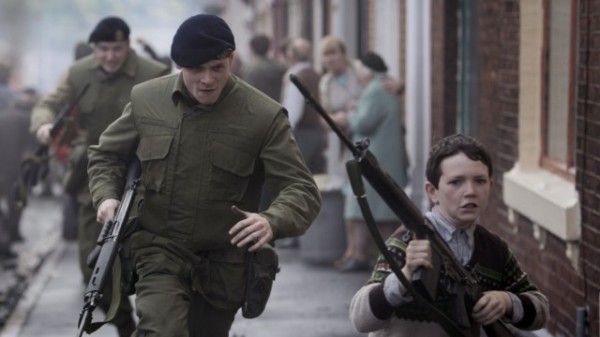
Taking place during the height of civil unrest in the Troubles, ’71 follows a young British army recruit named Gary Hook (Jack O’Connell), who gets deployed into Belfast during his first few weeks of training. Him and his squad is warned of the great dangers in entering the territory. Protestant and Catholic Irishmen are living side-by-side at each other’s throats, each with starkly different ideas of what is better for them. The protestants believe that the United Kingdom is their home and it is their best interests to remain with them. The catholics believe Ireland can be it’s own land and wants to secede from Europe. Hook and his fellow soldiers are just looking to keep the peace.

On the day of deployment, Hook watches as both sides come to a boil. The KGB is entering houses, threatening and beating people with their billy clubs, while an angry crowd of catholics gather outside in retaliation against the military. One of the rioting crowd members throws a rock and knocks a soldier out cold. A kid no older than ten grabs the soldier’s rifle and runs. Hook and another soldier chase after him when the crowd assaults them and beats viciously. Hook watches as the soldier is shot in the face. Hook only narrowly escapes with his life intact.

Trapped in Belfast with no way to find his comrades, Hook must fight through the night to survive against the city that’s hunting him.

Functioning more as a survivalist-thriller than as a pure-blooded war movie, ’71 strikes the viewer with sharp imagery and intelligence alike, filling them with a deepening sense of dread as we watch this young man crumble into desperation as he tries to escape from the people who are seeking to kill him. One of the things I love so much about this movie is how expertly it orchestrates itself and its emotions. French director Yann Demange, who before this directed British television shows such as “Dead Set” and “Top Boy”, debuts here as a talented filmmaker, crafting an exciting thriller that efficiently balances action with context.

I am reminded of another film similar in direction and subject, and that is Ben Affleck’s 2012 film Argo. In both films, the main character evades their pursuer through the chaos of a collapsing political climate. The camera captures the essence of both perspectives, with the pursuer desperately chasing their target while the pursued is equally as desperate trying to get away. And through both highly exciting and pulse-pounding features, both directors have deeper things to say about those societies and what impact they’re leaving on the people around them.

To me, ’71 is the British version of Argo, with one big difference: coherency. In Argo, everything is crystal-clear and straightforward. We know who the characters are, why they are there, what they are doing, who is after them, and how and why they plan to get away. In ’71, all of that is focused in towards one character only, and that is Gary Hook. We know everything we can know about a novice soldier, we just don’t know the same of everyone else around him.

For instance, the leaders of both factions, the catholics and the British Military Reaction force, are both skinny gingers with mustaches as thick as their hair. How can you tell who is who under the dim view of the street light? A young boy helps Hook towards a bar after his initial attack, but he’s on the same side as the people who are hunting him. Why is he helping Hook when he so clearly has so much disregard for British soldiers? In another scene, a Protestant seeks to help Hook when minutes earlier he had the cold, direct eyes of a killer with purpose. What inspired him to switch sides so easily? And then, near the end of the movie, there is a twist that didn’t make much sense to me at all.

Still though, the movie is there, and Demange handles the senses of unease and desperation well with the film, especially when trusting Jack O’Connell to portray all of these emotions at once. O’Connell is really having a strong career packing in for himself. In the past year, for instance, he created a very compelling presence in the prison-drama Starred Up and in the Angelina Jolie-directed biopic Unbroken. He makes a very strong case for choosing acting as a career in all of these films, and in ’71 he clearly shows that he can pull off the role of a young, desperate, and inexperienced soldier who just wants to go home. Demange was wise to cast him in this role and trust him with the emotional complexity of the character: O’Connell was the best part of the film.

I’ll admit, I didn’t understand everything I probably needed to understand in the movie, perhaps the biggest one being more aware of what the Troubles were in the 1970’s. Take that out of it. Take all of the political facets out of the movie, and what do you have? You have a raw, emotionally-charged war thriller that challenges the viewer to see it not from their perspective, but from the soldier’s perspective. Everyone hurts during the times of war. ’71 makes me wonder who war hurts the most.

Tagged , , , , , , , , , , , , , , , , , , , , , , , , , , , , , , , , , ,

“AMERICAN SNIPER” Review (✫✫✫1/2)

And hero, husband, and father.

Chris Kyle was an American sniper. Serving four tours in Iraq, with 160 confirmed kills and approximately 95 more unconfirmed, Kyle earned the title of being called the most lethal sniper in American history. More than being a soldier, though, he’s a father, a husband, and a friend. He was killed in 2013 at age 38. He was shot by a soldier suffering from PTSD that he was trying to help.

We know all these details going into Clint Eastwood’s American Sniper. We already know how it ends, we just don’t know everything leading up to it. Eastwood understands this, and uses it to his advantage as his film not only gives an honorable tribute to one of America’s most committed soldiers, but also foreshadows to a sad fate that we already know is coming. Gee, thanks a lot Clint. I didn’t even bring my tissues.

The film opens on the same startling scene that the book does: with Kyle looking down the scope of his sniper rifle at an Iraqi mother and her child, both of whom were aiming to suicide bomb a battalion of soldiers on the street. Eastwood sets up the tension of the scene perfectly here, with Kyle’s sweaty, darting eyes surveying the scene and desperately trying to see any way out of the tormenting choice he has to make. He soon dreadfully realizes there is no way out: it’s either the mother and her child, or the 15 soldiers and the suffering of their families back at home.

Think about being given that situation, about how devastating the experience must be and how haunting it must be to the person who has to make it. Now imagine having to make that same choice day, after day, after day, with your numbers climbing up until you’ve reached over 250 kills.

That’s the life of a soldier that Kyle has lived.

Kyle is portrayed in the film by Bradley Cooper, and both Cooper and Eastwood do a wonderful job representing Kyle here. They show that before he was a soldier, he was a citizen, an American with strong ideals and opinions and unafraid to show them or fight for them. Before he was shipped out and went on tour, they showed how normal Kyle was.

They showed that before he was a soldier, he was a man.

After having to make those difficult decisions day after day, how do you think that affects a man? In interviews, the real-life Kyle has said that he would not take back a single shot because every one that he took was to defend his brothers in uniform. I believe him when he says that, but I don’t believe that it didn’t leave an impact on him. Some soldiers suffer PTSD from killing just one man. How do you think more than 200 may have impacted Kyle?

Both Eastwood and Cooper do a great job humanizing Kyle here, and show that he’s more than the record kills he’s garnered. They show that Kyle is a man of coarse humor and blunt honesty, a man with a thick Texan accent and ideals, a man who tries to show that he’s strong and dependable, but who deep down is hurting and alone. The film is intimate in the ways that it shows Kyle, both in the chaos of battle and in the quietness of being home.

Cooper especially does a skillful job in portraying the iconic war hero. He expresses trauma and subtlety with the character so masterfully that the only differences I can tell between him and Kyle are minor facial features.

This movie has stirred controversy as of late for being “pro-war,” and for glorifying a man who was essentially labeled a murderer. I’m convinced these same people haven’t seen the same movie I saw, because the movie I watched unabashedly looks at the miseries of war and how the deaths Kyle could and couldn’t prevent affected him. The movie does suffer some slight pacing issues (not to mention the infamous “fake baby” seen in one of the shots), but when Eastwood resurrects a war hero to show the man behind the legacy, how can you look at this movie’s scope and not feel something for all of the physical and moral sacrifices Kyle had to give for his home? When the trumpet plays proudly over the solemnity in the end credits, you know that Eastwood represented a warrior in heart and a human in spirit.

Tagged , , , , , , , , , , , , , , , , , , , , , , , , , , , , ,

“THE LEGO MOVIE” Review (✫✫✫1/2)

Bricks, businessmen, and Batman.

The last thing I expected from anything titled The Lego Movie was anything good. How could I? The trailer had the reeking stench of an advertisement, barely differentiating itself from the Lego set commercials that air on children’s cartoon networks. Believe me, I went into this movie expecting an artificial, brainless experience looking only to profit itself from the name of it’s toy line. Boy, do I love it when I am proved wrong.

Based in a colorful world full of Lego bricks, buildings, and set pieces, The Lego Movie follows Emmett (Chris Pratt), an average, regular, 100% ordinary minifigure who loves coffee, people, Taco Tuesdays, cats, cars, work, television, and just about everything else under the orange Lego-bricked sun. If any of the characters in the film knew that they were in a movie, none of them would expect Emmett to be the main character: he has the personality and the appearance of a background character if anything.

One day, while working at his construction job, Emmett comes into contact with a strange red object called “The Piece of Resistance”, and passes out. When he wakes up, he is recruited by Wyldstyle (Elizabeth Banks), a punky and feisty master builder who tells Emmett that he is part of a prophecy that declares that a powerful being called “The Special” will find the Piece of Resistance and use it to overthrow Lord Business (Will Ferrell) and his plans to conquer the Lego-verse. As a result, Emmett gets catapulted into a decade-long conflict between wizards, robots, businessmen, DC superheroes, crazy cats, cyborg pirates, spacemen, and Batman.

Good God, where do I start with this? The Lego Movie is by every definition, a surprise; a fun and wacky little adventure that is just as original and audacious as it is clever and funny. Written and directed by Phil Lord and Chris Miller, the same guys who co-wrote and co-directed Cloudy With A Chance of Meatballs, these filmmakers worked to instill the same sense of energy, youth, and entertainment from that movie into this one. It’s surprising that the movie is not just good: it’s borderline great.

One of the things I love most about the movie is the animation. Like any great animated film, it reaches out to you in vivid, eye-catching detail, it’s beautiful colors and visuals striking out to you like a panel on a beautifully-crafted graphic novel. But it’s not just how the animation looks in itself: it’s also in how Lord and Miller achieved the effects they were going for. Nearly everything in the film was modeled from lego bricks and pieces, and I do mean everything. The buildings, the vehicles, the space stations: even seemingly trivial things such as the water, lava, and clouds are all made out of lego pieces, with explosions literally showing red-and-orange lego studs as they blow up. It would be so easy just to be cheap and give basic effects for the wind, the water, fire, sky, and everything else in the film, but Miller and Lord didn’t want to go that route. They wanted to make an authentic, accurate world jam-packed with lego pieces and objects. To put anything else in there would just cheapen the effects, and their persistence made for the best visual result that they could possibly have had.

Just as much though, I love the characters Lord and Miller wrote for this movie. Like the animation and lego bricks, they all have variety to them, and they all have colorful, unique personalities that make you want to relate to each character. You have Benny, a 1980’s space astronaut who is so obsessed with spaceships that he could build one from a pile of garbage bricks if you dared him to. You have UniKitty, a unicorn/kitten that has such a split sweet/violent personality that she would scare little children if they were locked in the same room with her. There’s Metal Beard, a pirate-turned-cyborg whose body literally blows up like a amalgam of lego bricks like a real lego mini figure. Also, Batman is in the movie.

The key character here, however, is Emmett, a sweet and charming little mini figure with intentions so pure, he at times can seem like a child with his quirky little antics. Emmett is the epitome of childhood in this movie: innocent, curious, creative, passionate, and at times a little too immature for his own good. His strengths and his flaws both make up for a very interesting character, a mini figure that we can all relate to because of his average nature and his desire to be greater than he already is. He may be made out of Lego pieces, but Emmett is more human than most of the live-action actors you’ve seen in motion pictures this year.

The movie does suffer from a slight drag in run time, and like it’s protagonist, the movie is at times too childish for it’s own good. That doesn’t change the fact that this movie is a clever, funny, original, and heartfelt take on childhood and what it means to be grown up, but always remain young at heart. The Lego Movie is much more than just a movie. It’s a celebration of creativity.

Post-script: Did I forget to mention that Batman is in the movie?

Tagged , , , , , , , , , , , , , , , , , , , , , , , , , , , , , , , , , , , , , , , , , , , , , , , , ,

“BIRDMAN” Review (✫✫✫✫)

The artist’s struggle, all in one take. 

Birdman, or otherwise known as The Unexpected Virtue of Ignorance is one of the most mesmerizing films I’ve ever seen. It is also one of the most unique, disturbing, shocking, and confusing films I’ve ever seen too. That’s okay. This film was reaching for a specific vision, and director Alejandro Inarritu has expanded beyond it. I admit I don’t know what to expect as far as the public reacting to this, and I also don’t know how accessible it is to non-film aficionados either. But I have seen the movie frame by frame, and I think it’s one of the best films of its kind. On the surface value, it’s about the struggles of Broadway theatre. In deeper insight, it’s about ego and the obsessive human condition.

The film stars Michael Keaton as washed-up actor Riggan Thompson, who has been forgotten by his adoring public after portraying the lead role in a series of superhero films titled Birdman. This is ironic, because in real life, Keaton portrayed a superhero in Tim Burton’s 1989 film Batman. Desperate for a comeback, Thompson sets out to write, direct and star in his favorite Broadway play: What We Talk About When We Talk About Love by Raymond Carver.

Things immediately hit the fan during the week of their first preview. One of Riggan’s actors gets a head injury from a loose light on the set. His replacement, Mike Shiner (Edward Norton) is a talented but brash and arrogant actor who sees himself as Riggan’s superior. And, as he faces personal problems with his estranged daughter Sam (Emma Stone), Riggan begins to feel the closing pressures of Broadway when a malicious theatre critic tells him she’s going to “kill his play.” Now Riggan is trying to keep the play and his sanity afloat, and he will make whatever sacrifices he needs to make sure both happens.

Written, directed and produced by Inarritu, Birdman is the first black comedy made by the filmmaker, his most successful films to date being Oscar nominees Babel and Biutiful. Now he has made Birdman, and I am tempted to say it’s the best film he’s made yet.

What worked so well with the film? The first thing is the editing and the cinematography, which was shot so wonderfully by Oscar winner Emmanuel Lubezki that it places you in the moment, in the reality of the film, not making you watch it from a cushion seat on the eighth row of a dark movie theater. Lubezki, who worked with Inarritu on short films in the past, decided to shoot the film and edit it into a continuous fashion, giving off the illusion that the entire film was filmed in one take. Even though the movie wasn’t filmed in one shot, the feeling it gives off makes it feel alive and moving, not unlike the world of theatre that Riggan is trying to prove himself in.

I wonder how much effort this takes, not just from the cinematographer and director’s point of view, but from everyone else involved in the film as well. How many hours did the actors need to rehearse their lines in order to get their roles right? How much pressure was the tech and lighting crew under while they were filming, knowing that if they screwed up, everyone would have to start back to square one? How many hours did film editors Douglas Crise and Stephen Mirrione have to sit in front of a computer, making sure the shots transitioned so well that you couldn’t even see the transitions? The illusion not only worked because of the idea that Lubezki and Inarritu offered, but because of the commitment it received from everyone involved with the film. In many ways, their efforts were all worth it: the camerawork here expresses more of the story than the character’s dialogue does.

The parallels in this movie are also ingenious. How does Keaton feel playing as Riggan Thompson in the movie, knowing that he reached international fame as Batman earlier in his career and having since then never been able to match a more recognized role? How does Inarritu feel, going through all of the production pressures Riggan did in making the play as he himself did in making the movie? Did he intend this movie as self-reflection? Is he telling the audience what he goes through daily as a filmmaker? Or is he using his struggles as a platform to tell a much deeper, more important story to the audience?

For me, I don’t get as much joy out of interpreting as much as I do out of experiencing. And make no mistake: Birdman is an experience, surreal, tantalizing, and thought-provoking all at once. I’m still sitting here, hours later, not quite fully realizing what exactly Inarritu was trying to portray in this film. Is he commenting on the artist’s struggle? Commercial vs. independent film? Fatherhood? Friendship? Family? Lost love?

I think it’s all of the above. Or maybe none of the above. I honestly don’t know. In the movie, Inarritu battles labels that are placed on artists and on the art that they produce. Is Riggan Thompson a superhero, or an actor portraying a superhero? Is he a former shell of who he is, or a flower that has yet to bloom? We see in this film how these labels influence his life and how much stress and anxiety it presses upon him. To put labels on the movie would contradict Inarritu’s intentions. It would be offensive to the film.

My bottom line: Birdman is a masterpiece. It is so distinct in its own language and style that I think it is impossible to define it, let alone replace it. Critics will applaud it for it’s technical and emotional achievements. It will definitely garner some Oscar nominations. It’s a sure contender for visual effects, cinematography and editing. It is also sure to confuse certain people, to which I would recommend stop trying to understand it. Birdman is not meant to be understood. It is meant to be experienced, and if you can help it, interpreted.

Post-script: A thought I had after seeing the movie that I think viewers will also have. Because of how profoundly his role as Birdman affected Riggan, is Inarritu attacking the superhero genre of film? I believe he is, but I choose not to acknowledge that. After all, for every time a superhero film was called too simple, couldn’t you call any art film too complicated? I quote Mark Twain: “Too much of anything is bad.” 

Tagged , , , , , , , , , , , , , , , , , , , , , , , , , , , , , , , ,

“SIN CITY: A DAME TO KILL FOR” Review (✫)

Can you kill me too while you’re so busy at it? Thanks. 

There’s a character early on in Sin City: A Dame To Kill For that describes the city as a place “where you go in with your eyes open, or you don’t come out at all.” He’s wrong. I went in and out with my eyes fully open. I only wished that I kept them closed.

Oh, where to begin with this. Sin City: A Dame To Kill For is, in a word, messy – a neo-noir thriller as confusing as a detective’s murder case and more violent, putrid and horrific than a crime scene. The only brains this movie has are the ones that it blows out of peoples’ heads.

The plot takes place sometime within the Sin City universe. The question is when? I honestly don’t know, and I don’t think the movie knows either. It’s part prequel, part sequel and part in-betweenuel that cuts to wherever and whenever it wants to.

Like the first movie, there are three main stories the plot revolves around and, likewise, three main characters to sympathize with. You have a young Dwight McCarthy (Josh Brolin), who, before he met Jackie Boy, was obsessing over a rich housewife named Ava (Eva Green). There’s Johnny (Joseph Gordon-Levitt), an overly-cocky poker player who wants to come to Sin City and beat the king of all cards himself — Senator Roark (Powers Boothe). And then there’s Nancy (Jessica Alba), who is still coping with John Hartigan’s (Bruce Willis) suicide at the end of Sin City.

Following this easy enough? Good, because that’s all the explanation you’re going to get. The biggest problem with Sin City: A Dame To Kill For is that it’s so convoluted. Stories are meshed, mixed and thrown together without any sense of connection or correlation to its plot, and the entire time while I was watching it, I kept wondering where these stories were taking place and why I should care. Some movies do well with intertwining narratives, such as Pulp Fiction or Crash. This is not one of them.

A good example of this is in the very first scene of the film. Marv (Mickey Rourke), the hard-headed thug who was framed for the murder of Goldie in the first movie, wakes up next to two crashed cars with no memory of how he got there. He goes through mundane dialogue for five minutes in his obviously exaggerated thuggish accent, then the movie cuts to the story and almost completely forgets about him.

My first thought after watching this: why was that scene necessary? As the movie continued its runtime, I continued to ask this question in my head until I realized that none of it was necessary, that it was just a continuous farce of violence and delinquency that the kids who play Grand Theft Auto would just drool over.

This movie is definitely violent. That’s to be expected, I know, especially when you remember how violent the first one was. There is, however, a stark difference in how the violence is used in each movie. In the first Sin City, the violence was both shocking and satirical, at times being so disturbing that you can’t help but reel back from it, and at other times being so exaggerated that I laughed at it. Whether it was positive or negative, however, I at least felt something.

Here, nothing is felt. Here, we just look at all shades of black, red and white among severed body parts while we plod through the final act like it’s a homework assignment rather than the climactic ending that it deserves to be.

I’ll admit to having disliked the first Sin City. Does that matter? I give credit and criticism equally where it is due, and even though both Sin City’s are equally violent and despicable, the first one was at least more intriguing and had more cohesiveness both as a whole story and as smaller, separate narratives. This one fell flat, crumbled to pieces and was about as clear as a muddy window pane. Maybe that’s why Marv couldn’t remember anything at the beginning of this movie – he realized what he signed up for, and he tried to forget all about it.

Tagged , , , , , , , , , , , , , , , , , , , , , , , , , , , , , , ,

“SIN CITY” Review (✫✫)

“There ain’t no sunshine when she’s gone.”

You’re either going to love or hate Sin City. There’s no getting around that fact. Like the movies directed by Quentin Tarantino or Eli Roth, Sin City is a movie specific to its own tastes, and doesn’t care much about the opinions opposite of it. It’s a violent, gross, disgusting and putrid film full of the stuff that would make a Catholic priest faint. If that sounds like something you would like, by all means, be my guest and have at it. If you are repulsed by my description of the film, I certainly don’t blame you.

Based off of the comic book series by Frank Miller, Sin City is a film that follows four separate stories that (mostly) intertwine together. John Hartigan (Bruce Willis) is an aged police officer who is viciously pursuing child rapist Roark Jr. (Nick Stahl). Marv (Mickey Rourke) is a rough-around-the-edges thug who is framed for the murder of a prostitute he slept with named Goldie (Jamie King). And Dwight (Clive Owen) is a private investigator who gets pulled into a turf war, risking the lives of cops and prostitutes alike.

What do all of these stories have in common? They all started because of a woman, and these men go out to kill because they love their woman. Or, at least, whatever constitutes as love in this universe, in which case it’s a one-night stand.

It’s so difficult to review a movie like Sin City. Why? Because it’s not for people like me, that’s why. I don’t like watching movies like Sin City. I don’t like watching blood and violence for the sake of blood and violence, or watching sex and nudity for the sake of sex and nudity. It’s hard to be non-biased with movies like these because I watch moments where a naked woman walks out with bare breasts and all, and I can’t help but imagine the director thinking “Hey, let’s have this actress naked in this scene, because boobs.”

Sin City is aggressively, unnecessarily violent. How violent? So violent that the least bloody scene in the movie came from Quentin Tarantino. That’s how bad it gets. Red, white, black and yellow blood splatter across the screen like Jackson Pollock was making a painting. Severed heads and body parts are frequently cut off and thrown around in the film like missing pieces to a G.I. Joe. Those body parts include testicles, by the way, on multiple occasions. And don’t even get me started on the absurdity of its kills. In one scene, Marv gets beaten, stabbed, shot, and crashed his car into a lake and still gets up to pursue Goldie’s killer. Good God, are these guys made of kevlar or something?

Remind you, I have no problem with violence in movies, but here it’s just far too absurd and disgusting to be able to fully stomach. When it’s used to illustrate an emotion or a point in movies like Pulp Fiction or Taxi Driver, I praise its purpose and its usage. Here, it illustrates no emotion or urgency. It’s a glorified selling point for a really long, disgusting, stupid movie.

I did like the visualization of Sin City. That, and its opening scene. I liked it’s black-and-white style, it’s sense of contrast and expert use of shadow and lighting. It gave it a strong reminiscent feeling of the classic neo-noir films that inspired the original Sin City comic books, the ones that have the snazzy saxophone playing in the background as two lovers stand on a balcony, telling each other that they love each other and that they never want to leave each other. The film itself, in fact, functions as a parody of the neo-noir genre: characters stand on balconies, docks, outrun police cars, smoke cigarettes and talk in thickly exaggerated accents to the point where it can’t be taken seriously.

Realize, however, that this wasn’t on accident; director Robert Rodriguez wanted you to see how he exaggerated details so you would understand that him and Frank Miller were lightly poking fun at the genre, all while at the same time suggesting delicate homages to it as well. I like that they tried to reach for a deeper effort with the film, even though their intentions were smarter than the film itself was.

So what’s my end consensus? Is it a movie that you should see or skip? I’ll leave that decision in your hands. For now, I have done my job in telling you what the movie is like, and I will wash my hands clean from it. I have church in the morning.

Tagged , , , , , , , , , , , , , , , , , , , , , , , , , , , , , , , ,

“TEENAGE MUTANT NINJA TURTLES (2014)” Review (✫)

Thankfully, they’re not aliens. 

Teenage Mutant Ninja Turtles is in complete and utter shambles, a movie that can’t decide on what it wants to be and not much better on how it wants to accomplish that. At times, it’s a loud and obnoxious action movie that takes its characters and their situations seriously. At other times, it’s so campy and immature it might as well be the Nickelodeon cartoon series. Wait, I take that back, that’s a dishonor to the Nickelodeon cartoon series. I don’t know what sort of movie I was expecting out of something titled Teenage Mutant Ninja Turtles, but I would have taken anything over this travesty.

Based (somewhat) on Kevin Eastman and Peter Laird’s comic-book creations, Teenage Mutant Ninja Turtles follows the story of April O’Neil (Megan Fox), a struggling news reporter who is looking to uncover the criminal conspiracy of the Foot Clan, a team of specialized military-trained soldiers who fight for their master, Shredder (Tohoru Masamune). Shredder is tyrannical Japanese warlord who wants nothing more but to rule New York City, and like all dark and obscure bad guys, he’ll stop at nothing until he gets what he’s after. But April’s not alone in this fight; she also has her pet rat and turtles by her side, her little friends she’s cared for since they were experimented on by her father when she was just a little girl.

…What? Yes, dear readers, they changed the origin story. After Mr. O’Neil discovered how the dangerous turtle weapons were going to be used for destructive purposes, he sets his lab ablaze, killing himself and destroying all of his hard work. Just before the turtles could be destroyed, however, April saves her small friends from the fire and they escape into the sewers. (Question: Since the fire is so hot that it consumes her father nearly instantly, how is it that  6-year old April manages to not only get into the lab, but also avoid the fire, grab the turtles, get out of the lab, and get back onto the pavement with a little ash makeup spread onto her face for good measure?)

As years pass, the rat and turtles mature into giant-sized humanoid creatures who teach themselves the art of ninjutsu, thanks to a book they fished out of the garbage and the convenience the script allowed them. The rat named Splinter (Tony Shalhoub) trained his sons Leonardo (Johnny Knoxville), Raphael (Alan Ritchson), Donatello (Jeremy Howard) and Michelangelo (Noel Fisher), knowing one day that they would need to fight the Shredder and defend New York City.

Where do I even begin with this? For starters, the script is unreliable, an immature, idiotic and thinly-written-and-thought-out mess that has plot holes the size of Swiss cheese and is as convenient as the dollar store. I could be cheap and pick apart the small things in the story, like what compelled the scientists to pick turtles as their experiments of mass destruction?

That, however, is too easy. It’s much more fun to pick apart the bigger holes in the plot, including:

  1. The fact that there is no way that Splinter, as a regular lab rat, could know anything about the Shredder or what he was plotting for him and the turtles.
  2. That since Shredder is a highly-skilled ninja, there is no reason why his foot clan shouldn’t be at least slightly trained in the arts either.
  3. That to convince her editor-in-chief that there are living, fighting humanoid ninja turtles in New York City she shows her a picture of a turtle she pulled off of Google images, not the pictures she took on her smart phone.
  4. That since Shredder is after the mutagen in the turtles’ blood, he wouldn’t spare Raphael and abandon him after he beat him to a pulp and cracked his shell.
  5. That to rescue his brothers when they were kidnapped halfway through the movie that Raphael, April and her camera man Vernon (Will Arnett) drive to rescue them in the snow mountains that apparently exist 50 minutes outside of Manhattan.

Oh yes, this script is a mess, and the actors do a nice job at making it even more laughable through their complacent, boring and plastic performances that could be played better by action figures. Any actor who was not a CGI character was completely wasted in a sea of bad dialogue and bland delivery, looking like victims to the screenplay and to the movie that they’re playing in. William Fichtner is hesitantly the best performance as an evil scientist, but his character is so plainly forgettable that it is almost completely wasted. Arnett is more charismatic and smirking as the camera man, but the dialogue he sputters is so unbelievably written at times that it hardly matters. (Ex. When told that your city’s vigilantes are giant turtles, is your first reaction to seriously ask if they’re aliens? I’m frankly surprised he didn’t laugh when April told him her crazy story.)

But the worst performance of the film is Megan Fox’s. Oh. My. God. What is she doing in the movie industry? Her performance was both disinterested and disingenuous, her expression looking as stiff and uncomfortable as if she came out of a facelift surgery. Fox is not a good actress. I say it again: Fox is not a good actress. Good-looking, yes, but looks only make half of a character, and she doesn’t fit April in neither appearance or spirit. In the 1990 film we had Judith Hoag portraying April, and boy, did she bring energy and enthusiasm to the character. Now we have Fox reading a teleprompter to replace the performance, and I start wondering if it would be better if April was recast as a Barbie doll in the movie.

Yes, the turtles, Splinter and Shredder look cool, and there’s a very sweet action sequence where they are sliding down the snow mountains that I will admit to have enjoyed. But in a visually-dominated industry, visual effects are a compliment I’m recycling at this point. Visual effects and fight scenes are wasted if you have a terrible plot, and in this case, where the bad guy’s master plan is to intoxicate a city with a poisonous gas by smashing a tower over it (an idea stolen from The Amazing Spider-man, by the way), I’m not inclined to say that the movie has much good of anything.

I know there is an audience for Teenage Mutant Ninja Turtles, and the majority of them will probably be under 12. The ones over that age will have grown up with the franchise, and will be looking for some sort of nostalgic experience to remind them of what it was like to grow up with the ninja turtles. I too went in hoping to feel some sort of nostalgia, but as the movie went on, I continued to notice that all of my hopes were running down the sewer.

Tagged , , , , , , , , , , , , , , , , , , , , , , , , , , , , , , , , , ,

“GUARDIANS OF THE GALAXY” Review (✫✫✫)


A  lovable group of space idiots.

Now here’s a movie I wasn’t expecting to be any good. No matter how you phrased it to me, I went into James Gunn’s Guardians of the Galaxy completely expecting to hate it. None of the heroes were as popular or as interesting as the other characters Marvel had to sport in its universe, it’s a sci-fi buccaneering adventure about an evil race intent on destroying/ruling the galaxy (I wonder where we’ve seen that before), and on top of all that, and it has a talking raccoon and a tree as two of it’s main characters. Believe me, I went into this movie fully expecting to dislike it on all counts. Turns out I was wrong on all of them.

Based on the Marvel comics superhero team of the same name, Guardians of the Galaxy follows a whole slew of space misfits as their futures suddenly become entangled because of one blasted macguffin: the infinity stone, an object we’ve been introduced to in earlier movies in the form of the tesseract and the aether in The Avengers and Thor: The Dark World. Peter Quill (Chris Pratt) is a Han Solo-ish kind of scavenger who steals items of value and sells them to buyers. Gamora (Zoe Saldana) is a trained assassin and adoptive daughter of a cruel omnipotent being called Thanos (Josh Brolin). Drax (Dave Bautista) is a brutish warrior who seeks vengeance against Thanos after the death of his family. And then Rocket and Groot (voiced by Bradley Cooper and Vin Diesel, respectively) are a bounty-hunting duo who travel together. Remember me mentioning the talking raccoon and tree? This is them, although Groot’s speech is merely limited to “I am Groot.”

Sounds like a lot of characters to deal with, I know, but don’t worry: the movie does a better job at explaining them than I did. Their fates become intertwined  with that of Ronan (Lee Pace), a vicious hunter who will stop at nothing until he has taken the infinity stone for himself and uses it to destroy his enemies. It’s up to Quill, Rocket, and the rest of the troupe to rise up and defend the galaxy from Ronan and the threat he holds with the infinity stone.

Written and directed by James Gunn, the wacko that directed the 2010 satire film Super, Guardians of the Galaxy is a wacky, oddballish film, a movie that doubles both as a sci-fi blockbuster actioneer and as a space comedy parodying… well, itself really. The biggest concern I had with this movie was how it was going to handle itself, because it really had everything working against it. Think about it: talking animals and trees, a copy-and-paste space plot, and a director whose work before this was a line of small-budget independent films. How on earth was any of this going to work?

Better than I expected, apparently. The best thing about Guardians of the Galaxy is that it doesn’t take itself seriously. It’s so irreverent, so shameless and so unabashed that it might as well be a clown throwing pies at its own face. There were many moments in the film where it called itself out on the flaws that I was prepared to criticize it for (such as it’s hammy one-liners or it’s talking animals), then it turned around making fun of itself because of it (Drax boasting about his reflexes when figures of speech go over his head, or Rocket asking Quill what a raccoon is.)

It just loves to make fun of itself, so much so that I want to call this a comedy more than science-fiction.

To make the comedy work though, you need a cast of equal caliber to make it work. And I’ll be completely honest here: the cast was exceptional. Even the cast members who I don’t like, consisting of Bautista and Diesel, gave performances that surprised me, effectively portraying their characters in a uniquely charismatic light that made them stand out from the obvious sci-fi fanfare. (One argument someone might pose to me is that Diesel’s job was easier because he only had to say three words over and over again. Believe me, his character wasn’t that simple.)

The element that stands out the most in the film is ironically the one I was most worried about: Rocket. Oh my gosh, was this guy a big ball of laughter. Cooper was excellent in voice performance, shooting out snazzy, snarky, sarcastic one-liners like he’s a New York taxi driver.

But it’s not just his voice performance that I love so much about the character. It’s how he’s animated and modeled too, with animators giving him life through his detailed, intricate emotions and movements as a CGI character. Rocket is much more than just another Guardian. He is, in many ways, the life of the film: a living, breathing embodiment of emotion, sentiment, sarcasm, hilarity and attitude. Every attitude that the film is, at least.

There’s no way to get out of the film’s silliness, but you shouldn’t let that stop you from enjoying it. Believe me, I tried. I went in fully equipped and prepared to blast this movie with a negative review, and I came out instead feeling like a kid after he finished watching his favorite Saturday morning cartoon.

Tagged , , , , , , , , , , , , , , , , , , , , , , , , , , , , , , , , , , , ,

“GODZILLA” (2014) Review (✫✫1/2)

Should have been called “Mutos” if you ask me. 

There are two questions that always come into my head every time I watch a reboot: Is it different from the original, and is it necessary? The answer to both is usually no, it isn’t. Why would it be? Most studios just cash in on the name of their franchise and re-brand it, rather than coming up with an original take of their story, breathing life and energy into a franchise that has since been left stale. Perfect example: did anyone find Roland Emmerich’s 1998 version of Godzilla to be even remotely tolerable?

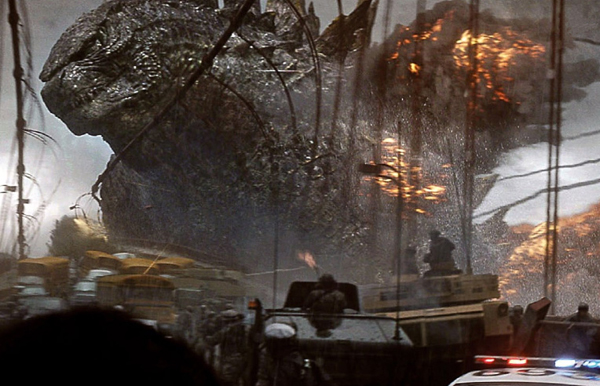
With this new version of Godzilla, I can say that it at least succeeded as a reboot in that it is different from the original. Whether that is a good different is something I’m still struggling with. I feel like I’m one of the helpless human beings running away from all the giant monster ruckus going on in the middle of Japan: I’m in the middle of a disarray of loud noise and violence, and while I’m fascinated by what is going on, I’m ultimately distraught because these giant monsters are destroying the things that I love.

Directed by Gareth Edwards, the writer/director behind 2010’s Monsters, Godzilla stars Aaron Taylor Johnson as Ford, a lieutenant who just came back from his service in the Navy. His wife and child (portrayed by Elizabeth Olsen and Carson Bolde) are more than eager to have their family whole again, and couldn’t be happier to see him when he finally comes home.

Only one problem: Ford’s father, Joe (Bryan Cranston) just got arrested in Japan for intrusion on private property. You see, about fifteen years ago, poor Joe was dutifully working as an engineer for a power plant in Japan. After scanning some strange readings off of the richter scale, he witnesses the death of his wife as the power plant quickly collapses before him.

Everyone around Joe believes that what he witnessed was a massive earthquake, including his son Ford. Joe doesn’t believe that it was an accident, and thinks there’s something much more sinister afoot than what everyone thinks. As Joe and his son continue to investigate the evidence he’s collected, they begin to become more aware of a giant conspiracy that the Japanese governments are working to hide, and soon, they come into contact with the biggest and most dangerous secret of all: a giant monster, the king of all beasts nicknamed “Godzilla”.

Looking back at this film, I am reminded by not how much I enjoyed this movie, but how much Peter Jackson’s King Kong got right as a remake. When reboots are done right, they are like King Kong: they are smart, clever, well-structured stories that are exciting, involving, and pay delicate homages to the source material. When they go wrong, they are like Emmerich’s Godzilla: explosions of CGI and visual effects garbage that go in every direction except for to the point.

With this new Godzilla, it takes steps to be a unique monster-sized reboot, but whether it reached the top of the staircase is another thing to be decided. I liked a lot of things about this movie. Edwards does a good job balancing the destruction with the human interest. Godzilla himself is a sight to see. The fights between him and these Cloverfield-like monsters called “Mutos” are a thing of classic Godzilla fandom. And Bryan Cranston was a clear emotional standout in the movie, giving a invested performance that was more than what the movie deserved.

One my biggest gripes with the movie is this: Godzilla isn’t in it. Or at least, not as much as I would like him to be. When you watch monster movies like King Kong or Jurassic Park, you get an overwhelming sensation of the scope and size of the creature’s presence, of the ground shaking when they take a step, or their shadows lurking over you as they quietly stalk their prey. I’m frustrated not by Godzilla’s physical appearance, but rather how infrequently he appears during the movie. The Godzilla movie has a total run time of 123 minutes, and where is he during the most of it? Swimming around in an ocean, spikes popping out, chasing monsters smaller than him that he could have easily killed 30 minutes ago.

Granted, I know what Edwards was trying to accomplish here. In an interview with Entertainment Tonight, Cranston compared the film to Steven Spielberg’s 1970 classic film Jaws, in that it doesn’t immediately show the monster, but its tension and presence could always be felt in it.

There, however, is one big reason why that doesn’t work with this movie. The shark in Jaws is a 300-foot shark lurking and sneaking through it’s quiet habitat in the waters. Godzilla is a 9,000 ton monster stomping his way through cities. I don’t think subtlety is supposed to be part of its nature.

As far as it’s lead goes, Taylor-Johnson is stock, a plain and uninteresting cutout of a soldier whose character is so one-note that he might as well be a cowbell instrument. For Pete’s sake, if you’re going to go to use the Hollywood hero archetype, can you at least get someone who is good at it? I could easily see someone like Tom Cruise or Jude Law in Taylor-Johnson’s role and succeed just as much at doing it. In fact, I almost prefer it. His emotions aren’t subtle, he doesn’t do a good job at expression, and at times he recites lines so casually that we could possibly be fooled into thinking that he was reading off of a cue card.

I went back and forth on whether or not I liked this movie, juggling around the things in my head that I did and didn’t like in the film. Ultimately though, if I’m having this hard of a time understanding what the movie was supposed to be, then usually so did the film itself. Godzilla is a decent reboot, restarting the franchise with a modern twist that I know many film aficionados will appreciate, but it should have been more. More as in better acting. More as in better handling, and more as in more of the freaking monster, period. Either way, the movie didn’t leave its mark on me, and when I talk to fans of the franchise since it’s debut, they too indicate that they prefer the original over the reboot. Hey, at least Godzilla had more screen time.

Tagged , , , , , , , , , , , , , , , , , , , , , , ,