Tag Archives: Adventure

“THE DARK KNIGHT” Review (✫✫✫✫)

Two madmen at war with each other and themselves.

Editor’s note: I was originally going to hold off on publishing this review due to an upcoming in-depth article I’m working on. However, upon learning that today would have been Heath Ledger’s 37th birthday, I couldn’t miss the opportunity to honor the late actor’s magnificent work. So, without further adieu, here is my review for the magnificent superhero epic that is ‘The Dark Knight.’

The Dark Knight is a moral dilemma about two madmen trying to make sense out of their own worlds. One hides his madness with a mask. The other demonstrates it proudly with a crooked smile and a demented laugh. We define one as “good” and the other as “bad”, but really, what’s the real difference between these two? They are both traumatized by tragedies they’ve experienced at very young ages, and one was clearly more devastating than the other. Just switch around Bruce Wayne’s childhood with that of the Joker’s for a second. Is it really that far-fetched to think that they could have grown up to become the other person?

It’s difficult to draw such similar parallels between a film’s protagonist and antagonist, especially in a superhero movie where everything is supposed to be so cut and dry. But Christopher Nolan orchestrates his characters masterfully here in The Dark Knight, a film that feels more like a Shakespearean tragedy than it does as a superhero blockbuster. It isn’t a film that is driven by big-budget fights and special effects, although those technical elements definitely don’t suffer in the movie all the same. This is a movie driven by character’s ambitions, desires, loss, and pain. Rarely does a film reach into such dark depths and have such outstanding payoff.

This movie is, of course, the sequel to Nolan’s highly praised 2005 prequel Batman Begins, which too succeeds in showing Bruce Wayne not as a comic book icon, but as a human being, reliably portrayed by Christian Bale with his own complexions and regrets. The Dark Knight continues Bruce’s story, but takes focus off of Batman and puts a larger focus on Gotham, the city Bruce is sworn to protect. In doing that, Nolan inadvertently creates another character in the Batman story, and you only need to look at its citizens to see what the character is like. It’s manipulative, murderous, deceitful, selfish, and crooked, with the only evidence of decency in only a handful of citizens wanting to do the right thing.

Heath Ledger’s Joker, of course, sees the sick nature of Gotham and imposes his own version of justice upon the city. From a different perspective, could the Joker be considered the hero of the story? Both Batman and the Joker are vigilantes in their own ways. The difference is who they see as the main poison to Gotham.

Like any other superhero, Batman sees the criminals and mob bosses as the biggest culprits to Gotham’s decay. The Joker, however, sees it differently. He sees the city’s politicians, judges, police officers, and commissioners as the real criminals. Technically, neither is wrong. All of these people are responsible for the state that Gotham is in, and Batman and Joker are just picking two different sides to the same coin. Our instinct tells us to root for Batman, mostly because we are the everyday regular citizen he’s fighting to protect. But the Joker has been hurt day-in and day-out by regular citizens. So has Batman. His parents were killed by a citizen of Gotham. The Joker forces citizens to kill each other in The Dark Knight. In witnessing all of this murder and corruption taking place, you can’t help but ask yourself one question: are we even worth saving?

This gloomy idea of morality has been explored by Christopher Nolan before. Indeed, his career has been defined by character’s questioning ethics in 2000’s Memento and 2006’s The Prestige. Look at those films and how eerily similar they are to The Dark Knight. Look at the parallels not just in character and theme, but in tone and aesthetic. Look at how closely they are shot. Look at how tightly the action is edited together, yet coherent enough to understand everything we need to. Look at the character’s conflicts that test them and, in some cases, even break them. Look at their state of mind and security, and how quickly they decay in the midst of crippling loss, paranoia, and distrust.

This is why The Dark Knight is almost universally seen as the best comic book movie of all time: because it is not a comic book movie. Nolan didn’t film it like a comic book movie. He didn’t want to make a comic book movie, or at least, in the conventional sense. Everything involved with this movie, from the writing to the framing to the visual effects to the acting, was constructed with the idea that Nolan and Warner Bros. were making something much more than a comic book movie. They were making a crime film, a psychological drama, and a visual poem in disguise as a superhero blockbuster.

Just to clarify, I’m not knocking the superhero genre. Some of the greatest movies of all time spawned out of that genre, and if done right, it can be the best out of any of the other film genres. Christopher Reeve’s Superman and Superman II humanized a superhero that was anything but human. Spider-Man made an ordinary character extraordinary. X2 embedded a message of prejudice into an action-fueled sci-fi thriller.

Great superhero movies have come before The Dark Knight, and many more will come after. But what makes The Dark Knight unique is not its status as a quote-unquote “superhero” movie. It is its mirroring psychology that makes you question what is truly right or wrong. Superhero movies don’t normally do that. They normally provide our hero and our villain and have them go at each other in fun, comic-booky fashion. But that wasn’t enough for The Dark Knight. It needed to ask why they were going after each other, and what was at stake if they didn’t do so? This is one of the rare action movies that questions if our hero is actually doing the right thing, and if he’s fighting this labeled villainy in the right way.

In these characterizations, the performances are key, and Bale and Ledger alike to brilliant work in not just bringing their characters to life, but their beliefs as well. Ledger has received all the acclaim and the Academy Award for best supporting actor as the Joker, and he’s right to. He’s delivered a downright chilling portrayal of a mentally disturbed madman: a brilliant finish to a long and successful career up until his death in 2008. Yet, I don’t think many people notice Bale’s nuanced performance as a man struggling to know and do the right thing. That’s genuinely a shame, because the movie is a success due to their acting together, not just one performance over the other. Again, they treat their characters not as superheros and supervillains, but as competing complexions, battling each other not for the sake of justice, but for the sake of proving their own personally defined morality. At the end of the day, isn’t the battle of morality more powerful than any physical battle can ever be?

The film builds up to it’s highly-anticipated climax in classic Nolan fashion. The final battle, however, is not between our hero and villain, but instead between the two sides of Gotham. One side has been convicted by the law. The other has been convicted by God. And in their convictions, both sides are forced to make a choice. I won’t spoil what happens, but I will say this: they make the right one.

Batman and Joker are not two different people. They are two sides to the same coin. We too exist on a coin and have the equal potential of being either Batman or the Joker. It’s only a matter of what we choose to be.

Tagged , , , , , , , , , , , , , , , , , , , , , , , , , , , , , , , , , ,

“BATMAN V SUPERMAN: DAWN OF JUSTICE” Review (✫✫)

How’s does the peach tea taste, Mr. Wayne?

Let’s start with the obvious: Batman v Superman: Dawn of Justice is the worst title for a superhero movie since Superman IV: The Quest For Peace. And yet, it’s so appropriate for a movie like this. The title is on-the-nose, hokey, ridiculous, and clearly unfocused, just like the movie itself is.

Taking place a few years after the events of Man of Steel, Batman v…. screw it, I’m not going to repeatedly spell out a bad title. BvS: DOJ picks up in the aftermath of the disaster that struck Metropolis during the battle between Superman (Henry Cavill) and the Kryptonian army. The city is dismantled. Hundreds of casualties have been named. A memorial that evokes the tragedy of 9/11 sits in the heart of the city, right next to a monument dedicated to the superhero that saved everyone. It is a tense time for Metropolis as they’re trying to rebuild, and everyone has one question on their minds: Is Superman doing more harm than good?

Enter billionaire Bruce Wayne (Ben Affleck), who unequivocally sees Superman as mankind’s enemy. During the day of the attack, Superman fought inside of one of Wayne’s corporate buildings, which had many of his employees still inside when it fell. Wayne took the hit very hard. He’s too familiar with losing a family, and here he lost his second one. Now, he once again adopts his criminal-fighting personality of Batman with one focus: to kill the Superman.

Let me start with the positives. First of all, Ben Affleck was incredible as Bruce Wayne and Batman. That genuinely surprises me, because A) Christian Bale’s Batman is still fresh on my mind, and B) Ben Affleck isn’t normally a great actor, minus the movies that he’s written or directed. This movie is a game changer for him. He’s playing Batman with a more grim facade; an older, meaner, more coarse attitude that is even more distrusting of people than The Dark Knight’s Batman was. This is not the same Batman that you’re familiar with. His psychological trauma and torture tactics have intensified, and he isn’t above killing criminals. This might be maddening for some comic purists out there, but I found it to be a refreshing take on the caped crusader. After all, in a DC Universe where you’re fighting for your life against space aliens and Frankenstein monsters, I think it’s reasonable to say that the stakes have been raised on all fronts.

And the Batman/Superman dynamic was equally amazing. The thing I liked most about this movie, and what I think most fans were looking forward to, was the contrasting nature between Batman and Superman. I’m not talking about the fight itself, although the buildup and the payoff to that sequence definitely did not disappoint. I’m talking about the real conflicting ideals of Batman versus Superman. Batman is a mortal who has faced cuts, bruises, and bloodshed all his life. Superman is an indestructible alien from outer space. Batman believes torture and intimidation are effective tactics for fighting crime. Superman finds those things to be disturbing and unnecessary. Batman sees a Kyryptonian alien as mankind’s greatest threat. Superman sees it as a vigilante that answers to no one. I was expecting their ideals to clash in this movie, but I wasn’t expecting to be rooting for them both when the film built to its climactic titular fight. The fact that we’re engaged in a superhero beatdown between our two protagonists and we can understand where both are coming from is the evidence of strong, smart writing, and Affleck and Cavill alike do very well in bouncing their personalities off of each other to make a strong, rivalrous relationship between the two.

Unfortunately, as far as positives for the movie goes, it ends there. Where do I start with the mistakes of Batman v Superman? First of all, its editor David Brenner needed to be fired. Either him or director Zack Snyder, depending on which one decided this movie needed to be two hours and 30 minutes long. There were so many unecessary scenes in the movie, so many sequences that added nothing and truly took away from the larger conflict between Batman, Superman, and our mischievous third player Lex Luthor (Jesse Eisenberg). Don’t worry, we’ll get to him in a bit.

Look at the first act as an example of the film’s poor editing. If Brenner knew what he was doing, he would open the film right on the destruction going on in Metropolis, with Bruce frantically driving and running around in a quickly collapsing city trying to save as many people as he can. That was a great scene that showed Bruce’s vulnerability, and even more rarely, his fear. We didn’t start with that though. We start with the same sequence we’ve seen in every Batman movie now, which is the death of Bruce’s parents. Why? Why do we need to see this again? Haven’t we seen it enough in Tim Burton and Christopher Nolan’s Batman movies? What is the purpose in showing this again? And also, when a younger Bruce falls into the cavern and becomes enveloped in bats, is there any reason to show him as a levitating Bat messiah floating to the top of the cave?

I’m blaming Brenner because he didn’t cut the sequence out, but the truth is it is just as much Snyder’s fault as it is Brenner’s. Why did he choose to even film these scenes in the first place? Didn’t either of them see that these scenes weren’t necessary? That the dream and hallucination sequences added nothing to the plot, that the easter eggs to the DC Universe did nothing to develop the story, or that the epilogue of the film was sappy and dragged out? There were so many stupid scenes in this movie that made no sense and formed no coherency with the greater ideas of the film. You could have cut 30 minutes from the film, make it shorter than The Dark Knight, and have a better movie.

And then we get to Eisenberg. Ugh. Remind me again why he is Lex Luthor? I get that he’s a great actor and that he was enthusiastic for the role. That doesn’t make him right for it, and he’s definitely not right for it.

I’ll give Eisenberg this: he tried. But he tried too hard. We’re not seeing Lex Luthor here as much as we are seeing a B-grade Joker or Riddler. He’s not the smart, calculated supervillain you remember. He’s ecstatic, chaotic, and impulsive, which makes him a good villain archetype, but not a good Lex Luthor. Eisenberg throws himself into the role and succeeds in portraying it, but it’s not his portrayal that’s the problem. It’s the way him and Snyder envision the character, as a psychotic messenger of doom rather than the intelligent, well-crafted, yet connivingly evil gentlemen that he’s supposed to be. If Batman was my favorite part of the movie, Lex Luthor was my least favorite. He’s that far off of the map from what Superman’s arch-nemesis is supposed to be.

What we end up having then, is an out-of-focus movie that does a lot of things right, and then equally does a lot of things wrong. That’s the most disappointing thing about this movie, is seeing its potential and how wasted it is by stupid editing and even stupider characters. And this is the movie that’s supposed to set up the Justice League films. Pray that those movies display smarter storytelling and editing. And a better title.

Tagged , , , , , , , , , , , , , , , , , , , , , , , , , , , , , , , , , , , , , , ,

“ZOOTOPIA” Review (✫✫✫)

And don’t forget the Zoopocalypse.

Zootopia is a movie just about as good as a movie titled Zootopia can be. There’s animals, a cute bunny protagonist (although she doesn’t like to be called “cute”), an underdog story for her to go through, and a colorful city, of which the title derives its name from. Kids will love it, adults not as much. But Zootopia has enough uniqueness to distance itself from the rest of the competition, and make itself stand out in a long line of successful Disney movies.

The plot takes place in an alternate reality where animals have evolved from their primitive, savage states into civilized, anthropomorphic beings, allowing predators and prey to coexist peacefully in the same society. Judy Hopps (Ginnifer Goodwin), a young rabbit who’s wanted to be a police officer ever since she was a kid, dreams of going to Zootopia, the heart of this new co-existing world. But as she soon finds out, Zootopia is not the city of paradise and tolerance that she had hoped. She quickly discovers that the big guys overpower the little ones on almost every block and street, and considering she’s just a wee rabbit, she quickly gets slapped onto parking duty in her district.

Enter Nick Wilde (Jason Bateman), a sniveling fox that is so coy in his craft that he could give Gordon Gecko a run for his money. Wilde becomes a witness to a kidnapping that Hopps is suddenly thrown into investigating. As this unlikely duo burrows deeper and deeper into the investigation, they discover a secret that may impact the future of Zootopia forever.

A question I wondered while watching Zootopia: where are all the humans? The animals have been on the Earth long enough to evolve into a more civilized state. Where did they learn to be civilized from? Did the animals overthrow the human race in an epic revolution? Did the humans become extinct as the animals evolved? I thought of all of these possibilities while Hopps stared in awe at Zootopia, which may or may not have been built on top of piles of human corpses. Of course, these are probably thoughts only I would think of, and a mystery I’ll have to be content with being unsolved, just like with what happened to the humans in Cars.

How do you expect Zootopia to play out? Whatever you’re thinking, the answer is yes, it plays out like that. Like every other animal-loving animated movie out there, Zootopia is filled with cute, cuddly creatures and colors that will liven up a child’s day. Are the beats too familiar for those who are experienced moviegoers? Of course they are, but at least we can still have fun with it.

Let’s run through the cast of characters, shall we? The rabbit is excited, energetic, and optimistic? Check. The fox is sly, slick, and wickedly sarcastic? Check. The Cape Buffalo is big, blunt, and a to-the-point, no-nonsense bovine? Check. Most of the animals you think of will fit their stereotypes, with one notable exception: Benjamin Clawhauser (Nate Torrence), an obese cheetah who works as a police dispatcher and has an obvious obsession for donuts. See the irony here? The fastest animal alive, now being the fattest animal alive. There’s a self-awareness to his character that makes him fun to watch and laugh at. Watching him makes you wish there was as much self-awareness in the entire movie as there is with this one character.

Still though, there are elements to appreciate with this movie. There’s a good reason why kids will enjoy it: it’s because the animation is vivid, detailed, and colorful. Not much of a surprise, considering all of the colorful worlds we witness in Disney movies like Tangled, Frozen, and Wreck-It Ralph. But the other thing I like with this movie is the creativity of its premise, in how vast Zootopia itself is and how different cultures of animals interact with each other.

In the movie, there is a big divide between the animals that are natural predators and prey. Watching this conflict draw out reminded me of the Black Lives Matter movement in today’s world, and the sharp disagreements that sprout in between black communities and the police force. You might find it funny how an animated movie can demonstrate a message of equality, but it pulls it off with immediate relevance while not straying away from its family-friendly tones. There was one moment where an animal shouted at a leopard to “Go back to Africa.” The leopard replies in shock “I’m from Zootopia.” I sadly wondered how many Americans have to repeat a similar conversation on a daily basis.

In its whole scope, Zootopia is a fun movie that is even more fun for the kiddies. I enjoyed it, but I wish it could have escaped from some of its conventions, and even further explored some of the deep ideas that it was already exploring. I guess I’m thinking too much like an adult though and not enough like a kid. Adults already have FOX and CNN. The kids can have Zootopia.

Tagged , , , , , , , , , , , , , , , , , , , , , , , ,

“10 CLOVERFIELD LANE” Review (✫✫✫)

You’re not safe inside. You’re not safe outside either.

Whether you love him or hate him, you gotta admit one thing about J.J. Abrams: he knows how to sell a film.

Take 10 Cloverfield Lane as a testament to his skill. When the trailer dropped out of nowhere back in January, nobody knew anything about the plot, characters, or premise of this movie. That’s rare in today’s industry, especially with all of the casting and production announcements circulating daily on today’s news platforms. The fact that 10 Cloverfield Lane’s producers, director, writers, and actors were able to keep it a secret up until now is genuinely surprising, and I think it will pay off for them. It’s built up anticipation for the movie in ways no major blockbuster can do, and it will equally fulfill it’s audience in ways only this movie can supply.

In their excitement, some fans speculated that this movie is a sequel to Cloverfield, a risky yet innovative 2008 monster thriller also produced by Abrams. You would be wrong. 10 Cloverfield Lane is about as related to Cloverfield as Star Wars is related to Star Trek. Same genre, different execution. Much different.

This time around, 10 Cloverfield Lane ditches the nauseating shaky cam from Cloverfield and chooses instead to focus on a few survivors in a bomb shelter as opposed to a collapsing New York City. These survivors consist of Michelle (Mary Elizabeth Winstead), Emmett (John Gallagher Jr.), and Howard (John Goodman), the last of whom built the shelter in the first place. These three are forced into the shelter after a chemical attack cripples the U.S..

Or so Michelle is told.

Before coming to the shelter, Michelle got into a devastating car crash that left her injured and unconscious. She wakes up chained to a small bed on the floor next to Howard, who doesn’t quite seem all there if you know what I mean. Michelle is left with a difficult decision. Does she choose to trust her instincts, or this man that’s telling her that the world has ended?

The special thing about 10 Cloverfield Lane is that it focuses on its setting and performances to provide suspense instead of an overflow of visual effects. This is not an aesthetic Abrams is unfamiliar with. Ever since producing Cloverfield, he’s mostly understood that it is not spectacle that provides thrills, but rather, perspective. And whether it’s through the eyes of a producer, or through the lense of directing Mission Impossible III or Super 8, he’s always been a filmmaker that’s understood the value of perspective.

Take, for instance, Michelle’s perspective in the movie. Through her eyes, she’s just a prisoner who woke up in someone’s basement chained up to a mattress on the floor. The man who says he saved her life isn’t entirely a friendly guy. He’s old, unsettling, awkward, unreasonable, and demanding, running his bomb shelter like a warden runs a prison. Michelle is understandably terrified with him, but then she’s told that there’s been an attack on the world outside. Now what do you do? Do you try to escape and possibly face death, or do you believe this stranger and confide in the safety of his shelter?

Such psychological dilemmas is what compels the film forward, and director Dan Trachtenberg handles this cast skillfully in the small space that they are confined in. Winstead and Goodman bounce off of each other perfectly in the film, like a cat and mouse locked together in the same cage. Winstead, who’s played the survivors role in quite a few films (Live Free Or Die Hard, The Thing prequel), displays her trauma and distress here effectively without overacting or reaching for an emotion. Goodman is just downright chilling. He’s a man who seems like he has good intentions, but has a dark side to him that he demonstrates with disturbing normalcy. Their dynamic together felt eerily resemblant of Clarice Starling and Hannibal Lecter from 1991’s The Silence of the Lambs, which also featured a chilling relationship formed more out of necessity rather than comfort.

All of this builds to a well-paced, tense, and uncomfortable film driven almost entirely through performance, which is a very special thing in today’s industry. My biggest regret is that given the talent and the uniqueness involved with this production, it has to undercut its own success by throwing a CGI action spectacle in the third act of the film. While I won’t spoil it by saying what exactly happens, I will say it’s a severe shift in genre by the time the third act rolls around. We go from a tensely-wrought suspense-thriller to what is typically considered a Hollywood blockbuster. In making that transition, the film loses a part of its spirit and what makes it special from other thriller films.

“But it’s science-fiction,” you might argue with me. Yes, but did it need to be? Damien Chazelle made an incredible, heart-racing thriller in 2014’s Whiplash, and that was a film about the sharp rivalry of two passion-fueled musicians. Chazelle also worked on the script for 10 Cloverfield Lane, and I’m convinced that Howard’s uneasy presence originated from Chazelle’s ideas. The studio should have followed in his lead. The creepiest scenes in this movie remains to be from the tension between the characters and for what they can or can’t do to each other: not some supernatural force that threatens these people from outside the shelter. A quick rewrite of the ending and a few reshoots could have shifted this picture from a good movie to a great one.

All in all, 10 Cloverfield Lane is an effectively creepy film that you just wish would follow through on its intentions. The movie draws a line between fearing what is reality and what is fiction, and at looking at that line, isn’t it reality that seems more scary to us? That’s the thought that stuck with me when I left the theater. Well, bomb shelter.

Tagged , , , , , , , , , , , , , , , , , , , , , , , ,

“CLOVERFIELD” Review (✫✫✫)

Turn the camera on.

Why is it when we think of monster movies, we remember the larger-than-life creatures more easily than we do the main characters? For instance, we don’t remember Ann Darrow as easily as we remember King Kong. We don’t remember Hideto Ogata over Godzilla. It’s simpler to remember Frankenstein’s monster rather than Dr. Frankenstein himself. And it’s easy to see why too: the monsters are more interesting than their human co-stars are. We all know someone like Ann, Hideto, or Victor because they’re all human beings, just like us. King Kong, Godzilla, and Frankenstein’s monster have never existed and can never exist. Perhaps that’s why they fascinate us so much: because they play on fantasy rather than reality.

Let Cloverfield, then, be the monster movie to flip the genre on its head. Not only do we not know the name of the monster that is tearing apart New York City, but our focus is poured almost entirely into the human survivors. It’s just as well too. Cloverfield is one of those rare movies that blends entertainment with art, method with innovation, fantasy with reality.

So yes, if you happened to miss the highly talked-about teaser trailer before the movie’s release, Cloverfield is another monster movie. There’s a big baddie, there’s a city, and chaos and destruction ensues. That’s how far the similarities extend. The difference in its approach this time around lies is its execution. While King Kong and Godzilla are framed and staged on a massive scale as monsters clobber each other and throw each other into buildings and landmarks, Cloverfield instead focuses on a smaller scale as found footage off of a New York City regular’s camcorder. This New Yorker is named Rob (Michael Stahl-David), and he is accompanied by his friend Hud (T.J. Miller) and his lover Beth (Odette Annable), of whom he has a complicated past with. Great time to have relationship problems, isn’t it? In the middle of a destroyed New York City while a monster is obliterating everything in sight.

Here is a movie that succeeds more as an experiment than it does as a film. Cloverfield is a movie that takes genre conventions and throws them out the back window, taking any direction it wishes as it propels its humans through the chaos of a quickly collapsing New York City. The risks it takes both pays off for itself and then doesn’t. Most of the time, the movie’s intentions shine clear and have a strong payoff for its audience. At other times, it’s shaky and unstable, much like this movie’s handheld shooting method.

I’ll start with the positives. First of all, it’s different. That much is a compliment you don’t hear too much nowadays in corporate Hollywood, which pushes out sequels and remakes like the happy meals at McDonalds. Yes, Cloverfield’s overall premise has been used and reused, but it’s originality comes from its forced perspective towards these human characters. Here’s a question for you: out of all of the horror movies you’ve seen, how many characters have you been able to relate to on a personal level? No, I’m not talking about relating to them in the sense that they’re running away from giant monsters or psychotic axe murderers. Sure, we like to root for Ellen Riply in Alien or Sally in The Texas Chainsaw Massacre, but take them out of their own movies for a second. How many of them can you relate to as people rather than as movie characters?

Cloverfield is one of those rare movies that understands its characters before it understands its visual effects. This is in credit to both screenwriter Drew Godard and cinematographer Michael Bonvillain, who both understand that for this story to work, we need to relate to the characters as regular people rather than as survivors. Them taking the time to change their focus and build on exposition works. After a very brief introduction, we understand who these characters are, their motivations, and their relationships to each other. When they die, it’s genuinely heartbreaking. It means something when they’re killed, as opposed to being just another number for the monster’s kill count. Because of our investment into Rob, Beth, Hud and others, we’re scared for them and with them as they’re running through a violently torn apart New York City, desperately searching for the people they love most. By making that the focus, Cloverfield works not just as a horror or monster movie, but also as a tragedy. Such deepness is rare for disaster pictures nowadays, but Cloverfield pulls it off well, unlike most of today’s big-budget blockbusters.

Of course, with this “found-footage” method of shooting, it also raises some problems for this production. For one thing, there is not a single steady shot in the movie. The camera is always shaking back and forth, which didn’t bother me as much, but I know it will cause motion sickness for some unfortunate viewers. Another problem is that with this shaky-cam method of shooting, some of the action flow is incoherent, or sometimes, lost altogether in a tense disaster scene. Most of the time, Bonvillain handles the camera well enough to capture important moments, like to focus on the tail of the monster or on a character when they are wounded. Sometimes though, Bonvillain’s method of shooting exceeds his talent on the camera. For instance, what do you see during a chase scene? A lot of the camera rocking back and forth between the motion of a character’s legs as they’re trying to get away.

The sad part is that Bonvillain is almost powerless to do anything about this. Making this a steady shot would do nothing to convince us that this was really happening, considering the camera is being supposably held by a movie character that A) Doesn’t know how to shoot, and B) Is in the middle of a literal disaster. But then again, the shakiness doesn’t do any favors for our eyesight either. You’re screwed either way.

I’ve repeatedly went back and forth on this movie, bobbling the pros and cons around in my head, trying to decide on which element beats out the others. There’s good cases to both sides. We identify with our heroes as people rather than as movie characters, and that humanity makes their crusade all the more important to us. The sense of mystery, eeriness, and hopelessness plays out perfectly like an H.P. Lovecraft novel. The scares and the thrills are all there. That much the movie has going for it. On the opposite end, though, we have a shaky camera that makes people want to vomit, a few genre cliches that the movie can’t escape from, and a pathetic, lackluster ending that just suddenly cuts off and leaves an empty, unfulfilled feeling for its desperately hungry audience. I have no problem whether a character lives or dies for the sake of drama, but when you’re stuck not knowing, that’s just dangling a hook in front of your audience that they’re never going to reach.

I’m giving the movie a thumbs up for one reason: it tried. It experimented. It did something different, and it partially worked out for itself. That’s a thumbs up not for the movie itself, but for the movie-making business.

Years ago, aspiring filmmakers dreamed of big visions in their heads. They experimented, they failed more times than they succeeded, but they took steps towards creating their visions, and their reward was seeing their beautiful, breathtaking ideas playing on the big screen. Filmmakers these days lack that creation or that aspiration, and they prefer piggybacking off of other people’s creations just for the big buck. The creators behind Cloverfield need to be honored not necessarily for their movie, but for their aspiration to create. They sought to make something all their own, and whether you like it or not, that’s exactly what they did.

Tagged , , , , , , , , , , , , , , , , , , , , , , , , , , , , ,

“GODS OF EGYPT” Review (Half of a star)

But not our Egypt though, just to be clear.

The world is round, not flat. This is common knowledge to most people, but apparently not to the people behind Gods of Egypt, who portray our planet in the film as a floating, circular disc spinning around in outer space. Such is one mistake among many that I noticed in Gods of Egypt, a terrible, loud, obnoxious, illogical, mind-numbing, headache-inducing travesty that may as well rip out our eyes like Set rips out Horus’ in the Egyptian legend. If the Egyptian Gods really do exist, they’d be disappointed at their representation here.

In case you didn’t already guess, Gods of Egypt is an adaptation of the classic Egyptian tales that were filled with vision and wonder, which the movie promptly sucks up and vomits into the nile. In this timeline, Gods co-exist with humans, and are taller, stronger, and smarter than them. Oh, and they bleed gold, which could be a useful skill, if you’re at the market and you forgot your wallet. If I were an Egyptian God, could you imagine how much I would have to bleed in order to pay off my college loans? There’s a thought worth having.

Most of the story goes about as you would expect. The evil desert God Set (Gerard Butler) kills Horus’ (Nikolaj Coster-Waldau) father, gouges out Horus’ eyes, takes his throne, his woman, and his land, then banishes him out to the far reaches of Egypt. That much of the story I already knew. What I didn’t know is that there were two humans named Bek (Brenton Thwaites) and Zaya (Courtney Eaton) who rediscovered Horus’ eyes, steals them back in Egyptian-caper style, then teams up with the Gods to dethrone Set and put Horus back on the king’s seat once and for all. Whoop-de-doo.

You can probably tell my enthusiasm wasn’t very high for this movie before its release. Can you blame me though? The trailers made it look like a stupid, CGI-heavy action fare, and that’s exactly what I was expecting up until when I took my seat. But I had a slight glimmer of hope right before I left for the theater. I looked up this movie’s credits on iMDB, and found that Alex Proyas was directing. Alex Proyas! Alex Proyas for Brandon Lee’s magnus opus The Crow. Alex Poryas for the fascinating and mesmerizing Dark City. Alex Proyas for the exciting and compelling sci-fi mystery I, Robot. At hearing that Proyas was directing, it excited me and gave me hope that this wasn’t going to be as bad an experience as I thought.

Oh, I was wrong. I was horribly, horribly wrong. This movie is bad on all fronts, from the acting to the story to the technical production. I don’t know how Proyas could make deftly smart and intelligent films for most of his career, then shrink down and make a movie as stupid and incomprehensible as this. It took him from a 9 director to maybe a 5.

What was so bad about this movie? For one thing, the story is completely ridiculous. Screenwriters Matt Sazama and Burk Sharpless make no attempt at making their story grounded or compelling, which would have helped them a lot considering how detached and uninteresting the movie feels. How many times have we had this tired escapade of a family drama mixed with fantasy and mythology? How many times have we seen tales of betrayal, defeat, rise, and redemption done and redone over and over again in Hamlet, Gladiator, Braveheart, Thor, The Odyssey, and so on and so forth? I am sick of not only seeing the same recycled plot, but of also seeing the same recycled plot redone poorly. This script is so run-of-the-mill that you wonder how the mill hasn’t broken down yet.

What’s most confusing is that just like its writers, Alex Proyas makes absolutely no effort to make this story realistic or even slightly convincing. In fact, he’s gone on record earlier in the year saying that this story doesn’t take place in ancient Egypt, and in fact, never really even took place at all. Then what was the freaking point of telling this story? Yeah, I kinda got that you weren’t going for a realistic Gods of Egypt the minute I saw the flat Earth. The question is why? Why did you feel this obstinate need to make a movie so obviously preposterous, silly, and over-the-top that it works better in promotions than it does in storytelling? I mean, would that really have hurt the entire premise of the movie if you did something so basic as making the Earth round?

The actors are all typecast and not even worth mentioning. At an exasperating two hours, this movie was way too long, and it’s hard to make a case that it was even edited. I wish I could say the movie was at least a cool visual spectacle, but even the visual effects were garbage. Everything is gold-plated and shiny, which means you’re squinting for two hours because the light is reflecting too brightly off of the golden surfaces. The Gods are obviously artificially manipulated to look bigger than the humans, resulting in a very photoshopped appearance where the Gods are proportionally bigger, but their weight and dimension makes them look flat and unconvincing next to their smaller human counterparts. Gods transform into golden robo-Gods in really bad CGI conversions. Gods fly and fight so fast at each other that you see their blurs more often than the smaller details of their robo-suits. I can go on and on. Normally, the visual effects are the best things in bad movies. It’s the worst thing here. In fact, the visual effects look so distant and bland that I think I would rather read the script and imagine the picture myself rather than have the movie give it to me. It’s that awful.

I liked only one thing about this movie, and that was the wondrous and exciting score provided by composer Marco Beltrami. The movie could have done with more of that wonder and excitement. Fantasy films come and go frequently in today’s age, but this movie didn’t even try to be unique or clever. Proyas should have done his audience a favor and gouged out his own eyes before starting filming. He may have even been able to provide better direction that way too.

Tagged , , , , , , , , , , , , , , , , , , ,

“DEADPOOL” Review (✫✫✫)

Featuring guest writer Wadey Wilson!!!

Hi! Deadpool here, just in time for the release of my own movie! I know this article says that some schmuck named “David” wrote this, but he won’t be joining us today because he’s kind of, well, dead. I’ll be writing in his place because I’m sooo much better at writing than he is! Winky face 😉

Sooooo, what do you need to know about my movie? Well I’m in it, I’m playing Ryan Reynolds, I’m after some douchebag that named himself after dish soap… oh, and there’s women. And nudity. And boobs. Lots and lots of boobs. And blood. Not boobs and blood together, because that would be very unsanitary. But what do I care?! This movie is great!

In your dreams, wise guy.

What the–?! Who are you and what are you doing in between my paragraphs???

I’m the guy you put a spork through his neck while eating a curled bean burrito.

GASP! It– it can’t be! DAVID DUNN???

Yep.

But— but how???

My words exist in my writing, Deadpunk. Even if you kill me, my opinions still exist through them.

Aw, dangit! But your opinion is wrong!

Believe me, Wade, your movie is all sorts of wrong. Did you even wait long enough to hear my opinion before you stabbed me? 

Hell yes, I did! You said you didn’t like my movie!

Wrong. I said I didn’t know if I liked your movie. But while rolling around in my grave, I finally decided that I actually did.  

That means you stabbed me for no reason. 

Killing me. 

Officially preventing me from getting my diploma in the fall. 

… do you take food stamps as an apology?

Idiot.

ARGH! IT’S YOUR OWN FAULT! HOW COULD YOU NOT KNOW IF YOU LIKED MY MOVIE OR NOT?!?!

To be fair, you gave me a good case for why your movie was both entertaining and macabre. On one hand, you’ve rightfully earned your title as “the merc with a mouth”, Wade. You’re funny, witty, self-aware, and you’re not afraid to make fun of yourself and the movies. You’re incredibly in-cheek, and that’s a rarity for superhero movies nowadays. 

Hehehe, well I don’t like to brag, buuuuuuuuut you’re kinda right.

But waitaminute. What didn’t you like about my movie then?

You’re equally as vulgar, violent, and idiotic as you are funny.

LIAR! LIAR LIAR, PANTS ON FIRE! Go ahead, name one example where I was any of those things. I’ll bet you can’t even name ONE.

You masturbated while staring intensely at a stuffed unicorn. 

Do you blame me? That stuffed unicorn was HAWT.

Unfortunately, I’m not sexually attracted to stuffed animals. So I’m just thinking you’re a sick person. 

Okay, okay sourpuss. Any other moments that wriled your panties up in a bunch?

Oh, plenty. You stuffed a hot car lighter into someone’s mouth and told them not to swallow. You made fun of a woman for her blindness and for being addicted to cocaine. You spelled out someone’s name using dead bodies and severed heads and limbs. I can go on and on. The violence, nudity, sex, and language are all the most deplorable elements of the picture, and you should be ashamed for having them in there.

Sorry broseph; I don’t know the definition of “ashamed,” and I also don’t own a dictionary. Just to clarify, you said you liked my movie, correct?

Yes, I did. 

What the ******* **** you ******-******* piece of ****. After all that ********, why the **** do you like my movie?

For one reason, and one reason alone. Every time I thought about your movie, I laughed. I smiled. I laughed again as I recalled moments where you made me grin from ear to ear. Deplorable and revolting as your movie is, it was equally unique and clever, and I would be lying if I said I didn’t have a good time watching it. That probably says more about me than about you, but there you have it. 

… I love you.

Oh God. 

So you, uh, doing anything later?

Get away from me. 

Don’t be scared, baby. I’m gentle.

That’s it, I’m out. I’m going to heaven to ask God’s forgiveness for liking your movie. Don’t worry, I’ll put in a good word for you. You’ll need it. 

Oh! Oh! Say hi for me when you see him! I sent a couple of buddies of mine his way during a runtime of 100 minutes! Or am I thinking of somebody else?

Tagged , , , , , , , , , , , , , , , , , , , , , , , , , , , , , , , , , , , , , , ,

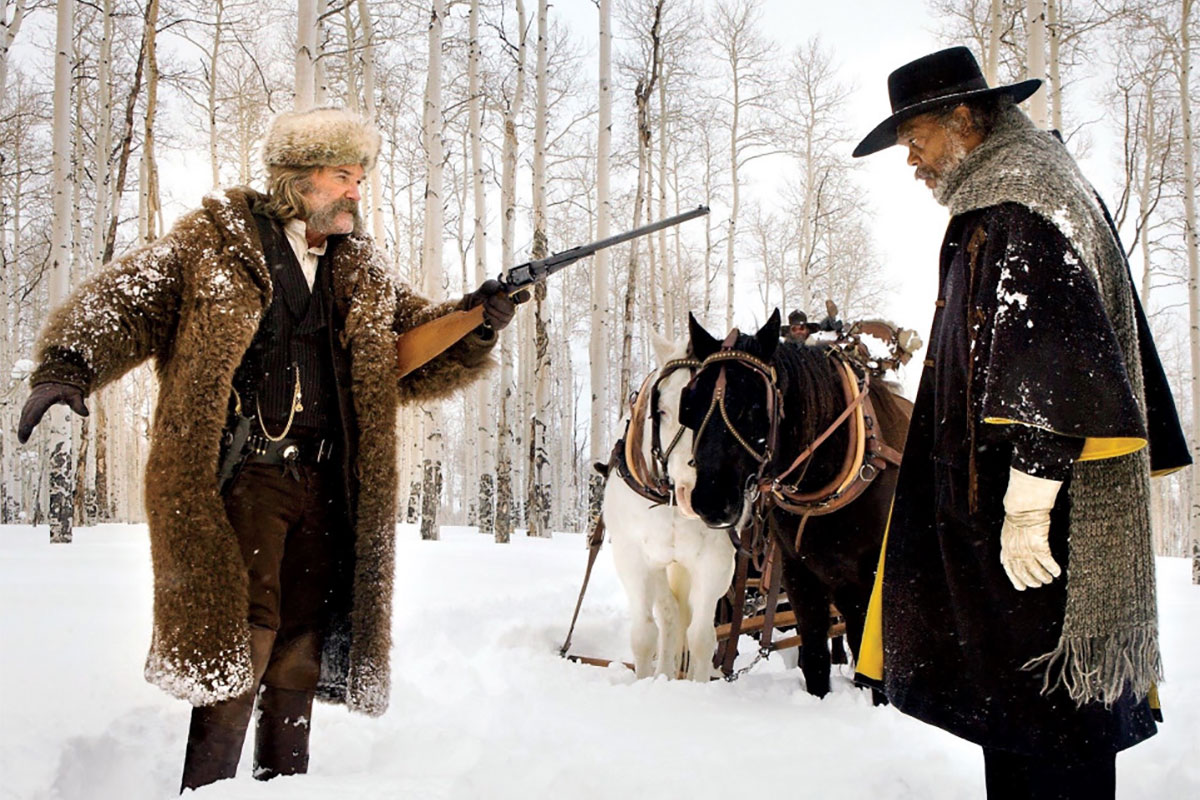
“THE HATEFUL EIGHT” Review (✫✫✫)

Quentin Tarantino sticking up his bloodied middle finger. 

You could not have picked a better title for The Hateful Eight if you had a team of eight Quentin Tarantinos working on the script. It’s simple, straightforward, and to the point: you take away everything you need to know about it, just like Tarantino’s writing. There’s eight killers, they’re all hateful, and they blow each other up in bloody, gory Tarantino-esque fashion. Whether you’d like that sort of thing depends on if you like Tarantino. I do, and I had just as much a blast watching this movie as Tarantino did writing it.

As already mentioned, The Hateful Eight pits eight character’s wits and murderous instincts against each other, all with unique names that accurately reflect their histories and personalities. They include The Bounty Hunter (Samuel L. Jackson), the Hangman (Kurt Russell), the Sheriff (Walton Goggins), the Mexican (Demian Bichir), the Little Man (Tim Roth), the Cow Puncher (Michael Madsen), the Confederate (Bruce Dern), and the Prisoner (Jennifer Jason Leigh), the last of which the plot more or less focuses around. Trapped in a cabin during a harsh winter storm, these eight killers need to keep their wits intact so that they don’t start murdering each other.

This being a Tarantino movie, however, that obviously doesn’t work out very well.

For a lack of a better word, Quentin Tarantino went through hell to get this movie made. First, his script got leaked a few months before he was supposed to start production. Then, he decided to turn his screenplay into a book. When he finally resolved to make it a feature film, he received threats from police officers for participating in a Black Lives Matter protest in New York. Oh, and he had to battle being released in the same month as Star Wars: The Force Awakens. It has not been an easy year for Quentin Tarantino.

With that in mind, I appreciate that Tarantino is still able to make a quality film up to his standards, despite everything he’s been through this year. What is it you love most about Tarantino’s movies? The performances? The dialogue? The characters? The dark humor? The grit? The violence? The shock value? The Hateful Eight has all of that just as much as Inglorious Basterds, Django Unchained, and Pulp Fiction does. To classify it as a western or a comedy or a mystery doesn’t do it justice. Tarantino movies are almost a genre all their own.

That much is how The Hateful Eight is similar to its counterparts. The differences lie in its mystery element, in the characters trying to find the one person slowly, yet violently, killing off everyone else in the cabin. That being confined to eight people makes it difficult to keep this a mystery, as we already know more or less who the “good” guys are, if such a thing can exist in this movie. Regardless, it’s fun to hypothesize and figure the plot out, as there is the added element of mystery that gives The Hateful Eight a sense of intrigue over Tarantino’s other pictures.

As always, the make-it or break-it element comes down to Tarantino’s almost insane obsession with on-screen violence. At times, it gives it that extra shock value that is so ridiculous, you can’t help but laugh about it. At other times, it’s just sick, and it makes you want to throw up the more you think about it. That’s what happened with me and Django Unchained after watching too many nut shots for my own comfort. The Hateful Eight is just as guilty for being violent as Tarantino’s other motion pictures, and while it doesn’t get away with all of its violence (such as the uncomfortable nut shots), it’s still smart enough to survive beyond its onslaught of blood, guts, beatings, bruisings, stabbings, and gore that’s enough to fill up The Shining’s elevator lobby.

Do you like Quentin Tarantino? If the answer is yes, then you will want to see The Hateful Eight. If no, then you definitely don’t want to find yourself alone in this cabin with these eight murderous psychopaths.

Tagged , , , , , , , , , , , , , , , , , , , , , , , , , , , , , , , , , ,

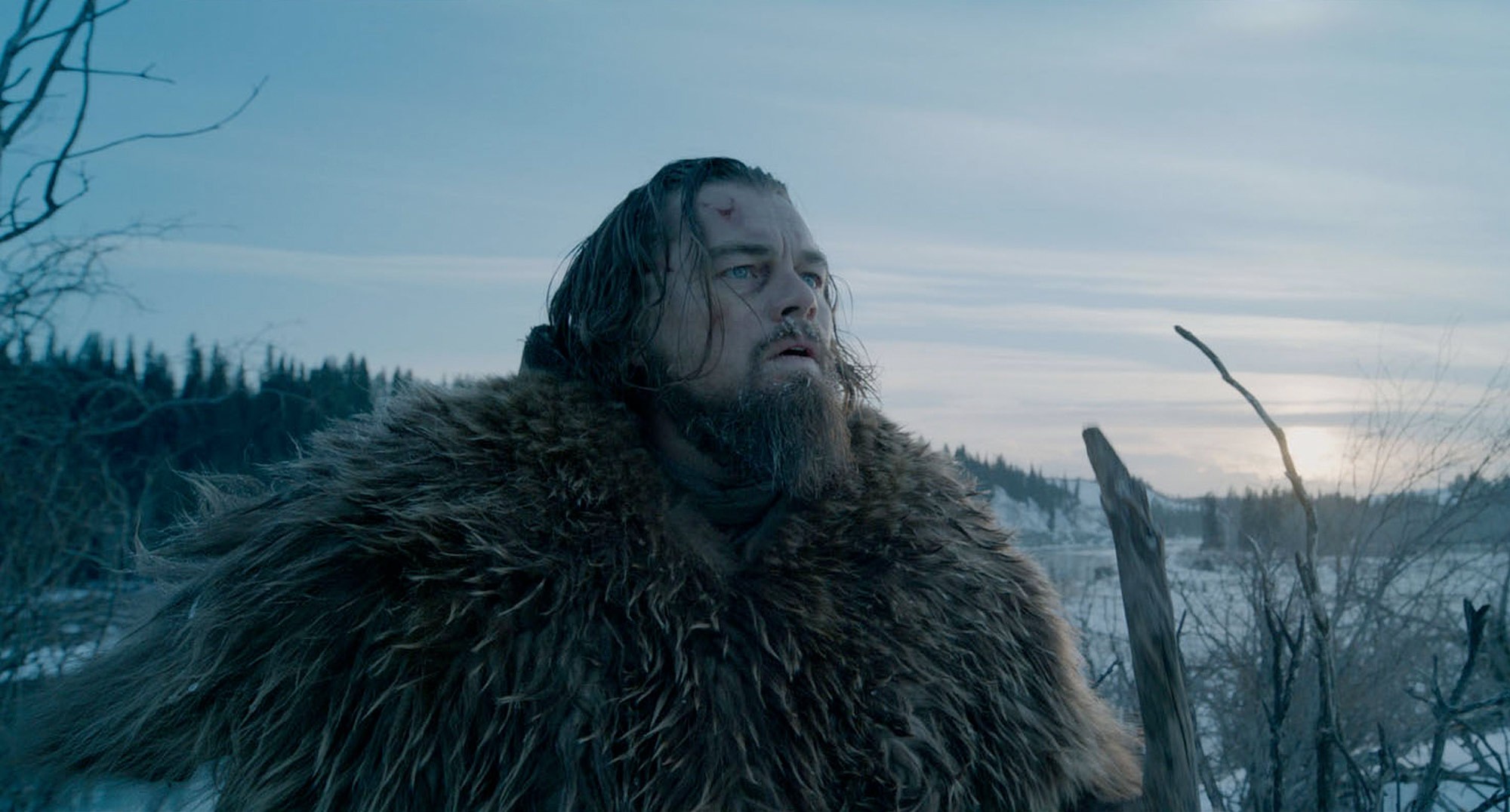
“THE REVENANT” Review (✫✫✫✫)

The broken spirit, revived. 

The Revenant is one of the best films I’ve ever seen, and I never want to see it again.

The film tells the story of Hugh Glass (Leonardo DiCaprio), an 1820’s frontiersman who got mauled by a bear, watched his son get murdered, was left for dead by his friends, and crawled 200 miles to society, seeking revenge against those who betrayed him. His story is not fictional. Author Michael Punke captured the true accounts of Glass’s life in the novel of the same name, which serves as the primary basis for this film.

At hearing about the film, you would never have guessed that this is a true story. Watching the film does little to suspend your disbelief, but as it continues on, you catch yourself slowly conforming to the film’s convictions, believing it more and more as it builds to its emotionally binding and captivating climax. Director Alejandro Gonzalez-Inarritu, who won an Oscar last year for directing Birdman, or The Unexpected Virtue of Ignorance, has made a film so vivid, eerie, and compelling that it could, and indeed does, pass itself off as reality.

Look at the huge risks Inarritu takes as a filmmaker. In Birdman, he took a great risk by filming in multiple long takes, editing them together to give off the illusion that Birdman was all filmed in one shot. Here, Inarritu takes another risk by shooting everything in natural light, using the sun to naturally fill the space that Inarritu captures on camera. The result allows us to experience The Revenant’s environments as they are, rather than being artificially constructed for the film’s sake.

Beyond its practical filming and staging, Inarritu is equally ambitious in his overarching vision for the film. To pick one word to describe The Revenant is impossible. It’s beautiful. Disturbing. Shocking. Heartbreaking. Violent. Gritty. Emotional. Meaningful. Spiritual. The scope of Inarritu’s filmmaking is simply incredible, peering into this man’s loneliness, desperation, paranoia, and drive as he struggles not only to survive, but to live beyond his son’s death.

Oh, this is a wonderfully shot film. In wide angles, cinematographer Emanuel Lubeski captures the sheer scope and vastness of his environments, capturing both the beauty and danger of nature around Glass. In tight shots, he perfectly encapsulates Glass’s struggle against life, nature, and himself as he fights to keep on living. DiCaprio lends just as much to Glass’ turmoil as Lubeski does. At times he doesn’t speak, but simply reacts to the environment around him, and his grief and angst is so believable that you buy his struggle not as a character or an actor, but as a real person.

All of these elements build to embody a perfect film. Yes. A perfect film. Why then, do I say that I never want to see it again? Because it captures its vision so perfectly that the filmmaking aspect no longer seems like an illusion. It doesn’t feel like you’re watching a movie: it feels like you’re watching life. You feel Glass’ nerves as he freezes in the cold, struggling breaths in between his slit throat and his stitches. You feel the pain stab through Glass as the bear’s claws tear into his flesh, literally ripping apart his fragile body as the blood replaces his decaying skin. And you feel Glass’ wrath and his pain, his internal torture where he knows that he will never be the same man again. The film is so convincing in its art that it becomes uncomfortable to watch. That’s what I mean when I say that I can’t see it again.

The film never tells us that it’s based on a true story in the opening and closing credits, and it doesn’t need to. We are already convinced of this through experiencing pure film.

Tagged , , , , , , , , , , , , , , , , , , , , , , , ,

“STAR WARS: THE FORCE AWAKENS” Review (✫✫✫✫)

SOURCE: Walt Disney Studios Motion Pictures

J.J. Abrams: the spiritual successor to George Lucas.

Star Wars: The Force Awakens is a sheer blast of nostalgia, meaningful and joyous from it’s opening scroll credits to when John William’s score crescendos in the last shot. We’ve seen an updated Star Wars for a modern audience before, and that was in the lopsided and disappointing prequel trilogy. Now we have The Force Awakens, and it’s so good that it’s eligible to compete with the original.

It’s 30 years after the events of Return of the Jedi. A new sith named Kylo Ren (Adam Driver) has arisen and is bent on taking over the galaxy. His pursuits lead him towards a troup of misfits who have become acquainted almost by sheer chance. A scavenger named Rey (Daisy Ridley) lived on the desolate planet of Jakku before she got entangled into this conflict. Finn (John Boyega) was a Stormtrooper who defected for reasons unbeknown to us. BB-8 is a spherical droid who wants to get away from Kylo Ren for reasons also unknown. What is known is that these three figures have something that Kylo Ren wants, and he won’t stop at nothing until he has fulfilled his destiny.

It’s hard to talk about this movie without giving away any spoilers. One thing I will say without giving too much away is that the story is exemplary, and is reminiscent of the adventure and intrigue that made Star Wars iconic in the first place. The screenplay, written by Toy Story 3 scribe Michael Ardnt and polished up by Star Trek director J.J. Abrams and The Empire Strikes Back writer Lawrence Kasdan, is an active synergy of the old and new, incorporating elements that we are familiar with while at the same time introducing original content all their own. This is not just a strong Star Wars story. It’s a strong story, period.

For me, that was my biggest concern going into the theater, and the biggest relief coming out of it. This was the first Star Wars movie where its key subjects would not be featured. Yes, we have references to the older films, but we don’t have Darth Vader. We don’t have Yoda. We don’t have Obi-Wan. We don’t have any of the key figures that linked the whole series together, minus R2 and C-3PO. How would the movie hold up on its own?

Very well, as it turns out, and the new cast members do a great job servicing their roles and making them memorable on their own. Driver is menacing and malicious as Kylo Ren, an egotistical and maniacal presence that reflects both the chilling imposition of Darth Vader and the deepening paranoia of Episode III’s Anakin Skywalker. Boyega is both humorous and likable as Finn, a reformed spirit who is just trying to find new meaning and purpose in his life. Out of the entire cast, however, I am most impressed with newcomer Daisy Ridley. This is the first time she has acted in a feature film, but you wouldn’t have been able to tell that based off of her performance. She is both heartbreaking and intriguing as Rey, equal parts fascinating, sympathetic, and compelling as this character whom is a complete mystery to us. Even by the end of the film, we still don’t understand everything about her, and that’s the point. We’re not supposed to understand her history; we’re supposed to understand her. Ridley did an amazing job at bringing this character to life, and out of anyone else from the cast, she made me most excited for her journey in the future installments.

Do I need to go into the film’s visual and sound effects? They were the groundbreaking features of the very first movies, and they’re stronger than ever in this motion picture. Part of that is because Abrams takes a note out of George Lucas’ old playbook, reverting to practical effects and detailed costuming to bring authenticity to this universe. He still uses CGI, but he doesn’t rely on it. He only uses it when he absolutely has to, when X-wings are firing at TIE Fighters or when lightsabers are clashing against each other. Everything else is created through elaborate art direction and set design, while the CGI is used to compliment the visuals rather than serve as them. The result is the most visually authentic out of any of the films yet.

I have one gripe, and one gripe alone, and that is that there are plot elements that eerily mimic the storyline of one of the original films. I won’t spoil it by saying which one. I will say that even in the face of that criticism, The Force Awakens still manages to make itself unique and special in a series that is already unique and special by itself. We said goodbye to this universe a long time ago. Rejoice as we are once again reunited with the galaxy from far, far away.

Tagged , , , , , , , , , , , , , , , , , , , , , , , , , , , , , , , , , , , , , , , , , , , , , , , , , , ,