Tag Archives: Science-fiction

“X-MEN” Review (✫✫✫)

Racism, xenophobia and too many super-mutants to count.

We open on a quiet, haunting frame of a familiar image. Poland, 1944. As German soldiers stand on top of brick rooftops with rain pouring down their uniforms and gun barrels, soldiers at ground level file Jewish citizens from one line into another. One soldier separates a young boy from his aging parents. The mother screams out in agony, aggressively pushing against the flow of the crowd just to get to her son. Soldiers block her path, her husband trying to hold her back while desperately trying to hold back tears. The son, who is kneeling in fear as both tears and rain pours over his cheeks, rushes through the mud to get to his parents. It’s too late: the gate has already closed.

Frustrated in grief and agony, the young man reaches out to the fence as soldiers hold him back, as if he’s wishing the bars to bend so he can escape and save his parents. Before a soldier comes up and knocks him out, his desires becomes his reality: the metal fence is left as bent and tangled as a twisted paperclip.

This is how Bryan Singer’s X-men starts off, with a visual metaphor for bigotry and discrimination where we don’t quite understand what happened, but its emotional power retains itself regardless. The plot goes from the dramatic to a much more stranger turn when we’re introduced to the film’s premise: a new form of species is identified as “mutants,” who are superhuman beings who develop extraordinary abilities through a biological change in their DNA. There’s nothing they do to forcefully trigger the change: it’s as natural as a teenager going through puberty.

What does society choose to do with these mutants? They scrutinize them, convict them and force them to submit to their mutant registration program where they will be forced to reveal themselves, otherwise they will be considered enemies of the state.

The plot goes much deeper than that. The mutant race has been mostly split in between two factions. One of them is the Brotherhood of Mutants, an extremist group led by the gray-haired and calculative Magneto (Ian McKellan), who you will notice was the little boy we saw in the earlier-mentioned credits. The other organization is hidden under the secrecy of a preparatory school called “The X-men”, a group of mutants who train other mutants to control their powers rather than be afraid of them, led by the passively-oriented Professor Charles Xavier (Patrick Stewart).

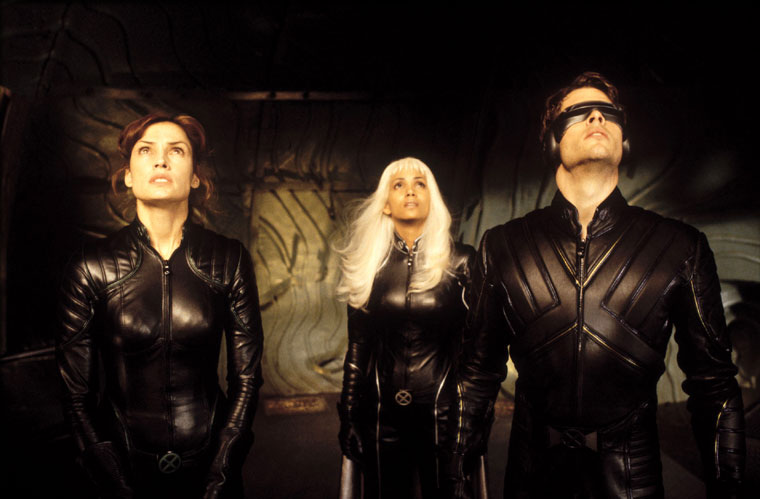
There’s too many other mutants in this movie to keep track of, and even a short roll call won’t cover all of them either. There’s Rogue (Anna Paquin), a teenage mutant who absorbs the life energy out of any being that she touches. There’s Storm (Halle Berry), a silver-haired centurion who can summon lightning bolts and powerful winds through her ability to control the weather. There’s Jean Grey (Famke Jennsen), a telepath who lives with her boyfriend Cyclops (James Marsden), who can obliterate anything with a laser beam simply by looking at them (makes you wonder how they take care of their evening business in the bedroom…). Perhaps the most recognizable mutant here is Wolverine (Hugh Jackman), who came into the X-men with Rogue after spending years trying to remember who he was and where he came from. Wolverine has the most unique ability out of these X-men by being able to heal at a faster rate and protrude claws out of his fists when threatened. So there’s that.

Long story short, the Brotherhood of mutants hatch a scheme against the human race, and the X-men must rise up to stop them. Doesn’t sound like any other superhero team-up action flick out there, right?

Let me start off with the positives. To put it simply, X-men is just a big ball of fun. Whether we’re laughing from a line of scathing dialogue between Wolverine and Cyclops, or watching a thrilling action scene between two mutants fighting on top of the Statue of Liberty, there’s so many memorable moments to look at and enjoy regardless of how hammy or preposterous they might be. Because of this, I think I have a good idea of who this movie was made for: it’s made for the comic-book die-hards, the kids that would freak out in glee and excitement when they get their never-before-opened copy of The Uncanny X-men #141 in the mail for the first time.

For me, my experience with the X-men comes from the 1990′s saturday morning cartoon, the one that included these characters and more in a colorful, energetic and fast-paced ensemble that had much more time and episodes to introduce these characters and delve a little more into their backstories and motivations. For me, this movie hits a few notes on that feeling of nostalgia and then misses on others. I like a lot of what this movie had to offer, from the exciting and uniquely-packaged action scenes all the way to the more dramatic, tensely-driven moments, such as when a mutant argues with a U.S. Senator on mutant rights.

Again, I know where this feeling comes from. Earlier in his career, writer and co-creator Stan Lee created the X-men as a response to the civil rights movement, as an allegory to how people are afraid and hated by other people just because they are different from them. With this movie, I was hoping it would delve into those themes as deeply as Spider-man did with his themes regarding love, guilt and responsibility. Instead, it chooses to make the makeup and visual effects the stars of the movie, showing us cool, flashy effects of people in black leather costumes instead of making the story and themes itself the focus. The movie is a playground to show off what kind of cool tricks these kids can do: not a serious drama about why the two kids are fighting on the playground in the first place.

Here’s the critical factor that saves this movie from just being another standard action flick: the cast. I’ve already mentioned how this movie touches up on some of the nostalgia from the original cartoon. This cast is the reasoning behind that nostalgia. McKellan was conniving as Magneto, a torn and hateful man who sees only one outcome in the human-mutant conflict, an extremist not too dissimilar from that of Malcolm X during the civil rights movement. If he’s Malcolm X then, Professor Xavier is Martin Luther King. Jr., a patient, kind-hearted and wise man who wishes to co-exist with the human race, and defend both of their rights for the sake of that future. I especially liked Hugh Jackman as the feral and vicious Wolverine, a man who definitely has that hardened, rough edge to him, but also that soft spot where he feels protective over those who can’t protect themselves, almost like a papa bear over his little cubs. The script is the transgressor for the silly, generic plot: the cast is what elevates this film above its mediocrity and makes it more than what it actually is.

Overall, I liked X-men. I wish it could have been better, being that the source material is among the most original and influential comic books ever conceived in print, but I’m willing to let that pass for the sake of the franchise’s potential future. If the movie aimed to be nothing else except for visually-splendid eye candy to fill the gleeful hearts of comic book nerds, this movie succeeded. Hey, at least Stan Lee’s Marvelites will be satisfied.
Tagged , , , , , , , , , , , , , , , , , , , , , , , , , , , , , , , , , ,

“THE AMAZING SPIDER-MAN 2” Review (✫✫✫✫)

Don’t worry: it’s not “Spider-man 3.”

The Amazing Spider-Man 2 is the standard of a superhero movie that everyone should aspire to. It’s exciting, action-packed, gut-bustlingly hilarious and emotionally involving to a point where I was surprised at how personal and genuine it really was. “Amazing,” in fact, is not a good enough word to describe this movie — “Superior” is more like it.

Taking place after Curt Connors, aka The Lizard, attacked New York City, The Amazing Spider-Man 2 shows Peter Parker (Andrew Garfield) as he continues to adapt to his new life as the spectacular Spider-Man. He’s just about to graduate, he’s getting a job as a freelance photographer at the Daily Bugle and his relationship with Gwen Stacy (Emma Stone) is going strong. Being Spider-Man has its perks and its downfalls, and this is a rare high point in Peter’s life.

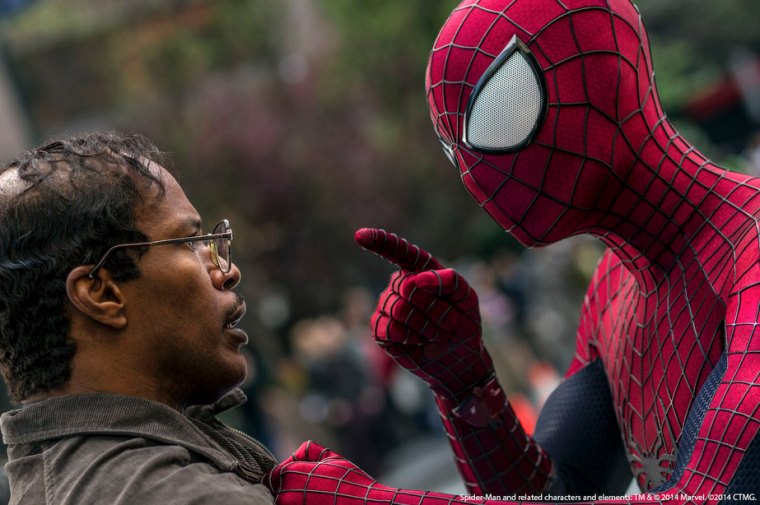
Elsewhere, however, dark forces develop under Oscorp. Engineer Max Dillon (Jamie Foxx) gets electrocuted by bio-electric eels, transforming him into the chaotic villain known as Electro. Russian mobster Aleksei Sytsevich (Paul Giamatti) gets equipped with a fully armed mechanical suit, becoming the Rhino. And Harry Osborn (Dane DeHaan), an old friend of Peter’s, returns with a dark secret that he’s hiding from everyone.

That makes three villains in total for this sequel. Concerned? You should be. The last time we had three villains in a Spider-Man movie, that film was Spider-Man 3. I’m never going to get that image of Tobey Maguire doing the Elvis Presley-stride out of my head, ever. Does anyone have any hydrochloric acid I can pour into my eyes?

Well, you can rest easy, fellow web heads. The Amazing Spider-Man 2 is not Spider-Man 3. Quite the contrary, actually. This is a significantly better Spider-Man than its predecessor, a film that bounces in between multiple tones and genres all at once and does all of them brilliantly.

An early fight scene in the film, for instance, is as wacky and funny as a Looney Tunes cartoon, with Spidey struggling to grab all these plutonium canisters off of a moving truck like he’s in the middle of a pinball table. In another scene, he’s in the middle of an action sequence so exhilarating and mind-blowing that it could have come straight from a video game cut scene. In another moment, him and Gwen are dealing with a real emotional struggle neither quite know how to handle, something that has haunted Peter since the first movie.

That’s what makes this Spider-Man better from the other one: It has many tones, story lines, characters and emotions that it’s juggling all at once. That’s a weighty order, and not one to handle easily. Yet director Marc Webb handles the challenge excellently, delivering just as relevant a character drama as he does an exciting action movie.

The cast members have expert chemistry with each other, but that should be expected because of their exceptional performances in the first film. We already expect Garfield and Stone to be perfect with each other because they were nearly inseparable in the first round of the series. It’s more efficient, then, to focus on the newer cast members: Jamie Foxx and Dane DeHaan. 

Foxx is electric as the high-voltage villain, pun intended. At first he’s just a socially silly and awkward scientist, similar to Jim Carrey’s version of the Riddler in Batman Forever. When he goes through his transformation into Electro, however, everything changes. He becomes an angry and malicious supervillain, a man who is mad and frustrated at everything and just wants to kill everyone, then jump start their heart just so he can kill them again. DeHaan, especially, was desperate and conniving as Harry Osborn, a menacing and starkly different Harry than the James Franco version we are used to in the original trilogy.

Both of these villains serve a pivotal role to Peter’s development. Electro is the physical conflict Peter has to face in the movie; Harry is the emotional one.

There’s another concern comic book fans will have about this movie, and that is the same concern they have with Captain America: The Winter Soldier: We’ve already read the comics. We already know the twists that are coming up, and as a result, our reaction is dulled when that moment comes in the movie.

Let me make a reassuring statement for my fellow comic book lovers: I could see the twist in this movie come from a mile away. Yet when I saw it, I reacted as if I was witnessing Peter’s tragic story for the first time.

There are apparent concerns to have with this movie. The multiple story strands are worrisome, the overload of villains can be an issue and Max Dillion’s character is far too silly to fully accept as being realistic.

Does that change The Amazing Spider-Man 2’s influence, or for that matter, its effect on the audience? The answer is no, it does not. The Amazing Spider-Man 2 is still a great sequel, an excellent expansion to the Spider-Man universe and a more-than-welcome development to Peter’s never-ending growth as Spider-Man. I’m tempted to compare it to the legendary Spider-Man 2, although I’m not sure if it’s quite there yet. One thing is for sure, however: it’s head-over-heels over Spider-Man 3. If Webb keeps this up, he just might surpass Sam Raimi’s original trilogy.

Tagged , , , , , , , , , , , , , , , , , , , , , , , , , , , , , , , , , ,

“X-MEN: FIRST CLASS” Review (✫✫)

Pretend G-men trying to skip out of class.

The very first shot of X-men: First Class is the exact same scene of the Holocaust, frame-by-frame of the very first X-men movie directed by Brian Singer. Not a good way to start off your movie by copying another one, isn’t it? The very next scene after briefly skipping through that one is a young Charles Xavier’s encounter with a young, hungry blue-skinned mutant named Raven who was trying to steal food from his refrigerator. Talking to her in a very sincere, comforting voice, he assures her that she doesn’t have to steal, and reaffirms it by saying that she’ll never have to steal again. Touching. I wonder how this conversation went over with his mother?

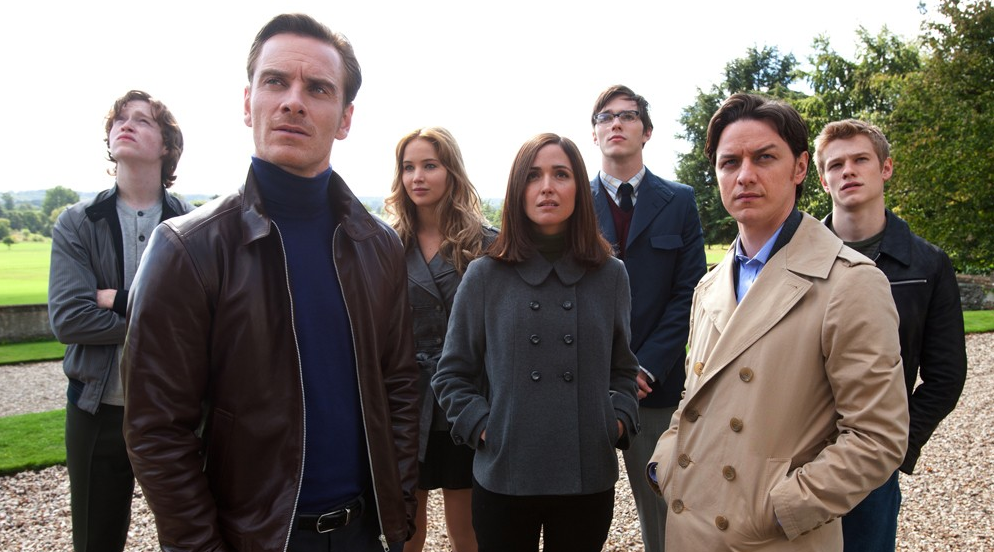
Years pass, and we’re reintroduced to the characters we’ve come to know for the past few movies now. Erik Lenshurr (Michael Fassbender), the man soon to become Magneto, is out on the hunt, looking for the man who killed his family and tortured him as a child back when he was a Jew in the concentration camps. Charles Xavier (James McAvoy) is now in college with the now much more mature Raven (Jennifer Lawrence), who is pursuing his masters degree in psychology.

There’s a mutual enemy that unites these three individuals together: Sebastian Shaw (Kevin Bacon), a menacing and conniving mutant with the ability to absorb and redistribute energy. That means a grenade can explode in his hand and he can transfer the explosion straight into you with a touch of his finger. Shaw is the man who tortured Erik back when he was a young child, and Xavier discovers a sinister plot that Shaw is setting to unveil upon the world. Erik and Charles combine their resources and their efforts to form a mutant team to work together and stop Shaw.

And how exactly does Shaw plan to carry out this giant, dastardly plan? By conspiring and coercing the Cuban Missile Crisis among nations, that’s how. How original. I wonder if these guys considered overthrowing the Chinese government while they were at it?

Hypothetical question. If you hear the term “prequel” being used, what’s the first thing that comes to mind? For me, its the word “beginning”. Beginning, as in, the start of the story. Beginning as in, the start of a legacy. Beginning as in, filling in the holes of all the ambiguous stuff we were told in the original trilogy, and beginning as in making sure everything fits into a nice, nifty little package by the time the end credits roll.

As a superhero blockbuster alone, X-men First Class succeeds. It’s exciting, it’s visually stunning, it features everyone’s favorite X-men that they’ve come to know and love, and it has enough comic book lore in it to make even Kevin Smith giggle with glee. As an action movie meant to please summer movie lovers, it is fine. As a prequel to the critically-acclaimed series that it is based on, however, it is utter and absolute failure.

Three of the biggest goofs that completely and utterly frustrated me. 1) There were flashback scenes in X2, X-men: The Last Stand, and Origins: Wolverine where Xavier is clearly seen as to being able to stand. Yet at the conclusion of First Class (spoiler alert!) Erik deflects a bullet into Xavier’s spine, permanently paralyzing is legs. 2) In the first X-men, Professor X audibly said to Wolverine that him and Magneto helped build Cerebro together, while in this movie it is very clear that a mutant named Hank McCoy (Nicholas Hoult) was the one who built it instead of them. Magneto’s helmet also didn’t exist prior to X-men, whereas here it already does. And lastly 3) a cameo appearance of a certain three-clawed mutant meeting Xavier and Erik about halfway through the movie at a bar. Wouldn’t they have remembered him thirty years later, especially since one of them is a telepath?

These ignorances to the plot show me that instead of providing an accurate prequel to a highly-revered superhero series, the filmmakers were more interested in letting loose and having fun rather than making something straight-laced and refined. I’m all for fun and high-octane action movies, but if you go in ignoring everything else that happened in the movies previous to your own, you’re being disrespectful to the franchise.

Oh, the cast was more than exceptional, I won’t deny that. McAvoy portrays the younger Professor X wonderfully here, passing himself off as a sort of young Patrick Stewart that’s more reckless and immature than his older self. Bacon is smug and charismatic as Shaw, and even though his role wasn’t as compelling as Ian McKellan’s was in the original trilogy, it still served its purpose in the film.

I especially enjoyed Fassbender’s performance as the angry, relentless, and grief-stricken Erik Lenshurr. The staple performances in the series overall belong to Patrick Stewart and Ian McKellan, there’s no doubt beyond that. Still, Fassbender gives it his all here. You notice the effort he extends here, the passion and the fire he instills in this character. McKellan’s rendition of Magneto was calm, collective, and calculated, a great foil to the equally intelligent but more morally aligned Xavier. Here, Fassbender is neither calm nor calculated. He is simply a raging, hateful man, a mutant who has been in pain and alone all his life, desperately seeking some sort of way to fill the emptiness within his cold, solemn heart. I genuinely liked and appreciated his take on the character, even though he bends missiles in one scene that look about as realistic as a Tom and Jerry cartoon.

“But wasn’t it fun?” is a common argument I get from a lot of moviegoers. “Fun” is such a subjective word, and can mean any one of different things. In the aspect of simple, plain, straightforward blockbuster fun, I guess this movie satisfies. The problem is I didn’t go into X-men: First Class expecting a brainless blockbuster. I went into this expecting this to be exactly what it claimed to be: a start to the X-men’s journey, an insightful and hot-blooded prequel that showed perspective on how their story began. This wasn’t even close to being a prequel, ending with more questions where there should have been answers. Fox has already announced that a sequel is currently in the works to be released sometime in 2014, and here I am, thinking that these kids need to go to summer school before even thinking about going into the second semester.

Tagged , , , , , , , , , , , , , , , , , , , , , , , , , , , , , , , , , , , ,

“THE AMAZING SPIDER-MAN” Review (✫✫✫1/2)

♪Does whatever a spider can♪

If I were to have a reboot of one of my favorite superhero films made just ten years ago, The Amazing Spider-man would be that reboot. What can I say about the film that will accurately do it justice? That it is exciting, suspenseful and displays visual effects that leaves the old one in the dust? That the writing is just as acute and skilled as the direction is? That Andrew Garfield has perfect chemistry with Emma Stone? No. Instead, I will describe the film by simply using just one word: amazing.

When Peter Parker was a young, bright-minded child, he lived in the content and warmth of his parents home. When his house was broken into, his father’s office searched through in every crook and cranny, his father Richard (Campbell Scott) quickly packs a suitcase, drives Peter to his Uncle Ben (Martin Sheen) and Aunt May’s (Sally Field) house, and tells Peter him and his mother will be gone for a while. A few days later, the plane that Peter’s parents were on was reported to have crashed. They didn’t make it out.

Twelve years later, Peter (Now played by Andrew Garfield), now in his teen years, is in high school, gets picked on by the local bullies every now and then, and has a crush on this pretty blonde-haired genius named Gwen Stacy (Emma Stone). While in the basement one day helping his Uncle unclog the water pipe, Peter makes an interesting discovery: his father’s briefcase, filled with notes, theories, and algorithms Peter has never seen before. While looking and studying the notes his father left behind, Peter realizes everything points to one scientific company in particular: Oscorp.

From there, Peter snoops around, goes into a lab he wasn’t supposed to go into, a radioactive spider bites him, and well… you probably already know where it goes from there.

If we look at the story, it is on repeat from the first Spider-man. But the repeat isn’t what we care about. The Amazing Spider-man is done with a new style, energy, and enthusiasm to it than the original one was. Funny, I didn’t expect this movie to be as energetic as it is. This film is directed by Mark Webb, who to date, his only directing experience being music videos and the 2009 romantic-comedy 500 Days of Summer. Quite a difference in genres, I know, but Webb handles the transition well. He makes Spider-man as he sees it, as a young man coming out of puberty using his powers for playful, mischievous reasons rather than the heroic acts of courage and responsibility that most heroes are known for. This Spider-man is more jokey and sarcastic than the original one, spitting witty one-liners while arresting a criminal or web swinging past bystanders.

He fuels the action scenes, inspires laughs, and is the source for original entertainment. If Tobey Maguire is the more emotional Spider-man, this Spider-man is the more sporadic and amusing one.

Andrew Garfield does a great job in portraying this Spider-man in a totally different dynamic. His character is definitely different, retorting to puns, jokes, and one-liners that would only result with awkward silences if Tobey Maguire tried to pull off the same thing. Garfield, however, is more talented than a one-dimensional joker. Like any great actor, his character portrays a flurry of emotions, and he portrays all of these emotions well. We can tell exactly when he is troubled or concerned, when he is angered and enraged, when he is happy and content, or when he is saddened and alone. Peter experiences many tragedies in this movie, and Garfield does a good job expressing the emotions for all of them. Emma Stone, equally, is incredible in this movie, providing the film’s beautiful, smart heroine. Together, their chemistry is irreplaceable, and forms a romance that rivals that of the chemistry Maguire and Dunst made in the original Spider-man movies.

Here is, regardless of pre-conceived opinions, a great movie. It is a blockbuster that does a great job balancing in between spectacular action, heartfelt emotion, and genuine humor, all combining into a reboot that makes it not only fun, but unique in its own right.

From a technical perspective, this film has no flaws. It, however, is not about what it did wrong; its a matter of who did it better.

The biggest weakness with The Amazing Spider-man is its release date. This is ten years after the first movie came out, and five years after its most recent one. Why did it need a reboot? It cannot help but bring up the comparison game when you watch this movie. And what happens when you compare things? You recognize which one did things better, and which one did things weaker. In comparison to the old one, The Amazing Spider-man cannot help but look inferior.

But how, exactly? The flaw exists in the writing, dear reader. There are just simply not enough moments in the film that are as emotionally real or relevant as there was in the first two Spider-man movies. Take, for example, the scene in the original Spider-man where Peter’s Uncle Ben dies because Peter did nothing to stop a criminal that ran past him. In the original film, this was a tragic, painful, and heartbroken realization for Peter that it was not the burglar who killed Uncle Ben, but Peter’s inaction and lack of doing the right thing. Here, it’s just on repeat as something that Peter needs to go through in order to become Spider-man. Peter, however, never acknowledges his responsibility in the matter, and neither does he ever even confront the criminal. How, then, does the issue ever become resolved? Answer: it does not. At the end of the film, everything is resolved except for that one specific conflict.

That’s the film’s only real weakness. I don’t want to go on about this weakness, though, because I’d be beating the bush. The main point: The Amazing Spider-man is still utterly fantastic. It is action-packed, suspenseful, energetic, relentless, exciting, humorous, and highly, highly entertaining. The production is all-around strong, the cast is even stronger, and the story is as driven and purposeful as it has ever been, despite a few moments of misplaced emotion. This is a reboot to one of my favorite superhero films of all time, and the surprise is I wouldn’t mind seeing a sequel to it in the slightest.

Tagged , , , , , , , , , , , , , , , , , , , , , , , , , , , , , ,

“GRAVITY” Review (✫✫✫✫)

“In space, no one can hear you scream”

We fade in on a list of statistics about space as the edgy synthesizer music builds in the background.  The earth rotates at a speed of about 1000 miles per hour.  The temperature is about -273 degrees celsius.  There’s no gravity.  No oxygen.  No air pressure to carry sound. No one to hear you scream or cry for help. Nothing to save you if your suit fails to sustain you. Nothing to stop your momentum if you’re flying in the wrong direction. If you get into trouble out in space, you are all alone. Life in space is impossible.

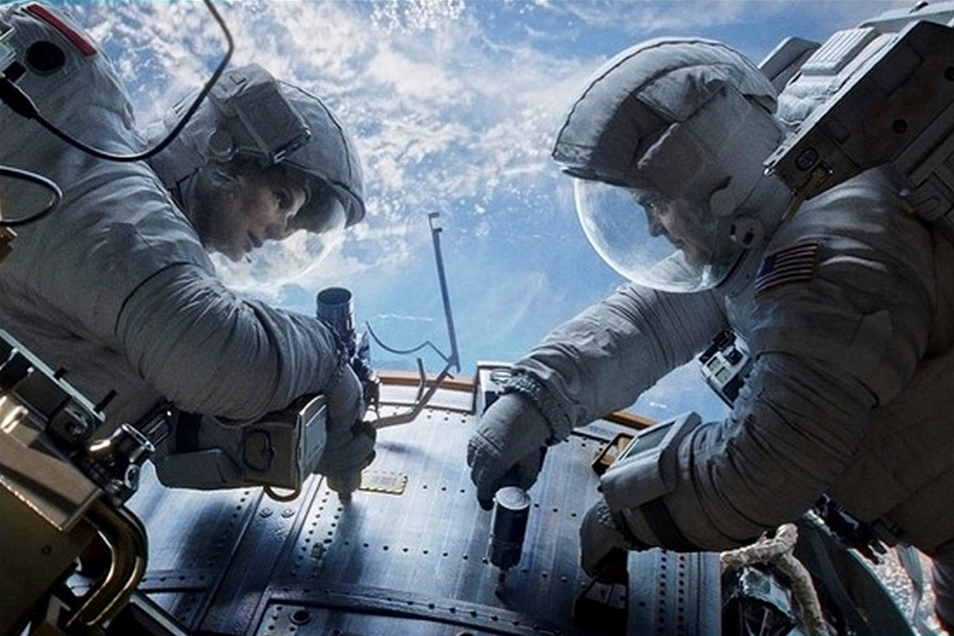
This sort of tension and desperation is felt on an emotional level so intense in Alfonso Cuaron’s Gravity that I feel like I’m in space experiencing the same things that these characters are experiencing, not watching the chaos unfold from mission control.  The plot follows three astronauts who are working on repairing a satellite in orbit. Dr. Ryan Stone (Sandra Bullock) is a mission specialist who is working hard at repairing the satellite on her very first space mission. Lieutenant Matt Kowalski (George Clooney) is an experienced space veteran who is retiring after this final expedition.  Shariff Dasari (Paul Sharma) is a flight engineer who carries a photo of him, his wife, and child inside his suit.  Early into their mission, the team gets a warning from mission control, saying that there is debris from a missile strike on a Russian satellite orbiting the earth, but that it shouldn’t collide with their trajectory.

Now if that isn’t a case of foreshadowing, I don’t know what is.  Eventually, the debris sets off a chain reaction of destruction, and it eradicates the shuttle that they came on.  Shariff is killed, Kowalski loses communication with mission control, and Stone is left desperately hanging on to her life as she floats aimlessly away from their space module. When Stone and Kowalski eventually meet up again, they have to race against time and fate as their oxygen levels continue to deplete, and need to find a way home before they are truly lost in space forever.

Man oh man, where to start.  Gravity is a film for a generation, a picture that is so convincing and so believable in its approach that its nearly impossible to think that it wasn’t even filmed in space.  It is visually stunning, emotionally gratifying, immensely captivating, and surprisingly involving, a picture that latches you on in its first shot and doesn’t let you go until hours after you’ve left the theater.

Who is responsible for this feeling of attachment and interest?  Why that is director Alfonso Cuaron, of course, who co-wrote the script with his son Jonas. Cuaron, who is most known for his mainstream films including Children Of Men and the third Harry Potter movie outdoes himself here. Not only has he made a compelling and visually breathtaking science-fiction film that visually challenges that of Avatar and Inception: he’s also made a emotionally captivating story with the human interest equivalent of Argo or Captain Phillips.

Oh, I’m not saying he isn’t already a great director: lord knows he’s delivered as much visual and emotional appeal as he did with Children Of Men and Prisoner of Azkaban.  But Gravity is head and shoulders above anything else he’s done in his entire career. Why? Everything in the movie is immaculate and intentional, from the physics and dangers of space to characters emotions and complexions. Look at the delicacy and the concentration on Cuaron’s shots. Look at how well he orchestrates a scene, whether a large, imposing space station is crumbling all around Earth’s orbit, or a astronaut is just awkwardly fitting herself in tight corridors around a space station. In each shot, there is interest, there is intricacy, and there is involvement. Whether its a big, intimidating destruction scene or a small conversation between characters doesn’t matter. The interest remains, and its boy does it keep your attention.

Visually, the film is unparalleled, hooking you on with all of its space-station grandeur and elegant scenery of earth from outer space. Part of this no doubt goes to the visual effects team led by supervisor Tim Webber, but a large accreditation needs to be made to cinematographer Emmanuel Lubeski, who collaborated on Cuaron’s other films including Children of Men and Y Tu Mama Tambien. Lubeski, who was nominated for an Oscar a few years ago for Terrence Malick’s Tree Of Life returns with the same artistry and craftsmanship that made him an artist in his own right. The camerawork in the film evokes a feeling of both reprehension and serenity, the same eerie feeling you get when you watch the slow, steady moments building up in Stanley Kubrick’s 2001: A Space Odyssey. It works in conjunction with the film’s plot and with Cuaron’s handling of it, a marriage of collaboration so essential that its doubtful anyone could be as fluid or as controlling as Lubeski is, not even Wally Phister’s steady, reliable camerawork from Christopher Nolan’s Inception or Dark Knight trilogy.

High praise, I know, but it’s well deserved. The visual effects alone have not made this movie. It’s Lubeski’s intricate framing and filming that not only captured these great shots, but intensified them, evoking the anxiety and unease of space just as much as the visual effects and sequencing does.

Bullock and Clooney are affectionate and grounded in their performances, pun intended.  Going in to the movie, I was really worried that the both of them were going to phone in their roles and just let the visuals take over, much like the Michael Bay/Roland Emmerich action movies you see nowadays. Boy, was I wrong. Their characters are real, charismatic and likable people in their own right, people who you’d probably like to sit with and share a conversation with over at Starbucks. Their chemistry is infectious with each other, as memorable and dynamic as the relationship Tom Hanks and Kevin Bacon shared with their crew mates during Ron Howard’s Apollo 13. You don’t only care for these characters because of their situation: you care for them because they are human beings, because they have hopes, dreams, and letdowns of their own and you want to see them make it through all of it.

This is what I love most about the movie: not just that it handles itself well as a science-fiction movie, but it handles itself well as human drama, period.

This is seriously one of the best films of the year. I’m not saying that because it is science-fiction. I’m saying that because it is seriously one of the best films of the year.  Under a different director, a different writer, cinematographer, composer, or even under a different cast, this film could have failed.  It’s hard to take a movie that takes place in an enclosed, blocked off environment separated from society with only one or two characters and make it interesting, and the filmmakers here have accomplished that in spades.

But Gravity is much more than a survival film.  It’s more than a science-fiction film.  It’s an epic and emotional story about an astronaut trying to survive, a woman trying to cope with living, reality, and tragedy, and the unhindered spirit that pushes her to keep living, even when all of the forces of nature tells her that she can’t. It blurs the line between science fiction and science reality and is quite possibly the best space movie I’ve ever seen.

Tagged , , , , , , , , , , , , , , , , , , , , , , , , ,

OSCAR REACTIONS 2013

Well, that was anti-climactic.

For those of you who live under a rock and don’t know who I’m talking about when I mention the word “oscar”, the 86th Academy Awards took place yesterday on ABC, hosted by comedian Ellen Degeneres. Needless to say, Degeneres was brilliant, taking selfies, buying pizza, crashing twitter, bringing the stage down for Jennifer Lawrence, and calling Liza Minelli a man all in one night. And yet, despite all of her efforts, the oscars seemed so… boring.

How did this happen? The nominees, dear reader. Out of the 24 categories in the ceremony I got twenty right, beating most of my Shorthorn peers and family members for the potluck we held that night. The most I’ve gotten previously was sixteen. I’m inclined to believe that the academy made the winners of these awards too obvious by building up too much hype of them during the buzz of the past few months.  Case in point: was there any argument that Frozen was going to take home best animated feature?

It doesn’t matter now, anyway. It happened, and I got 20 right out of 24 categories. Yes!!! Just because I predicted them correctly, however, doesn’t mean I need to be happy for their win. Let’s go through each of the categories and see whether or not they really deserved it or not…

BEST PICTURE (CORRECT!) The best picture of the year rightfully won best picture at the Academy Awards: Steve McQueen’s phenomenal, gripping, heart-wrenching, spellbinding and immensely powerful 12 Years A Slave won best picture. While I’m ecstatic for its win and could not agree more with the Academy’s consensus, I find it very strange that it won the Academy’s highest honor despite it only winning two other awards. But we’ll talk more about that later.

BEST DIRECTOR (CORRECT!) Also correctly predicted is Alfonso Cuaron for his nerve-wracking and tensely-directed sci-fi thriller Gravity. I already mentioned this in my predictions, but the best director award needs to be reserved for the best picture of the year. I loved Gravity with every fiber of my being, but it simply does not match the cinematic caliber to that of McQueen’s 12 Years A Slave. It would be like comparing The Dark Knight to that of Slumdog MillionaireThe Fugitive to that of Schindler’s List, or Jaws to that of One Flew Over The Cuckoos Nest. They are all ingenious, brilliant and incredibly memorable pictures, but the best picture of the year is awarded that because of the direction and treatment that it was given.

That’s not intended as an insult towards Cuaron, and I definitely believe he deserves it based on the physics and tension of the movie alone. If I’m thinking about which movie had the bigger impact, however, it’s no contest on which one it deserves to go to: McQueen for 12 Years A Slave. Nevertheless, I congratulate Cuaron on his many accomplishments regarding Gravity. Lord knows my heart stopped at least a few times while watching that picture.

BEST ACTOR (CORRECT!) Matthew McConaughey took home the award for best actor as a rowdy texas cowboy dying of AIDS in Dallas Buyers Club. While the award could have gone to either him or Chiwetel Ejiofor for 12 Years A Slave, there’s no denying the power, the energy, and the raw gravitas that he brought to a man’s desperate journey to survive. Plus, I love his acceptance speech and how he dedicated the award to God and to “himself in ten years”. That’s a wise goal that any man should strive for.

BEST ACTRESS (CORRECT!) Cate Blanchett won best actress for Woody Allen’s Blue Jasmine. While I have regretfully not seen the movie yet, I will say that the few scenes I have seen her in impressed me very much, and that she did a solid job portraying a deeply bothered woman who is in deep depression and alcohol addiction. Congratulations to her. I look forward to watching the film, as well as Blanchett’s performance in it.

BEST SUPPORTING ACTOR (CORRECT!) Did Michael Fassbender win best supporting actor like I wanted him to? No, he did not. Instead, Jared Leto took home the award portraying the transgender AIDS victim Rayon in Dallas Buyers Club

The more I think about it, the more ridiculous I think it is that the best picture winner of the year did not get recognized in so many categories. Why the snubbing from Fassbender? Half of the movie’s turmoil and conflict came from this despicable character, a man so inhumane and abominable that Calvin Candy from Django Unchained would have broke down in tears after seeing what this man forced people through. Fassbender was pivotal, aggressive, violent, and hateful as Edwin Epps, and incurred more emotions from audiences than that of a transgender AIDS patient in Dallas Buyers Club. I know 30 Seconds To Mars fans will hate me for saying this, but the more vital role needs to go to the more vital performance. I said it once, I’ll say it again: Leto is not as deserving in the award as Fassbender is.

Again, no disrespect, and I acknowledge that Leto gave a great performance in the picture. But like Cuaron with best direction, the more compelling presence needs to go to the more compelling artist. Sorry, Rayon.

BEST SUPPORTING ACTRESS (CORRECT!) Lupita Nyongo won (and deserved) the academy award for best supporting actress for her heartbreaking role as a desperate and depraved cotton picking slave in 12 Years A Slave. No qualms here.

BEST ORIGINAL SCREENPLAY (CORRECT!) I also correctly predicted that Spike Jonze would win the best original screenplay award for his sci-fi romance story Her. Comparing Her to the genius of David O’Russell’s American Hustle, I mentioned in my original predictions list that “just because its a smarter story doesn’t necessarily mean that it is a better one.” I do not retract my statement.

BEST ADAPTED SCREENPLAY (CORRECT!) John Ridley won best adapted screenplay for his incredibly well-documented 12 Years A Slave. He equally deserved it, as Solomon Northrup’s story, or legacy, could not have translated any better to the screen if the filmmakers tried. Great job, Ridley. You gave us an unforgettable and incredible story, the likes of which no one has seen since Steven Spielberg’s Schindler’s List. 

And this is the only other award 12 Years won for the night. No cinematography. No editing. No costume or production design. No supporting actor. No other award that would further substantiate and support its win for best picture.

Am I the only one that finds this completely ludicrous? To date, there are only three best picture winners to win only three academy awards. Those movies are The Godfather, Crash and Argo, and two of them didn’t even win in major categories. Seriously, what is going on? Why are we being so insubstantial towards movies that have been deemed the best of the year? Do academy voters not realize that by naming this the BEST PICTURE OF THE YEAR that they’re saying that its better than everything else? And according to this ceremony, not only are they saying that it is the equivalent of Dallas Buyers Club (they both won three academy awards), but that Gravity is superior to it with seven wins and no awarding of best picture.

Seriously. Make up your mind. I’m fine with you saying one picture is better than another, but substantiate that by what awards you give it. I seriously doubt that 12 Years is best picture because of its screenplay and its supporting actress alone. Likewise, I doubt that Gravity isn’t the best picture of the year because it has the best direction, camerawork, editing, sound mixing, and visual effects out of any other picture.

That’s all I ask, folks. Not preference. Fairness.

BEST FOREIGN LANGUAGE FILM (CORRECT!) The Great Beauty won for best foreign-language film. That’s the one that everyone saw, right? It obviously deserved to win.

BEST DOCUMENTARY FILM (INCORRECT!) I incorrectly predicted that Act Of Killing would win the award, but no, 20 Feet From Stardom took the award home, with featured artists on the film including music legends Mick Jagger, Bruce Springsteen and Stevie Wonder. I haven’t seen the film, so I have no place on commenting on it, but it seems odd that the Academy would reward a movie about background singers over that of a tragic confrontation of death and social issues. I’ve yet to see either of them though, so like I said, my opinion is invalid in this category.

BEST ANIMATED FILM (CORRECT!) Disney won best animated feature for Frozen. While I didn’t care much for it, I know it made a wide impact on its audience and that it will go on to be fondly remembered by many animated movie lovers for years to come. So congratulations for its win, even though I’m no fan of the cold weather this time around.

BEST ORIGINAL SONG (CORRECT!) Frozen won best original song for its memorable song “Let It Go”. It certainly didn’t win for Idina Menzel’s performance, that’s for sure. What the heck happened with her? Her pitch was all over the place, her control was wonky, and her whiny voice was the contrast of the powerful, beautifully controlled voice she exhibited in the movie itself. Seriously. What happened?

One song I’ve really been getting into recently (and I think you’ll agree with me) is Pharell Williams’ “Happy”. The performance proved why. Not only was it energetic, upbeat, and undeniably catchy, but Williams gave a great performance, he exhibited great control and showed very few differences from the studio version of his song. Menzel’s performance, in comparison, was completely and utterly horrendous.

But hey, I guess that’s why the award is called “best original song” and not “best performance”. Otherwise, I think we both what the turnout would be.

BEST ORIGINAL SCORE (CORRECT!) Steve Price took home the award for best original score with Gravity. He completely deserved it. Not only did it match the tension, edginess and unease of the movie, but it also gave a dignified sense of hope and accomplishment after a long journey of heart-pounding danger and peril. Listening to the soundtrack alone gave you the feeling of identity and survival, and Price was definitely the most deserving out of any nominee. Congrats to him for his win.

In the meantime, I’m still wondering where is Hans Zimmer’s nomination for Rush. Remind me again why this movie wasn’t nominated for anything?

BEST CINEMATOGRAPHY (CORRECT!) In 2011, Emanuel Lubewski was mercilessly snubbed for his masterful, Stanley Kubrick-esque camerawork in The Tree Of Life. If he didn’t win it this year, I was literally planning on flipping out.

Luckily, he did.

BEST FILM EDITING (CORRECT!) Another category that I felt 12 Years was superior to Gravity, yet it still lost to it. Must I keep beating a dead horse? Gravity was a more visually stellar and energetic picture. 12 Years was the more engaging and involved one. Part of that was because of how the film was put together in a traditionalist style that was reminiscent of Dylan Tichenor’s work from movies including There Will Be Blood and Brokeback Mountain, where he focused most of the runtime on the film’s subjects rather than worrying about flashy cuts or transitions. Film editing is one of the most important part of storytelling, and what have I been saying is the best story of the year? 12 Years A Slave.

I’m not going to drag this out though. Gravity was a great picture, and editors Alfonso Cuaron and Mark Sanger definitely reached outside the box to accomplish things visually no other film did this year. It did a good job. Moving on.

BEST PRODUCTION DESIGN (CORRECT!) The Great Gatsby won for best production design. Considering the sets were the most colorful and visually appealing out of the year, that isn’t very surprising.

BEST COSTUME DESIGN (INCORRECT!) Unfortunately, I predicted this category wrong, thinking that 12 Years was going to get this one. The only reason I went with that instead of winner The Great Gatsby was because I knew Catherine Martin was already going to win for best production design, and any more than that would have been greedy. I forgot that “spreading the wealth” isn’t a phrase the academy is most well known for.

BEST MAKEUP (CORRECT!) Thankfully, Dallas Buyers Club won for best makeup and hairstyling. As long as Jackass: Bad Grandpa didn’t walk home with the award, I’m satisfied.

BEST SOUND EDITING (CORRECT!) Gravity won.

BEST SOUND MIXING (CORRECT!) Gravity won. Again.

BEST VISUAL EFFECTS (CORRECT!) If you even thought this award was going to anything other than Gravity, you’re either insane, or blind.

And at last, the long-dreaded short film categories.

BEST LIVE-ACTION SHORT FILM (CORRECT!) Surprisingly, I got this category correct with predicting Helium. I haven’t seen the film though, so it was only by sheer luck that I got this right.

BEST ANIMATED SHORT FILM (INCORRECT!) Mr. Hublot took home this award. That’s surprising, considering how clever and fun Get A Horse! was, but nevermind. I haven’t seen the movie, so I can’t comment on it.

BEST DOCUMENTARY SHORT (INCORRECT!) The Lady In Number 6: Music Saved My Life. Again, just like any other films in these categories, I haven’t seen it, so how would you expect me to get it right? You might as well blindfold me and ask me to just write on the flipping ballot.

Overall, this has been a fun ceremony, and I’m grateful to Ellen Degeneres for making it a happy-go-lucky and loveably quirky time. Just please, make the ceremony less predictable next time, okay? I’d rather not have a film come in and just know that its going to dominate in all of the categories. You would have been better calling it “The First Annual Gravity Awards”.

-David Dunn

Tagged , , , , , , , , , , , , , , , , , , , , , , , , , , , , , ,

“HER” Review (✫✫1/2)

What on earth did I just watch?

How do you fall in love with a computer program? Throughout the entire runtime of Her, that’s the only thought that was peaking through my mind. I wasn’t thinking about Joaquin Phoenix’s deliberate performance. I wasn’t thinking about how sweet and serene Scarlett Johansson’s voice sounded. I didn’t think about how clever the story was or how passionate Spike Jonze’s direction was. The only thing I was thinking about was how hard it must be to maintain a relationship with a piece of machinery. Can you imagine how awkward those morning encounters must be?

Taking place in the not-too-distant future, Her follows the story of Theodore Twombly (Joaquin Phoenix), an introvert and manic depressive who writes love letters for a living and has recently gone through a divorce with his wife Catherine (Rooney Mara). Theodore is not in the most stable mindset as the movie begins, and as an effort to feel less lonely, he purchases an artificial intelligence who names herself “Samantha” (Scarlett Johanson) to help him with his everyday needs. What goes from there is a grand journey of self-discovery, identity and romance as these two gradually come closer with each other and eventually fall in love.

For those of you who have seen the movie, does that paragraph just about do it justice? I could go deeper into the plot synopsis, but why would I? From just those three sentences, half of you have already decided whether you would like the movie or not. There are, no doubt, some introspective and provocative thinkers out there who will find joy and enchantment with this story, while other viewers will watch it and ask themselves what on earth they just watched.

For me, I went in an open book. I knew that the movie had an opportunity to woo me, that it was a strange and outlandish idea to begin with, but that the idea doesn’t matter as long as it was handled and carried out well. How did the movie do with that?

Eh. I’d rather watch 1 Night In Paris. 

Like its central idea, Her is a strange movie, a surreal and against-the-grain picture that challenges a lot of misconceptions about love and relationships. While I like that and think it has a lot of great ideas to offer its viewers, I find them so hard to focus on while we’re watching Joaquin Phoenix having sex with a machine.

Yes, there are sex scenes in the movie, although I hesitate to even call them that. There are two that we actually see, but from their conversations we actually infer that there were plenty more.

The first one isn’t really a sex scene, but more or less a copycat of phone sex with Scarlett Johansson’s voice (which I’ll admit, didn’t bother me that much at all). The second one, however, was out of this world weird, with Samantha hiring a surrogate (prostitute) for Theodore to have pretend sex with. They’re trying to justify it by saying that she isn’t a prostitute and that she’s just trying to be a part of their experience, but that argument is null and void. She’s provided sexual services in exchange for something else. She’s a prostitute.

Don’t get me wrong: there are many emotional moments that the movie handled surprisingly well, and there’s an undeniable sweetness and sentiment to the story that can’t help but be noticed. Despite her being a machine, Samantha has a surprising amount of layers to her, being an in-depth and interesting character and love interest in her own right, while the human characters contribute the more grounded relationships that make more sense than that of Samantha’s (Including a recently-divorced Rooney Mara and Amy Adams, who offer very interesting parallels to Twombly’s exotic love story).

Joaquin Phoenix, however, is the flesh and blood of the film. His performance is nothing less than exemplary, playing this shy introvert so convincingly that its hard to imagine that he at one point portrayed Johnny Cash. His character reminds me of many of cinema’s most memorable introverts, ranging from the autistic-yet-brilliant Raymond Babbit in Rain Man to the hyper-obsessive and socially distant Mark Zuckerberg in The Social Network, or the paranoid John Forbes Nash Jr. in A Beautiful Mind. All of those movies focused on characters that struggled romantically and socially, and how much they struggled with their identity and being themselves. I love it when movies reach into characters that deep and personally, and if the film focused more on Twobly’s personality rather than that of his love and attraction to his operating system, the movie could have ended up being way more successful.

I can’t help but keep thinking about how small Her’s audience will be. In this day and age, art films are getting harder and harder to advertise and appeal to mainstream moviegoing audiences, and this movie is definitely no exception. I know the film’s premise doesn’t matter as much as how well that premise is handled, but there are some movies that just can’t get away from their bizarre ideas. Case in point: did anyone really expect Quentin Dupieux’s Rubber to be a good movie?

I stress this again: the main character is in love with a computer program. If you can buy that and get over that to enjoy the movie, good for you. But there are no doubt others who will not enjoy this picture, and I can’t help but think that they will be a more sane person because of it.

Tagged , , , , , , , , , , , , , , , , ,

“ELYSIUM” Review (✫✫)

We call it Halo– oops, I meant Elysium.

Elysium is a very specific movie for a very specific audience, a science-fiction film that is too illogical to be taken seriously, yet too solemn to have any good fun. Whenever I attend the movies, I expect either a thought-provoking story trying to instill some idea in its viewers, or an engaging, fun picture intended for the enjoyment of its audience. Never have I seen two tones clash with each other so furiously in a motion picture.

Taking place in the future of 2033, Elysium tells the story of Max Dacosta (Matt Damon), a poor young orphan who is stranded on the destitute slums on Earth since pollution and overpopulation took whatever life it had left long ago. The poor live on Earth while the rich live on an off-world, ring-shaped preservation called “Elysium”, where the fortunate carry out their spoiled, lavish lifestyles and cure diseases in these “health pods” that more or less reboot their bodies. Feeling sick, drowsy or nauseous? Not on Elysium.

Since he lives on Earth, Max is stuck to his harsh day job as a construction worker, building the guard robots that patrol and abuse the citizens on Earth on a daily basis. One day, however, a full, fatal blast of radiation doses him at his work place. Having only five days left to live, Max joins the rebellion on Earth and hatches a scheme to get to Elysium and get himself cured.

A notice to the visual effects designer that handled the majority of the film’s designs: I’m suing you for plagiarism. Video game fans will notice this more than me, but every single piece of designs for Elysium, the machines and anything else in the movie bears a strikingly similar resemblance to a Microsoft video game called Halo. Look it up. The robots, the armor, the weapons, the vehicles,the landscape, even the ring design of Elysium all bear multiple similarities to their counterparts in that video game to the point where it is no longer inspiration and becomes an issue of copyright. Frankly, I’m surprised Microsoft hasn’t sued them already.

Back to the matter at hand. What is there to say about this movie? Well, it’s written and directed by Neil Blomkamp, the same filmmaker behind District 9, who ironically was also in the running for adapting the Halo movie to the big screen. Matt Damon is the lead, a role previously offered to white rappers Eminem and Ninja, and Sharlto Copley plays a vicious bounty hunter that’s chasing after Dacosta, a sharp contrast to the bureaucratic role he adopted in his first collaboration with Blomkamp in District 9.

I myself have not seen District 9, although I’ve really wanted to. The words I’ve heard to describe the movie have been praising nonetheless, with phrases I’ve heard including “greatly entertaining”, “raw and intensely-blooded”, “aggressively original”, and “an un-compromising geo-political/xenophobic commentary.”

I feel like everything I heard about District 9 is everything that Elysium isn’t, save for all of the pointless blood and gore. Don’t get me wrong, there are good parts in Elysium, but that’s all they are: complete, fully realized parts of one broken, misshapen whole. The first hour is absolutely mesmerizing, immersing us in this world full of spectacle, bigotry and the unfair treatment of social classes. I love the opening sequence of the film because it painted a picture in between Earth and Elysium similarly to how one paints a picture of the rich and the poor. It truly touched and gripped me,  preparing me for an exhilarating experience filled with deepness and social commentary.

So what happened? Matt Damon gets doused with radiation and he straps on a large freakin’ robot suit that is about as lumpy and inconvenient as the metal suit Tony builds at the beginning of Iron Man. All of the emotional relevance I talked about at the beginning of the movie is now gone. What’s in the place of the drama and the social commentary is an action movie, filled with all sorts of the gunshots, robots, big ships, and the machine “whilring” sounds all the same. The worst part?  None of the action is either original or exhilarating. It’s just an awkward boxing match of punches and grabs that looks about as visually appealing as a round of “Rock-Em-Sock-Em Robots”.

Oh, Matt Damon does a good job being a puppet in the movie, but that’s all he is: a puppet, with no emotional gravity or relevance until the end of the picture. But even then, what do we have for the other 120 minutes? Just the typical bad boy character with big muscles dragging around a metal suit and shouting the F-word.

There are also multiple lapses in the film’s logic that can’t help but bother me. Why doesn’t Elysium have any defense systems? Why do they have to rely on a bounty hunter to shoot some spaceships down from the grounds on Earth? How can you aim at ships in space when you can’t even see them from the planet? Why does Max experience headaches randomly that are neither explained or elaborated? Why does it take one person multiple hours and a lot of painkillers to surgically install armor, whereas it takes another person mere minutes to put it on?

The worst, and most frustrating hole, however, comes from Elysium itself. Do the inhabitants there realize that Earth’s inhabitants are not after their home, but rather, their healing pods that they keep exclusively on Elysium? That’s why they invade the preservation, for crying out loud. Why, then, are they so selfish in keeping those pods and not at least building a few for the hospitals on Earth? The U.S. used to spend over $50,000 on foreign aid to other counties, and Elysium is obviously much better off than we are. Are Elysium’s inhabitants really so stupid to not realize that if they built a few of those pods down to earth, the tension would ease and they perhaps would be left alone? Their attitude is so selfish to the point that their actions are no longer sees as cruel and they begin to seem less realistic.

Yes, it paints imagery of the rich and the poor. Yes, it has its own philosophy of racism and social class. Yes, it has messages on healthcare and humanity. Laddy-freaking-da. What is the point of the messages if the film is no good? We were supposed to get a film that was smart, exciting, and dramatic. What we got instead from Elysium was an experience that is dull, confusing, and uninspired.

Tagged , , , , , , , , , , , , , , , , , , , , , , , , , , , , , , ,

“THE WORLD’S END” Review (✫✫✫)

These poor dims have had too much to drink.

We’ve all known that kid somewhere in our high school years. Yes, you know who I’m talking about. That kid. That kid as in, the troublemaker. The smart talker. The womanizer. The drinker. The guy who turns heads and raises eyebrows, the guy whose only concerned with having a good time and not much else. They act on impulse, spontaneity, paying no second thoughts to doubt or common sense. They don’t think about their future or what they’re going to do after high school. They don’t live in the future. They live in the moment.

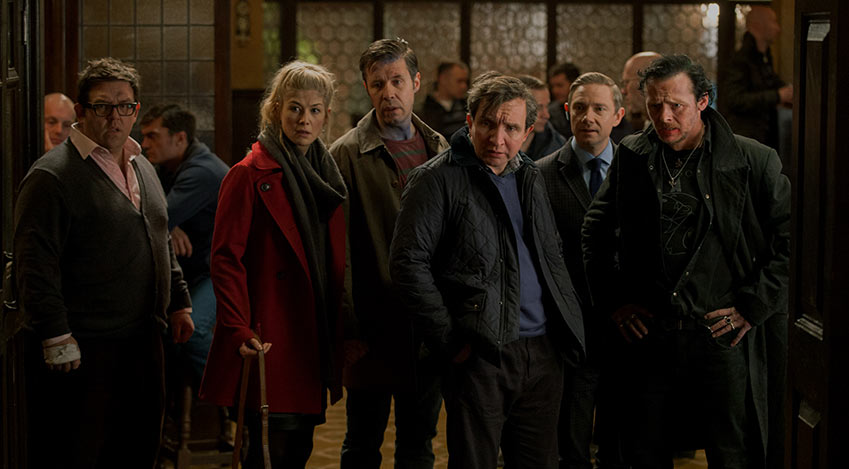
That same trouble-making, lady-loving, drink-guzzling, bad-mouthed rebel is known in this movie as Gary King (Simon Pegg), a poor old sap in rehab who misses the old days and just wants them back again. In order to do this, he reaches out to his old british friends from high school to go and complete “The Golden Mile”, a long pub crawl of twelve different pubs in his old town of Newhaven, where the crawl ends at the most popular pub of all, appropriately called “The Worlds End.”

His friends are now all estranged successful businessmen, but they all lack the energy and perhaps foolhardy excitement that Gary loves to constantly express. Perhaps the best of his friends, however, is one Andy Knighly (Nick Frost), a once-cheerful young fellow, now an old, depressed office worker trying to win back the affections of his wife and children. The last thing he needs is to go on this trip with Gary, but if there’s one thing Andy knows, its that you don’t say no to the King.

They go to their hometown where they started the Golden Mile, and they notice a lot of things have changed since they were last there. Why? Well, that’s because alien robots have taken the town over.

……WHAT?!?!?!? No, dear reader, I am not drunk. Alien robots took over Newhaven, and Gary King discovers this by knocking one’s head off after he slid on his own urine in the bathroom. When he recoups with his friends later on at the bar, they decide that they need to keep going on their route so as not to raise suspicion, and later quietly slip out of town. Sounds pretty simple, right? Not when you have four drunk guys traveling along a total fool. Good luck with that, fellas.

Co-written and directed by Edgar Wright, The World’s End is the birth child of an unofficial trilogy of Pegg, Wright, and Frost’s previous work together, including Shaun Of The Dead and Hot Fuzz. For those who’ve seen those previous movies and are expecting a pompous, outlandish experience just like those pictures, you’re not far off. The World’s End is, by every definition, a ridiculous, ludicrous, and far-out experience, a preposterous and purposefully silly picture to the point where it surpasses being stupid and starts being funny. It’s like those older television skits by Monty Python: they undeniably immature and stupid by nature, but there’s an inherent wit and silliness to them that can’t help but make them so much fun.

Case in point: Simon Pegg and Nick Frost’s chemistry. In the past, their character’s relationship involved a budding romance in a cheesy “You’ve Got A Friend In Me” type of ordeal. Here, the relationship is more strained, almost like Frost is a babysitter and its his turn to supervise little baby Simon so he doesn’t eat sand from the playground. Their characters are hilarious because they’re polar opposites: because Pegg plays the ambitious, over-the-top party boy while Frost is the more conserved, more easily frustrated business man.  Remember the chemistry between John Candy and Steve Martin in Planes, Trains, and Automobiles, where the frustrated business guy (Martin) keeps having to monitor the guy (Candy) who is oblivious, foolish and hopeless? Same case here, although the roles are more or less switched between the two actors.

And then the robots. Oh my God, are they hilarious. In Shaun Of The Dead we had zombies, and in Hot Fuzz we had crooked cops. Now, we have supernatural alien robots, although they hilariously keep insisting that they are not robots because they have sentiment and free will. Anyhow, the funniest thing is how the group reacts to them, tearing off their body parts, whacking themselves with their arms, legs, and anything else they can pull off of their bodies. It’s like someone combined the Lego minifigures with Whack-A-Mole and then decided to throw blue kool-aid somewhere into the mix. Just trust me, it gets messy.

I’m overanalyzing this. The question I should be answering is this: did it make me laugh? The answer: Yes it did, consistently and abundantly, and what’s even more important is that it had something more to offer than simply entertainment. It had a deeper message to tell its audience, and instead of celebrating foolishness and drunkenness, it decided to touch upon a deeper subject involving friendship and true happiness.

I won’t spoil the segment for you, because for me it was the best scene out of the whole movie. I will say this though: most movies, including Project X, 21 And Over, and the dreaded Hangover series take alcoholism and play it out like its fun, like a big party with no consequences or repercussions to the people involved with them. This movie had the opportunity to play it out in that same fashion, but it chose a different direction. It decided to take alcoholism and show it in a more realistic light, maybe even a tragic one. This sequence genuinely touched me, as well as the conversation two characters shared about their life and what exactly they mean to each other. It did more than entertained me: it genuinely surprised me.

As far as comedy and drama goes, I can name a number of films this year that have both made me laugh harder and feel more, among them including the explicit Don Jon, the tamer Monsters University and the other horror-comedy Warm Bodies. Should I take off points, however, if the movie doesn’t match up to the standard of other pictures? The point is that this is a good movie. It had more to offer than just pointless swearing and debauchery: the movie is funny, touching, and original, and there’s a lot of moral truth to it, aside from all of the alien robots mucking everything up.

Tagged , , , , , , , , , , , , , , , , , , , , , , , , , , ,

“MAN OF STEEL” Review (✫✫✫✫)

Look!  Up in the sky!  Its a bird!  It’s a plane!  It’s the man of steel!

Now this is what I’m talking about.  Man Of Steel is in a special place as a reboot, a carefully calculated yet ambitious and affectionate movie giving a new energy and enthusiasm to a cherished American icon.  The last thing I wanted Man Of Steel to become was a remake of the original Superman movies, or even worse, a PG-13 version of Watchmen.  We have none of that here.  It isn’t coy, formulaic, or insincere: it’s a rare rebooted superhero remake that affectionately, genuinely works.

In case you haven’t picked up on it by now, Man Of Steel is a retelling of the story of Superman.  Clark Kent (Henry Cavill) is a young inhabitant of Smallville, Kansas who deals with a specific problem that other teengers his age doesn’t deal with: he has metahuman powers the likes of which cannot be from planet earth.  And young Clark isn’t from planet Earth either: but he doesn’t know that.  Not yet.

You see, Clark’s real name is Kal-El, and he comes from the planet Krypton, a planet that died due to its own selfishness and greed.  Scientist Jor-el (Russel Crowe), who is the father of Kal-El, knew of Krypton’s future demise, and planned ahead for it.  He embedded the code of Krypton’s DNA within his newborn son, Kal-El, and sent him to a faraway planet where he not be harmed from Krypton’s destruction: Planet Earth.

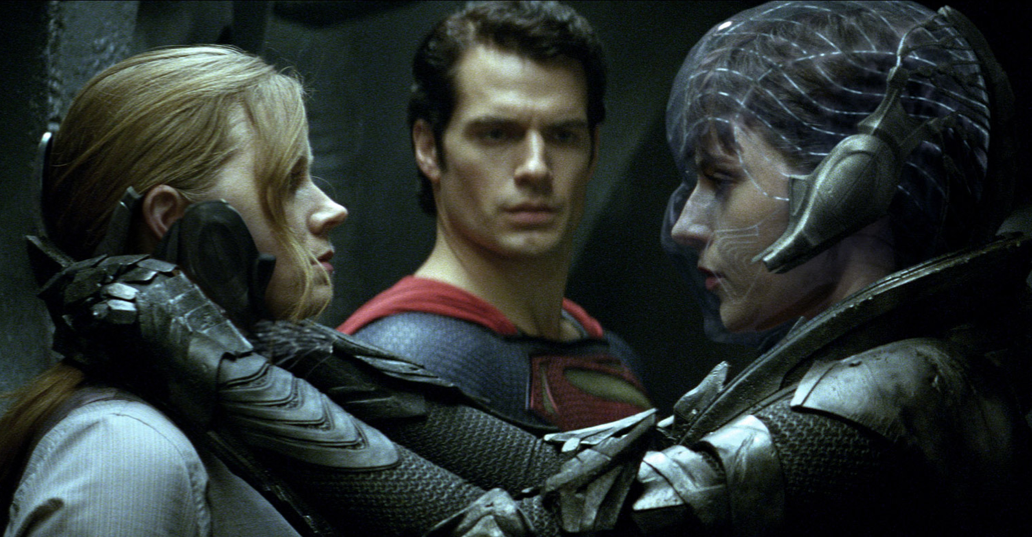
Unfortunately, his former ally and friend General Zod (Michael Shannon) is hellbent on preserving his species and building a new Krypton on planet Earth.  For this he needs Clark and his DNA to fuel his machine so that they can form a rebirthed Krypton upon the ashes of Earth’s surface.  Clark, fully knowing where he came from and the extent of his abilities, decides to defend the earth from Zod’s evil scheme and to become the symbol of hope for all of mankind to follow.

Fully aware of the dangers that came with a reboot for Superman, one of my initial worries for the film was that there would be too much action and not enough character investment to go with it.  That is the typical danger with superhero movies, after all: filmmakers are typically more interested in the action and visual effects than they are in emotion or in investment for their characters.

That is not what we have here.  Director Zack Snyder (300, Watchmen) and screenwriter David S. Goyer (Dark City, The Dark Knight Trilogy) make here a wonderful marriage of something rare: great scripting with great action, and great directing.  What makes this movie so appealing is not the fact that it is an action movie: we’ve seen hundreds of movies before where action is just stacked on top of action, with no real cause or motivation to be concerned with any of it.

Man Of Steel is not that.  It is a rare thing: a movie in which the action is just as fleshed out as the character’s emotions are.  Whenever Clark isn’t flying, breaking the sound barrier, or punching some guy’s light’s out, the movie interjects a flashback of Clark’s childhood: we get a glimpse to a more personal portrait of Clark as a child and what it was like growing up struggling with these superhuman powers.  Perhaps in another movie it would be all fun and jokey, but here it is taken as seriously as the death of Bruce’s parents from the Batman series.  I was reminded of the last line Peter spoke during his ending monologue of the original Spider-man: “This power is my gift: my curse”.

The action, however, is utterly spectacular.  In the original Superman movies, Clark was resorted to lifting up school buses and stopping nuclear missiles as his highest challenges.  Not here.  Here the stakes are much higher, and we can tell that because of the level of destruction in this movie.  When Superman trades blows with another Kryptonian, destruction is sure to follow.  Crushed cars and overturned trains are a constant during these fight scenes.  Crumbling buildings and falling debris is to be expected.  There was even one terrifying moment where the Kryptonians used a gravity machine to tear apart the Earth’s infrastructure.  Did I mention the crumbling buildings?  Watching this level of destruction made me feel sorry for the mayor of Metropolis.  I’d hate to see the repair bill.

And lastly, I must pay respect to Henry Cavill and Michael Shannon.  Here, they are the perfect embodiment of themselves: good, or evil, human or Kryptonian. They don’t fight in an area of black-and-white: they fight in many shades of gray, because while we don’t want Clark to lose his home on planet Earth, we also understand and sympathize with Zod’s reasonings because he too lost his home.  There’s a very human reason why these men are fighting, and there’s no simplicity in their conflict: only complexion and brutal reality.

Before you ask me, no this does not replace the original “Superman” movies, and no, Cavill is not an adequate replacement for Christopher Reeve himself.  That is besides the point.  Man Of Steel did to the Superman franchise what The Amazing Spider-man did for Spider-man: it breathed a new life and conception to it, ensuring that when its all said and done, the Superman legacy will live on, and it will not die away because the actor of the former icon has passed through time.  Snyder has accomplished quite a feat here: he has paid tribute and honor to Reeve and the filmmakers of the original Superman by offering this exciting, emotional, and action-packed thrill ride that gives a new birth to the flying caped crusader.

PS: Admittedly, I saw this film in IMAX 3-D.  See it in IMAX, but don’t waste your money on the 3-D.  A fantastic movie doesn’t deserve a dim picture anyway.

Tagged , , , , , , , , , , , , , , , , , ,