Tag Archives: Romance

“BIRDMAN” Review (✫✫✫✫)

The artist’s struggle, all in one take. 

Birdman, or otherwise known as The Unexpected Virtue of Ignorance is one of the most mesmerizing films I’ve ever seen. It is also one of the most unique, disturbing, shocking, and confusing films I’ve ever seen too. That’s okay. This film was reaching for a specific vision, and director Alejandro Inarritu has expanded beyond it. I admit I don’t know what to expect as far as the public reacting to this, and I also don’t know how accessible it is to non-film aficionados either. But I have seen the movie frame by frame, and I think it’s one of the best films of its kind. On the surface value, it’s about the struggles of Broadway theatre. In deeper insight, it’s about ego and the obsessive human condition.

The film stars Michael Keaton as washed-up actor Riggan Thompson, who has been forgotten by his adoring public after portraying the lead role in a series of superhero films titled Birdman. This is ironic, because in real life, Keaton portrayed a superhero in Tim Burton’s 1989 film Batman. Desperate for a comeback, Thompson sets out to write, direct and star in his favorite Broadway play: What We Talk About When We Talk About Love by Raymond Carver.

Things immediately hit the fan during the week of their first preview. One of Riggan’s actors gets a head injury from a loose light on the set. His replacement, Mike Shiner (Edward Norton) is a talented but brash and arrogant actor who sees himself as Riggan’s superior. And, as he faces personal problems with his estranged daughter Sam (Emma Stone), Riggan begins to feel the closing pressures of Broadway when a malicious theatre critic tells him she’s going to “kill his play.” Now Riggan is trying to keep the play and his sanity afloat, and he will make whatever sacrifices he needs to make sure both happens.

Written, directed and produced by Inarritu, Birdman is the first black comedy made by the filmmaker, his most successful films to date being Oscar nominees Babel and Biutiful. Now he has made Birdman, and I am tempted to say it’s the best film he’s made yet.

What worked so well with the film? The first thing is the editing and the cinematography, which was shot so wonderfully by Oscar winner Emmanuel Lubezki that it places you in the moment, in the reality of the film, not making you watch it from a cushion seat on the eighth row of a dark movie theater. Lubezki, who worked with Inarritu on short films in the past, decided to shoot the film and edit it into a continuous fashion, giving off the illusion that the entire film was filmed in one take. Even though the movie wasn’t filmed in one shot, the feeling it gives off makes it feel alive and moving, not unlike the world of theatre that Riggan is trying to prove himself in.

I wonder how much effort this takes, not just from the cinematographer and director’s point of view, but from everyone else involved in the film as well. How many hours did the actors need to rehearse their lines in order to get their roles right? How much pressure was the tech and lighting crew under while they were filming, knowing that if they screwed up, everyone would have to start back to square one? How many hours did film editors Douglas Crise and Stephen Mirrione have to sit in front of a computer, making sure the shots transitioned so well that you couldn’t even see the transitions? The illusion not only worked because of the idea that Lubezki and Inarritu offered, but because of the commitment it received from everyone involved with the film. In many ways, their efforts were all worth it: the camerawork here expresses more of the story than the character’s dialogue does.

The parallels in this movie are also ingenious. How does Keaton feel playing as Riggan Thompson in the movie, knowing that he reached international fame as Batman earlier in his career and having since then never been able to match a more recognized role? How does Inarritu feel, going through all of the production pressures Riggan did in making the play as he himself did in making the movie? Did he intend this movie as self-reflection? Is he telling the audience what he goes through daily as a filmmaker? Or is he using his struggles as a platform to tell a much deeper, more important story to the audience?

For me, I don’t get as much joy out of interpreting as much as I do out of experiencing. And make no mistake: Birdman is an experience, surreal, tantalizing, and thought-provoking all at once. I’m still sitting here, hours later, not quite fully realizing what exactly Inarritu was trying to portray in this film. Is he commenting on the artist’s struggle? Commercial vs. independent film? Fatherhood? Friendship? Family? Lost love?

I think it’s all of the above. Or maybe none of the above. I honestly don’t know. In the movie, Inarritu battles labels that are placed on artists and on the art that they produce. Is Riggan Thompson a superhero, or an actor portraying a superhero? Is he a former shell of who he is, or a flower that has yet to bloom? We see in this film how these labels influence his life and how much stress and anxiety it presses upon him. To put labels on the movie would contradict Inarritu’s intentions. It would be offensive to the film.

My bottom line: Birdman is a masterpiece. It is so distinct in its own language and style that I think it is impossible to define it, let alone replace it. Critics will applaud it for it’s technical and emotional achievements. It will definitely garner some Oscar nominations. It’s a sure contender for visual effects, cinematography and editing. It is also sure to confuse certain people, to which I would recommend stop trying to understand it. Birdman is not meant to be understood. It is meant to be experienced, and if you can help it, interpreted.

Post-script: A thought I had after seeing the movie that I think viewers will also have. Because of how profoundly his role as Birdman affected Riggan, is Inarritu attacking the superhero genre of film? I believe he is, but I choose not to acknowledge that. After all, for every time a superhero film was called too simple, couldn’t you call any art film too complicated? I quote Mark Twain: “Too much of anything is bad.” 

Tagged , , , , , , , , , , , , , , , , , , , , , , , , , , , , , , , ,

“GONE GIRL” Review (✫✫✫1/2)

Gone Girl

What happened to Amy Dunne?

When I started watching Gone Girl, I had no idea what happened between Nick Dunne and his wife Amy. Now I have finished the movie, and I still have no idea what happened between the two of them.

Gone Girl is a very strong psychological thriller, packaging the essential elements of tension, grit, and confusion to make an extremely fascinating, yet equally frustrating, watch. Imagine you’re driving on a highway, except you take a wrong turn. Then you take another wrong turn. Then you take another, then another, and then another after that. Gone Girl is that highway, taking you through so many twists and turns that you don’t know which way you’re going anymore. The only problem is that there’s no end destination when you get off of the highway.

Based on the book of the same name by Gillian Flynn, Gone Girl starts with Nick Dunne (Ben Affleck) coming home to see his living room torn apart and his wife Amy (Rosamund Pike) missing. There are a few details that disturb him upon this discovery. The glass table is smashed in. Chairs are overturned. A blood splatter can be spotted above the stove in the kitchen. Suddenly, Nick finds himself swept into a media frenzy as everyone everywhere cries out “Where’s Amy?” as he and Amy’s parents work to find Amy and bring her back home.

Yet, in the midst of all of this media attention, people start to recognize strange things about Nick. He’s behaving oddly for someone who has just lost his wife. A woman outside of a press conference takes a selfie with him and posts it online. He smiles at the conference when people take his picture. And as police discover Amy’s diary and uncover incriminating evidence about Nick’s marriage with Amy, people start to ask one question: did Nick Dunne kill his wife?

Let me start by saying this: there’s no way to expect anything from this film. The minute you think Gone Girl is going in a specific direction, it does a reversal and goes in the complete opposite direction, setting you on another prediction track until it does another reversal. There are many factors contributing to these twists, the biggest one being the writing contributions of Gillian Flynn. Flynn, who wrote the original book, was adamant about being involved in writing the screenplay for David Fincher’s adaptation, and she’s a good sport as far as working with him. Even though there are a few differences conceptually from the book, the work remains a whole emotionally, and lets off this gnawing paranoia on both characters as we question who is the victim and who is the perpetrator. This movie is like a game of cat and mouse, except no one really knows who is the cat or mouse.

The writing is ingenious, but the real star of this show is David Fincher. Fincher, who is no stranger to mind-bending plots (1997’s The Game, 1999’s Fight Club, and 2007’s Zodiac), incorporates elements from all of his movies into this one mind-bending thriller. It has plot twists as big as those in The Game, the pseudo/suicidal/mind trickery in Fight Club, the dark, disturbing realism in Zodiac, and the broad, expressive shots, angles, and edits from The Social Network. I like this about Fincher films, that they’re so distinct in visual style that you can almost instantly tell that it’s a David Fincher film.

Example: In the opening sequence of The Social Network, we capture the essence of the scenery as a lonely Mark Zuckerberg trots back to his dorm. We get a sense of the campus he’s on, the bridges, the buildings, the sidewalks, the trees. We not only feel the physical surroundings around him, but also the life that’s in it, almost like the scenery is breathing around him. Fincher did the same thing during The Girl With The Dragon Tattoo, and he did it again with Gone Girl. When he’s not filming a scene where there’s a tense exchange of dialogue between characters, he’s quietly viewing the scenery all around him, telling a story with silent images just as much as he does with outspoken characters.

More than what he does shot-wise though, I’m impressed with how he handles his cast. Look at the names associated with this film. Ben Affleck. Rosamund Pike. Tyler Perry. Neil Patrick Harris. Are any of these names what you’d expect to see in an intricate crime-thriller, let alone give a decent performance? I mean, the last memorable role Perry had since dressing up in drag as Madea is Alex Cross, and that was about as complacent as an action movie can get. Neil Patrick Harris’ most serious movie role is as himself in Harold and Kumar. Rosamund Pike is most known as a Bond girl. Affleck’s acting career is self-explanatory. I looked at all of these actors cast in these roles, and I couldn’t help but wonder what they were doing in a Fincher film.

Then I saw what he did with them, and I couldn’t see anyone else in their roles. Perry played Dunne’s attorney Tanner Bolt, and he was so smug and straightforward that he could lend Robert Downey Jr. a few tips for The Judge. Harris steps so wonderfully into a role he’s never played before, and Pike is exemplary too, though I won’t exactly specify how. Affleck to me was the most interesting. He uses awkward lulls, blank expressions, and his sterile voice just like he did during some of his bad performances in past movies. It’s not a bad performance though. Fincher is just using Affleck’s natural reactions to lend details to Nick Dunne’s character, like how he could be smiling in pictures while his wife is missing, or why he sounds so unconvincing when he gives a speech about how he loves his wife to ongoing listeners. Fincher uses both Affleck’s strengths and weaknesses as an actor to the film’s advantage, and that goes the same for everyone else in the film.

I liked many things from this film. The cinematography, the editing, the thought-provoking plot, Fincher’s masterful direction of the film and it’s cast all culminated into a jaw-dropping experience. My only regret about this film is it’s ending. I won’t spoil it for you, but I will say that it ends in the same way that it begins, posing questions and vague thoughts so that the audience may fill it with their wild imaginations. I realize Fincher and Flynn did not intend to have a straightforward, clear-cut ending, but I have a stubborn need for closure. Films are supposed to provide answers to the questions they’ve already posed to you. Gone Girl does not provide an answer. It provides a question.

Tagged , , , , , , , , , , , , , , , , , , , , , ,

“THE FAULT IN OUR STARS” Review (✫✫✫✫)

And the stars have never shone brighter.

The Fault In Our Stars is one of the most magical films you will ever see. It is also one of the most tragic, heartbreaking, funny, genuine, and real films you will ever see. It does exactly what the book does, and exactly what movies are supposed to do: it sweeps you away, transporting you, making you forget about your own reality and immerses you into the reality of these fictional characters that don’t seem so fictional. While I was watching the movie, someone in the audience leaned over to me and asked if this was a true story. “No, but it deserves to be,” I thought to myself.

Based off of the highly popular book of the same name by John Green, The Fault In Our Stars follows the story of Hazel Grace Lancaster (Shailene Woodley), a spirited, spunky, and sarcastic teenager who loves to read books, watch horrible reality TV shows, and question everything her parents tell her to do. Augustus Waters (Ansel Elgort) is another spirited, spunky, and sarcastic teenager who loves to watch movies, play video games, and ponder the many questions about the universe. Hazel and Gus are both like any regular teenager but with one significant difference: they’re cancer survivors.

Note that I said survivors. They’ve had cancer in the past, Hazel in her lungs and Gus in his right leg, but both have since moved on from their ordeals to try and tackle their lives as any other teenager would. Because of Hazel’s lungs, she has to carry around a respiratory machine (Oxygen tank instead? Machine sounds intensive) with her everywhere she goes, and what would seem like a simple task to anyone else (I.e. standing up, or walking a flight of stairs), nearly exhausts Hazel after doing so. Gus, on the other hand, has a prosthetic replacing his right leg in exchange for being cancer free.

One day, they both meet each other at a cancer support group meeting. Hazel notices Gus having a bounce to his step, despite only having one full leg. Gus notices Hazel’s beautiful face even though she’s deoxygenated. As they continue to meet and see each other, they soon realize that they have a special relationship with each other, one that no “normal” human being could ever possess.

From a first glance, some people may look at this movie and see it as an overly optimistic tween romance, where two characters fall in love, and their love beats all things, including their ailments. I know I did when I first heard about it, and why wouldn’t I? Romantic dramedies have a way of underemphasizing conflicts just so characters can have happy endings. As a result, we get movies that are more cheesy and insincere than they are genuine and heartfelt, much like those ungodly Nicholas Sparks movies.

But The Fault In Our Stars is different. It is not manipulative of it’s emotions and it doesn’t downplay the severity of character’s problems. It’s honest and up front about the challenges these teenagers face, and doesn’t shy away from the severity of it just because they’re children. In fact, Hazel Grace herself dispels the notion at the beginning of the film, saying to her listeners “That wouldn’t be the truth. This is the truth. Sorry.”

I know, I’m late on writing this review. Why am I writing this in October, when the movie has already come out on DVD? I was waiting, dear reader. Waiting to read the book and see not only how faithful the movie was to it’s source material, but also to it’s emotions. I’ve said it before, and I’ll say it again: you can bend the plot of the original story, but you cannot bend the emotions and still remain faithful.

Now I have read the book, and I can tell you firsthand from my experience that the movie held up to the book on both counts. The Fault In Our Stars is a breathtaking experience: touching, deliberate, and beautiful all at once. To say it’s faithful to the book is an understatement. It’s quite possibly one of the best book-to-movie adaptations I’ve ever seen.

The things that work so well in the movie are the same things that work so well in the book: the writing and the characters. At the heart of the entire story, movie and book included, is Hazel Grace, who is such a fascinating and singular character that it makes me sad to think that she doesn’t exist. Hazel isn’t like other cancer-ridden characters. She neither has an overly defeatist attitude of her ailment, or an overly optimistic perspective one either. She’s in the neutral realm, seeing her sickness as a part of her no matter what she does, and choosing to accept it because she’s more or less forced to.

And yet, she’s so much more than her sickness. In many ways, she’s just like any other regular teenager. She has a favorite book. A favorite author. A favorite show. A favorite food. A crush. And like any other teenager her age, she’s bursting with opinions, hopes, fears, and desires, all of which combine to make a completely fascinating, involving and passionate character. We quickly learn to love Hazel not because she has cancer, but because she is unique.

On that note, let me talk about Augustus. Can I just say that I love this kid? Gus is filled with spirit and enthusiasm, having a bounce to his step that contrasts with Hazel’s shy trotting. I find it interesting that even though I don’t like it when characters are unrealistically happy, here Gus is almost nothing but happy. He thinks it’s cool that he has a metal prosthetic leg, seeing it as him being half-cyborg. He likes video games, zombies, and heroism, seeing himself as one of the brave movie heroes who sacrifices himself for the sake of the people he loves. In many ways, that’s who he is: the hero of the movie, bringing all of the love and affection he could for the woman he loves. He’s so great in the film, he could have a movie all to himself if he wanted to.

You’ll notice that I’ve referred to both of these persons by their characters, not by the actors that portray them. That’s because Woodley and Elgort slip so wonderfully into their roles that they’ve completely disappeared into them. I didn’t think about The Descendants when I saw Woodley tear up and cry, or when she picked up her BiPAP and exhausted herself walking up the stairs. I didn’t think of Divergent when Elgort so tenderly cared to her needs, or sweetly telling her that he would be honored to have his heart broken by her. I saw these actors and was so immersed into their performances that I no longer thought about what they were and thought more about who they were. These two are not Shailene Woodley and Ansel Elgort. They are Hazel Grace Lancaster and Augustus Waters.

Everything else in this movie was made to near perfection. The screenplay by Scott Neustadter and Michael Weber adapted the story and emotions wonderfully from the book. The camera work by Ben Richardson was elegant and harmonic, much like the great work he did with 2012’s Beasts of the Southern Wild. And director Josh Boone guides the actors through the blissfully tragic story created by John Green, whose wondrous words were what made this entire movie possible.

That ends the review with one question: which is better? The book, or the movie? Neither. I could argue that the book is better because it has more content, or I could argue the movie is better because it brought the story to life visually. Both arguments are pointless. They are both two different mediums, but they both tell the same wonderful story.

Tagged , , , , , , , , , , , , , , , , , , , , , , , , ,

“BOYHOOD” Review (✫✫✫✫)

A scrapbook by Richard Linklater.

The main character’s name in Boyhood is not Mason. His name is also David. And Connor. And Warren. Aaron. Stacey. Tony. Eric. Steven. Ben. Richard. And so on and so forth until you’ve listed every masculine name in the dictionary. I probably went eight names over how many I needed to list, but you get my point. We’re doing more than just watching one boy’s journey into adulthood here. We’re watching ourselves grow with him.

Strange, I think. I don’t normally sympathize with characters to the point where I feel like I AM them. Relating to protagonists is a somewhat straightforward task; you merely need to introduce the character along with their conflict, and then let the filmmaker do his work to bringing their arc to life.

But with Boyhood, I face an interesting prospect: there is no one conflict that Mason faces in the story. Like myself and my closest family and friends, Mason’s conflict is life itself, complete with all of its blessings, gifts, challenges, and turmoils alike. If you’re still not getting the picture, let me put it to you this way; if I were a filmmaker, and I were adapting the full story of your life, would I be able to condense it into one or two events?

The answer is no, I couldn’t. There is a whole multitude of issues you’ve faced in your life, just like I did, and I’m sure we could turn those issues into ten or twelve more movies if we tried. Director Richard Linklater chose not to do that. With Boyhood, he took one boy’s life, a small child he found named Ellar Coltrane, and followed him from age six until age 18, gradually showing his life progress and the challenges he faced as he grew into a man year, by year, by year.

It’s fascinating I tell you, to watch a movie progress from one generation to another. I look at Ellar as a young boy obsessing over cartoons and action figures while his sister, portrayed by Linklater’s daughter Lorelei, constantly talks about makeup and Britney Spears. I look at these children’s parents, played by a significantly younger Patricia Arquette and Ethan Hawke, as they struggle to connect and be there for their children and to be the best parents they possibly can be. It’s interesting to see these children mature from young, simple-minded beings to young adults, trying to find their own paths in life while their parents mature from being those young adults to the older, more mature parents that have faced, and survived, every difficulty they could have ever faced.

It’s pointless to describe what the plot of the movie is like. What is the plot of the movie? Fill the movie with your life experiences, and you have the plot. I caught myself many times reliving past memories while watching the movie, sympathizing with Mason as I remember how I too faced issues such as bullying, peer pressure, puberty, growing up, and finding a place where I belonged.

It’s not so much a movie as it is a scrapbook of memories, and Linklater is merely showing the memories on screen like he’s pulling a photograph out of a book.

What of the performances then? Patricia and Ethan are the most emotive performances out of the movie, but that’s to be expected considering they’ve been working on this movie, among others, for literally a decade. Lorelei is cute as a child at the beginning of the film, but as the movie continues on, it begins to focus more on Ellar while Lorelei, more or less, fades in to the background.

That being said, Ellar isn’t the most compelling actor in the film. As a child at the beginning, he is the most believable, but that’s because he’s living, not acting, in the moment. When he’s playing with his friends or when he’s dressed up for the Harry Potter premiere, you know that’s him being excited in the moment, similar to how Drew Barrymore believed E.T. was real during the filming for E.T: The Extra Terrestrial. As he gets older, however, he gets less emotional about things and more or less goes through the motions wherever Linklater guides him.

At first, I thought this was an obvious criticism to the film, because how is a kid going to maintain his acting ability through 12 years of his life? As I look deeper, however, I realize that Ellar isn’t intended to give a performance. He isn’t meant to be an actor, but a surrogate, a character whose emotions and memories we fill in the film and then we sympathize with because those are the same emotions we faced when we were his age.

Mason goes through a lot in this movie. As a toddler, he witnesses his parents go through divorce. As a child, he faces abuse from his alcoholic stepfather. As a teenager, bullying. As a high schooler, heartbreak. This movie is so tangible that it made me want to grab hold of Mason. It made me want to hold him and hug him, telling him the same thing my mother told me when I was going through my own issues at his age.

I want to grab him and say to him, “You’re going to be okay, Mason. You’re going to be okay.”

Tagged , , , , , , , , , , , , , , , , , , , , , , , , ,

“SIN CITY” Review (✫✫)

“There ain’t no sunshine when she’s gone.”

You’re either going to love or hate Sin City. There’s no getting around that fact. Like the movies directed by Quentin Tarantino or Eli Roth, Sin City is a movie specific to its own tastes, and doesn’t care much about the opinions opposite of it. It’s a violent, gross, disgusting and putrid film full of the stuff that would make a Catholic priest faint. If that sounds like something you would like, by all means, be my guest and have at it. If you are repulsed by my description of the film, I certainly don’t blame you.

Based off of the comic book series by Frank Miller, Sin City is a film that follows four separate stories that (mostly) intertwine together. John Hartigan (Bruce Willis) is an aged police officer who is viciously pursuing child rapist Roark Jr. (Nick Stahl). Marv (Mickey Rourke) is a rough-around-the-edges thug who is framed for the murder of a prostitute he slept with named Goldie (Jamie King). And Dwight (Clive Owen) is a private investigator who gets pulled into a turf war, risking the lives of cops and prostitutes alike.

What do all of these stories have in common? They all started because of a woman, and these men go out to kill because they love their woman. Or, at least, whatever constitutes as love in this universe, in which case it’s a one-night stand.

It’s so difficult to review a movie like Sin City. Why? Because it’s not for people like me, that’s why. I don’t like watching movies like Sin City. I don’t like watching blood and violence for the sake of blood and violence, or watching sex and nudity for the sake of sex and nudity. It’s hard to be non-biased with movies like these because I watch moments where a naked woman walks out with bare breasts and all, and I can’t help but imagine the director thinking “Hey, let’s have this actress naked in this scene, because boobs.”

Sin City is aggressively, unnecessarily violent. How violent? So violent that the least bloody scene in the movie came from Quentin Tarantino. That’s how bad it gets. Red, white, black and yellow blood splatter across the screen like Jackson Pollock was making a painting. Severed heads and body parts are frequently cut off and thrown around in the film like missing pieces to a G.I. Joe. Those body parts include testicles, by the way, on multiple occasions. And don’t even get me started on the absurdity of its kills. In one scene, Marv gets beaten, stabbed, shot, and crashed his car into a lake and still gets up to pursue Goldie’s killer. Good God, are these guys made of kevlar or something?

Remind you, I have no problem with violence in movies, but here it’s just far too absurd and disgusting to be able to fully stomach. When it’s used to illustrate an emotion or a point in movies like Pulp Fiction or Taxi Driver, I praise its purpose and its usage. Here, it illustrates no emotion or urgency. It’s a glorified selling point for a really long, disgusting, stupid movie.

I did like the visualization of Sin City. That, and its opening scene. I liked it’s black-and-white style, it’s sense of contrast and expert use of shadow and lighting. It gave it a strong reminiscent feeling of the classic neo-noir films that inspired the original Sin City comic books, the ones that have the snazzy saxophone playing in the background as two lovers stand on a balcony, telling each other that they love each other and that they never want to leave each other. The film itself, in fact, functions as a parody of the neo-noir genre: characters stand on balconies, docks, outrun police cars, smoke cigarettes and talk in thickly exaggerated accents to the point where it can’t be taken seriously.

Realize, however, that this wasn’t on accident; director Robert Rodriguez wanted you to see how he exaggerated details so you would understand that him and Frank Miller were lightly poking fun at the genre, all while at the same time suggesting delicate homages to it as well. I like that they tried to reach for a deeper effort with the film, even though their intentions were smarter than the film itself was.

So what’s my end consensus? Is it a movie that you should see or skip? I’ll leave that decision in your hands. For now, I have done my job in telling you what the movie is like, and I will wash my hands clean from it. I have church in the morning.

Tagged , , , , , , , , , , , , , , , , , , , , , , , , , , , , , , , ,

“X-MEN: THE LAST STAND” Review (✫✫✫)

How can you “cure” what was intended as a gift?

There’s an obvious danger with the production of second sequels made with planned trilogies: how do you keep things fresh and interesting and make sure none of the material isn’t stretched out or forced? For many trilogies, the third entry is the one filmmakers are usually least concerned about. Why should they be? They’ve already made their biggest impact with the first two films and people will go and see it anyway, so why should they extend any effort? I like to call this “the trilogy curse,” and it explains why so many second sequels end up letting down their entire franchise (*cough* Terminator 3 *cough*).

The best thing that can be said for X-men: The Last Stand is that it does a good job avoiding the trilogy curse. While some may be frustrated by the liberties it took and the deviations it made from the source material, I for one found it to be very liberating. It changes things up a bit, made things different, and did one huge thing that many comic book movies can’t do: it made it unpredictable. Because of this, the stakes were higher, the action was more involving, and it made you invest yourself more in the characters rather than waiting for everyone to hold hands in the end for that “happily ever after” ending many films get trapped into. X-men: The Last Stand accomplished something important: it proved that comic-book movies can deviate from their source material and still be good.

After saving both human and mutantkind at the shrouded site where Wolverine (Hugh Jackman) gained his metal claws and lost his memory many years ago, X-men: The Last Stand takes place as the X-men still try to cope with the death of their beloved Jean Grey (Famke Jannsen), who sacrificed herself to save her friends as she became engulfed by a sea of raging waters. Most affected by this is her boyfriend Scott “Cyclops” Summers (James Marsden), who can still hear her voice in his head as he sits in their bedroom reminiscing about her.

The X-men, however, have a much more pressing issue at hand: a company called Worthington Labs has recently invented a mutation antibody that basically attacks mutant cells and nullifies them. The public dubbed it as a “cure,” and it essentially turns mutants into regular human beings, forever granting themselves the life of normalcy they’ve so long desired. Of course, this new invention stirs up quite a controversy among the mutant community, especially regarding Magneto (Ian McKellan) and his extremist brotherhood of mutants. When mutants come to terms with this cure and what it means for all of them, they must make a decision of whether or not to fight against the cure, or fight for humanity’s survival at all.

The first out of the X-men series not to be directed by Bryan Singer, filmmaker Brett Ratner (The Rush Hour series) steps in to fill in the reigns of Singer’s mostly definitive first two installments. How does he do? Well, the good news is that he holds his own pretty well, and makes a movie that he can call all his own. Ratner poses an important question here that I think the other two films mostly sidesteps: if you have an unwanted gift, should you keep it? For me when I watched the movie, I saw an image deeper than that of a mutant standing in line to take a shot that would take away their powers. I saw a pregnant teenager waiting in line for an abortion for that baby that she never intended to have in the first place, or an image of a man going in for a gender change because he doesn’t feel comfortable in his current body.

Controversial? Yes, but that’s how the film intends for it to be. Much like its predecessors, The Last Stand handles its political side well, and is being more ambitious by taking a different spin from the standard supremacist/racism themes that they explored in the earlier installments.

The cast is good, but that’s standard at this point. We expect Jackman to be good as Wolverine. We expect Patrick Stewart and McKellan to be convincing as the leaders for their own specific causes. We expect Storm (Halle Berry) to be the strong female hero that she is, and we expect Iceman (Shawn Ashmore) to be the kind-hearted, considerate teenager while Rogue (Anna Paquin) remains the estranged and desperately shy mutant who continuously questions keeping her abilities. The one we should notice more than anyone else is Janssen as Jean Grey. Yes, she’s back, and she has a much more villainous spin on her that comic fans may or may not be happy to see. She’s much more versatile in this movie, bouncing brilliantly in between angry and hateful to scared and grief-stricken. Without giving too much away, I really liked her role in this movie as both a protagonist and antagonist, and I think X-men fans will be just as pleased with her performance as well.

The only thing I don’t like with this movie is its climax. The buildup earlier in the film was so much better, with the backstory of Jean Grey, Professor X and Magneto culminating so ingeniously into a plot where all the danger was real and there was no way to predict who lived and who died. Another great scene with excellent buildup was when Wolverine went searching for Jean, fighting a small group of mutants within the confusion of a lush, maze-like forest. The final fight, however, could not have been more standard and one-note if it tried. It plays out exactly as you would predict it to, dragging out into a disarray of violence and loud noises until finally it ends in explosions and agonizing screams. Enough already. The rest of the movie did a good job building up anticipation: did you really have to give in right before the end?

Still, I had fun with this movie. I know “fun” is a very loose term that can be used within the film community, especially when you’re speaking about a potential deal breaker such as this. Still, I’m going to say it: this movie was fun. Why am I saying that? Because I enjoyed it, that’s why. I genuinely liked it. I liked the big, boisterous action scenes orchestrated on a grander scale in which I don’t think would have been possible six years ago. I liked the darker, more thematic moments between characters where they took time to build up the stakes and what was on the line here. Mostly however, I liked how it humanized the mutants, and made them genuine flesh-and-blood human beings that could be killed and harmed. It didn’t immunize them from death because of their fans’ love for them: it made them mortal, and it presented a real, legitimate threat in the film because of that.

I know many people who are going to disagree with me, and that there will be many who love these characters too much to be able to see them get killed off and just be okay with it. Let me set the news down with you easily: if you’re that bothered by seeing a character’s death in a movie, maybe you shouldn’t be watching that movie in the first place. These filmmakers set out to make a convincing movie where the threat was imminent and real: not to please the comic-book die hard who gets frustrated if a comic book character’s hair isn’t the right color. Maybe that was Ratner’s second goal beyond making a good sequel, to see how many changes he could make before the fans starting writing death threats to his home mailbox.

Tagged , , , , , , , , , , , , , , , , , , , , , , , , , , , , , , , , , , , , , , , , , , ,

“THE AMAZING SPIDER-MAN 2” Review (✫✫✫✫)

Don’t worry: it’s not “Spider-man 3.”

The Amazing Spider-Man 2 is the standard of a superhero movie that everyone should aspire to. It’s exciting, action-packed, gut-bustlingly hilarious and emotionally involving to a point where I was surprised at how personal and genuine it really was. “Amazing,” in fact, is not a good enough word to describe this movie — “Superior” is more like it.

Taking place after Curt Connors, aka The Lizard, attacked New York City, The Amazing Spider-Man 2 shows Peter Parker (Andrew Garfield) as he continues to adapt to his new life as the spectacular Spider-Man. He’s just about to graduate, he’s getting a job as a freelance photographer at the Daily Bugle and his relationship with Gwen Stacy (Emma Stone) is going strong. Being Spider-Man has its perks and its downfalls, and this is a rare high point in Peter’s life.

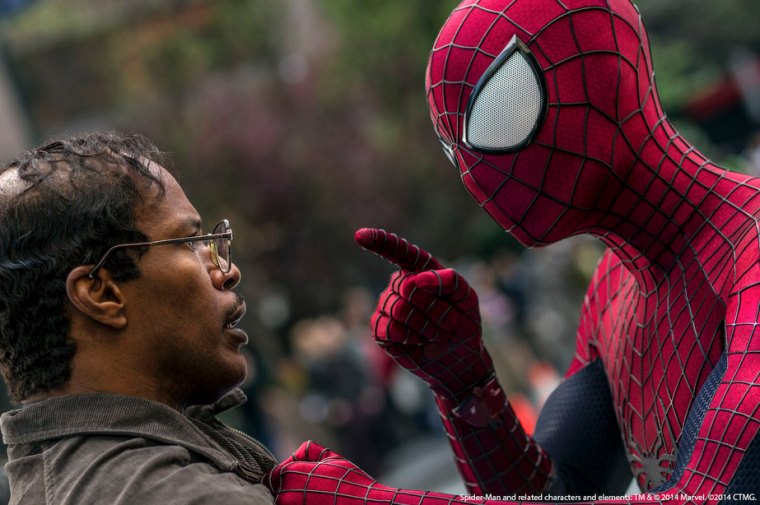
Elsewhere, however, dark forces develop under Oscorp. Engineer Max Dillon (Jamie Foxx) gets electrocuted by bio-electric eels, transforming him into the chaotic villain known as Electro. Russian mobster Aleksei Sytsevich (Paul Giamatti) gets equipped with a fully armed mechanical suit, becoming the Rhino. And Harry Osborn (Dane DeHaan), an old friend of Peter’s, returns with a dark secret that he’s hiding from everyone.

That makes three villains in total for this sequel. Concerned? You should be. The last time we had three villains in a Spider-Man movie, that film was Spider-Man 3. I’m never going to get that image of Tobey Maguire doing the Elvis Presley-stride out of my head, ever. Does anyone have any hydrochloric acid I can pour into my eyes?

Well, you can rest easy, fellow web heads. The Amazing Spider-Man 2 is not Spider-Man 3. Quite the contrary, actually. This is a significantly better Spider-Man than its predecessor, a film that bounces in between multiple tones and genres all at once and does all of them brilliantly.

An early fight scene in the film, for instance, is as wacky and funny as a Looney Tunes cartoon, with Spidey struggling to grab all these plutonium canisters off of a moving truck like he’s in the middle of a pinball table. In another scene, he’s in the middle of an action sequence so exhilarating and mind-blowing that it could have come straight from a video game cut scene. In another moment, him and Gwen are dealing with a real emotional struggle neither quite know how to handle, something that has haunted Peter since the first movie.

That’s what makes this Spider-Man better from the other one: It has many tones, story lines, characters and emotions that it’s juggling all at once. That’s a weighty order, and not one to handle easily. Yet director Marc Webb handles the challenge excellently, delivering just as relevant a character drama as he does an exciting action movie.

The cast members have expert chemistry with each other, but that should be expected because of their exceptional performances in the first film. We already expect Garfield and Stone to be perfect with each other because they were nearly inseparable in the first round of the series. It’s more efficient, then, to focus on the newer cast members: Jamie Foxx and Dane DeHaan. 

Foxx is electric as the high-voltage villain, pun intended. At first he’s just a socially silly and awkward scientist, similar to Jim Carrey’s version of the Riddler in Batman Forever. When he goes through his transformation into Electro, however, everything changes. He becomes an angry and malicious supervillain, a man who is mad and frustrated at everything and just wants to kill everyone, then jump start their heart just so he can kill them again. DeHaan, especially, was desperate and conniving as Harry Osborn, a menacing and starkly different Harry than the James Franco version we are used to in the original trilogy.

Both of these villains serve a pivotal role to Peter’s development. Electro is the physical conflict Peter has to face in the movie; Harry is the emotional one.

There’s another concern comic book fans will have about this movie, and that is the same concern they have with Captain America: The Winter Soldier: We’ve already read the comics. We already know the twists that are coming up, and as a result, our reaction is dulled when that moment comes in the movie.

Let me make a reassuring statement for my fellow comic book lovers: I could see the twist in this movie come from a mile away. Yet when I saw it, I reacted as if I was witnessing Peter’s tragic story for the first time.

There are apparent concerns to have with this movie. The multiple story strands are worrisome, the overload of villains can be an issue and Max Dillion’s character is far too silly to fully accept as being realistic.

Does that change The Amazing Spider-Man 2’s influence, or for that matter, its effect on the audience? The answer is no, it does not. The Amazing Spider-Man 2 is still a great sequel, an excellent expansion to the Spider-Man universe and a more-than-welcome development to Peter’s never-ending growth as Spider-Man. I’m tempted to compare it to the legendary Spider-Man 2, although I’m not sure if it’s quite there yet. One thing is for sure, however: it’s head-over-heels over Spider-Man 3. If Webb keeps this up, he just might surpass Sam Raimi’s original trilogy.

Tagged , , , , , , , , , , , , , , , , , , , , , , , , , , , , , , , , , ,

“HER” Review (✫✫1/2)

What on earth did I just watch?

How do you fall in love with a computer program? Throughout the entire runtime of Her, that’s the only thought that was peaking through my mind. I wasn’t thinking about Joaquin Phoenix’s deliberate performance. I wasn’t thinking about how sweet and serene Scarlett Johansson’s voice sounded. I didn’t think about how clever the story was or how passionate Spike Jonze’s direction was. The only thing I was thinking about was how hard it must be to maintain a relationship with a piece of machinery. Can you imagine how awkward those morning encounters must be?

Taking place in the not-too-distant future, Her follows the story of Theodore Twombly (Joaquin Phoenix), an introvert and manic depressive who writes love letters for a living and has recently gone through a divorce with his wife Catherine (Rooney Mara). Theodore is not in the most stable mindset as the movie begins, and as an effort to feel less lonely, he purchases an artificial intelligence who names herself “Samantha” (Scarlett Johanson) to help him with his everyday needs. What goes from there is a grand journey of self-discovery, identity and romance as these two gradually come closer with each other and eventually fall in love.

For those of you who have seen the movie, does that paragraph just about do it justice? I could go deeper into the plot synopsis, but why would I? From just those three sentences, half of you have already decided whether you would like the movie or not. There are, no doubt, some introspective and provocative thinkers out there who will find joy and enchantment with this story, while other viewers will watch it and ask themselves what on earth they just watched.

For me, I went in an open book. I knew that the movie had an opportunity to woo me, that it was a strange and outlandish idea to begin with, but that the idea doesn’t matter as long as it was handled and carried out well. How did the movie do with that?

Eh. I’d rather watch 1 Night In Paris. 

Like its central idea, Her is a strange movie, a surreal and against-the-grain picture that challenges a lot of misconceptions about love and relationships. While I like that and think it has a lot of great ideas to offer its viewers, I find them so hard to focus on while we’re watching Joaquin Phoenix having sex with a machine.

Yes, there are sex scenes in the movie, although I hesitate to even call them that. There are two that we actually see, but from their conversations we actually infer that there were plenty more.

The first one isn’t really a sex scene, but more or less a copycat of phone sex with Scarlett Johansson’s voice (which I’ll admit, didn’t bother me that much at all). The second one, however, was out of this world weird, with Samantha hiring a surrogate (prostitute) for Theodore to have pretend sex with. They’re trying to justify it by saying that she isn’t a prostitute and that she’s just trying to be a part of their experience, but that argument is null and void. She’s provided sexual services in exchange for something else. She’s a prostitute.

Don’t get me wrong: there are many emotional moments that the movie handled surprisingly well, and there’s an undeniable sweetness and sentiment to the story that can’t help but be noticed. Despite her being a machine, Samantha has a surprising amount of layers to her, being an in-depth and interesting character and love interest in her own right, while the human characters contribute the more grounded relationships that make more sense than that of Samantha’s (Including a recently-divorced Rooney Mara and Amy Adams, who offer very interesting parallels to Twombly’s exotic love story).

Joaquin Phoenix, however, is the flesh and blood of the film. His performance is nothing less than exemplary, playing this shy introvert so convincingly that its hard to imagine that he at one point portrayed Johnny Cash. His character reminds me of many of cinema’s most memorable introverts, ranging from the autistic-yet-brilliant Raymond Babbit in Rain Man to the hyper-obsessive and socially distant Mark Zuckerberg in The Social Network, or the paranoid John Forbes Nash Jr. in A Beautiful Mind. All of those movies focused on characters that struggled romantically and socially, and how much they struggled with their identity and being themselves. I love it when movies reach into characters that deep and personally, and if the film focused more on Twobly’s personality rather than that of his love and attraction to his operating system, the movie could have ended up being way more successful.

I can’t help but keep thinking about how small Her’s audience will be. In this day and age, art films are getting harder and harder to advertise and appeal to mainstream moviegoing audiences, and this movie is definitely no exception. I know the film’s premise doesn’t matter as much as how well that premise is handled, but there are some movies that just can’t get away from their bizarre ideas. Case in point: did anyone really expect Quentin Dupieux’s Rubber to be a good movie?

I stress this again: the main character is in love with a computer program. If you can buy that and get over that to enjoy the movie, good for you. But there are no doubt others who will not enjoy this picture, and I can’t help but think that they will be a more sane person because of it.

Tagged , , , , , , , , , , , , , , , , ,

“DON JON” Review (✫✫✫)

Oh, Donnie boy…

 “There’s only a few things I really care about in life,” a rich, deep boston voice says as we look at him staring  at his bright laptop screen shirtless in a dark room. “My body, my pad, my ride, my family, my church, my boys, my girls, and my porn.”

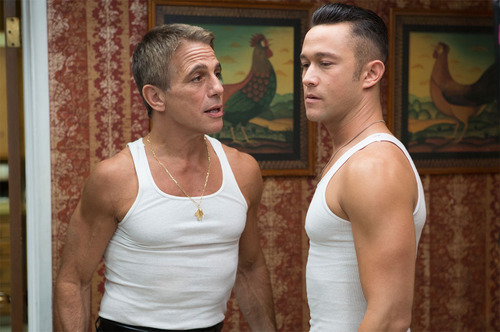
That last one doesn’t really belong there, but whatever, its in there.  The man we are looking at is Joe Martello (Joseph Gordon-Levitt), a thick, cut, and strongly appealing young man who has a slick, black haircut and a grin on his face that looks like he just finished up business in the bedroom.  His friends call him “The Don” because he’s able to score “dimes” on the weekends, which is another way of saying “That woman is a ten!”

One night in the bar, Donnie meets the best dime he’s ever seen: Barbara Sugarman (Scarlett Johansson), a beautiful blonde bombshell that turns heads and raises attention everywhere she goes.  To Donnie, this is simply another case of trying to score a hot night, but Barbara isn’t that easy.  She wants something more meaningful than just a one-night stand: she wants an affectionate, fairytale relationship, the cheesy kind you see in those unbearable romantic comedies starring Anne Hathaway and Channing Tatum.

So Donnie takes a deep breath and waits it out, hoping for her to come around eventually and give him the chance to slip under the covers with her.  The more time he spends with her, however, the more his addiction to pornography gets in the way and stops him from having a more meaningful relationship.  Now conflicted between his feelings between Barbara and his dependency on pornography, Donnie needs to figure out which is more important to him before she leaves him and all he has left is his laptop and his internet wifi.

Before I continue, let me issue a short disclaimer.  If you do not like R rated movies, do not watch this movie.  If you don’t like looking at nudity, do not watch this movie.  If you don’t like swearing, do not watch this movie.  And if you don’t like movies about sex, DEFINITELY do not watch this movie.  This is a picture stuffed to the mouthful with sex, nudity, T&A, F-words, censored and uncensored pornography to the point where I believe it deserved, and should have been rated, NC-17.

The only reason I issue this warning is because I know my readers, and the majority of my readers do not appreciate sexually explicit films that make jokes about the male/female anatomy and what goes on inside the bedroom.  Their views are warranted, and in many ways I share many of those same views with my readers.  I, however, am not as close-minded to this idea if it means not enjoying Don Jon, and believe me, that is a very hard thing to do.

That’s probably the worst word I could have used to describe this picture just now, but nevermind.  Don Jon is good.  Very good.  How good?  So good that it made me, a conservative reviewer who hates excessive nudity, enjoy it very, very much.  Trust me, I am not easy to please.  If you don’t believe me, you will when I tell you I rated The Hangover as the worst picture of 2009.

I find it interesting how effective Gordon-Levitt is here as a filmmaker.  His writing is fresh, fun, and original, exercising dialogue that is both clever and witty while at the same time being deeply meaningful and expressive.  The cast is equally brilliant, as their charismatic portrayals breathe life into these characters in ways that not even an animated rendition could do.

What I find more interesting, however, is how Gordon-Levitt handles this film as a director, using space and situations in his film to define Jon’s character and to show what sort of emotional state he’s in.

For instance, look at how he shows Jon’s everyday routine.  When Jon wakes up in the morning, he cleans his room the best way a bachelor knows how, he drives to Church, he goes to confession, he eats lunch with his family, he works out at the gym, he goes to a club to meet some beautiful lady, and then he ends his nights watching a skimpy porn video.

Got it?  Okay, now look at the variations of this same routine shown throughout the film.  At first its just the same thing over and over again, but later as Jon’s character changes, so does how he behaves during his routines.  When he’s depressed, his room get messy.  When he’s excited, he sings to Marky Mark in the car.  When he’s optimistic, he exercises with other people when he goes to the gym.  But what remains consistent in all of these sequences is him going to confessional and confessing his sins to the Catholic Priest he’s never met, hoping one day to have a clean slate in the eyes of the father.

I don’t think this movie is about a man struggling with his addiction to pornography.  I think this movie is about a man struggling between his lusts and sexual desires and the guilt he silently feels he needs to be redeemed from.  Think about it for a second.  Why else would he go to Church so frequently despite his promiscuous lifestyle?  He’s a grown man, he knows he doesn’t have to go to church if he doesn’t want to.  So why does he go so frequently even though his lifestyle isn’t congruent to that of a catholic?  There’s a deepness developing silently to Don Jon that can only be barely noticed, and if you don’t look out for it, it will slip you past you.

There’s obviously the negative element of watch a movie about pornography, and I would be the first to agree with you.  Even though the pornography is at times censored, its still there, and we can’t help but visualize everything because we’re seeing a rendition of it on the screen.

Still, since we’re talking about pornography, let me retaliate with another film that is also about addiction: a 2011 film titled Shame, starring Michael Fassbender and directed by Steve McQueen.  Like Don Jon, Shame is about a man who holds an unsatiated lust for porn and sex, and his life sinks into a swamp of sadness and depression because of his unsatiated hunger.  Unlike Don Jon, however, Shame is downtrodden, depressing, sickening, despicable, ugly, demeaning, and has no redeeming qualities whatsoever, outside of the acting and the composition.

Don Jon is different.  Unlike Shame, it is upbeat, energetic and joyous, and even though there are dramatic moments in the movie, there is never a moment that feels ugly, sickening, or unclean.  Don Jon is a stylish, articulate, and simply brilliant dramedy.  It is not only a film filled with clever dialogue and solid character development: it actually has a good, wholesome message to take away from the story, something to make you appreciate the small things in life that you never really notice.  I know some people are going to look at this movie from a first glance and ask “Why would I want to watch a feature-length pornography?”  Believe me, fellow reader, if this film can even be categorized as a pornography, its probably the best of its kind.

On a closing note, please don’t tell my mother.

Tagged , , , , , , , , , , , , , , , , , , , , , , ,

“THE BUTLER” Review (✫✫✫✫)

A humble heart living through harsh times.  

When we watch movies like The Butler, we are reminded of our history and why we must never return to the horrible origins that we came from.  When I say that, I am saying that regardless of race.  The film is obviously centered around the issues of slavery, segregation, and racism, and asks us to feel sympathy towards the African population for all of the horrible things they’ve been through.  But the movie evokes a more powerful emotion from me personally, a deep sense of regret and shame that my own race, the Caucasians, were at one point responsible for all of the death and cruelty we inflicted upon our own African brothers.  And why?  Because they have a different pigment than us?  That’s the sort of hate and bias that lead us to World War II when Adolph Hitler led the Third Reich against the Jews.

Based on the career of real-life butler Eugene Allen, The Butler follows the story of Cecil Gaines, a black butler who grew up during the slave era, growed up learning how to be a white man’s servant, got a job at the White House, and continued to serve there for almost 35 years. Throughout his career he witnesses history unfold in itself, from President Dwight D. Eisenhower’s (Robin Williams) decision to enforce desegregation laws in Arkansas, to witnessing the assassination of John F. Kennedy (James Mardesen), to seeing the rise of the Ku Klux Klan and the Black Panthers, to the assassination of Martin Luther King Jr., to the eventual inauguration of Illinois Senator Barack Obama into office.

The Butler is an earnest, humble film, parts approachable and observant yet equally ambitious and honest. Like movies such as Ghandi, The Hurricane, and The Shawshank Redemption, this is a movie that looks into the reality of situations and shows them exactly how they were, no matter how tragic or heartbreaking those circumstances were.

Take, for example, the scene where the Ku Klux Klan is introduced.  During his college years, Cecil’s son Louis (wonderfully portrayed by David Oyelowo), was on a bus to protest against a racist Alabama.  While on their way, their bus stops suddenly as they stare at the white-robed, torch-bearing Klan staring at them with their hateful eyes.  Equal parts petrified and terrified, the protestors desperately tried to escape before the Klan started igniting the bus with fire and molotovs.

I sat there watching these scene, equally infuriated and enraged as I was emotional and mournful.  How could this be our country?  How could this have once been our land, our people who so hypocritically claimed to be the land of the brave and home of the free?

To watch these scenes and to incur such an emotion takes great skill and courage, and I think Lee Daniels does a great job orchestrating these scenes in ways that makes them so emotional and powerful.  Daniels, who was nominated for an Oscar in 2009 for Precious took quite a fall last year when he made Paperboy, a idyllic, preposterous, and morally reprehensible film that was anything except relevant, coherent, and well, good.  Here Daniels redeems himself, and leads a star-studded cast through such a gripping, overwhelming story that I think it surpasses his accomplishes even with 2009’s Precious.

Oh yes, the cast.  The cast is what makes this picture, but you already know that if you take the time to simply read the cast list.  Jane Fonda as Nancy Reagan.  Alan Rickman as Ronald Reagan.  John Cusack as Richard Nixon.  Liev Schriber as Lyndon B. Johnson.  Minka Kelly as Jackie Kennedy.  John Mardesen as JFK.  Robin Williams as Dwight Eisenhower.  Alex Pettyfr as a plantation owner.  Terrence Howard as Cecil’s neighbor.  Cuba Gooding Jr. as a head butler.  For Pete’s sake, Mariah Carrey is in the film as Cecil’s mother and she doesn’t even say a line of dialogue.

The best performances, however, are the lead ones by Forest Whitaker and Oprah Winfrey.  Whitaker, who won the academy award for The Last King Of Scotland in 2006, steals the show in every single scene he’s in, showing the still portrait of a man who is tired, weary, and emotionally strained, a man who has seen endless ages of wrongful suffering but can do little to change it because he’s worrying about himself and his family.  Winfrey is equally as striking as his wife Gloria, a woman who is also hurting and in deep suffering because of her situation and because of a drinking problem she has long struggled with.  Both of these characters are central and integral to the plot and to the progression of the story, and at many times, they’re the only ones carrying the movie through as a whole.

The Butler is one of the best films of the year.  Period.  I know there’s a lot of movies about African-American history being released later on this year (Such as Mandela: Long Walk To Freedom and 12 Years A Slave), but there’s no denying the power, drama, or the history the movie so brilliantly provides us.  Yes, there are some inaccuracies to the butler’s real-life story (Starting with his name, with the real name being Eugene Allen), but the fact that it is loosely told is the best asset Daniels has towards his narrative. Since the figure is so little-known in today’s world, it allows Daniels to let loose and tell the story that he wants to tell, not the story that he’s committed to tell.  This is a movie that shows the history of a great man and a humble servant who was simply trying to support his family and to get through the days of wrongful judgement and discrimination.

Tagged , , , , , , , , , , , , , , , , , , , , , , , , , , , , , , , , , , , , , , , , ,