Tag Archives: Oscars

The Unexpected Virtue of Being Nominated

I am never more conflicted with myself than when Oscar nominations are released. It’s the same time every single year, and every time I look at them I feel a strange combination of pride and disappointment. Of course many actors and filmmakers are nominated across the board, and most of them are well deserved. But then there are always a good amount of snubs that are equally undeserved. Example: Since when does The Fault In Our Stars, Interstellar and The Lego Movie deserve zero nominations in any of the major categories?

Snubs happen every year. I expect it at this point. But what I find particularly interesting is that this year’s ceremonies are more well-rounded in their nominations. The eight best picture nominees, for instance, are also the pictures with the most nominations in the show. I think that reflects well on the Academy, especially because the best picture award isn’t won by only being nominated for best original song.

Regardless, the nominees have been released and the Oscars race has officially begun. Here are all of the best picture nominees.

Birdman

Otherwise known as The Unexpected Virtue of Ignorance, Alejandro Gonzalez Inarritu’s black comedy epic stars Michael Keaton as Riggan Thompson, a struggling stage actor who is desperately trying to escape his image as formerly portraying a superhero. Considering the irony that Keaton has been most known for playing Batman in Tim Burton’s movies, I can’t help but think he relates more to the film than he lets on. Birdman is nominated in nine categories, including best picture, best director, best original screenplay, best cinematography, best sound editing and mixing, and best acting awards for Keaton, Edward Norton, and Emma Stone.

The Grand Budapest Hotel

A surprise standout out of the other nominees, The Grand Budapest Hotel is a comedic escapade about Concierge Gustave H. (Ralph Fiennes), who is framed for the murder of one of his hotel guests and for stealing her most cherished painting. As he tries to outrun law enforcement and the family assassins that are after him, he teams up with his lobby boy Zero (Tony Revolori) to set out and prove his innocence. Written and directed by Wes Anderson (The Royal Tennenbaums, Moonrise Kingdom), The Grand Budapest Hotel has already won best comedy at the Golden Globes, so it is off to a good start in the Oscars race. The film ties with Birdman with nine nominations, including best picture, best director, best original screenplay, best cinematography, best costume design, best editing, best makeup and hairstyling, best original score, and best production design.

The Imitation Game

This historical epic stars Benedict Cumberbatch as Alan Turing, a brilliant physicist during WWII who worked with a team to crack Enigma, a German processing machine which masks German messages through cryptographic messages. Directed by Norwegian filmmaker Morten Tyldum and also starring Keira Knightly, Matthew Goode, and Mark Strong, The Imitation Game is nominated for eight academy awards, including best picture, best director, best adapted screenplay, best editing, best original score, best production, best actor for Benedict Cumberbatch and best supporting actress for Keira Knightly.

American Sniper

Based on the true story of Chris Kyle (Bradley Cooper), American Sniper tells his story working for the U.S. military, and the 120 kills he garnered throughout his military career. Directed by Clint Eastwood and written by Jason Hall, American Sniper is a late entry to the Oscars race, but it came out strong regardless. American Sniper is nominated for best picture, best adapted screenplay, best sound editing and mixing, and best actor for Bradley Cooper.

Boyhood

The 12 year epic that everyone is talking about, and the movie everyone is dying to see. Boyhood follows the story of Mason (Ellar Coltrane) from childhood to adulthood, through puberty, love, heartache, loss, and life. Richard Linklater directs Coltrane among others through this masterfully crafted drama, filmed over the period of 12 years. Ambitious both in production and vision, Boyhood was nominated for best picture, best director, best original screenplay, best film editing, and best supporting actor and actress for Ethan Hawke and Patricia Arquette.

The Theory of Everything

The fluffy, inspirational adaptation of Stephen Hawking’s life, The Theory of Everything stars Eddie Redmayne as King and Felicity Jones as his wife Jane, and follows their relationship from college to their marriage, and covers the issues that they’ve had to face together. I personally didn’t find this film to be as imposing as the other nominees, but Redmayne’s performance and the film’s intentions are definitely something to be admired. The film is nominated for best picture, best adapted screenplay, best original score, and best actor and best actress for Redmayne and Jones.

Whiplash

One of the best under-the-radar films of the year. Whiplash follows Andrew (Miles Teller), a young college student who is enrolled in an orchestra and is working to be the best drummer there is. His teacher is Terence Fletcher (J.K. Simmons), a narcissist conductor who treats his students like he is Gunnery Sergeant Hartman. As their rivalrous relationship builds to a tense climax, both men learn more about themselves as artists and teachers to each other. Written and directed by independent filmmaker Damien Chazelle, Whiplash is one of the year’s most standout films. Featuring strong performances from its leads and masterful direction from Chazelle, Whiplash is nominated for best picture, best editing, best sound mixing, and best supporting actor for J.K. Simmons. The movie is also nominated for best adapted screenplay, even though it’s an original idea crafted by Chazelle.

Selma

Directed by Ava Duvernay and starring David Oyewolo as Martin Luther King Jr., Selma follows the civil rights movement as it builds to a climax in the march from Selma to Montgomery, Alabama. The interesting thing about this film is that it only has two nominations for the evening: best picture and best original song for John Legend and Common’s “Glory.” If that is the logic behind the nominations, should Selma even be nominated for best picture? It’s more than deserving of the nomination, but it certainly isn’t great just because of the song that’s in it. Where’s the best director nomination? Best actor? Best screenplay? I feel like this movie had potential in many different categories at the Oscars, and it was snubbed for mostly all of them. It’s an utter shame to see so many great films get snubbed at the Academy Awards, and this film perhaps has been snubbed the most out of all of them.

Other films that were nominated in other categories include Foxcatcher, Interstellar, Mr. Turner, Into The Woods, Unbroken, The Lego Movie and Guardians of the Galaxy. We can gripe more about which films deserved which nominations later on, but for now, let’s be excited that Barney Stinson is hosting the awards.

– David Dunn

Tagged , , , , , , , , , , , , , , , , , , , , , , , , , , , , , , , , , ,

“BIRDMAN” Review (✫✫✫✫)

The artist’s struggle, all in one take. 

Birdman, or otherwise known as The Unexpected Virtue of Ignorance is one of the most mesmerizing films I’ve ever seen. It is also one of the most unique, disturbing, shocking, and confusing films I’ve ever seen too. That’s okay. This film was reaching for a specific vision, and director Alejandro Inarritu has expanded beyond it. I admit I don’t know what to expect as far as the public reacting to this, and I also don’t know how accessible it is to non-film aficionados either. But I have seen the movie frame by frame, and I think it’s one of the best films of its kind. On the surface value, it’s about the struggles of Broadway theatre. In deeper insight, it’s about ego and the obsessive human condition.

The film stars Michael Keaton as washed-up actor Riggan Thompson, who has been forgotten by his adoring public after portraying the lead role in a series of superhero films titled Birdman. This is ironic, because in real life, Keaton portrayed a superhero in Tim Burton’s 1989 film Batman. Desperate for a comeback, Thompson sets out to write, direct and star in his favorite Broadway play: What We Talk About When We Talk About Love by Raymond Carver.

Things immediately hit the fan during the week of their first preview. One of Riggan’s actors gets a head injury from a loose light on the set. His replacement, Mike Shiner (Edward Norton) is a talented but brash and arrogant actor who sees himself as Riggan’s superior. And, as he faces personal problems with his estranged daughter Sam (Emma Stone), Riggan begins to feel the closing pressures of Broadway when a malicious theatre critic tells him she’s going to “kill his play.” Now Riggan is trying to keep the play and his sanity afloat, and he will make whatever sacrifices he needs to make sure both happens.

Written, directed and produced by Inarritu, Birdman is the first black comedy made by the filmmaker, his most successful films to date being Oscar nominees Babel and Biutiful. Now he has made Birdman, and I am tempted to say it’s the best film he’s made yet.

What worked so well with the film? The first thing is the editing and the cinematography, which was shot so wonderfully by Oscar winner Emmanuel Lubezki that it places you in the moment, in the reality of the film, not making you watch it from a cushion seat on the eighth row of a dark movie theater. Lubezki, who worked with Inarritu on short films in the past, decided to shoot the film and edit it into a continuous fashion, giving off the illusion that the entire film was filmed in one take. Even though the movie wasn’t filmed in one shot, the feeling it gives off makes it feel alive and moving, not unlike the world of theatre that Riggan is trying to prove himself in.

I wonder how much effort this takes, not just from the cinematographer and director’s point of view, but from everyone else involved in the film as well. How many hours did the actors need to rehearse their lines in order to get their roles right? How much pressure was the tech and lighting crew under while they were filming, knowing that if they screwed up, everyone would have to start back to square one? How many hours did film editors Douglas Crise and Stephen Mirrione have to sit in front of a computer, making sure the shots transitioned so well that you couldn’t even see the transitions? The illusion not only worked because of the idea that Lubezki and Inarritu offered, but because of the commitment it received from everyone involved with the film. In many ways, their efforts were all worth it: the camerawork here expresses more of the story than the character’s dialogue does.

The parallels in this movie are also ingenious. How does Keaton feel playing as Riggan Thompson in the movie, knowing that he reached international fame as Batman earlier in his career and having since then never been able to match a more recognized role? How does Inarritu feel, going through all of the production pressures Riggan did in making the play as he himself did in making the movie? Did he intend this movie as self-reflection? Is he telling the audience what he goes through daily as a filmmaker? Or is he using his struggles as a platform to tell a much deeper, more important story to the audience?

For me, I don’t get as much joy out of interpreting as much as I do out of experiencing. And make no mistake: Birdman is an experience, surreal, tantalizing, and thought-provoking all at once. I’m still sitting here, hours later, not quite fully realizing what exactly Inarritu was trying to portray in this film. Is he commenting on the artist’s struggle? Commercial vs. independent film? Fatherhood? Friendship? Family? Lost love?

I think it’s all of the above. Or maybe none of the above. I honestly don’t know. In the movie, Inarritu battles labels that are placed on artists and on the art that they produce. Is Riggan Thompson a superhero, or an actor portraying a superhero? Is he a former shell of who he is, or a flower that has yet to bloom? We see in this film how these labels influence his life and how much stress and anxiety it presses upon him. To put labels on the movie would contradict Inarritu’s intentions. It would be offensive to the film.

My bottom line: Birdman is a masterpiece. It is so distinct in its own language and style that I think it is impossible to define it, let alone replace it. Critics will applaud it for it’s technical and emotional achievements. It will definitely garner some Oscar nominations. It’s a sure contender for visual effects, cinematography and editing. It is also sure to confuse certain people, to which I would recommend stop trying to understand it. Birdman is not meant to be understood. It is meant to be experienced, and if you can help it, interpreted.

Post-script: A thought I had after seeing the movie that I think viewers will also have. Because of how profoundly his role as Birdman affected Riggan, is Inarritu attacking the superhero genre of film? I believe he is, but I choose not to acknowledge that. After all, for every time a superhero film was called too simple, couldn’t you call any art film too complicated? I quote Mark Twain: “Too much of anything is bad.” 

Tagged , , , , , , , , , , , , , , , , , , , , , , , , , , , , , , , ,

“HOW TO TRAIN YOUR DRAGON” Review (✫✫✫✫)

Step one: Don’t get eaten by a nightfury.

How To Train Your Dragon is a pure joy, a complete and captivating wonder that reaches the inner child in you, touches it, and fills you with such inexplicable excitement and adventure that you almost feel like you can do anything. I was initially worried about this movie going in to it: how many other movies have attempted the human-pet budding romance E.T. did so wonderfully all those magical years ago, and failed? Well, there’s nothing to fear here, fellow reader. In their long line of successes, failures and mismatches, How To Train Your Dragon easily ranks among DreamWorks’ best work.

We open up on a grand battle on the land of Berk, an island where the vikings are as stubborn and hard-headed as the metal helmets they wear on their heads. But this battle isn’t against other vikings, mind you: it’s against dragons, giant, dangerous beasts that tear through the sky and spit fire like its flu season for them. For the vikings, killing a dragon is like the starting point for becoming a man. It’s their form of puberty I suppose, next to the endless gorges of food and testosterone that they throw and shout about at each other.

One Berk citizen, however, is a little more hopeless than other vikings: Hiccup (Jay Baruchel), a smart, inventive but helplessly clumsy little fellow that will reach for a pencil when he’s supposed to reach for an axe. Fate turned an eye to him when in the midst of the battle, he captured a “nightfury”, a sleek black dragon whose fast speed and blue fire makes him the most deadly dragon out in the field of battle. However, against his better judgement, Hiccup decides not to kill the nightfury after discovering that he was injured during the battle. Now, while slowly helping him back to health and back to being able to fly, Hiccup discovers the truth about the dragon race, and how similar he is to them and their personalities.

Taking a look at the past animated movies DreamWorks has helped produce, you realize how much of a mixed bag they put out there to their audience. Look at the best they’ve had to offer, such as Shrek and Kung Fu Panda. Now look at the worst they’ve had to offer, such as Shark Tale and Shrek The Third. And don’t even get me started on Bee Movie. Looking at their filmoraphy, and looking at how much they’ve done wrong mixed with their right, I was expecting a very artificial, forgettable experience.

Boy, was I wrong, and boy was I glad to be wrong. The very first detail you notice in How To Train Your Dragon is it’s animation, how crisp and refined it is in detail, and how authentic it makes everything look. In the opening sequence, for instance, we shift through the dark clouds and sea as we approach the land of Berk, and it was so atmospheric that I felt like I myself was flying over the ocean surface when I first saw it. Later in the film, you look at vikings talking to each other in the dining hall, and the rock floors and the wood detailing look so real that you can almost reach out and touch it.

But I know what you’re really after. You’re not after what the waves, clouds and wood looks like. Nuh uh. You’re interested in how the dragons look, how exhilarating the fight scenes are and how exciting it is when you see a dragon spread his wings for the first time.

Let me assure you, fellow reader: the action could not be any more exciting. The dragons are all colorful, lifelike and filled with variety, their wings spread out in glorious, anthropomorphic detail. When they fly, they soar at supersonic speeds, dodging mountains, flipping through the air, and skydiving towards valleys like they are swimming in an endless sea of clouds and sky.

I especially liked the chemistry Hiccup shares with the nighfury, who he later names Toothless in the movie. Did I really just say that? That I liked the chemistry between two fictional, fake, animated characters? Yes I did, because these characters are neither fake nor artificial: they’re genuine, sharing real, heartfelt emotions with each other in ways almost no other animated film captures in movies. When Hiccup touches Toothless’ snout for the first time, you feel conflicted emotions between each other as they struggle to trust one another. When Toothless saves Hiccup from certain death from the dangers of the skies, you feel their relationship growing as they form a closer bond with each other. But when an all-out war spawns in between the vikings and the dragons, it’s Hiccup and Toothless that remain strong through it all, their friendship so compelling that it almost feels like connecting with a long-lost brother, not too disimilar to how Boo and Sully interact in Monsters Inc. 

My only regret with this movie is that it won’t be the best animated film of the year. With Toy Story 3 releasing just around the corner, and considering Pixar’s track record, it’s doubtful to see How To Train Your Dragon trump years of animated fandom and cherishment, especially when we’ve had years to grow with these characters. Shame, because this movie has great, fluid animation, an involving story, and memorable characters just like Toy Story does. If Toy Story 3 wasn’t coming out in June, I am positive that How To Train Your Dragon would win the best animated feature award at the Oscars.

Tagged , , , , , , , , , , , , , , , , , , , , , , , , , , , , , , , , , , , , ,

“GRAVITY” Review (✫✫✫✫)

“In space, no one can hear you scream”

We fade in on a list of statistics about space as the edgy synthesizer music builds in the background.  The earth rotates at a speed of about 1000 miles per hour.  The temperature is about -273 degrees celsius.  There’s no gravity.  No oxygen.  No air pressure to carry sound. No one to hear you scream or cry for help. Nothing to save you if your suit fails to sustain you. Nothing to stop your momentum if you’re flying in the wrong direction. If you get into trouble out in space, you are all alone. Life in space is impossible.

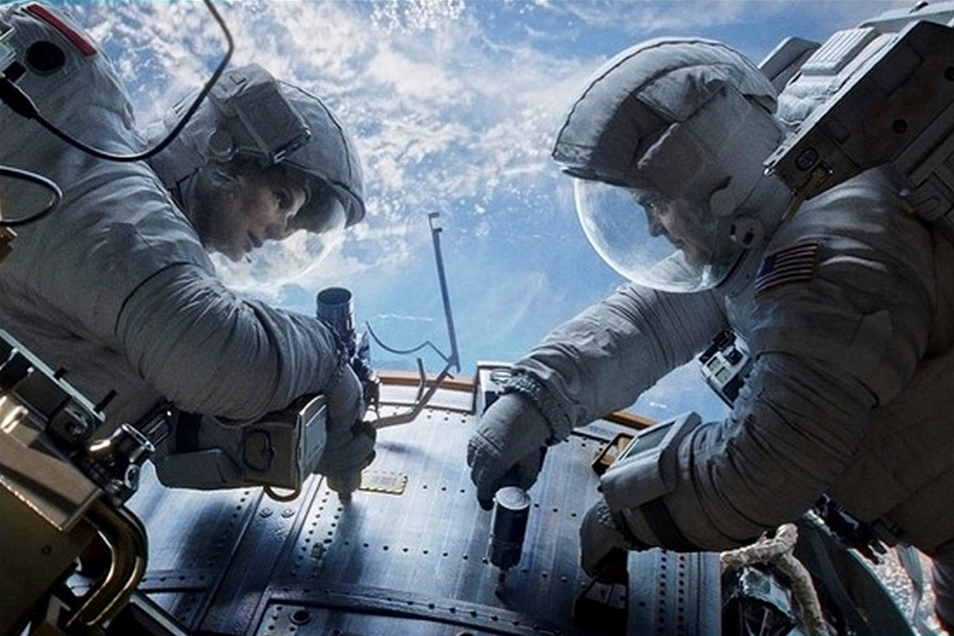
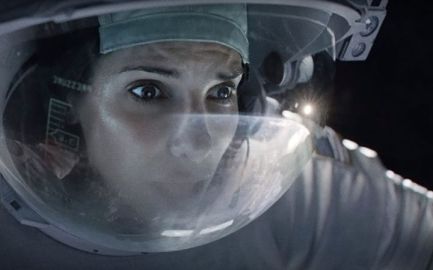
This sort of tension and desperation is felt on an emotional level so intense in Alfonso Cuaron’s Gravity that I feel like I’m in space experiencing the same things that these characters are experiencing, not watching the chaos unfold from mission control.  The plot follows three astronauts who are working on repairing a satellite in orbit. Dr. Ryan Stone (Sandra Bullock) is a mission specialist who is working hard at repairing the satellite on her very first space mission. Lieutenant Matt Kowalski (George Clooney) is an experienced space veteran who is retiring after this final expedition.  Shariff Dasari (Paul Sharma) is a flight engineer who carries a photo of him, his wife, and child inside his suit.  Early into their mission, the team gets a warning from mission control, saying that there is debris from a missile strike on a Russian satellite orbiting the earth, but that it shouldn’t collide with their trajectory.

Now if that isn’t a case of foreshadowing, I don’t know what is.  Eventually, the debris sets off a chain reaction of destruction, and it eradicates the shuttle that they came on.  Shariff is killed, Kowalski loses communication with mission control, and Stone is left desperately hanging on to her life as she floats aimlessly away from their space module. When Stone and Kowalski eventually meet up again, they have to race against time and fate as their oxygen levels continue to deplete, and need to find a way home before they are truly lost in space forever.

Man oh man, where to start.  Gravity is a film for a generation, a picture that is so convincing and so believable in its approach that its nearly impossible to think that it wasn’t even filmed in space.  It is visually stunning, emotionally gratifying, immensely captivating, and surprisingly involving, a picture that latches you on in its first shot and doesn’t let you go until hours after you’ve left the theater.

Who is responsible for this feeling of attachment and interest?  Why that is director Alfonso Cuaron, of course, who co-wrote the script with his son Jonas. Cuaron, who is most known for his mainstream films including Children Of Men and the third Harry Potter movie outdoes himself here. Not only has he made a compelling and visually breathtaking science-fiction film that visually challenges that of Avatar and Inception: he’s also made a emotionally captivating story with the human interest equivalent of Argo or Captain Phillips.

Oh, I’m not saying he isn’t already a great director: lord knows he’s delivered as much visual and emotional appeal as he did with Children Of Men and Prisoner of Azkaban.  But Gravity is head and shoulders above anything else he’s done in his entire career. Why? Everything in the movie is immaculate and intentional, from the physics and dangers of space to characters emotions and complexions. Look at the delicacy and the concentration on Cuaron’s shots. Look at how well he orchestrates a scene, whether a large, imposing space station is crumbling all around Earth’s orbit, or a astronaut is just awkwardly fitting herself in tight corridors around a space station. In each shot, there is interest, there is intricacy, and there is involvement. Whether its a big, intimidating destruction scene or a small conversation between characters doesn’t matter. The interest remains, and its boy does it keep your attention.

Visually, the film is unparalleled, hooking you on with all of its space-station grandeur and elegant scenery of earth from outer space. Part of this no doubt goes to the visual effects team led by supervisor Tim Webber, but a large accreditation needs to be made to cinematographer Emmanuel Lubeski, who collaborated on Cuaron’s other films including Children of Men and Y Tu Mama Tambien. Lubeski, who was nominated for an Oscar a few years ago for Terrence Malick’s Tree Of Life returns with the same artistry and craftsmanship that made him an artist in his own right. The camerawork in the film evokes a feeling of both reprehension and serenity, the same eerie feeling you get when you watch the slow, steady moments building up in Stanley Kubrick’s 2001: A Space Odyssey. It works in conjunction with the film’s plot and with Cuaron’s handling of it, a marriage of collaboration so essential that its doubtful anyone could be as fluid or as controlling as Lubeski is, not even Wally Phister’s steady, reliable camerawork from Christopher Nolan’s Inception or Dark Knight trilogy.

High praise, I know, but it’s well deserved. The visual effects alone have not made this movie. It’s Lubeski’s intricate framing and filming that not only captured these great shots, but intensified them, evoking the anxiety and unease of space just as much as the visual effects and sequencing does.

Bullock and Clooney are affectionate and grounded in their performances, pun intended.  Going in to the movie, I was really worried that the both of them were going to phone in their roles and just let the visuals take over, much like the Michael Bay/Roland Emmerich action movies you see nowadays. Boy, was I wrong. Their characters are real, charismatic and likable people in their own right, people who you’d probably like to sit with and share a conversation with over at Starbucks. Their chemistry is infectious with each other, as memorable and dynamic as the relationship Tom Hanks and Kevin Bacon shared with their crew mates during Ron Howard’s Apollo 13. You don’t only care for these characters because of their situation: you care for them because they are human beings, because they have hopes, dreams, and letdowns of their own and you want to see them make it through all of it.

This is what I love most about the movie: not just that it handles itself well as a science-fiction movie, but it handles itself well as human drama, period.

This is seriously one of the best films of the year. I’m not saying that because it is science-fiction. I’m saying that because it is seriously one of the best films of the year.  Under a different director, a different writer, cinematographer, composer, or even under a different cast, this film could have failed.  It’s hard to take a movie that takes place in an enclosed, blocked off environment separated from society with only one or two characters and make it interesting, and the filmmakers here have accomplished that in spades.

But Gravity is much more than a survival film.  It’s more than a science-fiction film.  It’s an epic and emotional story about an astronaut trying to survive, a woman trying to cope with living, reality, and tragedy, and the unhindered spirit that pushes her to keep living, even when all of the forces of nature tells her that she can’t. It blurs the line between science fiction and science reality and is quite possibly the best space movie I’ve ever seen.

Tagged , , , , , , , , , , , , , , , , , , , , , , , , ,

OSCAR REACTIONS 2013

Well, that was anti-climactic.

For those of you who live under a rock and don’t know who I’m talking about when I mention the word “oscar”, the 86th Academy Awards took place yesterday on ABC, hosted by comedian Ellen Degeneres. Needless to say, Degeneres was brilliant, taking selfies, buying pizza, crashing twitter, bringing the stage down for Jennifer Lawrence, and calling Liza Minelli a man all in one night. And yet, despite all of her efforts, the oscars seemed so… boring.

How did this happen? The nominees, dear reader. Out of the 24 categories in the ceremony I got twenty right, beating most of my Shorthorn peers and family members for the potluck we held that night. The most I’ve gotten previously was sixteen. I’m inclined to believe that the academy made the winners of these awards too obvious by building up too much hype of them during the buzz of the past few months.  Case in point: was there any argument that Frozen was going to take home best animated feature?

It doesn’t matter now, anyway. It happened, and I got 20 right out of 24 categories. Yes!!! Just because I predicted them correctly, however, doesn’t mean I need to be happy for their win. Let’s go through each of the categories and see whether or not they really deserved it or not…

BEST PICTURE (CORRECT!) The best picture of the year rightfully won best picture at the Academy Awards: Steve McQueen’s phenomenal, gripping, heart-wrenching, spellbinding and immensely powerful 12 Years A Slave won best picture. While I’m ecstatic for its win and could not agree more with the Academy’s consensus, I find it very strange that it won the Academy’s highest honor despite it only winning two other awards. But we’ll talk more about that later.

BEST DIRECTOR (CORRECT!) Also correctly predicted is Alfonso Cuaron for his nerve-wracking and tensely-directed sci-fi thriller Gravity. I already mentioned this in my predictions, but the best director award needs to be reserved for the best picture of the year. I loved Gravity with every fiber of my being, but it simply does not match the cinematic caliber to that of McQueen’s 12 Years A Slave. It would be like comparing The Dark Knight to that of Slumdog MillionaireThe Fugitive to that of Schindler’s List, or Jaws to that of One Flew Over The Cuckoos Nest. They are all ingenious, brilliant and incredibly memorable pictures, but the best picture of the year is awarded that because of the direction and treatment that it was given.

That’s not intended as an insult towards Cuaron, and I definitely believe he deserves it based on the physics and tension of the movie alone. If I’m thinking about which movie had the bigger impact, however, it’s no contest on which one it deserves to go to: McQueen for 12 Years A Slave. Nevertheless, I congratulate Cuaron on his many accomplishments regarding Gravity. Lord knows my heart stopped at least a few times while watching that picture.

BEST ACTOR (CORRECT!) Matthew McConaughey took home the award for best actor as a rowdy texas cowboy dying of AIDS in Dallas Buyers Club. While the award could have gone to either him or Chiwetel Ejiofor for 12 Years A Slave, there’s no denying the power, the energy, and the raw gravitas that he brought to a man’s desperate journey to survive. Plus, I love his acceptance speech and how he dedicated the award to God and to “himself in ten years”. That’s a wise goal that any man should strive for.

BEST ACTRESS (CORRECT!) Cate Blanchett won best actress for Woody Allen’s Blue Jasmine. While I have regretfully not seen the movie yet, I will say that the few scenes I have seen her in impressed me very much, and that she did a solid job portraying a deeply bothered woman who is in deep depression and alcohol addiction. Congratulations to her. I look forward to watching the film, as well as Blanchett’s performance in it.

BEST SUPPORTING ACTOR (CORRECT!) Did Michael Fassbender win best supporting actor like I wanted him to? No, he did not. Instead, Jared Leto took home the award portraying the transgender AIDS victim Rayon in Dallas Buyers Club

The more I think about it, the more ridiculous I think it is that the best picture winner of the year did not get recognized in so many categories. Why the snubbing from Fassbender? Half of the movie’s turmoil and conflict came from this despicable character, a man so inhumane and abominable that Calvin Candy from Django Unchained would have broke down in tears after seeing what this man forced people through. Fassbender was pivotal, aggressive, violent, and hateful as Edwin Epps, and incurred more emotions from audiences than that of a transgender AIDS patient in Dallas Buyers Club. I know 30 Seconds To Mars fans will hate me for saying this, but the more vital role needs to go to the more vital performance. I said it once, I’ll say it again: Leto is not as deserving in the award as Fassbender is.

Again, no disrespect, and I acknowledge that Leto gave a great performance in the picture. But like Cuaron with best direction, the more compelling presence needs to go to the more compelling artist. Sorry, Rayon.

BEST SUPPORTING ACTRESS (CORRECT!) Lupita Nyongo won (and deserved) the academy award for best supporting actress for her heartbreaking role as a desperate and depraved cotton picking slave in 12 Years A Slave. No qualms here.

BEST ORIGINAL SCREENPLAY (CORRECT!) I also correctly predicted that Spike Jonze would win the best original screenplay award for his sci-fi romance story Her. Comparing Her to the genius of David O’Russell’s American Hustle, I mentioned in my original predictions list that “just because its a smarter story doesn’t necessarily mean that it is a better one.” I do not retract my statement.

BEST ADAPTED SCREENPLAY (CORRECT!) John Ridley won best adapted screenplay for his incredibly well-documented 12 Years A Slave. He equally deserved it, as Solomon Northrup’s story, or legacy, could not have translated any better to the screen if the filmmakers tried. Great job, Ridley. You gave us an unforgettable and incredible story, the likes of which no one has seen since Steven Spielberg’s Schindler’s List. 

And this is the only other award 12 Years won for the night. No cinematography. No editing. No costume or production design. No supporting actor. No other award that would further substantiate and support its win for best picture.

Am I the only one that finds this completely ludicrous? To date, there are only three best picture winners to win only three academy awards. Those movies are The Godfather, Crash and Argo, and two of them didn’t even win in major categories. Seriously, what is going on? Why are we being so insubstantial towards movies that have been deemed the best of the year? Do academy voters not realize that by naming this the BEST PICTURE OF THE YEAR that they’re saying that its better than everything else? And according to this ceremony, not only are they saying that it is the equivalent of Dallas Buyers Club (they both won three academy awards), but that Gravity is superior to it with seven wins and no awarding of best picture.

Seriously. Make up your mind. I’m fine with you saying one picture is better than another, but substantiate that by what awards you give it. I seriously doubt that 12 Years is best picture because of its screenplay and its supporting actress alone. Likewise, I doubt that Gravity isn’t the best picture of the year because it has the best direction, camerawork, editing, sound mixing, and visual effects out of any other picture.

That’s all I ask, folks. Not preference. Fairness.

BEST FOREIGN LANGUAGE FILM (CORRECT!) The Great Beauty won for best foreign-language film. That’s the one that everyone saw, right? It obviously deserved to win.

BEST DOCUMENTARY FILM (INCORRECT!) I incorrectly predicted that Act Of Killing would win the award, but no, 20 Feet From Stardom took the award home, with featured artists on the film including music legends Mick Jagger, Bruce Springsteen and Stevie Wonder. I haven’t seen the film, so I have no place on commenting on it, but it seems odd that the Academy would reward a movie about background singers over that of a tragic confrontation of death and social issues. I’ve yet to see either of them though, so like I said, my opinion is invalid in this category.

BEST ANIMATED FILM (CORRECT!) Disney won best animated feature for Frozen. While I didn’t care much for it, I know it made a wide impact on its audience and that it will go on to be fondly remembered by many animated movie lovers for years to come. So congratulations for its win, even though I’m no fan of the cold weather this time around.

BEST ORIGINAL SONG (CORRECT!) Frozen won best original song for its memorable song “Let It Go”. It certainly didn’t win for Idina Menzel’s performance, that’s for sure. What the heck happened with her? Her pitch was all over the place, her control was wonky, and her whiny voice was the contrast of the powerful, beautifully controlled voice she exhibited in the movie itself. Seriously. What happened?

One song I’ve really been getting into recently (and I think you’ll agree with me) is Pharell Williams’ “Happy”. The performance proved why. Not only was it energetic, upbeat, and undeniably catchy, but Williams gave a great performance, he exhibited great control and showed very few differences from the studio version of his song. Menzel’s performance, in comparison, was completely and utterly horrendous.

But hey, I guess that’s why the award is called “best original song” and not “best performance”. Otherwise, I think we both what the turnout would be.

BEST ORIGINAL SCORE (CORRECT!) Steve Price took home the award for best original score with Gravity. He completely deserved it. Not only did it match the tension, edginess and unease of the movie, but it also gave a dignified sense of hope and accomplishment after a long journey of heart-pounding danger and peril. Listening to the soundtrack alone gave you the feeling of identity and survival, and Price was definitely the most deserving out of any nominee. Congrats to him for his win.

In the meantime, I’m still wondering where is Hans Zimmer’s nomination for Rush. Remind me again why this movie wasn’t nominated for anything?

BEST CINEMATOGRAPHY (CORRECT!) In 2011, Emanuel Lubewski was mercilessly snubbed for his masterful, Stanley Kubrick-esque camerawork in The Tree Of Life. If he didn’t win it this year, I was literally planning on flipping out.

Luckily, he did.

BEST FILM EDITING (CORRECT!) Another category that I felt 12 Years was superior to Gravity, yet it still lost to it. Must I keep beating a dead horse? Gravity was a more visually stellar and energetic picture. 12 Years was the more engaging and involved one. Part of that was because of how the film was put together in a traditionalist style that was reminiscent of Dylan Tichenor’s work from movies including There Will Be Blood and Brokeback Mountain, where he focused most of the runtime on the film’s subjects rather than worrying about flashy cuts or transitions. Film editing is one of the most important part of storytelling, and what have I been saying is the best story of the year? 12 Years A Slave.

I’m not going to drag this out though. Gravity was a great picture, and editors Alfonso Cuaron and Mark Sanger definitely reached outside the box to accomplish things visually no other film did this year. It did a good job. Moving on.

BEST PRODUCTION DESIGN (CORRECT!) The Great Gatsby won for best production design. Considering the sets were the most colorful and visually appealing out of the year, that isn’t very surprising.

BEST COSTUME DESIGN (INCORRECT!) Unfortunately, I predicted this category wrong, thinking that 12 Years was going to get this one. The only reason I went with that instead of winner The Great Gatsby was because I knew Catherine Martin was already going to win for best production design, and any more than that would have been greedy. I forgot that “spreading the wealth” isn’t a phrase the academy is most well known for.

BEST MAKEUP (CORRECT!) Thankfully, Dallas Buyers Club won for best makeup and hairstyling. As long as Jackass: Bad Grandpa didn’t walk home with the award, I’m satisfied.

BEST SOUND EDITING (CORRECT!) Gravity won.

BEST SOUND MIXING (CORRECT!) Gravity won. Again.

BEST VISUAL EFFECTS (CORRECT!) If you even thought this award was going to anything other than Gravity, you’re either insane, or blind.

And at last, the long-dreaded short film categories.

BEST LIVE-ACTION SHORT FILM (CORRECT!) Surprisingly, I got this category correct with predicting Helium. I haven’t seen the film though, so it was only by sheer luck that I got this right.

BEST ANIMATED SHORT FILM (INCORRECT!) Mr. Hublot took home this award. That’s surprising, considering how clever and fun Get A Horse! was, but nevermind. I haven’t seen the movie, so I can’t comment on it.

BEST DOCUMENTARY SHORT (INCORRECT!) The Lady In Number 6: Music Saved My Life. Again, just like any other films in these categories, I haven’t seen it, so how would you expect me to get it right? You might as well blindfold me and ask me to just write on the flipping ballot.

Overall, this has been a fun ceremony, and I’m grateful to Ellen Degeneres for making it a happy-go-lucky and loveably quirky time. Just please, make the ceremony less predictable next time, okay? I’d rather not have a film come in and just know that its going to dominate in all of the categories. You would have been better calling it “The First Annual Gravity Awards”.

-David Dunn

Tagged , , , , , , , , , , , , , , , , , , , , , , , , , , , , , ,

OSCAR PREDICTIONS 2013

Ah yes, its that time of the year again, ladies and gentlemen. It’s Oscar time, where forgettable movies to get gold statues, while great movies get ignored.

Calm down, calm down, I’m just kidding. Except not really. People know that I’m openly critical about the Oscars for a number of reasons, mostly because the movies that were nominated were given those nominations by bloviating pundits and not genuine movie lovers. Don’t agree with me? Look at the following movies that weren’t even nominated for best picture: Rush. Harry Potter. The Dark Knight. Pan’s Labyrinth. Black Hawk Down. Fight Club. 2001: A Space Odyssey. Rear Window. Psycho. The Good, The Bad, and the Ugly. 

Don’t get me wrong: I enjoy the majority of the motion pictures that are nominated at the Oscars, and I usually agree with their picks of who wins best picture. I absolutely love The Lord of The Rings trilogy, I love Rocky, The Godfather, Slumdog Millionaire, Titanic, and I uphold that Schindler’s List is the best academy-award winner for best picture of all time. Just because those movies deserved it, however, doesn’t mean those other movies don’t deserve mention, and I find it absolutely despicable that the academy snubs pictures that have made a large impact on society. I mean, everyone’s heard of Oliver! before, right? RIGHT?!

Okay, rant over.  This year is a very interesting awards race, with Gravity, American Hustle, and 12 Years A Slave the frontrunners for the best picture race, not to mention all of the other awards in the ceremony. I’ve already written my top ten list of the year, so I won’t bother you with the details of which I think is better. Let’s begin the predictions.

BEST PICTURE: Since Sundance of last year, 12 Years A Slave has been recieving the most steadfast buzz that lasted all throughout the year into this ceremony. While I agree that Gravity is a great frontrunner, I don’t think that consensus is going to change. Plus, look at the academy’s track record. Based off of previous data, the academy loves to give the best picture Oscar to movies based on real events and that statistically grossed less than 100 million. Not only is 12 Years based on the true story of Solomon Northrup, but it also grossed 96 million dollars. I’m sticking to my gut here. 12 Years A Slave is winning best picture. 

BEST DIRECTOR: Everyone seems convinced that Alfonso Cuaron will win the academy award for best direction with Gravity, and that especially seems the case since he won the DGA award as well. I’m not convinced, however, that he’s the most fit for this award. Gravity, of course, was science-fiction perfection, accurately capturing the physics and dangers of space so perfectly that it could have been filmed in space for all we know. Equally as difficult, however, is capturing the cruelty of the slave era in a relentless, gritty, unhinging fashion, and director Steve McQueen did that masterfully all while maintaing his decorum. I won’t be mad if Cuaron wins and McQueen loses, and to be honest, both are very deserving in this award. All I’m saying is that if Cuaron wins, it will be the equivalent of Steven Spielberg losing for Schindler’s List to Andrew Davis’ The Fugitive.

BEST ACTOR: The battle has been in between actors Matthew McConaughey and Chiwetel Ejiofor, both nominated for their roles in Dallas Buyers Club and 12 Years A Slave.I’m going with McConaughey for three reasons. 1) Since his win at the Golden Globes, he’s had a steady winning streak in many award ceremonies, including the SAG Awards. 2) His performance was stunning, sinking into this role of an aggressive party-hard cowboy turned health advocate, and 3) He’s Matthew freakin’ McConaughey. Do I really need to give a further argument?

BEST ACTRESS: Again, this battle is between Sandra Bullock for Gravity and Cate Blanchett for Blue Jasmine. There are two reasons why Bullock won’t win this year: 1) She won the academy award for best actress a few years ago for her performance in The Blind Side, and 2) I’ve never seen a best actress win for a science-fiction film in any year. So Cate Blanchett is the assumed winner. 

BEST SUPPORTING ACTOR: I want every single molecule and fiber of my being to give the award to Michael Fassbender as a hateful slave driver in 12 Years A Slave. His performance was cruel, relentless and teeth-grinding all at once, and was so despicable as a villain that he surpassed Leonardo DiCaprio’s performance in Django Unchained. He won’t win it. The dominant opinion has been swayed towards Jared Leto in his transformative performance as a transgender AIDS victim in Dallas Buyers Club. While I commend his bravery and his ability to slip so effectively into this role, it doesn’t change the fact that his performance didn’t shake me as much as Fassbender’s did. Fassbender played the more striking character: he’s the one that’s more deserving in the award.

BEST SUPPORTING ACTRESS: This is the only acting category where a consensus is generally already made. Besides Ejiofor, Lupita Nyongo stood out both as a character, as an actress, and as a spiritually broken slave who lost all hope at life and at happiness in 12 Years A Slave. Her performance truly broke my heart, and she deserves no less than the academy award for best supporting actress. 

BEST ORIGINAL SCREENPLAY: This battle is between writer-director David O’Russell and Spike Jonze, both responsible for their respective films American Hustle and HerBecause it takes a lot more ambition to write about a middle-aged man falling in love with a computer than it does to write a historically based crime-comedy-drama, my best is on Spike Jonze’s Her. Just because its a smarter story, however, doesn’t necessarily mean that it is a better one.

BEST ADAPTED SCREENPLAY: If 12 Years A Slave is going to have any chance in the best picture race, it needs more of a push than best supporting actress. It’s going to get that extra push in this category. Not only is it among the year’s best, but it is one of the most spellbinding stories of the year, only barely straying from the original text that Solomon Northup wrote all those years ago. Not only will John Ridley win for 12 Years A Slave: he deserves it. 

BEST ANIMATED FILM: I’m one of the relative few that did not enjoy Disney’s newest feature Frozen, a story based on the “Snow Queen” fairy tale about two sisters trying to save each other in a crumbling kingdom. While the characters were fun and energetic, they were equally annoying and ditzy, especially whenever the stupid trolls were on the screen. While I’m less enthusiastic about it, however, it obviously hasn’t disappointed its mainstream audience, garnering a 90% on rotten tomatoes and a rare A+ on cinema score. There’s no question on who’s winning this: Frozen will win the best animated feature award.

BEST ORIGINAL SONG: I’ll give Frozen this: it had wonderful music. It deserves no less, then, to win the academy award for best song for their brilliant track titled “Let it go.”

BEST ORIGINAL SCORE: A few years ago, The Social Network won best original score for its energetic beats and its fluid synthesized sounds. For these reasons will Steven Price not only win the Oscar for Gravity, but deserve it because his music added tension, edginess and paranoia to Gravity’s already heart-pounding premise. 

BEST CINEMATOGRAPHY: Emmanuel Lubewski lost years ago with The Tree Of Life against Robert Richardson for Hugo. The Academy will make that up to him this year for giving him the academy award for best cinematography for Gravity, although I’m still sad that Roger Deakins is getting left behind for Prisoners. 

BEST FILM EDITING: Let me say something here: great visual effects doesn’t make for great editing. Likewise, a masterful editor knows not only when to cut away from a shot, but also on how long to stay on one as well. Although Joe Walker is more that deserving to win for capturing the tragic essence of 12 Years A Slave, I believe it will go to Alfonso Cuaron and Mark Sanger for Gravity due to its technical achievements. 

BEST SOUND EDITING: “In space, no one can hear you scream?” Yeah right. I heard a mother in mourning screaming in space for 120 minutes and I was absolutely petrified.There’s no question on which movie this award deserves to go to: Gravity. 

BEST SOUND MIXING: Gravity for the same reasons as above. 

BEST VISUAL EFFECTS: Gravity. End of discussion.

BEST MAKEUP: Dallas Buyers Club is going to win. If the academy dares to give the award to either Jackass: Bad Grandpa or The Lone Ranger, I’m going to invite them inside my personal port-a-potty and wait for them to realize that its the poo cocktail from Jackass 3.

BEST COSTUME DESIGN: I’ve flipped sides on this one a few times now. First I thought The Great Gatsby’s flashy and colorful costumes were going to take home the award. Then I considered American Hustle for its stylish, contemporary costumes. Now, after giving it a second look, my mind is made up: 12 Years A Slave is going to win for best costume design.
BEST PRODUCTION DESIGN: I was hesitant to name this at first, because honestly anyone can take this one home. The set pieces and designs for all of the film were spectacular in the least, ranging from the financially corrupt society that American Hustle portrayed, to the bleak, barren landscapes of 12 Years A Slave, all the way to the surreal, futuristic Stanley Kubrick-style buildings in Her. I’m ultimately going to guess that The Great Gatsby wins best production design only because it is excellent at displaying the roaring twenties as well as being the most diverse out of any other nominee. 

BEST DOCUMENTARY: This category started off controversial, leaving off one of the most critically-acclaimed documentaries Blackfish off of its list of nominees. Disregarding that, however, look at the other nominees. Out of any of the other selections, which one was talked about the most? Which one is the most controversial? Which one gave a clear, unbiased perspective of a serious issue and let the film show reality as it is?

Filmmaker Joshua Oppenheimer was praised all around for his film The Act Of Killing, a story about a former soldier revisiting his dark past and facing the truth about the lives he took long ago. It ended up taking many number one spots on many top ten lists, including Sight and Sound’s poll for best of the year. It’s no contest for me. The Act Of Killing is taking this Oscar home. 

BEST FOREIGN LANGAUGE FILM: The more I look into this category, the more I notice that The Hunt has been getting more and more buzz with moviegoers about the Oscars, and is the only nominee to be on IMDB’s top 250 films of all time (although, oddly enough, its listed for 2012 instead of 2013). Despite how praising the word of mouth has is, however, I’m convinced that it won’t win. The Great Beauty has been getting the most buzz out of any other nominee, and that buzz usually isn’t wrong. Plus, my ex-film professor loves it. That’s when you know two things: that it’s a bad movie, and that it’s going to be an Oscar-winner.

And here it is, at last, my three (least) favorite awards categories: the short films. Why do I say that? With the exception of one, I haven’t seen any of them. Nobody has seen them. Point me to one normal moviegoer who has seen any of these shorts, and I will pay him $100 to smuggle in DVD-ripped copies of them to my home theater.

Blehhhhhhh. Let’s finish this.

BEST ANIMATED SHORT FILM: The only one I’ve seen out of any of the films in any of these categories is Disney’s Get A Horse, a buoyant and clever combination of classic 1930’s Disney animation with that of today’s three-dimensional standard. I got this category right last year, but that doesn’t mean I will do it again this year.

BEST DOCUMENTARY SHORT FILM: Cavedigger, because it has the coolest title. 

BEST LIVE-ACTION SHORT FILM: Helium, because I can’t breathe. 

What are your predictions? Do you think Gravity is going to take the big picture home, or am I shortchanging 12 Years too much? Comment below, let me know.

Now, if you’ll excuse me, I have to go write the president of AMPAS an angry letter about why Rush wasn’t nominated for anything.

-David Dunn

Correction 2/25: On the “best production design” category, ‘American Hustle’ was inaccurately identified as being “the roaring twenties that American Hustle portrayed”. The description was intended to go towards ‘The Great Gatsby’ and has since been corrected. 

Tagged , , , , , , , , , , , , , , , , , , , , , , , , , , , , , , , , , , , , , , , , , , , , , , , , , , ,

Where Did These Nominations Come From, Kemosabe?

Today is the day. I was looking forward to this all of yesterday, and its finally here. I can hardly contain my excitement: the nominations for the 86th Academy Awards have been announced.

What, you didn’t think I was talking about Librean President Ellen Sirleaf’s anniversary, did you? Of course not, I only focus on things that are important. And what could be more vital, necessary, and inaccessive than handing out a slew of golden statues to over 24 nominees?

All sardonicism aside, I am excited about the nominations this year. I always am. While I am constantly critical about the Academy Awards and the films they snub and spoil consistently, I always look forward to predicting the winners with my family and always beating them out 18 to one. I get even more excited when a movie that wins best picture actually deserves the win. For example: Schindler’s List or Argo.

The nominees are in, and just like last year, there are nine films up for the award for best motion picture, among other awards. The first film that’s up for grabs is David O’Russell’s comedy-crime-drama American Hustle, a smart, surprisingly witty exercise that looks at the financial situations of characters and how it affects their morality. Besides best picture, American Hustle has also been nominated for awards including best film editing, best costume design, best production design, best original screenplay and direction for David O’Russell and all of the nominations for his cast. Seriously, check the list. Just like last year, all of his leads got nominations in every single acting category, with Christian Bale for best actor, Amy Adams for actress, Bradley Cooper for supporting actor, and Jennifer Lawrence for supporting actress. Geesh. Conceited much, O’Russell?

Just kidding. The film is good, and O’Russell is deserving in most of the nominations, although I think ten in total is a bit of a stretch. Tied with Hustle’s nominations is a film that deserves every single one of them is Gravity, a moving, enthralling picture that plays out as a heart-pounding race of survival in outer space. Gravity’s total nominations besides best picture includes best direction for Alfonso Cuaron, best sound editing and mixing, best production design, best cinematography, best film editing, best visual effects, and best actress for Sandra Bullock. Gravity and American Hustle have ten nominations each, making them the films with the most nominations out of any other picture.

Coming up with nine nominations is my favorite picture of the year, 12 Years A Slave, a motion picture that is devastating, cruel, heartbreaking, and thought-provoking all at once. This drama-driven biopic is directed by filmmaker Steve McQueen (Hunger, Shame), and its easily his best one yet. 12 Years is nominated for best picture, best director, best adapted screenplay, best production design, best costume design, best film editing, and best acting nominations for Chiwetel Ejiofor, Michael Fassbenber, and newcomer Lupita Nyongo, who is the most deserving out of any other nominee in the supporting actress category. Out of any of the other best picture nominees, 12 Years has been getting the most buzz and talk about the Oscars the entire year. I would pay attention to this one if I were you.

Tied with six nominations each is Captain Phillips, Dallas Buyers Club, and Alexander Payne’s Nebraska, a story about a dismal father who wants to go to Nebraska to collect a sweepstakes prize that he supposedly won. Nebraska was also nominated for best cinematography, best acting nominations for Bruce Dern and Kate Grant, and best directing and writing nominations for Alexander Payne. He won his second academy award a few years ago for The Descendants with his first being Sideways, so for his sake I hope he doesn’t win again so his head doesn’t get too big.

Dallas Buyers Club is also nominated for best makeup and hairstyling, best film editing, best original screenplay, and best acting awards for Matthew Mconaughey and Jared Leto, who are currently the frontrunners in both categories. Captain Phillips is nominated for best picture, best film editing, best sound editing and mixing, best adapted screenplay, and best supporting actor for newcomer Barkhad Abdi. Surprisingly, Tom Hanks wasn’t nominated for a best actor nomination, and I can’t help but feel really frustrated by this. If you saw the film, you would understand why.

Her and Wolf Of Wall Street both have five nominations, including best picture. For those of you who haven’t heard about it, Her is a light science-fiction romantic dramedy about a lonely older man who falls in love with a computer program. Yes, I know it sounds weird. I still encourage you to seek it out. While it isn’t as straightforward as other movies, Her is an experimental film in every right trying to say something about love and the reliance on technology. Her is nominated for best original score, best original song, best production design, and best writing and picture awards for director Spike Jonze. Even though it has lesser nominations, I’m definitely going to pay close attention to this film.

Wolf Of Wall Street is easily the most controversial out of any other best picture nominee. The opening shot is Jordan Belfort snorting cocaine out of a hooker’s arse, for crying out loud. Regardless, that obviously didn’t slow the picture down. Wolf is nominated for best adapted screenplay, best acting awards for Leonardo DiCaprio and Jonah Hill, and best picture and direction for filmmaking legend Martin Scorcese.

And lastly, the final best picture nominee is a humble little picture called Philomena, a true story about a struggling writer chronicling the story of an older mother trying to reconnect with her long-lost son. Out of all of the best picture nominees for the Oscars, this one was the least expected and one of the few that I have not seen. Besides best picture, Philomena is nominated for best original score by Alejandre Desplat, best actress for Judi Dench, and best adapted screenplay by Jeff Pope and Steve Coogan, who also starred in the movie.

Also nominated for the evening is films including Blue Jasmine, The Hobbit: Desolation of Smaug, Frozen, Inside Llelyn Davis, The Great Gatsby, and… The Lone Ranger? 

Yes, dear reader, Lone Ranger is nominated for not one, but two academy awards, although I have no idea why. I haven’t seen the film, but reception has been polarizing from both critics and moviegoers, so I can’t imagine anyone being happy about this. It’s nominated for best makeup and hairstyling and best visual effects, which the second one irreverently ticks me off because neither Pacific Rim or Man Of Steel is nominated. Did I also mention that The Lone Ranger was also nominated for five raspberry awards, including Worst Picture?

Other surprises includes Blackfish and… Bad Grandpa? Yes, Jackass: Bad Grandpa is nominated for best makeup, but why the heck is it nominated for an academy award? That makeup looks about as realistic as a halloween mask. I certainly didn’t expect it, and I don’t think many others did either. The seaworld documentary Blackfish, which has been talked about all year, also did not get nominated for best documentary, even though it grossed more than any of the other nominees, save for 20 Feet From Stardom. Why the snub? I have no idea, but it certainly deserves a nomination over Bad Grandpa and The Lone Ranger.

Overall, I’m satisfied with the nominees. There’s a few weird inserts here and there, but generally, most of the nominees are very deserving. My only complaint is that the Ron Howard-directed Rush, a true story about two racers and the rivalries that they shared with each other, was nominated for nothing, not even best makeup, which certainly deserved it more than Bad Grandpa did. The heck man?

On the bright side though, Ellen Degeneres is hosting. Tune in on March 2nd, and you might see Dory make a cameo appearance.

-David Dunn

Tagged , , , , , , , , , , , , , , , , , , , , , , , , , , , , , , , , , , , ,

“ARGO” Review (✫✫✫✫)

“Argo”: The science-fiction epic that didn’t exist

In 1980, political instability and rebellion shook the grounds of Iran, a once prosperous city run dry by the greed and evil of its former shah, Mohammad Pahlavi.  When the U.S. agreed to house Pahlavi in southern California after he contracted cancer, the Iranian people stormed the U.S. Embassy in a furious rage and took everybody inside hostage.  Only six Americans escaped with their well-beings intact.

This is the true story of Argo, a political thriller based on the Iranian hostage crisis of 1980.  After barely escaping the U.S. embassy just before it is overran by Iranians, the Americans flee and take refuge inside Canadain Ambassador Ken Taylor’s (Victor Garber) house as social and political stability continues to crumble outside of the Taylor household. They remain stuck there for 69 days.

Enter the CIA. The intelligence agency plots ways to try and rescue the Americans and get them home to safety, but no luck. Their best ideas involve riding bicycles and meeting them at the border with gatorade. All hope seems lost until Tony Mendez (Ben Affleck) hatches the idea of disguising the American’s as a film crew scouting for locations out in Iran. As the Secretary of State asks Tony Mendez, “You got any better bad idea than this?”

“This is the best bad idea we have sir. By far.”

Here is a movie that knows how to utilize suspense and tension to the fullest effect. Similarly to how Kathryn Bigelow sets up the stakes of the film within the establishing shot of the 2009 best picture winner The Hurt Locker, Argo similarly sets up its stakes with a tense, horrifying sequence of the Iranians overrunning the U.S. Embassy in the beginning shot. They jump over walls and tear down the gates as they storm through the front lawn. They break through doors and windows as they charge into the building, screaming as they hold up picket signs and crow bars. They bind their hostages in rope and cloth as they grab and shake them all while screaming into their ears and breaking furniture around them. In the world of film, the goal is to put audiences into the scene, into the moment of the picture. We are not just put into the environment of Iran in Argo: we are immersed in it.

At the same time though, this is a movie that knows how to expertly balance drama with humor and comedy. Two essential roles in this movie help achieve this: John Goodman as make-up artist John Chambers, and Alan Arkin as movie producer Lester Seigel. These two are the C-3PO and R2-D2 of filmmakers, a duo who argue and bicker over the smallest, funniest of details. In one scene where they were looking over scripts for the operation, Lester complains as to how they are all of poor quality.

John: “We’re making a fake movie here.”

Lester: “If we’re making a fake movie, I want it to be a fake hit.”

This is one of those rarities of films where it transcends merely being labeled as a “movie” and has graduated to being something as an “experience”.  Argo is a tense, nerve-wracking film.  It keeps you on the edge of your seat, cringing, waiting, teeth chattering, spine tingling with every tense moment of the film pulsating through your entire body.  Ben Affleck directs this film with alluring precision, utilizing jump-cuts and precise cutaways to the greatest effect during this American horror that is a true story.

Very few films match the precision and craftmanship that this film possesses.  Combine that with the film’s smart, witty dialogue, as well as its great spirit for humanity, and what you have is one of, if not, the best drama film of the year.

Tagged , , , , , , , , , , , , , , ,