Tag Archives: Blockbuster

“’71” Review (✫✫✫)

A boy trapped in a soldier’s life. 

We’re always looking for someone to blame in war. Most of the time, the blame is directed at the soldier. Rarely do we blame the military, or the government, or those we are fighting, and even more rarely do we blame the people living stateside, in the warmth and comfort of their blanket and home and far away from the battlefield. No, if we are angered at travesties such as the Vietnam or the Afghan war, we don’t point at the general who gave the order to shoot. We point at the soldier who was following orders.

In ’71, the soldier is treated not as a cold-hearted, emotionless machine, but as a young man, a flesh-and-blood being full of heart and consciousness, but who is equally confused, hurt, alone, and afraid of the people he’s trying to protect. The controversy around another war film called American Sniper released a few months ago argued if we glorify war and the military too much. Those same people need to watch ’71 and realize there is nothing to glorify about it.

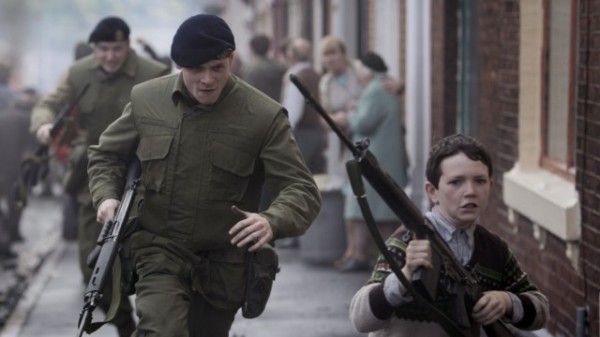
Taking place during the height of civil unrest in the Troubles, ’71 follows a young British army recruit named Gary Hook (Jack O’Connell), who gets deployed into Belfast during his first few weeks of training. Him and his squad is warned of the great dangers in entering the territory. Protestant and Catholic Irishmen are living side-by-side at each other’s throats, each with starkly different ideas of what is better for them. The protestants believe that the United Kingdom is their home and it is their best interests to remain with them. The catholics believe Ireland can be it’s own land and wants to secede from Europe. Hook and his fellow soldiers are just looking to keep the peace.

On the day of deployment, Hook watches as both sides come to a boil. The KGB is entering houses, threatening and beating people with their billy clubs, while an angry crowd of catholics gather outside in retaliation against the military. One of the rioting crowd members throws a rock and knocks a soldier out cold. A kid no older than ten grabs the soldier’s rifle and runs. Hook and another soldier chase after him when the crowd assaults them and beats viciously. Hook watches as the soldier is shot in the face. Hook only narrowly escapes with his life intact.

Trapped in Belfast with no way to find his comrades, Hook must fight through the night to survive against the city that’s hunting him.

Functioning more as a survivalist-thriller than as a pure-blooded war movie, ’71 strikes the viewer with sharp imagery and intelligence alike, filling them with a deepening sense of dread as we watch this young man crumble into desperation as he tries to escape from the people who are seeking to kill him. One of the things I love so much about this movie is how expertly it orchestrates itself and its emotions. French director Yann Demange, who before this directed British television shows such as “Dead Set” and “Top Boy”, debuts here as a talented filmmaker, crafting an exciting thriller that efficiently balances action with context.

I am reminded of another film similar in direction and subject, and that is Ben Affleck’s 2012 film Argo. In both films, the main character evades their pursuer through the chaos of a collapsing political climate. The camera captures the essence of both perspectives, with the pursuer desperately chasing their target while the pursued is equally as desperate trying to get away. And through both highly exciting and pulse-pounding features, both directors have deeper things to say about those societies and what impact they’re leaving on the people around them.

To me, ’71 is the British version of Argo, with one big difference: coherency. In Argo, everything is crystal-clear and straightforward. We know who the characters are, why they are there, what they are doing, who is after them, and how and why they plan to get away. In ’71, all of that is focused in towards one character only, and that is Gary Hook. We know everything we can know about a novice soldier, we just don’t know the same of everyone else around him.

For instance, the leaders of both factions, the catholics and the British Military Reaction force, are both skinny gingers with mustaches as thick as their hair. How can you tell who is who under the dim view of the street light? A young boy helps Hook towards a bar after his initial attack, but he’s on the same side as the people who are hunting him. Why is he helping Hook when he so clearly has so much disregard for British soldiers? In another scene, a Protestant seeks to help Hook when minutes earlier he had the cold, direct eyes of a killer with purpose. What inspired him to switch sides so easily? And then, near the end of the movie, there is a twist that didn’t make much sense to me at all.

Still though, the movie is there, and Demange handles the senses of unease and desperation well with the film, especially when trusting Jack O’Connell to portray all of these emotions at once. O’Connell is really having a strong career packing in for himself. In the past year, for instance, he created a very compelling presence in the prison-drama Starred Up and in the Angelina Jolie-directed biopic Unbroken. He makes a very strong case for choosing acting as a career in all of these films, and in ’71 he clearly shows that he can pull off the role of a young, desperate, and inexperienced soldier who just wants to go home. Demange was wise to cast him in this role and trust him with the emotional complexity of the character: O’Connell was the best part of the film.

I’ll admit, I didn’t understand everything I probably needed to understand in the movie, perhaps the biggest one being more aware of what the Troubles were in the 1970’s. Take that out of it. Take all of the political facets out of the movie, and what do you have? You have a raw, emotionally-charged war thriller that challenges the viewer to see it not from their perspective, but from the soldier’s perspective. Everyone hurts during the times of war. ’71 makes me wonder who war hurts the most.

Tagged , , , , , , , , , , , , , , , , , , , , , , , , , , , , , , , , , ,

“AMERICAN SNIPER” Review (✫✫✫1/2)

And hero, husband, and father.

Chris Kyle was an American sniper. Serving four tours in Iraq, with 160 confirmed kills and approximately 95 more unconfirmed, Kyle earned the title of being called the most lethal sniper in American history. More than being a soldier, though, he’s a father, a husband, and a friend. He was killed in 2013 at age 38. He was shot by a soldier suffering from PTSD that he was trying to help.

We know all these details going into Clint Eastwood’s American Sniper. We already know how it ends, we just don’t know everything leading up to it. Eastwood understands this, and uses it to his advantage as his film not only gives an honorable tribute to one of America’s most committed soldiers, but also foreshadows to a sad fate that we already know is coming. Gee, thanks a lot Clint. I didn’t even bring my tissues.

The film opens on the same startling scene that the book does: with Kyle looking down the scope of his sniper rifle at an Iraqi mother and her child, both of whom were aiming to suicide bomb a battalion of soldiers on the street. Eastwood sets up the tension of the scene perfectly here, with Kyle’s sweaty, darting eyes surveying the scene and desperately trying to see any way out of the tormenting choice he has to make. He soon dreadfully realizes there is no way out: it’s either the mother and her child, or the 15 soldiers and the suffering of their families back at home.

Think about being given that situation, about how devastating the experience must be and how haunting it must be to the person who has to make it. Now imagine having to make that same choice day, after day, after day, with your numbers climbing up until you’ve reached over 250 kills.

That’s the life of a soldier that Kyle has lived.

Kyle is portrayed in the film by Bradley Cooper, and both Cooper and Eastwood do a wonderful job representing Kyle here. They show that before he was a soldier, he was a citizen, an American with strong ideals and opinions and unafraid to show them or fight for them. Before he was shipped out and went on tour, they showed how normal Kyle was.

They showed that before he was a soldier, he was a man.

After having to make those difficult decisions day after day, how do you think that affects a man? In interviews, the real-life Kyle has said that he would not take back a single shot because every one that he took was to defend his brothers in uniform. I believe him when he says that, but I don’t believe that it didn’t leave an impact on him. Some soldiers suffer PTSD from killing just one man. How do you think more than 200 may have impacted Kyle?

Both Eastwood and Cooper do a great job humanizing Kyle here, and show that he’s more than the record kills he’s garnered. They show that Kyle is a man of coarse humor and blunt honesty, a man with a thick Texan accent and ideals, a man who tries to show that he’s strong and dependable, but who deep down is hurting and alone. The film is intimate in the ways that it shows Kyle, both in the chaos of battle and in the quietness of being home.

Cooper especially does a skillful job in portraying the iconic war hero. He expresses trauma and subtlety with the character so masterfully that the only differences I can tell between him and Kyle are minor facial features.

This movie has stirred controversy as of late for being “pro-war,” and for glorifying a man who was essentially labeled a murderer. I’m convinced these same people haven’t seen the same movie I saw, because the movie I watched unabashedly looks at the miseries of war and how the deaths Kyle could and couldn’t prevent affected him. The movie does suffer some slight pacing issues (not to mention the infamous “fake baby” seen in one of the shots), but when Eastwood resurrects a war hero to show the man behind the legacy, how can you look at this movie’s scope and not feel something for all of the physical and moral sacrifices Kyle had to give for his home? When the trumpet plays proudly over the solemnity in the end credits, you know that Eastwood represented a warrior in heart and a human in spirit.

Tagged , , , , , , , , , , , , , , , , , , , , , , , , , , , , ,

“THE LEGO MOVIE” Review (✫✫✫1/2)

Bricks, businessmen, and Batman.

The last thing I expected from anything titled The Lego Movie was anything good. How could I? The trailer had the reeking stench of an advertisement, barely differentiating itself from the Lego set commercials that air on children’s cartoon networks. Believe me, I went into this movie expecting an artificial, brainless experience looking only to profit itself from the name of it’s toy line. Boy, do I love it when I am proved wrong.

Based in a colorful world full of Lego bricks, buildings, and set pieces, The Lego Movie follows Emmett (Chris Pratt), an average, regular, 100% ordinary minifigure who loves coffee, people, Taco Tuesdays, cats, cars, work, television, and just about everything else under the orange Lego-bricked sun. If any of the characters in the film knew that they were in a movie, none of them would expect Emmett to be the main character: he has the personality and the appearance of a background character if anything.

One day, while working at his construction job, Emmett comes into contact with a strange red object called “The Piece of Resistance”, and passes out. When he wakes up, he is recruited by Wyldstyle (Elizabeth Banks), a punky and feisty master builder who tells Emmett that he is part of a prophecy that declares that a powerful being called “The Special” will find the Piece of Resistance and use it to overthrow Lord Business (Will Ferrell) and his plans to conquer the Lego-verse. As a result, Emmett gets catapulted into a decade-long conflict between wizards, robots, businessmen, DC superheroes, crazy cats, cyborg pirates, spacemen, and Batman.

Good God, where do I start with this? The Lego Movie is by every definition, a surprise; a fun and wacky little adventure that is just as original and audacious as it is clever and funny. Written and directed by Phil Lord and Chris Miller, the same guys who co-wrote and co-directed Cloudy With A Chance of Meatballs, these filmmakers worked to instill the same sense of energy, youth, and entertainment from that movie into this one. It’s surprising that the movie is not just good: it’s borderline great.

One of the things I love most about the movie is the animation. Like any great animated film, it reaches out to you in vivid, eye-catching detail, it’s beautiful colors and visuals striking out to you like a panel on a beautifully-crafted graphic novel. But it’s not just how the animation looks in itself: it’s also in how Lord and Miller achieved the effects they were going for. Nearly everything in the film was modeled from lego bricks and pieces, and I do mean everything. The buildings, the vehicles, the space stations: even seemingly trivial things such as the water, lava, and clouds are all made out of lego pieces, with explosions literally showing red-and-orange lego studs as they blow up. It would be so easy just to be cheap and give basic effects for the wind, the water, fire, sky, and everything else in the film, but Miller and Lord didn’t want to go that route. They wanted to make an authentic, accurate world jam-packed with lego pieces and objects. To put anything else in there would just cheapen the effects, and their persistence made for the best visual result that they could possibly have had.

Just as much though, I love the characters Lord and Miller wrote for this movie. Like the animation and lego bricks, they all have variety to them, and they all have colorful, unique personalities that make you want to relate to each character. You have Benny, a 1980’s space astronaut who is so obsessed with spaceships that he could build one from a pile of garbage bricks if you dared him to. You have UniKitty, a unicorn/kitten that has such a split sweet/violent personality that she would scare little children if they were locked in the same room with her. There’s Metal Beard, a pirate-turned-cyborg whose body literally blows up like a amalgam of lego bricks like a real lego mini figure. Also, Batman is in the movie.

The key character here, however, is Emmett, a sweet and charming little mini figure with intentions so pure, he at times can seem like a child with his quirky little antics. Emmett is the epitome of childhood in this movie: innocent, curious, creative, passionate, and at times a little too immature for his own good. His strengths and his flaws both make up for a very interesting character, a mini figure that we can all relate to because of his average nature and his desire to be greater than he already is. He may be made out of Lego pieces, but Emmett is more human than most of the live-action actors you’ve seen in motion pictures this year.

The movie does suffer from a slight drag in run time, and like it’s protagonist, the movie is at times too childish for it’s own good. That doesn’t change the fact that this movie is a clever, funny, original, and heartfelt take on childhood and what it means to be grown up, but always remain young at heart. The Lego Movie is much more than just a movie. It’s a celebration of creativity.

Post-script: Did I forget to mention that Batman is in the movie?

Tagged , , , , , , , , , , , , , , , , , , , , , , , , , , , , , , , , , , , , , , , , , , , , , , , , ,

“THE HOBBIT: THE BATTLE OF THE FIVE ARMIES” Review (✫✫✫)

And the Dwarf King: The Battle for Himself. 

Here it is, at last: the end of Peter Jackson’s Hobbit trilogy. It hasn’t arrived without it’s challenges. Originally, the series was supposed to be directed by Hellboy director Guillermo del Toro before he dropped out and let Peter Jackson hop back in the director’s chair. Then, Jackson decided to turn it from two movies into three because he wanted to “expand the story.” Then in April, he decided to retitle the third film from There and Back Again to The Battle of the Five Armies. Every indication from the production of this film has shown that the movie was going to be either the weakest entry or the most unnecessary film out of the series. Jackson, however, has overcome every obstacle in his path and made a film that is just as exciting, enduring, and memorable as any other film in the series. Jackson’s persistence is something to be admired.

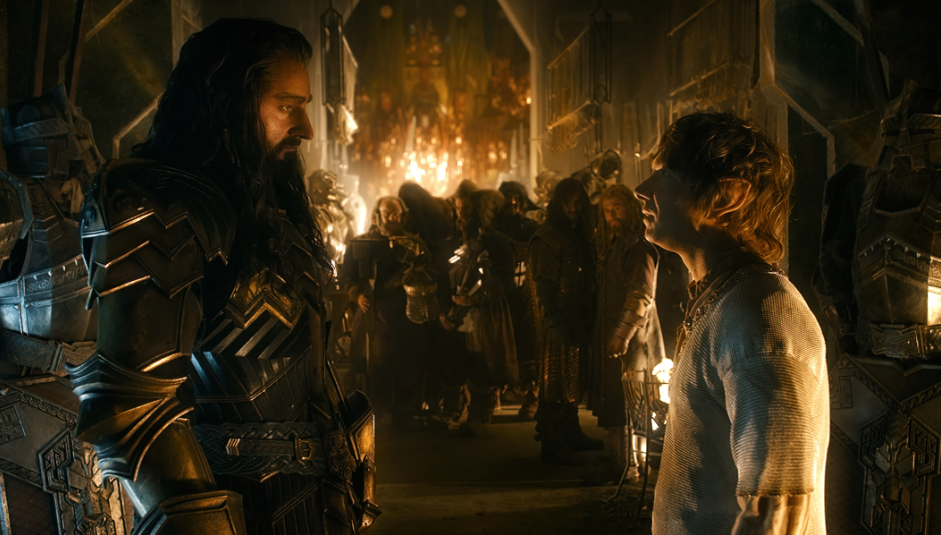
Picking up after that horrible cliffhanger of an ending we got from The Desolation of Smaug, The Battle of the Five Armies opens with Smaug the Dragon (Benedict Cumberbatch) laying waste to the village of Laketown shortly after he was set free by Bilbo Baggins (Martin Freeman) and Thorin Oakenshield (Richard Armitage). After setting the village on fire and killing many of the villagers, Bard the bowman (Luke Evans) escapes from prison, climbs the highest tower he can find, and kills the dragon with the black arrow he inherited from his father.

With Smaug dead, the dwarves have taken possession of the Lonely Mountain. However, something strange is happening to Thorin. He has become more greedy, violent, and eager to find the Arkenstone in the chamber and become the next king of the mountain. Bilbo has noticed his new attitude, and finds it disturbingly similar to that of Smaug’s personality. As tensions grow inside the mountains, things heat up with elven, eagle, orc, and human armies assembling outside of the mountains as well. Now with the four armies gathering to take the mountain from the dwarves, Thorin gathers his own dwarf (and hobbit) army to protect their inheritance and keep it from unworthy hands.

The third movie in any trilogy is always the most crucial. It either makes or breaks the series, making it just as memorable as The Lord of the Rings trilogy, or as half-baked as the Matrix trilogy. Part of me wonders why they even had to make a third movie at all, and why they couldn’t just combine this with The Desolation of Smaug. That was originally the plan, after all, but I guess if they did that, they would run the risk of shoehorning two plots into one film.

Honestly though, I don’t know if it would have been that big of an issue. The Hobbit: The Battle of Five Armies offers exactly what the title suggests: a battle which is bigger and bolder than any other fight in the Lord of the Rings movies. Yes, that includes the final siege on Sauron in Return of the King and the fight against Smaug in Desolation of Smaug. The scale and scope is bigger here than any other Lord of the Rings movie, with elves, dwarves, eagles, orcs, villagers, trolls, wizards, spirits, and a hobbit crashing, slashing, and colliding into each other like nobody’s business. This is the most action-packed Lord of the Rings movie yet, with it’s final lengthy action sequence clocking in at about over an hour.

Some of the action runs rampant and gets repetitive now and then. In one scene, for instance, Legolas the elf fights against an orc on a tumbling castle. The scene ran for well over 20 minutes, with them clashing swords and fists against each other, and I sat there wondering to myself “Why couldn’t he just trip him off and be done with it?”

But here’s the interesting thing: no matter how long the action ran, it kept me engaged. If this were a Michael Bay or a John Woo picture, the action would have ran wild and I would have gotten bored about 10 minutes into it. But Jackson is more talented than most filmmakers. He understands that in order for your audience to be invested in the action, they need to be invested in the characters first, because what’s the point of having characters go through these epic fights if you don’t care about them?

With this movie, I noticed that the character I cared most for was not Bilbo Baggins, but Thorin Oakenshield. He has the most interesting arc out of any other character in the movie, spending one half of the film fighting orcs, and the other half fighting himself. His character in the film reminds me a lot of Gollum: his conflict isn’t so much with others trying to take the things precious to him, but with himself in how the things he values most changes him. He especially serves a crucial part in the film’s final climatic battle scene, which is so nerve-wrecking and heart-pounding that it brought me just as much excitement as the climax in Return of the King did. The impressive part? Return of the King’s climax featured an entire armada of warriors, while The Battle of the Five Armies’ climax only needed two.

All in all, The Battle of the Five Armies did to The Hobbit what The Return of the King did to The Lord of the Rings: it wrapped it up nicely into a tight, satisfying conclusion, bringing excitement, emotion, and resolution to these characters that we’ve cared so much for so long now. Granted, it didn’t do as well as The Return of the King did with this, and I personally would have wished that Jackson would have made it less messy and cluttered than it already was. Does that ultimately matter, though, if I had fun watching it? Let’s just be glad that Bilbo made it there and back again in one piece.

Tagged , , , , , , , , , , , , , , , , , , , , , , , , , , , , , , , , , , , , , , , ,

“THE HOBBIT: THE DESOLATION OF SMAUG” Review (✫✫✫)

Be honest, Mr. Smaug: do you need a breath mint?

The Hobbit: The Desolation of Smaug is both one of the most satisfying and maddening films of the year. It’s visually splendid, illustrating the joys and perils of the world of Middle-Earth as finely as any movie before it did. It’s emotionally versatile, being comical and lighthearted at certain moments and then treacherous and gloomy in others. The performances are sound, with CGI characters being just as memorable as the live ones. Everything in the film was perfect up until it came to it’s end, which ended on a cliffhanger so big that a slackwire artist couldn’t tightrope across it.

Taking place shortly after the events of An Unexpected Journey, The Hobbit: The Desolation of Smaug continues the journey of Gandalf the Grey (Ian McKellan), Thorin Oakenshield (Richard Armitage), his troop of dwarves, and the slight hobbit Bilbo Baggins (Martin Freeman). After narrowly escaping the clutches of the white orc Azog (Manu Bennett), Bilbo and the rest of the dwarves venture on towards the Lonely Mountains, only having a few days left until the secret entrance closes, leaving them forever locked outside of the Lonely Mountains.

Bilbo, however, has greater concerns if the dwarves do manage to get inside. Deep within the twisty lairs of the mountain lies an endless sea of gold and jewels, and asleep among these riches is the vicious Smaug (Benedict Cumberbatch), a violent, terrifying dragon that formerly laid waste to the dwarves’ land and took their possessions all for himself. If the company does manage to get inside the mountains, Smaug will be waiting there for Bilbo, and there will be a massive conflict between the 100-foot tall fire-breathing dragon and the small, terrified hobbit.

One of the things I love about The Lord of the Rings movies is that the stakes are set up really well in them. Peter Jackson, who has been writing/producing/directing/godfathering the series since The Fellowship of the Ring has proven time and time again how well he can make depth-defying set pieces and visual spectacles, all while raising the emotional stakes of the movie.

Here is yet another example of what Peter Jackson can do in a movie. Visually, the film is unparalleled. There were many moments in the film that I recalled for being either visually spectacular or heart-poundingly exciting. One of them was a eerily creepy fight scene where Bilbo and the dwarves were fighting off an army of spiders in a cursed forest. Another was a chase scene where the crew was stuck in a line of barrels while falling down a waterfall. Other instances in the film include when the dwarves encountered a giant who could transform into a bear, or when Gandalf confronted an early confrontation of Sauron in his own castle. And don’t even get me started on when we meet Smaug for the first time. Jackson’s visual prowess excels just as much as his emotional involvement, and with each of his movies, he always seeks how to outdo himself from his last effort. I’d say he’s outdone himself tremendously here: the look of the film shows just that.

The performances are just as refined as the action and visual effects are. Martin Freeman was just as charismatic and loveable as he was the first time he was Bilbo in An Unexpected Journey, and Ian McKellen once again does well as the wise, ambitious, righteously-driven wizard Gandalf. And Richard Armitage has gained traction as Thorin Oakenshield since the first movie, showing that he can be more than the brutish tough guy. He’s a more vulnerable, more fleshed-out character here, with deep desires and hidden intentions showing that perhaps will be explored more in the third installment.

My favorite character by far, however, wasn’t even from a live performance. Benedict Cumberbatch was frightening, fearsome, and daunting as the terrible Smaug, his articulate, vocabulary-filled speech lining up perfectly with his sinister, seething voice. The visual spectacle of Smaug is perfect, with the dragon leaning luminously over his small, feeble enemies, while his long, slender, scaly arms and body lunge across the dungeon like an elongated spider. But the vocal performance is what makes him convincing, what makes him more than just a CGI creation and a terrifying villain in his own right. The minute I heard Smaug speaking to a shaking Bilbo, I had shivers run down my spine. The entire time he was speaking to Bilbo in mysterious anecdotes and sinister undertones, I was on the edge of my seat. When he started to attack, I clutched my mouth and stared endlessly at the screen, wondering and hoping for the fate of these characters in Smaug’s way.

In An Unexpected Journey, Bilbo benefits from being a more active protagonist than that of Frodo. Here we have Smaug, a giant, fearsome beast that is more actively sinister and spiteful than the stillness of Sauron from The Lord of the Rings.

Everything in the film is refined to the quality of film that you’d recall from The Lord of the Rings trilogy. My only regret is the copout, cliffhanger of an ending that inspired my theater to erupt into boos and groans. I hate it when movies do this to me. They put in so much effort to make a great film up until the last five minutes, where they pull the rug from under you and say “Sorry, that’s all for now! See you next year!” What was Peter Jackson thinking when he went with this ending? At the end of each Lord of the Rings movie, it ended with some form of closure and assurance that the adventure would continue into the next installment, but you didn’t know how it was going to pan out. It kept us intrigued, and it kept us wondering what would happen next. With this movie, it sets itself up to where we already know how it’s going to end: we just don’t get the payoff along with it.

I quote J.R.R. Tolkien: “Books ought to have good endings.” The same should be said for movies.

Tagged , , , , , , , , , , , , , , , , , , , , , , , , , , , , , , , ,

“THE HOBBIT: AN UNEXPECTED JOURNEY” Review (✫✫✫✫)

A journey J.R.R. Tolkien would want to go on. 

The Hobbit: An Unexpected Journey is the story I first experienced when I saw The Lord Of The Rings: The Fellowship Of The Ring for the first time. Like The Wizard Of Oz or Harry Potter and The Sorcerer’s Stone, it’s a sweeping fantasy about ordinary characters getting thrown into extraordinary circumstances. So if hobbits, dwarves, wizards, and fire-breathing dragons constituted as “ordinary” in this universe, imagine the extraordinary circumstances that they go through.

Serving as a prequel to the J.R.R. fantasy epic The Lord Of The RingsThe Hobbit tells the story of Bilbo Baggins (Martin Freeman), a relaxed and easygoing hobbit who doesn’t like to do much throughout the day except for eat, sleep, and smoke his pipe every now and then. One day, he gets a visit from a mysterious stranger named Gandalf (Ian McKellen), an elderly wizard who is looking for shelter and a young companion to go on an adventure with. Much against Bilbo’s wishes, Gandalf not only stays in his small village home: he invites an entire company of dwarves, who proceed to wreck Bilbo’s house and eat everything in his fridge.

After having a nervous breakdown and cleaning up his entire house, Bilbo overhears Gandalf and the small dwarf brigade’s plans. Ages ago, the dwarves‘ prized possession, the Lonely Mountain, was overtaken by a vicious fire-breathing dragon named Smaug, who destroyed their village and stole the castle and all of it’s gold for his own desires.

After being betrayed by their allies, the elves, and being left to fight for their land all by themselves, the dwarves are determined to travel back to the mountain and fight for their home. Bilbo must make a decision of continuing to live on his normal, uneventful life, or to reach out, travel with the dwarves, and seek out adventure the likes of which he’s never experienced before.

Remembering that it was only a few years ago when I originally fell in love with The Lord of the Rings: The Fellowship of the RingThe Hobbit: An Unexpected Journey is a prequel that hits on all of the right notes, and then some more that I wasn’t expecting. In comparison to it’s elder companion, The Hobbit is uncanny. It has a wide verse of characters, each one being unique and memorable both in appearance and personality. It has a dynamic and involving story, ripe with exposition and emotion, retaining your full attention despite the lengthy run time. And it has highly stylized set pieces and visual spectacles that excite the eyes and overwhelm the mind. Do not mistaken Peter Jackson’s intentions here: he was inspired by Lord of the Rings when he was making The Hobbit.

And yet, there are so many differences from The Hobbit to The Lord of the Rings. One of the biggest, I think, would be it’s protagonist. Bilbo is different from Frodo, his nephew in Lord of the Rings whom Elijah Wood inhabited so wonderfully. They’re similar, of course, in that they are small hobbits not necessarily fit for fighting, but are clever, creative, and courageous nonetheless.

And yet, Bilbo is so much more than Frodo is. He’s funnier, for one thing, a bumbling, clumsy little hobbit that reminds me so much of the antics between Pippin and Merry in the original movies. He’s also more outgoing, a more active protagonist doing more in the film than just holding a ring and trekking long miles. He does so much in the film, sneaking around trolls, fighting Orcs, going through traps and mazes, and having a first-hand involvement in many of the film’s biggest fights. My particular favorite scene is one where he is talking to a fan favorite from The Lord of the Rings about the possession of a mysterious gold, rounded object. Hint: His favorite word is “precious.”

My point in saying all of this is that Bilbo is a dynamic character in his own right, and Martin Freeman handles the character very well. In the previous movie trilogy, Freeman had four hobbit inspirations to pull from, and instead of following just one of them, he took characteristics from all of them and made a character all his own. That took great talent and risk, and Freeman’s efforts paid off, making a character that I think is the most memorable and charismatic hobbit out of all of them.

Without a doubt, the best film in the series is Return of the King. This film is perhaps the second best. Sure, at times it might suffer from a slight overdose on exposition, but doesn’t all of the films? The Hobbit: An Unexpected Journey is an adventurous, ambitious gamble of a film, and it makes me believe once again in the power that a wizard, a slew of dwarves, and a brave little hobbit can have.

Tagged , , , , , , , , , , , , , , , , , , , , , , , , , , , , , ,

“INTERSTELLAR” Review (✫✫✫1/2)

A space odyssey led by Christopher Nolan. 

The first time I watched Christopher Nolan’s Interstellar, I knew I had found something special, but didn’t know if I fully comprehended everything I saw. I just finished watching it a second time, and now I understand I’m not supposed to comprehend everything I saw. Interstellar is mesmerizing and breathtaking, a highly ambitious and exhilarating journey taking you through the far reaches of time, space, planets, wormholes, black holes, stars, and anything else in space that you can think of. But just like space, it is also vast and daring, reaching for a vision that it cannot possibly hope to grasp. That’s okay. It’s better to aim for too much rather than too little.

Based off of an idea conceived by theoretical physicist Kip Thorne, Interstellar takes place in the distant future, where the Earth is slowly dying and the only source of sustainable food is by growing corn. Cooper (Matthew McConaughey), is an aerospace engineer-turned-farmer just trying to make it day to day with his small family, consisting of his father-in-law Donald (John Lithgow), his son Tom (Timothée Chalamet), and his daughter Murphy (Mackenzie Foy). Like the great astronauts Neil Armstrong and Buzz Aldrin, Cooper dared greater things in his younger years. He wanted to fly. He wanted to explore. He wanted to traverse and discover new spaces that he hasn’t seen before. Now he’s only concerned about making sure his family survives.

One day, him and Murph discover a secret space station that has been hiding NASA, which has been operating in secret since the world state of health has declined over the years. When Cooper finds out that the Earth will soon be unable to sustain life and that his daughter’s generation will be the Earth’s last, Cooper is recruited on a daring space mission to find a new planet that is able to sustain and save the human race.

Written and directed by Christopher Nolan, Interstellar is a testament to the quality of film that Nolan is consistent in making. It has all of the elements that you appreciate in all of his films. It has a grounded, human story intertwined in a brilliantly woven, thought-provoking plot. It has well-rounded, relatable characters that you root for and admire deeply. It has incredibly breathtaking visuals, created with the same visual and cinematic sense of style that is unique only to Nolan’s movies. And it has plot twists the size of Mount Everest, taking complete 180 turnarounds when you least expect it. You will not see the end of this movie coming.

Interstellar is up to par with many of Nolan’s other works, including The Prestige, Inception and The Dark Knight. If I’d continue on about those qualities, however, I’d be writing the same review for those films. It’s easy to write about the things you’ve already seen: I’d like to write about how this film is different from Nolan’s past work.

For one thing, the performances are the best they’ve ever been in any of Nolan’s films, and the heart of this film’s emotion comes from that of Matthew McConaughey. I love how his character is represented in this film, and I especially love how McConaughey handles him. He isn’t handled as a bold science-fiction action hero similar to the likes of Han Solo from Star Wars or James Kirk from Star Trek. He’s more human than hero, a vulnerable and quietly suffering man who just wants to go home to his daughter, but knows he has a greater duty in fighting for the Earth’s survival. I’ve always appreciated the humanity Nolan has always instilled in his characters, but somehow McConaughey reaches an emotional depth much deeper than that of his predecessors. I like seeing McConaughey jumping from such polar opposite roles as this from Dallas Buyers Club, yet giving the same dedication and credibility to both characters. He has proven himself to be an extremely versatile actor, whether it be for small, independent films like Dallas Buyers Club, or big Hollywood productions such as Interstellar.

I am also led to believe that this is the most scientifically accurate out of any of Nolan’s other films. Working closely with Kip Thorne on how accurate the film would be, Nolan worked hard to realize both his vision and Thorne’s, abiding by Thorne’s recommendations and notations as closely as possible. His representation of a wormhole in space. His portrayal of relativity to time and space. Thorne has gone on record to say that there is one major scene demonstrating high artistic freedom, and that is when Cooper visits a planet that has “ice clouds”. This film is intensely interesting and fascinating, and the coolest part to me is knowing that most of this was reviewed by a well-known physicist who has deemed it all possible.

Side note: please excuse me for using the word “coolest.”

There are a few weaknesses to mention. As a Nolan film, it is expected to be extremely complicated, and I admit to needing to see the film multiple times to even begin to understand it. I know many others will have a harder time at understanding it than I did. There were a few slow lulls in the film that detracted from its steady pace, and there were severe sound mixing issues at the beginning of the film that I noticed almost immediately. I’m no sound expert, but when the music is so loud that I can’t even hear what a character is saying, I think you need to fix something before you release the film.

I think it was the third act that really sold me on this film, the last half of the story that compelled me to believe that this was a very memorable journey, and it was. I won’t go into the particulars for the sake of spoilers, but I will say that Nolan is a master at orchestrating thrilling and tense-heavy climaxes. Sure, I would like that to persist throughout the rest of the movie, but I won’t complain. I appreciate Nolan’s ambition, if I appreciate nothing else.

Tagged , , , , , , , , , , , , , , , , , , , , , , , , , , , , ,

“THE FAULT IN OUR STARS” Review (✫✫✫✫)

And the stars have never shone brighter.

The Fault In Our Stars is one of the most magical films you will ever see. It is also one of the most tragic, heartbreaking, funny, genuine, and real films you will ever see. It does exactly what the book does, and exactly what movies are supposed to do: it sweeps you away, transporting you, making you forget about your own reality and immerses you into the reality of these fictional characters that don’t seem so fictional. While I was watching the movie, someone in the audience leaned over to me and asked if this was a true story. “No, but it deserves to be,” I thought to myself.

Based off of the highly popular book of the same name by John Green, The Fault In Our Stars follows the story of Hazel Grace Lancaster (Shailene Woodley), a spirited, spunky, and sarcastic teenager who loves to read books, watch horrible reality TV shows, and question everything her parents tell her to do. Augustus Waters (Ansel Elgort) is another spirited, spunky, and sarcastic teenager who loves to watch movies, play video games, and ponder the many questions about the universe. Hazel and Gus are both like any regular teenager but with one significant difference: they’re cancer survivors.

Note that I said survivors. They’ve had cancer in the past, Hazel in her lungs and Gus in his right leg, but both have since moved on from their ordeals to try and tackle their lives as any other teenager would. Because of Hazel’s lungs, she has to carry around a respiratory machine (Oxygen tank instead? Machine sounds intensive) with her everywhere she goes, and what would seem like a simple task to anyone else (I.e. standing up, or walking a flight of stairs), nearly exhausts Hazel after doing so. Gus, on the other hand, has a prosthetic replacing his right leg in exchange for being cancer free.

One day, they both meet each other at a cancer support group meeting. Hazel notices Gus having a bounce to his step, despite only having one full leg. Gus notices Hazel’s beautiful face even though she’s deoxygenated. As they continue to meet and see each other, they soon realize that they have a special relationship with each other, one that no “normal” human being could ever possess.

From a first glance, some people may look at this movie and see it as an overly optimistic tween romance, where two characters fall in love, and their love beats all things, including their ailments. I know I did when I first heard about it, and why wouldn’t I? Romantic dramedies have a way of underemphasizing conflicts just so characters can have happy endings. As a result, we get movies that are more cheesy and insincere than they are genuine and heartfelt, much like those ungodly Nicholas Sparks movies.

But The Fault In Our Stars is different. It is not manipulative of it’s emotions and it doesn’t downplay the severity of character’s problems. It’s honest and up front about the challenges these teenagers face, and doesn’t shy away from the severity of it just because they’re children. In fact, Hazel Grace herself dispels the notion at the beginning of the film, saying to her listeners “That wouldn’t be the truth. This is the truth. Sorry.”

I know, I’m late on writing this review. Why am I writing this in October, when the movie has already come out on DVD? I was waiting, dear reader. Waiting to read the book and see not only how faithful the movie was to it’s source material, but also to it’s emotions. I’ve said it before, and I’ll say it again: you can bend the plot of the original story, but you cannot bend the emotions and still remain faithful.

Now I have read the book, and I can tell you firsthand from my experience that the movie held up to the book on both counts. The Fault In Our Stars is a breathtaking experience: touching, deliberate, and beautiful all at once. To say it’s faithful to the book is an understatement. It’s quite possibly one of the best book-to-movie adaptations I’ve ever seen.

The things that work so well in the movie are the same things that work so well in the book: the writing and the characters. At the heart of the entire story, movie and book included, is Hazel Grace, who is such a fascinating and singular character that it makes me sad to think that she doesn’t exist. Hazel isn’t like other cancer-ridden characters. She neither has an overly defeatist attitude of her ailment, or an overly optimistic perspective one either. She’s in the neutral realm, seeing her sickness as a part of her no matter what she does, and choosing to accept it because she’s more or less forced to.

And yet, she’s so much more than her sickness. In many ways, she’s just like any other regular teenager. She has a favorite book. A favorite author. A favorite show. A favorite food. A crush. And like any other teenager her age, she’s bursting with opinions, hopes, fears, and desires, all of which combine to make a completely fascinating, involving and passionate character. We quickly learn to love Hazel not because she has cancer, but because she is unique.

On that note, let me talk about Augustus. Can I just say that I love this kid? Gus is filled with spirit and enthusiasm, having a bounce to his step that contrasts with Hazel’s shy trotting. I find it interesting that even though I don’t like it when characters are unrealistically happy, here Gus is almost nothing but happy. He thinks it’s cool that he has a metal prosthetic leg, seeing it as him being half-cyborg. He likes video games, zombies, and heroism, seeing himself as one of the brave movie heroes who sacrifices himself for the sake of the people he loves. In many ways, that’s who he is: the hero of the movie, bringing all of the love and affection he could for the woman he loves. He’s so great in the film, he could have a movie all to himself if he wanted to.

You’ll notice that I’ve referred to both of these persons by their characters, not by the actors that portray them. That’s because Woodley and Elgort slip so wonderfully into their roles that they’ve completely disappeared into them. I didn’t think about The Descendants when I saw Woodley tear up and cry, or when she picked up her BiPAP and exhausted herself walking up the stairs. I didn’t think of Divergent when Elgort so tenderly cared to her needs, or sweetly telling her that he would be honored to have his heart broken by her. I saw these actors and was so immersed into their performances that I no longer thought about what they were and thought more about who they were. These two are not Shailene Woodley and Ansel Elgort. They are Hazel Grace Lancaster and Augustus Waters.

Everything else in this movie was made to near perfection. The screenplay by Scott Neustadter and Michael Weber adapted the story and emotions wonderfully from the book. The camera work by Ben Richardson was elegant and harmonic, much like the great work he did with 2012’s Beasts of the Southern Wild. And director Josh Boone guides the actors through the blissfully tragic story created by John Green, whose wondrous words were what made this entire movie possible.

That ends the review with one question: which is better? The book, or the movie? Neither. I could argue that the book is better because it has more content, or I could argue the movie is better because it brought the story to life visually. Both arguments are pointless. They are both two different mediums, but they both tell the same wonderful story.

Tagged , , , , , , , , , , , , , , , , , , , , , , , , ,

“SIN CITY: A DAME TO KILL FOR” Review (✫)

Can you kill me too while you’re so busy at it? Thanks. 

There’s a character early on in Sin City: A Dame To Kill For that describes the city as a place “where you go in with your eyes open, or you don’t come out at all.” He’s wrong. I went in and out with my eyes fully open. I only wished that I kept them closed.

Oh, where to begin with this. Sin City: A Dame To Kill For is, in a word, messy – a neo-noir thriller as confusing as a detective’s murder case and more violent, putrid and horrific than a crime scene. The only brains this movie has are the ones that it blows out of peoples’ heads.

The plot takes place sometime within the Sin City universe. The question is when? I honestly don’t know, and I don’t think the movie knows either. It’s part prequel, part sequel and part in-betweenuel that cuts to wherever and whenever it wants to.

Like the first movie, there are three main stories the plot revolves around and, likewise, three main characters to sympathize with. You have a young Dwight McCarthy (Josh Brolin), who, before he met Jackie Boy, was obsessing over a rich housewife named Ava (Eva Green). There’s Johnny (Joseph Gordon-Levitt), an overly-cocky poker player who wants to come to Sin City and beat the king of all cards himself — Senator Roark (Powers Boothe). And then there’s Nancy (Jessica Alba), who is still coping with John Hartigan’s (Bruce Willis) suicide at the end of Sin City.

Following this easy enough? Good, because that’s all the explanation you’re going to get. The biggest problem with Sin City: A Dame To Kill For is that it’s so convoluted. Stories are meshed, mixed and thrown together without any sense of connection or correlation to its plot, and the entire time while I was watching it, I kept wondering where these stories were taking place and why I should care. Some movies do well with intertwining narratives, such as Pulp Fiction or Crash. This is not one of them.

A good example of this is in the very first scene of the film. Marv (Mickey Rourke), the hard-headed thug who was framed for the murder of Goldie in the first movie, wakes up next to two crashed cars with no memory of how he got there. He goes through mundane dialogue for five minutes in his obviously exaggerated thuggish accent, then the movie cuts to the story and almost completely forgets about him.

My first thought after watching this: why was that scene necessary? As the movie continued its runtime, I continued to ask this question in my head until I realized that none of it was necessary, that it was just a continuous farce of violence and delinquency that the kids who play Grand Theft Auto would just drool over.

This movie is definitely violent. That’s to be expected, I know, especially when you remember how violent the first one was. There is, however, a stark difference in how the violence is used in each movie. In the first Sin City, the violence was both shocking and satirical, at times being so disturbing that you can’t help but reel back from it, and at other times being so exaggerated that I laughed at it. Whether it was positive or negative, however, I at least felt something.

Here, nothing is felt. Here, we just look at all shades of black, red and white among severed body parts while we plod through the final act like it’s a homework assignment rather than the climactic ending that it deserves to be.

I’ll admit to having disliked the first Sin City. Does that matter? I give credit and criticism equally where it is due, and even though both Sin City’s are equally violent and despicable, the first one was at least more intriguing and had more cohesiveness both as a whole story and as smaller, separate narratives. This one fell flat, crumbled to pieces and was about as clear as a muddy window pane. Maybe that’s why Marv couldn’t remember anything at the beginning of this movie – he realized what he signed up for, and he tried to forget all about it.

Tagged , , , , , , , , , , , , , , , , , , , , , , , , , , , , , , ,

“SIN CITY” Review (✫✫)

“There ain’t no sunshine when she’s gone.”

You’re either going to love or hate Sin City. There’s no getting around that fact. Like the movies directed by Quentin Tarantino or Eli Roth, Sin City is a movie specific to its own tastes, and doesn’t care much about the opinions opposite of it. It’s a violent, gross, disgusting and putrid film full of the stuff that would make a Catholic priest faint. If that sounds like something you would like, by all means, be my guest and have at it. If you are repulsed by my description of the film, I certainly don’t blame you.

Based off of the comic book series by Frank Miller, Sin City is a film that follows four separate stories that (mostly) intertwine together. John Hartigan (Bruce Willis) is an aged police officer who is viciously pursuing child rapist Roark Jr. (Nick Stahl). Marv (Mickey Rourke) is a rough-around-the-edges thug who is framed for the murder of a prostitute he slept with named Goldie (Jamie King). And Dwight (Clive Owen) is a private investigator who gets pulled into a turf war, risking the lives of cops and prostitutes alike.

What do all of these stories have in common? They all started because of a woman, and these men go out to kill because they love their woman. Or, at least, whatever constitutes as love in this universe, in which case it’s a one-night stand.

It’s so difficult to review a movie like Sin City. Why? Because it’s not for people like me, that’s why. I don’t like watching movies like Sin City. I don’t like watching blood and violence for the sake of blood and violence, or watching sex and nudity for the sake of sex and nudity. It’s hard to be non-biased with movies like these because I watch moments where a naked woman walks out with bare breasts and all, and I can’t help but imagine the director thinking “Hey, let’s have this actress naked in this scene, because boobs.”

Sin City is aggressively, unnecessarily violent. How violent? So violent that the least bloody scene in the movie came from Quentin Tarantino. That’s how bad it gets. Red, white, black and yellow blood splatter across the screen like Jackson Pollock was making a painting. Severed heads and body parts are frequently cut off and thrown around in the film like missing pieces to a G.I. Joe. Those body parts include testicles, by the way, on multiple occasions. And don’t even get me started on the absurdity of its kills. In one scene, Marv gets beaten, stabbed, shot, and crashed his car into a lake and still gets up to pursue Goldie’s killer. Good God, are these guys made of kevlar or something?

Remind you, I have no problem with violence in movies, but here it’s just far too absurd and disgusting to be able to fully stomach. When it’s used to illustrate an emotion or a point in movies like Pulp Fiction or Taxi Driver, I praise its purpose and its usage. Here, it illustrates no emotion or urgency. It’s a glorified selling point for a really long, disgusting, stupid movie.

I did like the visualization of Sin City. That, and its opening scene. I liked it’s black-and-white style, it’s sense of contrast and expert use of shadow and lighting. It gave it a strong reminiscent feeling of the classic neo-noir films that inspired the original Sin City comic books, the ones that have the snazzy saxophone playing in the background as two lovers stand on a balcony, telling each other that they love each other and that they never want to leave each other. The film itself, in fact, functions as a parody of the neo-noir genre: characters stand on balconies, docks, outrun police cars, smoke cigarettes and talk in thickly exaggerated accents to the point where it can’t be taken seriously.

Realize, however, that this wasn’t on accident; director Robert Rodriguez wanted you to see how he exaggerated details so you would understand that him and Frank Miller were lightly poking fun at the genre, all while at the same time suggesting delicate homages to it as well. I like that they tried to reach for a deeper effort with the film, even though their intentions were smarter than the film itself was.

So what’s my end consensus? Is it a movie that you should see or skip? I’ll leave that decision in your hands. For now, I have done my job in telling you what the movie is like, and I will wash my hands clean from it. I have church in the morning.

Tagged , , , , , , , , , , , , , , , , , , , , , , , , , , , , , , , ,