Tag Archives: Animation

“THE JUNGLE BOOK (1967)” Review (✫✫1/2)

Talk about bare necessities. 

In a 2012 TED talk titled “The Clues To A Great Story“, Pixar animator Andrew Stanton gave some fast facts about Pixar’s successes while creating Toy Story. The essence of his pitch laid in five tips: No songs, no “I want” moments, no happy village, no love story, and make me care. That last part is perhaps the most pertinent.

Well, in 1966’s Disney movie The Jungle Book, there’s a plethora of songs, one of them titled “I Wanna Be Like You”, a happy village, and a romance that’s rushed at the end of the movie. Oh, and it didn’t make me care about Mowgli, Baloo, Bageera, Kaa, Shere Kahn, or any of other jungle animals in this predictable, by-the-books story. Removing me from the experience was perhaps the movie’s biggest violation.

Oh, I admit there’s a lot going on in The Jungle Book. Based on a collection of short stories of the same name by Rudyard Kipling, The Jungle Book tells the story of Mowgli (Bruce Reitherman), a human orphan who was adopted by the jungle animals and taken care of throughout his youth. One day, the jungle wolves find out that Shere Kahn (George Sanders), a vicious tiger who has a intense hatred of human beings, has returned to the jungle and wants to kill Mowgli. In an effort to protect the boy and save him from Shere Kahn, Mowlgi and his friends Baloo the bear (Phil Harris) and Bageera the black panther (Sebastian Cabot) travel throughout the jungle to return Mowgli to the man village, where he will be reunited with his kind once again.

Back to the TED talk. When Stanton gave his presentation, he gave it knowing the genre’s conventions and with what audiences are used to seeing. Case in point, the singing, the on-the-nose “I want” moments, the happy villages, and the love stories. How many times have we seen each of these? Indeed, how many times have we seen it in most of the Disney movies, dating all the way back to Walt Disney’s first animated feature Snow White and The Seven Dwarfs in 1937?

Disney has used and reused these elements over and over again through the likes of Cinderella, Lady and the Tramp, and Sleeping Beauty, and seeing those elements repeat again in The Jungle Book definitely doesn’t help in its representation. The film’s premise is not the worst in the world. It had good ideas of man versus nature that it could have been explored very well, and might have even stood out in a long line of conventional Disney pictures.

The problem is The Jungle Book is incredibly rushed, and character’s motivations are not explored much deeper beyond their surface value. Mowgli, for instance, wants to remain in the jungle instead of traveling to live in the man village, but we’re never told why. We assume its because the jungle is where his wolf pack family lives, but since they only appear in the first 15 minutes of the film and are never referred to again, that reasoning quickly diminishes. Baloo is a laid back and easygoing bear that wants to raise Mowgli as his cub, which is not only creepy and silly, but also just plain nonsensical. Why does Baloo want to raise Mowgli as his cub after mere minutes of just meeting him? Why does Mowgli trust this big, brutish bear that could eat him in a heartbeat to be his bear dad? Why are they more concerned about relaxing and chilling in the jungle when they both know that a man-eating tiger is after them?

Which brings me to Shere Kahn. He is perhaps the most underdeveloped of any of the characters, which is the most frustrating to me because he has the most potential for development out of any of the other characters. We’re told that he is a tiger that hates human beings. Okay, why is that? Was there some deep, traumatizing experience where mankind crippled him for life? Did he lose his tiger family to a human tribe? Did mankind kill and take his food supply? Why does Shere Kahn hate mankind?

We’re never given a reason. Shere Kahn just hates man, and Mowgli is a man, and that’s supposed to be it. There’s no complexion to their relationship, just typical archetypes that could be written by any screenwriter that has a thought in their brain and a head on their shoulders.

I acknowledge that the movie is fun, that is without exception. The characters, while flat and thinly written, do have interesting and unique personalities, with the most memorable character being an ecstatic orangutan named King Louie (Louis Prima). The musical numbers are the opportunities where character’s personalities shine the most, and their silly, wacky, and fun energy takes over the screen like an Elephant herd stampeding through the jungle. While the movie is definitely too conventional for its own good, I must admit that I had fun with the music and I especially liked seeing the characters sing along to them. It’s the parts in between where the movie slows down to a crawl.

I look at this movie, and I think of how many Walt Disney pictures came before that did so much better at involving its audience than The Jungle Book did. Look at Pinnocchio. Look at FantasiaDumbo. BambiPeter Pan. Look at all the wonder, the excitement, the feeling of adventure that those movies provoked. Look at those characters, their ambitions, and their reasons for having those ambitions. Look at the magic they instill, the sense of creativity and imagination in their journeys. Yes, those characters had songs, wants, happy villages, and love stories in their movies, but they all did one very important thing that The Jungle Book forgot to do: they made me care.

When Baloo sang “Bare Necessities” to Mowgli, I didn’t know the audience was supposed to take it literally. Walt Disney certainly did.

Tagged , , , , , , , , , , , , , , , , , , , , , , , ,

“ZOOTOPIA” Review (✫✫✫)

And don’t forget the Zoopocalypse.

Zootopia is a movie just about as good as a movie titled Zootopia can be. There’s animals, a cute bunny protagonist (although she doesn’t like to be called “cute”), an underdog story for her to go through, and a colorful city, of which the title derives its name from. Kids will love it, adults not as much. But Zootopia has enough uniqueness to distance itself from the rest of the competition, and make itself stand out in a long line of successful Disney movies.

The plot takes place in an alternate reality where animals have evolved from their primitive, savage states into civilized, anthropomorphic beings, allowing predators and prey to coexist peacefully in the same society. Judy Hopps (Ginnifer Goodwin), a young rabbit who’s wanted to be a police officer ever since she was a kid, dreams of going to Zootopia, the heart of this new co-existing world. But as she soon finds out, Zootopia is not the city of paradise and tolerance that she had hoped. She quickly discovers that the big guys overpower the little ones on almost every block and street, and considering she’s just a wee rabbit, she quickly gets slapped onto parking duty in her district.

Enter Nick Wilde (Jason Bateman), a sniveling fox that is so coy in his craft that he could give Gordon Gecko a run for his money. Wilde becomes a witness to a kidnapping that Hopps is suddenly thrown into investigating. As this unlikely duo burrows deeper and deeper into the investigation, they discover a secret that may impact the future of Zootopia forever.

A question I wondered while watching Zootopia: where are all the humans? The animals have been on the Earth long enough to evolve into a more civilized state. Where did they learn to be civilized from? Did the animals overthrow the human race in an epic revolution? Did the humans become extinct as the animals evolved? I thought of all of these possibilities while Hopps stared in awe at Zootopia, which may or may not have been built on top of piles of human corpses. Of course, these are probably thoughts only I would think of, and a mystery I’ll have to be content with being unsolved, just like with what happened to the humans in Cars.

How do you expect Zootopia to play out? Whatever you’re thinking, the answer is yes, it plays out like that. Like every other animal-loving animated movie out there, Zootopia is filled with cute, cuddly creatures and colors that will liven up a child’s day. Are the beats too familiar for those who are experienced moviegoers? Of course they are, but at least we can still have fun with it.

Let’s run through the cast of characters, shall we? The rabbit is excited, energetic, and optimistic? Check. The fox is sly, slick, and wickedly sarcastic? Check. The Cape Buffalo is big, blunt, and a to-the-point, no-nonsense bovine? Check. Most of the animals you think of will fit their stereotypes, with one notable exception: Benjamin Clawhauser (Nate Torrence), an obese cheetah who works as a police dispatcher and has an obvious obsession for donuts. See the irony here? The fastest animal alive, now being the fattest animal alive. There’s a self-awareness to his character that makes him fun to watch and laugh at. Watching him makes you wish there was as much self-awareness in the entire movie as there is with this one character.

Still though, there are elements to appreciate with this movie. There’s a good reason why kids will enjoy it: it’s because the animation is vivid, detailed, and colorful. Not much of a surprise, considering all of the colorful worlds we witness in Disney movies like Tangled, Frozen, and Wreck-It Ralph. But the other thing I like with this movie is the creativity of its premise, in how vast Zootopia itself is and how different cultures of animals interact with each other.

In the movie, there is a big divide between the animals that are natural predators and prey. Watching this conflict draw out reminded me of the Black Lives Matter movement in today’s world, and the sharp disagreements that sprout in between black communities and the police force. You might find it funny how an animated movie can demonstrate a message of equality, but it pulls it off with immediate relevance while not straying away from its family-friendly tones. There was one moment where an animal shouted at a leopard to “Go back to Africa.” The leopard replies in shock “I’m from Zootopia.” I sadly wondered how many Americans have to repeat a similar conversation on a daily basis.

In its whole scope, Zootopia is a fun movie that is even more fun for the kiddies. I enjoyed it, but I wish it could have escaped from some of its conventions, and even further explored some of the deep ideas that it was already exploring. I guess I’m thinking too much like an adult though and not enough like a kid. Adults already have FOX and CNN. The kids can have Zootopia.

Tagged , , , , , , , , , , , , , , , , , , , , , , , ,

“INSIDE OUT” Review (✫✫✫✫)

A lot going on inside Riley’s head.

Pixar movies have a way of transcending fantasy and translating it into a form of reality. Does that make any sense? Of course it does, because you’ve seen many of Pixar’s masterpieces before. Up’s fantasy is about a man building a floating house about balloons, but the reality it’s portraying is an elder man dealing with personal loss and finding happiness in unexpected places. WALL-E’s fantasy is about a clumsy dumpster robot, but its reality is about discovering humanity and protecting our home and history. And Toy Story. Ooff. That’s a fantasy about one boy’s childhood with his toys and how they’ve impacted him into his adulthood. That is also its reality.

Here we have another colorful Pixar masterpiece that uses reality as its springboard for creativity and fantasy, using a human being as a setting, and her emotions as its characters. The human is Riley Anderson (Kaitlyn Dias), an 11-year-old girl who just recently moved from Minnesota to San Francisco. Her emotions are Joy (Amy Poehler), Sadness (Phyllis Smith), Fear (Bill Hader), Disgust (Mindy Kaling), and Anger (Lewis Black), and their memories with her make up the core of Riley’s personality and how she reacts in different situations. After the move-in, Riley gets all shaken up from all of the new adjustments she has to get used to, from being the new kid at school, to moving in to a home smaller than her old one. It’s up to her vibrant and unique emotions to try and keep Riley together and make her new life a happy, sad, fearful, disgusted, and angry one.

Written and directed by Pete Docter, who also helmed Pixar’s Monsters Inc. and Up, Inside Out is a clever, original animated feature that uses the human psyche as its playground. The best thing about the movie is seeing how creative it is in re-creating the human brain for a child’s mind, and seeing children react to all of the colorful adventures going on in this infinite cranial wonderland.

The first thing you notice with the film is its animation: vibrant colors and character models reach out to you in vivid details, even more so without the dimmed effects of 3D. Memories come in the form of small bowling ball spheres, colored after the fashion of each of Riley’s emotions. Different parts of her life are modeled into vast theme-park-like islands, from Family Land all the way to Goofball Island. Each island is also jam-packed with its own sleek features and gadgets that make you feel like you’re in the wonderful landscape of Disney land. Be honest: you would love to ride the literal “Train of thought” if it existed, wouldn’t you?

The film’s creative landscape, though, is to be expected. We’ve seen dozens of vast, colorful settings from many of Pixar’s films before. Andy’s room in Toy Story. Paradise Falls in Up. The AXIOM in WALL-E. You can probably name one setting that struck your eye in each movie, from the world of self-aware automobiles in Cars to the anthill in A Bug’s Life. Pixar has never failed in creativity, and I doubt anyone expects them to start failing now.

What I’m most impressed with is how the film handles its vastly ambitious premise, even with the film’s somewhat purported flaws. For instance, in Riley’s mind, a lot of childish, silly things go on that might make adults go on “offline” mode while the kids laugh at the overt goofiness going on the screen, like double rainbows and processed boyfriend machines. The characters are mostly one-dimensional, and for a film that has five emotions in it, the movie primarily focuses on only two of them: Joy and Sadness.

In any other movie, these quote-unquote “flaws” would make the film a weaker experience for me. It didn’t here. Why? The film’s premise, setting, and execution constitutes a need for each of these elements, making them contributors to the plot instead of distractions degrading from the experience. I would knock the film for being really silly and goofy at times, but it’s taking place in a kid’s mind. What else would be in the ecstatic and excited mind of a child? Doom, gloom, and misery? The characters are mostly one-dimensional and go through little change in the motion picture, but isn’t that kind of expected? I mean, what emotions do you think characters named Joy, Sadness, Fear, Disgust, and Anger are going to feel? Woe, Delight, Calm, Desire, and Peace? That would break their characters, and detract from the personalities and make them who they are. Finally, there’s the greater focus of using Joy and Sadness as the film’s key players instead of the others. There’s a specific reason for doing this. It’s because those are the core emotions any human being is going to experience: positive and negative.

In the film, Joy and Sadness conflict with each other with their contrasting personalities, each one trying to help Riley in the best ways that they can. Joy wants everything to be happy and optimistic, and for Riley to feel the enjoyment out of every situation. Sadness focuses on the reality of each situation and on the raw reactions one may feel from those that are less than happy. While both emotions conflict with each other in the ways they want to help Riley, they are ultimately the most essential for her. They allow her to express her emotions in their purest forms: in either pure Joy, or pure Sadness.

This is the ultimate meaning of the film, in that there are different things that make up each human being. Some has more anger in their bodies than others. Some may be filled with more Fear than others as well. But like the animated, wacky emotions in Riley’s curious little head, we’re all unique to each other and in the ways that we handle life’s problems. It’s how a baby will react differently to a traffic jam in how a taxi driver would. It’s how a fully-grown man will react differently to broccoli-covered pizza than a toddler would. It’s how a young, maturing boy will react differently to meeting a girl for the first time, and visa-versa.

As human beings, we are all made up of different emotions and personalities, but being different doesn’t mean being bad. Sometimes we need to experience the rawness of certain emotions for certain situations, and that’s not a bad thing. Sometimes, we need the help of Joy, Sadness, Fear, Disgust, and Anger to get through life. How we express those emotions is what makes us who we are, and we end up being human beings as unique and diverse as Riley’s wonderful emotions are because of them.

Tagged , , , , , , , , , , , , , , , , , , , , , , , , , , , , , , , , , , , , , , ,

“THE LEGO MOVIE” Review (✫✫✫1/2)

Bricks, businessmen, and Batman.

The last thing I expected from anything titled The Lego Movie was anything good. How could I? The trailer had the reeking stench of an advertisement, barely differentiating itself from the Lego set commercials that air on children’s cartoon networks. Believe me, I went into this movie expecting an artificial, brainless experience looking only to profit itself from the name of it’s toy line. Boy, do I love it when I am proved wrong.

Based in a colorful world full of Lego bricks, buildings, and set pieces, The Lego Movie follows Emmett (Chris Pratt), an average, regular, 100% ordinary minifigure who loves coffee, people, Taco Tuesdays, cats, cars, work, television, and just about everything else under the orange Lego-bricked sun. If any of the characters in the film knew that they were in a movie, none of them would expect Emmett to be the main character: he has the personality and the appearance of a background character if anything.

One day, while working at his construction job, Emmett comes into contact with a strange red object called “The Piece of Resistance”, and passes out. When he wakes up, he is recruited by Wyldstyle (Elizabeth Banks), a punky and feisty master builder who tells Emmett that he is part of a prophecy that declares that a powerful being called “The Special” will find the Piece of Resistance and use it to overthrow Lord Business (Will Ferrell) and his plans to conquer the Lego-verse. As a result, Emmett gets catapulted into a decade-long conflict between wizards, robots, businessmen, DC superheroes, crazy cats, cyborg pirates, spacemen, and Batman.

Good God, where do I start with this? The Lego Movie is by every definition, a surprise; a fun and wacky little adventure that is just as original and audacious as it is clever and funny. Written and directed by Phil Lord and Chris Miller, the same guys who co-wrote and co-directed Cloudy With A Chance of Meatballs, these filmmakers worked to instill the same sense of energy, youth, and entertainment from that movie into this one. It’s surprising that the movie is not just good: it’s borderline great.

One of the things I love most about the movie is the animation. Like any great animated film, it reaches out to you in vivid, eye-catching detail, it’s beautiful colors and visuals striking out to you like a panel on a beautifully-crafted graphic novel. But it’s not just how the animation looks in itself: it’s also in how Lord and Miller achieved the effects they were going for. Nearly everything in the film was modeled from lego bricks and pieces, and I do mean everything. The buildings, the vehicles, the space stations: even seemingly trivial things such as the water, lava, and clouds are all made out of lego pieces, with explosions literally showing red-and-orange lego studs as they blow up. It would be so easy just to be cheap and give basic effects for the wind, the water, fire, sky, and everything else in the film, but Miller and Lord didn’t want to go that route. They wanted to make an authentic, accurate world jam-packed with lego pieces and objects. To put anything else in there would just cheapen the effects, and their persistence made for the best visual result that they could possibly have had.

Just as much though, I love the characters Lord and Miller wrote for this movie. Like the animation and lego bricks, they all have variety to them, and they all have colorful, unique personalities that make you want to relate to each character. You have Benny, a 1980’s space astronaut who is so obsessed with spaceships that he could build one from a pile of garbage bricks if you dared him to. You have UniKitty, a unicorn/kitten that has such a split sweet/violent personality that she would scare little children if they were locked in the same room with her. There’s Metal Beard, a pirate-turned-cyborg whose body literally blows up like a amalgam of lego bricks like a real lego mini figure. Also, Batman is in the movie.

The key character here, however, is Emmett, a sweet and charming little mini figure with intentions so pure, he at times can seem like a child with his quirky little antics. Emmett is the epitome of childhood in this movie: innocent, curious, creative, passionate, and at times a little too immature for his own good. His strengths and his flaws both make up for a very interesting character, a mini figure that we can all relate to because of his average nature and his desire to be greater than he already is. He may be made out of Lego pieces, but Emmett is more human than most of the live-action actors you’ve seen in motion pictures this year.

The movie does suffer from a slight drag in run time, and like it’s protagonist, the movie is at times too childish for it’s own good. That doesn’t change the fact that this movie is a clever, funny, original, and heartfelt take on childhood and what it means to be grown up, but always remain young at heart. The Lego Movie is much more than just a movie. It’s a celebration of creativity.

Post-script: Did I forget to mention that Batman is in the movie?

Tagged , , , , , , , , , , , , , , , , , , , , , , , , , , , , , , , , , , , , , , , , , , , , , , , , ,

“BIG HERO 6” Review (✫✫✫)

“Initiating fist bump.” 

You know there’s going to be some kid out there watching Big Hero 6 thinking “Wow! I want to build a tech super suit too!” Unfortunately, to be able to create something in the likes of Iron Man, you need to have a lot of brains, and that’s something I don’t really have. Intellectual, daring, or different? No, but Big Hero 6 is sure a heckuva lot of fun.

Based loosely off of the Marvel Comics creation of the same name, Big Hero 6 follows a 14 year old braniac named Hiro (Ryan Potter), who has the technical skills that would rival at the levels of Tony Stark’s ego. His brother Tadashi (Daniel Henney) is a science wiz at a slightly lesser level than Hiro, but still brilliant enough to create Baymax (Scott Adsit), a giant, fluffy medical robot who introduces himself and asks you to rate your pain every time he boots up. In many ways, Tadashi inspires Hiro in everything he does, even convincing him to apply to the technology program at Tadashi’s university.

One day, however, the worst happens: a laboratory fire breaks out at the school, and Tadashi is killed in the midst of trying to rescue one of his professors. Grieved and hurt by his loss, Hiro becomes a recluse and tries to avoid his friends. Only by booting Baymax back up does Hiro learn that the fire was not an accident, and that someone had killed Tadashi in the midst of the chaos. Hiro bunkers down, suits up, and arms Baymax with any technology he can give him to go after this mysterious enemy and avenge his brother.

Man, does that synopsis sound like a Marvel property or what? The biggest worries with animated films like Big Hero 6  is that the filmmakers are going to cash in on their franchise’s name rather than actually work to tell a moving, involving story with the great characters they are already given. Isn’t that where movies like Rise of the Guardians and Shrek 3 fell flat? Animators nowadays aren’t concerned with such tedious things to them as interesting characters or a compelling story: they’re mostly concerned with just making sure things are looking bright and beautiful for the little kiddies rushing to the theaters to give them their weekly allowance.

Big Hero 6, luckily, will not waste any of your money, kiddos. One of the best things about this film is that it is a story first, and a franchise second. Hiro is a likeable and enthusiastic little hero, a young man who has some of that rebellious nature that all teenagers like to have going through puberty, but are still intent on doing the right thing regardless.

Even more than Hiro, however, I love Baymax. How is it that such a cute, wonderful, and buoyant robotic character can even exist? It’s rare to experience a character as literal, one-minded, and oblivious as Baymax and have him be so darn fun. There were scenes in the movie where Baymax literally had to scan and observe Hiro on how to do a fist bump, or where he mistakened a cat as a “hairy baby”. There are many times where characters take things so literally to the point where it is annoying, but I was never annoyed by Baymax’s antics. He’s so innocent, loveable and well-intentioned that I just want to hug his big fluffy body when he asks “On a scale of one to ten, how would you rate your pain?

There are a few gripes to be had, of course, and they’re the same as they are with most animated films. The story is mostly predictable. The twists revealed aren’t really that shocking because they’ve been done in every other animated film before. The other characters don’t lend much to the story besides Hiro and Baymax, and are mostly just there so that the team can have six members. And especially, absolutely, does the film have to end in an overly long and exaggerated fight sequence. Why does every movie involving superheroes always feel that they have to do this?

Regardless, Big Hero 6 is both fun and fast-moving, with Hiro and Baymax’s humorous conversations to keep our attention until the next big fight scene. The fantasies of the superhero genre dares us to dream bigger and aim higher. Big Hero 6 is a wonderful fantasy to experience.

Note: Of course there’s needs to be an after-credits scene with a very popular cameo appearance. Guess who it is.

Tagged , , , , , , , , , , , , , , , , , , ,

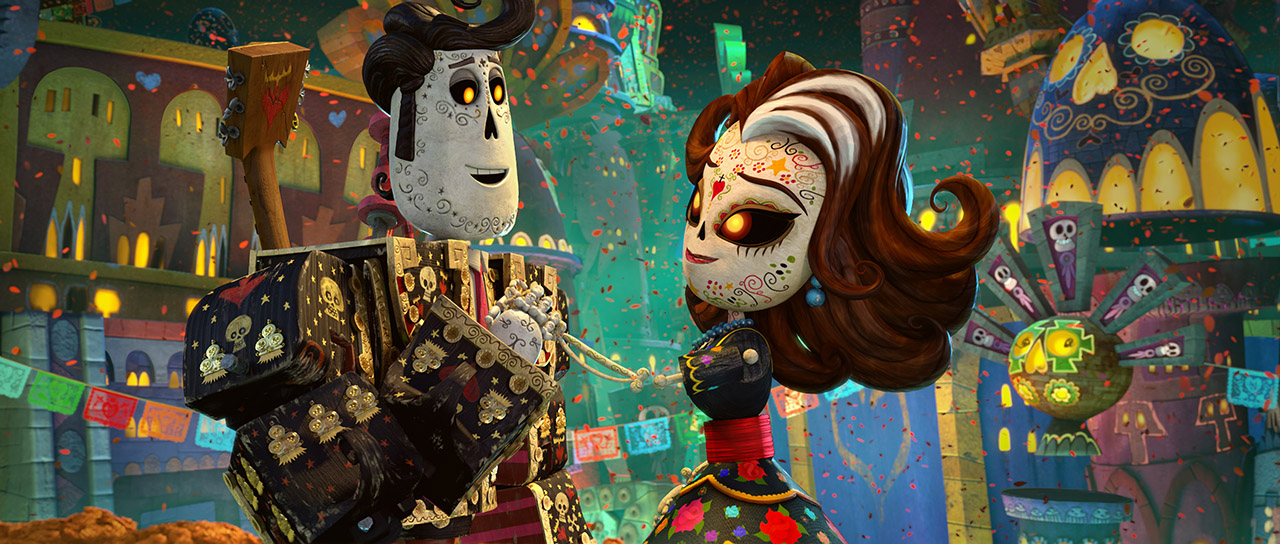
“THE BOOK OF LIFE” Review (✫✫✫)

book of life

Ay caramba, tu joven amantes.

As children, we were told many fairy tales that filled our young minds with wonder and imagination. We looked at the pictures in our tiny children’s books as our parents narrated the words to us, but did we ever stop to think about where these fairy tales came from? The Three Little Pigs came from England. The Little Red Riding Hood, London. The Fountain of Youth, Japan. The Little Mermaid, Denmark. The Sorcerer’s Apprentice, Germany. So many stories have come from so many places all around the world that by the time they reach us, we have “cleansed” it of it’s culture and Americanized it for our own comfort.

Here, we have Jorge Gutierrez’s own fairy tale called The Book Of Life, and for the sake of the movie I’m glad it didn’t succumb to mainstream appeal by having it take place in Colonial America. The Book Of Life is splendid, a wonderful, uplifting, joyous, and immensely entertaining animation engulfed and inspired by the culture Gutierrez came from. Think about how quickly you are swept away when you read the fairy tales by the Brothers Grimm, and you can imagine how this film sweeps you up in that exact same way.

Told as a story within a story similar to Rob Reiner’s The Princess Bride, The Book Of Life follows a group of schoolchildren through a museum as they are told the tale of Manolo (Diego Luna), a Mexican bull fighter who is fighting for the heart of his childhood friend Maria (Zoe Saldana). His closest friend and rival, Joaquin (Channing Tatum) is also fighting for her love, and when they finally see each other after many years apart, they begin their pursuit for Maria’s love.

Unbeknownst to any of them, however, a heavy secret hides behind their innocent intentions. The spirits of the afterlife La Muerte (Kate del Castillo), who rules the world of the remembered, and Xibalba (Ron Perlman), the one who rules the world of the forgotten, have placed a bet on these three friends. If Manolo ends up marrying Maria, La Muerte wins and gets to rule both the land of the remembered and the forgotten. If Joaquin marries Maria, Xibalba wins and he gets to rule the land of the remembered. The world of the undead is at stake here, and it’s up to Manolo, Maria, and Joaquin to set things right.

What do I say about an animated children’s film that’s based around Mexican fables and customs? The Book Of Life is a wonderful animation: bright, vibrant, colorful, and lively all at once. Writer/director/animator Jorge Gutierrez has a careful eye for detail, and does well in visually adapting to different scenes, settings, and moods.

In one scene, after one of the supporting characters die, the setting suddenly becomes dark. The sun drops. The candles burn out. A cloudy fog envelops in the sky as rain drops pellet onto the ground. In the very next scene, however, we see the world of the remembered from this deceased person’s perspective, and it is lively colors light up with shiny, gold-brick pathways illuminating everywhere and with Churros and balloons floating as far as the eye can see.

This is what I mean when I say the animation is versatile: it’s attentive, eye-catching, and delightful, demanding your attention the minute you lay your eyes on it. But it’s not just the animation that works so well with this movie. The Book of Life is entrenched and inspired in its own culture, living and breathing the Mexican customs though every frame of its run time.  There is one work that Gutierrez did this with before The Book Of Life, and that is the Annie award-winning Nickelodeon cartoon series “El Tigre: The Adventures of Manny Rivera.” Now we have The Book of Life, and I feel it will spur on many Mexican children and families to pick up their heritage and be proud to represent it. In a day and age where Hollywood feels they need to Americanize everything, The Book of Life is a Godsend.

Everything else in this film functions exactly as it is supposed to. The story is mostly formula in that there has to be a good guy, a bad guy, a forbidden love, a big fight scene at the end, and a happy ending. The voice cast is solid, and Channing Tatum didn’t annoy the living daylights out of me for a change. And the music by Gustavo Santaolallo is pristine and authentic, with the plucking of the Mexican guitar strings filling your ears with wonderfully harmonic sound.

But make no mistake. The best thing about this film is the inspiration Gutierrez instills in it, the inspiration that his parents most likely instilled in him when he was still just a little boy. I hope there will be a children’s novelization of this film in the future and that it too will inspire children of all ages, regardless of their heritage.

Tagged , , , , , , , , , , , , , , , , , , , , , , , , , , , , , , , ,

“THE FAULT IN OUR STARS” Review (✫✫✫✫)

And the stars have never shone brighter.

The Fault In Our Stars is one of the most magical films you will ever see. It is also one of the most tragic, heartbreaking, funny, genuine, and real films you will ever see. It does exactly what the book does, and exactly what movies are supposed to do: it sweeps you away, transporting you, making you forget about your own reality and immerses you into the reality of these fictional characters that don’t seem so fictional. While I was watching the movie, someone in the audience leaned over to me and asked if this was a true story. “No, but it deserves to be,” I thought to myself.

Based off of the highly popular book of the same name by John Green, The Fault In Our Stars follows the story of Hazel Grace Lancaster (Shailene Woodley), a spirited, spunky, and sarcastic teenager who loves to read books, watch horrible reality TV shows, and question everything her parents tell her to do. Augustus Waters (Ansel Elgort) is another spirited, spunky, and sarcastic teenager who loves to watch movies, play video games, and ponder the many questions about the universe. Hazel and Gus are both like any regular teenager but with one significant difference: they’re cancer survivors.

Note that I said survivors. They’ve had cancer in the past, Hazel in her lungs and Gus in his right leg, but both have since moved on from their ordeals to try and tackle their lives as any other teenager would. Because of Hazel’s lungs, she has to carry around a respiratory machine (Oxygen tank instead? Machine sounds intensive) with her everywhere she goes, and what would seem like a simple task to anyone else (I.e. standing up, or walking a flight of stairs), nearly exhausts Hazel after doing so. Gus, on the other hand, has a prosthetic replacing his right leg in exchange for being cancer free.

One day, they both meet each other at a cancer support group meeting. Hazel notices Gus having a bounce to his step, despite only having one full leg. Gus notices Hazel’s beautiful face even though she’s deoxygenated. As they continue to meet and see each other, they soon realize that they have a special relationship with each other, one that no “normal” human being could ever possess.

From a first glance, some people may look at this movie and see it as an overly optimistic tween romance, where two characters fall in love, and their love beats all things, including their ailments. I know I did when I first heard about it, and why wouldn’t I? Romantic dramedies have a way of underemphasizing conflicts just so characters can have happy endings. As a result, we get movies that are more cheesy and insincere than they are genuine and heartfelt, much like those ungodly Nicholas Sparks movies.

But The Fault In Our Stars is different. It is not manipulative of it’s emotions and it doesn’t downplay the severity of character’s problems. It’s honest and up front about the challenges these teenagers face, and doesn’t shy away from the severity of it just because they’re children. In fact, Hazel Grace herself dispels the notion at the beginning of the film, saying to her listeners “That wouldn’t be the truth. This is the truth. Sorry.”

I know, I’m late on writing this review. Why am I writing this in October, when the movie has already come out on DVD? I was waiting, dear reader. Waiting to read the book and see not only how faithful the movie was to it’s source material, but also to it’s emotions. I’ve said it before, and I’ll say it again: you can bend the plot of the original story, but you cannot bend the emotions and still remain faithful.

Now I have read the book, and I can tell you firsthand from my experience that the movie held up to the book on both counts. The Fault In Our Stars is a breathtaking experience: touching, deliberate, and beautiful all at once. To say it’s faithful to the book is an understatement. It’s quite possibly one of the best book-to-movie adaptations I’ve ever seen.

The things that work so well in the movie are the same things that work so well in the book: the writing and the characters. At the heart of the entire story, movie and book included, is Hazel Grace, who is such a fascinating and singular character that it makes me sad to think that she doesn’t exist. Hazel isn’t like other cancer-ridden characters. She neither has an overly defeatist attitude of her ailment, or an overly optimistic perspective one either. She’s in the neutral realm, seeing her sickness as a part of her no matter what she does, and choosing to accept it because she’s more or less forced to.

And yet, she’s so much more than her sickness. In many ways, she’s just like any other regular teenager. She has a favorite book. A favorite author. A favorite show. A favorite food. A crush. And like any other teenager her age, she’s bursting with opinions, hopes, fears, and desires, all of which combine to make a completely fascinating, involving and passionate character. We quickly learn to love Hazel not because she has cancer, but because she is unique.

On that note, let me talk about Augustus. Can I just say that I love this kid? Gus is filled with spirit and enthusiasm, having a bounce to his step that contrasts with Hazel’s shy trotting. I find it interesting that even though I don’t like it when characters are unrealistically happy, here Gus is almost nothing but happy. He thinks it’s cool that he has a metal prosthetic leg, seeing it as him being half-cyborg. He likes video games, zombies, and heroism, seeing himself as one of the brave movie heroes who sacrifices himself for the sake of the people he loves. In many ways, that’s who he is: the hero of the movie, bringing all of the love and affection he could for the woman he loves. He’s so great in the film, he could have a movie all to himself if he wanted to.

You’ll notice that I’ve referred to both of these persons by their characters, not by the actors that portray them. That’s because Woodley and Elgort slip so wonderfully into their roles that they’ve completely disappeared into them. I didn’t think about The Descendants when I saw Woodley tear up and cry, or when she picked up her BiPAP and exhausted herself walking up the stairs. I didn’t think of Divergent when Elgort so tenderly cared to her needs, or sweetly telling her that he would be honored to have his heart broken by her. I saw these actors and was so immersed into their performances that I no longer thought about what they were and thought more about who they were. These two are not Shailene Woodley and Ansel Elgort. They are Hazel Grace Lancaster and Augustus Waters.

Everything else in this movie was made to near perfection. The screenplay by Scott Neustadter and Michael Weber adapted the story and emotions wonderfully from the book. The camera work by Ben Richardson was elegant and harmonic, much like the great work he did with 2012’s Beasts of the Southern Wild. And director Josh Boone guides the actors through the blissfully tragic story created by John Green, whose wondrous words were what made this entire movie possible.

That ends the review with one question: which is better? The book, or the movie? Neither. I could argue that the book is better because it has more content, or I could argue the movie is better because it brought the story to life visually. Both arguments are pointless. They are both two different mediums, but they both tell the same wonderful story.

Tagged , , , , , , , , , , , , , , , , , , , , , , , , ,

“HOW TO TRAIN YOUR DRAGON” Review (✫✫✫✫)

Step one: Don’t get eaten by a nightfury.

How To Train Your Dragon is a pure joy, a complete and captivating wonder that reaches the inner child in you, touches it, and fills you with such inexplicable excitement and adventure that you almost feel like you can do anything. I was initially worried about this movie going in to it: how many other movies have attempted the human-pet budding romance E.T. did so wonderfully all those magical years ago, and failed? Well, there’s nothing to fear here, fellow reader. In their long line of successes, failures and mismatches, How To Train Your Dragon easily ranks among DreamWorks’ best work.

We open up on a grand battle on the land of Berk, an island where the vikings are as stubborn and hard-headed as the metal helmets they wear on their heads. But this battle isn’t against other vikings, mind you: it’s against dragons, giant, dangerous beasts that tear through the sky and spit fire like its flu season for them. For the vikings, killing a dragon is like the starting point for becoming a man. It’s their form of puberty I suppose, next to the endless gorges of food and testosterone that they throw and shout about at each other.

One Berk citizen, however, is a little more hopeless than other vikings: Hiccup (Jay Baruchel), a smart, inventive but helplessly clumsy little fellow that will reach for a pencil when he’s supposed to reach for an axe. Fate turned an eye to him when in the midst of the battle, he captured a “nightfury”, a sleek black dragon whose fast speed and blue fire makes him the most deadly dragon out in the field of battle. However, against his better judgement, Hiccup decides not to kill the nightfury after discovering that he was injured during the battle. Now, while slowly helping him back to health and back to being able to fly, Hiccup discovers the truth about the dragon race, and how similar he is to them and their personalities.

Taking a look at the past animated movies DreamWorks has helped produce, you realize how much of a mixed bag they put out there to their audience. Look at the best they’ve had to offer, such as Shrek and Kung Fu Panda. Now look at the worst they’ve had to offer, such as Shark Tale and Shrek The Third. And don’t even get me started on Bee Movie. Looking at their filmoraphy, and looking at how much they’ve done wrong mixed with their right, I was expecting a very artificial, forgettable experience.

Boy, was I wrong, and boy was I glad to be wrong. The very first detail you notice in How To Train Your Dragon is it’s animation, how crisp and refined it is in detail, and how authentic it makes everything look. In the opening sequence, for instance, we shift through the dark clouds and sea as we approach the land of Berk, and it was so atmospheric that I felt like I myself was flying over the ocean surface when I first saw it. Later in the film, you look at vikings talking to each other in the dining hall, and the rock floors and the wood detailing look so real that you can almost reach out and touch it.

But I know what you’re really after. You’re not after what the waves, clouds and wood looks like. Nuh uh. You’re interested in how the dragons look, how exhilarating the fight scenes are and how exciting it is when you see a dragon spread his wings for the first time.

Let me assure you, fellow reader: the action could not be any more exciting. The dragons are all colorful, lifelike and filled with variety, their wings spread out in glorious, anthropomorphic detail. When they fly, they soar at supersonic speeds, dodging mountains, flipping through the air, and skydiving towards valleys like they are swimming in an endless sea of clouds and sky.

I especially liked the chemistry Hiccup shares with the nighfury, who he later names Toothless in the movie. Did I really just say that? That I liked the chemistry between two fictional, fake, animated characters? Yes I did, because these characters are neither fake nor artificial: they’re genuine, sharing real, heartfelt emotions with each other in ways almost no other animated film captures in movies. When Hiccup touches Toothless’ snout for the first time, you feel conflicted emotions between each other as they struggle to trust one another. When Toothless saves Hiccup from certain death from the dangers of the skies, you feel their relationship growing as they form a closer bond with each other. But when an all-out war spawns in between the vikings and the dragons, it’s Hiccup and Toothless that remain strong through it all, their friendship so compelling that it almost feels like connecting with a long-lost brother, not too disimilar to how Boo and Sully interact in Monsters Inc. 

My only regret with this movie is that it won’t be the best animated film of the year. With Toy Story 3 releasing just around the corner, and considering Pixar’s track record, it’s doubtful to see How To Train Your Dragon trump years of animated fandom and cherishment, especially when we’ve had years to grow with these characters. Shame, because this movie has great, fluid animation, an involving story, and memorable characters just like Toy Story does. If Toy Story 3 wasn’t coming out in June, I am positive that How To Train Your Dragon would win the best animated feature award at the Oscars.

Tagged , , , , , , , , , , , , , , , , , , , , , , , , , , , , , , , , , , , , ,

OSCAR REACTIONS 2013

Well, that was anti-climactic.

For those of you who live under a rock and don’t know who I’m talking about when I mention the word “oscar”, the 86th Academy Awards took place yesterday on ABC, hosted by comedian Ellen Degeneres. Needless to say, Degeneres was brilliant, taking selfies, buying pizza, crashing twitter, bringing the stage down for Jennifer Lawrence, and calling Liza Minelli a man all in one night. And yet, despite all of her efforts, the oscars seemed so… boring.

How did this happen? The nominees, dear reader. Out of the 24 categories in the ceremony I got twenty right, beating most of my Shorthorn peers and family members for the potluck we held that night. The most I’ve gotten previously was sixteen. I’m inclined to believe that the academy made the winners of these awards too obvious by building up too much hype of them during the buzz of the past few months.  Case in point: was there any argument that Frozen was going to take home best animated feature?

It doesn’t matter now, anyway. It happened, and I got 20 right out of 24 categories. Yes!!! Just because I predicted them correctly, however, doesn’t mean I need to be happy for their win. Let’s go through each of the categories and see whether or not they really deserved it or not…

BEST PICTURE (CORRECT!) The best picture of the year rightfully won best picture at the Academy Awards: Steve McQueen’s phenomenal, gripping, heart-wrenching, spellbinding and immensely powerful 12 Years A Slave won best picture. While I’m ecstatic for its win and could not agree more with the Academy’s consensus, I find it very strange that it won the Academy’s highest honor despite it only winning two other awards. But we’ll talk more about that later.

BEST DIRECTOR (CORRECT!) Also correctly predicted is Alfonso Cuaron for his nerve-wracking and tensely-directed sci-fi thriller Gravity. I already mentioned this in my predictions, but the best director award needs to be reserved for the best picture of the year. I loved Gravity with every fiber of my being, but it simply does not match the cinematic caliber to that of McQueen’s 12 Years A Slave. It would be like comparing The Dark Knight to that of Slumdog MillionaireThe Fugitive to that of Schindler’s List, or Jaws to that of One Flew Over The Cuckoos Nest. They are all ingenious, brilliant and incredibly memorable pictures, but the best picture of the year is awarded that because of the direction and treatment that it was given.

That’s not intended as an insult towards Cuaron, and I definitely believe he deserves it based on the physics and tension of the movie alone. If I’m thinking about which movie had the bigger impact, however, it’s no contest on which one it deserves to go to: McQueen for 12 Years A Slave. Nevertheless, I congratulate Cuaron on his many accomplishments regarding Gravity. Lord knows my heart stopped at least a few times while watching that picture.

BEST ACTOR (CORRECT!) Matthew McConaughey took home the award for best actor as a rowdy texas cowboy dying of AIDS in Dallas Buyers Club. While the award could have gone to either him or Chiwetel Ejiofor for 12 Years A Slave, there’s no denying the power, the energy, and the raw gravitas that he brought to a man’s desperate journey to survive. Plus, I love his acceptance speech and how he dedicated the award to God and to “himself in ten years”. That’s a wise goal that any man should strive for.

BEST ACTRESS (CORRECT!) Cate Blanchett won best actress for Woody Allen’s Blue Jasmine. While I have regretfully not seen the movie yet, I will say that the few scenes I have seen her in impressed me very much, and that she did a solid job portraying a deeply bothered woman who is in deep depression and alcohol addiction. Congratulations to her. I look forward to watching the film, as well as Blanchett’s performance in it.

BEST SUPPORTING ACTOR (CORRECT!) Did Michael Fassbender win best supporting actor like I wanted him to? No, he did not. Instead, Jared Leto took home the award portraying the transgender AIDS victim Rayon in Dallas Buyers Club

The more I think about it, the more ridiculous I think it is that the best picture winner of the year did not get recognized in so many categories. Why the snubbing from Fassbender? Half of the movie’s turmoil and conflict came from this despicable character, a man so inhumane and abominable that Calvin Candy from Django Unchained would have broke down in tears after seeing what this man forced people through. Fassbender was pivotal, aggressive, violent, and hateful as Edwin Epps, and incurred more emotions from audiences than that of a transgender AIDS patient in Dallas Buyers Club. I know 30 Seconds To Mars fans will hate me for saying this, but the more vital role needs to go to the more vital performance. I said it once, I’ll say it again: Leto is not as deserving in the award as Fassbender is.

Again, no disrespect, and I acknowledge that Leto gave a great performance in the picture. But like Cuaron with best direction, the more compelling presence needs to go to the more compelling artist. Sorry, Rayon.

BEST SUPPORTING ACTRESS (CORRECT!) Lupita Nyongo won (and deserved) the academy award for best supporting actress for her heartbreaking role as a desperate and depraved cotton picking slave in 12 Years A Slave. No qualms here.

BEST ORIGINAL SCREENPLAY (CORRECT!) I also correctly predicted that Spike Jonze would win the best original screenplay award for his sci-fi romance story Her. Comparing Her to the genius of David O’Russell’s American Hustle, I mentioned in my original predictions list that “just because its a smarter story doesn’t necessarily mean that it is a better one.” I do not retract my statement.

BEST ADAPTED SCREENPLAY (CORRECT!) John Ridley won best adapted screenplay for his incredibly well-documented 12 Years A Slave. He equally deserved it, as Solomon Northrup’s story, or legacy, could not have translated any better to the screen if the filmmakers tried. Great job, Ridley. You gave us an unforgettable and incredible story, the likes of which no one has seen since Steven Spielberg’s Schindler’s List. 

And this is the only other award 12 Years won for the night. No cinematography. No editing. No costume or production design. No supporting actor. No other award that would further substantiate and support its win for best picture.

Am I the only one that finds this completely ludicrous? To date, there are only three best picture winners to win only three academy awards. Those movies are The Godfather, Crash and Argo, and two of them didn’t even win in major categories. Seriously, what is going on? Why are we being so insubstantial towards movies that have been deemed the best of the year? Do academy voters not realize that by naming this the BEST PICTURE OF THE YEAR that they’re saying that its better than everything else? And according to this ceremony, not only are they saying that it is the equivalent of Dallas Buyers Club (they both won three academy awards), but that Gravity is superior to it with seven wins and no awarding of best picture.

Seriously. Make up your mind. I’m fine with you saying one picture is better than another, but substantiate that by what awards you give it. I seriously doubt that 12 Years is best picture because of its screenplay and its supporting actress alone. Likewise, I doubt that Gravity isn’t the best picture of the year because it has the best direction, camerawork, editing, sound mixing, and visual effects out of any other picture.

That’s all I ask, folks. Not preference. Fairness.

BEST FOREIGN LANGUAGE FILM (CORRECT!) The Great Beauty won for best foreign-language film. That’s the one that everyone saw, right? It obviously deserved to win.

BEST DOCUMENTARY FILM (INCORRECT!) I incorrectly predicted that Act Of Killing would win the award, but no, 20 Feet From Stardom took the award home, with featured artists on the film including music legends Mick Jagger, Bruce Springsteen and Stevie Wonder. I haven’t seen the film, so I have no place on commenting on it, but it seems odd that the Academy would reward a movie about background singers over that of a tragic confrontation of death and social issues. I’ve yet to see either of them though, so like I said, my opinion is invalid in this category.

BEST ANIMATED FILM (CORRECT!) Disney won best animated feature for Frozen. While I didn’t care much for it, I know it made a wide impact on its audience and that it will go on to be fondly remembered by many animated movie lovers for years to come. So congratulations for its win, even though I’m no fan of the cold weather this time around.

BEST ORIGINAL SONG (CORRECT!) Frozen won best original song for its memorable song “Let It Go”. It certainly didn’t win for Idina Menzel’s performance, that’s for sure. What the heck happened with her? Her pitch was all over the place, her control was wonky, and her whiny voice was the contrast of the powerful, beautifully controlled voice she exhibited in the movie itself. Seriously. What happened?

One song I’ve really been getting into recently (and I think you’ll agree with me) is Pharell Williams’ “Happy”. The performance proved why. Not only was it energetic, upbeat, and undeniably catchy, but Williams gave a great performance, he exhibited great control and showed very few differences from the studio version of his song. Menzel’s performance, in comparison, was completely and utterly horrendous.

But hey, I guess that’s why the award is called “best original song” and not “best performance”. Otherwise, I think we both what the turnout would be.

BEST ORIGINAL SCORE (CORRECT!) Steve Price took home the award for best original score with Gravity. He completely deserved it. Not only did it match the tension, edginess and unease of the movie, but it also gave a dignified sense of hope and accomplishment after a long journey of heart-pounding danger and peril. Listening to the soundtrack alone gave you the feeling of identity and survival, and Price was definitely the most deserving out of any nominee. Congrats to him for his win.

In the meantime, I’m still wondering where is Hans Zimmer’s nomination for Rush. Remind me again why this movie wasn’t nominated for anything?

BEST CINEMATOGRAPHY (CORRECT!) In 2011, Emanuel Lubewski was mercilessly snubbed for his masterful, Stanley Kubrick-esque camerawork in The Tree Of Life. If he didn’t win it this year, I was literally planning on flipping out.

Luckily, he did.

BEST FILM EDITING (CORRECT!) Another category that I felt 12 Years was superior to Gravity, yet it still lost to it. Must I keep beating a dead horse? Gravity was a more visually stellar and energetic picture. 12 Years was the more engaging and involved one. Part of that was because of how the film was put together in a traditionalist style that was reminiscent of Dylan Tichenor’s work from movies including There Will Be Blood and Brokeback Mountain, where he focused most of the runtime on the film’s subjects rather than worrying about flashy cuts or transitions. Film editing is one of the most important part of storytelling, and what have I been saying is the best story of the year? 12 Years A Slave.

I’m not going to drag this out though. Gravity was a great picture, and editors Alfonso Cuaron and Mark Sanger definitely reached outside the box to accomplish things visually no other film did this year. It did a good job. Moving on.

BEST PRODUCTION DESIGN (CORRECT!) The Great Gatsby won for best production design. Considering the sets were the most colorful and visually appealing out of the year, that isn’t very surprising.

BEST COSTUME DESIGN (INCORRECT!) Unfortunately, I predicted this category wrong, thinking that 12 Years was going to get this one. The only reason I went with that instead of winner The Great Gatsby was because I knew Catherine Martin was already going to win for best production design, and any more than that would have been greedy. I forgot that “spreading the wealth” isn’t a phrase the academy is most well known for.

BEST MAKEUP (CORRECT!) Thankfully, Dallas Buyers Club won for best makeup and hairstyling. As long as Jackass: Bad Grandpa didn’t walk home with the award, I’m satisfied.

BEST SOUND EDITING (CORRECT!) Gravity won.

BEST SOUND MIXING (CORRECT!) Gravity won. Again.

BEST VISUAL EFFECTS (CORRECT!) If you even thought this award was going to anything other than Gravity, you’re either insane, or blind.

And at last, the long-dreaded short film categories.

BEST LIVE-ACTION SHORT FILM (CORRECT!) Surprisingly, I got this category correct with predicting Helium. I haven’t seen the film though, so it was only by sheer luck that I got this right.

BEST ANIMATED SHORT FILM (INCORRECT!) Mr. Hublot took home this award. That’s surprising, considering how clever and fun Get A Horse! was, but nevermind. I haven’t seen the movie, so I can’t comment on it.

BEST DOCUMENTARY SHORT (INCORRECT!) The Lady In Number 6: Music Saved My Life. Again, just like any other films in these categories, I haven’t seen it, so how would you expect me to get it right? You might as well blindfold me and ask me to just write on the flipping ballot.

Overall, this has been a fun ceremony, and I’m grateful to Ellen Degeneres for making it a happy-go-lucky and loveably quirky time. Just please, make the ceremony less predictable next time, okay? I’d rather not have a film come in and just know that its going to dominate in all of the categories. You would have been better calling it “The First Annual Gravity Awards”.

-David Dunn

Tagged , , , , , , , , , , , , , , , , , , , , , , , , , , , , , ,

“FROZEN” Review (✫✫1/2)

The Snow Queen: The Musical

Good news first: Frozen will please its core audience. It’s a cute, cuddly little fairy tale movie with a lot of music and a lot of misplaced optimism. Kids will enjoy it, and there’s a solid chance that the parents might enjoy it too. The bad news: It’s the same Disney Princess movie you’ve seen for the past 50 times now.

Based loosely on the Danish fairy tale “The Snow Queen”, Frozen follows the story of two princess sisters, Anna (Kirsten Bell) and Elsa (Idina Menzel). Being enclosed in a castle all of her life, Anna is a cheery, energetic, happy and overly-optimistic princess who would marry a man after getting to know him for just one day.

Elsa, however, does not have the luxury of being optimistic. Cursed with the ability to create snow and ice at a young age, Elsa has soon realized that she cannot control her powers and decides to escape before she does her kingdom, and her sister, any harm. Now determined to find her sister and mend the relationships that were shattered long ago, Anna sets out with a ice picker named Kristoff (Johnathon Groff), his reindeer Sven and an animate snowman named Olaf (Josh Gad) to find Elsa and save the kingdom.

Written by Jennifer Lee (Wreck-It Ralph) and co-directed by Chris Buck (Tarzan), Frozen is by definition, a family movie. It’s driven by a childish energy, a lively and undiminished spirit that fills children with joy through its wonderful music and its bright, colorful animation.

The characters are enthusiastic (at times, annoyingly so), with the most likable character being a midget snowman called Olaf. Olaf is just funny. He’s the kind of oblivious, clumsy snowman that bumbles around like a lego stick figure, losing his body parts every five minutes, stumbling to get them all back together, and put it on straight before the snow monster eats him. “Go! I’ll distract him!” his head said in one scene as everyone ran away, including his body. “No! Wait! Not you! I was talking to them!”

He also has a ironic fascination to the sun, fire and heat, not realizing what effect they have on snow.

All in all, Frozen is a fun movie. But if you’ve seen Tangled, then you’ve already seen Frozen before. The two movies are so similar, so mirrored in appearance, character, story and animation that the only real difference in between both is that Frozen takes place in a winter wonderland.

See, the problem doesn’t exist in the movie itself: the problem exists in what earlier Disney movies did first and better. Tangled is not the only movie where we’ve seen this story about self-discovery and relationship building. Look at virtually any other Diseny Princess movie on their filmography, including Brave, Mulan, Pocahantus, Princess and the Frog, etc etc. No, none of those movies deals with the theme of sisterhood, but does it need to? Those movies are still so similar in personalities, humor and musical numbers that the story becomes a copy-and-paste convenience rather than an original pleasure.

However, understand that this is not a critical observation of the movie, but rather a neutral one. I stress this point again: this movie will please its core audience, which is little children, the parents of those children and the hardcore Disney lovers. By all means, if you want to see the movie, go ahead and see it. Chances are you’ll enjoy it more than this Scrooge going “Bah humbug” in the corner of the newsroom.

Tagged , , , , , , , , , , , , , , , , , , , , , , , ,