“MAN OF STEEL” Review (✫✫✫✫)

Look!  Up in the sky!  Its a bird!  It’s a plane!  It’s the man of steel!

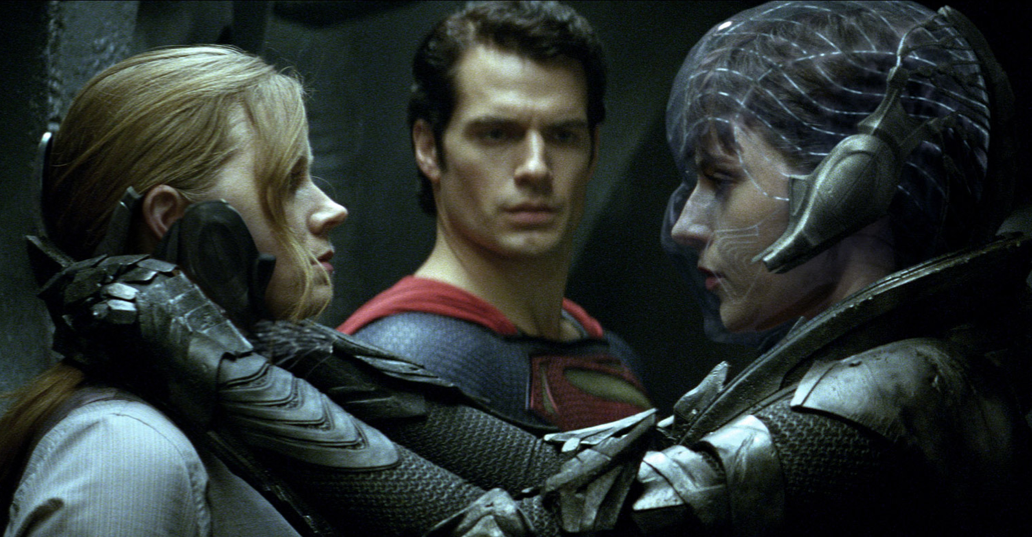
Now this is what I’m talking about.  Man Of Steel is in a special place as a reboot, a carefully calculated yet ambitious and affectionate movie giving a new energy and enthusiasm to a cherished American icon.  The last thing I wanted Man Of Steel to become was a remake of the original Superman movies, or even worse, a PG-13 version of Watchmen.  We have none of that here.  It isn’t coy, formulaic, or insincere: it’s a rare rebooted superhero remake that affectionately, genuinely works.

In case you haven’t picked up on it by now, Man Of Steel is a retelling of the story of Superman.  Clark Kent (Henry Cavill) is a young inhabitant of Smallville, Kansas who deals with a specific problem that other teengers his age doesn’t deal with: he has metahuman powers the likes of which cannot be from planet earth.  And young Clark isn’t from planet Earth either: but he doesn’t know that.  Not yet.

You see, Clark’s real name is Kal-El, and he comes from the planet Krypton, a planet that died due to its own selfishness and greed.  Scientist Jor-el (Russel Crowe), who is the father of Kal-El, knew of Krypton’s future demise, and planned ahead for it.  He embedded the code of Krypton’s DNA within his newborn son, Kal-El, and sent him to a faraway planet where he not be harmed from Krypton’s destruction: Planet Earth.

Unfortunately, his former ally and friend General Zod (Michael Shannon) is hellbent on preserving his species and building a new Krypton on planet Earth.  For this he needs Clark and his DNA to fuel his machine so that they can form a rebirthed Krypton upon the ashes of Earth’s surface.  Clark, fully knowing where he came from and the extent of his abilities, decides to defend the earth from Zod’s evil scheme and to become the symbol of hope for all of mankind to follow.

Fully aware of the dangers that came with a reboot for Superman, one of my initial worries for the film was that there would be too much action and not enough character investment to go with it.  That is the typical danger with superhero movies, after all: filmmakers are typically more interested in the action and visual effects than they are in emotion or in investment for their characters.

That is not what we have here.  Director Zack Snyder (300, Watchmen) and screenwriter David S. Goyer (Dark City, The Dark Knight Trilogy) make here a wonderful marriage of something rare: great scripting with great action, and great directing.  What makes this movie so appealing is not the fact that it is an action movie: we’ve seen hundreds of movies before where action is just stacked on top of action, with no real cause or motivation to be concerned with any of it.

Man Of Steel is not that.  It is a rare thing: a movie in which the action is just as fleshed out as the character’s emotions are.  Whenever Clark isn’t flying, breaking the sound barrier, or punching some guy’s light’s out, the movie interjects a flashback of Clark’s childhood: we get a glimpse to a more personal portrait of Clark as a child and what it was like growing up struggling with these superhuman powers.  Perhaps in another movie it would be all fun and jokey, but here it is taken as seriously as the death of Bruce’s parents from the Batman series.  I was reminded of the last line Peter spoke during his ending monologue of the original Spider-man: “This power is my gift: my curse”.

The action, however, is utterly spectacular.  In the original Superman movies, Clark was resorted to lifting up school buses and stopping nuclear missiles as his highest challenges.  Not here.  Here the stakes are much higher, and we can tell that because of the level of destruction in this movie.  When Superman trades blows with another Kryptonian, destruction is sure to follow.  Crushed cars and overturned trains are a constant during these fight scenes.  Crumbling buildings and falling debris is to be expected.  There was even one terrifying moment where the Kryptonians used a gravity machine to tear apart the Earth’s infrastructure.  Did I mention the crumbling buildings?  Watching this level of destruction made me feel sorry for the mayor of Metropolis.  I’d hate to see the repair bill.

And lastly, I must pay respect to Henry Cavill and Michael Shannon.  Here, they are the perfect embodiment of themselves: good, or evil, human or Kryptonian. They don’t fight in an area of black-and-white: they fight in many shades of gray, because while we don’t want Clark to lose his home on planet Earth, we also understand and sympathize with Zod’s reasonings because he too lost his home.  There’s a very human reason why these men are fighting, and there’s no simplicity in their conflict: only complexion and brutal reality.

Before you ask me, no this does not replace the original “Superman” movies, and no, Cavill is not an adequate replacement for Christopher Reeve himself.  That is besides the point.  Man Of Steel did to the Superman franchise what The Amazing Spider-man did for Spider-man: it breathed a new life and conception to it, ensuring that when its all said and done, the Superman legacy will live on, and it will not die away because the actor of the former icon has passed through time.  Snyder has accomplished quite a feat here: he has paid tribute and honor to Reeve and the filmmakers of the original Superman by offering this exciting, emotional, and action-packed thrill ride that gives a new birth to the flying caped crusader.

PS: Admittedly, I saw this film in IMAX 3-D.  See it in IMAX, but don’t waste your money on the 3-D.  A fantastic movie doesn’t deserve a dim picture anyway.
Tagged , , , , , , , , , , , , , , , , , ,

“WATCHMEN” Review (✫✫)

Bad content, bad timing, and a bad comedian, all five minutes before midnight.   

Watchmen is a misguided and misunderstood film, a movie that will sharply divide the fans for both the original graphic novel and fans of the superhero movie sub genre, period.  On one hand, what we have here is compelling superhero drama.  The characters are fleshed out, their motivations are clearly understood, and we’re rooting for a few of them once we understand that their intentions are pure.  For everyone else, however, we grow to despise their character arc, we become annoyed with their conventions, and some characters are just downright despicable.  And how come some of them aren’t even wearing pants?  Didn’t they know jeans were invented way back in 1873?

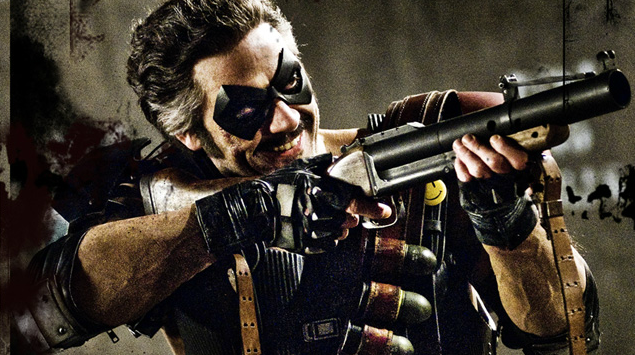
Watchmen is based around the graphic novel of the same name by artist Dave Gibbons and writer Alan Moore (who demanded his name be left completely out of the credits, convinced that a movie adaptation of his novel was impossible).  Both the graphic novel and the film adaptation surrounds a group of retired superheroes called “The Watchmen” who are brought out of retirement when they learn that one of their own has been murdered by being thrown out of his own the window and landing on the concrete pavement, his blood staining the smiley pin on his jacket.

The one who has been murdered is Edward Blake, aka “The Comedian” (Jeffrey Dean Morgan).  The first Watchman to learn of Blake’s murder is a fedora-wearing culprit known as Rorschach (Jackie Eerie Haley), who wears a ink-blot shape-shifting mask which makes his name appropriate.  He develops a theory that someone is gunning for masked heroes, so he sets out to warn his other fellow watchmen: Dan Dreiberg (Patrick Wilson), aka a Batman rip-off called Night Owl, Sally Jupiter (Malin Akerman) aka Silk Spectre, Adrian Veidt (Matthew Goode) aka Ozymandias, to whom his secret identity is known to the world, and John Osterman, aka Doctor Manhattan (Billy Crudrup), who is the only one with super powers, apparently being able to conduct anything his mind can imagine.

Here is a movie that is, at parts, a compelling character study and a fascinating crime drama.  That is because unlike other action movies, Watchmen is based heavily on character and story, not relentless action and CGI.  The film delves deep into the histories and origins of each individual watchman, and while at times the exposition may be drawn out and a bit boring, the rest of the time it is undeniably gripping and attentive.

Cudrup was ghastly and stoic as Doctor Manhattan, a man slowly losing his humanity but doesn’t know what to quite do about it.  Malin Akerman had a sort of spunk and wit to her as Laurie Jupiter, and in one emotionally stirring moment we experience all of her dread and desperation through her cries of anguish and defeat.  I especially liked Jackie Earle Haley as the cold, calculated, and unforgiving vigilante known as Rorschach.  I think he is the most fascinating character out of the bunch.  He has a rashness, a raspy, hurt, and pained voice behind his every narration, and we can tell that this is man who has had a pained past.  I would have hoped that the movie would delve deeper into his past than it did, but that’s besides the point.  Haley is so intimidating in his performance, the alternate title for this movie could have been called Watchmen: The Journal of Rorschach.

There are parts of this movie that are undeniably surreal and fascinating.  For the rest of the movie, however, the emotion and the mythology becomes redundant, and we lose interest because of its slow pacing and its drawn-out monologue.  This surprises me, because the director is Zack Snyder, and he is the same man who made the the visually and emotionally appealing 300 prior to this.  How is it that he goes from the provocative, epic, and entertaining veins of 300 to something as drawn-out and overly-philosophical as this?

Part of this, I think, has to be his dependency on the original comic.  One of his tactics when filming 300 was using the original graphic novel as both the storyboard and script for the production.  He has been reported to have used that same tactic here for Watchmen, with a few minor edits of the script by screenwriters David Hayater and Alex Tse.  How could this tactic work for 300 and yet backfire on him for Watchmen?  Simple: the answer lies with the page length.  300 had a total of 88 pages, while Watchmen had a total of 416.  Surely, Zack Snyder must’ve thought at some point he’d lose his audience with the overuse of exposition?

Whether he thought about it or not, he went through with it anyways: what we have here is a note-for-note, page-by-page adaptation that copies its story as simple as a copy-and-paste edit on Microsoft word.  For that, he loses points for unoriginality and innovation.

I feel like I’m watching two different movies here: two halves of one whole.  One half of the movie is dark and mesmerizing, is well acted, emotional and motivated, and sports plenty of visually beauitful scenes at the helm of the film’s director, Zack Snyder.

The other half of this movie is filled with content so bleak, graphic, and unnecessary that I’m shocked Zack Snyder didn’t turn it into a porno.  Maybe he did and we don’t even know it: Doctor Manhattan is naked through more than half of the film (and yes, we see every angle of his shining blue huevos), there’s an overly-prolonged sex scene between Night Owl and Silk Spectre, and you could have cut half of the Comedian’s scenes in the movie and make him more appealing to the audience.  Seriously: someone explain to me how having a guy rape a woman and then shoot another he impregnated supposed to make him a sympathetic figure?

Someone in theory could make an opposing argument by saying “But David!  That was in the comic book!”  Yes, but should that have been in the comic book, let alone in the movie?  I’ll answer that for you: No.  It shouldn’t have.  If it doesn’t advance story or define character, then what was the point for having it in there in the first place?  If the superhero genre is a big, beaming smiley face, Watchmen is the blood stain covering the eyelid: distracting, unsettling, and unnecessary.

Tagged , , , , , , , , , , , , , , , , , ,

“STAR TREK” (2009) Review (✫✫✫✫)

To go where no Trekkie has gone before.  

When I first heard about J.J. Abrams rebooting the Star Trek series with another movie outing, my immediate reaction was rolling my eyes.  “Not ANOTHER Star Trek movie!” I remember thinking.  Indeed, wasn’t that everybody’s reaction?  Star Trek lived and had its time, and it seemed like the only people who would enjoy this new release were the Trekkies that were faithful to the series since episode one.

Nothing, however, would have prepared me for how immersive and fantastic this new movie is.  It’s more than just another Star Trek movie: its a science-fiction epic.  It’s an energetic and revamped take on a series that severely needed a new direction.  The story is original, the characters are fresh, and the vision is as bold and fearless as it possibly can be. Its success doesn’t just rely on CGI and visual effects (although believe me, it doesn’t fail in either category).  It’s one of those rare treasures where the characters and their dialogue is more appealing than the action scenes we have to go through every twenty minutes.

The plot originated from an idea that was had way back in 1968.  Back when the series was first spawning its popularity, original creator Gene Rodenberry started early writing for a prequel to his own science-fiction series.  But just like superhero movies Watchmen and Sam Rami’s Spider-man, it was stuck in development hell until finally creative writing team Roberto Orci and Alex Kurtzman were hired to write the script for the new mysterious Star Trek prequel.

This was a smart move.  They are the same writers behind movies as successful as Mission Impossible III, Transformers, and Eagle Eye, and their proficiency as writers shines here more than ever.  They compose a story as brilliant as it is exciting, a plot that is as action-packed, captivating, explosive, humorous, and in-cheek as possibly can be.  They do more than just adapt this universe: they pay tribute to it.  They pay homage to the classic series, pulling inspiration and ideas from all corners of the galaxy in the Star Trek universe.  We can tell this through tidbits of plot and dialogue that Orci and Kurtzman insert throughout the movie that reveal intimate details of the Star Trek universe we might not have known before, such as how Kirk came to become enrolled in Star Fleet, the origins of Spock, or how James McCoy got his famous nickname “Bones”.

This isn’t just another action film where the characters are just shoved aside for the action and explosions: Orci and Kurtzman are just as careful with developing character and dialogue as they are story.

Still though, if we have Orci and Kurtzman to thank for the vision, we have director J.J. Abrams to thank for the realization of it.  To date, this is only his second time in the director’s chair (his first being Mission Impossible III), but his skills as a filmmaker shine here of blockbuster-esque proportions.  Every minute of this film is fueled by both ambition and excitement, with every minute being tense, exciting, funny, exhilerating, and action-packed all at once.  Nothing is ever dull or boring or repetitious in this film: every second is filled with character appeal and visual spectacle that hasn’t been matched since George Lucas’ Star Wars series, or recently James Cameron’s Avatar.  I cannot recall a single moment in the film where I was bored or irritated.

If we’re talking about science-fiction epics, it flat out doesn’t get much better than this.  Star Trek is a great movie for many reasons, both obvious and not obvious.  The obvious reasons would involve its visual effects, make-up, and art direction.  The film is obviously visually ambitious, and like the U.S.S. Enterprise, transports you to many worlds of visual color, dazzle, fantasy, and wonder that is ever-present in the constantly-changing genre of sci-fi.  Another obvious reason would probably involve the performances: Chris Pine and Zachary Quinto do a great job at portraying the next-generation versions of James Kirk and Spock, and their chemistry with each other reflects their rivalrous spirit with both great tension and comedy.  Eric Bana also, deserves great props as the lead antagonist.  He portrays a villain so passionate and deadly that I pray the Wrath of Khan would never have to face him.

But those reasons makes the movie succeed: what makes the movie thrive are the unexpected reasons.  And those reasons are writers Orci and Kurtzman and director J.J. Abrams.  I’m not saying their careers don’t precede them: I’ve enjoyed Mission Impossible III and Eagle Eye, and I absolutely love the first Transformers movie (although the second one made me want to gouge my eyes out with a toothpick).

But the caliber of this work goes far beyond what was expected for them.  It’s typical to expect a good product from a good team: it’s rare to see exceptional work of this caliber from that exact same team.

Take this from a guy who isn’t a Trekkie.  I’ve seen a few episodes of “Star Trek” in the past, but I never became interested enough to follow the series as a direct fan.  Watching this movie makes me wonder what I might have been missing out on.

Tagged , , , , , , , , , , , , , , , , , , , ,

“STAR TREK INTO DARKNESS” Review (✫✫✫1/2)

A.k.a, the wrath of John Harrison. 

Star Trek Into Darkness is a sequel of excellent caliber, a science-fiction movie that not only lives up to the expectations set beforehand by its fans, but in many ways, surpasses them by making a much more efficient, fluent, exciting, and overall, more well-made film.  The movie is everything a science-fiction epic should be and more: it is exciting, suspenseful, entertaining, visually spectacular, and surprisingly emotional.  Were we expecting this?  I think we were not.  

Taking place a few years after the events of the first film, Star Trek Into Darkness finds the newly-appointed Captain James Kirk (Chris Pine) and his first-mate Spock (Zachary Quinto) as they have just started breaking into their roles as pioneers of the U.S.S. Enterprise.  As they continue to carry out their duties, however, a new threat has arisen to challenge them and the entire Starfleet: Captain John Harrison (Benedict Cumberbatch), a sniveling criminal who has betrayed Starfleet for unknown reasons.  As Kirk and Spock begin to investigate further into Harrison’s history, however, they uncover a dark secret that will haunt their lives forever.

This is everything a great sequel is supposed to be: exciting, suspenseful, engaging, emotive, and reminiscent of the original.  The key ingredient to this recipe is its writers and director: Roberto Orci and Alex Kurtzman, who are responsible for the witty and intelligent dialogue from the first movie, and J.J. Abrams, who is nearly a master at making blockbuster movies.  Abrams, whose most recent film was the intelligent and highly entertaining sci-fi Super 8 shows once again why he is one of the best filmmakers in the business: he is great at manipulating emotion.

In one scene, for instance, he shows a light-hearted, funny, rivalrous exchange between its two leads, Pine and Quinto.  In another scene, he shows an explosive, exciting, and suspensful mid-space gunfight through all of the lense flares and visual effects.  In another, he shows a sad, tragic, emotionally stirring moment between two close characters, almost bringing its audience to tears in the process.  With Star Trek Into Darkness, Abrams does what every great director should: he doesn’t let the visual effects run on autopilot.  He illustrates every emotional moment of this film with alluring precision, and it only makes us all the more excited knowing that he’s going to be in the directors chair for Star Wars: Episode VII.  

Regardless of Abram’s direction, however, this movie would not have survived without Roberto Orci and Alex Kurtzman’s intelligent, creative, and captivating screenplay.  This movie once again reminds me why they are among my favorite writers in the industry: they highlight character motivation and emotions and embed them into gripping, fascinating, and exciting science-fiction stories.  This is prevalent in all of their work: Mission Impossible III.  Transformers.  Eagle Eye.  Even the first Star Trek was focused largely on character than it was in explosions and special effects (although, as you can guess, it didn’t disappoint in either category).  With Orci and Kurtzman, they do here with any of their screenplays that makes their writing the highlight of the film: they make the characters appealing, funny, likable, and sympathetic.  Even the bad guys have a soft spot we can root for.

Which leads me to my final point: the performances.  Specifically Benedict Cumberbatch, who gives such a rousing performance as the film’s villain that he stands out in my mind similar to The Joker from The Dark Knight, or Loki from The Avengers.  Cumberbatch, who is most known for portraying the title role in BBC’s Sherlock, plays here a villain so contrasting, so ruthless and unforgiving in nature, that one could say he’s a more driven antagonist than Nero was in the first Star Trek.  His movements are stiff in STID, his gaze cold and calculative.  But when his intent is revealed, its a secret so shocking that it shakes the entire theater like the collapsing corridors of the Enterprise when it is shot and going down.

That, and this movie has endless amounts of explosions, gunfights, spacefights and CGI, which only makes the movie all the more better.  The only thing this movie lacks is the originality of the first film, and it somehow doesn’t evoke the same sense of fascination the first one did either.  That hardly matters, because Star Trek Into Darkness is still a wonderful science-fiction story while paying homage to the earlier Star Trek film, Star Trek: The Wrath Of Khan, although I dare not say precisely how.  All you need to know right now is that Star Trek Into Darkness is engaging, intelligent, touching, shocking, energetic, and fun.

Tagged , , , , , , , , , , , , , , , , , ,

“WALL-E” Review (✫✫✫✫)

A little robot proves that emotion isn’t a malfunction after all.

If there is any film that shows a greater maturity can be reached with something as simple as a children’s film, WALL-E proves that very point perfectly.  It’s everything you’d expect from a Pixar movie and more.  Yes, the animation is gleaming and beautiful.  Yes, the story is touching and poignant.  And yes, the main character is as funny and entertaining as he is sympathetic and lovable.  But oh, is this film much more than being just a simple kids movie.  Much more.

Taking place on planet Earth in a dystopian future, WALL-E (Ben Burns) is the last of a line of robots tasked with cleaning up the earth after the human race left it in a state of filth and desolation.  After they left centuries ago onboard a space ship called the AXIOM, WALL-E is the last active robot who continues to engage in his duties day in and day out on planet earth.  During all of his time on earth, however, he begins to develop something some technicians might call a “malfunction”.  He begins to develop a conscious: a heart.

Time passes as days turn into years, and on one day just like any other, WALL-E encounters EVE (Elissa Knight), a probing bot tasked with retrieving something on planet earth for the AXIOM to analyze.  WALL-E cannot help but feel infatuated by EVE, and their meeting launches into a space adventure of involving, epic, and emotional proportions.

You need to see this film just for the plain simple fact of seeing it.  WALL-E is a bright, beautiful, stylish, and visually stellar film that astonishes the audience through its rich amounts of animation, colors, computer graphics, and textures.  There’s quality in the environments in WALL-E, a vibrant and lively texture that makes the world of WALL-E not only great to look at, but also make it look real. Whether WALL-E is traveling on the chaotic and anxious AXIOM, working on the desperate, garbage-infested planet Earth, floating over the lonely, dusty surfaces of the moon, or flying peacefully through the stars in outer space, WALL-E is great to look at because of its authentic, detailed computer animation.  WALL-E is a great-looking film.

More than that though, I’m impressed by the story and the themes that are being expressed to us through those visuals.  Written and directed by Andrew Stanton, the same man who wrote and directed Finding Nemo, WALL-E is a space adventure filled to the brim with imagination and creativity.  You would typically expect this considering this is Pixar, but even by those standards Stanton outdoes himself.  Similar to Finding Nemo, Stanton once again manages to make a story that is not only funny and light-hearted, but also deep and significant to its audience.  In this story Stanton develops a nice theme of consumerism and environmentalism, though he does it in a subtle way to which it doesn’t overwhelm the story or annoy the audience.  He does this through simple scenes where we see an American flag sitting on a cherished historical landmark long ago, but a slow pan reveals an advertisement for an upcoming BUY N’ LARGE mall coming soon.  Stanton is effective here as a storyteller, as he deliberately uses pace, subtext, and soft, quiet moments to make the greatest impact upon his audience.

And finally, there are the characters, who are written and animated here with such life and uniqueness that it is hard to forget them once you leave the theater.  EVE is a determined, upbeat, and enthralling spherical robot who is just as intimidating and confrontational as she is enthusiastic and sincere.  A small robot named MO is such a clean freak that he will stalk you around an entire space station if your shoes aren’t clean.  And then there is WALL-E, the robot who is so curious, clumsy, funny, brave, heartfelt, and full of wonderment that his heart is as full as any flesh-and-blood human being’s can be.

Again, the majesty and craftsmanship of WALL-E is to be admired.  To the younger audience, it is a children’s film about a curious little robot exploring the universe and finding love.  You wouldn’t be wrong if you made that assessment, but that’s only the surface of the story.  To the older audiences, WALL-E is a fantasizing and amazing story encompassing the totality of human nature, the preservation of the environment, and what would become of planet Earth if humanity does not take care of their home.  Kids will like the movie because WALL-E is quirky, funny and lovable.  Adults will appreciate it for the deeper intentions.

Tagged , , , , , , , , , , , ,

Meeting Me: The Kid From Texas

securedownload

The above photograph you’re looking at is a picture of the first time I’ve ever visited a beach.  I remember that moment as if it were a picture in a postcard.  I took off my shirt, my shoes, and my socks as I leapt from my mom’s car.  I ran out onto the beach and felt the warmth and the coarseness of the sand in between my toes.  And I just ran.  I ran and ran and ran and ran.  I ran so much, it looked like the world was running with me.  I ran so much, my Aunt couldn’t keep up with me.  I ran so much, Forest Gump would have been impressed.

I share you this memory not to flaunt about my lifestyle, but just to give you an idea of who I am.  My name is David Dunn.  I am many things in this life, but boring isn’t one of them.  I’m a writer.  I’m an enthusiast.  I’m a spiritualist.  I’m an introvert.  I’m an adventurer.

Of course, none of those things pays the bills (well, maybe the “writer” part.  But many would offer an opposing argument).  Profession-wise, I am pursuing many endeavors.  I am a filmmaker.  I am a producer.  I am a screenwriter.  I am a composer.  I am a photographer.  I am an aspiring actor.  But my most significant profession is my current job at my school newspaper, the University of Texas at Arlington Shorthorn: I am a film critic and journalist.

All of these jobs have one thing in common: they are all deeply invested with the respect and power of film.

I’ve been studying film history and appreciation ever since I was in high school, and I haven’t been done studying since.  I’ve been watching and loving films far beyond that, as my mom would always show me childhood videos of me copying Tigger’s movements from Winnie The Pooh back when I was just a kid.  I’ve been watching and respecting stories my whole life.  In a way, I guess you could say I’ve been studying film appreciation forever.

It didn’t come upon chance that I wound up in this profession.  I decided on a profession in film early in 2005, although I didn’t quite know what it would be.  I made this decision after reading an early draft of the newly-produced Halo screenplay by Alex Garland.  The script, much like many other screenplays written in that year, was a wonderful and energetic science-fiction story about a emotionally reserved hero who was trying to find recompense after failing a mission that resulted in the loss of countless lives and an entire planet.  I loved that script and would have loved seeing a film adaptation of it.  Sadly, it never came to be made, but that hardly deterred my enthusiasm.  I found love in many other films that would continue to inspire me in my studies, including Friday Night Lights, There Will Be Blood, Gran Torino, Slumdog Millionaire, and my personal favorite, The Social Network. 

Post-Script: The original Halo video game released by Microsoft and developed by Bungie is just as much a cinematic experience as it is a well-crafted arcade game.  I’d strongly recommend anyone to play through the campaign at least once in your lifetime.  

But again, I had no idea what my new profession would be.  I wanted to do something I could I was good at, anything in the film world that I could grab my hands on (Many of my peers tell me I’m a decent actor, although my film professor verbally disagrees with many of them).

Since I was pursuing a career in film, the first thing I decided was that I needed to understand my own opinion of it.  Not just about movies, but about filmmakers, about actors, screenwriters, production companies, projects in production, creative decisions, moral boundaries, etc etc.  I also knew that while doing that, I also had to develop my own theories and ideas that I could relate to other people’s opinions and experiences in film (Ex. A movie that relies on relentless violence and explosions instead of story and character cannot be categorized as a movie, but instead, should be labeled as a 150-minute trailer).

See, the important thing about film criticism is not agreeing with everybody else’s opinion about film: you’re not a critic if you do that.  You’re just a normal run-of-the-mill schmuck who nods his head and smiles while everybody else around him is also nodding and smiling.

You do, however, need to word your opinion in a way where everybody agrees with your review, even if they don’t necessarily agree with your opinion.

For example, if I look up the definition of a PREQUEL in a dictionary, the definition will read “a story or movie containing events that precede those of an existing work”.

Now, let’s bring two prequels to the table: X-men: First Class and the Star Wars prequel trilogy.  I’m one of the relative few that didn’t like X-men: First Class because A) Magneto’s conflict is with another mutant, not with the human race, B) Mystique’s relationship with Professor Xavier is different from how it is portrayed in the original trilogy, and C) Xavier was confined to a wheelchair at the end of First Class even though his older self is seen walking through flashback sequences of X-men 2, 3, and Wolverine.  

Now, as an action blockbuster intended to revive energy into the franchise, the movie worked.  But as a prequel to a superhero trilogy of epic proportions, it ended with more holes and questions than it did with answers.  Therefore, I did not like the movie because it did not serve its function as a prequel.

Oppositely, the prequel trilogy of Star Wars was fun, entertaining, visually spectacular, highly stylized, and ended with no holes at the end of its conclusion.  Despite its tonal inconsistencies and its moments of failed comedy (*Cough, cough* JAR-JAR BINKS *Cough, cough*), it served its purpose as a prequel.  Therefore, I enjoyed the movie.

This is my goal as a film critic: to cite why I liked a movie, the reasons why I liked it, and mention the reasons why you too might like it.  Of course, there will be times where you and I will come to disagreement, but that is the joy of film criticism: finding out the differences between viewers and learning our similarities to each other.

Yes, I know I’m not the first critic to enter into the criticism field.  Yes, I know my competition is just as ridiculous as the film industry is.  And yes, I realize I may not be the best film critic out there on the world wide web.

Which no doubt leaves you with one question: what makes me different from all the other movie critics out there right now?

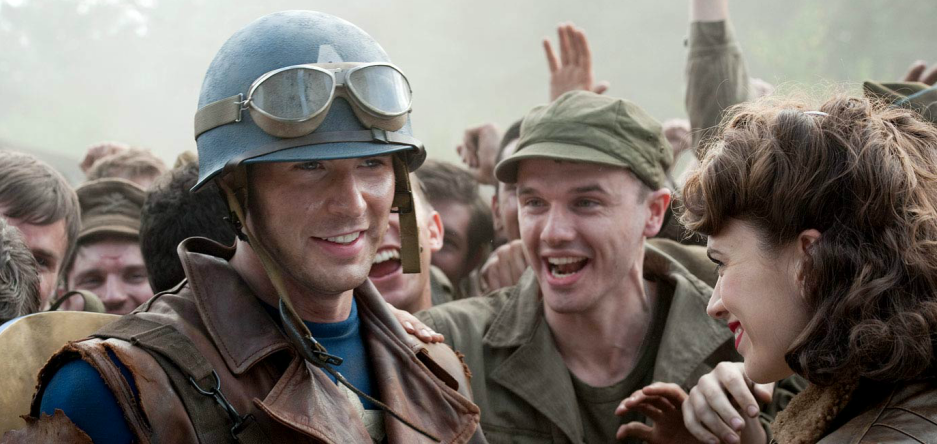
To answer that, I’ll quote a moment from Joe Johnston’s superhero film, Captain America: The First Avenger.  At one point in the movie, the heinous villain Red Skull (brilliantly portrayed by Hugo Weaving) captures our hero Captain America (Chris Evans) and has his men hold him down.  With a tone as sinister and slithering as can be, he asks our hero:

Red Skull: “Tell me… what makes you so special?”

Captain America: “Nothing.  I’m just a normal kid from Brooklyn”.

Well, it’s Texas, but you get my point.

-David Dunn

John Williams To Return To Score “Star Wars: Episode VII”

Okay, now I have reason to be excited for this.

Film Composer John Williams recently announced his involvement with the newest Disney-produced sci-fi sequel, Star Wars: Episode VII.  He will be returning to write the score for the movie with Michael Arndt (Little Miss Sunshine, Toy Story 3) writing and J.J. Abrams (Star Trek, Super 8) directing.  This being the first collaboration between him and Abrams, Williams tells TotalFilm.com about his anticipation for working with the young director.

“…<J.J. Abrams> seems excited about the idea.” Williams said. “I have to say that J.J. is a much younger man than I, but I will try to keep up with him as much as I can.”

If we didn’t have a reason to be excited before, we have a reason now.  Williams, who is arguably one of the greatest film composers of our time, is one of the most highly-recognized and respected musicians of our generation.  Not only has he won academy awards for Fiddler On The Roof, Jaws, Star Wars, E.T: The Extra Terrestrial, and Schindler’s List, but he has also scored a collection of equally-memorable works in which he has not won for, including (but not limited to) Superman, Indiana Jones: Raiders Of The Lost Ark, Empire Of The Sun, Home Alone, Jurassic Park, Saving Private Ryan, and Harry Potter.

Yeah, you better be excited.

I’m not going to ask you whether or not you think this is a good decision on the production company’s part considering there is no possible way any sane person could see this as a bad idea.  Just leave a comment below and let me know how excited you are for Williams’ return!

-David Dunn

Source: TotalFilm, NextMovie

Danny Huston is “Big-Eyeing” Tim Burton’s Newest Feature Film

It looks like Tim Burton’s newest project is moving forward quite efficiently.  The Hollywood Reporter recently announced that Tim Burton’s production company is looking to add actor Danny Huston to its cast for Burton’s newest feature Big Eyes, starring Amy Adams and Christoph Waltz.

If you don’t know who Danny Huston is, you should.  He has portrayed a wide variety of both supporting and villainous roles in a collection of history biopics, including Jack Frye in Martin Scorcese’s The Aviator, Richard the Lionheart in Robin Hood, and Chief Prosecutor Joseph Holt in Robert Redford’s political film The Conspirator.  Sure, he sunk briefly by starring opposite of Hugh Jackman in the dismal and lifeless X-men Origins: Wolverine, but that is neither here nor there.  The guy is a great actor.

And to star opposite of Amy Adams and Christoph Waltz?  Aka, the Oscar-nominated performers who were recognized in movies like Doubt, The Fighter, Inglorious, and Django Unchained?  Now you can’t tell me you’re not excited for this.

At the same time though, some people have been wary of Tim Burton’s recent career, and I’d agree with them.  Although he has mainly been a success with movies like Alice In Wonderland and Frankenweenie, we have to remember he also made Dark Shadows and helped produce movies like 9 and Abraham Lincoln: Vampire Hunter.  Uggghhhhhh…..

Despite this, I have confidence in his newest project.  This is based on the true story of Margaret Keene, an artist who broke mainstream success in the 1950’s-60’s for her paintings putting emphasis on the big eyes of her subjects, but her husband Walter took credit and compensation for the paintings she produced.  Waltz is set to portray Walter and Adams is set to portray Margaret.  Huston’s role has not been announced as of yet.

That being said, I’m excited for this movie.

What do you guys think though?  Are you on board for this cast and this project?  Or could you not care less on what Tim Burton is doing?

Comment below, let me know!

-David Dunn

Source: The Hollywood Reporter, ComingSoon.Net

Top Ten Movies of 2012

Man, what a year in movies. There has been so many achievements in so many different films, it’s hard to keep up with all of them at once. Superheroes defeated alien races. Lincoln was brought back from the dead. Ben Affleck made a fake movie. The Batman chronology came to a fantastic close. Peter Griffin possessed Teddy Bear. The list goes on and on and on.

With all of these stories coming into and out of theaters, it’s hard to decide which movies should be placed above another one. For a film critic, however, its important to know which movies are the best of the year and which are best left forgotten.

From bottom to top, here is my list for the Top Ten films of 2012.

NOTE: Not every film has been seen this year. If there is a ground-breaking blockbuster epic that isn’t up here already, its probably because it hasn’t been viewed yet. Either that, or you’re watching too much Alfred Hitchcock.

10) LES MISERABLES

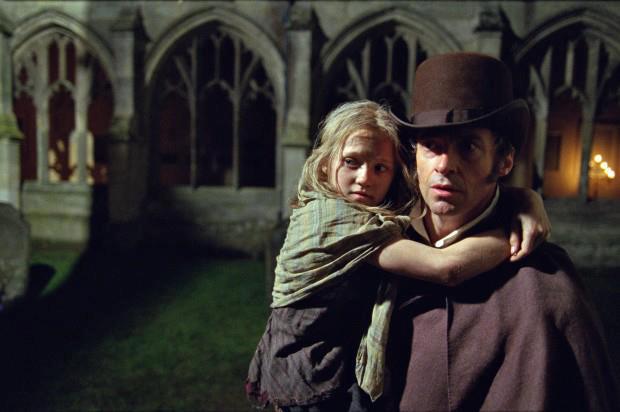
An enriching and inspirational musical experience beyond all measure.  Hugh Jackman stars as Jean Valjean, a man struggling with his past as he struggles to look for peace and redemption in a land torn by poverty and civil war.

Directed by Tom Hooper, Oscar-winner for 2010’s The King’s Speech, this is a movie that juggles emotional tensity with visual splendor and grandeur, with Hooper’s dignified set pieces shining brightly all over the place. At the same time though, this movie thrives as an aesthetic piece, with these characters conveying their thoughts and emotions through their powerful performances and voices through the film. Jackman, however, steals the show as Jean,  a man whose powerful, perilous spiritual journey is told through the film’s emotion-stirring song numbers. This movie isn’t just another musical. This is an opera of unexpectedly epic proportions. Four-and-a-half stars.

9) THE HOBBIT: AN UNEXPECTED JOURNEY

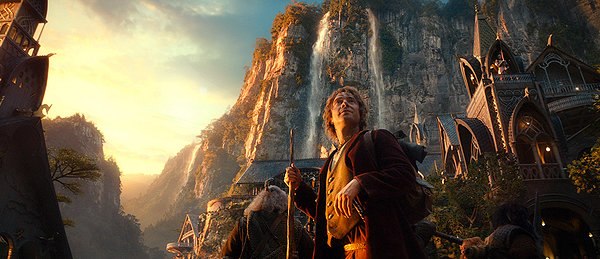
A prequel that not only matches the expectations set by its predecessor, The Lord Of The Rings: in some ways, it surpasses them. Martin Freeman plays as Bilbo Baggins, a young hobbit who lives a peaceful life full of rest and relaxation in his roomy cottage home. He was the last person who was expecting a visit from Gandalf The Grey (Ian McKellan), a wizard who traveled from the west in search of great adventure in middle-Earth: and he wants Bilbo to come along with him.

Directed, written, and produced by Peter Jackson, the same man credited to the success of the previous Lord Of The Rings trilogy, The Hobbit: An Unexpected Journey is a film that is influential enough to fuel its own trilogy. With a wonderful script, a solid cast, and creative and dynamic visuals, The Hobbit matches the proficiency of the first two Lord Of The Rings movies and rivals the mastery of the third. Five stars.

8) THE HUNGER GAMES

A survival-fantasy epic that retains the same tension and energy from the original novel. In the post-dystopian kingdom of Panem, young Katniss Everdeen (Jennifer Lawrence) volunteers for the Hunger Games, a brutal survival competition where combatants fight to the death, when she realizes her younger sister was previously selected to participate. Now having to participate in the games alongside fellow villager Peeta Melark (Josh Hutcherson), Katniss must find a way to win the Hunger games and get back home.

Lawrence is a powerful presence in the lead role, and she fits the part well as a strong-willed, courageous, yet secretly afraid heroine who simply wants to be reunited with her family. The movie does a great job as an adaptation as well, not only retaining faithfulness to the original novel, but also expanding upon it, actively showing what a broken and crumbled society this story takes place in. Directed by Gary Ross (Pleasantville, Seabiscuit). Five stars.

7) FRANKENWEENIE

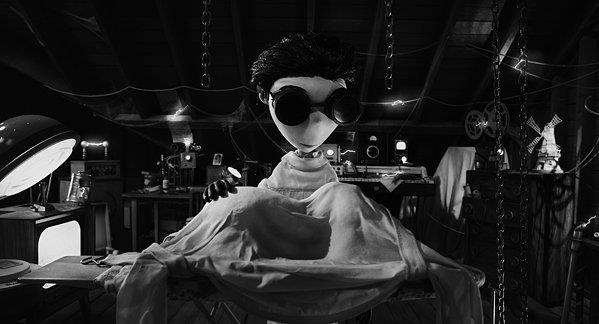
An affectionate tribute to classic horror cinema and a welcome return to form for director Tim Burton (Edward Scizzorhands, The Nightmare Before Christmas). When Victor Frankenstein (Charlie Tahan) witnesses the death of his dog Sparky (Frank Welker), Victor sets out on an experiment using lightning and electricity to bring his best friend back to life.

Based on an idea that originally got Burton fired from Disney Studios, Burton turns this idea around by offering us this creative, imaginative, dark, twisted, yet mature and emotional film about life, death, resurrection, growing up and companionship. The film is also smartly stylized, with its black-and-white animated visuals offering a surprising amount of eye candy.

A film every bit as fun and entertaining as it is thoughtful and emotional. Five stars.

6) SKYFALL

A Bond movie lived to the fullest potential. Daniel Craig returns as 007, the double-daring, martini-sipping secret agent who isn’t afraid to talk back to his superior, M (Judi Dench). But when Bond discovers an enemy who returned from M’s past to exact revenge, Bond will uncover a secret in his past so haunting that it will impact the entire nation of Britain and shake the foundations of MI6 forever.

Skyfall is a full-blooded action film, a spy movie that completely embodies everything great about Bond, from the lively, exotic locations to the pulse-pounding action that overflows you by the minute. The cast is great, the plot is fresh, the action is refined and thrilling, and the film has a deeper introspective into Bond than what we were expecting. Skyfall assures us that not only will Bond survive throughout the years as cinema progresses: it will also thrive on its success and its legacy. Directed by Sam Mendes (American Beauty, Jarhead). Five stars.

5) CHRONICLE

A fascinating and exciting science-fiction story filmed creatively through the “found footage” shooting method. Young Andrew Detmer (Dane DeHaan) lives a troubled home life with a sick, absent mother and a drunken alcoholic for a father, and decides to film everything on his home video camera as means of emotional release. When his cousin Matt (Alex Russel) and his friend Steve (Michael B. Jordan) discover a hole in an empty field in the backyard of a party, all three of them make a discovery that will change their lives forever.

Dane Dehaan is tense and subversive in his role as Andrew, and portrays him as a character that is both fearsome and sympathetic. The biggest props, however, goes to director Josh Trank and screenwriter Max Landis. They both help compose a very mature, thoughtful story that serves as a sort of metaphor for troubled youth. Their decision to make it a found footage film especially affected the film’s outcome. If the found footage genre was created for the purpose of one movie, Chronicle is that one movie. Five stars.

4) LINCOLN

A powerhouse of a biopic driven by Daniel Day-Lewis’ overwhelming performance as the famous president. Set during the final years of Lincoln’s presidency, the film follows the famed President as he tries to abolish slavery, end the civil war and attempt to mend the wounds of a torn country.

This dialogue-heavy narrative boasts screenwriter Tony Kushner (Munich) and director Steven Spielberg (Schindler’s List, Saving Private Ryan) at their best, carefully composing a story with intricate detail, whimsical humor and tender emotion that results in a very personal perspective in the life of Abraham Lincoln. Daniel Day-Lewis, of course, deserves all praise and admiration as the famous president. He’s so skilled in his performance, there’s no indication that he even is Daniel Day-Lewis. He fully embodies Lincoln, from the weariness in his voice, to the hunch in his back. Five stars.

3) BEASTS OF THE SOUTHERN WILD

An rich, aural experiment that pays off in many unsuspecting ways. The young and adventurous Hushpuppy (Quevenzhane Wallis) lives with her father Wink (Dwight Henry) in a place known as “The bathtub”, a Louisiana bayou that faces demise at the hands of a flooding. First-time director Behn Zeitlin wrote, produced, directed, and even composed this brilliant feature, and everything he was involved with fine-tuned this film to near-perfection. Through his skill of direction and symbolism, Zeitlin ends up commenting on many social issues such as poverty, naturalism, global warming, parenthood, neglect, childhood, purity, and innocence.

Wallis, especially, is breathtakingly powerful as Hushpuppy, a child that is so brave, strong-willed, and spirited, yet also at the same time vulnerable and emotionally fragile. A fantasy drama that is ripe with context, emotion, and adventure. Five stars.

POST-SCRIPT: I went back and forth on the following two movies on which should be second and which should be first, and you know what? I’m cheating. Only one film is ranked higher than the other, but they both truly are the best films of the year, as no other film has reached the success or the cinematic value that these movies have achieved.  Although one must be ranked higher than the other, both of these are number one in my book.  

2) THE AVENGERS

Built upon the success of iconic superhero movies such as Iron ManThorThe Incredible Hulk, and Captain AmericaThe Avengers assembles the world’s greatest heroes to fight the battles that humanity never could. And when an alien race known as the Chitari threaten the existence of mankind, it is up to the Avengers to step up and fight for humanity’s survival.

Being the sort of action-blockbuster that seems inspired by epic nature of the Lord Of The Rings and Star Wars franchises, The Avengers is the most iconic, the most exciting, the most quotable, the most entertaining and the most memorable picture of the whole year. With great action, a strong cast, a convincing script and so many memorable and witty one-liners, The Avengers is easily one of the most ambitious and most efficient films of the year. It is highly unlikely that there will be another just like it. Five stars.

1) ARGO

A tense, thrilling, and heart-pounding experience that is every bit surreal as it is unflinchingly realistic. During the Iran Hostage Crisis of 1979, all 50 people inside the U.S. Embassy building are taken hostage except for six Americans who escape and hold refuge inside a Canadian ambassador’s house. Two months later, CIA operative Tony Mendez (Ben Affleck) is given the assignment of getting the Americans out, and he hatches the ultimate unorthodox cover: disguise the Americans as a film crew, tell the officials that they’re scouting locations for a film production, get the Americans on a plane and get them home.

Ben Affleck shines in the film not only as its lead character, but also as its director. He directs this film with both skill and conviction, building up to highly suspenseful and climactic moments through expert pacing and precise cut-aways. He also knows how to excise compassion and sympathy, as he is able to show the American’s struggle through the traumatic situation they are in. The best drama of the year. Five stars.

And that’s my list for the year, folks.  Wake me up when its 2014.

-David Dunn

“ARGO” Review (✫✫✫✫)

“Argo”: The science-fiction epic that didn’t exist

In 1980, political instability and rebellion shook the grounds of Iran, a once prosperous city run dry by the greed and evil of its former shah, Mohammad Pahlavi.  When the U.S. agreed to house Pahlavi in southern California after he contracted cancer, the Iranian people stormed the U.S. Embassy in a furious rage and took everybody inside hostage.  Only six Americans escaped with their well-beings intact.

This is the true story of Argo, a political thriller based on the Iranian hostage crisis of 1980.  After barely escaping the U.S. embassy just before it is overran by Iranians, the Americans flee and take refuge inside Canadain Ambassador Ken Taylor’s (Victor Garber) house as social and political stability continues to crumble outside of the Taylor household. They remain stuck there for 69 days.

Enter the CIA. The intelligence agency plots ways to try and rescue the Americans and get them home to safety, but no luck. Their best ideas involve riding bicycles and meeting them at the border with gatorade. All hope seems lost until Tony Mendez (Ben Affleck) hatches the idea of disguising the American’s as a film crew scouting for locations out in Iran. As the Secretary of State asks Tony Mendez, “You got any better bad idea than this?”

“This is the best bad idea we have sir. By far.”

Here is a movie that knows how to utilize suspense and tension to the fullest effect. Similarly to how Kathryn Bigelow sets up the stakes of the film within the establishing shot of the 2009 best picture winner The Hurt Locker, Argo similarly sets up its stakes with a tense, horrifying sequence of the Iranians overrunning the U.S. Embassy in the beginning shot. They jump over walls and tear down the gates as they storm through the front lawn. They break through doors and windows as they charge into the building, screaming as they hold up picket signs and crow bars. They bind their hostages in rope and cloth as they grab and shake them all while screaming into their ears and breaking furniture around them. In the world of film, the goal is to put audiences into the scene, into the moment of the picture. We are not just put into the environment of Iran in Argo: we are immersed in it.

At the same time though, this is a movie that knows how to expertly balance drama with humor and comedy. Two essential roles in this movie help achieve this: John Goodman as make-up artist John Chambers, and Alan Arkin as movie producer Lester Seigel. These two are the C-3PO and R2-D2 of filmmakers, a duo who argue and bicker over the smallest, funniest of details. In one scene where they were looking over scripts for the operation, Lester complains as to how they are all of poor quality.

John: “We’re making a fake movie here.”

Lester: “If we’re making a fake movie, I want it to be a fake hit.”

This is one of those rarities of films where it transcends merely being labeled as a “movie” and has graduated to being something as an “experience”.  Argo is a tense, nerve-wracking film.  It keeps you on the edge of your seat, cringing, waiting, teeth chattering, spine tingling with every tense moment of the film pulsating through your entire body.  Ben Affleck directs this film with alluring precision, utilizing jump-cuts and precise cutaways to the greatest effect during this American horror that is a true story.

Very few films match the precision and craftmanship that this film possesses.  Combine that with the film’s smart, witty dialogue, as well as its great spirit for humanity, and what you have is one of, if not, the best drama film of the year.

Tagged , , , , , , , , , , , , , , ,