“SKYFALL” Review (✫✫✫✫)

United Artists Corporation/PA Wire

Old dog: new tricks.  

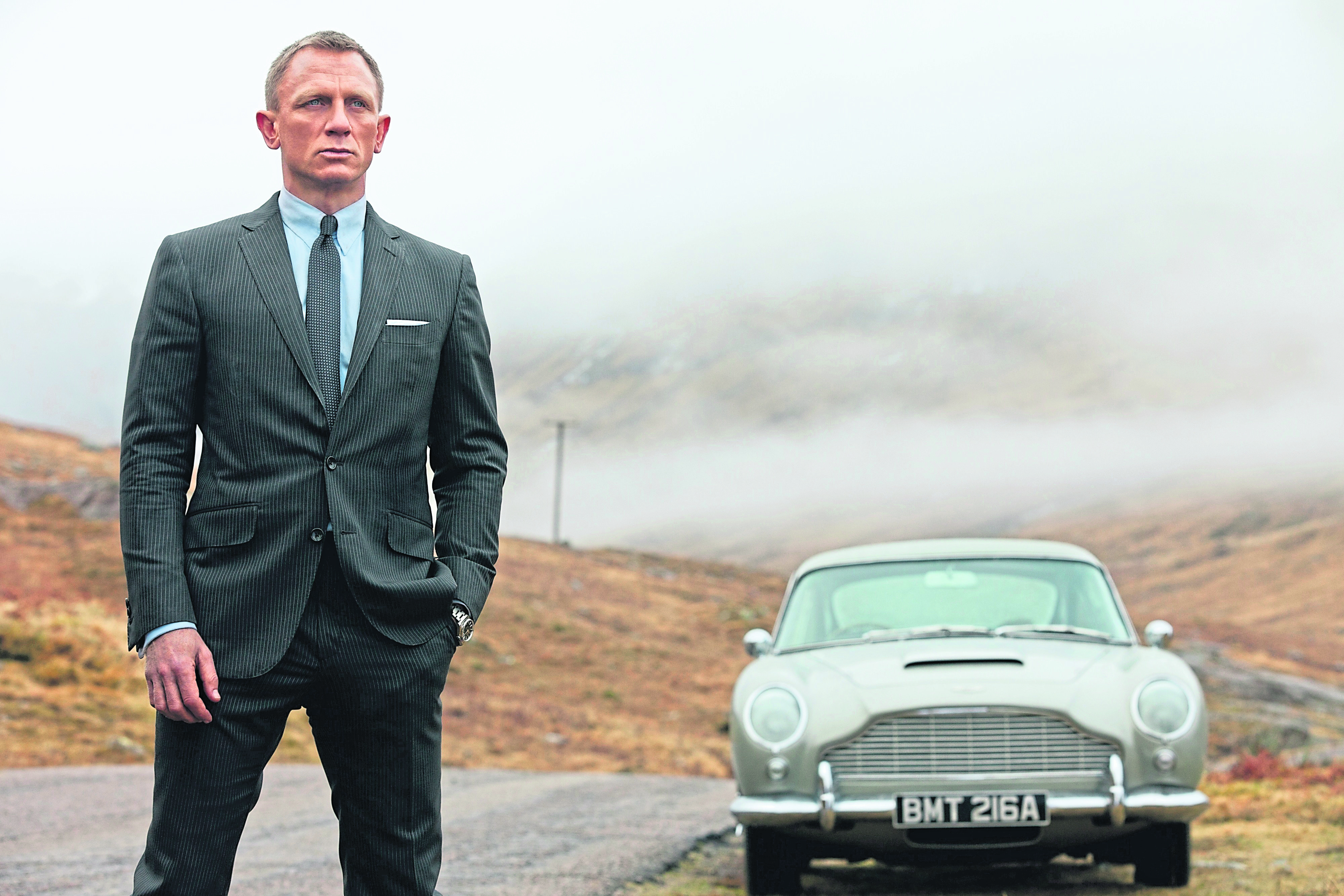
You’re not gonna see this one coming.  No matter what you expect to get from Skyfall, I promise you it isn’t what you expect it to be.  Yeah, its a high-adrenaline action film featuring Daniel Craig, yet again, as the double-daring, martini-sipping secret agent known as James Bond. I think we all pretty much understood that from the film’s trailer.  But oh, is the experience much more than just being a simple action film.  Much more.

Skyfall takes place a few years after the events of Quantum of Solace.  After a bomb threat has been declared on the headquarters of MI6, James Bond (Daniel Craig) is ordered by M (Judi Dench) to find and apprehend the ex-MI6 operative known as Raoul Silva (Javier Bardem), a cyberterrorist who has some deepening grudges with Bond’s superior officer.  As Bond begins to follow the trail and find out who Silva really is, he uncovers a secret in his past so haunting that it will impact the entire nation of Britain and shake the foundations of MI6 forever.

Here is a Bond movie lived to the fullest potential, an action movie that begins with a sensational chase sequence and refuses to let up on the excitement as the movie progresses.  Written by John Logan (Gladiator, The Last Samurai) and directed by Sam Mendes (Jarhead, 1999 best picture winner American Beauty), Skyfall is a full-blooded action film, a spy movie that completely embodies everything great about Bond, from the lively, exotic locations to the pulse-pounding action that overflows you by the minute.

But this film doesn’t just succeed as another action movie: it also brilliantly serves its purpose as a drama piece.  Being one of the more personal and more deeper Bond films to date, Skyfall is a profoundly mature film that has a deeper introspective into Bond than what we were expecting.  Unlike other Bond movies (including the dreary Quantam Of Solace), where Bond is just an emotionless action hero that goes through the motions, Bond actually has an arc in this movie when compared to other ones.  In the film, Bond struggles with both his morality and past, and both of these conflicts come into full circle in ways nobody expects nearing the end of the film.

The film remembers something important that Quantum Of Solace has forgotten: that James Bond isn’t just an action hero.  He’s a movie character that holds a popularity entirely in his own bracket, a character who holds an iconic presence similar to how Indiana Jones does in his own series.  Daniel Craig inhabits the role well in Skyfall, and shows us the truth about James Bond: that he’s at a level of character fascination entirely in his own caliber.

At the same time though, it isn’t just the hero that makes the film what it is: the villain must be equally as motivated, and interesting, as the main character is.

Enter Javier Bardem as Silva, a villain who is as imposing and daunting as the action itself is.  Bardem is brilliant and chilling as Silva, a man whose past and pains haunt him, M, and Bond through the history that he remembers.  This shouldn’t come as a big surprise.  He did, after all, portray Felix in 2002’s Collateral and Anton Chigurh in his Oscar-winning performance for No Country For Old Men.  Here, he’s just as chilling as ever as a villain who is as deceitful, conniving, and crafty as Silva.  He’s one of the more memorable Bond villains to date, and I wouldn’t be surprised if he was in the top five for IGN’s top 25 Bond Villains list.

This is a great movie.  The cast is great, the plot is fresh, the action is refined and thrilling, and the story is told through the lens of cinema master Roger Deakins as he flows from one beautiful shot to another.  There is much to love about this movie.

The only weakness, if there is one, is that the film doesn’t go deep enough.  The idea of Skyfall is great, the idea being that Bond is mortal and vulnerable and, like all of the other characters and villains in the Bond series, has a history where his issues have not been resolved.  Writer John Logan was brilliant for making this idea, and Mendes was smart in heading into this great direction.

The problem is that he doesn’t go deep enough.  The film dominates as an action movie, and granted, its a great action movie.  Still though.  Hasn’t there been other action movies that have been as deep and profound as they were exciting and fun?  Inception, for instance.  The Dark Knight.  The Terminator.  The Bourne Identity.  Movies like these succeed not only as action movies, but as compelling dramas.  Skyfall has a tint of that “drama” category, but it could have gone deeper.  It might seem like a small thing, but that’s all it takes.  One small thing would have turned Skyfall from just another great action movie into an instant classic.

This is a weakness on the film’s part, but am I really going to hold it against Bond?  No.  I am not.  Despite the supposed weaknesses, Skyfall is a fantastic thriller.  It revives Bond in ways similar to how Batman was revived in Christopher Nolan’s The Dark Knight trilogy, and it assures us that not only will Bond survive throughout the years as cinema progresses: it will also thrive on its success and its legacy.

P.S.: You will never guess what Skyfall actually is in the movie.  Seriously.  You will never guess.

Tagged , , , , , , , , , , , , , , , , , , , ,

“LIFE OF PI” Review (✫✫✫)

A boy, a boat, and his bengal tiger.  

If there is any film that will stick out in your mind more than any other film in 2012, its going to be Life Of Pi.  How could it not be?  With spectacular visuals, daring execution, and a solid story, Life Of Pi may very well be one of the most memorable experiences of the year, even though that doesn’t strictly mean it is of the highest standard in movies.

Based on the novel of the same name by Yann Martel, Life Of Pi follows the story of Pi “Piscine” Patel (Suraj Sharma), a young indian boy who is a believer in many religions, including Hinduism, Christianity, and Islam.  To Pi, all of these religions lead to the same path: a greater understanding and relationship with God.  In one wonderful moment of the film, he described faith like a mansion, with room for both belief and doubt on every floor.

Besides being a follower of many faiths, Pi’s family also runs a local zoo in India, an exotic place filled with vibrant species and animals of all kinds.  Most significant to Pi is a 450-pound bengal tiger named Richard Parker, who got his name after the hunter tha caught him switched the names around by accident, with the hunter’s name appearing on the sheet as “Thirsty”.  The name stuck on Richard Parker ever since.

Eventually, the day has come where Pi’s family can no longer support themselves in India and have to move themselves and the animals to Canada, where they can hopefully find a living and start anew.  But when the ship his family and livestock are on crashes and sinks into the Pacific Ocean, Pi ends up stranded on a lifeboat all alone with Richard Parker. Now, armed with little more than a life-vest and the clothes on his back, Pi must find a way to not only co-exist with Richard Parker, but to also find a way to tame him and stay alive in the lonely abyss of the ocean.

The best thing about this movie is its faithfulness to the original novel, in how it portrays Pi as a strange, introverted, religiously diverse human being but also a spiritually focused young adult.  Pi’s story is a unique one, with the film dwelving into his story with such emotional maturity and observation, that we cannot help but understand Pi and his spiritual connection to God.

I especially loved one line Pi said to a friend at one point at the film, but when looking at it through a closer lens, maybe he was saying it more to himself:

“Even when God seemed to have abandoned me, he was watching.  Even when he seemed indifferent to my suffering, he was watching. And when I was beyond all hope of saving, he gave me rest. Then he gave me a sign to continue my journey.”

I also like the connection Pi shares with this 450-pound man-eating animal named Richard Parker: dare I say they have chemistry with one another? Yes I can, because the tiger is rendered here with such precision and detail that he actually looks like a living, breathing man-eating animal, not just another CGI creation. The rest of the movie is no exception, as it takes us  through many wonderfully dazzling visual moments that are just as impressive as when we watched James Cameron’s Titanic for the first time.

Here is, truthfully, a genuinely good movie.  The score is settling, ambient, and beautiful.  The visuals are transcendent, amazing, and stunning.  And the underlying context Ang Lee adapts from Yann Martel’s novel retains its strength, as Lee knows how to balance emotional relevance with visual splendor.

Unfortunately, the greatest strength of this film is also its greatest weakness: it follows too closely to the original novel.  Thinking back to when I read the book back in high school, I remember a story that was ambitious, daring, creative, deep, emotional, spiritual, and unique all at once.  It wasn’t just another survival-fantasy-advenure: it was a spiritual journey that has as much to do with faith and God as it does with friendship and sacrifice.

The movie doesn’t reach into this idea as deeply as the book does.  That’s to be expected, considering books are typically more in-depth than their movie counterparts.  Still though.  Haven’t other book-to-movie adaptations benefitted moreover their novel counterparts when they branched out and embraced other possibilities the original writers didn’t?

I bring two other novel adaptations from earlier this year as an example: The Hobbit and The Hunger Games.  Those movies, unlike Life Of Pi don’t just retell their stories: they rework them.  They change it to better fit their narrative, and they expand upon the stories they are helping to re-create within their own cinematic universes.

Life Of Pi doesn’t do that.  It relies too heavily on its novel-based counterpart, it refuses to branch out any more than the pages of Yann Martel’s novel will allow it to, and it has one of the slowest beginnings ever known to mankind.  The scenes where an older Pi converses with a young novelist searching for a story were especially unnecessary: why not just replace thirty-minutes of exposition with a simple narrative voice-over?

Again, I will stress this: Life Of Pi is the most memorable film of the year.  That does not mean that it is the best film of the year, and that does not mean that everybody will enjoy it.  It just simply means that when somebody watches the movie, it will mean something to them.  Whether that’s a good or bad thing remains to be seen.

Still though, to have a movie that actually says something for a change is significant enough.  Take the ocean Pi is trying to survive itself as an example.  One could say it is symbolic to everyone’s spiritual journeys in life: there are quiet moments, and then there are chaotic ones.  But your journey is never truly complete, even if you do end up washing onto the shore.

Tagged , , , , , , , , , , , , , , , , , , , ,

“MEMENTO” Review (✫✫✫✫)

Like solving a puzzle backwards and then back together.

I’ve never been so attentive to a plot in a way that I was with Christopher Nolan’s Memento.  I’ve never been so immersed, so mesmerized, so hypnotized by the plot, by the narrative, by the structure, and by the character himself and everything he has to struggle with.  When I asked a friend of mine what it was like watching Memento, he said to me “It’s like reading a book, except chapter one is the epilogue, the epilogue is chapter two, and chapter one is sprawled out throughout the book until it reaches the end of the book, which in reality, is the beginning.”

I know, I know, it sounds confusing.  But believe me, the structure of storytelling in this film only adds to the fascination that I feel for the main character.  The film begins with a photograph, a small photo showing a dead body lying on the ground with his brains blown out.  The man holding it shakes it a couple of times, but after a couple of seconds the celluloid fades to white, as if it just came out of the camera stock.

Blood shifts along the ground.  Glass forms back together.  A bullet floats off of the ground and enters itself back into the chamber of a gun.  As the man fires it and cocks it, the corpse he shot on the ground lifts his head, blood flows from the ground back into his head, and his glasses form back together just in time for him to shout “NO!” at the man in front of him before he points the gun at him.

If you’re confused at this, don’t be.  This sequence is shown in reverse, inverted from the normal time stream of what would normally be happening in this situation.  Even though the scene plays backwards, we understand the basic points of it: a man shoots someone and takes a picture of his dead body.

Consider this an outline for the rest of the film.  Leonard Shelby (Guy Pearce) is a man who struggles with short-term memory loss.  He suffers from this condition after sustaining a severe injury from an unknown assailant who stormed inside his house, slammed his head against the mirror, raped his wife, and then killed her while he was passed out.

Fast forward to the present as Leonard suffers from his current condition.  He remembers who he was, where he came from, and how he got to the place he’s now at, but due to his condition he is incapable of making new memories.  Depite this, he’s now on a quest to find the man who killed his wife and stole his memory by leaving himself notes, taking photographs, and marking tattoos on his body to serve as his reminders that his irreversible memory condition won’t allow him to remember.

Written and directed by Christopher Nolan, the same guy who made the 1998 neo-noir film FollowingMemento is the sort of movie that can define a career.  This is a plot as heavy, thick, and deceptive as they come, a clever and concise thriller that is exciting and interesting in every pulse-pounding moment of the film.  Much of this has to do with the film’s structure, and Nolan’s expert timing with the film’s plot.

Take, for instance, his decision to structure the story in reverse order.  Many would look at this and think that this would lead to a confusing, convoluted story.  I think that’s the opposite of what we see here.  Imagine it like you’re watching a police detective working at the scene of a crime: he always starts at the end, but if he follows the right path, he’ll always end up where the story began.  That’s exactly how Memento plays out, and the payoff at the end (beginning?) couldn’t have been greater when all is revealed by the film’s conclusion.

Another thing that makes this film stand out is Guy Pearce.  Here he portrays a disturbed man, a man haunted by his past and by his situation so much that it taints his mind like it does the blood on his jacket.  I heard from a friend that the role was originally intended to be portrayed by an A-lister like Brad Pitt or Aaron Eckhart, but Nolan eventually opted for a lesser-known actor that would bring as much energy and enthusiasm to the role.  His decision was a smart one.  Guy Pearce is perfect as Leonard, capturing the right amount of turmoil and paranoia that comes with people taunted by mental disorders while at the same time retaining the emotion that shows that he is a confused, misunderstood man.

But again, his struggle only leads back to the films structure.  And no matter how Nolan formats his story, I’m surprised at how much it holds up despite the unstable nature of the film’s narrative.

I challenge you to study the plot in this film.  Not to just watch it and react to it, but to look into it and analyze it.  Observe the film as Nolan transitions from one scene to another.  Try to find one plot hole in this film.  Not four, not three, not even two.  One.  I’ll bet you $100 bucks that you won’t find a single plothole in this film.  Not one.

If you think you found one, I bet you $150 that someone can find an opposing argument, and $200 that you’ll end up being wrong.

I keep twisting this film inside and out.  I keep going back to it, looking through it, rewatching it, trying to pick it apart and find any possible flaw I can point out with this movie.  I cannot.  Every single frame of every single second in Memento is tense, fascinating, and mesmerizing, capturing both your attention and your mind early in the film and refusing to let go until the very last slide of the end credits roll.  It’s one of those movies you watch that as soon as you’re done watching it, you go back to the theater just so you can experience it again.

Tagged , , , , , , , , , , , , ,

“LINCOLN” Review (✫✫✫✫)

A man, not a monument, named Lincoln.

I’m rarely made more aware of what Lincoln was in history than what this powerful biopic reminds me: Lincoln was a man.  He wasn’t a fable.  He wasn’t a myth.  He wasn’t some sanctified holy figure that was crowned with solely freeing the slaves.  He wasn’t even technically honest Abe.  Abraham Lincoln was, solely, earnestly, realistically, the 16th President of the United States.  He was for the Union, he despised slavery, he was humble on approach, and he always fought intently for the things that he believed in: the things that he thought were right.

Depicting the final months of Lincoln’s presidency, including the end of the civil war and the abolishment of slavery, Lincoln is a very personal view of the final months of Abraham Lincoln’s life.  In that period Lincoln pushed for african freedom, dealt with conflicting opinions of his cabinet, sought peace negotiations with the confederacy, managed an entire union, and was in a state of emotional grief with his family after the recent death of Lincoln’s middle child, Willie.  If you told me that Lincoln had an easy time during his term as American president, I would call you grossly inaccurate.

In this drama-driven biopic, Daniel Day-Lewis portrays Abraham Lincoln.  When you watch him in this movie, I guarantee you that you won’t recognize him.  Day-Lewis doesn’t just portray the famous president: he embodies and embraces Lincoln’s spirit on every possible level, from the weariness in his voice to the hunch in his back.  His performance is so acute, there is barely any indication that he even is Daniel Day-Lewis.  For two and half hours he disappears into his role, and we briefly witness the miraculous resurrection of Lincoln through Daniel Day-Lewis.  The film lives and breathes on Daniel Day-Lewis’ performance.

Even then, a great actor cannot do anything without great material.  Enter Steven Spielberg and screenwriter Tony Kushner.  Kushner, who co-wrote Spielberg’s earlier history epic, Munich returns here to compose a story that is as complex and insightful as it is dramatic and informative.  Speilberg obviously needs no introduction.  For a decade-defining career as Speilberg’s, and for a project as personal to Spielberg as Lincoln, its obvious he would pay as much attention and focus to this era as he would with Schindler’s List or Saving Private Ryan.

Even then, I’m surprised at Spielberg’s role in this movie.  He’s effective as a director with this film, but he’s not the highlight.  He kind of takes a backseat to Kushner’s screenplay and Day-Lewis’ performance, with him serving as the production’s moderator rather than their visionary.

Which believe me, I’m fine with that.  At times, a director must learn to step back and just let the production flow into place.  Here, Spielberg is a great moderator, carefully directing Day-Lewis through Kushner’s fragile, elaborate script and always making sure he never takes the wrong step along the journey.  It isn’t like Spielberg’s previous films where it relies on flashy effects and CGI: this film is carefully paced through revealing dialogue and personal character development.  While it’s a step out of Speilberg’s comfort zone, it more than works for this production.  Lincoln is one of Spielberg’s most personal and most effective works to date.

The film’s only problem: pace.  Because this film relies on dialogue and performance as its greatest assets, there are times where the film becomes so muddled within its political kurfuffle and babbling that at times its hard to keep track of all at once.  You should know what I’m talking about: Senators and Congressmen shout and babble about to each other in such incoherent conversation that our ears zoom out for a bit and miss some key information we’ll need to remember later on.  This will be a problem for some viewers in the audience, as it will be difficult for some people to be hooked on the beginning of Lincoln’s story because of its slow, slow, slow pace.

But even then, I’m so absorbed into Lincoln’s story and Day-Lewis’ performance that I don’t even care about this minute fault.  The one thing that defines this film, the one thing Spielberg, Kushner, and Day-Lewis got right more than anything else is Lincoln’s compassion, his character, and his humanity.

I remember an interview Speilberg and Day-Lewis gave to Yahoo!Movies earlier this year.  When asked about the gravity of the challenge of bringing Lincoln’s legacy to life on the big screen, Spielberg had this to say about his lifelong dream project:

“…we have a big responsibility in telling the story,” Spielberg said. “And we determined that we didn’t want to make a movie about a monument named Lincoln, we wanted to make a movie about a man named Lincoln.”

A man.

Tagged , , , , , , , , , ,

“LES MISERABLES” Review (✫✫✫1/2)

An opera of unexpectedly epic proportions.  

The first thing that crossed my mind while watching Tom Hooper’s Les Miserables is that this entire story is based around truth.  Not a true story, mind you, but rather the truth about 1800’s great Britain.  In that time period, the country was engulfed in sadness, desperation, and revolution.  The rich outmatched the poor.  The sick and the hungry dominated the streets.  Employment was scarce.  In times like these, misery seemed to inhabit every dark corner, and God was hard to find in the shrinking light.

Perhaps this is also a metaphor for today’s world, but that’s besides the point.  Les Miserables shocked me with its energy, its spirit, and its mature handling of its subject matter.  If the film industry was a railroad, and the train is Les Miserables, Tom Hooper is the conductor, and he’s taking me through a roller-coaster of emotions that range from shock, to sadness, to grief, to anger, to loss, to laughter, and ultimately, to happiness.  How was I supposed to know that I would begin the film with a sulk as low as Russell Crowe’s beard and end the film with a smile beaming as brightly as the sun?

This is the kind of film that Les Miserables is: the kind that finds the light shining through the cracks in the concrete.  Based on both the original novel by Victor Hugo and the subsequent musical by Claude Schonberg, Les Miserables follows the story of Jean Valjean (Hugh Jackman), a convicted criminal in 1815, Great Britain who was put away nine years ago for stealing a loaf of bread.  After being released from prison and breaking parole, Javert (Russell Crowe) is tasked with finding him and imprisoning him once again.

But somewhere along the way, Jean’s hardened heart changes. He encounters Fantine (Anne Hathaway), a sick prostitute mother who greatly fears for what will become of her daughter Cosette (Isabelle Allen). After hearing her dying wish pleading for Cosette’s safety, Jean vows to find Cosette and raise her in the world as if she were his own child.

This is an emotion-stirring epic that is vast and grand beyond all comprehension. Directed by Tom Hooper, Oscar-winner for 2010’s The King’s Speech, Les Miserables is a movie that juggles emotional tensity with visual splendor and grandeur, with Hooper’s dignified set pieces shining brightly all over the place in a broadly dignified fashion.  The opening sequence in itself is bold and spectacular, beginning deep in British seawaters and lifting itself out of the water to show a view of British prisoners pulling a ship into the bay.  With the visua effects, there is a great historical context within this picture, focusing attentively to many issues in 1800’s France, including criminal treatment, poverty, child neglect and the French revolution.

At the same time though, this movie thrives as an aesthetic piece, with these characters conveying their thoughts and emotions through their powerful performances and voices through the film.  Russell Crowe is upright and stoic as Javert, a man committed to law and order to the point where it is almost inhumane and cruel.  Anne Hathaway is affectionate and masterful as Fantine, and her character is one of the more tragic characterizations I’ve come across in recent cinema.

Hugh Jackman, however, steals the show as Jean Valjean. He is a man who has experienced cruelty and unfairness firsthand and has hardened his heart so much just so he can survive in this world. But he is also a man who has gone through a change, a man who experienced a kindness and love that no one has shown him for so long. Jackman is brilliant in the lead role, and a powerful spiritual connotation is told through his fantastic, emotional journey through the perilous land of France.

Admittedly, the film is at times overly expressive, and the music is also overwhelming to the story. The plain and simple fact is that there’s too much of it in the picture: 98% of all of the performances in the film involve singing and music, and only one or two lines are spoken through lines of actual dialogue in this movie. Won’t people get tired of hearing just relentless music numbers one after the other?

But the important thing is that Les Miserables has the emotion to match the dramatic tension that is heard through the music. As far as story and character goes, Les Miserables is unparalleled, and draws in its viewer through the drama and tragedies the characters are experiencing.  I’ll admit, balance is an issue, and people might have trouble staying interested in a two-and-a-half hour musical.

This isn’t just a musical though. This is an opera of unexpectedly epic proportions.

Tagged , , , , , , , , , , , , , , , , , , , , ,

A Tribute To Roger Ebert

ebert

I’ve never known any film critic like Roger Ebert. I’ve never known any critic more funny than him, more intelligent than him, more emotional than him, or more real than him. Roger Ebert wasn’t just another journalist or film critic. He was a man who loved, cherished, and believed in the power of movies and cinema. He wasn’t just a man who studied films: he was a man who watched them.

Roger Joseph Ebert was born on June 18, 1942 in Urbana, Illinois. By the time he graduated high school, he was a sports writer for The News-Gazzette in Champaign, Illinois, an enthusiastic contributor for science-fiction fanzines, became the co-editor for the high-school paper, won first place at the Illinois State Speech Championship in Radio Speaking and began taking classes at the University of Illinois at Urbana-Champaign while simultaneously finishing the last of his high school credits.

Geez. And here I am struggling to get into film festivals and write two stories a week.

His first exposure to professional journalism was in 1966 when he applied for a job at the Chicago Daily News, but was then referred to Jim Hodge, the editor-in-chief of the Chicago Sun-times. After being promoted to film critic after the paper’s previous critic resigned, he eventually began his own television show called “Sneak Previews”, where he would eventually meet his longtime partner, friend, and collaborator: Gene Siskel.

Some of the best moments of film reviewing came from “Siskel And Ebert”. Not one. Not the other. Both. They defined what film criticism truly is: two human beings, with two different opinions, and the two of them trying to find the common ground of a movie between the both of them.

What made those two so funny and memorable though was not the fact that they agreed and saw eye-to-eye as film scholars: they often couldn’t find the common ground, and this resulted in many of their most scathing and hilariously heated debates.

On Brain Candy:

Siskel: Roger, what happened to your sense of humor?

Ebert: I’ve GOT my sense of humor. My sense of humor was STARVING for laughter!

On Silence Of The Lambs:

Siskel: I wasn’t compelled by anybody except, I suppose, the Jodie Foster character as a ‘strong woman’.

Roger: Come on, a great performance!

Siskel: Not a great performance, a decent performance.

Roger: Anthony Hopkins?

Siskel: NO. I thought that was way overplayed.

On Full Metal Jacket:

Siskel: I’ve never felt a kill in a movie quite like that.

Ebert: Well, in that case, you’re going to love “The Late Show”, because they have kills like that every night in black-and-white starring John Wayne.

Those two were not just the definition of film lovers: they were the definition of film critics.

Their relationship lasted all the way until Gene’s death in 1999. Ironically, Gene passed very similarly to Ebert: He contracted cancer and died due to surgery complications.

From there, the show survived until Siskel’s successor was found in Sun-time columnist Richard Roeper, where the show was then renamed “Ebert and Roeper”. The show had a successful run, but it wasn’t at the same level as when Siskel was still a co-host. How could it be, when Ebert and Siskel’s rivalrous relationship was the highlight of the show?

The two critics eventually parted ways to follow their own interests and endeavors. Roeper would go on to publish his reviews via internet broadcasts for the ReelzChannel, while Ebert continued to write for the Chicago Sun-times as well as spend time with his beloved wife, Chaz.

However, a great obstacle eventually put itself right in front of Roger’s path: he contracted papillary thyroid cancer. For more than ten years, Ebert vigorously fought and combated cancer in any way he could, while still maintaining his job as a film critic.

It wasn’t easy. He underwent three surgeries, lost the ability to speak through a surgery involving his jawbone, got tissues and pieces of bone removed from his back, arms, and legs in order to replace it, and after it failed, was left with no voice and a frail body. Here the man finally was: a great film scholar and historian physically shriveled down to nothing.

That didn’t stop Ebert though. If anything, it made his voice through his writing stronger. Ebert continued to write for the Chicago Sun-Times, all while maintaining film submissions for his film festival Ebertfest and even tried to revive “At The Movies” with film critics Christy Lemiere and Ignaty Vishnivetsky.

But after a while, he couldn’t take it anymore. He succumbed to his ailments in the morning of Thursday, April 4th of last week while him and his wife Chaz were preparing to go to a hopsital appointment with the doctors at Hospice hospital care.

I remember where I was at that exact moment when I first heard the news. I was at the 2013 TIPA Convention, representing my college paper alongside many of my other fellow journalists and reporters when a friend of mine from the paper called me:

“David… you’ve heard about Roger Ebert, haven’t you? He’s dead.”

I couldn’t believe it. My hero, my role model, my inspiration for film criticism, was dead. It was too much for me to process all at once. It nearly ruined my whole day.

Ever since I started getting serious about criticism and started reading his reviews in 2008, I’ve always been a huge admirer and fan of Roger Ebert’s reviews. There were specifically three things about his reviews that stood out to me so much.

First of all, his narcissistic sarcasm. When he loved a movie, you knew it. When he didn’t like a movie, you knew it. When he hated a movie with such steaming passion that he would give anything (including an admission price) to leave the theater, well, you knew that too.

Some of his most famous hate speeches below:

“This movie doesn’t scrape the bottom of the barrel. This movie isn’t the bottom of the barrel. This movie isn’t below the bottom of the barrel. This movie doesn’t deserve to be mentioned in the same sentence with barrels.” 

-Freddy Got Fingered, 2001

“Enough. Do the people who made ‘Meteor’ take us all for total fools? And if so, could that possibly be because they’re looking for company?” 

-Meteor, 1979

“I hated this movie. Hated hated hated hated hated this movie. Hated it. Hated every simpering stupid vacant audience-insulting moment of it. Hated the sensibility that thought anyone would like it. Hated the implied insult to the audience by its belief that anyone would be entertained by it.” 

-North, 1994

I didn’t love Roger Ebert because he ripped off on bad movies: I loved him because he was funny while he did it.

Secondly, I liked how personal Ebert made his reviews. It wasn’t just his tastes or his education he considered when he was writing: he also considered his personal background when doing so.  He considered his morality.

Take, for instance, his review of Mel Gibson’s epic “The Passion of The Christ”, a film I feel is severely underrated by the critical public. Ebert, after giving the movie four stars out of four, said:

“What Gibson has provided for me, for the first time in my life, is a visceral idea of what the Passion consisted of. This is not a sermon or a homily, but a visualization of the central event in the Christian religion.”

-Passion Of The Christ, 2004

And later on, another comment he gave about Terrence Malick’s “The Tree Of Life”.

“In whispered words near the beginning, “nature” and “grace” are heard. We have seen nature as it gives and takes away; one of the family’s boys dies… And what then? The film’s coda provides a vision of an afterlife, a desolate landscape on which quiet people solemnly recognize and greet one another, and all is understood in the fullness of time.”

-The Tree of Life, 2011

In many ways, Ebert isn’t unlike Terrence Malick in “The Tree Of Life”: vast, attentive, understanding, patient, and recognizing of true beauty. He noticed morality and principle more than he noticed art and vision, although he paid equal attention to both things all the same. He doesn’t just analyze the technical skill of a film: he analyzes the intent, and whether it is appropriate or not for its content.

Lastly, I respected Roger Ebert because, more than anyone else, he understands the value of opinion and film criticism. The best line Roger has ever said about the business was in a journal entry dated for July 18th, 2010. In it, he wrote:

“The one thing you can never be wrong about is your own opinion. It’s when you start giving your reasons that you lay yourself open. Only rarely does it stray into objective fact.”  

-Ebert’s Journal, “Whole Lotta Cantin’ Going On”, July 18th, 2010.  

That line is what inspired me to become a film critic. That line first got me writing my articles and reviews in the first place. It established my perspective as a critic in the field. It broadened my respect for other opinions in the field. It honed me to being able to debate and argue opposite views of film. I learned to love film through Robert Ebert.

Thank you Roger Ebert. You’ve given me and so many other aspiring journalists to strive for something only you so far have been able to reach. For now, the balcony is closed. But maybe someday, with you as our guide, we’ll be able to open it again.

R.I.P. ROGER JOSEPH EBERT (JUNE 18, 1942 – APRIL 4, 2013)

-David Dunn

OSCAR REACTIONS 2013

Well then.  Turns out even William Shatner couldn’t save Seth Macfarlane from being the worst awards show host I’ve ever seen.

I’m not even kidding.  I couldn’t stand him.  He annoyed me even more than Anne Hathaway and James Franco.  He disgusted me even more than Ricky Gervais.  He was even less humorous than David Letterman.  Seriously, how is it a guy of this caliber walks up on stage and, aside from being tasteless and offensive, fails to even be funny?  He’s the worst Oscar host I’ve ever seen on stage.

Enough of that though.  Besides the show’s prolonged, idiosyncratic pace, this was a decent year at the Oscars, with just as many candidates deserving their wins as there was candidates who were… well, let’s just say “lacking” in their wins.

Here are the categories I got right this year:

BEST PICTURE (CORRECT! 👍) Yes, yes, and yes.  Ben Affleck won best picture alongside Grant Heslov and George Clooney for his brilliant thriller, Argo.  He more than deserves it and his acceptance speech was one of the most emotional and sincere of the night.  I’m glad he won.  Moving along.

BEST DIRECTOR (WRONG! 👎)  No, no, NO.  Ang Lee won best direction for his fantasy-epic Life Of Pi.

Why?  Where did this come from?  Was Life Of Pi a good movie?  Yes.  Was it faithful to the novel?  Yes.  Was it a revolutionary piece that has singular and daring direction that made the movie stand out compared to other nominees?

NO.  NO NO NO.  Steven Spielberg directed the 16th American president and the entire Union through the civil war in his powerful biopic Lincoln.  Behn Zeitlan directed a six-year old girl through the swampy infestations of New Orleans in Beasts Of The Southern Wild.  Ang Lee had to direct one indian boy on a lifeboat with a CGI tiger.  How does Ang Lee win the award for just following the book note-for-note, word-for-word.  Why?

Argh.  Whatever.  He’s not a bad choice, I’ll give them that.  At least the award went to a decent director.

BEST ACTOR (CORRECT! 👍) Good.  Daniel-Day Lewis won best actor for his adamant performance in Lincoln.  The president of AMPAS just saved himself a broken TV.

BEST ACTRESS (CORRECT! 👍) And yet again, Jennifer Lawrence wins best actress for Silver Linings Playbook.  I’m happy for her win, even though she tripped on the stairs on the way up to accept her award.  She’s a woman of character, integrity, charisma, and good humor.  Congradulations for her win.

BEST SUPPORTING ACTOR (WRONG! 👎) Christoph Waltz beat out Tommy Lee Jones for Lincoln with Django Unchained.  While he certainly isn’t a bad choice, he wouldn’t have been my first pick.  Tommy Lee Jones’ role in Lincoln demanded more for his character, and more emotion and context was shown behind the character of Congressman Thaddeus Stevens.  I would have preferred he recieve the award over Waltz.

On the flip side, where is Leonardo DiCaprio in this?  His performance stood out even more in Django than Waltz’ did.  And yet, here he is, being snubbed for pushing himself as an artist so the Academy can give it to someone who has already won before.  Typical.

But I digress.  Waltz’ role was vital in Django and he served it well.  Congradulations to him for his second win.

BEST SUPPORTING ACTRESS (CORRECT! 👍) Thank you, Anne Hathway, for giving us one of the most powerful moments this year in film for your performance in Les Miserables.  And thank you, Academy, for recognizing her for it.

BEST ORIGINAL SCREENPLAY (CORRECT! 👍) Quintin Taratino won for Django Unchained While I can say the movie is witty and well-written, I still have to point out that I think Zero Dark Thirty and Flight were superior movies compared to that one.  But that is besides the point.  Congradulations to Quintin for his second Oscar.

BEST ADAPTED SCREENPLAY (CORRECT! 👍) Chris Terrio won for Argo.  This is fair considering this is a phenomenal movie with great writing, brilliant pacing, and witty humor.  That all started on the pages of the screenplay, and Terrio is more than deserving in the award.  Again, congrats.

BEST ANIMATED FILM (WRONG! 👎) ….um…. wow.  I gotta admit, I didn’t see this one coming.  Pixar’s Brave won for best animated film over Wreck It Ralph and Frankenweenie.  While I am happy for its win and agree it is among the best animated films of the year, to say it is the best is something of a long shot.  It doesn’t match Frankenweenie as far as maturity goes, and it doesn’t precede Wreck-It Ralph as far as wit and cleverness goes.

I’m not mad, and I’m happy for its win.  I’m just pointing out that I wasn’t expecting it, and out of all of the Pixar epics, this has been one of them that has been recieved with lesser critical reception.  I expect many people to be upset about this win.

BEST DOCUMENTARY (CORRECT! 👍) Of course Searching For Sugar Man won for best documentary.  It’s one of the most critically-acclaimed films of the year and achieved widespread popularity despite its limited release.  Congrats for the win.

BEST FOREIGN LANGUAGE FILM (CORRECT! 👍) Amour won best foreign-language film.  No surprise there.

BEST COSTUME DESIGN (CORRECT! 👍) Anna Karenina won.  I have no comment for its win except that The Dark Knight Rises should have been nominated in its place.

BEST PRODUCTION DESIGN (WRONG! 👎) Now here’s a pleasant surprise.  I was expecting Anna Karenina to win, but it turns out the Academy wisened up for a change and gave the award to Lincoln instead.  Congradulations, and thank you.  That film was a phenomenal period piece that had great attention to historical detail and architecture.  I am not mad at all that I got this category wrong.  Not at all.

BEST CINEMATOGRAPHY (CORRECT! 👍) One step forward, two steps back.  Claudio Miranda beat Roger Deakins in cinemetography with his Life Of Pi against Skyfall.

I knew this was going to happen, even though I wished it hadn’t.  Skyfall was a superior action piece utilizing inventive camera angles at the hands of cinema master Roger Deakins.  Life Of Pi relied on visual effects and wide shots to convey its story across.  Deakins was the more original artist, and he deserved to win.  Just like every other year he’s been nominated.

BEST FILM EDITING (CORRECT! 👍) Argo won for best film editing.

BEST ORIGINAL SCORE (CORRECT! 👍) Life Of Pi won best original score.  And this is one of the categories it wins in which I don’t mind.

BEST ORIGINAL SONG (CORRECT! 👍) Adele took home the award for the night for Skyfall.  Could anyone else have taken it away and be just as deserving?  I think not.

BEST VISUAL EFFECTS (CORRECT! 👍) Life Of Pi won best visual effects.  How humuliating is it that the cast of The Avengers, a movie which SHOULD have walked away with the award, handed it off to the people in charge of the visuals for Life Of Pi?  What a sham.

BEST MAKEUP (WRONG! 👎) Les Miserables won for best makeup.  While I got this category wrong (predicting it’d be The Hobbit), its at least not as polarizing as when The Iron Lady won.  At least its more deserving than Hitchcock.

BEST SOUND EDITING (WRONG! 👎)  Shockingly, for the sixth (seventh?) time in Oscar history, the winner of this category is a tie.  Between Zero Dark Thirty and Skyfall to be precise.  This is great because both nominees were worthwhile movies that deserved at least some recognition.  Bad because I didn’t predict either one on my sheet.

Oh well.  Can’t get everything you want.

BEST SOUND MIXING (CORRECT! 👍) And Les Miserables won best sound mixing. Congradulations.  It deserved it due to the difficulty of the request of what Tom Hooper was asking his sound editors.  Congradulations to that musical epic regardless.

And of course, I got all three of the following categories incorrect.  But that’s only because…

BEST DOCUMENTARY SHORT (WRONG! 👎) Innocente.  Didn’t see it.

BEST LIVE-ACTION SHORT FILM (WRONG! 👎) Curfew.  Didn’t see it.

BEST ANIMATED SHORT FILM (CORRECT?) ...waitaminute, I GOT ONE RIGHT??!?!  Whoa…

Didn’t see that one coming.

In all sincerity, Paperman is the only animation short I’ve seen, paired with my screening of Wreck-It Ralph.  And I’m glad it won.  It was a tender, sincere piece that was just as visually dynamic as it was gripping and creative.  It was a phenomenal animation piece and it deserved no less than best animated short.  Huge congratulations for John Kahr’s win.

Again, and again, and again, congratulations to all of the nominees and their wins.  This was a great year at the Oscars, and many deserved the wins that they received.

Poor on you, though, Seth Macfarlane.  As Ben Affleck said as he was presenting a category in the ceremony, “Y’know, I thought we were doing pretty well here today, Seth.  But I’m sure you’ll turn that around for us”.

-David Dunn

“OZ: THE GREAT AND POWERFUL” Review (✫✫✫)

Follow the yellow brick road down the rabbit hole.  

I was five years old when I saw Victor Fleming’s The Wizard Of Oz for the first time in my life. I remember that exact moment like it was yesterday. My mother held me in her lap, our dog Sandy lay in mine, my father was laying on his couch sipping a cup coffee, and they would both tell me all the wonderful memories they have of watching that movie growing up. Those memories would eventually become mine as I now recount all of the joyous times I was transported to Oz every time I watched that fantasy classic. I would eventually go on to name that film as one of  best movies ever made.

Now here I am, 15 years later, recounting my memories of watching the original and am now watching its prequel Oz: The Great and Powerful”and judging it with the same fairness as I did with the original. My verdict? It’s a good prequel, but Oz fell a little too far down the rabbit hole if you know what I mean.

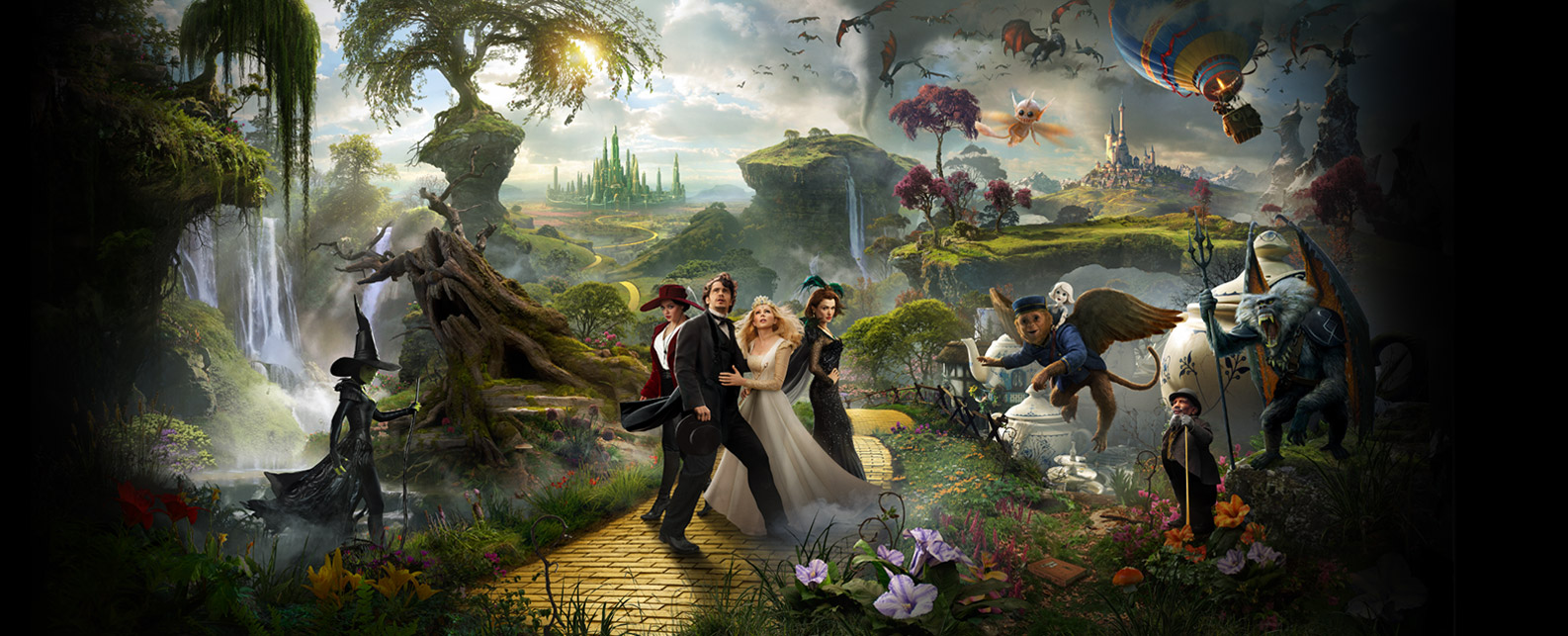
Preceding the events of the fantasy classic The Wizard Of Oz by whatever-something-amount-of-years, Oz: The Great and Powerful follows the story of Oscar Diggs (James Franco), a struggling magician in a traveling circus who dreams of rising above mediocrity and amounting to greatness in the world.

Unfortunately, Diggs is also a crook and a womanizer. When he escapes a few enraged circus freaks by stealing a hot air balloon, he’s gets trapped in a whirling tornado that transports him to a place he’s never seen — Oz, the wonderful land of munchkins, emeralds and yellow brick roads. It is here where Diggs discovers he’s part of an ancient prophecy: that a wizard named after the land of Oz will descend onto the land, and free the people from the tyranny and evil of the Wicked Witch of the West.

Here is a movie that functions as an appropriate prequel, a good movie that actually fits into the magnificent story of The Wizard Of Oz  and makes it work within the established timeline. Co-Written by Tony award-winning writer David Lindsay-Abaire (who wrote both his stage and screen adaptations of Rabbit Hole), the plot in Oz: The Great and Powerful can be defined in adjectives to the first movie: traditional. Imaginary. Creative. Dynamic. Classic. Every piece fits into this puzzle, and ultimately adds up to what is a straightforward prequel that provides background for the first movie, even if it wasn’t needed before.

The cast is strong here as well, with James Franco shining the most out of a cast list that consists mostly of women. Here he portrays a spirited man, a man full of charisma and humor that makes the screen vibrate with his very presence. Both his energy, his passion and his kindness is contagious with other characters, and the end result is a near-flawless chemistry with every character on-screen (with the exclusion of the Wicked Witch of the West, who I felt was severely miscast in this film. I dare not spoil it though by telling you who it is).

As a movie and as a prequel, this film succeeds. The plot is enjoyable, the cast is skilled in both vocal and physical performance and the visual effects reach out and dazzle you with its many bright colors and details that instantly transport you to a land of fantasy and wonder (Even though it is a little too resemblant of the art direction in Tim Burton’s Alice In Wonderland).

The biggest problem with the film, however, is its balance. Director Sam Raimi (who is most known for the Evil Dead and Spider-man trilogies) is the visual effects master behind this film, but unfortunately, he depends too much on it. The most enjoyable moments of this film involved Oscar displaying his joy and humor through his energetic and witty dialogue with other characters, which was both affectionate and entertaining at the same time. Everything else was overdone, and at times Raimi depends on the visual aspect of his film as if its the only thing it has going for it.

The last 40 minutes of the film especially becomes so redundant and prolonged, dragging out a scene of conflict between the munchkins and the witches just to provide action and flashy effects. This part of the film doesn’t seem to have purpose or motivation in mind, and the reptition of visual effects and CGI eventually becomes dizzying and nauseating.

My recommendation: Don’t go into this movie expecting it to be the masterpiece that The Wizard Of Oz is. You’re setting yourself up for disappointment and inevitable failure. Instead, see Oz: The Great and Powerful for what it is: a charming, ambient and lively prequel to the original fantasy classic made 74 years after its original release. When looking through that perspective, the return to Oz couldn’t be more glorious, even though the yellow brick road now looks more like a green screen rather than a stage set.

Tagged , , , , , , , , , , , , , , , , , , , ,