J.K. Rowling To Bring Wizards And Magic Back To Theaters (Not In “Harry Potter” Though)

Rowling fans, hold on to your broomsticks.  Details have emerged earlier this morning that the critically acclaimed “Harry Potter” author will be writing her very first screenplay.

Yeah, I know.

According to an announcement by Warner Bros. CEO Kevin Tsujihara, Rowling will writing the first in a planned film series which takes place 70 years prior to the events in “Harry Potter”.  The script will be called Fantastic Beasts And Where To Find Them, and is based on the J.K. Rowling novel of the same name featuring a fictional author named Newt Scamander and his many adventures in the world of witchcraft and wizardry.

“Although it will be set in the worldwide community of witches and wizards where I was so happy for seven years,” Rowling said, “Fantastic Beasts And Where To Find Them is neither a prequel nor a sequel to the Harry Potter series, but an extension of the wizarding world.”

This isn’t Rowling’s first great partnership with Warner Bros.  Her first adult novel “The Casual Vacancy” is being adapted as a BBC television series, with Warner Bros. distributing the project with production slated to begin in 2014.

“We are incredibly honored that [J.K. Rowling] has chosen to partner with Warner Bros. on this exciting new exploration of the world of wizardry which has been tremendously successful across all of our businesses,” Tsujihara said. “We know that audiences will be as excited as we are to see what her brilliant and boundless imagination conjures up for us.

Excited?  Skeptical?  “The Casual Vacancy” was met with some mixed reactions when it was released, but there’s no denying the success of the book and movie series of “Harry Potter”, with the last entry grossing over 1 billion dollars in profits.

Comment below, let me know.

Oh, and since we’re talking about Harry Potter…

EXPECTO PATRONUM!!!!  

– David Dunn

Source: The Hollywood Reporter, FirstShowing.net

“THE GREAT GATSBY” Review (✫✫✫)

Nice to see you again, old sport.  

When you sit and think about the character of Jay Gatsby, there is never a simple answer to define him and his purpose in The Great Gatsby.  Some people have cited him as a post-modern interpretation of Romeo And Juliet, in the aspect that the character is going through a romantic struggle that always ends in nothing but tragedy.  Others have viewed him as a representation of the roaring twenties, as a pioneer who emboldens and defines the industrial image of the 1920’s and their status as they faded away into the 1930’s.  Others see him more like an enigma, an image of the upper class and the bleak loneliness that comes with it.  Whatever you believe to see, Jay Gatsby is no simple character.  For all we know, he could be one or none of these things.  Or all of them.

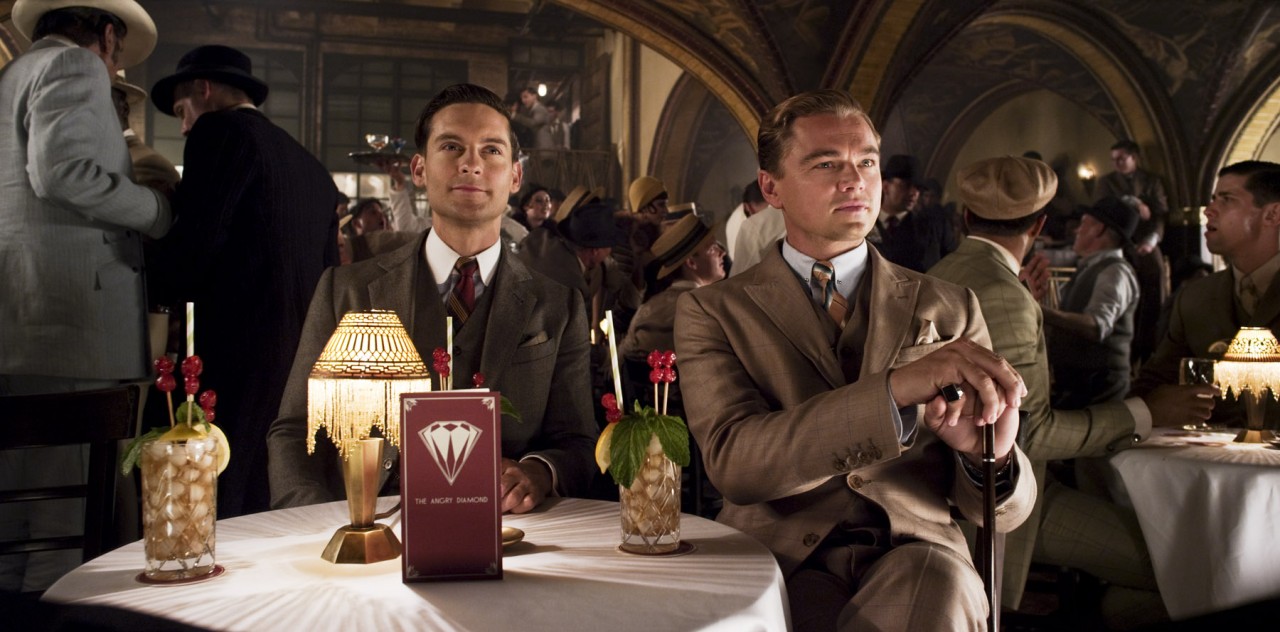
The fact that this film knows, respects, and acknowledges that makes me appreciate this movie, and hope that others can appreciate it too through DiCaprio’s performance and the mythology being revisited here.  Those who read the book should already know the story: a 1920’s bond salesman and struggling writer named Nick Carraway (Tobey Maguire) moves into New York city, where he learns of his rich next door “neighbor” named Jay Gatsby (Leonardo DiCaprio).

I put “neighbor” in quotations because Nick never actually sees Jay Gatsby in the beginning of the film.  All he ever sees of his estranged, self-secluded neighbor is a man looking behind some curtains and holding lavish parties in his mansion in the cool of midnight.  All he ever hears of him is scandalous rumors and war stories about a man many people haven’t met either.  The more Nick lives in his lonely little house, the more he questions if Mr. Gatsby even exists.

Eventually, Mr. Gatsby of course does introduce himself, but not as the host of the party, but rather, as a humble servant who offers Nick a drink on a plate of beverages.  As Nick becomes more familiar with Mr. Gatsby and his lifestyle, he soon learns the truth of Mr. Gatsby’s past and the reasons he really came to New York.

When I first heard of another Great Gatsby picture being made, my first reaction was excitement and anticipation.  How could it not be?  From the creative mind of F. Scott Fitzgerald and the many politics and emotions he makes you feel in his novel, it sounded like this movie was going to be a home run for both fans and non-fans of the book.

Then I learned that Baz Lurhmann was writing and directing.  And then bowed my head and uttered a long, dubious groaaannnn.  Lurhmann, who is most known for directing 1996’s Romeo + Juliet and 2008’s Australia, is commonly remembered as a director who abuses style over substance.  With the previous films I just mentioned, not only are they silly, soupy, and sappy menial dramas: they fail to even attain interest, and are extremely forgettable in a line of much better romantic dramas, including Titanic and the 1968 Romeo And Juliet by Franco Zeffirelli.

Note: Okay, I’ll admit I haven’t seen his 2001 film Moulin Rouge!.  Does it matter though, when out of his entire filmography, that’s the only film he can really brag about?  

The beginning of The Great Gatsby, much like Luhrmann’s other pictures, also suffers from this case of style over substance, with its overly boisterous parties and distracting art sequences making no coherent sense or adding anything to the picture overall.  What I found interesting, however, is that the first act barely matters.  When Jay Gatsby is finally introduced, the film takes a sharp turn of interest and invigorates the audience with new energy, almost like the character changes the entire tone of the film simply by him just being there.

I imagine this is the kind of Jay Gatsby that Fitzgerald would have wanted cast: the type that dresses in nice suits, stands straight with his chin up, and one who enters a room with such stillness that you could hear a penny drop.  The casting directors knew that their casting decision would be crucial to the film, and I think Fitzgerald would be pleased with the end result.  DiCaprio hits every single note dead-on this fascinating character, and just by sheer appearance, demeanor and dialect does he inhabit the character of Jay Gatsby and allow audiences to slip into his conscience and feel what he is feeling.

Oh, I won’t deny everyone else is good in this movie.  Joel Edgerton is effective as the antagonist, and even though he’s an industrial pioneer much like Gatsby is, he has such a hateful energy about him that makes you just want to run him over with a yellow beetle.  Carey Mulligan is good as Gatsby’s love interest, and perfectly shows all the innocence and indecisiveness of her character in the midst of all the ruckus.  Maguire, as well, is perfect as Nick Carraway, not as a character in himself, but as a silent observer, a passive voice who quietly watches over the scene, acting as the audience’s eyes and ears in this third-person narrative.  But its DiCaprio who sucks us in, DiCaprio who winds us up and plays us like a record as he asks us to sit through this tender, emotionally captivating journey that serves as a metaphor for the wealthy and for the industrial era.

And don’t worry, I’ll give Luhrmann credit too.  This film would not have survived without his writing or directing, as he has such reverence for the book and a great fear from deviating from it that the movie functions more as a love letter to Fitzgerald than it does as a strict book-to-movie adaptation.

Regardless, there’s only one person who shines the most here.  DiCaprio made this movie, and through his performance we were able to identify with a character that struggles with his past, his wealth, his love, and the deepening sadness that he hides behinds his warm, welcoming smile.

Tagged , , , , , , , , , , , , , , , , , , , , , , , , , , , , , , , ,

Jackie Robi– I Mean, Chadwick Boseman, Will Become James Brown In Biography Picture

Fans of the home-run hit 42, prepare to be excited.  It was announced earlier this morning that Chadwick Boseman, the little-known actor that landed the knockout role as Jackie Robinson in 42 is set to portray R&B and soul legend James Brown in an upcoming biographical picture.  Announcement by Variety is below:

Universal and Imagine Entertainment have greenlit the long-gestating James Brown biopic after tapping “42″ star Chadwick Boseman to play the legendary artist known as the “godfather of soul.”  Several actors were vying for the role, but Boseman emerged as the top choice a few weeks ago, though no offer could be made until the pic was formally greenlit.

Anyone who has seen 42 has reason to be excited: Boseman was masterful in the role as Robinson, equal parts affectionate and charismatic as the game-changing black baseball player.  I wrote in my review of the picture that Boseman “inhabits the role so well that it is impossible to think of anyone else replacing him… Jamie Foxx couldn’t have done better than Boseman did.” I still hold by that statement, and I still believe that he is a developing talent to be reckoned with.  I’m going to look forward to his performance in this film with great interest, hoping that Boseman will do the same thing to Brown and music as he did with Robinson and Baseball.

On a flip note, the production team behind the picture has been announced as well.  Screenwriters John and Jez Henry Buttersworth are set to write the screenplay (With the duo having collaborated on 2010’s Fair Game starring Naomi Watts), produced by Brian Grazer (A Beautiful Mind, Friday Night Lights) and to be directed by Tate Taylor, writer-director of the 2011 audience favorite The Help.  Even though I have yet to see Fair Game, I have loved all of the films that this team has both produced and directed, and I don’t think the James Brown movie could be in better hands.

What do you guys think?  Are you excited for the team put together for James Brown’s biopic?  Or do you wish someone else were to be included instead?  Another casting option perhaps?

Whatever your opinions, comment below, let me know.

-David Dunn

Source: Variety, Cinemablend

Daredevil (Oops, I Mean Ben Affleck) Will Be Batman In “Man Of Steel 2”

Okay, before we go any further, just stand still and take a deep breath.

You still with me?  Good.  Hold on to your rancheros, this is going to be crazy.

Just hours ago, breaking details emerged about the upcoming sequel to Man Of Steel featuring a rebooted Batman.  The part has been cast, and the new man is…

Ben Affleck.

Didn’t see that coming, didja now?  With names like Josh Brolin, Joe Mangiello, and Jon Hamm swirling around, I don’t think anybody expected the part to be cast this suddenly or abruptly.  Then again though, casting news like this isn’t naturally to be expected, now is it?

Greg Silverman, President of Creative Development at Warner Bros., said this at the announcement of the new Bruce Wayne/Batman:

“We knew we needed an extraordinary actor to take on one of DC Comics’ most enduringly popular Super Heroes, and Ben Affleck certainly fits that bill, and then some. His outstanding career is a testament to his talent and we know he and Zack will bring new dimension to the duality of this character.”

Zack Snyder on Ben Affleck’s casting:

“Ben provides an interesting counter-balance to Henry’s Superman. He has the acting chops to create a layered portrayal of a man who is older and wiser than Clark Kent and bears the scars of a seasoned crime fighter, but retain the charm that the world sees in billionaire Bruce Wayne.  I can’t wait to work with him.”

If we’re talking about Zack Snyder’s vision, Affleck certainly fits the bill.  Knowing that this sequel is partially inspired by Frank Miller’s “The Dark Knight Returns”, Snyder needed an older, more hardened actor to play an older, hardened Bruce Wayne.  With Affleck staring in gritty, hard-edged crime thrillers such as State Of Play, The Town, and recently Argo, I would definitely say he has the chops to play both the charming playboy and seasoned crime-fighter that Snyder needs for his picture.  Congratulations on his casting.  I look forward to seeing how he does.

What are your opinions?  Are you happy that Ben Affleck is the new Batman?  Or are you furious that they didn’t stick with a younger, lesser known actor like Henry Cavill was to Superman?  Or do you just wish that Christian Bale would return for the cowl one more time?

Whatever it is, comment below, let me know.

“He’s the hero we deserve, but not the one it needs right now.”

-Commissioner James Gordon

Source: Warner Bros, The Huffington Post

An Absent Presence

Forging back into the 2013 Fall Semester of my school year, I’ll be diving headfirst into a semester of studying, schoolwork, journalism, reporting, and extracurricular activities mostly involved with the Kappa Sigma fraternity.  Because of this, I will not be able to visit this site and post as frequently as I would like to.  If this were any other year, I would be sulking about in this return, mostly drowning my sorrows in some Elton John and endless bottles of Coca-Cola.

What does this mean for me though, now that I have discovered my site and my newfound presence on the blogosphere?  Not much really.  I’ll still be putting posts up on my website, writing reviews, reporting news announcements, and piping up my own opinion on ‘The Scope’ every now and then.  None of my functions on this site have changed one bit.  The only difference between the semester and now is that my postings will be more irregular than they already have been, and I won’t be able to post on my site as much as I want to.

Again, this doesn’t mean much difference except for a quantity of articles.  Experienced film critics like Peter Travers or Michael Phillips post an average of 4-6 articles every week.  At my current rate, I have only been producing about 2-3 articles every two weeks, reaching Travers or Phillips weekly numbers by the end of a month.  That’s embarrassing, isn’t it, to admit that you’re one-fourth of a professional film journalist?

It is what it is.  I choose not to compare myself to those journalists only because I haven’t reached their level of expertise yet.  If there is anything that I’ve learned this summer of film reviewing, its that film criticism takes a great amount of thought and dedication.  It’s not enough to simply watch a movie and have an opinion of it: people do that automatically, from the petite three-year-old toddlers to the average 80-year old retiree.

It’s easy for anyone to have an opinion, and its easy to assess why you have that opinion.  What’s difficult is deciding who the film’s intended target audience is, and whether it will appeal to that audience or not.

The difference between myself, Travers, Phillips and normal moviegoers is that we’re required to assess what elements will appeal to its target audience and what will not.  We do this through the words we write in our critiques.  Whether we liked a film or not isn’t the point: people should be able to read your review, and whether they agree or not, should at least reason whether or not it will be something they want to see or not.  This seems like it would be a simple job, but not when you think about all the elements you need to take into account when writing your review.  How easy is it, for instance, when trying to describe whether movies like Taxi Driver, Cloud Atlas, or The Tree Of Life will win over its target audience or not?

Nevertheless, I have had a great thing happen to me over the course of summer break.  I have learned what it meant to be a film journalist and I gained more experience as to what the online database is like.  When I first started this site, I had little to no clue what I was doing.  I played with menus, I designed topics, I took photos, I practiced with designs, and I kept fleshing out what my site would look like and how I would market it to my audience.  When I first started, all I had was a few articles and many, many empty pages. on my site  Now, I have had well over 800 views of my articles, I have seven subscribers, and I have people regularly commenting on my articles whenever they pique their interest.

My site is not at the level of my other fellow bloggers, but that is besides the point.  This is a great starting point for me.  Over the course of the summer, I’ve learned the value of consistency, accuracy, opinion, and debate, and I’ve got to experience what going “viral” felt like.

To which I need to say one thing to whoever is reading this: thank you.  I would have not made it this far without your interest and support, and I certainly would not have made it this far without your initiation to click onto my page.  Whether you commented on an article, shared a link, subscribed to my page, or either just pointed-and-clicked any of my articles on Facebook or Twitter, your support has helped me mature as a writer/journalist/blogger/critic, and helped me better understand the world I am trying to appeal to.

So again, and again, and again, I say thank you.  This is not a goodbye, but rather, I’ll see you soon.  To the seven-or-more people who consistently follow my site, you are in my upmost regards and appreciation.  I’ll be back before you know it.

To those who are visiting here for the first time, I encourage you to stick around.  A few surprises just might come your way.

-David Dunn

“MY NEIGHBOR TOTORO” Review (✫✫✫✫)

My name isn’t Totoro, kids.  It’s Hayao Miyazaki. 

Now this is what we’re supposed to get when we go in to see an animation picture.  My Neighbor Totoro is everything you expect it to be, and equally as much everything you don’t expect it to be.  This is definitely a kids movie, intended to fulfill the needs of the most innocent and simple-minded of younger viewers.  But this is a rare treasure for adults too, a film that is equally fulfilling and emotionally appealing to older audiences as it is upbeat and joyous for the younger ones.

Taking place in 1950’s Japan, My Neighbor Totoro follows the story of two young sisters named Satsuki and Mei (English dub by Dakota and Elle Fanning), who are moving into their new home with their father Tatsuo (Tim Daly) in order to be closer to their mother in the hospital, Yasuko (Lea Salonga).  Their mother has been sick with an unknown disease for quite some time, and it really concerns the girls because they can’t even get her home for a visit.  Most affected is Satsuki, because her father is always busy, Mei is painstakingly afraid that her mother will leave them, and Satsuki is forced to be the strong one during this time of hardship.

Deep in the forest though, the girls encounter strange beasts of wonder and splendor.  There are these small, darkly black fuzz balls called soot spirits, who hibernate from one dark spot to another.  There are two bunny-like creatures, one white young one who can phase through objects like a ghost, and an older blue one who carries a knapsack of acorns with her everywhere.  Most fascinating though, is a giant, loud, gray beast called Totoro (Frank Welker), a gentle-hearted forest spirit who loves nothing more but to sleep and play on his flute in the silence of the night.  The girls are at first afraid of Totoro’s large, intimidating appearance, but through his gentle, kind-hearted spirit, learn to appreciate him and become friends with Totoro and the forest creatures.

Written and directed by Hayao Miyazaki, My Neighbor Totoro is a rare animated film where the characters are as vibrant and colorful as the beautiful animation that is being expressed on screen.  You really just need to see these little girls in action: they’re one of the most energetic, emotional, endearing, and inspiring little characters I’ve ever seen.  I knew from the first moment I saw them that I would like them: they are these little oddballs of energy, two cute girls who are literally exploding with energy and enthusiasm as they run across the front lawn, or explore the mysteries of their upstairs attic.

The best moments, however, come from when the little girls encounter Totoro.  Looking from a straightforward perspective at Totoro, its a case of what you see is what you get.  He’s a big, fluffy creature who loves to eat, dance, fly, talk (and by talk, I mean roar loudly), and more than anything else, sleep.  If this were any other animated film, I would say the character was another interpretation of Garfield.

I, however, think Totoro is required for more fervent analysis.  I can’t help but look at Totoro like an emotional recompense for the girls, almost like an imaginary friend to distract them from the pain they experience everyday through their sick mother.  Kids with only one parent will know what I’m talking about: when the one you love is in pain or worse, they want everything in the world to distract them from the reality of what they are experiencing.  Its simply too painful for them to take in all at once.  They need something to distract them, to divert them from reality, and so the younger ones try to focus on something fictional that will put their mind at ease, like an imaginary friend for them to talk with.

Totoro reminds me of that imaginary friend.  Unlike an imaginary friend, however, Totoro is real, and this is proven through the interactions he has with the girls.  He is not just a simple-minded, unintelligent forest animal.  He is considerate towards the girls.  He cares for them.  He expresses real and genuine affection for the girls, and he shows this by dancing with them in the middle of the night, growing trees with them in their backyard, or by letting them ride his Cat Bus in cases of emergency.  Even though Totoro is fictional, he’s the most real thing in the movie, taking the girls story filled with hardship and tragedy and filling it with energy, enthusiasm, and life that cannot be faked in a movie.

Every single fiber of me wants to look at this movie and say it is a perfect film, but something stops me.  What is it?  It certainly isn’t the characters, the animation, the story, or the emotion being expressed on screen.  What is it then, if its none of the above?

Of course, I think.  Accessibility.  The weakness with this film, much like the stark foreign language films and the ancient black-and-white silent films, is that it strictly appeals to a certain audience.  You know what I’m talking about: what is the typical american viewer going to see, a boisterous and explosive action movie with big name actors starring in it, or some independent animated film made by some guy whose name they can’t even pronounce?  The weakness here is this: people who don’t like anime won’t like it, and probably shouldn’t see it, because this film mainly appeals to that same audience and culture through its story and through its execution.  Because of that, Totoro will lose some viewers in its audience.

But even then, is that the fault of the filmmaker for not conforming to their tastes, or the audiences for not being open about it?  Regardless of what you think, My Neighbor Totoro is a magical little film, an uplifting and wonderful fantasy that taps into the inner child in all of us, and in many ways reflects the behavior of children: animate, lifelike, endearing, sincere, and visually expressive.  It’s a movie whose characters are so precious and lifelike that a live-action portrayal couldn’t have been as real as this.  It’s a film that allows us to believe in miracles, even if we don’t necessarily believe in them.  And at the heart of it all is Totoro, a warm, fluffy forest spirit that only loves children more than he does sleeping on his favorite moss bed.

Tagged , , , , , , , , , , , , , , , , , , , ,

“Interstellar” Principal Photography Begins With Christopher Nolan In Canada

Nolan die-hards, this should fuel your appetite for science-fiction fantasies.  Details have recently emerged that Christopher Nolan, the award-winning director behind Inception and The Dark Knight trilogy, just started principal photography behind his newest film, Interstellar in Alberta, Canada earlier this morning.

Featuring an all-star-studded cast including Matthew McConaughey, Anne Hathaway, Jessica Chastain, John Lithgow, Casey Affleck, and Michael Caine, Interstellar follows the story of a group of explorers who have discovered a wormhole that can allow them to travel through space and time.  The explorers eventually use the wormhole to travel great distances in an interstellar voyage across the universe.

I love Christopher Nolan.  He is perhaps one of my favorite contemporary filmmakers who are out in the business right now.  I don’t think its possible for anyone to hate him: how can you, with other movies like The Prestige, Insomnia, and my personal favorite Memento under his belt?

Besides with Nolan serving as director and co-writer, the film also has Nolan’s wife Emma Thomas producing alongside Lynda Obst, brother Jonathan Nolan as screenwriter, and frequent collaborators Lee Smith and Hans Zimmer editing and scoring, respectively.

Interesting enough, Nolan’s frequent collaborating cinematographer, academy-award winner Wally Pfister, will not be collaborating with Nolan on this film.  That job is handed to Hoyte van Hoytema, the cinematographer behind films such as The Fighter and Tinker, Tailor, Soldier, Spy.  Pfister is busy with production of his own director debut Transcendence, a science-fiction story about a man’s conscious being uploaded to a computer after he is assassinated by terrorists.  Nolan is serving as executive producer for the film, with both movies slated for release in 2014.

Excited?  Concerned?  I know there are some people out there who aren’t Nolan die-hards out there, but what are your thoughts?

Comment below, let me know.

-David Dunn

SOURCE: Deadline, Latinoreview

“THE BOURNE LEGACY” Review (✫1/2)

This movie has the wrong title.

The Bourne Legacy is a misconstrued mess, an absolute miscalculation and train wreck of a film that it has no business being made into a movie in the first place.  I hated this idea months before this was released, and I hate it even more now after having seen it.  Who, in their right minds, thought it was a good idea to make a Bourne movie without Jason Bourne???  That was my biggest concern going into the movie.  Believe me though, fellow moviegoers: that is the least of your worries.

Taking place shortly after the events of The Bourne Ultimatum, The Bourne Legacy shows the repercussions of Bourne’s actions, how it affects Treadstone, and what marks it leaves on the people involved.  Erik Byer (Edward Norton) is a government official who was directly involved with the affairs of Treadstone during its days of operation.  Shortly after Jason Bourne escapes their custody, however, Byer believes that all of the agents now are a potential threat to the government, and is convinced that he needs to shut the project down in order to protect themselves.  By “shut the project down”, I really mean kill all of the agents in the field.

One of these agents is Aaron Cross (Jeremy Renner), an experienced field agent who is carrying out a mission in Alaska for Treadstone when the order was released.  While taking refuge in a wooden cabin with another fellow agent out in Alaska, they are suddenly attacked by robot jets, and Cross barely escapes with his life intact.  Surviving only because of the medication he is on (Treadstone agents are required to take two pills, a blue one for physical boosting, and a green one for mental boosting), Cross looked into his stash to realize that he only has a couple days worth of medication left.  Now low on food, supplies, and ammunition, Cross must now find a way to get back to America and survive against Treadstone long enough to find a way to counterattack their onslaught.

Let me start with the most obvious flaw here: Tony Gilroy.  Looking at his filmography, you would think he would be the best man for the job here.  He was credited as co-writer for the three previous Bourne movies, he wrote and directed the Oscar-winning drama-thriller Michael Clayton as well as the 2008 caper film Duplicity.  I enjoyed all of those movies, and thinking that this one would be the same, made the mistake of thinking that it would be just as good.

Trust me, this couldn’t be any more of a dissapointment.  Everything wrong with this movie has everything to do with Gilroy’s script and direction, which couldn’t be more forced, erratic, confusing, and half-lapsed than this.

The problems start with the premise: a Jason Bourne movie without Jason Bourne is a bad enough idea.  But let’s take a step back here and try to be open with this.  Let’s just say, for facetious effort, that Aaron Cross’ story is just as fascinating and compelling as Bourne’s is.  What are the conflicts?  In his first three movies, Jason Bourne’s struggle was against his morality, identity, and the confronting of his past.  What is Cross’ magnificent, epic struggle?  Survival by trying to find a green pill.  If this movie dwelved any more into the conflict than it did, I would have said Cross was a junkie.

“Funny”, I think.  “I don’t remember these pills being used in the original trilogy”.  Correction: I vaguely remember them.  In a brief flashback sequence in The Bourne Ultimatum, I remember Jason Bourne taking a blue and green pill during his initiation into Treadstone (this memory is hazy though).  Bourne obviously didn’t need to take the pills further because his body adapted to the drugs.  Here, Cross is dependent on the drugs like a junkie is on cocaine, and if he doesn’t get his daily dose of the green pill, he’ll apparently revert to the level of intelligence of Forest Gump, according to him.

Okay, that’s fine.  Jason Bourne isn’t in the movie, check.  Super pills gives Cross super powers, check.  I would be able to buy the premise and its characters if A) it were handled well, or B) it was anywhere near as smart, interesting, or even remotely readable as it was to The Bourne Identity.  Here, instead of intelligence we get confusion, instead of cleverness we get forced easter eggs to earlier movies, and instead of interest we get on-the-nose, ham-fisted writing.  The editing in this film is choppy, leaping all over the place, jumping from one timeline to another, one flashback to the next, and it becomes so repetitive and convoluted throughout the picture that by halfway through I stopped caring about it.

Oh, I don’t deny Jeremy Renner is a knockout in this role.  Neither do I deny the talents of Rachel Weisz, Edward Norton, and especially not Joan Allen or Albert Finney.  All of the performances are great, but the story is a complete wreck, and Gilroy clearly has no idea how to handle his premise or the cast he’s been given for this.  What more proof do you need, besides this convoluted script, an uninteresting story, and a tedious chase sequence at the end with a sharply abrupt cliffhanger?

This is exactly the reason why I hate sequels.  When done well, like the original Bourne trilogy, they are compelling, brilliant expansions furthering the story set up by the first one.  When done like this however, they are nothing but forced, awkward, nonsensical garbage.

Again, I ask this: why did this movie have to get made?  The Bourne Legacy is exactly what you expect it to be, a Bourne movie without Jason Bourne, equally without the compelling character drama or real conflict in it. And now they’re talking about a possible sequel to this mess.  Only if Jason comes back and kills Aaron Cross.  That’s the only way they can redeem themselves at this point.

Tagged , , , , , , , , , , , , , , , , , , , , , , , ,

“42” Review (✫✫✫✫)

Thanks, Jackie, for showing us white folks how its done.

You’re not watching a movie when you watch 42, you’re watching a legacy.  You’re watching one man’s story as he started from the bottom, as a black baseball player living during the accursed segregation era of our country, who is suddenly called to greatness and is demanded to be a bigger and better person than he thinks that he is.  It isn’t entertainment as much as it is a retelling of one man’s life, and everything he had to go through during the turmoil and cruelty of the 1940’s.

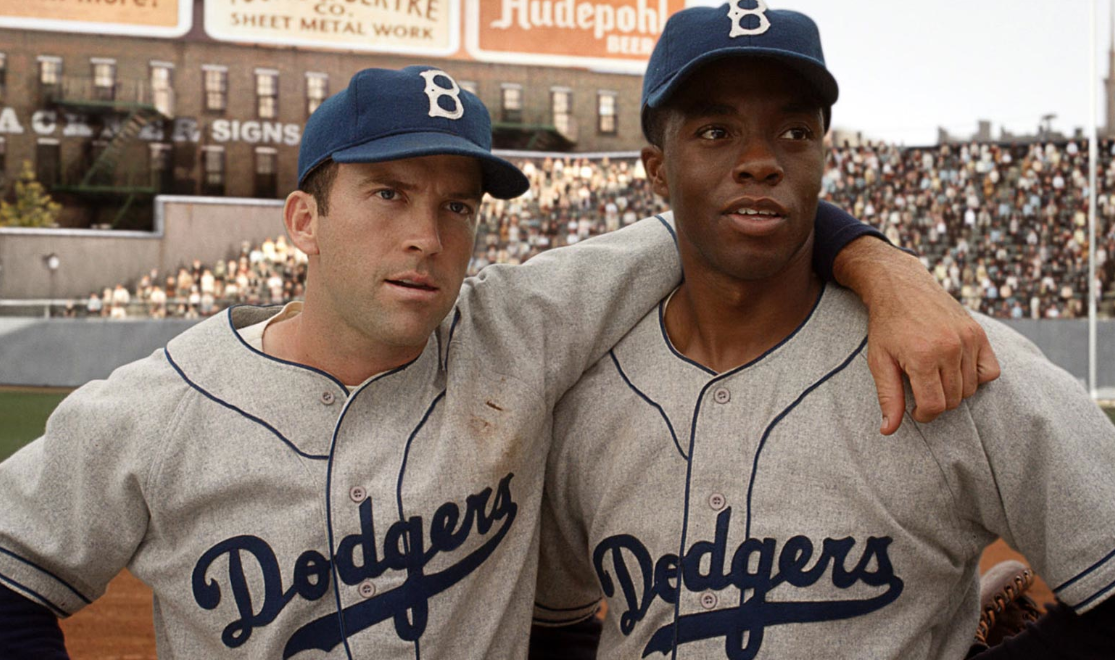
This man, of course, is Jackie Robinson, the black man who did to baseball what Rosa Parks did to buses.  Portrayed here by newcomer Chadwick Boseman, the movie starts off showing the beginning of  Robinson’s career with the Kansas City Monarchs, a primarily black baseball team who gets treated the same way at a gas station in the way a homeless man would be.  Robinson doesn’t stand for it, but it doesn’t matter: he is soon recruited by a man in a black van asking him to come with him to meet with baseball executive Branch Rickey (Harrison Ford), who wants to be the first man in American history to recruit the first African-American ballplayer onto the Brooklyn Dodgers.

His assistants are baffled.  “A black baseball player on a white baseball team”?  What are his reasonings?  Rickey makes multiple excuses, from the financial benefits to simply being different.  It isn’t until later in the film where a much deeper reasoning is found in Rickey’s baseball history, though I dare not spoil it just for the sake of you being able to experience it yourself.

Eventually, Robinson has his meeting with Rickey, and he’s surprised when Rickey tells him that he wants to recruit him on the Brooklyn Dodgers.  There’s only one condition Rickey has for Robinson: he wants him to control his fiery hot tempter when white players act out unfairly against him.

“I don’t want a man who has the guts to fight”, said Rickey.  “I want a man who has the guts not to fight”.

There are two things that make this movie stand out from the typical baseball-biography picture: the director, Brian Helgeland, and its lead, Chadwick Boseman.  Boseman, who is mostly a no-name actor, dives headfirst into his character, and inhabits the role so well that it is impossible to think of anyone else replacing him.  You just need to see this guy in action: the way Boseman puts himself out there is just like how Robinson would have played on the field, from digging his hands in the dirt to firm his grip, to stealing second, third, and home bases like he was taking candy from children.  It’s especially funny watching him getting ready to steal bases: he jogs his legs together and shoots a look at players with a face that says “Come at me bro” to which pitchers get obviously frustrated at him.  Jamie Foxx couldn’t have done better than Boseman did.

But its just not the movements, the pitches, and the home-run hits Boseman delivers that makes him a convincing actor: his expressions are flawless, his dialogue delivery spot-on, and his performance so affectionate, with his every spoken line coming across truthfully and genuinely from the heart.  I could name multiple scenes in the movie, on the field and off, that genuinely touched me.  Perhaps the most memorable with Boseman was when he was out on the field ready to bat when a baseball manager starting shouting racial expletives at him.  I’m not even kidding: if every other word he was shouting wasn’t a profanity, it was the N-word.

This scene was powerful, frustrating, and maddening all at once, and we could feel our anger channel through Boseman when he had to hold his tongue, when he had to walk off the field, and when he screamed in the locker room, breaking his bat against the walls in furious anger.

Oh yes, many emotions were felt in this movie, and writer-director Brian Helgeland does a great job at expressing all of them.  Surprising, I think, that the same man who wrote and directed the tonally inconsistent A Knight’s Tale was able to make a movie this sincere and heartfelt.  I’m being unfair though: I forgot that Helgeland also wrote the screenplays behind movies such as L.A. Confidential and Mystic River, and here he brings that same sense of grounded realism from those pictures into this one.  Throughout the course of the picture, Jackie Robinson grows as a person and as a player, and so do the people around him.  Relationships become bigger.  Bonds become stronger.  Intimate details are revealed through each character to Jackie, and through his stressful, agonizing, and roller-coaster emotion journey Jackie becomes the hero that nobody expected him to be: not even himself.

If a weakness exists, I’ll admit that 42 is straightforward storytelling, with little room for originality or surprises.  That’s only because we already know the history though.  What 42 lacks in innovation, it makes up for in emotion, in gripping and well-written storytelling with a great cast compelling us through it, with especially one of the performances being completely unexpected.  The best moment of the picture comes after Jackie grows closer to one of the players, the player encourage to not feel fear when openly associating himself with a black man.  As they run back out to their respective places in the field,  the player calls out to him: “Maybe tomorrow we’ll all wear the number 42.  That way they won’t tell us apart”.

Tagged , , , , , , , , , , , , , , , , , , , , , , , ,

James Cameron Confirms New Writers For “Avatar” Sequels

Avatar haters, you are not going to dig this.  Details have recently emerged about the sequel’s to James Cameron’s Oscar-winning 2009 film Avatar, the sci-fi blockbuster that broke boundaries in technical achievements and is currently the highest grossing picture of all time, minus inflation.

The announcement made by Cameron earlier today has confirmed it: Cameron has hired three new writers to help penn not only Avatar 2 & 3, but also a fourth installment to be released sometime in 2018.  The confirmed contributors to the project are Joshua Friedman (Steven Spielberg’s War Of The Worlds), Shane Salerno (Oliver Stone’s Savages), Rich Jaffa and Amanda Silver (Rise Of The Planet Of The Apes).

And again come the sequels.  What is the world coming to when we have to recycle everything every two-to-three years?  Unlike my other fellow film lovers who seemed to hate the movie, I for one loved the first Avatar.  I loved the characters, the concept, the stellar visuals, Cameron’s expert handling of the premise, and ultimately how he, through the story, came to resonate Sully’s conflict with that of the oppressed indians during the Cherokee trail of 1849.  It was not only an ambitious film, but an intelligent film, and a wondrous sci-fi blockbuster that genuinely made great use of its visuals and of its concept.

That being said, you all know my views of sequels.  The more movies that are produced, the less likely it is to be compared to the original one.  I like that Cameron is enlisting in the help of four other writers, and believe that it will help stretch and expand its story to greater heights.  But there is still the greater danger of the story being unaffected, no matter how many writers are attached.  Example: Armageddon had nine credited writers for its screenplay.  Nine.  Was it a fun movie?  Yes, but was it intelligent-worthy of nine writers???  I’ll let you answer that for me.

What are your thoughts?  Some people loved Avatar, others hated it.  What are your views, and what are your thoughts on the sequel?  Comment below, let me know.

-David Dunn

SOURCE: LatinoReview, Cinemablend