Category Archives: The Scope

An Afternoon With Alejandro Inarritu

“And did you get what you wanted from this life, even so?

I did.

And what did you want?

To call myself beloved, to feel myself beloved on the earth.”

– Raymond Carver

These were the words that director Alejandro Inarritu (Babel, Biutiful) chose to quote at the beginning of his meticulous film Birdman, or The Unexpected Virtue of Ignorance. It was also the first words that came back into my head minutes before I was to interview him.

This weekend, I had two great experiences happen to me. Firstly, getting to see Birdman, a viciously unique film that tackles it’s characters and themes with pinpoint precision: a masterwork by a master director. The second you already know. If you don’t, you didn’t read my first paragraph.

Alejandro gave myself, along with about ten other college journalists, the privilege to talk to him about his upcoming limited release. After seeing the movie, this surprised me, because there was a moment in the film where a journalist accuses the main character of injecting semen into his pores to maintain his young features. I suspect Mr. Inarritu hosts a very guarded spirit while being interviewed by the press, and I certainly don’t blame him for that if that is the case. Now that I think about it, maybe that’s why Inarritu wanted to host the interview over the phone in the first place.

Anyhow, I had 20 minutes to listen to the director’s innermost thoughts, and while I only got to ask him one question, I enjoyed the experience as much as any other college journalist who participated in the call. While all of these aren’t my questions, these are the ones I found the most relevant to the film, and the ones I believed Inarritu would have preferred to be answered in the first place. So without further adieu, here is Alejandro Inarritu on the unexpected virtue of ignorance.

Question: Your film is unique, hyperactive and full of energy. How do you communicate to your cast the complex tone you’re wanting to portray?

Answer: I always try to be very specific, help them to clarify and simplify things by having a very clear objective. I think every scene has an objective, and every character has something they want to achieve in each scene. When you have cleared your objective, and to try one or two possible ways to get that done through an action verb, I think that would simplify the work not only for me, but for everybody.

Q: What were some of the challenges you faced while making the film? 

A: It was a very short shooting — 29 days. We rehearsed a lot before arriving to the set, so basically it was a very intense and meticulous work of precision with actors, camera and crew. Everything was designed and matched the needs of the film that was basically predecided in rehearsal.

Q: You have a big role behind your scenes in producing, writing and directing all of your films. What is it like taking on all of those jobs at once? 

A: I have been lucky to have been the producer and be involved in all of my films in a very personal way. I think there is no other way to make it. I think if you have a film that is personal, if you are doing your own film, there is no other way to not produce it, because I think it’s a part of the film. Producing means a lot of decisions that will impact your film one way or another.

Q: In the movie, Riggan Thompson is overshadowed by a superhero role he played earlier in his career. In real life, Keaton is overshadowed by his role in Tim Burton’s Batman. Is that an intentional casting decision that you made?

A: Keaton adds a lot of mental reality to the film, being an authority and one of the few persons of his work that pioneered the superhero thing. But at the same time, he has the craft and the range to play in drama and comedy, and very few actors can do that. He plays a prick in this film, and I need someone who was adorable, somebody who you can really like. He has that likeness, that likeness that was required. All of these things made him the perfect choice for it. I think he was very bold in trusting me with this role.

Q: One of the things that is particularly interesting with the film is the long take. Can you talk about why you made that visual choice?

A: I wanted the long take to make the people really feel the experience of this guy. I think it’s important for every director in every film to pick the point of view, and in this case I wanted radical point of view, and the people were in the shoes of the character to experience his emotions. I felt that was the most effective way to do that.

Q: Why did you choose to portray mental illness in a film that is at least extensively a comedy?

A: I think ego is a part of our decease as a society. I think the ego is a necessity, but I think when the ego takes over and we attach our personalities to the ego, and he domains a person absolutely without being discovered or controlled. That’s mental deceit, and I see in a way Riggan Thompson suffering from that illusion of ego that’s distorting him. He thinks he does things that he does not do, he’s in like a manic state of mind. He’s an extreme case of ego.

Q: Is that part of the commentary?

A: Everything is part of the tone of the film. That’s why it opens with a guy meditating in tidy whites.

– David Dunn

Tagged , , , , , , , , , , , , , , , , , , , , , , , , , , , , , ,

He’s Not Fat. He’s Fluffy.

Out of all of the celebrity interviews I’ve ever had the pleasure of going to, I don’t believe I’ve ever had as much fun as I did speaking with comedian Gabriel Iglesias. Iglesias, who also goes by his comedic identity as “Fluffy” was born 1976 in California, which is also his current place of residence. After we introduced ourselves, he talked about how he’s been up since 6 a.m. promoting for his new movie The Fluffy Movie, in theaters July 26, and how he just got to eat.

That’s when I noticed his shirt, which sported a logo of a famous autobot that I loved from a series featuring transforming robots.

“Can I just say that I love your shirt?” I told him.

“Man, I love it to,” he replied. “Even though they don’t want me to market with it. They’re like ‘You should be wearing your old shirt!’ I’m like ‘Man, come on. Really?'”

As we sat down at got ourselves comfortable, me and the other journalists at the table starting asking him questions regarding his early beginning as a comedian. Before becoming the highly-popular comedic phenomenon that he is, Iglesias worked as a salesman for a company called LA Cellular, which would later merge with a company called AT&T.

“We call them the cancer phones, the ones where you put them against your head and you can feel like you’re talking with a microwave,” Iglesias said. “Like, you could use your phone as a weapon. If you dropped your phone back then, you could throw your phone, it was fine, it was industrial, it was meant to last. Not like now, you dropped it off a table, you’re like ‘Oh shoot, there goes 800 bucks.’”

Iglesias took his chance at comedy when he went into a club late into his career as a phone salesman. He even remembered the date that he first performed: April 10th, 1997.

“There was somebody  in the crowd that saw me and he goes ‘Hey, you’re funny. We got a comedy show at this nightclub next week. I’ll pay you $20,'” he said. “So after my first night performing, I already got my first paid gig.”

When I asked him about when he hit mainstream attention, when he became “Fluffy”, he corrected me, saying at how those were two different things.

“I was always known as the Fluffy guy, ever since I started,” he said. “That was always a nickname. In the beginning, people wouldn’t remember ‘Gabriel Iglesias.’ After the show, it’s ‘Hey, good job Fluffy!’ I’m like ‘Ugh, come on man, half of my name is already famous, work with me!’ I would be like, really?”

Iglesias said his career took off once he learned to use the name “Fluffy”.

“I just started embracing it so much that I started marketing it,” he said. “Now its to the point where years later, if you type ‘Fluffy’ in Google or Bing, I’d beat everything. I’m number one. I’d beat out bunnies, cotton candy, quilts, you name it. It works for me, and I’d rather people call me Fluffy than mess with my name. It’s one word, like ‘Cher.’ If I dropped Gabriel Iglesias all together and I just started going by Fluffy tomorrow, people would totally take it.”

Iglesias said that the key to his success has been through networking. That networking has been the key to everything.

“I know a lot of funny guys, guys that are hysterical, that will floor you, leave you bent over just laughing hard, but you know what? They’re really bad at returning phone calls,” Iglesias said. “They’re bad at social networks, they’re really bad at just dealing with people one-on-one, and you know, just negotiating and simple basic things that they’re crippled with, but they’re talented on stage. So someone like that, they need really good management, someone that’s going to be patient with them, somebody that’s going to understand them and speak on their behalf.”

After a journalist mentioned how Iglesias manages all of his own social media, Iglesias said handling it himself has been a big deal to him.

“I don’t want someone speaking on my behalf that’s going to say something I don’t want to say,” he said. “You can tell it’s me that writes the stuff because the grammar is so f—– up. I write everything with an ‘r’ instead of ‘a-r-e’, or a number two instead of ‘to’, I still don’t know how to spell ‘there’ the right way. I always jack that one up, people always correct me, and I’m like ‘Really? Why’d you got to correct me? You let the number two fly, you let the letter U fly, you let everything else fly,’ but I use ‘there’ the wrong way, and I spell ‘there’ instead t-h-i, uh, whatever. It’s so messed up.”

Man, my copy desk chief would be having a fit.

After talking about a time when he was drunk and cussed out his management team on a comedy club stage, Iglesias was asked if he felt like he got too open with his audience sometimes.

“Yeah, like right now,” he said, as the room erupted into laughs. “Probably shouldn’t have said that stuff.”

“But sometimes I do open up a little too much. But if I don’t open up to the crowd, man, I’m not even talking to you at home, I can’t vent about certain things at the house. It’s not the same. At home you get judged. On stage, people are like ‘You know what, I’m messed up like you. I get it.’ And again, at the end of the day, that’s one of the things that people can relate to, it’s like ‘Man, that guy, yeah he’s successful, but he’s still got s— going on.'”

As I conversed with him, I could tell through his speech that his audience was the thing he cared most about his career; about taking pictures with people at the airport and talking to fans as he sat down to order at the Pizza Parlor.

“Just common courtesy, a lot of basic things, they go a long way,” he said. “Any time I perform at a comedy club, talking to the staff, looking at people in the eyes, some people don’t want to just connect at all. You get off the stage, being like ‘Leave me alone,’ it’s like ‘No, why man?’ The staff, they’re the ones that are going to see people and be like ‘Hey, we saw a real funny show, you should come see him, he’s a real nice guy too.’ It goes a long way.”

Iglesias said that he tries to please everyone with his act, and when it doesn’t, he’s bothered by it.

“If somebody says a negative comment on Twitter, I take it so personal, and I care,” Iglesias said. “I care what people say and what they think, and sometimes I care a little too much to where I let it consume me. I’m learning the hard way you can’t please everybody, and that bothers me, because I just want to please everybody. I want everybody to be happy.”

After talking with Jeff Sewell, Improv Comedy Club General manager, for my Shorthorn article, I discovered that he has known comedian Gabriel Iglesias for years. He said that Iglesias hasn’t changed one bit, ever since he met him about ten years ago in Houston.

“He was totally down to earth,” Sewell said. “Everybody you talk to, everybody loves Gabriel. They never have a bad word to say about that guy.”

Iglesias said that despite some disappointments, he won’t change his act, because the Fluffy persona is what helped him sell out stadiums and arenas across the world.

“For people that don’t think I’m edgy enough, well that’s fine,” Iglesias said. “Go ahead, go enjoy whoever makes you laugh. I’ll have fun with my full house.”

To read more on Iglesias, go online at www.theshorthorn.com. My article has a whole slew of good little nuggets, including audio tidbits of some of Iglesias’ best stories that I couldn’t fit into my article.

Oh, and Gabriel also took a selfie with my cell phone.

Yeah. That happened.

-David Dunn

Tagged , , , , , , , , , , , , ,

Dear Twitter: I’m Sorry

Dear Twitter.com,

Hi. I know it’s been a long time. How have you been? Good, I hope. I know things haven’t been the same since, well, you know. I know we’ve been through a lot together, I know that you hold some things against me and I’ve equally held some things against you, but for at least the next few moments, I want to put that behind us just so I can talk to you.

I remember the first time that we met each other. It was August 2012, when my entertainment editor at the time told me that I needed to get a twitter account. The idea infuriated me. “Twitter?!” I thought. “Who wants to deal with that bull4#5+?!”

But I remained open to the idea. I knew for my new job as the film critic that I had to build a social media presence that would help me in my audience syndication, similar to how Roger Ebert and Richard Roeper developed their presence and identities on the blogosphere. But the idea intimidated me. I was never a sociable guy in high school and I wasn’t much better in college. How could I possibly succeed at being social on a site I knew nothing about?

Then I met you. Boy, was my world turned upside down. I was instantly attracted to how neat and clean your format looked, how bright and colorful your pages were and how each tweet was as legible as a line of text messages. But it wasn’t just how you looked: your assets were tantalizing, your tutorial simplistic and ideal and your interface user-friendly. I knew from the moment I met you that we had something special, something that no other blogger could ever match. You and I were more than a team; we were star-crossed lovers, taking down the blogosphere one tweet at a time.

At least, that’s what we both thought. It was good the first few months, with you filling up my feed with content and with me tweeting out stories and pictures as if I knew what I was doing. Soon though, we both started doing things that set both of us on edge, and I don’t think we’ve been the same ever since.

For instance, you would always punish me for writing a tweet longer than 140 characters, and always asserting me with the answer “No” when I told you to publish it. I would yell at you for telling me no and shout at you about why the hell it was 140 characters instead of 140 words. You said that the tweet would be long and unappealing. I told you that your rants were long and unappealing.

We said hurtful things to each other, and our passion and love for each other was all but gone. In short, the reality of the romance quickly set in, and while we kept trying with each other, things just weren’t working out between us.

You remember how things went from there. After talking for a long while, we decided to go our separate ways and see other tweeters.

I’m not going to lie to you, the experience really hurt me. Do you know what bothered me the most though? It wasn’t the fact that you were mean to me. It wasn’t the fact that you were strict or stiff about the boundaries of our relationship. It wasn’t even the fact that you criticized me for any tweet that was over 15 words. It was the fact that you never let me know how you truly feel.

Please don’t lie, it’s the truth. You never talked to me about why the tweets couldn’t be over 140 characters. You never talked to me about what was wrong with you when I had five bars of WiFi, or why it took so long to upload a small file photo. You never even talked to me about your needs, about what you wanted in our relationship and why I wasn’t satisfying you in the ways I was supposed to.

I was not hurt that you were seeing other tweeters. I was hurt because you never talked to me about why. Why did you never talk to me?

It doesn’t matter. I miss you, and I want to give this a second shot. I know, I know, you’re scared and you don’t want this to fail a second time. Let me assure you: I know my mistakes. We didn’t agree on the character limit or the picture space. So what? I don’t care about that. I want to make this work, and I’m willing to work on my mistakes if it means being with you again. This isn’t a joke, and this isn’t me pranking you. I feel like I can make this work. I need you.

If you want to give this a second shot, you can reach me at my twitter handle @dDUnn87. Funny, huh? Exchanging twitter handles just like when we first met.

I won’t pressure you with anything more. I just wanted you to know that I miss you and I want to give this a second shot. Please reach me if you want to as well. I hope you do.

Truly yours,

David Anthony Dunn

P.S.: I saw you online today. You looked lovely.

Tagged , , , , , , , , , , ,

Just A TIPA

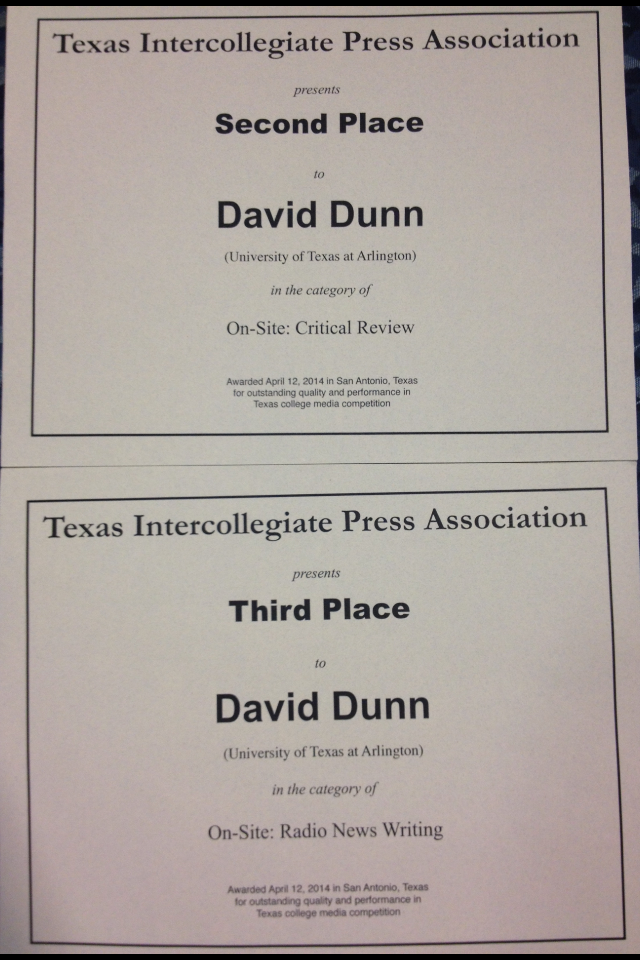
Photo by David DunnToday was a day that I will remember fondly throughout the entirety of my writing career. On this week, from Wednesday through Saturday, I was asked by my publications director to represent The Shorthorn at the 2014 Texas Intercollegiate Press Association Convention, an annual ceremony where not only the best work is rewarded in journalism and broadcast for the year of 2013, but competitions were held for reporters and writers to compete for the top spots in these competitions. I competed in three separate competitions, and at the end of today I walked away with two plain manilla paper awards that looked as exquisite as gold.

I attended the previous TIPA convention back in April 2013, a novice who barely knew how to reference a source in the first draft of his story. This year’s TIPA was significantly different for me in more ways than one. First of all, this year’s TIPA was held at San Antonio, whereas the last convention was hosted close to home in Dallas. Second, I came to TIPA this year as an experienced entertainment editor, not as the idle and clueless reporter that I used to be. I had much more experience since the last time I came, and I was ready to combat any uncertainties that would come my way. Third, the only competition I was in during the 2013 ceremony was the critical review competition, where I attended a performance of some sort and critiqued it at the conclusion of the event. This year, I competed in three categories, including critical review, radio news writing and television anchoring.

You have no idea how grueling the competitions were, how frustrating and nerve-wracking they were when you were on deadline and had only three minutes left on the clock. The day started off traveling to an off-site location for my news writing event, where myself and two of my fellow reporters and photographers came with for their own competitions. Our assignment was to cover an arson fire, only, it wasn’t a real fire: members of the San Antonio Fire Department put on a demonstration for us, showing what they would do for a real-life emergency situation, even at one point pulling out a humanoid dummy pretending it to be a real victim of a real-life arson fire.

We witnessed the event, asked questions, left the event, and arrived back on-site to complete our respective assignments. My script had to be a 30 to 45 second copy, and knowing that three words equals approximately one second in narration, I knew that my script had to be somewhere in between 90 and 135 words.

I was ten minutes away from script deadline, quick to finish my script so I could turn it in and conclude my event. I was very excited when my final copy was at 44 seconds, only to realize that my five-second sound cue at the beginning of the script made it 49 seconds. I panicked, looking frantically at my script, knowing full well that I would have to cut at least 12 words to make it fit the time frame. I scanned my document for seven nerve-wracking minutes, looking for any unnecessary words I could cut out. I ended up omitting five words, equating only to one second less of a copy that I had before.

“Screw it,” I thought to myself. “I’ll cut the sound cue.” So I turned in a script with a one-second natural sound lead and 44 seconds worth of narrating material. I turned it in with the runtime exactly at 45 seconds.

Later on that day, I went to the critical review competition, which was in a word, a wreck. Not the event itself, mind you, but the performance that they chose for us to review. It was a performance of Bruce Norris’ Pulitzer prize-winning play Clyboune Park, a story that looked at two different generations of racism and compared them side-by-side showing how nothing has changed.

The problem was we only viewed the first half. The production ended Sunday April 6 of last week, with most of the cast returning exclusively just for our viewing. While I appreciated their involvement and the opportunity to review their production, with the second half missing I had no context to refer to. I left the theatre with an empty taste in my mouth, but with plenty of opinion to put into my review.

Friday came along, and was a day where I was supposed to attend a majority of the workshops, where we were stressed the importance of internships, social media, adapting to industry standards and finding your voice. I learned a lot from the workshops I attended, and kept the information enclosed in my notes I took throughout the day. My day got interrupted, however, when I learned that a replacement was not found for one of my friend’s television anchoring competition. Not wanting The Shorthorn to be misrepresented at a competition that it signed up for, I gathered my things, a change of clothes, and quickly made my way to the competition, as it was one that I was previously interested in anyway. It was haphazard, chaotic, quickly assembled, and my clothes were so tight that I looked like a pound of sausage squeezed into a tube of toothpaste. But the point was I made it, I gave my best effort and I gained relevant experience that I can use the next time I compete.

Then came along the awards ceremony on Saturday. Sitting down calmly with my vanilla coffee in my left hand, I sat back in a relaxed poise fully expecting to lose in every category. Quite the contrary: my name was called twice in a row, one for second place critical review, and third for radio news writing.

My mind is still trying to grasp the fact that I won these awards. Firstly, I want to say thank you to everyone involved who inspire me to do the best that I can everyday in everything that I do. That includes Beth Francesco, our publications director, Lance Liguez, my broadcast professor, my fellow colleagues, and my mom and dad, who both remind me that the best possible job you can do is never enough.

Secondly, I want to pay respects to my friends in newsroom publications who also walked away with widely-recognized awards. My editor-in-chief Lindsey Juarez walked away with first place feature writing, an award she rightfully deserved by crowd sourcing and finding a compelling story through a homeless man that moved from shelter to shelter from New York down to here in San Antonio. The Shorthorn’s sports editor Grant McKinley walked away with third place print sports writing, while his reporter Cassie Logan walked away with second place television sports writing. Our copydesk chief Chloe Gonzales won first place copy editing while many other staffers won a multitude of other awards, including photographer Adrian Gandara, our photo editor Richard Hoang, our current digital managing editor Jonathan Silver and many others, eventually contributing to The Shorthorn’s number one placement for best in show. Even my music reviewer Brian Peterson placed first in critical review overall for the year, although it was during his time at another publication, at Stephen F. Austin’s The Pine Log. 

Realize none of these awards were easy to come by. There were over 20 student publications represented at the convention. To even place in the honorable mentions is a stroke of sheer luck.

Lastly, I want to thank you, the reader, for inspiring me to do what I do day in and day out. All I’m trying to say is that I’m grateful. I’m grateful for the people that I work with. I’m grateful for the publication I work for. I’m grateful for the job I have and the goals that I aspire to meet. I’m grateful for my friends, my family and my brotherhood for being so understanding with my long hours and work schedule and who are happy to see me when I come around. Yes, there’s a lot of unprecedented challenges I face on a daily basis, and yes, we as editors will sometimes get frustrated by each other by our antics and our work ethics. That doesn’t change the fact that we’re continually progressing as a student newspaper, and that you, the readers, are the reason why we continue to be in operation.

That same reason is why this blog is still in operation, although on a much lesser scale. I can’t say this enough: thank you, thank you, and thank you for your continued interest in my writing career. Movies is my passion, and film criticism is definitely the career I want to pursue when I graduate college. Until then, I will continue to improve both as an editor and as a writer, and hopefully TIPA will be ready for me when I return in 2015.

Post-script: Below are the award-winning samples that got me my two TIPA awards at this year’s conference. Feel free to read them, as they are probably more interesting than this four-page blog post.

Critical Review – 395

Radio News writing – 395

-David Dunn

Now I Have A Radio Show. Ho-Ho-Ho.

Perhaps I am a little untimely by posting this in late March, when in reality this has been going on since February. Nevertheless, a starkly different turn has been taken for me involving my recent broadcasting career. So here goes.

I am officially now a radio talk show host for the University of Texas at Arlington’s official internet radio station. I run my own one-hour show live every Tuesday at 10 a.m. where I discuss everything about movies, from news headlines, to upcoming releases, and a review of a new release coming out that week.

It’s called “The Talkie Tuesdays with David Dunn”, and it is everything that I have ever dreamed of it being.

My foray into radio started a long time ago, back when I was a new broadcasting student in Fall of 2013. After experiencing the penultimate failure and disarray of the film department here at the university, I explored other possible venues into the communications department, ones that would help improve my skills technically and help market myself professionally.

That opportunity started in UTA Radio. Having introduced myself as the film critic of the UTA Shorthorn, I pitched a segment idea to the station’s executive producer and manager, Lance Liguez. It was called “The Movie Minute With David Dunn” and it was literally a 60-second review of a movie that came out that week, either in theaters or on DVD.

I know, I know, 60 seconds sounds like a very short time. In radio, however, I can’t tell you how much time that is, and how inconvenient it is for the entire program if you run even a second over. Regardless, Lance was very helpful to me in introducing me to the profession of radio. He gave me pointers on how to have a better announcing voice, introduced me to the station and granted me access to the recording studios as well. He introduced me with my production team (my bosses), and the people I’d be working for as long as I would be contributing to the station. He paired me up with broadcaster Tracie Hill, who ran the news program at the time, and also introduced me to the station manager Charlie Vann, of whom I would send my recordings to so he can edit them into Tracie’s segments.

Fast forward to present day. As a part of Lance’s radio production class, I am getting even more experience than I did before. As I already stated, I was scheduled for a 10 a.m. Tuesday shift for UTA Radio. Originally, my shifted consisted of little more than playing music and coming on saying “You’re listening to UTA Radio.com”. When we were reformatting our shows, however, I couldn’t have been more excited to reformat mine into a talk show and do what I love most: talk about movies.

This new format started two weeks ago. I didn’t post anything on this yet because I was both nervous and I was afraid I would be ready for live announcing. After getting a better feel of it, however, I must say that I think this is working out for me and I’m ready to advertise it in the best way I know how: shamelessly plug it on my personal blog. Horray for bloated egos!!!

Long and short of this post, I would like to invite you to check out my show. If you didn’t read the previous seven paragraphs, my show is on 10 a.m. every Tuesdays on UTA Radio. It won’t be on any regular F.M. or A.M. band. It’s an online radio broadcast channeled through iHeart radio and can be accessed through http://www.utaradio.com

Thank you to everyone for your support and for your interest not only in my reviews, but in my constantly progressing career. The communication department here has been more than helpful with all of my skills that I’ve been developing, and I cannot wait to continue to develop it here at the University of Texas at Arlington.

I’ll see you, fellow moviegoers, at the movies.

-David Dunn

Post-script: I’ll give you one more chance: 10 a.m. Tuesdays at http://www.utaradio.com

Tagged , , , , , , , , , , , , , , , , , , , , , , , , , , , , ,

It’s Aaron Paul and Scott Waugh, Yo

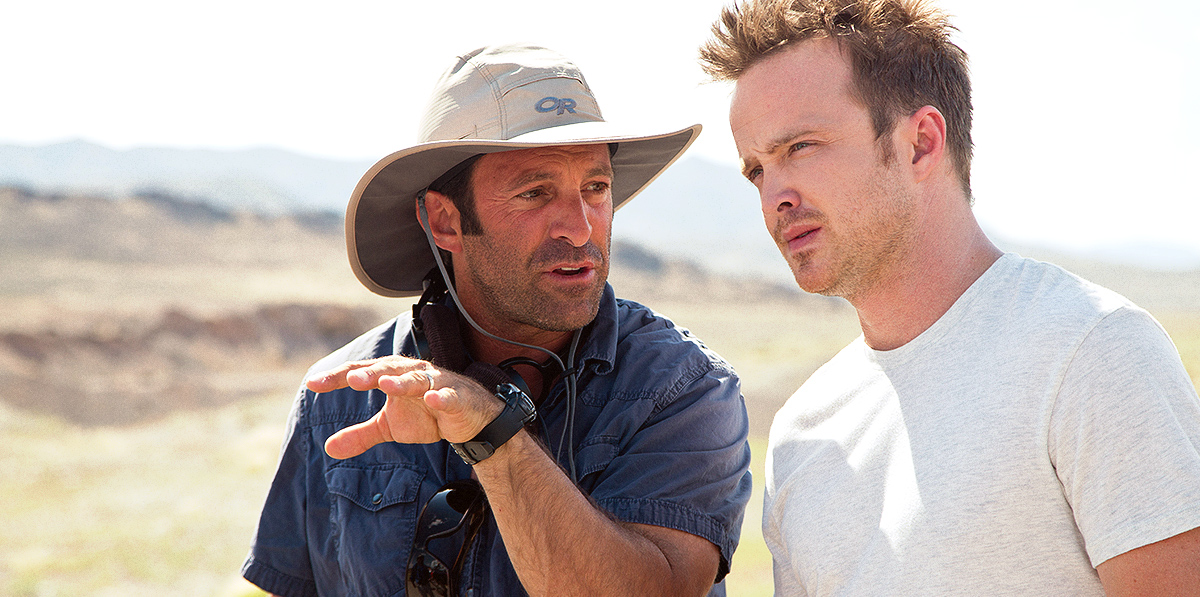
Straight off the wheels (pun intended) of his award-winning role as Jesse Pinkman in Vince Gilligan’s “Breaking Bad,” actor Aaron Paul’s followup to film is that of street racer Tobey Marshall in Need For Speed, an action movie produced by filmmaker Steven Spielberg loosely based on the video game series of the same name. After attending an early screening of the movie before its release on March 14, Paul and director Scott Waugh (Act Of Valor), sat down with myself and the audience to talk about the movie and what it was like filming the high-octane action thriller.

Question: Before this movie was even made, it was a video game franchise. It was kind of a blank slate for you guys. How did you come up with the story?

Scott Waugh: We just really wanted to come up with a really compelling, really human story that we could develop and really take the audience along for a thrill ride. We just got so lucky enough to get a man like Aaron Paul to play the lead and really put ourself on the map that we’re a different movie and trying to do a throwback to the films that I grew up on, like The French Connection and Vanishing Point.

Q: What exactly were you looking for when you cast Aaron Paul?

SW: Man, I was so pumped when we were trying to cast the movie, and we were literally saying, “Look, I want to find the next Steve McQueen.” His name came up, I never watched “Breaking Bad,” so I didn’t know who the hell Aaron Paul was. The funny part was when his name came up, it was to play Dino. I was like “Really? Let me see some tape on him.” I saw some tape on him. I was like, “Man, this kid is for real. He is so good. Forget Dino, man. This guy should play the lead.” They said no, the studio would never go for that. So they talked me out of it, and then they put Aaron up in front of Spielberg to see which guys he wanted to play around the kid that we thought was going to play Tobey. He saw Aaron’s tape and goes, “Man, this Aaron Paul kid is really fantastic. Why aren’t we considering him for the lead?” And that was it. Long story short, 24 hours later, Aaron Paul was cast.

Aaron Paul: Yeah, it’s such a surreal thing. I never knew about the whole Dino conversation, literally until this press tour, but when it was sent to me on my desk, I always thought that they were always interested in me with Tobey. I read the title page. It said Need For Speed, you know, what is this movie really going to be about? Is there going to be a really solid story there? I read it, and I was just so invested in these characters from the very beginning, and when I talked to Scott, he told me he wanted to do a throwback to the classic car culture films, such as Bullet and Vanishing Point. I’ve been such a huge fan of Steve McQueen forever, and that just got me very excited about jumping on board.

Q: How did you go about training, getting ready for the role, Aaron?

AP: That was the thing. When I talked to Scott, when we first had conversations about this project, he said, “Now listen, if you want to jump on board, I’m going to really need you to learn how to drive.” And I knew how to drive before, but nothing like this, and so he was like, “If you want to do this, I’m going to get you some serious seat time in these cars.” Really, the first day working on this project was on a racetrack, a closed down racetrack, from sunrise to sunset, just really learning how to get out of problematic situations and then learning how to drive around corners, do reverse 180s. Just madness. Just so much fun.

TS: What was the best stunt you got to do during the shoot?

AP: All the freeway stuff. I was weaving through traffic, most of that was me, so I had to drive at pretty high speeds. We closed down freeways for five to seven miles, but it had to be that long because we were going so fast, so we were eating a lot of the road really quick. There’s a shot right when Pete went over the bridge, Tobey flips around and goes back for him. Scotty wanted me to fly directly at the camera and slide and get inches away from the camera that is attached to a cameraman that was him. That was very terrifying for me because to get it to slide the way that he wanted it, I needed to be going 65-70 miles an hour and then use the brake and then slide and get this far away. The first take we did it—

SW: He pussed out on the first two, got like 15 feet away from me. I came up to him after the second one, and I was like, “All right bro, here’s what you need to do. Don’t worry about me. I’ve been hit by a car several times. I’m cool with it. Just come in and hit your mark, and if you hit me, I’ll just flip over the top of it.”

AP: Which did not make me feel any better about the situation.

SW: It was pretty funny, so he’s coming in around 65-70 miles an hour. And I can tell, because he shifted into fourth. And I was like “Oh shit, now he’s coming in really fast.” He came in, started sliding towards me, and I will be the first one to say I pussed out and closed my eyes. The tires stopped, and I was still standing, and I opened my eyes and he’s literally two inches away from my camera. And I was like “Did I get it?” I didn’t even know if I got the shot.

Q: Scott, you used the cameras that you used to collaborate with your dad when you were younger, right?

SW: Yeah, I was so lucky, I grew up in this crazy household. My father was the original [stunt coordinator of] Spiderman in the ’76 TV show, he was a stuntman and a circus performer, and I had a trapeze in my backyard, a bunch of crazy stuff like that. My dad became a director, and he always wanted to put the audience in the movies, rather than sit back. He came up with this device in the ’80s called a helmet camera, which is like a film camera on your head. So, it’s not like a go-pro, it’s like 30 pounds on your head. So, take a dumbbell when you go to the gym, set it on your head and go walk around. I used to tell my dad, “This is going to kill somebody,” because it’s too heavy. And, of course, my dad would put it on my head, and that’s why I don’t do stunts anymore, because my neck is stretched all the way to my chest. But what happened was because of my dad. It really gave me the insights to come up with the new technology to do first person so you can drive. The audience gets to drive in this movie, kind of like Act Of Valor. You got to actually participate in the Seals’ escapades. It’s just that I’ve been able to fortunately do what my dad always aspired to do because technology has finally caught up with us.

Q: Aaron, to finish this off, what was your favorite car, and can you call me a bitch?

AP: First of all, my favorite car had to be the Gran Torino. I mean, all those cars are so much fun to drive, but I just wanted to take the Gran Torino home with me. We were fighting for the Gran Torino during the entire shoot. We had two identical Gran Torinos. One got totaled by accident during one of the races, so there was one remaining, and we would just look at each other and just mess with each other during the rest of the shoot. Neither of us won because DreamWorks has the keys.

Oh, and also, you’re a bitch.

-David Dunn

Tagged , , , , , , , , , , , , ,

OSCAR REACTIONS 2013

Well, that was anti-climactic.

For those of you who live under a rock and don’t know who I’m talking about when I mention the word “oscar”, the 86th Academy Awards took place yesterday on ABC, hosted by comedian Ellen Degeneres. Needless to say, Degeneres was brilliant, taking selfies, buying pizza, crashing twitter, bringing the stage down for Jennifer Lawrence, and calling Liza Minelli a man all in one night. And yet, despite all of her efforts, the oscars seemed so… boring.

How did this happen? The nominees, dear reader. Out of the 24 categories in the ceremony I got twenty right, beating most of my Shorthorn peers and family members for the potluck we held that night. The most I’ve gotten previously was sixteen. I’m inclined to believe that the academy made the winners of these awards too obvious by building up too much hype of them during the buzz of the past few months.  Case in point: was there any argument that Frozen was going to take home best animated feature?

It doesn’t matter now, anyway. It happened, and I got 20 right out of 24 categories. Yes!!! Just because I predicted them correctly, however, doesn’t mean I need to be happy for their win. Let’s go through each of the categories and see whether or not they really deserved it or not…

BEST PICTURE (CORRECT!) The best picture of the year rightfully won best picture at the Academy Awards: Steve McQueen’s phenomenal, gripping, heart-wrenching, spellbinding and immensely powerful 12 Years A Slave won best picture. While I’m ecstatic for its win and could not agree more with the Academy’s consensus, I find it very strange that it won the Academy’s highest honor despite it only winning two other awards. But we’ll talk more about that later.

BEST DIRECTOR (CORRECT!) Also correctly predicted is Alfonso Cuaron for his nerve-wracking and tensely-directed sci-fi thriller Gravity. I already mentioned this in my predictions, but the best director award needs to be reserved for the best picture of the year. I loved Gravity with every fiber of my being, but it simply does not match the cinematic caliber to that of McQueen’s 12 Years A Slave. It would be like comparing The Dark Knight to that of Slumdog MillionaireThe Fugitive to that of Schindler’s List, or Jaws to that of One Flew Over The Cuckoos Nest. They are all ingenious, brilliant and incredibly memorable pictures, but the best picture of the year is awarded that because of the direction and treatment that it was given.

That’s not intended as an insult towards Cuaron, and I definitely believe he deserves it based on the physics and tension of the movie alone. If I’m thinking about which movie had the bigger impact, however, it’s no contest on which one it deserves to go to: McQueen for 12 Years A Slave. Nevertheless, I congratulate Cuaron on his many accomplishments regarding Gravity. Lord knows my heart stopped at least a few times while watching that picture.

BEST ACTOR (CORRECT!) Matthew McConaughey took home the award for best actor as a rowdy texas cowboy dying of AIDS in Dallas Buyers Club. While the award could have gone to either him or Chiwetel Ejiofor for 12 Years A Slave, there’s no denying the power, the energy, and the raw gravitas that he brought to a man’s desperate journey to survive. Plus, I love his acceptance speech and how he dedicated the award to God and to “himself in ten years”. That’s a wise goal that any man should strive for.

BEST ACTRESS (CORRECT!) Cate Blanchett won best actress for Woody Allen’s Blue Jasmine. While I have regretfully not seen the movie yet, I will say that the few scenes I have seen her in impressed me very much, and that she did a solid job portraying a deeply bothered woman who is in deep depression and alcohol addiction. Congratulations to her. I look forward to watching the film, as well as Blanchett’s performance in it.

BEST SUPPORTING ACTOR (CORRECT!) Did Michael Fassbender win best supporting actor like I wanted him to? No, he did not. Instead, Jared Leto took home the award portraying the transgender AIDS victim Rayon in Dallas Buyers Club

The more I think about it, the more ridiculous I think it is that the best picture winner of the year did not get recognized in so many categories. Why the snubbing from Fassbender? Half of the movie’s turmoil and conflict came from this despicable character, a man so inhumane and abominable that Calvin Candy from Django Unchained would have broke down in tears after seeing what this man forced people through. Fassbender was pivotal, aggressive, violent, and hateful as Edwin Epps, and incurred more emotions from audiences than that of a transgender AIDS patient in Dallas Buyers Club. I know 30 Seconds To Mars fans will hate me for saying this, but the more vital role needs to go to the more vital performance. I said it once, I’ll say it again: Leto is not as deserving in the award as Fassbender is.

Again, no disrespect, and I acknowledge that Leto gave a great performance in the picture. But like Cuaron with best direction, the more compelling presence needs to go to the more compelling artist. Sorry, Rayon.

BEST SUPPORTING ACTRESS (CORRECT!) Lupita Nyongo won (and deserved) the academy award for best supporting actress for her heartbreaking role as a desperate and depraved cotton picking slave in 12 Years A Slave. No qualms here.

BEST ORIGINAL SCREENPLAY (CORRECT!) I also correctly predicted that Spike Jonze would win the best original screenplay award for his sci-fi romance story Her. Comparing Her to the genius of David O’Russell’s American Hustle, I mentioned in my original predictions list that “just because its a smarter story doesn’t necessarily mean that it is a better one.” I do not retract my statement.

BEST ADAPTED SCREENPLAY (CORRECT!) John Ridley won best adapted screenplay for his incredibly well-documented 12 Years A Slave. He equally deserved it, as Solomon Northrup’s story, or legacy, could not have translated any better to the screen if the filmmakers tried. Great job, Ridley. You gave us an unforgettable and incredible story, the likes of which no one has seen since Steven Spielberg’s Schindler’s List. 

And this is the only other award 12 Years won for the night. No cinematography. No editing. No costume or production design. No supporting actor. No other award that would further substantiate and support its win for best picture.

Am I the only one that finds this completely ludicrous? To date, there are only three best picture winners to win only three academy awards. Those movies are The Godfather, Crash and Argo, and two of them didn’t even win in major categories. Seriously, what is going on? Why are we being so insubstantial towards movies that have been deemed the best of the year? Do academy voters not realize that by naming this the BEST PICTURE OF THE YEAR that they’re saying that its better than everything else? And according to this ceremony, not only are they saying that it is the equivalent of Dallas Buyers Club (they both won three academy awards), but that Gravity is superior to it with seven wins and no awarding of best picture.

Seriously. Make up your mind. I’m fine with you saying one picture is better than another, but substantiate that by what awards you give it. I seriously doubt that 12 Years is best picture because of its screenplay and its supporting actress alone. Likewise, I doubt that Gravity isn’t the best picture of the year because it has the best direction, camerawork, editing, sound mixing, and visual effects out of any other picture.

That’s all I ask, folks. Not preference. Fairness.

BEST FOREIGN LANGUAGE FILM (CORRECT!) The Great Beauty won for best foreign-language film. That’s the one that everyone saw, right? It obviously deserved to win.

BEST DOCUMENTARY FILM (INCORRECT!) I incorrectly predicted that Act Of Killing would win the award, but no, 20 Feet From Stardom took the award home, with featured artists on the film including music legends Mick Jagger, Bruce Springsteen and Stevie Wonder. I haven’t seen the film, so I have no place on commenting on it, but it seems odd that the Academy would reward a movie about background singers over that of a tragic confrontation of death and social issues. I’ve yet to see either of them though, so like I said, my opinion is invalid in this category.

BEST ANIMATED FILM (CORRECT!) Disney won best animated feature for Frozen. While I didn’t care much for it, I know it made a wide impact on its audience and that it will go on to be fondly remembered by many animated movie lovers for years to come. So congratulations for its win, even though I’m no fan of the cold weather this time around.

BEST ORIGINAL SONG (CORRECT!) Frozen won best original song for its memorable song “Let It Go”. It certainly didn’t win for Idina Menzel’s performance, that’s for sure. What the heck happened with her? Her pitch was all over the place, her control was wonky, and her whiny voice was the contrast of the powerful, beautifully controlled voice she exhibited in the movie itself. Seriously. What happened?

One song I’ve really been getting into recently (and I think you’ll agree with me) is Pharell Williams’ “Happy”. The performance proved why. Not only was it energetic, upbeat, and undeniably catchy, but Williams gave a great performance, he exhibited great control and showed very few differences from the studio version of his song. Menzel’s performance, in comparison, was completely and utterly horrendous.

But hey, I guess that’s why the award is called “best original song” and not “best performance”. Otherwise, I think we both what the turnout would be.

BEST ORIGINAL SCORE (CORRECT!) Steve Price took home the award for best original score with Gravity. He completely deserved it. Not only did it match the tension, edginess and unease of the movie, but it also gave a dignified sense of hope and accomplishment after a long journey of heart-pounding danger and peril. Listening to the soundtrack alone gave you the feeling of identity and survival, and Price was definitely the most deserving out of any nominee. Congrats to him for his win.

In the meantime, I’m still wondering where is Hans Zimmer’s nomination for Rush. Remind me again why this movie wasn’t nominated for anything?

BEST CINEMATOGRAPHY (CORRECT!) In 2011, Emanuel Lubewski was mercilessly snubbed for his masterful, Stanley Kubrick-esque camerawork in The Tree Of Life. If he didn’t win it this year, I was literally planning on flipping out.

Luckily, he did.

BEST FILM EDITING (CORRECT!) Another category that I felt 12 Years was superior to Gravity, yet it still lost to it. Must I keep beating a dead horse? Gravity was a more visually stellar and energetic picture. 12 Years was the more engaging and involved one. Part of that was because of how the film was put together in a traditionalist style that was reminiscent of Dylan Tichenor’s work from movies including There Will Be Blood and Brokeback Mountain, where he focused most of the runtime on the film’s subjects rather than worrying about flashy cuts or transitions. Film editing is one of the most important part of storytelling, and what have I been saying is the best story of the year? 12 Years A Slave.

I’m not going to drag this out though. Gravity was a great picture, and editors Alfonso Cuaron and Mark Sanger definitely reached outside the box to accomplish things visually no other film did this year. It did a good job. Moving on.

BEST PRODUCTION DESIGN (CORRECT!) The Great Gatsby won for best production design. Considering the sets were the most colorful and visually appealing out of the year, that isn’t very surprising.

BEST COSTUME DESIGN (INCORRECT!) Unfortunately, I predicted this category wrong, thinking that 12 Years was going to get this one. The only reason I went with that instead of winner The Great Gatsby was because I knew Catherine Martin was already going to win for best production design, and any more than that would have been greedy. I forgot that “spreading the wealth” isn’t a phrase the academy is most well known for.

BEST MAKEUP (CORRECT!) Thankfully, Dallas Buyers Club won for best makeup and hairstyling. As long as Jackass: Bad Grandpa didn’t walk home with the award, I’m satisfied.

BEST SOUND EDITING (CORRECT!) Gravity won.

BEST SOUND MIXING (CORRECT!) Gravity won. Again.

BEST VISUAL EFFECTS (CORRECT!) If you even thought this award was going to anything other than Gravity, you’re either insane, or blind.

And at last, the long-dreaded short film categories.

BEST LIVE-ACTION SHORT FILM (CORRECT!) Surprisingly, I got this category correct with predicting Helium. I haven’t seen the film though, so it was only by sheer luck that I got this right.

BEST ANIMATED SHORT FILM (INCORRECT!) Mr. Hublot took home this award. That’s surprising, considering how clever and fun Get A Horse! was, but nevermind. I haven’t seen the movie, so I can’t comment on it.

BEST DOCUMENTARY SHORT (INCORRECT!) The Lady In Number 6: Music Saved My Life. Again, just like any other films in these categories, I haven’t seen it, so how would you expect me to get it right? You might as well blindfold me and ask me to just write on the flipping ballot.

Overall, this has been a fun ceremony, and I’m grateful to Ellen Degeneres for making it a happy-go-lucky and loveably quirky time. Just please, make the ceremony less predictable next time, okay? I’d rather not have a film come in and just know that its going to dominate in all of the categories. You would have been better calling it “The First Annual Gravity Awards”.

-David Dunn
Tagged , , , , , , , , , , , , , , , , , , , , , , , , , , , , , ,

The Best Valentine’s Date There Is: You

I was 19 years old when I kissed a girl for the first time. I was about ten when I hugged one. I was six when I told a girl “I love you”. I’ve never been in a serious relationship.

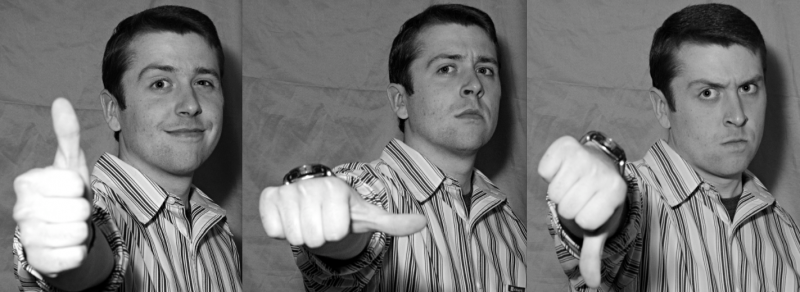
Yeah I know, boo-hoo me, right? I’ve been in this song-and-dance routine long enough to know how this game goes. Yes, I’m single. Valentines Day translates to me as “Single Awareness” day. You tell people your sad romance story, people go “aw” after your confession, and you go about your own way so you can sulk about. Right?

Well to be honest, I haven’t felt like that in a very long time, and its strange because growing up, that’s the only way that I’ve ever felt.

It all started back in high school. I was attracted to one of my pretty brunette friends that sat in my English class with me. This is the kind of girl that you need to take a snapshot of and save it on your phone. Her hair was long and silky, and spread down her back like a river over a waterfall. Her figure was fit and voluptuous, looking more like a sculpture than a human body. She had this perfumey aroma that was both sweet and addictive. Saying that she was beautiful didn’t do it justice. She was spellbinding.

But physical beauty isn’t enough to make a fitting partner: she needs to be beautiful on the inside as much as outside. And in regards to her, I didn’t know which was more beautiful.

We got along well. Very well. We shared the same taste in movies, books, and television shows, we had the same interests, we both went to Church, we both believed in the importance of family and spirituality, and most importantly, she believed in being happy.

So what happened? Well, despite our friendship, I wasn’t a sociable person back in high school. Quite contrarily, I was a creep. I’ve struggled socially speaking to people all my life, and it was even worse when it came to girls. When it came to my advances, she was instantly intimidated and swatted any of the notions out of the way.

I was devastated, and for my first few years in college I sought a filler for this empty spot that laid in my broken being. Long have I struggled to find the answer until one day it was just handed to me.

I was at lunch with a few of my fraternity brothers. We were all laughing, talking about hot girls we would hook up with and what teacher was the worst at his job. All laughing stopped, however, when I got a message from one of my brother’s girlfriends, saying that she was going to harm herself if he didn’t call her back.

I panicked and showed the message to my brothers. One of them called another friend to try and mediate the situation while another sent a message to her, saying he wanted to reach out. The message was long and endearing, but the part that hit me like a train was this:

“Your happiness can’t be dependent on another person. People can encourage you and be your companions along your journey. However the decision to be happy is up to you.”

I looked at this message long and hard, trying to understand the meaning of it and how I could apply it to my life. Finally, I stopped thinking about it and decided to start doing it: I was going to be happy.

It took a long time, and I’ve had some bumps in the way, but I’ve finally gotten to the point where I can be independently happy without someone else’s influence. Happiness doesn’t come in a relationship. It doesn’t come in a kiss, or a hug, or even in the words “I love you.” Happiness comes in a personal decision and mindset to being happy and being satisfied with who you are, even if you’re a flawed individual. Being in a relationship doesn’t add or lessen your happiness: it’s just an opportunity to share that happiness.

So to the single folks out there who are sulking about their situations, I implore you to think differently. Yes, you’re single. So what? There are thousands of other single people out in the world right now, and they’re in the exact same situation as you. I know that I’m the best valentine date there could ever be, and the best part about that is that its true for you as well.

Happy Valentines Day, everybody.

-David Dunn

Tagged , , , , , , , , , , , , , , , , , , , , ,

Vanessa Hudgens Is The Apple Of Our Eyes

I once again had the pleasure of sitting down at a journalist’s roundtable for an in-person Q&A with actress/singer/songwriter Vanessa Hudgens, who came to Dallas to provide publicity for her newest role in a wonderful little picture called Gimme Shelter, directed by Ron KraussHudgens, who started off her career as an energetic young singer in High School Musical has been everywhere and back again in her career, with film roles ranging from the family-friendly Thunderbirds and Bandslam, to that of the more adult-oriented Sucker Punch and Spring Breakers.

With movies like those under her belt, I’ll admit I went into the screening a little less than underwhelmed. After watching it, however, I couldn’t have been more surprised. The movie is not only emotional, relevant, powerful and provocative: Hudgens gives the performance of her career, portraying a troubled pregnant teen named Apple who runs away from her abusive mother in order to find a better life. Hudgens was so striking, so compelling and authentic that for more than half of the movie I barely recognized her.

I, however, did recognize the woman who came into our conference room, and just like with Joseph Gordon-Levitt, I was instantly surprised at how… human she was. Society builds up actors like they’re otherworldly deities of the sort, and that couldn’t be further from the truth. The woman we were speaking to was not Vanessa Hudgens, but rather, a beautiful, humble young actress who had dreams, goals and aspirations and was at a high point at this portion of her life.

All of the publications were very grateful for the opportunity to introduce ourselves to her, myself included. The following transcript is a compilation of their questions and mine. See if you can guess which one is which.

Question: Hello Ms. Hudgens. How are you today?

Vanessa Hudgens: Good, how are you guys?

Q: Excellent. How are you handling the Dallas weather?

VH: It’s really not bad. I was in Chicago a few weeks ago.

Q: I have some family up in Chicago, its horrible up there. 

VH: It’s crazy, I was there for one day and it was the coldest day they’ve ever had.

Q: I’m sorry. 

VH: The wind was just so blistery. It was cold.

Q: So how’d you come to get involved with this project?

VH: Just like I would with any other one. My agent sent me a script, no urgency behind it at all, and it was just another one that was floating around. I gave it a read, and I knew that it was going to be my next project. I went in, I read for Ron [the director], sent him an email, and through the power of persuasion, I got the part.

Q: What was the most difficult experience for you during filming?

VH: You know, it’s really interesting because I don’t think of it as difficult. I think of it as exciting, because I was so passionate about the project I was more than willing to put in the work. The deeper I got, the more thrilled I became. I mean, I did have a moment where I personally broke down just because I was really uncomfortable in one of the scenes and I was afraid of someone getting hurt. Aside from that, I had Ron by my side, who was constantly putting me in the right direction, and I would kind of celebrate myself after every scene. It was a fun but challenging process.

Q: What scene specifically was that? 

VH: It’s so random, it’s the scene where I’m walking on the street and a pimp rolls up to me right before I get into a car crash. They wanted me to drive as close to him as possible. His name was Jeff, he was my bodyguard while we were filming in the dodgy areas. I just don’t like the idea of people getting hurt, and it just really freaked me out. It gave me serious anxiety, and I had to stop and remind myself how to breathe.

Q: Apple was dragged a bunch of directions in the movie, how do you think that could possibly parallel your career in the past few years? 

VH: I mean, Apple is strong. She’s such a survivor, and I love strong women. That’s one thing that really attracted me to her. But she does take her life into her own hands, and she doesn’t look at her circumstance or her condition and she has her own will. I definitely think that reflects my career. I had my circumstance, but I am taking things into my own hands as well and just fighting for the things that I want.

Q: Did you have any conversations with the real-life Apple about her relationship with the Chaplin? I mean, James Earl Jones is only in three scenes of the movie.

VH: Well, not necessarily. I feel like the religion and faith aspect is something that I see more so now after being able to see what it’s doing to people in the way that its connecting with people. But in the present moment, that wasn’t necessarily my focus.

Q: There is a moment early in the film where Apple is giving herself a pep talk before she cuts nearly all of her hair off as a sort of act of rebellion towards her cruel mother. Was that acting or did you really have to give yourself a pep talk before you did that?

VH: I mean, I would always try to stare at myself in the mirror before a scene just so I can remember who I’m playing, and I think that really just set the tone for me. But in that scene, I was cutting a wig. That would be way to messy to try to do that on film.

Q: I was just thinking of Joseph Gordon-Levitt with 50/50 in that scene.

VH: Yeah.

Q: And how did you prepare yourself with the birthing scene? That was one of the most moving scenes in that movie.

VH: Thank you, all of it. I mean, every single scene was just putting myself in that circumstance. I popped a bunch of blood vessels in my neck and in my cheek afterwards I realized, so I was really going for it. The most powerful part of that for me was when they put the baby on my chest. That was when the acting disappeared. I mean, there’s nothing more powerful and profound than childbirth. It’s a miracle. So to have that moment, even though I know its acting and I know its not my baby, putting myself in that circumstance it just really resonated in my heart and filled me with so much love and hope and its really overwhelming.

Q: Do you still stay in touch with the girls at the shelter?

VH: Yeah, one in specific, Darlisha, she’s the one who had the events happen to her with the mother, and she was in the shelter when I was there. We still chat, she’s amazing, she just got her drivers license which she’s very excited about, she’s studying to be a nurse, and she’s really starting to love herself and just seeing her transformation is really, really beautiful. She’s being released into this world, and she’s starting to become independent. And now she’s got a beautiful little boy. He’s amazing.

Q: What was it like working with Rosario Dawson?

VH: Incredible. She’s amazing. That woman is a powerhouse. She consistently surprises me in every single thing that she does. Just her dedication and her hard work and just how she really spreads her act over a wide spectrum. She’s an amazing actress, she really understood this character. I think she came from a poverty family growing up and she got it. She had seen this side of motherhood. She connected, I connected, we both understood our characters, so when we worked together it was just organic. Things were just happening naturally and we just let it play out. It was nice.

Q: Regarding your past filmography, how much different taking on this role and were you a little intimidated taking it on?

VH: Yeah, of course. It’s terrifying to really dive into something and not know if you can actually go there because you’ve never tried to before, and to know that it’s going to be documented forever. So there really is no second chances with it. It’s a complete 180. I’ve never really been able to transform myself like this. Everything. I mean, the way that I walked, the way that I talked, the way that I moved my face, it was so much fun. Because its really just creating someone new and living within that. I really had such a blast. If I could do something like this again but a completely different character I would jump at it. Because it’s really a dream role.

Q: I’d love to see it again. 

VH: Oh, it’ll happen.

Q: How was it walking away from it? 

VH: It sucked. It was really hard just because I think subconsciously, I stayed in the character the entire time. I put in so much work into becoming that person, stepping out of it would just be taking away from the work that I put in. So I got home, and I looked in the mirror, and I still saw Apple. I didn’t see Vanessa, I didn’t know who Vanessa was, I didn’t know what she was interested in, I just completely lost sight of myself. It took a while, it took a lot of time just taking care of myself and giving myself love and getting back in my body, and just being comfortable with me again. It was tough though.

Q: What are your expectations of the movie?

VH: I expect it to bring people healing, and to bring them a wider view of the world and of human nature. I think that a lot of humans naturally suppress pain and I think this movie brings it back up again, and you have to sit in that and you have to feel it and you have to deal with it. So I think from that brings a lot of healing and compassion. I got so much out of this movie myself and that’s what I love about it, is that it touches on so many different subjects. There’s abandonment, there’s abortion, there’s homelessness, there’s abuse, so I think everyone is going to get something different out of it.

-David Dunn

Tagged , , , , , , , , , , , , , , , , ,

Top Films of 2013

“Storytelling has gone through a great evolution in today’s culture,” said my pastor on Christmas day sermon, speaking on the technology breakthroughs we’ve made this year through film and television. “The stories that were given to us as a result are for more than just entertainment,” he said. “They were given to us as insight for the ears and for the heart.”

Oh man, is he right. 2013 was one heckuva year for movies, and while I can’t necessarily say that it was better than last year (With The Avengers and Argo and all), it certainly didn’t let me down. Just like any other year in my career, the movies have never dissapointed me.

Unfortunately, if I want to remain “hip” or “relevant” in today’s culture, I have to do the long-dreaded top ten list. Did I mention before how much I hate doing these? While I like highlighting the best films among the year, I hate placing one film over another, like one of them inherently did something wrong to not fight for one spot higher. Can’t we just appreciate the films for what they are and be done with it?

Faithful readers will remember that I had trouble making this same list last year. I was so intent and so focused on rushing my 2012 list out there in a timely fashion that I left out a few notable pictures that I haven’t been given the chance to see yet, including Les Miserables, The Hunger Games and Beasts of The Southern Wild. I eventually re-wrote my top ten list and published it in late February, leaving out movies such as The Amazing Spider-man and Prometheus off of my list.

So what makes this year different from last year? I’m more sure of myself. I’ve given considerable thought to the movies I’ve seen, what movies others have seen and what has made the greater impact on me this year. I’ve also covered more ground than I did last year, and I saw more of the contenders that people will be paying close attention to come awards season. In short, dear reader, I have improved. As a critic, as a writer, and as a media analyst overall.

Keep two things in mind when reading this list. I look at these movies based on their own merit, specific to their genre, why they may or may not appeal to you, and why you should go and see them. I’m not going to judge Star Wars in the same way I judge Schindler’s List, and neither should you. I also have not seen every film released this year, so I sadly can’t give credit to those movies I haven’t seen. That includes movies such as Wolf Of Wall StreetHer, and perhaps most disappointingly, Fruitvale Station.

Despite that, I’m confident that these are my favorite pictures of the year, and that many of them will be your favorites as well. All ten of the movies you are about to see made a significant impact on me this year. They’ve delighted me. Entertained me. Gave me insight on issues I knew little about. But most importantly, they’ve reached emotional levels so personal that it’s hard to find someone who wasn’t affected by them this year.

If you are still reading my inexhaustible bantering, it means you are still interested in my top picks of the year (which indeed is very shocking to me). Let’s begin:

10) STAR TREK INTO DARKNESS

A sequel of excellent caliber, a science-fiction film that not only lives up to its fans’ expectations, but in many ways, surpasses them. After Captain John Harrison (Benedict Cumberbatch) betrays Star Fleet, attacks their headquarters and flees to a Klingon planet, Captain James T. Kirk (Chris Pine) and Spock (Zachary Quinto) are assigned to track down Harrison and bring him in, but soon discover a dark secret in his past that will change their lives forever. This movie is everything that a great sequel is supposed to be: exciting, engaging, suspenseful, emotive, and reminiscent of the original. It lacks the originality as it’s predecessor, but that hardly matters: the script is brilliant, director J.J. Abrams is great, and the fight sequences are exhilarating. Cumberbatch is irreplaceable. Three and a half stars

9) MAN OF STEEL

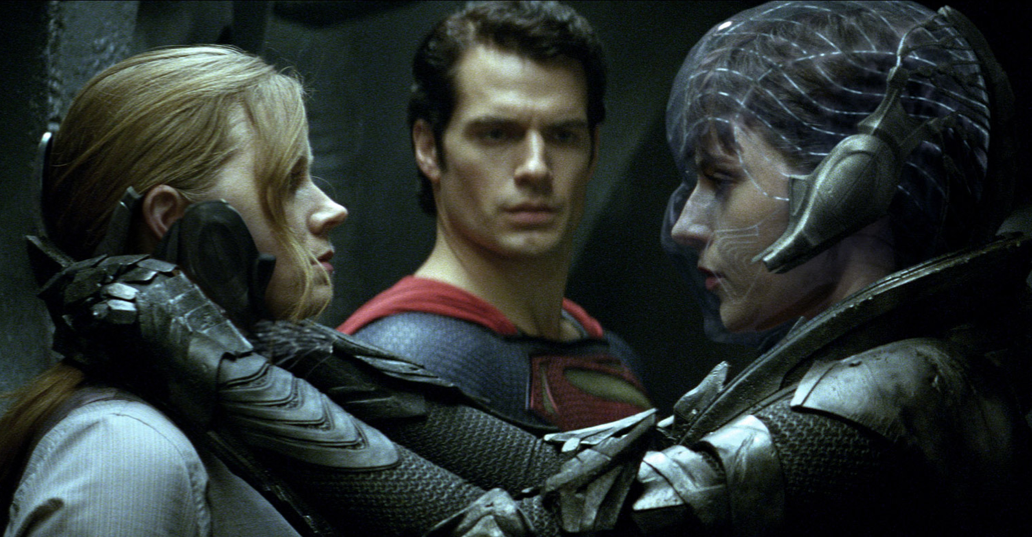
An ambitious and action-packed thrill ride giving new energy and enthusiasm to a cherished American franchise. When Clark Kent (Henry Cavill) discovers that he is a descendent of an extinct alien race from the planet Krypton, Clark needs to embrace his superhuman abilities and become the symbol of hope destined to inspire humanity. Directed by Zack Snyder (300), produced by Christopher Nolan (Inception) and written by David S. Goyer (The Dark Knight Trilogy), Man Of Steel is a superhero epic that fires on all cylinders. The cast is great, the visual effects are striking, the story is compelling, and it looks at Superman from a more humanistic perspective, as an outsider trying to fit in to a world where he doesn’t belong. The definition of a Hollywood Blockbuster. Four stars.

Photo courtesy of Warner Bros.8) 42

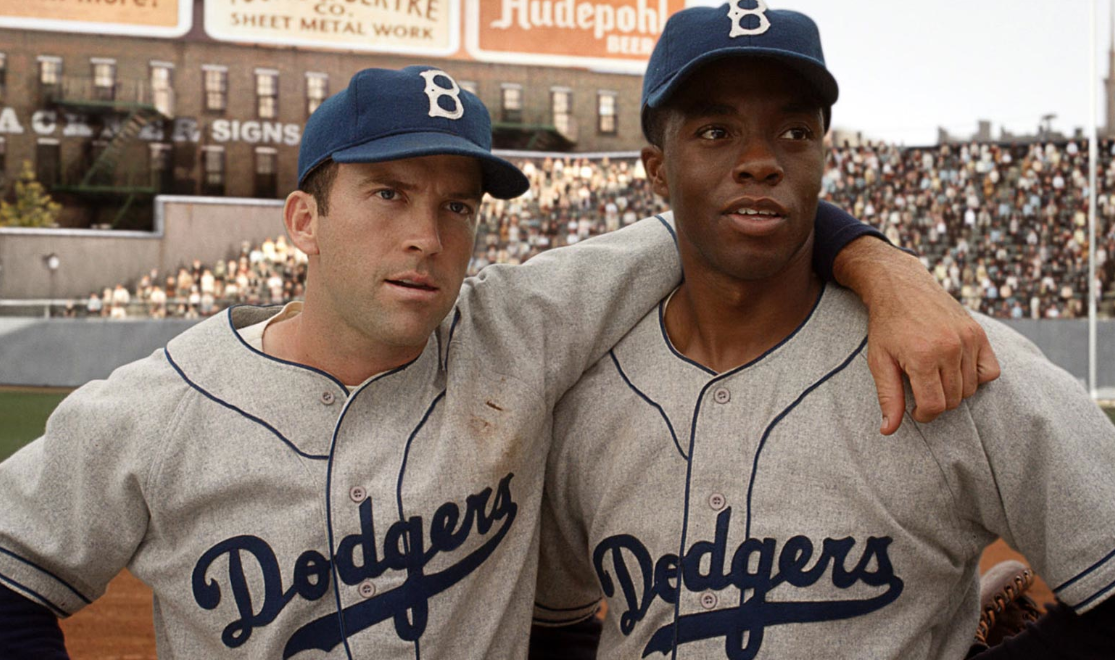
A gripping, well-written sports story with a great cast to compel us through it. Chronicling the true story of the first professional African-american ballplayer in American history, Jackie Robinson (Chadwick Boseman) is asked by baseball executive Branch Rickey (Harrison Ford) to play for the dodgers and unite a country through a time of separation. Written and directed by Brian Hedgeland, 42 does a good job switching between emotions, from that of anger and disappointment to that of happiness and endearment. Ford is good as the headstrong and stubborn Rickey, but the surprise performance comes from the little-known Chadwick Boseman, who portrays Jackie so well that its nearly impossible to think of anyone else portraying him. You’re not watching a movie when you watch 42. You’re watching a legacy. Four stars.

7) CAPTAIN PHILLIPS

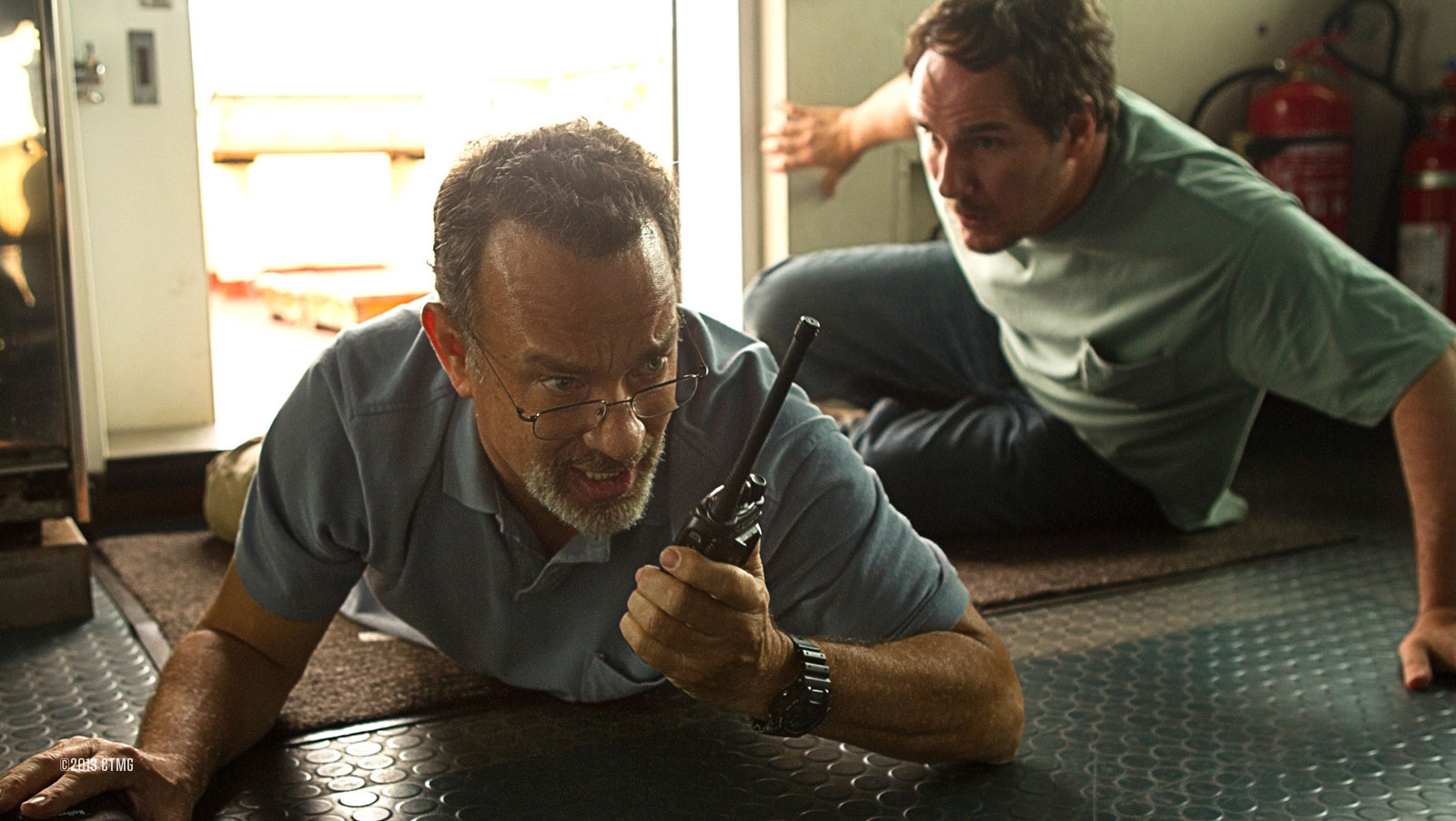
An exciting account on true events that somehow remains suspenseful, despite knowing how its going to end. Captain Richard Phillips (Tom Hanks) leads the cargo ship Maersk Alabama over the pacific ocean when a band of pirates attack the ship, kidnap Phillips, and take him hostage. Now with the Navy and the U.S. Government looking for the pirates at every turn, the quest to find the pirates quickly turns to a race against time to find and save the selfless captain. Paul Greengrass, who helmed the Bourne Supremacy and Ultimatum films, pioneers Hanks through this suspense thriller, and his expert timing combined with Hanks’ heartfelt performance made this film feel very real and fluid. The editing is tight, clean and efficient, cutting in and out at precise moments to give us the most tension and unease.  A convincing portrayal of events that is excellent at orchestrating emotions. Four stars.

6) SAVING MR. BANKS

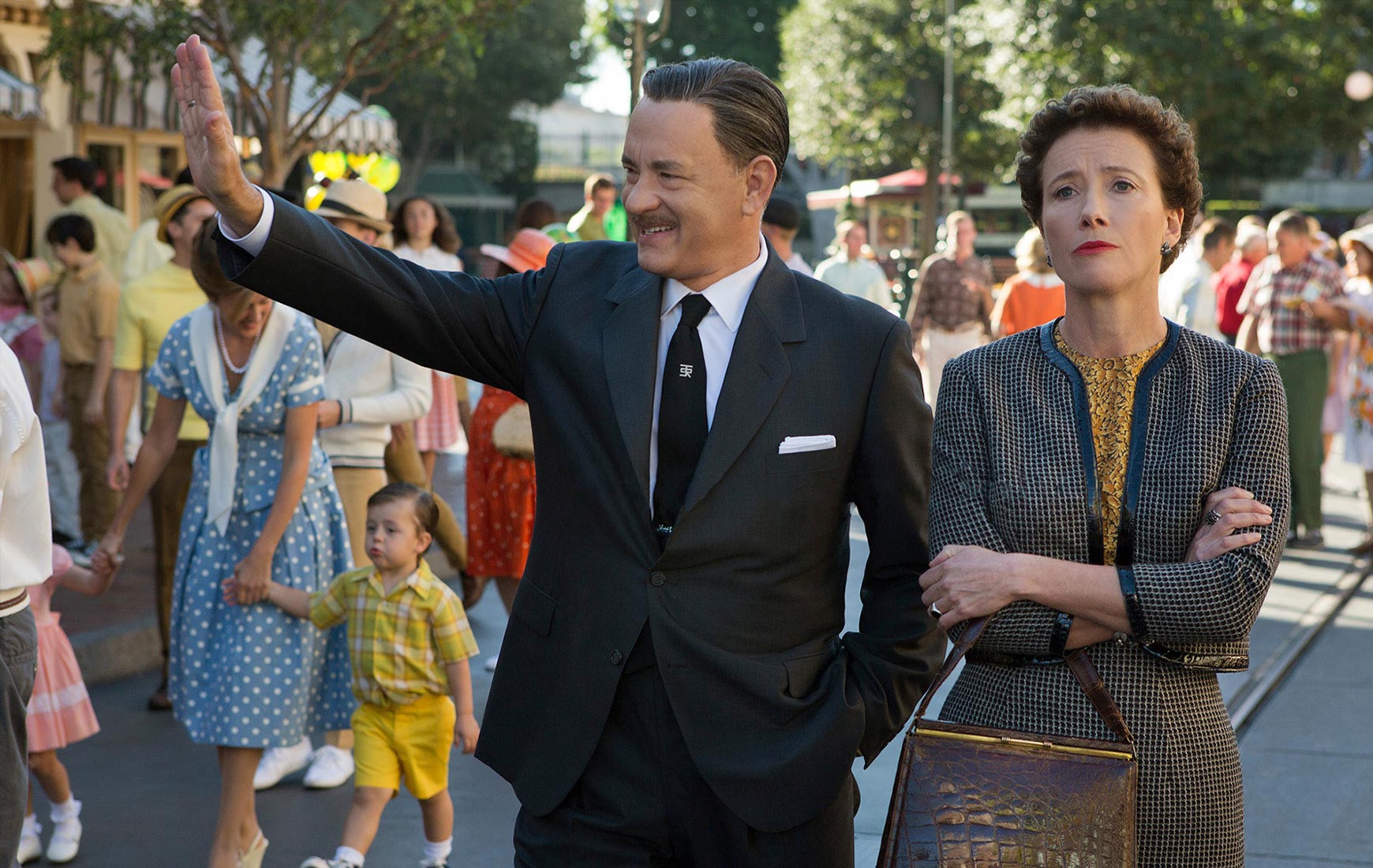
A nostalgic, heartfelt, genuinely touching film about an author worried about her work similar to how a mother worries over her child. Pamela Travers (Emma Thompson) is the author of her acclaimed series of her “Mary Poppins” books, and her war of the creative rights with Walt Disney (Tom Hanks) is nearing its end. However, after confronting her own past and getting to know Walt a little better, Pamela begins to feel more at ease sharing her story not only with Walt, but with the rest of the world. Written and directed by John Lee Hancock (The Blind Side), Saving Mr. Banks is a wonderful film that bounces in between emotions like a kid does inside a bounce house. Hanks is good as Walt Disney, but surprisingly, he isn’t the highlight performance. Emma Thompson is the driving force behind this biopic, delivering a performance so versatile and demanding that she comes to identify the film entirely through her own character. The most magical moment comes when Ms. Travers watches Walt’s film adaptation of Mary Poppins for the first time. Four stars.

5) RUSH

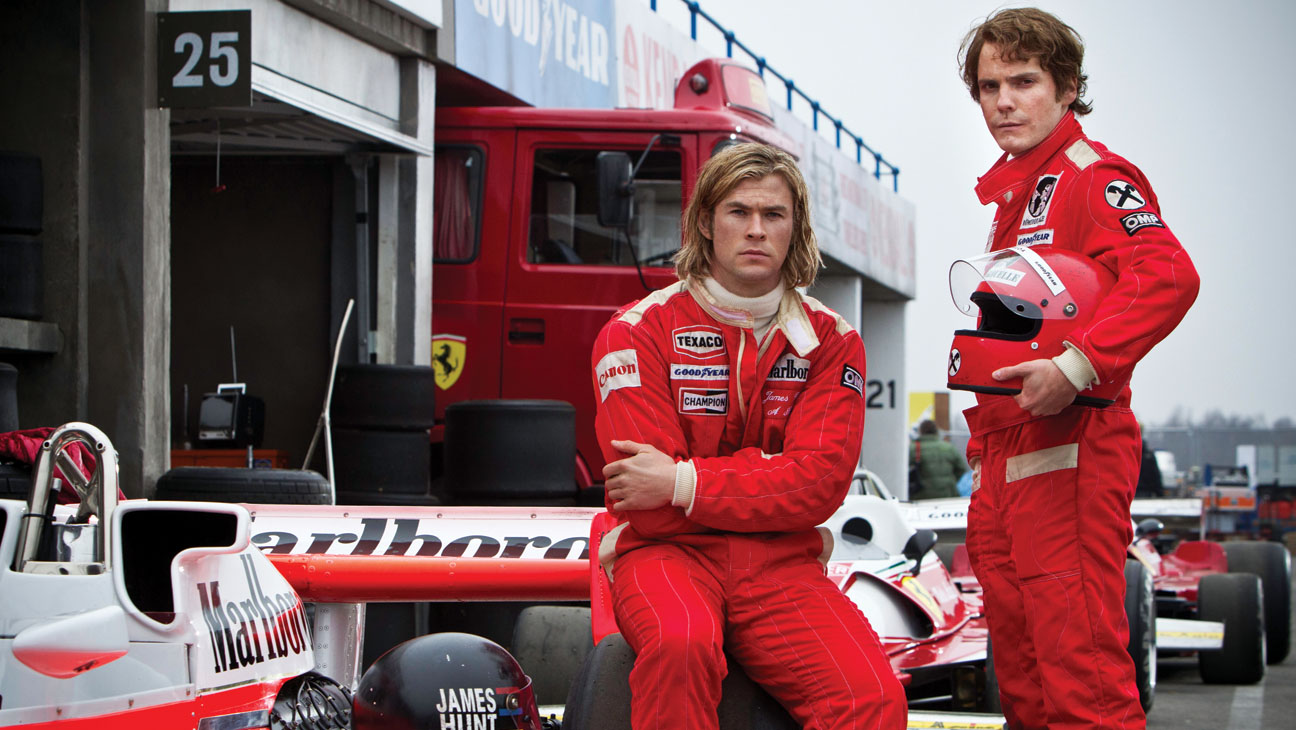
An unstoppable and uncontrollable rush of energy, excitement, and gravitas, a movie that starts on a high note and simply refuses to let up all the way through. James Hunt (Chris Hemsworth) is a hot-headed racer who knows nothing except instinct and winning. Nicki Lauda (Daniel Bruhl) is a german racer who knows nothing except business and blunt honesty. Together these two rivals inspire and fuel each other’s ambition to outdo the other and win first place in the 1976 Formula One Season. This is a movie that is compelled by truth and driven by accuracy, pun intended. Hemsworth and Bruhl are perfect as Hunt and Lauda, their edginess and animosity apparent in every scene, never once breaking character. Ron Howard is documenting the film more than making it, and with the help of his screenwriter Pete Morgan and his editors Daniel Hanley and Mike Hill, he makes a biographical picture that is both relevant and exciting for its audience. An incredibly driven film that is entirely, unforgettably awesome. Four stars.

4) THE BUTLER

An earnest, humble film, parts approachable and observant yet equally ambitious and honest. Forest Whitaker plays as Cecil Gaines, a black butler who grew up during the slave era, growed up learning how to be a white man’s servant, got a job at the White House, and continued to serve there for almost 35 years. As he watches history pass him by from President Eisenhower all the way up until President Regan, Cecil recounts how he’s changed as a husband and as a father and what it means to be a free black man in America. Lee Daniels directs an all-star cast through this gripping, emotionally overwhelming story, with actors like Robin Williams, Alan Rickman, John Cusack, Cuba Gooding Jr., Terrence Howard and Mariah Carrey in it just to name a few. The best performances come from Forest Whitaker and Oprah Winfrey as his wife, whose performances at many times carry the film on their own merit. A film that looks into the reality of circumstances and shows them exactly how they were, no matter how tragic or heartbreaking they were. Four stars.

3) THE HUNGER GAMES: CATCHING FIRE

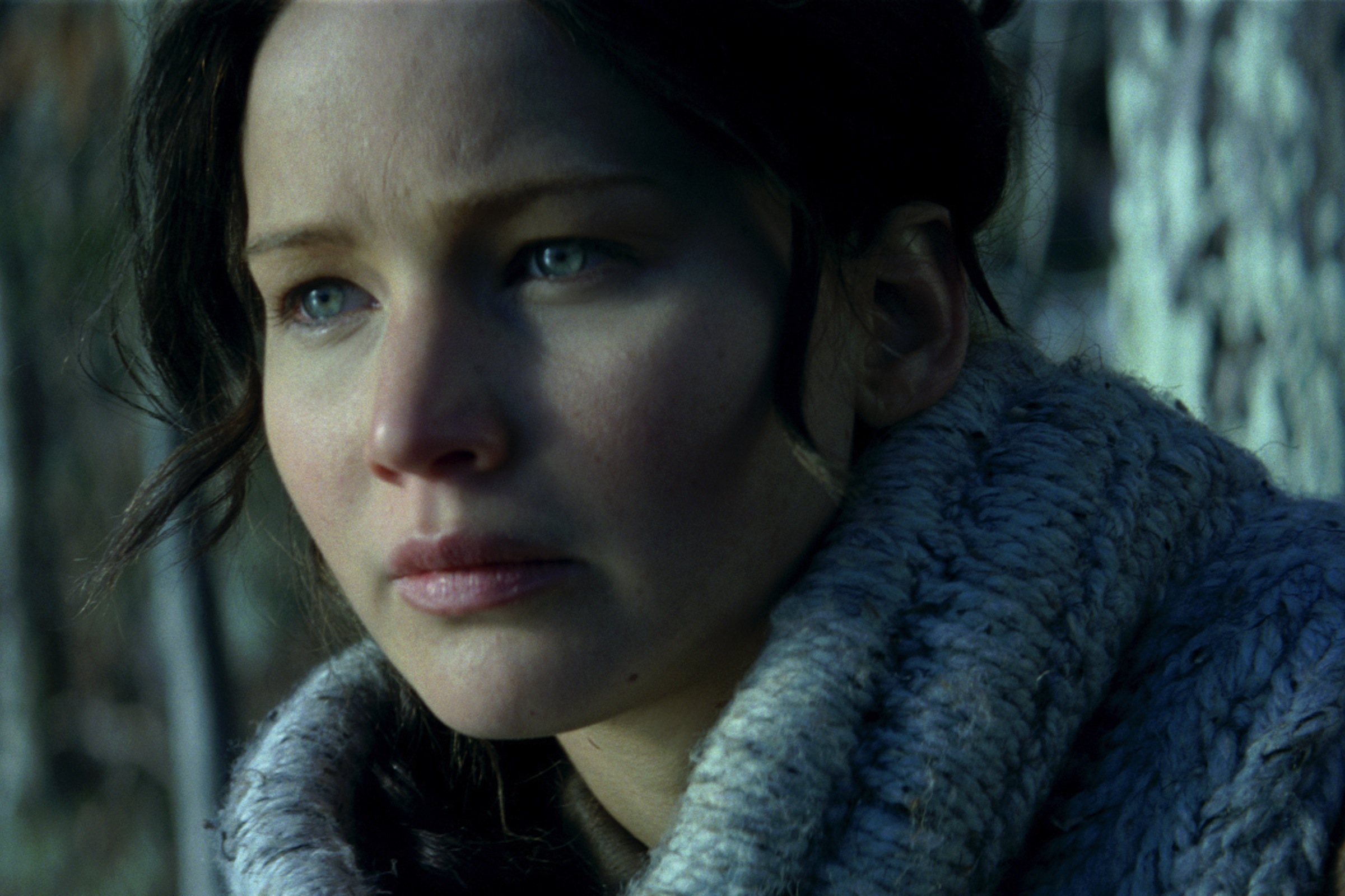
A tense, gripping, and pulsating film crackling with energy and drama. Taking place after their victory at the 74th Hunger Games, Katniss Everdeen (Jennifer Lawrence) and Peeta Mellark (Josh Hutcherson) try to re-adjust to their normal life until President Snow (Donal Sutherland) declares that the 75th Hunger Games will feature all of the previous winners, including Katniss and Peeta. Now shoved back into the horrid games that scarred her in the first place, Katniss must find a way to not only survive the games with Peeta, but to retain her humanity after everything is over. Directed by Francis Lawrence (I Am Legend), Catching Fire is the film that is everything the first thing was except more. The story is captivating, compelling, and deeply emotional. The themes are deep, powerful, and maddening. And the cast is more than exceptional, with Lawrence’s heartbreaking expressions at the center of it all. Not only one of the best sequels of the year, but one of the best movies of the year, period. Four stars.

2) GRAVITY

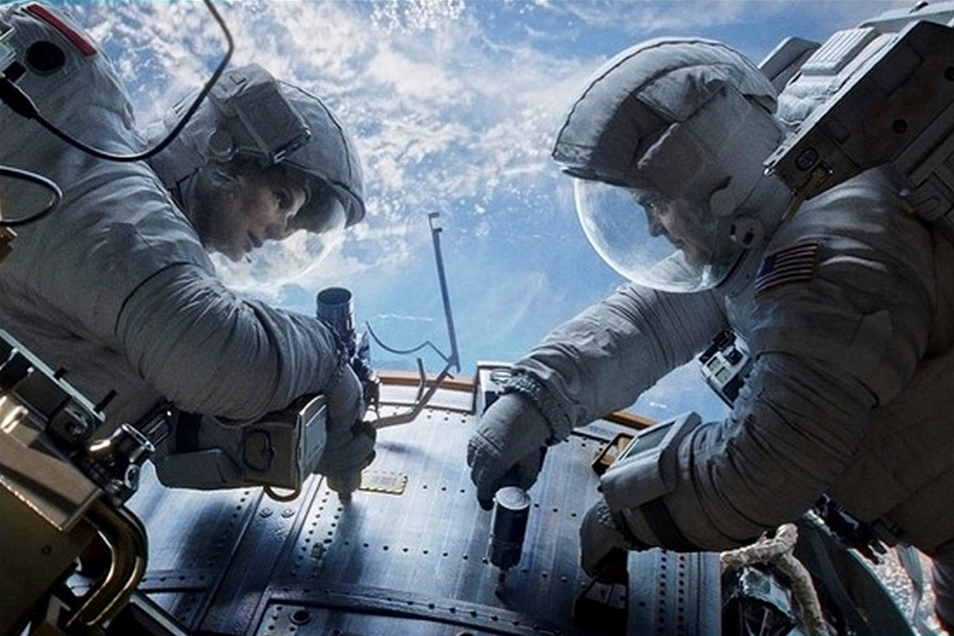
A film for a generation, a picture so convincing in its approach that its nearly impossible to think that it wasn’t even filmed in space. Sandra Bullock stars as Dr. Ryan Stone, a medical engineer out on her very first space mission with veteran astronaut Matt Kowalski (George Clooney). When debris suddenly strikes their station and leaves them astray, Stone and Kowalski need to fight to survive and find their way home back to planet Earth. There is literally not a single technical fault in the film. The visual effects are stunning, eye-popping, and visually-breathtaking. The cinematography by Emanuel Libewski is poignant, curious, and masterfully constructed. But the most credit needs to go to writer-director Alfonso Cuaron, who is so precise with the film’s visuals, story and Bullock’s performance that he makes the film just as emotional as it is anticipative and on the edge of your seat. It blurs the line in between science fiction and science reality, and is probably the best space movie I’ve ever seen. Four stars.

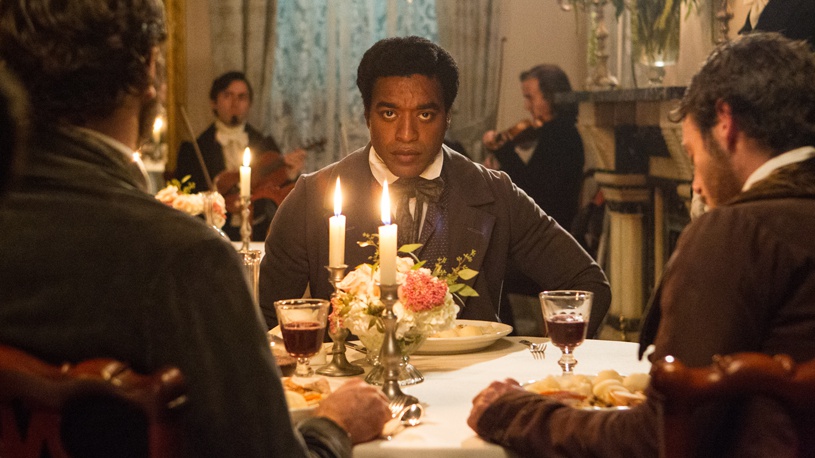
1) 12 YEARS A SLAVE

One of the best films of the year, and among the best on the subject of racism and slavery. Based on the true story of a free man named Solomon Northup (Chiwetel Ejiofor), 12 Years A Slave chronicles his story of being drugged, captured, and sold into slavery for over a decade of his life. Directed by Steve McQueen (Hunger, Shame) 12 Years A Slave is this year’s frontrunner of the Oscar for best picture, and it’s very deserving of that title. Not only is it tragic, maddening, and heartbreaking all at once: it is a very diverse and well-made film. The cinematography by Sean Bobbit is lush, broad, and captivating. The soundtrack by Hans Zimmer is slow and dreary, the third of his movies this year to be featured on this list. Ejiofor, however, is the star of this show, with his passionate, tearjerking performance driving us to care for this character and feel what he is feeling. Compels you to experience compassion and sympathy in ways almost no other film can do. Not even with Schindler’s List. Four stars.

Whether you’re a dedicated movie lover or simply a casual viewer, I encourage all of you to see the movies on this list. They did more than impact me: they touched and inspired the people all around me.

-David Dunn

Tagged , , , , , , , , , , , , , , , , , , , ,