Warning: Spoilers ahead for ‘Star Wars: The Last Jedi.’
Nobody hates Star Wars movies more than Star Wars fans do. This is made no more apparent than with their spiteful reaction to its most recent sequel The Last Jedi, which is currently sitting at 49% on Rotten Tomatoes and 46 on Metacritic among its users. That’s lower than any of the prequel movies, including The Phantom Menace. The critics conversely say it’s one of the best Star Wars movies ever made, with many arguing that it’s even better than The Empire Strikes Back. I have a question for both of these viewers: are you all out of your minds?
The Last Jedi is not the best Star Wars movie by any means. Honestly, it doesn’t even break the top five. Yet, I find Star Wars: The Last Jedi to be challenging both to the series’ characters and to ourselves as fans. That’s because it throws both of us through loops nobody was expecting, forcing us to digest shocking, life-changing choices and fully confront their implications face-to-face.
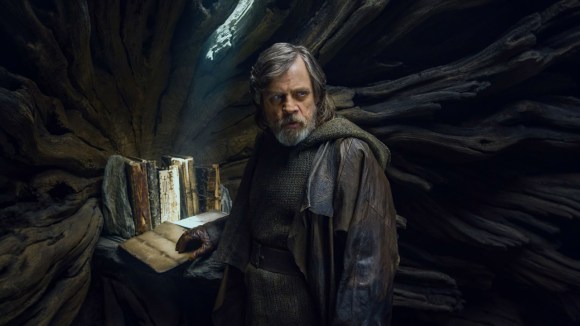
Take, for instance, Luke Skywalker. A lot of fans were angry at how writer-director Rian Johnson represented Luke in the film as an exhausted and defeated old man who had lost faith in the Jedi and in himself. Even Luke Skywalker himself was frustrated at how he was handled in the film, with actor Mark Hamill going so far as to say this version of Luke isn’t his Luke Skywalker.
“Jedis don’t give up,” he told SensaCine in December. “I mean, even if he had a problem, he would maybe take a year to try and regroup, but if he made a mistake he would try and right that wrong, so right there, we had a fundamental difference. But, it’s not my story anymore. It’s somebody else’s story, and Rian needed me to be a certain way to make the ending effective.”
Exactly. Actors disagree with their directors on how their characters should be portrayed all the time. Even Harrison Ford wanted George Lucas to kill off Han Solo in Return of the Jedi (although the character later met his demise at the hands of his son in The Force Awakens). A disagreement with your director on a character’s direction doesn’t necessarily mean its the wrong direction; just a different one. And that’s exactly what Johnson was aiming for: a Luke Skywalker who lost his way, devoid of the hope he once possessed and lacking the faith that made him a Jedi in the first place.
But just because he isn’t the hero you remember, doesn’t mean he still isn’t the hero at all. I found myself strangely caught up in Luke’s emotions in the opening moments of the film: of him once again meeting Chewie and asking where Han was, sneaking onto the Millennium Falcon and reminiscing on old memories, finding R2 and seeming so happy to see his old friend again. I actually teared up at the moment when he told R2 that he was never coming back and that nothing was going to change his mind. R2 uttered a beep, spurred his head around, and lit up a projection of the first message that brought them together in the first place: his sister Leia begging “Help me Obi-Wan Kenobi. You are my only hope.”
We weren’t seeing Luke Skywalker the swashbuckling space hero in The Last Jedi. We were seeing Luke Skywalker as a broken fragment of what he once was. That makes sense, because in the context of the Star Wars universe, these characters aren’t invulnerable movie icons that live happily ever after. They’re just people, complete with their own flaws and doubts that make them penetrable with their emotions. Characters change in movies because people change in real life. What makes characters like Luke a Jedi is not succumbing to their failure or regret, but instead resolving to get past their own feelings and do the right thing, which Luke eventually does in this movie.
Also, if you have a problem with Luke’s attitude and exiling himself, Johnson is not the right person to blame for that. Director J.J. Abrams is, as he was the one who first banished Luke to that gaudy island in The Force Awakens in the first place. Johnson was just following through on the implications made in the first film. Don’t shoot the messenger for what the tax collector handed to him.

There are other elements in the picture that don’t work as well. One of those is the planet Canto Bight, where Finn (John Boyega), Rose (Kelly Marie Tran), and BB-8 travel to recruit a code breaker to get them onto the First Order’s Star Destroyer. This side-plot felt removed and out-of-place, forcefully injecting themes of animal brutality, war profiteering, and capitalism in a movie that’s most known for its big space battles and lightsaber duels. Mind you, I didn’t hate the sequence. Boyega and Tran had a good enough chemistry to keep me engaged throughout, and BB-8 is such a quirky character that I can enjoy watching him no matter what mundane plot he’s going through. But the scene itself was awkward and disjointed. It felt weird to go from a fast-paced chase in outer space to essentially a dragged-out casino scene where our heroes narrated exposition on unnecessary social commentary.
However, I don’t think that scene itself was the problem. The problem was Laura Dern’s character, whom I simply refer to as “Purple Hair Lady” considering that is her most distinguishing feature. This whole sub-plot arrived because she refused to tell Poe Dameron (Oscar Isaac) the plan to outrun the First Order to make a point about following orders. Yet when you’re about to be killed by Hitler’s equivalent of a First Order maniac, I would think you would put personal vendettas aside and focus on the important tasks at hand, mostly saving your crew. Because Purple Hair Lady didn’t do that, she confused Poe and the others, threw them into the Canto Bight subplot, which ended up being meaningless because they got caught anyway, and to make matters worse, her secrecy actually endangered the mission, with the captured Finn and Rose inadvertently leading the First Order to attack the escaping life pods instead of the main Starship. Basically, 40 minutes of the movie could have been cut if Purple Hair Lady provided only one line of dialogue to a concerned Poe. That’s not a lapse in judgement. That’s poor writing.
However, that scene where Purple Hair Lady takes the Starship and suicide lightspeeds into the Destroyer was amazing. That scene made it into my top five favorite visual moments out of the entire series.
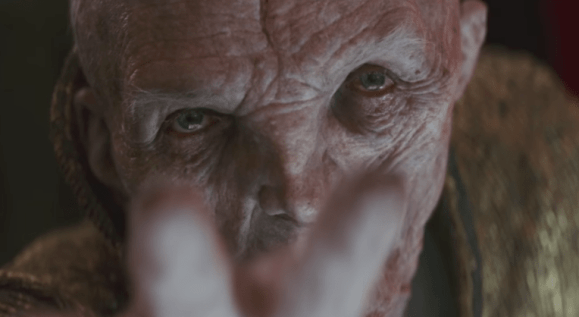
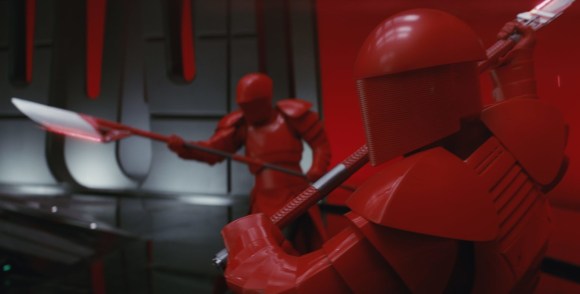
The worst part of the movie unequivocally comes with Supreme Leader Snoke (Andy Serkis), who is abruptly killed off halfway through the movie in a moment nobody was expecting. Admittedly, the scene was very cool, with Kylo Ren (Adam Driver) turning his lightsaber using the Force towards his master while tricking him into thinking that he’s going to kill Rey (Daisy Ridley). Instead, he kills Snoke and teams up with Rey to take down Snoke’s Pratorian guards, which leads into a lightsaber fight so spectacular that it barely nudged into my top five lightsaber duels of all time. There’s just something really satisfying about a bunch of lightsaber weapons crackling into each other all at once here.
But upon sitting over it, I realized that we still know nothing about Snoke. We don’t know where he comes from, how he knows the Force, when he met Ben Solo, how he tempted him over to the Dark Side to become Kylo Ren, and how he gave rise to the First Order. This was one of the most intriguing characters introduced in The Force Awakens, and here he is needlessly axed off like Boba Fett was thrown into the Sarlacc Pit in Return of the Jedi. Is that a fair treatment of a character? I wanted to know more about him before his climactic death, maybe in a duel with Luke or Rey before biting the lit end of a lightsaber. Thanks to Johnson, we’re never going to get that, and that’s the most frustrating aspect of the film.
Side-note: I do humor the possibility that Snoke might make his return as a Force ghost in Episode IX. Throughout the movie, Rey and Kylo are connected through the Force to conversate, and later on Snoke reveals that he was the one connecting them. Yet after he died, Rey and Kylo were connected once again briefly before Rey took off in the Millennium Falcon. Is that potential foreshadowing for the character’s return?

There are two changes to the Star Wars lore that were jarring upon my first viewing, but upon further analysis I grew to eventually accept. The first one is the reveal of Rey’s parents. After the aforementioned battle with the Pratorian guards, Kylo asks Rey to join him with the First Order so they can rule the galaxy. To tempt her, he asks her to confess who her parents were. With tearful eyes and quivering lips, she hesitantly said:
“They were nobody.”
And that’s that. Kylo Ren tells her that she was sold off into slavery for drinking money, that she comes from nothing, and that she is nothing. Rey’s parents are nobody.
For all of the hype built up in The Force Awakens, this is reasonably disappointing to many fans. Here I was thinking she was either a Skywalker or a Solo, and it turns out that she’s neither. I was at first extremely frustrated by this weak reveal, but as I further lulled on it I came around to liking it. Mostly because it’s poetic in how someone who came from nothing can grow to become someone so important in the Star Wars saga, but also because it makes the tragedy of the character all the more real.
The series, in hindsight, is a story about family: the ones we come from, the ones we don’t have, and the ones we make for ourselves. Anakin had only one family in his mother and wife, and both were taken from him. Luke lost his family in a raider attack, but found a new one in his sister and in his father that he never knew. And Rey likewise was abandoned by her family, but now finds a new family among people who lost their own families as well. It’s a really sweet sentiment that I appreciated the film for exploring. Even if her true parentage is retconned in Episode IX, I at least appreciate that they have that underdog theme going on in there.
The second is how Luke dies in the movie. In admittedly one of the best scenes in the film, Luke shows up on this salt planet (yes, a salt planet, don’t ask) to defend the Resistance from the First Order. After all the AT-AT’s fire a barrage of blasts at Luke and he deflects them all (he humorously brushes it off like a leaf fell on him), Kylo Ren emerges from his cruiser to face his former master. As Luke kept frequently dodging Kylo Ren’s attacks and sidestepping his lightsaber swipes, I caught myself wondering why Luke wasn’t swiping back? Or why his feet weren’t leaving footprints on the salty surface? I got my answer shortly after: Luke isn’t actually on the salt planet. Instead, he’s still mediating on a rock back on his exiled planet, and since he overexerted himself by making a Force projection from star systems away, he collapses, faces the sunset, then vanishes into the Force like his masters Obi-Wan and Yoda before him.
I was extremely disappointed with this upon my first viewing, mostly because it wasn’t the ending that I wanted for Luke. I had built up in my mind years ago a big, epic duel between himself and Snoke, while Rey and Kylo Ren possibly fought each other in the background. The fact that he passed on through the Force instead of meeting some epic end like Han did in The Force Awakens? It felt like short-changing the character itself.
Again though, the more I thought about it, the more this ending made sense. First of all, how was Luke going to get to the salt planet? His X-Wing was drowned in the ocean back on his island, and he didn’t have an Astromech droid to co-pilot it. Not an ideal scenario for sure, but if you’ve written Luke into a corner on the far side of the galaxy, it wouldn’t make much sense to ham-fist an explanation into there just so Luke can fight on the salt planet, now would it? As Luke mentions in the film, he went into exile for one purpose: to die and bring an end to the Jedi. For someone who seems so committed to that purpose, it wouldn’t make sense for him to stow away an escape pod somewhere on the island so he can just opt out of suicide, now would it?
Second, Luke isn’t the Jedi that he once was. As Rey mentioned earlier in the film, Luke purposefully closed himself off from the Force as penance for his past actions. This implies that even though Luke is still in-tune with the Force, he’s not all-powerful as he once was, nor are his fighting skills as refined as when he was younger. Stacked together, we have an aged, crippled Luke stranded across the galaxy on an isolated planet with no way of getting off, who still needs to save his family star systems away regardless. So what does he do? He Force-projects himself across the galaxy to distract the First Order, exhausting himself fatally, ultimately sacrificing himself so that the Resistance can get away and fight another day. It’s not the ending I would have preferred, but I can’t deny that it works in the context of this film. It’s just one of those cases where what I wanted as a fan conflicts with objectively reviewing the film as a critic. That happens once in a while, where your cinematic intuitions contradict one another in a film.
And yet, the moment was still strangely sentimental, with Luke ending his place in the series the way it began: facing the sunset, staring at the two suns shining down on him, hopeful for what the future will bring. Unfulfilling, yes, but this was the ending Luke chose for himself. Even though I felt let down with Luke’s return, I have to admit there is something satisfying about Luke finding peace with himself after all of these years of suffering that he’s had to endure.
I will not deny that I felt disappointment with Star Wars: The Last Jedi. A lot of fans did. And yet, the movie was about disappointment. Luke’s disappointment in himself and the Jedi way. Kylo Ren’s disappointment in his masters, both from the light and dark side. Poe Dameron’s disappointment in the Resistence. Finn’s disappointment in his friends that betrayed him. Leia’s disappointment in her allies who abandoned her. Rey’s disappointment in her life’s heroes and with who she was and where she came from.
Yet through that disappointment, frustration, and failure, something good came out of it. Our heroes grew. They matured. They became better people, and they became more, not less, motivated to fighting their enemy and protecting each other. And that catharsis is the point of the movie: the fact that tragedy can bring about strength and growth.
In a throwback moment to The Empire Strikes Back, Yoda appears as a Force ghost to Luke and tells him that failure is the greatest teacher: that it educates us beyond anything we can learn by ourselves. “We are what they grow beyond,” Yoda tells Luke in a touching moment. Hopefully the fans who hated this movie can learn to grow up like the rest of the characters in this series do.
Post-script: The Porgs are cute. I have nothing to add beyond that.

– David Dunn
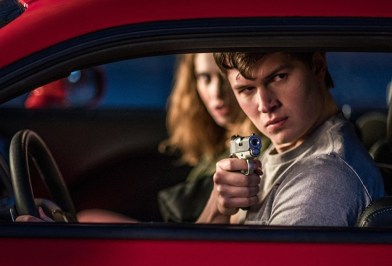 A sleek, stylish, and electric action-drama booming with nostalgia, in-cheek humor, and a hot-blooded soundtrack to boot. When a getaway driver named Baby (Ansel Elgort) decides he wants to get out of the criminal life, he has to go through his boss Doc (Kevin Spacey) and assassins Buddy (Jon Hamm) and Bats (Jamie Foxx) to save his girlfriend Debora (Lily James) and hit the road running. Elgort is a powerhouse in the lead, portraying a conflicted young man guided by a moral compass in a place where it points nowhere. The action and comedy blend together perfectly, with writer-director Edgar Wright framing the film as a homage to classic 1980’s espionage films. And the soundtrack is infectious in its appeal, with featured artists such as The Beach Boys, Queen, and Simon and Garfunkel here to keep your feet tapping. The year’s biggest surprise hit. Three and a half stars.
 Hugh Jackman’s last outing in a role that he has served well for more than 17 years, a finale that is equal parts violent, action-packed, emotional, heartbreaking, and powerful. When Logan (Jackman) is approached by a little girl named Laura (Dafne Keene) asking for his help, he teams up one last time with his mentor Charles Xavier (Patrick Stewart) to save Laura from the men that are after her. Refusing to shy away from the bloody, hard-R violence that made Deadpool a mainstay, Logan is the most emotional, the most vivid, and the most grounded story told in Wolverine’s saga. Instead of the action and the visual effects, writer-director James Mangold chooses to focus on something more practical to Wolverine: his humanity. Like The Dark Knight and Spider-Man 2, Logan relates to us on a more human level as opposed to a fantastical one, and the characters deal with real struggles as human beings, not as superheroes. Jackman and Stewart also give the most defined performances of their careers, playing their characters in their most vulnerable, broken appearance to date. Time will remember Wolverine for the hero. I will remember Logan for the man. Three and a half stars.
 A strange, surreal, and deeply unusual horror film, but also immediately relevant to its intended audience. When an interracial couple goes to visit the girlfriend’s parents for a weekend getaway, they discover that her parents aren’t all that they seem: and neither are their neighbors. “Key & Peele” co-creator Jordan Peele comes forward here in his directing debut as a masterful storyteller, deconstructing and elaborating on white privilege and the devastating effects it can have on individual lives. Daniel Kaluuya and Lil Rel Howery respectively delivers the films most climactic and comedic moments, with Kaluuya particularly impressive in portraying a character that is confused, scared, and victimized in a situation where no one is coming to help him. Get Out is one of the most creative, compelling, riveting, and darkly humorous films I’ve seen in years. It works across the board as horror, comedy, drama, or satire. Take your pick. Three and a half stars.
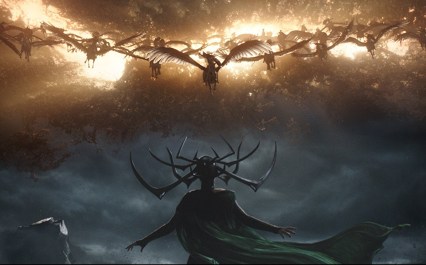 Marvel’s standout of the year, a movie that has absolutely no business being this good or memorable. When Thor (Chris Hemsworth) starts getting visions of Ragnarok, the prophesied destruction of Asgard, he has to team up with Valkyrie (Tessa Thompson), the Hulk (Mark Ruffalo), and Loki (Tom Hiddleston) to stop Hela, the Goddess of Death (Cate Blanchett) from destroying Asgard. Packing five different genres into one unorthodox mess of perfection, Thor: Ragnarok is a funny comedy, a thrilling action movie, an exciting adventure, a heartfelt drama, and a groundbreaking superhero epic all at once. The comedy hits exactly the right notes with the right lines. The drama, while at times a little too brisk, strikes with the emotional chord that it needs to. The action scenes are thrilling. The visual effects, mesmerizing. The music, synthesized and catchy. Even the Easter Eggs are infectious in their appeal. I haven’t had this much fun in a superhero movie since The Avengers in 2012. Yes, I’m comparing Thor: Ragnarok to The Avengers. Don’t knock it until you try it. Four stars.
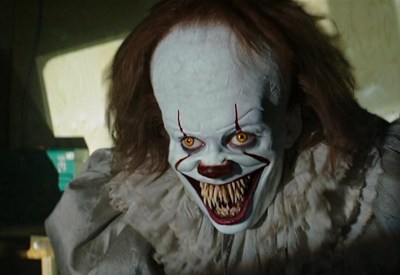 A terrifying and insightful personification of fear made possible by the brilliantly mad mind of Stephen King. When a group of kids discover an omniscient being disguised as a clown haunting their hometown, the children decide to team up and put an end to it’s villainy once and for all. The cast takes center-stage in a horror film fueled by complex emotions and ideas, with Bill Skarsgard perfectly embodying the madness and bloodlust that the iconic character Pennywise the dancing clown would possess. Director Andy Muschietti also smartly compares and juxtaposes human nature with that of a predator’s nature, asking us if these two concepts can exist in the same society. It is visually dynamic and haunting, with the makeup and costuming on Skarsgard being among the best work I’ve seen in years. A thoughtful, captivating, and intensifying look into the psychology of fear and how it affects our flawed perceptions of life. Four stars.
 A cruel, horrifying, and maddening fact-based account of one of the most egregious cases of police brutality in American history. During the 12th Street Detroit riots of 1967, a team of rogue cops infiltrate their way through the Algier’s Motel and pin the inhabitants against the wall, demanding to know if they’re hiding any weapons inside the building. As the hours pass, the teenagers soon realize that this is not a run-of-the-mill police checkup, but instead a fight for survival between themselves and the men who are supposed to be upholding the law. Thoroughly researched and accurately dramatized from the Academy Award-winning team of screenwriter Mark Boal and director Kathryn Bigelow, Detroit is one of the most riveting and essential pieces of cinema you can watch this decade. The details of this real-life account are haunting and tragic, and the cast equally commits to recreating this monstrous night with passionate urgency. Newcomer Algee Smith especially shines as a troubled R&B musician, a terrified kid caught in this confusion of racial prejudice and hatred that permanently damages him for the rest of his life. Don’t turn away from Detroit. Watch and be horrified by our nation’s history. Four stars.


 DAVID DUNN