Tag Archives: Spin-Off

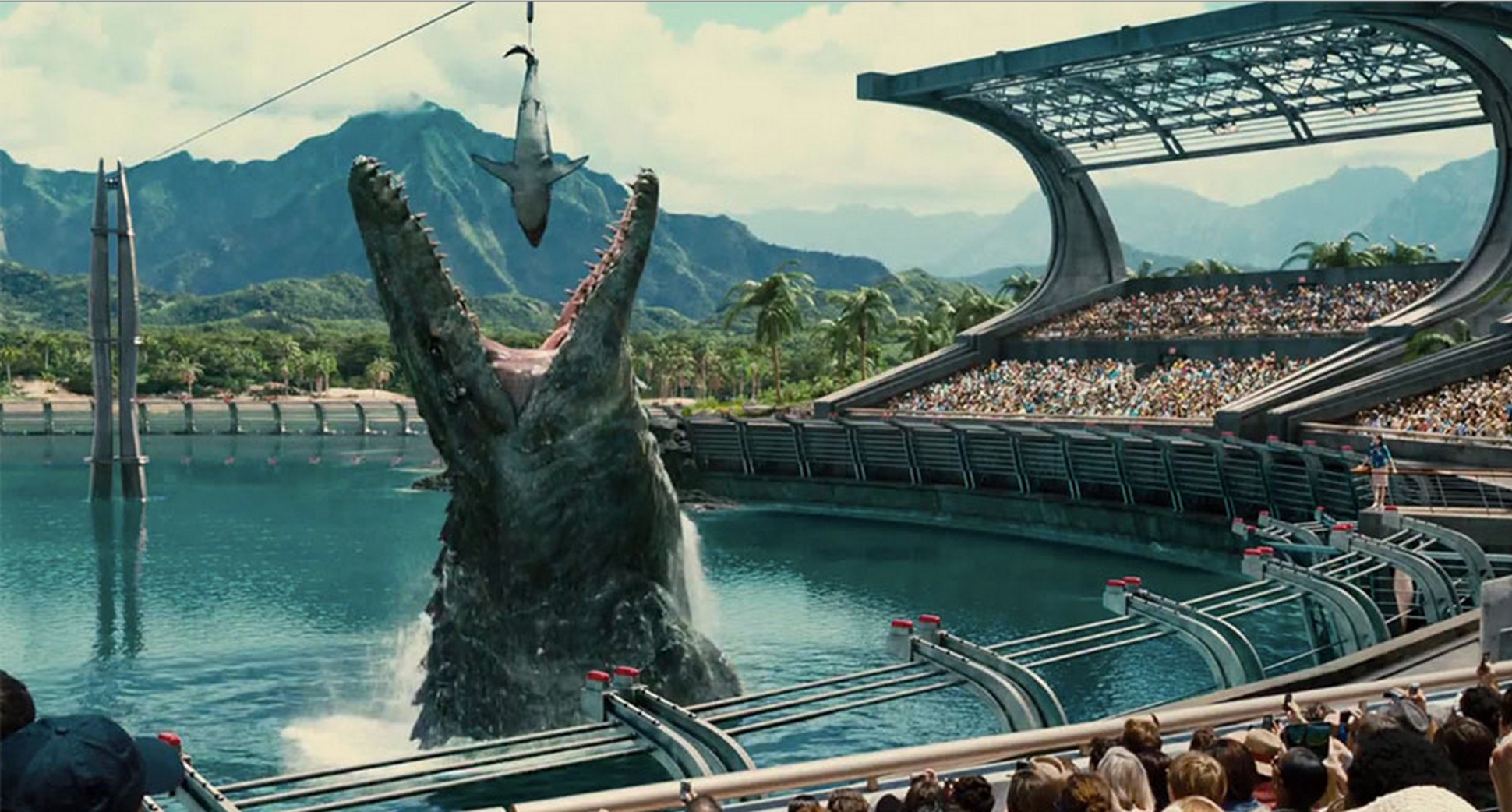
“JURASSIC WORLD” Review (✫1/2)

Never trust a velociraptor. 

If there is any reason you need convincing as to why some movie franchises need to stay extinct, let Jurassic World be your most recent example. How to I start with this? Well, let me start with a positive: Joe Johnston isn’t directing. Thank God, because I couldn’t stomach another Jurassic Park III. Maybe I already have.

The movie takes place 20 years after the events of Jurassic Park, which is just as well because it literally is more than 20 years after the original was released. The new plot re-writes the history so that The Lost World and Jurassic Park III never took place. Not a change I will be missing since those movies contributed as little to the series as World does.

The film’s cast of characters includes a dinosaur whisperer named Owen Grady (Chris Pratt), who controls his own small battalion of velociraptors ready at a moment’s notice. Yes, you read that right. A velociraptor battalion. You get used to such absurdities as the movie goes on. You have Claire Dearing (Bryce Dallas Howard), the park manager of the newly-designed Jurassic World. Then you have Zach and Gray Mitchell (Ty Simpkins and Nick Robinson), two brothers who go to Jurassic World for a small vacation away from their parents. Oh yeah, and Claire is their aunt. You can tell their parents are really responsible by sending their kids away to an exotic park filled with man-eating beasts and reptiles with their ditzy, airhead of an estranged aunt to take care of them.

Anyhow, the upgraded, new-and-improved Jurassic World is a major step forward from Jurassic Park, the failed first attempt at a dinosaur park thanks to the hands of John Hammond. But no worries! Jurassic World is the perfected design of Jurassic Park, and nothing can possibly go wrong!

…right? RIGHT?!

Wrong. They do the smartest thing they can do and create a new carnivorous dinosaur called the Indominus that is more powerful than the T-Rex, Spinosaurus and a pack of Velociraptors combined. Hooray for dinosaur science!

As soon as the film opens up, you realize how many stupid characters are packed into the film to create the biggest idiot plot you’ve seen since Idiocracy. Idiot # 1: Whoever decided to create this park after the original one ended so disastrously. Idiot # 2: The mad scientists who decided to create a new carnivorous dinosaur, splicing together the DNA of nature’s most dangerous dinosaurs. Idiot # 3: Bryce Dallas Howard’s character, for deciding to run in high heels the entire movie. Idiot # 4: The park official who thought the dinosaurs could be reused as weapons for tactical takeover. I’m sure he was still wondering what went wrong as one was chewing off his head (Hint: They’re hungry, you moron). Idiot # 5: Mr. DNA, because curse that Clippit wannabe. Idiot # 6: Anyone who thought it was a good idea to pay money to go to this park after knowing what happened at the old one.

It’s true, I’m not a fan of this movie’s conception to begin with. The premise itself has so many logical flaws to begin with, its hard to get into the story. But I’ve been faced with worse cases before and have been happily proven wrong. I had doubts before I went into the theaters to see 22 Jump Street and Guardians of the Galaxy, and those ended up being some of the most fun movies of 2014. If done well, a movie can suspend disbeliefs and be what a summer moviegoing experience is supposed to be: entertaining.

The problem with Jurassic World is that it undermines its own intelligence, and the entertainment value doesn’t pay off despite it. The script starts off with its flaws of logic in the outset and never addresses them in the film, its characters as oblivious to their own faulty thinking as badly as the screenwriters are. The movie continues with an onslaught of cliches and inaccuracies, some of which I rolled my eyes hard at and wondering if I was watching a Roland Emmerich action picture. Some of the worst blows come in the form of dialogue that actors somehow manage to deliver with straight faces (i.e. Lines like “I was with the Navy, not the Navajo” or “Wait until I tell my mom!”). Don’t even ask me how many times characters told each other to run.

Probably the worst offense comes with the casting. I’m not denying that these are talented actors. From big roles to small ones, each of these cast members have been in roles where they had a strong presence on screen. Now, their presence includes running away from dinosaurs and looking good in sweaty clothes. Simpkins was cute and likable in movies like The Next Three Days and Iron Man 3. Now, he’s an OCD dinosaur nerd who recites species like he’s a dictionary. Robinson was solid in in the coming-of-age drama The Kings Of Summer. Here, he’s in the cliche Gothic-teen phase like those characters you’d see from “Degrassi.” Howard’s resume needs no explanation. Her acting ability is worth more than the pretty-faced ditz role she’s forced into this movie. And Pratt? Ugh. Pratt is the worst. After making as strong a debut as he did in Guardians of The Galaxy, director Colin Trevorrow did the worse thing you possibly could do to Pratt in this movie: he made him boring.

Again, the visuals are amazing. Whoop-de-do. The more I offer the visual effects and the fight sequences as the movie’s strongest points, the more irritated I get at knowing I’m writing the same criticism over, and over, and over, and over again. Yes, the visuals are amazing, but are they good enough to substantiate the movie’s flaws? The original Jurassic Park revolutionized computer imaging years ago when you saw the life-sized dinosaur for the first time in 1993. What big achievement can Jurassic World boast about? Continuing the trend that Jurassic Park started. That’s it.

Great visual effects mean nothing if a plot is not strong enough to stand on its own two legs. Is one character’s solution to outrunning a giant dinosaur seriously to release a bigger, scarier dinosaur? What was she going to do when either dinosaur was finished? And on that note, is she seriously running and doing all of this leg work in high heels???

I’m seeming pretty harsh with this movie. I know it, and I’m sticking by it. The more I thought about my experience with this movie, the more irritated I get at the movie’s ignorances of itself and its audience. This movie’s premise was not the worst thing in the world. Guardians of the Galaxy had an even more preposterous idea to its story with talking trees and raccoons, and it pulled it off with humor and with heart. This movie copied what Jurassic Park did first and better, and it’s artificial efforts show. It needed to understand how prehistoric sequels are nowadays, and how badly it needed to evolve from it.
Tagged , , , , , , , , , , , , , , , , , , , , , , , , , , , , , , ,

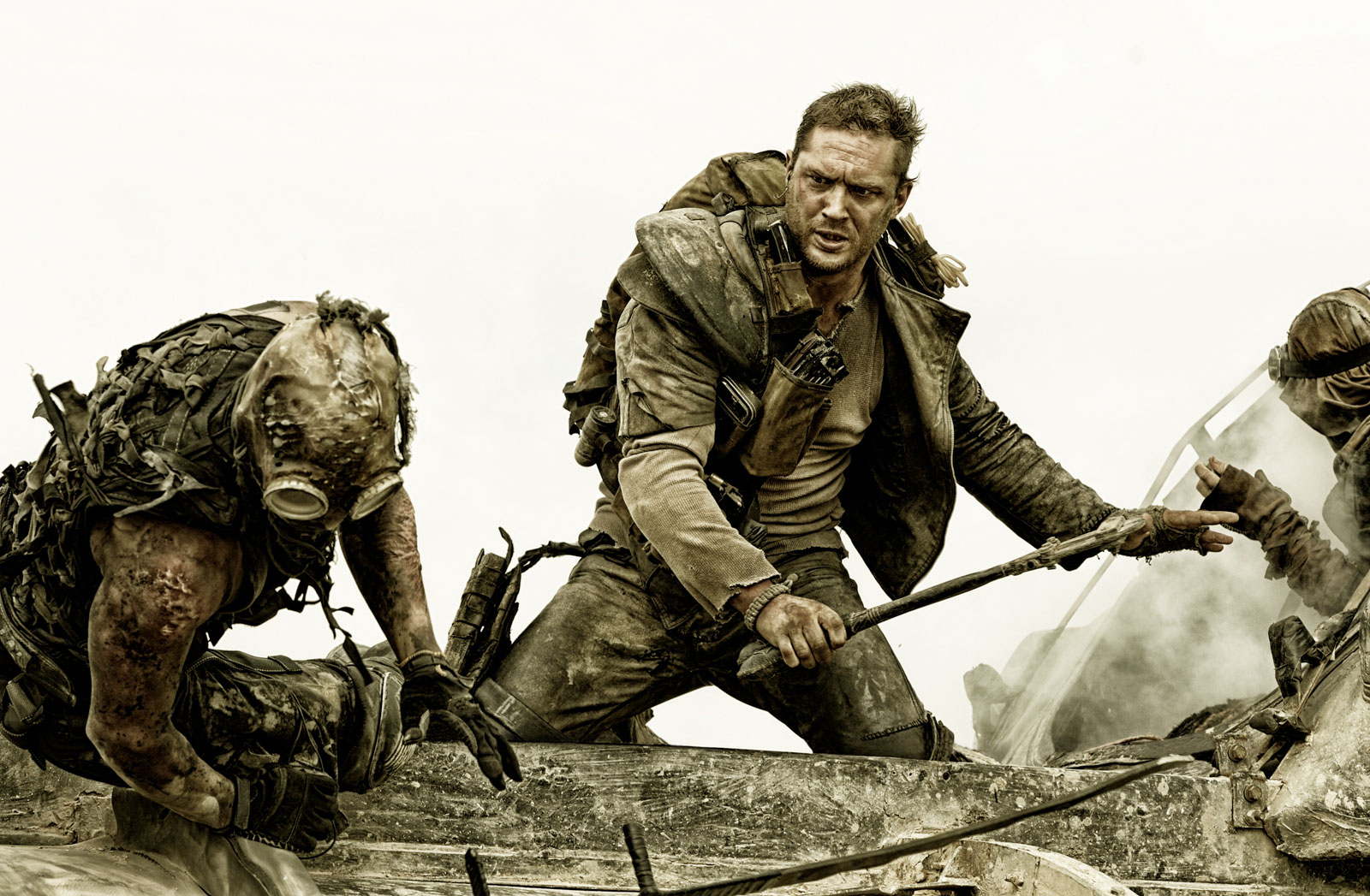
“MAD MAX: FURY ROAD” Review (✫✫✫1/2)

A lovely day and a flaming guitar. 

I’ve never seen a movie break as many rules as Mad Max: Fury Road does and get away with it. I’ve never seen a movie so loud, obnoxious and over-the-top that still manages to impress me by the time the end credits roll. Previous movies have done the same thing Fury Road has done and failed spectacularly. Transformers. Resident Evil. Underworld. G.I. Joe. Fast and Furious. All of those films are every bit as explosive and stupid as Mad Max: Fury Road is, and yet I don’t love them as much as I do Mad Max. Why is that?

I think its because the movie knows its just that: a movie. It knows that it’s loud, obstinate and stupidly explosive. It knows that its a blockbuster of exceedingly epic proportions that shakes the theater so much, it makes viewers shat in their pants. And more than anything else, it knows it is an action movie, with all of the fun and flaws alike bundled with it.

So what does a director like George Miller decide to do with that, knowing this is the fourth film in his own franchise? Fix the mistakes that are present in all of his predecessors?

No. Instead, he decided to embrace them, like a soldier throwing himself onto a hot grenade.

The end result is exactly how it sounds: bloody awesome.

The plot (if you can call it that) follows Max Rockatansky (this time portrayed by Tom Hardy) after the events of Road Warrior and before Beyond Thunderdome. In this desolate landscape called planet Earth, Max is a survivor of Nuclear war, traveling dry and sandy deserts in silence and solitude. Everyone else around him is either dead or has signed up in the mad crusade of Immortan Joe (Hugh Keays-Byrne), a tyrannical warlord who has idolized himself as a god and has labeled everyone under him as his followers. Considering he has control over the only water source over hundreds of miles, the survivors have little choice but to submit to him.

One of these followers is Furiosa (Charlize Theron), a fierce female warrior who is charged with transporting Joe’s water to a nearby town with her small battalion. Little to Joe’s knowledge, however, Furiosa is transporting something else: all of Joe’s wives. Now on the hunt from Joe and all of his maniacal followers, Furiosa needs to team up with Max to escape the desert landscape and free the wives that have been under Joe’s cruel control for so long.

Is the plot as stupid as it sounds? The answer is no, because the film really doesn’t have a plot, only the resemblance of one. The narrative is a weakness all of the films in the series share with each other. While other science-fiction movies have a rich amount of lore and backstory behind them, Mad Max doesn’t have as much to boast about in its own series. Really, as far as story goes, all of the Mad Max movies are kind of weak in narrative scope. Here’s the plot for all of them: a guy is trying to survive against a homicidal maniac in a deserted landscape. That’s it. It’s a big case of “what you see is what you get.”

Here’s where Mad Max: Fury Road is different though: there’s a lot to see. Even though the plot is about as thick as a studio pitch, Miller displays this meager plot in spectacular, stunning, eye-popping action and explosions, and even a few soft moments of short dialogue exchanges between characters.

The stunts are unlike anything you’ve seen in any of the previous movies. The most destruction you found in Mad Max and Mad Max 2 was cars exploding and toppling over into deep sand dunes and rocky road pavements. In this movie, vehicular manslaughter is the least of the destruction found in the film. In one of the first action sequences, an entire armada of Joe’s fleet follows Furiosa into a giant sand storm of extremely windy proportions. In another scene, gang members viciously chase Furiosa’s truck in a tightly-cornered crevice of mountains. In another, a flunkie gets blinded by gunfire, puts cloth around his bleeding eyes, then fires blindly at Max and his gang like a crack-happy trigger maniac. For crying out loud, there’s one underling in the film that uses a guitar flamethrower.

Yes. That’s right. A guitar flamethrower.

It’s obvious that the film is ridiculous and absurd in the most gleeful of ways. Yet, what I like so much is that in between all of the over-the-top and in-your-face action, there’s actually a purpose and a reason for actors being in the movie. Yes ladies and gentlemen: this is an action movie that has actual acting in it. Hardy replaces Mel Gibson’s role with hardened machismo and stiffness to his gesture, and while Max is still mostly a flat character, Hardy portrays him with a sort of intrigue to him that makes you curious about his history, even though we already know most of it. Theron, however, impresses me the most. She’s incredibly versatile in the film, being a firm and uncompromising action heroine in one moment, and an emotionally exhausted and stricken survivor in another. She’s honestly the real lead in the film, with Max being more of a supporting character to Furosia’s rebellion against Immortan Joe. The film is really empowering to females, and that’s an incredibly rare thing, especially for an action movie.

By now, you’ve hopefully gotten the idea of what the movie is like and whether you’d be interested in this sort of thing or not. The film definitely has its flaws, but by God, the movie is just so freaking entertaining. I can’t sum up the film any better than that. Now go get your movie ticket. There’s a flaming guitar that you need to see.

Tagged , , , , , , , , , , , , , , , , , , , , , , , , , , , , ,

“THE AVENGERS” Review (✫✫✫✫)

The ultimate example of comic-book superhero movies. 

I remember opening a comic book for the first time in my life when I was just a small kid. The small pamphlet fascinated me: by just a flip of a page, an entirely different world was created. A world where normal people gained super powers, wore red capes and tights, fought evil wherever it may exist, and made the world a safer place by the end of the day. In a small, poor neighborhood town where I was the only white kid in a predominantly Latino school building, it provided me a sense of relief and sanction from much bullying and torment I experienced from the other school children back in the day. It provided me freedom from the accursed world I lived in: it provided me a means of escape.

And now here I am, 15 years later, watching a live-action re-enactment of the world I discovered and loved all those many years ago. The Avengers is masterfully fantastic. It is an epic superhero tale, portraying the never-ending conflict of good and evil. It is an action movie with surprising finesse, switching from scenes of explosive energy and action to other scenes with insight, humor, and heartfelt emotion. It is a faithful re-production of multiple universes we have come to love in the past four years, and re-adapts them faithfully and full of energy in this film. But the core of this film’s success is this: that the film’s story and themes are emotional, honest, and truthful, and fleshes out its heroes to make them what they are: humans. All fighting for very human, realistic, and understandable reasons.

If you’ve seen the previous Marvel entries, you already know what this movie is about. The Avengers is a group of superheroes brought together to fight the battles that human beings never could.  Who are these heroes?  You would know most of them.

Tony Stark “Iron Man” (Robert Downey Jr): A billionaire playboy/philanthropist that has a genius-level-intellect that has allowed him to build and fight in a suit of armor.

Bruce Banner “Hulk” (Mark Ruffalo): A scientist exposed to gamma radiation, who turns into a giant, brutish beast with monstrous strength when he becomes angry.

Natasha Romanoff “Black Widow” (Scarlett Johansson): An agile and intelligent spy that is more skilled and capable than most other men.

Clint Barton “Hawkeye” (Jeremy Renner): A masterful marksman who can aim and shoot with his bow and various arrows in a matter of milliseconds.

Thor (Chris Hemsworth): The Norse God of thunder who can manipulate lightning with the power of his mighty hammer, Mjolnir.

Steve Rogers “Captain America” (Chris Evans): A super soldier frozen through time who can beat criminals to a pulp, as well as wielding a shield cast in a rare metal called “vibranium”.

You’ve seen these heroes before, most of them in their own respective movies.  All with their own stories, origins, conflicts, and themes that were explored along with their respective characters. My original worry with this film was, despite the huge expectations people were having, I was afraid this movie would let people down. It does, after all, have a lot on its plate: adapting over six superheroes into one action-packed movie is no easy task. We have Batman Forever and Spiderman 3 as evidence of that, where they had trouble of adapting even four super-powered beings to the big screen.

This film, though, has surprising finesse. Writer-director Joss Whedon adapts these characters with such child-like love and faithfulness, I feel their themes and stories from their previous films carry over to this film with them. It doesn’t feel like an adaptation, or an act of cruel financial commercialism. It lives up to the hype. The characters in this film live and breathe their uniqueness we have come to know and love from the previous Marvel movies. We feel Iron Man’s sarcasm and big ego, Thor’s sense of responsibility and brotherhood, Banner’s fear, frustration, and anger, and Steve’s sense of honor, patriotism, loss, and duty. Through the film’s dialogue and references to prior films, we sense Whedon’s pure intentions underneath the action, and we respect it. We realize he isn’t making just another action movie; he is making a superhero movie.  One with upmost faithfulness and loyalty to its own universes.

Impressive also, are the actors, but I don’t need to tell you that. We’ve seen them in prior films, so we already know they are good. I will comment then, on something we haven’t seen yet: their chemistry with each other. My word. This is what makes the Avengers, The Avengers. The actor’s chemistry with each other is spot-on, and in-tune. Whether it is a scene involving humorous, sarcastic dialogue, or another scene with painful realism and emotional truth to it, there is reality being shown in every single shot when an actor is with another Avenger on-screen. I can’t accurately describe it to you and do it justice. You need to see the film to understand their relationship with each other.

People are also wondering, of course, if the visual side of the film delivers. The answer is yes, but it isn’t just because it looks great; it is because of how they handled the great visuals they had for this picture. Too many times are we given films that have great visual CGI and explosions to overwhelm the audience with, but we have no suspense, excitement, or surprise to go along with it. It doesn’t make for an entertaining film. All that is left is a predictable action film that’s empty amidst the flat storytelling and redundant action sequences that just shows one explosion after another.

The Avengers isn’t like that. It doesn’t use its action as an excuse to fall flat and give up on entertaining its audience. Its excitement is relentless. Its suspense builds, and builds, and builds until we can take it no longer.  We scramble in our seat as we attentively watch what will happen next for our heroes.

This is the kind of excitement we need in superhero movies: the kind that is reminiscent of those kids watching Saturday morning cartoons, the ones that have you sitting on the edge of your seat with your bowl of “Captain Crunch” in order to see if your favorite hero does, in fact, save the day. It is this suspense and tension that builds The Avengers to incredible cinematic heights, and makes for some truly entertaining, memorable, and iconic moments in the picture.

The Avengers is the ultimate example of a comic book superhero movie. Whedon has a great subject to play with, sure. But his film is a great one not because he solely depends on the idea to be successful. This film is a success because he treats it the way it is supposed to be treated: as an exciting action-blockbuster that retains humanity to its characters, spirit to its humor, and excitement in its own story. I know somewhere in this world, some little ten-year old kid will watch this movie, and will one day be inspired to make his own superhero movie. It’s kind of depressing, though. It doesn’t really get much better than this.

Tagged , , , , , , , , , , , , , , , , , , , , , , , , , , , , , , , , , , , , , , , , , , , , , , , , , ,

“THE LEGO MOVIE” Review (✫✫✫1/2)

Bricks, businessmen, and Batman.

The last thing I expected from anything titled The Lego Movie was anything good. How could I? The trailer had the reeking stench of an advertisement, barely differentiating itself from the Lego set commercials that air on children’s cartoon networks. Believe me, I went into this movie expecting an artificial, brainless experience looking only to profit itself from the name of it’s toy line. Boy, do I love it when I am proved wrong.

Based in a colorful world full of Lego bricks, buildings, and set pieces, The Lego Movie follows Emmett (Chris Pratt), an average, regular, 100% ordinary minifigure who loves coffee, people, Taco Tuesdays, cats, cars, work, television, and just about everything else under the orange Lego-bricked sun. If any of the characters in the film knew that they were in a movie, none of them would expect Emmett to be the main character: he has the personality and the appearance of a background character if anything.

One day, while working at his construction job, Emmett comes into contact with a strange red object called “The Piece of Resistance”, and passes out. When he wakes up, he is recruited by Wyldstyle (Elizabeth Banks), a punky and feisty master builder who tells Emmett that he is part of a prophecy that declares that a powerful being called “The Special” will find the Piece of Resistance and use it to overthrow Lord Business (Will Ferrell) and his plans to conquer the Lego-verse. As a result, Emmett gets catapulted into a decade-long conflict between wizards, robots, businessmen, DC superheroes, crazy cats, cyborg pirates, spacemen, and Batman.

Good God, where do I start with this? The Lego Movie is by every definition, a surprise; a fun and wacky little adventure that is just as original and audacious as it is clever and funny. Written and directed by Phil Lord and Chris Miller, the same guys who co-wrote and co-directed Cloudy With A Chance of Meatballs, these filmmakers worked to instill the same sense of energy, youth, and entertainment from that movie into this one. It’s surprising that the movie is not just good: it’s borderline great.

One of the things I love most about the movie is the animation. Like any great animated film, it reaches out to you in vivid, eye-catching detail, it’s beautiful colors and visuals striking out to you like a panel on a beautifully-crafted graphic novel. But it’s not just how the animation looks in itself: it’s also in how Lord and Miller achieved the effects they were going for. Nearly everything in the film was modeled from lego bricks and pieces, and I do mean everything. The buildings, the vehicles, the space stations: even seemingly trivial things such as the water, lava, and clouds are all made out of lego pieces, with explosions literally showing red-and-orange lego studs as they blow up. It would be so easy just to be cheap and give basic effects for the wind, the water, fire, sky, and everything else in the film, but Miller and Lord didn’t want to go that route. They wanted to make an authentic, accurate world jam-packed with lego pieces and objects. To put anything else in there would just cheapen the effects, and their persistence made for the best visual result that they could possibly have had.

Just as much though, I love the characters Lord and Miller wrote for this movie. Like the animation and lego bricks, they all have variety to them, and they all have colorful, unique personalities that make you want to relate to each character. You have Benny, a 1980’s space astronaut who is so obsessed with spaceships that he could build one from a pile of garbage bricks if you dared him to. You have UniKitty, a unicorn/kitten that has such a split sweet/violent personality that she would scare little children if they were locked in the same room with her. There’s Metal Beard, a pirate-turned-cyborg whose body literally blows up like a amalgam of lego bricks like a real lego mini figure. Also, Batman is in the movie.

The key character here, however, is Emmett, a sweet and charming little mini figure with intentions so pure, he at times can seem like a child with his quirky little antics. Emmett is the epitome of childhood in this movie: innocent, curious, creative, passionate, and at times a little too immature for his own good. His strengths and his flaws both make up for a very interesting character, a mini figure that we can all relate to because of his average nature and his desire to be greater than he already is. He may be made out of Lego pieces, but Emmett is more human than most of the live-action actors you’ve seen in motion pictures this year.

The movie does suffer from a slight drag in run time, and like it’s protagonist, the movie is at times too childish for it’s own good. That doesn’t change the fact that this movie is a clever, funny, original, and heartfelt take on childhood and what it means to be grown up, but always remain young at heart. The Lego Movie is much more than just a movie. It’s a celebration of creativity.

Post-script: Did I forget to mention that Batman is in the movie?

Tagged , , , , , , , , , , , , , , , , , , , , , , , , , , , , , , , , , , , , , , , , , , , , , , , , ,

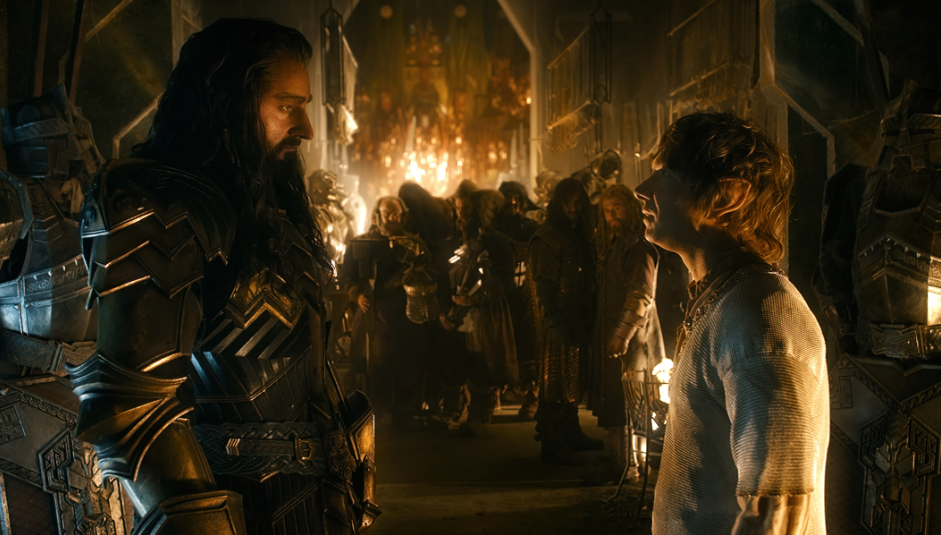
“THE HOBBIT: THE BATTLE OF THE FIVE ARMIES” Review (✫✫✫)

And the Dwarf King: The Battle for Himself. 

Here it is, at last: the end of Peter Jackson’s Hobbit trilogy. It hasn’t arrived without it’s challenges. Originally, the series was supposed to be directed by Hellboy director Guillermo del Toro before he dropped out and let Peter Jackson hop back in the director’s chair. Then, Jackson decided to turn it from two movies into three because he wanted to “expand the story.” Then in April, he decided to retitle the third film from There and Back Again to The Battle of the Five Armies. Every indication from the production of this film has shown that the movie was going to be either the weakest entry or the most unnecessary film out of the series. Jackson, however, has overcome every obstacle in his path and made a film that is just as exciting, enduring, and memorable as any other film in the series. Jackson’s persistence is something to be admired.

Picking up after that horrible cliffhanger of an ending we got from The Desolation of Smaug, The Battle of the Five Armies opens with Smaug the Dragon (Benedict Cumberbatch) laying waste to the village of Laketown shortly after he was set free by Bilbo Baggins (Martin Freeman) and Thorin Oakenshield (Richard Armitage). After setting the village on fire and killing many of the villagers, Bard the bowman (Luke Evans) escapes from prison, climbs the highest tower he can find, and kills the dragon with the black arrow he inherited from his father.

With Smaug dead, the dwarves have taken possession of the Lonely Mountain. However, something strange is happening to Thorin. He has become more greedy, violent, and eager to find the Arkenstone in the chamber and become the next king of the mountain. Bilbo has noticed his new attitude, and finds it disturbingly similar to that of Smaug’s personality. As tensions grow inside the mountains, things heat up with elven, eagle, orc, and human armies assembling outside of the mountains as well. Now with the four armies gathering to take the mountain from the dwarves, Thorin gathers his own dwarf (and hobbit) army to protect their inheritance and keep it from unworthy hands.

The third movie in any trilogy is always the most crucial. It either makes or breaks the series, making it just as memorable as The Lord of the Rings trilogy, or as half-baked as the Matrix trilogy. Part of me wonders why they even had to make a third movie at all, and why they couldn’t just combine this with The Desolation of Smaug. That was originally the plan, after all, but I guess if they did that, they would run the risk of shoehorning two plots into one film.

Honestly though, I don’t know if it would have been that big of an issue. The Hobbit: The Battle of Five Armies offers exactly what the title suggests: a battle which is bigger and bolder than any other fight in the Lord of the Rings movies. Yes, that includes the final siege on Sauron in Return of the King and the fight against Smaug in Desolation of Smaug. The scale and scope is bigger here than any other Lord of the Rings movie, with elves, dwarves, eagles, orcs, villagers, trolls, wizards, spirits, and a hobbit crashing, slashing, and colliding into each other like nobody’s business. This is the most action-packed Lord of the Rings movie yet, with it’s final lengthy action sequence clocking in at about over an hour.

Some of the action runs rampant and gets repetitive now and then. In one scene, for instance, Legolas the elf fights against an orc on a tumbling castle. The scene ran for well over 20 minutes, with them clashing swords and fists against each other, and I sat there wondering to myself “Why couldn’t he just trip him off and be done with it?”

But here’s the interesting thing: no matter how long the action ran, it kept me engaged. If this were a Michael Bay or a John Woo picture, the action would have ran wild and I would have gotten bored about 10 minutes into it. But Jackson is more talented than most filmmakers. He understands that in order for your audience to be invested in the action, they need to be invested in the characters first, because what’s the point of having characters go through these epic fights if you don’t care about them?

With this movie, I noticed that the character I cared most for was not Bilbo Baggins, but Thorin Oakenshield. He has the most interesting arc out of any other character in the movie, spending one half of the film fighting orcs, and the other half fighting himself. His character in the film reminds me a lot of Gollum: his conflict isn’t so much with others trying to take the things precious to him, but with himself in how the things he values most changes him. He especially serves a crucial part in the film’s final climatic battle scene, which is so nerve-wrecking and heart-pounding that it brought me just as much excitement as the climax in Return of the King did. The impressive part? Return of the King’s climax featured an entire armada of warriors, while The Battle of the Five Armies’ climax only needed two.

All in all, The Battle of the Five Armies did to The Hobbit what The Return of the King did to The Lord of the Rings: it wrapped it up nicely into a tight, satisfying conclusion, bringing excitement, emotion, and resolution to these characters that we’ve cared so much for so long now. Granted, it didn’t do as well as The Return of the King did with this, and I personally would have wished that Jackson would have made it less messy and cluttered than it already was. Does that ultimately matter, though, if I had fun watching it? Let’s just be glad that Bilbo made it there and back again in one piece.

Tagged , , , , , , , , , , , , , , , , , , , , , , , , , , , , , , , , , , , , , , , ,

“THE HOBBIT: THE DESOLATION OF SMAUG” Review (✫✫✫)

Be honest, Mr. Smaug: do you need a breath mint?

The Hobbit: The Desolation of Smaug is both one of the most satisfying and maddening films of the year. It’s visually splendid, illustrating the joys and perils of the world of Middle-Earth as finely as any movie before it did. It’s emotionally versatile, being comical and lighthearted at certain moments and then treacherous and gloomy in others. The performances are sound, with CGI characters being just as memorable as the live ones. Everything in the film was perfect up until it came to it’s end, which ended on a cliffhanger so big that a slackwire artist couldn’t tightrope across it.

Taking place shortly after the events of An Unexpected Journey, The Hobbit: The Desolation of Smaug continues the journey of Gandalf the Grey (Ian McKellan), Thorin Oakenshield (Richard Armitage), his troop of dwarves, and the slight hobbit Bilbo Baggins (Martin Freeman). After narrowly escaping the clutches of the white orc Azog (Manu Bennett), Bilbo and the rest of the dwarves venture on towards the Lonely Mountains, only having a few days left until the secret entrance closes, leaving them forever locked outside of the Lonely Mountains.

Bilbo, however, has greater concerns if the dwarves do manage to get inside. Deep within the twisty lairs of the mountain lies an endless sea of gold and jewels, and asleep among these riches is the vicious Smaug (Benedict Cumberbatch), a violent, terrifying dragon that formerly laid waste to the dwarves’ land and took their possessions all for himself. If the company does manage to get inside the mountains, Smaug will be waiting there for Bilbo, and there will be a massive conflict between the 100-foot tall fire-breathing dragon and the small, terrified hobbit.

One of the things I love about The Lord of the Rings movies is that the stakes are set up really well in them. Peter Jackson, who has been writing/producing/directing/godfathering the series since The Fellowship of the Ring has proven time and time again how well he can make depth-defying set pieces and visual spectacles, all while raising the emotional stakes of the movie.

Here is yet another example of what Peter Jackson can do in a movie. Visually, the film is unparalleled. There were many moments in the film that I recalled for being either visually spectacular or heart-poundingly exciting. One of them was a eerily creepy fight scene where Bilbo and the dwarves were fighting off an army of spiders in a cursed forest. Another was a chase scene where the crew was stuck in a line of barrels while falling down a waterfall. Other instances in the film include when the dwarves encountered a giant who could transform into a bear, or when Gandalf confronted an early confrontation of Sauron in his own castle. And don’t even get me started on when we meet Smaug for the first time. Jackson’s visual prowess excels just as much as his emotional involvement, and with each of his movies, he always seeks how to outdo himself from his last effort. I’d say he’s outdone himself tremendously here: the look of the film shows just that.

The performances are just as refined as the action and visual effects are. Martin Freeman was just as charismatic and loveable as he was the first time he was Bilbo in An Unexpected Journey, and Ian McKellen once again does well as the wise, ambitious, righteously-driven wizard Gandalf. And Richard Armitage has gained traction as Thorin Oakenshield since the first movie, showing that he can be more than the brutish tough guy. He’s a more vulnerable, more fleshed-out character here, with deep desires and hidden intentions showing that perhaps will be explored more in the third installment.

My favorite character by far, however, wasn’t even from a live performance. Benedict Cumberbatch was frightening, fearsome, and daunting as the terrible Smaug, his articulate, vocabulary-filled speech lining up perfectly with his sinister, seething voice. The visual spectacle of Smaug is perfect, with the dragon leaning luminously over his small, feeble enemies, while his long, slender, scaly arms and body lunge across the dungeon like an elongated spider. But the vocal performance is what makes him convincing, what makes him more than just a CGI creation and a terrifying villain in his own right. The minute I heard Smaug speaking to a shaking Bilbo, I had shivers run down my spine. The entire time he was speaking to Bilbo in mysterious anecdotes and sinister undertones, I was on the edge of my seat. When he started to attack, I clutched my mouth and stared endlessly at the screen, wondering and hoping for the fate of these characters in Smaug’s way.

In An Unexpected Journey, Bilbo benefits from being a more active protagonist than that of Frodo. Here we have Smaug, a giant, fearsome beast that is more actively sinister and spiteful than the stillness of Sauron from The Lord of the Rings.

Everything in the film is refined to the quality of film that you’d recall from The Lord of the Rings trilogy. My only regret is the copout, cliffhanger of an ending that inspired my theater to erupt into boos and groans. I hate it when movies do this to me. They put in so much effort to make a great film up until the last five minutes, where they pull the rug from under you and say “Sorry, that’s all for now! See you next year!” What was Peter Jackson thinking when he went with this ending? At the end of each Lord of the Rings movie, it ended with some form of closure and assurance that the adventure would continue into the next installment, but you didn’t know how it was going to pan out. It kept us intrigued, and it kept us wondering what would happen next. With this movie, it sets itself up to where we already know how it’s going to end: we just don’t get the payoff along with it.

I quote J.R.R. Tolkien: “Books ought to have good endings.” The same should be said for movies.

Tagged , , , , , , , , , , , , , , , , , , , , , , , , , , , , , , , ,

“THE HOBBIT: AN UNEXPECTED JOURNEY” Review (✫✫✫✫)

A journey J.R.R. Tolkien would want to go on. 

The Hobbit: An Unexpected Journey is the story I first experienced when I saw The Lord Of The Rings: The Fellowship Of The Ring for the first time. Like The Wizard Of Oz or Harry Potter and The Sorcerer’s Stone, it’s a sweeping fantasy about ordinary characters getting thrown into extraordinary circumstances. So if hobbits, dwarves, wizards, and fire-breathing dragons constituted as “ordinary” in this universe, imagine the extraordinary circumstances that they go through.

Serving as a prequel to the J.R.R. fantasy epic The Lord Of The RingsThe Hobbit tells the story of Bilbo Baggins (Martin Freeman), a relaxed and easygoing hobbit who doesn’t like to do much throughout the day except for eat, sleep, and smoke his pipe every now and then. One day, he gets a visit from a mysterious stranger named Gandalf (Ian McKellen), an elderly wizard who is looking for shelter and a young companion to go on an adventure with. Much against Bilbo’s wishes, Gandalf not only stays in his small village home: he invites an entire company of dwarves, who proceed to wreck Bilbo’s house and eat everything in his fridge.

After having a nervous breakdown and cleaning up his entire house, Bilbo overhears Gandalf and the small dwarf brigade’s plans. Ages ago, the dwarves‘ prized possession, the Lonely Mountain, was overtaken by a vicious fire-breathing dragon named Smaug, who destroyed their village and stole the castle and all of it’s gold for his own desires.

After being betrayed by their allies, the elves, and being left to fight for their land all by themselves, the dwarves are determined to travel back to the mountain and fight for their home. Bilbo must make a decision of continuing to live on his normal, uneventful life, or to reach out, travel with the dwarves, and seek out adventure the likes of which he’s never experienced before.

Remembering that it was only a few years ago when I originally fell in love with The Lord of the Rings: The Fellowship of the RingThe Hobbit: An Unexpected Journey is a prequel that hits on all of the right notes, and then some more that I wasn’t expecting. In comparison to it’s elder companion, The Hobbit is uncanny. It has a wide verse of characters, each one being unique and memorable both in appearance and personality. It has a dynamic and involving story, ripe with exposition and emotion, retaining your full attention despite the lengthy run time. And it has highly stylized set pieces and visual spectacles that excite the eyes and overwhelm the mind. Do not mistaken Peter Jackson’s intentions here: he was inspired by Lord of the Rings when he was making The Hobbit.

And yet, there are so many differences from The Hobbit to The Lord of the Rings. One of the biggest, I think, would be it’s protagonist. Bilbo is different from Frodo, his nephew in Lord of the Rings whom Elijah Wood inhabited so wonderfully. They’re similar, of course, in that they are small hobbits not necessarily fit for fighting, but are clever, creative, and courageous nonetheless.

And yet, Bilbo is so much more than Frodo is. He’s funnier, for one thing, a bumbling, clumsy little hobbit that reminds me so much of the antics between Pippin and Merry in the original movies. He’s also more outgoing, a more active protagonist doing more in the film than just holding a ring and trekking long miles. He does so much in the film, sneaking around trolls, fighting Orcs, going through traps and mazes, and having a first-hand involvement in many of the film’s biggest fights. My particular favorite scene is one where he is talking to a fan favorite from The Lord of the Rings about the possession of a mysterious gold, rounded object. Hint: His favorite word is “precious.”

My point in saying all of this is that Bilbo is a dynamic character in his own right, and Martin Freeman handles the character very well. In the previous movie trilogy, Freeman had four hobbit inspirations to pull from, and instead of following just one of them, he took characteristics from all of them and made a character all his own. That took great talent and risk, and Freeman’s efforts paid off, making a character that I think is the most memorable and charismatic hobbit out of all of them.

Without a doubt, the best film in the series is Return of the King. This film is perhaps the second best. Sure, at times it might suffer from a slight overdose on exposition, but doesn’t all of the films? The Hobbit: An Unexpected Journey is an adventurous, ambitious gamble of a film, and it makes me believe once again in the power that a wizard, a slew of dwarves, and a brave little hobbit can have.

Tagged , , , , , , , , , , , , , , , , , , , , , , , , , , , , , ,

“SIN CITY: A DAME TO KILL FOR” Review (✫)

Can you kill me too while you’re so busy at it? Thanks. 

There’s a character early on in Sin City: A Dame To Kill For that describes the city as a place “where you go in with your eyes open, or you don’t come out at all.” He’s wrong. I went in and out with my eyes fully open. I only wished that I kept them closed.

Oh, where to begin with this. Sin City: A Dame To Kill For is, in a word, messy – a neo-noir thriller as confusing as a detective’s murder case and more violent, putrid and horrific than a crime scene. The only brains this movie has are the ones that it blows out of peoples’ heads.

The plot takes place sometime within the Sin City universe. The question is when? I honestly don’t know, and I don’t think the movie knows either. It’s part prequel, part sequel and part in-betweenuel that cuts to wherever and whenever it wants to.

Like the first movie, there are three main stories the plot revolves around and, likewise, three main characters to sympathize with. You have a young Dwight McCarthy (Josh Brolin), who, before he met Jackie Boy, was obsessing over a rich housewife named Ava (Eva Green). There’s Johnny (Joseph Gordon-Levitt), an overly-cocky poker player who wants to come to Sin City and beat the king of all cards himself — Senator Roark (Powers Boothe). And then there’s Nancy (Jessica Alba), who is still coping with John Hartigan’s (Bruce Willis) suicide at the end of Sin City.

Following this easy enough? Good, because that’s all the explanation you’re going to get. The biggest problem with Sin City: A Dame To Kill For is that it’s so convoluted. Stories are meshed, mixed and thrown together without any sense of connection or correlation to its plot, and the entire time while I was watching it, I kept wondering where these stories were taking place and why I should care. Some movies do well with intertwining narratives, such as Pulp Fiction or Crash. This is not one of them.

A good example of this is in the very first scene of the film. Marv (Mickey Rourke), the hard-headed thug who was framed for the murder of Goldie in the first movie, wakes up next to two crashed cars with no memory of how he got there. He goes through mundane dialogue for five minutes in his obviously exaggerated thuggish accent, then the movie cuts to the story and almost completely forgets about him.

My first thought after watching this: why was that scene necessary? As the movie continued its runtime, I continued to ask this question in my head until I realized that none of it was necessary, that it was just a continuous farce of violence and delinquency that the kids who play Grand Theft Auto would just drool over.

This movie is definitely violent. That’s to be expected, I know, especially when you remember how violent the first one was. There is, however, a stark difference in how the violence is used in each movie. In the first Sin City, the violence was both shocking and satirical, at times being so disturbing that you can’t help but reel back from it, and at other times being so exaggerated that I laughed at it. Whether it was positive or negative, however, I at least felt something.

Here, nothing is felt. Here, we just look at all shades of black, red and white among severed body parts while we plod through the final act like it’s a homework assignment rather than the climactic ending that it deserves to be.

I’ll admit to having disliked the first Sin City. Does that matter? I give credit and criticism equally where it is due, and even though both Sin City’s are equally violent and despicable, the first one was at least more intriguing and had more cohesiveness both as a whole story and as smaller, separate narratives. This one fell flat, crumbled to pieces and was about as clear as a muddy window pane. Maybe that’s why Marv couldn’t remember anything at the beginning of this movie – he realized what he signed up for, and he tried to forget all about it.

Tagged , , , , , , , , , , , , , , , , , , , , , , , , , , , , , , ,

“TEENAGE MUTANT NINJA TURTLES (2014)” Review (✫)

Thankfully, they’re not aliens. 

Teenage Mutant Ninja Turtles is in complete and utter shambles, a movie that can’t decide on what it wants to be and not much better on how it wants to accomplish that. At times, it’s a loud and obnoxious action movie that takes its characters and their situations seriously. At other times, it’s so campy and immature it might as well be the Nickelodeon cartoon series. Wait, I take that back, that’s a dishonor to the Nickelodeon cartoon series. I don’t know what sort of movie I was expecting out of something titled Teenage Mutant Ninja Turtles, but I would have taken anything over this travesty.

Based (somewhat) on Kevin Eastman and Peter Laird’s comic-book creations, Teenage Mutant Ninja Turtles follows the story of April O’Neil (Megan Fox), a struggling news reporter who is looking to uncover the criminal conspiracy of the Foot Clan, a team of specialized military-trained soldiers who fight for their master, Shredder (Tohoru Masamune). Shredder is tyrannical Japanese warlord who wants nothing more but to rule New York City, and like all dark and obscure bad guys, he’ll stop at nothing until he gets what he’s after. But April’s not alone in this fight; she also has her pet rat and turtles by her side, her little friends she’s cared for since they were experimented on by her father when she was just a little girl.

…What? Yes, dear readers, they changed the origin story. After Mr. O’Neil discovered how the dangerous turtle weapons were going to be used for destructive purposes, he sets his lab ablaze, killing himself and destroying all of his hard work. Just before the turtles could be destroyed, however, April saves her small friends from the fire and they escape into the sewers. (Question: Since the fire is so hot that it consumes her father nearly instantly, how is it that  6-year old April manages to not only get into the lab, but also avoid the fire, grab the turtles, get out of the lab, and get back onto the pavement with a little ash makeup spread onto her face for good measure?)

As years pass, the rat and turtles mature into giant-sized humanoid creatures who teach themselves the art of ninjutsu, thanks to a book they fished out of the garbage and the convenience the script allowed them. The rat named Splinter (Tony Shalhoub) trained his sons Leonardo (Johnny Knoxville), Raphael (Alan Ritchson), Donatello (Jeremy Howard) and Michelangelo (Noel Fisher), knowing one day that they would need to fight the Shredder and defend New York City.

Where do I even begin with this? For starters, the script is unreliable, an immature, idiotic and thinly-written-and-thought-out mess that has plot holes the size of Swiss cheese and is as convenient as the dollar store. I could be cheap and pick apart the small things in the story, like what compelled the scientists to pick turtles as their experiments of mass destruction?

That, however, is too easy. It’s much more fun to pick apart the bigger holes in the plot, including:

  1. The fact that there is no way that Splinter, as a regular lab rat, could know anything about the Shredder or what he was plotting for him and the turtles.
  2. That since Shredder is a highly-skilled ninja, there is no reason why his foot clan shouldn’t be at least slightly trained in the arts either.
  3. That to convince her editor-in-chief that there are living, fighting humanoid ninja turtles in New York City she shows her a picture of a turtle she pulled off of Google images, not the pictures she took on her smart phone.
  4. That since Shredder is after the mutagen in the turtles’ blood, he wouldn’t spare Raphael and abandon him after he beat him to a pulp and cracked his shell.
  5. That to rescue his brothers when they were kidnapped halfway through the movie that Raphael, April and her camera man Vernon (Will Arnett) drive to rescue them in the snow mountains that apparently exist 50 minutes outside of Manhattan.

Oh yes, this script is a mess, and the actors do a nice job at making it even more laughable through their complacent, boring and plastic performances that could be played better by action figures. Any actor who was not a CGI character was completely wasted in a sea of bad dialogue and bland delivery, looking like victims to the screenplay and to the movie that they’re playing in. William Fichtner is hesitantly the best performance as an evil scientist, but his character is so plainly forgettable that it is almost completely wasted. Arnett is more charismatic and smirking as the camera man, but the dialogue he sputters is so unbelievably written at times that it hardly matters. (Ex. When told that your city’s vigilantes are giant turtles, is your first reaction to seriously ask if they’re aliens? I’m frankly surprised he didn’t laugh when April told him her crazy story.)

But the worst performance of the film is Megan Fox’s. Oh. My. God. What is she doing in the movie industry? Her performance was both disinterested and disingenuous, her expression looking as stiff and uncomfortable as if she came out of a facelift surgery. Fox is not a good actress. I say it again: Fox is not a good actress. Good-looking, yes, but looks only make half of a character, and she doesn’t fit April in neither appearance or spirit. In the 1990 film we had Judith Hoag portraying April, and boy, did she bring energy and enthusiasm to the character. Now we have Fox reading a teleprompter to replace the performance, and I start wondering if it would be better if April was recast as a Barbie doll in the movie.

Yes, the turtles, Splinter and Shredder look cool, and there’s a very sweet action sequence where they are sliding down the snow mountains that I will admit to have enjoyed. But in a visually-dominated industry, visual effects are a compliment I’m recycling at this point. Visual effects and fight scenes are wasted if you have a terrible plot, and in this case, where the bad guy’s master plan is to intoxicate a city with a poisonous gas by smashing a tower over it (an idea stolen from The Amazing Spider-man, by the way), I’m not inclined to say that the movie has much good of anything.

I know there is an audience for Teenage Mutant Ninja Turtles, and the majority of them will probably be under 12. The ones over that age will have grown up with the franchise, and will be looking for some sort of nostalgic experience to remind them of what it was like to grow up with the ninja turtles. I too went in hoping to feel some sort of nostalgia, but as the movie went on, I continued to notice that all of my hopes were running down the sewer.

Tagged , , , , , , , , , , , , , , , , , , , , , , , , , , , , , , , , , ,

“GUARDIANS OF THE GALAXY” Review (✫✫✫)


A  lovable group of space idiots.

Now here’s a movie I wasn’t expecting to be any good. No matter how you phrased it to me, I went into James Gunn’s Guardians of the Galaxy completely expecting to hate it. None of the heroes were as popular or as interesting as the other characters Marvel had to sport in its universe, it’s a sci-fi buccaneering adventure about an evil race intent on destroying/ruling the galaxy (I wonder where we’ve seen that before), and on top of all that, and it has a talking raccoon and a tree as two of it’s main characters. Believe me, I went into this movie fully expecting to dislike it on all counts. Turns out I was wrong on all of them.

Based on the Marvel comics superhero team of the same name, Guardians of the Galaxy follows a whole slew of space misfits as their futures suddenly become entangled because of one blasted macguffin: the infinity stone, an object we’ve been introduced to in earlier movies in the form of the tesseract and the aether in The Avengers and Thor: The Dark World. Peter Quill (Chris Pratt) is a Han Solo-ish kind of scavenger who steals items of value and sells them to buyers. Gamora (Zoe Saldana) is a trained assassin and adoptive daughter of a cruel omnipotent being called Thanos (Josh Brolin). Drax (Dave Bautista) is a brutish warrior who seeks vengeance against Thanos after the death of his family. And then Rocket and Groot (voiced by Bradley Cooper and Vin Diesel, respectively) are a bounty-hunting duo who travel together. Remember me mentioning the talking raccoon and tree? This is them, although Groot’s speech is merely limited to “I am Groot.”

Sounds like a lot of characters to deal with, I know, but don’t worry: the movie does a better job at explaining them than I did. Their fates become intertwined  with that of Ronan (Lee Pace), a vicious hunter who will stop at nothing until he has taken the infinity stone for himself and uses it to destroy his enemies. It’s up to Quill, Rocket, and the rest of the troupe to rise up and defend the galaxy from Ronan and the threat he holds with the infinity stone.

Written and directed by James Gunn, the wacko that directed the 2010 satire film Super, Guardians of the Galaxy is a wacky, oddballish film, a movie that doubles both as a sci-fi blockbuster actioneer and as a space comedy parodying… well, itself really. The biggest concern I had with this movie was how it was going to handle itself, because it really had everything working against it. Think about it: talking animals and trees, a copy-and-paste space plot, and a director whose work before this was a line of small-budget independent films. How on earth was any of this going to work?

Better than I expected, apparently. The best thing about Guardians of the Galaxy is that it doesn’t take itself seriously. It’s so irreverent, so shameless and so unabashed that it might as well be a clown throwing pies at its own face. There were many moments in the film where it called itself out on the flaws that I was prepared to criticize it for (such as it’s hammy one-liners or it’s talking animals), then it turned around making fun of itself because of it (Drax boasting about his reflexes when figures of speech go over his head, or Rocket asking Quill what a raccoon is.)

It just loves to make fun of itself, so much so that I want to call this a comedy more than science-fiction.

To make the comedy work though, you need a cast of equal caliber to make it work. And I’ll be completely honest here: the cast was exceptional. Even the cast members who I don’t like, consisting of Bautista and Diesel, gave performances that surprised me, effectively portraying their characters in a uniquely charismatic light that made them stand out from the obvious sci-fi fanfare. (One argument someone might pose to me is that Diesel’s job was easier because he only had to say three words over and over again. Believe me, his character wasn’t that simple.)

The element that stands out the most in the film is ironically the one I was most worried about: Rocket. Oh my gosh, was this guy a big ball of laughter. Cooper was excellent in voice performance, shooting out snazzy, snarky, sarcastic one-liners like he’s a New York taxi driver.

But it’s not just his voice performance that I love so much about the character. It’s how he’s animated and modeled too, with animators giving him life through his detailed, intricate emotions and movements as a CGI character. Rocket is much more than just another Guardian. He is, in many ways, the life of the film: a living, breathing embodiment of emotion, sentiment, sarcasm, hilarity and attitude. Every attitude that the film is, at least.

There’s no way to get out of the film’s silliness, but you shouldn’t let that stop you from enjoying it. Believe me, I tried. I went in fully equipped and prepared to blast this movie with a negative review, and I came out instead feeling like a kid after he finished watching his favorite Saturday morning cartoon.

Tagged , , , , , , , , , , , , , , , , , , , , , , , , , , , , , , , , , , , ,