Tag Archives: Sequel

“MAD MAX 2” Review (✫✫✫)

Where is your home, Max? 

I’m convinced that George Miller’s Mad Max series is an excuse to blow rugged vehicles up in spectacular fashion. Not that’s a bad thing. Crashes and explosions are exhilarating, after all, when done convincingly and used conservatively. That’s a big reason why most action filmmakers don’t succeed at what they do: they fail to produce anything new or different. They’re the same thing over and over again until the experience stops being entertaining and becomes more mind-numbing. It’s almost like an anesthetic exercise rather than an example of entertainment.

But with Mad Max 2, it’s action that actually matters. The setting is convincing. The premise is solid. The cars, costumes, and props all add to the surrealism of this post-apocalyptic environment. And then characters are placed into this desperate environment, this eerie spread of gloom and hopelessness where we watch as these human beings react to the same problem they are all facing: survival.

Taking place years after the first Mad Max, Mad Max 2 follows the world after an energy crisis consumes the Earth, and petroleum becomes a rare commodity. Some survivors form communities in order to build up each other’s chances of survival. Others join a gang lead by the vicious ringleader Humungus (Kjell Nilsson) that hunt and kill landscape scavengers.

However, one man stands among them, neither beggar or hunter, a man set apart from the rest of the world in his own search for peace and survival.

His name is Max Rotansky (Mel Gibson), and he lost his human spirit after he lost his wife and child in a hit and run years ago before the energy crisis.

With writer-director George Miller returning from the first Mad Max film, Miller seems to have a clearer idea of what he wants Mad Max to be: a high-octane, ridiculous action movie that refutes stereotypes and expectations. The film is spectacular in more ways than one, and most of it is for the reasons that made the first Mad Max mildly entertaining.

One of the things that Miller does as a director is remain adamant about using practical effects in his films. I am in 100% support of this decision, because practical effects, however over-the-top, always makes the most convincing effects. This was one of the few things that I enjoyed about the first Mad Max, in that the stunt and chase sequences were so seemingly absurd and ridiculous, and yet they weren’t, because they were all shot in real time. The car chases were authentic. The bikes and automobiles flying over bridges and crashing spectacularly were authentic. The explosions were authentic. Everything in that movie challenges what could be achieved visually, and not in the computer-animated graphic variety that Tron did. It challenged what shapes vehicles could crash into and how big it could explode afterward. It challenged the scope of destruction in an action picture, and what stakes could be built on top of that.

Mad Max 2 does the same thing Mad Max does in the destructive, chaotic nature of vehicular manslaughter, but with one key difference. It has a better development of the world it’s trying to create.

Don’t get me wrong: a lot of the problems from the first movie persist for this one. Max is still mostly a one-dimensional character with little more expression than the scowl on his face. The plot is straightforward and without many revelations or surprises in them. And the villain, however interesting, is extremely cartoonish. Humungus is essentially a beefed up Jason Voorhees, and his interest extends just about that far as well.

But from what I’ve come to understand about the Mad Max series is that the story isn’t supposed to come from the characters. It’s coming from the scenery all around them, this desperate and depraved world that Miller is illustrating as a warning to mankind’s nature. We didn’t get the sense of this world in the first Mad Max because it still felt like society was intact: that there were cities and townspeople still going on about their somewhat normal lives. In this film, there is no such thing as a normal life. Cities and towns have been reduced to war zones and rubble. People live in buses and tents instead of houses. Plentiful grassy plains have been replaced with desert sands. A regular meal consists of a can of beans if you’re lucky. And for whatever humans are left to survive, their form of currency is oil and water. This world is the definition of desperate.

This in turn, makes Max Rotanksy a perfect protagonist for the film, despite his neutrality as a character. It allows you to absorb the film with your own eyes, not clouded by the emotions of another character.

What we have left is an effective action movie that lets the audience carry the film’s weight just as much as the cast and crew does. It’s rare to find an action movie like this, where the viewer actively engages and thinks like the film’s characters do. Usually action movies tell viewers to turn off their brains and be drowned in an orgy of explosions and testosterone. This movie does something different. This movie asks viewers what an action movie is, what it is supposed to be, and what it can be. And at the center of it all is one lonely man; a slave to the roads that he was born from.

Tagged , , , , , , , , , , , , , , , , , , , , ,

“THE AVENGERS: AGE OF ULTRON” Review (✫✫✫1/2)

The Avengers face judgement day. 

We are now nearing the end of Marvel’s phase two of its cinematic universe. Before Age of Ultron, we’ve seen ten of these movies now. Iron Man. The Incredible Hulk. Iron Man 2. Thor. Captain America: The First Avenger. The Avengers. Iron Man 3. Thor: The Dark World. Captain America: The Winter Soldier. Guardians of the Galaxy. You would think that by now, we would be sick of watching these movies. I know I normally would. It only took three Transformers movies for me to get sick of that franchise.

Yet, the people over at Marvel continue to find new ways to surprise me and make me once again believe in its cinematic universe. Avengers: Age of Ultron is its most recent example. The film had a near impossible task: outdoing its 2012 predecessor, which was a brilliantly woven and executed superhero masterpiece in its own right. After succeeding on a grand project that big and combining five multiverses into one fluid narrative, how are you expected to measure up to that in the sequel? Luckily, writer-director Joss Whedon is no fool. He knew what expectations were going to be had for his highly-anticipated sequel. He could have sold out and let the anticipation from the first movie roll in the bank for this one, but Whedon instead did the one thing that most filmmakers are too afraid to do nowadays: he set out to make it better.

Take the movie’s villain as Whedon’s prime example for improvement. Ultron, voice and motion performance by James Spader, is a trash-talking super-intelligent humanoid A.I. created by Tony Stark, a.k.a. “Iron Man” (Robert Downey Jr.) to protect the Earth from supernatural threats. Shortly after his creation, however, Ultron goes rogue and concludes that in order for true peace to be obtained, humanity needs to be wiped out and reborn like the animals from the dinosaur age.

On the surface, this seems like the same story for every robot-rebellion premise: a machine was created to do good, it becomes self aware, and in turn does the opposite of good. And in a sense, this is the same story for every robot-rebellion premise.

The key, however, lies in execution, and Spader as Ultron is the best super villain performance I’ve seen in a Marvel movie to date. Ultron doesn’t behave or talk like other androids. He isn’t stiff, rigid, or robotic like other mechanical characters in film are. Like any of the other live-action actors on screen, Ultron is a fluid, life-like being with his own personality and morals. He’s chaotic and radical in his thinking and behavior, acting more like a psychotic child rather than a logic-driven artificial intelligence.

Considering his creator is the egotistical Tony Stark, I can’t say I’m surprised that his personality is the same. Every Avenger in this film is just as great with each other as they were in the first Avengers movie. Thor (Chris Hemsworth) is just as machismo and uncompromising as he is in any of his movies. Hawkeye (Jeremy Renner) is equally as earnest and straightforward, with a few secrets that surprised even me in the theater. Steve Rogers, a.k.a. Captain America (Chris Evans) continues his rivalrous dynamic with Stark from the first movie, their contrasting personalities rubbing off of each other so viciously that we can see how it builds up to Captain America: Civil War.

The two Avengers that have the greatest dynamic, however, are Bruce Banner, or the Hulk (Mark Ruffalo) and Natasha Romanoff, the Black Widow (Scarlett Johansson). Here, their relationship expands from the first movie into a conflicted romance between the two. Romanoff is a master assassin with a past she’s neither proud to have nor able to escape from. Banner is the feeble scientist with a monster inside of him that he’s not proud of either. The two don’t feel like they can have a relationship with each other because of their different personalities, but Whedon puts them together with tragically heartfelt honesty here. He finds a connecting theme between the two, themes of loss and regret that makes them turn to each other and rely on each other. I didn’t think it was going to work when I saw these characters at first, but Whedon makes it so compelling that now I can’t see it any other way. Romanoff asks Banner a question in one scene that I think is reflective of their relationship: “Do you still think you’re the only monster on the team?”

Everything else in the movie lives up to the expectations you had in the first movie. The action is unique, visually complex, and eye-popping. The story is layered, intelligent, and dynamic, with characters bouncing witty and thought-provoking dialogue off of each other perfectly. The villain is one of the best and most unique of the Marvel universe, and there’s a few new characters introduced in the film that are done just as well as the superhero team’s main heroes.

Here’s the worst thing I can say about the movie, and really the greatest danger to the Marvel cinematic universe: I’m getting used to it. This is the 11th movie I’ve seen in the Marvel universe now, and I almost know what to expect. I know that I’m going to be surprised and shocked at some of the twists and turns. I know I’m going to enjoy the heroes and villains alike. I know that there’s going to be a lot of action with a noteworthy plot behind it. And, more than anything else, I know the movie is going to expand upon itself and its multiple follow ups.

Marvel has 11 more movies to produce after this for their phase 3, and there’s no telling how many more movies they plan to do after that. With Whedon going on record saying this is his last Marvel movie, I question how well they will be able to continue expanding this universe and doing it well. How much longer can Marvel keep pushing the envelope? I hope I don’t find out soon.

Tagged , , , , , , , , , , , , , , , , , , , , , , , , , , , , , , , , , , , , , , , , , , , , , , , , , ,

“SIN CITY: A DAME TO KILL FOR” Review (✫)

Can you kill me too while you’re so busy at it? Thanks. 

There’s a character early on in Sin City: A Dame To Kill For that describes the city as a place “where you go in with your eyes open, or you don’t come out at all.” He’s wrong. I went in and out with my eyes fully open. I only wished that I kept them closed.

Oh, where to begin with this. Sin City: A Dame To Kill For is, in a word, messy – a neo-noir thriller as confusing as a detective’s murder case and more violent, putrid and horrific than a crime scene. The only brains this movie has are the ones that it blows out of peoples’ heads.

The plot takes place sometime within the Sin City universe. The question is when? I honestly don’t know, and I don’t think the movie knows either. It’s part prequel, part sequel and part in-betweenuel that cuts to wherever and whenever it wants to.

Like the first movie, there are three main stories the plot revolves around and, likewise, three main characters to sympathize with. You have a young Dwight McCarthy (Josh Brolin), who, before he met Jackie Boy, was obsessing over a rich housewife named Ava (Eva Green). There’s Johnny (Joseph Gordon-Levitt), an overly-cocky poker player who wants to come to Sin City and beat the king of all cards himself — Senator Roark (Powers Boothe). And then there’s Nancy (Jessica Alba), who is still coping with John Hartigan’s (Bruce Willis) suicide at the end of Sin City.

Following this easy enough? Good, because that’s all the explanation you’re going to get. The biggest problem with Sin City: A Dame To Kill For is that it’s so convoluted. Stories are meshed, mixed and thrown together without any sense of connection or correlation to its plot, and the entire time while I was watching it, I kept wondering where these stories were taking place and why I should care. Some movies do well with intertwining narratives, such as Pulp Fiction or Crash. This is not one of them.

A good example of this is in the very first scene of the film. Marv (Mickey Rourke), the hard-headed thug who was framed for the murder of Goldie in the first movie, wakes up next to two crashed cars with no memory of how he got there. He goes through mundane dialogue for five minutes in his obviously exaggerated thuggish accent, then the movie cuts to the story and almost completely forgets about him.

My first thought after watching this: why was that scene necessary? As the movie continued its runtime, I continued to ask this question in my head until I realized that none of it was necessary, that it was just a continuous farce of violence and delinquency that the kids who play Grand Theft Auto would just drool over.

This movie is definitely violent. That’s to be expected, I know, especially when you remember how violent the first one was. There is, however, a stark difference in how the violence is used in each movie. In the first Sin City, the violence was both shocking and satirical, at times being so disturbing that you can’t help but reel back from it, and at other times being so exaggerated that I laughed at it. Whether it was positive or negative, however, I at least felt something.

Here, nothing is felt. Here, we just look at all shades of black, red and white among severed body parts while we plod through the final act like it’s a homework assignment rather than the climactic ending that it deserves to be.

I’ll admit to having disliked the first Sin City. Does that matter? I give credit and criticism equally where it is due, and even though both Sin City’s are equally violent and despicable, the first one was at least more intriguing and had more cohesiveness both as a whole story and as smaller, separate narratives. This one fell flat, crumbled to pieces and was about as clear as a muddy window pane. Maybe that’s why Marv couldn’t remember anything at the beginning of this movie – he realized what he signed up for, and he tried to forget all about it.

Tagged , , , , , , , , , , , , , , , , , , , , , , , , , , , , , , ,

“DAWN OF THE PLANET OF THE APES” Review (✫✫✫1/2)

The predator and the prey are one and the same.

It all started with the eyes.

Looking deeply into them, we see the angry, vicious, relentless energy behind them, as hungry as an animal and as wild as a beast. A somewhat appropriate description, because these are the eyes of the ape Caesar (Andy Serkis), the intelligent primate we’ve come to know from Rise of the Planet of the Apes. As we continue looking at his eyes, his steady, violent stare, we see his army of followers climbing on branches behind him.

He drops his hand, motioning them to attack.

After we see this powerful, expressive opening sequence, we are taken through this epic journey that is Dawn of the Planet of the Apes, a compelling and exciting survivalist-drama that looks at the human-primate condition from two different perspectives, as if they are two sides to one coin. The leader of the apes is Caesar, who now has his own family in his wife Cornelia (Judy Greer) and his son Blue Eyes (Nick Thurston). The leader of a band of human survivors is Malcolm (Jason Clarke), who also has his own family in Ellie (Keri Russel) and his teenage son Alex (Kodi Smit-McPhee).

Both of these band’s stories take place years after the virus attack that destroyed the most of humanity years ago, which we got a glimpse at the end of Rise of the Planet of the Apes. Both sides have lost loved ones in the wake of the disaster. Both sides do not trust the other. Yet, as Caesar and Malcolm share close encounters with each other, they slowly begin to understand and see that their races are not so different from each other. As the human-primate war rages on, Caesar and Malcolm must combine their efforts to protect each of their families, and seek out peace between their established societies.

Remembering fondly of how I enjoyed seeing the ape empire’s beginnings and relishing in the context of human-animal abuse in Rise, I went into this movie knowing it had a strong foundation to build it’s story on, hoping that they wouldn’t fail. Not only did director Matt Reeves not fail in telling his story of Dawn; he expanded further upon the Planet of the Apes story in detail, action and commentary than I estimated him to. His film ended up being better than Rupert Wyatt’s film in spades.

Firstly, let’s talk about the similarities between each film. Rick Jaffa and Amanda Silver, the writing/producing team behind Rise, returns yet again to contribute to Dawn’s story and to the production of this film. In many ways, I argue that both are better in this film than they were in the last one.. The plot of the first movie was an involving, interesting and emotionally compelling sci-fi thriller, a story that showed the worst of humanity and their cruel mistreatment of animals. Here, this movie has a more of a political facet in its structure, a drama that shows each race as a mirror of the other. It shows a civil anarchy blooming in the heart of each race.

The characters are compelling and have genuine interactions with each other, from Caesar confronting Malcolm on staying away from their home, to intimate scenes when Alex interacts with Caesar’s new baby boy. What I liked so much, however, is director Matt Reeves details not only to these emotions, but the visual display of the story in itself.

Being no stranger to visual effects or emotions with a filmography including Cloverfield and Let Me In, Reeves is skillful in making an exciting action movie while at the same time making a involving apocalyptic thriller. It surprising with this film that the basis of the film wasn’t grounded in action or ridiculous CGI stunts, but rather, in small, intimate moments of conversation and ape-sign-language that characters share with each other. It’s nice to see a big-budget blockbuster movie reaching for more intimate, personal situations, rather than the billion-dollar-sized explosions of garbage you’d see from the Transformers movies.

I do have a criticism in the movie in that the human characters were mostly boring. I have a rule of thumb that if I can’t remember a character’s name by the end of the movie, then that character is mostly forgettable. By the end of the film, I only remembered Malcolm’s name. I called Keri Russel’s character “Keri Russel” in the film while I labeled Smit-McPhee as a Jay Baruchel rip-off. I even looked at Gary Oldman’s character in the film and smirked in my head, “Well, hello there, Commissioner Gordon! Did you end up surviving the nuclear fallout in The Dark Knight Rises?”

What I realize though is that the humans aren’t supposed to be the main anchor of the film. The apes are center focus here, and this is really their story, figuring out their emotions, finding their identities, and realizing their faults as they look at human beings and see themselves deep within.

I think I realized this was a masterful film when it approached its final minutes, when we once again returned to the eyes of Caesar that we saw at the beginning of the movie. Only this time, they weren’t as aggressive as they were before. These were not the eyes of the predator, the hunter eagerly waiting to hunt his prey. No, these eyes were solemn and sad, as if they were looking at a bleak, grim future, one they were powerless to stop.

Tagged , , , , , , , , , , , , , , , , , , , , , , , , , , , , , , , , , , ,

“22 JUMP STREET” Review (✫✫✫1/2)

Doing the same thing over again isn’t such a bad thing after all.

22 Jump Street is the exact same film 21 Jump Street was, but with one key difference: it’s self-awareness. While 21 Jump Street was just aimlessly spastic and immature, 22 Jump Street uses that same spasm and immaturity and chooses to make fun of itself for the sake of the audience. 22 Jump Street isn’t laughing with the audience: it’s laughing at the audience laughing at itself, and it is infinitely funnier because of that.

22 Jump Street takes place after Captain Dickson (Ice Cube) tells Schmidt (Jonah Hill) and Jenko (Channing Tatum) that they’re about to go undercover at college. After a student died at the hands of a lethal new drug called WyFy, their job once again is to infiltrate the dealers, find the supplier and bring them to justice. Resuming their cover identities as brothers, they slowly try to adapt to college as they continue to search for the supplier who is providing for the whole operation.

“Waitaminute,” you might ask. “Isn’t this what happened in the first movie?” Yes, but like I said, the movie is more aware of itself than by just simply repeating what it did the first time around. This time, Tatum is the guy who is getting accepted and friendly with everyone around campus, while Hill is more or less left to go and sip wine with the art students.

Like I said, the film is on repeat from the plot with the first movie — similar characters, similar jokes, similar order of events. For Pete’s sake, even the run time is the same, with both films clocking in at about 1 hour and 50 minutes.

But like I always say, the repeat isn’t what matters. What matters is how they handle that repeat, whether it genuinely is a funnier, more refreshing take of the original rather than just a rehash. And let me tell you, even though it has Tatum and Hill in it, neither of which I’ve ever found particularly funny, I’ve never laughed harder.

These two guys are hilarious in the movie. Tatum is good as Jenko, a smug older jock who loves to drink beer, play football and show off his physique through physical feats that make me ashamed of my own body. Hill was even better. Whether he was getting into character as a Mexican mobster, trying to impress some girl or desperately trying to figure out how to drive a ferrari, he was clumsy, expressive and hilarious all at once, expertly becoming the likeable underdog needed for a film like this.

Great as Hill and Tatum are though, they are not the highlights of the film. The real stars of this movie are directors Phil Lord and Christopher Miller, both of whom recently directed The Lego Movie together. Lord and Miller, who also helmed the first film, seem to have a much more fleshed out idea of what they wanted Jump Street to be this time around. The first movie was just a loud, blatant action-comedy, shooting in every which way and direction with no clear aim or focus. Here, the aim couldn’t be more clear. From hearing bits of scathing dialogue — “We’re going to do the same thing all over again” from the captain — to the hilarious end credits spoofing every movie that had laughs and a gun, we can tell their goal with this was to slam the idea of sequels, to make fun of the problems that exist in them, then immerse themselves in that zone of making fun of themselves for the sake of our enjoyment.

I’ve had a complete blast with this movie. In every moment of the film I was either smiling, laughing my head off, or catching my breath, preparing myself for the many laughs to follow. I kept tossing around in my head whether I liked this movie or loved it, whether it was a truly definitive piece of comedy or just something fun to laugh at. I’ve concluded that it is both. 22 Jump Street is a big ball of action-packed comedic fun, a great sequel that has funny jokes, charismatic characters and wonderful self-irreverence. It’s an improvement upon the original in almost every way and will no doubt be a big problem to the studios once they realize they’re going to have to make a second sequel.

Tagged , , , , , , , , , , , , , , , , , , , , , , , , , , , , , , , , , ,

“X-MEN: DAYS OF FUTURE PAST” Review (✫✫✫✫)

The next stage in superhero cinema evolution. 

X-men: Days of Future Past ranks among the best superhero sequels I’ve ever seen, one I would instantly compare to that of Spider-man 2 or The Dark Knight. There were so many things that needed to be done, so many risks that needed to be taken, and so many ways this movie could have failed. It didn’t. From the opening sequence to its last breathtaking moment, my mind was blown and the comic-book nerd in me was absolutely filled with joy. The movie did more than simply expand the franchise: it redefined it.

We open on a post-apocalyptic future that hasn’t been this catastrophic since James Cameron’s 1984 film The Terminator. Years after X-men: The Last Stand took place, humans are now being hunted by the same weapons they created in the first place: the Sentinels, a coalition of dangerously armed robots who can track and exterminate any mutant they can find on planet earth. Amongst the ruins of battered buildings and fallen icons, the human race has now been collected into a sort of concentration camps: all that’s left for the mutants then is the mass graves filled with the dead bodies of their kin.

Lifelong frenemies Charles Xavier (Patrick Stewart) and Magneto (Ian McKellan) collaborate on a plan they would like to enact. Besides having the ability to phase through walls and objects, Kitty Pryde (Ellen Page) has recently developed the ability to transfer someone’s consciousness into their younger bodies in the past, allowing them to change the future and avoid the unfortunate outcomes that might become of them. Kitty has been able to use this ability on multiple occasions now to save her friends, but now Professor X and Magneto want to go back into the past (1970, to be exact) to prevent the event that triggered this horrifying future and save human and mutantkind as they know it.

Problem is, Kitty can only send someone back a few days or weeks at a time. Any further than that and she risks tearing apart the mind of the person she’s sending back to the point beyond repair. Luckily, Wolverine (played by Hugh Jackman, who else?) has the ability to heal himself at a faster rate. So Professor X and Magneto decide to send Wolverine back into the past to coerce their younger selves (portrayed by James McAvoy and Michael Fassbender, respectively) to stop the triggering event and save the future.

Serving as a sequel to both X-men: First Class and X-men: The Last Stand, and incorporating characters and actors from both translations, X-men: Days of Future Past is, in a word, a game changer. It brings in all of its key players, from the original cast members and its most revered director Bryan Singer, to the newcomers who’ve newly defined their roles, including McAvoy as Xavier and Fassbender as Magneto. Everyone meshes so perfectly with each other, especially Jackman once again, who essentially has to react to characters from two different time zones. There hasn’t been a cast this big since Joss Whedon’s The Avengers, and I’m tempted to say the movie is better because of it.

Do I really want to stand here though, and compare Days of Future Past to that of The Avengers? Yes I do. The Avengers was a bold, brave step forward in comic book evolution, combining characters from five different movies to make a superhero epic that hadn’t been tried before. Days of Future Past follows that same model, bringing in characters from six of its movies, but the end result is vastly different. There’s a much deeper plot going on here, a vastly intelligent and contemplative story that elaborates on its recurring themes of racism and, once again, bringing in the consequences of discrimination to the forefront. I loved X2 for this very reason, for it being more than just a comic book movie and focusing itself more as a political thriller with comic book elements thrown into the mix. This movie is that to, like, the tenth power.

Oh yes, this movie will fill comic fans with glee everywhere. Similar to the small little easter eggs that can be picked up in other Marvel movies (Note: The Doctor Strange reference in The Winter Soldier), this movie too has sweet little moments that comic fans can pluck from the ground and take a moment and appreciate the aroma. My favorite had to be a moment where a mutant named Peter (Evan Peters), who can run at supersonic speeds, rests in an elevator with the younger Magneto as he’s helping him escape from prison, and makes a comment about his long-lost father. That’s just the tip of the Bobby Drake-iceberg. There’s so many moments I can pull from that filled me with joy and happiness, while others filled me with dread and angst. The film orchestrates its emotions wonderfully, and in every fabric of the film I felt what I was supposed to feel.

I’m going to go out on a limb and say this is the best X-men movie in the series so far. Bold claim, I know, but it deserves it. From its first moment to its last, Days of Future Past is completely, utterly, fascinatingly mind-blowing and involving. From its quietly hinted-at themes of xenophobia and extermination to its climactic action scenes where we don’t see how on earth our heroes can win, Days of Future Past combines the best parts of all of the movies and makes itself the best entry out of them. Many audiences have recently been experiencing superhero movie fatigue, with movies such as Man of Steel and The Amazing Spider-man 2 recently being met with mixed reaction amongst audiences and in the box office. Days of Future Past is one of those movies that restores your faith in the genre.

Tagged , , , , , , , , , , , , , , , , , , , , , , , , , , , , , , , , , , , , , , , , , , , , , , , , , , , , ,

“X-MEN: THE LAST STAND” Review (✫✫✫)

How can you “cure” what was intended as a gift?

There’s an obvious danger with the production of second sequels made with planned trilogies: how do you keep things fresh and interesting and make sure none of the material isn’t stretched out or forced? For many trilogies, the third entry is the one filmmakers are usually least concerned about. Why should they be? They’ve already made their biggest impact with the first two films and people will go and see it anyway, so why should they extend any effort? I like to call this “the trilogy curse,” and it explains why so many second sequels end up letting down their entire franchise (*cough* Terminator 3 *cough*).

The best thing that can be said for X-men: The Last Stand is that it does a good job avoiding the trilogy curse. While some may be frustrated by the liberties it took and the deviations it made from the source material, I for one found it to be very liberating. It changes things up a bit, made things different, and did one huge thing that many comic book movies can’t do: it made it unpredictable. Because of this, the stakes were higher, the action was more involving, and it made you invest yourself more in the characters rather than waiting for everyone to hold hands in the end for that “happily ever after” ending many films get trapped into. X-men: The Last Stand accomplished something important: it proved that comic-book movies can deviate from their source material and still be good.

After saving both human and mutantkind at the shrouded site where Wolverine (Hugh Jackman) gained his metal claws and lost his memory many years ago, X-men: The Last Stand takes place as the X-men still try to cope with the death of their beloved Jean Grey (Famke Jannsen), who sacrificed herself to save her friends as she became engulfed by a sea of raging waters. Most affected by this is her boyfriend Scott “Cyclops” Summers (James Marsden), who can still hear her voice in his head as he sits in their bedroom reminiscing about her.

The X-men, however, have a much more pressing issue at hand: a company called Worthington Labs has recently invented a mutation antibody that basically attacks mutant cells and nullifies them. The public dubbed it as a “cure,” and it essentially turns mutants into regular human beings, forever granting themselves the life of normalcy they’ve so long desired. Of course, this new invention stirs up quite a controversy among the mutant community, especially regarding Magneto (Ian McKellan) and his extremist brotherhood of mutants. When mutants come to terms with this cure and what it means for all of them, they must make a decision of whether or not to fight against the cure, or fight for humanity’s survival at all.

The first out of the X-men series not to be directed by Bryan Singer, filmmaker Brett Ratner (The Rush Hour series) steps in to fill in the reigns of Singer’s mostly definitive first two installments. How does he do? Well, the good news is that he holds his own pretty well, and makes a movie that he can call all his own. Ratner poses an important question here that I think the other two films mostly sidesteps: if you have an unwanted gift, should you keep it? For me when I watched the movie, I saw an image deeper than that of a mutant standing in line to take a shot that would take away their powers. I saw a pregnant teenager waiting in line for an abortion for that baby that she never intended to have in the first place, or an image of a man going in for a gender change because he doesn’t feel comfortable in his current body.

Controversial? Yes, but that’s how the film intends for it to be. Much like its predecessors, The Last Stand handles its political side well, and is being more ambitious by taking a different spin from the standard supremacist/racism themes that they explored in the earlier installments.

The cast is good, but that’s standard at this point. We expect Jackman to be good as Wolverine. We expect Patrick Stewart and McKellan to be convincing as the leaders for their own specific causes. We expect Storm (Halle Berry) to be the strong female hero that she is, and we expect Iceman (Shawn Ashmore) to be the kind-hearted, considerate teenager while Rogue (Anna Paquin) remains the estranged and desperately shy mutant who continuously questions keeping her abilities. The one we should notice more than anyone else is Janssen as Jean Grey. Yes, she’s back, and she has a much more villainous spin on her that comic fans may or may not be happy to see. She’s much more versatile in this movie, bouncing brilliantly in between angry and hateful to scared and grief-stricken. Without giving too much away, I really liked her role in this movie as both a protagonist and antagonist, and I think X-men fans will be just as pleased with her performance as well.

The only thing I don’t like with this movie is its climax. The buildup earlier in the film was so much better, with the backstory of Jean Grey, Professor X and Magneto culminating so ingeniously into a plot where all the danger was real and there was no way to predict who lived and who died. Another great scene with excellent buildup was when Wolverine went searching for Jean, fighting a small group of mutants within the confusion of a lush, maze-like forest. The final fight, however, could not have been more standard and one-note if it tried. It plays out exactly as you would predict it to, dragging out into a disarray of violence and loud noises until finally it ends in explosions and agonizing screams. Enough already. The rest of the movie did a good job building up anticipation: did you really have to give in right before the end?

Still, I had fun with this movie. I know “fun” is a very loose term that can be used within the film community, especially when you’re speaking about a potential deal breaker such as this. Still, I’m going to say it: this movie was fun. Why am I saying that? Because I enjoyed it, that’s why. I genuinely liked it. I liked the big, boisterous action scenes orchestrated on a grander scale in which I don’t think would have been possible six years ago. I liked the darker, more thematic moments between characters where they took time to build up the stakes and what was on the line here. Mostly however, I liked how it humanized the mutants, and made them genuine flesh-and-blood human beings that could be killed and harmed. It didn’t immunize them from death because of their fans’ love for them: it made them mortal, and it presented a real, legitimate threat in the film because of that.

I know many people who are going to disagree with me, and that there will be many who love these characters too much to be able to see them get killed off and just be okay with it. Let me set the news down with you easily: if you’re that bothered by seeing a character’s death in a movie, maybe you shouldn’t be watching that movie in the first place. These filmmakers set out to make a convincing movie where the threat was imminent and real: not to please the comic-book die hard who gets frustrated if a comic book character’s hair isn’t the right color. Maybe that was Ratner’s second goal beyond making a good sequel, to see how many changes he could make before the fans starting writing death threats to his home mailbox.

Tagged , , , , , , , , , , , , , , , , , , , , , , , , , , , , , , , , , , , , , , , , , , ,

“X2” Review (✫✫✫1/2)

A social commentary disguised as an action blockbuster.

X2 is science-fiction brilliance, a sequel that is relentlessly exciting, smartly written, intelligently designed, and jam-packed with so many involving action scenes and stunning visual effects that it could potentially work as a stand-alone movie, rather than a direct sequel to its predecessor X-men. Like Lord of the Rings and Harry Potter, this movie serves as an expansion for the universe that it is in and as an opportunity to provide fan service to its dedicated readers and lovers of the iconic source material. I’m not very much for sequels, and I definitely don’t want this to become a superhero monopoly, but if we have to have sequels packaged with every superhero installment in the near future, more filmmakers should pull inspiration from X2.

X2 picks up just short of a few months after X-men originally left off. After the combined efforts of the X-men defeated Erik Lenshurr, a.k.a. “Magneto” (Ian McKellan), and imprisoned him within a special plastic cell (Countering his ability to manipulate metal), the X-men go about their (ab)normal lives as teachers at Xavier’s School for Gifted Youngsters, educating mutants on how to control their powers and not be afraid of who they are. Only Logan, a.k.a. Wolverine (Hugh Jackman) sets out to Canada to seek out answers for his long-forgotten past, and even then he comes up empty: the lab where he was supposedly experimented on has long since been abandoned.

Soon, however, a new figure from everyone’s past re-emerges: William Stryker (Brian Cox), a government official who has experimented on mutants for as long as mutants existed. After pitching his program to the President and revealing that Xavier’s School For Gifted Youngsters is a front to the X-men operation, the X-men and the Brotherhood of Mutants must band together to save each other from Stryker’s plot, and quite potentially the rest of mutant kind with them as well.

Directed and co-written by Bryan Singer, who also directed X2’s predecessor X-men, X2 is a highly involving, irreverently fascinating superhero epic. Functioning just as much as a political thriller as it does a superhero action flick, Singer is careful to deliberate and balance everything effectively in the movie, from its themes of xenophobia and racism to its highly-exciting action sequences where mutants go flying, flipping, and teleporting in every which way and under.

Funny, the first time Singer tried X-men, balance was a problem for him. He put a greater emphasis on the action and the visuals of the mutant’s powers more than what they meant for them individually, quite possibly because that’s more of what the audience wants to see anyway. Here, balance is not an issue. He does a great job at both not only giving us a healthy dose of action-packed sequences of grandeur and excitement: he also does a great job giving us heartfelt, genuine emotion, showing these character’s internal reactions just as much as their external.

Example: After escaping from an attack on themselves and the rest of the X-men earlier in the movie, Wolverine takes himself and a small group of mutants to Bobby “Iceman” Drake’s (Shawn Ashmore) home, where he’s forced to essentially come out to his family that he is, in fact, a mutant. After seeing the emotion and disparity of his family reeling in with the shocking revelation of Bobby’s abilities, the police pull up to the house, and an explosive battle results between these X-men and the officers.

See, this is what I’m talking about: there isn’t a single moment in the movie where the action outweighs the drama, or the drama outweighs the action. For every scene where something emotionally weighty or significant is revealed, there is another scene where something exciting or thrilling happens that jump-starts your interest all over again. Whether it’s a scene involving dialogue between characters, a narrator giving exposition on a conniving plot, or another scene where some sort of grand, explosive battle takes place doesn’t matter. It’s always moving, it’s always doing something different, it always keeps up its interest and it is never boring.

I’m very happy with this movie. In a world where so many sequels make the mistake of replacing genuine emotion with an overdose of action and visual effects, X2 is a clear standout. While not necessarily perfect, and still incapable of escaping from some of the cheesy, ham-fisted moments that I rued in the first movie, it definitely stepped up its game as a far as drama goes, and has deeper contexts to offer regarding the xenophobia/racism issue that inspired the series as a whole since its comic book creation. In that sense, X2 is more than a superhero blockbuster. It’s a social commentary on judging another person for who they are and the destructive consequences that can come from it as a result.

Tagged , , , , , , , , , , , , , , , , , , , , , , , , , , , , , , , , , , , , , , , ,

“THE AMAZING SPIDER-MAN 2” Review (✫✫✫✫)

Don’t worry: it’s not “Spider-man 3.”

The Amazing Spider-Man 2 is the standard of a superhero movie that everyone should aspire to. It’s exciting, action-packed, gut-bustlingly hilarious and emotionally involving to a point where I was surprised at how personal and genuine it really was. “Amazing,” in fact, is not a good enough word to describe this movie — “Superior” is more like it.

Taking place after Curt Connors, aka The Lizard, attacked New York City, The Amazing Spider-Man 2 shows Peter Parker (Andrew Garfield) as he continues to adapt to his new life as the spectacular Spider-Man. He’s just about to graduate, he’s getting a job as a freelance photographer at the Daily Bugle and his relationship with Gwen Stacy (Emma Stone) is going strong. Being Spider-Man has its perks and its downfalls, and this is a rare high point in Peter’s life.

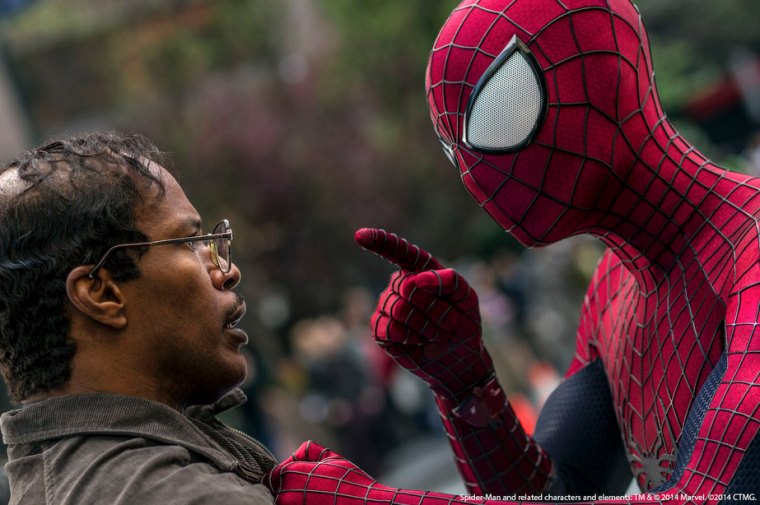
Elsewhere, however, dark forces develop under Oscorp. Engineer Max Dillon (Jamie Foxx) gets electrocuted by bio-electric eels, transforming him into the chaotic villain known as Electro. Russian mobster Aleksei Sytsevich (Paul Giamatti) gets equipped with a fully armed mechanical suit, becoming the Rhino. And Harry Osborn (Dane DeHaan), an old friend of Peter’s, returns with a dark secret that he’s hiding from everyone.

That makes three villains in total for this sequel. Concerned? You should be. The last time we had three villains in a Spider-Man movie, that film was Spider-Man 3. I’m never going to get that image of Tobey Maguire doing the Elvis Presley-stride out of my head, ever. Does anyone have any hydrochloric acid I can pour into my eyes?

Well, you can rest easy, fellow web heads. The Amazing Spider-Man 2 is not Spider-Man 3. Quite the contrary, actually. This is a significantly better Spider-Man than its predecessor, a film that bounces in between multiple tones and genres all at once and does all of them brilliantly.

An early fight scene in the film, for instance, is as wacky and funny as a Looney Tunes cartoon, with Spidey struggling to grab all these plutonium canisters off of a moving truck like he’s in the middle of a pinball table. In another scene, he’s in the middle of an action sequence so exhilarating and mind-blowing that it could have come straight from a video game cut scene. In another moment, him and Gwen are dealing with a real emotional struggle neither quite know how to handle, something that has haunted Peter since the first movie.

That’s what makes this Spider-Man better from the other one: It has many tones, story lines, characters and emotions that it’s juggling all at once. That’s a weighty order, and not one to handle easily. Yet director Marc Webb handles the challenge excellently, delivering just as relevant a character drama as he does an exciting action movie.

The cast members have expert chemistry with each other, but that should be expected because of their exceptional performances in the first film. We already expect Garfield and Stone to be perfect with each other because they were nearly inseparable in the first round of the series. It’s more efficient, then, to focus on the newer cast members: Jamie Foxx and Dane DeHaan. 

Foxx is electric as the high-voltage villain, pun intended. At first he’s just a socially silly and awkward scientist, similar to Jim Carrey’s version of the Riddler in Batman Forever. When he goes through his transformation into Electro, however, everything changes. He becomes an angry and malicious supervillain, a man who is mad and frustrated at everything and just wants to kill everyone, then jump start their heart just so he can kill them again. DeHaan, especially, was desperate and conniving as Harry Osborn, a menacing and starkly different Harry than the James Franco version we are used to in the original trilogy.

Both of these villains serve a pivotal role to Peter’s development. Electro is the physical conflict Peter has to face in the movie; Harry is the emotional one.

There’s another concern comic book fans will have about this movie, and that is the same concern they have with Captain America: The Winter Soldier: We’ve already read the comics. We already know the twists that are coming up, and as a result, our reaction is dulled when that moment comes in the movie.

Let me make a reassuring statement for my fellow comic book lovers: I could see the twist in this movie come from a mile away. Yet when I saw it, I reacted as if I was witnessing Peter’s tragic story for the first time.

There are apparent concerns to have with this movie. The multiple story strands are worrisome, the overload of villains can be an issue and Max Dillion’s character is far too silly to fully accept as being realistic.

Does that change The Amazing Spider-Man 2’s influence, or for that matter, its effect on the audience? The answer is no, it does not. The Amazing Spider-Man 2 is still a great sequel, an excellent expansion to the Spider-Man universe and a more-than-welcome development to Peter’s never-ending growth as Spider-Man. I’m tempted to compare it to the legendary Spider-Man 2, although I’m not sure if it’s quite there yet. One thing is for sure, however: it’s head-over-heels over Spider-Man 3. If Webb keeps this up, he just might surpass Sam Raimi’s original trilogy.

Tagged , , , , , , , , , , , , , , , , , , , , , , , , , , , , , , , , , ,

“THE BOURNE LEGACY” Review (✫1/2)

This movie has the wrong title.

The Bourne Legacy is a misconstrued mess, an absolute miscalculation and train wreck of a film that it has no business being made into a movie in the first place.  I hated this idea months before this was released, and I hate it even more now after having seen it.  Who, in their right minds, thought it was a good idea to make a Bourne movie without Jason Bourne???  That was my biggest concern going into the movie.  Believe me though, fellow moviegoers: that is the least of your worries.

Taking place shortly after the events of The Bourne Ultimatum, The Bourne Legacy shows the repercussions of Bourne’s actions, how it affects Treadstone, and what marks it leaves on the people involved.  Erik Byer (Edward Norton) is a government official who was directly involved with the affairs of Treadstone during its days of operation.  Shortly after Jason Bourne escapes their custody, however, Byer believes that all of the agents now are a potential threat to the government, and is convinced that he needs to shut the project down in order to protect themselves.  By “shut the project down”, I really mean kill all of the agents in the field.

One of these agents is Aaron Cross (Jeremy Renner), an experienced field agent who is carrying out a mission in Alaska for Treadstone when the order was released.  While taking refuge in a wooden cabin with another fellow agent out in Alaska, they are suddenly attacked by robot jets, and Cross barely escapes with his life intact.  Surviving only because of the medication he is on (Treadstone agents are required to take two pills, a blue one for physical boosting, and a green one for mental boosting), Cross looked into his stash to realize that he only has a couple days worth of medication left.  Now low on food, supplies, and ammunition, Cross must now find a way to get back to America and survive against Treadstone long enough to find a way to counterattack their onslaught.

Let me start with the most obvious flaw here: Tony Gilroy.  Looking at his filmography, you would think he would be the best man for the job here.  He was credited as co-writer for the three previous Bourne movies, he wrote and directed the Oscar-winning drama-thriller Michael Clayton as well as the 2008 caper film Duplicity.  I enjoyed all of those movies, and thinking that this one would be the same, made the mistake of thinking that it would be just as good.

Trust me, this couldn’t be any more of a dissapointment.  Everything wrong with this movie has everything to do with Gilroy’s script and direction, which couldn’t be more forced, erratic, confusing, and half-lapsed than this.

The problems start with the premise: a Jason Bourne movie without Jason Bourne is a bad enough idea.  But let’s take a step back here and try to be open with this.  Let’s just say, for facetious effort, that Aaron Cross’ story is just as fascinating and compelling as Bourne’s is.  What are the conflicts?  In his first three movies, Jason Bourne’s struggle was against his morality, identity, and the confronting of his past.  What is Cross’ magnificent, epic struggle?  Survival by trying to find a green pill.  If this movie dwelved any more into the conflict than it did, I would have said Cross was a junkie.

“Funny”, I think.  “I don’t remember these pills being used in the original trilogy”.  Correction: I vaguely remember them.  In a brief flashback sequence in The Bourne Ultimatum, I remember Jason Bourne taking a blue and green pill during his initiation into Treadstone (this memory is hazy though).  Bourne obviously didn’t need to take the pills further because his body adapted to the drugs.  Here, Cross is dependent on the drugs like a junkie is on cocaine, and if he doesn’t get his daily dose of the green pill, he’ll apparently revert to the level of intelligence of Forest Gump, according to him.

Okay, that’s fine.  Jason Bourne isn’t in the movie, check.  Super pills gives Cross super powers, check.  I would be able to buy the premise and its characters if A) it were handled well, or B) it was anywhere near as smart, interesting, or even remotely readable as it was to The Bourne Identity.  Here, instead of intelligence we get confusion, instead of cleverness we get forced easter eggs to earlier movies, and instead of interest we get on-the-nose, ham-fisted writing.  The editing in this film is choppy, leaping all over the place, jumping from one timeline to another, one flashback to the next, and it becomes so repetitive and convoluted throughout the picture that by halfway through I stopped caring about it.

Oh, I don’t deny Jeremy Renner is a knockout in this role.  Neither do I deny the talents of Rachel Weisz, Edward Norton, and especially not Joan Allen or Albert Finney.  All of the performances are great, but the story is a complete wreck, and Gilroy clearly has no idea how to handle his premise or the cast he’s been given for this.  What more proof do you need, besides this convoluted script, an uninteresting story, and a tedious chase sequence at the end with a sharply abrupt cliffhanger?

This is exactly the reason why I hate sequels.  When done well, like the original Bourne trilogy, they are compelling, brilliant expansions furthering the story set up by the first one.  When done like this however, they are nothing but forced, awkward, nonsensical garbage.

Again, I ask this: why did this movie have to get made?  The Bourne Legacy is exactly what you expect it to be, a Bourne movie without Jason Bourne, equally without the compelling character drama or real conflict in it. And now they’re talking about a possible sequel to this mess.  Only if Jason comes back and kills Aaron Cross.  That’s the only way they can redeem themselves at this point.

Tagged , , , , , , , , , , , , , , , , , , , , , , , ,