Tag Archives: Movie

“THE HOBBIT: AN UNEXPECTED JOURNEY” Review (✫✫✫✫)

A journey J.R.R. Tolkien would want to go on. 

The Hobbit: An Unexpected Journey is the story I first experienced when I saw The Lord Of The Rings: The Fellowship Of The Ring for the first time. Like The Wizard Of Oz or Harry Potter and The Sorcerer’s Stone, it’s a sweeping fantasy about ordinary characters getting thrown into extraordinary circumstances. So if hobbits, dwarves, wizards, and fire-breathing dragons constituted as “ordinary” in this universe, imagine the extraordinary circumstances that they go through.

Serving as a prequel to the J.R.R. fantasy epic The Lord Of The RingsThe Hobbit tells the story of Bilbo Baggins (Martin Freeman), a relaxed and easygoing hobbit who doesn’t like to do much throughout the day except for eat, sleep, and smoke his pipe every now and then. One day, he gets a visit from a mysterious stranger named Gandalf (Ian McKellen), an elderly wizard who is looking for shelter and a young companion to go on an adventure with. Much against Bilbo’s wishes, Gandalf not only stays in his small village home: he invites an entire company of dwarves, who proceed to wreck Bilbo’s house and eat everything in his fridge.

After having a nervous breakdown and cleaning up his entire house, Bilbo overhears Gandalf and the small dwarf brigade’s plans. Ages ago, the dwarves‘ prized possession, the Lonely Mountain, was overtaken by a vicious fire-breathing dragon named Smaug, who destroyed their village and stole the castle and all of it’s gold for his own desires.

After being betrayed by their allies, the elves, and being left to fight for their land all by themselves, the dwarves are determined to travel back to the mountain and fight for their home. Bilbo must make a decision of continuing to live on his normal, uneventful life, or to reach out, travel with the dwarves, and seek out adventure the likes of which he’s never experienced before.

Remembering that it was only a few years ago when I originally fell in love with The Lord of the Rings: The Fellowship of the RingThe Hobbit: An Unexpected Journey is a prequel that hits on all of the right notes, and then some more that I wasn’t expecting. In comparison to it’s elder companion, The Hobbit is uncanny. It has a wide verse of characters, each one being unique and memorable both in appearance and personality. It has a dynamic and involving story, ripe with exposition and emotion, retaining your full attention despite the lengthy run time. And it has highly stylized set pieces and visual spectacles that excite the eyes and overwhelm the mind. Do not mistaken Peter Jackson’s intentions here: he was inspired by Lord of the Rings when he was making The Hobbit.

And yet, there are so many differences from The Hobbit to The Lord of the Rings. One of the biggest, I think, would be it’s protagonist. Bilbo is different from Frodo, his nephew in Lord of the Rings whom Elijah Wood inhabited so wonderfully. They’re similar, of course, in that they are small hobbits not necessarily fit for fighting, but are clever, creative, and courageous nonetheless.

And yet, Bilbo is so much more than Frodo is. He’s funnier, for one thing, a bumbling, clumsy little hobbit that reminds me so much of the antics between Pippin and Merry in the original movies. He’s also more outgoing, a more active protagonist doing more in the film than just holding a ring and trekking long miles. He does so much in the film, sneaking around trolls, fighting Orcs, going through traps and mazes, and having a first-hand involvement in many of the film’s biggest fights. My particular favorite scene is one where he is talking to a fan favorite from The Lord of the Rings about the possession of a mysterious gold, rounded object. Hint: His favorite word is “precious.”

My point in saying all of this is that Bilbo is a dynamic character in his own right, and Martin Freeman handles the character very well. In the previous movie trilogy, Freeman had four hobbit inspirations to pull from, and instead of following just one of them, he took characteristics from all of them and made a character all his own. That took great talent and risk, and Freeman’s efforts paid off, making a character that I think is the most memorable and charismatic hobbit out of all of them.

Without a doubt, the best film in the series is Return of the King. This film is perhaps the second best. Sure, at times it might suffer from a slight overdose on exposition, but doesn’t all of the films? The Hobbit: An Unexpected Journey is an adventurous, ambitious gamble of a film, and it makes me believe once again in the power that a wizard, a slew of dwarves, and a brave little hobbit can have.

Tagged , , , , , , , , , , , , , , , , , , , , , , , , , , , , , ,

“BIG HERO 6” Review (✫✫✫)

“Initiating fist bump.” 

You know there’s going to be some kid out there watching Big Hero 6 thinking “Wow! I want to build a tech super suit too!” Unfortunately, to be able to create something in the likes of Iron Man, you need to have a lot of brains, and that’s something I don’t really have. Intellectual, daring, or different? No, but Big Hero 6 is sure a heckuva lot of fun.

Based loosely off of the Marvel Comics creation of the same name, Big Hero 6 follows a 14 year old braniac named Hiro (Ryan Potter), who has the technical skills that would rival at the levels of Tony Stark’s ego. His brother Tadashi (Daniel Henney) is a science wiz at a slightly lesser level than Hiro, but still brilliant enough to create Baymax (Scott Adsit), a giant, fluffy medical robot who introduces himself and asks you to rate your pain every time he boots up. In many ways, Tadashi inspires Hiro in everything he does, even convincing him to apply to the technology program at Tadashi’s university.

One day, however, the worst happens: a laboratory fire breaks out at the school, and Tadashi is killed in the midst of trying to rescue one of his professors. Grieved and hurt by his loss, Hiro becomes a recluse and tries to avoid his friends. Only by booting Baymax back up does Hiro learn that the fire was not an accident, and that someone had killed Tadashi in the midst of the chaos. Hiro bunkers down, suits up, and arms Baymax with any technology he can give him to go after this mysterious enemy and avenge his brother.

Man, does that synopsis sound like a Marvel property or what? The biggest worries with animated films like Big Hero 6  is that the filmmakers are going to cash in on their franchise’s name rather than actually work to tell a moving, involving story with the great characters they are already given. Isn’t that where movies like Rise of the Guardians and Shrek 3 fell flat? Animators nowadays aren’t concerned with such tedious things to them as interesting characters or a compelling story: they’re mostly concerned with just making sure things are looking bright and beautiful for the little kiddies rushing to the theaters to give them their weekly allowance.

Big Hero 6, luckily, will not waste any of your money, kiddos. One of the best things about this film is that it is a story first, and a franchise second. Hiro is a likeable and enthusiastic little hero, a young man who has some of that rebellious nature that all teenagers like to have going through puberty, but are still intent on doing the right thing regardless.

Even more than Hiro, however, I love Baymax. How is it that such a cute, wonderful, and buoyant robotic character can even exist? It’s rare to experience a character as literal, one-minded, and oblivious as Baymax and have him be so darn fun. There were scenes in the movie where Baymax literally had to scan and observe Hiro on how to do a fist bump, or where he mistakened a cat as a “hairy baby”. There are many times where characters take things so literally to the point where it is annoying, but I was never annoyed by Baymax’s antics. He’s so innocent, loveable and well-intentioned that I just want to hug his big fluffy body when he asks “On a scale of one to ten, how would you rate your pain?

There are a few gripes to be had, of course, and they’re the same as they are with most animated films. The story is mostly predictable. The twists revealed aren’t really that shocking because they’ve been done in every other animated film before. The other characters don’t lend much to the story besides Hiro and Baymax, and are mostly just there so that the team can have six members. And especially, absolutely, does the film have to end in an overly long and exaggerated fight sequence. Why does every movie involving superheroes always feel that they have to do this?

Regardless, Big Hero 6 is both fun and fast-moving, with Hiro and Baymax’s humorous conversations to keep our attention until the next big fight scene. The fantasies of the superhero genre dares us to dream bigger and aim higher. Big Hero 6 is a wonderful fantasy to experience.

Note: Of course there’s needs to be an after-credits scene with a very popular cameo appearance. Guess who it is.

Tagged , , , , , , , , , , , , , , , , , , ,

“INTERSTELLAR” Review (✫✫✫1/2)

A space odyssey led by Christopher Nolan. 

The first time I watched Christopher Nolan’s Interstellar, I knew I had found something special, but didn’t know if I fully comprehended everything I saw. I just finished watching it a second time, and now I understand I’m not supposed to comprehend everything I saw. Interstellar is mesmerizing and breathtaking, a highly ambitious and exhilarating journey taking you through the far reaches of time, space, planets, wormholes, black holes, stars, and anything else in space that you can think of. But just like space, it is also vast and daring, reaching for a vision that it cannot possibly hope to grasp. That’s okay. It’s better to aim for too much rather than too little.

Based off of an idea conceived by theoretical physicist Kip Thorne, Interstellar takes place in the distant future, where the Earth is slowly dying and the only source of sustainable food is by growing corn. Cooper (Matthew McConaughey), is an aerospace engineer-turned-farmer just trying to make it day to day with his small family, consisting of his father-in-law Donald (John Lithgow), his son Tom (Timothée Chalamet), and his daughter Murphy (Mackenzie Foy). Like the great astronauts Neil Armstrong and Buzz Aldrin, Cooper dared greater things in his younger years. He wanted to fly. He wanted to explore. He wanted to traverse and discover new spaces that he hasn’t seen before. Now he’s only concerned about making sure his family survives.

One day, him and Murph discover a secret space station that has been hiding NASA, which has been operating in secret since the world state of health has declined over the years. When Cooper finds out that the Earth will soon be unable to sustain life and that his daughter’s generation will be the Earth’s last, Cooper is recruited on a daring space mission to find a new planet that is able to sustain and save the human race.

Written and directed by Christopher Nolan, Interstellar is a testament to the quality of film that Nolan is consistent in making. It has all of the elements that you appreciate in all of his films. It has a grounded, human story intertwined in a brilliantly woven, thought-provoking plot. It has well-rounded, relatable characters that you root for and admire deeply. It has incredibly breathtaking visuals, created with the same visual and cinematic sense of style that is unique only to Nolan’s movies. And it has plot twists the size of Mount Everest, taking complete 180 turnarounds when you least expect it. You will not see the end of this movie coming.

Interstellar is up to par with many of Nolan’s other works, including The Prestige, Inception and The Dark Knight. If I’d continue on about those qualities, however, I’d be writing the same review for those films. It’s easy to write about the things you’ve already seen: I’d like to write about how this film is different from Nolan’s past work.

For one thing, the performances are the best they’ve ever been in any of Nolan’s films, and the heart of this film’s emotion comes from that of Matthew McConaughey. I love how his character is represented in this film, and I especially love how McConaughey handles him. He isn’t handled as a bold science-fiction action hero similar to the likes of Han Solo from Star Wars or James Kirk from Star Trek. He’s more human than hero, a vulnerable and quietly suffering man who just wants to go home to his daughter, but knows he has a greater duty in fighting for the Earth’s survival. I’ve always appreciated the humanity Nolan has always instilled in his characters, but somehow McConaughey reaches an emotional depth much deeper than that of his predecessors. I like seeing McConaughey jumping from such polar opposite roles as this from Dallas Buyers Club, yet giving the same dedication and credibility to both characters. He has proven himself to be an extremely versatile actor, whether it be for small, independent films like Dallas Buyers Club, or big Hollywood productions such as Interstellar.

I am also led to believe that this is the most scientifically accurate out of any of Nolan’s other films. Working closely with Kip Thorne on how accurate the film would be, Nolan worked hard to realize both his vision and Thorne’s, abiding by Thorne’s recommendations and notations as closely as possible. His representation of a wormhole in space. His portrayal of relativity to time and space. Thorne has gone on record to say that there is one major scene demonstrating high artistic freedom, and that is when Cooper visits a planet that has “ice clouds”. This film is intensely interesting and fascinating, and the coolest part to me is knowing that most of this was reviewed by a well-known physicist who has deemed it all possible.

Side note: please excuse me for using the word “coolest.”

There are a few weaknesses to mention. As a Nolan film, it is expected to be extremely complicated, and I admit to needing to see the film multiple times to even begin to understand it. I know many others will have a harder time at understanding it than I did. There were a few slow lulls in the film that detracted from its steady pace, and there were severe sound mixing issues at the beginning of the film that I noticed almost immediately. I’m no sound expert, but when the music is so loud that I can’t even hear what a character is saying, I think you need to fix something before you release the film.

I think it was the third act that really sold me on this film, the last half of the story that compelled me to believe that this was a very memorable journey, and it was. I won’t go into the particulars for the sake of spoilers, but I will say that Nolan is a master at orchestrating thrilling and tense-heavy climaxes. Sure, I would like that to persist throughout the rest of the movie, but I won’t complain. I appreciate Nolan’s ambition, if I appreciate nothing else.

Tagged , , , , , , , , , , , , , , , , , , , , , , , , , , , , ,

“THE BOOK OF LIFE” Review (✫✫✫)

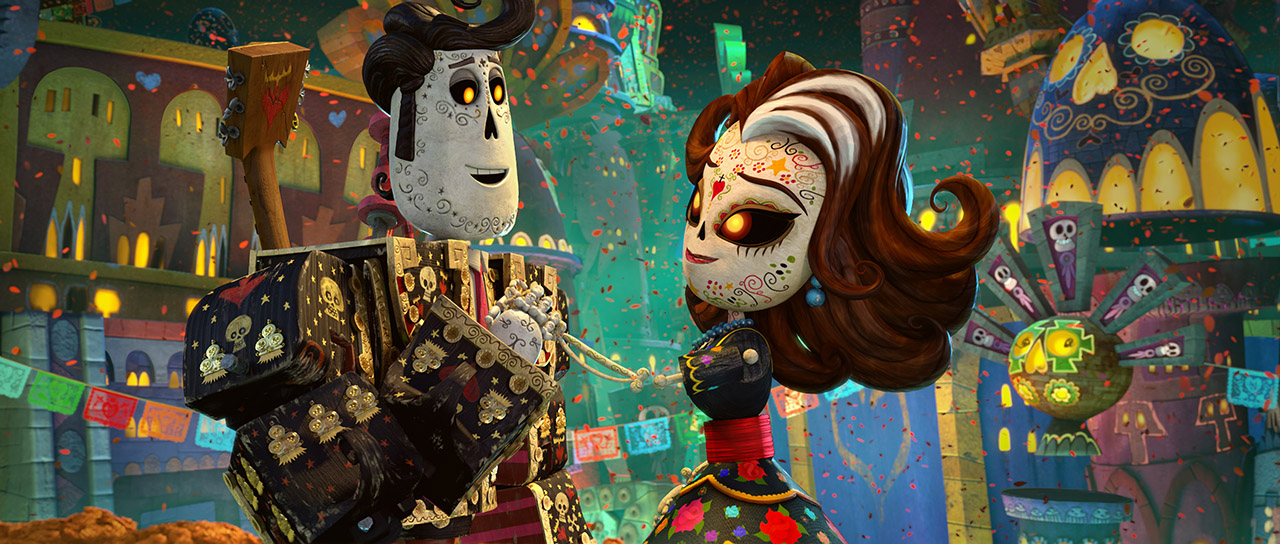
book of life

Ay caramba, tu joven amantes.

As children, we were told many fairy tales that filled our young minds with wonder and imagination. We looked at the pictures in our tiny children’s books as our parents narrated the words to us, but did we ever stop to think about where these fairy tales came from? The Three Little Pigs came from England. The Little Red Riding Hood, London. The Fountain of Youth, Japan. The Little Mermaid, Denmark. The Sorcerer’s Apprentice, Germany. So many stories have come from so many places all around the world that by the time they reach us, we have “cleansed” it of it’s culture and Americanized it for our own comfort.

Here, we have Jorge Gutierrez’s own fairy tale called The Book Of Life, and for the sake of the movie I’m glad it didn’t succumb to mainstream appeal by having it take place in Colonial America. The Book Of Life is splendid, a wonderful, uplifting, joyous, and immensely entertaining animation engulfed and inspired by the culture Gutierrez came from. Think about how quickly you are swept away when you read the fairy tales by the Brothers Grimm, and you can imagine how this film sweeps you up in that exact same way.

Told as a story within a story similar to Rob Reiner’s The Princess Bride, The Book Of Life follows a group of schoolchildren through a museum as they are told the tale of Manolo (Diego Luna), a Mexican bull fighter who is fighting for the heart of his childhood friend Maria (Zoe Saldana). His closest friend and rival, Joaquin (Channing Tatum) is also fighting for her love, and when they finally see each other after many years apart, they begin their pursuit for Maria’s love.

Unbeknownst to any of them, however, a heavy secret hides behind their innocent intentions. The spirits of the afterlife La Muerte (Kate del Castillo), who rules the world of the remembered, and Xibalba (Ron Perlman), the one who rules the world of the forgotten, have placed a bet on these three friends. If Manolo ends up marrying Maria, La Muerte wins and gets to rule both the land of the remembered and the forgotten. If Joaquin marries Maria, Xibalba wins and he gets to rule the land of the remembered. The world of the undead is at stake here, and it’s up to Manolo, Maria, and Joaquin to set things right.

What do I say about an animated children’s film that’s based around Mexican fables and customs? The Book Of Life is a wonderful animation: bright, vibrant, colorful, and lively all at once. Writer/director/animator Jorge Gutierrez has a careful eye for detail, and does well in visually adapting to different scenes, settings, and moods.

In one scene, after one of the supporting characters die, the setting suddenly becomes dark. The sun drops. The candles burn out. A cloudy fog envelops in the sky as rain drops pellet onto the ground. In the very next scene, however, we see the world of the remembered from this deceased person’s perspective, and it is lively colors light up with shiny, gold-brick pathways illuminating everywhere and with Churros and balloons floating as far as the eye can see.

This is what I mean when I say the animation is versatile: it’s attentive, eye-catching, and delightful, demanding your attention the minute you lay your eyes on it. But it’s not just the animation that works so well with this movie. The Book of Life is entrenched and inspired in its own culture, living and breathing the Mexican customs though every frame of its run time.  There is one work that Gutierrez did this with before The Book Of Life, and that is the Annie award-winning Nickelodeon cartoon series “El Tigre: The Adventures of Manny Rivera.” Now we have The Book of Life, and I feel it will spur on many Mexican children and families to pick up their heritage and be proud to represent it. In a day and age where Hollywood feels they need to Americanize everything, The Book of Life is a Godsend.

Everything else in this film functions exactly as it is supposed to. The story is mostly formula in that there has to be a good guy, a bad guy, a forbidden love, a big fight scene at the end, and a happy ending. The voice cast is solid, and Channing Tatum didn’t annoy the living daylights out of me for a change. And the music by Gustavo Santaolallo is pristine and authentic, with the plucking of the Mexican guitar strings filling your ears with wonderfully harmonic sound.

But make no mistake. The best thing about this film is the inspiration Gutierrez instills in it, the inspiration that his parents most likely instilled in him when he was still just a little boy. I hope there will be a children’s novelization of this film in the future and that it too will inspire children of all ages, regardless of their heritage.

Tagged , , , , , , , , , , , , , , , , , , , , , , , , , , , , , , , ,

“BIRDMAN” Review (✫✫✫✫)

The artist’s struggle, all in one take. 

Birdman, or otherwise known as The Unexpected Virtue of Ignorance is one of the most mesmerizing films I’ve ever seen. It is also one of the most unique, disturbing, shocking, and confusing films I’ve ever seen too. That’s okay. This film was reaching for a specific vision, and director Alejandro Inarritu has expanded beyond it. I admit I don’t know what to expect as far as the public reacting to this, and I also don’t know how accessible it is to non-film aficionados either. But I have seen the movie frame by frame, and I think it’s one of the best films of its kind. On the surface value, it’s about the struggles of Broadway theatre. In deeper insight, it’s about ego and the obsessive human condition.

The film stars Michael Keaton as washed-up actor Riggan Thompson, who has been forgotten by his adoring public after portraying the lead role in a series of superhero films titled Birdman. This is ironic, because in real life, Keaton portrayed a superhero in Tim Burton’s 1989 film Batman. Desperate for a comeback, Thompson sets out to write, direct and star in his favorite Broadway play: What We Talk About When We Talk About Love by Raymond Carver.

Things immediately hit the fan during the week of their first preview. One of Riggan’s actors gets a head injury from a loose light on the set. His replacement, Mike Shiner (Edward Norton) is a talented but brash and arrogant actor who sees himself as Riggan’s superior. And, as he faces personal problems with his estranged daughter Sam (Emma Stone), Riggan begins to feel the closing pressures of Broadway when a malicious theatre critic tells him she’s going to “kill his play.” Now Riggan is trying to keep the play and his sanity afloat, and he will make whatever sacrifices he needs to make sure both happens.

Written, directed and produced by Inarritu, Birdman is the first black comedy made by the filmmaker, his most successful films to date being Oscar nominees Babel and Biutiful. Now he has made Birdman, and I am tempted to say it’s the best film he’s made yet.

What worked so well with the film? The first thing is the editing and the cinematography, which was shot so wonderfully by Oscar winner Emmanuel Lubezki that it places you in the moment, in the reality of the film, not making you watch it from a cushion seat on the eighth row of a dark movie theater. Lubezki, who worked with Inarritu on short films in the past, decided to shoot the film and edit it into a continuous fashion, giving off the illusion that the entire film was filmed in one take. Even though the movie wasn’t filmed in one shot, the feeling it gives off makes it feel alive and moving, not unlike the world of theatre that Riggan is trying to prove himself in.

I wonder how much effort this takes, not just from the cinematographer and director’s point of view, but from everyone else involved in the film as well. How many hours did the actors need to rehearse their lines in order to get their roles right? How much pressure was the tech and lighting crew under while they were filming, knowing that if they screwed up, everyone would have to start back to square one? How many hours did film editors Douglas Crise and Stephen Mirrione have to sit in front of a computer, making sure the shots transitioned so well that you couldn’t even see the transitions? The illusion not only worked because of the idea that Lubezki and Inarritu offered, but because of the commitment it received from everyone involved with the film. In many ways, their efforts were all worth it: the camerawork here expresses more of the story than the character’s dialogue does.

The parallels in this movie are also ingenious. How does Keaton feel playing as Riggan Thompson in the movie, knowing that he reached international fame as Batman earlier in his career and having since then never been able to match a more recognized role? How does Inarritu feel, going through all of the production pressures Riggan did in making the play as he himself did in making the movie? Did he intend this movie as self-reflection? Is he telling the audience what he goes through daily as a filmmaker? Or is he using his struggles as a platform to tell a much deeper, more important story to the audience?

For me, I don’t get as much joy out of interpreting as much as I do out of experiencing. And make no mistake: Birdman is an experience, surreal, tantalizing, and thought-provoking all at once. I’m still sitting here, hours later, not quite fully realizing what exactly Inarritu was trying to portray in this film. Is he commenting on the artist’s struggle? Commercial vs. independent film? Fatherhood? Friendship? Family? Lost love?

I think it’s all of the above. Or maybe none of the above. I honestly don’t know. In the movie, Inarritu battles labels that are placed on artists and on the art that they produce. Is Riggan Thompson a superhero, or an actor portraying a superhero? Is he a former shell of who he is, or a flower that has yet to bloom? We see in this film how these labels influence his life and how much stress and anxiety it presses upon him. To put labels on the movie would contradict Inarritu’s intentions. It would be offensive to the film.

My bottom line: Birdman is a masterpiece. It is so distinct in its own language and style that I think it is impossible to define it, let alone replace it. Critics will applaud it for it’s technical and emotional achievements. It will definitely garner some Oscar nominations. It’s a sure contender for visual effects, cinematography and editing. It is also sure to confuse certain people, to which I would recommend stop trying to understand it. Birdman is not meant to be understood. It is meant to be experienced, and if you can help it, interpreted.

Post-script: A thought I had after seeing the movie that I think viewers will also have. Because of how profoundly his role as Birdman affected Riggan, is Inarritu attacking the superhero genre of film? I believe he is, but I choose not to acknowledge that. After all, for every time a superhero film was called too simple, couldn’t you call any art film too complicated? I quote Mark Twain: “Too much of anything is bad.” 

Tagged , , , , , , , , , , , , , , , , , , , , , , , , , , , , , , , ,

An Afternoon With Alejandro Inarritu

“And did you get what you wanted from this life, even so?

I did.

And what did you want?

To call myself beloved, to feel myself beloved on the earth.”

– Raymond Carver

These were the words that director Alejandro Inarritu (Babel, Biutiful) chose to quote at the beginning of his meticulous film Birdman, or The Unexpected Virtue of Ignorance. It was also the first words that came back into my head minutes before I was to interview him.

This weekend, I had two great experiences happen to me. Firstly, getting to see Birdman, a viciously unique film that tackles it’s characters and themes with pinpoint precision: a masterwork by a master director. The second you already know. If you don’t, you didn’t read my first paragraph.

Alejandro gave myself, along with about ten other college journalists, the privilege to talk to him about his upcoming limited release. After seeing the movie, this surprised me, because there was a moment in the film where a journalist accuses the main character of injecting semen into his pores to maintain his young features. I suspect Mr. Inarritu hosts a very guarded spirit while being interviewed by the press, and I certainly don’t blame him for that if that is the case. Now that I think about it, maybe that’s why Inarritu wanted to host the interview over the phone in the first place.

Anyhow, I had 20 minutes to listen to the director’s innermost thoughts, and while I only got to ask him one question, I enjoyed the experience as much as any other college journalist who participated in the call. While all of these aren’t my questions, these are the ones I found the most relevant to the film, and the ones I believed Inarritu would have preferred to be answered in the first place. So without further adieu, here is Alejandro Inarritu on the unexpected virtue of ignorance.

Question: Your film is unique, hyperactive and full of energy. How do you communicate to your cast the complex tone you’re wanting to portray?

Answer: I always try to be very specific, help them to clarify and simplify things by having a very clear objective. I think every scene has an objective, and every character has something they want to achieve in each scene. When you have cleared your objective, and to try one or two possible ways to get that done through an action verb, I think that would simplify the work not only for me, but for everybody.

Q: What were some of the challenges you faced while making the film? 

A: It was a very short shooting — 29 days. We rehearsed a lot before arriving to the set, so basically it was a very intense and meticulous work of precision with actors, camera and crew. Everything was designed and matched the needs of the film that was basically predecided in rehearsal.

Q: You have a big role behind your scenes in producing, writing and directing all of your films. What is it like taking on all of those jobs at once? 

A: I have been lucky to have been the producer and be involved in all of my films in a very personal way. I think there is no other way to make it. I think if you have a film that is personal, if you are doing your own film, there is no other way to not produce it, because I think it’s a part of the film. Producing means a lot of decisions that will impact your film one way or another.

Q: In the movie, Riggan Thompson is overshadowed by a superhero role he played earlier in his career. In real life, Keaton is overshadowed by his role in Tim Burton’s Batman. Is that an intentional casting decision that you made?

A: Keaton adds a lot of mental reality to the film, being an authority and one of the few persons of his work that pioneered the superhero thing. But at the same time, he has the craft and the range to play in drama and comedy, and very few actors can do that. He plays a prick in this film, and I need someone who was adorable, somebody who you can really like. He has that likeness, that likeness that was required. All of these things made him the perfect choice for it. I think he was very bold in trusting me with this role.

Q: One of the things that is particularly interesting with the film is the long take. Can you talk about why you made that visual choice?

A: I wanted the long take to make the people really feel the experience of this guy. I think it’s important for every director in every film to pick the point of view, and in this case I wanted radical point of view, and the people were in the shoes of the character to experience his emotions. I felt that was the most effective way to do that.

Q: Why did you choose to portray mental illness in a film that is at least extensively a comedy?

A: I think ego is a part of our decease as a society. I think the ego is a necessity, but I think when the ego takes over and we attach our personalities to the ego, and he domains a person absolutely without being discovered or controlled. That’s mental deceit, and I see in a way Riggan Thompson suffering from that illusion of ego that’s distorting him. He thinks he does things that he does not do, he’s in like a manic state of mind. He’s an extreme case of ego.

Q: Is that part of the commentary?

A: Everything is part of the tone of the film. That’s why it opens with a guy meditating in tidy whites.

– David Dunn

Tagged , , , , , , , , , , , , , , , , , , , , , , , , , , , , , ,

“GONE GIRL” Review (✫✫✫1/2)

Gone Girl

What happened to Amy Dunne?

When I started watching Gone Girl, I had no idea what happened between Nick Dunne and his wife Amy. Now I have finished the movie, and I still have no idea what happened between the two of them.

Gone Girl is a very strong psychological thriller, packaging the essential elements of tension, grit, and confusion to make an extremely fascinating, yet equally frustrating, watch. Imagine you’re driving on a highway, except you take a wrong turn. Then you take another wrong turn. Then you take another, then another, and then another after that. Gone Girl is that highway, taking you through so many twists and turns that you don’t know which way you’re going anymore. The only problem is that there’s no end destination when you get off of the highway.

Based on the book of the same name by Gillian Flynn, Gone Girl starts with Nick Dunne (Ben Affleck) coming home to see his living room torn apart and his wife Amy (Rosamund Pike) missing. There are a few details that disturb him upon this discovery. The glass table is smashed in. Chairs are overturned. A blood splatter can be spotted above the stove in the kitchen. Suddenly, Nick finds himself swept into a media frenzy as everyone everywhere cries out “Where’s Amy?” as he and Amy’s parents work to find Amy and bring her back home.

Yet, in the midst of all of this media attention, people start to recognize strange things about Nick. He’s behaving oddly for someone who has just lost his wife. A woman outside of a press conference takes a selfie with him and posts it online. He smiles at the conference when people take his picture. And as police discover Amy’s diary and uncover incriminating evidence about Nick’s marriage with Amy, people start to ask one question: did Nick Dunne kill his wife?

Let me start by saying this: there’s no way to expect anything from this film. The minute you think Gone Girl is going in a specific direction, it does a reversal and goes in the complete opposite direction, setting you on another prediction track until it does another reversal. There are many factors contributing to these twists, the biggest one being the writing contributions of Gillian Flynn. Flynn, who wrote the original book, was adamant about being involved in writing the screenplay for David Fincher’s adaptation, and she’s a good sport as far as working with him. Even though there are a few differences conceptually from the book, the work remains a whole emotionally, and lets off this gnawing paranoia on both characters as we question who is the victim and who is the perpetrator. This movie is like a game of cat and mouse, except no one really knows who is the cat or mouse.

The writing is ingenious, but the real star of this show is David Fincher. Fincher, who is no stranger to mind-bending plots (1997’s The Game, 1999’s Fight Club, and 2007’s Zodiac), incorporates elements from all of his movies into this one mind-bending thriller. It has plot twists as big as those in The Game, the pseudo/suicidal/mind trickery in Fight Club, the dark, disturbing realism in Zodiac, and the broad, expressive shots, angles, and edits from The Social Network. I like this about Fincher films, that they’re so distinct in visual style that you can almost instantly tell that it’s a David Fincher film.

Example: In the opening sequence of The Social Network, we capture the essence of the scenery as a lonely Mark Zuckerberg trots back to his dorm. We get a sense of the campus he’s on, the bridges, the buildings, the sidewalks, the trees. We not only feel the physical surroundings around him, but also the life that’s in it, almost like the scenery is breathing around him. Fincher did the same thing during The Girl With The Dragon Tattoo, and he did it again with Gone Girl. When he’s not filming a scene where there’s a tense exchange of dialogue between characters, he’s quietly viewing the scenery all around him, telling a story with silent images just as much as he does with outspoken characters.

More than what he does shot-wise though, I’m impressed with how he handles his cast. Look at the names associated with this film. Ben Affleck. Rosamund Pike. Tyler Perry. Neil Patrick Harris. Are any of these names what you’d expect to see in an intricate crime-thriller, let alone give a decent performance? I mean, the last memorable role Perry had since dressing up in drag as Madea is Alex Cross, and that was about as complacent as an action movie can get. Neil Patrick Harris’ most serious movie role is as himself in Harold and Kumar. Rosamund Pike is most known as a Bond girl. Affleck’s acting career is self-explanatory. I looked at all of these actors cast in these roles, and I couldn’t help but wonder what they were doing in a Fincher film.

Then I saw what he did with them, and I couldn’t see anyone else in their roles. Perry played Dunne’s attorney Tanner Bolt, and he was so smug and straightforward that he could lend Robert Downey Jr. a few tips for The Judge. Harris steps so wonderfully into a role he’s never played before, and Pike is exemplary too, though I won’t exactly specify how. Affleck to me was the most interesting. He uses awkward lulls, blank expressions, and his sterile voice just like he did during some of his bad performances in past movies. It’s not a bad performance though. Fincher is just using Affleck’s natural reactions to lend details to Nick Dunne’s character, like how he could be smiling in pictures while his wife is missing, or why he sounds so unconvincing when he gives a speech about how he loves his wife to ongoing listeners. Fincher uses both Affleck’s strengths and weaknesses as an actor to the film’s advantage, and that goes the same for everyone else in the film.

I liked many things from this film. The cinematography, the editing, the thought-provoking plot, Fincher’s masterful direction of the film and it’s cast all culminated into a jaw-dropping experience. My only regret about this film is it’s ending. I won’t spoil it for you, but I will say that it ends in the same way that it begins, posing questions and vague thoughts so that the audience may fill it with their wild imaginations. I realize Fincher and Flynn did not intend to have a straightforward, clear-cut ending, but I have a stubborn need for closure. Films are supposed to provide answers to the questions they’ve already posed to you. Gone Girl does not provide an answer. It provides a question.

Tagged , , , , , , , , , , , , , , , , , , , , , ,

“THE FAULT IN OUR STARS” Review (✫✫✫✫)

And the stars have never shone brighter.

The Fault In Our Stars is one of the most magical films you will ever see. It is also one of the most tragic, heartbreaking, funny, genuine, and real films you will ever see. It does exactly what the book does, and exactly what movies are supposed to do: it sweeps you away, transporting you, making you forget about your own reality and immerses you into the reality of these fictional characters that don’t seem so fictional. While I was watching the movie, someone in the audience leaned over to me and asked if this was a true story. “No, but it deserves to be,” I thought to myself.

Based off of the highly popular book of the same name by John Green, The Fault In Our Stars follows the story of Hazel Grace Lancaster (Shailene Woodley), a spirited, spunky, and sarcastic teenager who loves to read books, watch horrible reality TV shows, and question everything her parents tell her to do. Augustus Waters (Ansel Elgort) is another spirited, spunky, and sarcastic teenager who loves to watch movies, play video games, and ponder the many questions about the universe. Hazel and Gus are both like any regular teenager but with one significant difference: they’re cancer survivors.

Note that I said survivors. They’ve had cancer in the past, Hazel in her lungs and Gus in his right leg, but both have since moved on from their ordeals to try and tackle their lives as any other teenager would. Because of Hazel’s lungs, she has to carry around a respiratory machine (Oxygen tank instead? Machine sounds intensive) with her everywhere she goes, and what would seem like a simple task to anyone else (I.e. standing up, or walking a flight of stairs), nearly exhausts Hazel after doing so. Gus, on the other hand, has a prosthetic replacing his right leg in exchange for being cancer free.

One day, they both meet each other at a cancer support group meeting. Hazel notices Gus having a bounce to his step, despite only having one full leg. Gus notices Hazel’s beautiful face even though she’s deoxygenated. As they continue to meet and see each other, they soon realize that they have a special relationship with each other, one that no “normal” human being could ever possess.

From a first glance, some people may look at this movie and see it as an overly optimistic tween romance, where two characters fall in love, and their love beats all things, including their ailments. I know I did when I first heard about it, and why wouldn’t I? Romantic dramedies have a way of underemphasizing conflicts just so characters can have happy endings. As a result, we get movies that are more cheesy and insincere than they are genuine and heartfelt, much like those ungodly Nicholas Sparks movies.

But The Fault In Our Stars is different. It is not manipulative of it’s emotions and it doesn’t downplay the severity of character’s problems. It’s honest and up front about the challenges these teenagers face, and doesn’t shy away from the severity of it just because they’re children. In fact, Hazel Grace herself dispels the notion at the beginning of the film, saying to her listeners “That wouldn’t be the truth. This is the truth. Sorry.”

I know, I’m late on writing this review. Why am I writing this in October, when the movie has already come out on DVD? I was waiting, dear reader. Waiting to read the book and see not only how faithful the movie was to it’s source material, but also to it’s emotions. I’ve said it before, and I’ll say it again: you can bend the plot of the original story, but you cannot bend the emotions and still remain faithful.

Now I have read the book, and I can tell you firsthand from my experience that the movie held up to the book on both counts. The Fault In Our Stars is a breathtaking experience: touching, deliberate, and beautiful all at once. To say it’s faithful to the book is an understatement. It’s quite possibly one of the best book-to-movie adaptations I’ve ever seen.

The things that work so well in the movie are the same things that work so well in the book: the writing and the characters. At the heart of the entire story, movie and book included, is Hazel Grace, who is such a fascinating and singular character that it makes me sad to think that she doesn’t exist. Hazel isn’t like other cancer-ridden characters. She neither has an overly defeatist attitude of her ailment, or an overly optimistic perspective one either. She’s in the neutral realm, seeing her sickness as a part of her no matter what she does, and choosing to accept it because she’s more or less forced to.

And yet, she’s so much more than her sickness. In many ways, she’s just like any other regular teenager. She has a favorite book. A favorite author. A favorite show. A favorite food. A crush. And like any other teenager her age, she’s bursting with opinions, hopes, fears, and desires, all of which combine to make a completely fascinating, involving and passionate character. We quickly learn to love Hazel not because she has cancer, but because she is unique.

On that note, let me talk about Augustus. Can I just say that I love this kid? Gus is filled with spirit and enthusiasm, having a bounce to his step that contrasts with Hazel’s shy trotting. I find it interesting that even though I don’t like it when characters are unrealistically happy, here Gus is almost nothing but happy. He thinks it’s cool that he has a metal prosthetic leg, seeing it as him being half-cyborg. He likes video games, zombies, and heroism, seeing himself as one of the brave movie heroes who sacrifices himself for the sake of the people he loves. In many ways, that’s who he is: the hero of the movie, bringing all of the love and affection he could for the woman he loves. He’s so great in the film, he could have a movie all to himself if he wanted to.

You’ll notice that I’ve referred to both of these persons by their characters, not by the actors that portray them. That’s because Woodley and Elgort slip so wonderfully into their roles that they’ve completely disappeared into them. I didn’t think about The Descendants when I saw Woodley tear up and cry, or when she picked up her BiPAP and exhausted herself walking up the stairs. I didn’t think of Divergent when Elgort so tenderly cared to her needs, or sweetly telling her that he would be honored to have his heart broken by her. I saw these actors and was so immersed into their performances that I no longer thought about what they were and thought more about who they were. These two are not Shailene Woodley and Ansel Elgort. They are Hazel Grace Lancaster and Augustus Waters.

Everything else in this movie was made to near perfection. The screenplay by Scott Neustadter and Michael Weber adapted the story and emotions wonderfully from the book. The camera work by Ben Richardson was elegant and harmonic, much like the great work he did with 2012’s Beasts of the Southern Wild. And director Josh Boone guides the actors through the blissfully tragic story created by John Green, whose wondrous words were what made this entire movie possible.

That ends the review with one question: which is better? The book, or the movie? Neither. I could argue that the book is better because it has more content, or I could argue the movie is better because it brought the story to life visually. Both arguments are pointless. They are both two different mediums, but they both tell the same wonderful story.

Tagged , , , , , , , , , , , , , , , , , , , , , , , , ,

“BOYHOOD” Review (✫✫✫✫)

A scrapbook by Richard Linklater.

The main character’s name in Boyhood is not Mason. His name is also David. And Connor. And Warren. Aaron. Stacey. Tony. Eric. Steven. Ben. Richard. And so on and so forth until you’ve listed every masculine name in the dictionary. I probably went eight names over how many I needed to list, but you get my point. We’re doing more than just watching one boy’s journey into adulthood here. We’re watching ourselves grow with him.

Strange, I think. I don’t normally sympathize with characters to the point where I feel like I AM them. Relating to protagonists is a somewhat straightforward task; you merely need to introduce the character along with their conflict, and then let the filmmaker do his work to bringing their arc to life.

But with Boyhood, I face an interesting prospect: there is no one conflict that Mason faces in the story. Like myself and my closest family and friends, Mason’s conflict is life itself, complete with all of its blessings, gifts, challenges, and turmoils alike. If you’re still not getting the picture, let me put it to you this way; if I were a filmmaker, and I were adapting the full story of your life, would I be able to condense it into one or two events?

The answer is no, I couldn’t. There is a whole multitude of issues you’ve faced in your life, just like I did, and I’m sure we could turn those issues into ten or twelve more movies if we tried. Director Richard Linklater chose not to do that. With Boyhood, he took one boy’s life, a small child he found named Ellar Coltrane, and followed him from age six until age 18, gradually showing his life progress and the challenges he faced as he grew into a man year, by year, by year.

It’s fascinating I tell you, to watch a movie progress from one generation to another. I look at Ellar as a young boy obsessing over cartoons and action figures while his sister, portrayed by Linklater’s daughter Lorelei, constantly talks about makeup and Britney Spears. I look at these children’s parents, played by a significantly younger Patricia Arquette and Ethan Hawke, as they struggle to connect and be there for their children and to be the best parents they possibly can be. It’s interesting to see these children mature from young, simple-minded beings to young adults, trying to find their own paths in life while their parents mature from being those young adults to the older, more mature parents that have faced, and survived, every difficulty they could have ever faced.

It’s pointless to describe what the plot of the movie is like. What is the plot of the movie? Fill the movie with your life experiences, and you have the plot. I caught myself many times reliving past memories while watching the movie, sympathizing with Mason as I remember how I too faced issues such as bullying, peer pressure, puberty, growing up, and finding a place where I belonged.

It’s not so much a movie as it is a scrapbook of memories, and Linklater is merely showing the memories on screen like he’s pulling a photograph out of a book.

What of the performances then? Patricia and Ethan are the most emotive performances out of the movie, but that’s to be expected considering they’ve been working on this movie, among others, for literally a decade. Lorelei is cute as a child at the beginning of the film, but as the movie continues on, it begins to focus more on Ellar while Lorelei, more or less, fades in to the background.

That being said, Ellar isn’t the most compelling actor in the film. As a child at the beginning, he is the most believable, but that’s because he’s living, not acting, in the moment. When he’s playing with his friends or when he’s dressed up for the Harry Potter premiere, you know that’s him being excited in the moment, similar to how Drew Barrymore believed E.T. was real during the filming for E.T: The Extra Terrestrial. As he gets older, however, he gets less emotional about things and more or less goes through the motions wherever Linklater guides him.

At first, I thought this was an obvious criticism to the film, because how is a kid going to maintain his acting ability through 12 years of his life? As I look deeper, however, I realize that Ellar isn’t intended to give a performance. He isn’t meant to be an actor, but a surrogate, a character whose emotions and memories we fill in the film and then we sympathize with because those are the same emotions we faced when we were his age.

Mason goes through a lot in this movie. As a toddler, he witnesses his parents go through divorce. As a child, he faces abuse from his alcoholic stepfather. As a teenager, bullying. As a high schooler, heartbreak. This movie is so tangible that it made me want to grab hold of Mason. It made me want to hold him and hug him, telling him the same thing my mother told me when I was going through my own issues at his age.

I want to grab him and say to him, “You’re going to be okay, Mason. You’re going to be okay.”

Tagged , , , , , , , , , , , , , , , , , , , , , , , , ,

“SIN CITY: A DAME TO KILL FOR” Review (✫)

Can you kill me too while you’re so busy at it? Thanks. 

There’s a character early on in Sin City: A Dame To Kill For that describes the city as a place “where you go in with your eyes open, or you don’t come out at all.” He’s wrong. I went in and out with my eyes fully open. I only wished that I kept them closed.

Oh, where to begin with this. Sin City: A Dame To Kill For is, in a word, messy – a neo-noir thriller as confusing as a detective’s murder case and more violent, putrid and horrific than a crime scene. The only brains this movie has are the ones that it blows out of peoples’ heads.

The plot takes place sometime within the Sin City universe. The question is when? I honestly don’t know, and I don’t think the movie knows either. It’s part prequel, part sequel and part in-betweenuel that cuts to wherever and whenever it wants to.

Like the first movie, there are three main stories the plot revolves around and, likewise, three main characters to sympathize with. You have a young Dwight McCarthy (Josh Brolin), who, before he met Jackie Boy, was obsessing over a rich housewife named Ava (Eva Green). There’s Johnny (Joseph Gordon-Levitt), an overly-cocky poker player who wants to come to Sin City and beat the king of all cards himself — Senator Roark (Powers Boothe). And then there’s Nancy (Jessica Alba), who is still coping with John Hartigan’s (Bruce Willis) suicide at the end of Sin City.

Following this easy enough? Good, because that’s all the explanation you’re going to get. The biggest problem with Sin City: A Dame To Kill For is that it’s so convoluted. Stories are meshed, mixed and thrown together without any sense of connection or correlation to its plot, and the entire time while I was watching it, I kept wondering where these stories were taking place and why I should care. Some movies do well with intertwining narratives, such as Pulp Fiction or Crash. This is not one of them.

A good example of this is in the very first scene of the film. Marv (Mickey Rourke), the hard-headed thug who was framed for the murder of Goldie in the first movie, wakes up next to two crashed cars with no memory of how he got there. He goes through mundane dialogue for five minutes in his obviously exaggerated thuggish accent, then the movie cuts to the story and almost completely forgets about him.

My first thought after watching this: why was that scene necessary? As the movie continued its runtime, I continued to ask this question in my head until I realized that none of it was necessary, that it was just a continuous farce of violence and delinquency that the kids who play Grand Theft Auto would just drool over.

This movie is definitely violent. That’s to be expected, I know, especially when you remember how violent the first one was. There is, however, a stark difference in how the violence is used in each movie. In the first Sin City, the violence was both shocking and satirical, at times being so disturbing that you can’t help but reel back from it, and at other times being so exaggerated that I laughed at it. Whether it was positive or negative, however, I at least felt something.

Here, nothing is felt. Here, we just look at all shades of black, red and white among severed body parts while we plod through the final act like it’s a homework assignment rather than the climactic ending that it deserves to be.

I’ll admit to having disliked the first Sin City. Does that matter? I give credit and criticism equally where it is due, and even though both Sin City’s are equally violent and despicable, the first one was at least more intriguing and had more cohesiveness both as a whole story and as smaller, separate narratives. This one fell flat, crumbled to pieces and was about as clear as a muddy window pane. Maybe that’s why Marv couldn’t remember anything at the beginning of this movie – he realized what he signed up for, and he tried to forget all about it.

Tagged , , , , , , , , , , , , , , , , , , , , , , , , , , , , , , ,