Tag Archives: Legacy

“PAPER TOWNS” Review (✫✫✫1/2)

Just a paper boy living in a paper town.

The frames we see in Paper Towns are the stuff of fantasies, the kind that we think about and dream of late at night in our bed while staring at the ceiling. It’s hard to look at this movie and not relate it to our own experiences in high school, in first love, in friendship, and in self-discovery. At one point, I was watching the movie and wondering if I was watching someone else’s story, or my own.

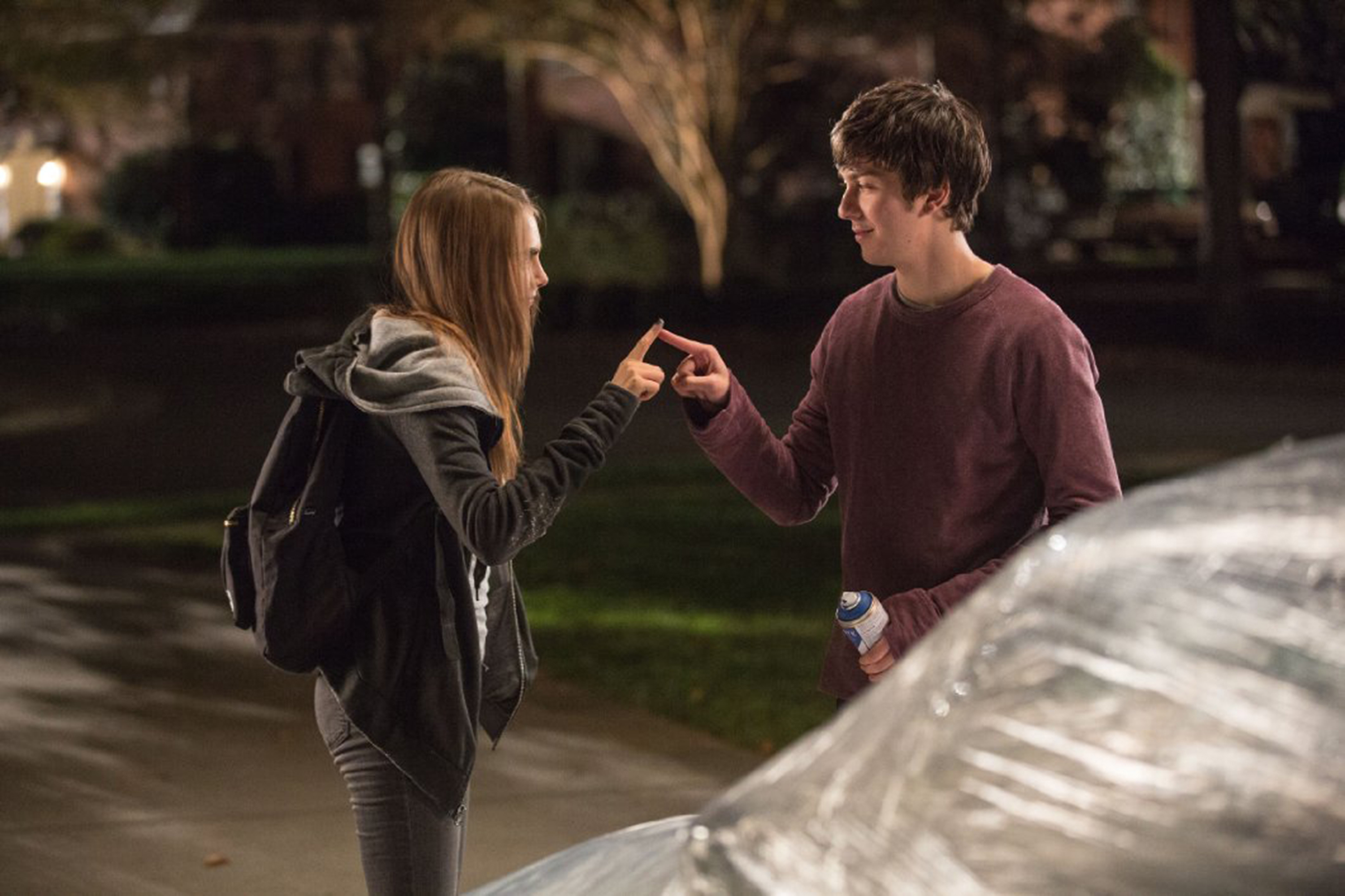
If we are watching someone else’s story, that someone is Quintin “Q” Jacobsen (Nat Wolff), a regular high school student with regular friends, regular parents, regular life, and regular post-graduation plans. Just about everything is regular to Q except for one thing: Margo Roth Spiegelman (Cara Delevingne), the girl on his block that he’s been in love with since they were kids.

Q and Margo are the epitome of opposites. Q is shy and introverted. Margo is confident and extroverted. Q likes to play it safe. Margo likes to take risks. Q likes to look ahead and plan for his next step. Margo thinks not knowing where you’ll end up is the most fun part of anything.

One day, Margo completely vanishes. Her parents, her friends, nobody knows where Margo may have gone. As time passes, however, Q discovers clues Margo left behind for him to discover. A piece of paper in his door. A page torn out of a map. Writing on an old gas station wall that reads “You will go to the paper towns, and you will never come back.” Now convinced that Margo wants him to find her, Q starts piecing all of the clues together to find out where she has gone to convince her to come home.

The second of John Green’s novels to be adapted to film (with the first being last year’s The Fault In Our Stars), Paper Towns is a truly unique and invigorating experience, refreshing in its comedy, in its drama, and in its truth. It reminds me so much of The Fault In Our Stars, and yet, it’s so different from it too.

I’ll start with the best thing from both movies: the characters. Green’s novels have such a unique way of making ordinary characters extraordinary, and that’s just as true with the movies as it is the books. Margo is a spur-of-the-moment, lively and rebellious teenager who serves as more or less an enigma of what adventures high school students fantasize about and aspire to. She’s almost too ecstatic to be believable as a character, and that’s exactly the point. As Q says it best in the movie, “It’s so silly, it can only be true.”

The moments where she takes Q on her midnight adventures are probably some of my favorite scenes in the movie. While Margo was pushing Q to get out of his comfort zone, I was reminded of a scene between the two leads from Martin Scorsese’s 2011 film Hugo.

Isabelle: We could get in trouble.

Hugo: That’s how you know it’s an adventure.

Every other supporting character is just as interesting and likeable as Margo is, however less mysterious. Q’s friends, Radar and Ben (Justice Smith and Austin Abrams), are the mischievous sort that talk about high school rumors and made up sex stories just like immature high school students do. Halston Sage portrays Margo’s best friend Lacey, and while she’s convincing and bubbly in the role, she’s a little too old to convincingly look like she’s still in high school. Most of the younger cast is ages 18 to 20. Sage is 22.

The one that most impresses me is Nat Wolff. Originally a supporting character in The Fault In Our Stars, here Wolff transitions front and center as the lead role in Paper Towns. His versatility as an actor is pitch-perfect here, portraying all of the joy, excitement, angst, ambition, and confusion a teenager has during his high school years. Actors in these roles tend to overplay them, either with an over exaggeration of joy or sadness. Not Wolff. Hearing him crack his voice or watching his eyes tear up gets more of a reaction out of me than the overabundance of tears and sobbing we get out of actors who overdo it in other movies. Wolff plays his role convincingly without overdoing it. He doesn’t miss a note.

Everything else in the movie is primed to near-perfection. The comedy is fresh and wholehearted without being on-the-nose or over-the-top. The drama is grounded and believable, and hits on issues that most teenagers experience on the verge of growing up and moving on to college. The only minor complaint I would have with the movie is that some of the plot elements seem so out there for teenagers under 18, but the movie addresses that near the end of the third act.

All in all, Paper Towns does what its supposed to and when its supposed to do it. It made me laugh abundantly and uncontrollably. It made me choke up and quiver. It made me intrigued and interested. And it made me eagerly happy and excited, not unlike the excitement these characters experience with each other throughout the film. I may have been too much of a romanticist while writing this review, but I’d like to think Green was one while he was writing the book. The movie delves into both the truths and fantasies of growing up. Just because not everything happened, doesn’t mean it’s any less real.
Tagged , , , , , , , , , , , , , , , , , , , , , , , ,

“JURASSIC WORLD” Review (✫1/2)

Never trust a velociraptor. 

If there is any reason you need convincing as to why some movie franchises need to stay extinct, let Jurassic World be your most recent example. How to I start with this? Well, let me start with a positive: Joe Johnston isn’t directing. Thank God, because I couldn’t stomach another Jurassic Park III. Maybe I already have.

The movie takes place 20 years after the events of Jurassic Park, which is just as well because it literally is more than 20 years after the original was released. The new plot re-writes the history so that The Lost World and Jurassic Park III never took place. Not a change I will be missing since those movies contributed as little to the series as World does.

The film’s cast of characters includes a dinosaur whisperer named Owen Grady (Chris Pratt), who controls his own small battalion of velociraptors ready at a moment’s notice. Yes, you read that right. A velociraptor battalion. You get used to such absurdities as the movie goes on. You have Claire Dearing (Bryce Dallas Howard), the park manager of the newly-designed Jurassic World. Then you have Zach and Gray Mitchell (Ty Simpkins and Nick Robinson), two brothers who go to Jurassic World for a small vacation away from their parents. Oh yeah, and Claire is their aunt. You can tell their parents are really responsible by sending their kids away to an exotic park filled with man-eating beasts and reptiles with their ditzy, airhead of an estranged aunt to take care of them.

Anyhow, the upgraded, new-and-improved Jurassic World is a major step forward from Jurassic Park, the failed first attempt at a dinosaur park thanks to the hands of John Hammond. But no worries! Jurassic World is the perfected design of Jurassic Park, and nothing can possibly go wrong!

…right? RIGHT?!

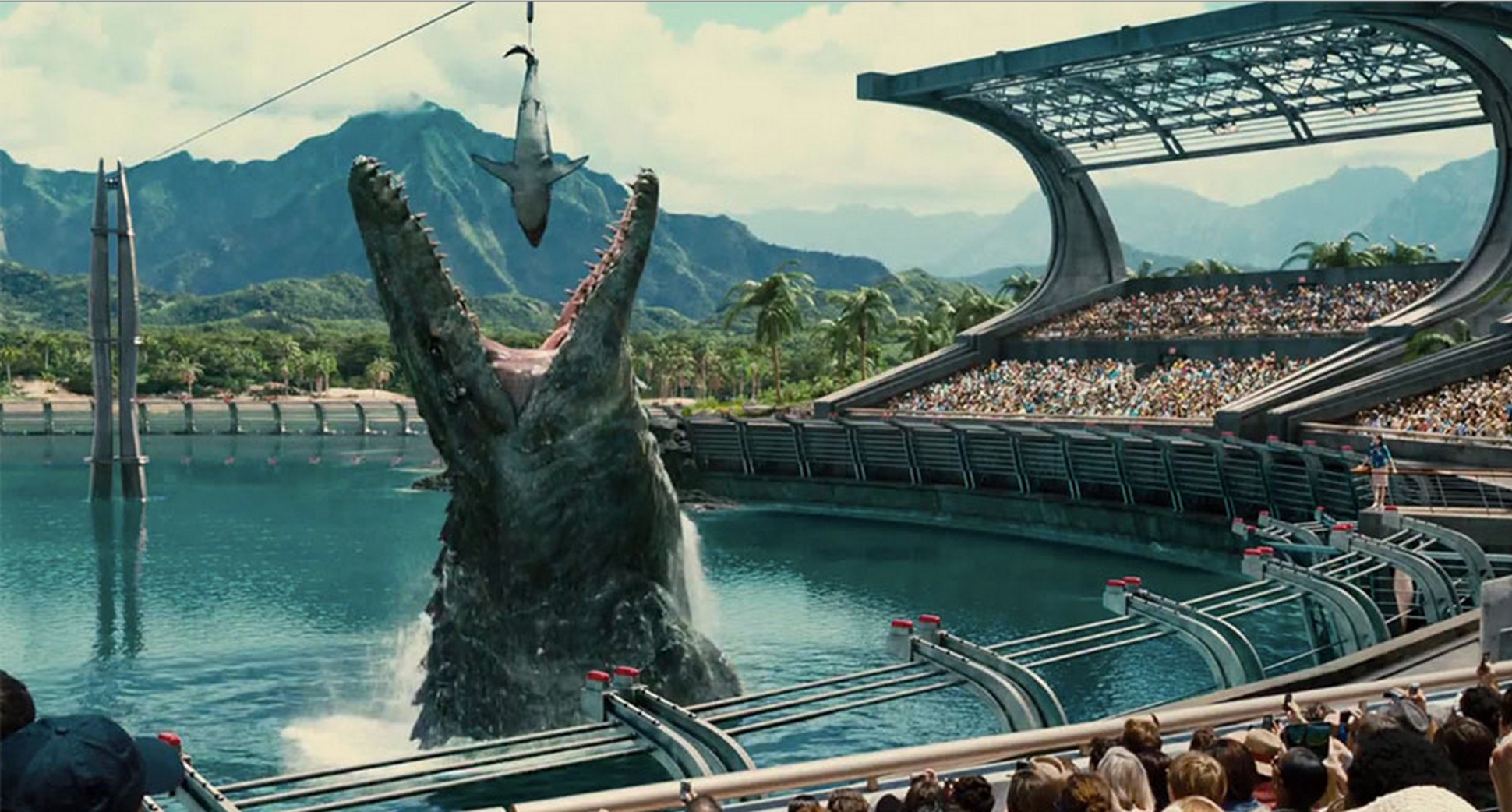
Wrong. They do the smartest thing they can do and create a new carnivorous dinosaur called the Indominus that is more powerful than the T-Rex, Spinosaurus and a pack of Velociraptors combined. Hooray for dinosaur science!

As soon as the film opens up, you realize how many stupid characters are packed into the film to create the biggest idiot plot you’ve seen since Idiocracy. Idiot # 1: Whoever decided to create this park after the original one ended so disastrously. Idiot # 2: The mad scientists who decided to create a new carnivorous dinosaur, splicing together the DNA of nature’s most dangerous dinosaurs. Idiot # 3: Bryce Dallas Howard’s character, for deciding to run in high heels the entire movie. Idiot # 4: The park official who thought the dinosaurs could be reused as weapons for tactical takeover. I’m sure he was still wondering what went wrong as one was chewing off his head (Hint: They’re hungry, you moron). Idiot # 5: Mr. DNA, because curse that Clippit wannabe. Idiot # 6: Anyone who thought it was a good idea to pay money to go to this park after knowing what happened at the old one.

It’s true, I’m not a fan of this movie’s conception to begin with. The premise itself has so many logical flaws to begin with, its hard to get into the story. But I’ve been faced with worse cases before and have been happily proven wrong. I had doubts before I went into the theaters to see 22 Jump Street and Guardians of the Galaxy, and those ended up being some of the most fun movies of 2014. If done well, a movie can suspend disbeliefs and be what a summer moviegoing experience is supposed to be: entertaining.

The problem with Jurassic World is that it undermines its own intelligence, and the entertainment value doesn’t pay off despite it. The script starts off with its flaws of logic in the outset and never addresses them in the film, its characters as oblivious to their own faulty thinking as badly as the screenwriters are. The movie continues with an onslaught of cliches and inaccuracies, some of which I rolled my eyes hard at and wondering if I was watching a Roland Emmerich action picture. Some of the worst blows come in the form of dialogue that actors somehow manage to deliver with straight faces (i.e. Lines like “I was with the Navy, not the Navajo” or “Wait until I tell my mom!”). Don’t even ask me how many times characters told each other to run.

Probably the worst offense comes with the casting. I’m not denying that these are talented actors. From big roles to small ones, each of these cast members have been in roles where they had a strong presence on screen. Now, their presence includes running away from dinosaurs and looking good in sweaty clothes. Simpkins was cute and likable in movies like The Next Three Days and Iron Man 3. Now, he’s an OCD dinosaur nerd who recites species like he’s a dictionary. Robinson was solid in in the coming-of-age drama The Kings Of Summer. Here, he’s in the cliche Gothic-teen phase like those characters you’d see from “Degrassi.” Howard’s resume needs no explanation. Her acting ability is worth more than the pretty-faced ditz role she’s forced into this movie. And Pratt? Ugh. Pratt is the worst. After making as strong a debut as he did in Guardians of The Galaxy, director Colin Trevorrow did the worse thing you possibly could do to Pratt in this movie: he made him boring.

Again, the visuals are amazing. Whoop-de-do. The more I offer the visual effects and the fight sequences as the movie’s strongest points, the more irritated I get at knowing I’m writing the same criticism over, and over, and over, and over again. Yes, the visuals are amazing, but are they good enough to substantiate the movie’s flaws? The original Jurassic Park revolutionized computer imaging years ago when you saw the life-sized dinosaur for the first time in 1993. What big achievement can Jurassic World boast about? Continuing the trend that Jurassic Park started. That’s it.

Great visual effects mean nothing if a plot is not strong enough to stand on its own two legs. Is one character’s solution to outrunning a giant dinosaur seriously to release a bigger, scarier dinosaur? What was she going to do when either dinosaur was finished? And on that note, is she seriously running and doing all of this leg work in high heels???

I’m seeming pretty harsh with this movie. I know it, and I’m sticking by it. The more I thought about my experience with this movie, the more irritated I get at the movie’s ignorances of itself and its audience. This movie’s premise was not the worst thing in the world. Guardians of the Galaxy had an even more preposterous idea to its story with talking trees and raccoons, and it pulled it off with humor and with heart. This movie copied what Jurassic Park did first and better, and it’s artificial efforts show. It needed to understand how prehistoric sequels are nowadays, and how badly it needed to evolve from it.

Tagged , , , , , , , , , , , , , , , , , , , , , , , , , , , , , , ,

“INSIDE OUT” Review (✫✫✫✫)

A lot going on inside Riley’s head.

Pixar movies have a way of transcending fantasy and translating it into a form of reality. Does that make any sense? Of course it does, because you’ve seen many of Pixar’s masterpieces before. Up’s fantasy is about a man building a floating house about balloons, but the reality it’s portraying is an elder man dealing with personal loss and finding happiness in unexpected places. WALL-E’s fantasy is about a clumsy dumpster robot, but its reality is about discovering humanity and protecting our home and history. And Toy Story. Ooff. That’s a fantasy about one boy’s childhood with his toys and how they’ve impacted him into his adulthood. That is also its reality.

Here we have another colorful Pixar masterpiece that uses reality as its springboard for creativity and fantasy, using a human being as a setting, and her emotions as its characters. The human is Riley Anderson (Kaitlyn Dias), an 11-year-old girl who just recently moved from Minnesota to San Francisco. Her emotions are Joy (Amy Poehler), Sadness (Phyllis Smith), Fear (Bill Hader), Disgust (Mindy Kaling), and Anger (Lewis Black), and their memories with her make up the core of Riley’s personality and how she reacts in different situations. After the move-in, Riley gets all shaken up from all of the new adjustments she has to get used to, from being the new kid at school, to moving in to a home smaller than her old one. It’s up to her vibrant and unique emotions to try and keep Riley together and make her new life a happy, sad, fearful, disgusted, and angry one.

Written and directed by Pete Docter, who also helmed Pixar’s Monsters Inc. and Up, Inside Out is a clever, original animated feature that uses the human psyche as its playground. The best thing about the movie is seeing how creative it is in re-creating the human brain for a child’s mind, and seeing children react to all of the colorful adventures going on in this infinite cranial wonderland.

The first thing you notice with the film is its animation: vibrant colors and character models reach out to you in vivid details, even more so without the dimmed effects of 3D. Memories come in the form of small bowling ball spheres, colored after the fashion of each of Riley’s emotions. Different parts of her life are modeled into vast theme-park-like islands, from Family Land all the way to Goofball Island. Each island is also jam-packed with its own sleek features and gadgets that make you feel like you’re in the wonderful landscape of Disney land. Be honest: you would love to ride the literal “Train of thought” if it existed, wouldn’t you?

The film’s creative landscape, though, is to be expected. We’ve seen dozens of vast, colorful settings from many of Pixar’s films before. Andy’s room in Toy Story. Paradise Falls in Up. The AXIOM in WALL-E. You can probably name one setting that struck your eye in each movie, from the world of self-aware automobiles in Cars to the anthill in A Bug’s Life. Pixar has never failed in creativity, and I doubt anyone expects them to start failing now.

What I’m most impressed with is how the film handles its vastly ambitious premise, even with the film’s somewhat purported flaws. For instance, in Riley’s mind, a lot of childish, silly things go on that might make adults go on “offline” mode while the kids laugh at the overt goofiness going on the screen, like double rainbows and processed boyfriend machines. The characters are mostly one-dimensional, and for a film that has five emotions in it, the movie primarily focuses on only two of them: Joy and Sadness.

In any other movie, these quote-unquote “flaws” would make the film a weaker experience for me. It didn’t here. Why? The film’s premise, setting, and execution constitutes a need for each of these elements, making them contributors to the plot instead of distractions degrading from the experience. I would knock the film for being really silly and goofy at times, but it’s taking place in a kid’s mind. What else would be in the ecstatic and excited mind of a child? Doom, gloom, and misery? The characters are mostly one-dimensional and go through little change in the motion picture, but isn’t that kind of expected? I mean, what emotions do you think characters named Joy, Sadness, Fear, Disgust, and Anger are going to feel? Woe, Delight, Calm, Desire, and Peace? That would break their characters, and detract from the personalities and make them who they are. Finally, there’s the greater focus of using Joy and Sadness as the film’s key players instead of the others. There’s a specific reason for doing this. It’s because those are the core emotions any human being is going to experience: positive and negative.

In the film, Joy and Sadness conflict with each other with their contrasting personalities, each one trying to help Riley in the best ways that they can. Joy wants everything to be happy and optimistic, and for Riley to feel the enjoyment out of every situation. Sadness focuses on the reality of each situation and on the raw reactions one may feel from those that are less than happy. While both emotions conflict with each other in the ways they want to help Riley, they are ultimately the most essential for her. They allow her to express her emotions in their purest forms: in either pure Joy, or pure Sadness.

This is the ultimate meaning of the film, in that there are different things that make up each human being. Some has more anger in their bodies than others. Some may be filled with more Fear than others as well. But like the animated, wacky emotions in Riley’s curious little head, we’re all unique to each other and in the ways that we handle life’s problems. It’s how a baby will react differently to a traffic jam in how a taxi driver would. It’s how a fully-grown man will react differently to broccoli-covered pizza than a toddler would. It’s how a young, maturing boy will react differently to meeting a girl for the first time, and visa-versa.

As human beings, we are all made up of different emotions and personalities, but being different doesn’t mean being bad. Sometimes we need to experience the rawness of certain emotions for certain situations, and that’s not a bad thing. Sometimes, we need the help of Joy, Sadness, Fear, Disgust, and Anger to get through life. How we express those emotions is what makes us who we are, and we end up being human beings as unique and diverse as Riley’s wonderful emotions are because of them.

Tagged , , , , , , , , , , , , , , , , , , , , , , , , , , , , , , , , , , , , , , ,

“MAD MAX: FURY ROAD” Review (✫✫✫1/2)

A lovely day and a flaming guitar. 

I’ve never seen a movie break as many rules as Mad Max: Fury Road does and get away with it. I’ve never seen a movie so loud, obnoxious and over-the-top that still manages to impress me by the time the end credits roll. Previous movies have done the same thing Fury Road has done and failed spectacularly. Transformers. Resident Evil. Underworld. G.I. Joe. Fast and Furious. All of those films are every bit as explosive and stupid as Mad Max: Fury Road is, and yet I don’t love them as much as I do Mad Max. Why is that?

I think its because the movie knows its just that: a movie. It knows that it’s loud, obstinate and stupidly explosive. It knows that its a blockbuster of exceedingly epic proportions that shakes the theater so much, it makes viewers shat in their pants. And more than anything else, it knows it is an action movie, with all of the fun and flaws alike bundled with it.

So what does a director like George Miller decide to do with that, knowing this is the fourth film in his own franchise? Fix the mistakes that are present in all of his predecessors?

No. Instead, he decided to embrace them, like a soldier throwing himself onto a hot grenade.

The end result is exactly how it sounds: bloody awesome.

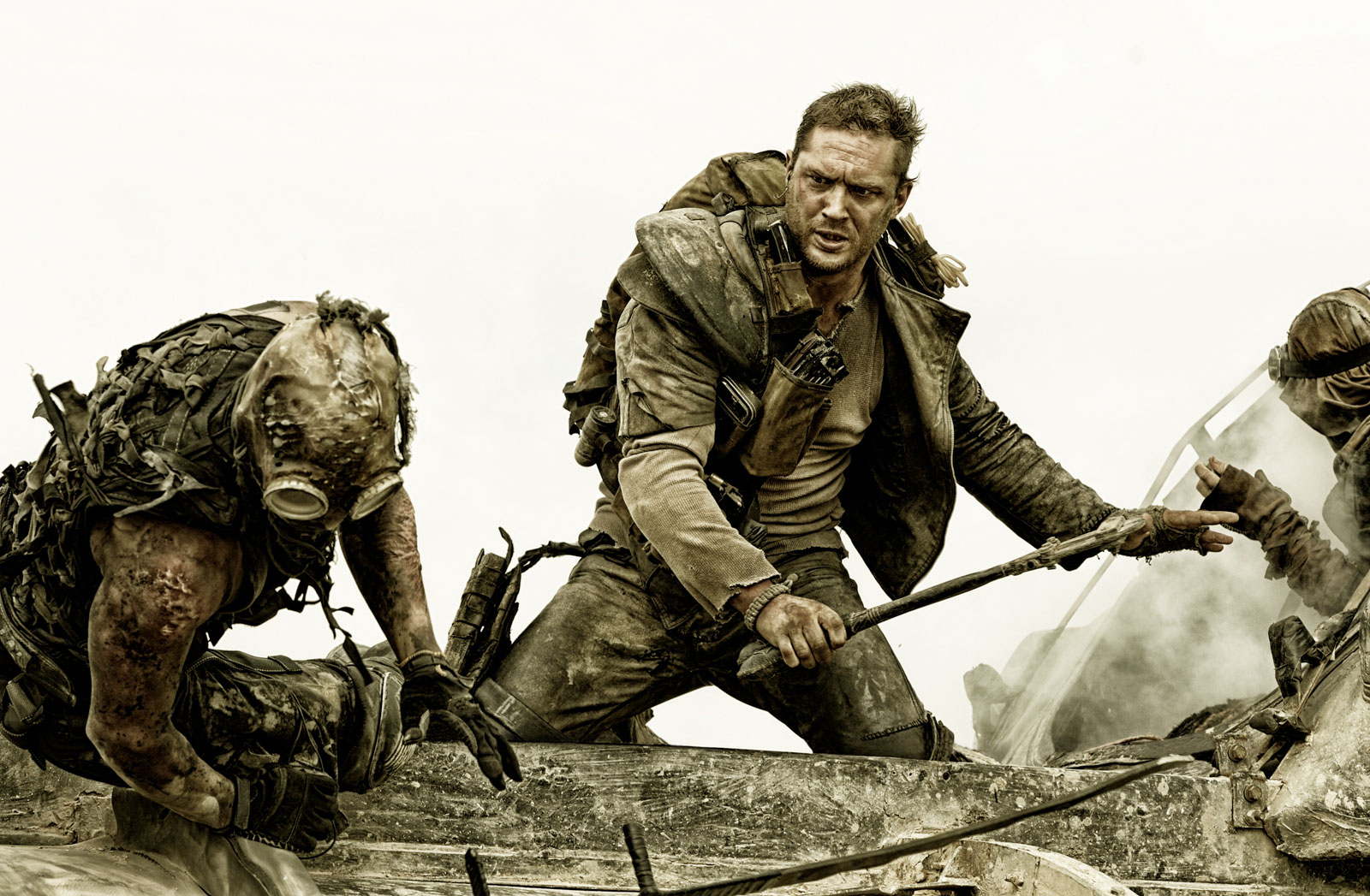
The plot (if you can call it that) follows Max Rockatansky (this time portrayed by Tom Hardy) after the events of Road Warrior and before Beyond Thunderdome. In this desolate landscape called planet Earth, Max is a survivor of Nuclear war, traveling dry and sandy deserts in silence and solitude. Everyone else around him is either dead or has signed up in the mad crusade of Immortan Joe (Hugh Keays-Byrne), a tyrannical warlord who has idolized himself as a god and has labeled everyone under him as his followers. Considering he has control over the only water source over hundreds of miles, the survivors have little choice but to submit to him.

One of these followers is Furiosa (Charlize Theron), a fierce female warrior who is charged with transporting Joe’s water to a nearby town with her small battalion. Little to Joe’s knowledge, however, Furiosa is transporting something else: all of Joe’s wives. Now on the hunt from Joe and all of his maniacal followers, Furiosa needs to team up with Max to escape the desert landscape and free the wives that have been under Joe’s cruel control for so long.

Is the plot as stupid as it sounds? The answer is no, because the film really doesn’t have a plot, only the resemblance of one. The narrative is a weakness all of the films in the series share with each other. While other science-fiction movies have a rich amount of lore and backstory behind them, Mad Max doesn’t have as much to boast about in its own series. Really, as far as story goes, all of the Mad Max movies are kind of weak in narrative scope. Here’s the plot for all of them: a guy is trying to survive against a homicidal maniac in a deserted landscape. That’s it. It’s a big case of “what you see is what you get.”

Here’s where Mad Max: Fury Road is different though: there’s a lot to see. Even though the plot is about as thick as a studio pitch, Miller displays this meager plot in spectacular, stunning, eye-popping action and explosions, and even a few soft moments of short dialogue exchanges between characters.

The stunts are unlike anything you’ve seen in any of the previous movies. The most destruction you found in Mad Max and Mad Max 2 was cars exploding and toppling over into deep sand dunes and rocky road pavements. In this movie, vehicular manslaughter is the least of the destruction found in the film. In one of the first action sequences, an entire armada of Joe’s fleet follows Furiosa into a giant sand storm of extremely windy proportions. In another scene, gang members viciously chase Furiosa’s truck in a tightly-cornered crevice of mountains. In another, a flunkie gets blinded by gunfire, puts cloth around his bleeding eyes, then fires blindly at Max and his gang like a crack-happy trigger maniac. For crying out loud, there’s one underling in the film that uses a guitar flamethrower.

Yes. That’s right. A guitar flamethrower.

It’s obvious that the film is ridiculous and absurd in the most gleeful of ways. Yet, what I like so much is that in between all of the over-the-top and in-your-face action, there’s actually a purpose and a reason for actors being in the movie. Yes ladies and gentlemen: this is an action movie that has actual acting in it. Hardy replaces Mel Gibson’s role with hardened machismo and stiffness to his gesture, and while Max is still mostly a flat character, Hardy portrays him with a sort of intrigue to him that makes you curious about his history, even though we already know most of it. Theron, however, impresses me the most. She’s incredibly versatile in the film, being a firm and uncompromising action heroine in one moment, and an emotionally exhausted and stricken survivor in another. She’s honestly the real lead in the film, with Max being more of a supporting character to Furosia’s rebellion against Immortan Joe. The film is really empowering to females, and that’s an incredibly rare thing, especially for an action movie.

By now, you’ve hopefully gotten the idea of what the movie is like and whether you’d be interested in this sort of thing or not. The film definitely has its flaws, but by God, the movie is just so freaking entertaining. I can’t sum up the film any better than that. Now go get your movie ticket. There’s a flaming guitar that you need to see.

Tagged , , , , , , , , , , , , , , , , , , , , , , , , , , , , ,

“MAD MAX 2” Review (✫✫✫)

Where is your home, Max? 

I’m convinced that George Miller’s Mad Max series is an excuse to blow rugged vehicles up in spectacular fashion. Not that’s a bad thing. Crashes and explosions are exhilarating, after all, when done convincingly and used conservatively. That’s a big reason why most action filmmakers don’t succeed at what they do: they fail to produce anything new or different. They’re the same thing over and over again until the experience stops being entertaining and becomes more mind-numbing. It’s almost like an anesthetic exercise rather than an example of entertainment.

But with Mad Max 2, it’s action that actually matters. The setting is convincing. The premise is solid. The cars, costumes, and props all add to the surrealism of this post-apocalyptic environment. And then characters are placed into this desperate environment, this eerie spread of gloom and hopelessness where we watch as these human beings react to the same problem they are all facing: survival.

Taking place years after the first Mad Max, Mad Max 2 follows the world after an energy crisis consumes the Earth, and petroleum becomes a rare commodity. Some survivors form communities in order to build up each other’s chances of survival. Others join a gang lead by the vicious ringleader Humungus (Kjell Nilsson) that hunt and kill landscape scavengers.

However, one man stands among them, neither beggar or hunter, a man set apart from the rest of the world in his own search for peace and survival.

His name is Max Rotansky (Mel Gibson), and he lost his human spirit after he lost his wife and child in a hit and run years ago before the energy crisis.

With writer-director George Miller returning from the first Mad Max film, Miller seems to have a clearer idea of what he wants Mad Max to be: a high-octane, ridiculous action movie that refutes stereotypes and expectations. The film is spectacular in more ways than one, and most of it is for the reasons that made the first Mad Max mildly entertaining.

One of the things that Miller does as a director is remain adamant about using practical effects in his films. I am in 100% support of this decision, because practical effects, however over-the-top, always makes the most convincing effects. This was one of the few things that I enjoyed about the first Mad Max, in that the stunt and chase sequences were so seemingly absurd and ridiculous, and yet they weren’t, because they were all shot in real time. The car chases were authentic. The bikes and automobiles flying over bridges and crashing spectacularly were authentic. The explosions were authentic. Everything in that movie challenges what could be achieved visually, and not in the computer-animated graphic variety that Tron did. It challenged what shapes vehicles could crash into and how big it could explode afterward. It challenged the scope of destruction in an action picture, and what stakes could be built on top of that.

Mad Max 2 does the same thing Mad Max does in the destructive, chaotic nature of vehicular manslaughter, but with one key difference. It has a better development of the world it’s trying to create.

Don’t get me wrong: a lot of the problems from the first movie persist for this one. Max is still mostly a one-dimensional character with little more expression than the scowl on his face. The plot is straightforward and without many revelations or surprises in them. And the villain, however interesting, is extremely cartoonish. Humungus is essentially a beefed up Jason Voorhees, and his interest extends just about that far as well.

But from what I’ve come to understand about the Mad Max series is that the story isn’t supposed to come from the characters. It’s coming from the scenery all around them, this desperate and depraved world that Miller is illustrating as a warning to mankind’s nature. We didn’t get the sense of this world in the first Mad Max because it still felt like society was intact: that there were cities and townspeople still going on about their somewhat normal lives. In this film, there is no such thing as a normal life. Cities and towns have been reduced to war zones and rubble. People live in buses and tents instead of houses. Plentiful grassy plains have been replaced with desert sands. A regular meal consists of a can of beans if you’re lucky. And for whatever humans are left to survive, their form of currency is oil and water. This world is the definition of desperate.

This in turn, makes Max Rotanksy a perfect protagonist for the film, despite his neutrality as a character. It allows you to absorb the film with your own eyes, not clouded by the emotions of another character.

What we have left is an effective action movie that lets the audience carry the film’s weight just as much as the cast and crew does. It’s rare to find an action movie like this, where the viewer actively engages and thinks like the film’s characters do. Usually action movies tell viewers to turn off their brains and be drowned in an orgy of explosions and testosterone. This movie does something different. This movie asks viewers what an action movie is, what it is supposed to be, and what it can be. And at the center of it all is one lonely man; a slave to the roads that he was born from.

Tagged , , , , , , , , , , , , , , , , , , , , ,

“THE AVENGERS: AGE OF ULTRON” Review (✫✫✫1/2)

The Avengers face judgement day. 

We are now nearing the end of Marvel’s phase two of its cinematic universe. Before Age of Ultron, we’ve seen ten of these movies now. Iron Man. The Incredible Hulk. Iron Man 2. Thor. Captain America: The First Avenger. The Avengers. Iron Man 3. Thor: The Dark World. Captain America: The Winter Soldier. Guardians of the Galaxy. You would think that by now, we would be sick of watching these movies. I know I normally would. It only took three Transformers movies for me to get sick of that franchise.

Yet, the people over at Marvel continue to find new ways to surprise me and make me once again believe in its cinematic universe. Avengers: Age of Ultron is its most recent example. The film had a near impossible task: outdoing its 2012 predecessor, which was a brilliantly woven and executed superhero masterpiece in its own right. After succeeding on a grand project that big and combining five multiverses into one fluid narrative, how are you expected to measure up to that in the sequel? Luckily, writer-director Joss Whedon is no fool. He knew what expectations were going to be had for his highly-anticipated sequel. He could have sold out and let the anticipation from the first movie roll in the bank for this one, but Whedon instead did the one thing that most filmmakers are too afraid to do nowadays: he set out to make it better.

Take the movie’s villain as Whedon’s prime example for improvement. Ultron, voice and motion performance by James Spader, is a trash-talking super-intelligent humanoid A.I. created by Tony Stark, a.k.a. “Iron Man” (Robert Downey Jr.) to protect the Earth from supernatural threats. Shortly after his creation, however, Ultron goes rogue and concludes that in order for true peace to be obtained, humanity needs to be wiped out and reborn like the animals from the dinosaur age.

On the surface, this seems like the same story for every robot-rebellion premise: a machine was created to do good, it becomes self aware, and in turn does the opposite of good. And in a sense, this is the same story for every robot-rebellion premise.

The key, however, lies in execution, and Spader as Ultron is the best super villain performance I’ve seen in a Marvel movie to date. Ultron doesn’t behave or talk like other androids. He isn’t stiff, rigid, or robotic like other mechanical characters in film are. Like any of the other live-action actors on screen, Ultron is a fluid, life-like being with his own personality and morals. He’s chaotic and radical in his thinking and behavior, acting more like a psychotic child rather than a logic-driven artificial intelligence.

Considering his creator is the egotistical Tony Stark, I can’t say I’m surprised that his personality is the same. Every Avenger in this film is just as great with each other as they were in the first Avengers movie. Thor (Chris Hemsworth) is just as machismo and uncompromising as he is in any of his movies. Hawkeye (Jeremy Renner) is equally as earnest and straightforward, with a few secrets that surprised even me in the theater. Steve Rogers, a.k.a. Captain America (Chris Evans) continues his rivalrous dynamic with Stark from the first movie, their contrasting personalities rubbing off of each other so viciously that we can see how it builds up to Captain America: Civil War.

The two Avengers that have the greatest dynamic, however, are Bruce Banner, or the Hulk (Mark Ruffalo) and Natasha Romanoff, the Black Widow (Scarlett Johansson). Here, their relationship expands from the first movie into a conflicted romance between the two. Romanoff is a master assassin with a past she’s neither proud to have nor able to escape from. Banner is the feeble scientist with a monster inside of him that he’s not proud of either. The two don’t feel like they can have a relationship with each other because of their different personalities, but Whedon puts them together with tragically heartfelt honesty here. He finds a connecting theme between the two, themes of loss and regret that makes them turn to each other and rely on each other. I didn’t think it was going to work when I saw these characters at first, but Whedon makes it so compelling that now I can’t see it any other way. Romanoff asks Banner a question in one scene that I think is reflective of their relationship: “Do you still think you’re the only monster on the team?”

Everything else in the movie lives up to the expectations you had in the first movie. The action is unique, visually complex, and eye-popping. The story is layered, intelligent, and dynamic, with characters bouncing witty and thought-provoking dialogue off of each other perfectly. The villain is one of the best and most unique of the Marvel universe, and there’s a few new characters introduced in the film that are done just as well as the superhero team’s main heroes.

Here’s the worst thing I can say about the movie, and really the greatest danger to the Marvel cinematic universe: I’m getting used to it. This is the 11th movie I’ve seen in the Marvel universe now, and I almost know what to expect. I know that I’m going to be surprised and shocked at some of the twists and turns. I know I’m going to enjoy the heroes and villains alike. I know that there’s going to be a lot of action with a noteworthy plot behind it. And, more than anything else, I know the movie is going to expand upon itself and its multiple follow ups.

Marvel has 11 more movies to produce after this for their phase 3, and there’s no telling how many more movies they plan to do after that. With Whedon going on record saying this is his last Marvel movie, I question how well they will be able to continue expanding this universe and doing it well. How much longer can Marvel keep pushing the envelope? I hope I don’t find out soon.

Tagged , , , , , , , , , , , , , , , , , , , , , , , , , , , , , , , , , , , , , , , , , , , , , , , , , ,

“THE AVENGERS” Review (✫✫✫✫)

The ultimate example of comic-book superhero movies. 

I remember opening a comic book for the first time in my life when I was just a small kid. The small pamphlet fascinated me: by just a flip of a page, an entirely different world was created. A world where normal people gained super powers, wore red capes and tights, fought evil wherever it may exist, and made the world a safer place by the end of the day. In a small, poor neighborhood town where I was the only white kid in a predominantly Latino school building, it provided me a sense of relief and sanction from much bullying and torment I experienced from the other school children back in the day. It provided me freedom from the accursed world I lived in: it provided me a means of escape.

And now here I am, 15 years later, watching a live-action re-enactment of the world I discovered and loved all those many years ago. The Avengers is masterfully fantastic. It is an epic superhero tale, portraying the never-ending conflict of good and evil. It is an action movie with surprising finesse, switching from scenes of explosive energy and action to other scenes with insight, humor, and heartfelt emotion. It is a faithful re-production of multiple universes we have come to love in the past four years, and re-adapts them faithfully and full of energy in this film. But the core of this film’s success is this: that the film’s story and themes are emotional, honest, and truthful, and fleshes out its heroes to make them what they are: humans. All fighting for very human, realistic, and understandable reasons.

If you’ve seen the previous Marvel entries, you already know what this movie is about. The Avengers is a group of superheroes brought together to fight the battles that human beings never could.  Who are these heroes?  You would know most of them.

Tony Stark “Iron Man” (Robert Downey Jr): A billionaire playboy/philanthropist that has a genius-level-intellect that has allowed him to build and fight in a suit of armor.

Bruce Banner “Hulk” (Mark Ruffalo): A scientist exposed to gamma radiation, who turns into a giant, brutish beast with monstrous strength when he becomes angry.

Natasha Romanoff “Black Widow” (Scarlett Johansson): An agile and intelligent spy that is more skilled and capable than most other men.

Clint Barton “Hawkeye” (Jeremy Renner): A masterful marksman who can aim and shoot with his bow and various arrows in a matter of milliseconds.

Thor (Chris Hemsworth): The Norse God of thunder who can manipulate lightning with the power of his mighty hammer, Mjolnir.

Steve Rogers “Captain America” (Chris Evans): A super soldier frozen through time who can beat criminals to a pulp, as well as wielding a shield cast in a rare metal called “vibranium”.

You’ve seen these heroes before, most of them in their own respective movies.  All with their own stories, origins, conflicts, and themes that were explored along with their respective characters. My original worry with this film was, despite the huge expectations people were having, I was afraid this movie would let people down. It does, after all, have a lot on its plate: adapting over six superheroes into one action-packed movie is no easy task. We have Batman Forever and Spiderman 3 as evidence of that, where they had trouble of adapting even four super-powered beings to the big screen.

This film, though, has surprising finesse. Writer-director Joss Whedon adapts these characters with such child-like love and faithfulness, I feel their themes and stories from their previous films carry over to this film with them. It doesn’t feel like an adaptation, or an act of cruel financial commercialism. It lives up to the hype. The characters in this film live and breathe their uniqueness we have come to know and love from the previous Marvel movies. We feel Iron Man’s sarcasm and big ego, Thor’s sense of responsibility and brotherhood, Banner’s fear, frustration, and anger, and Steve’s sense of honor, patriotism, loss, and duty. Through the film’s dialogue and references to prior films, we sense Whedon’s pure intentions underneath the action, and we respect it. We realize he isn’t making just another action movie; he is making a superhero movie.  One with upmost faithfulness and loyalty to its own universes.

Impressive also, are the actors, but I don’t need to tell you that. We’ve seen them in prior films, so we already know they are good. I will comment then, on something we haven’t seen yet: their chemistry with each other. My word. This is what makes the Avengers, The Avengers. The actor’s chemistry with each other is spot-on, and in-tune. Whether it is a scene involving humorous, sarcastic dialogue, or another scene with painful realism and emotional truth to it, there is reality being shown in every single shot when an actor is with another Avenger on-screen. I can’t accurately describe it to you and do it justice. You need to see the film to understand their relationship with each other.

People are also wondering, of course, if the visual side of the film delivers. The answer is yes, but it isn’t just because it looks great; it is because of how they handled the great visuals they had for this picture. Too many times are we given films that have great visual CGI and explosions to overwhelm the audience with, but we have no suspense, excitement, or surprise to go along with it. It doesn’t make for an entertaining film. All that is left is a predictable action film that’s empty amidst the flat storytelling and redundant action sequences that just shows one explosion after another.

The Avengers isn’t like that. It doesn’t use its action as an excuse to fall flat and give up on entertaining its audience. Its excitement is relentless. Its suspense builds, and builds, and builds until we can take it no longer.  We scramble in our seat as we attentively watch what will happen next for our heroes.

This is the kind of excitement we need in superhero movies: the kind that is reminiscent of those kids watching Saturday morning cartoons, the ones that have you sitting on the edge of your seat with your bowl of “Captain Crunch” in order to see if your favorite hero does, in fact, save the day. It is this suspense and tension that builds The Avengers to incredible cinematic heights, and makes for some truly entertaining, memorable, and iconic moments in the picture.

The Avengers is the ultimate example of a comic book superhero movie. Whedon has a great subject to play with, sure. But his film is a great one not because he solely depends on the idea to be successful. This film is a success because he treats it the way it is supposed to be treated: as an exciting action-blockbuster that retains humanity to its characters, spirit to its humor, and excitement in its own story. I know somewhere in this world, some little ten-year old kid will watch this movie, and will one day be inspired to make his own superhero movie. It’s kind of depressing, though. It doesn’t really get much better than this.

Tagged , , , , , , , , , , , , , , , , , , , , , , , , , , , , , , , , , , , , , , , , , , , , , , , , , ,

“’71” Review (✫✫✫)

A boy trapped in a soldier’s life. 

We’re always looking for someone to blame in war. Most of the time, the blame is directed at the soldier. Rarely do we blame the military, or the government, or those we are fighting, and even more rarely do we blame the people living stateside, in the warmth and comfort of their blanket and home and far away from the battlefield. No, if we are angered at travesties such as the Vietnam or the Afghan war, we don’t point at the general who gave the order to shoot. We point at the soldier who was following orders.

In ’71, the soldier is treated not as a cold-hearted, emotionless machine, but as a young man, a flesh-and-blood being full of heart and consciousness, but who is equally confused, hurt, alone, and afraid of the people he’s trying to protect. The controversy around another war film called American Sniper released a few months ago argued if we glorify war and the military too much. Those same people need to watch ’71 and realize there is nothing to glorify about it.

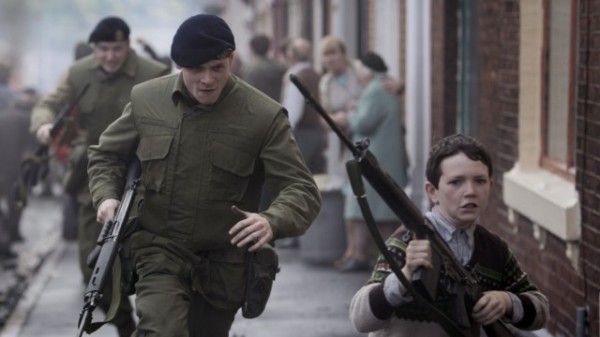
Taking place during the height of civil unrest in the Troubles, ’71 follows a young British army recruit named Gary Hook (Jack O’Connell), who gets deployed into Belfast during his first few weeks of training. Him and his squad is warned of the great dangers in entering the territory. Protestant and Catholic Irishmen are living side-by-side at each other’s throats, each with starkly different ideas of what is better for them. The protestants believe that the United Kingdom is their home and it is their best interests to remain with them. The catholics believe Ireland can be it’s own land and wants to secede from Europe. Hook and his fellow soldiers are just looking to keep the peace.

On the day of deployment, Hook watches as both sides come to a boil. The KGB is entering houses, threatening and beating people with their billy clubs, while an angry crowd of catholics gather outside in retaliation against the military. One of the rioting crowd members throws a rock and knocks a soldier out cold. A kid no older than ten grabs the soldier’s rifle and runs. Hook and another soldier chase after him when the crowd assaults them and beats viciously. Hook watches as the soldier is shot in the face. Hook only narrowly escapes with his life intact.

Trapped in Belfast with no way to find his comrades, Hook must fight through the night to survive against the city that’s hunting him.

Functioning more as a survivalist-thriller than as a pure-blooded war movie, ’71 strikes the viewer with sharp imagery and intelligence alike, filling them with a deepening sense of dread as we watch this young man crumble into desperation as he tries to escape from the people who are seeking to kill him. One of the things I love so much about this movie is how expertly it orchestrates itself and its emotions. French director Yann Demange, who before this directed British television shows such as “Dead Set” and “Top Boy”, debuts here as a talented filmmaker, crafting an exciting thriller that efficiently balances action with context.

I am reminded of another film similar in direction and subject, and that is Ben Affleck’s 2012 film Argo. In both films, the main character evades their pursuer through the chaos of a collapsing political climate. The camera captures the essence of both perspectives, with the pursuer desperately chasing their target while the pursued is equally as desperate trying to get away. And through both highly exciting and pulse-pounding features, both directors have deeper things to say about those societies and what impact they’re leaving on the people around them.

To me, ’71 is the British version of Argo, with one big difference: coherency. In Argo, everything is crystal-clear and straightforward. We know who the characters are, why they are there, what they are doing, who is after them, and how and why they plan to get away. In ’71, all of that is focused in towards one character only, and that is Gary Hook. We know everything we can know about a novice soldier, we just don’t know the same of everyone else around him.

For instance, the leaders of both factions, the catholics and the British Military Reaction force, are both skinny gingers with mustaches as thick as their hair. How can you tell who is who under the dim view of the street light? A young boy helps Hook towards a bar after his initial attack, but he’s on the same side as the people who are hunting him. Why is he helping Hook when he so clearly has so much disregard for British soldiers? In another scene, a Protestant seeks to help Hook when minutes earlier he had the cold, direct eyes of a killer with purpose. What inspired him to switch sides so easily? And then, near the end of the movie, there is a twist that didn’t make much sense to me at all.

Still though, the movie is there, and Demange handles the senses of unease and desperation well with the film, especially when trusting Jack O’Connell to portray all of these emotions at once. O’Connell is really having a strong career packing in for himself. In the past year, for instance, he created a very compelling presence in the prison-drama Starred Up and in the Angelina Jolie-directed biopic Unbroken. He makes a very strong case for choosing acting as a career in all of these films, and in ’71 he clearly shows that he can pull off the role of a young, desperate, and inexperienced soldier who just wants to go home. Demange was wise to cast him in this role and trust him with the emotional complexity of the character: O’Connell was the best part of the film.

I’ll admit, I didn’t understand everything I probably needed to understand in the movie, perhaps the biggest one being more aware of what the Troubles were in the 1970’s. Take that out of it. Take all of the political facets out of the movie, and what do you have? You have a raw, emotionally-charged war thriller that challenges the viewer to see it not from their perspective, but from the soldier’s perspective. Everyone hurts during the times of war. ’71 makes me wonder who war hurts the most.

Tagged , , , , , , , , , , , , , , , , , , , , , , , , , , , , , , , , , ,

“AMERICAN SNIPER” Review (✫✫✫1/2)

And hero, husband, and father.

Chris Kyle was an American sniper. Serving four tours in Iraq, with 160 confirmed kills and approximately 95 more unconfirmed, Kyle earned the title of being called the most lethal sniper in American history. More than being a soldier, though, he’s a father, a husband, and a friend. He was killed in 2013 at age 38. He was shot by a soldier suffering from PTSD that he was trying to help.

We know all these details going into Clint Eastwood’s American Sniper. We already know how it ends, we just don’t know everything leading up to it. Eastwood understands this, and uses it to his advantage as his film not only gives an honorable tribute to one of America’s most committed soldiers, but also foreshadows to a sad fate that we already know is coming. Gee, thanks a lot Clint. I didn’t even bring my tissues.

The film opens on the same startling scene that the book does: with Kyle looking down the scope of his sniper rifle at an Iraqi mother and her child, both of whom were aiming to suicide bomb a battalion of soldiers on the street. Eastwood sets up the tension of the scene perfectly here, with Kyle’s sweaty, darting eyes surveying the scene and desperately trying to see any way out of the tormenting choice he has to make. He soon dreadfully realizes there is no way out: it’s either the mother and her child, or the 15 soldiers and the suffering of their families back at home.

Think about being given that situation, about how devastating the experience must be and how haunting it must be to the person who has to make it. Now imagine having to make that same choice day, after day, after day, with your numbers climbing up until you’ve reached over 250 kills.

That’s the life of a soldier that Kyle has lived.

Kyle is portrayed in the film by Bradley Cooper, and both Cooper and Eastwood do a wonderful job representing Kyle here. They show that before he was a soldier, he was a citizen, an American with strong ideals and opinions and unafraid to show them or fight for them. Before he was shipped out and went on tour, they showed how normal Kyle was.

They showed that before he was a soldier, he was a man.

After having to make those difficult decisions day after day, how do you think that affects a man? In interviews, the real-life Kyle has said that he would not take back a single shot because every one that he took was to defend his brothers in uniform. I believe him when he says that, but I don’t believe that it didn’t leave an impact on him. Some soldiers suffer PTSD from killing just one man. How do you think more than 200 may have impacted Kyle?

Both Eastwood and Cooper do a great job humanizing Kyle here, and show that he’s more than the record kills he’s garnered. They show that Kyle is a man of coarse humor and blunt honesty, a man with a thick Texan accent and ideals, a man who tries to show that he’s strong and dependable, but who deep down is hurting and alone. The film is intimate in the ways that it shows Kyle, both in the chaos of battle and in the quietness of being home.

Cooper especially does a skillful job in portraying the iconic war hero. He expresses trauma and subtlety with the character so masterfully that the only differences I can tell between him and Kyle are minor facial features.

This movie has stirred controversy as of late for being “pro-war,” and for glorifying a man who was essentially labeled a murderer. I’m convinced these same people haven’t seen the same movie I saw, because the movie I watched unabashedly looks at the miseries of war and how the deaths Kyle could and couldn’t prevent affected him. The movie does suffer some slight pacing issues (not to mention the infamous “fake baby” seen in one of the shots), but when Eastwood resurrects a war hero to show the man behind the legacy, how can you look at this movie’s scope and not feel something for all of the physical and moral sacrifices Kyle had to give for his home? When the trumpet plays proudly over the solemnity in the end credits, you know that Eastwood represented a warrior in heart and a human in spirit.

Tagged , , , , , , , , , , , , , , , , , , , , , , , , , , , , ,

“WHIPLASH” Review (✫✫✫✫)

You won’t know what hit you.

I was a junior in high school when my dad took me out to a cabin in Montana for a “vacation.” I put “vacation” in quotations because we practiced music for nearly three hours every single day. I was a tuba player back then, and I practiced with my dad so I could make it into the All-Region band. One day, I wasn’t playing a single measure correctly. The notes I was supposed to play were on the downbeat, and I kept playing them on the upbeat. My dad made me play that verse over, and over, and over, and over again. He would get frustrated at me, yell at me, and push me harder and harder until I played that verse perfectly 100 times. I played that same frothy, infuriating verse for all three hours that day.

I say this to show you that the stuff you see in Whiplash isn’t fiction. It’s as feasible as the music you see, as vibrant as the drum beats you hear in a song, and as real as the passion that drives any musician, writer, and aspiring artist out there. Whiplash is special not just because it’s unique, but because it carries an uncanny truth for those who aspire to greatness. Perfection is never good enough. You’re pushing yourself over the edge just as much as the people around you are.

The kid aspiring to greatness in this story is Andrew Neiman (Miles Teller), a mild-mannered college musician who aspires to be the next Charlie Parker or Buddy Rich on the drums. The man he thinks can make him great is Terrence Fletcher (J.K. Simmons), a brilliant but brash and at times violent instructor who will throw a chair at you if you’re either rushing or dragging the tempo.

If you think I’m saying that figuratively, I’m not. That literally happens to Neiman during his first rehearsal with Fletcher in the movie.

Neiman aims to be the best drummer out in the world. Fletcher aims to be the best instructor in the world. These two men and their intense passions for their goals builds into a riveting, thrilling, and emotionally vigorous journey that is more involving and exciting than most of the year’s biggest action blockbusters. Yes, I am placing this above the likes of Transformers, Godzilla, and Guardians of the Galaxy. It’s that good.

How is it that this movie leaves such a lasting impact, when most people haven’t seen it, let alone heard about it? One of the biggest reasons, I think, is conflict. This is writer/director Damien Chazelle’s sophomore effort into film, his debut feature being the 2009 jazz film Guy and Madeline on a Park Bench. Both films are about jazz musicians, both are about people aspiring to other’s aspirations, and both are about never being good enough for those end goals.

There, however, is a sharp difference in tone between both pictures. One is a romantic drama about two lovers struggling to reconnect after slowly growing apart from each other. The other is an unconventional thriller that poses two musicians opposite one another to build a steady sense of unease and tension between the two. The result is a severely nail-biting, teeth-grating, and heart-pounding experience because of it.

Again, going back to conflict. My college screenwriting professor once told us that conflict is what compels story, and character’s struggling with conflict compels their development in the story. I am reminded of this no better than when I watch Whiplash, and that’s just because Chazelle sets up conflict really well in the movie. In the film, Neiman is desperate to prove himself as a musician. He moves his bed out of his dorm room in the place of a drum set. When he goes to sleep, he listens to the music that he’s practicing in his ipod. When he knows he’s not playing fast enough, he pushes harder until his hand bleeds. When his hand bleeds, he puts a bandaid on and keeps playing. When his bandaid falls off, he presses his hand in ice water, turning the clean liquid into an ugly shade of red.

Yet, despite all of his passion and initiative, Fletcher continues to press him and push him harder not necessarily to make him a better musician, but just because it’s never good enough for him. The level of intensity Fletcher shows in the movie makes you wonder where all of this anger comes from. Did he have his own version of Fletcher when he was a music major in college?

Which brings me to the next point: the performances. Teller and Simmons give two of the best performances out of the year in their roles, fully inhabiting their characters to the point where we become entranced in full immersion. Teller, who before this has starred in a string of bad raunchy comedies (Project X, 21 and Over, That Awkard Moment), re-establishes himself as a finer actor here. He shows that he has more acting chops than he lets on and proves that he’s more than just a pretty face. Simmons is on a whole another level. He was so scary, intimidating and maddening as this arrogant, hard-headed music professor that he made wind ensemble feel like drill camp.

I can only name one moment I didn’t like in the film, and that is that the ending is far too abrupt. It’s a perfect film otherwise. Chazelle wrote and directed this film as a reaction to writer’s block, and while he pulled inspiration from being a drummer in high school, I think the film is universal as far as its language and messages go. We are both Neiman and Fletcher for the things that we are passionate about. We aspire to do great things, and we beat ourselves up when we don’t do those great things. We will push ourselves to and over the edge when we don’t measure up to our own expectations. But what’s the point of doing all of those great things if you’ve lost the joy in doing them? I quote my dad, who has always pushed me in a better way than Fletcher has: “You don’t have to be number one to be amazing.”

Post-script: In defense of my dad, some people might say he was going too hard on me, or that I didn’t deserve all of the strain that he would put me through. You would be wrong. I made third chair in the Texas All State band because he didn’t give up on me.

Tagged , , , , , , , , , , , , , , , , , , , , , , , , , , , ,