
Before I begin, let me start by stating the obvious: yes, I know that I’m late with reporting this. Everyone already knows about the following issues I will be tackling. The information provided in this article is no longer timely. I know that. However, given the gravity of the situations and considering that I’m also writing this from an essential perspective, I write and publish this in the hopes that people will have a changed outlook to similar occurrences in the near future, not that I’m looking forward to these things repeating themselves in any way.
On Saturday, December 5th of last week, Nelson Mandela passed away at his home in Houghton, Johannesburg, succumbing to the respiratory infection he’s been struggling with for years now. He was surrounded by his friends and family when he died. The nation mourned, a memorial was held, and the world leaders all flocked to Africa to celebrate the life of one great man, including President Barack Obama and South Africa’s own Jacob Zuma. Mandela was 95 years old.
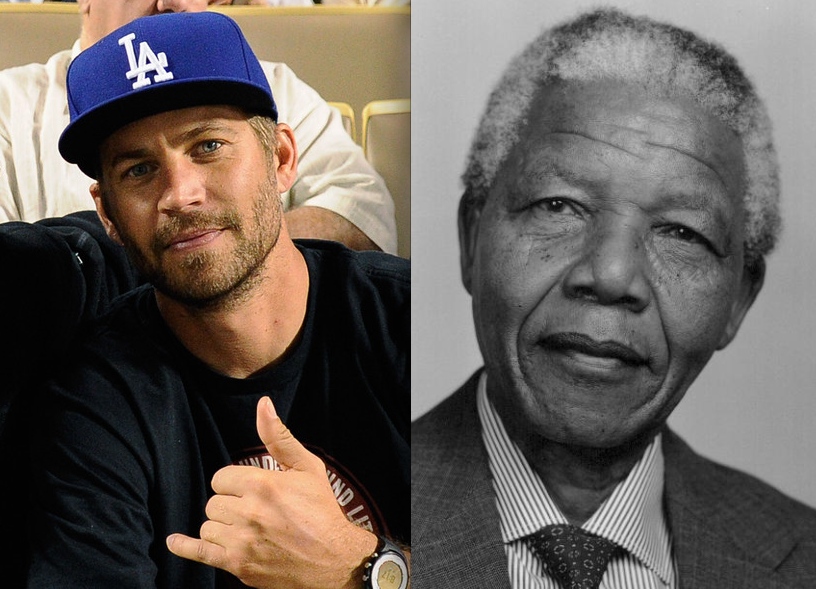
A week before, the world was ridden of another great man. On November 30th, two days after thanksgiving, celebrity and actor Paul Walker was killed in a fatal car crash that took him and friend Roger Rodas’ life on the road. The car burst into flames upon crashing into a light pole, which investigators believe the car was going 90 miles per hour in a 45 mph speed zone.
Regardless of the details of the crash, their deaths were tragic all the same. Rodas, who was a raceshop owner and Walker’s financial adviser, was survived by his wife and his two children, one of whom was his eight-year old son who saw him at the crash site. While Walker is most known for the Fast and Furious series, Walker was also known as an avid car lover, racer and a phenomenal philanthropist, founding a charity in 2010 called “Reach Out Worldwide” as a response to the earthquake in Haiti. Him and Rodas were coming back from a philanthropic event hosted by this same charity before they got into the fatal crash.
These three great men passed away under tragic circumstances, all of them leaving behind families who will love them and miss them forever. Two of them were known world-wide, and contributed to the health and well-being of mankind. One of them, however, changed a nation and inspired generations.
If you read that last part and were about to say Paul Walker, I’m going to slap you so hard you won’t be able to tell the difference between a Ferrari and a Volkswaggen. The day I was informed of Walker’s death was surprising in the least. At 24 years old I didn’t expect to hear that he had passed away, though admittedly I wasn’t surprised to hear it was a car crash. All of social media blew up with his death. My Facebook was crammed with status updates. There were too many tweets to count. And in the following days, so many publications were writing about his death he might as well have been Michael Jackson.
Now experiencing the same shock and sadness with Nelson Mandela’s death, I find it interesting that the public’s reaction is mild at best and non-existent at its worst. Looking back at my twitter and Facebook feeds, I notice nearly everyone I followed wrote about Paul Walker almost instantaneously the day he died. When Nelson Mandela died on December 5th, about how many people do you think tweeted or facebooked on his death? On my feeds, I counted five.
Anyhow, back to Paul Walker. On one of the posts I was reading, a close friend of mine commented on the feed which stirred quite a controversy between him and other bloggers. On another friend’s post, he commented bluntly: “What war did he serve in? Oh yeah, that’s right…”
He later came back on Facebook, writing about Paul Walker’s death and criticizing all of the attention people were paying towards it. Obviously, people were angered and offended by his comments, but take a second to understand it from his perspective. My friend, who will remain anonymous out of respect, previously served in the military before going to college. He served in the Iraq war for eight years on two tours of duty. The experience of killing and seeing many of his friends getting killed impacted him deeply, and when he came back to the USA he was mostly alone, suffered from cases of depression and paranoia, and was homeless for many years of his life before a friend convinced him to go to college and change his future. He experienced the worst the world had to offer, came back from it and decided to make himself something out of it. I respect him with great admiration, as I do towards anyone who makes the sacrifices he does and comes back choosing to better themselves out of it.
But this isn’t about him. This is about Paul Walker, Nelson Mandela, and the media that popularizes them both. Answer honestly: in the days you heard about Walker and Mandela’s death, which one did you hear about quicker? Whose death was talked about more? Who’s stories were discussed more in the media? Do you even know who Nelson Mandela is?
If you don’t, here are the bullet points: Nelson Mandela was born into an apartheid and racially segregated Africa. From 1950 to 1962, he protested against his government and the racial evil they advocated, and because he spoke out he was thrown into prison for 28 years of his life. When he finally was released from prison in 1990, he ran an election for presidency over South Africa, and was the first black president ever to be elected into office. During his time as president he brought an end to apartheid, advocated human rights for all African citizens, and unified a country during a time of great tension.
That’s just a summary of his career, but Mandela has done so much more. After his retirement, Mandela focused on charitable foundations and poverty. He communicated to the NAACP on the economic assistance of Africa. He focused on world-wide issues through an organization called “The Elders” founded by himself and others in 2007. And when his son Makgatho died of AIDS in 2005, Mandela lead a campaign aimed towards the improvement of treating and preventing AIDS among other hurting families so they don’t have to go through the same things that he did.
Point being: Mandela changed a nation. For Pete’s sake, he changed the world. There were some things that people were critical of him towards, including his violent protests at the beginning of his career or his condescending views of the United States during the Iraq war. Beyond that though, look at what this man has done. He has taken hardship, unfairness and tragedy, turned it around, and made everything better for an entire nation. I only saw a few facebook updates for this wonderful man, yet Paul Walker looked good and drove sports cars for a living and the internet basically exploded at the mention of his death.
I end mentioning one notable scene from this year’s 12 Years A Slave. In one sorrowful scene, Solomon Northrup is begging to a Canadian carpenter named Samuel Bass, played by Brad Pitt, to write and deliver a letter to his hometown so law enforcement can bring his citizenship papers and free him from his life as a slave. While at first intimidated and afraid at the notion, he eventually comes to resolve, standing up and saying to him:
“I will write your letter, Solomon. If you indeed find freedom, it will not have only been my privilege. It will have been my duty.”
Mandela too recognized freedom from oppression as his duty over of his privilege. And yet we pay more attention to the death of an entertainer over that of the carpenter who freed them.
-David Dunn
Post-Script: Everyone, no doubt, has seen the Fast and Furious movies, because that’s what Paul Walker was most known for. I encourage you then to seek out Clint Eastwood’s phenomenal 2009 sports-drama film Invictus, which not only shows Nelson Mandela’s impact of a nation, but also of the hardships he’s had to endure along the way. Also, Morgan Freeman is in it.
SOURCES: The Guardian, WORLD Magazine, The Huffington Post, NelsonMandela.org

 DAVID DUNN