Tag Archives: History

“X-MEN: DAYS OF FUTURE PAST” Review (✫✫✫✫)

The next stage in superhero cinema evolution. 

X-men: Days of Future Past ranks among the best superhero sequels I’ve ever seen, one I would instantly compare to that of Spider-man 2 or The Dark Knight. There were so many things that needed to be done, so many risks that needed to be taken, and so many ways this movie could have failed. It didn’t. From the opening sequence to its last breathtaking moment, my mind was blown and the comic-book nerd in me was absolutely filled with joy. The movie did more than simply expand the franchise: it redefined it.

We open on a post-apocalyptic future that hasn’t been this catastrophic since James Cameron’s 1984 film The Terminator. Years after X-men: The Last Stand took place, humans are now being hunted by the same weapons they created in the first place: the Sentinels, a coalition of dangerously armed robots who can track and exterminate any mutant they can find on planet earth. Amongst the ruins of battered buildings and fallen icons, the human race has now been collected into a sort of concentration camps: all that’s left for the mutants then is the mass graves filled with the dead bodies of their kin.

Lifelong frenemies Charles Xavier (Patrick Stewart) and Magneto (Ian McKellan) collaborate on a plan they would like to enact. Besides having the ability to phase through walls and objects, Kitty Pryde (Ellen Page) has recently developed the ability to transfer someone’s consciousness into their younger bodies in the past, allowing them to change the future and avoid the unfortunate outcomes that might become of them. Kitty has been able to use this ability on multiple occasions now to save her friends, but now Professor X and Magneto want to go back into the past (1970, to be exact) to prevent the event that triggered this horrifying future and save human and mutantkind as they know it.

Problem is, Kitty can only send someone back a few days or weeks at a time. Any further than that and she risks tearing apart the mind of the person she’s sending back to the point beyond repair. Luckily, Wolverine (played by Hugh Jackman, who else?) has the ability to heal himself at a faster rate. So Professor X and Magneto decide to send Wolverine back into the past to coerce their younger selves (portrayed by James McAvoy and Michael Fassbender, respectively) to stop the triggering event and save the future.

Serving as a sequel to both X-men: First Class and X-men: The Last Stand, and incorporating characters and actors from both translations, X-men: Days of Future Past is, in a word, a game changer. It brings in all of its key players, from the original cast members and its most revered director Bryan Singer, to the newcomers who’ve newly defined their roles, including McAvoy as Xavier and Fassbender as Magneto. Everyone meshes so perfectly with each other, especially Jackman once again, who essentially has to react to characters from two different time zones. There hasn’t been a cast this big since Joss Whedon’s The Avengers, and I’m tempted to say the movie is better because of it.

Do I really want to stand here though, and compare Days of Future Past to that of The Avengers? Yes I do. The Avengers was a bold, brave step forward in comic book evolution, combining characters from five different movies to make a superhero epic that hadn’t been tried before. Days of Future Past follows that same model, bringing in characters from six of its movies, but the end result is vastly different. There’s a much deeper plot going on here, a vastly intelligent and contemplative story that elaborates on its recurring themes of racism and, once again, bringing in the consequences of discrimination to the forefront. I loved X2 for this very reason, for it being more than just a comic book movie and focusing itself more as a political thriller with comic book elements thrown into the mix. This movie is that to, like, the tenth power.

Oh yes, this movie will fill comic fans with glee everywhere. Similar to the small little easter eggs that can be picked up in other Marvel movies (Note: The Doctor Strange reference in The Winter Soldier), this movie too has sweet little moments that comic fans can pluck from the ground and take a moment and appreciate the aroma. My favorite had to be a moment where a mutant named Peter (Evan Peters), who can run at supersonic speeds, rests in an elevator with the younger Magneto as he’s helping him escape from prison, and makes a comment about his long-lost father. That’s just the tip of the Bobby Drake-iceberg. There’s so many moments I can pull from that filled me with joy and happiness, while others filled me with dread and angst. The film orchestrates its emotions wonderfully, and in every fabric of the film I felt what I was supposed to feel.

I’m going to go out on a limb and say this is the best X-men movie in the series so far. Bold claim, I know, but it deserves it. From its first moment to its last, Days of Future Past is completely, utterly, fascinatingly mind-blowing and involving. From its quietly hinted-at themes of xenophobia and extermination to its climactic action scenes where we don’t see how on earth our heroes can win, Days of Future Past combines the best parts of all of the movies and makes itself the best entry out of them. Many audiences have recently been experiencing superhero movie fatigue, with movies such as Man of Steel and The Amazing Spider-man 2 recently being met with mixed reaction amongst audiences and in the box office. Days of Future Past is one of those movies that restores your faith in the genre.
Tagged , , , , , , , , , , , , , , , , , , , , , , , , , , , , , , , , , , , , , , , , , , , , , , , , , , , , ,

“X-MEN: FIRST CLASS” Review (✫✫)

Pretend G-men trying to skip out of class.

The very first shot of X-men: First Class is the exact same scene of the Holocaust, frame-by-frame of the very first X-men movie directed by Brian Singer. Not a good way to start off your movie by copying another one, isn’t it? The very next scene after briefly skipping through that one is a young Charles Xavier’s encounter with a young, hungry blue-skinned mutant named Raven who was trying to steal food from his refrigerator. Talking to her in a very sincere, comforting voice, he assures her that she doesn’t have to steal, and reaffirms it by saying that she’ll never have to steal again. Touching. I wonder how this conversation went over with his mother?

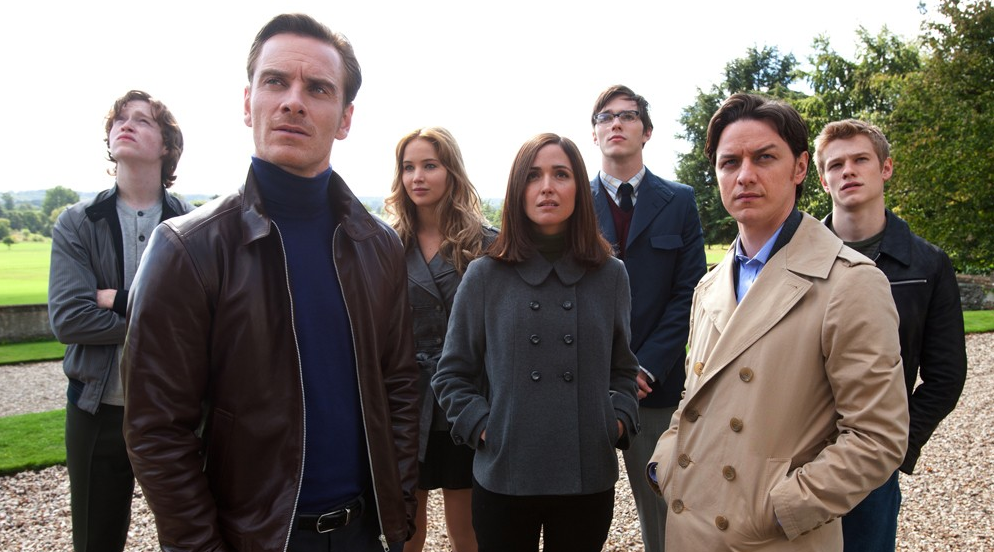
Years pass, and we’re reintroduced to the characters we’ve come to know for the past few movies now. Erik Lenshurr (Michael Fassbender), the man soon to become Magneto, is out on the hunt, looking for the man who killed his family and tortured him as a child back when he was a Jew in the concentration camps. Charles Xavier (James McAvoy) is now in college with the now much more mature Raven (Jennifer Lawrence), who is pursuing his masters degree in psychology.

There’s a mutual enemy that unites these three individuals together: Sebastian Shaw (Kevin Bacon), a menacing and conniving mutant with the ability to absorb and redistribute energy. That means a grenade can explode in his hand and he can transfer the explosion straight into you with a touch of his finger. Shaw is the man who tortured Erik back when he was a young child, and Xavier discovers a sinister plot that Shaw is setting to unveil upon the world. Erik and Charles combine their resources and their efforts to form a mutant team to work together and stop Shaw.

And how exactly does Shaw plan to carry out this giant, dastardly plan? By conspiring and coercing the Cuban Missile Crisis among nations, that’s how. How original. I wonder if these guys considered overthrowing the Chinese government while they were at it?

Hypothetical question. If you hear the term “prequel” being used, what’s the first thing that comes to mind? For me, its the word “beginning”. Beginning, as in, the start of the story. Beginning as in, the start of a legacy. Beginning as in, filling in the holes of all the ambiguous stuff we were told in the original trilogy, and beginning as in making sure everything fits into a nice, nifty little package by the time the end credits roll.

As a superhero blockbuster alone, X-men First Class succeeds. It’s exciting, it’s visually stunning, it features everyone’s favorite X-men that they’ve come to know and love, and it has enough comic book lore in it to make even Kevin Smith giggle with glee. As an action movie meant to please summer movie lovers, it is fine. As a prequel to the critically-acclaimed series that it is based on, however, it is utter and absolute failure.

Three of the biggest goofs that completely and utterly frustrated me. 1) There were flashback scenes in X2, X-men: The Last Stand, and Origins: Wolverine where Xavier is clearly seen as to being able to stand. Yet at the conclusion of First Class (spoiler alert!) Erik deflects a bullet into Xavier’s spine, permanently paralyzing is legs. 2) In the first X-men, Professor X audibly said to Wolverine that him and Magneto helped build Cerebro together, while in this movie it is very clear that a mutant named Hank McCoy (Nicholas Hoult) was the one who built it instead of them. Magneto’s helmet also didn’t exist prior to X-men, whereas here it already does. And lastly 3) a cameo appearance of a certain three-clawed mutant meeting Xavier and Erik about halfway through the movie at a bar. Wouldn’t they have remembered him thirty years later, especially since one of them is a telepath?

These ignorances to the plot show me that instead of providing an accurate prequel to a highly-revered superhero series, the filmmakers were more interested in letting loose and having fun rather than making something straight-laced and refined. I’m all for fun and high-octane action movies, but if you go in ignoring everything else that happened in the movies previous to your own, you’re being disrespectful to the franchise.

Oh, the cast was more than exceptional, I won’t deny that. McAvoy portrays the younger Professor X wonderfully here, passing himself off as a sort of young Patrick Stewart that’s more reckless and immature than his older self. Bacon is smug and charismatic as Shaw, and even though his role wasn’t as compelling as Ian McKellan’s was in the original trilogy, it still served its purpose in the film.

I especially enjoyed Fassbender’s performance as the angry, relentless, and grief-stricken Erik Lenshurr. The staple performances in the series overall belong to Patrick Stewart and Ian McKellan, there’s no doubt beyond that. Still, Fassbender gives it his all here. You notice the effort he extends here, the passion and the fire he instills in this character. McKellan’s rendition of Magneto was calm, collective, and calculated, a great foil to the equally intelligent but more morally aligned Xavier. Here, Fassbender is neither calm nor calculated. He is simply a raging, hateful man, a mutant who has been in pain and alone all his life, desperately seeking some sort of way to fill the emptiness within his cold, solemn heart. I genuinely liked and appreciated his take on the character, even though he bends missiles in one scene that look about as realistic as a Tom and Jerry cartoon.

“But wasn’t it fun?” is a common argument I get from a lot of moviegoers. “Fun” is such a subjective word, and can mean any one of different things. In the aspect of simple, plain, straightforward blockbuster fun, I guess this movie satisfies. The problem is I didn’t go into X-men: First Class expecting a brainless blockbuster. I went into this expecting this to be exactly what it claimed to be: a start to the X-men’s journey, an insightful and hot-blooded prequel that showed perspective on how their story began. This wasn’t even close to being a prequel, ending with more questions where there should have been answers. Fox has already announced that a sequel is currently in the works to be released sometime in 2014, and here I am, thinking that these kids need to go to summer school before even thinking about going into the second semester.

Tagged , , , , , , , , , , , , , , , , , , , , , , , , , , , , , , , , , , , ,

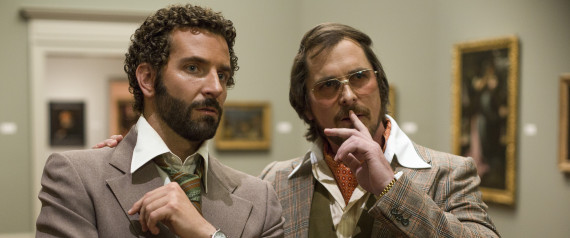
“AMERICAN HUSTLE” Review (✫✫✫)

FBI trying to hustle politicians by hustling con artists.

“We’re always conning other people,” says a slurred, yet sure voice in the background. “It’s in our nature. We even con ourselves.” These words are coming from the mouth that belongs to Irving Rosenfeld (Christian Bale), a con artist who quickly learned what it meant to grow up and survive in a harsh economy. Irving is the sort of guy you wouldn’t want to interact with out in public. He is grossly out of shape, he smells of old hairspray and cologne, his crafty eyes hide behind a dark pair of shades, and his diet consists of nothing but beer, fast food and cigars. From an outward appearance, Irving doesn’t really make a good impression. But man, can that guy talk a good game.

After rushing through Irving’s very brief childhood, we are quickly introduced to Sydney Prosser (Amy Adams), a woman in her mid-thirties whose beauty is both ageless and captivating. Despite his nauseating physical appearance, Sydney almost instantly falls in love with Irving, and Irving falls in love with her too. So much so that he discloses his illegal business with her, asking her to become a part of him scamming other people out of their hard-earned cash and checks.

That’s all I’m going to get into as far as the plot synopsis goes. Believe me, I haven’t even gotten to the surface of it. There’s an FBI agent trying to catch them named Richie DiMaso (Bradley Cooper), there’s a New Jersey mayor played by Jeremy Renner somewhere in the mix, Irving has a son and a wife he’s committed to named Rosalyn (Jennifer Lawrence). There’s even a mobster somewhere in this movie where an actor makes a cameo appearance, but I won’t spoil the surprise by revealing who it is (hint hint: He’s got some bad ideas in his head).

Point being: this is a smart movie. It’s funny, original, intelligent, and thoughtful, an observant portrait that looks at the moral and financial struggles of these characters and what impact their actions have on the people in their lives. Part of this, no doubt, is because of the cast’s mastery at delivery. Part of it is also because its writer-director is equally as funny, original, intelligent, and thoughtful as the story is. David O’Russell, who was nominated for best directing and writing Oscars for the past few years now (For Silver Linings Playbook last year and The Fighter in 2010), returns yet again with the same wit, charm, and complexion that made his previous films both unique and entertaining.

The dialogue is authentic, almost like it pops off of the pages of the screenplay just as much as it does in the movie. How though? This is, after all, a work of fiction, right? Wrong. The plot is just is like Irving’s deceptions: they’re only half fake. The movie is based on the real-life ASCAM sting operations of the late 1970’s, in which the FBI arrested over 31 individuals of congress and 7 were convicted of bribery and conspiracy. That sort of realism translates brilliantly to the screen, and makes the conversations characters share feel so personal. Make no mistake, fellow reader: this is, in every definition, a heist picture, because everyone is all after something and are willing to manipulate everyone in order to get to it first.

The cast is unforgettable. So much so that I can’t even pick a favorite among them. Bale is as talented as ever in this movie, a brilliant and dedicated method actor who has immersed himself so much into a role that its hard to imagine that at one point he was Patrick Bateman or Bruce Wayne. Lawrence and Adams are excellent female leads, and are great at expressing how conflicted Irving feels towards the both of them as lovers. Renner is great as the New Jersey mayor, a loving and kind-hearted man, father, and husband who just wants the best for everybody, but ends up making the wrong decisions in trying to do so. If I had to pick a favorite, it would probably be Bradley Cooper, only because he is so passionate and wacky that he could have been redone as a cartoon character. Like I said though, I can’t pick one. This cast is so talented and skilled in their roles that to pick one performance over another would be considered a sin. They are just as responsible for bringing this story to life as David O’Russell is.

This movie has all of the elements of being Oscar-worthy material: a great story, dialogue, characters, direction, and a great cast that fills these figures with vibrant energy and personality. The only real problem with this movie is the setup, and that’s unfortunate because that’s one of the most important parts of any movie.

Let me provide an example: when I first watched Goodfellas, what absorbed me into that picture was the first 15 minutes, a little italian boy learning about the mafia as a child, and the first narration we hear being “Ever since I can remember, I’ve always wanted to be a gangster.” Another one? In the opening scene of There Will Be Blood, we see a touching yet tragic portrait of a man seeing one of his workers die in an oil deposit, leaving behind an infant who can’t even speak, and Daniel Plainview deciding, against his better judgement, to adopt him as his own. Do I even need to mention Up?

All of those pictures started off with a bang because they gave us a perspective into the character’s history before getting into the meat of the story. Not that there needs to be a “How-to” guide for making opening sequences, but American Hustle literally flashes Irving’s childhood for about a minute before throwing us into the plot. I’m all for “show-don’t-tell” stories where they’re all situational, strictly limited to being set in their own present (Such as The King’s Speech or Black Hawk Down), but this one felt too much like being thrown into cold water when you can’t even swim.

Despite my views, I know critics already have their opinions established on this movie. They’re going to say its a masterpiece. That it is masterfully written and acted (which it is) and that it is going going to be nominated for multiple Academy Awards (which it will be as well). What critics won’t realize is the movie itself might be a con, making people believe that it is better than it actually is.

Well, if it is a scam, and David O’Russell is the con artist, then all I’m going to say is that he did a damn good job at it.

Post-script: For you irresponsible parents that are considering taking your teenagers to see this movie, don’t. The MPAA rated this movie R for “pervasive language, some sexual content and brief violence.” The violence is very brief and honestly not a large problem. The sexual content, however, is profuse because of Irving’s two sexual partners, and the movie has no shame for showing us any of it. I noticed over 100 F-words.

Tagged , , , , , , , , , , , , , , , , , , , , , , , , , , ,

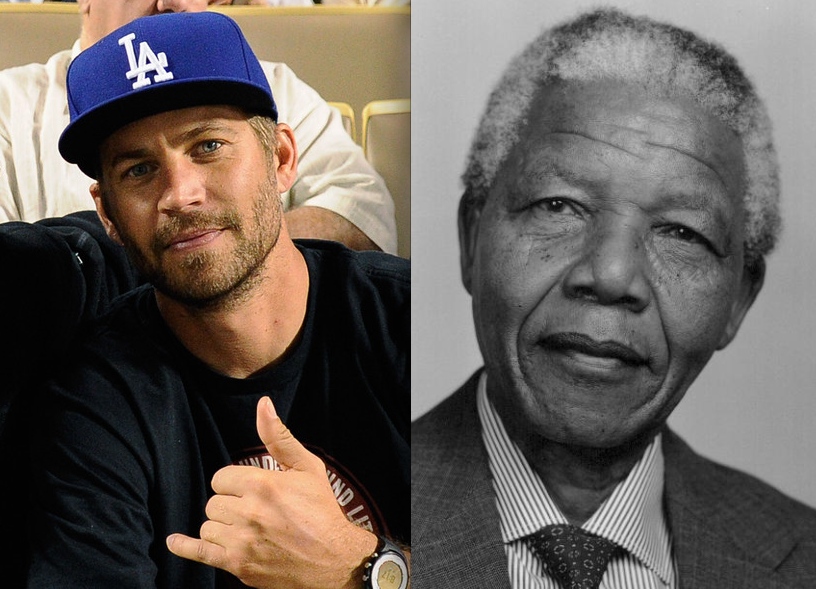
The Philanthropist And The Entertainer: A Eulogy

Before I begin, let me start by stating the obvious: yes, I know that I’m late with reporting this. Everyone already knows about the following issues I will be tackling. The information provided in this article is no longer timely. I know that. However, given the gravity of the situations and considering that I’m also writing this from an essential perspective, I write and publish this in the hopes that people will have a changed outlook to similar occurrences in the near future, not that I’m looking forward to these things repeating themselves in any way.

On Saturday, December 5th of last week, Nelson Mandela passed away at his home in Houghton, Johannesburg, succumbing to the respiratory infection he’s been struggling with for years now. He was surrounded by his friends and family when he died. The nation mourned, a memorial was held, and the world leaders all flocked to Africa to celebrate the life of one great man, including President Barack Obama and South Africa’s own Jacob Zuma. Mandela was 95 years old.

A week before, the world was ridden of another great man. On November 30th, two days after thanksgiving, celebrity and actor Paul Walker was killed in a fatal car crash that took him and friend Roger Rodas’ life on the road. The car burst into flames upon crashing into a light pole, which investigators believe the car was going 90 miles per hour in a 45 mph speed zone.

Regardless of the details of the crash, their deaths were tragic all the same. Rodas, who was a raceshop owner and Walker’s financial adviser, was survived by his wife and his two children, one of whom was his eight-year old son who saw him at the crash site. While Walker is most known for the Fast and Furious series, Walker was also known as an avid car lover, racer and a phenomenal philanthropist, founding a charity in 2010 called “Reach Out Worldwide” as a response to the earthquake in Haiti. Him and Rodas were coming back from a philanthropic event hosted by this same charity before they got into the fatal crash.

These three great men passed away under tragic circumstances, all of them leaving behind families who will love them and miss them forever. Two of them were known world-wide, and contributed to the health and well-being of mankind. One of them, however, changed a nation and inspired generations.

If you read that last part and were about to say Paul Walker, I’m going to slap you so hard you won’t be able to tell the difference between a Ferrari and a Volkswaggen. The day I was informed of Walker’s death was surprising in the least. At 24 years old I didn’t expect to hear that he had passed away, though admittedly I wasn’t surprised to hear it was a car crash. All of social media blew up with his death. My Facebook was crammed with status updates. There were too many tweets to count. And in the following days, so many publications were writing about his death he might as well have been Michael Jackson.

Now experiencing the same shock and sadness with Nelson Mandela’s death, I find it interesting that the public’s reaction is mild at best and non-existent at its worst. Looking back at my twitter and Facebook feeds, I notice nearly everyone I followed wrote about Paul Walker almost instantaneously the day he died. When Nelson Mandela died on December 5th, about how many people do you think tweeted or facebooked on his death? On my feeds, I counted five.

Anyhow, back to Paul Walker. On one of the posts I was reading, a close friend of mine commented on the feed which stirred quite a controversy between him and other bloggers. On another friend’s post, he commented bluntly: “What war did he serve in? Oh yeah, that’s right…”

He later came back on Facebook, writing about Paul Walker’s death and criticizing all of the attention people were paying towards it. Obviously, people were angered and offended by his comments, but take a second to understand it from his perspective. My friend, who will remain anonymous out of respect, previously served in the military before going to college. He served in the Iraq war for eight years on two tours of duty. The experience of killing and seeing many of his friends getting killed impacted him deeply, and when he came back to the USA he was mostly alone, suffered from cases of depression and paranoia, and was homeless for many years of his life before a friend convinced him to go to college and change his future. He experienced the worst the world had to offer, came back from it and decided to make himself something out of it. I respect him with great admiration, as I do towards anyone who makes the sacrifices he does and comes back choosing to better themselves out of it.

But this isn’t about him. This is about Paul Walker, Nelson Mandela, and the media that popularizes them both. Answer honestly: in the days you heard about Walker and Mandela’s death, which one did you hear about quicker? Whose death was talked about more? Who’s stories were discussed more in the media? Do you even know who Nelson Mandela is?

If you don’t, here are the bullet points: Nelson Mandela was born into an apartheid and racially segregated Africa. From 1950 to 1962, he protested against his government and the racial evil they advocated, and because he spoke out he was thrown into prison for 28 years of his life. When he finally was released from prison in 1990, he ran an election for presidency over South Africa, and was the first black president ever to be elected into office. During his time as president he brought an end to apartheid, advocated human rights for all African citizens, and unified a country during a time of great tension.

That’s just a summary of his career, but Mandela has done so much more. After his retirement, Mandela focused on charitable foundations and poverty. He communicated to the NAACP on the economic assistance of Africa. He focused on world-wide issues through an organization called “The Elders” founded by himself and others in 2007. And when his son Makgatho died of AIDS in 2005, Mandela lead a campaign aimed towards the improvement of treating and preventing AIDS among other hurting families so they don’t have to go through the same things that he did.

Point being: Mandela changed a nation. For Pete’s sake, he changed the world. There were some things that people were critical of him towards, including his violent protests at the beginning of his career or his condescending views of the United States during the Iraq war. Beyond that though, look at what this man has done. He has taken hardship, unfairness and tragedy, turned it around, and made everything better for an entire nation. I only saw a few facebook updates for this wonderful man, yet Paul Walker looked good and drove sports cars for a living and the internet basically exploded at the mention of his death.

I end mentioning one notable scene from this year’s 12 Years A Slave. In one sorrowful scene, Solomon Northrup is begging to a Canadian carpenter named Samuel Bass, played by Brad Pitt, to write and deliver a letter to his hometown so law enforcement can bring his citizenship papers and free him from his life as a slave. While at first intimidated and afraid at the notion, he eventually comes to resolve, standing up and saying to him:

“I will write your letter, Solomon. If you indeed find freedom, it will not have only been my privilege. It will have been my duty.”

Mandela too recognized freedom from oppression as his duty over of his privilege. And yet we pay more attention to the death of an entertainer over that of the carpenter who freed them.

-David Dunn

Post-Script: Everyone, no doubt, has seen the Fast and Furious movies, because that’s what Paul Walker was most known for. I encourage you then to seek out Clint Eastwood’s phenomenal 2009 sports-drama film Invictus, which not only shows Nelson Mandela’s impact of a nation, but also of the hardships he’s had to endure along the way. Also, Morgan Freeman is in it.

SOURCES: The Guardian, WORLD Magazine, The Huffington Post, NelsonMandela.org
Tagged , , , , , , , , , , , , , , , ,

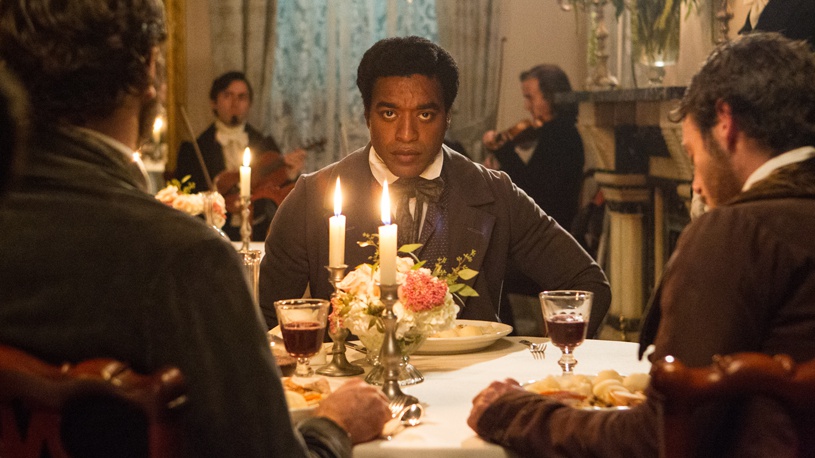
“12 YEARS A SLAVE” Review (✫✫✫✫)

Over a decade of injustice and cruelty.

12 Years A Slave is quite possibly the best film of the year.

It is also the most disturbing.

Based off the 1853 autobiography of the same name, 12 Years A Slave follows the true story of Solomon Northup (Chiwetel Ejiofor), a free black man who lives with his family and plays the violin in Saratoga, New York.

One evening, he becomes acquainted with two young gentlemen who claim to be circus performers looking to hire him for a one-night gig. When he wakes up the next morning, he is in chains, and realizes that he was drugged, kidnapped and sold into slavery by his captors. During his years as a slave, Northup goes from one owner to the next, from a kindhearted owner named William Ford (Benedict Cumberbatch) to a cruel, racist and mean-spirited pig named Edwin Epps (Michael Fassbender), who presents the greatest trials he must face if he is ever to survive.

12 Years A Slave is a film that not only lives up to all of its built-up hype and expectations: in many ways, it exceeds them.

Its quality as a work of art is so striking and powerful that it can be compared to other historical tragedies, including The Pianistand Schindler’s List.

Director Steve McQueen, who made the morally reprehensible and eerily bleak film Shame back in 2011, redeems himself here as a filmmaker. McQueen, in collaboration with cinematographer Sean Bobbitt, is not only masterful with framing his articulate, beautiful shots with 12 Years A Slave, but also brilliant with orchestrating scenes between his actors, showing us the bleak realism and truth of the slavery years in America.

Ejiofor, who portrays Northup in 12 Years A Slave is endlessly captivating. In moments where you think he might just be phoning it in, or just going along with the motions, he surprises you and releases an emotional intensity in ways no other actor has this year, not even Forest Whitaker in Lee Daniels’ The Butler. Newcomer Lupita Nyong’o plays a young female slave in this movie so passionately that you forget she’s an actress and slip into her character’s tragedy as a human being more than you do as a movie character.

Most noticeable perhaps is Michael Fassbender as Edwin Epps, who is so hateful and so spiteful in this role that all of the audience’s energy, anger and frustration is focused on him and his sadistic acts. Fassbender was brilliant in his portrayal, and I sincerely hope that he at least gets an Academy Award nomination for his performance.

Every other aspect of this film can be praised endlessly. The script by John Ridley, who wrote Three Kings in 1999, was endlessly emotional and captivating. The score by Hans Zimmer was quiet, humble and breathtakingly beautiful, encompassing both the truth and tragedy of Northup’s heartbreaking story.

However, let there be a strong word of caution: 12 Years A Slave will elicit violent reactions from its audiences. You will laugh. You will weep. You will grind your teeth in anger and frustration, maddened by the many years of cruelty, prejudice and barbarism that no human being should ever have to experience. But it compels you to care for the character, to reach deep down in your heart to feel what he is feeling, to experience compassion and sympathy in ways almost no other film can do, not even with Schindler’s List. 

And let this be a testament to the film’s quality: at the end of the showing, there was a white man who could be heard weeping in the back of the theater. In between his hiccups, tears and hysterical reactions, he turned toward the black viewer sitting next to him, shook her hand and after introducing himself said to her, “I’m so sorry for what my race did to your ancestors.”

That man felt a powerful feeling of guilt and shame for the things that he saw in 12 Years A Slave.

That man was me.

Tagged , , , , , , , , , , , , , , , , , , , , , , , , , , , , , , , , , , , , , , , ,

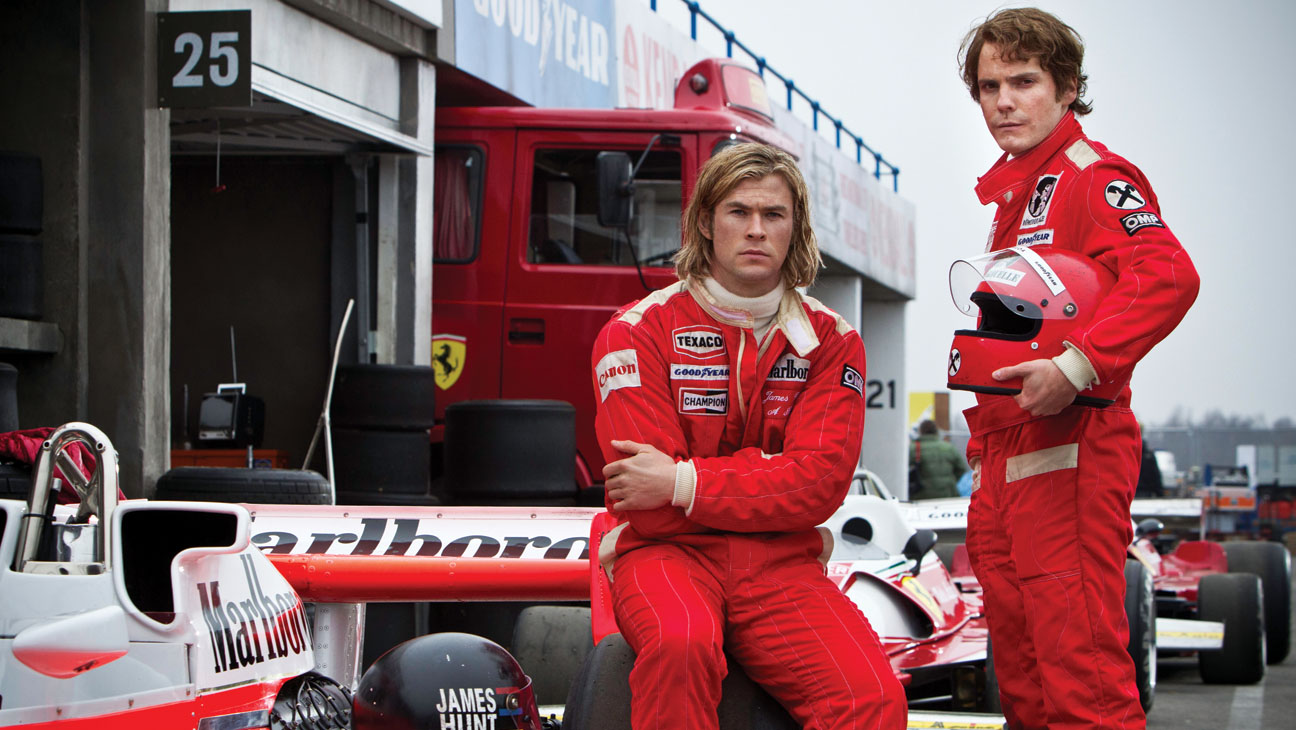
“RUSH” Review (✫✫✫✫)

Don’t think.  Don’t pause.  Just drive.  

I couldn’t have thought of a better title for the movie Rush, because that’s exactly what it is: an unstoppable and uncontrollable rush of energy, excitement, and gravitas, a movie that starts on a high note and simply refuses to let up all the way through.  I hear a lot of complaints that there are biographical movies that are more concerned with cashing in on people’s legacies rather than making an authentic account of a person’s true story, such as Jobs or The Iron Lady.  Here is a break from all of that, a refreshing and ideal account of two racers who live every moment of their life trying to figure out how to beat the other guy, while understanding that their symbiotic relationship is what made them both great racers in the first place.

Focusing on the 1976 Formula One Grand Prix season, Rush follows the story of two different racers, both with polar opposite personalities and complexions.  James Hunt (Chris Hemsworth) is a hard-headed racer who races with passion instead of brains, and a playboy who drinks a lot, smokes a lot, and sleeps with beautiful women, a lot.  Nicki Lauda (Daniel Bruhl) is a intelligent, smart, and crafty german who is just as focused and analytical as he is rude and ignorant. The film chronicles the contempt they feel for each other and the mutual respect that makes them strive to be better than the other man.

Before you go and see this picture, I encourage you to go online and google the names “James Hunt” and “Nicki Lauda” and look at their images.  Got it?  Okay, now that you’ve done that, go and watch the movie.

If you actually took the time to open up another tab and look at the images, you will be just as shocked as I was.  Comparing the sight of Lauda and Hunt with that of Bruhl and Hemsworth isn’t comparing them at all: they look exactly like the same characters, from the red jackets around their back to the color and hairstyles that we see on their heads.

I love it when movies do this: when movies are so accurate to the real-life figures that they copy their appearance so accurately, it is nearly impossible to differentiate from them.  We’ve seen this from The Fighter in 2009, and recently from Daniel Day-Lewis in Lincoln.

Here is yet another example of a movie that is compelled by truth and driven by accuracy, pun intended.  Rush is exhilarating.  Exciting.  Edgy.  Anticipative.  Emotional.  True.  Everything about this movie is a heart-pounding, sweat-pouring adventure, and what’s truly impressive is not that the movie makes us feel this way: its the fact that it really happened, and that really director Ron Howard is just documenting it rather than retelling it.

One of the highlights in the film are easily its lead actors.  Not only do Hemsworth and Bruhl look exactly like the people they are portraying: they act like them too, with their rivalry and their edginess apparent in every fraction of a scene.  Sometimes their clashes are funny, like the dialogue bits between Mark Zuckerberg and Eduardo Saverin in The Social Network, while at other times its strikingly serious like the James Braddock/Max Baer rivalry in Cinderella Man.  Whatever the situations, these actors do well at remaining in tense situations and they never, ever break their character.  Hemsworth is energetic, lively, and egotistical as Hunt, a man whose only loves are beautiful women and racing.  Bruhl is equally as egotistical, but he’s got a sly smartness about him you can’t help but appreciate.  There’s one great scene where Hunt calls Lauda a rat and he responds by saying “You think I’m hurt that you call me a rat, Hunt?  Rats are ugly, but they are smart.  Intelligent.  I am proud of that.”

The film doesn’t slow down at their performances, however, and filmmaker Ron Howard (Apollo 13, A Beautiful Mind) and screenwriter Peter Morgan (The Queen, Frost/Nixon) are quick to follow up on the pace of these two fine actors.  The guys who made Fast And Furious could take a hint or two from this movie. Morgan and Howard not only succeed in making the movie exciting and suspenseful through key moments in races, press conferences and private, vulnerable moments when these racers are all by their lonesomes: they’ve managed to make it gripping and relevant, a grounded drama thats equal parts and insightful into these two men’s lives that we feel like we’re witnessing their story upfront in the pit, not viewing it from far away on the sidelines.

Oh, I could go on all day praising this film and how all the elements culminate into a near masterpiece.  The soundtrack by Hans Zimmer is tense, unsettling, and noble, defining these men’s relationship just as well as the movie does.  The editing is tight, crisp, and clean at the hands of collaborators Daniel Hanley and Mike Hill.  For Pete’s sake, even the cinematography by Anthony Mantle was so good at capturing emotions and details so intimate, Howard would probably have missed some of them if Mantle wasn’t there to point them out.

Bottom line: Rush is entirely, unforgettably awesome.  It’s a strong and powerful tale about two passionate racers who knew what they were after and were willing to sacrifice whatever they could to go after it.  We see why they want to beat each other.  We understand who they are and why they are racing.  We know what makes them tick and we want to see them make it through every pulsating moment of the film in order to accomplish their dreams.  Trust me, you’re going to want to sit in on this race.  Oh, and bring your seatbelt.  You’re going to need it.

Tagged , , , , , , , , , , , , , , , , , , , , , , , , , , , , , , , , , , , ,

“THE BUTLER” Review (✫✫✫✫)

A humble heart living through harsh times.  

When we watch movies like The Butler, we are reminded of our history and why we must never return to the horrible origins that we came from.  When I say that, I am saying that regardless of race.  The film is obviously centered around the issues of slavery, segregation, and racism, and asks us to feel sympathy towards the African population for all of the horrible things they’ve been through.  But the movie evokes a more powerful emotion from me personally, a deep sense of regret and shame that my own race, the Caucasians, were at one point responsible for all of the death and cruelty we inflicted upon our own African brothers.  And why?  Because they have a different pigment than us?  That’s the sort of hate and bias that lead us to World War II when Adolph Hitler led the Third Reich against the Jews.

Based on the career of real-life butler Eugene Allen, The Butler follows the story of Cecil Gaines, a black butler who grew up during the slave era, growed up learning how to be a white man’s servant, got a job at the White House, and continued to serve there for almost 35 years. Throughout his career he witnesses history unfold in itself, from President Dwight D. Eisenhower’s (Robin Williams) decision to enforce desegregation laws in Arkansas, to witnessing the assassination of John F. Kennedy (James Mardesen), to seeing the rise of the Ku Klux Klan and the Black Panthers, to the assassination of Martin Luther King Jr., to the eventual inauguration of Illinois Senator Barack Obama into office.

The Butler is an earnest, humble film, parts approachable and observant yet equally ambitious and honest. Like movies such as Ghandi, The Hurricane, and The Shawshank Redemption, this is a movie that looks into the reality of situations and shows them exactly how they were, no matter how tragic or heartbreaking those circumstances were.

Take, for example, the scene where the Ku Klux Klan is introduced.  During his college years, Cecil’s son Louis (wonderfully portrayed by David Oyelowo), was on a bus to protest against a racist Alabama.  While on their way, their bus stops suddenly as they stare at the white-robed, torch-bearing Klan staring at them with their hateful eyes.  Equal parts petrified and terrified, the protestors desperately tried to escape before the Klan started igniting the bus with fire and molotovs.

I sat there watching these scene, equally infuriated and enraged as I was emotional and mournful.  How could this be our country?  How could this have once been our land, our people who so hypocritically claimed to be the land of the brave and home of the free?

To watch these scenes and to incur such an emotion takes great skill and courage, and I think Lee Daniels does a great job orchestrating these scenes in ways that makes them so emotional and powerful.  Daniels, who was nominated for an Oscar in 2009 for Precious took quite a fall last year when he made Paperboy, a idyllic, preposterous, and morally reprehensible film that was anything except relevant, coherent, and well, good.  Here Daniels redeems himself, and leads a star-studded cast through such a gripping, overwhelming story that I think it surpasses his accomplishes even with 2009’s Precious.

Oh yes, the cast.  The cast is what makes this picture, but you already know that if you take the time to simply read the cast list.  Jane Fonda as Nancy Reagan.  Alan Rickman as Ronald Reagan.  John Cusack as Richard Nixon.  Liev Schriber as Lyndon B. Johnson.  Minka Kelly as Jackie Kennedy.  John Mardesen as JFK.  Robin Williams as Dwight Eisenhower.  Alex Pettyfr as a plantation owner.  Terrence Howard as Cecil’s neighbor.  Cuba Gooding Jr. as a head butler.  For Pete’s sake, Mariah Carrey is in the film as Cecil’s mother and she doesn’t even say a line of dialogue.

The best performances, however, are the lead ones by Forest Whitaker and Oprah Winfrey.  Whitaker, who won the academy award for The Last King Of Scotland in 2006, steals the show in every single scene he’s in, showing the still portrait of a man who is tired, weary, and emotionally strained, a man who has seen endless ages of wrongful suffering but can do little to change it because he’s worrying about himself and his family.  Winfrey is equally as striking as his wife Gloria, a woman who is also hurting and in deep suffering because of her situation and because of a drinking problem she has long struggled with.  Both of these characters are central and integral to the plot and to the progression of the story, and at many times, they’re the only ones carrying the movie through as a whole.

The Butler is one of the best films of the year.  Period.  I know there’s a lot of movies about African-American history being released later on this year (Such as Mandela: Long Walk To Freedom and 12 Years A Slave), but there’s no denying the power, drama, or the history the movie so brilliantly provides us.  Yes, there are some inaccuracies to the butler’s real-life story (Starting with his name, with the real name being Eugene Allen), but the fact that it is loosely told is the best asset Daniels has towards his narrative. Since the figure is so little-known in today’s world, it allows Daniels to let loose and tell the story that he wants to tell, not the story that he’s committed to tell.  This is a movie that shows the history of a great man and a humble servant who was simply trying to support his family and to get through the days of wrongful judgement and discrimination.

Tagged , , , , , , , , , , , , , , , , , , , , , , , , , , , , , , , , , , , , , , , , ,

“THE GREAT GATSBY” Review (✫✫✫)

Nice to see you again, old sport.  

When you sit and think about the character of Jay Gatsby, there is never a simple answer to define him and his purpose in The Great Gatsby.  Some people have cited him as a post-modern interpretation of Romeo And Juliet, in the aspect that the character is going through a romantic struggle that always ends in nothing but tragedy.  Others have viewed him as a representation of the roaring twenties, as a pioneer who emboldens and defines the industrial image of the 1920’s and their status as they faded away into the 1930’s.  Others see him more like an enigma, an image of the upper class and the bleak loneliness that comes with it.  Whatever you believe to see, Jay Gatsby is no simple character.  For all we know, he could be one or none of these things.  Or all of them.

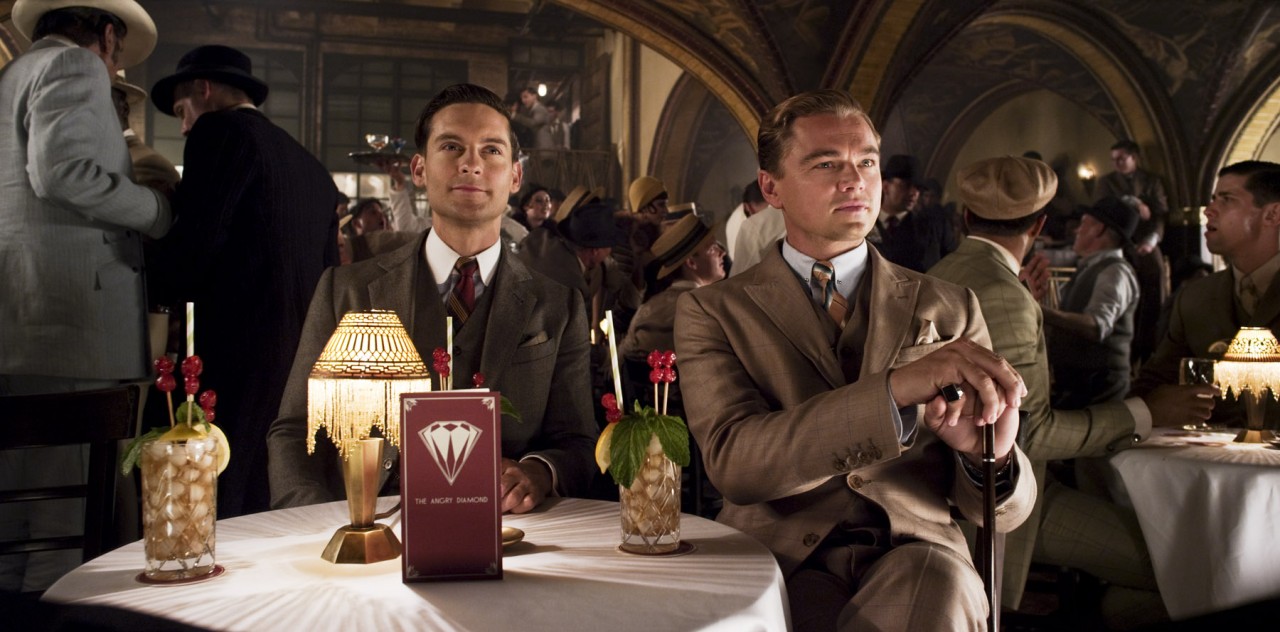
The fact that this film knows, respects, and acknowledges that makes me appreciate this movie, and hope that others can appreciate it too through DiCaprio’s performance and the mythology being revisited here.  Those who read the book should already know the story: a 1920’s bond salesman and struggling writer named Nick Carraway (Tobey Maguire) moves into New York city, where he learns of his rich next door “neighbor” named Jay Gatsby (Leonardo DiCaprio).

I put “neighbor” in quotations because Nick never actually sees Jay Gatsby in the beginning of the film.  All he ever sees of his estranged, self-secluded neighbor is a man looking behind some curtains and holding lavish parties in his mansion in the cool of midnight.  All he ever hears of him is scandalous rumors and war stories about a man many people haven’t met either.  The more Nick lives in his lonely little house, the more he questions if Mr. Gatsby even exists.

Eventually, Mr. Gatsby of course does introduce himself, but not as the host of the party, but rather, as a humble servant who offers Nick a drink on a plate of beverages.  As Nick becomes more familiar with Mr. Gatsby and his lifestyle, he soon learns the truth of Mr. Gatsby’s past and the reasons he really came to New York.

When I first heard of another Great Gatsby picture being made, my first reaction was excitement and anticipation.  How could it not be?  From the creative mind of F. Scott Fitzgerald and the many politics and emotions he makes you feel in his novel, it sounded like this movie was going to be a home run for both fans and non-fans of the book.

Then I learned that Baz Lurhmann was writing and directing.  And then bowed my head and uttered a long, dubious groaaannnn.  Lurhmann, who is most known for directing 1996’s Romeo + Juliet and 2008’s Australia, is commonly remembered as a director who abuses style over substance.  With the previous films I just mentioned, not only are they silly, soupy, and sappy menial dramas: they fail to even attain interest, and are extremely forgettable in a line of much better romantic dramas, including Titanic and the 1968 Romeo And Juliet by Franco Zeffirelli.

Note: Okay, I’ll admit I haven’t seen his 2001 film Moulin Rouge!.  Does it matter though, when out of his entire filmography, that’s the only film he can really brag about?  

The beginning of The Great Gatsby, much like Luhrmann’s other pictures, also suffers from this case of style over substance, with its overly boisterous parties and distracting art sequences making no coherent sense or adding anything to the picture overall.  What I found interesting, however, is that the first act barely matters.  When Jay Gatsby is finally introduced, the film takes a sharp turn of interest and invigorates the audience with new energy, almost like the character changes the entire tone of the film simply by him just being there.

I imagine this is the kind of Jay Gatsby that Fitzgerald would have wanted cast: the type that dresses in nice suits, stands straight with his chin up, and one who enters a room with such stillness that you could hear a penny drop.  The casting directors knew that their casting decision would be crucial to the film, and I think Fitzgerald would be pleased with the end result.  DiCaprio hits every single note dead-on this fascinating character, and just by sheer appearance, demeanor and dialect does he inhabit the character of Jay Gatsby and allow audiences to slip into his conscience and feel what he is feeling.

Oh, I won’t deny everyone else is good in this movie.  Joel Edgerton is effective as the antagonist, and even though he’s an industrial pioneer much like Gatsby is, he has such a hateful energy about him that makes you just want to run him over with a yellow beetle.  Carey Mulligan is good as Gatsby’s love interest, and perfectly shows all the innocence and indecisiveness of her character in the midst of all the ruckus.  Maguire, as well, is perfect as Nick Carraway, not as a character in himself, but as a silent observer, a passive voice who quietly watches over the scene, acting as the audience’s eyes and ears in this third-person narrative.  But its DiCaprio who sucks us in, DiCaprio who winds us up and plays us like a record as he asks us to sit through this tender, emotionally captivating journey that serves as a metaphor for the wealthy and for the industrial era.

And don’t worry, I’ll give Luhrmann credit too.  This film would not have survived without his writing or directing, as he has such reverence for the book and a great fear from deviating from it that the movie functions more as a love letter to Fitzgerald than it does as a strict book-to-movie adaptation.

Regardless, there’s only one person who shines the most here.  DiCaprio made this movie, and through his performance we were able to identify with a character that struggles with his past, his wealth, his love, and the deepening sadness that he hides behinds his warm, welcoming smile.

Tagged , , , , , , , , , , , , , , , , , , , , , , , , , , , , , , , ,

“42” Review (✫✫✫✫)

Thanks, Jackie, for showing us white folks how its done.

You’re not watching a movie when you watch 42, you’re watching a legacy.  You’re watching one man’s story as he started from the bottom, as a black baseball player living during the accursed segregation era of our country, who is suddenly called to greatness and is demanded to be a bigger and better person than he thinks that he is.  It isn’t entertainment as much as it is a retelling of one man’s life, and everything he had to go through during the turmoil and cruelty of the 1940’s.

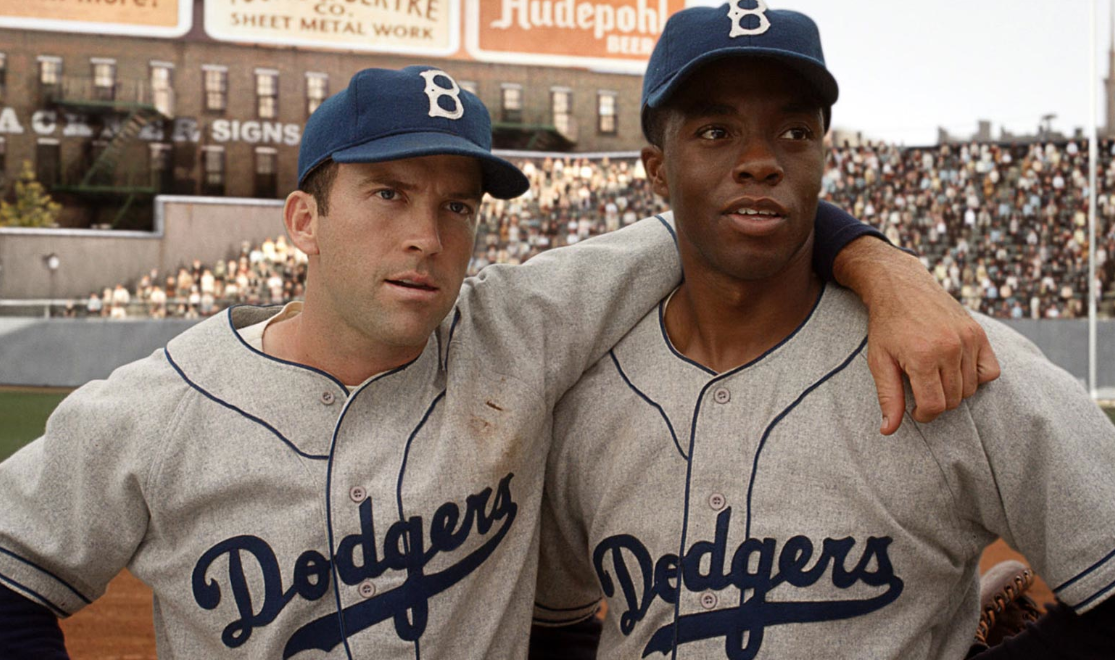
This man, of course, is Jackie Robinson, the black man who did to baseball what Rosa Parks did to buses.  Portrayed here by newcomer Chadwick Boseman, the movie starts off showing the beginning of  Robinson’s career with the Kansas City Monarchs, a primarily black baseball team who gets treated the same way at a gas station in the way a homeless man would be.  Robinson doesn’t stand for it, but it doesn’t matter: he is soon recruited by a man in a black van asking him to come with him to meet with baseball executive Branch Rickey (Harrison Ford), who wants to be the first man in American history to recruit the first African-American ballplayer onto the Brooklyn Dodgers.

His assistants are baffled.  “A black baseball player on a white baseball team”?  What are his reasonings?  Rickey makes multiple excuses, from the financial benefits to simply being different.  It isn’t until later in the film where a much deeper reasoning is found in Rickey’s baseball history, though I dare not spoil it just for the sake of you being able to experience it yourself.

Eventually, Robinson has his meeting with Rickey, and he’s surprised when Rickey tells him that he wants to recruit him on the Brooklyn Dodgers.  There’s only one condition Rickey has for Robinson: he wants him to control his fiery hot tempter when white players act out unfairly against him.

“I don’t want a man who has the guts to fight”, said Rickey.  “I want a man who has the guts not to fight”.

There are two things that make this movie stand out from the typical baseball-biography picture: the director, Brian Helgeland, and its lead, Chadwick Boseman.  Boseman, who is mostly a no-name actor, dives headfirst into his character, and inhabits the role so well that it is impossible to think of anyone else replacing him.  You just need to see this guy in action: the way Boseman puts himself out there is just like how Robinson would have played on the field, from digging his hands in the dirt to firm his grip, to stealing second, third, and home bases like he was taking candy from children.  It’s especially funny watching him getting ready to steal bases: he jogs his legs together and shoots a look at players with a face that says “Come at me bro” to which pitchers get obviously frustrated at him.  Jamie Foxx couldn’t have done better than Boseman did.

But its just not the movements, the pitches, and the home-run hits Boseman delivers that makes him a convincing actor: his expressions are flawless, his dialogue delivery spot-on, and his performance so affectionate, with his every spoken line coming across truthfully and genuinely from the heart.  I could name multiple scenes in the movie, on the field and off, that genuinely touched me.  Perhaps the most memorable with Boseman was when he was out on the field ready to bat when a baseball manager starting shouting racial expletives at him.  I’m not even kidding: if every other word he was shouting wasn’t a profanity, it was the N-word.

This scene was powerful, frustrating, and maddening all at once, and we could feel our anger channel through Boseman when he had to hold his tongue, when he had to walk off the field, and when he screamed in the locker room, breaking his bat against the walls in furious anger.

Oh yes, many emotions were felt in this movie, and writer-director Brian Helgeland does a great job at expressing all of them.  Surprising, I think, that the same man who wrote and directed the tonally inconsistent A Knight’s Tale was able to make a movie this sincere and heartfelt.  I’m being unfair though: I forgot that Helgeland also wrote the screenplays behind movies such as L.A. Confidential and Mystic River, and here he brings that same sense of grounded realism from those pictures into this one.  Throughout the course of the picture, Jackie Robinson grows as a person and as a player, and so do the people around him.  Relationships become bigger.  Bonds become stronger.  Intimate details are revealed through each character to Jackie, and through his stressful, agonizing, and roller-coaster emotion journey Jackie becomes the hero that nobody expected him to be: not even himself.

If a weakness exists, I’ll admit that 42 is straightforward storytelling, with little room for originality or surprises.  That’s only because we already know the history though.  What 42 lacks in innovation, it makes up for in emotion, in gripping and well-written storytelling with a great cast compelling us through it, with especially one of the performances being completely unexpected.  The best moment of the picture comes after Jackie grows closer to one of the players, the player encourage to not feel fear when openly associating himself with a black man.  As they run back out to their respective places in the field,  the player calls out to him: “Maybe tomorrow we’ll all wear the number 42.  That way they won’t tell us apart”.

Tagged , , , , , , , , , , , , , , , , , , , , , , , ,