Tag Archives: History

“CAPTAIN AMERICA: THE WINTER SOLDIER” Review (✫✫✫)


Patriotism replaced with fast-paced spy action and conspiracy.

In his review for the Toronto Sun, writer Jim Slotek says that “Captain America: The Winter Soldier is actually a Jason Bourne film masquerading as a superhero movie.” Right there is your first problem. Captain America is not Jason Bourne. He does not need to be Jason Bourne. Captain America is Captain America. He has his own arc, history, complexions, motivations, and conflicts that make him a fascinating character in his own right. He is as noble as he is heroic, and in just the two appearances he’s had in the MCU so far, he’s already cemented himself as an icon and staple in this expanding universe.

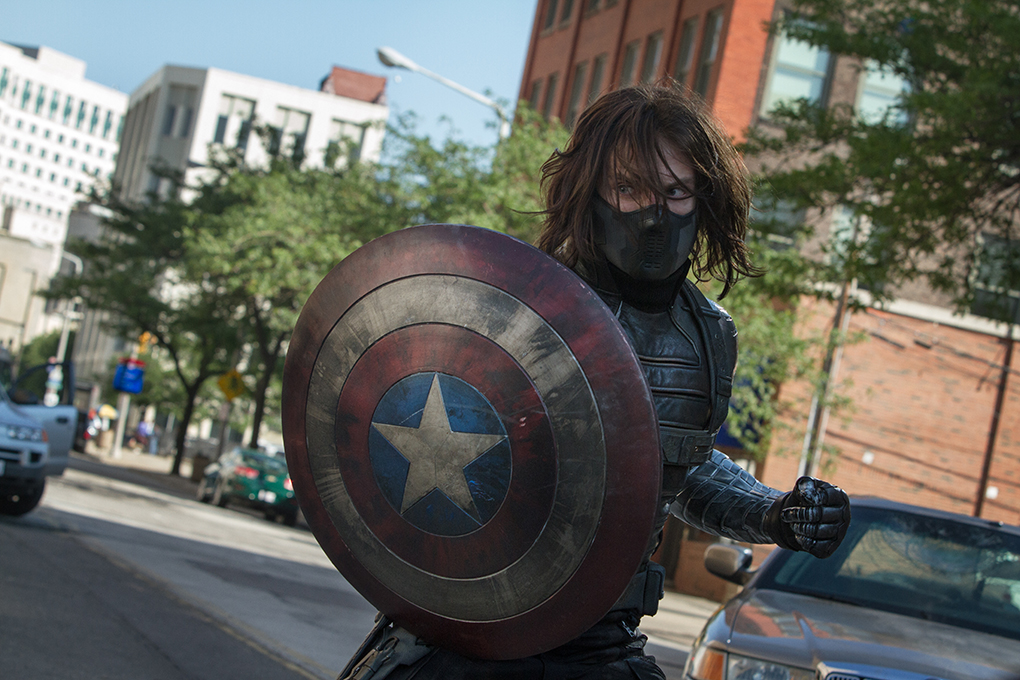
Tonally, there’s a severe shift in between The First Avenger and The Winter Soldier. Captain America: The First Avenger was exciting, old-fashioned, comic-book fun, and had the look, feel, and nostalgia of those 1940’s pulp magazines. The Winter Soldier, in comparison, feels like a dark, gritty espionage thriller, and our hero wears a red, white, and blue costume instead of the atypical black motorcycle jacket and jeans. This time around, Steve Rogers, a.k.a. Captain America (Chris Evans) isn’t fighting Nazi-clad super soldiers or aliens from outer space. This time, Cap is after the Winter Soldier, a expert assassin who has a metal arm and has been operating for decades under the world’s nose. When one of Cap’s closest friends gets caught in the crossfire, Cap goes on the hunt for the Winter Soldier, along with an underlying conspiracy that he’s quickly unraveling.

The script is easily the best thing about Captain America: The Winter Soldier. Screenwriters Marcus Freely and Warren McAllen, who also penned the first Captain America movie as well as Thor: The Dark World, have made an incredibly thoughtful and politically-driven film, a story that, if put into book format, would arguably be more compelling than the movie is. Without giving too much away, Cap gets stuck into a position that pits him both against his own country and against his enemies, making him question himself and the ideals that he’s been fighting for all along. Is America the same country he knew during World War II? Is there any more life, liberty, and the pursuit of happiness in the American dream? Is the American dream even alive any more? All of these questions are what drives the story and its characters forward, and sets up a very hard-hitting, close-to-home conflict with our favorite Captain. This is a movie that has severe repercussions towards the future of the MCU, and the twists are so hard-hitting that they surprised me, even with the ones that I was expecting.

The plot is sound and strong for the purposes of the film. But the problem doesn’t exist in the screenplay, it exists in how it’s handled. Directors Anthony and Joe Russo, whose last film credit before this was 2006’s You, Me and Dupree, didn’t see a superhero story in Captain America: The Winter Soldier. They saw a political thriller, and they decided to live up to that in every way that they could.

Take, for instance, the choreography and the motion of the action in the film. It is straight up Jason Bourne. In Captain America: The First Avenger, the action was unique, creative, and dynamic, with Cap flipping around with his shield and beating up HYDRA soldiers in classic, swashbuckling fashion, making it fun and refreshing escapism from all of the action fanfares we’ve gotten throughout the years. Here, the action feels like a retread. We’ve seen this sort of lightning-quick, fast-paced fighting in virtually every action thriller, from James Bond all the way to Mission Impossible. Why should The Winter Soldier feel any more special?

The thing that makes Captain America unique, especially in The First Avenger, is his patriotic loyalty and his unwavering sense of justice. He looks out for the little guy. He cares about such things as self-respect and manners. He won’t throw a punch unless he has to. At heart, he is this small, skimpy, honest, good-hearted kid from Brooklyn, and this is the kid that Dr. Erskine saw in the first Captain America. Here, he’s in full hero mode as he kicks, punches, tackles, slams, and throws shields at all of the bad guys, and brings everything down all around him, including buildings, bridges, and S.H.I.E.L.D. helicarriers.

Tell me, where is the patriotism? Where is the nobility? Where is the sense of joy and adventure in this movie? In its two hour runtime, we don’t get a strong sense of these things that make Captain America who he is. What we get instead is quickly-edited action, punctuated in between moments of heavy exposition and backstory, which always feels like its building up to something big, but never really pays off.

I say this again: Captain America is not an action hero! He is not Jason Bourne, or Ethan Hunt, or James Bond, or John McClane. He is Steve Rogers, and he builds this identity of Captain America to protect those who can’t protect themselves. But The Winter Soldier does not focus on the theme of protection, unlike The First Avenger. Instead, it chooses to focus on distrust and political paranoia. In doing that, it takes away something very important from Captain America: his sense of character.

As it stands, Captain America: The Winter Soldier is a good movie and not a great one. It’s serviceable in what it needs to do, and not much else. Instead of likening to Cap’s sense of bravery and heroism, we instead look to his aggression and fighting. In doing that, we lose a part of him that we wish we had back. In this day and age, dry, drab, joyless action movies are Hollywood’s currency, and all of the world is buying. The deeper we sink into this culture of entertainment and violence, the more we need our favorite Captain to stand above it. 

Tagged , , , , , , , , , , , , , , , , , , , , , , , , , , , , , ,

“CAPTAIN AMERICA: THE FIRST AVENGER” Review (✫✫✫)

I pledge allegiance to the first Avenger. 

If Iron Man is the best film out of this expanding Marvel universe, let Captain America: The First Avenger be the second best. It is exciting, stylish, suspenseful, dramatic, and has a patriotic energy to boot. If Captain America were any more American, he would stop being a captain and would become a bald eagle.

Based on the Marvel comic of the same name, Captain America: The First Avenger flashes back to the 1940’s to Steve Rogers (Chris Evans), a frail young man who wants to enlist in the military, despite his bone-thin figure. Everyone around Steve tells him he should give up on enlisting, including his best friend Bucky Barnes (Sebastian Stan), who himself is a U.S. Sergeant. But Steve doesn’t see himself doing anything else. He loves his country and what it stands for, and is willing to throw himself onto a live grenade for it if he has to. Despite his patriotic passion, every military inspection officer denies his eligibility to enlist due to his health.

Enter Dr. Abraham Erskine (Stanley Tucci). Erskine has created a chemical called the super soldier serum, which amplifies a person’s physical stature as well as their personality. Seeing Steve for his heart and not for his size, Erskine enlists him in the super soldier program and sees him grow: literally and figuratively. No longer the weak and passive man known as Steve Rogers, he has now become the powerful, noble super soldier known as Captain America.

Does the premise sound a little silly? Well, that’s because it is, and it’s supposed to be. Captain America: The First Avengers feels and breathes like a comic book, a fast-paced and energetic thrill ride that pops off the screen like the panels in those old pulp fiction comic books. It feels reasonably old-fashioned. It doesn’t project itself as a superhero movie as much as it does a swashbuckling action-adventure, and our main hero Captain America is its grandiose hero, not unlike Zorro or James Bond.

This tone is fitting for Captain America, and especially for director Joe Johnston, who previous directing experience included Jumanji and The Rocketeer. The fact that he was able to tap into those movies instead of Jurassic Park III and The Wolfman is a very good thing for Johnston, as it has allowed him to make a meaningful, action-packed blockbuster that has just as much fun with its characters as it does with its action. Just look at the cast’s diversity. Besides its leads, you have a supporting cast including Tommy Lee Jones, Hayley Atwell, Dominic Cooper, Neal McDonough, Toby Jones, and of course, Stanley Tucci. All of these characters are entertaining not because of the action sequences they go through, but because of their unique personalities, with Jones’ snark being the most entertaining out of the bunch.  One of my favorite scenes of him in the film involved a cliche shot where our hero passionately kissed his love interest before sweeping into battle. Jones takes advantage of the cliche as best he can: “I’m not kissing you,” he bluntly tells the Cap.

But the shining performances surprisingly comes from Evans and his antagonist, a Nazi general named Johann Schmidt, brilliantly played up by Hugo Weaving. Evans, whose most notable role before this was as the Human Torch in the incredibly campy 2005 film Fantastic Four, demonstrates a surprising level of versatility here. He exemplifies the ultimate underdog, displaying earnest and nobility whether he’s small and skinny or strong and stoic. He never displays an obvious external sense of emotion, but consistently expresses an internal one. You get a sense of purpose and motivation with this character, a man who desperately wants to be a part of something that everyone tells him he can’t be a part of. Evans personifies the character both physically and emotionally, and Weaving is effective in the villain’s role with appropriate grandiose and theatrics, serving as an appropriate foil for the Captain America character.

All the same, I’m most disappointed with the fact that we’re once again playing up this whole Avengers cinematic universe thing. The Avengers is right around the corner, and with studio heads knowing that, I think they tried too hard to tie in both movies at the climax, which features a twist so absurd and ridiculous that I want to compare it to the Ape Lincoln twist at the end of Tim Burton’s Planet of the Apes remake. Can’t Captain America just be allowed to breathe and live in his own story, much like Iron Man did in his own movie? Apparently that’s too much to ask for. We’re at the event now that everything has to build up to The Avengers. Even if the events in this movie had to happen, did they have to happen like this? Couldn’t it have been a post-credits scene, or maybe saved for The Avengers movie altogether? The way it is now, the resolution feels too forced and hammy. It takes away from the meaning of the rest of the story, and the sacrifice that Cap gives at the end of the film.

I know that Captain America sounds like a silly and ridiculous superhero. Before I went into this movie, that’s what I thought myself. Then again though, wasn’t Iron Man working against those same perceptions when his movie was released? Here is another superhero epic that is, at it’s heart, a fun, capable, and entertaining story that makes us believe in the skinny kid from Brooklyn. Red, white, and blue never looked so good on another superhero.

Tagged , , , , , , , , , , , , , , , , , , , , , , , , , , , , ,

“THE REVENANT” Review (✫✫✫✫)

The broken spirit, revived. 

The Revenant is one of the best films I’ve ever seen, and I never want to see it again.

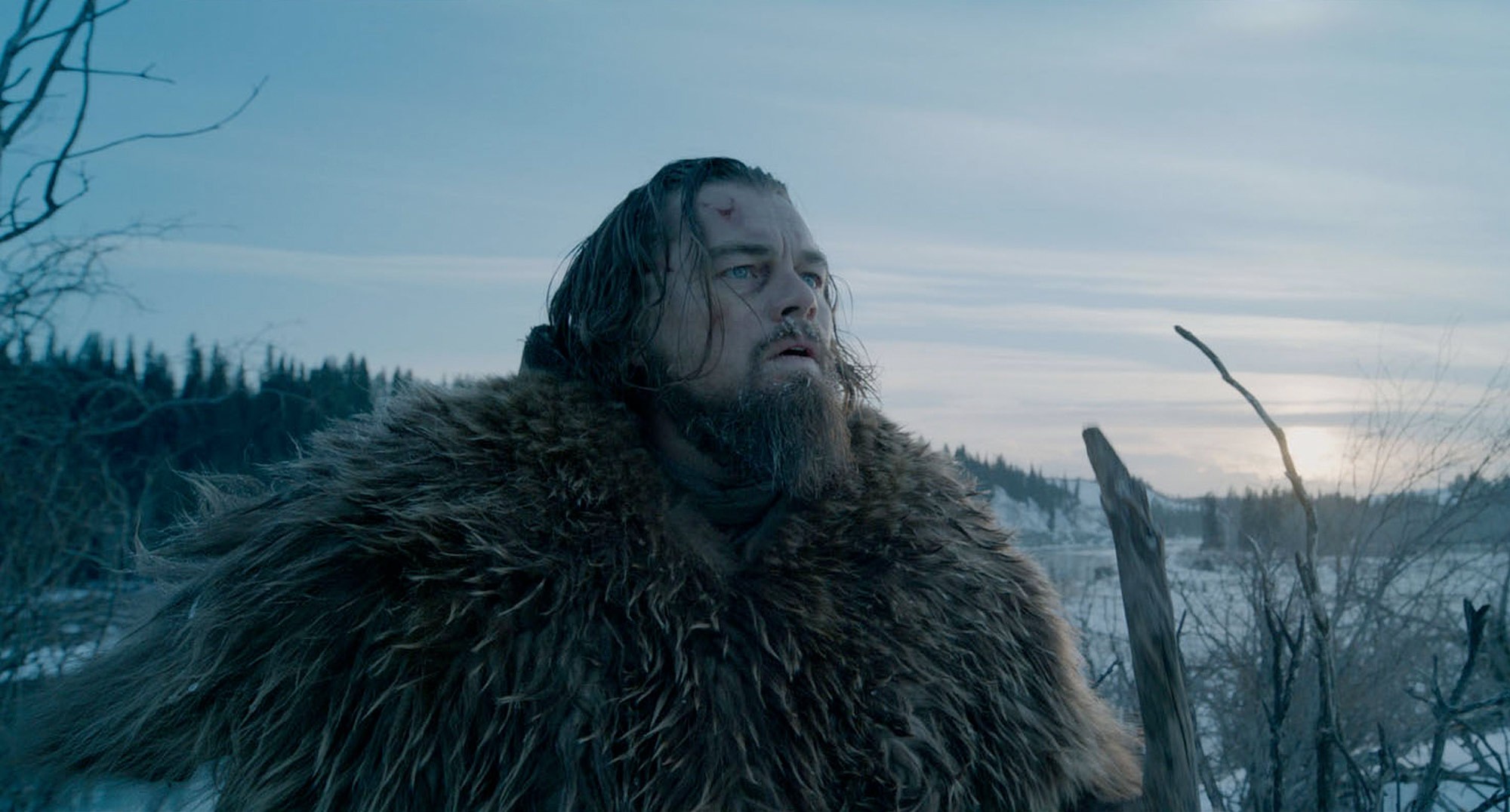
The film tells the story of Hugh Glass (Leonardo DiCaprio), an 1820’s frontiersman who got mauled by a bear, watched his son get murdered, was left for dead by his friends, and crawled 200 miles to society, seeking revenge against those who betrayed him. His story is not fictional. Author Michael Punke captured the true accounts of Glass’s life in the novel of the same name, which serves as the primary basis for this film.

At hearing about the film, you would never have guessed that this is a true story. Watching the film does little to suspend your disbelief, but as it continues on, you catch yourself slowly conforming to the film’s convictions, believing it more and more as it builds to its emotionally binding and captivating climax. Director Alejandro Gonzalez-Inarritu, who won an Oscar last year for directing Birdman, or The Unexpected Virtue of Ignorance, has made a film so vivid, eerie, and compelling that it could, and indeed does, pass itself off as reality.

Look at the huge risks Inarritu takes as a filmmaker. In Birdman, he took a great risk by filming in multiple long takes, editing them together to give off the illusion that Birdman was all filmed in one shot. Here, Inarritu takes another risk by shooting everything in natural light, using the sun to naturally fill the space that Inarritu captures on camera. The result allows us to experience The Revenant’s environments as they are, rather than being artificially constructed for the film’s sake.

Beyond its practical filming and staging, Inarritu is equally ambitious in his overarching vision for the film. To pick one word to describe The Revenant is impossible. It’s beautiful. Disturbing. Shocking. Heartbreaking. Violent. Gritty. Emotional. Meaningful. Spiritual. The scope of Inarritu’s filmmaking is simply incredible, peering into this man’s loneliness, desperation, paranoia, and drive as he struggles not only to survive, but to live beyond his son’s death.

Oh, this is a wonderfully shot film. In wide angles, cinematographer Emanuel Lubeski captures the sheer scope and vastness of his environments, capturing both the beauty and danger of nature around Glass. In tight shots, he perfectly encapsulates Glass’s struggle against life, nature, and himself as he fights to keep on living. DiCaprio lends just as much to Glass’ turmoil as Lubeski does. At times he doesn’t speak, but simply reacts to the environment around him, and his grief and angst is so believable that you buy his struggle not as a character or an actor, but as a real person.

All of these elements build to embody a perfect film. Yes. A perfect film. Why then, do I say that I never want to see it again? Because it captures its vision so perfectly that the filmmaking aspect no longer seems like an illusion. It doesn’t feel like you’re watching a movie: it feels like you’re watching life. You feel Glass’ nerves as he freezes in the cold, struggling breaths in between his slit throat and his stitches. You feel the pain stab through Glass as the bear’s claws tear into his flesh, literally ripping apart his fragile body as the blood replaces his decaying skin. And you feel Glass’ wrath and his pain, his internal torture where he knows that he will never be the same man again. The film is so convincing in its art that it becomes uncomfortable to watch. That’s what I mean when I say that I can’t see it again.

The film never tells us that it’s based on a true story in the opening and closing credits, and it doesn’t need to. We are already convinced of this through experiencing pure film.

Tagged , , , , , , , , , , , , , , , , , , , , , , , ,

“SPOTLIGHT” Review (✫✫✫✫)

“Shine a light, and let the whole world see.”

In the Boston Globe story on the 1990 Church abuse scandal, the Spotlight team reported that there were over 130 sexual assault victims from just one Catholic priest. In the film Spotlight, we eventually learn that over 80 Boston priests were sexual predators, and were being continuously circulated from parish to parish. If those numbers are consistent, how many victims of sexual assault does that spell out for Boston? My math came down to over 10,000.

I don’t know if that’s accurate because I haven’t dug much further into the Boston Globe’s reporting, but I don’t think that matters. What matters is that Spotlight made me think of those victims. It made me think about the people that you don’t normally think about, the problems that you don’t think exist, and the secrets that you don’t think are being hidden behind prayers and confession booths. Like any great piece of reporting, Spotlight brings importance, urgency, and truth that needs to be known about. If Spotlight isn’t the best film of the year, it is definitely the most important.

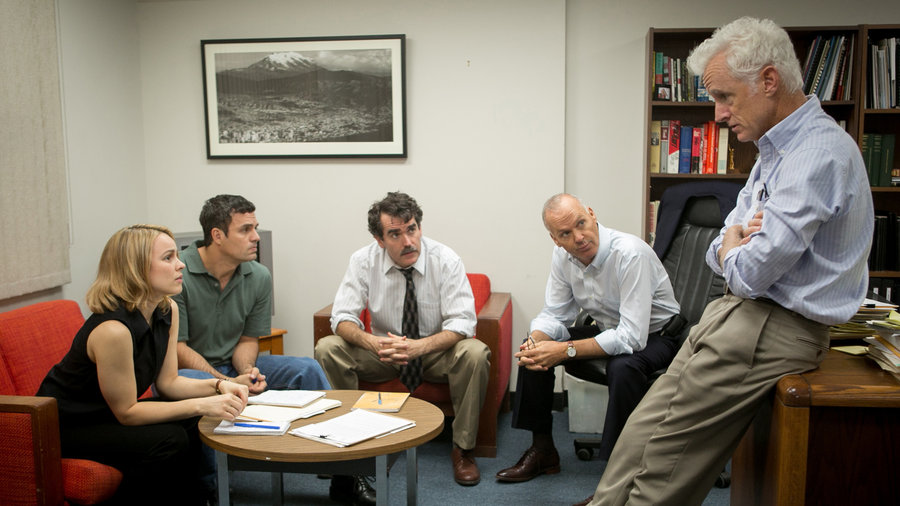
The Spotlight team consists of lead editor Walter Robinson (Michael Keaton) and reporters Matt Carol (Brian d’Arcy James), Sacha Pfeiffer (Rachel McAdams), and Michael Rezendes (Mark Ruffalo). The team is specifically reserved for investigative reporting, previously breaking stories on transit mismanagement and political corruption in Massachusetts. At the time when they were given this assignment, it was not as a follow-up to a news story, but to a column written and published by one of the Globe’s staffers.

At first, no one really thought much of the project. When originally pitched, it had to do with the Catholic church finding out that one priest had sexually assaulted children in six different churches, and did nothing about it. But when the team kept digging, they found out that it was bigger than they anticipated. Much bigger.

While watching Spotlight, I was thrusted upon an early memory of one of my first major news assignments. It was a story called “Seconds Away,” and it was about a university alumna who was just seconds from crossing the finish line before it blew up during the Boston Marathon bombings in 2013. The story wasn’t that she survived. It was that she went back the following year to finish crossing the line that she never did.

While getting ready for our interview, I was excited, nervous, and petrified all at once. This was a woman who had survived a near-death experience. She had faced something few other people have had to face, myself included. I didn’t know how to approach it. Was she comfortable with me talking to her? Would I be insensitive by asking serious questions? Would I be disrespectful by asking what was going through her mind? What would that say of me as a person, by asking her to relive something traumatic that she already went through?

The reporters and editors behind Spotlight face these same questions and concerns of morality every day they step into the office. Yet, they handled this difficult subject in the same way that the movie does: with grace and respect.

The greatest thing that can be said about Spotlight is its transparency: in how its characters charge towards this groundbreaking story and the emotions and conflicts they experience while doing their jobs. Writer-director Tom McCarthy, who was raised Catholic, juggles this behind-the-scenes story with real people’s traumas and emotions in mind. The result is a portrait that is genuine, astounding, mind-blowing, and heartbreaking all at once.

Take the interview scenes as a demonstration of this. During the film’s first scenes, Spotlight reporters sit down with a few sex abuse survivors, their brokenness and vulnerability made evident on the spot. The interesting thing you’ll find in between these intercut scenes is that it’s not Rachel McAdam’s mannerisms we’re noticing. It’s not Mark Ruffalo’s reactions or face of shock we’re noticing. It’s the supporting actors playing these victims, whom I can’t even identify off of the film’s cast list. Every detail of them is absorbing and introspective.

We notice the gay man in a coffee shop as he twiddles his thumbs nervously on his coffee cup. We notice the skinny drug addict sweating, entering the room cautiously, seeing scars up his arms from when he injected himself with heroin. We notice that while their testimonies are overwhelmingly tragic, they talk about it casually and on a whim; like it’s a scar that has already been healed, but will never go away. We listen to their silence as they quietly relive their traumas, the quivering in their voice as they slowly speak, the tears building up in their eyes as they come to once again realize what they are. I find that so compelling, that one of the best things in this film are the actors that I can’t even name.

The rest of the film is like that: finding value in the areas that you can’t exactly point out, but you know they are there. For instance, who’s the main protagonist? You could argue Rezendes, because he has the most visible reaction from working on this story. In reality though, this story is impacting the entire Spotlight team and more. It impacts everyone, in ways that nobody realizes until it walks right up to their doorstep.

This movie takes time and dedication to build up its story and collect the necessary information, just like Spotlight’s reporters do. In doing that, this is undeniably a slow film, but the pace doesn’t matter as much as the payoff. Spotlight deserves to be sought out. It is one of those rare films that not only makes us better viewers, but also better human beings.

Tagged , , , , , , , , , , , , , , , , , , , , , , , , , , , , , , , , , , , , , , ,

“STEVE JOBS” Review (✫✫✫)

Creator. Entrepreneur. Father.

Steve Jobs is defined by three years of his life: 1984, 1988 and 1998.

The movie, Steve Jobs, covers these years of his life. So will this review.

1984

Steve Jobs (Michael Fassbender) is on edge. The Macintosh is malfunctioning. He is told by his technicians that the computer won’t say “Hello” to him. It’s 40 minutes before the product launches. His ex-girlfriend is waiting in the other room with her daughter, who Jobs insists isn’t his, wondering why they are both living on welfare while he is making millions. He paces back and forth in between his professional and personal problems. He tells his technician to fix it and walks off stage.

Fassbender is mesmerizing as Jobs. He’s ecstatic, energetic, passionate. He’s tense, egotistical, confrontational. He’s at peace when thinking about how many people’s lives this new computer will impact. He’s angry at people who come up to him, trying to stop him from completing his mission. His expression shows that they’ll fail. He’s too determined to let his ambitions die.

The filming in this sequence is enclosed, personal. It uses tracking shots to follow Jobs as he paces back and forth, looking at TIME Magazines, drinking his sparkling water, his mind racing with everything that needs to get done. The reel itself has a texture to it that I couldn’t quite point out until it hit me: this sequence is shot on celluloid film, reminiscent of the decade that it’s reflecting. A great choice of stylistic direction from Danny Boyle (Slumdog Millionaire, 127 Hours), but just like the time period we’re in, we know that it won’t last long.

Jobs handles his personal issues. The technical issues are resolved. He steps out onto the stage and introduces the Apple Macintosh.

1988

The Macintosh underperformed in sales. Jobs is let go by Apple, the company that he helped start. He feels betrayed by his closest friends, alone in his struggle for significance.

He meets a few of his former colleagues who want to wish him well. Steve Wozniak (Seth Rogen) starts acting friendly to him, but then confronts him on not giving him enough credit on the launch of the Macintosh. He asks him what he does.

“I play the orchestra, and you’re a good musician,” Jobs says. “You sit right there and you’re the best in your row.”

The scene switches to another where Jobs is confronting a former confidant. The editing is off, choppy. It’s cross-cutting between this scene and a flashback so rapidly it’s hard to keep track of the two conversations. I don’t know what Boyle was trying to do here. Maybe he thought he was adding tension to the scene. I thought he was adding confusion.

Jobs visits his daughter in the next room, who is skipping class to come and see him. She’s in middle school. He tells her she needs to go to school before she rushes up to him and hugs his legs.

“I want to live with you, daddy,” she whispers to him.

She and her mother leave. Jobs is shaken. He steps out onto the stage.

1998

This is it: the launch that has come to define both Apple and Jobs for years to come. This is the most important act of the film, and the one I will talk less about for the sake of spoilers.

Jobs looks different. He looks older. His hair is whiter. He’s sporting the iconic glasses and turtleneck that most people recognize Jobs in. Fassbender is no longer just acting like Steve Jobs. He has become Steve Jobs.

The framing of shots is similar to the beginning. It tracks Jobs while he walks from one place to another. He’s more sure of himself in relationship to Apple, less sure of himself in relationship to his daughter. Boyle captures the panic on his face, the fear recognizing his failings as a person and as a father.

It’s nearing the end of the film, and I realize the thing that I love most about the movie is its screenplay. Screenwriter Aaron Sorkin captures both the genius and fragility of Jobs, the sharpness in his words and the intimacy of his emotions. This is a good change of pace for Sorkin. From a filmography of lightning-quick, witty characters and dialogue from A Few Good Men to The Social Network, this is his most emotive work yet. It makes you feel more than it makes you think.

I exit the theater. I call my dad on my iPhone and tell him I love him. Steve Jobs too realizes that the greatest thing he ever made wasn’t an Apple product. It was his daughter.

Tagged , , , , , , , , , , , , , , , , , , , , , , , , , ,

“STRAIGHT OUTTA COMPTON” Review (✫✫✫✫)

The biography of the boyz in the hood. 

Perception is reality.

That’s a motto my newsroom lives and dies by. That’s also a truth that the boys from Straight Outta Compton live and die by. The only difference between us is that we experience it figuratively: they experience it literally.

We witness this early in Straight Outta Compton; as early as the first scene, in fact. Eric Wright, a.k.a. Eazy E (Jason Mitchell) confronts his cousins, who hasn’t paid him yet for the dope that he sold them a few weeks ago. Suddenly, like an Earthquake striking a town, the police ram into the house and start raiding it, arresting any African-American they can find in there. E slips out of the window and onto the roof just in time. He’s survived. For now.

We switch to a less tense scene. Andre Young, a.k.a. Dr. Dre (Corey Hawkins) is sitting on his bedroom floor, listening to classic funk and R&B records on his record player. Dre isn’t like the others in the streets. He doesn’t want to sling dope or be in a gang. He just wants to produce beats and music: a mozart to his suburbs.

His mother Verna (Lisa Renee Pitts), however, isn’t so enthused about his career path. He has a family and a daughter to care for, and he isn’t going to do it sitting on the floor listening to a record player, DJ’ing for a club at night. Dre, however, has his mind set. His future doesn’t lie in cleaning toilets and taking fast food orders. It lies in a DJ mixer and a pair of headphones. Dre knows what he needs to do.

Meanwhile, on the other side of Compton, O’Shea Jackson, a.k.a. Ice Cube (played by his own son, O’Shea Jackson Jr.) is sitting on a bus waiting to go to school. He sees the white kids in another school yard, all dressed in nice clothes, all with newly-bought school supplies and slick cars. Meanwhile, Cube sits in his creaky bus seat, looking at his clothes he probably wore yesterday, and his worn pencil and notepad, which is the only school supplies he has.

He takes his pencil and notepad and starts writing.

These three men, alongside Lorenzo Patterson, a.k.a. MC Ren (Aldis Hodge) and Antoine Carraby, a.k.a. DJ Yella (Neil Brown Jr.) make up the notorious hip-hop group N.W.A. The last two words stand for “With Attitude.” You can imagine what the letter “N” stands for.

Here is a film that, by any standards, is morally despicable. I go on and on in some of my reviews how movies are either incredibly violent, shamelessly sexual, or blatantly vulgar. This movie is all of those things and more. F-words fly out of their mouths like bullets in an uzi. Nude and scantily-clad women flock to these rappers in herds. In some scenes, they engage in sexual intercourse with many attendants watching, all with drugs and alcohol present. Police and gang violence is also present in the film, with crips, bloods, and officers shoving, punching, shooting, assaulting, and harassing each other in very violent, confrontational fashions.

Do not be fooled. This is not an easy film to watch, and if you don’t have a strong moral compass, you will get lost in the violent, sexual, promiscuous, profane, and blatantly explicit content you will find in this motion picture. If you hate hip-hop, you will hate Straight Outta Compton.

That being said, Straight Outta Compton is one of the most compelling films I’ve seen so far this year. The movie is more than the problems it poses. In fact, I’m happy that the film shows the content that it does in the film. It shows the destructive lifestyle these people experience, both on and off the streets, and they confront very real issues that hits them hard at home and at heart. The most significant issue that the movie covers is, of course, police violence. In one of my favorite scenes from the film, one of the police officers that was harassing these young men was not white, but black. My jaw dropped as he continued to berate these men as they were walking away: “Listen to your master!” he said, referring to their white manager.

What I love most about this movie, though, is that it isn’t biased. It isn’t pro-police or anti-police or pro-gangs or anti-gangs. It shows the ugliness of every side of Compton, whether it exists on a badge or on a bandana. Police cruelty is an obvious focus of the film, because it’s a recurring theme in hip-hop and rap culture. I was pleasantly surprised, though, to find at how much the film delved into hood culture and how damaging it is to these young men’s lives. The biggest instances of cruelty came from record producer Suge Knight, portrayed here by R. Marcus Taylor, whose business tactics include physical intimidation, humiliation, fear, confrontation, and violence. If the movie is anything to go by on how the real events transpired, Suge is a monster. He is painted as nothing less than the Godfather of suffering in this movie.

The parallels this movie draws on is ingenious, and director F. Gary Gray is exemplary in realizing the African-American struggle in a poverty-stricken neighborhood and in their aspiration to escape from it. Jackson does very well in portraying his father, and demonstrates the same snarl and attitude with such accuracy that it made me laugh at how similar he looked to his father. Hawkins is passionate and driven in portraying Dre, and while he physically looks smaller than the real-life Dr. Dre, his performance and his versatility in emotion more than makes up for lacking in physical similarities.

The greatest performance, however, comes from Jason Mitchell. In hindsight, he is the character with the most problems. He’s egotistical, he objectifies women, he betrays his friends, he resorts to violence, and he flourishes in the most destructive lifestyle as he bathes himself in a plethora of drugs, alcohol, and sex. In comparison to his N.W.A. companions, he is the most flawed character. But with his flaws comes his emotions to those flaws, his own moments of self-reflection that makes him think back at his decisions, his career, and the life that he’s trapped in. E goes through many emotions in this film, from fear, to anger, to happiness, to sadness, to heartbreak, and Mitchell portrays all of those emotions perfectly. If he doesn’t deserve the Academy Award for best supporting actor, he definitely deserves a nomination.

But at the heart of this movie is the struggle, the struggle that these five young men go through together, apart, individually, and inseparably. Their struggle being not having enough money. Their struggle being having too much money. Their struggle of not having a place in the world, and their struggle of what to do after establishing their place in the world. Like hip-hop, this movie will stir some major controversy for its content and for what messages it sends to its younger viewers. But it’s important to understand that this movie doesn’t set out to prove who is right and wrong. This movie sets out to show a reality. This movie sets out to show their reality.

Tagged , , , , , , , , , , , , , , , , , , , , , , , , , , , , , , , , , ,

“’71” Review (✫✫✫)

A boy trapped in a soldier’s life. 

We’re always looking for someone to blame in war. Most of the time, the blame is directed at the soldier. Rarely do we blame the military, or the government, or those we are fighting, and even more rarely do we blame the people living stateside, in the warmth and comfort of their blanket and home and far away from the battlefield. No, if we are angered at travesties such as the Vietnam or the Afghan war, we don’t point at the general who gave the order to shoot. We point at the soldier who was following orders.

In ’71, the soldier is treated not as a cold-hearted, emotionless machine, but as a young man, a flesh-and-blood being full of heart and consciousness, but who is equally confused, hurt, alone, and afraid of the people he’s trying to protect. The controversy around another war film called American Sniper released a few months ago argued if we glorify war and the military too much. Those same people need to watch ’71 and realize there is nothing to glorify about it.

Taking place during the height of civil unrest in the Troubles, ’71 follows a young British army recruit named Gary Hook (Jack O’Connell), who gets deployed into Belfast during his first few weeks of training. Him and his squad is warned of the great dangers in entering the territory. Protestant and Catholic Irishmen are living side-by-side at each other’s throats, each with starkly different ideas of what is better for them. The protestants believe that the United Kingdom is their home and it is their best interests to remain with them. The catholics believe Ireland can be it’s own land and wants to secede from Europe. Hook and his fellow soldiers are just looking to keep the peace.

On the day of deployment, Hook watches as both sides come to a boil. The KGB is entering houses, threatening and beating people with their billy clubs, while an angry crowd of catholics gather outside in retaliation against the military. One of the rioting crowd members throws a rock and knocks a soldier out cold. A kid no older than ten grabs the soldier’s rifle and runs. Hook and another soldier chase after him when the crowd assaults them and beats viciously. Hook watches as the soldier is shot in the face. Hook only narrowly escapes with his life intact.

Trapped in Belfast with no way to find his comrades, Hook must fight through the night to survive against the city that’s hunting him.

Functioning more as a survivalist-thriller than as a pure-blooded war movie, ’71 strikes the viewer with sharp imagery and intelligence alike, filling them with a deepening sense of dread as we watch this young man crumble into desperation as he tries to escape from the people who are seeking to kill him. One of the things I love so much about this movie is how expertly it orchestrates itself and its emotions. French director Yann Demange, who before this directed British television shows such as “Dead Set” and “Top Boy”, debuts here as a talented filmmaker, crafting an exciting thriller that efficiently balances action with context.

I am reminded of another film similar in direction and subject, and that is Ben Affleck’s 2012 film Argo. In both films, the main character evades their pursuer through the chaos of a collapsing political climate. The camera captures the essence of both perspectives, with the pursuer desperately chasing their target while the pursued is equally as desperate trying to get away. And through both highly exciting and pulse-pounding features, both directors have deeper things to say about those societies and what impact they’re leaving on the people around them.

To me, ’71 is the British version of Argo, with one big difference: coherency. In Argo, everything is crystal-clear and straightforward. We know who the characters are, why they are there, what they are doing, who is after them, and how and why they plan to get away. In ’71, all of that is focused in towards one character only, and that is Gary Hook. We know everything we can know about a novice soldier, we just don’t know the same of everyone else around him.

For instance, the leaders of both factions, the catholics and the British Military Reaction force, are both skinny gingers with mustaches as thick as their hair. How can you tell who is who under the dim view of the street light? A young boy helps Hook towards a bar after his initial attack, but he’s on the same side as the people who are hunting him. Why is he helping Hook when he so clearly has so much disregard for British soldiers? In another scene, a Protestant seeks to help Hook when minutes earlier he had the cold, direct eyes of a killer with purpose. What inspired him to switch sides so easily? And then, near the end of the movie, there is a twist that didn’t make much sense to me at all.

Still though, the movie is there, and Demange handles the senses of unease and desperation well with the film, especially when trusting Jack O’Connell to portray all of these emotions at once. O’Connell is really having a strong career packing in for himself. In the past year, for instance, he created a very compelling presence in the prison-drama Starred Up and in the Angelina Jolie-directed biopic Unbroken. He makes a very strong case for choosing acting as a career in all of these films, and in ’71 he clearly shows that he can pull off the role of a young, desperate, and inexperienced soldier who just wants to go home. Demange was wise to cast him in this role and trust him with the emotional complexity of the character: O’Connell was the best part of the film.

I’ll admit, I didn’t understand everything I probably needed to understand in the movie, perhaps the biggest one being more aware of what the Troubles were in the 1970’s. Take that out of it. Take all of the political facets out of the movie, and what do you have? You have a raw, emotionally-charged war thriller that challenges the viewer to see it not from their perspective, but from the soldier’s perspective. Everyone hurts during the times of war. ’71 makes me wonder who war hurts the most.

Tagged , , , , , , , , , , , , , , , , , , , , , , , , , , , , , , , , , ,

“AMERICAN SNIPER” Review (✫✫✫1/2)

And hero, husband, and father.

Chris Kyle was an American sniper. Serving four tours in Iraq, with 160 confirmed kills and approximately 95 more unconfirmed, Kyle earned the title of being called the most lethal sniper in American history. More than being a soldier, though, he’s a father, a husband, and a friend. He was killed in 2013 at age 38. He was shot by a soldier suffering from PTSD that he was trying to help.

We know all these details going into Clint Eastwood’s American Sniper. We already know how it ends, we just don’t know everything leading up to it. Eastwood understands this, and uses it to his advantage as his film not only gives an honorable tribute to one of America’s most committed soldiers, but also foreshadows to a sad fate that we already know is coming. Gee, thanks a lot Clint. I didn’t even bring my tissues.

The film opens on the same startling scene that the book does: with Kyle looking down the scope of his sniper rifle at an Iraqi mother and her child, both of whom were aiming to suicide bomb a battalion of soldiers on the street. Eastwood sets up the tension of the scene perfectly here, with Kyle’s sweaty, darting eyes surveying the scene and desperately trying to see any way out of the tormenting choice he has to make. He soon dreadfully realizes there is no way out: it’s either the mother and her child, or the 15 soldiers and the suffering of their families back at home.

Think about being given that situation, about how devastating the experience must be and how haunting it must be to the person who has to make it. Now imagine having to make that same choice day, after day, after day, with your numbers climbing up until you’ve reached over 250 kills.

That’s the life of a soldier that Kyle has lived.

Kyle is portrayed in the film by Bradley Cooper, and both Cooper and Eastwood do a wonderful job representing Kyle here. They show that before he was a soldier, he was a citizen, an American with strong ideals and opinions and unafraid to show them or fight for them. Before he was shipped out and went on tour, they showed how normal Kyle was.

They showed that before he was a soldier, he was a man.

After having to make those difficult decisions day after day, how do you think that affects a man? In interviews, the real-life Kyle has said that he would not take back a single shot because every one that he took was to defend his brothers in uniform. I believe him when he says that, but I don’t believe that it didn’t leave an impact on him. Some soldiers suffer PTSD from killing just one man. How do you think more than 200 may have impacted Kyle?

Both Eastwood and Cooper do a great job humanizing Kyle here, and show that he’s more than the record kills he’s garnered. They show that Kyle is a man of coarse humor and blunt honesty, a man with a thick Texan accent and ideals, a man who tries to show that he’s strong and dependable, but who deep down is hurting and alone. The film is intimate in the ways that it shows Kyle, both in the chaos of battle and in the quietness of being home.

Cooper especially does a skillful job in portraying the iconic war hero. He expresses trauma and subtlety with the character so masterfully that the only differences I can tell between him and Kyle are minor facial features.

This movie has stirred controversy as of late for being “pro-war,” and for glorifying a man who was essentially labeled a murderer. I’m convinced these same people haven’t seen the same movie I saw, because the movie I watched unabashedly looks at the miseries of war and how the deaths Kyle could and couldn’t prevent affected him. The movie does suffer some slight pacing issues (not to mention the infamous “fake baby” seen in one of the shots), but when Eastwood resurrects a war hero to show the man behind the legacy, how can you look at this movie’s scope and not feel something for all of the physical and moral sacrifices Kyle had to give for his home? When the trumpet plays proudly over the solemnity in the end credits, you know that Eastwood represented a warrior in heart and a human in spirit.

Tagged , , , , , , , , , , , , , , , , , , , , , , , , , , , , ,

“BOYHOOD” Review (✫✫✫✫)

A scrapbook by Richard Linklater.

The main character’s name in Boyhood is not Mason. His name is also David. And Connor. And Warren. Aaron. Stacey. Tony. Eric. Steven. Ben. Richard. And so on and so forth until you’ve listed every masculine name in the dictionary. I probably went eight names over how many I needed to list, but you get my point. We’re doing more than just watching one boy’s journey into adulthood here. We’re watching ourselves grow with him.

Strange, I think. I don’t normally sympathize with characters to the point where I feel like I AM them. Relating to protagonists is a somewhat straightforward task; you merely need to introduce the character along with their conflict, and then let the filmmaker do his work to bringing their arc to life.

But with Boyhood, I face an interesting prospect: there is no one conflict that Mason faces in the story. Like myself and my closest family and friends, Mason’s conflict is life itself, complete with all of its blessings, gifts, challenges, and turmoils alike. If you’re still not getting the picture, let me put it to you this way; if I were a filmmaker, and I were adapting the full story of your life, would I be able to condense it into one or two events?

The answer is no, I couldn’t. There is a whole multitude of issues you’ve faced in your life, just like I did, and I’m sure we could turn those issues into ten or twelve more movies if we tried. Director Richard Linklater chose not to do that. With Boyhood, he took one boy’s life, a small child he found named Ellar Coltrane, and followed him from age six until age 18, gradually showing his life progress and the challenges he faced as he grew into a man year, by year, by year.

It’s fascinating I tell you, to watch a movie progress from one generation to another. I look at Ellar as a young boy obsessing over cartoons and action figures while his sister, portrayed by Linklater’s daughter Lorelei, constantly talks about makeup and Britney Spears. I look at these children’s parents, played by a significantly younger Patricia Arquette and Ethan Hawke, as they struggle to connect and be there for their children and to be the best parents they possibly can be. It’s interesting to see these children mature from young, simple-minded beings to young adults, trying to find their own paths in life while their parents mature from being those young adults to the older, more mature parents that have faced, and survived, every difficulty they could have ever faced.

It’s pointless to describe what the plot of the movie is like. What is the plot of the movie? Fill the movie with your life experiences, and you have the plot. I caught myself many times reliving past memories while watching the movie, sympathizing with Mason as I remember how I too faced issues such as bullying, peer pressure, puberty, growing up, and finding a place where I belonged.

It’s not so much a movie as it is a scrapbook of memories, and Linklater is merely showing the memories on screen like he’s pulling a photograph out of a book.

What of the performances then? Patricia and Ethan are the most emotive performances out of the movie, but that’s to be expected considering they’ve been working on this movie, among others, for literally a decade. Lorelei is cute as a child at the beginning of the film, but as the movie continues on, it begins to focus more on Ellar while Lorelei, more or less, fades in to the background.

That being said, Ellar isn’t the most compelling actor in the film. As a child at the beginning, he is the most believable, but that’s because he’s living, not acting, in the moment. When he’s playing with his friends or when he’s dressed up for the Harry Potter premiere, you know that’s him being excited in the moment, similar to how Drew Barrymore believed E.T. was real during the filming for E.T: The Extra Terrestrial. As he gets older, however, he gets less emotional about things and more or less goes through the motions wherever Linklater guides him.

At first, I thought this was an obvious criticism to the film, because how is a kid going to maintain his acting ability through 12 years of his life? As I look deeper, however, I realize that Ellar isn’t intended to give a performance. He isn’t meant to be an actor, but a surrogate, a character whose emotions and memories we fill in the film and then we sympathize with because those are the same emotions we faced when we were his age.

Mason goes through a lot in this movie. As a toddler, he witnesses his parents go through divorce. As a child, he faces abuse from his alcoholic stepfather. As a teenager, bullying. As a high schooler, heartbreak. This movie is so tangible that it made me want to grab hold of Mason. It made me want to hold him and hug him, telling him the same thing my mother told me when I was going through my own issues at his age.

I want to grab him and say to him, “You’re going to be okay, Mason. You’re going to be okay.”

Tagged , , , , , , , , , , , , , , , , , , , , , , , , ,