Tag Archives: History

“KILLERS OF THE FLOWER MOON” REVIEW (✫✫✫✫)

SOURCE: Paramount Pictures

Beware the wolves in sheep’s clothing.

Killers Of The Flower Moon is the kind of film that leaves you stunned and speechless: the kind that makes you sit on uncomfortable emotions, reflect on your history, and think about all we have taken from people that we have never met. People don’t think often enough about how America was founded on stolen land, but they should. All we have done since meeting the Native American in the 17th century was kill and steal from them — and we’ve been killing and stealing from them ever since. 

Martin Scorsese confronts this cold, stark truth with brutal honesty and unflinching reality. You don’t merely watch Killers Of The Flower Moon — you are devastated by it. You watch as real-life horrors unfold before your very eyes, begging that justice comes and relieves the persecuted like a breath of fresh air. It never does. In this film, a kind word is a lie. A hug is insincere. A kiss is betrayal. And the words “I love you” mean death. 

Based on the nonfiction book by journalist David Grann, Killers of the Flower Moon tells the true story of the Osage Nation, who stumbled upon oil on their lands and became filthy rich. Many white Americans were jealous of the natives and their obscene amounts of wealth in 1920s Oklahoma, including William Hale (Robert De Niro), a cattle rancher who familiarized himself with the Osage’s customs and gained their trust. 

After World War I ended, William’s simpleton nephew Ernest Burkhart (Leonardo DiCaprio) comes home to live with William and his family. Once he settles in, William plants an idea to Ernest — marry an Osage woman and kill her and her family so that they can inherit their oil headrights after they die. 

That woman ends up being Mollie (Lily Gladstone), whose family’s estate owns more than $7 million in oil money. As Ernest marries Mollie and they build a life together, he’s torn between his love for money and his love for family, and he ultimately has to decide which one matters to him more. 

Killers Of The Flower Moon is a hard film to review because it’s a hard film to watch. Many of Martin Scorsese’s contemporary and modern-day classics are all entertaining to some degree, whether you’re talking about the dark humor and wit of Goodfellas, the spine-tingling sensations of Shutter Island, the grandiose splendor and serenity of Hugo, or the outrageousness of The Wolf Of Wall Street. Killers Of The Flower Moon is a different story. It is not a fun film by any means. It isn’t enjoyable, amusing, exciting, or gratifying. I wouldn’t even call it fulfilling. 

No, the word that comes to mind is “traumatizing.” And why wouldn’t it be? You’re dealing with indigenous genocide here. I wouldn’t say Killers Of The Flower Moon is a fun watch any more than I would say Schindler’s List or 12 Years A Slave is a fun watch. In fact, going into a movie like this searching for entertainment value diminishes the film at large and the story it’s trying to tell. 

Instead, Martin Scorsese pays it the respect and the seriousness it deserves. Killers Of The Flower Moon is not a traditional picture — it’s a striking and observant portrait, a vast and stunning painting filled with beautiful colors and harrowing scenes filled with violence, terror, and tragedy. The fact is you don’t enjoy Killers Of The Flower Moon — you are entranced by it. You embrace it as the experience washes over you and you feel the deep pain that the Osage have experienced in silence for generations. 

While Leonardo DiCaprio and Robert De Niro have both separately teamed up with Martin Scorsese in the past, this is the first time both Academy Award-winning actors have partnered up with Scorsese at the same time, and it pays off with wonderful results. De Niro is downright hateful as William Hale, a sly and sick little scab that pretends to be a friend to the Osage people, when in reality he is the most dangerous predator there is — the kind you don’t recognize. The worst thing about his character isn’t how monstrous he is: it’s how normal he seems when he discusses genocide and plotting to take away the dead’s land and money for himself. He sounds so casual and matter-of-factly in his delivery — like he’s discussing a business strategy instead of a murder plot. For him, they may mean the same thing. 

DiCaprio is the exact opposite. While De Niro is calculated and crafty in his murder schemes, DiCaprio is a bumbling fool who wouldn’t know how to tie his shoelaces if you told him they were untied. At this point in his career, Leonardo DiCaprio has played all types of characters, from the undercover cop in The Departed to the illustrious millionaire in The Great Gatsby to the frostbitten survivor in The Revenant. He’s sold all types of characters in all types of roles, but he’s never sold stupid quite as well as he does in Killers Of The Flower Moon. It may sound like I’m insulting him, but I genuinely mean that as a positive. When it comes to murder conspiracies as massive as this, every master planner needs an idiot underling to carry out his bidding. Leonardo DiCaprio plays that part to a T, and considering I’m used to seeing him as the teen heartthrob from Titanic, it was shocking to me to see no traces of him here with Ernest Berkhardt. 

And the thing is his actions in the film might seem contradictory at first, but they’re really not once you understand his character’s motivations. He says at one point that he doesn’t know what he loves more: women or money. It seems like a throwaway line, but it actually informs everything his character does throughout the entire film. Because even though he’s slowly killing his wife and her family, he’s doing it through the thin veneer of love and being torn by what he loves most: his wife or her money. It’s incredibly conflicting, and DiCaprio captures that inner turmoil perfectly. 

But the best performance in the film is neither of the leads. It’s actually Lily Gladstone, who up until now has had mostly supporting roles in shows like “Room 104,” “Billions” and “Reservation Dogs.” Here, she takes command of the screen and steals every single scene she’s in. She is not a victim here: she is a fierce and powerful woman, a loyal and loving daughter, mother, and sister who watches in horror as her entire family slowly perishes one at a time. With a narrative this demanding, you need an actress who can authentically channel the pain, the torment, and the generational trauma that the indigenous have felt, and Lily Gladstone nails it perfectly. I can honestly say that she gives one of my favorite performances out of the whole year, and I hope she gets a lot of recognition come awards season because she truly deserves no less. 

At three hours and 26 minutes, Killers of the Flower Moon is one of Martin Scorsese’s longest films ever, second only behind 2019’s The Irishman. Does it feel long? Yes it does, but it also feels like it needed to be. This was a sprawling murder conspiracy that lasted several years and took the lives of over 60 people and shattered the lives of many more. Those people deserve to have their story told in full, uncompromising view. Quite frankly, anything shorter than three hours would have been disrespectful to those this film was dedicated to.

By the time Killers of the Flower Moon ended, I was left shaking in the theater with angry tears in my eyes. Not because of what Ernest and William had already done to the Osage, but because of how much they were allowed to take from them when they’ve already lost so much. May Ernest and William burn for eternity from the fiery coals they piled up for themselves in Hell, and may Molly and her family finally experience peace, knowing that the vibrant shades of the flower moon will shine forever. 
Tagged , , , , , ,

“OPPENHEIMER” Review (✫✫✫✫)

Becoming Death, The Destroyer Of Worlds.

On August 6th, 1945, the United States dropped an atomic bomb over Hiroshima, killing over 70,000 people and burning, scarring, and poisoning several hundred others. A few days later, the U.S. dropped a second bomb on Nagasaki, killing 60,000 more people. That’s at least 130,000 dead, and several historians estimate that casualties were actually much higher. If that bomb were dropped on U.S. soil instead, it would have meant the death of America. Maybe it already does. 

The argument lingers over how necessary those bombings were in effectively ending World War II, but even those arguments don’t answer one key question: what is the cost of taking all of those lives? History gives us hindsight of what the literal fallout from those bombings was, but what do all of those deaths do to a man? What is it like to feel the weight of a thousand burning souls on your shoulders? 

Oppenheimer answers this question with cold, stark, unflinching reality, simultaneously providing us with a behind-the-scenes look at how the atomic bomb was made as well as a peak into the soul of the man tortured by his own creation. Written and directed by Christopher Nolan (Inception, The Dark Knight trilogy), Oppenheimer recounts the story of the infamous father of the atomic bomb through three key points of his life: his academic upbringing in Cambridge, his days working on the Manhattan Project, and his security clearance hearing in 1954. While all of these storylines are being portrayed simultaneously, all of them are linked toward one recurring theme: Oppenheimer, and humanity itself, hurtling towards a dark, inevitable fate that all seem powerless to prevent.

I remember the first time I saw J. Robert Oppenheimer speak. It was during the 1965 documentary “The Decision To Drop The Bomb,” where he uttered the infamous quote “Now I have become Death, the destroyer of worlds.” However, the thing I remember most from that telecast wasn’t those words: it was Oppenheimer’s eyes. His face was cold, expressionless, the light from his eyes evaporated as if he were a corpse confessing his soul. He looked as if the atomic bomb went off inside of him, and his body on the outside was decaying from the nuclear fallout from within. 

More than anything else, I wanted Oppenheimer to capture what it’s like to be the man behind the deadliest weapon in human history. I wanted to see what that does to a person — what knowing the death and destruction you have caused does to your spirit. Oppenheimer gave me more than what I asked for and delivered a dramatic epic that’s part tragedy, part cautionary tale, and part Greek fable not unlike that of Prometheus, the god of fire. 

A key part of that comes from one of Nolan’s longtime collaborators Cillian Murphy, who convincingly portrays Oppenheimer at every point of his life. At the beginning of the film, he’s a curious and ambitious young scientist who dreams of atoms, molecules, and the world of matter that hides behind our own. As the film progresses, he transforms into an atomic-sized dramatic force determined to bring the Manhattan Project to life. It’s only after the Trinity test that he becomes Oppenheimer as we recognize him — an aging, decrepit shell of a man haunted by the nightmares he helped create. Cillian brilliantly portrays Oppenheimer not as a historical figure, but as a real person experiencing all of these events in real time. While the film doesn’t excuse his actions, Cillian humanizes Oppenheimer so effectively to the point where you understand where he’s coming from. At times, you even feel bad for him. 

But Cillian is only one part of this giant and mesmerizing nuclear puzzle, and his exceptional castmates help complete it. Emily Blunt plays Oppenheimer’s wife Kitty, and her fiery, ferocious spirit perfectly balances Cillian’s nuanced, colder demeanor. Matt Damon plays Oppenheimer’s handler, and his snarky condescension brings welcome brevity and comedic timing to a film that usually feels unbearably heavy. And I’m happy to say that Robert Downey Jr. was exceptional as AEC chairman Lewis Strauss. I was worried after he finished his time as Iron Man that he might become complacent and not want to work as hard for future roles. Oppenheimer demonstrates that he’s still got the acting chops, and if you give him a good part, he’ll damn near outshine everyone else in the movie.

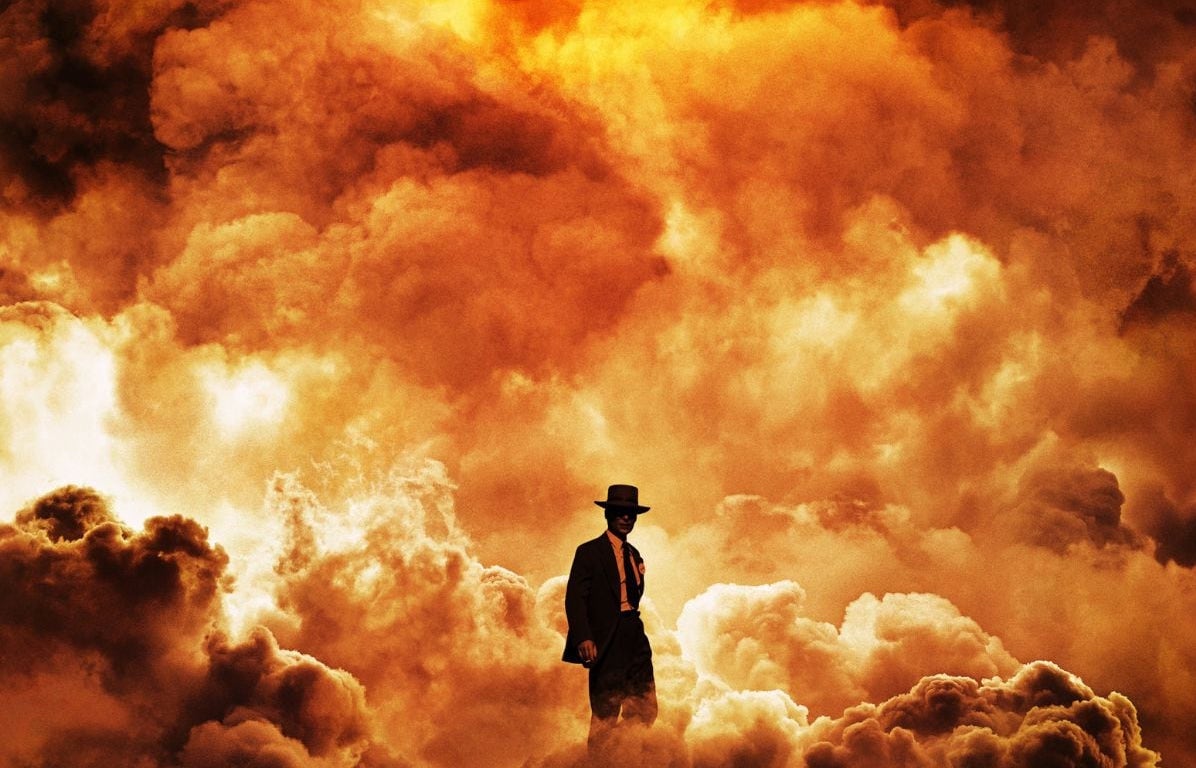
And like all of his movies before, Christopher Nolan outdoes himself in his commitment to only using practical effects. It all culminates into the Trinity test sequence, which is actually the only time we ever see the atomic bomb explode on screen. The buildup and anticipation was nerve-wracking, the score by Ludwig Goransson was intense and anxious, and the cinematography by Hoyte Van Hoytema captured everyone’s uneasy expressions beautifully. But when that bomb went off, that bright light consumed the screen, and the sound design shook the theater like an earthquake… dear reader, I have NEVER felt an explosion like that in the cinema ever. It felt like you were in the bunker with Oppenheimer, and like everyone else on the Manhattan Project, you were worried you were going to set the sky on fire. 

But amazingly, that explosion was not the most impactful thing from the movie. What impacted me most was witnessing the fallout of it — how global powers changed, how the world reacted to its creation, how Washington scrambled to politicize it and benefit from its power, and the guilt and the grief that racked Oppenheimer for years after he detonated that first bomb.

We never actually see the bombings of Hiroshima and Nagasaki, and rightfully so. After all, Oppenheimer never saw it himself, so it makes sense that we share his perspective when he heard about it afterward. But what’s incredible is despite never witnessing it, Oppenheimer imagines it, and his imaginings are horrifying. He feels the bomb go off and the bright light consuming his body. He feels flesh burning and sees charred bodies crumble into ashes. And he hears the shrieks and screams as they fill his ears like a chorus from hell.

Oppenheimer is a haunting and harrowing vision of one man’s nuclear nightmares and what they may mean for the future of the human race. By the end of the film, the scariest thing isn’t wondering if the world will end from nuclear warfare — it’s wondering if it already did. 

Tagged , , , , , ,

“MALCOLM X” Review (✫✫✫✫)

SOURCE: Warner Bros.

Liberate your mind. 

If history has taught us anything, it was that Malcolm X and Martin Luther King Jr. had starkly different methods to fighting racism in America. Yet they were so similar in so many other ways despite all of their differences. For instance, both men have experienced firsthand the boot and lashes of white America. Both were men of faith that were compelled to action because of what they believed. Both fought fiercely and passionately for the day that black men would be free from persecution and hatred. And both were shot and killed at 39 years old before they would ever see that day realized.

But of course, Malcolm X is not remembered by many for marching for the same causes that Martin Luther King Jr. did. Malcolm is not remembered for advocating for his fellow black men, for his fight against the evils of racism, and for his rousing speeches and words burning with passion and fire. Instead, he’s remembered because his words were filled with contention and confrontation, not the piety and the hope as Dr. King’s speeches were. Regardless of which ideology you do or don’t agree with, there’s no denying the one truth that both men share: they understood all too well of what it meant to be a black man in America.

In Spike Lee’s Malcolm X, Denzel Washington portrays the Muslim minister in an epic encapsulation of his whole life. The movie covers everything from his traumatic childhood where his family was hunted by white supremacists, to his robbery days as “Detroit Red,” to his discovery of Islam during his time in prison, to his emergence in the civil rights movement, all the way to his last days ministering before he was ruthlessly gunned down by Thomas Hagan and his crew.

Seeing Malcolm’s life play out like this gives perspective into who he was, where he came from, and what happened in his life to shape him into the leader he’s widely recognized as today. Writer-director Spike Lee illustrates Malcolm’s life story with intensity and conviction, fully committed to showing you who he was and who he wasn’t. Lee stylizes his scenes with flair and pizzazz, with Malcolm and his buddies dressed in colorful outfits, shucking and jiving down the streets in Boston while the smoke and police sirens linger in the background. But Lee’s film design isn’t gimmicky or exploitative of Malcolm X. Like Lee’s earlier films Do The Right Thing and Mo’ Better Blues, they speak to the era they’re representing and add authenticity to Malcolm’s story.

The scenes that deal with Malcolm’s faith are especially moving and touching. When he’s first introduced to Islam in his prison cell, it’s an emotionally-stirring moment where Malcolm faces who he is and how he needs to make a change in his life. When he later confronts the hypocrisies of the Nation of Islam, he becomes disillusioned to what message he’s been preaching and what his faith really represents. And when he later travels to Mecca and encounters Muslims of all ethnicities and cultures, Malcolm experiences a spiritual revival of Islam and what it means to him. It’s a poignant redemption arc that shows how he grew from Malcolm Little to becoming Malcolm X.

I can’t talk about Malcolm X without mentioning the man who plays him. Denzel Washington is simply stunning as the civil rights activist. Whether he’s portraying him in high school trying to pick up white women, running a numbers game as a gangster, or standing against oppression in the streets as an outspoken civil rights advocate, Denzel portrays each chapter of Malcolm’s life with vigor and authenticity. He isn’t playing one character so much as he is playing several characters and their many transformations throughout their lives, and he fully commits himself to every single aspect of those characters. I find it fascinating that in the really captivating moments where he was preaching to crowds and protestors, I never once thought it was Denzel reciting someone else’s words. I only saw Malcolm X.

This leads to the film’s greatest strength, and that is its honesty. With a figure as controversial as Malcolm X, it would have been too easy to shy away from the hard conversations Malcolm X forced us to have and sanitize his story for the comfort of neutral moviegoers. But Spike Lee doesn’t do that. Instead, he lays out the entirety of Malcolm X’s legacy, and he doesn’t shy away from its highs or lows. It’s no secret that Malcolm X made many disparaging remarks to many individuals throughout his life, including Dr. Martin Luther King Jr., President John F. Kennedy, and white America as a whole.

Yet the movie doesn’t virtue signal as to whether Malcolm was right or wrong in the statements he’s made: it just shows it the way it was and lets the audience decide for themselves. I’m not going to comment much on it myself, because my job as a film critic is to review the movie, not the person it’s portraying. I will say that if Malcolm X’s words bother you more than the lynchings, the police brutality, the white nationalism, and the racist institutions he was fighting against, then you need to evaluate whether it’s the words that bother you so much or the cause behind them.

Whatever conclusions you come to about his life, Malcolm X is a powerful film: dramatic, well-acted, and faithfully executed. The film forces you to face uncomfortable questions regarding America’s racist history, and many people may not like facing those truths. My view of it is that if Malcolm X couldn’t shy away from it, neither can we. We could all learn something from those that we don’t see eye-to-eye with. Perhaps we could start with Malcolm X.

Tagged , , , ,

“DEEPWATER HORIZON” Review (✫✫✫✫)


Unexpected emergencies. Unexpected heroes.

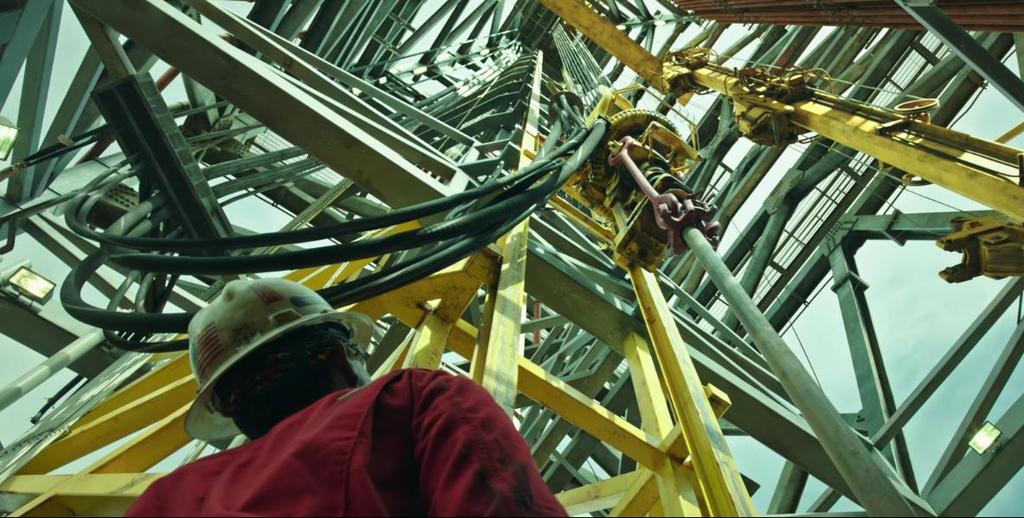
The first thing that surprised me about Deepwater Horizon was realizing that it was rated PG-13. The violence in this movie is graphic and vivid, with its source material translating so well to the big screen that I question how different it really is from its actual events. Through every explosion, every flame set ablaze, every bone that is crushed, and every life that is taken, this is a film that seeks to honor its real-life subjects by showing us exactly what they went through. It is not for the average viewer, and it is definitely not for children. I would say younger than 17 is pushing it. 

In this adaptation of the 2010 BP oil spill directed by Peter Berg (Friday Night Lights, Lone Survivor), Deepwater Horizon follows the oil-drilling crew in their final hours before the notable disaster. Mark Wahlberg plays Mike Williams, who has a family waiting for him at home. Gina Rodriguez plays Andrea, who has her boyfriend and a broken mustang back at shore. Kurt Russell is the hardened captain of the crew Jimmy Harrell. Dylan O’Brien plays Caleb, an oil driller who’s just trying to do his best job on-site. And then there’s John Malkovich, who plays the asshole that got everyone into this mess. 

The standout element of this picture, by far, is Berg’s treatment on this delicate topic. You might remember that I wasn’t very fond of his last film Lone Survivor, which I found to be too generic and predictable to do its source material justice. Here though, there’s nothing generic or predictable, not even in the opening shots. During an early breakfast conversation between Mike and his daughter, she innocently described to him her classroom speech about his job, explaining how her daddy “fights the dinosaurs” underneath the earth. While serving as sweet softener dialogue between these characters, it also doubles as exposition about his job, how he does it, what they do on a day-to-day basis, and what perils come with the occupation.

As she’s speaking, the coke she’s using to demonstrate suddenly bursts and floods the whole table. I’m thinking what would have happened if that coke was a few thousand feet bigger and was carrying oil instead of soda. 

This much is how Berg improves upon his technique from Lone Survivor to Deepwater Horizon. In Lone Survivor, our heroes were thrown into grisly escapades of war violence, with nothing building up beforehand to help us connect with these characters. Here, Berg connects us to the crewmembers’ humanity before ominously foreshadowing to their dreary fate. These are not normal movie characters. These are fathers, mothers, sons, daughters, brothers, and sisters, all of whom are real people outside of the movie theater. They all have someone waiting for them at home, wrecked and nervous for their safety and survival. For the most part in war movies, our heroes more or less made the conscious decision to go fight for their country, regardless of who was waiting for them at home.

Deepwater Horizon’s heroes are different. None of these characters made the conscious decision to plant themselves square in the middle of danger. Nobody in the film was expecting the disaster to occur when it did or with how greatly it devastated them. This is a disaster picture first and foremost, and you’re frantically navigating the action with the film’s survivors as they look for a way past the spewing oil, the collapsing metal frames, the wild fires, and the empty sea gallows looming beneath them. This is a movie that completely understands what the real-life crewmembers were up against, and they bring you every detail of that disaster with nerve-wrecking alertness and urgency.

I have no qualms for this movie. At least, nothing that I can fairly hold against it. If you wanted to be picky, I suppose you could say that the editing was choppy and sometimes made the action hard to follow. But when you see the events unfold on screen, when the metal frames tip over and the rig catches on fire, you’re very quick to forgive the film for its tightly-edited action. After all, Deepwater’s residents barely had any time to process everything themselves. Why should we?

This is a masterful picture, guided delicately through its facts and events with its survivors and victims in mind. In its simplest state, Deepwater Horizon is a unique and riveting action film that perfectly captures the details of its real-life disaster. Through a more complex scope, it is a celebration of life, a commemoration for bravery, and a quiet mourning for the lives lost. 

Tagged , , , , , , , , , , , , , , , , , , , , , , , ,

“SNOWDEN” Review (✫✫✫)


The persecution of the American dream. 

Before you will have read this review, the government will have read it first. That is a fact that each of us must face and understand, although we shouldn’t necessarily accept it, even though many will tell us that we should. It’s been three years since Edward Snowden has leaked classified information about the NSA spying on its own citizens, and they still haven’t apologized or confronted the issue up front. To me that is an admission of guilt, and the movie Snowden is their sentencing.

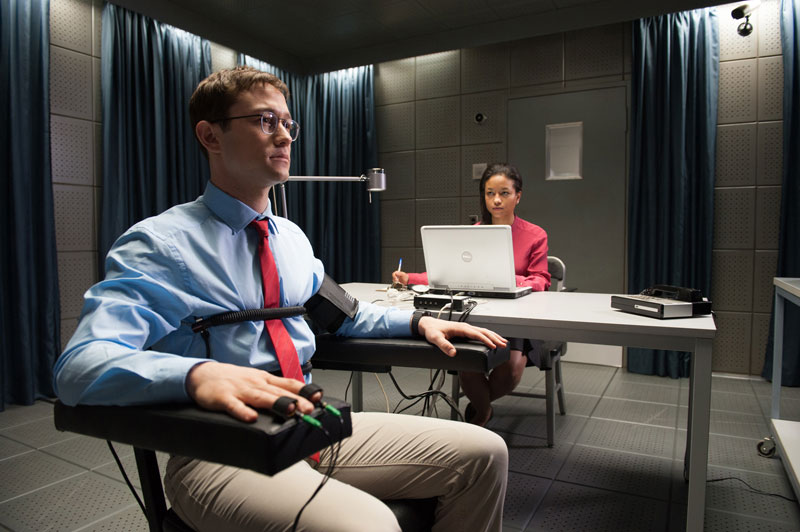
Taking place years before the NSA leak, Snowden, portrayed by Joseph Gordon-Levitt, is an American just wanting to do his best to support his country. He’s worked in numerous jobs with the government before, including the Special Forces and C.I.A. But when Snowden is employed by the NSA, he makes a devastating discovery: the government is surveilling all of its citizens, everywhere, 24/7.

How bad is it? Imagine Uncle Sam looking over your shoulder every second of every day, and you’ve got a pretty accurate idea of the government’s hold on you. Your phone. Your iPad. Your MAC computer. Even if any of these things are off, their cameras and audio software can still pick up everything you’re saying or doing. And that’s not to mention the NSA’s access to your internet, social media, emails, private messages, and video chats, along with every other surveillance tool at their disposal.

This is where the film finds its emotional core, caught square in the middle of political paranoia, distrust, and dread. Our hero is caught in that same place as well, navigating the morality and technicality of this reality trapped, like a mouse running lost through a maze. The end result feels exactly how it sounds: thrilling, revealing, and disturbing.

I’m going to get your biggest concern right out of the way. Joseph Gordon-Levitt is absolutely mesmerizing as Edward Snowden. Like the best method performances, Gordon-Levitt focuses on the slight mannerisms and habits of the real-life figure and mimics them to near exact precision. This is an actor who has taken on a variety of roles in action films, including Inception, The Dark Knight Rises, and Looper. There is no indication in the film that this is the same actor minus appearances. He embodies everything he needs to about Snowden: his social awkwardness, his physicality, his stammering, his idle movements. Everything that he did made me feel like he was a second Edward Snowden. My only complaint is that his voice is a little low-pitched compared to Snowden’s, but for an otherwise flawless performance, this is one flaw I’m willing to forgive.

The screenplay is also very well composed, giving vital insight into this man’s perspective that perhaps we didn’t know how to feel about before. Writer/director Oliver Stone isn’t unfamiliar with controversial subject matter. From confronting the U.S.’s treatment of veterans in Born on the Fourth of July, to conspiracy theories in JFK, to violent escapades in Natural Born Killers, Stone is experienced with telling a wide variety of stories and how they affect modern society. Snowden seems like a perfect fit for him. Stone confronts the facts headfirst, not shying away from any of the details, no matter how disturbing they may be to us. The resulting message does everything a film is supposed to do: it thrills us while at the same time informing us.

All the same though, there were some moments that just did not work with this picture. I’m talking about scenes and elements that sharply collided with the movie’s tone and took you out of the experience rather than further immersing you. The first thing I’m going to mention is the score by Craig Armstrong, which is an unusual thing to mention because in a movie about Edward Snowden, you would think your first complaint wouldn’t be about the music. In one early scene during Snowden’s special forces days, the score was so soupy and melodramatic you would think they were trying to emulate Saving Private Ryan. Kinda off-tone for a movie about government surveillance and whistleblowers, don’t you think? His score does eventually come back to the sharp rhythms and ominous tones that are appropriate for a subject like this, but even then, the soupy melodies repeat two or three more times in the picture. The inconsistencies in this score take us out of the moment of tension that we’re supposed to be feeling and throws us into a state of perplexity, as if we’re not sure what sort of movie we’re supposed to be watching here.

But then in other scenes of the movie, you can’t fairly place blame on the music. Some scenes were just plain directed badly. In the omnipotent climax of the film, the highlight moment of the picture, the one where Snowden commits the act that we all know he’s inevitably heading towards, he finishes doing what he does, then he… smiles? His life has just been ruined, he’s now officially going to be hunted by the government as a fugitive, he has to run away from his home, his family, his friends, everything he has ever known to live in a country all by himself. And in this moment of self-sacrifice and legal martyrdom, he chooses to smile with the sun brightly illuminating his face, his hair blowing carefree in the wind? That’s not on-the-nose, cheesy, silly, and plain corny in any way, Stone. There’s no way to excuse a scene like that. It demanded a reshoot.

I fully believe everything I saw in Snowden. I don’t doubt a single frame in it. I believe it is real and it scares me. That’s a good thing though, because its supposed to scare you. The things you’re watching are things that have happened to you, and you should not be okay with them. You may not know the full story, but this is your opportunity to know.

Snowden may be the most important film you see this year, even if it isn’t necessarily the most well made.

Tagged , , , , , , , , , , , , , ,

“13 HOURS: THE SECRET SOLDIERS OF BENGHAZI” Review (✫✫✫1/2)

Hell in half a day.

Here are the facts. On Sept. 11, 2012, the same day as another infamous tragedy, a U.S. compound in Benghazi was attacked. Four Americans were murdered that day, one of them being ambassador Chris Stevens. The rest of the on-site personnel fought for their lives for over 13 nightmarish hours against an enemy as cruel as they were relentless. This much is indisputable.

In the aftermath of the Benghazi attacks, there were accusers from all sides looking for someone to blame. The Republicans blamed the Democrats for being ignorant to the threat in the middle east. The Democrats wrote off the Republican’s criticisms as embellishing the truth. In their accusations against the other party, both forgot about the party that mattered the most: the American survivors. They didn’t care about left-wing or right-wing democracy. They cared about one more gasp of breath, the next plane that was flying out, how soon they could see their families again, maybe even hearing their voices one last time. You can talk politics about the situation all you want, but you cannot deny the 13 hours when someone’s family members were stuck in that hellhole.

I myself do not care about two party politics. They distract from the larger issues at hand, such as the growing anti-American sentiment in the middle east or getting our own citizens back home to us. Michael Bay apparently shares my emotions as he brings us 13 Hours: The Secret Soldiers of Benghazi, an exhilarating and heart-racing look at the soldiers fighting on the front lines, not the politicians making speeches from behind them.

In this adaptation of the real-life tragedy, 13 Hours follows the Global Response Staff (GRS), a team of ex-military operatives assigned to protect a U.S. compound based in Libya. Keep in mind, this is not an official embassy. Technically speaking, the U.S. isn’t even supposed to be in Libya. But legalities haven’t stopped the U.S. from operating outside the law before, and it’s not very likely to start now.

There are six men assigned to the GRS task force. One of them is Jack Silva (John Krasinski), a father of three with another one on the way. The rest of the team members aren’t so different from Jack. In one pivotal scene before the aforementioned events take place, all of the soldiers are on phones and videochats, talking to their wives, sons, and daughters back home, all whom are eagerly waiting to see each of them again. In this very important moment, we see these soldiers not as killers, but as human beings.

And of course, you already know what happens from there.

The best thing about this movie by far is the action. That’s so unusual for me to say, because most of the time, the action is the most overused part of any movie. Here though, the firefights are so exemplary, chaotic and explosive all at once, throwing our heroes through nearly impossible stakes that keep building as the movie goes on. The one thing Michael Bay is excellent at directing is action, and the firefights get so intense and on-edge that you question if our heroes can make it out multiple times.

But that’s not all Michael Bay does well here. Surprisingly, he exercises excellent restraint in slower-paced moments as well. In one early scene, Jack and fellow team member Tyrone Woods (James Dale) are at a standstill with a Libyan militia. I think I counted eight men training their guns against the two of them in their car. Woods tells them that a drone is flying over, and if anything happens to them, it’ll launch an airstrike against him and his men. After a narrow escape, Jack asks if they really had a drone on this assignment. Woods scoffs. “What do you think?”

I didn’t notice any obvious political motives from the film. I don’t care about them if they are in there. As a film critic, I’m not looking for those. What I am looking for is emotion, pacing, timing, things that help build the mood of the scene and help further implicate the ideas the movie is expressing. The best movies combine entertainment with relevance, and 13 Hours does that stunningly well. Think of a movie blending the paranoia of Zero Dark Thirty with the violence and grit from Black Hawk Down, and you get 13 Hours.

I’ve been very critical of Michael Bay in the past, and I think rightfully so. His Transformers movies have long plagued Hollywood with its stupid writing and absent-minded, overblown action sequences, while Pain and Gain was as offensive to its real-life subjects as it was to its movie theater attendants. With 13 Hours, however, Michael Bay finds himself in the zone, expressing his own style while at the same time spreading awareness on real-life issues. Thank God for those six men that found themselves fighting for their lives in Benghazi on Sept. 11, 2012. Without them, those 13 hours could have gone a lot worse.

Tagged , , , , , , , , , , , , , , , , , , , , , , , ,

“THE CONJURING” Review (✫✫✫1/2)

Be afraid of what you can’t see.

The Conjuring is a revelation in horror cinema: a genuinely creepy and disturbing movie, infesting every nerve of your body with consistent tension, anxiety, and unease. In a long failing genre that mistakes horror for sick images and macabre violence, at last we find a movie that gets it. True horror does not come from the gruesome things we see on the screen: it comes from the things that we don’t see, the things that we suspect are hiding in dark corners, quietly leaning over our shoulders.

The fact that The Conjuring is based on two real-life paranormal investigators, Ed (Patrick Wilson) and Lorraine Warren (Vera Farmiga) makes the film’s events all the more unnerving to watch, and it makes you question how much of it is fiction. In the film, the Warrens are investigating the Perrons, a family that recently moved out to a house in Rhode Island where they think they will be able to peacefully raise their five children. It doesn’t even take a day for unexplainable occurrences to start happening in the house. The clocks always stop at exactly 3:07 in the morning. Picture frames fall to the floor all at once. Strange clapping can be heard in the house every now and then. And after a while, the Perron’s youngest daughter Christine (Joey King) persists that she sees a malevolent spirit late at night. The Warrens commit to the case to find out what is causing the occurrences and help the family before it is too late.

The Conjuring reaffirms an idea I’ve believed in for a long time now: ghosts by themselves are not scary. Neither are poltergeists, demons, monsters, psychotic murderers, serial killers, or supernatural entities. None of these things are scary on their own. What makes them truly scary is the environment around them, the sounds of feet shuffling, the crunching of leaves as they are being stepped on, the chairs creaking, the wind blowing out of nowhere, the chill running down your spine that you can’t explain where it came from. True fear comes from knowing that the threat is near, and yet, not being able to see or sense them.

Director James Wan plays on the senses brilliantly in The Conjuring. He doesn’t evoke sensationalism. He evokes moods, tones, feelings, paranoia, confusion, hopelessness, distrust, and dread. Because he relies on these things instead of the usually cheap jump scares, the picture lasts longer and leaves a heavier impact on you than most other horror pictures do.

Compare one of this film’s creepier antagonists, a small ceramic Annabelle doll, to most of today’s horror icons, such as Jason Vorhees and Michael Myers. Maybe once they were scary, but nowadays they’re just big, brainless buffoons that groan at their victims, swinging sharp objects around, their brutish bodies invulnerable to every hazard imaginable. That’s not scary, that’s overkill. How are you supposed to get invested into a story where its main threats are indestructible? How are you supposed to be surprised or shocked when you can see them lumbering 50 miles away? In the Friday the 13th and Halloween movies, you don’t go to get scared: you go to watch teenagers get hacked to death, with no suspense or investment to supplement their bloody deaths.

Annabelle, however, is a different story. She’s not scary because of one specific instance: she’s scary because she represents something much larger than herself, which is the obvious risks of the Warrens’ career choice. In one moment, the Warren’s professional life crosses over into their personal life, and the threat that entities like Annabelle poses to the Warrens is truly frightening. It made me really think, if this story were true, and malicious spirits like Annabelle are really out there, what defense would we have against them? What would we do if our families were haunted by them? We would be truly helpless, just like one of Annabelle’s victims.

Some might argue that the pace is too slow or deliberate in this picture. I guess I would agree with you, if James Wan hadn’t made Insidious before this, which truly was a slow, deliberate picture that didn’t have half of the thrills as The Conjuring does. Most horror pictures take their genre for granted, thinking that they will be successful just by following conventions. Not The Conjuring. It cherishes its horror, lingers on it, and smartly builds up to unexpected moments, surprising you in the most profound of ways. Like a poltergeist, The Conjuring possesses you, and no incantation can lift the spell it has on you.

Tagged , , , , , , , , , , , , , , , , , , , , , , , ,

“THE NICE GUYS” Review (✫✫)

Not so nice. 

The fundamental mistake that Shane Black made with The Nice Guys was thinking that the frosting could count for the cake. The Nice Guys wants so badly to be the next buddy-cop film: the next Lethal Weapon or Rush Hour. In order to be that, however, it needs a story that is coherent and believable, neither of which are adjectives that can describe the plot for Nice Guys. If Shane Black wanted a more thorough crime-comedy thriller, he should have focused just as much on the story’s larger consequences as he did on character’s conversations.

Taking place in 1977 Los Angeles, The Nice Guys opens up on porn star Misty Mountains (Murielle Telio) getting killed in a car crash, where we get to see the features bare all (I’m talking about the actress, not the car). A few days later, enforcer Jackson Healy (Russel Crowe) and private eye Holland March (Ryan Gosling) cross paths. March is looking for Misty’s porn-acting colleague, Amelia (Margaret Qualley), while Healy was hired to get March off of her trail. When their cases supposably line up in interest, these two wannabe detectives need to team up to find Amelia and save her from whatever threat is pursuing her.

Positives first. The dialogue is the best of the year so far. Seriously. Like Shane Black’s other credits, including Kiss Kiss, Bang Bang and Iron Man 3, The Nice Guys is a fast-paced film driven by witty, electric dialogue between its characters. Like any great comedy, the dialogue is key to this film’s comedic moments, and thanks to some great one-liner delivery from its leads, the jokes punch you in the laughing gut very hard. Take the following scene as an example, where March takes his daughter Holly (Angourie Rice) to the last place that she should be going to: a Los Angeles night party.

Holly: Dad, there are whores here and stuff.

March: Don’t say “and stuff.” Just say, “Dad, there are whores here.”

Another moment I appreciated was one where March shows an ad to a friend featuring the two of their likenesses on it. “I made your head small because I know you’re sensitive about how big it is,” March quipped.

The dialogue and the interactions surrounding the characters are timely and humorous, believable in every second not just because of Crowe and Gosling, but also because of Rice, who displays a surprising amount of maturity for an actress at 14 years old. The problem, however, doesn’t lie in the dialogue or delivery. It lies in the screenplay, which throws our heroes through situations and conspiracies so unbelievable that convincing us about the existence of aliens is an easier task. There’s so many unraveled strings, so many stretched out threads that never really weave together fluidly for one larger story. In fact, Black tries to tie in a ridiculous underlying theme about climate change that is so forced into the narrative that it makes PETA look like a passive organization.

Then there’s the whole issue regarding the film’s promiscuous premise. I’ve been vocal about explicit content being featured uselessly in motion pictures before. The Nice Guys is no exception. Tell me, why exactly is this film focused so much on the porn industry? Why is it so intent on showing us clips of two people in the middle of intercourse, scantily clad woman flaunting their bare breasts to attending patrons, or when most horrifyingly, a bloody, beaten, and nude woman flies out of a car before she dies? What do any of these things accomplish? What do any of these things add to the plot that isn’t already there? Couldn’t you have replaced all of these porn stars with supermodels and essentially have the same structure? What reason was there to be so sex obsessed?   

The Nice Guys is not a bad picture: just a misguided one. Black has written his dialogue skillfully, and it’s one of those rare films where the characters are more fun than the action is. The areas it’s lacking in are in its flow, clarity, and basic decency, adding too many elements that distract us from the larger picture rather than entertain us by what’s already going on. If Black made his story simpler, he would have had a better movie, and stuff.   

Tagged , , , , , , , , , , , , , , , , , , ,

“X-MEN: APOCALYPSE” Review (✫✫1/2)

En Sabah No.

The biggest problem X-Men: Apocalypse faces is one it isn’t even responsible for. X-Men: Days of Future Past was and will always be one of the most definitive superhero experiences at the movies. Asking for follow-up to that is unreasonable, let alone damn near impossible, and to its credit, X-Men Apocalypse tries. It tries too hard, but at least it tries.

Taking place ten years after the events of Days of Future Past, Apocalypse shows an ancient threat that reawakens deep within the pyramids of Egypt. The first known mutant to ever historically exist, En Sabah Nur (Oscar Isaac) awakens to a world ran amuck in chaos and disorder. Political corruption. Poverty. War. Violence. En Sabah Nur sees all that’s wrong with the world and decides that, in order to save it, it must be destroyed and rebuilt.

Back in Westchester, at Xavier’s School for Gifted Youngsters, Jean Grey (Sophie Turner) awakens from a horrible nightmare. Witnessing horrible visions of the end of the world, Jean is convinced that these visions are real and that they will come to pass. Her professor Charles Xavier (James McAvoy) thinks these are just dreams. Yet, as one thing happens after another, he begins to think there is something devestating going on that even the X-Men might not be able to stop.

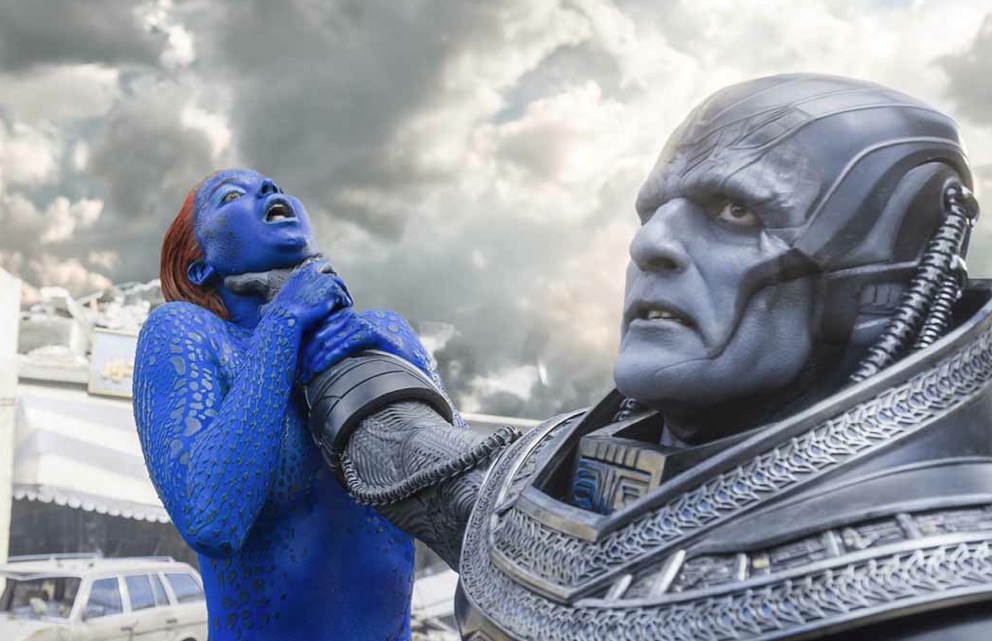
The third movie for the newly rebooted X-Men universe, X-Men: Apocalypse boasts a lot of the strengths that its predecessors have. For one thing, the performances are superb, and the actors exemplify their characters down to the molecule. McAvoy is earnest and well-intentioned as Xavier, while Jennifer Lawrence is motivated and sharp-shooting as Mystique. The actor I noticed most, however, was Michael Fassbender, once again adopting the role of Magneto. Every time I watch him, I am reminded of this character’s tragic history and how other people’s cruelty has driven him towards violence and extremism. Without giving too much away, there is one moment where Magneto sustain a crippling loss that comes to define his character the most throughout the picture. These moments remind us that Magneto is not a villain, but rather a tragic hero who fell through grace, and Fassbender is brilliant in capturing both the character’s regret, penance, and guilt throughout the movie.

The action is also incredibly polished, especially for an X-Men film. En Sabah Nur himself is the most omnipotent, wiping enemies away with a dash of his hand or the white glow of his eyes. Havok (Lucas Till) reappears alongside his brother Cyclops (Tye Sheridan) for the first time, and their red energies run amuck obliterating anything in their path. The most fun X-Man to make a return, however, is Evan Peters as the speedster mutant Peter Maximoff. You remember his signature scene at the Pentagon in X-Men: Days of Future Past. His scene in this movie blows that one out of the water. I won’t give much away, but saving over 30 people at superspeed is much more impressive than taking out six security guards in a kitchen. This sequence was funny, exciting, and most importantly, entertaining. His scenes were easily my favorite from the film.

The action and the characters culminate together fluidly, similar to the other X-Men films. The differences lie in its story, or more specifically, in its lack of focus. There are about five different stories packed into one in X-Men: Apocalypse, and most of them are unnecessary. You have so many unraveled narratives trying to weave together into one that quickly falls apart once the plot starts picking up speed. 

Take, for instance, the plight of Magneto. His story is pure tragedy. His hearbreak, his pain, his loss, it echoes of Magneto’s earlier history and builds into a climactic moment between himself and his transgressors. The scene should have been a moment of suspense and satisfaction, but then all of a sudden, En Sabah Nur appears on the scene and completely disjoints the narrative.

The whole film is like that, building up to big moments and then suddenly switching to other ones. There’s Xavier’s arc, then there’s Mystique’s, then Magneto’s, then Jean’s, and then Cyclops’. The most dissapointing to me is Peter. His story has to deal with his true parentage, but it never even leads anywhere. Screenwriter Simon Kinberg and director Bryan Singer build all of this effort up for nothing. No conclusion. No resolution. No payoff. That’s because they don’t have a focus, and the picture ends up losing our interest, despite all of its spectacular action.

X2 and X-Men: Days of Future Past remain to be the best entries of the franchise, while X-Men Origins: Wolverine is the unoquivocal worst. This movie falls in the middle ground. Like its predecessors, X-Men: Apocalypse has great action pieces and performances, but it collapses under the weight of its narrative while simultaneously lacking in depth and development. As Jean Grey observes after seeing Return of the Jedi, “At least we can all agree that the third one is always the worst.” You read my mind, sister.

Tagged , , , , , , , , , , , , , , , , , , , , , , , , , , , , , , , , , , , , , , , , , , , ,

“CAPTAIN AMERICA: CIVIL WAR” Review (✫✫✫✫)

A war of humans, not heroes. 

I’m going to make a bold claim here. Captain America: Civil War is the best MCU movie to be made to date.

I know, I know, I’m probably a little overzealous when I say that. Except that I’m not. I’m fully aware of what its competition is. There are two other Marvel movies that I can compare Captain America: Civil War with. Those two are Iron Man and The Avengers. All three of them are exciting, suspenseful, nail-biting, eye-widening entertainment that are just as fun and memorable as they are emotional and meaningful. They’re not just great superhero dramas. They’re great human dramas.

But Captain America: Civil War is especially unique to even these entries. How? The biggest reason is because it isn’t formulaic. In Iron Man and The Avengers, we had our heroes, our villains, and they went at each other like rock-em sock-em robots. Granted, there’s deeper insight and perspective than just the two-dimensional hero/villain foreplay, but you can’t deny the framework that’s there. There’s a clear cut good guy and bad guy, as there is in most superhero movies.

But that black-and-white sense of morality isn’t well defined in Captain America: Civil War. In fact, there isn’t really an established sense of right and wrong in the picture, just characters whose ideals and values clash violently with each other. You can argue that there is a quote-unquote “villain” in the movie, but he’s more of a viewer than an active participant to the conflict involved. If we have to go by titles in this movie, what we have then is hero against hero, Avenger against Avenger, and friend against friend. The ensuing action is nothing else but thrilling, thought-provoking, mind-blowing, and heartbreaking.

In this sequel to both Captain America: The Winter Soldier and Avengers: Age of Ultron, Steve Rogers, a.k.a. Captain America (Chris Evans) leads a new team of Avengers, consisting of Black Widow (Scarlett Johannson), War Machine (Don Cheadle), Falcon (Anthony Mackie), Vision (Paul Bettany) and Scarlet Witch (Elizabeth Olsen). After an international event involving the Avengers ends in high casualties, General Thaddeus Ross (William Hurt) and Tony Stark, a.k.a. Iron Man (Robert Downey Jr.) step in to introduce the Sokovia Accords, which states that the Avengers would no longer be a private organization, but instead will be employed and assigned missions by a United Nations panel.

There are two perspectives to the Accords. On one hand, the Accords would give a new level of accountability to the Avengers. They would be restricted in where they could go and what they could do, and the public casualties in turn could be lessened. Plus, the Avengers would now get paid for all of their superheroing. On the other hand, this could put a level of control and interference on the Avengers that would prevent them from doing the most good. Plus, being assigned to report to a panel leaves them vulnerable for manipulation, forcing them to do things that they wouldn’t otherwise.

Iron Man leads the side that’s for the Accords: Cap leads the side that’s against it. But regardless of both sides, there’s another player in the field whose looking to manipulate both sides to his advantage. And neither side realizes it until its too late.

The second Marvel movie to be directed by brothers Anthony and Joe Russo and the fourth to be written by Christopher Markus and Stephen McFeely, Captain America: Civil War is a superhero movie ripe with context, a movie that asks uncomfortable questions that we would much rather remain unanswered. Just like how The Winter Soldier related its plot to today’s world of government control, survaillance, and corruption, Civil War also relates to real-world issues that appeals just as much to reality as they do to fantasy.

Take, for instance, the introduction of the Sokovia Accords. These documents, much like the connection between S.H.I.E.L.D. and H.Y.D.R.A. in The Winter Soldier, presents the theme of government interference and how those implications affect our world. Yes, the Accords would impose an element of control and responsibility over the heroes, but at what cost? This is a situation where civil liberties are being traded for security, and the question is raised on whether its a good trade or not. Juxtaposing this idea of control in between our heroes raises very important questions: questions that are startlingly resemblant of our world abundant with government surveillance and manipulation.

But the movie doesn’t suffer under its philosophical weight. This is still one of those fast-paced, funny, exciting Marvel movies that you’ve come to love. It’s just now a fast-paced, funny, exciting action movie that has deeper insight and drama than the previous entries did. The issues involved draw us deeper into the film’s conflict and to each of the outcomes that these characters face.

There are two of these characters that I haven’t mentioned yet. One of them is the rebooted Peter Parker/ Spider-Man, who is played here by Tom Holland as opposed to the recently discontinued Andrew Garfield. Holland’s appearance in the film is brief yet significant, and while he doesn’t serve a role as important as the others, his charisma, immaturity, and innocent charm makes him for a very entertaining and memorable character, one who sticks out in my mind just as much as Captain America and Iron Man. To be rebooted in just two years time is definitely too soon, and part of me wonders how well Garfield would have done if he had been given the same opportunities as Holland was. That doesn’t take away from the fact that Holland still wins us over and sticks out in our minds just as strongly as Garfield and Toby Maguire does. He makes me very excited to see what’s in store for him for his eventual return in Spider-Man: Homecoming.

The other character is T’Challa, a.k.a. the Black Panther (Chadwick Boseman). If there is a neutral side in this conflict, it is in T’Challa, although at one point he does fight on Iron Man’s team. He’s so great because unlike Iron Man or Cap, his perspective is the most human out of the other players. He is the citizen Cap and Iron Man are fighting to protect. He is the one that faces the most casualty out of any of the other players. This natural perspective into the film is so important, because it demonstrates an investment that isn’t coming from another superhero: it’s coming from the victim of both sides of the conflict. That pain and confusion is so important to understand Captain America: Civil War not just as a Marvel movie, but as a complex drama on its own two legs.

The performances, the action, the visual effects, and the direction all accumulate masterfully, and the Russo brothers demonstrate a better understanding of their characters than they did in Captain America: The Winter Soldier. What we have left, then, is an unchallenged masterpiece, a moral dilemma packaged as a superhero blockbuster that excites us just as much as it challenges us. Iron Man and The Avengers both challenged themselves morally and ethically, but not so much to the point where it’s entire plot was founded around it. There was still a right or wrong in those movies. There isn’t in Captain America: Civil War, and that makes it just as compelling as it is entertaining. The one downside to this film’s success: now the Russo brothers have to follow this up with Avengers: Infinity War. I don’t know how they’re going to do it. I would personally guess that they can’t do it. But I’ve been wrong before.

Tagged , , , , , , , , , , , , , , , , , , , , , , , , , , , , , , , , , , , , , , , , , , , , , , , , , , , , , , , , , , ,