Tag Archives: Drama

“THE AVENGERS” Review (✫✫✫✫)

The ultimate example of comic-book superhero movies. 

I remember opening a comic book for the first time in my life when I was just a small kid. The small pamphlet fascinated me: by just a flip of a page, an entirely different world was created. A world where normal people gained super powers, wore red capes and tights, fought evil wherever it may exist, and made the world a safer place by the end of the day. In a small, poor neighborhood town where I was the only white kid in a predominantly Latino school building, it provided me a sense of relief and sanction from much bullying and torment I experienced from the other school children back in the day. It provided me freedom from the accursed world I lived in: it provided me a means of escape.

And now here I am, 15 years later, watching a live-action re-enactment of the world I discovered and loved all those many years ago. The Avengers is masterfully fantastic. It is an epic superhero tale, portraying the never-ending conflict of good and evil. It is an action movie with surprising finesse, switching from scenes of explosive energy and action to other scenes with insight, humor, and heartfelt emotion. It is a faithful re-production of multiple universes we have come to love in the past four years, and re-adapts them faithfully and full of energy in this film. But the core of this film’s success is this: that the film’s story and themes are emotional, honest, and truthful, and fleshes out its heroes to make them what they are: humans. All fighting for very human, realistic, and understandable reasons.

If you’ve seen the previous Marvel entries, you already know what this movie is about. The Avengers is a group of superheroes brought together to fight the battles that human beings never could.  Who are these heroes?  You would know most of them.

Tony Stark “Iron Man” (Robert Downey Jr): A billionaire playboy/philanthropist that has a genius-level-intellect that has allowed him to build and fight in a suit of armor.

Bruce Banner “Hulk” (Mark Ruffalo): A scientist exposed to gamma radiation, who turns into a giant, brutish beast with monstrous strength when he becomes angry.

Natasha Romanoff “Black Widow” (Scarlett Johansson): An agile and intelligent spy that is more skilled and capable than most other men.

Clint Barton “Hawkeye” (Jeremy Renner): A masterful marksman who can aim and shoot with his bow and various arrows in a matter of milliseconds.

Thor (Chris Hemsworth): The Norse God of thunder who can manipulate lightning with the power of his mighty hammer, Mjolnir.

Steve Rogers “Captain America” (Chris Evans): A super soldier frozen through time who can beat criminals to a pulp, as well as wielding a shield cast in a rare metal called “vibranium”.

You’ve seen these heroes before, most of them in their own respective movies.  All with their own stories, origins, conflicts, and themes that were explored along with their respective characters. My original worry with this film was, despite the huge expectations people were having, I was afraid this movie would let people down. It does, after all, have a lot on its plate: adapting over six superheroes into one action-packed movie is no easy task. We have Batman Forever and Spiderman 3 as evidence of that, where they had trouble of adapting even four super-powered beings to the big screen.

This film, though, has surprising finesse. Writer-director Joss Whedon adapts these characters with such child-like love and faithfulness, I feel their themes and stories from their previous films carry over to this film with them. It doesn’t feel like an adaptation, or an act of cruel financial commercialism. It lives up to the hype. The characters in this film live and breathe their uniqueness we have come to know and love from the previous Marvel movies. We feel Iron Man’s sarcasm and big ego, Thor’s sense of responsibility and brotherhood, Banner’s fear, frustration, and anger, and Steve’s sense of honor, patriotism, loss, and duty. Through the film’s dialogue and references to prior films, we sense Whedon’s pure intentions underneath the action, and we respect it. We realize he isn’t making just another action movie; he is making a superhero movie.  One with upmost faithfulness and loyalty to its own universes.

Impressive also, are the actors, but I don’t need to tell you that. We’ve seen them in prior films, so we already know they are good. I will comment then, on something we haven’t seen yet: their chemistry with each other. My word. This is what makes the Avengers, The Avengers. The actor’s chemistry with each other is spot-on, and in-tune. Whether it is a scene involving humorous, sarcastic dialogue, or another scene with painful realism and emotional truth to it, there is reality being shown in every single shot when an actor is with another Avenger on-screen. I can’t accurately describe it to you and do it justice. You need to see the film to understand their relationship with each other.

People are also wondering, of course, if the visual side of the film delivers. The answer is yes, but it isn’t just because it looks great; it is because of how they handled the great visuals they had for this picture. Too many times are we given films that have great visual CGI and explosions to overwhelm the audience with, but we have no suspense, excitement, or surprise to go along with it. It doesn’t make for an entertaining film. All that is left is a predictable action film that’s empty amidst the flat storytelling and redundant action sequences that just shows one explosion after another.

The Avengers isn’t like that. It doesn’t use its action as an excuse to fall flat and give up on entertaining its audience. Its excitement is relentless. Its suspense builds, and builds, and builds until we can take it no longer.  We scramble in our seat as we attentively watch what will happen next for our heroes.

This is the kind of excitement we need in superhero movies: the kind that is reminiscent of those kids watching Saturday morning cartoons, the ones that have you sitting on the edge of your seat with your bowl of “Captain Crunch” in order to see if your favorite hero does, in fact, save the day. It is this suspense and tension that builds The Avengers to incredible cinematic heights, and makes for some truly entertaining, memorable, and iconic moments in the picture.

The Avengers is the ultimate example of a comic book superhero movie. Whedon has a great subject to play with, sure. But his film is a great one not because he solely depends on the idea to be successful. This film is a success because he treats it the way it is supposed to be treated: as an exciting action-blockbuster that retains humanity to its characters, spirit to its humor, and excitement in its own story. I know somewhere in this world, some little ten-year old kid will watch this movie, and will one day be inspired to make his own superhero movie. It’s kind of depressing, though. It doesn’t really get much better than this.
Tagged , , , , , , , , , , , , , , , , , , , , , , , , , , , , , , , , , , , , , , , , , , , , , , , , , ,

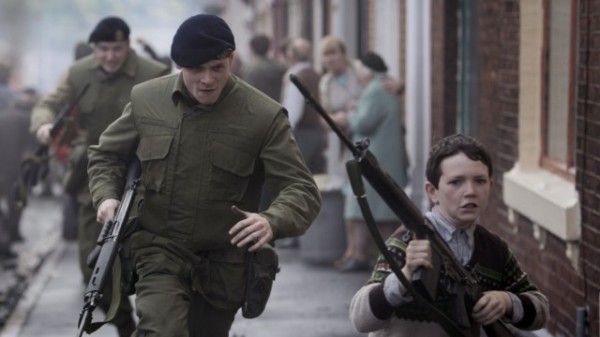
“’71” Review (✫✫✫)

A boy trapped in a soldier’s life. 

We’re always looking for someone to blame in war. Most of the time, the blame is directed at the soldier. Rarely do we blame the military, or the government, or those we are fighting, and even more rarely do we blame the people living stateside, in the warmth and comfort of their blanket and home and far away from the battlefield. No, if we are angered at travesties such as the Vietnam or the Afghan war, we don’t point at the general who gave the order to shoot. We point at the soldier who was following orders.

In ’71, the soldier is treated not as a cold-hearted, emotionless machine, but as a young man, a flesh-and-blood being full of heart and consciousness, but who is equally confused, hurt, alone, and afraid of the people he’s trying to protect. The controversy around another war film called American Sniper released a few months ago argued if we glorify war and the military too much. Those same people need to watch ’71 and realize there is nothing to glorify about it.

Taking place during the height of civil unrest in the Troubles, ’71 follows a young British army recruit named Gary Hook (Jack O’Connell), who gets deployed into Belfast during his first few weeks of training. Him and his squad is warned of the great dangers in entering the territory. Protestant and Catholic Irishmen are living side-by-side at each other’s throats, each with starkly different ideas of what is better for them. The protestants believe that the United Kingdom is their home and it is their best interests to remain with them. The catholics believe Ireland can be it’s own land and wants to secede from Europe. Hook and his fellow soldiers are just looking to keep the peace.

On the day of deployment, Hook watches as both sides come to a boil. The KGB is entering houses, threatening and beating people with their billy clubs, while an angry crowd of catholics gather outside in retaliation against the military. One of the rioting crowd members throws a rock and knocks a soldier out cold. A kid no older than ten grabs the soldier’s rifle and runs. Hook and another soldier chase after him when the crowd assaults them and beats viciously. Hook watches as the soldier is shot in the face. Hook only narrowly escapes with his life intact.

Trapped in Belfast with no way to find his comrades, Hook must fight through the night to survive against the city that’s hunting him.

Functioning more as a survivalist-thriller than as a pure-blooded war movie, ’71 strikes the viewer with sharp imagery and intelligence alike, filling them with a deepening sense of dread as we watch this young man crumble into desperation as he tries to escape from the people who are seeking to kill him. One of the things I love so much about this movie is how expertly it orchestrates itself and its emotions. French director Yann Demange, who before this directed British television shows such as “Dead Set” and “Top Boy”, debuts here as a talented filmmaker, crafting an exciting thriller that efficiently balances action with context.

I am reminded of another film similar in direction and subject, and that is Ben Affleck’s 2012 film Argo. In both films, the main character evades their pursuer through the chaos of a collapsing political climate. The camera captures the essence of both perspectives, with the pursuer desperately chasing their target while the pursued is equally as desperate trying to get away. And through both highly exciting and pulse-pounding features, both directors have deeper things to say about those societies and what impact they’re leaving on the people around them.

To me, ’71 is the British version of Argo, with one big difference: coherency. In Argo, everything is crystal-clear and straightforward. We know who the characters are, why they are there, what they are doing, who is after them, and how and why they plan to get away. In ’71, all of that is focused in towards one character only, and that is Gary Hook. We know everything we can know about a novice soldier, we just don’t know the same of everyone else around him.

For instance, the leaders of both factions, the catholics and the British Military Reaction force, are both skinny gingers with mustaches as thick as their hair. How can you tell who is who under the dim view of the street light? A young boy helps Hook towards a bar after his initial attack, but he’s on the same side as the people who are hunting him. Why is he helping Hook when he so clearly has so much disregard for British soldiers? In another scene, a Protestant seeks to help Hook when minutes earlier he had the cold, direct eyes of a killer with purpose. What inspired him to switch sides so easily? And then, near the end of the movie, there is a twist that didn’t make much sense to me at all.

Still though, the movie is there, and Demange handles the senses of unease and desperation well with the film, especially when trusting Jack O’Connell to portray all of these emotions at once. O’Connell is really having a strong career packing in for himself. In the past year, for instance, he created a very compelling presence in the prison-drama Starred Up and in the Angelina Jolie-directed biopic Unbroken. He makes a very strong case for choosing acting as a career in all of these films, and in ’71 he clearly shows that he can pull off the role of a young, desperate, and inexperienced soldier who just wants to go home. Demange was wise to cast him in this role and trust him with the emotional complexity of the character: O’Connell was the best part of the film.

I’ll admit, I didn’t understand everything I probably needed to understand in the movie, perhaps the biggest one being more aware of what the Troubles were in the 1970’s. Take that out of it. Take all of the political facets out of the movie, and what do you have? You have a raw, emotionally-charged war thriller that challenges the viewer to see it not from their perspective, but from the soldier’s perspective. Everyone hurts during the times of war. ’71 makes me wonder who war hurts the most.

Tagged , , , , , , , , , , , , , , , , , , , , , , , , , , , , , , , , , ,

“AMERICAN SNIPER” Review (✫✫✫1/2)

And hero, husband, and father.

Chris Kyle was an American sniper. Serving four tours in Iraq, with 160 confirmed kills and approximately 95 more unconfirmed, Kyle earned the title of being called the most lethal sniper in American history. More than being a soldier, though, he’s a father, a husband, and a friend. He was killed in 2013 at age 38. He was shot by a soldier suffering from PTSD that he was trying to help.

We know all these details going into Clint Eastwood’s American Sniper. We already know how it ends, we just don’t know everything leading up to it. Eastwood understands this, and uses it to his advantage as his film not only gives an honorable tribute to one of America’s most committed soldiers, but also foreshadows to a sad fate that we already know is coming. Gee, thanks a lot Clint. I didn’t even bring my tissues.

The film opens on the same startling scene that the book does: with Kyle looking down the scope of his sniper rifle at an Iraqi mother and her child, both of whom were aiming to suicide bomb a battalion of soldiers on the street. Eastwood sets up the tension of the scene perfectly here, with Kyle’s sweaty, darting eyes surveying the scene and desperately trying to see any way out of the tormenting choice he has to make. He soon dreadfully realizes there is no way out: it’s either the mother and her child, or the 15 soldiers and the suffering of their families back at home.

Think about being given that situation, about how devastating the experience must be and how haunting it must be to the person who has to make it. Now imagine having to make that same choice day, after day, after day, with your numbers climbing up until you’ve reached over 250 kills.

That’s the life of a soldier that Kyle has lived.

Kyle is portrayed in the film by Bradley Cooper, and both Cooper and Eastwood do a wonderful job representing Kyle here. They show that before he was a soldier, he was a citizen, an American with strong ideals and opinions and unafraid to show them or fight for them. Before he was shipped out and went on tour, they showed how normal Kyle was.

They showed that before he was a soldier, he was a man.

After having to make those difficult decisions day after day, how do you think that affects a man? In interviews, the real-life Kyle has said that he would not take back a single shot because every one that he took was to defend his brothers in uniform. I believe him when he says that, but I don’t believe that it didn’t leave an impact on him. Some soldiers suffer PTSD from killing just one man. How do you think more than 200 may have impacted Kyle?

Both Eastwood and Cooper do a great job humanizing Kyle here, and show that he’s more than the record kills he’s garnered. They show that Kyle is a man of coarse humor and blunt honesty, a man with a thick Texan accent and ideals, a man who tries to show that he’s strong and dependable, but who deep down is hurting and alone. The film is intimate in the ways that it shows Kyle, both in the chaos of battle and in the quietness of being home.

Cooper especially does a skillful job in portraying the iconic war hero. He expresses trauma and subtlety with the character so masterfully that the only differences I can tell between him and Kyle are minor facial features.

This movie has stirred controversy as of late for being “pro-war,” and for glorifying a man who was essentially labeled a murderer. I’m convinced these same people haven’t seen the same movie I saw, because the movie I watched unabashedly looks at the miseries of war and how the deaths Kyle could and couldn’t prevent affected him. The movie does suffer some slight pacing issues (not to mention the infamous “fake baby” seen in one of the shots), but when Eastwood resurrects a war hero to show the man behind the legacy, how can you look at this movie’s scope and not feel something for all of the physical and moral sacrifices Kyle had to give for his home? When the trumpet plays proudly over the solemnity in the end credits, you know that Eastwood represented a warrior in heart and a human in spirit.

Tagged , , , , , , , , , , , , , , , , , , , , , , , , , , , , ,

“WHIPLASH” Review (✫✫✫✫)

You won’t know what hit you.

I was a junior in high school when my dad took me out to a cabin in Montana for a “vacation.” I put “vacation” in quotations because we practiced music for nearly three hours every single day. I was a tuba player back then, and I practiced with my dad so I could make it into the All-Region band. One day, I wasn’t playing a single measure correctly. The notes I was supposed to play were on the downbeat, and I kept playing them on the upbeat. My dad made me play that verse over, and over, and over, and over again. He would get frustrated at me, yell at me, and push me harder and harder until I played that verse perfectly 100 times. I played that same frothy, infuriating verse for all three hours that day.

I say this to show you that the stuff you see in Whiplash isn’t fiction. It’s as feasible as the music you see, as vibrant as the drum beats you hear in a song, and as real as the passion that drives any musician, writer, and aspiring artist out there. Whiplash is special not just because it’s unique, but because it carries an uncanny truth for those who aspire to greatness. Perfection is never good enough. You’re pushing yourself over the edge just as much as the people around you are.

The kid aspiring to greatness in this story is Andrew Neiman (Miles Teller), a mild-mannered college musician who aspires to be the next Charlie Parker or Buddy Rich on the drums. The man he thinks can make him great is Terrence Fletcher (J.K. Simmons), a brilliant but brash and at times violent instructor who will throw a chair at you if you’re either rushing or dragging the tempo.

If you think I’m saying that figuratively, I’m not. That literally happens to Neiman during his first rehearsal with Fletcher in the movie.

Neiman aims to be the best drummer out in the world. Fletcher aims to be the best instructor in the world. These two men and their intense passions for their goals builds into a riveting, thrilling, and emotionally vigorous journey that is more involving and exciting than most of the year’s biggest action blockbusters. Yes, I am placing this above the likes of Transformers, Godzilla, and Guardians of the Galaxy. It’s that good.

How is it that this movie leaves such a lasting impact, when most people haven’t seen it, let alone heard about it? One of the biggest reasons, I think, is conflict. This is writer/director Damien Chazelle’s sophomore effort into film, his debut feature being the 2009 jazz film Guy and Madeline on a Park Bench. Both films are about jazz musicians, both are about people aspiring to other’s aspirations, and both are about never being good enough for those end goals.

There, however, is a sharp difference in tone between both pictures. One is a romantic drama about two lovers struggling to reconnect after slowly growing apart from each other. The other is an unconventional thriller that poses two musicians opposite one another to build a steady sense of unease and tension between the two. The result is a severely nail-biting, teeth-grating, and heart-pounding experience because of it.

Again, going back to conflict. My college screenwriting professor once told us that conflict is what compels story, and character’s struggling with conflict compels their development in the story. I am reminded of this no better than when I watch Whiplash, and that’s just because Chazelle sets up conflict really well in the movie. In the film, Neiman is desperate to prove himself as a musician. He moves his bed out of his dorm room in the place of a drum set. When he goes to sleep, he listens to the music that he’s practicing in his ipod. When he knows he’s not playing fast enough, he pushes harder until his hand bleeds. When his hand bleeds, he puts a bandaid on and keeps playing. When his bandaid falls off, he presses his hand in ice water, turning the clean liquid into an ugly shade of red.

Yet, despite all of his passion and initiative, Fletcher continues to press him and push him harder not necessarily to make him a better musician, but just because it’s never good enough for him. The level of intensity Fletcher shows in the movie makes you wonder where all of this anger comes from. Did he have his own version of Fletcher when he was a music major in college?

Which brings me to the next point: the performances. Teller and Simmons give two of the best performances out of the year in their roles, fully inhabiting their characters to the point where we become entranced in full immersion. Teller, who before this has starred in a string of bad raunchy comedies (Project X, 21 and Over, That Awkard Moment), re-establishes himself as a finer actor here. He shows that he has more acting chops than he lets on and proves that he’s more than just a pretty face. Simmons is on a whole another level. He was so scary, intimidating and maddening as this arrogant, hard-headed music professor that he made wind ensemble feel like drill camp.

I can only name one moment I didn’t like in the film, and that is that the ending is far too abrupt. It’s a perfect film otherwise. Chazelle wrote and directed this film as a reaction to writer’s block, and while he pulled inspiration from being a drummer in high school, I think the film is universal as far as its language and messages go. We are both Neiman and Fletcher for the things that we are passionate about. We aspire to do great things, and we beat ourselves up when we don’t do those great things. We will push ourselves to and over the edge when we don’t measure up to our own expectations. But what’s the point of doing all of those great things if you’ve lost the joy in doing them? I quote my dad, who has always pushed me in a better way than Fletcher has: “You don’t have to be number one to be amazing.”

Post-script: In defense of my dad, some people might say he was going too hard on me, or that I didn’t deserve all of the strain that he would put me through. You would be wrong. I made third chair in the Texas All State band because he didn’t give up on me.

Tagged , , , , , , , , , , , , , , , , , , , , , , , , , , , ,

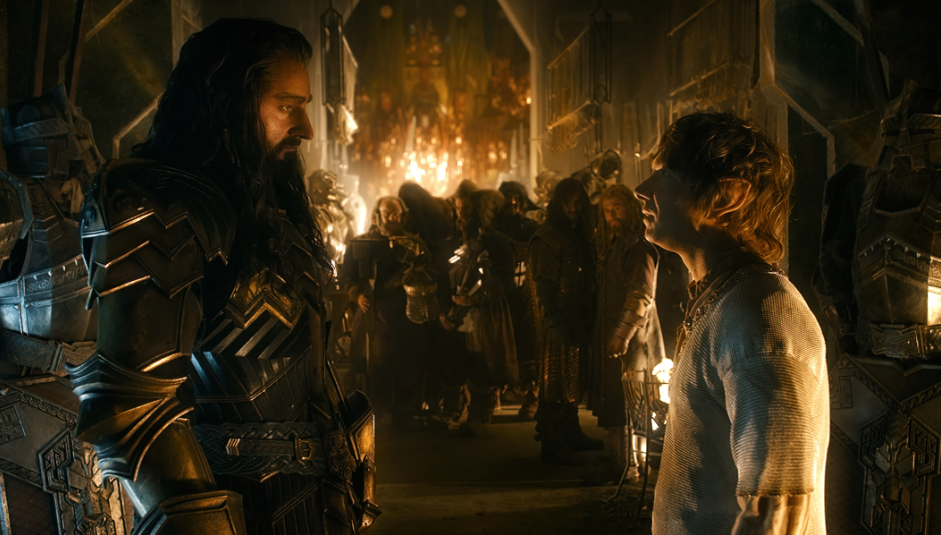
“THE HOBBIT: THE BATTLE OF THE FIVE ARMIES” Review (✫✫✫)

And the Dwarf King: The Battle for Himself. 

Here it is, at last: the end of Peter Jackson’s Hobbit trilogy. It hasn’t arrived without it’s challenges. Originally, the series was supposed to be directed by Hellboy director Guillermo del Toro before he dropped out and let Peter Jackson hop back in the director’s chair. Then, Jackson decided to turn it from two movies into three because he wanted to “expand the story.” Then in April, he decided to retitle the third film from There and Back Again to The Battle of the Five Armies. Every indication from the production of this film has shown that the movie was going to be either the weakest entry or the most unnecessary film out of the series. Jackson, however, has overcome every obstacle in his path and made a film that is just as exciting, enduring, and memorable as any other film in the series. Jackson’s persistence is something to be admired.

Picking up after that horrible cliffhanger of an ending we got from The Desolation of Smaug, The Battle of the Five Armies opens with Smaug the Dragon (Benedict Cumberbatch) laying waste to the village of Laketown shortly after he was set free by Bilbo Baggins (Martin Freeman) and Thorin Oakenshield (Richard Armitage). After setting the village on fire and killing many of the villagers, Bard the bowman (Luke Evans) escapes from prison, climbs the highest tower he can find, and kills the dragon with the black arrow he inherited from his father.

With Smaug dead, the dwarves have taken possession of the Lonely Mountain. However, something strange is happening to Thorin. He has become more greedy, violent, and eager to find the Arkenstone in the chamber and become the next king of the mountain. Bilbo has noticed his new attitude, and finds it disturbingly similar to that of Smaug’s personality. As tensions grow inside the mountains, things heat up with elven, eagle, orc, and human armies assembling outside of the mountains as well. Now with the four armies gathering to take the mountain from the dwarves, Thorin gathers his own dwarf (and hobbit) army to protect their inheritance and keep it from unworthy hands.

The third movie in any trilogy is always the most crucial. It either makes or breaks the series, making it just as memorable as The Lord of the Rings trilogy, or as half-baked as the Matrix trilogy. Part of me wonders why they even had to make a third movie at all, and why they couldn’t just combine this with The Desolation of Smaug. That was originally the plan, after all, but I guess if they did that, they would run the risk of shoehorning two plots into one film.

Honestly though, I don’t know if it would have been that big of an issue. The Hobbit: The Battle of Five Armies offers exactly what the title suggests: a battle which is bigger and bolder than any other fight in the Lord of the Rings movies. Yes, that includes the final siege on Sauron in Return of the King and the fight against Smaug in Desolation of Smaug. The scale and scope is bigger here than any other Lord of the Rings movie, with elves, dwarves, eagles, orcs, villagers, trolls, wizards, spirits, and a hobbit crashing, slashing, and colliding into each other like nobody’s business. This is the most action-packed Lord of the Rings movie yet, with it’s final lengthy action sequence clocking in at about over an hour.

Some of the action runs rampant and gets repetitive now and then. In one scene, for instance, Legolas the elf fights against an orc on a tumbling castle. The scene ran for well over 20 minutes, with them clashing swords and fists against each other, and I sat there wondering to myself “Why couldn’t he just trip him off and be done with it?”

But here’s the interesting thing: no matter how long the action ran, it kept me engaged. If this were a Michael Bay or a John Woo picture, the action would have ran wild and I would have gotten bored about 10 minutes into it. But Jackson is more talented than most filmmakers. He understands that in order for your audience to be invested in the action, they need to be invested in the characters first, because what’s the point of having characters go through these epic fights if you don’t care about them?

With this movie, I noticed that the character I cared most for was not Bilbo Baggins, but Thorin Oakenshield. He has the most interesting arc out of any other character in the movie, spending one half of the film fighting orcs, and the other half fighting himself. His character in the film reminds me a lot of Gollum: his conflict isn’t so much with others trying to take the things precious to him, but with himself in how the things he values most changes him. He especially serves a crucial part in the film’s final climatic battle scene, which is so nerve-wrecking and heart-pounding that it brought me just as much excitement as the climax in Return of the King did. The impressive part? Return of the King’s climax featured an entire armada of warriors, while The Battle of the Five Armies’ climax only needed two.

All in all, The Battle of the Five Armies did to The Hobbit what The Return of the King did to The Lord of the Rings: it wrapped it up nicely into a tight, satisfying conclusion, bringing excitement, emotion, and resolution to these characters that we’ve cared so much for so long now. Granted, it didn’t do as well as The Return of the King did with this, and I personally would have wished that Jackson would have made it less messy and cluttered than it already was. Does that ultimately matter, though, if I had fun watching it? Let’s just be glad that Bilbo made it there and back again in one piece.

Tagged , , , , , , , , , , , , , , , , , , , , , , , , , , , , , , , , , , , , , , , ,

“THE HOBBIT: THE DESOLATION OF SMAUG” Review (✫✫✫)

Be honest, Mr. Smaug: do you need a breath mint?

The Hobbit: The Desolation of Smaug is both one of the most satisfying and maddening films of the year. It’s visually splendid, illustrating the joys and perils of the world of Middle-Earth as finely as any movie before it did. It’s emotionally versatile, being comical and lighthearted at certain moments and then treacherous and gloomy in others. The performances are sound, with CGI characters being just as memorable as the live ones. Everything in the film was perfect up until it came to it’s end, which ended on a cliffhanger so big that a slackwire artist couldn’t tightrope across it.

Taking place shortly after the events of An Unexpected Journey, The Hobbit: The Desolation of Smaug continues the journey of Gandalf the Grey (Ian McKellan), Thorin Oakenshield (Richard Armitage), his troop of dwarves, and the slight hobbit Bilbo Baggins (Martin Freeman). After narrowly escaping the clutches of the white orc Azog (Manu Bennett), Bilbo and the rest of the dwarves venture on towards the Lonely Mountains, only having a few days left until the secret entrance closes, leaving them forever locked outside of the Lonely Mountains.

Bilbo, however, has greater concerns if the dwarves do manage to get inside. Deep within the twisty lairs of the mountain lies an endless sea of gold and jewels, and asleep among these riches is the vicious Smaug (Benedict Cumberbatch), a violent, terrifying dragon that formerly laid waste to the dwarves’ land and took their possessions all for himself. If the company does manage to get inside the mountains, Smaug will be waiting there for Bilbo, and there will be a massive conflict between the 100-foot tall fire-breathing dragon and the small, terrified hobbit.

One of the things I love about The Lord of the Rings movies is that the stakes are set up really well in them. Peter Jackson, who has been writing/producing/directing/godfathering the series since The Fellowship of the Ring has proven time and time again how well he can make depth-defying set pieces and visual spectacles, all while raising the emotional stakes of the movie.

Here is yet another example of what Peter Jackson can do in a movie. Visually, the film is unparalleled. There were many moments in the film that I recalled for being either visually spectacular or heart-poundingly exciting. One of them was a eerily creepy fight scene where Bilbo and the dwarves were fighting off an army of spiders in a cursed forest. Another was a chase scene where the crew was stuck in a line of barrels while falling down a waterfall. Other instances in the film include when the dwarves encountered a giant who could transform into a bear, or when Gandalf confronted an early confrontation of Sauron in his own castle. And don’t even get me started on when we meet Smaug for the first time. Jackson’s visual prowess excels just as much as his emotional involvement, and with each of his movies, he always seeks how to outdo himself from his last effort. I’d say he’s outdone himself tremendously here: the look of the film shows just that.

The performances are just as refined as the action and visual effects are. Martin Freeman was just as charismatic and loveable as he was the first time he was Bilbo in An Unexpected Journey, and Ian McKellen once again does well as the wise, ambitious, righteously-driven wizard Gandalf. And Richard Armitage has gained traction as Thorin Oakenshield since the first movie, showing that he can be more than the brutish tough guy. He’s a more vulnerable, more fleshed-out character here, with deep desires and hidden intentions showing that perhaps will be explored more in the third installment.

My favorite character by far, however, wasn’t even from a live performance. Benedict Cumberbatch was frightening, fearsome, and daunting as the terrible Smaug, his articulate, vocabulary-filled speech lining up perfectly with his sinister, seething voice. The visual spectacle of Smaug is perfect, with the dragon leaning luminously over his small, feeble enemies, while his long, slender, scaly arms and body lunge across the dungeon like an elongated spider. But the vocal performance is what makes him convincing, what makes him more than just a CGI creation and a terrifying villain in his own right. The minute I heard Smaug speaking to a shaking Bilbo, I had shivers run down my spine. The entire time he was speaking to Bilbo in mysterious anecdotes and sinister undertones, I was on the edge of my seat. When he started to attack, I clutched my mouth and stared endlessly at the screen, wondering and hoping for the fate of these characters in Smaug’s way.

In An Unexpected Journey, Bilbo benefits from being a more active protagonist than that of Frodo. Here we have Smaug, a giant, fearsome beast that is more actively sinister and spiteful than the stillness of Sauron from The Lord of the Rings.

Everything in the film is refined to the quality of film that you’d recall from The Lord of the Rings trilogy. My only regret is the copout, cliffhanger of an ending that inspired my theater to erupt into boos and groans. I hate it when movies do this to me. They put in so much effort to make a great film up until the last five minutes, where they pull the rug from under you and say “Sorry, that’s all for now! See you next year!” What was Peter Jackson thinking when he went with this ending? At the end of each Lord of the Rings movie, it ended with some form of closure and assurance that the adventure would continue into the next installment, but you didn’t know how it was going to pan out. It kept us intrigued, and it kept us wondering what would happen next. With this movie, it sets itself up to where we already know how it’s going to end: we just don’t get the payoff along with it.

I quote J.R.R. Tolkien: “Books ought to have good endings.” The same should be said for movies.

Tagged , , , , , , , , , , , , , , , , , , , , , , , , , , , , , , , ,

“THE HOBBIT: AN UNEXPECTED JOURNEY” Review (✫✫✫✫)

A journey J.R.R. Tolkien would want to go on. 

The Hobbit: An Unexpected Journey is the story I first experienced when I saw The Lord Of The Rings: The Fellowship Of The Ring for the first time. Like The Wizard Of Oz or Harry Potter and The Sorcerer’s Stone, it’s a sweeping fantasy about ordinary characters getting thrown into extraordinary circumstances. So if hobbits, dwarves, wizards, and fire-breathing dragons constituted as “ordinary” in this universe, imagine the extraordinary circumstances that they go through.

Serving as a prequel to the J.R.R. fantasy epic The Lord Of The RingsThe Hobbit tells the story of Bilbo Baggins (Martin Freeman), a relaxed and easygoing hobbit who doesn’t like to do much throughout the day except for eat, sleep, and smoke his pipe every now and then. One day, he gets a visit from a mysterious stranger named Gandalf (Ian McKellen), an elderly wizard who is looking for shelter and a young companion to go on an adventure with. Much against Bilbo’s wishes, Gandalf not only stays in his small village home: he invites an entire company of dwarves, who proceed to wreck Bilbo’s house and eat everything in his fridge.

After having a nervous breakdown and cleaning up his entire house, Bilbo overhears Gandalf and the small dwarf brigade’s plans. Ages ago, the dwarves‘ prized possession, the Lonely Mountain, was overtaken by a vicious fire-breathing dragon named Smaug, who destroyed their village and stole the castle and all of it’s gold for his own desires.

After being betrayed by their allies, the elves, and being left to fight for their land all by themselves, the dwarves are determined to travel back to the mountain and fight for their home. Bilbo must make a decision of continuing to live on his normal, uneventful life, or to reach out, travel with the dwarves, and seek out adventure the likes of which he’s never experienced before.

Remembering that it was only a few years ago when I originally fell in love with The Lord of the Rings: The Fellowship of the RingThe Hobbit: An Unexpected Journey is a prequel that hits on all of the right notes, and then some more that I wasn’t expecting. In comparison to it’s elder companion, The Hobbit is uncanny. It has a wide verse of characters, each one being unique and memorable both in appearance and personality. It has a dynamic and involving story, ripe with exposition and emotion, retaining your full attention despite the lengthy run time. And it has highly stylized set pieces and visual spectacles that excite the eyes and overwhelm the mind. Do not mistaken Peter Jackson’s intentions here: he was inspired by Lord of the Rings when he was making The Hobbit.

And yet, there are so many differences from The Hobbit to The Lord of the Rings. One of the biggest, I think, would be it’s protagonist. Bilbo is different from Frodo, his nephew in Lord of the Rings whom Elijah Wood inhabited so wonderfully. They’re similar, of course, in that they are small hobbits not necessarily fit for fighting, but are clever, creative, and courageous nonetheless.

And yet, Bilbo is so much more than Frodo is. He’s funnier, for one thing, a bumbling, clumsy little hobbit that reminds me so much of the antics between Pippin and Merry in the original movies. He’s also more outgoing, a more active protagonist doing more in the film than just holding a ring and trekking long miles. He does so much in the film, sneaking around trolls, fighting Orcs, going through traps and mazes, and having a first-hand involvement in many of the film’s biggest fights. My particular favorite scene is one where he is talking to a fan favorite from The Lord of the Rings about the possession of a mysterious gold, rounded object. Hint: His favorite word is “precious.”

My point in saying all of this is that Bilbo is a dynamic character in his own right, and Martin Freeman handles the character very well. In the previous movie trilogy, Freeman had four hobbit inspirations to pull from, and instead of following just one of them, he took characteristics from all of them and made a character all his own. That took great talent and risk, and Freeman’s efforts paid off, making a character that I think is the most memorable and charismatic hobbit out of all of them.

Without a doubt, the best film in the series is Return of the King. This film is perhaps the second best. Sure, at times it might suffer from a slight overdose on exposition, but doesn’t all of the films? The Hobbit: An Unexpected Journey is an adventurous, ambitious gamble of a film, and it makes me believe once again in the power that a wizard, a slew of dwarves, and a brave little hobbit can have.

Tagged , , , , , , , , , , , , , , , , , , , , , , , , , , , , , ,

“INTERSTELLAR” Review (✫✫✫1/2)

A space odyssey led by Christopher Nolan. 

The first time I watched Christopher Nolan’s Interstellar, I knew I had found something special, but didn’t know if I fully comprehended everything I saw. I just finished watching it a second time, and now I understand I’m not supposed to comprehend everything I saw. Interstellar is mesmerizing and breathtaking, a highly ambitious and exhilarating journey taking you through the far reaches of time, space, planets, wormholes, black holes, stars, and anything else in space that you can think of. But just like space, it is also vast and daring, reaching for a vision that it cannot possibly hope to grasp. That’s okay. It’s better to aim for too much rather than too little.

Based off of an idea conceived by theoretical physicist Kip Thorne, Interstellar takes place in the distant future, where the Earth is slowly dying and the only source of sustainable food is by growing corn. Cooper (Matthew McConaughey), is an aerospace engineer-turned-farmer just trying to make it day to day with his small family, consisting of his father-in-law Donald (John Lithgow), his son Tom (Timothée Chalamet), and his daughter Murphy (Mackenzie Foy). Like the great astronauts Neil Armstrong and Buzz Aldrin, Cooper dared greater things in his younger years. He wanted to fly. He wanted to explore. He wanted to traverse and discover new spaces that he hasn’t seen before. Now he’s only concerned about making sure his family survives.

One day, him and Murph discover a secret space station that has been hiding NASA, which has been operating in secret since the world state of health has declined over the years. When Cooper finds out that the Earth will soon be unable to sustain life and that his daughter’s generation will be the Earth’s last, Cooper is recruited on a daring space mission to find a new planet that is able to sustain and save the human race.

Written and directed by Christopher Nolan, Interstellar is a testament to the quality of film that Nolan is consistent in making. It has all of the elements that you appreciate in all of his films. It has a grounded, human story intertwined in a brilliantly woven, thought-provoking plot. It has well-rounded, relatable characters that you root for and admire deeply. It has incredibly breathtaking visuals, created with the same visual and cinematic sense of style that is unique only to Nolan’s movies. And it has plot twists the size of Mount Everest, taking complete 180 turnarounds when you least expect it. You will not see the end of this movie coming.

Interstellar is up to par with many of Nolan’s other works, including The Prestige, Inception and The Dark Knight. If I’d continue on about those qualities, however, I’d be writing the same review for those films. It’s easy to write about the things you’ve already seen: I’d like to write about how this film is different from Nolan’s past work.

For one thing, the performances are the best they’ve ever been in any of Nolan’s films, and the heart of this film’s emotion comes from that of Matthew McConaughey. I love how his character is represented in this film, and I especially love how McConaughey handles him. He isn’t handled as a bold science-fiction action hero similar to the likes of Han Solo from Star Wars or James Kirk from Star Trek. He’s more human than hero, a vulnerable and quietly suffering man who just wants to go home to his daughter, but knows he has a greater duty in fighting for the Earth’s survival. I’ve always appreciated the humanity Nolan has always instilled in his characters, but somehow McConaughey reaches an emotional depth much deeper than that of his predecessors. I like seeing McConaughey jumping from such polar opposite roles as this from Dallas Buyers Club, yet giving the same dedication and credibility to both characters. He has proven himself to be an extremely versatile actor, whether it be for small, independent films like Dallas Buyers Club, or big Hollywood productions such as Interstellar.

I am also led to believe that this is the most scientifically accurate out of any of Nolan’s other films. Working closely with Kip Thorne on how accurate the film would be, Nolan worked hard to realize both his vision and Thorne’s, abiding by Thorne’s recommendations and notations as closely as possible. His representation of a wormhole in space. His portrayal of relativity to time and space. Thorne has gone on record to say that there is one major scene demonstrating high artistic freedom, and that is when Cooper visits a planet that has “ice clouds”. This film is intensely interesting and fascinating, and the coolest part to me is knowing that most of this was reviewed by a well-known physicist who has deemed it all possible.

Side note: please excuse me for using the word “coolest.”

There are a few weaknesses to mention. As a Nolan film, it is expected to be extremely complicated, and I admit to needing to see the film multiple times to even begin to understand it. I know many others will have a harder time at understanding it than I did. There were a few slow lulls in the film that detracted from its steady pace, and there were severe sound mixing issues at the beginning of the film that I noticed almost immediately. I’m no sound expert, but when the music is so loud that I can’t even hear what a character is saying, I think you need to fix something before you release the film.

I think it was the third act that really sold me on this film, the last half of the story that compelled me to believe that this was a very memorable journey, and it was. I won’t go into the particulars for the sake of spoilers, but I will say that Nolan is a master at orchestrating thrilling and tense-heavy climaxes. Sure, I would like that to persist throughout the rest of the movie, but I won’t complain. I appreciate Nolan’s ambition, if I appreciate nothing else.

Tagged , , , , , , , , , , , , , , , , , , , , , , , , , , , , ,

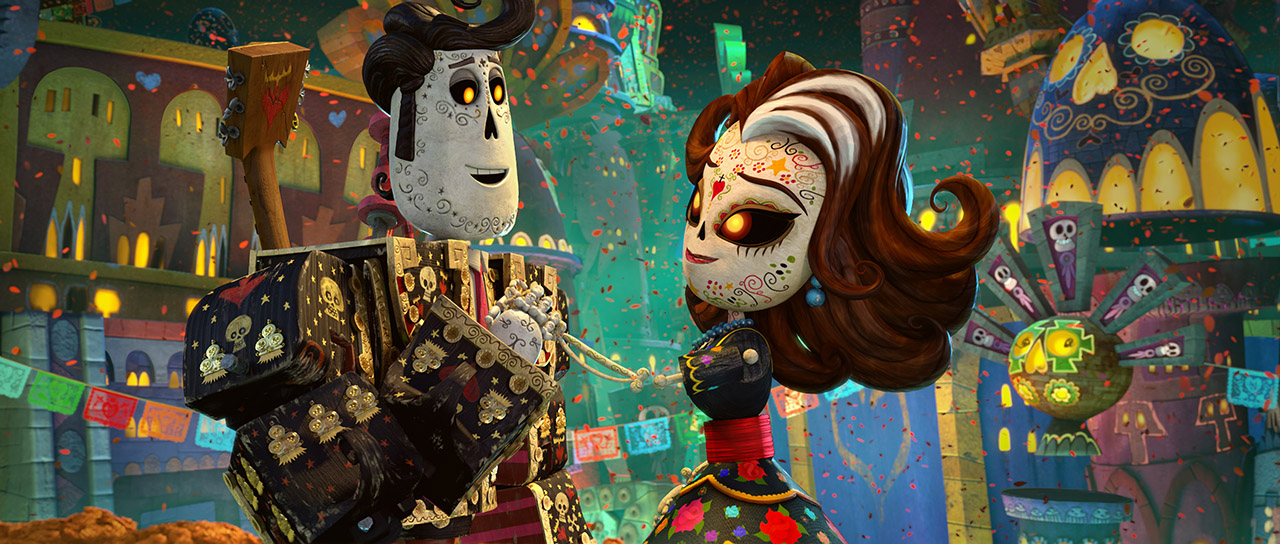
“THE BOOK OF LIFE” Review (✫✫✫)

book of life

Ay caramba, tu joven amantes.

As children, we were told many fairy tales that filled our young minds with wonder and imagination. We looked at the pictures in our tiny children’s books as our parents narrated the words to us, but did we ever stop to think about where these fairy tales came from? The Three Little Pigs came from England. The Little Red Riding Hood, London. The Fountain of Youth, Japan. The Little Mermaid, Denmark. The Sorcerer’s Apprentice, Germany. So many stories have come from so many places all around the world that by the time they reach us, we have “cleansed” it of it’s culture and Americanized it for our own comfort.

Here, we have Jorge Gutierrez’s own fairy tale called The Book Of Life, and for the sake of the movie I’m glad it didn’t succumb to mainstream appeal by having it take place in Colonial America. The Book Of Life is splendid, a wonderful, uplifting, joyous, and immensely entertaining animation engulfed and inspired by the culture Gutierrez came from. Think about how quickly you are swept away when you read the fairy tales by the Brothers Grimm, and you can imagine how this film sweeps you up in that exact same way.

Told as a story within a story similar to Rob Reiner’s The Princess Bride, The Book Of Life follows a group of schoolchildren through a museum as they are told the tale of Manolo (Diego Luna), a Mexican bull fighter who is fighting for the heart of his childhood friend Maria (Zoe Saldana). His closest friend and rival, Joaquin (Channing Tatum) is also fighting for her love, and when they finally see each other after many years apart, they begin their pursuit for Maria’s love.

Unbeknownst to any of them, however, a heavy secret hides behind their innocent intentions. The spirits of the afterlife La Muerte (Kate del Castillo), who rules the world of the remembered, and Xibalba (Ron Perlman), the one who rules the world of the forgotten, have placed a bet on these three friends. If Manolo ends up marrying Maria, La Muerte wins and gets to rule both the land of the remembered and the forgotten. If Joaquin marries Maria, Xibalba wins and he gets to rule the land of the remembered. The world of the undead is at stake here, and it’s up to Manolo, Maria, and Joaquin to set things right.

What do I say about an animated children’s film that’s based around Mexican fables and customs? The Book Of Life is a wonderful animation: bright, vibrant, colorful, and lively all at once. Writer/director/animator Jorge Gutierrez has a careful eye for detail, and does well in visually adapting to different scenes, settings, and moods.

In one scene, after one of the supporting characters die, the setting suddenly becomes dark. The sun drops. The candles burn out. A cloudy fog envelops in the sky as rain drops pellet onto the ground. In the very next scene, however, we see the world of the remembered from this deceased person’s perspective, and it is lively colors light up with shiny, gold-brick pathways illuminating everywhere and with Churros and balloons floating as far as the eye can see.

This is what I mean when I say the animation is versatile: it’s attentive, eye-catching, and delightful, demanding your attention the minute you lay your eyes on it. But it’s not just the animation that works so well with this movie. The Book of Life is entrenched and inspired in its own culture, living and breathing the Mexican customs though every frame of its run time.  There is one work that Gutierrez did this with before The Book Of Life, and that is the Annie award-winning Nickelodeon cartoon series “El Tigre: The Adventures of Manny Rivera.” Now we have The Book of Life, and I feel it will spur on many Mexican children and families to pick up their heritage and be proud to represent it. In a day and age where Hollywood feels they need to Americanize everything, The Book of Life is a Godsend.

Everything else in this film functions exactly as it is supposed to. The story is mostly formula in that there has to be a good guy, a bad guy, a forbidden love, a big fight scene at the end, and a happy ending. The voice cast is solid, and Channing Tatum didn’t annoy the living daylights out of me for a change. And the music by Gustavo Santaolallo is pristine and authentic, with the plucking of the Mexican guitar strings filling your ears with wonderfully harmonic sound.

But make no mistake. The best thing about this film is the inspiration Gutierrez instills in it, the inspiration that his parents most likely instilled in him when he was still just a little boy. I hope there will be a children’s novelization of this film in the future and that it too will inspire children of all ages, regardless of their heritage.

Tagged , , , , , , , , , , , , , , , , , , , , , , , , , , , , , , , ,