Tag Archives: Drama

“SUICIDE SQUAD” Review (✫✫✫)

Worst. Heroes. Ever.

If you do not like superhero movies, do not watch Suicide Squad. I’m warning you now. It’s a haphazard, off-the-wall, ridiculous superhero/villain exercise that is psychotic and gleeful in every way imaginable. I highly doubt that your chess club or church study group would enjoy seeing this movie. To enjoy it is possible, but it has to be from a fan of the material.

I myself am a fan superhero movies, but only when they are confident and competent with their vision and purpose. DC’s earlier Man of Steel was one of those movies, and while many spoke out against the controversial changes to the character, the movie at least understood those changes and how importantly they played into the greater mythos of Superman. The more recent Batman V. Superman: Dawn of Justice, comparatively, was neither confident or competent, hopping around everywhere, having no clear focus or clarity, and was more interested in setting up its future installments rather than developing its current story or characters. If you are looking for the potential of superhero movies, you need look no further than DC’s own successes and failures. 

And yet, Suicide Squad doesn’t fall anywhere between being masterful or disastrous. It finds solid middle ground between action and absurdity as its villains fight, shoot, punch, breathe, feel, emote, joke, and laugh maniacally at each other’s antics. The movie fulfills every insane requirement that you expect it to have and then some.

Following up after the events of Batman V. Superman, Suicide Squad shows government official Amanda Waller (Viola Davis) playing a dangerous gamble with national security. After seeing the world’s most important hero bite the dust, Waller wants to assemble a task force to protect the world from supernatural threats. This team would consist of imprisoned supervillains Waller would have under her control. If they succeed in doing what she says, they get time off from their prison sentences. If they rebel, a microchip in their neck explodes, killing them in a heartbeat.

These villains are no joke. Floyd Lawton, a.k.a. Deadshot (Will Smith) is a master assassin who hits his target with every pull of the trigger. Harley Quinn (Margot Robbie) is a mad woman who is insanely in love with her fellow baddie the Joker (Jared Leto), whom she affectionately refers to as “Puddin'”. There’s the heathen thief Digger Harkins, a.k.a. Captain Boomerang (Jai Courtney), the reptilian-looking beast Waylon Jones, a.k.a. Killer Croc (Adewale Akinnuoye-Agbaje), and the repenting Chato Santana, a.k.a. El Diablo (Jay Hernandez), who can emit flames from his body. These villains-turned-sorta-heroes are forced together to do greater good, whether they like it or not.

Suicide Squad reminded me of another superhero film I watched earlier this year, one that also had a simple, straightforward plot, was unorthodox in nature, and featured a character that frequently crossed the line. I’m referring to Deadpool, which like Suicide Squad, took joy in its characters and frequently mocked genre cliches in its fellow superhero movies. They’re not quote-unquote “good guys”, and that allows them to break the mold of the typical action movie. It lets them be much more loose and flexible in their morality, and by that definition, it also lets them be more fun.

The differences with Deadpool and Suicide Squad, of course, lie with its parodist style. Deadpool called out superhero conventions with the middle finger and a dirty mouth. Suicide Squad inhabits these conventions while at the same time not playing to their nature. You can argue back and forth which is the better film, but there is one thing you cannot argue: the divisive nature of its fans.

Oh, to say this movie got mixed feedback is a strong understatement. Suicide Squad is currently at 26 percent on Rotten Tomatoes, 40 out of 100 on Metacritic. “A clotted and delirious film” is what Peter Bradshaw wrote for The Guardian. “Clumsy and disrupted” is what Ignatiy Vishnevetsky wrote for The A.V. Club. Perhaps the worst criticism comes from Kyle Smith from The New York Post: “What promised to be a Super Bowl of villainy turned out more like toddler playtime.”

I get that these movies aren’t necessarily geared towards critics, but at the same time, I also understand who these movies are trying to appeal to. Critics don’t bring box office numbers. Fans do. And they don’t care about a film’s direction, artistry, uniqueness, genre conventions, cliches, or anything else that critics are normally concerned about. They care about how fun it is and how faithful the movie interprets their favorite comic book characters.

With that criteria in mind, Suicide Squad is all sorts of fun and faithful, with the chemistry of its actors colliding into each other like the most dysfunctional supervillains you’ve never seen. The best thing about this movie is easily its cast, who inhabit their roles so fluidly that you take their villainy at face value without judgement or questioning. Margot Robbie in particular stands out as Harley Quinn, who has an enthusiastic wackiness and infectious personality to her that you can’t help but fall in love with. She’s a fun yet tragic character, the squad member who easily has the most life to her twisted laugh and dark humor. Robbie does a lot more than merely portray Harley Quinn: she is Harley Quinn, just as much as Hugh Jackman is Wolverine, Ryan Reynolds is Deadpool, dare I say it, as Heath Ledger is the Joker.

But she’s not the only one that impressed me so much. The entire cast have their moments, and whether it was major or minor scenes, they inhabited the nuances of their characters with skill and brilliance. Smith, who normally gets stuck in a routine of portraying the stock action hero, switches it up a little bit here by bringing his “Fresh Prince of Bel-Air” personality to lighten the movie’s mood, and the tone is surprisingly fitting. Jai Courtney, who to date has never impressed me from A Good Day To Die Hard to I, Frankenstein, fully embodies his role as this dirty, loud-mouthed, unappealing mass of redneck. Even Karen Fukuhara, who makes her debut as sword-wielding warrior Katana, provides a performance so versatile that she could be powerful and intimidating in some scenes, yet fragile and intimate in much smaller moments. This was a great debut for her talents, and I eagerly wait to see what her next role is after this.

Sadly, my least favorite character is the one that I was most eager to see: Jared Leto’s Joker, who plays a smaller role in the movie than people may expect. The problem is not Leto’s performance, who throws every bit of his energy and effort into this role. It’s how the character is written. If you take away the green hair, the makeup, the tattoos, and the grilled teeth, what you would have left is not the Joker. You would have a stock movie gangster that is obsessed with guns, knives, torture, slick cars, and violence, with no demeanor of his resembling that of a clown or a twisted comedian. The Joker we have in this movie is not the anarchist you’ve come to know him for. He’s a mob boss, and that is an absolute waste on the character’s potential. The Joker is a much more interesting villain than that, and Leto deserves so much better than just portraying Scarface with makeup on. If this Joker is going to reappear in future DC installments, they will need to rewrite the character in order to make him more accurate to his origins.

I can easily name a few other flaws from the movie. A few character’s motivations make no sense. The editing in the first act was choppy and erratic. And the action, while fun and stylish, was at times long and overbearing. None of this changes the odd-baldish chemistry the actors share, the unique spin the movie itself has on the superhero genre, the compelling dichotomy between the characters, or the fact that this is one of the most exciting movies I’ve had the pleasure to sit through this summer. Many more critics will no doubt discount this movie as supervillain trash, but this movie was not made for them. This movie was made for me. And I will say without batting an eye that Suicide Squad is sickeningly entertaining.

Tagged , , , , , , , , , , , , , , , , , , , , , , , , , , , , , , , , , , , , , , , , , , , , , , , , ,

“STAR TREK BEYOND” Review (✫✫1/2)

A little short of beyond, actually. 

A wash of sadness came over me as I sat down to watch Star Trek Beyond. This was the last time I was going to see Anton Yelchin and Leonard Nimoy on the big screen, who both tragically passed away earlier this year due to unfortunate circumstance. With both becoming Star Trek staples of their own generations, I knew Star Trek would never be the same with the both of them gone. My sadness grew as I kept watching Star Trek Beyond and realized their final appearances were wasted on a mediocre movie. Surely they deserved a better final outing than this.

The third film in the newly rebooted Star Trek universe, Beyond follows the U.S.S. Enterprise as it traverses on its five-year voyage through space. The crew, while going through amazing and exhilarating adventures, grow restless of their time in space. Captain James Kirk (Chris Pine) isn’t sure if he wants to be a captain anymore. Spock (Zachary Quinto) isn’t sure if he still wants to be in Starfleet. Uhura (Zoe Saldana) doesn’t know if she wants to keep seeing Spock. Bones (Karl Urban) is still a sarcastic sourpuss.

One day, while investigating a distress call, the Enterprise is attacked by a swarm of vicious new aliens. Crash-landing on a strange planet, the Enterprise crew needs to navigate their way back to each other to team up against this mysterious new threat.

The first of the Star Trek reboots not to be directed by J.J. Abrams, Star Trek Beyond is instead steered by Justin Lin, who is most known for the more recent Fast & Furious movies. Watching this movie, and more specifically the action sequences, you kind of get the sense that Lin is pulling inspiration from those movies and shooting it into the veins of Star Trek’s science-fiction. The result is one that strangely works, a Star Trek movie that is an entertaining and unconventional spin on the action genre. In one of my favorite scenes from the movie, Kirk is fighting the villain in a field where gravity is pulling from three different directions. Seeing them fighting, flying, flipping around, with only a few glass frames to support their footing was one of the more exciting sequences not just from this film, but from the previous two as well.

All the same, some sequences were just too silly to fully accept and be entertained by. In one instance, Kirk is driving towards an enemy base using a motorcycle he lifted from a carrier. I’m not bothered by the fact that he’s using a motorcycle. I’m bothered that when he’s using it, dust isn’t coming out from behind the motorcycle, or that it isn’t even shaking from the rocky terrain he’s driving on. The CGI looks so ridiculous in this scene that it feels like he’s riding on a hovercraft than on a rugged vehicle.

In another scene, the Enterprise crew kills an entire armada of aliens by… playing the Beastie Boys? I’m not making this up. They literally pushed play on a stereo and blew up thousands of aliens. If that just sounds ridiculous, imagine what it looks like seeing it on screen.

The cast is fine in their roles and the movie retains its sense of visual style from the previous two movies. The problems come in with this movie’s scripting, which compared to Abrams’ earlier entries, is just a half-hearted effort at making a relevant Star Trek movie. I’m not a simpleton. I wasn’t expecting this to outdo the impact of the first Star Trek, and it didn’t. That one is in a class of its own, standing out both as a reboot and as its own exciting story.

What I do expect a movie to have is intelligence, or maybe more importantly, integrity. For years, Star Trek has pushed science-fiction writing to the limits in what it could achieve narratively. It asked questions, probed situations, presented problems, and provided answers for our Enterprise crew and their many quests across the galaxy. To its fans, Star Trek is more than science-fiction. It is science-philosophy.

You will find no thought-provoking ideas in Star Trek Beyond, and that’s fine. These movies are not automatically required to be outstanding. Even so, can you at least pretend to have some excitement at directing a Star Trek movie? There is not a cell of this movie that you can’t find in its previous movies. Even the villain is so insipid that he made Jesse Eisenberg look more interesting in Batman V. Superman: Dawn of Justice. What excuse does this movie have to be so stock?

Heath Ledger got The Dark Knight. Paul Walker got Furious 7. Yelcin and Nimoy, unfortunately, have to settle with Star Trek Beyond, a recycled action movie that fails to even be consistent. If we didn’t deserve a better movie, then at the very least, they did.

Tagged , , , , , , , , , , , , , , , , , , , , , , , , , , , , , , , , , ,

“THE SECRET LIFE OF PETS” Review (✫)


It should stay a secret.

There were two things I liked about The Secret Life of Pets: the minions and Kevin Hart. That’s it. Those are the only two things I enjoyed from 90 minutes of annoyance and monotony. The minions were only in the short featurette before the movie started, so you can already cross them right off of the list. That leaves Hart as the only positive, who admittedly does provide the movie’s funnier and more unique moments. Everything else belongs in the kitty litter.

In what is perhaps his most boring role to date, Louis C.K. plays as Max, a Jack Russel terrier who lives happily with his owner, Katie (Ellie Kemper). They play all day together, but when Katie leaves, Max lays defeatedly on the floor, waiting for her to come back home.

One day, she comes home with a surprise: another dog named Duke (Eric Stonestreet), who she says is going to be Max’s new brother. Frustrated and intimidated by this new dog, Max forms a rivalry with Duke on who will be the top dog of the house.

Does this premise sound familiar to you? An animated movie about characters that live secret lives unbeknownst to their owners, then become jealous as a new neighbor moves in and sets out to sabotage their stay? Where have we seen this before? Where could we have possibly gotten this oh-so-original idea from?

Oh. That’s right. It’s the same plot as Toy Story. How creative.

Right out of the gate, the most detrimental element of this movie is its half-effort of a premise. It is utterly, disappointingly dull. Every single note of The Secret Life of Pets is corny, obvious, and exaggerated, with not one single piece of it sticking with you. All of the jokes, the emotions, the so-called “twists”, none of it is surprising and every bit of it is mind-numbingly, sickeningly predictable.

That’s to be expected with most animated movies though, right? Our culture is so saturated with feel-good emotions and brightly-colored characters that surely their stories are also familiar to us by now. It sometimes seems like they can write themselves. Zootopia was a cute and fun movie, but its twists were too obvious for its own good. So was Big Hero 6’s as it essentially repeated the superhero action formula, but in animation. Even Illumination’s own Despicable Me is so on-the-nose that you knew Gru couldn’t stay a bad guy. Most movies nowadays are predictable, and animated movies are definitely no exception.

All the same, while most animated movies are predictable, that doesn’t automatically mean that they are bad. I can forgive familiarity. What I can’t forgive is mediocrity. I can’t forgive something that feels so bland and tasteless, so ignorant to its own production that it forgets to be funny, touching, or even remotely relevant while copying someone else’s idea. This movie is so by-the-books that it becomes incessantly boring to watch. There is not a shred of integrity to it, nothing to make you care about its characters or the stupidly cartoonish situations happening to them.

Well, that’s not entirely true. There’s one redeeming character in Snowball, a hilarious white rabbit voiced by Kevin Hart. He’s wacky and over-the-top in every sense of the word, a violent little cretin that blurts out long-winded rants against humanity like a radical activist or a disillusioned rebel leader. Out of all of the characters, casting Hart as this bunny gone bananas is sheer genius. His accentuated, ecstatic voice perfectly matches the crazy nature of Snowball, easily making him the most fun character out of the movie.

All the same, one fun character doesn’t replace 15 boring ones. Can I stress how much I don’t care about these characters? I don’t care about Max. I don’t care about Duke. I don’t care about the pets. I don’t care about their voice actors. I don’t care about the less-than-paper-thin plot that they’re forced through. I don’t care about the recycled animation, the unfunny humor, the artificial optimism, the relentless cheese, and the completely random music number inserted awkwardly halfway through the movie. Do you understand what I’m saying? I. Don’t. Care.

This is from Illumination Entertainment and director Chris Renaud, who up until now have both had pretty steady careers. The first two Despicable Me movies were good, whole-hearted fun, while The Lorax was well-intentioned and meaningful, albeit a little heavy-handed. Later this year, they’re releasing Sing, a musical comedy about animals participating in a singing competition. Hopefully they will knock it out of the park and sell out the theater. The Secret Life of Pets deserves to be booed off of the stage.

Tagged , , , , , , , , , , , , , , , , , , ,

“FINDING DORY” Review (✫✫✫✫)

Just keep swimming.

There is absolutely no reason why a movie called Finding Dory should be this good. Absolutely no reason. The last time Pixar attempted a sequel/spinoff, we got Cars 2, a cheeky and unnecessary addition to the Pixar universe. Finding Dory is equally unnecessary, but the good news is that it knows that. So instead of trying to follow up from its first film, it chooses to focuses on telling its own story rather than trying to expand upon another one. What we get is something truly rare: an animated sequel that is every bit as good as its predecessor. Considering that’s Finding Nemo, I think this is the best possible movie you could have gotten from Finding Dory.

Years before Dory (Ellen DeGeneres) met Marlin (Albert Brooks), Dory was just a baby fish happily playing with her parents. Just as forgetful and funny as her older self is, Dory was trained by her parents to say 10 words to any new fish she meets: “Hi, I’m Dory, and I have short-term memory loss.” (Or “reromry”, as she likes to pronounce it). Happy and comforted around her parents, baby Dory is afraid what might happen if she was ever separated from them, or worse, if she even forgot them.

Fast forward many years later, after the events of Finding Nemo. Dory suddenly remembers her parents and her life before meeting Marlin and Nemo (Hayden Rolence). Now determined to find her parents and be reunited again after all these years, Dory, Marlin, and Nemo embark on yet another journey across the ocean to find Dory’s family.

The first time I watched Finding Nemo, I was completely entranced by everything about it. The characters, story, animation, colors, and environments immediately swept me from my theater seat and plunged me 100 feet in the ocean to witness this story about a father and his son. At originally hearing about Finding Dory, all I felt was concern. Minus the Toy Story franchise, Pixar hadn’t handled its sequels as well as its first entries. I was really worried they were about to turn Finding Nemo into a cash-grabber, something that Finding Nemo is worth much more than.

Turns out I had no reason to be worried. Finding Dory is not only a smart homage to its origins, but also a funny, unique, and emotional roller coaster of a film that stands very well on its own two feet (well, fins). The screenplay, co-written by director Andrew Stanton, displays a fine understanding of everyone’s favorite forgetful fish. So fine, in fact, that this movie truly stands on its own, needing almost no support from its previous entry.

Watch the first scenes of Finding Dory closely. Like Finding Nemo, they pull you into the character’s reality and establish an almost immediate connection with your subject. In Finding Nemo, we watched as Marlin lost his wife and most of his children in one of the most tragic openings ever. In Finding Dory, we witness the opposite as a child loses her parents, although not in the same way. The same feeling is established in both cases: a deepened sense of loss, confusion, and grief. You look at baby Dory swimming around aimlessly in the ocean, and you can’t help but feel a deep sense of sympathy for this poor baby fish, alone and with no sense of direction or security.

This sympathy lasts throughout the entire movie, and that’s because Stanton has a clear understanding of Dory and how to get us to care about her. We don’t see Dory as a supporting character in Finding Dory, and we shouldn’t either. This is truly her story, and she appropriately takes center stage as we’re wrapped into her journey and emotions.

I have absolutely no gripes with this film. No criticisms. No recommendations to improve it any further from where it already is now. If we had to compare, then Finding Nemo is clearly superior, but that’s only because we’ve had more time to appreciate it. If Finding Nemo never happened, Finding Dory not only makes sense without it: it stands on its own and functions as its own entry. That’s because Stanton knows how to masterfully guide his audience without manipulating them, and we get caught up into Dory’s story not because we have to, but because we want to.

What we have left is an unchallenged successor to Finding Nemo: a movie that replicates the same appeal of characters, animation, wonder, and amazement as we’re completely engrossed into this story, not once feeling like it’s artificial or incomplete. When Pixar prepares to make the third entry, I officially now want it to be titled Finding Marlin. I trust Pixar enough that they’ll take it in the right direction.

Tagged , , , , , , , , , , , , , , , , , , , , , , , , ,

“FINDING NEMO” Review (✫✫✫✫)

Fish are friends, not food.

Reviewing a film like Finding Nemo is an impossible task, because it isn’t meant to be reviewed. It’s meant to be experienced. Like Pixar’s other masterpieces, Finding Nemo finds joy and adventure in seemingly ordinary environments. Toy Story found theirs in a toy box, and A Bug’s Life found theirs in an anthill. Now Finding Nemo plunges into the ocean to tell us a story about family, fatherhood, and friendship. The resulting film is nothing short of Pixar’s best: iconic, entertaining, and meaningful.

After viewing what is perhaps the most heartbreaking opening I’ve ever seen in an animated movie, we are introduced to the film’s key characters. Marlin (Albert Brooks), a deep-sea clownfish, is the single father of Nemo (Alexander Gould), his son who suffers from a short, defective fin. He’s very protective of his son: so much so, that he will hide him away in his anemone, away from the rest of the ocean.

One day, Marlon goes through any parent’s worst nightmare: he sees his son kidnapped by human divers swimming out in the ocean. Now accompanied only by a short-minded regal tang named Dory (Ellen DeGeneres), they set off across the ocean to save Marlin’s son.

The first thing you notice in any Pixar movie is its animation. Vibrant, elegant, and beaming with life, the one thing you can always appreciate about their films is the vivid details of their animation. With Finding Nemo, however, I’d argue that it is the most refined out of Pixar’s other films. This is the fifth film Pixar has produced now, and the fifth time that they’ve captured me with their ambient motions, intricate details, and complex characters. The colors are bright and saturated, reaching out to you in all of its eye-catching graphics and details. The fish feel fresh and alive, briskly swimming through the ocean as if they were real animals. The ocean itself breathes with just as much life as the fish do. Its plants flow in synchronization with the ocean streams, its currents moving like breaths in the ocean. This is easily Pixar’s most visually pleasing film yet, not just because of the colors and motions, but because of how real entire environments feel. This isn’t just an animated ocean: it is the ocean. That’s how authentic it feels and moves.

But the animation isn’t the only beautiful thing about Finding Nemo. Its story is equally breathtaking; simple and straightforward, yet creative and complex. On the surface, we have this father-son dynamic going on in between Marlin and Nemo, which serves as the emotional focal point of the film. In deeper insight, this is a movie about environment conservation and the effect our race is having on fish life.

Take Nemo’s plight as the most pure example of this. After being kidnapped, Nemo is dropped into a dentist’s fish tank with a collection of other fish, all of whom are terrified of the dentist’s reckless niece. It is in this tank where you see very simply that fish are not viewed as living creatures to these humans, but rather as objects, property, gifts. Seeing how poorly the fish are treated in this movie reflects a very sad truth under its layers of fun and humor, and it makes me ponder on how much of a threat we truly pose on the environments of the real clownfish, regal tangs, sharks, sea turtles, and the rest of the fish in the ocean.

None of this takes away from the fact that this is at heart a kids movie: a fun, colorful, and unique one at that. Yet this is a rare picture even among children’s films, an animated movie parents can enjoy just as much as their kids do. Perhaps that is because the main character is a parent himself, and it is easy to relate to his joy, his fears, and his solace as a father, and as someone who cares for something much bigger than himself. Animated films nowadays are like the ocean: vast, wide, never-ending, and impossible to predict. Finding Nemo is the pearl you find in it: small, hard to find, yet immensely valuable, just like its small-finned star.

Tagged , , , , , , , , , , , , , , , , , , , , , , , ,

“THE CONJURING” Review (✫✫✫1/2)

Be afraid of what you can’t see.

The Conjuring is a revelation in horror cinema: a genuinely creepy and disturbing movie, infesting every nerve of your body with consistent tension, anxiety, and unease. In a long failing genre that mistakes horror for sick images and macabre violence, at last we find a movie that gets it. True horror does not come from the gruesome things we see on the screen: it comes from the things that we don’t see, the things that we suspect are hiding in dark corners, quietly leaning over our shoulders.

The fact that The Conjuring is based on two real-life paranormal investigators, Ed (Patrick Wilson) and Lorraine Warren (Vera Farmiga) makes the film’s events all the more unnerving to watch, and it makes you question how much of it is fiction. In the film, the Warrens are investigating the Perrons, a family that recently moved out to a house in Rhode Island where they think they will be able to peacefully raise their five children. It doesn’t even take a day for unexplainable occurrences to start happening in the house. The clocks always stop at exactly 3:07 in the morning. Picture frames fall to the floor all at once. Strange clapping can be heard in the house every now and then. And after a while, the Perron’s youngest daughter Christine (Joey King) persists that she sees a malevolent spirit late at night. The Warrens commit to the case to find out what is causing the occurrences and help the family before it is too late.

The Conjuring reaffirms an idea I’ve believed in for a long time now: ghosts by themselves are not scary. Neither are poltergeists, demons, monsters, psychotic murderers, serial killers, or supernatural entities. None of these things are scary on their own. What makes them truly scary is the environment around them, the sounds of feet shuffling, the crunching of leaves as they are being stepped on, the chairs creaking, the wind blowing out of nowhere, the chill running down your spine that you can’t explain where it came from. True fear comes from knowing that the threat is near, and yet, not being able to see or sense them.

Director James Wan plays on the senses brilliantly in The Conjuring. He doesn’t evoke sensationalism. He evokes moods, tones, feelings, paranoia, confusion, hopelessness, distrust, and dread. Because he relies on these things instead of the usually cheap jump scares, the picture lasts longer and leaves a heavier impact on you than most other horror pictures do.

Compare one of this film’s creepier antagonists, a small ceramic Annabelle doll, to most of today’s horror icons, such as Jason Vorhees and Michael Myers. Maybe once they were scary, but nowadays they’re just big, brainless buffoons that groan at their victims, swinging sharp objects around, their brutish bodies invulnerable to every hazard imaginable. That’s not scary, that’s overkill. How are you supposed to get invested into a story where its main threats are indestructible? How are you supposed to be surprised or shocked when you can see them lumbering 50 miles away? In the Friday the 13th and Halloween movies, you don’t go to get scared: you go to watch teenagers get hacked to death, with no suspense or investment to supplement their bloody deaths.

Annabelle, however, is a different story. She’s not scary because of one specific instance: she’s scary because she represents something much larger than herself, which is the obvious risks of the Warrens’ career choice. In one moment, the Warren’s professional life crosses over into their personal life, and the threat that entities like Annabelle poses to the Warrens is truly frightening. It made me really think, if this story were true, and malicious spirits like Annabelle are really out there, what defense would we have against them? What would we do if our families were haunted by them? We would be truly helpless, just like one of Annabelle’s victims.

Some might argue that the pace is too slow or deliberate in this picture. I guess I would agree with you, if James Wan hadn’t made Insidious before this, which truly was a slow, deliberate picture that didn’t have half of the thrills as The Conjuring does. Most horror pictures take their genre for granted, thinking that they will be successful just by following conventions. Not The Conjuring. It cherishes its horror, lingers on it, and smartly builds up to unexpected moments, surprising you in the most profound of ways. Like a poltergeist, The Conjuring possesses you, and no incantation can lift the spell it has on you.

Tagged , , , , , , , , , , , , , , , , , , , , , , , ,

“THE NICE GUYS” Review (✫✫)

Not so nice. 

The fundamental mistake that Shane Black made with The Nice Guys was thinking that the frosting could count for the cake. The Nice Guys wants so badly to be the next buddy-cop film: the next Lethal Weapon or Rush Hour. In order to be that, however, it needs a story that is coherent and believable, neither of which are adjectives that can describe the plot for Nice Guys. If Shane Black wanted a more thorough crime-comedy thriller, he should have focused just as much on the story’s larger consequences as he did on character’s conversations.

Taking place in 1977 Los Angeles, The Nice Guys opens up on porn star Misty Mountains (Murielle Telio) getting killed in a car crash, where we get to see the features bare all (I’m talking about the actress, not the car). A few days later, enforcer Jackson Healy (Russel Crowe) and private eye Holland March (Ryan Gosling) cross paths. March is looking for Misty’s porn-acting colleague, Amelia (Margaret Qualley), while Healy was hired to get March off of her trail. When their cases supposably line up in interest, these two wannabe detectives need to team up to find Amelia and save her from whatever threat is pursuing her.

Positives first. The dialogue is the best of the year so far. Seriously. Like Shane Black’s other credits, including Kiss Kiss, Bang Bang and Iron Man 3, The Nice Guys is a fast-paced film driven by witty, electric dialogue between its characters. Like any great comedy, the dialogue is key to this film’s comedic moments, and thanks to some great one-liner delivery from its leads, the jokes punch you in the laughing gut very hard. Take the following scene as an example, where March takes his daughter Holly (Angourie Rice) to the last place that she should be going to: a Los Angeles night party.

Holly: Dad, there are whores here and stuff.

March: Don’t say “and stuff.” Just say, “Dad, there are whores here.”

Another moment I appreciated was one where March shows an ad to a friend featuring the two of their likenesses on it. “I made your head small because I know you’re sensitive about how big it is,” March quipped.

The dialogue and the interactions surrounding the characters are timely and humorous, believable in every second not just because of Crowe and Gosling, but also because of Rice, who displays a surprising amount of maturity for an actress at 14 years old. The problem, however, doesn’t lie in the dialogue or delivery. It lies in the screenplay, which throws our heroes through situations and conspiracies so unbelievable that convincing us about the existence of aliens is an easier task. There’s so many unraveled strings, so many stretched out threads that never really weave together fluidly for one larger story. In fact, Black tries to tie in a ridiculous underlying theme about climate change that is so forced into the narrative that it makes PETA look like a passive organization.

Then there’s the whole issue regarding the film’s promiscuous premise. I’ve been vocal about explicit content being featured uselessly in motion pictures before. The Nice Guys is no exception. Tell me, why exactly is this film focused so much on the porn industry? Why is it so intent on showing us clips of two people in the middle of intercourse, scantily clad woman flaunting their bare breasts to attending patrons, or when most horrifyingly, a bloody, beaten, and nude woman flies out of a car before she dies? What do any of these things accomplish? What do any of these things add to the plot that isn’t already there? Couldn’t you have replaced all of these porn stars with supermodels and essentially have the same structure? What reason was there to be so sex obsessed?   

The Nice Guys is not a bad picture: just a misguided one. Black has written his dialogue skillfully, and it’s one of those rare films where the characters are more fun than the action is. The areas it’s lacking in are in its flow, clarity, and basic decency, adding too many elements that distract us from the larger picture rather than entertain us by what’s already going on. If Black made his story simpler, he would have had a better movie, and stuff.   

Tagged , , , , , , , , , , , , , , , , , , ,

“X-MEN: APOCALYPSE” Review (✫✫1/2)

En Sabah No.

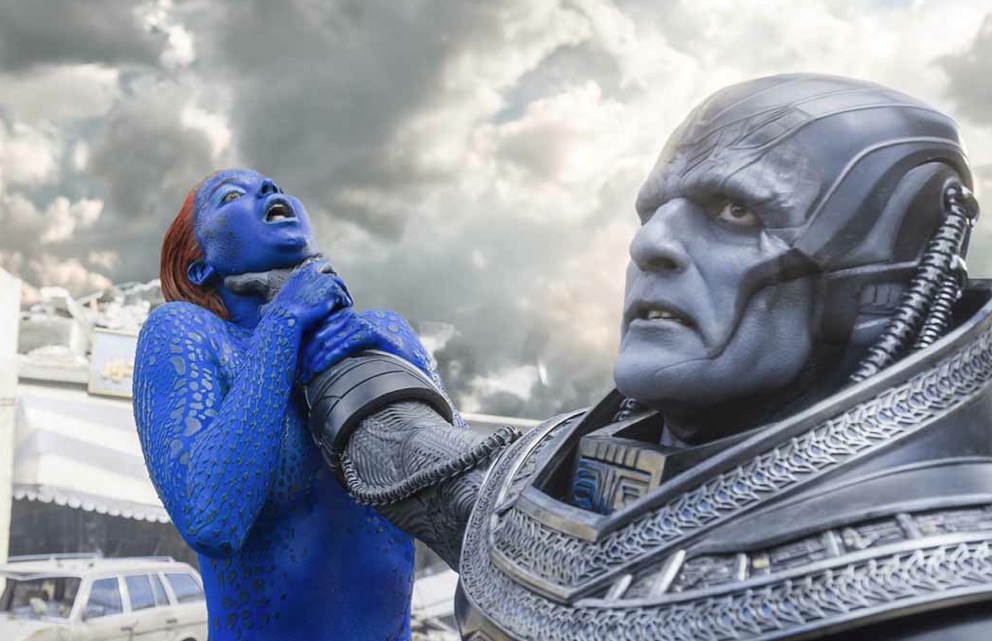
The biggest problem X-Men: Apocalypse faces is one it isn’t even responsible for. X-Men: Days of Future Past was and will always be one of the most definitive superhero experiences at the movies. Asking for follow-up to that is unreasonable, let alone damn near impossible, and to its credit, X-Men Apocalypse tries. It tries too hard, but at least it tries.

Taking place ten years after the events of Days of Future Past, Apocalypse shows an ancient threat that reawakens deep within the pyramids of Egypt. The first known mutant to ever historically exist, En Sabah Nur (Oscar Isaac) awakens to a world ran amuck in chaos and disorder. Political corruption. Poverty. War. Violence. En Sabah Nur sees all that’s wrong with the world and decides that, in order to save it, it must be destroyed and rebuilt.

Back in Westchester, at Xavier’s School for Gifted Youngsters, Jean Grey (Sophie Turner) awakens from a horrible nightmare. Witnessing horrible visions of the end of the world, Jean is convinced that these visions are real and that they will come to pass. Her professor Charles Xavier (James McAvoy) thinks these are just dreams. Yet, as one thing happens after another, he begins to think there is something devestating going on that even the X-Men might not be able to stop.

The third movie for the newly rebooted X-Men universe, X-Men: Apocalypse boasts a lot of the strengths that its predecessors have. For one thing, the performances are superb, and the actors exemplify their characters down to the molecule. McAvoy is earnest and well-intentioned as Xavier, while Jennifer Lawrence is motivated and sharp-shooting as Mystique. The actor I noticed most, however, was Michael Fassbender, once again adopting the role of Magneto. Every time I watch him, I am reminded of this character’s tragic history and how other people’s cruelty has driven him towards violence and extremism. Without giving too much away, there is one moment where Magneto sustain a crippling loss that comes to define his character the most throughout the picture. These moments remind us that Magneto is not a villain, but rather a tragic hero who fell through grace, and Fassbender is brilliant in capturing both the character’s regret, penance, and guilt throughout the movie.

The action is also incredibly polished, especially for an X-Men film. En Sabah Nur himself is the most omnipotent, wiping enemies away with a dash of his hand or the white glow of his eyes. Havok (Lucas Till) reappears alongside his brother Cyclops (Tye Sheridan) for the first time, and their red energies run amuck obliterating anything in their path. The most fun X-Man to make a return, however, is Evan Peters as the speedster mutant Peter Maximoff. You remember his signature scene at the Pentagon in X-Men: Days of Future Past. His scene in this movie blows that one out of the water. I won’t give much away, but saving over 30 people at superspeed is much more impressive than taking out six security guards in a kitchen. This sequence was funny, exciting, and most importantly, entertaining. His scenes were easily my favorite from the film.

The action and the characters culminate together fluidly, similar to the other X-Men films. The differences lie in its story, or more specifically, in its lack of focus. There are about five different stories packed into one in X-Men: Apocalypse, and most of them are unnecessary. You have so many unraveled narratives trying to weave together into one that quickly falls apart once the plot starts picking up speed. 

Take, for instance, the plight of Magneto. His story is pure tragedy. His hearbreak, his pain, his loss, it echoes of Magneto’s earlier history and builds into a climactic moment between himself and his transgressors. The scene should have been a moment of suspense and satisfaction, but then all of a sudden, En Sabah Nur appears on the scene and completely disjoints the narrative.

The whole film is like that, building up to big moments and then suddenly switching to other ones. There’s Xavier’s arc, then there’s Mystique’s, then Magneto’s, then Jean’s, and then Cyclops’. The most dissapointing to me is Peter. His story has to deal with his true parentage, but it never even leads anywhere. Screenwriter Simon Kinberg and director Bryan Singer build all of this effort up for nothing. No conclusion. No resolution. No payoff. That’s because they don’t have a focus, and the picture ends up losing our interest, despite all of its spectacular action.

X2 and X-Men: Days of Future Past remain to be the best entries of the franchise, while X-Men Origins: Wolverine is the unoquivocal worst. This movie falls in the middle ground. Like its predecessors, X-Men: Apocalypse has great action pieces and performances, but it collapses under the weight of its narrative while simultaneously lacking in depth and development. As Jean Grey observes after seeing Return of the Jedi, “At least we can all agree that the third one is always the worst.” You read my mind, sister.

Tagged , , , , , , , , , , , , , , , , , , , , , , , , , , , , , , , , , , , , , , , , , , , ,

“THE JUNGLE BOOK (2016)” Review (✫✫✫)

Introducing the legend of Tarza– oops, I meant Mowgli.

What is it with Jon Favreau taking the most obscure ideas and actually making good movies out of them? In 2008 he brought us Iron Man, which initially seemed like a sub par idea for a superhero, but then he delivered one of the greatest superhero films of our generation. Then he made Cowboys & Aliens, which sounds stupid by the title alone, yet he still managed to make a unique blend of genres in one exciting and interesting sci-fi western. Now we have his answer to Walt Disney’s The Jungle Book, and even though it’s a remake, it’s remains to be one of the most original and compelling experiences you can have at the movies this weekend.

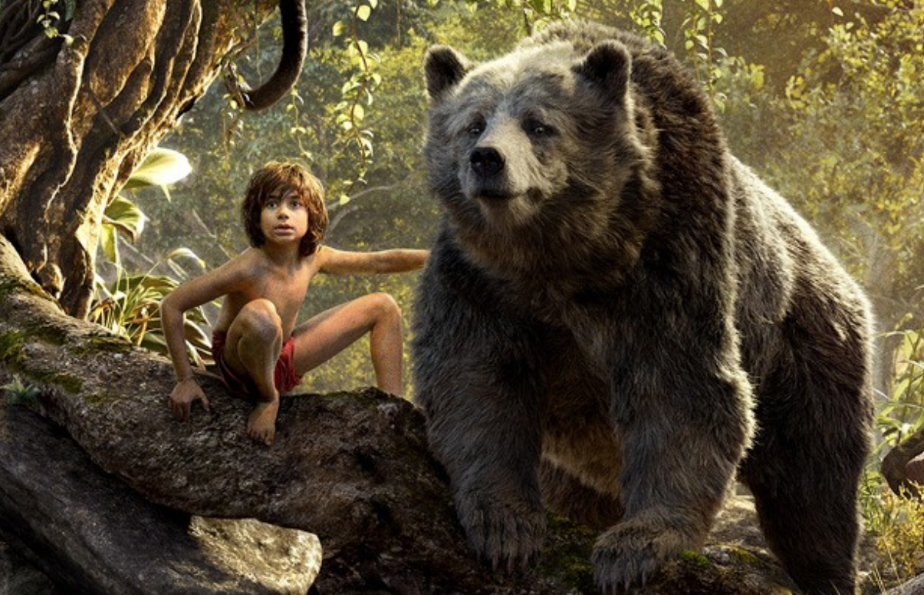
Anyone who is watching this movie already knows the story of The Jungle Book. There’s a jungle, an adventurous human child named Mowgli (Neel Sethi), his wolf pack family, a lazy, carefree bear named Baloo (Bill Murray), a black panther named Bageera (Ben Kingsley), and a vicious tiger named Shere Kahn (Idris Elba), who harbors an intense hatred of mankind. At learning about Mowgli’s presence in the jungle, Shere Kahn swears to find the child and maul him limb-from-limb. The jungle unites together to take Mowgli away to a human village and save him from Shere Kahn.

Those of you who frequently read my reviews will notice that I am not a big fan of remakes. I am also, surprisingly, not a big fan of the original Jungle Book, which I thought was thinly written despite some outstanding musical numbers. Yet, despite my negative outlook for both of these things, I found myself quite pleased with this movie, both as a remake and as an adaptation of The Jungle Book.

The first improvement Favreau makes over its predecessor is its characters. Yes, we liked Mowgli, Baloo, Bageera and others in the 1969 quote-unquote “classic”, but we didn’t really know them. We didn’t really understand them. We had their surface personalities to admire, but that’s it. Where did Mowgli come from? Why does Baloo want to adopt this man-cub straight for no reason whatsoever? Why does Shere Kahn hate mankind?

All of these are questions I had as a kid that 2016 provided me the answers to. This is a jungle fable that is fully fleshed out and realized, not unlike most of today’s modern fantasy epics. The characters of Mowgli, Baloo, Bageera, Shere Kahn, Kaa and others all have their place and function in the story, and their narrative flows as freely as the nile river. We come to relate to these characters not as Disney properties, but as personalities in their own right.

But the best thing about The Jungle Book is easily its visual effects. Yes, I know that’s a recycled compliment in today’s visually-dominated industry, but its a compliment that The Jungle Book is more than deserving in. Utilizing both motion capture from the voice actors and studying the motions and movements of real jungle animals, Favreau illustrates a smart attention to detail as these animals breathe, move, and feel like their real life counterparts, minus their speaking. Neel’s interactions with the environment, likewise, feel vivid and alert, as if he truly is swinging on vines, jumping into rivers, and running through the jungle, as opposed to acting in front of a green screen. For most other movies, it’s easy to say it’s visually stimulating because it has big explosions or large collateral damage. What makes The Jungle Book so praiseworthy is that it has none of these things, and yet, it has no evidence of being unreal despite being almost entirely computer-generated. This is easily an early contender for the visual effects Oscar at the Academy Awards, and even if it doesn’t win, it definitely deserves a nomination at the very least.

Neel is functional but not outstanding as Mowgli. What do you expect? The kid is 13 years old, barely enough to be in junior high. He’s not expected to demonstrate a bravura performance at his age, and he doesn’t. His performance centers mostly on his choreography and stuntwork, and that’s just about as far as his acting skills reach as well.

The key performance, however, doesn’t come from Neel. It comes from these jungle animals, captured so accurately on screen visually and aesthetically to its environment. It’s true, Neel isn’t that impressive on his own, but he doesn’t need to be. His interactions with the other animals is what makes this story believable and so easy to get wrapped up into.

The Jungle Book, of course, wraps its adventure up all nice and tidy, almost too much so in regards to my tastes with Disney. But the plain fact of the matter is that I was surprised. Surprised that I was actually invested in Mowgli and his jungle adventures. Surprised that when I saw the jungle and its inhabitants, my first instinct wasn’t to make fun of them, but to be absorbed by them. Surprised that when watching The Jungle Book, I was looking at it through the eyes of wonder and curiosity as a child, not the hardened, distrusting gaze of a critic.

Disney has plans to produce live-action remakes of many of their animated classics, among them including Pete’s Dragon and Beauty and the Beast. If they follow the pattern of The Jungle Book, Disney has a good road ahead of them.

Tagged , , , , , , , , , , , , , , , , , , , , , , , , , , , , ,

“CAPTAIN AMERICA: CIVIL WAR” Review (✫✫✫✫)

A war of humans, not heroes. 

I’m going to make a bold claim here. Captain America: Civil War is the best MCU movie to be made to date.

I know, I know, I’m probably a little overzealous when I say that. Except that I’m not. I’m fully aware of what its competition is. There are two other Marvel movies that I can compare Captain America: Civil War with. Those two are Iron Man and The Avengers. All three of them are exciting, suspenseful, nail-biting, eye-widening entertainment that are just as fun and memorable as they are emotional and meaningful. They’re not just great superhero dramas. They’re great human dramas.

But Captain America: Civil War is especially unique to even these entries. How? The biggest reason is because it isn’t formulaic. In Iron Man and The Avengers, we had our heroes, our villains, and they went at each other like rock-em sock-em robots. Granted, there’s deeper insight and perspective than just the two-dimensional hero/villain foreplay, but you can’t deny the framework that’s there. There’s a clear cut good guy and bad guy, as there is in most superhero movies.

But that black-and-white sense of morality isn’t well defined in Captain America: Civil War. In fact, there isn’t really an established sense of right and wrong in the picture, just characters whose ideals and values clash violently with each other. You can argue that there is a quote-unquote “villain” in the movie, but he’s more of a viewer than an active participant to the conflict involved. If we have to go by titles in this movie, what we have then is hero against hero, Avenger against Avenger, and friend against friend. The ensuing action is nothing else but thrilling, thought-provoking, mind-blowing, and heartbreaking.

In this sequel to both Captain America: The Winter Soldier and Avengers: Age of Ultron, Steve Rogers, a.k.a. Captain America (Chris Evans) leads a new team of Avengers, consisting of Black Widow (Scarlett Johannson), War Machine (Don Cheadle), Falcon (Anthony Mackie), Vision (Paul Bettany) and Scarlet Witch (Elizabeth Olsen). After an international event involving the Avengers ends in high casualties, General Thaddeus Ross (William Hurt) and Tony Stark, a.k.a. Iron Man (Robert Downey Jr.) step in to introduce the Sokovia Accords, which states that the Avengers would no longer be a private organization, but instead will be employed and assigned missions by a United Nations panel.

There are two perspectives to the Accords. On one hand, the Accords would give a new level of accountability to the Avengers. They would be restricted in where they could go and what they could do, and the public casualties in turn could be lessened. Plus, the Avengers would now get paid for all of their superheroing. On the other hand, this could put a level of control and interference on the Avengers that would prevent them from doing the most good. Plus, being assigned to report to a panel leaves them vulnerable for manipulation, forcing them to do things that they wouldn’t otherwise.

Iron Man leads the side that’s for the Accords: Cap leads the side that’s against it. But regardless of both sides, there’s another player in the field whose looking to manipulate both sides to his advantage. And neither side realizes it until its too late.

The second Marvel movie to be directed by brothers Anthony and Joe Russo and the fourth to be written by Christopher Markus and Stephen McFeely, Captain America: Civil War is a superhero movie ripe with context, a movie that asks uncomfortable questions that we would much rather remain unanswered. Just like how The Winter Soldier related its plot to today’s world of government control, survaillance, and corruption, Civil War also relates to real-world issues that appeals just as much to reality as they do to fantasy.

Take, for instance, the introduction of the Sokovia Accords. These documents, much like the connection between S.H.I.E.L.D. and H.Y.D.R.A. in The Winter Soldier, presents the theme of government interference and how those implications affect our world. Yes, the Accords would impose an element of control and responsibility over the heroes, but at what cost? This is a situation where civil liberties are being traded for security, and the question is raised on whether its a good trade or not. Juxtaposing this idea of control in between our heroes raises very important questions: questions that are startlingly resemblant of our world abundant with government surveillance and manipulation.

But the movie doesn’t suffer under its philosophical weight. This is still one of those fast-paced, funny, exciting Marvel movies that you’ve come to love. It’s just now a fast-paced, funny, exciting action movie that has deeper insight and drama than the previous entries did. The issues involved draw us deeper into the film’s conflict and to each of the outcomes that these characters face.

There are two of these characters that I haven’t mentioned yet. One of them is the rebooted Peter Parker/ Spider-Man, who is played here by Tom Holland as opposed to the recently discontinued Andrew Garfield. Holland’s appearance in the film is brief yet significant, and while he doesn’t serve a role as important as the others, his charisma, immaturity, and innocent charm makes him for a very entertaining and memorable character, one who sticks out in my mind just as much as Captain America and Iron Man. To be rebooted in just two years time is definitely too soon, and part of me wonders how well Garfield would have done if he had been given the same opportunities as Holland was. That doesn’t take away from the fact that Holland still wins us over and sticks out in our minds just as strongly as Garfield and Toby Maguire does. He makes me very excited to see what’s in store for him for his eventual return in Spider-Man: Homecoming.

The other character is T’Challa, a.k.a. the Black Panther (Chadwick Boseman). If there is a neutral side in this conflict, it is in T’Challa, although at one point he does fight on Iron Man’s team. He’s so great because unlike Iron Man or Cap, his perspective is the most human out of the other players. He is the citizen Cap and Iron Man are fighting to protect. He is the one that faces the most casualty out of any of the other players. This natural perspective into the film is so important, because it demonstrates an investment that isn’t coming from another superhero: it’s coming from the victim of both sides of the conflict. That pain and confusion is so important to understand Captain America: Civil War not just as a Marvel movie, but as a complex drama on its own two legs.

The performances, the action, the visual effects, and the direction all accumulate masterfully, and the Russo brothers demonstrate a better understanding of their characters than they did in Captain America: The Winter Soldier. What we have left, then, is an unchallenged masterpiece, a moral dilemma packaged as a superhero blockbuster that excites us just as much as it challenges us. Iron Man and The Avengers both challenged themselves morally and ethically, but not so much to the point where it’s entire plot was founded around it. There was still a right or wrong in those movies. There isn’t in Captain America: Civil War, and that makes it just as compelling as it is entertaining. The one downside to this film’s success: now the Russo brothers have to follow this up with Avengers: Infinity War. I don’t know how they’re going to do it. I would personally guess that they can’t do it. But I’ve been wrong before.

Tagged , , , , , , , , , , , , , , , , , , , , , , , , , , , , , , , , , , , , , , , , , , , , , , , , , , , , , , , , , , ,