Tag Archives: Drama

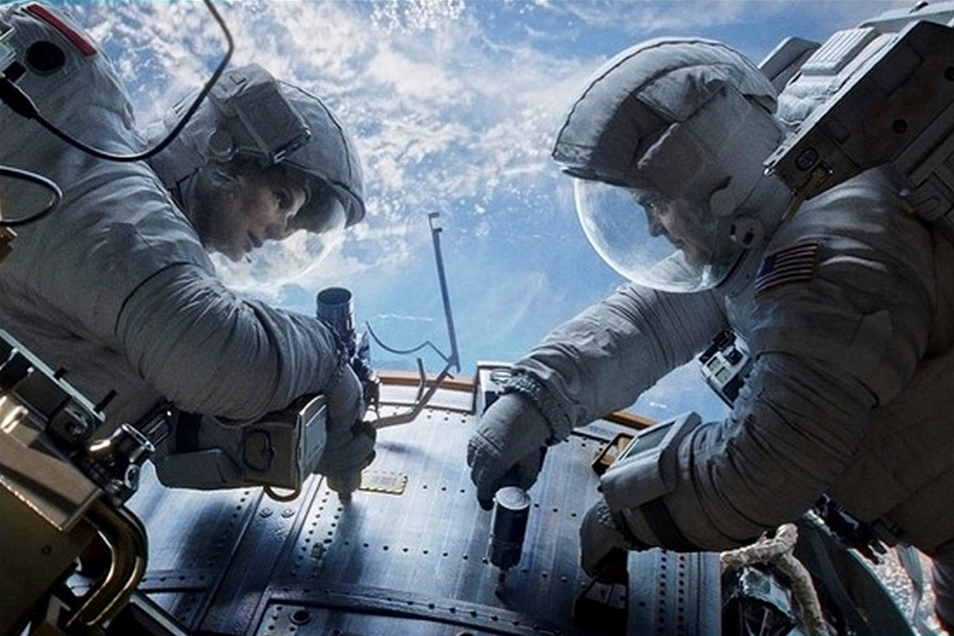
“GRAVITY” Review (✫✫✫✫)

“In space, no one can hear you scream”

We fade in on a list of statistics about space as the edgy synthesizer music builds in the background.  The earth rotates at a speed of about 1000 miles per hour.  The temperature is about -273 degrees celsius.  There’s no gravity.  No oxygen.  No air pressure to carry sound. No one to hear you scream or cry for help. Nothing to save you if your suit fails to sustain you. Nothing to stop your momentum if you’re flying in the wrong direction. If you get into trouble out in space, you are all alone. Life in space is impossible.

This sort of tension and desperation is felt on an emotional level so intense in Alfonso Cuaron’s Gravity that I feel like I’m in space experiencing the same things that these characters are experiencing, not watching the chaos unfold from mission control.  The plot follows three astronauts who are working on repairing a satellite in orbit. Dr. Ryan Stone (Sandra Bullock) is a mission specialist who is working hard at repairing the satellite on her very first space mission. Lieutenant Matt Kowalski (George Clooney) is an experienced space veteran who is retiring after this final expedition.  Shariff Dasari (Paul Sharma) is a flight engineer who carries a photo of him, his wife, and child inside his suit.  Early into their mission, the team gets a warning from mission control, saying that there is debris from a missile strike on a Russian satellite orbiting the earth, but that it shouldn’t collide with their trajectory.

Now if that isn’t a case of foreshadowing, I don’t know what is.  Eventually, the debris sets off a chain reaction of destruction, and it eradicates the shuttle that they came on.  Shariff is killed, Kowalski loses communication with mission control, and Stone is left desperately hanging on to her life as she floats aimlessly away from their space module. When Stone and Kowalski eventually meet up again, they have to race against time and fate as their oxygen levels continue to deplete, and need to find a way home before they are truly lost in space forever.

Man oh man, where to start.  Gravity is a film for a generation, a picture that is so convincing and so believable in its approach that its nearly impossible to think that it wasn’t even filmed in space.  It is visually stunning, emotionally gratifying, immensely captivating, and surprisingly involving, a picture that latches you on in its first shot and doesn’t let you go until hours after you’ve left the theater.

Who is responsible for this feeling of attachment and interest?  Why that is director Alfonso Cuaron, of course, who co-wrote the script with his son Jonas. Cuaron, who is most known for his mainstream films including Children Of Men and the third Harry Potter movie outdoes himself here. Not only has he made a compelling and visually breathtaking science-fiction film that visually challenges that of Avatar and Inception: he’s also made a emotionally captivating story with the human interest equivalent of Argo or Captain Phillips.

Oh, I’m not saying he isn’t already a great director: lord knows he’s delivered as much visual and emotional appeal as he did with Children Of Men and Prisoner of Azkaban.  But Gravity is head and shoulders above anything else he’s done in his entire career. Why? Everything in the movie is immaculate and intentional, from the physics and dangers of space to characters emotions and complexions. Look at the delicacy and the concentration on Cuaron’s shots. Look at how well he orchestrates a scene, whether a large, imposing space station is crumbling all around Earth’s orbit, or a astronaut is just awkwardly fitting herself in tight corridors around a space station. In each shot, there is interest, there is intricacy, and there is involvement. Whether its a big, intimidating destruction scene or a small conversation between characters doesn’t matter. The interest remains, and its boy does it keep your attention.

Visually, the film is unparalleled, hooking you on with all of its space-station grandeur and elegant scenery of earth from outer space. Part of this no doubt goes to the visual effects team led by supervisor Tim Webber, but a large accreditation needs to be made to cinematographer Emmanuel Lubeski, who collaborated on Cuaron’s other films including Children of Men and Y Tu Mama Tambien. Lubeski, who was nominated for an Oscar a few years ago for Terrence Malick’s Tree Of Life returns with the same artistry and craftsmanship that made him an artist in his own right. The camerawork in the film evokes a feeling of both reprehension and serenity, the same eerie feeling you get when you watch the slow, steady moments building up in Stanley Kubrick’s 2001: A Space Odyssey. It works in conjunction with the film’s plot and with Cuaron’s handling of it, a marriage of collaboration so essential that its doubtful anyone could be as fluid or as controlling as Lubeski is, not even Wally Phister’s steady, reliable camerawork from Christopher Nolan’s Inception or Dark Knight trilogy.

High praise, I know, but it’s well deserved. The visual effects alone have not made this movie. It’s Lubeski’s intricate framing and filming that not only captured these great shots, but intensified them, evoking the anxiety and unease of space just as much as the visual effects and sequencing does.

Bullock and Clooney are affectionate and grounded in their performances, pun intended.  Going in to the movie, I was really worried that the both of them were going to phone in their roles and just let the visuals take over, much like the Michael Bay/Roland Emmerich action movies you see nowadays. Boy, was I wrong. Their characters are real, charismatic and likable people in their own right, people who you’d probably like to sit with and share a conversation with over at Starbucks. Their chemistry is infectious with each other, as memorable and dynamic as the relationship Tom Hanks and Kevin Bacon shared with their crew mates during Ron Howard’s Apollo 13. You don’t only care for these characters because of their situation: you care for them because they are human beings, because they have hopes, dreams, and letdowns of their own and you want to see them make it through all of it.

This is what I love most about the movie: not just that it handles itself well as a science-fiction movie, but it handles itself well as human drama, period.

This is seriously one of the best films of the year. I’m not saying that because it is science-fiction. I’m saying that because it is seriously one of the best films of the year.  Under a different director, a different writer, cinematographer, composer, or even under a different cast, this film could have failed.  It’s hard to take a movie that takes place in an enclosed, blocked off environment separated from society with only one or two characters and make it interesting, and the filmmakers here have accomplished that in spades.

But Gravity is much more than a survival film.  It’s more than a science-fiction film.  It’s an epic and emotional story about an astronaut trying to survive, a woman trying to cope with living, reality, and tragedy, and the unhindered spirit that pushes her to keep living, even when all of the forces of nature tells her that she can’t. It blurs the line between science fiction and science reality and is quite possibly the best space movie I’ve ever seen.

Tagged , , , , , , , , , , , , , , , , , , , , , , , , ,

OSCAR REACTIONS 2013

Well, that was anti-climactic.

For those of you who live under a rock and don’t know who I’m talking about when I mention the word “oscar”, the 86th Academy Awards took place yesterday on ABC, hosted by comedian Ellen Degeneres. Needless to say, Degeneres was brilliant, taking selfies, buying pizza, crashing twitter, bringing the stage down for Jennifer Lawrence, and calling Liza Minelli a man all in one night. And yet, despite all of her efforts, the oscars seemed so… boring.

How did this happen? The nominees, dear reader. Out of the 24 categories in the ceremony I got twenty right, beating most of my Shorthorn peers and family members for the potluck we held that night. The most I’ve gotten previously was sixteen. I’m inclined to believe that the academy made the winners of these awards too obvious by building up too much hype of them during the buzz of the past few months.  Case in point: was there any argument that Frozen was going to take home best animated feature?

It doesn’t matter now, anyway. It happened, and I got 20 right out of 24 categories. Yes!!! Just because I predicted them correctly, however, doesn’t mean I need to be happy for their win. Let’s go through each of the categories and see whether or not they really deserved it or not…

BEST PICTURE (CORRECT!) The best picture of the year rightfully won best picture at the Academy Awards: Steve McQueen’s phenomenal, gripping, heart-wrenching, spellbinding and immensely powerful 12 Years A Slave won best picture. While I’m ecstatic for its win and could not agree more with the Academy’s consensus, I find it very strange that it won the Academy’s highest honor despite it only winning two other awards. But we’ll talk more about that later.

BEST DIRECTOR (CORRECT!) Also correctly predicted is Alfonso Cuaron for his nerve-wracking and tensely-directed sci-fi thriller Gravity. I already mentioned this in my predictions, but the best director award needs to be reserved for the best picture of the year. I loved Gravity with every fiber of my being, but it simply does not match the cinematic caliber to that of McQueen’s 12 Years A Slave. It would be like comparing The Dark Knight to that of Slumdog MillionaireThe Fugitive to that of Schindler’s List, or Jaws to that of One Flew Over The Cuckoos Nest. They are all ingenious, brilliant and incredibly memorable pictures, but the best picture of the year is awarded that because of the direction and treatment that it was given.

That’s not intended as an insult towards Cuaron, and I definitely believe he deserves it based on the physics and tension of the movie alone. If I’m thinking about which movie had the bigger impact, however, it’s no contest on which one it deserves to go to: McQueen for 12 Years A Slave. Nevertheless, I congratulate Cuaron on his many accomplishments regarding Gravity. Lord knows my heart stopped at least a few times while watching that picture.

BEST ACTOR (CORRECT!) Matthew McConaughey took home the award for best actor as a rowdy texas cowboy dying of AIDS in Dallas Buyers Club. While the award could have gone to either him or Chiwetel Ejiofor for 12 Years A Slave, there’s no denying the power, the energy, and the raw gravitas that he brought to a man’s desperate journey to survive. Plus, I love his acceptance speech and how he dedicated the award to God and to “himself in ten years”. That’s a wise goal that any man should strive for.

BEST ACTRESS (CORRECT!) Cate Blanchett won best actress for Woody Allen’s Blue Jasmine. While I have regretfully not seen the movie yet, I will say that the few scenes I have seen her in impressed me very much, and that she did a solid job portraying a deeply bothered woman who is in deep depression and alcohol addiction. Congratulations to her. I look forward to watching the film, as well as Blanchett’s performance in it.

BEST SUPPORTING ACTOR (CORRECT!) Did Michael Fassbender win best supporting actor like I wanted him to? No, he did not. Instead, Jared Leto took home the award portraying the transgender AIDS victim Rayon in Dallas Buyers Club

The more I think about it, the more ridiculous I think it is that the best picture winner of the year did not get recognized in so many categories. Why the snubbing from Fassbender? Half of the movie’s turmoil and conflict came from this despicable character, a man so inhumane and abominable that Calvin Candy from Django Unchained would have broke down in tears after seeing what this man forced people through. Fassbender was pivotal, aggressive, violent, and hateful as Edwin Epps, and incurred more emotions from audiences than that of a transgender AIDS patient in Dallas Buyers Club. I know 30 Seconds To Mars fans will hate me for saying this, but the more vital role needs to go to the more vital performance. I said it once, I’ll say it again: Leto is not as deserving in the award as Fassbender is.

Again, no disrespect, and I acknowledge that Leto gave a great performance in the picture. But like Cuaron with best direction, the more compelling presence needs to go to the more compelling artist. Sorry, Rayon.

BEST SUPPORTING ACTRESS (CORRECT!) Lupita Nyongo won (and deserved) the academy award for best supporting actress for her heartbreaking role as a desperate and depraved cotton picking slave in 12 Years A Slave. No qualms here.

BEST ORIGINAL SCREENPLAY (CORRECT!) I also correctly predicted that Spike Jonze would win the best original screenplay award for his sci-fi romance story Her. Comparing Her to the genius of David O’Russell’s American Hustle, I mentioned in my original predictions list that “just because its a smarter story doesn’t necessarily mean that it is a better one.” I do not retract my statement.

BEST ADAPTED SCREENPLAY (CORRECT!) John Ridley won best adapted screenplay for his incredibly well-documented 12 Years A Slave. He equally deserved it, as Solomon Northrup’s story, or legacy, could not have translated any better to the screen if the filmmakers tried. Great job, Ridley. You gave us an unforgettable and incredible story, the likes of which no one has seen since Steven Spielberg’s Schindler’s List. 

And this is the only other award 12 Years won for the night. No cinematography. No editing. No costume or production design. No supporting actor. No other award that would further substantiate and support its win for best picture.

Am I the only one that finds this completely ludicrous? To date, there are only three best picture winners to win only three academy awards. Those movies are The Godfather, Crash and Argo, and two of them didn’t even win in major categories. Seriously, what is going on? Why are we being so insubstantial towards movies that have been deemed the best of the year? Do academy voters not realize that by naming this the BEST PICTURE OF THE YEAR that they’re saying that its better than everything else? And according to this ceremony, not only are they saying that it is the equivalent of Dallas Buyers Club (they both won three academy awards), but that Gravity is superior to it with seven wins and no awarding of best picture.

Seriously. Make up your mind. I’m fine with you saying one picture is better than another, but substantiate that by what awards you give it. I seriously doubt that 12 Years is best picture because of its screenplay and its supporting actress alone. Likewise, I doubt that Gravity isn’t the best picture of the year because it has the best direction, camerawork, editing, sound mixing, and visual effects out of any other picture.

That’s all I ask, folks. Not preference. Fairness.

BEST FOREIGN LANGUAGE FILM (CORRECT!) The Great Beauty won for best foreign-language film. That’s the one that everyone saw, right? It obviously deserved to win.

BEST DOCUMENTARY FILM (INCORRECT!) I incorrectly predicted that Act Of Killing would win the award, but no, 20 Feet From Stardom took the award home, with featured artists on the film including music legends Mick Jagger, Bruce Springsteen and Stevie Wonder. I haven’t seen the film, so I have no place on commenting on it, but it seems odd that the Academy would reward a movie about background singers over that of a tragic confrontation of death and social issues. I’ve yet to see either of them though, so like I said, my opinion is invalid in this category.

BEST ANIMATED FILM (CORRECT!) Disney won best animated feature for Frozen. While I didn’t care much for it, I know it made a wide impact on its audience and that it will go on to be fondly remembered by many animated movie lovers for years to come. So congratulations for its win, even though I’m no fan of the cold weather this time around.

BEST ORIGINAL SONG (CORRECT!) Frozen won best original song for its memorable song “Let It Go”. It certainly didn’t win for Idina Menzel’s performance, that’s for sure. What the heck happened with her? Her pitch was all over the place, her control was wonky, and her whiny voice was the contrast of the powerful, beautifully controlled voice she exhibited in the movie itself. Seriously. What happened?

One song I’ve really been getting into recently (and I think you’ll agree with me) is Pharell Williams’ “Happy”. The performance proved why. Not only was it energetic, upbeat, and undeniably catchy, but Williams gave a great performance, he exhibited great control and showed very few differences from the studio version of his song. Menzel’s performance, in comparison, was completely and utterly horrendous.

But hey, I guess that’s why the award is called “best original song” and not “best performance”. Otherwise, I think we both what the turnout would be.

BEST ORIGINAL SCORE (CORRECT!) Steve Price took home the award for best original score with Gravity. He completely deserved it. Not only did it match the tension, edginess and unease of the movie, but it also gave a dignified sense of hope and accomplishment after a long journey of heart-pounding danger and peril. Listening to the soundtrack alone gave you the feeling of identity and survival, and Price was definitely the most deserving out of any nominee. Congrats to him for his win.

In the meantime, I’m still wondering where is Hans Zimmer’s nomination for Rush. Remind me again why this movie wasn’t nominated for anything?

BEST CINEMATOGRAPHY (CORRECT!) In 2011, Emanuel Lubewski was mercilessly snubbed for his masterful, Stanley Kubrick-esque camerawork in The Tree Of Life. If he didn’t win it this year, I was literally planning on flipping out.

Luckily, he did.

BEST FILM EDITING (CORRECT!) Another category that I felt 12 Years was superior to Gravity, yet it still lost to it. Must I keep beating a dead horse? Gravity was a more visually stellar and energetic picture. 12 Years was the more engaging and involved one. Part of that was because of how the film was put together in a traditionalist style that was reminiscent of Dylan Tichenor’s work from movies including There Will Be Blood and Brokeback Mountain, where he focused most of the runtime on the film’s subjects rather than worrying about flashy cuts or transitions. Film editing is one of the most important part of storytelling, and what have I been saying is the best story of the year? 12 Years A Slave.

I’m not going to drag this out though. Gravity was a great picture, and editors Alfonso Cuaron and Mark Sanger definitely reached outside the box to accomplish things visually no other film did this year. It did a good job. Moving on.

BEST PRODUCTION DESIGN (CORRECT!) The Great Gatsby won for best production design. Considering the sets were the most colorful and visually appealing out of the year, that isn’t very surprising.

BEST COSTUME DESIGN (INCORRECT!) Unfortunately, I predicted this category wrong, thinking that 12 Years was going to get this one. The only reason I went with that instead of winner The Great Gatsby was because I knew Catherine Martin was already going to win for best production design, and any more than that would have been greedy. I forgot that “spreading the wealth” isn’t a phrase the academy is most well known for.

BEST MAKEUP (CORRECT!) Thankfully, Dallas Buyers Club won for best makeup and hairstyling. As long as Jackass: Bad Grandpa didn’t walk home with the award, I’m satisfied.

BEST SOUND EDITING (CORRECT!) Gravity won.

BEST SOUND MIXING (CORRECT!) Gravity won. Again.

BEST VISUAL EFFECTS (CORRECT!) If you even thought this award was going to anything other than Gravity, you’re either insane, or blind.

And at last, the long-dreaded short film categories.

BEST LIVE-ACTION SHORT FILM (CORRECT!) Surprisingly, I got this category correct with predicting Helium. I haven’t seen the film though, so it was only by sheer luck that I got this right.

BEST ANIMATED SHORT FILM (INCORRECT!) Mr. Hublot took home this award. That’s surprising, considering how clever and fun Get A Horse! was, but nevermind. I haven’t seen the movie, so I can’t comment on it.

BEST DOCUMENTARY SHORT (INCORRECT!) The Lady In Number 6: Music Saved My Life. Again, just like any other films in these categories, I haven’t seen it, so how would you expect me to get it right? You might as well blindfold me and ask me to just write on the flipping ballot.

Overall, this has been a fun ceremony, and I’m grateful to Ellen Degeneres for making it a happy-go-lucky and loveably quirky time. Just please, make the ceremony less predictable next time, okay? I’d rather not have a film come in and just know that its going to dominate in all of the categories. You would have been better calling it “The First Annual Gravity Awards”.

-David Dunn

Tagged , , , , , , , , , , , , , , , , , , , , , , , , , , , , , ,

“HER” Review (✫✫1/2)

What on earth did I just watch?

How do you fall in love with a computer program? Throughout the entire runtime of Her, that’s the only thought that was peaking through my mind. I wasn’t thinking about Joaquin Phoenix’s deliberate performance. I wasn’t thinking about how sweet and serene Scarlett Johansson’s voice sounded. I didn’t think about how clever the story was or how passionate Spike Jonze’s direction was. The only thing I was thinking about was how hard it must be to maintain a relationship with a piece of machinery. Can you imagine how awkward those morning encounters must be?

Taking place in the not-too-distant future, Her follows the story of Theodore Twombly (Joaquin Phoenix), an introvert and manic depressive who writes love letters for a living and has recently gone through a divorce with his wife Catherine (Rooney Mara). Theodore is not in the most stable mindset as the movie begins, and as an effort to feel less lonely, he purchases an artificial intelligence who names herself “Samantha” (Scarlett Johanson) to help him with his everyday needs. What goes from there is a grand journey of self-discovery, identity and romance as these two gradually come closer with each other and eventually fall in love.

For those of you who have seen the movie, does that paragraph just about do it justice? I could go deeper into the plot synopsis, but why would I? From just those three sentences, half of you have already decided whether you would like the movie or not. There are, no doubt, some introspective and provocative thinkers out there who will find joy and enchantment with this story, while other viewers will watch it and ask themselves what on earth they just watched.

For me, I went in an open book. I knew that the movie had an opportunity to woo me, that it was a strange and outlandish idea to begin with, but that the idea doesn’t matter as long as it was handled and carried out well. How did the movie do with that?

Eh. I’d rather watch 1 Night In Paris. 

Like its central idea, Her is a strange movie, a surreal and against-the-grain picture that challenges a lot of misconceptions about love and relationships. While I like that and think it has a lot of great ideas to offer its viewers, I find them so hard to focus on while we’re watching Joaquin Phoenix having sex with a machine.

Yes, there are sex scenes in the movie, although I hesitate to even call them that. There are two that we actually see, but from their conversations we actually infer that there were plenty more.

The first one isn’t really a sex scene, but more or less a copycat of phone sex with Scarlett Johansson’s voice (which I’ll admit, didn’t bother me that much at all). The second one, however, was out of this world weird, with Samantha hiring a surrogate (prostitute) for Theodore to have pretend sex with. They’re trying to justify it by saying that she isn’t a prostitute and that she’s just trying to be a part of their experience, but that argument is null and void. She’s provided sexual services in exchange for something else. She’s a prostitute.

Don’t get me wrong: there are many emotional moments that the movie handled surprisingly well, and there’s an undeniable sweetness and sentiment to the story that can’t help but be noticed. Despite her being a machine, Samantha has a surprising amount of layers to her, being an in-depth and interesting character and love interest in her own right, while the human characters contribute the more grounded relationships that make more sense than that of Samantha’s (Including a recently-divorced Rooney Mara and Amy Adams, who offer very interesting parallels to Twombly’s exotic love story).

Joaquin Phoenix, however, is the flesh and blood of the film. His performance is nothing less than exemplary, playing this shy introvert so convincingly that its hard to imagine that he at one point portrayed Johnny Cash. His character reminds me of many of cinema’s most memorable introverts, ranging from the autistic-yet-brilliant Raymond Babbit in Rain Man to the hyper-obsessive and socially distant Mark Zuckerberg in The Social Network, or the paranoid John Forbes Nash Jr. in A Beautiful Mind. All of those movies focused on characters that struggled romantically and socially, and how much they struggled with their identity and being themselves. I love it when movies reach into characters that deep and personally, and if the film focused more on Twobly’s personality rather than that of his love and attraction to his operating system, the movie could have ended up being way more successful.

I can’t help but keep thinking about how small Her’s audience will be. In this day and age, art films are getting harder and harder to advertise and appeal to mainstream moviegoing audiences, and this movie is definitely no exception. I know the film’s premise doesn’t matter as much as how well that premise is handled, but there are some movies that just can’t get away from their bizarre ideas. Case in point: did anyone really expect Quentin Dupieux’s Rubber to be a good movie?

I stress this again: the main character is in love with a computer program. If you can buy that and get over that to enjoy the movie, good for you. But there are no doubt others who will not enjoy this picture, and I can’t help but think that they will be a more sane person because of it.

Tagged , , , , , , , , , , , , , , , , ,

“ELYSIUM” Review (✫✫)

We call it Halo– oops, I meant Elysium.

Elysium is a very specific movie for a very specific audience, a science-fiction film that is too illogical to be taken seriously, yet too solemn to have any good fun. Whenever I attend the movies, I expect either a thought-provoking story trying to instill some idea in its viewers, or an engaging, fun picture intended for the enjoyment of its audience. Never have I seen two tones clash with each other so furiously in a motion picture.

Taking place in the future of 2033, Elysium tells the story of Max Dacosta (Matt Damon), a poor young orphan who is stranded on the destitute slums on Earth since pollution and overpopulation took whatever life it had left long ago. The poor live on Earth while the rich live on an off-world, ring-shaped preservation called “Elysium”, where the fortunate carry out their spoiled, lavish lifestyles and cure diseases in these “health pods” that more or less reboot their bodies. Feeling sick, drowsy or nauseous? Not on Elysium.

Since he lives on Earth, Max is stuck to his harsh day job as a construction worker, building the guard robots that patrol and abuse the citizens on Earth on a daily basis. One day, however, a full, fatal blast of radiation doses him at his work place. Having only five days left to live, Max joins the rebellion on Earth and hatches a scheme to get to Elysium and get himself cured.

A notice to the visual effects designer that handled the majority of the film’s designs: I’m suing you for plagiarism. Video game fans will notice this more than me, but every single piece of designs for Elysium, the machines and anything else in the movie bears a strikingly similar resemblance to a Microsoft video game called Halo. Look it up. The robots, the armor, the weapons, the vehicles,the landscape, even the ring design of Elysium all bear multiple similarities to their counterparts in that video game to the point where it is no longer inspiration and becomes an issue of copyright. Frankly, I’m surprised Microsoft hasn’t sued them already.

Back to the matter at hand. What is there to say about this movie? Well, it’s written and directed by Neil Blomkamp, the same filmmaker behind District 9, who ironically was also in the running for adapting the Halo movie to the big screen. Matt Damon is the lead, a role previously offered to white rappers Eminem and Ninja, and Sharlto Copley plays a vicious bounty hunter that’s chasing after Dacosta, a sharp contrast to the bureaucratic role he adopted in his first collaboration with Blomkamp in District 9.

I myself have not seen District 9, although I’ve really wanted to. The words I’ve heard to describe the movie have been praising nonetheless, with phrases I’ve heard including “greatly entertaining”, “raw and intensely-blooded”, “aggressively original”, and “an un-compromising geo-political/xenophobic commentary.”

I feel like everything I heard about District 9 is everything that Elysium isn’t, save for all of the pointless blood and gore. Don’t get me wrong, there are good parts in Elysium, but that’s all they are: complete, fully realized parts of one broken, misshapen whole. The first hour is absolutely mesmerizing, immersing us in this world full of spectacle, bigotry and the unfair treatment of social classes. I love the opening sequence of the film because it painted a picture in between Earth and Elysium similarly to how one paints a picture of the rich and the poor. It truly touched and gripped me,  preparing me for an exhilarating experience filled with deepness and social commentary.

So what happened? Matt Damon gets doused with radiation and he straps on a large freakin’ robot suit that is about as lumpy and inconvenient as the metal suit Tony builds at the beginning of Iron Man. All of the emotional relevance I talked about at the beginning of the movie is now gone. What’s in the place of the drama and the social commentary is an action movie, filled with all sorts of the gunshots, robots, big ships, and the machine “whilring” sounds all the same. The worst part?  None of the action is either original or exhilarating. It’s just an awkward boxing match of punches and grabs that looks about as visually appealing as a round of “Rock-Em-Sock-Em Robots”.

Oh, Matt Damon does a good job being a puppet in the movie, but that’s all he is: a puppet, with no emotional gravity or relevance until the end of the picture. But even then, what do we have for the other 120 minutes? Just the typical bad boy character with big muscles dragging around a metal suit and shouting the F-word.

There are also multiple lapses in the film’s logic that can’t help but bother me. Why doesn’t Elysium have any defense systems? Why do they have to rely on a bounty hunter to shoot some spaceships down from the grounds on Earth? How can you aim at ships in space when you can’t even see them from the planet? Why does Max experience headaches randomly that are neither explained or elaborated? Why does it take one person multiple hours and a lot of painkillers to surgically install armor, whereas it takes another person mere minutes to put it on?

The worst, and most frustrating hole, however, comes from Elysium itself. Do the inhabitants there realize that Earth’s inhabitants are not after their home, but rather, their healing pods that they keep exclusively on Elysium? That’s why they invade the preservation, for crying out loud. Why, then, are they so selfish in keeping those pods and not at least building a few for the hospitals on Earth? The U.S. used to spend over $50,000 on foreign aid to other counties, and Elysium is obviously much better off than we are. Are Elysium’s inhabitants really so stupid to not realize that if they built a few of those pods down to earth, the tension would ease and they perhaps would be left alone? Their attitude is so selfish to the point that their actions are no longer sees as cruel and they begin to seem less realistic.

Yes, it paints imagery of the rich and the poor. Yes, it has its own philosophy of racism and social class. Yes, it has messages on healthcare and humanity. Laddy-freaking-da. What is the point of the messages if the film is no good? We were supposed to get a film that was smart, exciting, and dramatic. What we got instead from Elysium was an experience that is dull, confusing, and uninspired.

Tagged , , , , , , , , , , , , , , , , , , , , , , , , , , , , , , ,

“DAREDEVIL” Review (✫✫✫)

What is the man without fear afraid of?  

We open on a still, quiet shot, a haunting frame of a rat walking over a pool of blood dripping in front of a church.  As we pan up the window frame, with quick flashbacks cutting in and out as the music crescendos, we reach the top, helicopter spotlights shining on a wounded man in a devil costume grasping onto the holy cross.  This is easily the film’s master shot, and its influence quite possibly lasts throughout the rest of the film, even if nothing else ever comes to live up with this establishing shot.

The man we are looking at is Daredevil, and unless you read the comics, you would never have guessed that he’s blind. Growing up as a young boy in Hell’s Kitchen, Matthew Murdock (Ben Affleck) was the son of former boxer Jack “The Devil” Murdock (David Keith), nicknamed for his brutal fighting style towards his opponents. One day while skating past a construction site, Matt got in the way of a truck carrying barrels of radioactive chemicals when a bar suddenly punctures the metal, spilling the lethal chemical into young Matt’s eyes.

He lost his vision, but what he gained changed him forever. When he woke up in a hospital bed the next day, all of his senses were enhanced to superhuman levels. He could feel the fabrics of his eye bandages without even touching them. He could smell the aroma of bleach permeating off of the tiles in the hallway outside of his room. He could hear the sound of construction work, the cars beeping and the heartbeats of other human beings from miles away. But most impressively, his sense of sound gave him a “radar sense”, allowing him to form images of the people and things that he saw in front of him. He wasn’t just a boy any longer: he became a living sonar.

After witnessing the death of his father (I guess “hearing” his death if you want to get technical), Matt vows to never be afraid of the things he can’t see. To find the killer and bring him to justice. To seek justice, one way or another. To become Daredevil.

Here is a film that has an irresistible sense of style, a movie that takes us through its lavish stunts, choreography, and fight sequences and makes them exhilarating to sit through. It is really exciting, seeing these characters pulling off these crazy, mind-blowing leaps and bounds over buildings, in bars, and on rooftops as they fight each other with lightning-quick movements, attacks and reflexes. It’s even more fascinating seeing it from Daredevil’s perspective, watching bullets fly past him while he slides on railing, flips over tables, and knocks criminals out with his staff and nunchuks. Most would probably view these scenes as silly or preposterous, with characters flying from building to building as if they were in The Matrix. My response? I don’t really care. The fight scenes are choreographed and filmed in a very specific way to where its enjoyable, almost as if the laws of physics don’t matter in a movie like this. You more or less watch it for the joy of seeing the sensational effects rather than criticizing how preposterous and unrealistic it looks.

Oh yes, the action is excellent. Compared to the action, the performances are… inconsistent. Not bad, mind you, just inconsistent, and not all of it is entirely the actors fault. Affleck at least does a good job to keep us interested in between the sensational fight scenes, and even offers some very nice emotional moments where his character experiences both fear and vulnerability. Michael Clarke Duncan, most known as the pure-hearted and innocent miracle-maker in The Green Mile plays here the antonym of that role, a kingpin so foul and villanous that its shocking to see him make the transition. The highlight performance is in breakout actor Collin Ferrel as a hitman named Bullseye, and his presence on the screen is infectious. He is terrifying, his motions, speech and mannerisms forming this character who is so set on making his jobs perfect that he will kill anyone that makes him do something as simple as missing. He is mortifying, and definitely not the kind of guy you want to sit next to on a plane. The only actress I didn’t care much for in this movie was Jennifer Garner, who played a love interest of Matt’s named Elektra, but we’ll get a more into that in a bit.

For simple entertainment, the movie is acceptable. The fight scenes are great, the actors are fitting in their roles and the story advances in a form of pulpy comic book violence, the kind you expect to see when you open a Frank Miller comic and see two superhuman acrobats fighting all over the page.

The problems don’t start at the fight scenes or in its cast: they start at the hands of writer-director Mark Steven Johnson, and that’s a problem because those are two areas that should be the strongest in any film. Johnson, who directed the critically-favorable Simon Birch before this obviously has his “rookie” cap on because the film is so lopsided. It’s so freakingly inconsistent, so much so to the point where I can name an equal number of scenes that I liked side-by-side with the scenes that I disliked.

Do I really need to write out a list? The script switches from serious to silly. So does the acting. The tone can’t decide whether it wants to be dark and dreary or smirking and tongue-in-cheek. I mentioned early in this review that we were introduced with a dark, mesmerizing shot that hooked our attention to the screen. Would you take this movie just as seriously, however, if I told you that there was scene later in the movie where blind lawyer Matt Murdock was kung-fu-fighting against Elektra at a children’s park in broad daylight in public? Probably not, no.

Look, in the eyes of a critic (and I’m not talking about myself), this movie failed. The tone is off-beat, the acting is off-kilter, the scripting is inconsistent, and on that note, so are the visuals. And yet here I stand, giving this movie a marginal positive rating.  Why?  Because I liked it, that’s why. Because I sat down, looked at the movie, compared the good side-by-side with the bad, and ultimately, the good won me over.

I know that won’t be the same case for other viewers, and others are likely to hate the movie for its silliness, for its half-completed visuals, for its inconsistent scripting, filming, editing, and even acting. That’s fine. Different movies appeal to different tastes, and Daredevil won’t appeal to all of them. In the genre of superhero movies, there are many obviously superior to this one,  including the recently-released Spider-man and X-men movies.  If we are going to admit what it is worse than, however, let’s not be forget that Batman and Robin and Howard The Duck also exists. No, that last one was not a typo.

Tagged , , , , , , , , , , , , , , , , , , , , , , , , , ,

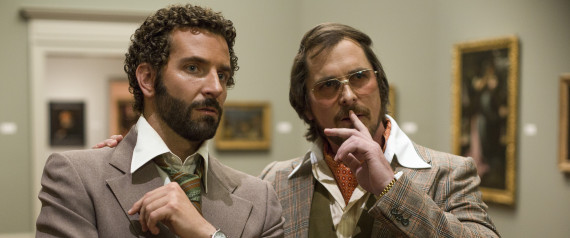
“AMERICAN HUSTLE” Review (✫✫✫)

FBI trying to hustle politicians by hustling con artists.

“We’re always conning other people,” says a slurred, yet sure voice in the background. “It’s in our nature. We even con ourselves.” These words are coming from the mouth that belongs to Irving Rosenfeld (Christian Bale), a con artist who quickly learned what it meant to grow up and survive in a harsh economy. Irving is the sort of guy you wouldn’t want to interact with out in public. He is grossly out of shape, he smells of old hairspray and cologne, his crafty eyes hide behind a dark pair of shades, and his diet consists of nothing but beer, fast food and cigars. From an outward appearance, Irving doesn’t really make a good impression. But man, can that guy talk a good game.

After rushing through Irving’s very brief childhood, we are quickly introduced to Sydney Prosser (Amy Adams), a woman in her mid-thirties whose beauty is both ageless and captivating. Despite his nauseating physical appearance, Sydney almost instantly falls in love with Irving, and Irving falls in love with her too. So much so that he discloses his illegal business with her, asking her to become a part of him scamming other people out of their hard-earned cash and checks.

That’s all I’m going to get into as far as the plot synopsis goes. Believe me, I haven’t even gotten to the surface of it. There’s an FBI agent trying to catch them named Richie DiMaso (Bradley Cooper), there’s a New Jersey mayor played by Jeremy Renner somewhere in the mix, Irving has a son and a wife he’s committed to named Rosalyn (Jennifer Lawrence). There’s even a mobster somewhere in this movie where an actor makes a cameo appearance, but I won’t spoil the surprise by revealing who it is (hint hint: He’s got some bad ideas in his head).

Point being: this is a smart movie. It’s funny, original, intelligent, and thoughtful, an observant portrait that looks at the moral and financial struggles of these characters and what impact their actions have on the people in their lives. Part of this, no doubt, is because of the cast’s mastery at delivery. Part of it is also because its writer-director is equally as funny, original, intelligent, and thoughtful as the story is. David O’Russell, who was nominated for best directing and writing Oscars for the past few years now (For Silver Linings Playbook last year and The Fighter in 2010), returns yet again with the same wit, charm, and complexion that made his previous films both unique and entertaining.

The dialogue is authentic, almost like it pops off of the pages of the screenplay just as much as it does in the movie. How though? This is, after all, a work of fiction, right? Wrong. The plot is just is like Irving’s deceptions: they’re only half fake. The movie is based on the real-life ASCAM sting operations of the late 1970’s, in which the FBI arrested over 31 individuals of congress and 7 were convicted of bribery and conspiracy. That sort of realism translates brilliantly to the screen, and makes the conversations characters share feel so personal. Make no mistake, fellow reader: this is, in every definition, a heist picture, because everyone is all after something and are willing to manipulate everyone in order to get to it first.

The cast is unforgettable. So much so that I can’t even pick a favorite among them. Bale is as talented as ever in this movie, a brilliant and dedicated method actor who has immersed himself so much into a role that its hard to imagine that at one point he was Patrick Bateman or Bruce Wayne. Lawrence and Adams are excellent female leads, and are great at expressing how conflicted Irving feels towards the both of them as lovers. Renner is great as the New Jersey mayor, a loving and kind-hearted man, father, and husband who just wants the best for everybody, but ends up making the wrong decisions in trying to do so. If I had to pick a favorite, it would probably be Bradley Cooper, only because he is so passionate and wacky that he could have been redone as a cartoon character. Like I said though, I can’t pick one. This cast is so talented and skilled in their roles that to pick one performance over another would be considered a sin. They are just as responsible for bringing this story to life as David O’Russell is.

This movie has all of the elements of being Oscar-worthy material: a great story, dialogue, characters, direction, and a great cast that fills these figures with vibrant energy and personality. The only real problem with this movie is the setup, and that’s unfortunate because that’s one of the most important parts of any movie.

Let me provide an example: when I first watched Goodfellas, what absorbed me into that picture was the first 15 minutes, a little italian boy learning about the mafia as a child, and the first narration we hear being “Ever since I can remember, I’ve always wanted to be a gangster.” Another one? In the opening scene of There Will Be Blood, we see a touching yet tragic portrait of a man seeing one of his workers die in an oil deposit, leaving behind an infant who can’t even speak, and Daniel Plainview deciding, against his better judgement, to adopt him as his own. Do I even need to mention Up?

All of those pictures started off with a bang because they gave us a perspective into the character’s history before getting into the meat of the story. Not that there needs to be a “How-to” guide for making opening sequences, but American Hustle literally flashes Irving’s childhood for about a minute before throwing us into the plot. I’m all for “show-don’t-tell” stories where they’re all situational, strictly limited to being set in their own present (Such as The King’s Speech or Black Hawk Down), but this one felt too much like being thrown into cold water when you can’t even swim.

Despite my views, I know critics already have their opinions established on this movie. They’re going to say its a masterpiece. That it is masterfully written and acted (which it is) and that it is going going to be nominated for multiple Academy Awards (which it will be as well). What critics won’t realize is the movie itself might be a con, making people believe that it is better than it actually is.

Well, if it is a scam, and David O’Russell is the con artist, then all I’m going to say is that he did a damn good job at it.

Post-script: For you irresponsible parents that are considering taking your teenagers to see this movie, don’t. The MPAA rated this movie R for “pervasive language, some sexual content and brief violence.” The violence is very brief and honestly not a large problem. The sexual content, however, is profuse because of Irving’s two sexual partners, and the movie has no shame for showing us any of it. I noticed over 100 F-words.

Tagged , , , , , , , , , , , , , , , , , , , , , , , , , , ,

“ALL IS LOST” Review (✫)

All Is Lost? You have no idea. 

I’m about to save you twelve dollars and about two hours of your life. Robert Redford lives.

Frustrated? Good. You’re supposed to feel frustrated, because that’s all the movie makes you feel. Out of all of the survival movies you will ever see, expect All Is Lost to be a bare, boring, and mindlessly pointless experience.

Here is the premise of the movie: Robert Redford is on a boat, trying to survive against storms at sea.

That’s it. That’s as much depth and interest as you’re going to get with this film’s premise. Make no mistake fellow reader: All Is Lost is aggressively bad. It is the most boring film of the year. It is the most forgettable film of the year. If the Academy Awards had an award for Most Mundane Picture of The Year, All Is Lost wouldn’t only be the winner of the category, it would be the only film nominated.

And yet, strangely enough, the movie has been mostly well-received by critics. The movie has a 94 percent rating on Rottentomatoes and an 88 percent on Metacritic, so there will be no shortage of people trying to defend it. Here are the most popular arguments defending the movie:

“The film is great at latching your attention despite limited dialogue.”

It’s true that the first 20 minutes are exciting enough to do a good job at latching you’re attention. The other hour and a half, however, could not be more repetitive or frustrating. Only two lines of dialogue are spoken throughout the film: “This is Virginia Gene with an S.O.S. call, over?” and profanity. That’s it. The rest of the movie is Redford staring out into an empty ocean with a deep, dreary melody playing in the background. Oh boy! Music! That sure will keep us interested!

“J.C. Chandor was masterful as a writer/director.”

It’s hard to make an argument that he even wrote this. The screenplay was a little more than 31 pages, barely any material to substantiate a feature-length motion picture. Chandor, who is most known for the intelligent and conversational Margin Call in 2011, was great as a writer, making an intelligent, well-crafted picture filled with character depth, dialogue and dimension. Now, he has reverted to making All Is Lost. Why? What convinced him to step out of his comfort zone as a writer? With the clever, intelligent and enticing dialogue now missing from Margin Call, his sense of style is just as absent, and it gives the film an empty feeling that feels like it’s just half complete. It’s better, in fact, to describe the movie as a feature-length short film, meaning it’s a 30-minute television special stretched out to feature length simply to enhance profit.

“Robert Redford was incredible in the movie.”

Yes, I see Redford is in the movie. Thank you for pointing out the obvious. He is completely and utterly useless. Notice with the plot synopsis, I never called him by his character name. That is because his character doesn’t have a name, credited as “Our Man” on the international movie database. Redford is not acting here. He is modeling, staging and positioning himself in meager, idle positions and actions as Chandor commands him to flip from one side of the boat to another. The character is so impersonal, so thinly written and so emotionally bleak that there is little reason to care about him or be motivated by his journey. So thanks, Chandor, for casting Redford in a character nobody gives two rips about.

Compare this to any survival movie written and produced in the past 30 years. JawsCast Away127 HoursThe GreyGravity. Look at all of those movies and try to remember the emotions you felt while watching them. What is it about those movies that latched everyone’s attention? What captivated audiences and compelled them to care for these characters to survive?

That’s exactly it: Characters. We cared about Chief Brody when his son barely missed the shark’s jaws. We care about Chuck and Wilson because Chuck needs to get home to his girlfriend Kelly. We care about Aaron Ralston because of how estranged he was with his family, with John Ottoway when we realize his wife is dying, or with Doctor Stone when we realize what became of her daughter.

We care about these characters not because of their situations, but because of their inner turmoils that compelled them to keep living: They all had something to live for.

What reason does Robert Redford have to live for? We are told nothing except for that he’s “Our Man.” Riiiiiiight.

It’s movies like Jaws and Cast Away that keeps us away from the ocean, but it’s movies like All Is Lost that keeps us away from the movie theater. All Is Lost? You have no idea.

Tagged , , , , , , , , , , , , , ,

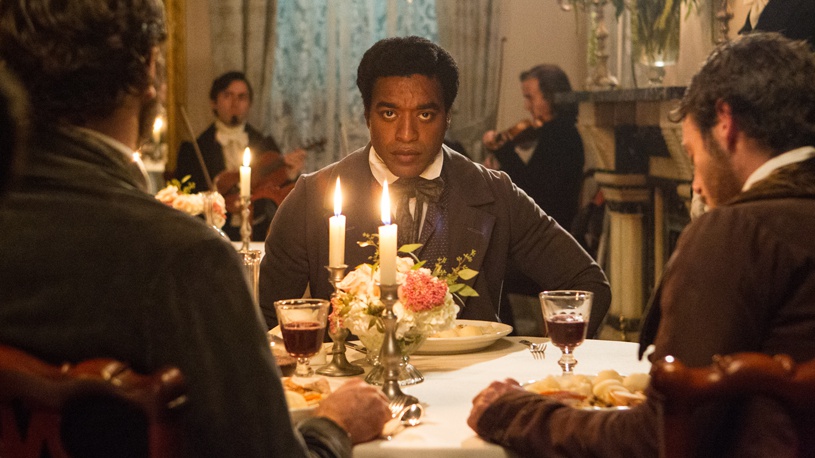
“12 YEARS A SLAVE” Review (✫✫✫✫)

Over a decade of injustice and cruelty.

12 Years A Slave is quite possibly the best film of the year.

It is also the most disturbing.

Based off the 1853 autobiography of the same name, 12 Years A Slave follows the true story of Solomon Northup (Chiwetel Ejiofor), a free black man who lives with his family and plays the violin in Saratoga, New York.

One evening, he becomes acquainted with two young gentlemen who claim to be circus performers looking to hire him for a one-night gig. When he wakes up the next morning, he is in chains, and realizes that he was drugged, kidnapped and sold into slavery by his captors. During his years as a slave, Northup goes from one owner to the next, from a kindhearted owner named William Ford (Benedict Cumberbatch) to a cruel, racist and mean-spirited pig named Edwin Epps (Michael Fassbender), who presents the greatest trials he must face if he is ever to survive.

12 Years A Slave is a film that not only lives up to all of its built-up hype and expectations: in many ways, it exceeds them.

Its quality as a work of art is so striking and powerful that it can be compared to other historical tragedies, including The Pianistand Schindler’s List.

Director Steve McQueen, who made the morally reprehensible and eerily bleak film Shame back in 2011, redeems himself here as a filmmaker. McQueen, in collaboration with cinematographer Sean Bobbitt, is not only masterful with framing his articulate, beautiful shots with 12 Years A Slave, but also brilliant with orchestrating scenes between his actors, showing us the bleak realism and truth of the slavery years in America.

Ejiofor, who portrays Northup in 12 Years A Slave is endlessly captivating. In moments where you think he might just be phoning it in, or just going along with the motions, he surprises you and releases an emotional intensity in ways no other actor has this year, not even Forest Whitaker in Lee Daniels’ The Butler. Newcomer Lupita Nyong’o plays a young female slave in this movie so passionately that you forget she’s an actress and slip into her character’s tragedy as a human being more than you do as a movie character.

Most noticeable perhaps is Michael Fassbender as Edwin Epps, who is so hateful and so spiteful in this role that all of the audience’s energy, anger and frustration is focused on him and his sadistic acts. Fassbender was brilliant in his portrayal, and I sincerely hope that he at least gets an Academy Award nomination for his performance.

Every other aspect of this film can be praised endlessly. The script by John Ridley, who wrote Three Kings in 1999, was endlessly emotional and captivating. The score by Hans Zimmer was quiet, humble and breathtakingly beautiful, encompassing both the truth and tragedy of Northup’s heartbreaking story.

However, let there be a strong word of caution: 12 Years A Slave will elicit violent reactions from its audiences. You will laugh. You will weep. You will grind your teeth in anger and frustration, maddened by the many years of cruelty, prejudice and barbarism that no human being should ever have to experience. But it compels you to care for the character, to reach deep down in your heart to feel what he is feeling, to experience compassion and sympathy in ways almost no other film can do, not even with Schindler’s List. 

And let this be a testament to the film’s quality: at the end of the showing, there was a white man who could be heard weeping in the back of the theater. In between his hiccups, tears and hysterical reactions, he turned toward the black viewer sitting next to him, shook her hand and after introducing himself said to her, “I’m so sorry for what my race did to your ancestors.”

That man felt a powerful feeling of guilt and shame for the things that he saw in 12 Years A Slave.

That man was me.

Tagged , , , , , , , , , , , , , , , , , , , , , , , , , , , , , , , , , , , , , , , ,

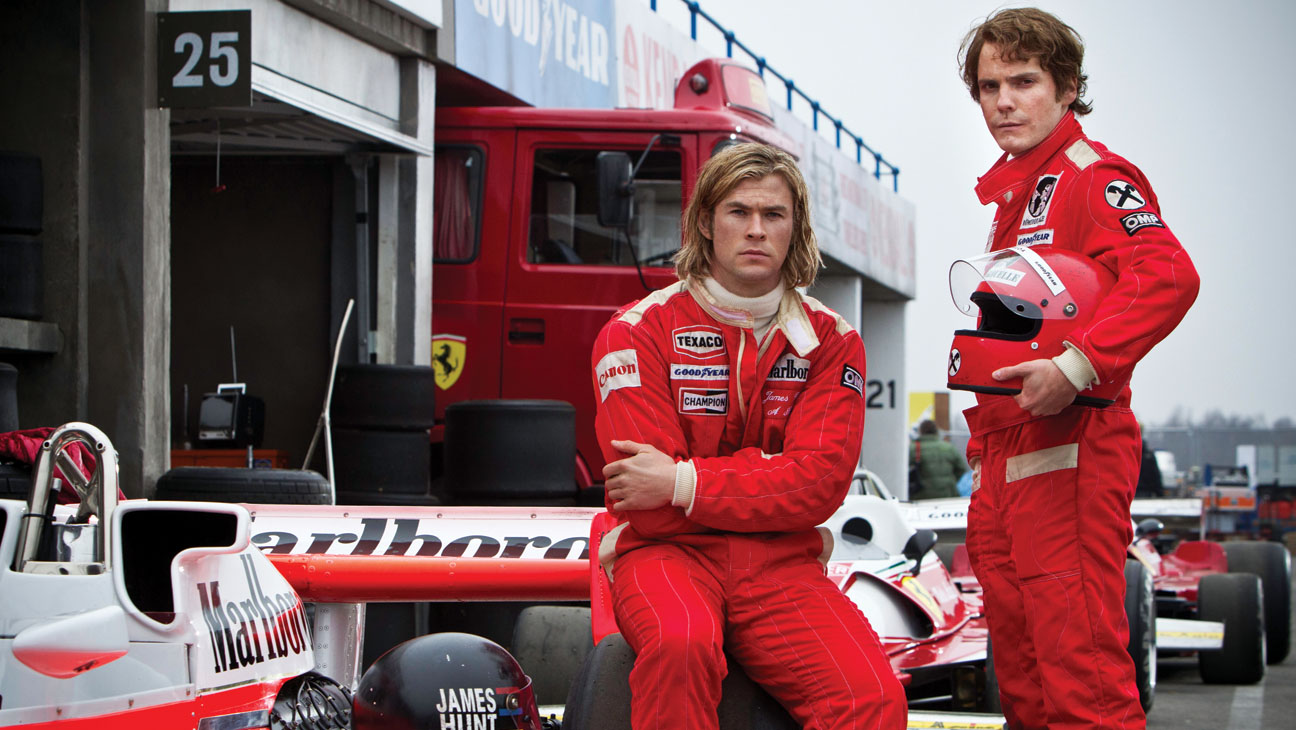
“RUSH” Review (✫✫✫✫)

Don’t think.  Don’t pause.  Just drive.  

I couldn’t have thought of a better title for the movie Rush, because that’s exactly what it is: an unstoppable and uncontrollable rush of energy, excitement, and gravitas, a movie that starts on a high note and simply refuses to let up all the way through.  I hear a lot of complaints that there are biographical movies that are more concerned with cashing in on people’s legacies rather than making an authentic account of a person’s true story, such as Jobs or The Iron Lady.  Here is a break from all of that, a refreshing and ideal account of two racers who live every moment of their life trying to figure out how to beat the other guy, while understanding that their symbiotic relationship is what made them both great racers in the first place.

Focusing on the 1976 Formula One Grand Prix season, Rush follows the story of two different racers, both with polar opposite personalities and complexions.  James Hunt (Chris Hemsworth) is a hard-headed racer who races with passion instead of brains, and a playboy who drinks a lot, smokes a lot, and sleeps with beautiful women, a lot.  Nicki Lauda (Daniel Bruhl) is a intelligent, smart, and crafty german who is just as focused and analytical as he is rude and ignorant. The film chronicles the contempt they feel for each other and the mutual respect that makes them strive to be better than the other man.

Before you go and see this picture, I encourage you to go online and google the names “James Hunt” and “Nicki Lauda” and look at their images.  Got it?  Okay, now that you’ve done that, go and watch the movie.

If you actually took the time to open up another tab and look at the images, you will be just as shocked as I was.  Comparing the sight of Lauda and Hunt with that of Bruhl and Hemsworth isn’t comparing them at all: they look exactly like the same characters, from the red jackets around their back to the color and hairstyles that we see on their heads.

I love it when movies do this: when movies are so accurate to the real-life figures that they copy their appearance so accurately, it is nearly impossible to differentiate from them.  We’ve seen this from The Fighter in 2009, and recently from Daniel Day-Lewis in Lincoln.

Here is yet another example of a movie that is compelled by truth and driven by accuracy, pun intended.  Rush is exhilarating.  Exciting.  Edgy.  Anticipative.  Emotional.  True.  Everything about this movie is a heart-pounding, sweat-pouring adventure, and what’s truly impressive is not that the movie makes us feel this way: its the fact that it really happened, and that really director Ron Howard is just documenting it rather than retelling it.

One of the highlights in the film are easily its lead actors.  Not only do Hemsworth and Bruhl look exactly like the people they are portraying: they act like them too, with their rivalry and their edginess apparent in every fraction of a scene.  Sometimes their clashes are funny, like the dialogue bits between Mark Zuckerberg and Eduardo Saverin in The Social Network, while at other times its strikingly serious like the James Braddock/Max Baer rivalry in Cinderella Man.  Whatever the situations, these actors do well at remaining in tense situations and they never, ever break their character.  Hemsworth is energetic, lively, and egotistical as Hunt, a man whose only loves are beautiful women and racing.  Bruhl is equally as egotistical, but he’s got a sly smartness about him you can’t help but appreciate.  There’s one great scene where Hunt calls Lauda a rat and he responds by saying “You think I’m hurt that you call me a rat, Hunt?  Rats are ugly, but they are smart.  Intelligent.  I am proud of that.”

The film doesn’t slow down at their performances, however, and filmmaker Ron Howard (Apollo 13, A Beautiful Mind) and screenwriter Peter Morgan (The Queen, Frost/Nixon) are quick to follow up on the pace of these two fine actors.  The guys who made Fast And Furious could take a hint or two from this movie. Morgan and Howard not only succeed in making the movie exciting and suspenseful through key moments in races, press conferences and private, vulnerable moments when these racers are all by their lonesomes: they’ve managed to make it gripping and relevant, a grounded drama thats equal parts and insightful into these two men’s lives that we feel like we’re witnessing their story upfront in the pit, not viewing it from far away on the sidelines.

Oh, I could go on all day praising this film and how all the elements culminate into a near masterpiece.  The soundtrack by Hans Zimmer is tense, unsettling, and noble, defining these men’s relationship just as well as the movie does.  The editing is tight, crisp, and clean at the hands of collaborators Daniel Hanley and Mike Hill.  For Pete’s sake, even the cinematography by Anthony Mantle was so good at capturing emotions and details so intimate, Howard would probably have missed some of them if Mantle wasn’t there to point them out.

Bottom line: Rush is entirely, unforgettably awesome.  It’s a strong and powerful tale about two passionate racers who knew what they were after and were willing to sacrifice whatever they could to go after it.  We see why they want to beat each other.  We understand who they are and why they are racing.  We know what makes them tick and we want to see them make it through every pulsating moment of the film in order to accomplish their dreams.  Trust me, you’re going to want to sit in on this race.  Oh, and bring your seatbelt.  You’re going to need it.

Tagged , , , , , , , , , , , , , , , , , , , , , , , , , , , , , , , , , , , ,