
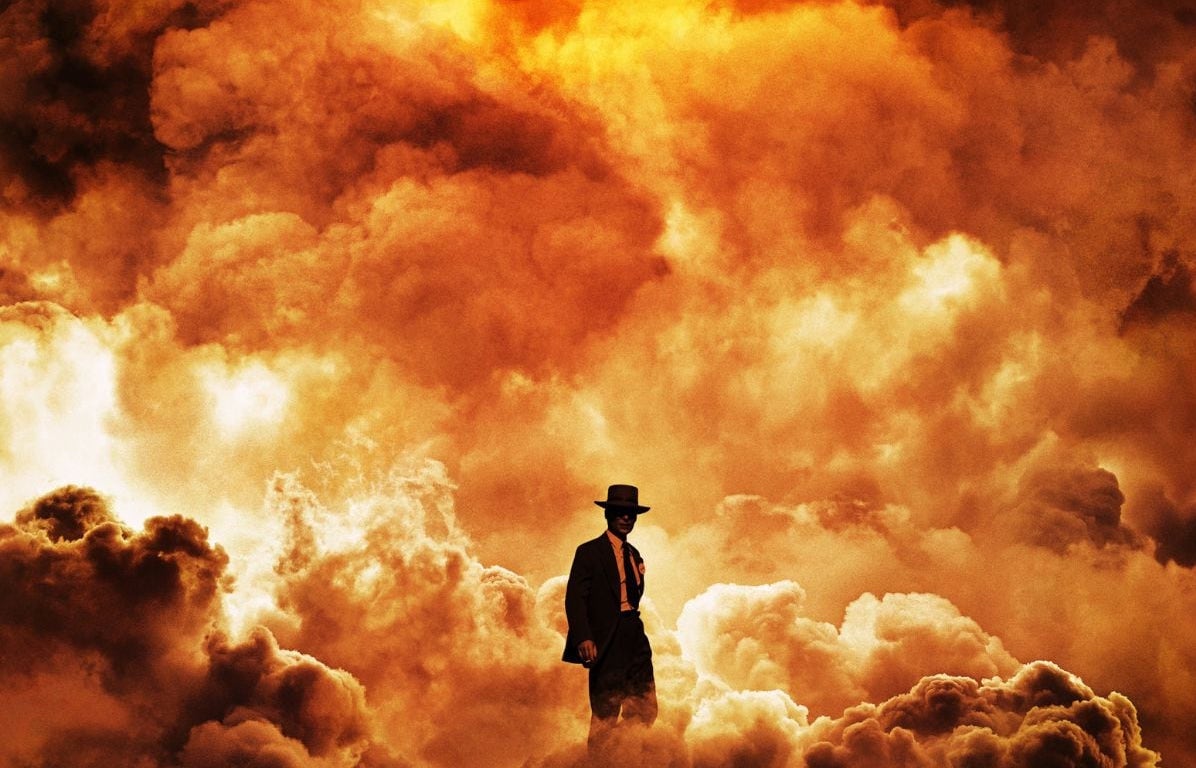
Becoming Death, The Destroyer Of Worlds.
On August 6th, 1945, the United States dropped an atomic bomb over Hiroshima, killing over 70,000 people and burning, scarring, and poisoning several hundred others. A few days later, the U.S. dropped a second bomb on Nagasaki, killing 60,000 more people. That’s at least 130,000 dead, and several historians estimate that casualties were actually much higher. If that bomb were dropped on U.S. soil instead, it would have meant the death of America. Maybe it already does.
The argument lingers over how necessary those bombings were in effectively ending World War II, but even those arguments don’t answer one key question: what is the cost of taking all of those lives? History gives us hindsight of what the literal fallout from those bombings was, but what do all of those deaths do to a man? What is it like to feel the weight of a thousand burning souls on your shoulders?
Oppenheimer answers this question with cold, stark, unflinching reality, simultaneously providing us with a behind-the-scenes look at how the atomic bomb was made as well as a peak into the soul of the man tortured by his own creation. Written and directed by Christopher Nolan (Inception, The Dark Knight trilogy), Oppenheimer recounts the story of the infamous father of the atomic bomb through three key points of his life: his academic upbringing in Cambridge, his days working on the Manhattan Project, and his security clearance hearing in 1954. While all of these storylines are being portrayed simultaneously, all of them are linked toward one recurring theme: Oppenheimer, and humanity itself, hurtling towards a dark, inevitable fate that all seem powerless to prevent.
I remember the first time I saw J. Robert Oppenheimer speak. It was during the 1965 documentary “The Decision To Drop The Bomb,” where he uttered the infamous quote “Now I have become Death, the destroyer of worlds.” However, the thing I remember most from that telecast wasn’t those words: it was Oppenheimer’s eyes. His face was cold, expressionless, the light from his eyes evaporated as if he were a corpse confessing his soul. He looked as if the atomic bomb went off inside of him, and his body on the outside was decaying from the nuclear fallout from within.
More than anything else, I wanted Oppenheimer to capture what it’s like to be the man behind the deadliest weapon in human history. I wanted to see what that does to a person — what knowing the death and destruction you have caused does to your spirit. Oppenheimer gave me more than what I asked for and delivered a dramatic epic that’s part tragedy, part cautionary tale, and part Greek fable not unlike that of Prometheus, the god of fire.
A key part of that comes from one of Nolan’s longtime collaborators Cillian Murphy, who convincingly portrays Oppenheimer at every point of his life. At the beginning of the film, he’s a curious and ambitious young scientist who dreams of atoms, molecules, and the world of matter that hides behind our own. As the film progresses, he transforms into an atomic-sized dramatic force determined to bring the Manhattan Project to life. It’s only after the Trinity test that he becomes Oppenheimer as we recognize him — an aging, decrepit shell of a man haunted by the nightmares he helped create. Cillian brilliantly portrays Oppenheimer not as a historical figure, but as a real person experiencing all of these events in real time. While the film doesn’t excuse his actions, Cillian humanizes Oppenheimer so effectively to the point where you understand where he’s coming from. At times, you even feel bad for him.
But Cillian is only one part of this giant and mesmerizing nuclear puzzle, and his exceptional castmates help complete it. Emily Blunt plays Oppenheimer’s wife Kitty, and her fiery, ferocious spirit perfectly balances Cillian’s nuanced, colder demeanor. Matt Damon plays Oppenheimer’s handler, and his snarky condescension brings welcome brevity and comedic timing to a film that usually feels unbearably heavy. And I’m happy to say that Robert Downey Jr. was exceptional as AEC chairman Lewis Strauss. I was worried after he finished his time as Iron Man that he might become complacent and not want to work as hard for future roles. Oppenheimer demonstrates that he’s still got the acting chops, and if you give him a good part, he’ll damn near outshine everyone else in the movie.
And like all of his movies before, Christopher Nolan outdoes himself in his commitment to only using practical effects. It all culminates into the Trinity test sequence, which is actually the only time we ever see the atomic bomb explode on screen. The buildup and anticipation was nerve-wracking, the score by Ludwig Goransson was intense and anxious, and the cinematography by Hoyte Van Hoytema captured everyone’s uneasy expressions beautifully. But when that bomb went off, that bright light consumed the screen, and the sound design shook the theater like an earthquake… dear reader, I have NEVER felt an explosion like that in the cinema ever. It felt like you were in the bunker with Oppenheimer, and like everyone else on the Manhattan Project, you were worried you were going to set the sky on fire.
But amazingly, that explosion was not the most impactful thing from the movie. What impacted me most was witnessing the fallout of it — how global powers changed, how the world reacted to its creation, how Washington scrambled to politicize it and benefit from its power, and the guilt and the grief that racked Oppenheimer for years after he detonated that first bomb.
We never actually see the bombings of Hiroshima and Nagasaki, and rightfully so. After all, Oppenheimer never saw it himself, so it makes sense that we share his perspective when he heard about it afterward. But what’s incredible is despite never witnessing it, Oppenheimer imagines it, and his imaginings are horrifying. He feels the bomb go off and the bright light consuming his body. He feels flesh burning and sees charred bodies crumble into ashes. And he hears the shrieks and screams as they fill his ears like a chorus from hell.
Oppenheimer is a haunting and harrowing vision of one man’s nuclear nightmares and what they may mean for the future of the human race. By the end of the film, the scariest thing isn’t wondering if the world will end from nuclear warfare — it’s wondering if it already did.



 DAVID DUNN