

Have you heard about any of the Academy Award nominees? Yeah, me neither.
Like clockwork, the Academy Awards recently released their nominations for this year’s ceremonies. Unlike previous years where I wake up at my own leisure and read the nominees at my earliest convenience, I actually got up earlier the morning of the announcements and listened to the livestream on my way to work. Good gravy, are these people pretentious. The live-action shorts that played before the category announcements were so high-quality that they were better produced than many of the nominees themselves were. Can we recruit these people to make better films for these categories in future award ceremonies?
But never mind that, you’re not here to hear me gripe about the Hollywood elites. You’re wanting the breakdown on this year’s nominees. Let’s hop into it.
Leading the pack of best picture nominees this year is Guillermo Del Toro’s science-fiction romance The Shape of Water, a weird and uncomfortable movie about a fish creature falling in love with a woman. In hindsight, I passively admit that the film is mostly deserving of its 13 nominations. It is, after all, visually and aesthetically pleasing, and the creature himself has some of the most convincing effects I’ve seen in the past year. But I didn’t like the movie itself, feeling that it was too preachy and on-the-nose to be taken seriously. I do think Del Toro is very deserving of an Academy Award in general. His films Hellboy and Pacific Rim both pushed the boundaries in what could be achieved through visual storytelling, while Pan’s Labyrinth was a beautifully dark fantasy that put adult tragedies through the innocent eyes of a child (it’s actually one of my frustrations that film didn’t win best foreign language film at the 2007 Oscar ceremony). Will The Shape of Water be the film to break Del Toro’s losing streak? Possibly, but I can’t help but feel that parts of his earlier filmography are more deserving for an Oscar than The Shape of Water is.
The runner-up best picture nominee with the most nominations is Christopher Nolan’s Dunkirk, a World War II drama depicting the battles for French beaches, seas, and skies. Again, Christopher Nolan is a fantastic filmmaker: one of our generations best. But his earlier films are astronomically better compared to the sloppy, confused timeline that Dunkirk gave us. His first nominated film Memento was a mind-boggling and fascinating study of a decomposing mind, while The Dark Knight broke the boundaries between what we consider superhero movies and art. Inception is one of the greatest films this decade. Any one of these masterpieces could and should have been major contenders for best picture in previous ceremonies. Why is it suddenly that the lapsed, removed experience of Dunkirk is the one picture to suddenly give him a serious chance at the Oscars? Dunkirk is nominated for eight Academy Awards. It deserves five of them.
Side-note: In addition to Dunkirk’s best picture nomination, this is also the first time Nolan has been nominated for best director, merely getting only screenplay nominations in previous ceremonies. Regardless of what your opinion is on Dunkirk, can we at least agree that it is blatantly outrageous that this is Nolans’ first best director nomination?
Next is Three Billboards Outside Ebbing, Missouri, which places in this year’s ceremony with seven Oscar nominations. This is one picture you gotta look out for here, folks. It swept at both the Golden Globes and the Screen Actor Guild Awards, winning the highest prizes at both ceremonies. Its stars Frances McDormand and Sam Rockwell are both serious contenders for this year’s acting categories. Writer-director Martin McDonagh has a strong chance at the best original screenplay award. I haven’t watched the film yet, but it’s been racking up wins this awards season like a Star Wars movie stealing the holiday box office. Keep your eyes focused on this one.
Two surprise nominees here that I wasn’t expecting: the biopics Darkest Hour and Phantom Thread, both starring Hollywood heavyweights Gary Oldman and Daniel Day Lewis. The surprise here isn’t that they’re nominated for best picture, but that they’re nominated for five other Academy Awards besides it. I figured those two pictures were shoo-ins in the acting categories due to the reputation of its leads. I didn’t expect them to also slip in to the production design, costume, makeup, and cinematography categories as well. If anything, this shows that this year’s ceremonies are not as predictable as they usually are, and they’ll really contain their own twists and turns that none of us were expecting. I’m genuinely excited to see how these two films will impact the best picture race on Oscar night.
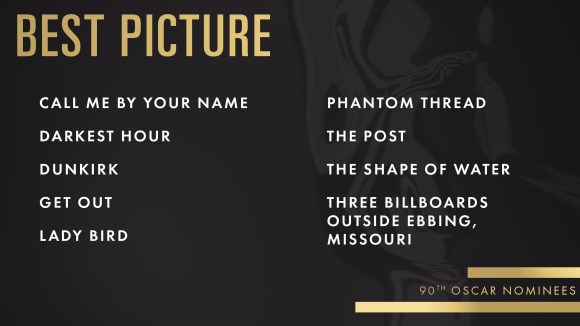
Also nominated for best picture is the coming-of-age drama Lady Bird, the gay romance film Call Me By Your Name, and the satire-comedy-horror picture Get Out. Out of all of the movies to be nominated for best picture this year, my favorite is easily Get Out. If you haven’t seen it yet, you absolutely need too. It’s one of the most creative films I’ve seen in years, making a provocative race commentary that is equal parts violent, scary, entertaining, and relevant to its intended audience. The fact that it’s nominated here not only for best picture, but also best director, actor, and screenplay makes my heart happy for writer-director Jordan Peele, who basically exploded onto the film scene with this directorial debut. One could only dream to have a year as successful as Peele did.
There’s one best picture nominee here that doesn’t belong. Not because it isn’t deserving, but because it isn’t fairly backed up by its other nominations: The Post. Don’t get me wrong, it absolutely deserves to be nominated for best picture. The journalism-drama tells the story of the Washington Post reporting team that broke the story on U.S. Government’s obscured involvement with the Vietnam War, which eventually developed into the Pentagon Papers expose. It very much is Oscar-worthy material. The issue is that it’s only nominated for one other award besides best picture, and that is best actress for Meryl Streep’s role in the film.
This isn’t the first time that this has happened in recent Oscar history. Extremely Loud and Incredibly Close was only nominated for best picture and best supporting actor for Max Von Sydow in 2012, while the Martin Luther King Jr. biopic Selma was only nominated for best picture and best original song in 2015. The worst of these offenses was Spotlight in 2016, which only won best original screenplay in addition to its best picture win. It is the only best picture winner in Oscar history to receive only two awards from the night.
This pity-nomination party has to stop in the Academy Awards. A film is not considered the best of the year for one actress alone, but for an assortment of cohesive elements that work together for the film. The director Steven Spielberg. The writer Josh Singer. The editor Michael Kahn. The cinematographer Janusz Kamiński. Streep’s co-star Tom Hanks. There was a lot of talent associated with this film, all of them equally deserving for attention as Streep was. Either give the film more nominations to support its best picture nomination, or don’t nominate it at all. There were plenty of other hard-hitting contenders that could have been nominated instead of The Post that have the nominations to back it up. Blade Runner 2049 with five nominations. Mudbound with four nominations. Baby Driver with three. You can make a case for any of these films and more to be nominated in the place of The Post due to its acting and technical nominees. Why on Earth are we giving out pity nominations for movies that can’t get more than two nominations from Academy board voters?
Overall, how do I feel about these nominations? Meh. They’re fine. I’m not really excited or maddened by their recognition here. They’re just kind of a passing mention of under-the-radar films to be aware of before you get to awards night.
I will say that, just like every year, there is obvious snubbing in categories where films did not deserve the disservice they received. You will notice, for instance, that Wonder Woman got zero nominations, despite being one of the biggest critical and commercial successes of the year. Detroit got zero nominations, despite its attention to detail and authentic depiction of such despicable events. The Stephen King horror film It got zero nominations, not even for makeup or supporting actor for its brilliant performance by Pennywise actor Bill Skarsgard. Good grief, even Logan got snubbed with Hugh Jackman and Patrick Stewart’s mesmerizing performances as old heroes reflecting on their broken selves (although it did impressively nab a best adapted screenplay nomination, the first superhero movie in Oscar history to ever receive such an honor).
But Academy Awards ratings have been consistently dropping, ever since its changes to the best picture category first proposed in 2010. Continuing to skip over mainstream films such as these is exactly why. Critics love the indie flicks that continue to surprise us in new ways, while moviegoing audiences love the occasional blockbusters that give them the escapism and entertainment that they need. It’s entirely possible to love and appreciate both of these kinds of films. Somebody please send the Academy the memo.
– David Dunn

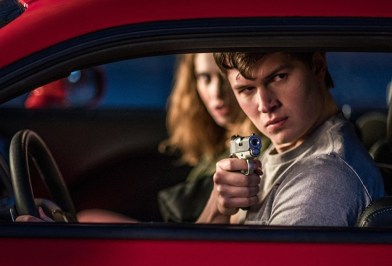 A sleek, stylish, and electric action-drama booming with nostalgia, in-cheek humor, and a hot-blooded soundtrack to boot. When a getaway driver named Baby (Ansel Elgort) decides he wants to get out of the criminal life, he has to go through his boss Doc (Kevin Spacey) and assassins Buddy (Jon Hamm) and Bats (Jamie Foxx) to save his girlfriend Debora (Lily James) and hit the road running. Elgort is a powerhouse in the lead, portraying a conflicted young man guided by a moral compass in a place where it points nowhere. The action and comedy blend together perfectly, with writer-director Edgar Wright framing the film as a homage to classic 1980’s espionage films. And the soundtrack is infectious in its appeal, with featured artists such as The Beach Boys, Queen, and Simon and Garfunkel here to keep your feet tapping. The year’s biggest surprise hit. Three and a half stars.
 Hugh Jackman’s last outing in a role that he has served well for more than 17 years, a finale that is equal parts violent, action-packed, emotional, heartbreaking, and powerful. When Logan (Jackman) is approached by a little girl named Laura (Dafne Keene) asking for his help, he teams up one last time with his mentor Charles Xavier (Patrick Stewart) to save Laura from the men that are after her. Refusing to shy away from the bloody, hard-R violence that made Deadpool a mainstay, Logan is the most emotional, the most vivid, and the most grounded story told in Wolverine’s saga. Instead of the action and the visual effects, writer-director James Mangold chooses to focus on something more practical to Wolverine: his humanity. Like The Dark Knight and Spider-Man 2, Logan relates to us on a more human level as opposed to a fantastical one, and the characters deal with real struggles as human beings, not as superheroes. Jackman and Stewart also give the most defined performances of their careers, playing their characters in their most vulnerable, broken appearance to date. Time will remember Wolverine for the hero. I will remember Logan for the man. Three and a half stars.
 A strange, surreal, and deeply unusual horror film, but also immediately relevant to its intended audience. When an interracial couple goes to visit the girlfriend’s parents for a weekend getaway, they discover that her parents aren’t all that they seem: and neither are their neighbors. “Key & Peele” co-creator Jordan Peele comes forward here in his directing debut as a masterful storyteller, deconstructing and elaborating on white privilege and the devastating effects it can have on individual lives. Daniel Kaluuya and Lil Rel Howery respectively delivers the films most climactic and comedic moments, with Kaluuya particularly impressive in portraying a character that is confused, scared, and victimized in a situation where no one is coming to help him. Get Out is one of the most creative, compelling, riveting, and darkly humorous films I’ve seen in years. It works across the board as horror, comedy, drama, or satire. Take your pick. Three and a half stars.
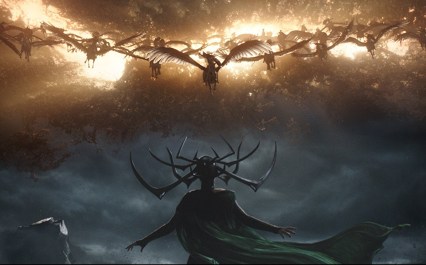 Marvel’s standout of the year, a movie that has absolutely no business being this good or memorable. When Thor (Chris Hemsworth) starts getting visions of Ragnarok, the prophesied destruction of Asgard, he has to team up with Valkyrie (Tessa Thompson), the Hulk (Mark Ruffalo), and Loki (Tom Hiddleston) to stop Hela, the Goddess of Death (Cate Blanchett) from destroying Asgard. Packing five different genres into one unorthodox mess of perfection, Thor: Ragnarok is a funny comedy, a thrilling action movie, an exciting adventure, a heartfelt drama, and a groundbreaking superhero epic all at once. The comedy hits exactly the right notes with the right lines. The drama, while at times a little too brisk, strikes with the emotional chord that it needs to. The action scenes are thrilling. The visual effects, mesmerizing. The music, synthesized and catchy. Even the Easter Eggs are infectious in their appeal. I haven’t had this much fun in a superhero movie since The Avengers in 2012. Yes, I’m comparing Thor: Ragnarok to The Avengers. Don’t knock it until you try it. Four stars.
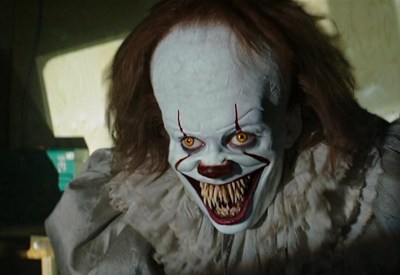 A terrifying and insightful personification of fear made possible by the brilliantly mad mind of Stephen King. When a group of kids discover an omniscient being disguised as a clown haunting their hometown, the children decide to team up and put an end to it’s villainy once and for all. The cast takes center-stage in a horror film fueled by complex emotions and ideas, with Bill Skarsgard perfectly embodying the madness and bloodlust that the iconic character Pennywise the dancing clown would possess. Director Andy Muschietti also smartly compares and juxtaposes human nature with that of a predator’s nature, asking us if these two concepts can exist in the same society. It is visually dynamic and haunting, with the makeup and costuming on Skarsgard being among the best work I’ve seen in years. A thoughtful, captivating, and intensifying look into the psychology of fear and how it affects our flawed perceptions of life. Four stars.
 A cruel, horrifying, and maddening fact-based account of one of the most egregious cases of police brutality in American history. During the 12th Street Detroit riots of 1967, a team of rogue cops infiltrate their way through the Algier’s Motel and pin the inhabitants against the wall, demanding to know if they’re hiding any weapons inside the building. As the hours pass, the teenagers soon realize that this is not a run-of-the-mill police checkup, but instead a fight for survival between themselves and the men who are supposed to be upholding the law. Thoroughly researched and accurately dramatized from the Academy Award-winning team of screenwriter Mark Boal and director Kathryn Bigelow, Detroit is one of the most riveting and essential pieces of cinema you can watch this decade. The details of this real-life account are haunting and tragic, and the cast equally commits to recreating this monstrous night with passionate urgency. Newcomer Algee Smith especially shines as a troubled R&B musician, a terrified kid caught in this confusion of racial prejudice and hatred that permanently damages him for the rest of his life. Don’t turn away from Detroit. Watch and be horrified by our nation’s history. Four stars.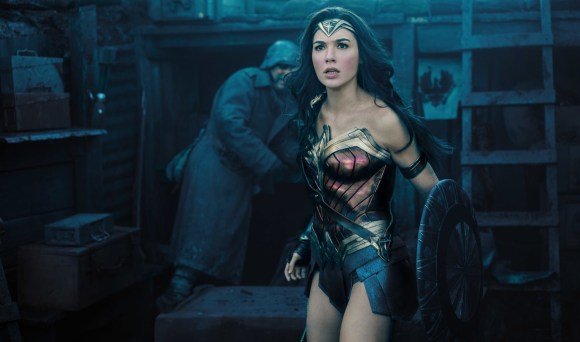


 DAVID DUNN