Tag Archives: Crime

“MISSION IMPOSSIBLE III” Review (✫✫✫)

Your mission, should you choose to accept it. 

Finally, we can forgive Tom Cruise for the disaster that was Mission Impossible II. This is the perfect example of a solid action movie, a film that has suspense, excitement, romance, and intrigue: a Hollywood blockbuster that has a nice balance of everything you can ask for. There is a moment in Mission Impossible III where we feel for Ethan Hunt not as another movie action hero, but as a human being, who has emotions and worries that any other normal human being would possess. The way Cruise portrays him in this movie is very realistic. Think about it: if you were out there, stealing nuclear devices, kidnapping black arms dealers, and saving the world every ten seconds, wouldn’t you be worried about your wife who knew nothing of your double life back at home?

Apparently now retired, we catch former IMF agent Ethan Hunt (Tom Cruise) as he is happily engaged to Julie (Michelle Monoghan) a nurse who is studying to be a doctor. For once, Ethan is experiencing a sense of normalcy. He’s experiencing what it is like to be a husband, and what it is like to love. No explosions, no excitement, and no lives at risk. Ethan, for once, is just a normal guy who is in love with a beautiful woman. He is experiencing happiness.

Happiness for Ethan, however, doesn’t last long, and he soon finds himself shoved right back into the profession he wants to retire from. When told by his superior, John (Billy Cudrup) that Ethan’s apprentice, Lindsey (Kerri Russell) was captured and tortured by criminals while spying on black arms dealer Owen Davian (Phillip Seymour Hoffman), Ethan feels that he has no choice but to go back into the field so he can save his friend from certain demise.

This film, like the other Mission Impossible movies, sports strong performances. The cast is just as strong as any other movie, and I think you can argue that they are the strongest in this one. Cruise, for instance, doesn’t play a paragon of an action hero. Here, he plays a human being, flesh and blood, emotion for emotion, merely molded to look like an action hero. Despite his skills and experience, he can’t be everywhere at once. He can’t be with his wife and take care of her and go off to save the world at the same time.

At some point, whether he’d like to or not, he has to leave one world in order to take care of the other.

I however, wouldn’t leave Julie alone with a creep like Davian for a second if I had known he would pay her a visit. This dude seriously scares me. Phillip Seymour Hoffman, who is a very skilled actor, is perhaps the subtlest in this movie, and plays a ruthless criminal who is just plain mean, evil, cruel, and antagonizing. I have met few antagonists who are as patronizing and as threatening as this guy is. Here is a guy that puts many other movie villains to shame, including those in the first Mission Impossible. Here is a guy who scares you just by staring bleakly into your eyes. He doesn’t need to speak to you: his eyes do all the talking, the eyes that say that he’s going to kill the person you love most, and he’s going to do it in front of you while you’re watching.

This film doesn’t go as deep into those politics of things as some may like it to, but I don’t think it is necessary. Mission Impossible III is fun. I say that as a simple statement, but there is nothing simple about this movie. This movie has earned the title of Mission Impossible from the stunts and visuals alone. I can easily name eight scenes on the top of my head that truly impressed me. Perhaps the most memorable moment for me was an assault between IMF agents and trained ex-military assassins on a bridge near New York. This scene was nerve-wracking, exciting, and worrisome for multiple reasons. Perhaps the biggest is because everything was happening all at once.

Cars were blowing up. Pieces of the bridge were falling apart. Innocent people were caught confused and afraid in the crossfire. Agents were getting shot. Assasins were breaking a prisoner out of an armed jeep. And here is Ethan, running around, avoiding gunfire and explosions, trying desperately to grasp the situation and take control of it. The reason this movie is so successful is because, like the other movies in this series, they push the limits of what they can achieve. There is not a single moment in this film where a thrill is wasted. It’s all there, and it is just as effective as it was in the first Mission Impossible.

The action overwhelms the plot a little bit in the third act of this movie, but other than that, the film is almost perfectly balanced. Director J.J. Abrams and screenwriters Roberto Orci and Alex Kurtzman have found a nice combination involving stellar action sequences, funny dialogue, memorable characters, and heartfelt emotion. Have I mentioned before how I hate emotionless action movies? I have no complaint with Mission Impossible III. Its heart is in the right place, and it knows its characters as well as its action. That’s a rare treatment for action movies. It’s a treatment that should be given to them more often.

Tagged , , , , , , , , , , , , , , , , , , , , , , , ,

“MISSION IMPOSSIBLE II” Review (✫✫)

So ridiculous, it can only happen in a movie.

I wonder what it would be like to write action scenes in a screenplay. Not briefly, mind you, but over an extended period of time. We are so used to these action movies that contain nothing but wall-to-wall action, violence, exploding, shooting, stabbing, kicking, punching, and body-dropping all over the place. Few of those movies have worthwhile plot or dialogue to them, which are the main tools a screenwriter uses when writing their screenplay. I imagine writing an action movie for them would be a nightmare. There’s nothing interesting to write about except for who dies next.

I feel especially sorry, then, for screenwriter Robert Towne, who is normally known for his smart, driving plots found in movies like Chinatown, The Firm, indeed, even the first Mission Impossible, now stuck to writing about nothing but explosions, gunfire, broken bones, ribs, limbs, and jaws, with a little twinge of intrigue placed somewhere in this muck of explosions and action. Mission Impossible II is not the movie that the first Mission Impossible was. The first Mission Impossible had memorable characters, iconic situations, and an in-depth and mysterious plot that kept your interest for every second of that movie. Its sequel Mission Impossible II has nothing the first one had except for its action. The characters, while likable, are also disposable, and lack any emotional conviction to make me really care for anyone for a long period of time. The plot is utterly pointless. Like this movie, it exists only to provide reason for the action, rather than the other way around.

MI2 follows agent Ethan Hunt’s (Tom Cruise) pursuit of an ex-IMF agent named Sean Ambrose (Dougray Scott), who is impersonating Hunt through the same face-masks from the first film. What is Ambrose after, and what does Hunt’s identity have to do with it? He is after a harmful chemical known as “Chimera”, a terrible virus that infects the host in a matter of hours, takes his cells, eats them, and kills the host as slowly and painfully as possible. The doctor who made this is named Vladmir Nekhorvich (Rade Serbegija), and he has been a close friend of Hunt’s for some unknown period of time now (Although he keeps calling him “Dimitri”, for some  reason).

This film is directed by John Woo, who is mostly known for his ridiculous, overly-long, overly-explosive action scenes in his movies. His action scenes are so ridiculous, that he makes Michael Bay shrivel up in his seat. This movie is no exception. Mission Impossible II is just as explosive, outlandish, insane, exhilarating and visually stellar as any other John Woo movie is, and that includes movies such as Broken Arrow and Face/Off.

On one hand, this is a good thing, considering Woo makes some incredible action sequences at some moments in this movie. I remember one scene where Tom is fighting off countless professional assassins in a chemical building while trying to destroy a sample of “Chimera” in the process. That gunfight was insane. Cruise was fighting off countless assassins with grenades, Uzi-Subs, and M-104’s, and what does Tom have to fight off against them? A pistol. It is these impossible odds that stacks up the action scenes to incredible heights, and makes for very entertaining, exciting moments in this movie.

Unfortunately, Woo focuses too much on the action. The difference between this film and his earlier film Face/Off is that Face/Off had a smart, original, and fascinating plot, while Mission Impossible II just copies elements from other action films. Stop me if you’ve seen any of this before: A) A Bond-type action hero that beats bad guys to a pulp and always gets the girl, all while looking incredibly sexy to the female audience with his long hair flowing freely in the wind, B) The hero falling madly in love with a woman who is just as sexy to the male population as the hero is to the female, C) The hero eventually having to rescue the damsel from distress, D) The sinister villain is introduced and narrates a plan so ridiculous, it can only happen in movies, E) An excruciating length of a 40 minute action sequence takes place, F) The villain dies at the end of the movie, and G) The hero and his lover kiss at the end of the movie and walk into the sunset in a “Happily Ever After” kind of concluding tone.

Could that entire paragraph be technically considered a spoiler? No, it can’t, because we’ve all seen that movie before. Is it really so surprising that the villain dies, and the woman is saved from danger at the end of the movie? Is it really so shocking? You might enjoy seeing the same thing over and over again, but I can’t stand it. I can’t stand movies that have a method to it. I can’t stand movies that follow formulas. Granted, I don’t want a movie where the villain lives and the hero dies with his love next to him, but geez, throw something unpredictable in there. Action without point is no action at all. It is just headaches.

That’s not to say that the strong points still don’t hold up to what we expect them to be. I already said the action is amazing, and it is. The music has definitely improved from the last movie, and Hans Zimmer inserts a nice rock twist to the famous theme that made the series iconic by right. Cruise especially shines in this movie just as much as he did in the first movie. In the first sequence he’s introduced in, Cruise makes an impossible rock climb over a canyon in nothing but a sleeveless shirt and a waist pouch with gripping dust in it. Remember something here: that’s not CGI, and that’s not a stunt double. Cruise is doing his own stunts, meaning he actually free-climbed up this deathly-high slab of rock. I think he secretly has a death wish for pulling off stunts as stupidly risky as this, but I hold my respect to him for having the audacity to even think about pulling off a stunt like that. It is moments like that that really impresses the audience, and what I think, makes Cruise a very credible and successful actor. He’s willing to pull off whatever he can in order to impress the audience.

But the strong points of this film pales to the weaknesses. Mission Impossible II is all style, and no substance. It has plenty of action, explosions, and body counts to overwhelm you with, but it lacks interest and consistency in between the action scenes with its stupid dialogue, and its plot that is as incredulous and predictable as any other action film can be. I’ve said before that I don’t mind action films as long as they are good ones. This is an ambitious one, but it’s too similar to other action movies to say it’s a “good” one. In the end, this movie to me is like a magician trying to con you at the circus. He shows off its tricks to you, but when he’s done, he turns and says to you “Sorry kid, no refunds”.

Tagged , , , , , , , , , , , , , , , , , , , , , , , , , , , , , , ,

“MISSION IMPOSSIBLE” Review (✫✫✫✫)

Your mission: survive.

Now this is what an action blockbuster is supposed to be: smart, exciting escapism entertainment that makes its audience think rather than overloading them with special effects. Mission Impossible is pure fun, starting with its intelligent, masterful plot, and carrying itself through with state-of-the-art special effects, credible acting, and relatable characters that have a purpose in the conflicts they are going through. You don’t have that many movies where the characters are as fleshed out as the action is.

Mission Impossible follows the perspective of a young agent named Ethan Hunt (Tom Cruise) who works for a secret agency known as the IMF. His leader, James Phelps (Jon Voight), is given a mission to capture a fugitive who is after the “Noc List”, a file that categorizes every IMF agent working undercover in the field. If the Noc list ever got into criminal hands, many IMF agents’ lives would be in danger.

That’s where Phelps and his team come in: their mission is to capture this thief on-camera stealing the Noc list, follow him to a meeting with his buyer, and apprehend the both of them.

The mission goes desperately wrong. One by one, Ethan’s team is killed off, and Ethan is the only one to walk away. Now, IMF believes he is a traitor because the thief got away from Ethan Scott-free. Now alone with no backup and no resources, Ethan has to not only recover the Noc list, but also find out who is responsible for his team’s mission failure, as well as clear his name for the crimes he didn’t commit.

Here is a spy movie lived to its fullest. Going undercover in tuxedoes and bow ties while sipping martinis and champagne, these spies use their wits, not their weaponry, to outsmart their foes. And their weaponry itself… dear lord. They utilize such a wide array of complicated spy equipment that would floor anyone who would just take a glance at them. What we have here isn’t just guns, pistols, and radar jammers: we also have trip wires, laser security, balance beams, harnesses, suction gloves, and these latex masks that allow agents to copy the facial features of another person. There is a lot of spy tech and gear for the characters to play around with in this movie, and boy, do they play around with it.

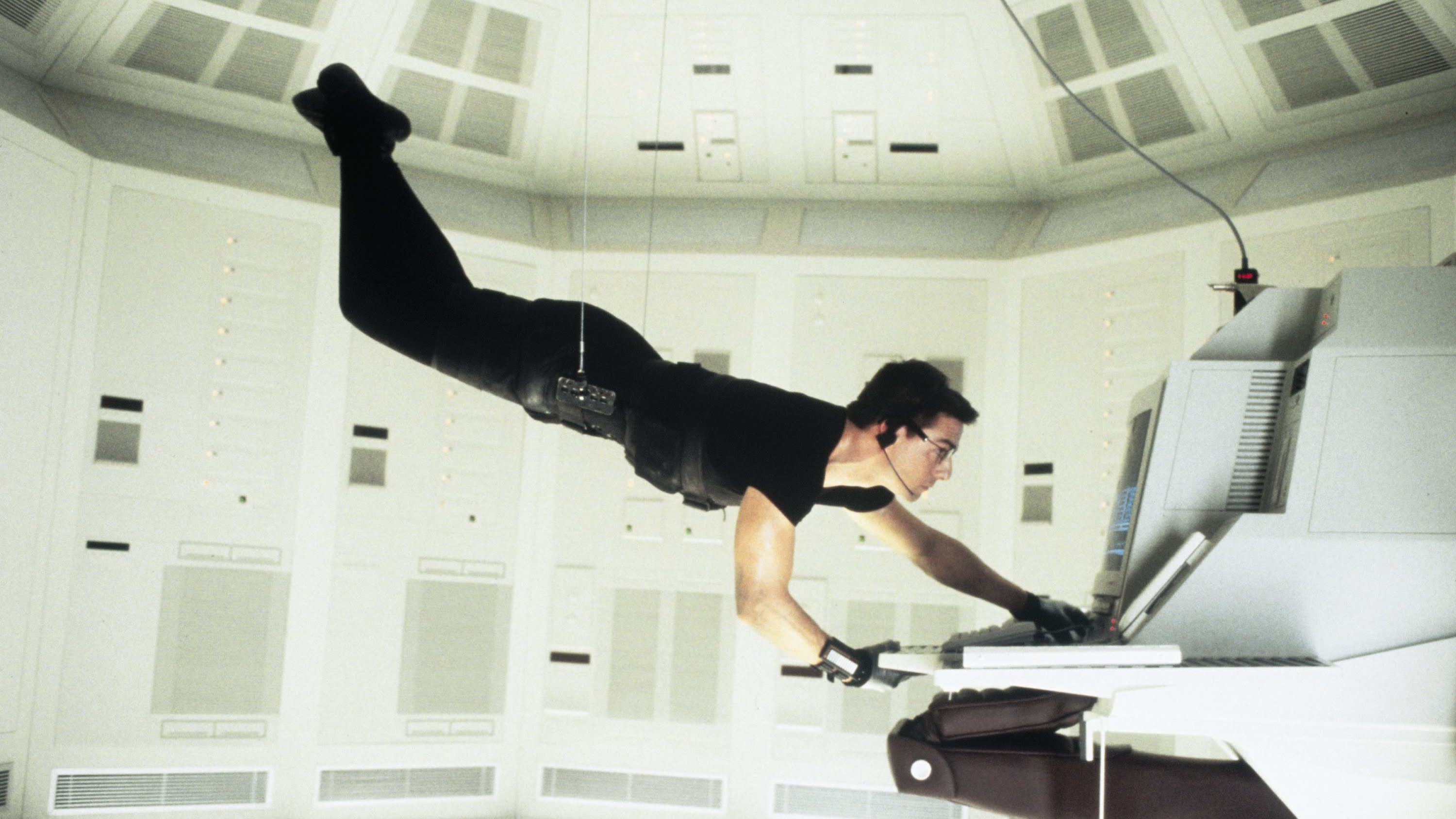
With such tools at a spy’s disposal, you can only infer how good the action looks. They are as explosive and action-packed as a James Bond movie is, and as exciting and surreal as a Tom Clancy thriller. Here is a movie that holds nothing back. It lets loose freely in its field of CGI and special effects, and the result is the most spectacular because of it. I can recall a few moments in this film that can be called iconic by right. My favorite, interestingly enough, has to be one of the film’s most quiet moments: an espionage scene where Ethan is slipping into a room that has motion sensors, pressure sensors, audio sensors, laser sensors, really anything with the word “sensor” in it. This is the scene where the movie earns the right to call itself Mission Impossible, because that’s exactly what this mission is: impossible. Except for the fact that Ethan and his team pull it off.

But action without plot is like frosting without the cake. I’m a picky viewer. For me, there needs to be a reason, and a good reason, for all of the action and explosions to be taking place in the film. Mission Impossible is a different action movie because of this. Its plot is complex, deep, deceptive, weighty, and manipulative, a plot that twists and turns and scurries about in all directions all while maintaining its narrative and purpose in a consistent, healthy flow. I expect many viewers will be confused and irritated by how much writer Robert Towne is making them think. They need to step back and actually analyze the movie they’re watching for a change. Mission Impossible is well worth the analysis. This is a movie that doesn’t cheat, and it doesn’t rob you of anything from this experience.

There are few movies I have seen where the plot and the characters match the appeal already provided by the special effects and explosions on the screen. Here is a movie where the story exceeds the visual effects. Director Brian De Palma utilized this film’s premise to its fullest, and gave actual meaning behind the plot and the spectacular action sequences we see in this movie. Here is a film that is truly one of its kind. It is perhaps one of the best action films I have ever seen.

Tagged , , , , , , , , , , , , , , , , , , , , , , , ,

“ANT-MAN” Review (✫✫)

Fear me! I control ants! 

Here’s the perfect example of expectation affecting outcome. Let’s be honest: who was expecting anything out of Ant-Man? I know I wasn’t. I went in expecting a complacent, by-the-books, predictable superhero thriller. I left after getting that exact same thing.

Okay, maybe I’m being a little rough. The movie does have its moments, and it did at times give me slight enjoyment and chuckles. But how can individual moments replace an entire movie? If you compare Ant-Man to its other giant-sized movie counterparts (The Avengers, Iron Man, Captain America: The Winter Soldier), you will always arrive to the same word to describe it: smaller.

Taking place after the events of The Avengers: Age of Ultron, Ant-Man introduces Hank Pym (Michael Douglas), a genius scientist that rivals the intellect of Iron Man’s father Howard Stark (John Slattery). After realizing that the government was seeking his Pym particles, which allows him to turn into Ant-Man, to be weaponized, Pym goes into retirement, hoping to protect his particles from the world so that they would never be used for nefarious purposes.

Enter Daniel Cross (Corey Stoll), Pym’s ex prodigy. In modern day, Cross re-created Pym’s particles in the form of Yellowjacket, a suit similarly designed to Ant-Man and outfitted with the same capabilities. Desperate to get the suit and to further protect his invention, Pym enlists the only individual who can help take up the Ant-Man mantle: Scott Lang (Paul Rudd), a notorious thief who has a knack for getting into places he doesn’t belong, and a daughter he’d do anything to see again after separating from her mother.

It’s true, most probably didn’t think much about a superhero named Ant-man when this project was originally announced. But to be fair, this film does have some merit, despite its low expectations. The best thing I can say about Ant-Man is this: its fun. Meagerly fun, yes, but it still counts.

Honestly though, that doesn’t surprise me much. The film was originally written and was supposed to be directed by Edgar Wright, who is most known for his comedic action films Shaun of the Dead, Hot Fuzz, The World’s End, and Scott Pilgrim vs. the World. If you’ve seen any of those films, you know that he’s a clever and well-versed filmmaker who knows how to balance action and comedy with drama. If I were a studio head, I would have taken one look at his filmography, thrown all of my money at him, and shouted “Take it! Take it all! Take it and make more!”

So what happened? Simply put, Marvel happened. After a few creative disagreements between himself and Marvel, Wright left and Peyton Reed was hired in his place. Reed directed The Break Up and Yes Man before helming Ant-Man. Yeesh.

Luckily, Ant-Man survived it’s lop-sided pre-production into release. Well, maybe “survived” isn’t an appropriate word. Dragged by its insect legs is more accurate.

The biggest complaint about Ant-Man is that it’s inconsistent. Moments of heartfelt drama collide with out-of-place comedy. Comedy is bogged down by moments of forced emotion. The only thing that is consistent in the film is its action, which is surprisingly innovative to its premise.

For instance: in the first scene where Scott shrinks as Ant-Man, he falls into a bathtub. Who would have thought falling in between droplets of water and cracks in the floor would be so exciting and interesting? The details we see when Scott shrinks are extraordinarily eye-popping, immersing us in this whole new world we didn’t see before in regular proportion. Seeing Scott traverse into ant hills that turn big when he shrinks, communicating with insects his size when he’s small, and finding new locations inside smaller ones are among some of the fantasies we see when he’s Ant-Man. Seeing him fight as Ant-Man is the most fun. Who knew that a Thomas the Train set could be so dangerous to two miniature super-beings?

Other than the visuals though, the movie is sub-standard. It’s cookie-cutter in about every sense of the word. The comedy, the drama, and the acting is all forced for effect, and in the process, it has none. For Pete’s sake, even the movie’s villain is so bland. Who cares about some bratty little business executive who steals a powered suit for money, fame, and power? That was Obadiah Stane in 2007’s Iron Man, and he was a much more compelling villain than this standard archetype of an antagonist.

It’s true, this film didn’t have much to go on when originally announced, but the idea doesn’t count as much as the execution. People doubted Guardians of the Galaxy when that came out, and people reversed their opinions and said it was greater than The Avengers after they saw the film. I believe those same people will watch Ant-Man with no reaction as he flies in the air and goes “splat” across their window pane.

Footnote: If you do decide to watch Ant-Man, do not watch it in 3D. It has some of the worst particle effects I’ve ever seen in a 3D conversion, and I had to lift my glasses every five minutes to see how much brighter the film was without the glasses. I didn’t know that Ant-Man was supposed to be such a dark picture.

Tagged , , , , , , , , , , , , , , , , , , , , , , , , , , , , , , , , , ,

“KINGSMAN: THE SECRET SERVICE” Review (✫✫)

The name’s Eggsy. Agent Eggsy. 

For any of you who are planning on going into the moviemaking business, always keep one thing in mind: your audience. While most of them might be fairly desensitized and will enjoy senseless amounts of gore and violence, one or two of your audience members might not enjoy it as much, and indeed, might be so revolted by it that it affects their view of the whole picture. Does it really ruin all of the fun for everyone if you just tone down the blood and gore one or two notches? Just a few scenes can ruin a whole movie for your viewer, just like it did with me.

I know, I know, the movie probably wasn’t made for me since I’m being Mr. poopy pants by saying “ew” to blood. Can you blame me though? The MPAA rated Kingsman: The Secret Service R for “sequences of strong violence, language and some sexual content.” They didn’t indicate how disturbing it was, or even how frequent and over-the-top it was either. Adding the word “intense” to any of the film’s rating descriptors would not have been inaccurate.

The plot is based on a Mark Millar comic series The Secret Service. A young man named Gary “Eggsy” Unwin (Taron Egerton) is a troublemaking rebel who steals cars and gets into fights when his mother’s jerk of a boyfriend isn’t beating him up. His many delinquencies land him in jail, where he is told he’s going to spend the next 18 years of his life.

Yes, I know his name is Eggsy. Go ahead and laugh. I’ll give you a minute.

Eventually, he is freed by Harry Hart (Colin Firth), a tailor who has a thing for good manners and tall pints. What Eggsy doesn’t know is that Hart isn’t really a tailor at all: he’s a british spy, working for a secret service called “The Kingsman”, the same service Eggsy’s father worked with before he died saving Harry’s life. Now feeling a need to repay Eggsy’s father, Harry gives Eggsy a chance to become a Kingsman himself: to change his destiny and become the “gentleman” his father always wanted him to be.

The film is written and directed by Matthew Vaughn. If you know anything about Vaughn, its that his films have a very strong reception to his core audience, which I guess is… who, exactly? Masochists? His films have received an equal amount of both support and controversy in the past, including among them Kick-Ass and X-men: First Class. I myself am not a fan of him. Kick-Ass was a morally degenerate and violent escapade even worse than this movie, including horrific scenes of torture and child violence. First Class on the whole wasn’t controversial as it was incoherent, ignoring the rest of the series canon like it was a reboot instead of the self-purported prequel it was selling itself as.

But I don’t look at the director as much as I look at the film itself. What was this movie trying to be? An action-comedy. Did it succeed in that? On the whole, yes. Kingsman: The Secret Service is a humorous and stylish escapade with cartoonish violence and action equivalent to that of a Mortal Kombat video game. It had two goals here: being funny and exciting. It fulfilled both.

There was a lot I liked here with Kingsman. First off, the film was casted well. Egerton’s spunky rebellious attitude clashes well with Firth’s firm sense of structure and order, and makes for some good scenes with strong comedic dialogue in them. Mark Strong is a solid supporting character here, serving here as an adept tech assistant instead of the usual villainous roles that he does in his movies. Samuel L. Jackson was perhaps the funniest as the film’s main antagonist. In a career where Jackson spitballs lines of dialogue like bullets in films like Jungle Fever, Pulp Fiction and The Avengers, it’s both unexpected and refreshing to see him here talking with a lisp and with a sour distaste for blood. What kind of baddie doesn’t like to look at blood and give lengthy villainous monologues?

The action, while preposterous, is both stylish and exciting. Characters punch, stab, flip, grab, kick, and shoot each other in skillfully choreographed positions and movements, taking each other out in uniquely different styles that I haven’t seen before. Imagine a cross between the usual James Bond martial-arts fighting with the gunplay you’d see in a Die Hard movie. That’s the type of combat you see in Kingsman: The Secret Service, and its a rare visual treat that got me really engaged into some of the movie’s greater fighting sequences.

All in all, I was really enjoying Kingsman: The Secret Service until it got into the third act. Then it took a nosedive straight into the pavement.

I’ll try as hard as I can to describe this without giving many spoilers. In one scene, a church congregation starts slaughtering each other after the pastor delivers an incredibly racist and prejudiced sermon that I think is supposed to resemble the ramblings of Fred Phelps from the Westboro Baptist Church. This is one of the more violent and disturbing sequences in the movie, with neck snapping and people stabbings and body contortions into convoluted shapes that I didn’t even think was possible for a dead human being. The scene, while stylish and entertaining, was also equally disturbing and out of place. I laughed out loud, but I didn’t know if it was out of enjoyment or shock.

Another scene involved a mother stabbing a door in a Jack Torrance-Shining style, trying to kill her one-year-old crying daughter. That one was too much for me. I don’t like seeing child violence or distress in movies. Unless you’re having it in there to make a point about parentage or childhood trauma, scenes like that aren’t ever necessary to a movie.

Overall, we have a really cohesive film that on the whole works really well. What backfired was simply one or two scenes that severely clashed with the film’s overall vision, moments that took me out of the fun I was having to make me insanely sickened and disgusted at what was going on the screen.

The last out-of-place scene was one where a woman was asking Eggsy for anal sex. I think that’s a metaphor for something.

Tagged , , , , , , , , , , , , , , , , , , , , , , , ,

“MAD MAX: FURY ROAD” Review (✫✫✫1/2)

A lovely day and a flaming guitar. 

I’ve never seen a movie break as many rules as Mad Max: Fury Road does and get away with it. I’ve never seen a movie so loud, obnoxious and over-the-top that still manages to impress me by the time the end credits roll. Previous movies have done the same thing Fury Road has done and failed spectacularly. Transformers. Resident Evil. Underworld. G.I. Joe. Fast and Furious. All of those films are every bit as explosive and stupid as Mad Max: Fury Road is, and yet I don’t love them as much as I do Mad Max. Why is that?

I think its because the movie knows its just that: a movie. It knows that it’s loud, obstinate and stupidly explosive. It knows that its a blockbuster of exceedingly epic proportions that shakes the theater so much, it makes viewers shat in their pants. And more than anything else, it knows it is an action movie, with all of the fun and flaws alike bundled with it.

So what does a director like George Miller decide to do with that, knowing this is the fourth film in his own franchise? Fix the mistakes that are present in all of his predecessors?

No. Instead, he decided to embrace them, like a soldier throwing himself onto a hot grenade.

The end result is exactly how it sounds: bloody awesome.

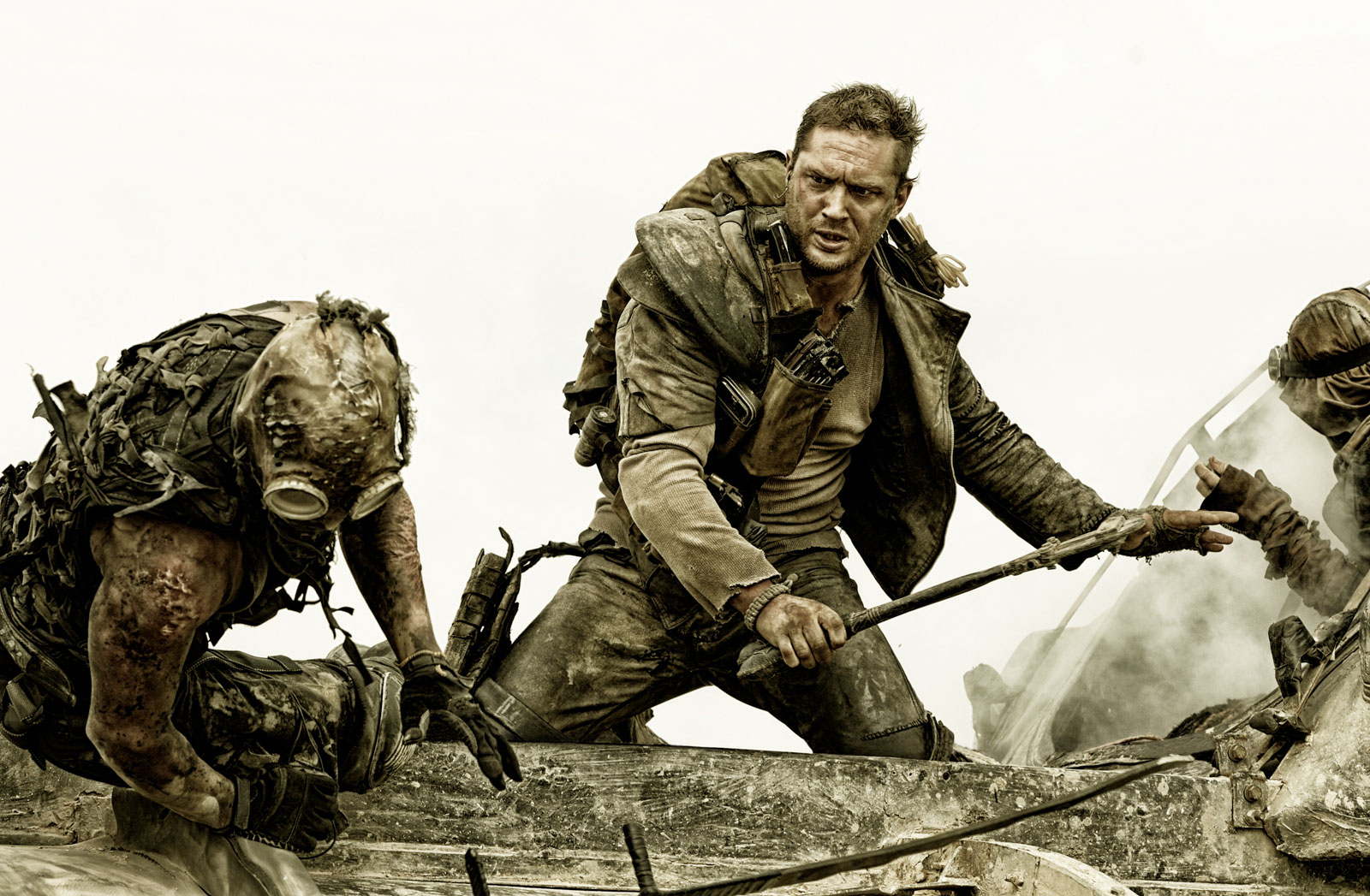
The plot (if you can call it that) follows Max Rockatansky (this time portrayed by Tom Hardy) after the events of Road Warrior and before Beyond Thunderdome. In this desolate landscape called planet Earth, Max is a survivor of Nuclear war, traveling dry and sandy deserts in silence and solitude. Everyone else around him is either dead or has signed up in the mad crusade of Immortan Joe (Hugh Keays-Byrne), a tyrannical warlord who has idolized himself as a god and has labeled everyone under him as his followers. Considering he has control over the only water source over hundreds of miles, the survivors have little choice but to submit to him.

One of these followers is Furiosa (Charlize Theron), a fierce female warrior who is charged with transporting Joe’s water to a nearby town with her small battalion. Little to Joe’s knowledge, however, Furiosa is transporting something else: all of Joe’s wives. Now on the hunt from Joe and all of his maniacal followers, Furiosa needs to team up with Max to escape the desert landscape and free the wives that have been under Joe’s cruel control for so long.

Is the plot as stupid as it sounds? The answer is no, because the film really doesn’t have a plot, only the resemblance of one. The narrative is a weakness all of the films in the series share with each other. While other science-fiction movies have a rich amount of lore and backstory behind them, Mad Max doesn’t have as much to boast about in its own series. Really, as far as story goes, all of the Mad Max movies are kind of weak in narrative scope. Here’s the plot for all of them: a guy is trying to survive against a homicidal maniac in a deserted landscape. That’s it. It’s a big case of “what you see is what you get.”

Here’s where Mad Max: Fury Road is different though: there’s a lot to see. Even though the plot is about as thick as a studio pitch, Miller displays this meager plot in spectacular, stunning, eye-popping action and explosions, and even a few soft moments of short dialogue exchanges between characters.

The stunts are unlike anything you’ve seen in any of the previous movies. The most destruction you found in Mad Max and Mad Max 2 was cars exploding and toppling over into deep sand dunes and rocky road pavements. In this movie, vehicular manslaughter is the least of the destruction found in the film. In one of the first action sequences, an entire armada of Joe’s fleet follows Furiosa into a giant sand storm of extremely windy proportions. In another scene, gang members viciously chase Furiosa’s truck in a tightly-cornered crevice of mountains. In another, a flunkie gets blinded by gunfire, puts cloth around his bleeding eyes, then fires blindly at Max and his gang like a crack-happy trigger maniac. For crying out loud, there’s one underling in the film that uses a guitar flamethrower.

Yes. That’s right. A guitar flamethrower.

It’s obvious that the film is ridiculous and absurd in the most gleeful of ways. Yet, what I like so much is that in between all of the over-the-top and in-your-face action, there’s actually a purpose and a reason for actors being in the movie. Yes ladies and gentlemen: this is an action movie that has actual acting in it. Hardy replaces Mel Gibson’s role with hardened machismo and stiffness to his gesture, and while Max is still mostly a flat character, Hardy portrays him with a sort of intrigue to him that makes you curious about his history, even though we already know most of it. Theron, however, impresses me the most. She’s incredibly versatile in the film, being a firm and uncompromising action heroine in one moment, and an emotionally exhausted and stricken survivor in another. She’s honestly the real lead in the film, with Max being more of a supporting character to Furosia’s rebellion against Immortan Joe. The film is really empowering to females, and that’s an incredibly rare thing, especially for an action movie.

By now, you’ve hopefully gotten the idea of what the movie is like and whether you’d be interested in this sort of thing or not. The film definitely has its flaws, but by God, the movie is just so freaking entertaining. I can’t sum up the film any better than that. Now go get your movie ticket. There’s a flaming guitar that you need to see.

Tagged , , , , , , , , , , , , , , , , , , , , , , , , , , , , ,

“MAD MAX” Review (✫✫)

You people are mad, alright. 

Sometimes I watch a movie and I wonder what purpose it’s supposed to serve in the world of cinema. Mad Max is one of those movies.

I’m not saying its either good or bad. I’m saying I don’t know what it’s supposed to be doing. Is it supposed to be social commentary? If so, the film actually needs to comment about something. Is it supposed to be a character study? The character needs to be either unique or fascinating then, but Mad Max himself is neither. Is it supposed to be just plain, dumb old entertainment? Well, by that logic, isn’t the film supposed to be entertaining?

The plot takes place in a semi-post-apocalyptic future where the police force’s power is dwindled and resourced into a new unit called the Main Force Patrol, which monitors highway crime like a cop and a speed detector. The best of these MFP’s is Max Rockatansky (Mel Gibson), a highly-skilled driver who has a beloved wife and child at his home.

One day, after driving a murderous criminal into a barrel roll and an explosion after a high speed chase, Max is pursued by the criminal’s gang followers as they prepare to take on Max and the rest of the MFP. These guys do anything and everything to get under Max’s skin, from assaulting his friend Goose (Steve Bisley), to terrorizing a small town, to even killing Max’s wife and child. Now on a quest for vengeance, Max goes on a hunting spree, tracking down every gang member involved, not stopping until every single one of them paid for what they’ve done.

I know that paragraph sounds like the premise of the film, but really the two paragraphs I just typed could also count as a plot synopsis too. Oopsie! Did I spoil it much? I don’t think so. After all, is it still a spoiler if you see the so-called “twist” coming from a mile away?

The biggest problem I find with Mad Max is that there is too much buildup and not enough payoff. In the above synopsis I provided, it sounds like the perfect setup for an excellent movie. Yet in retrospect, I more or less described the entire plot of the film in less than 164 words. What happens in this movie? Just about what I described above, and little else. There’s no complex emotion with the film, no sense of urgency or immediacy to make us care for the movie or what’s going on in it. No, instead we get a bleak, lifeless film that sounds like a great studio pitch, but the final product doesn’t extend much further beyond the pitch itself. I think the studio execs involved were more fascinated with the idea itself than they were with carrying out the idea.

Oh, don’t get me wrong: Mel Gibson is as good in the role as the character will allow him to be. But the other part of this movie’s flimsiness is that the protagonist is as flat as the movie’s plot is. What’s the most interesting thing about Max Rockatansky? He’s a father and a husband. That’s it. He doesn’t have the charisma of James Bond, the grit of Harry Callahan, or even the smugness of Han Solo. No, Max Rockatansky has no defining characteristics as the lead protagonist: he’s just supposed to pose in his leather jacket next to his car with a big gun, and apparently that’s all he needs to be called an action hero.

Again, I ask: why did this movie have to get made? What purpose does it serve? Well, I read on a forum that writer-director George Miller wrote the movie after working in a hospital emergency room, supposedly inspired by the car crash victims he tended to. That’s all fine and dandy, but how does that translate into a film? The movie doesn’t have any clear motivations of what it wants to be, no clear idea as to what its themes are or how to express those themes. I didn’t get from the movie that Miller was trying to tell a cautionary tale about high-speed driving. In fact, I didn’t get much of anything from the picture. I just got a stereotypical action hero and his arc of vengeance that has been done better in numerous other movies before Mad Max. 

I’ll give the film one point, and one point only, for the stunts. With Miller being adamant about using 100 percent practical effects, everything you see on the screen genuinely happened. Cars barrel rolling and crashing spectacularly into other cars on the highway. Motorbikes flying off of bridges with the paint and metal ripping off of their surfaces. Vehicles blowing up in large, spectacular fashion. All of it was done with practical effects, and the film achieved the greatest visual result from it. Now if only the rest of the film could be just as practical.

Tagged , , , , , , , , , , , , , , , , , , ,

“’71” Review (✫✫✫)

A boy trapped in a soldier’s life. 

We’re always looking for someone to blame in war. Most of the time, the blame is directed at the soldier. Rarely do we blame the military, or the government, or those we are fighting, and even more rarely do we blame the people living stateside, in the warmth and comfort of their blanket and home and far away from the battlefield. No, if we are angered at travesties such as the Vietnam or the Afghan war, we don’t point at the general who gave the order to shoot. We point at the soldier who was following orders.

In ’71, the soldier is treated not as a cold-hearted, emotionless machine, but as a young man, a flesh-and-blood being full of heart and consciousness, but who is equally confused, hurt, alone, and afraid of the people he’s trying to protect. The controversy around another war film called American Sniper released a few months ago argued if we glorify war and the military too much. Those same people need to watch ’71 and realize there is nothing to glorify about it.

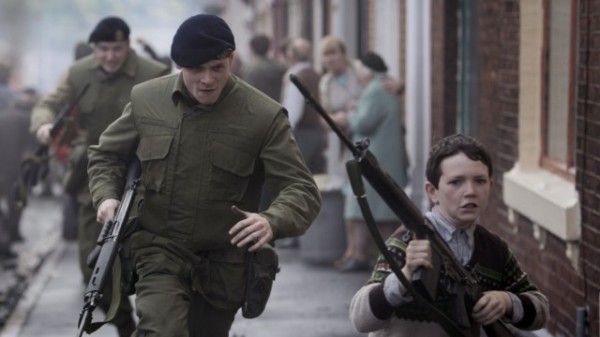
Taking place during the height of civil unrest in the Troubles, ’71 follows a young British army recruit named Gary Hook (Jack O’Connell), who gets deployed into Belfast during his first few weeks of training. Him and his squad is warned of the great dangers in entering the territory. Protestant and Catholic Irishmen are living side-by-side at each other’s throats, each with starkly different ideas of what is better for them. The protestants believe that the United Kingdom is their home and it is their best interests to remain with them. The catholics believe Ireland can be it’s own land and wants to secede from Europe. Hook and his fellow soldiers are just looking to keep the peace.

On the day of deployment, Hook watches as both sides come to a boil. The KGB is entering houses, threatening and beating people with their billy clubs, while an angry crowd of catholics gather outside in retaliation against the military. One of the rioting crowd members throws a rock and knocks a soldier out cold. A kid no older than ten grabs the soldier’s rifle and runs. Hook and another soldier chase after him when the crowd assaults them and beats viciously. Hook watches as the soldier is shot in the face. Hook only narrowly escapes with his life intact.

Trapped in Belfast with no way to find his comrades, Hook must fight through the night to survive against the city that’s hunting him.

Functioning more as a survivalist-thriller than as a pure-blooded war movie, ’71 strikes the viewer with sharp imagery and intelligence alike, filling them with a deepening sense of dread as we watch this young man crumble into desperation as he tries to escape from the people who are seeking to kill him. One of the things I love so much about this movie is how expertly it orchestrates itself and its emotions. French director Yann Demange, who before this directed British television shows such as “Dead Set” and “Top Boy”, debuts here as a talented filmmaker, crafting an exciting thriller that efficiently balances action with context.

I am reminded of another film similar in direction and subject, and that is Ben Affleck’s 2012 film Argo. In both films, the main character evades their pursuer through the chaos of a collapsing political climate. The camera captures the essence of both perspectives, with the pursuer desperately chasing their target while the pursued is equally as desperate trying to get away. And through both highly exciting and pulse-pounding features, both directors have deeper things to say about those societies and what impact they’re leaving on the people around them.

To me, ’71 is the British version of Argo, with one big difference: coherency. In Argo, everything is crystal-clear and straightforward. We know who the characters are, why they are there, what they are doing, who is after them, and how and why they plan to get away. In ’71, all of that is focused in towards one character only, and that is Gary Hook. We know everything we can know about a novice soldier, we just don’t know the same of everyone else around him.

For instance, the leaders of both factions, the catholics and the British Military Reaction force, are both skinny gingers with mustaches as thick as their hair. How can you tell who is who under the dim view of the street light? A young boy helps Hook towards a bar after his initial attack, but he’s on the same side as the people who are hunting him. Why is he helping Hook when he so clearly has so much disregard for British soldiers? In another scene, a Protestant seeks to help Hook when minutes earlier he had the cold, direct eyes of a killer with purpose. What inspired him to switch sides so easily? And then, near the end of the movie, there is a twist that didn’t make much sense to me at all.

Still though, the movie is there, and Demange handles the senses of unease and desperation well with the film, especially when trusting Jack O’Connell to portray all of these emotions at once. O’Connell is really having a strong career packing in for himself. In the past year, for instance, he created a very compelling presence in the prison-drama Starred Up and in the Angelina Jolie-directed biopic Unbroken. He makes a very strong case for choosing acting as a career in all of these films, and in ’71 he clearly shows that he can pull off the role of a young, desperate, and inexperienced soldier who just wants to go home. Demange was wise to cast him in this role and trust him with the emotional complexity of the character: O’Connell was the best part of the film.

I’ll admit, I didn’t understand everything I probably needed to understand in the movie, perhaps the biggest one being more aware of what the Troubles were in the 1970’s. Take that out of it. Take all of the political facets out of the movie, and what do you have? You have a raw, emotionally-charged war thriller that challenges the viewer to see it not from their perspective, but from the soldier’s perspective. Everyone hurts during the times of war. ’71 makes me wonder who war hurts the most.

Tagged , , , , , , , , , , , , , , , , , , , , , , , , , , , , , , , , , ,

“GONE GIRL” Review (✫✫✫1/2)

Gone Girl

What happened to Amy Dunne?

When I started watching Gone Girl, I had no idea what happened between Nick Dunne and his wife Amy. Now I have finished the movie, and I still have no idea what happened between the two of them.

Gone Girl is a very strong psychological thriller, packaging the essential elements of tension, grit, and confusion to make an extremely fascinating, yet equally frustrating, watch. Imagine you’re driving on a highway, except you take a wrong turn. Then you take another wrong turn. Then you take another, then another, and then another after that. Gone Girl is that highway, taking you through so many twists and turns that you don’t know which way you’re going anymore. The only problem is that there’s no end destination when you get off of the highway.

Based on the book of the same name by Gillian Flynn, Gone Girl starts with Nick Dunne (Ben Affleck) coming home to see his living room torn apart and his wife Amy (Rosamund Pike) missing. There are a few details that disturb him upon this discovery. The glass table is smashed in. Chairs are overturned. A blood splatter can be spotted above the stove in the kitchen. Suddenly, Nick finds himself swept into a media frenzy as everyone everywhere cries out “Where’s Amy?” as he and Amy’s parents work to find Amy and bring her back home.

Yet, in the midst of all of this media attention, people start to recognize strange things about Nick. He’s behaving oddly for someone who has just lost his wife. A woman outside of a press conference takes a selfie with him and posts it online. He smiles at the conference when people take his picture. And as police discover Amy’s diary and uncover incriminating evidence about Nick’s marriage with Amy, people start to ask one question: did Nick Dunne kill his wife?

Let me start by saying this: there’s no way to expect anything from this film. The minute you think Gone Girl is going in a specific direction, it does a reversal and goes in the complete opposite direction, setting you on another prediction track until it does another reversal. There are many factors contributing to these twists, the biggest one being the writing contributions of Gillian Flynn. Flynn, who wrote the original book, was adamant about being involved in writing the screenplay for David Fincher’s adaptation, and she’s a good sport as far as working with him. Even though there are a few differences conceptually from the book, the work remains a whole emotionally, and lets off this gnawing paranoia on both characters as we question who is the victim and who is the perpetrator. This movie is like a game of cat and mouse, except no one really knows who is the cat or mouse.

The writing is ingenious, but the real star of this show is David Fincher. Fincher, who is no stranger to mind-bending plots (1997’s The Game, 1999’s Fight Club, and 2007’s Zodiac), incorporates elements from all of his movies into this one mind-bending thriller. It has plot twists as big as those in The Game, the pseudo/suicidal/mind trickery in Fight Club, the dark, disturbing realism in Zodiac, and the broad, expressive shots, angles, and edits from The Social Network. I like this about Fincher films, that they’re so distinct in visual style that you can almost instantly tell that it’s a David Fincher film.

Example: In the opening sequence of The Social Network, we capture the essence of the scenery as a lonely Mark Zuckerberg trots back to his dorm. We get a sense of the campus he’s on, the bridges, the buildings, the sidewalks, the trees. We not only feel the physical surroundings around him, but also the life that’s in it, almost like the scenery is breathing around him. Fincher did the same thing during The Girl With The Dragon Tattoo, and he did it again with Gone Girl. When he’s not filming a scene where there’s a tense exchange of dialogue between characters, he’s quietly viewing the scenery all around him, telling a story with silent images just as much as he does with outspoken characters.

More than what he does shot-wise though, I’m impressed with how he handles his cast. Look at the names associated with this film. Ben Affleck. Rosamund Pike. Tyler Perry. Neil Patrick Harris. Are any of these names what you’d expect to see in an intricate crime-thriller, let alone give a decent performance? I mean, the last memorable role Perry had since dressing up in drag as Madea is Alex Cross, and that was about as complacent as an action movie can get. Neil Patrick Harris’ most serious movie role is as himself in Harold and Kumar. Rosamund Pike is most known as a Bond girl. Affleck’s acting career is self-explanatory. I looked at all of these actors cast in these roles, and I couldn’t help but wonder what they were doing in a Fincher film.

Then I saw what he did with them, and I couldn’t see anyone else in their roles. Perry played Dunne’s attorney Tanner Bolt, and he was so smug and straightforward that he could lend Robert Downey Jr. a few tips for The Judge. Harris steps so wonderfully into a role he’s never played before, and Pike is exemplary too, though I won’t exactly specify how. Affleck to me was the most interesting. He uses awkward lulls, blank expressions, and his sterile voice just like he did during some of his bad performances in past movies. It’s not a bad performance though. Fincher is just using Affleck’s natural reactions to lend details to Nick Dunne’s character, like how he could be smiling in pictures while his wife is missing, or why he sounds so unconvincing when he gives a speech about how he loves his wife to ongoing listeners. Fincher uses both Affleck’s strengths and weaknesses as an actor to the film’s advantage, and that goes the same for everyone else in the film.

I liked many things from this film. The cinematography, the editing, the thought-provoking plot, Fincher’s masterful direction of the film and it’s cast all culminated into a jaw-dropping experience. My only regret about this film is it’s ending. I won’t spoil it for you, but I will say that it ends in the same way that it begins, posing questions and vague thoughts so that the audience may fill it with their wild imaginations. I realize Fincher and Flynn did not intend to have a straightforward, clear-cut ending, but I have a stubborn need for closure. Films are supposed to provide answers to the questions they’ve already posed to you. Gone Girl does not provide an answer. It provides a question.

Tagged , , , , , , , , , , , , , , , , , , , , , ,

“SIN CITY: A DAME TO KILL FOR” Review (✫)

Can you kill me too while you’re so busy at it? Thanks. 

There’s a character early on in Sin City: A Dame To Kill For that describes the city as a place “where you go in with your eyes open, or you don’t come out at all.” He’s wrong. I went in and out with my eyes fully open. I only wished that I kept them closed.

Oh, where to begin with this. Sin City: A Dame To Kill For is, in a word, messy – a neo-noir thriller as confusing as a detective’s murder case and more violent, putrid and horrific than a crime scene. The only brains this movie has are the ones that it blows out of peoples’ heads.

The plot takes place sometime within the Sin City universe. The question is when? I honestly don’t know, and I don’t think the movie knows either. It’s part prequel, part sequel and part in-betweenuel that cuts to wherever and whenever it wants to.

Like the first movie, there are three main stories the plot revolves around and, likewise, three main characters to sympathize with. You have a young Dwight McCarthy (Josh Brolin), who, before he met Jackie Boy, was obsessing over a rich housewife named Ava (Eva Green). There’s Johnny (Joseph Gordon-Levitt), an overly-cocky poker player who wants to come to Sin City and beat the king of all cards himself — Senator Roark (Powers Boothe). And then there’s Nancy (Jessica Alba), who is still coping with John Hartigan’s (Bruce Willis) suicide at the end of Sin City.

Following this easy enough? Good, because that’s all the explanation you’re going to get. The biggest problem with Sin City: A Dame To Kill For is that it’s so convoluted. Stories are meshed, mixed and thrown together without any sense of connection or correlation to its plot, and the entire time while I was watching it, I kept wondering where these stories were taking place and why I should care. Some movies do well with intertwining narratives, such as Pulp Fiction or Crash. This is not one of them.

A good example of this is in the very first scene of the film. Marv (Mickey Rourke), the hard-headed thug who was framed for the murder of Goldie in the first movie, wakes up next to two crashed cars with no memory of how he got there. He goes through mundane dialogue for five minutes in his obviously exaggerated thuggish accent, then the movie cuts to the story and almost completely forgets about him.

My first thought after watching this: why was that scene necessary? As the movie continued its runtime, I continued to ask this question in my head until I realized that none of it was necessary, that it was just a continuous farce of violence and delinquency that the kids who play Grand Theft Auto would just drool over.

This movie is definitely violent. That’s to be expected, I know, especially when you remember how violent the first one was. There is, however, a stark difference in how the violence is used in each movie. In the first Sin City, the violence was both shocking and satirical, at times being so disturbing that you can’t help but reel back from it, and at other times being so exaggerated that I laughed at it. Whether it was positive or negative, however, I at least felt something.

Here, nothing is felt. Here, we just look at all shades of black, red and white among severed body parts while we plod through the final act like it’s a homework assignment rather than the climactic ending that it deserves to be.

I’ll admit to having disliked the first Sin City. Does that matter? I give credit and criticism equally where it is due, and even though both Sin City’s are equally violent and despicable, the first one was at least more intriguing and had more cohesiveness both as a whole story and as smaller, separate narratives. This one fell flat, crumbled to pieces and was about as clear as a muddy window pane. Maybe that’s why Marv couldn’t remember anything at the beginning of this movie – he realized what he signed up for, and he tried to forget all about it.

Tagged , , , , , , , , , , , , , , , , , , , , , , , , , , , , , , ,