Tag Archives: Book

“SIN CITY: A DAME TO KILL FOR” Review (✫)

Can you kill me too while you’re so busy at it? Thanks. 

There’s a character early on in Sin City: A Dame To Kill For that describes the city as a place “where you go in with your eyes open, or you don’t come out at all.” He’s wrong. I went in and out with my eyes fully open. I only wished that I kept them closed.

Oh, where to begin with this. Sin City: A Dame To Kill For is, in a word, messy – a neo-noir thriller as confusing as a detective’s murder case and more violent, putrid and horrific than a crime scene. The only brains this movie has are the ones that it blows out of peoples’ heads.

The plot takes place sometime within the Sin City universe. The question is when? I honestly don’t know, and I don’t think the movie knows either. It’s part prequel, part sequel and part in-betweenuel that cuts to wherever and whenever it wants to.

Like the first movie, there are three main stories the plot revolves around and, likewise, three main characters to sympathize with. You have a young Dwight McCarthy (Josh Brolin), who, before he met Jackie Boy, was obsessing over a rich housewife named Ava (Eva Green). There’s Johnny (Joseph Gordon-Levitt), an overly-cocky poker player who wants to come to Sin City and beat the king of all cards himself — Senator Roark (Powers Boothe). And then there’s Nancy (Jessica Alba), who is still coping with John Hartigan’s (Bruce Willis) suicide at the end of Sin City.

Following this easy enough? Good, because that’s all the explanation you’re going to get. The biggest problem with Sin City: A Dame To Kill For is that it’s so convoluted. Stories are meshed, mixed and thrown together without any sense of connection or correlation to its plot, and the entire time while I was watching it, I kept wondering where these stories were taking place and why I should care. Some movies do well with intertwining narratives, such as Pulp Fiction or Crash. This is not one of them.

A good example of this is in the very first scene of the film. Marv (Mickey Rourke), the hard-headed thug who was framed for the murder of Goldie in the first movie, wakes up next to two crashed cars with no memory of how he got there. He goes through mundane dialogue for five minutes in his obviously exaggerated thuggish accent, then the movie cuts to the story and almost completely forgets about him.

My first thought after watching this: why was that scene necessary? As the movie continued its runtime, I continued to ask this question in my head until I realized that none of it was necessary, that it was just a continuous farce of violence and delinquency that the kids who play Grand Theft Auto would just drool over.

This movie is definitely violent. That’s to be expected, I know, especially when you remember how violent the first one was. There is, however, a stark difference in how the violence is used in each movie. In the first Sin City, the violence was both shocking and satirical, at times being so disturbing that you can’t help but reel back from it, and at other times being so exaggerated that I laughed at it. Whether it was positive or negative, however, I at least felt something.

Here, nothing is felt. Here, we just look at all shades of black, red and white among severed body parts while we plod through the final act like it’s a homework assignment rather than the climactic ending that it deserves to be.

I’ll admit to having disliked the first Sin City. Does that matter? I give credit and criticism equally where it is due, and even though both Sin City’s are equally violent and despicable, the first one was at least more intriguing and had more cohesiveness both as a whole story and as smaller, separate narratives. This one fell flat, crumbled to pieces and was about as clear as a muddy window pane. Maybe that’s why Marv couldn’t remember anything at the beginning of this movie – he realized what he signed up for, and he tried to forget all about it.

Tagged , , , , , , , , , , , , , , , , , , , , , , , , , , , , , , ,

“SIN CITY” Review (✫✫)

“There ain’t no sunshine when she’s gone.”

You’re either going to love or hate Sin City. There’s no getting around that fact. Like the movies directed by Quentin Tarantino or Eli Roth, Sin City is a movie specific to its own tastes, and doesn’t care much about the opinions opposite of it. It’s a violent, gross, disgusting and putrid film full of the stuff that would make a Catholic priest faint. If that sounds like something you would like, by all means, be my guest and have at it. If you are repulsed by my description of the film, I certainly don’t blame you.

Based off of the comic book series by Frank Miller, Sin City is a film that follows four separate stories that (mostly) intertwine together. John Hartigan (Bruce Willis) is an aged police officer who is viciously pursuing child rapist Roark Jr. (Nick Stahl). Marv (Mickey Rourke) is a rough-around-the-edges thug who is framed for the murder of a prostitute he slept with named Goldie (Jamie King). And Dwight (Clive Owen) is a private investigator who gets pulled into a turf war, risking the lives of cops and prostitutes alike.

What do all of these stories have in common? They all started because of a woman, and these men go out to kill because they love their woman. Or, at least, whatever constitutes as love in this universe, in which case it’s a one-night stand.

It’s so difficult to review a movie like Sin City. Why? Because it’s not for people like me, that’s why. I don’t like watching movies like Sin City. I don’t like watching blood and violence for the sake of blood and violence, or watching sex and nudity for the sake of sex and nudity. It’s hard to be non-biased with movies like these because I watch moments where a naked woman walks out with bare breasts and all, and I can’t help but imagine the director thinking “Hey, let’s have this actress naked in this scene, because boobs.”

Sin City is aggressively, unnecessarily violent. How violent? So violent that the least bloody scene in the movie came from Quentin Tarantino. That’s how bad it gets. Red, white, black and yellow blood splatter across the screen like Jackson Pollock was making a painting. Severed heads and body parts are frequently cut off and thrown around in the film like missing pieces to a G.I. Joe. Those body parts include testicles, by the way, on multiple occasions. And don’t even get me started on the absurdity of its kills. In one scene, Marv gets beaten, stabbed, shot, and crashed his car into a lake and still gets up to pursue Goldie’s killer. Good God, are these guys made of kevlar or something?

Remind you, I have no problem with violence in movies, but here it’s just far too absurd and disgusting to be able to fully stomach. When it’s used to illustrate an emotion or a point in movies like Pulp Fiction or Taxi Driver, I praise its purpose and its usage. Here, it illustrates no emotion or urgency. It’s a glorified selling point for a really long, disgusting, stupid movie.

I did like the visualization of Sin City. That, and its opening scene. I liked it’s black-and-white style, it’s sense of contrast and expert use of shadow and lighting. It gave it a strong reminiscent feeling of the classic neo-noir films that inspired the original Sin City comic books, the ones that have the snazzy saxophone playing in the background as two lovers stand on a balcony, telling each other that they love each other and that they never want to leave each other. The film itself, in fact, functions as a parody of the neo-noir genre: characters stand on balconies, docks, outrun police cars, smoke cigarettes and talk in thickly exaggerated accents to the point where it can’t be taken seriously.

Realize, however, that this wasn’t on accident; director Robert Rodriguez wanted you to see how he exaggerated details so you would understand that him and Frank Miller were lightly poking fun at the genre, all while at the same time suggesting delicate homages to it as well. I like that they tried to reach for a deeper effort with the film, even though their intentions were smarter than the film itself was.

So what’s my end consensus? Is it a movie that you should see or skip? I’ll leave that decision in your hands. For now, I have done my job in telling you what the movie is like, and I will wash my hands clean from it. I have church in the morning.

Tagged , , , , , , , , , , , , , , , , , , , , , , , , , , , , , , , ,

“X-MEN: DAYS OF FUTURE PAST” Review (✫✫✫✫)

The next stage in superhero cinema evolution. 

X-men: Days of Future Past ranks among the best superhero sequels I’ve ever seen, one I would instantly compare to that of Spider-man 2 or The Dark Knight. There were so many things that needed to be done, so many risks that needed to be taken, and so many ways this movie could have failed. It didn’t. From the opening sequence to its last breathtaking moment, my mind was blown and the comic-book nerd in me was absolutely filled with joy. The movie did more than simply expand the franchise: it redefined it.

We open on a post-apocalyptic future that hasn’t been this catastrophic since James Cameron’s 1984 film The Terminator. Years after X-men: The Last Stand took place, humans are now being hunted by the same weapons they created in the first place: the Sentinels, a coalition of dangerously armed robots who can track and exterminate any mutant they can find on planet earth. Amongst the ruins of battered buildings and fallen icons, the human race has now been collected into a sort of concentration camps: all that’s left for the mutants then is the mass graves filled with the dead bodies of their kin.

Lifelong frenemies Charles Xavier (Patrick Stewart) and Magneto (Ian McKellan) collaborate on a plan they would like to enact. Besides having the ability to phase through walls and objects, Kitty Pryde (Ellen Page) has recently developed the ability to transfer someone’s consciousness into their younger bodies in the past, allowing them to change the future and avoid the unfortunate outcomes that might become of them. Kitty has been able to use this ability on multiple occasions now to save her friends, but now Professor X and Magneto want to go back into the past (1970, to be exact) to prevent the event that triggered this horrifying future and save human and mutantkind as they know it.

Problem is, Kitty can only send someone back a few days or weeks at a time. Any further than that and she risks tearing apart the mind of the person she’s sending back to the point beyond repair. Luckily, Wolverine (played by Hugh Jackman, who else?) has the ability to heal himself at a faster rate. So Professor X and Magneto decide to send Wolverine back into the past to coerce their younger selves (portrayed by James McAvoy and Michael Fassbender, respectively) to stop the triggering event and save the future.

Serving as a sequel to both X-men: First Class and X-men: The Last Stand, and incorporating characters and actors from both translations, X-men: Days of Future Past is, in a word, a game changer. It brings in all of its key players, from the original cast members and its most revered director Bryan Singer, to the newcomers who’ve newly defined their roles, including McAvoy as Xavier and Fassbender as Magneto. Everyone meshes so perfectly with each other, especially Jackman once again, who essentially has to react to characters from two different time zones. There hasn’t been a cast this big since Joss Whedon’s The Avengers, and I’m tempted to say the movie is better because of it.

Do I really want to stand here though, and compare Days of Future Past to that of The Avengers? Yes I do. The Avengers was a bold, brave step forward in comic book evolution, combining characters from five different movies to make a superhero epic that hadn’t been tried before. Days of Future Past follows that same model, bringing in characters from six of its movies, but the end result is vastly different. There’s a much deeper plot going on here, a vastly intelligent and contemplative story that elaborates on its recurring themes of racism and, once again, bringing in the consequences of discrimination to the forefront. I loved X2 for this very reason, for it being more than just a comic book movie and focusing itself more as a political thriller with comic book elements thrown into the mix. This movie is that to, like, the tenth power.

Oh yes, this movie will fill comic fans with glee everywhere. Similar to the small little easter eggs that can be picked up in other Marvel movies (Note: The Doctor Strange reference in The Winter Soldier), this movie too has sweet little moments that comic fans can pluck from the ground and take a moment and appreciate the aroma. My favorite had to be a moment where a mutant named Peter (Evan Peters), who can run at supersonic speeds, rests in an elevator with the younger Magneto as he’s helping him escape from prison, and makes a comment about his long-lost father. That’s just the tip of the Bobby Drake-iceberg. There’s so many moments I can pull from that filled me with joy and happiness, while others filled me with dread and angst. The film orchestrates its emotions wonderfully, and in every fabric of the film I felt what I was supposed to feel.

I’m going to go out on a limb and say this is the best X-men movie in the series so far. Bold claim, I know, but it deserves it. From its first moment to its last, Days of Future Past is completely, utterly, fascinatingly mind-blowing and involving. From its quietly hinted-at themes of xenophobia and extermination to its climactic action scenes where we don’t see how on earth our heroes can win, Days of Future Past combines the best parts of all of the movies and makes itself the best entry out of them. Many audiences have recently been experiencing superhero movie fatigue, with movies such as Man of Steel and The Amazing Spider-man 2 recently being met with mixed reaction amongst audiences and in the box office. Days of Future Past is one of those movies that restores your faith in the genre.

Tagged , , , , , , , , , , , , , , , , , , , , , , , , , , , , , , , , , , , , , , , , , , , , , , , , , , , , ,

“X2” Review (✫✫✫1/2)

A social commentary disguised as an action blockbuster.

X2 is science-fiction brilliance, a sequel that is relentlessly exciting, smartly written, intelligently designed, and jam-packed with so many involving action scenes and stunning visual effects that it could potentially work as a stand-alone movie, rather than a direct sequel to its predecessor X-men. Like Lord of the Rings and Harry Potter, this movie serves as an expansion for the universe that it is in and as an opportunity to provide fan service to its dedicated readers and lovers of the iconic source material. I’m not very much for sequels, and I definitely don’t want this to become a superhero monopoly, but if we have to have sequels packaged with every superhero installment in the near future, more filmmakers should pull inspiration from X2.

X2 picks up just short of a few months after X-men originally left off. After the combined efforts of the X-men defeated Erik Lenshurr, a.k.a. “Magneto” (Ian McKellan), and imprisoned him within a special plastic cell (Countering his ability to manipulate metal), the X-men go about their (ab)normal lives as teachers at Xavier’s School for Gifted Youngsters, educating mutants on how to control their powers and not be afraid of who they are. Only Logan, a.k.a. Wolverine (Hugh Jackman) sets out to Canada to seek out answers for his long-forgotten past, and even then he comes up empty: the lab where he was supposedly experimented on has long since been abandoned.

Soon, however, a new figure from everyone’s past re-emerges: William Stryker (Brian Cox), a government official who has experimented on mutants for as long as mutants existed. After pitching his program to the President and revealing that Xavier’s School For Gifted Youngsters is a front to the X-men operation, the X-men and the Brotherhood of Mutants must band together to save each other from Stryker’s plot, and quite potentially the rest of mutant kind with them as well.

Directed and co-written by Bryan Singer, who also directed X2’s predecessor X-men, X2 is a highly involving, irreverently fascinating superhero epic. Functioning just as much as a political thriller as it does a superhero action flick, Singer is careful to deliberate and balance everything effectively in the movie, from its themes of xenophobia and racism to its highly-exciting action sequences where mutants go flying, flipping, and teleporting in every which way and under.

Funny, the first time Singer tried X-men, balance was a problem for him. He put a greater emphasis on the action and the visuals of the mutant’s powers more than what they meant for them individually, quite possibly because that’s more of what the audience wants to see anyway. Here, balance is not an issue. He does a great job at both not only giving us a healthy dose of action-packed sequences of grandeur and excitement: he also does a great job giving us heartfelt, genuine emotion, showing these character’s internal reactions just as much as their external.

Example: After escaping from an attack on themselves and the rest of the X-men earlier in the movie, Wolverine takes himself and a small group of mutants to Bobby “Iceman” Drake’s (Shawn Ashmore) home, where he’s forced to essentially come out to his family that he is, in fact, a mutant. After seeing the emotion and disparity of his family reeling in with the shocking revelation of Bobby’s abilities, the police pull up to the house, and an explosive battle results between these X-men and the officers.

See, this is what I’m talking about: there isn’t a single moment in the movie where the action outweighs the drama, or the drama outweighs the action. For every scene where something emotionally weighty or significant is revealed, there is another scene where something exciting or thrilling happens that jump-starts your interest all over again. Whether it’s a scene involving dialogue between characters, a narrator giving exposition on a conniving plot, or another scene where some sort of grand, explosive battle takes place doesn’t matter. It’s always moving, it’s always doing something different, it always keeps up its interest and it is never boring.

I’m very happy with this movie. In a world where so many sequels make the mistake of replacing genuine emotion with an overdose of action and visual effects, X2 is a clear standout. While not necessarily perfect, and still incapable of escaping from some of the cheesy, ham-fisted moments that I rued in the first movie, it definitely stepped up its game as a far as drama goes, and has deeper contexts to offer regarding the xenophobia/racism issue that inspired the series as a whole since its comic book creation. In that sense, X2 is more than a superhero blockbuster. It’s a social commentary on judging another person for who they are and the destructive consequences that can come from it as a result.

Tagged , , , , , , , , , , , , , , , , , , , , , , , , , , , , , , , , , , , , , , , ,

“X-MEN” Review (✫✫✫)

Racism, xenophobia and too many super-mutants to count.

We open on a quiet, haunting frame of a familiar image. Poland, 1944. As German soldiers stand on top of brick rooftops with rain pouring down their uniforms and gun barrels, soldiers at ground level file Jewish citizens from one line into another. One soldier separates a young boy from his aging parents. The mother screams out in agony, aggressively pushing against the flow of the crowd just to get to her son. Soldiers block her path, her husband trying to hold her back while desperately trying to hold back tears. The son, who is kneeling in fear as both tears and rain pours over his cheeks, rushes through the mud to get to his parents. It’s too late: the gate has already closed.

Frustrated in grief and agony, the young man reaches out to the fence as soldiers hold him back, as if he’s wishing the bars to bend so he can escape and save his parents. Before a soldier comes up and knocks him out, his desires becomes his reality: the metal fence is left as bent and tangled as a twisted paperclip.

This is how Bryan Singer’s X-men starts off, with a visual metaphor for bigotry and discrimination where we don’t quite understand what happened, but its emotional power retains itself regardless. The plot goes from the dramatic to a much more stranger turn when we’re introduced to the film’s premise: a new form of species is identified as “mutants,” who are superhuman beings who develop extraordinary abilities through a biological change in their DNA. There’s nothing they do to forcefully trigger the change: it’s as natural as a teenager going through puberty.

What does society choose to do with these mutants? They scrutinize them, convict them and force them to submit to their mutant registration program where they will be forced to reveal themselves, otherwise they will be considered enemies of the state.

The plot goes much deeper than that. The mutant race has been mostly split in between two factions. One of them is the Brotherhood of Mutants, an extremist group led by the gray-haired and calculative Magneto (Ian McKellan), who you will notice was the little boy we saw in the earlier-mentioned credits. The other organization is hidden under the secrecy of a preparatory school called “The X-men”, a group of mutants who train other mutants to control their powers rather than be afraid of them, led by the passively-oriented Professor Charles Xavier (Patrick Stewart).

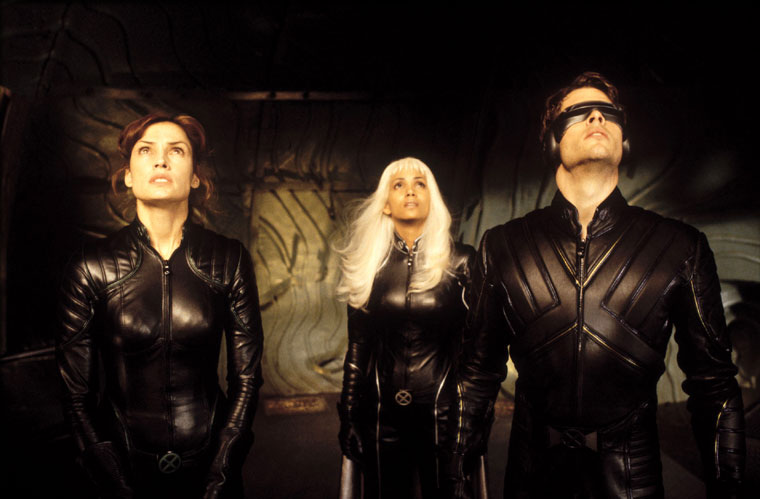
There’s too many other mutants in this movie to keep track of, and even a short roll call won’t cover all of them either. There’s Rogue (Anna Paquin), a teenage mutant who absorbs the life energy out of any being that she touches. There’s Storm (Halle Berry), a silver-haired centurion who can summon lightning bolts and powerful winds through her ability to control the weather. There’s Jean Grey (Famke Jennsen), a telepath who lives with her boyfriend Cyclops (James Marsden), who can obliterate anything with a laser beam simply by looking at them (makes you wonder how they take care of their evening business in the bedroom…). Perhaps the most recognizable mutant here is Wolverine (Hugh Jackman), who came into the X-men with Rogue after spending years trying to remember who he was and where he came from. Wolverine has the most unique ability out of these X-men by being able to heal at a faster rate and protrude claws out of his fists when threatened. So there’s that.

Long story short, the Brotherhood of mutants hatch a scheme against the human race, and the X-men must rise up to stop them. Doesn’t sound like any other superhero team-up action flick out there, right?

Let me start off with the positives. To put it simply, X-men is just a big ball of fun. Whether we’re laughing from a line of scathing dialogue between Wolverine and Cyclops, or watching a thrilling action scene between two mutants fighting on top of the Statue of Liberty, there’s so many memorable moments to look at and enjoy regardless of how hammy or preposterous they might be. Because of this, I think I have a good idea of who this movie was made for: it’s made for the comic-book die-hards, the kids that would freak out in glee and excitement when they get their never-before-opened copy of The Uncanny X-men #141 in the mail for the first time.

For me, my experience with the X-men comes from the 1990′s saturday morning cartoon, the one that included these characters and more in a colorful, energetic and fast-paced ensemble that had much more time and episodes to introduce these characters and delve a little more into their backstories and motivations. For me, this movie hits a few notes on that feeling of nostalgia and then misses on others. I like a lot of what this movie had to offer, from the exciting and uniquely-packaged action scenes all the way to the more dramatic, tensely-driven moments, such as when a mutant argues with a U.S. Senator on mutant rights.

Again, I know where this feeling comes from. Earlier in his career, writer and co-creator Stan Lee created the X-men as a response to the civil rights movement, as an allegory to how people are afraid and hated by other people just because they are different from them. With this movie, I was hoping it would delve into those themes as deeply as Spider-man did with his themes regarding love, guilt and responsibility. Instead, it chooses to make the makeup and visual effects the stars of the movie, showing us cool, flashy effects of people in black leather costumes instead of making the story and themes itself the focus. The movie is a playground to show off what kind of cool tricks these kids can do: not a serious drama about why the two kids are fighting on the playground in the first place.

Here’s the critical factor that saves this movie from just being another standard action flick: the cast. I’ve already mentioned how this movie touches up on some of the nostalgia from the original cartoon. This cast is the reasoning behind that nostalgia. McKellan was conniving as Magneto, a torn and hateful man who sees only one outcome in the human-mutant conflict, an extremist not too dissimilar from that of Malcolm X during the civil rights movement. If he’s Malcolm X then, Professor Xavier is Martin Luther King. Jr., a patient, kind-hearted and wise man who wishes to co-exist with the human race, and defend both of their rights for the sake of that future. I especially liked Hugh Jackman as the feral and vicious Wolverine, a man who definitely has that hardened, rough edge to him, but also that soft spot where he feels protective over those who can’t protect themselves, almost like a papa bear over his little cubs. The script is the transgressor for the silly, generic plot: the cast is what elevates this film above its mediocrity and makes it more than what it actually is.

Overall, I liked X-men. I wish it could have been better, being that the source material is among the most original and influential comic books ever conceived in print, but I’m willing to let that pass for the sake of the franchise’s potential future. If the movie aimed to be nothing else except for visually-splendid eye candy to fill the gleeful hearts of comic book nerds, this movie succeeded. Hey, at least Stan Lee’s Marvelites will be satisfied.

Tagged , , , , , , , , , , , , , , , , , , , , , , , , , , , , , , , , , ,

OSCAR REACTIONS 2013

Well, that was anti-climactic.

For those of you who live under a rock and don’t know who I’m talking about when I mention the word “oscar”, the 86th Academy Awards took place yesterday on ABC, hosted by comedian Ellen Degeneres. Needless to say, Degeneres was brilliant, taking selfies, buying pizza, crashing twitter, bringing the stage down for Jennifer Lawrence, and calling Liza Minelli a man all in one night. And yet, despite all of her efforts, the oscars seemed so… boring.

How did this happen? The nominees, dear reader. Out of the 24 categories in the ceremony I got twenty right, beating most of my Shorthorn peers and family members for the potluck we held that night. The most I’ve gotten previously was sixteen. I’m inclined to believe that the academy made the winners of these awards too obvious by building up too much hype of them during the buzz of the past few months.  Case in point: was there any argument that Frozen was going to take home best animated feature?

It doesn’t matter now, anyway. It happened, and I got 20 right out of 24 categories. Yes!!! Just because I predicted them correctly, however, doesn’t mean I need to be happy for their win. Let’s go through each of the categories and see whether or not they really deserved it or not…

BEST PICTURE (CORRECT!) The best picture of the year rightfully won best picture at the Academy Awards: Steve McQueen’s phenomenal, gripping, heart-wrenching, spellbinding and immensely powerful 12 Years A Slave won best picture. While I’m ecstatic for its win and could not agree more with the Academy’s consensus, I find it very strange that it won the Academy’s highest honor despite it only winning two other awards. But we’ll talk more about that later.

BEST DIRECTOR (CORRECT!) Also correctly predicted is Alfonso Cuaron for his nerve-wracking and tensely-directed sci-fi thriller Gravity. I already mentioned this in my predictions, but the best director award needs to be reserved for the best picture of the year. I loved Gravity with every fiber of my being, but it simply does not match the cinematic caliber to that of McQueen’s 12 Years A Slave. It would be like comparing The Dark Knight to that of Slumdog MillionaireThe Fugitive to that of Schindler’s List, or Jaws to that of One Flew Over The Cuckoos Nest. They are all ingenious, brilliant and incredibly memorable pictures, but the best picture of the year is awarded that because of the direction and treatment that it was given.

That’s not intended as an insult towards Cuaron, and I definitely believe he deserves it based on the physics and tension of the movie alone. If I’m thinking about which movie had the bigger impact, however, it’s no contest on which one it deserves to go to: McQueen for 12 Years A Slave. Nevertheless, I congratulate Cuaron on his many accomplishments regarding Gravity. Lord knows my heart stopped at least a few times while watching that picture.

BEST ACTOR (CORRECT!) Matthew McConaughey took home the award for best actor as a rowdy texas cowboy dying of AIDS in Dallas Buyers Club. While the award could have gone to either him or Chiwetel Ejiofor for 12 Years A Slave, there’s no denying the power, the energy, and the raw gravitas that he brought to a man’s desperate journey to survive. Plus, I love his acceptance speech and how he dedicated the award to God and to “himself in ten years”. That’s a wise goal that any man should strive for.

BEST ACTRESS (CORRECT!) Cate Blanchett won best actress for Woody Allen’s Blue Jasmine. While I have regretfully not seen the movie yet, I will say that the few scenes I have seen her in impressed me very much, and that she did a solid job portraying a deeply bothered woman who is in deep depression and alcohol addiction. Congratulations to her. I look forward to watching the film, as well as Blanchett’s performance in it.

BEST SUPPORTING ACTOR (CORRECT!) Did Michael Fassbender win best supporting actor like I wanted him to? No, he did not. Instead, Jared Leto took home the award portraying the transgender AIDS victim Rayon in Dallas Buyers Club

The more I think about it, the more ridiculous I think it is that the best picture winner of the year did not get recognized in so many categories. Why the snubbing from Fassbender? Half of the movie’s turmoil and conflict came from this despicable character, a man so inhumane and abominable that Calvin Candy from Django Unchained would have broke down in tears after seeing what this man forced people through. Fassbender was pivotal, aggressive, violent, and hateful as Edwin Epps, and incurred more emotions from audiences than that of a transgender AIDS patient in Dallas Buyers Club. I know 30 Seconds To Mars fans will hate me for saying this, but the more vital role needs to go to the more vital performance. I said it once, I’ll say it again: Leto is not as deserving in the award as Fassbender is.

Again, no disrespect, and I acknowledge that Leto gave a great performance in the picture. But like Cuaron with best direction, the more compelling presence needs to go to the more compelling artist. Sorry, Rayon.

BEST SUPPORTING ACTRESS (CORRECT!) Lupita Nyongo won (and deserved) the academy award for best supporting actress for her heartbreaking role as a desperate and depraved cotton picking slave in 12 Years A Slave. No qualms here.

BEST ORIGINAL SCREENPLAY (CORRECT!) I also correctly predicted that Spike Jonze would win the best original screenplay award for his sci-fi romance story Her. Comparing Her to the genius of David O’Russell’s American Hustle, I mentioned in my original predictions list that “just because its a smarter story doesn’t necessarily mean that it is a better one.” I do not retract my statement.

BEST ADAPTED SCREENPLAY (CORRECT!) John Ridley won best adapted screenplay for his incredibly well-documented 12 Years A Slave. He equally deserved it, as Solomon Northrup’s story, or legacy, could not have translated any better to the screen if the filmmakers tried. Great job, Ridley. You gave us an unforgettable and incredible story, the likes of which no one has seen since Steven Spielberg’s Schindler’s List. 

And this is the only other award 12 Years won for the night. No cinematography. No editing. No costume or production design. No supporting actor. No other award that would further substantiate and support its win for best picture.

Am I the only one that finds this completely ludicrous? To date, there are only three best picture winners to win only three academy awards. Those movies are The Godfather, Crash and Argo, and two of them didn’t even win in major categories. Seriously, what is going on? Why are we being so insubstantial towards movies that have been deemed the best of the year? Do academy voters not realize that by naming this the BEST PICTURE OF THE YEAR that they’re saying that its better than everything else? And according to this ceremony, not only are they saying that it is the equivalent of Dallas Buyers Club (they both won three academy awards), but that Gravity is superior to it with seven wins and no awarding of best picture.

Seriously. Make up your mind. I’m fine with you saying one picture is better than another, but substantiate that by what awards you give it. I seriously doubt that 12 Years is best picture because of its screenplay and its supporting actress alone. Likewise, I doubt that Gravity isn’t the best picture of the year because it has the best direction, camerawork, editing, sound mixing, and visual effects out of any other picture.

That’s all I ask, folks. Not preference. Fairness.

BEST FOREIGN LANGUAGE FILM (CORRECT!) The Great Beauty won for best foreign-language film. That’s the one that everyone saw, right? It obviously deserved to win.

BEST DOCUMENTARY FILM (INCORRECT!) I incorrectly predicted that Act Of Killing would win the award, but no, 20 Feet From Stardom took the award home, with featured artists on the film including music legends Mick Jagger, Bruce Springsteen and Stevie Wonder. I haven’t seen the film, so I have no place on commenting on it, but it seems odd that the Academy would reward a movie about background singers over that of a tragic confrontation of death and social issues. I’ve yet to see either of them though, so like I said, my opinion is invalid in this category.

BEST ANIMATED FILM (CORRECT!) Disney won best animated feature for Frozen. While I didn’t care much for it, I know it made a wide impact on its audience and that it will go on to be fondly remembered by many animated movie lovers for years to come. So congratulations for its win, even though I’m no fan of the cold weather this time around.

BEST ORIGINAL SONG (CORRECT!) Frozen won best original song for its memorable song “Let It Go”. It certainly didn’t win for Idina Menzel’s performance, that’s for sure. What the heck happened with her? Her pitch was all over the place, her control was wonky, and her whiny voice was the contrast of the powerful, beautifully controlled voice she exhibited in the movie itself. Seriously. What happened?

One song I’ve really been getting into recently (and I think you’ll agree with me) is Pharell Williams’ “Happy”. The performance proved why. Not only was it energetic, upbeat, and undeniably catchy, but Williams gave a great performance, he exhibited great control and showed very few differences from the studio version of his song. Menzel’s performance, in comparison, was completely and utterly horrendous.

But hey, I guess that’s why the award is called “best original song” and not “best performance”. Otherwise, I think we both what the turnout would be.

BEST ORIGINAL SCORE (CORRECT!) Steve Price took home the award for best original score with Gravity. He completely deserved it. Not only did it match the tension, edginess and unease of the movie, but it also gave a dignified sense of hope and accomplishment after a long journey of heart-pounding danger and peril. Listening to the soundtrack alone gave you the feeling of identity and survival, and Price was definitely the most deserving out of any nominee. Congrats to him for his win.

In the meantime, I’m still wondering where is Hans Zimmer’s nomination for Rush. Remind me again why this movie wasn’t nominated for anything?

BEST CINEMATOGRAPHY (CORRECT!) In 2011, Emanuel Lubewski was mercilessly snubbed for his masterful, Stanley Kubrick-esque camerawork in The Tree Of Life. If he didn’t win it this year, I was literally planning on flipping out.

Luckily, he did.

BEST FILM EDITING (CORRECT!) Another category that I felt 12 Years was superior to Gravity, yet it still lost to it. Must I keep beating a dead horse? Gravity was a more visually stellar and energetic picture. 12 Years was the more engaging and involved one. Part of that was because of how the film was put together in a traditionalist style that was reminiscent of Dylan Tichenor’s work from movies including There Will Be Blood and Brokeback Mountain, where he focused most of the runtime on the film’s subjects rather than worrying about flashy cuts or transitions. Film editing is one of the most important part of storytelling, and what have I been saying is the best story of the year? 12 Years A Slave.

I’m not going to drag this out though. Gravity was a great picture, and editors Alfonso Cuaron and Mark Sanger definitely reached outside the box to accomplish things visually no other film did this year. It did a good job. Moving on.

BEST PRODUCTION DESIGN (CORRECT!) The Great Gatsby won for best production design. Considering the sets were the most colorful and visually appealing out of the year, that isn’t very surprising.

BEST COSTUME DESIGN (INCORRECT!) Unfortunately, I predicted this category wrong, thinking that 12 Years was going to get this one. The only reason I went with that instead of winner The Great Gatsby was because I knew Catherine Martin was already going to win for best production design, and any more than that would have been greedy. I forgot that “spreading the wealth” isn’t a phrase the academy is most well known for.

BEST MAKEUP (CORRECT!) Thankfully, Dallas Buyers Club won for best makeup and hairstyling. As long as Jackass: Bad Grandpa didn’t walk home with the award, I’m satisfied.

BEST SOUND EDITING (CORRECT!) Gravity won.

BEST SOUND MIXING (CORRECT!) Gravity won. Again.

BEST VISUAL EFFECTS (CORRECT!) If you even thought this award was going to anything other than Gravity, you’re either insane, or blind.

And at last, the long-dreaded short film categories.

BEST LIVE-ACTION SHORT FILM (CORRECT!) Surprisingly, I got this category correct with predicting Helium. I haven’t seen the film though, so it was only by sheer luck that I got this right.

BEST ANIMATED SHORT FILM (INCORRECT!) Mr. Hublot took home this award. That’s surprising, considering how clever and fun Get A Horse! was, but nevermind. I haven’t seen the movie, so I can’t comment on it.

BEST DOCUMENTARY SHORT (INCORRECT!) The Lady In Number 6: Music Saved My Life. Again, just like any other films in these categories, I haven’t seen it, so how would you expect me to get it right? You might as well blindfold me and ask me to just write on the flipping ballot.

Overall, this has been a fun ceremony, and I’m grateful to Ellen Degeneres for making it a happy-go-lucky and loveably quirky time. Just please, make the ceremony less predictable next time, okay? I’d rather not have a film come in and just know that its going to dominate in all of the categories. You would have been better calling it “The First Annual Gravity Awards”.

-David Dunn

Tagged , , , , , , , , , , , , , , , , , , , , , , , , , , , , , ,

“12 YEARS A SLAVE” Review (✫✫✫✫)

Over a decade of injustice and cruelty.

12 Years A Slave is quite possibly the best film of the year.

It is also the most disturbing.

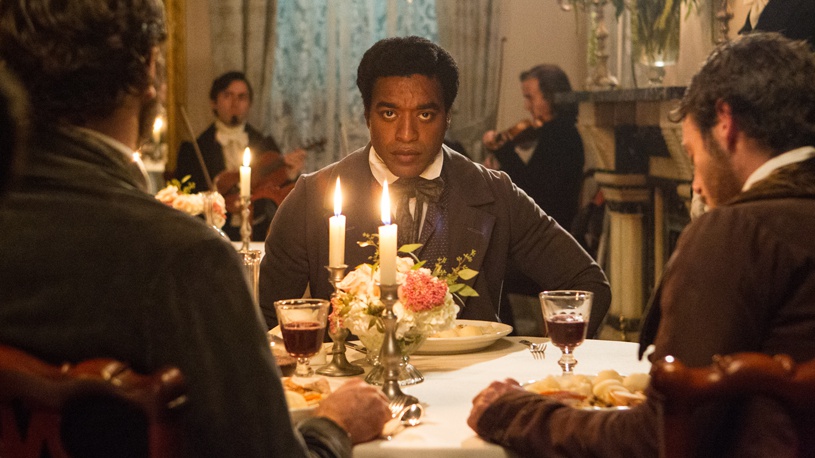
Based off the 1853 autobiography of the same name, 12 Years A Slave follows the true story of Solomon Northup (Chiwetel Ejiofor), a free black man who lives with his family and plays the violin in Saratoga, New York.

One evening, he becomes acquainted with two young gentlemen who claim to be circus performers looking to hire him for a one-night gig. When he wakes up the next morning, he is in chains, and realizes that he was drugged, kidnapped and sold into slavery by his captors. During his years as a slave, Northup goes from one owner to the next, from a kindhearted owner named William Ford (Benedict Cumberbatch) to a cruel, racist and mean-spirited pig named Edwin Epps (Michael Fassbender), who presents the greatest trials he must face if he is ever to survive.

12 Years A Slave is a film that not only lives up to all of its built-up hype and expectations: in many ways, it exceeds them.

Its quality as a work of art is so striking and powerful that it can be compared to other historical tragedies, including The Pianistand Schindler’s List.

Director Steve McQueen, who made the morally reprehensible and eerily bleak film Shame back in 2011, redeems himself here as a filmmaker. McQueen, in collaboration with cinematographer Sean Bobbitt, is not only masterful with framing his articulate, beautiful shots with 12 Years A Slave, but also brilliant with orchestrating scenes between his actors, showing us the bleak realism and truth of the slavery years in America.

Ejiofor, who portrays Northup in 12 Years A Slave is endlessly captivating. In moments where you think he might just be phoning it in, or just going along with the motions, he surprises you and releases an emotional intensity in ways no other actor has this year, not even Forest Whitaker in Lee Daniels’ The Butler. Newcomer Lupita Nyong’o plays a young female slave in this movie so passionately that you forget she’s an actress and slip into her character’s tragedy as a human being more than you do as a movie character.

Most noticeable perhaps is Michael Fassbender as Edwin Epps, who is so hateful and so spiteful in this role that all of the audience’s energy, anger and frustration is focused on him and his sadistic acts. Fassbender was brilliant in his portrayal, and I sincerely hope that he at least gets an Academy Award nomination for his performance.

Every other aspect of this film can be praised endlessly. The script by John Ridley, who wrote Three Kings in 1999, was endlessly emotional and captivating. The score by Hans Zimmer was quiet, humble and breathtakingly beautiful, encompassing both the truth and tragedy of Northup’s heartbreaking story.

However, let there be a strong word of caution: 12 Years A Slave will elicit violent reactions from its audiences. You will laugh. You will weep. You will grind your teeth in anger and frustration, maddened by the many years of cruelty, prejudice and barbarism that no human being should ever have to experience. But it compels you to care for the character, to reach deep down in your heart to feel what he is feeling, to experience compassion and sympathy in ways almost no other film can do, not even with Schindler’s List. 

And let this be a testament to the film’s quality: at the end of the showing, there was a white man who could be heard weeping in the back of the theater. In between his hiccups, tears and hysterical reactions, he turned toward the black viewer sitting next to him, shook her hand and after introducing himself said to her, “I’m so sorry for what my race did to your ancestors.”

That man felt a powerful feeling of guilt and shame for the things that he saw in 12 Years A Slave.

That man was me.

Tagged , , , , , , , , , , , , , , , , , , , , , , , , , , , , , , , , , , , , , , , ,

“THE GREAT GATSBY” Review (✫✫✫)

Nice to see you again, old sport.  

When you sit and think about the character of Jay Gatsby, there is never a simple answer to define him and his purpose in The Great Gatsby.  Some people have cited him as a post-modern interpretation of Romeo And Juliet, in the aspect that the character is going through a romantic struggle that always ends in nothing but tragedy.  Others have viewed him as a representation of the roaring twenties, as a pioneer who emboldens and defines the industrial image of the 1920’s and their status as they faded away into the 1930’s.  Others see him more like an enigma, an image of the upper class and the bleak loneliness that comes with it.  Whatever you believe to see, Jay Gatsby is no simple character.  For all we know, he could be one or none of these things.  Or all of them.

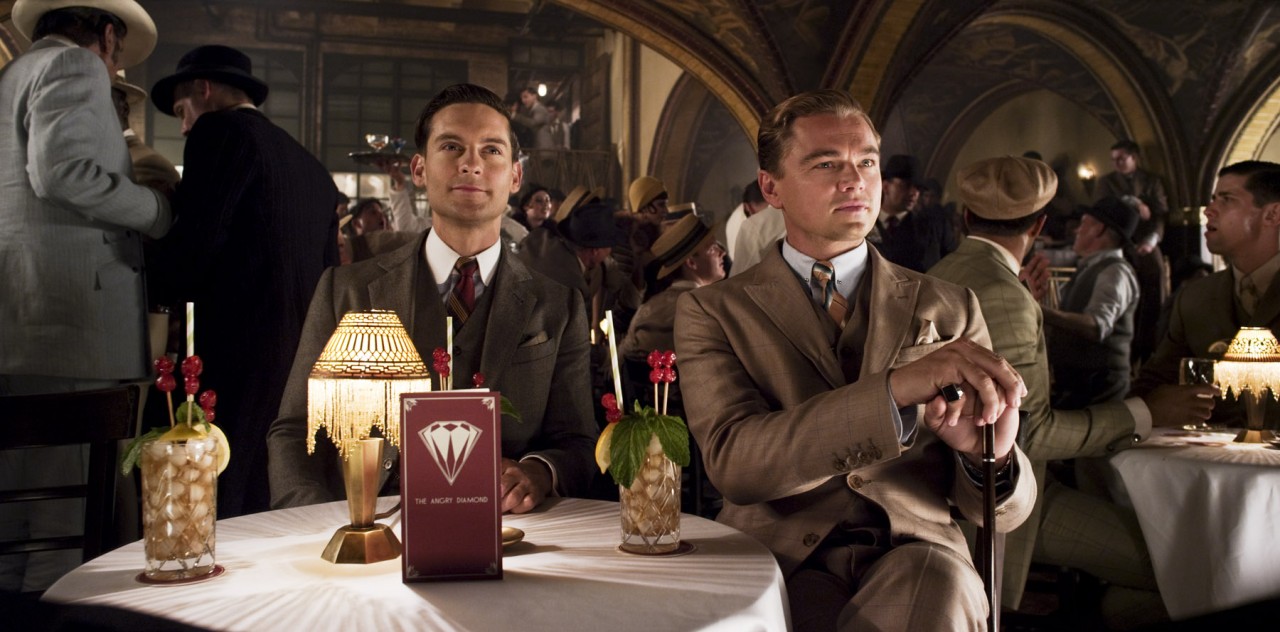
The fact that this film knows, respects, and acknowledges that makes me appreciate this movie, and hope that others can appreciate it too through DiCaprio’s performance and the mythology being revisited here.  Those who read the book should already know the story: a 1920’s bond salesman and struggling writer named Nick Carraway (Tobey Maguire) moves into New York city, where he learns of his rich next door “neighbor” named Jay Gatsby (Leonardo DiCaprio).

I put “neighbor” in quotations because Nick never actually sees Jay Gatsby in the beginning of the film.  All he ever sees of his estranged, self-secluded neighbor is a man looking behind some curtains and holding lavish parties in his mansion in the cool of midnight.  All he ever hears of him is scandalous rumors and war stories about a man many people haven’t met either.  The more Nick lives in his lonely little house, the more he questions if Mr. Gatsby even exists.

Eventually, Mr. Gatsby of course does introduce himself, but not as the host of the party, but rather, as a humble servant who offers Nick a drink on a plate of beverages.  As Nick becomes more familiar with Mr. Gatsby and his lifestyle, he soon learns the truth of Mr. Gatsby’s past and the reasons he really came to New York.

When I first heard of another Great Gatsby picture being made, my first reaction was excitement and anticipation.  How could it not be?  From the creative mind of F. Scott Fitzgerald and the many politics and emotions he makes you feel in his novel, it sounded like this movie was going to be a home run for both fans and non-fans of the book.

Then I learned that Baz Lurhmann was writing and directing.  And then bowed my head and uttered a long, dubious groaaannnn.  Lurhmann, who is most known for directing 1996’s Romeo + Juliet and 2008’s Australia, is commonly remembered as a director who abuses style over substance.  With the previous films I just mentioned, not only are they silly, soupy, and sappy menial dramas: they fail to even attain interest, and are extremely forgettable in a line of much better romantic dramas, including Titanic and the 1968 Romeo And Juliet by Franco Zeffirelli.

Note: Okay, I’ll admit I haven’t seen his 2001 film Moulin Rouge!.  Does it matter though, when out of his entire filmography, that’s the only film he can really brag about?  

The beginning of The Great Gatsby, much like Luhrmann’s other pictures, also suffers from this case of style over substance, with its overly boisterous parties and distracting art sequences making no coherent sense or adding anything to the picture overall.  What I found interesting, however, is that the first act barely matters.  When Jay Gatsby is finally introduced, the film takes a sharp turn of interest and invigorates the audience with new energy, almost like the character changes the entire tone of the film simply by him just being there.

I imagine this is the kind of Jay Gatsby that Fitzgerald would have wanted cast: the type that dresses in nice suits, stands straight with his chin up, and one who enters a room with such stillness that you could hear a penny drop.  The casting directors knew that their casting decision would be crucial to the film, and I think Fitzgerald would be pleased with the end result.  DiCaprio hits every single note dead-on this fascinating character, and just by sheer appearance, demeanor and dialect does he inhabit the character of Jay Gatsby and allow audiences to slip into his conscience and feel what he is feeling.

Oh, I won’t deny everyone else is good in this movie.  Joel Edgerton is effective as the antagonist, and even though he’s an industrial pioneer much like Gatsby is, he has such a hateful energy about him that makes you just want to run him over with a yellow beetle.  Carey Mulligan is good as Gatsby’s love interest, and perfectly shows all the innocence and indecisiveness of her character in the midst of all the ruckus.  Maguire, as well, is perfect as Nick Carraway, not as a character in himself, but as a silent observer, a passive voice who quietly watches over the scene, acting as the audience’s eyes and ears in this third-person narrative.  But its DiCaprio who sucks us in, DiCaprio who winds us up and plays us like a record as he asks us to sit through this tender, emotionally captivating journey that serves as a metaphor for the wealthy and for the industrial era.

And don’t worry, I’ll give Luhrmann credit too.  This film would not have survived without his writing or directing, as he has such reverence for the book and a great fear from deviating from it that the movie functions more as a love letter to Fitzgerald than it does as a strict book-to-movie adaptation.

Regardless, there’s only one person who shines the most here.  DiCaprio made this movie, and through his performance we were able to identify with a character that struggles with his past, his wealth, his love, and the deepening sadness that he hides behinds his warm, welcoming smile.

Tagged , , , , , , , , , , , , , , , , , , , , , , , , , , , , , , , ,

“LIFE OF PI” Review (✫✫✫)

A boy, a boat, and his bengal tiger.  

If there is any film that will stick out in your mind more than any other film in 2012, its going to be Life Of Pi.  How could it not be?  With spectacular visuals, daring execution, and a solid story, Life Of Pi may very well be one of the most memorable experiences of the year, even though that doesn’t strictly mean it is of the highest standard in movies.

Based on the novel of the same name by Yann Martel, Life Of Pi follows the story of Pi “Piscine” Patel (Suraj Sharma), a young indian boy who is a believer in many religions, including Hinduism, Christianity, and Islam.  To Pi, all of these religions lead to the same path: a greater understanding and relationship with God.  In one wonderful moment of the film, he described faith like a mansion, with room for both belief and doubt on every floor.

Besides being a follower of many faiths, Pi’s family also runs a local zoo in India, an exotic place filled with vibrant species and animals of all kinds.  Most significant to Pi is a 450-pound bengal tiger named Richard Parker, who got his name after the hunter tha caught him switched the names around by accident, with the hunter’s name appearing on the sheet as “Thirsty”.  The name stuck on Richard Parker ever since.

Eventually, the day has come where Pi’s family can no longer support themselves in India and have to move themselves and the animals to Canada, where they can hopefully find a living and start anew.  But when the ship his family and livestock are on crashes and sinks into the Pacific Ocean, Pi ends up stranded on a lifeboat all alone with Richard Parker. Now, armed with little more than a life-vest and the clothes on his back, Pi must find a way to not only co-exist with Richard Parker, but to also find a way to tame him and stay alive in the lonely abyss of the ocean.

The best thing about this movie is its faithfulness to the original novel, in how it portrays Pi as a strange, introverted, religiously diverse human being but also a spiritually focused young adult.  Pi’s story is a unique one, with the film dwelving into his story with such emotional maturity and observation, that we cannot help but understand Pi and his spiritual connection to God.

I especially loved one line Pi said to a friend at one point at the film, but when looking at it through a closer lens, maybe he was saying it more to himself:

“Even when God seemed to have abandoned me, he was watching.  Even when he seemed indifferent to my suffering, he was watching. And when I was beyond all hope of saving, he gave me rest. Then he gave me a sign to continue my journey.”

I also like the connection Pi shares with this 450-pound man-eating animal named Richard Parker: dare I say they have chemistry with one another? Yes I can, because the tiger is rendered here with such precision and detail that he actually looks like a living, breathing man-eating animal, not just another CGI creation. The rest of the movie is no exception, as it takes us  through many wonderfully dazzling visual moments that are just as impressive as when we watched James Cameron’s Titanic for the first time.

Here is, truthfully, a genuinely good movie.  The score is settling, ambient, and beautiful.  The visuals are transcendent, amazing, and stunning.  And the underlying context Ang Lee adapts from Yann Martel’s novel retains its strength, as Lee knows how to balance emotional relevance with visual splendor.

Unfortunately, the greatest strength of this film is also its greatest weakness: it follows too closely to the original novel.  Thinking back to when I read the book back in high school, I remember a story that was ambitious, daring, creative, deep, emotional, spiritual, and unique all at once.  It wasn’t just another survival-fantasy-advenure: it was a spiritual journey that has as much to do with faith and God as it does with friendship and sacrifice.

The movie doesn’t reach into this idea as deeply as the book does.  That’s to be expected, considering books are typically more in-depth than their movie counterparts.  Still though.  Haven’t other book-to-movie adaptations benefitted moreover their novel counterparts when they branched out and embraced other possibilities the original writers didn’t?

I bring two other novel adaptations from earlier this year as an example: The Hobbit and The Hunger Games.  Those movies, unlike Life Of Pi don’t just retell their stories: they rework them.  They change it to better fit their narrative, and they expand upon the stories they are helping to re-create within their own cinematic universes.

Life Of Pi doesn’t do that.  It relies too heavily on its novel-based counterpart, it refuses to branch out any more than the pages of Yann Martel’s novel will allow it to, and it has one of the slowest beginnings ever known to mankind.  The scenes where an older Pi converses with a young novelist searching for a story were especially unnecessary: why not just replace thirty-minutes of exposition with a simple narrative voice-over?

Again, I will stress this: Life Of Pi is the most memorable film of the year.  That does not mean that it is the best film of the year, and that does not mean that everybody will enjoy it.  It just simply means that when somebody watches the movie, it will mean something to them.  Whether that’s a good or bad thing remains to be seen.

Still though, to have a movie that actually says something for a change is significant enough.  Take the ocean Pi is trying to survive itself as an example.  One could say it is symbolic to everyone’s spiritual journeys in life: there are quiet moments, and then there are chaotic ones.  But your journey is never truly complete, even if you do end up washing onto the shore.

Tagged , , , , , , , , , , , , , , , , , , , ,