Tag Archives: Adventure

OSCAR REACTIONS 2013

Well, that was anti-climactic.

For those of you who live under a rock and don’t know who I’m talking about when I mention the word “oscar”, the 86th Academy Awards took place yesterday on ABC, hosted by comedian Ellen Degeneres. Needless to say, Degeneres was brilliant, taking selfies, buying pizza, crashing twitter, bringing the stage down for Jennifer Lawrence, and calling Liza Minelli a man all in one night. And yet, despite all of her efforts, the oscars seemed so… boring.

How did this happen? The nominees, dear reader. Out of the 24 categories in the ceremony I got twenty right, beating most of my Shorthorn peers and family members for the potluck we held that night. The most I’ve gotten previously was sixteen. I’m inclined to believe that the academy made the winners of these awards too obvious by building up too much hype of them during the buzz of the past few months.  Case in point: was there any argument that Frozen was going to take home best animated feature?

It doesn’t matter now, anyway. It happened, and I got 20 right out of 24 categories. Yes!!! Just because I predicted them correctly, however, doesn’t mean I need to be happy for their win. Let’s go through each of the categories and see whether or not they really deserved it or not…

BEST PICTURE (CORRECT!) The best picture of the year rightfully won best picture at the Academy Awards: Steve McQueen’s phenomenal, gripping, heart-wrenching, spellbinding and immensely powerful 12 Years A Slave won best picture. While I’m ecstatic for its win and could not agree more with the Academy’s consensus, I find it very strange that it won the Academy’s highest honor despite it only winning two other awards. But we’ll talk more about that later.

BEST DIRECTOR (CORRECT!) Also correctly predicted is Alfonso Cuaron for his nerve-wracking and tensely-directed sci-fi thriller Gravity. I already mentioned this in my predictions, but the best director award needs to be reserved for the best picture of the year. I loved Gravity with every fiber of my being, but it simply does not match the cinematic caliber to that of McQueen’s 12 Years A Slave. It would be like comparing The Dark Knight to that of Slumdog MillionaireThe Fugitive to that of Schindler’s List, or Jaws to that of One Flew Over The Cuckoos Nest. They are all ingenious, brilliant and incredibly memorable pictures, but the best picture of the year is awarded that because of the direction and treatment that it was given.

That’s not intended as an insult towards Cuaron, and I definitely believe he deserves it based on the physics and tension of the movie alone. If I’m thinking about which movie had the bigger impact, however, it’s no contest on which one it deserves to go to: McQueen for 12 Years A Slave. Nevertheless, I congratulate Cuaron on his many accomplishments regarding Gravity. Lord knows my heart stopped at least a few times while watching that picture.

BEST ACTOR (CORRECT!) Matthew McConaughey took home the award for best actor as a rowdy texas cowboy dying of AIDS in Dallas Buyers Club. While the award could have gone to either him or Chiwetel Ejiofor for 12 Years A Slave, there’s no denying the power, the energy, and the raw gravitas that he brought to a man’s desperate journey to survive. Plus, I love his acceptance speech and how he dedicated the award to God and to “himself in ten years”. That’s a wise goal that any man should strive for.

BEST ACTRESS (CORRECT!) Cate Blanchett won best actress for Woody Allen’s Blue Jasmine. While I have regretfully not seen the movie yet, I will say that the few scenes I have seen her in impressed me very much, and that she did a solid job portraying a deeply bothered woman who is in deep depression and alcohol addiction. Congratulations to her. I look forward to watching the film, as well as Blanchett’s performance in it.

BEST SUPPORTING ACTOR (CORRECT!) Did Michael Fassbender win best supporting actor like I wanted him to? No, he did not. Instead, Jared Leto took home the award portraying the transgender AIDS victim Rayon in Dallas Buyers Club

The more I think about it, the more ridiculous I think it is that the best picture winner of the year did not get recognized in so many categories. Why the snubbing from Fassbender? Half of the movie’s turmoil and conflict came from this despicable character, a man so inhumane and abominable that Calvin Candy from Django Unchained would have broke down in tears after seeing what this man forced people through. Fassbender was pivotal, aggressive, violent, and hateful as Edwin Epps, and incurred more emotions from audiences than that of a transgender AIDS patient in Dallas Buyers Club. I know 30 Seconds To Mars fans will hate me for saying this, but the more vital role needs to go to the more vital performance. I said it once, I’ll say it again: Leto is not as deserving in the award as Fassbender is.

Again, no disrespect, and I acknowledge that Leto gave a great performance in the picture. But like Cuaron with best direction, the more compelling presence needs to go to the more compelling artist. Sorry, Rayon.

BEST SUPPORTING ACTRESS (CORRECT!) Lupita Nyongo won (and deserved) the academy award for best supporting actress for her heartbreaking role as a desperate and depraved cotton picking slave in 12 Years A Slave. No qualms here.

BEST ORIGINAL SCREENPLAY (CORRECT!) I also correctly predicted that Spike Jonze would win the best original screenplay award for his sci-fi romance story Her. Comparing Her to the genius of David O’Russell’s American Hustle, I mentioned in my original predictions list that “just because its a smarter story doesn’t necessarily mean that it is a better one.” I do not retract my statement.

BEST ADAPTED SCREENPLAY (CORRECT!) John Ridley won best adapted screenplay for his incredibly well-documented 12 Years A Slave. He equally deserved it, as Solomon Northrup’s story, or legacy, could not have translated any better to the screen if the filmmakers tried. Great job, Ridley. You gave us an unforgettable and incredible story, the likes of which no one has seen since Steven Spielberg’s Schindler’s List. 

And this is the only other award 12 Years won for the night. No cinematography. No editing. No costume or production design. No supporting actor. No other award that would further substantiate and support its win for best picture.

Am I the only one that finds this completely ludicrous? To date, there are only three best picture winners to win only three academy awards. Those movies are The Godfather, Crash and Argo, and two of them didn’t even win in major categories. Seriously, what is going on? Why are we being so insubstantial towards movies that have been deemed the best of the year? Do academy voters not realize that by naming this the BEST PICTURE OF THE YEAR that they’re saying that its better than everything else? And according to this ceremony, not only are they saying that it is the equivalent of Dallas Buyers Club (they both won three academy awards), but that Gravity is superior to it with seven wins and no awarding of best picture.

Seriously. Make up your mind. I’m fine with you saying one picture is better than another, but substantiate that by what awards you give it. I seriously doubt that 12 Years is best picture because of its screenplay and its supporting actress alone. Likewise, I doubt that Gravity isn’t the best picture of the year because it has the best direction, camerawork, editing, sound mixing, and visual effects out of any other picture.

That’s all I ask, folks. Not preference. Fairness.

BEST FOREIGN LANGUAGE FILM (CORRECT!) The Great Beauty won for best foreign-language film. That’s the one that everyone saw, right? It obviously deserved to win.

BEST DOCUMENTARY FILM (INCORRECT!) I incorrectly predicted that Act Of Killing would win the award, but no, 20 Feet From Stardom took the award home, with featured artists on the film including music legends Mick Jagger, Bruce Springsteen and Stevie Wonder. I haven’t seen the film, so I have no place on commenting on it, but it seems odd that the Academy would reward a movie about background singers over that of a tragic confrontation of death and social issues. I’ve yet to see either of them though, so like I said, my opinion is invalid in this category.

BEST ANIMATED FILM (CORRECT!) Disney won best animated feature for Frozen. While I didn’t care much for it, I know it made a wide impact on its audience and that it will go on to be fondly remembered by many animated movie lovers for years to come. So congratulations for its win, even though I’m no fan of the cold weather this time around.

BEST ORIGINAL SONG (CORRECT!) Frozen won best original song for its memorable song “Let It Go”. It certainly didn’t win for Idina Menzel’s performance, that’s for sure. What the heck happened with her? Her pitch was all over the place, her control was wonky, and her whiny voice was the contrast of the powerful, beautifully controlled voice she exhibited in the movie itself. Seriously. What happened?

One song I’ve really been getting into recently (and I think you’ll agree with me) is Pharell Williams’ “Happy”. The performance proved why. Not only was it energetic, upbeat, and undeniably catchy, but Williams gave a great performance, he exhibited great control and showed very few differences from the studio version of his song. Menzel’s performance, in comparison, was completely and utterly horrendous.

But hey, I guess that’s why the award is called “best original song” and not “best performance”. Otherwise, I think we both what the turnout would be.

BEST ORIGINAL SCORE (CORRECT!) Steve Price took home the award for best original score with Gravity. He completely deserved it. Not only did it match the tension, edginess and unease of the movie, but it also gave a dignified sense of hope and accomplishment after a long journey of heart-pounding danger and peril. Listening to the soundtrack alone gave you the feeling of identity and survival, and Price was definitely the most deserving out of any nominee. Congrats to him for his win.

In the meantime, I’m still wondering where is Hans Zimmer’s nomination for Rush. Remind me again why this movie wasn’t nominated for anything?

BEST CINEMATOGRAPHY (CORRECT!) In 2011, Emanuel Lubewski was mercilessly snubbed for his masterful, Stanley Kubrick-esque camerawork in The Tree Of Life. If he didn’t win it this year, I was literally planning on flipping out.

Luckily, he did.

BEST FILM EDITING (CORRECT!) Another category that I felt 12 Years was superior to Gravity, yet it still lost to it. Must I keep beating a dead horse? Gravity was a more visually stellar and energetic picture. 12 Years was the more engaging and involved one. Part of that was because of how the film was put together in a traditionalist style that was reminiscent of Dylan Tichenor’s work from movies including There Will Be Blood and Brokeback Mountain, where he focused most of the runtime on the film’s subjects rather than worrying about flashy cuts or transitions. Film editing is one of the most important part of storytelling, and what have I been saying is the best story of the year? 12 Years A Slave.

I’m not going to drag this out though. Gravity was a great picture, and editors Alfonso Cuaron and Mark Sanger definitely reached outside the box to accomplish things visually no other film did this year. It did a good job. Moving on.

BEST PRODUCTION DESIGN (CORRECT!) The Great Gatsby won for best production design. Considering the sets were the most colorful and visually appealing out of the year, that isn’t very surprising.

BEST COSTUME DESIGN (INCORRECT!) Unfortunately, I predicted this category wrong, thinking that 12 Years was going to get this one. The only reason I went with that instead of winner The Great Gatsby was because I knew Catherine Martin was already going to win for best production design, and any more than that would have been greedy. I forgot that “spreading the wealth” isn’t a phrase the academy is most well known for.

BEST MAKEUP (CORRECT!) Thankfully, Dallas Buyers Club won for best makeup and hairstyling. As long as Jackass: Bad Grandpa didn’t walk home with the award, I’m satisfied.

BEST SOUND EDITING (CORRECT!) Gravity won.

BEST SOUND MIXING (CORRECT!) Gravity won. Again.

BEST VISUAL EFFECTS (CORRECT!) If you even thought this award was going to anything other than Gravity, you’re either insane, or blind.

And at last, the long-dreaded short film categories.

BEST LIVE-ACTION SHORT FILM (CORRECT!) Surprisingly, I got this category correct with predicting Helium. I haven’t seen the film though, so it was only by sheer luck that I got this right.

BEST ANIMATED SHORT FILM (INCORRECT!) Mr. Hublot took home this award. That’s surprising, considering how clever and fun Get A Horse! was, but nevermind. I haven’t seen the movie, so I can’t comment on it.

BEST DOCUMENTARY SHORT (INCORRECT!) The Lady In Number 6: Music Saved My Life. Again, just like any other films in these categories, I haven’t seen it, so how would you expect me to get it right? You might as well blindfold me and ask me to just write on the flipping ballot.

Overall, this has been a fun ceremony, and I’m grateful to Ellen Degeneres for making it a happy-go-lucky and loveably quirky time. Just please, make the ceremony less predictable next time, okay? I’d rather not have a film come in and just know that its going to dominate in all of the categories. You would have been better calling it “The First Annual Gravity Awards”.

-David Dunn

Tagged , , , , , , , , , , , , , , , , , , , , , , , , , , , , , ,

“ELYSIUM” Review (✫✫)

We call it Halo– oops, I meant Elysium.

Elysium is a very specific movie for a very specific audience, a science-fiction film that is too illogical to be taken seriously, yet too solemn to have any good fun. Whenever I attend the movies, I expect either a thought-provoking story trying to instill some idea in its viewers, or an engaging, fun picture intended for the enjoyment of its audience. Never have I seen two tones clash with each other so furiously in a motion picture.

Taking place in the future of 2033, Elysium tells the story of Max Dacosta (Matt Damon), a poor young orphan who is stranded on the destitute slums on Earth since pollution and overpopulation took whatever life it had left long ago. The poor live on Earth while the rich live on an off-world, ring-shaped preservation called “Elysium”, where the fortunate carry out their spoiled, lavish lifestyles and cure diseases in these “health pods” that more or less reboot their bodies. Feeling sick, drowsy or nauseous? Not on Elysium.

Since he lives on Earth, Max is stuck to his harsh day job as a construction worker, building the guard robots that patrol and abuse the citizens on Earth on a daily basis. One day, however, a full, fatal blast of radiation doses him at his work place. Having only five days left to live, Max joins the rebellion on Earth and hatches a scheme to get to Elysium and get himself cured.

A notice to the visual effects designer that handled the majority of the film’s designs: I’m suing you for plagiarism. Video game fans will notice this more than me, but every single piece of designs for Elysium, the machines and anything else in the movie bears a strikingly similar resemblance to a Microsoft video game called Halo. Look it up. The robots, the armor, the weapons, the vehicles,the landscape, even the ring design of Elysium all bear multiple similarities to their counterparts in that video game to the point where it is no longer inspiration and becomes an issue of copyright. Frankly, I’m surprised Microsoft hasn’t sued them already.

Back to the matter at hand. What is there to say about this movie? Well, it’s written and directed by Neil Blomkamp, the same filmmaker behind District 9, who ironically was also in the running for adapting the Halo movie to the big screen. Matt Damon is the lead, a role previously offered to white rappers Eminem and Ninja, and Sharlto Copley plays a vicious bounty hunter that’s chasing after Dacosta, a sharp contrast to the bureaucratic role he adopted in his first collaboration with Blomkamp in District 9.

I myself have not seen District 9, although I’ve really wanted to. The words I’ve heard to describe the movie have been praising nonetheless, with phrases I’ve heard including “greatly entertaining”, “raw and intensely-blooded”, “aggressively original”, and “an un-compromising geo-political/xenophobic commentary.”

I feel like everything I heard about District 9 is everything that Elysium isn’t, save for all of the pointless blood and gore. Don’t get me wrong, there are good parts in Elysium, but that’s all they are: complete, fully realized parts of one broken, misshapen whole. The first hour is absolutely mesmerizing, immersing us in this world full of spectacle, bigotry and the unfair treatment of social classes. I love the opening sequence of the film because it painted a picture in between Earth and Elysium similarly to how one paints a picture of the rich and the poor. It truly touched and gripped me,  preparing me for an exhilarating experience filled with deepness and social commentary.

So what happened? Matt Damon gets doused with radiation and he straps on a large freakin’ robot suit that is about as lumpy and inconvenient as the metal suit Tony builds at the beginning of Iron Man. All of the emotional relevance I talked about at the beginning of the movie is now gone. What’s in the place of the drama and the social commentary is an action movie, filled with all sorts of the gunshots, robots, big ships, and the machine “whilring” sounds all the same. The worst part?  None of the action is either original or exhilarating. It’s just an awkward boxing match of punches and grabs that looks about as visually appealing as a round of “Rock-Em-Sock-Em Robots”.

Oh, Matt Damon does a good job being a puppet in the movie, but that’s all he is: a puppet, with no emotional gravity or relevance until the end of the picture. But even then, what do we have for the other 120 minutes? Just the typical bad boy character with big muscles dragging around a metal suit and shouting the F-word.

There are also multiple lapses in the film’s logic that can’t help but bother me. Why doesn’t Elysium have any defense systems? Why do they have to rely on a bounty hunter to shoot some spaceships down from the grounds on Earth? How can you aim at ships in space when you can’t even see them from the planet? Why does Max experience headaches randomly that are neither explained or elaborated? Why does it take one person multiple hours and a lot of painkillers to surgically install armor, whereas it takes another person mere minutes to put it on?

The worst, and most frustrating hole, however, comes from Elysium itself. Do the inhabitants there realize that Earth’s inhabitants are not after their home, but rather, their healing pods that they keep exclusively on Elysium? That’s why they invade the preservation, for crying out loud. Why, then, are they so selfish in keeping those pods and not at least building a few for the hospitals on Earth? The U.S. used to spend over $50,000 on foreign aid to other counties, and Elysium is obviously much better off than we are. Are Elysium’s inhabitants really so stupid to not realize that if they built a few of those pods down to earth, the tension would ease and they perhaps would be left alone? Their attitude is so selfish to the point that their actions are no longer sees as cruel and they begin to seem less realistic.

Yes, it paints imagery of the rich and the poor. Yes, it has its own philosophy of racism and social class. Yes, it has messages on healthcare and humanity. Laddy-freaking-da. What is the point of the messages if the film is no good? We were supposed to get a film that was smart, exciting, and dramatic. What we got instead from Elysium was an experience that is dull, confusing, and uninspired.

Tagged , , , , , , , , , , , , , , , , , , , , , , , , , , , , , , ,

“DAREDEVIL” Review (✫✫✫)

What is the man without fear afraid of?  

We open on a still, quiet shot, a haunting frame of a rat walking over a pool of blood dripping in front of a church.  As we pan up the window frame, with quick flashbacks cutting in and out as the music crescendos, we reach the top, helicopter spotlights shining on a wounded man in a devil costume grasping onto the holy cross.  This is easily the film’s master shot, and its influence quite possibly lasts throughout the rest of the film, even if nothing else ever comes to live up with this establishing shot.

The man we are looking at is Daredevil, and unless you read the comics, you would never have guessed that he’s blind. Growing up as a young boy in Hell’s Kitchen, Matthew Murdock (Ben Affleck) was the son of former boxer Jack “The Devil” Murdock (David Keith), nicknamed for his brutal fighting style towards his opponents. One day while skating past a construction site, Matt got in the way of a truck carrying barrels of radioactive chemicals when a bar suddenly punctures the metal, spilling the lethal chemical into young Matt’s eyes.

He lost his vision, but what he gained changed him forever. When he woke up in a hospital bed the next day, all of his senses were enhanced to superhuman levels. He could feel the fabrics of his eye bandages without even touching them. He could smell the aroma of bleach permeating off of the tiles in the hallway outside of his room. He could hear the sound of construction work, the cars beeping and the heartbeats of other human beings from miles away. But most impressively, his sense of sound gave him a “radar sense”, allowing him to form images of the people and things that he saw in front of him. He wasn’t just a boy any longer: he became a living sonar.

After witnessing the death of his father (I guess “hearing” his death if you want to get technical), Matt vows to never be afraid of the things he can’t see. To find the killer and bring him to justice. To seek justice, one way or another. To become Daredevil.

Here is a film that has an irresistible sense of style, a movie that takes us through its lavish stunts, choreography, and fight sequences and makes them exhilarating to sit through. It is really exciting, seeing these characters pulling off these crazy, mind-blowing leaps and bounds over buildings, in bars, and on rooftops as they fight each other with lightning-quick movements, attacks and reflexes. It’s even more fascinating seeing it from Daredevil’s perspective, watching bullets fly past him while he slides on railing, flips over tables, and knocks criminals out with his staff and nunchuks. Most would probably view these scenes as silly or preposterous, with characters flying from building to building as if they were in The Matrix. My response? I don’t really care. The fight scenes are choreographed and filmed in a very specific way to where its enjoyable, almost as if the laws of physics don’t matter in a movie like this. You more or less watch it for the joy of seeing the sensational effects rather than criticizing how preposterous and unrealistic it looks.

Oh yes, the action is excellent. Compared to the action, the performances are… inconsistent. Not bad, mind you, just inconsistent, and not all of it is entirely the actors fault. Affleck at least does a good job to keep us interested in between the sensational fight scenes, and even offers some very nice emotional moments where his character experiences both fear and vulnerability. Michael Clarke Duncan, most known as the pure-hearted and innocent miracle-maker in The Green Mile plays here the antonym of that role, a kingpin so foul and villanous that its shocking to see him make the transition. The highlight performance is in breakout actor Collin Ferrel as a hitman named Bullseye, and his presence on the screen is infectious. He is terrifying, his motions, speech and mannerisms forming this character who is so set on making his jobs perfect that he will kill anyone that makes him do something as simple as missing. He is mortifying, and definitely not the kind of guy you want to sit next to on a plane. The only actress I didn’t care much for in this movie was Jennifer Garner, who played a love interest of Matt’s named Elektra, but we’ll get a more into that in a bit.

For simple entertainment, the movie is acceptable. The fight scenes are great, the actors are fitting in their roles and the story advances in a form of pulpy comic book violence, the kind you expect to see when you open a Frank Miller comic and see two superhuman acrobats fighting all over the page.

The problems don’t start at the fight scenes or in its cast: they start at the hands of writer-director Mark Steven Johnson, and that’s a problem because those are two areas that should be the strongest in any film. Johnson, who directed the critically-favorable Simon Birch before this obviously has his “rookie” cap on because the film is so lopsided. It’s so freakingly inconsistent, so much so to the point where I can name an equal number of scenes that I liked side-by-side with the scenes that I disliked.

Do I really need to write out a list? The script switches from serious to silly. So does the acting. The tone can’t decide whether it wants to be dark and dreary or smirking and tongue-in-cheek. I mentioned early in this review that we were introduced with a dark, mesmerizing shot that hooked our attention to the screen. Would you take this movie just as seriously, however, if I told you that there was scene later in the movie where blind lawyer Matt Murdock was kung-fu-fighting against Elektra at a children’s park in broad daylight in public? Probably not, no.

Look, in the eyes of a critic (and I’m not talking about myself), this movie failed. The tone is off-beat, the acting is off-kilter, the scripting is inconsistent, and on that note, so are the visuals. And yet here I stand, giving this movie a marginal positive rating.  Why?  Because I liked it, that’s why. Because I sat down, looked at the movie, compared the good side-by-side with the bad, and ultimately, the good won me over.

I know that won’t be the same case for other viewers, and others are likely to hate the movie for its silliness, for its half-completed visuals, for its inconsistent scripting, filming, editing, and even acting. That’s fine. Different movies appeal to different tastes, and Daredevil won’t appeal to all of them. In the genre of superhero movies, there are many obviously superior to this one,  including the recently-released Spider-man and X-men movies.  If we are going to admit what it is worse than, however, let’s not be forget that Batman and Robin and Howard The Duck also exists. No, that last one was not a typo.

Tagged , , , , , , , , , , , , , , , , , , , , , , , , , ,

“FROZEN” Review (✫✫1/2)

The Snow Queen: The Musical

Good news first: Frozen will please its core audience. It’s a cute, cuddly little fairy tale movie with a lot of music and a lot of misplaced optimism. Kids will enjoy it, and there’s a solid chance that the parents might enjoy it too. The bad news: It’s the same Disney Princess movie you’ve seen for the past 50 times now.

Based loosely on the Danish fairy tale “The Snow Queen”, Frozen follows the story of two princess sisters, Anna (Kirsten Bell) and Elsa (Idina Menzel). Being enclosed in a castle all of her life, Anna is a cheery, energetic, happy and overly-optimistic princess who would marry a man after getting to know him for just one day.

Elsa, however, does not have the luxury of being optimistic. Cursed with the ability to create snow and ice at a young age, Elsa has soon realized that she cannot control her powers and decides to escape before she does her kingdom, and her sister, any harm. Now determined to find her sister and mend the relationships that were shattered long ago, Anna sets out with a ice picker named Kristoff (Johnathon Groff), his reindeer Sven and an animate snowman named Olaf (Josh Gad) to find Elsa and save the kingdom.

Written by Jennifer Lee (Wreck-It Ralph) and co-directed by Chris Buck (Tarzan), Frozen is by definition, a family movie. It’s driven by a childish energy, a lively and undiminished spirit that fills children with joy through its wonderful music and its bright, colorful animation.

The characters are enthusiastic (at times, annoyingly so), with the most likable character being a midget snowman called Olaf. Olaf is just funny. He’s the kind of oblivious, clumsy snowman that bumbles around like a lego stick figure, losing his body parts every five minutes, stumbling to get them all back together, and put it on straight before the snow monster eats him. “Go! I’ll distract him!” his head said in one scene as everyone ran away, including his body. “No! Wait! Not you! I was talking to them!”

He also has a ironic fascination to the sun, fire and heat, not realizing what effect they have on snow.

All in all, Frozen is a fun movie. But if you’ve seen Tangled, then you’ve already seen Frozen before. The two movies are so similar, so mirrored in appearance, character, story and animation that the only real difference in between both is that Frozen takes place in a winter wonderland.

See, the problem doesn’t exist in the movie itself: the problem exists in what earlier Disney movies did first and better. Tangled is not the only movie where we’ve seen this story about self-discovery and relationship building. Look at virtually any other Diseny Princess movie on their filmography, including Brave, Mulan, Pocahantus, Princess and the Frog, etc etc. No, none of those movies deals with the theme of sisterhood, but does it need to? Those movies are still so similar in personalities, humor and musical numbers that the story becomes a copy-and-paste convenience rather than an original pleasure.

However, understand that this is not a critical observation of the movie, but rather a neutral one. I stress this point again: this movie will please its core audience, which is little children, the parents of those children and the hardcore Disney lovers. By all means, if you want to see the movie, go ahead and see it. Chances are you’ll enjoy it more than this Scrooge going “Bah humbug” in the corner of the newsroom.

Tagged , , , , , , , , , , , , , , , , , , , , , , , ,

“NOW YOU SEE ME” Review (✫✫✫)

And now you don’t.  

We open on a black screen, similar to how a magician opens up his show behind the secrecy of a red curtain.  A deck of cards can be heard flipping through the background with the presence of a calm, cool, and serene voice to accompany them.  “Pick a card”, he says.  “Any card”.  But before his volunteer can pick a card, he is quick to remind her “But look closely.  Because the closer you look, the less you will actually see”.

The words of a true magician, and the fact that he flipped this deck and actually picked the card I choose impressed me even more.  This character is named Atlas, who is played by Jesse Eisenberg, and he is a street magician on such a skill level to where he can make skyscrapers light up in the night.  As he impresses a crowd of ongoing viewers, one stands in the audience with a hood over his head quietly observing Atlas.  We can’t see his face and we don’t know who he is, but he carries a card in his pocket, and leaves it for Mr. Atlas at the end of the performance.

Atlas isn’t the only magician to receive special treatment: three other magicians have also been observed by this strange visitor and have been left cards for each of them.  There is the mentalist Meritt McKinney (Woody Harrelson), the pickpocket Jack Wilder (Dave Franco), and the escape artist Henly Reeves (Isla Fisher).  All four of these talented magicians have been recruited by a secret cult called “The Eye” to carry out a secret mission for them.  One year later, they come together in their first show as “The Four Horsemen”: and during their show, they rob a bank all the way in Paris while still performing in Las Vegas.

The FBI are called in to investigate, and they bring in Agent Dylan Rhodes (Mark Ruffalo) to arrest and interrogate the four horsemen.  Pressing as he is, the horsemen are equally as clever and deceptive.  Henly is spinning chairs, McKinney keeps reading his mind, and Atlas ends the interrogation by taking off his handcuffs and snapping them onto Rhodes.  The rest of the film shows Rhodes chasing the four horsemen, trying to figure out their plot, and to stop them before they succeed.

This film is all about style over substance, a movie that is more concerned with tricks and showcase over character depth and dimension.  Do I care about dimension, however, if the film is more than fun enough to take it over?  The success of movies do not just come from how deep or complex they are.  They also come from how well-made the picture is, how sharply the cut is edited, and how cleverly the narrative is structured.

And boy, if Now You See Me is anything, its definitely clever.  Directed by Lois Letterier (Transporter 2, The Incredible Hulk) and written by screenwriters Ed Solomon (Men In Black) and Boaz Yakin (Remember The Titans), Now You See Me is a movie driven to the brim with its cleverness, its wit, deceit, and effervescent charm in its characters, in what they do, and how they do it.  In many ways, this movie reminds me of caper films such as Oceans Eleven and The Italian Job: its a movie where characters cleverly trick and deceive their pursuers and expose them to their traps and their decisive plans.  They don’t use muscle, brawn, or big guys with guns to get what they want: they use their wits, their brains, and their thievingly cunning plans to accomplish their goals in the plot.

Of course, these plans weren’t inherently inspired by the four horsemen in themselves: someone from the shadows has helped them with this plan, and is always monitoring these horsemen from shadows of secrecy.  Tonally, the film achieves what it desires, and throughout the conniving plot we’re always wondering a key mystery: who is the fifth horseman?  Why did he enlist in the help of these four?  Who could it possibly be?  Is it one of the FBI or Interpol, pretending to be on one side while coyly playing for the other?  Or is it another mystery card player, one who has hidden behind a long-aged myth and has hidden himself from all cards in the field?

This isn’t just a caper film: it is a complex and fascinating mystery, and the cast of characters is all the rogues gallery in this police questioning.   Mark Ruffallo does well as Dylan Rhodes, and in small moments of intimate revealings he shows a man who was once a boy who will always hate those in higher power oppressing the helpless underdogs.  Michael Caine and Morgan Freeman make great cameos, and each play a role we don’t normally see from them, Caine being an antagonistic money monger and Freeman being an observant expose’ of schemes.  Eisenberg, as always, is a knockout in anything he does.  Here his character combines both the social awkward and invertedness of The Social Network, and the coy, cool, sleek confidence of Brad Pitt from Oceans Eleven.  Don’t ask me how he does it, okay?  He just does.

And this is a film that has been bombasted by critics.  For what?  A few quotes I pulled from Rottentomatoes:  “Overcooked, overcomplicated and underinteresting, this heist caper turns into a mess”, one critic said. “Complicated nonsense”, and “…a flimsy plot whose logic disappears faster than a rabbit in a hat”.

There is some truth here.  Yes, the film is overcomplicated.  Yes, it is elaborate and sometimes distracting.  Yes the characters are one-note and thinly written.  And yes, the twist ending is dangerous enough to make the entire narrative collapse on itself, let alone offering the threat of plot holes.

In other words, I’ll admit I don’t understand everything by the end of the picture.  And that’s precisely the point.  There isn’t any fun with a trick that has been exposed: the fun comes in with those trying to figure it out.

Tagged , , , , , , , , , , , , , , , , , , , , , , , ,

“WHITE HOUSE DOWN” Review (✫✫1/2)

You’d be crazy running for a second term, Mr. President.  

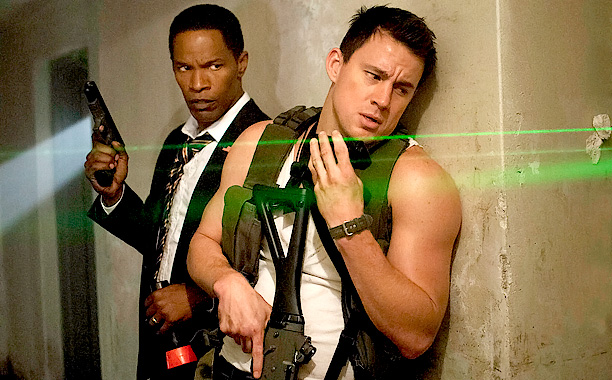
Now here’s a movie that would give President Obama a heart attack.  White House Down, much like a film released earlier this film called Olympus Has Fallen are both about the same thing.  The white house is under attack by a group of professional terrorists, the president is in danger, and our brawn yet brave hero must step in to save him.  All you need is a ripped shirt, a clean-shaven face, and a lot of guns on this guy (not just automatic) and you’re all set.

Unfortunately, that’s all the information I can give you.  This movie is so thinly written that that’s the deepest I can go without giving any spoilers.  The only other information I can provide that could give you any clue on to what this movie is like is that the brawn, brutish hero is played by Channing Tatum,  the president is played by Jamie Foxx, and Tatum owns a daughter portrayed by the sweet and talented Joey King.

I’m going to get this out of the way: Channing Tatum should never play the lead in any movie ever.  He cannot act.  There is no sincerity in his voice, no fluid movement of his body, no expression on his face to show he’s feeling anything except for when he’s shooting at something.  The fullest his acting capability reaches in the movie is the eyedrops you see in his cornea when he’s “crying” for his daughter. I’m not even kidding.  His acting is so terrible, the only use Tatum is in the movie is to provide meat for the female viewers in the audience.

(And I will admit my jealousy here: I will never look as good as Channing Tatum does.  I don’t think its possible for any man to).

Where was I again?  Ah yes, Tatum’s acting.  As always he is a stiff, awkward, and uncomfortable actor, a perfect reason why he should never be the lead character in a movie.  Admittedly though, the dialogue isn’t helping him much.  His best lines in the movie involve something like: “You have to go out there and be President”, or “If this guy keeps making those sounds, I’m going to start looking at him.”

If the above description makes this movie sound appealing to you, you should see it.  White House Down is a big case of what-you-see-is-what-you-get: a movie filled to the brim with excessive action, big explosions, cheesy dialogue, and mediocre acting, with the minor exception of Jamie Foxx, who has the most patriotic and humorous dialogue out of any other character in the movie.  In one scene, he’s reciting the history of America so beautifully to his secretary of defense over the phone that one could mistaken him as a Lincoln who underwent skin surgery.  In another scene, he’s following Tatum up an elevator shaft to evade capture when this exchange happens between them:

Foxx: What you do, I do.

(Channing Tatum ninja moves across elevator).

Foxx: I ain’t doing that.

Foxx’s character was the most appealing, the most intelligent, and the most charismatic character out of the entire movie.  Everyone other character was overly charismatic and grossly unrealistic.  One radical baddie is so stereotypical and so overpumped with tattoos, facial hair, ego, and steroids that I expected him to rip off his skin and reveal that he’s the Terminator.  A tour guide portrayed by Nicholas Wright is more worried about fine china and precious artifacts than he is about his own life and well being.  Tatum’s daughter, however, is probably the most frustrating.  She comes off as annoying, careless, and extremely absent-minded in this film.  You might say this is because she’s a child, but tell me something: how realistic is it that a teenage girl like this is smart enough to run her own youtube channel and know more about the white house than the tour guide, and yet, she doesn’t know when to stay in the bathroom or to leave a building when its going to blow up?

I remember an argument I had with a friend of mine in my first year of college.  He was an experienced videographer who understood more about the film industry than any of the professors did in that department.  We were arguing about the differences between film and art, and he told me a direct yet simple statement:

“Film is not an art” he argued.  “Film is a business.”

While I desperately want to prove him wrong through films such as Inception, Life Of Pi and Beasts Of The Southern Wild, it is movies like White House Down that remind me that the industry does in fact exist and operate like a business intended for profit.  At least Roland Emmerich didn’t release this film in 3-D: that wouldn’t have helped my side of the argument one bit.

Tagged , , , , , , , , , , , , , , , , , , , , ,

“SNOW WHITE AND THE HUNTSMAN” Review (✫✫✫)

And thank you, Thor, for keeping up appearances.

Take a deep breath and say it with me: Snow White And The Huntsman.  Doesn’t sound very promising, does it?  Like most fantasy films, Snow White And The Huntsman seemed set up for failure.  It’s centered around a very popular character portrayed by Bella Swan, the film is based around a fairy tale known universally in every person’s mind, and it seemed tempted to fall for a formula and let down its audience.  Believe me, that was the movie I was expecting when I went into the theater.  The movie, however, is much better than the title suggests.

Based on the famous original fairy tale by brothers Grimm, Snow White And The Huntsmanfollows the story of Snow White (Kirsten Stewart), a kind and beautiful princess of the land Tabor who would one day inherit the kingdom and the throne from her father King Magnus (Noah Huntley).  Before she was born, the narrator tells us that her mother pricked her fingers on a rose outside of her castle, with three drops of blood staining the snow.  Her mother told herself that she wanted a daughter as white as the snow, lips as red as the blood, and a spirit as strong and defiant as the rose she prickled.

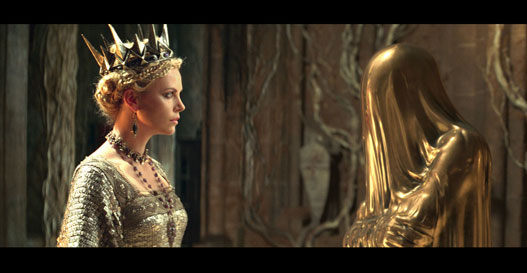
This opening sequence was both fascinating and revealing, a deeper introspect into Snow White’s history that I don’t believe has been visited before.  Her mother eventually died giving birth to Snow White, and so King Magnus marries a strikingly beautiful woman named Ravenna (Charlize Theron), whom he rescued from a dark army made out of glass soldiers that tried to invade his kingdom.  Magnus is so stricken by Ravenna’s beauty, in fact, that she becomes his queen in less than two days.

You already know where this is going, don’t you?  Ravenna is, in fact, the dark and conniving witch leader of the dark army.  After killing Magnus in his bed, she takes Snow White, forces her into the upstairs dungeon, and seizes power over the kingdom as the newly appointed Queen of Tabor.

Years past, and the kingdom of Tabor falls into desolation and poverty.  Snow White has now become of age to become the new queen of Tabor, and has been blessed with the gift of kindness that will ultimately dethrone Ravenna from the throne.  Snow White eventually escapes from the dungeon, flees from Ravenna, and escapes into the dark forest, a place where people slowly lose their sanity and, in time, their life.

Raevenna cannot go to this place to kill Snow White, so she hires somebody who can: a huntsman by the name of Eric (Chris Hemsworth), a man who lost his wife to death’s hand long ago.  Nothing could convince this angry, tired old drunk to take this job willingly, but he takes the job nonetheless in the hopes of that the evil witch can revive his dead wife with her dark powers.  And so the adventures of Snow White and the Huntsman begin.

The biggest thing Snow White And The Huntsman has going for it is two things: its visuals and its handling of the premise, in that exact order.  Rubert Sanders, who is making his director debut through this picture, is very smart and very careful with his visuals, using very precise and expertly-detailed CGI in things like the Magic Mirror or in the dark army made out of glass.  But it isn’t just the visuals that makes the picture what it is: Sanders is smart enough to make the visuals mean something, and just like the camera he’s using to record the picture, the visuals are a tool he uses to tell a story and to instill some deeper meaning in the audience.

Take, for example, how Sanders uses the color of white in the picture.  The color itself only appears three times in the picture: once where Snow White rides and abandons a white horse on the beach, another time where she encounters and caresses a magnificent and beautiful white stag, and the last one being where she dies and is resurrected while being in a white funeral dress.  Go back and look at the pictures again and try to look at it through a more symbolic scope.  I promise you, if you see the picture as I do, you will see a princess abandoning her kingdom, returning to her kingdom, and finally, becoming the queen and leader that the kingdom deserves.

To find such complexion in a picture as this was both shocking and surprising, and the cast delivers just as much as the visuals do. Charlize Theron was menacing, evil, and conniving as the dark witch, and gives a stellar performance that would have had the animated version relieving in her pants.  Stewart, shockingly, is very grounded in her take as Snow White, and embodies everything her mother says she has: strength, beauty, courage, kindness, and heart, and this especially shows in the last half hour of the picture.  Hemsworth was equally as emotional and convincing as the huntsman named Eric, although there are a few brief moments where he breaks character and acts more like Thor from The Avengers.

There was another Snow White movie released earlier this year called Mirror Mirror, and it starred the lovely Lily Collins and Julia Roberts in roles opposite Stewart and Theron.  That movie was too silly and immature for its own good.  Here, we have the opposite problem: this film is dreary, dark, sullen, and bleak, a movie that for the first half of its runtime, fills us with dread, angst,  and sorrow.  Starkly different tone from the whimsical, uplifting veins of the original Disney classic don’t you think?  Whatever happened to Doc, Grumpy, Happy, Sleepy, Bashful, Sneezy, and Dopey?

Still, its a good movie.  When there is color in the picture, it reaches out to you in striking detail, the cast is extremely strong, and the visuals and the camera angles combine to make a very provocative picture and a very sharp visual experience.  All you need left is Mjolnir and the rest of the Avengers, and you’ll be all set.

Tagged , , , , , , , , , , , , , , , , , , , , , ,

“THE LAST STAND” Review (✫✫)

Stuff blowin’ up real good in Redneck City. 

The Last Stand is an actioneer’s action movie, a film so overstuffed with explosions, gunshots, profanity and testosterone that it might have been more appropriate as a video game rather than a movie. I had a friend of mine describe the movie as being “The guyest guy guy movie you’re ever going to see”. That much is true. Whether its the best one, or even a good one, is up to you.

Sheriff Ray Owens (Arnold Schwarzeneggar) has been the sheriff of Summertown for many years now after having quit his profession of being a cop in Los Angeles.  Summertown is a quiet place, a small town where crimes range from the Mayor parking his car in a fire lane to deputies firing at slabs of meat during lunch time.  In a small, quiet town such as this, Ray finds little excitement in his day to day routines and he is perfectly fine with that.

But one day, he receives unwelcome news from the FBI: a nation-wide criminal named Gabriel Cortez (Eduardo Noriega) escaped from the FBI’s hands and is fast on his way to the Mexican border, where he will be out of the FBI’s reach.  The only thing blocking his path: Summertown, which also sits on the United States border to Mexico.  Owens now has to rise up to the challenge to defend his home.  To defend its citizens.  This is the last stand.

This is Arnold’s first lead role after his 10 year hiatus as California’s governor.  Before that hiatus, Arnold was a standout in a slew of memorable action roles, including (but not limited to) Predator, Total Recall, True Lies, Last Action Hero, and my personal favorite, The Terminator and its sequel.  All of those movies are memorable, exciting, suspenseful, and sport great blockbuster entertainment.

Now look at The Last Stand.  This movie cannot help but look shoddy compared to those titles because of its plot, its only inconsistently funny and exciting, and whats worse, it depends on the forumula of repetitive action.  Wonderful.  We certainly don’t get enough of those, now do we?

Let’s take a deeper look at Arnold real quick.  The man has had a great career.  Before going into office, he was asked to be in these tense, highly riveting action roles, and he was damn good in all of them.  Now, he’s been dilluted to just standing tall and read lines as everyone else turns to him asking what to do when a drug cartel is ready to tear through his town.  Guys, come on.  This is the 42nd governor of California, not Angus MacGyver.

The rest of the characters aren’t really that helpful or compelling.  Zach Gilford portrays Officer Jerry, a guy who wants to see more action than he does but then gets his nose broke by the recoil of a gun.  Luis Guzman plays as a chubby mexican officer, and he’s so stereotypical he might as well have been portrayed by Anthony Anderson.  Rodrigo Santoro and Jaimie Alexander share a forced romantic conflict in the middle of all the bullets and gunfire, and while they’re coincidentally dodging all of the bullets amist their kissing, all I could think to myself was “Hey kids!  Find a shower!”

The worst miscalculation, however, is in the film’s villains: Eduardo Noriega as Gabriel Cortez and Rodrigo Santoro as his goatee, ponytail lackey.   Noriega is worthless as the main villain, and is just stuck to driving a car recklessly for more than two-thirds of the movie until the last 20 minutes where the climax calls for a chase scene.  But even worse is his lackey, who seems completely lacking basic motivation of reasoning behind his actions.

Take a look at the only three things he does in the movie: kill a farmer, build a bridge over to Mexico, and strike a raid across Arnold’s town.  Explain to me A) Why he killed the farmer and clued the detectives into his plan, considering the construction of the bridge was nowhere near the farmland, B) How the bridge to Mexico only took around 24 hours to complete, C) Why waste resources building a bridge when he can just bring in a helicopter for the escape, and D) What is the relevance for attacking the town when it means nothing toward Cortez’s escape?  His actions seem senseless, almost like his decisions are delegated by the script just for the sake of action sequences and explosions.  Why must an action film like this seem so mindless, so pointless in its structure and so artificial in its writing?

The film’s most entertaining character is a man named Lewis Dinkam, portrayed by Jackass star Johnny Knoxville.  Highlight, embolden, and underline Jackass.  This guy is the opitimy of stupid, most of it portrayed humorously so.  This guy is an absolute psycho, shooting off pistols and machine guns named “Betty” and “Nazi Killer” with his pajamas on and tearing off electric polls by climbing them and chainsawing the electric wire.  Is he the smartest character in the bunch?  No, but he is the funniest, although I don’t understand why he’s wearing a woolly hat in the middle of the summer.

Ultimately, I’m at a loss with The Last Stand.  There’s no doubt entertainment value here, but it is severrely misguided, almost like a misfired Colt.  Half of the film is used to just set up its premise with predictable scripting and bad acting, while the other half is used for repetitive and monotonous action, gunshots, and F-bombs.

“But David”, one fellow viewer pointed to me, “That’s entertainment!  People need entertainment because real life sucks!”  This is true that people need entertainment, and The Last Stand will satisfy some viewers.  For others however, they will be left yearning for a better story, more original action, and a more worthwhile experience.  In the meantime, what you see is what you get: if its action you want, boy oh boy, it action what you’re going to get.

Tagged , , , , , , , , , , , , , , , , , ,

DC Versus Marvel: Why “The Justice League” Will Not Be As Successful As “The Avengers”

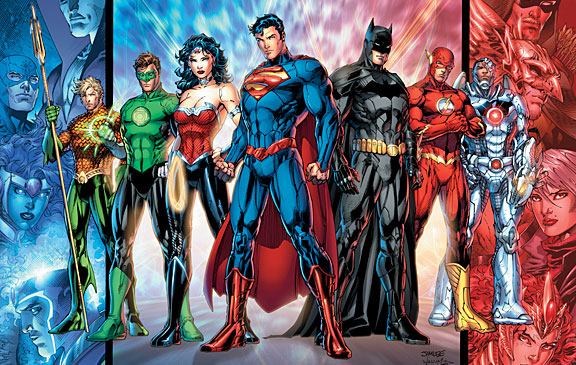
Well, this’ll ruin your morning coffee.  Due to recent developments, I am now convinced that no matter what DC does, that the much-speculated Justice League movie will not be as unique or outstanding as Joss Whedon’s The Avengers was, is, and always will be.  Why all the pessimism?  Call it intuition.  Before The Avengers cinematic universe was conceived, Marvel had a wider grasp of successful projects to boast of, including (but not limited to) SpidermanX-menBladeWolverine, Kick-Ass, and Men In Black.  DC, in comparison, only has SupermanBatman, and arguably RED and Watchmen as their most successful properties.  Also, I have an unhealthy amount of OCD.  Just thought you should know.

Believe me, I would like nothing more than to see a well-made Justice League movie hit the horizon.  There are as many characters that are as creative and dynamic in the DC universe as there are in the Marvel universe, many of them with memorable stories and villains of their own.  While I want to see a movie eventually, I now believe it will not happen, and if it does, it will not hit the mainstream success that The Avengers did.

Why am I so convinced of this?  DC has every inconvenience against them, and they have to deal with issues Marvel never had to face while producing The Avengers.  I’m not saying Marvel had it easy while making The Avengers.  Lord knows you’ll have a fair amount of doubt and backlash when you try to combine five comic-book properties into one high-adrelanine, action-packed adventure.  Regardless, DC is facing a lot of issues Marvel didn’t have to worry about, including competitive release with The Avengers in itself.

Let’s face facts: When The Avengers was released, we didn’t know what to expect.  All we knew was that it was incorporating six superheroes into one movie, they would be mostly featuring the same actors, the writer/director of “Firefly” was at the helm, and we were hoping it wouldn’t turn into the Saturday Morning Power Hour.  It didn’t, and now we have the exciting, exhilerating, witty, and entertaining Hulk-box-office-smash that The Avengers was.

This is the biggest issue that DC has over Marvel: the comparison game.  If DC would have thought of a plan similar to this ahead of Marvel and released Justice League incorporating elements from multiple DC universe movie properties at once, they would then have had a substantial edge over Marvel and would give them reason to compete for their box office revenue.  But the plain simple fact is that Marvel beat them to it, and now we have something to compare to when Justice League hits the theaters.  How big of a catastrophe is that?  What could possibly compete with The Avengers as far as box-office superheroes go?  I’ll name a few just for facetious effort: X-menFantastic Four, and Watchmen.  Now be honest with yourself: do any of those movies stand out in your mind at the level of enjoyment as The Avengers does?

If you’re being honest, it probably doesn’t, and what’s worse is that DC is now pressured into that because Marvel did it first.  But like I said, DC has a lot of issues against them, and many of them have to deal with their very own properties.  Take the following franchises as an example:

THE DARK KNIGHT TRILOGY

If we were talking about the movies by themselves, there’s no reason for concern.  The Dark Knight trilogy is among the greatest trilogies ever released into theaters, and it not only pleased long-time fans of the caped crusader: it pleased moviegoers who were not associated with the comic books.  The Dark Knighttrilogy isn’t only one of the best comic book movies of all time: they one of the best movies of all time, period.  Very few bad things are said about that franchise as a whole.

Which would enhance excitement to the fans when they think this same character will be incorporated into the Justice League, right?  Wrong.  Producer/Director Christopher Nolan and screenwriter David S. Goyer have stated multiple times that the Batman in the new Justice League is not associated with Nolan’s trilogy.  The quote from Goyer pulled from IGN says it all:

“…Zack has said that Bruce Wayne exists in this universe. It would be a different Bruce Wayne from Chris’ [Nolan] Dark Knight trilogy, and it would be disingenuous to say that Zack and I haven’t had various conversations on set, around ‘what if’ and ‘moving forward'”.  

On top of that, Christian Bale himself admitted to Entertainment Weekly that not only will he not be portraying Batman in the upcoming DC team-up film: he doesn’t even know about a release date.

“I have no information, no knowledge about anything. I’ve literally not had a conversation with a living soul. I understand that they may be making a Justice League movie, that’s it”.  

So what is their plan?  End a movie series in 2012, release a Superman movie in 2013, and reboot the character only a few years later?  Don’t they remember how many people saw those movies?  How much people praised them?  How those movies stuck out in people’s minds when someone mentioned the word “Batman”?  What are they thinking?  How on Earth do they think can they replace that?

Now, someone could offer the argument by saying Nolan’s universe was meant to be seen as realistic, whereas the rest of the DC universe wouldn’t be.  To which I respond that as hogwash.  Snyder also saidMan Of Steel was meant to be seen as realistic too, but we all know how realistic it is for an alien from outer space to get super powers on earth, or having a guy dress up in a halloween costume to beat criminals to near death.  The thought of superheroes in itself is fictitious, with powers or without.  So why are we trying so hard to differentiate in between reality and fiction?

Another possible argument someone could make is that The Dark Knight trilogy has ended, and there would be no way to revive the character for the Justice League.  To which I would say you are half right.  If we are talking about the Batman after The Dark Knight Rises then yes, that Batman is no more with us. But what about the Batman in between movies?  There is a two-year split in between Batman Begins andThe Dark Knight, and a five-year split in between The Dark Knight and The Dark Knight Rises.  Surely, someone could find room to fit Nolan’s Batman into the JL somewhere in that time stamp?

So, already you have your greatest property and you’re sending it out the window.  That’s great.  What else could go wrong?

MAN OF STEEL

I’m just going to go ahead and say this: Man Of Steel was a great film.  It had depth, it had character, it had development, and it had plenty of high-octane turbulent action.  It was a great reboot for Superman, and it was a great jump-off point for a possible Justice League series.  That much I will give to Snyder and his crew.

The complications with the Justice League universe, however, are plenty.  The biggest issue right now is their speculated release dates.  As many of you might expect, Warner Bros. has been trying to push for the Justice League movie to be released in 2016, to be released competitively with The Avengers 2 andStar Wars: Episode VII.  The original plan was to release Man Of Steel this year, release a possible sequel in 2014-2015, and then release the Justice League movie

That puts a great amount of pressure on Man Of Steel, and I don’t think it can handle it.  Again, not to play the comparison game with Marvel (even though I am), but like Man Of SteelIron Man was a great jump-off point for The Avengers, even though it was more charismatic and down-to-earth than Man Of Steel was.  It was a great film.  Great enough to jump right into The Avengers though?  Absolutely not.  It had to release four more movies before the buildup to the Avengers was complete and the excitement was at its highest.

Like Iron ManMan Of Steel is a great film to set up its expanded Universe.  Enough to jump right into aJustice League movie though?  Not even close.  Another sequel, maybe, but to jump right into the DC-team-up film would be suicide.  The announcement of a JL movie that this point wouldn’t be an anticipation: it would be a surprise.  How is that a good setup for a box-office smash?

Also, many other audience members felt the tone was too serious and did not fit into the joyous, silly veins of the original Christopher Reeve series.  To which I would say quit being a stooge and enjoy the movie for what it is.  People who wanted Green Lantern to be fun and silly got what they asked for, and look at how that movie faired with the moviegoing audiences.

Speaking of which…

GREEN LANTERN

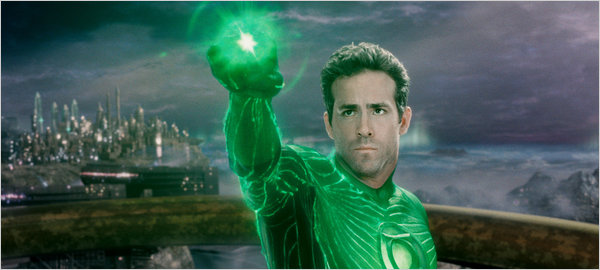
Many people hated this movie, and their hate was warranted.  Green Lantern was silly, stupid fun, and that’s all it needed to be.  I for one enjoyed the movie and appreciated it for its confidence, its stellar visual effects, and its smirking charisma.  Others, however, obviously do not share my opinion, and ultimately their opinion as a whole matters more than mine does.

To which I know disregard and ask this: what are you going to do with him now for the Justice League?  They can’t bring this same character in and have him do the same thing he did the first time: that will resurrect everything audiences hated the first time they watched the Martin Campbell film.  What are they going to do then?  Are they going to revamp him?  Recast him?  Reboot him?  Maybe even cut him out entirely?  Batman has a great story behind his success and Superman a great following.  Green Lantern has none of that.  So what can DC do to the character to give him a new spin and a spirit on the franchise?

The list of issues goes on and on.  How are they going to incorporate Wonder Woman into it?  What about the Flash?  Martian Manhunter?  Who would they cast?  Who would be the villain?  And how on Earth are they going to make Aquaman not look stupid???  

Bottom line: Justice League will not be as good as The Avengers.  DC just isn’t prepared for it.  There is the off-chance that it can still be good, exciting, and entertaining blockbuster fun, but I’m convinced that there’s no way that DC can give these characters the same treatment Whedon did for The Avengers solely because they won’t be as recognized as those characters have.  Even if you do give each Justice Leaguer his own movie and give time to set up each character: how do you know you’ll be as successful as The Avengers was?  Won’t you be following a formula at that point?

Of course, there is the off-chance that I’m completely wrong and that the Justice League will be vastly more successful than The Avengers will be.  I’m going to see it regardless of what RottenTomatoes says, and I hope it’ll at least be as good as Man Of Steel is.  But that’s unlikely, and no matter how it turns out, lets just be grateful that Robert Schwentke won’t be directing, writing, or having anything to do with the movie.  The last thing we need is a PG-13 version of RED.

Oh, wait a minute.

Source: EMPIRE, Entertainment Weekly, IGN
Tagged , , , , , , , , , , , , , , , , , , , , , , , , , , , , , , , , , , , , ,

“STAR TREK” (2009) Review (✫✫✫✫)

To go where no Trekkie has gone before.  

When I first heard about J.J. Abrams rebooting the Star Trek series with another movie outing, my immediate reaction was rolling my eyes.  “Not ANOTHER Star Trek movie!” I remember thinking.  Indeed, wasn’t that everybody’s reaction?  Star Trek lived and had its time, and it seemed like the only people who would enjoy this new release were the Trekkies that were faithful to the series since episode one.

Nothing, however, would have prepared me for how immersive and fantastic this new movie is.  It’s more than just another Star Trek movie: its a science-fiction epic.  It’s an energetic and revamped take on a series that severely needed a new direction.  The story is original, the characters are fresh, and the vision is as bold and fearless as it possibly can be. Its success doesn’t just rely on CGI and visual effects (although believe me, it doesn’t fail in either category).  It’s one of those rare treasures where the characters and their dialogue is more appealing than the action scenes we have to go through every twenty minutes.

The plot originated from an idea that was had way back in 1968.  Back when the series was first spawning its popularity, original creator Gene Rodenberry started early writing for a prequel to his own science-fiction series.  But just like superhero movies Watchmen and Sam Rami’s Spider-man, it was stuck in development hell until finally creative writing team Roberto Orci and Alex Kurtzman were hired to write the script for the new mysterious Star Trek prequel.

This was a smart move.  They are the same writers behind movies as successful as Mission Impossible III, Transformers, and Eagle Eye, and their proficiency as writers shines here more than ever.  They compose a story as brilliant as it is exciting, a plot that is as action-packed, captivating, explosive, humorous, and in-cheek as possibly can be.  They do more than just adapt this universe: they pay tribute to it.  They pay homage to the classic series, pulling inspiration and ideas from all corners of the galaxy in the Star Trek universe.  We can tell this through tidbits of plot and dialogue that Orci and Kurtzman insert throughout the movie that reveal intimate details of the Star Trek universe we might not have known before, such as how Kirk came to become enrolled in Star Fleet, the origins of Spock, or how James McCoy got his famous nickname “Bones”.

This isn’t just another action film where the characters are just shoved aside for the action and explosions: Orci and Kurtzman are just as careful with developing character and dialogue as they are story.

Still though, if we have Orci and Kurtzman to thank for the vision, we have director J.J. Abrams to thank for the realization of it.  To date, this is only his second time in the director’s chair (his first being Mission Impossible III), but his skills as a filmmaker shine here of blockbuster-esque proportions.  Every minute of this film is fueled by both ambition and excitement, with every minute being tense, exciting, funny, exhilerating, and action-packed all at once.  Nothing is ever dull or boring or repetitious in this film: every second is filled with character appeal and visual spectacle that hasn’t been matched since George Lucas’ Star Wars series, or recently James Cameron’s Avatar.  I cannot recall a single moment in the film where I was bored or irritated.

If we’re talking about science-fiction epics, it flat out doesn’t get much better than this.  Star Trek is a great movie for many reasons, both obvious and not obvious.  The obvious reasons would involve its visual effects, make-up, and art direction.  The film is obviously visually ambitious, and like the U.S.S. Enterprise, transports you to many worlds of visual color, dazzle, fantasy, and wonder that is ever-present in the constantly-changing genre of sci-fi.  Another obvious reason would probably involve the performances: Chris Pine and Zachary Quinto do a great job at portraying the next-generation versions of James Kirk and Spock, and their chemistry with each other reflects their rivalrous spirit with both great tension and comedy.  Eric Bana also, deserves great props as the lead antagonist.  He portrays a villain so passionate and deadly that I pray the Wrath of Khan would never have to face him.

But those reasons makes the movie succeed: what makes the movie thrive are the unexpected reasons.  And those reasons are writers Orci and Kurtzman and director J.J. Abrams.  I’m not saying their careers don’t precede them: I’ve enjoyed Mission Impossible III and Eagle Eye, and I absolutely love the first Transformers movie (although the second one made me want to gouge my eyes out with a toothpick).

But the caliber of this work goes far beyond what was expected for them.  It’s typical to expect a good product from a good team: it’s rare to see exceptional work of this caliber from that exact same team.

Take this from a guy who isn’t a Trekkie.  I’ve seen a few episodes of “Star Trek” in the past, but I never became interested enough to follow the series as a direct fan.  Watching this movie makes me wonder what I might have been missing out on.

Tagged , , , , , , , , , , , , , , , , , , , ,