Tag Archives: Adventure

“21 JUMP STREET” Review (✫1/2)

Two 30-year old cops pretending to be in high school.

21 Jump Street is a film that pretends to be a parody on action-comedies and instead collapses under its own pretension. It’s a silly, stupid, obnoxious film, a movie that feels like a kid poking a wet willy into your ear and refusing to stop because you’re laughing inexplicably for some reason. Is it possible to feel this annoyed, or for that matter, this violated? Apparently so. This is a movie that is okay with constant profanity, blatant stereotypes and unfunny penis jokes to the point where it feels like these cops are pretending to be in elementary rather than high school.

As much as they’d like to make you believe, 21 Jump Street is not an expansion of the original television show it was based on. This movie follows an entirely new duo, this one much more clumsier and haphazard than the Johnny Depp-Peter DeLuise relationship in the original show. Morton Schmidt (Jonah Hill) and Greg Jenko (Channing Tatum) are a dysfunctional pair of police officers that can’t shoot a gun or recite the miranda rights worth a damn. Schmidt plays the fat kid stereotype who can barely do a leg lift in the morning while Jenko is the strong-but-stupid stereotype that looks at answer choices on a test like they’re written in Chinese. Together, this lopsided duo plans to pursue a life of stopping crime as police officers. Little did they know that they’re starting duties included patrolling the town park, honking their horns and yelling at kids to not feed the ducks in the pond. Hey, you’ve got to start somewhere, right?

Well believe it or not, they mess even that up too. When arresting a gangster for cocaine possession, the gangster is eventually let go because he was not read his miranda rights. The duo is since transferred to this secret operation of undercover police work, located at a nice little chapel addressed at 21 Jump Street.

Sounds like a nice revisitation of the good old days with Johnny Depp, right? No. It isn’t. Whatever you hear about 21 Jump Street please hear this: that this is a complete deviation from the source material, and has been meat-processed through the unfortunate action-comedy formula into another recycled blockbuster.

Oh boy, where do I begin. First of all, let me start by looking at the most important part of the film: it’s leads. Hill and Tatum both served as executive producers for the film while Hill himself holds a story credit to the film. You would expect that, considering both of them have acted in comedies before this, that they would understand that most important element in comedies it the characters. With these two portrayals, they’re okay, but they’re only as good as their stereotypes will let them be. Jonah Hill is sheepish and clumsy while Channing Tatum is moody and stupid, and their characters don’t get much more expressive, or memorable, than that.

Oh no, they don’t go into an inch of smart or sincere territory, and their silly, childish interactions prove it. In one scene, Channing Tatum was whacking and tea-bagging Jonah Hill while he’s on the bed talking to a girl on the phone. In another, they’re fighting in the middle of a stage production while Hill is attached to a harness and Tatum is throwing plastic rocks and trees at him. Watching this duo makes me miss the smartly ironic and genuine chemistry that was shared in between comedic greats such as Jack Lemmon and Walter Mathau in Grumpy Old Men, or Steve Martin and John Candy in Plains, Trains and Automobiles. That’s better than the hopelessly slapstick mess we have here, at least.

There is another issue we have at stake here: that this is not an adaptation, doing more disservice to itself by linking it to the source material that it was inspired by in the first place. The original television show was a crime drama about a group of teenagers trying to prove themselves as cops and as heroes. The movie is an action-comedy that deconstructs that idea and makes fun of it before killing it off at the start of the film’s climax, though I won’t say exactly how. All I will say is that fans of the show will be extremely disappointed by this new outing, and even if they won’t be, they’re going to have to let go an important part of the show in order to enjoy this new one.

None of that is really important though. The actors, the faithfulness, nothing. The most important question is this: did it make me laugh?

Kind of. Most of the time my face was as plain as a checker board, erroneously letting the stupidity and immaturity of the film rub off of me as I continued to tolerate its runtime. There were a few fun, clever moments in the film, but seeing them was as rare as Jenko getting a C on his chemistry exam.

I will also admit that I’m not much into raunchy humor, but why would I be? It’s cliche and cheap. It’s plastic, mundane and annoying, butting its head in the way of genuine, clever humor birthed by dialogue and satire, rather than the jumbled action and sex jokes we have to deal with in this movie. Plus, when your best joke involves a police officer shooting off a guy’s penis, and then watching him grab it with his mouth trying to reattach it, I think there’s something seriously wrong with this films humor.

I do predict that this movie will fare well with audiences though. Why? Because this is what people want, that’s why. When I ask for John Hughes, I get Adam Sandler. When I cry for Ridley Scott, I get Paul W.S. Anderson. When I praise Inception, I log onto box office mojo to discover that Transformers: Revenge of The Fallen grossed ten million more than it.

The more I think about this movie, the more frustrated I become. This movie has little to no redeeming factors, the phrase “it was fun” being its only flimsy crutch. There will be no doubt people who will defend it, and these are the people who also enjoy raunchy sex jokes, Channing Tatum’s mug and Jonah Hill’s clumsy failings. When other action comedies exist out there such as Scott Pilgrim and Zombieland, why on earth would I waste my time seeing this? If 21 Jump Street was supposed to assault me as much as it did, I wasn’t read my miranda rights.

Tagged , , , , , , , , , , , , , , , , , , , , , , , , , , ,

“X-MEN: DAYS OF FUTURE PAST” Review (✫✫✫✫)

The next stage in superhero cinema evolution. 

X-men: Days of Future Past ranks among the best superhero sequels I’ve ever seen, one I would instantly compare to that of Spider-man 2 or The Dark Knight. There were so many things that needed to be done, so many risks that needed to be taken, and so many ways this movie could have failed. It didn’t. From the opening sequence to its last breathtaking moment, my mind was blown and the comic-book nerd in me was absolutely filled with joy. The movie did more than simply expand the franchise: it redefined it.

We open on a post-apocalyptic future that hasn’t been this catastrophic since James Cameron’s 1984 film The Terminator. Years after X-men: The Last Stand took place, humans are now being hunted by the same weapons they created in the first place: the Sentinels, a coalition of dangerously armed robots who can track and exterminate any mutant they can find on planet earth. Amongst the ruins of battered buildings and fallen icons, the human race has now been collected into a sort of concentration camps: all that’s left for the mutants then is the mass graves filled with the dead bodies of their kin.

Lifelong frenemies Charles Xavier (Patrick Stewart) and Magneto (Ian McKellan) collaborate on a plan they would like to enact. Besides having the ability to phase through walls and objects, Kitty Pryde (Ellen Page) has recently developed the ability to transfer someone’s consciousness into their younger bodies in the past, allowing them to change the future and avoid the unfortunate outcomes that might become of them. Kitty has been able to use this ability on multiple occasions now to save her friends, but now Professor X and Magneto want to go back into the past (1970, to be exact) to prevent the event that triggered this horrifying future and save human and mutantkind as they know it.

Problem is, Kitty can only send someone back a few days or weeks at a time. Any further than that and she risks tearing apart the mind of the person she’s sending back to the point beyond repair. Luckily, Wolverine (played by Hugh Jackman, who else?) has the ability to heal himself at a faster rate. So Professor X and Magneto decide to send Wolverine back into the past to coerce their younger selves (portrayed by James McAvoy and Michael Fassbender, respectively) to stop the triggering event and save the future.

Serving as a sequel to both X-men: First Class and X-men: The Last Stand, and incorporating characters and actors from both translations, X-men: Days of Future Past is, in a word, a game changer. It brings in all of its key players, from the original cast members and its most revered director Bryan Singer, to the newcomers who’ve newly defined their roles, including McAvoy as Xavier and Fassbender as Magneto. Everyone meshes so perfectly with each other, especially Jackman once again, who essentially has to react to characters from two different time zones. There hasn’t been a cast this big since Joss Whedon’s The Avengers, and I’m tempted to say the movie is better because of it.

Do I really want to stand here though, and compare Days of Future Past to that of The Avengers? Yes I do. The Avengers was a bold, brave step forward in comic book evolution, combining characters from five different movies to make a superhero epic that hadn’t been tried before. Days of Future Past follows that same model, bringing in characters from six of its movies, but the end result is vastly different. There’s a much deeper plot going on here, a vastly intelligent and contemplative story that elaborates on its recurring themes of racism and, once again, bringing in the consequences of discrimination to the forefront. I loved X2 for this very reason, for it being more than just a comic book movie and focusing itself more as a political thriller with comic book elements thrown into the mix. This movie is that to, like, the tenth power.

Oh yes, this movie will fill comic fans with glee everywhere. Similar to the small little easter eggs that can be picked up in other Marvel movies (Note: The Doctor Strange reference in The Winter Soldier), this movie too has sweet little moments that comic fans can pluck from the ground and take a moment and appreciate the aroma. My favorite had to be a moment where a mutant named Peter (Evan Peters), who can run at supersonic speeds, rests in an elevator with the younger Magneto as he’s helping him escape from prison, and makes a comment about his long-lost father. That’s just the tip of the Bobby Drake-iceberg. There’s so many moments I can pull from that filled me with joy and happiness, while others filled me with dread and angst. The film orchestrates its emotions wonderfully, and in every fabric of the film I felt what I was supposed to feel.

I’m going to go out on a limb and say this is the best X-men movie in the series so far. Bold claim, I know, but it deserves it. From its first moment to its last, Days of Future Past is completely, utterly, fascinatingly mind-blowing and involving. From its quietly hinted-at themes of xenophobia and extermination to its climactic action scenes where we don’t see how on earth our heroes can win, Days of Future Past combines the best parts of all of the movies and makes itself the best entry out of them. Many audiences have recently been experiencing superhero movie fatigue, with movies such as Man of Steel and The Amazing Spider-man 2 recently being met with mixed reaction amongst audiences and in the box office. Days of Future Past is one of those movies that restores your faith in the genre.

Tagged , , , , , , , , , , , , , , , , , , , , , , , , , , , , , , , , , , , , , , , , , , , , , , , , , , , , ,

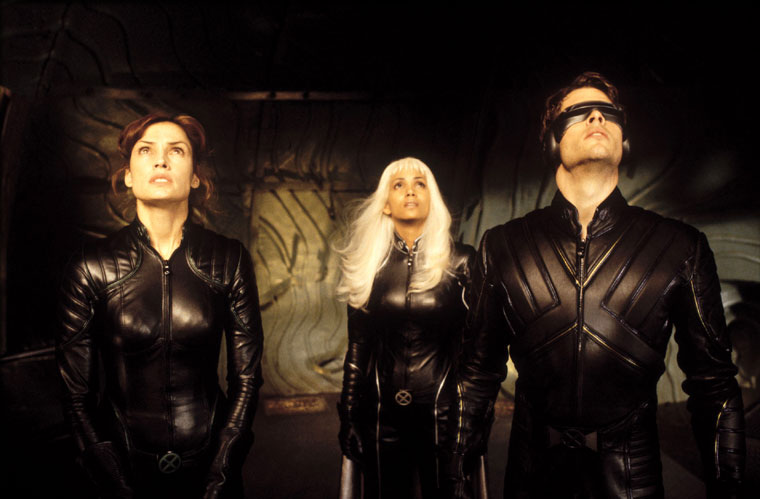
“X-MEN: THE LAST STAND” Review (✫✫✫)

How can you “cure” what was intended as a gift?

There’s an obvious danger with the production of second sequels made with planned trilogies: how do you keep things fresh and interesting and make sure none of the material isn’t stretched out or forced? For many trilogies, the third entry is the one filmmakers are usually least concerned about. Why should they be? They’ve already made their biggest impact with the first two films and people will go and see it anyway, so why should they extend any effort? I like to call this “the trilogy curse,” and it explains why so many second sequels end up letting down their entire franchise (*cough* Terminator 3 *cough*).

The best thing that can be said for X-men: The Last Stand is that it does a good job avoiding the trilogy curse. While some may be frustrated by the liberties it took and the deviations it made from the source material, I for one found it to be very liberating. It changes things up a bit, made things different, and did one huge thing that many comic book movies can’t do: it made it unpredictable. Because of this, the stakes were higher, the action was more involving, and it made you invest yourself more in the characters rather than waiting for everyone to hold hands in the end for that “happily ever after” ending many films get trapped into. X-men: The Last Stand accomplished something important: it proved that comic-book movies can deviate from their source material and still be good.

After saving both human and mutantkind at the shrouded site where Wolverine (Hugh Jackman) gained his metal claws and lost his memory many years ago, X-men: The Last Stand takes place as the X-men still try to cope with the death of their beloved Jean Grey (Famke Jannsen), who sacrificed herself to save her friends as she became engulfed by a sea of raging waters. Most affected by this is her boyfriend Scott “Cyclops” Summers (James Marsden), who can still hear her voice in his head as he sits in their bedroom reminiscing about her.

The X-men, however, have a much more pressing issue at hand: a company called Worthington Labs has recently invented a mutation antibody that basically attacks mutant cells and nullifies them. The public dubbed it as a “cure,” and it essentially turns mutants into regular human beings, forever granting themselves the life of normalcy they’ve so long desired. Of course, this new invention stirs up quite a controversy among the mutant community, especially regarding Magneto (Ian McKellan) and his extremist brotherhood of mutants. When mutants come to terms with this cure and what it means for all of them, they must make a decision of whether or not to fight against the cure, or fight for humanity’s survival at all.

The first out of the X-men series not to be directed by Bryan Singer, filmmaker Brett Ratner (The Rush Hour series) steps in to fill in the reigns of Singer’s mostly definitive first two installments. How does he do? Well, the good news is that he holds his own pretty well, and makes a movie that he can call all his own. Ratner poses an important question here that I think the other two films mostly sidesteps: if you have an unwanted gift, should you keep it? For me when I watched the movie, I saw an image deeper than that of a mutant standing in line to take a shot that would take away their powers. I saw a pregnant teenager waiting in line for an abortion for that baby that she never intended to have in the first place, or an image of a man going in for a gender change because he doesn’t feel comfortable in his current body.

Controversial? Yes, but that’s how the film intends for it to be. Much like its predecessors, The Last Stand handles its political side well, and is being more ambitious by taking a different spin from the standard supremacist/racism themes that they explored in the earlier installments.

The cast is good, but that’s standard at this point. We expect Jackman to be good as Wolverine. We expect Patrick Stewart and McKellan to be convincing as the leaders for their own specific causes. We expect Storm (Halle Berry) to be the strong female hero that she is, and we expect Iceman (Shawn Ashmore) to be the kind-hearted, considerate teenager while Rogue (Anna Paquin) remains the estranged and desperately shy mutant who continuously questions keeping her abilities. The one we should notice more than anyone else is Janssen as Jean Grey. Yes, she’s back, and she has a much more villainous spin on her that comic fans may or may not be happy to see. She’s much more versatile in this movie, bouncing brilliantly in between angry and hateful to scared and grief-stricken. Without giving too much away, I really liked her role in this movie as both a protagonist and antagonist, and I think X-men fans will be just as pleased with her performance as well.

The only thing I don’t like with this movie is its climax. The buildup earlier in the film was so much better, with the backstory of Jean Grey, Professor X and Magneto culminating so ingeniously into a plot where all the danger was real and there was no way to predict who lived and who died. Another great scene with excellent buildup was when Wolverine went searching for Jean, fighting a small group of mutants within the confusion of a lush, maze-like forest. The final fight, however, could not have been more standard and one-note if it tried. It plays out exactly as you would predict it to, dragging out into a disarray of violence and loud noises until finally it ends in explosions and agonizing screams. Enough already. The rest of the movie did a good job building up anticipation: did you really have to give in right before the end?

Still, I had fun with this movie. I know “fun” is a very loose term that can be used within the film community, especially when you’re speaking about a potential deal breaker such as this. Still, I’m going to say it: this movie was fun. Why am I saying that? Because I enjoyed it, that’s why. I genuinely liked it. I liked the big, boisterous action scenes orchestrated on a grander scale in which I don’t think would have been possible six years ago. I liked the darker, more thematic moments between characters where they took time to build up the stakes and what was on the line here. Mostly however, I liked how it humanized the mutants, and made them genuine flesh-and-blood human beings that could be killed and harmed. It didn’t immunize them from death because of their fans’ love for them: it made them mortal, and it presented a real, legitimate threat in the film because of that.

I know many people who are going to disagree with me, and that there will be many who love these characters too much to be able to see them get killed off and just be okay with it. Let me set the news down with you easily: if you’re that bothered by seeing a character’s death in a movie, maybe you shouldn’t be watching that movie in the first place. These filmmakers set out to make a convincing movie where the threat was imminent and real: not to please the comic-book die hard who gets frustrated if a comic book character’s hair isn’t the right color. Maybe that was Ratner’s second goal beyond making a good sequel, to see how many changes he could make before the fans starting writing death threats to his home mailbox.

Tagged , , , , , , , , , , , , , , , , , , , , , , , , , , , , , , , , , , , , , , , , , , ,

“X2” Review (✫✫✫1/2)

A social commentary disguised as an action blockbuster.

X2 is science-fiction brilliance, a sequel that is relentlessly exciting, smartly written, intelligently designed, and jam-packed with so many involving action scenes and stunning visual effects that it could potentially work as a stand-alone movie, rather than a direct sequel to its predecessor X-men. Like Lord of the Rings and Harry Potter, this movie serves as an expansion for the universe that it is in and as an opportunity to provide fan service to its dedicated readers and lovers of the iconic source material. I’m not very much for sequels, and I definitely don’t want this to become a superhero monopoly, but if we have to have sequels packaged with every superhero installment in the near future, more filmmakers should pull inspiration from X2.

X2 picks up just short of a few months after X-men originally left off. After the combined efforts of the X-men defeated Erik Lenshurr, a.k.a. “Magneto” (Ian McKellan), and imprisoned him within a special plastic cell (Countering his ability to manipulate metal), the X-men go about their (ab)normal lives as teachers at Xavier’s School for Gifted Youngsters, educating mutants on how to control their powers and not be afraid of who they are. Only Logan, a.k.a. Wolverine (Hugh Jackman) sets out to Canada to seek out answers for his long-forgotten past, and even then he comes up empty: the lab where he was supposedly experimented on has long since been abandoned.

Soon, however, a new figure from everyone’s past re-emerges: William Stryker (Brian Cox), a government official who has experimented on mutants for as long as mutants existed. After pitching his program to the President and revealing that Xavier’s School For Gifted Youngsters is a front to the X-men operation, the X-men and the Brotherhood of Mutants must band together to save each other from Stryker’s plot, and quite potentially the rest of mutant kind with them as well.

Directed and co-written by Bryan Singer, who also directed X2’s predecessor X-men, X2 is a highly involving, irreverently fascinating superhero epic. Functioning just as much as a political thriller as it does a superhero action flick, Singer is careful to deliberate and balance everything effectively in the movie, from its themes of xenophobia and racism to its highly-exciting action sequences where mutants go flying, flipping, and teleporting in every which way and under.

Funny, the first time Singer tried X-men, balance was a problem for him. He put a greater emphasis on the action and the visuals of the mutant’s powers more than what they meant for them individually, quite possibly because that’s more of what the audience wants to see anyway. Here, balance is not an issue. He does a great job at both not only giving us a healthy dose of action-packed sequences of grandeur and excitement: he also does a great job giving us heartfelt, genuine emotion, showing these character’s internal reactions just as much as their external.

Example: After escaping from an attack on themselves and the rest of the X-men earlier in the movie, Wolverine takes himself and a small group of mutants to Bobby “Iceman” Drake’s (Shawn Ashmore) home, where he’s forced to essentially come out to his family that he is, in fact, a mutant. After seeing the emotion and disparity of his family reeling in with the shocking revelation of Bobby’s abilities, the police pull up to the house, and an explosive battle results between these X-men and the officers.

See, this is what I’m talking about: there isn’t a single moment in the movie where the action outweighs the drama, or the drama outweighs the action. For every scene where something emotionally weighty or significant is revealed, there is another scene where something exciting or thrilling happens that jump-starts your interest all over again. Whether it’s a scene involving dialogue between characters, a narrator giving exposition on a conniving plot, or another scene where some sort of grand, explosive battle takes place doesn’t matter. It’s always moving, it’s always doing something different, it always keeps up its interest and it is never boring.

I’m very happy with this movie. In a world where so many sequels make the mistake of replacing genuine emotion with an overdose of action and visual effects, X2 is a clear standout. While not necessarily perfect, and still incapable of escaping from some of the cheesy, ham-fisted moments that I rued in the first movie, it definitely stepped up its game as a far as drama goes, and has deeper contexts to offer regarding the xenophobia/racism issue that inspired the series as a whole since its comic book creation. In that sense, X2 is more than a superhero blockbuster. It’s a social commentary on judging another person for who they are and the destructive consequences that can come from it as a result.

Tagged , , , , , , , , , , , , , , , , , , , , , , , , , , , , , , , , , , , , , , , ,

“X-MEN” Review (✫✫✫)

Racism, xenophobia and too many super-mutants to count.

We open on a quiet, haunting frame of a familiar image. Poland, 1944. As German soldiers stand on top of brick rooftops with rain pouring down their uniforms and gun barrels, soldiers at ground level file Jewish citizens from one line into another. One soldier separates a young boy from his aging parents. The mother screams out in agony, aggressively pushing against the flow of the crowd just to get to her son. Soldiers block her path, her husband trying to hold her back while desperately trying to hold back tears. The son, who is kneeling in fear as both tears and rain pours over his cheeks, rushes through the mud to get to his parents. It’s too late: the gate has already closed.

Frustrated in grief and agony, the young man reaches out to the fence as soldiers hold him back, as if he’s wishing the bars to bend so he can escape and save his parents. Before a soldier comes up and knocks him out, his desires becomes his reality: the metal fence is left as bent and tangled as a twisted paperclip.

This is how Bryan Singer’s X-men starts off, with a visual metaphor for bigotry and discrimination where we don’t quite understand what happened, but its emotional power retains itself regardless. The plot goes from the dramatic to a much more stranger turn when we’re introduced to the film’s premise: a new form of species is identified as “mutants,” who are superhuman beings who develop extraordinary abilities through a biological change in their DNA. There’s nothing they do to forcefully trigger the change: it’s as natural as a teenager going through puberty.

What does society choose to do with these mutants? They scrutinize them, convict them and force them to submit to their mutant registration program where they will be forced to reveal themselves, otherwise they will be considered enemies of the state.

The plot goes much deeper than that. The mutant race has been mostly split in between two factions. One of them is the Brotherhood of Mutants, an extremist group led by the gray-haired and calculative Magneto (Ian McKellan), who you will notice was the little boy we saw in the earlier-mentioned credits. The other organization is hidden under the secrecy of a preparatory school called “The X-men”, a group of mutants who train other mutants to control their powers rather than be afraid of them, led by the passively-oriented Professor Charles Xavier (Patrick Stewart).

There’s too many other mutants in this movie to keep track of, and even a short roll call won’t cover all of them either. There’s Rogue (Anna Paquin), a teenage mutant who absorbs the life energy out of any being that she touches. There’s Storm (Halle Berry), a silver-haired centurion who can summon lightning bolts and powerful winds through her ability to control the weather. There’s Jean Grey (Famke Jennsen), a telepath who lives with her boyfriend Cyclops (James Marsden), who can obliterate anything with a laser beam simply by looking at them (makes you wonder how they take care of their evening business in the bedroom…). Perhaps the most recognizable mutant here is Wolverine (Hugh Jackman), who came into the X-men with Rogue after spending years trying to remember who he was and where he came from. Wolverine has the most unique ability out of these X-men by being able to heal at a faster rate and protrude claws out of his fists when threatened. So there’s that.

Long story short, the Brotherhood of mutants hatch a scheme against the human race, and the X-men must rise up to stop them. Doesn’t sound like any other superhero team-up action flick out there, right?

Let me start off with the positives. To put it simply, X-men is just a big ball of fun. Whether we’re laughing from a line of scathing dialogue between Wolverine and Cyclops, or watching a thrilling action scene between two mutants fighting on top of the Statue of Liberty, there’s so many memorable moments to look at and enjoy regardless of how hammy or preposterous they might be. Because of this, I think I have a good idea of who this movie was made for: it’s made for the comic-book die-hards, the kids that would freak out in glee and excitement when they get their never-before-opened copy of The Uncanny X-men #141 in the mail for the first time.

For me, my experience with the X-men comes from the 1990′s saturday morning cartoon, the one that included these characters and more in a colorful, energetic and fast-paced ensemble that had much more time and episodes to introduce these characters and delve a little more into their backstories and motivations. For me, this movie hits a few notes on that feeling of nostalgia and then misses on others. I like a lot of what this movie had to offer, from the exciting and uniquely-packaged action scenes all the way to the more dramatic, tensely-driven moments, such as when a mutant argues with a U.S. Senator on mutant rights.

Again, I know where this feeling comes from. Earlier in his career, writer and co-creator Stan Lee created the X-men as a response to the civil rights movement, as an allegory to how people are afraid and hated by other people just because they are different from them. With this movie, I was hoping it would delve into those themes as deeply as Spider-man did with his themes regarding love, guilt and responsibility. Instead, it chooses to make the makeup and visual effects the stars of the movie, showing us cool, flashy effects of people in black leather costumes instead of making the story and themes itself the focus. The movie is a playground to show off what kind of cool tricks these kids can do: not a serious drama about why the two kids are fighting on the playground in the first place.

Here’s the critical factor that saves this movie from just being another standard action flick: the cast. I’ve already mentioned how this movie touches up on some of the nostalgia from the original cartoon. This cast is the reasoning behind that nostalgia. McKellan was conniving as Magneto, a torn and hateful man who sees only one outcome in the human-mutant conflict, an extremist not too dissimilar from that of Malcolm X during the civil rights movement. If he’s Malcolm X then, Professor Xavier is Martin Luther King. Jr., a patient, kind-hearted and wise man who wishes to co-exist with the human race, and defend both of their rights for the sake of that future. I especially liked Hugh Jackman as the feral and vicious Wolverine, a man who definitely has that hardened, rough edge to him, but also that soft spot where he feels protective over those who can’t protect themselves, almost like a papa bear over his little cubs. The script is the transgressor for the silly, generic plot: the cast is what elevates this film above its mediocrity and makes it more than what it actually is.

Overall, I liked X-men. I wish it could have been better, being that the source material is among the most original and influential comic books ever conceived in print, but I’m willing to let that pass for the sake of the franchise’s potential future. If the movie aimed to be nothing else except for visually-splendid eye candy to fill the gleeful hearts of comic book nerds, this movie succeeded. Hey, at least Stan Lee’s Marvelites will be satisfied.

Tagged , , , , , , , , , , , , , , , , , , , , , , , , , , , , , , , , , ,

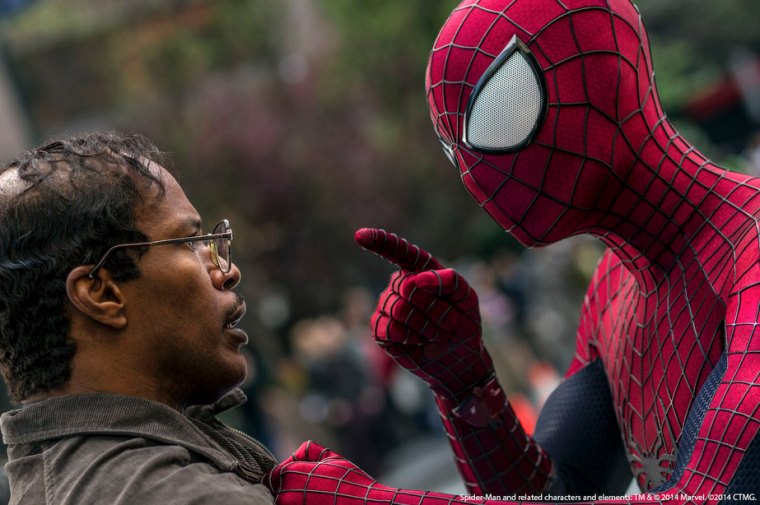
“THE AMAZING SPIDER-MAN 2” Review (✫✫✫✫)

Don’t worry: it’s not “Spider-man 3.”

The Amazing Spider-Man 2 is the standard of a superhero movie that everyone should aspire to. It’s exciting, action-packed, gut-bustlingly hilarious and emotionally involving to a point where I was surprised at how personal and genuine it really was. “Amazing,” in fact, is not a good enough word to describe this movie — “Superior” is more like it.

Taking place after Curt Connors, aka The Lizard, attacked New York City, The Amazing Spider-Man 2 shows Peter Parker (Andrew Garfield) as he continues to adapt to his new life as the spectacular Spider-Man. He’s just about to graduate, he’s getting a job as a freelance photographer at the Daily Bugle and his relationship with Gwen Stacy (Emma Stone) is going strong. Being Spider-Man has its perks and its downfalls, and this is a rare high point in Peter’s life.

Elsewhere, however, dark forces develop under Oscorp. Engineer Max Dillon (Jamie Foxx) gets electrocuted by bio-electric eels, transforming him into the chaotic villain known as Electro. Russian mobster Aleksei Sytsevich (Paul Giamatti) gets equipped with a fully armed mechanical suit, becoming the Rhino. And Harry Osborn (Dane DeHaan), an old friend of Peter’s, returns with a dark secret that he’s hiding from everyone.

That makes three villains in total for this sequel. Concerned? You should be. The last time we had three villains in a Spider-Man movie, that film was Spider-Man 3. I’m never going to get that image of Tobey Maguire doing the Elvis Presley-stride out of my head, ever. Does anyone have any hydrochloric acid I can pour into my eyes?

Well, you can rest easy, fellow web heads. The Amazing Spider-Man 2 is not Spider-Man 3. Quite the contrary, actually. This is a significantly better Spider-Man than its predecessor, a film that bounces in between multiple tones and genres all at once and does all of them brilliantly.

An early fight scene in the film, for instance, is as wacky and funny as a Looney Tunes cartoon, with Spidey struggling to grab all these plutonium canisters off of a moving truck like he’s in the middle of a pinball table. In another scene, he’s in the middle of an action sequence so exhilarating and mind-blowing that it could have come straight from a video game cut scene. In another moment, him and Gwen are dealing with a real emotional struggle neither quite know how to handle, something that has haunted Peter since the first movie.

That’s what makes this Spider-Man better from the other one: It has many tones, story lines, characters and emotions that it’s juggling all at once. That’s a weighty order, and not one to handle easily. Yet director Marc Webb handles the challenge excellently, delivering just as relevant a character drama as he does an exciting action movie.

The cast members have expert chemistry with each other, but that should be expected because of their exceptional performances in the first film. We already expect Garfield and Stone to be perfect with each other because they were nearly inseparable in the first round of the series. It’s more efficient, then, to focus on the newer cast members: Jamie Foxx and Dane DeHaan. 

Foxx is electric as the high-voltage villain, pun intended. At first he’s just a socially silly and awkward scientist, similar to Jim Carrey’s version of the Riddler in Batman Forever. When he goes through his transformation into Electro, however, everything changes. He becomes an angry and malicious supervillain, a man who is mad and frustrated at everything and just wants to kill everyone, then jump start their heart just so he can kill them again. DeHaan, especially, was desperate and conniving as Harry Osborn, a menacing and starkly different Harry than the James Franco version we are used to in the original trilogy.

Both of these villains serve a pivotal role to Peter’s development. Electro is the physical conflict Peter has to face in the movie; Harry is the emotional one.

There’s another concern comic book fans will have about this movie, and that is the same concern they have with Captain America: The Winter Soldier: We’ve already read the comics. We already know the twists that are coming up, and as a result, our reaction is dulled when that moment comes in the movie.

Let me make a reassuring statement for my fellow comic book lovers: I could see the twist in this movie come from a mile away. Yet when I saw it, I reacted as if I was witnessing Peter’s tragic story for the first time.

There are apparent concerns to have with this movie. The multiple story strands are worrisome, the overload of villains can be an issue and Max Dillion’s character is far too silly to fully accept as being realistic.

Does that change The Amazing Spider-Man 2’s influence, or for that matter, its effect on the audience? The answer is no, it does not. The Amazing Spider-Man 2 is still a great sequel, an excellent expansion to the Spider-Man universe and a more-than-welcome development to Peter’s never-ending growth as Spider-Man. I’m tempted to compare it to the legendary Spider-Man 2, although I’m not sure if it’s quite there yet. One thing is for sure, however: it’s head-over-heels over Spider-Man 3. If Webb keeps this up, he just might surpass Sam Raimi’s original trilogy.

Tagged , , , , , , , , , , , , , , , , , , , , , , , , , , , , , , , , , ,

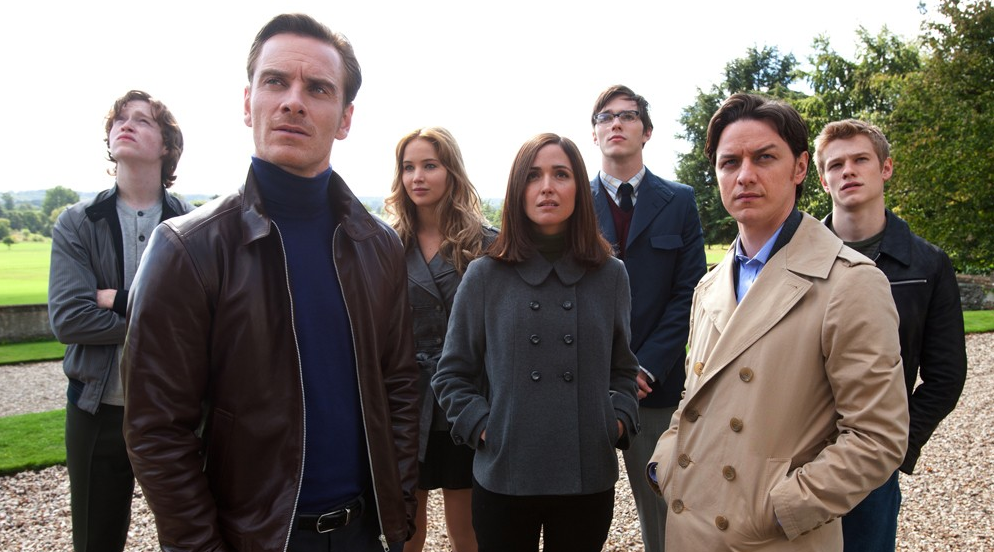
“X-MEN: FIRST CLASS” Review (✫✫)

Pretend G-men trying to skip out of class.

The very first shot of X-men: First Class is the exact same scene of the Holocaust, frame-by-frame of the very first X-men movie directed by Brian Singer. Not a good way to start off your movie by copying another one, isn’t it? The very next scene after briefly skipping through that one is a young Charles Xavier’s encounter with a young, hungry blue-skinned mutant named Raven who was trying to steal food from his refrigerator. Talking to her in a very sincere, comforting voice, he assures her that she doesn’t have to steal, and reaffirms it by saying that she’ll never have to steal again. Touching. I wonder how this conversation went over with his mother?

Years pass, and we’re reintroduced to the characters we’ve come to know for the past few movies now. Erik Lenshurr (Michael Fassbender), the man soon to become Magneto, is out on the hunt, looking for the man who killed his family and tortured him as a child back when he was a Jew in the concentration camps. Charles Xavier (James McAvoy) is now in college with the now much more mature Raven (Jennifer Lawrence), who is pursuing his masters degree in psychology.

There’s a mutual enemy that unites these three individuals together: Sebastian Shaw (Kevin Bacon), a menacing and conniving mutant with the ability to absorb and redistribute energy. That means a grenade can explode in his hand and he can transfer the explosion straight into you with a touch of his finger. Shaw is the man who tortured Erik back when he was a young child, and Xavier discovers a sinister plot that Shaw is setting to unveil upon the world. Erik and Charles combine their resources and their efforts to form a mutant team to work together and stop Shaw.

And how exactly does Shaw plan to carry out this giant, dastardly plan? By conspiring and coercing the Cuban Missile Crisis among nations, that’s how. How original. I wonder if these guys considered overthrowing the Chinese government while they were at it?

Hypothetical question. If you hear the term “prequel” being used, what’s the first thing that comes to mind? For me, its the word “beginning”. Beginning, as in, the start of the story. Beginning as in, the start of a legacy. Beginning as in, filling in the holes of all the ambiguous stuff we were told in the original trilogy, and beginning as in making sure everything fits into a nice, nifty little package by the time the end credits roll.

As a superhero blockbuster alone, X-men First Class succeeds. It’s exciting, it’s visually stunning, it features everyone’s favorite X-men that they’ve come to know and love, and it has enough comic book lore in it to make even Kevin Smith giggle with glee. As an action movie meant to please summer movie lovers, it is fine. As a prequel to the critically-acclaimed series that it is based on, however, it is utter and absolute failure.

Three of the biggest goofs that completely and utterly frustrated me. 1) There were flashback scenes in X2, X-men: The Last Stand, and Origins: Wolverine where Xavier is clearly seen as to being able to stand. Yet at the conclusion of First Class (spoiler alert!) Erik deflects a bullet into Xavier’s spine, permanently paralyzing is legs. 2) In the first X-men, Professor X audibly said to Wolverine that him and Magneto helped build Cerebro together, while in this movie it is very clear that a mutant named Hank McCoy (Nicholas Hoult) was the one who built it instead of them. Magneto’s helmet also didn’t exist prior to X-men, whereas here it already does. And lastly 3) a cameo appearance of a certain three-clawed mutant meeting Xavier and Erik about halfway through the movie at a bar. Wouldn’t they have remembered him thirty years later, especially since one of them is a telepath?

These ignorances to the plot show me that instead of providing an accurate prequel to a highly-revered superhero series, the filmmakers were more interested in letting loose and having fun rather than making something straight-laced and refined. I’m all for fun and high-octane action movies, but if you go in ignoring everything else that happened in the movies previous to your own, you’re being disrespectful to the franchise.

Oh, the cast was more than exceptional, I won’t deny that. McAvoy portrays the younger Professor X wonderfully here, passing himself off as a sort of young Patrick Stewart that’s more reckless and immature than his older self. Bacon is smug and charismatic as Shaw, and even though his role wasn’t as compelling as Ian McKellan’s was in the original trilogy, it still served its purpose in the film.

I especially enjoyed Fassbender’s performance as the angry, relentless, and grief-stricken Erik Lenshurr. The staple performances in the series overall belong to Patrick Stewart and Ian McKellan, there’s no doubt beyond that. Still, Fassbender gives it his all here. You notice the effort he extends here, the passion and the fire he instills in this character. McKellan’s rendition of Magneto was calm, collective, and calculated, a great foil to the equally intelligent but more morally aligned Xavier. Here, Fassbender is neither calm nor calculated. He is simply a raging, hateful man, a mutant who has been in pain and alone all his life, desperately seeking some sort of way to fill the emptiness within his cold, solemn heart. I genuinely liked and appreciated his take on the character, even though he bends missiles in one scene that look about as realistic as a Tom and Jerry cartoon.

“But wasn’t it fun?” is a common argument I get from a lot of moviegoers. “Fun” is such a subjective word, and can mean any one of different things. In the aspect of simple, plain, straightforward blockbuster fun, I guess this movie satisfies. The problem is I didn’t go into X-men: First Class expecting a brainless blockbuster. I went into this expecting this to be exactly what it claimed to be: a start to the X-men’s journey, an insightful and hot-blooded prequel that showed perspective on how their story began. This wasn’t even close to being a prequel, ending with more questions where there should have been answers. Fox has already announced that a sequel is currently in the works to be released sometime in 2014, and here I am, thinking that these kids need to go to summer school before even thinking about going into the second semester.

Tagged , , , , , , , , , , , , , , , , , , , , , , , , , , , , , , , , , , , ,

“THE AMAZING SPIDER-MAN” Review (✫✫✫1/2)

♪Does whatever a spider can♪

If I were to have a reboot of one of my favorite superhero films made just ten years ago, The Amazing Spider-man would be that reboot. What can I say about the film that will accurately do it justice? That it is exciting, suspenseful and displays visual effects that leaves the old one in the dust? That the writing is just as acute and skilled as the direction is? That Andrew Garfield has perfect chemistry with Emma Stone? No. Instead, I will describe the film by simply using just one word: amazing.

When Peter Parker was a young, bright-minded child, he lived in the content and warmth of his parents home. When his house was broken into, his father’s office searched through in every crook and cranny, his father Richard (Campbell Scott) quickly packs a suitcase, drives Peter to his Uncle Ben (Martin Sheen) and Aunt May’s (Sally Field) house, and tells Peter him and his mother will be gone for a while. A few days later, the plane that Peter’s parents were on was reported to have crashed. They didn’t make it out.

Twelve years later, Peter (Now played by Andrew Garfield), now in his teen years, is in high school, gets picked on by the local bullies every now and then, and has a crush on this pretty blonde-haired genius named Gwen Stacy (Emma Stone). While in the basement one day helping his Uncle unclog the water pipe, Peter makes an interesting discovery: his father’s briefcase, filled with notes, theories, and algorithms Peter has never seen before. While looking and studying the notes his father left behind, Peter realizes everything points to one scientific company in particular: Oscorp.

From there, Peter snoops around, goes into a lab he wasn’t supposed to go into, a radioactive spider bites him, and well… you probably already know where it goes from there.

If we look at the story, it is on repeat from the first Spider-man. But the repeat isn’t what we care about. The Amazing Spider-man is done with a new style, energy, and enthusiasm to it than the original one was. Funny, I didn’t expect this movie to be as energetic as it is. This film is directed by Mark Webb, who to date, his only directing experience being music videos and the 2009 romantic-comedy 500 Days of Summer. Quite a difference in genres, I know, but Webb handles the transition well. He makes Spider-man as he sees it, as a young man coming out of puberty using his powers for playful, mischievous reasons rather than the heroic acts of courage and responsibility that most heroes are known for. This Spider-man is more jokey and sarcastic than the original one, spitting witty one-liners while arresting a criminal or web swinging past bystanders.

He fuels the action scenes, inspires laughs, and is the source for original entertainment. If Tobey Maguire is the more emotional Spider-man, this Spider-man is the more sporadic and amusing one.

Andrew Garfield does a great job in portraying this Spider-man in a totally different dynamic. His character is definitely different, retorting to puns, jokes, and one-liners that would only result with awkward silences if Tobey Maguire tried to pull off the same thing. Garfield, however, is more talented than a one-dimensional joker. Like any great actor, his character portrays a flurry of emotions, and he portrays all of these emotions well. We can tell exactly when he is troubled or concerned, when he is angered and enraged, when he is happy and content, or when he is saddened and alone. Peter experiences many tragedies in this movie, and Garfield does a good job expressing the emotions for all of them. Emma Stone, equally, is incredible in this movie, providing the film’s beautiful, smart heroine. Together, their chemistry is irreplaceable, and forms a romance that rivals that of the chemistry Maguire and Dunst made in the original Spider-man movies.

Here is, regardless of pre-conceived opinions, a great movie. It is a blockbuster that does a great job balancing in between spectacular action, heartfelt emotion, and genuine humor, all combining into a reboot that makes it not only fun, but unique in its own right.

From a technical perspective, this film has no flaws. It, however, is not about what it did wrong; its a matter of who did it better.

The biggest weakness with The Amazing Spider-man is its release date. This is ten years after the first movie came out, and five years after its most recent one. Why did it need a reboot? It cannot help but bring up the comparison game when you watch this movie. And what happens when you compare things? You recognize which one did things better, and which one did things weaker. In comparison to the old one, The Amazing Spider-man cannot help but look inferior.

But how, exactly? The flaw exists in the writing, dear reader. There are just simply not enough moments in the film that are as emotionally real or relevant as there was in the first two Spider-man movies. Take, for example, the scene in the original Spider-man where Peter’s Uncle Ben dies because Peter did nothing to stop a criminal that ran past him. In the original film, this was a tragic, painful, and heartbroken realization for Peter that it was not the burglar who killed Uncle Ben, but Peter’s inaction and lack of doing the right thing. Here, it’s just on repeat as something that Peter needs to go through in order to become Spider-man. Peter, however, never acknowledges his responsibility in the matter, and neither does he ever even confront the criminal. How, then, does the issue ever become resolved? Answer: it does not. At the end of the film, everything is resolved except for that one specific conflict.

That’s the film’s only real weakness. I don’t want to go on about this weakness, though, because I’d be beating the bush. The main point: The Amazing Spider-man is still utterly fantastic. It is action-packed, suspenseful, energetic, relentless, exciting, humorous, and highly, highly entertaining. The production is all-around strong, the cast is even stronger, and the story is as driven and purposeful as it has ever been, despite a few moments of misplaced emotion. This is a reboot to one of my favorite superhero films of all time, and the surprise is I wouldn’t mind seeing a sequel to it in the slightest.

Tagged , , , , , , , , , , , , , , , , , , , , , , , , , , , , , ,

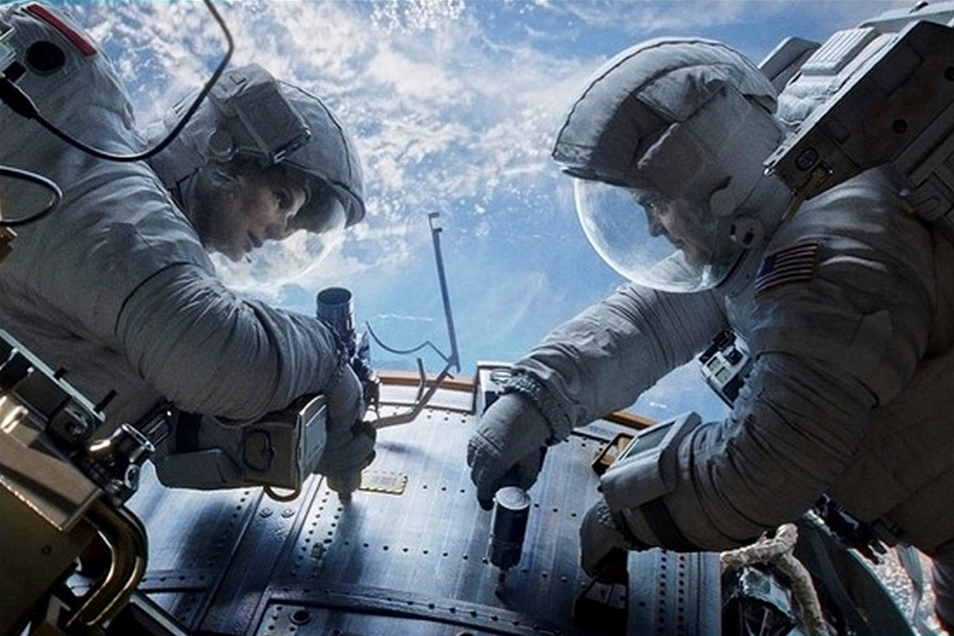
“GRAVITY” Review (✫✫✫✫)

“In space, no one can hear you scream”

We fade in on a list of statistics about space as the edgy synthesizer music builds in the background.  The earth rotates at a speed of about 1000 miles per hour.  The temperature is about -273 degrees celsius.  There’s no gravity.  No oxygen.  No air pressure to carry sound. No one to hear you scream or cry for help. Nothing to save you if your suit fails to sustain you. Nothing to stop your momentum if you’re flying in the wrong direction. If you get into trouble out in space, you are all alone. Life in space is impossible.

This sort of tension and desperation is felt on an emotional level so intense in Alfonso Cuaron’s Gravity that I feel like I’m in space experiencing the same things that these characters are experiencing, not watching the chaos unfold from mission control.  The plot follows three astronauts who are working on repairing a satellite in orbit. Dr. Ryan Stone (Sandra Bullock) is a mission specialist who is working hard at repairing the satellite on her very first space mission. Lieutenant Matt Kowalski (George Clooney) is an experienced space veteran who is retiring after this final expedition.  Shariff Dasari (Paul Sharma) is a flight engineer who carries a photo of him, his wife, and child inside his suit.  Early into their mission, the team gets a warning from mission control, saying that there is debris from a missile strike on a Russian satellite orbiting the earth, but that it shouldn’t collide with their trajectory.

Now if that isn’t a case of foreshadowing, I don’t know what is.  Eventually, the debris sets off a chain reaction of destruction, and it eradicates the shuttle that they came on.  Shariff is killed, Kowalski loses communication with mission control, and Stone is left desperately hanging on to her life as she floats aimlessly away from their space module. When Stone and Kowalski eventually meet up again, they have to race against time and fate as their oxygen levels continue to deplete, and need to find a way home before they are truly lost in space forever.

Man oh man, where to start.  Gravity is a film for a generation, a picture that is so convincing and so believable in its approach that its nearly impossible to think that it wasn’t even filmed in space.  It is visually stunning, emotionally gratifying, immensely captivating, and surprisingly involving, a picture that latches you on in its first shot and doesn’t let you go until hours after you’ve left the theater.

Who is responsible for this feeling of attachment and interest?  Why that is director Alfonso Cuaron, of course, who co-wrote the script with his son Jonas. Cuaron, who is most known for his mainstream films including Children Of Men and the third Harry Potter movie outdoes himself here. Not only has he made a compelling and visually breathtaking science-fiction film that visually challenges that of Avatar and Inception: he’s also made a emotionally captivating story with the human interest equivalent of Argo or Captain Phillips.

Oh, I’m not saying he isn’t already a great director: lord knows he’s delivered as much visual and emotional appeal as he did with Children Of Men and Prisoner of Azkaban.  But Gravity is head and shoulders above anything else he’s done in his entire career. Why? Everything in the movie is immaculate and intentional, from the physics and dangers of space to characters emotions and complexions. Look at the delicacy and the concentration on Cuaron’s shots. Look at how well he orchestrates a scene, whether a large, imposing space station is crumbling all around Earth’s orbit, or a astronaut is just awkwardly fitting herself in tight corridors around a space station. In each shot, there is interest, there is intricacy, and there is involvement. Whether its a big, intimidating destruction scene or a small conversation between characters doesn’t matter. The interest remains, and its boy does it keep your attention.

Visually, the film is unparalleled, hooking you on with all of its space-station grandeur and elegant scenery of earth from outer space. Part of this no doubt goes to the visual effects team led by supervisor Tim Webber, but a large accreditation needs to be made to cinematographer Emmanuel Lubeski, who collaborated on Cuaron’s other films including Children of Men and Y Tu Mama Tambien. Lubeski, who was nominated for an Oscar a few years ago for Terrence Malick’s Tree Of Life returns with the same artistry and craftsmanship that made him an artist in his own right. The camerawork in the film evokes a feeling of both reprehension and serenity, the same eerie feeling you get when you watch the slow, steady moments building up in Stanley Kubrick’s 2001: A Space Odyssey. It works in conjunction with the film’s plot and with Cuaron’s handling of it, a marriage of collaboration so essential that its doubtful anyone could be as fluid or as controlling as Lubeski is, not even Wally Phister’s steady, reliable camerawork from Christopher Nolan’s Inception or Dark Knight trilogy.

High praise, I know, but it’s well deserved. The visual effects alone have not made this movie. It’s Lubeski’s intricate framing and filming that not only captured these great shots, but intensified them, evoking the anxiety and unease of space just as much as the visual effects and sequencing does.

Bullock and Clooney are affectionate and grounded in their performances, pun intended.  Going in to the movie, I was really worried that the both of them were going to phone in their roles and just let the visuals take over, much like the Michael Bay/Roland Emmerich action movies you see nowadays. Boy, was I wrong. Their characters are real, charismatic and likable people in their own right, people who you’d probably like to sit with and share a conversation with over at Starbucks. Their chemistry is infectious with each other, as memorable and dynamic as the relationship Tom Hanks and Kevin Bacon shared with their crew mates during Ron Howard’s Apollo 13. You don’t only care for these characters because of their situation: you care for them because they are human beings, because they have hopes, dreams, and letdowns of their own and you want to see them make it through all of it.

This is what I love most about the movie: not just that it handles itself well as a science-fiction movie, but it handles itself well as human drama, period.

This is seriously one of the best films of the year. I’m not saying that because it is science-fiction. I’m saying that because it is seriously one of the best films of the year.  Under a different director, a different writer, cinematographer, composer, or even under a different cast, this film could have failed.  It’s hard to take a movie that takes place in an enclosed, blocked off environment separated from society with only one or two characters and make it interesting, and the filmmakers here have accomplished that in spades.

But Gravity is much more than a survival film.  It’s more than a science-fiction film.  It’s an epic and emotional story about an astronaut trying to survive, a woman trying to cope with living, reality, and tragedy, and the unhindered spirit that pushes her to keep living, even when all of the forces of nature tells her that she can’t. It blurs the line between science fiction and science reality and is quite possibly the best space movie I’ve ever seen.

Tagged , , , , , , , , , , , , , , , , , , , , , , , , ,

“NEED FOR SPEED” Review (✫✫)

Needs more brains if you ask me.

Need For Speed is one of those movies that feels like pressing on the gas pedal. You get a good kick out of it at first, but it doesn’t take long for it to run on empty.

Based loosely on the video game series of the same name, Need For Speed stars Aaron Paul (Breaking Bad’s Jesse Pinkman) as Tobey Marshall, a car mechanic whose prowess at street racing precedes that of Dom Toretto from Fast and Furious. When Tobey’s closest friend Pete (Harrison Gilbertson) is killed in a race against his wealthy rival Dino Brewster (Dominic Cooper), Marshall sets out in a race across the country to find Brewster and make him pay for what he has done.

Directed by Scott Waugh, the filmmaker behind the 2011 war drama Act Of Valor, Need For Speed is a typical Hollywood sports car movie with the typical ingredients you’d expect: a lot of action, few brains, even less wit and an over-dependence on formulaic Hollywood cheese

The screenplay is unbearably generic, to the point where groaning in disbelief is almost a reflex. In the first 20 minutes, we get every racing movie cliché you could possibly find in the handbook, from the underdog street racer stereotype to the prolifically rich and jerk of a rival to the underdog getting framed for a crime that he didn’t commit, seeking revenge on his transgressor. I wonder where we’ve seen that before?

Oh, is this movie bad. From the movie’s first scenes to its very last, it’s a predictable farce that can be easily foreseeable if you’ve seen any street racing movie ever. Case in point: Would I be really giving away any spoilers if I offer that A) Marshall makes it into the final race, B) He beats Brewster in a tedious scene that’s supposed to be the climax and C) He gets a beautiful girl in his arms? Please look at that, and tell me that doesn’t remind you of The Fast and the Furious franchise.

The movie might have been decent if the performances were worth anything more than a ukulele pick. Look at all of the names that are in this movie: Dominic Cooper, Imogen Poots, Michael Keaton, Aaron Paul. All great and talented actors, whose versatility of projects range from Batman and 28 Weeks Later to Captain America: The First Avenger and “Breaking Bad”. Their roles in this movie are wasted because they are mostly shoved aside for the (dis)pleasure of preposterous stunts, relentless engine revving and unbearably bad CGI animation. The fire effects that can be seen in one scene are so laughably bad that the video game looks more realistic.

The only thing I give the movie credit for is its third act, which is surprisingly affectionate. Dare I say that it may be poetic? No, that would be giving the movie too much credit. Still, it carries a very humble message about it, a grounded and reassuring statement that everything is going to be all right, even if things don’t initially seem that way. This end scene was surprisingly touching and relevant, elevating the movie above its mediocrity, although temporarily.

That still doesn’t change what we have here, though. Need For Speed is a predictable, standard, run-of-the-mill action farce with no surprises or original ideas. It’s almost like playing a video game, except you’re watching the filmmaker play it for you.

Tagged , , , , , , , , , , , , , , , , , , , , , , , , , ,