Tag Archives: Adventure

“MISSION IMPOSSIBLE” Review (✫✫✫✫)

Your mission: survive.

Now this is what an action blockbuster is supposed to be: smart, exciting escapism entertainment that makes its audience think rather than overloading them with special effects. Mission Impossible is pure fun, starting with its intelligent, masterful plot, and carrying itself through with state-of-the-art special effects, credible acting, and relatable characters that have a purpose in the conflicts they are going through. You don’t have that many movies where the characters are as fleshed out as the action is.

Mission Impossible follows the perspective of a young agent named Ethan Hunt (Tom Cruise) who works for a secret agency known as the IMF. His leader, James Phelps (Jon Voight), is given a mission to capture a fugitive who is after the “Noc List”, a file that categorizes every IMF agent working undercover in the field. If the Noc list ever got into criminal hands, many IMF agents’ lives would be in danger.

That’s where Phelps and his team come in: their mission is to capture this thief on-camera stealing the Noc list, follow him to a meeting with his buyer, and apprehend the both of them.

The mission goes desperately wrong. One by one, Ethan’s team is killed off, and Ethan is the only one to walk away. Now, IMF believes he is a traitor because the thief got away from Ethan Scott-free. Now alone with no backup and no resources, Ethan has to not only recover the Noc list, but also find out who is responsible for his team’s mission failure, as well as clear his name for the crimes he didn’t commit.

Here is a spy movie lived to its fullest. Going undercover in tuxedoes and bow ties while sipping martinis and champagne, these spies use their wits, not their weaponry, to outsmart their foes. And their weaponry itself… dear lord. They utilize such a wide array of complicated spy equipment that would floor anyone who would just take a glance at them. What we have here isn’t just guns, pistols, and radar jammers: we also have trip wires, laser security, balance beams, harnesses, suction gloves, and these latex masks that allow agents to copy the facial features of another person. There is a lot of spy tech and gear for the characters to play around with in this movie, and boy, do they play around with it.

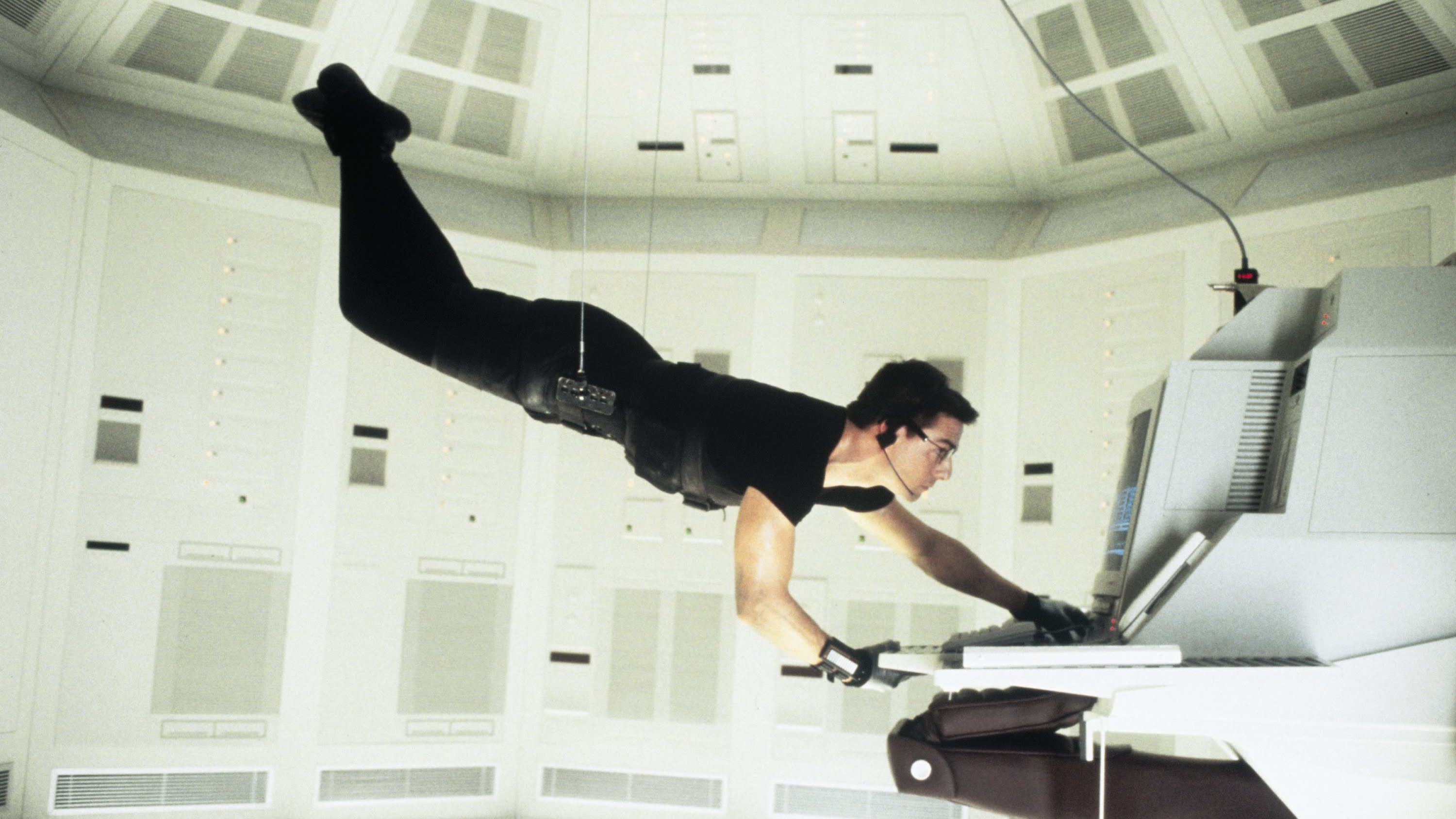
With such tools at a spy’s disposal, you can only infer how good the action looks. They are as explosive and action-packed as a James Bond movie is, and as exciting and surreal as a Tom Clancy thriller. Here is a movie that holds nothing back. It lets loose freely in its field of CGI and special effects, and the result is the most spectacular because of it. I can recall a few moments in this film that can be called iconic by right. My favorite, interestingly enough, has to be one of the film’s most quiet moments: an espionage scene where Ethan is slipping into a room that has motion sensors, pressure sensors, audio sensors, laser sensors, really anything with the word “sensor” in it. This is the scene where the movie earns the right to call itself Mission Impossible, because that’s exactly what this mission is: impossible. Except for the fact that Ethan and his team pull it off.

But action without plot is like frosting without the cake. I’m a picky viewer. For me, there needs to be a reason, and a good reason, for all of the action and explosions to be taking place in the film. Mission Impossible is a different action movie because of this. Its plot is complex, deep, deceptive, weighty, and manipulative, a plot that twists and turns and scurries about in all directions all while maintaining its narrative and purpose in a consistent, healthy flow. I expect many viewers will be confused and irritated by how much writer Robert Towne is making them think. They need to step back and actually analyze the movie they’re watching for a change. Mission Impossible is well worth the analysis. This is a movie that doesn’t cheat, and it doesn’t rob you of anything from this experience.

There are few movies I have seen where the plot and the characters match the appeal already provided by the special effects and explosions on the screen. Here is a movie where the story exceeds the visual effects. Director Brian De Palma utilized this film’s premise to its fullest, and gave actual meaning behind the plot and the spectacular action sequences we see in this movie. Here is a film that is truly one of its kind. It is perhaps one of the best action films I have ever seen.

Tagged , , , , , , , , , , , , , , , , , , , , , , , ,

“FANTASTIC FOUR” Review (✫)

Not so fantastic.

That’s it. I give up. We will never have a good Fantastic Four movie in this lifetime that will do Marvel’s first superhero family justice. We have had four live-action bouts with the Fantastic Four now. The first one was never theatrically released. The next two installments was campy melodrama that should have premiered on SyFy. Now we have the newest reboot, and it’s safe to say this movie deserved the fate that the first movie suffered from.

The Fantastic Four team consists of Reed Richards (Miles Teller), Ben Grimm (Jamie Bell), Johnny Storm (Michael B. Jordan) and his adopted sister Sue (Kate Mara), with the third wheel being Latverian computer whiz Victor Von Doom (Toby Kebbell), who is an anti-social douchebag that is spoiled, rotten, selfish, privileged, and self-obsessed. King Joffrey from “Game of Thrones” is more well-mannered than this POS.

If you know anything ever about Marvel movies, you know the formula. Person X gets caught in an accident. Person X gains super powers. Person X struggles with said powers. Person X eventually learns to control them, fight the obviously-labeled baddie, and then commits himself to a life of fighting crime. The only difference between Fantastic Four and the other Marvel formula movies is that it’s more obvious with this film. And it’s persons instead of person.

In hindsight, Fantastic Four is not easy to adapt into film. For one thing, their powers are so complacent. A rubber man, an invisible woman, a human torch, and a rocky troll is not the ideal superhero team I would line up to see. The other problem, though, is their comic book origins. Compared to other heroes such as Spider-Man, Daredevil, Iron Man, and Captain America, the tone with the Fantastic Four comics is much more lighthearted and even comical. Be honest: can you even keep a straight face with a name as silly as “Fantastic Four”?

All the same though, the concept doesn’t matter as much as the payoff. This movie could have worked. The members of the Fantastic Four have vibrant personalities and character traits that make them both memorable and likable. That’s the reason why Marvel’s first family has survived all these years: it’s because they’re enduring. People relate to them, and despite their meta-human circumstances, their problems and emotions with each other are all human.

We didn’t relate to them as superheroes. We related to them as characters.

That’s a problem for this movie, though, because this movie neither has personality or character. Good lord, where do I begin? When the lineup for this movie’s cast was announced, I was skeptical at first, and I was right to be. Not only can none of the actors hold the screen presence on their own: their chemistry with each other was disastrously non-existent. The cast didn’t even seem to really care about their roles. Every half-hearted expression, every line of dialogue and every motion seems disinterested and bland. Nothing works when these actors are on the screen together.

Teller, for instance, is an atypical and complacent scientist character, a step down from his bravado performance full of passion and drive in last year’s Whiplash. Kebbell is just as forgettable as Teller is, except he’s more of an asshole about it. Mara is beautiful but witless, her character cluelessly wandering about as if she’s there just so the studio can say they’re gender diverse. Michael B. Jordan, who is a standout in movies like Chronicle and Fruitvale Station, appears here just so the studio can say they’re racial diverse.

Side-note: I’m all about racial diversity in movies, but if you’re going to cast two actors as siblings, at least have them be the same race. Saying Mara’s character is adopted doesn’t count as being diverse. It’s an obviously cheap effort to be labeled “racially diverse.” If you genuinely want to be racially diverse, recast everyone as African Americans. Don’t put in a half effort.

But out of all of the actors, I feel the most bad for Jamie Bell. He’s not even on the screen for most of the film: he’s replaced with this ugly gargoyle reject that looks like a combination of John Cena with a pile of rocks. I’m not even kidding, he looks freggin’ horrendous. What were the visual effects artists thinking with this? I get that Ben Grimm is supposed to be this big, ugly figure, but not this ugly. Not the kind of ugly that makes your vomit turn inside out, then go back into your stomach. It offends me to think that Bell was basically thrown into the tracking suit and have his performance replaced by this ugly CGI creation. With the other cast members, they at least have the opportunity to give a convincing performance before they fail. Bell isn’t even given the opportunity to fail. His performance is canned the minute the visual effects artists placed a 3D model over him. You could have cast a stunt double in this same role and get the same result from it: a big, bulky figure that just stiffly sits and stands like he has to go to the bathroom really bad. I haven’t seen a CGI creation this putrid since the Teenage Mutant Ninja Turtles from last year.

The movie’s flimsy, indistinct plot is just as bad as anything else is. What is the plot of this movie? Four people get superpowers, mope about it for a few hours, then have their final battle 20 minutes before the movie ends. That’s it. There’s no character building here, no heart, no humor, no unique elements or surprises to this film that makes it stand out from the standard superhero fare. The Avengers was just as fun, if not more so, for its characterizations and dialogue as it was with its action. Guardians of the Galaxy was wacky, clever, in-cheek fun that had a blast roasting itself. Shoot, even the original Fantastic Four movies had more charisma than this. This movie was so downtrodden, so serious, and so stupidly depressing that I felt like I was watching gothic fan fiction of the Fantastic Four. If you thought Man of Steel was too dark for a superhero movie, you haven’t seen Fantastic Four.

This is a disinteresting, joyless, illogical, poorly acted, written, produced, and directed experience. The cast must have heard the film’s whimsical title and wondered if they were on the wrong set.

Tagged , , , , , , , , , , , , , , , , , , , , , , , , , , , , , , , , , ,

“PAPER TOWNS” Review (✫✫✫1/2)

Just a paper boy living in a paper town.

The frames we see in Paper Towns are the stuff of fantasies, the kind that we think about and dream of late at night in our bed while staring at the ceiling. It’s hard to look at this movie and not relate it to our own experiences in high school, in first love, in friendship, and in self-discovery. At one point, I was watching the movie and wondering if I was watching someone else’s story, or my own.

If we are watching someone else’s story, that someone is Quintin “Q” Jacobsen (Nat Wolff), a regular high school student with regular friends, regular parents, regular life, and regular post-graduation plans. Just about everything is regular to Q except for one thing: Margo Roth Spiegelman (Cara Delevingne), the girl on his block that he’s been in love with since they were kids.

Q and Margo are the epitome of opposites. Q is shy and introverted. Margo is confident and extroverted. Q likes to play it safe. Margo likes to take risks. Q likes to look ahead and plan for his next step. Margo thinks not knowing where you’ll end up is the most fun part of anything.

One day, Margo completely vanishes. Her parents, her friends, nobody knows where Margo may have gone. As time passes, however, Q discovers clues Margo left behind for him to discover. A piece of paper in his door. A page torn out of a map. Writing on an old gas station wall that reads “You will go to the paper towns, and you will never come back.” Now convinced that Margo wants him to find her, Q starts piecing all of the clues together to find out where she has gone to convince her to come home.

The second of John Green’s novels to be adapted to film (with the first being last year’s The Fault In Our Stars), Paper Towns is a truly unique and invigorating experience, refreshing in its comedy, in its drama, and in its truth. It reminds me so much of The Fault In Our Stars, and yet, it’s so different from it too.

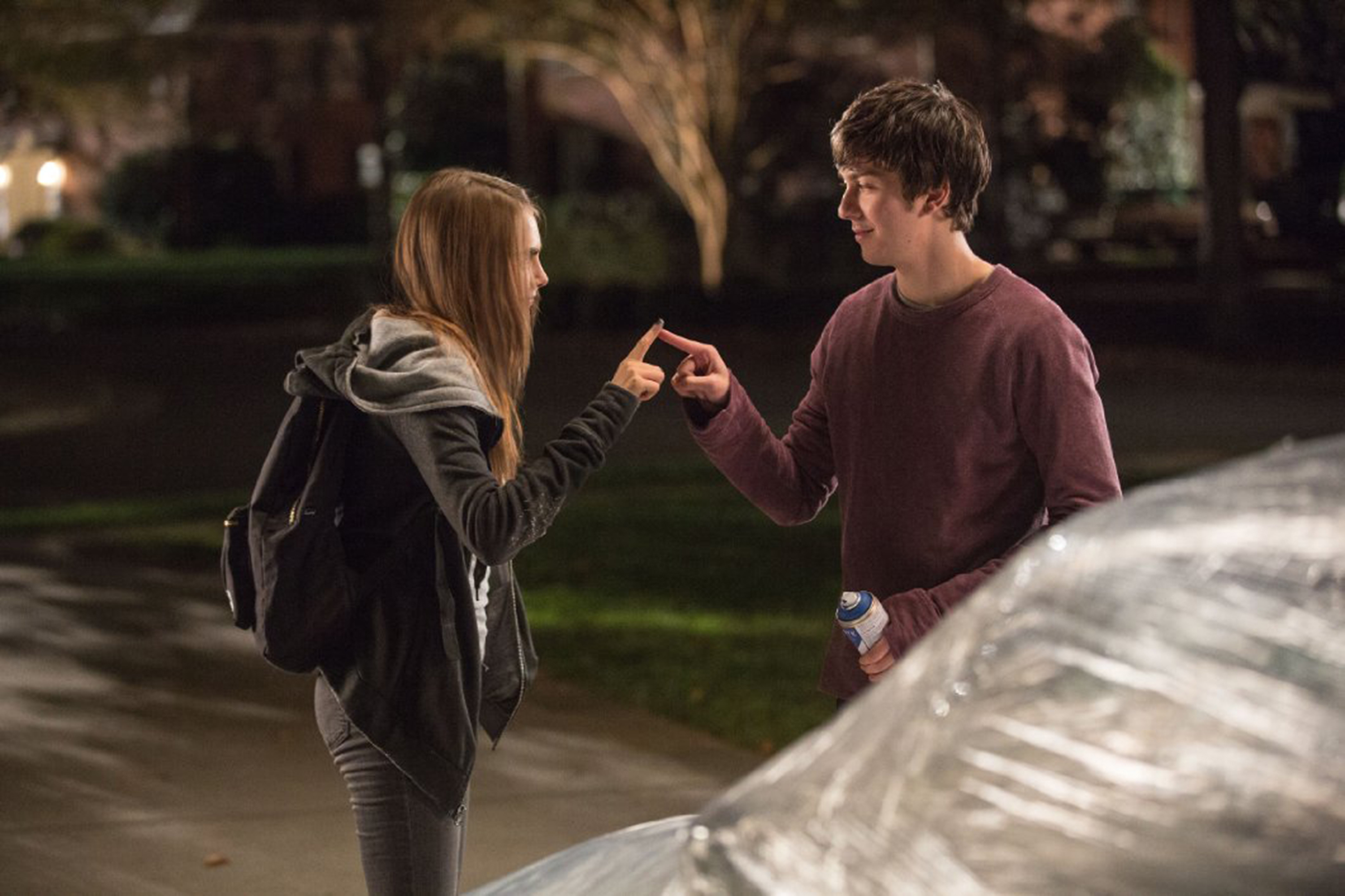
I’ll start with the best thing from both movies: the characters. Green’s novels have such a unique way of making ordinary characters extraordinary, and that’s just as true with the movies as it is the books. Margo is a spur-of-the-moment, lively and rebellious teenager who serves as more or less an enigma of what adventures high school students fantasize about and aspire to. She’s almost too ecstatic to be believable as a character, and that’s exactly the point. As Q says it best in the movie, “It’s so silly, it can only be true.”

The moments where she takes Q on her midnight adventures are probably some of my favorite scenes in the movie. While Margo was pushing Q to get out of his comfort zone, I was reminded of a scene between the two leads from Martin Scorsese’s 2011 film Hugo.

Isabelle: We could get in trouble.

Hugo: That’s how you know it’s an adventure.

Every other supporting character is just as interesting and likeable as Margo is, however less mysterious. Q’s friends, Radar and Ben (Justice Smith and Austin Abrams), are the mischievous sort that talk about high school rumors and made up sex stories just like immature high school students do. Halston Sage portrays Margo’s best friend Lacey, and while she’s convincing and bubbly in the role, she’s a little too old to convincingly look like she’s still in high school. Most of the younger cast is ages 18 to 20. Sage is 22.

The one that most impresses me is Nat Wolff. Originally a supporting character in The Fault In Our Stars, here Wolff transitions front and center as the lead role in Paper Towns. His versatility as an actor is pitch-perfect here, portraying all of the joy, excitement, angst, ambition, and confusion a teenager has during his high school years. Actors in these roles tend to overplay them, either with an over exaggeration of joy or sadness. Not Wolff. Hearing him crack his voice or watching his eyes tear up gets more of a reaction out of me than the overabundance of tears and sobbing we get out of actors who overdo it in other movies. Wolff plays his role convincingly without overdoing it. He doesn’t miss a note.

Everything else in the movie is primed to near-perfection. The comedy is fresh and wholehearted without being on-the-nose or over-the-top. The drama is grounded and believable, and hits on issues that most teenagers experience on the verge of growing up and moving on to college. The only minor complaint I would have with the movie is that some of the plot elements seem so out there for teenagers under 18, but the movie addresses that near the end of the third act.

All in all, Paper Towns does what its supposed to and when its supposed to do it. It made me laugh abundantly and uncontrollably. It made me choke up and quiver. It made me intrigued and interested. And it made me eagerly happy and excited, not unlike the excitement these characters experience with each other throughout the film. I may have been too much of a romanticist while writing this review, but I’d like to think Green was one while he was writing the book. The movie delves into both the truths and fantasies of growing up. Just because not everything happened, doesn’t mean it’s any less real.

Tagged , , , , , , , , , , , , , , , , , , , , , , , ,

“ANT-MAN” Review (✫✫)

Fear me! I control ants! 

Here’s the perfect example of expectation affecting outcome. Let’s be honest: who was expecting anything out of Ant-Man? I know I wasn’t. I went in expecting a complacent, by-the-books, predictable superhero thriller. I left after getting that exact same thing.

Okay, maybe I’m being a little rough. The movie does have its moments, and it did at times give me slight enjoyment and chuckles. But how can individual moments replace an entire movie? If you compare Ant-Man to its other giant-sized movie counterparts (The Avengers, Iron Man, Captain America: The Winter Soldier), you will always arrive to the same word to describe it: smaller.

Taking place after the events of The Avengers: Age of Ultron, Ant-Man introduces Hank Pym (Michael Douglas), a genius scientist that rivals the intellect of Iron Man’s father Howard Stark (John Slattery). After realizing that the government was seeking his Pym particles, which allows him to turn into Ant-Man, to be weaponized, Pym goes into retirement, hoping to protect his particles from the world so that they would never be used for nefarious purposes.

Enter Daniel Cross (Corey Stoll), Pym’s ex prodigy. In modern day, Cross re-created Pym’s particles in the form of Yellowjacket, a suit similarly designed to Ant-Man and outfitted with the same capabilities. Desperate to get the suit and to further protect his invention, Pym enlists the only individual who can help take up the Ant-Man mantle: Scott Lang (Paul Rudd), a notorious thief who has a knack for getting into places he doesn’t belong, and a daughter he’d do anything to see again after separating from her mother.

It’s true, most probably didn’t think much about a superhero named Ant-man when this project was originally announced. But to be fair, this film does have some merit, despite its low expectations. The best thing I can say about Ant-Man is this: its fun. Meagerly fun, yes, but it still counts.

Honestly though, that doesn’t surprise me much. The film was originally written and was supposed to be directed by Edgar Wright, who is most known for his comedic action films Shaun of the Dead, Hot Fuzz, The World’s End, and Scott Pilgrim vs. the World. If you’ve seen any of those films, you know that he’s a clever and well-versed filmmaker who knows how to balance action and comedy with drama. If I were a studio head, I would have taken one look at his filmography, thrown all of my money at him, and shouted “Take it! Take it all! Take it and make more!”

So what happened? Simply put, Marvel happened. After a few creative disagreements between himself and Marvel, Wright left and Peyton Reed was hired in his place. Reed directed The Break Up and Yes Man before helming Ant-Man. Yeesh.

Luckily, Ant-Man survived it’s lop-sided pre-production into release. Well, maybe “survived” isn’t an appropriate word. Dragged by its insect legs is more accurate.

The biggest complaint about Ant-Man is that it’s inconsistent. Moments of heartfelt drama collide with out-of-place comedy. Comedy is bogged down by moments of forced emotion. The only thing that is consistent in the film is its action, which is surprisingly innovative to its premise.

For instance: in the first scene where Scott shrinks as Ant-Man, he falls into a bathtub. Who would have thought falling in between droplets of water and cracks in the floor would be so exciting and interesting? The details we see when Scott shrinks are extraordinarily eye-popping, immersing us in this whole new world we didn’t see before in regular proportion. Seeing Scott traverse into ant hills that turn big when he shrinks, communicating with insects his size when he’s small, and finding new locations inside smaller ones are among some of the fantasies we see when he’s Ant-Man. Seeing him fight as Ant-Man is the most fun. Who knew that a Thomas the Train set could be so dangerous to two miniature super-beings?

Other than the visuals though, the movie is sub-standard. It’s cookie-cutter in about every sense of the word. The comedy, the drama, and the acting is all forced for effect, and in the process, it has none. For Pete’s sake, even the movie’s villain is so bland. Who cares about some bratty little business executive who steals a powered suit for money, fame, and power? That was Obadiah Stane in 2007’s Iron Man, and he was a much more compelling villain than this standard archetype of an antagonist.

It’s true, this film didn’t have much to go on when originally announced, but the idea doesn’t count as much as the execution. People doubted Guardians of the Galaxy when that came out, and people reversed their opinions and said it was greater than The Avengers after they saw the film. I believe those same people will watch Ant-Man with no reaction as he flies in the air and goes “splat” across their window pane.

Footnote: If you do decide to watch Ant-Man, do not watch it in 3D. It has some of the worst particle effects I’ve ever seen in a 3D conversion, and I had to lift my glasses every five minutes to see how much brighter the film was without the glasses. I didn’t know that Ant-Man was supposed to be such a dark picture.

Tagged , , , , , , , , , , , , , , , , , , , , , , , , , , , , , , , , , ,

“KINGSMAN: THE SECRET SERVICE” Review (✫✫)

The name’s Eggsy. Agent Eggsy. 

For any of you who are planning on going into the moviemaking business, always keep one thing in mind: your audience. While most of them might be fairly desensitized and will enjoy senseless amounts of gore and violence, one or two of your audience members might not enjoy it as much, and indeed, might be so revolted by it that it affects their view of the whole picture. Does it really ruin all of the fun for everyone if you just tone down the blood and gore one or two notches? Just a few scenes can ruin a whole movie for your viewer, just like it did with me.

I know, I know, the movie probably wasn’t made for me since I’m being Mr. poopy pants by saying “ew” to blood. Can you blame me though? The MPAA rated Kingsman: The Secret Service R for “sequences of strong violence, language and some sexual content.” They didn’t indicate how disturbing it was, or even how frequent and over-the-top it was either. Adding the word “intense” to any of the film’s rating descriptors would not have been inaccurate.

The plot is based on a Mark Millar comic series The Secret Service. A young man named Gary “Eggsy” Unwin (Taron Egerton) is a troublemaking rebel who steals cars and gets into fights when his mother’s jerk of a boyfriend isn’t beating him up. His many delinquencies land him in jail, where he is told he’s going to spend the next 18 years of his life.

Yes, I know his name is Eggsy. Go ahead and laugh. I’ll give you a minute.

Eventually, he is freed by Harry Hart (Colin Firth), a tailor who has a thing for good manners and tall pints. What Eggsy doesn’t know is that Hart isn’t really a tailor at all: he’s a british spy, working for a secret service called “The Kingsman”, the same service Eggsy’s father worked with before he died saving Harry’s life. Now feeling a need to repay Eggsy’s father, Harry gives Eggsy a chance to become a Kingsman himself: to change his destiny and become the “gentleman” his father always wanted him to be.

The film is written and directed by Matthew Vaughn. If you know anything about Vaughn, its that his films have a very strong reception to his core audience, which I guess is… who, exactly? Masochists? His films have received an equal amount of both support and controversy in the past, including among them Kick-Ass and X-men: First Class. I myself am not a fan of him. Kick-Ass was a morally degenerate and violent escapade even worse than this movie, including horrific scenes of torture and child violence. First Class on the whole wasn’t controversial as it was incoherent, ignoring the rest of the series canon like it was a reboot instead of the self-purported prequel it was selling itself as.

But I don’t look at the director as much as I look at the film itself. What was this movie trying to be? An action-comedy. Did it succeed in that? On the whole, yes. Kingsman: The Secret Service is a humorous and stylish escapade with cartoonish violence and action equivalent to that of a Mortal Kombat video game. It had two goals here: being funny and exciting. It fulfilled both.

There was a lot I liked here with Kingsman. First off, the film was casted well. Egerton’s spunky rebellious attitude clashes well with Firth’s firm sense of structure and order, and makes for some good scenes with strong comedic dialogue in them. Mark Strong is a solid supporting character here, serving here as an adept tech assistant instead of the usual villainous roles that he does in his movies. Samuel L. Jackson was perhaps the funniest as the film’s main antagonist. In a career where Jackson spitballs lines of dialogue like bullets in films like Jungle Fever, Pulp Fiction and The Avengers, it’s both unexpected and refreshing to see him here talking with a lisp and with a sour distaste for blood. What kind of baddie doesn’t like to look at blood and give lengthy villainous monologues?

The action, while preposterous, is both stylish and exciting. Characters punch, stab, flip, grab, kick, and shoot each other in skillfully choreographed positions and movements, taking each other out in uniquely different styles that I haven’t seen before. Imagine a cross between the usual James Bond martial-arts fighting with the gunplay you’d see in a Die Hard movie. That’s the type of combat you see in Kingsman: The Secret Service, and its a rare visual treat that got me really engaged into some of the movie’s greater fighting sequences.

All in all, I was really enjoying Kingsman: The Secret Service until it got into the third act. Then it took a nosedive straight into the pavement.

I’ll try as hard as I can to describe this without giving many spoilers. In one scene, a church congregation starts slaughtering each other after the pastor delivers an incredibly racist and prejudiced sermon that I think is supposed to resemble the ramblings of Fred Phelps from the Westboro Baptist Church. This is one of the more violent and disturbing sequences in the movie, with neck snapping and people stabbings and body contortions into convoluted shapes that I didn’t even think was possible for a dead human being. The scene, while stylish and entertaining, was also equally disturbing and out of place. I laughed out loud, but I didn’t know if it was out of enjoyment or shock.

Another scene involved a mother stabbing a door in a Jack Torrance-Shining style, trying to kill her one-year-old crying daughter. That one was too much for me. I don’t like seeing child violence or distress in movies. Unless you’re having it in there to make a point about parentage or childhood trauma, scenes like that aren’t ever necessary to a movie.

Overall, we have a really cohesive film that on the whole works really well. What backfired was simply one or two scenes that severely clashed with the film’s overall vision, moments that took me out of the fun I was having to make me insanely sickened and disgusted at what was going on the screen.

The last out-of-place scene was one where a woman was asking Eggsy for anal sex. I think that’s a metaphor for something.

Tagged , , , , , , , , , , , , , , , , , , , , , , , ,

“JURASSIC WORLD” Review (✫1/2)

Never trust a velociraptor. 

If there is any reason you need convincing as to why some movie franchises need to stay extinct, let Jurassic World be your most recent example. How to I start with this? Well, let me start with a positive: Joe Johnston isn’t directing. Thank God, because I couldn’t stomach another Jurassic Park III. Maybe I already have.

The movie takes place 20 years after the events of Jurassic Park, which is just as well because it literally is more than 20 years after the original was released. The new plot re-writes the history so that The Lost World and Jurassic Park III never took place. Not a change I will be missing since those movies contributed as little to the series as World does.

The film’s cast of characters includes a dinosaur whisperer named Owen Grady (Chris Pratt), who controls his own small battalion of velociraptors ready at a moment’s notice. Yes, you read that right. A velociraptor battalion. You get used to such absurdities as the movie goes on. You have Claire Dearing (Bryce Dallas Howard), the park manager of the newly-designed Jurassic World. Then you have Zach and Gray Mitchell (Ty Simpkins and Nick Robinson), two brothers who go to Jurassic World for a small vacation away from their parents. Oh yeah, and Claire is their aunt. You can tell their parents are really responsible by sending their kids away to an exotic park filled with man-eating beasts and reptiles with their ditzy, airhead of an estranged aunt to take care of them.

Anyhow, the upgraded, new-and-improved Jurassic World is a major step forward from Jurassic Park, the failed first attempt at a dinosaur park thanks to the hands of John Hammond. But no worries! Jurassic World is the perfected design of Jurassic Park, and nothing can possibly go wrong!

…right? RIGHT?!

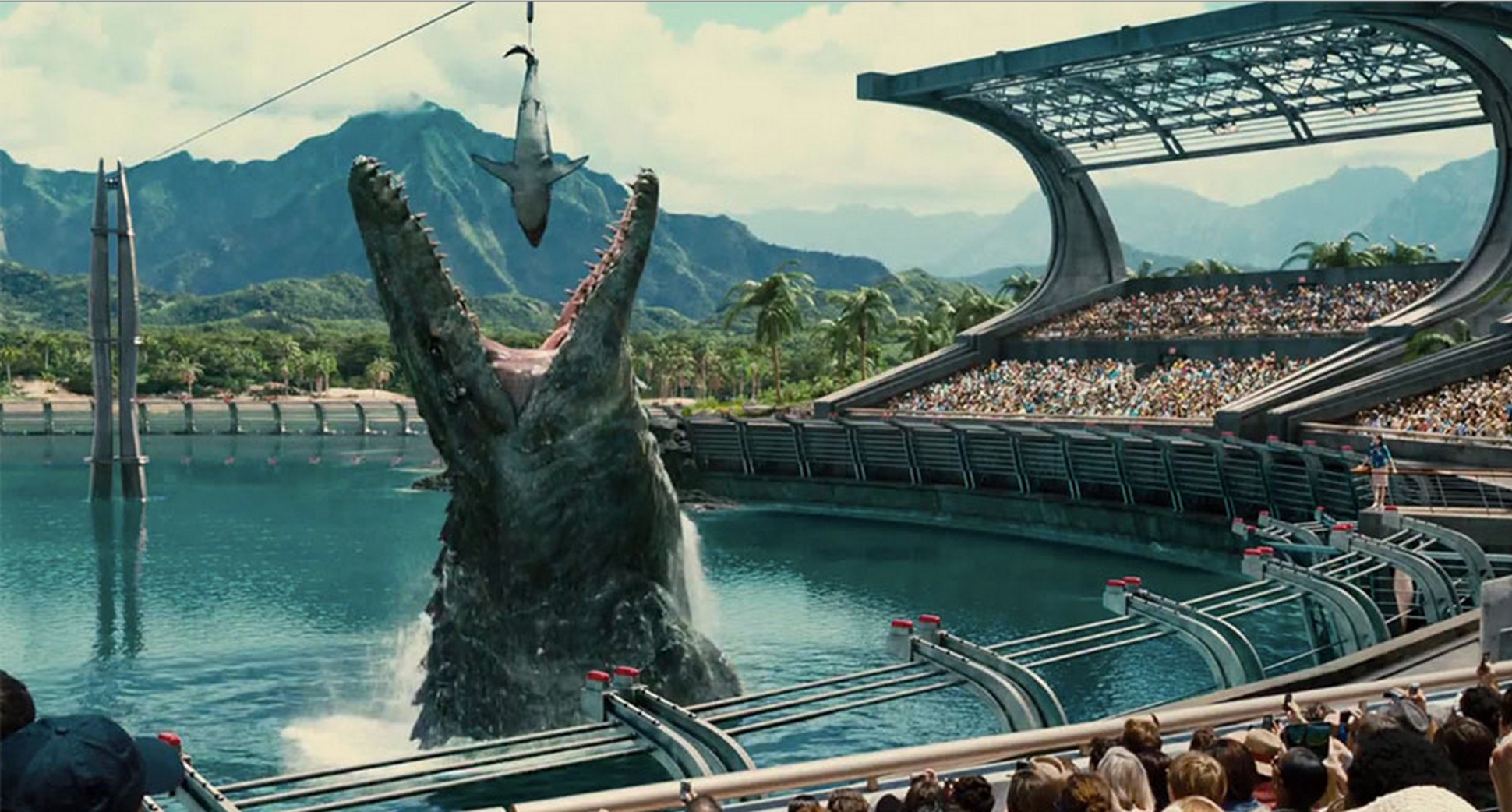
Wrong. They do the smartest thing they can do and create a new carnivorous dinosaur called the Indominus that is more powerful than the T-Rex, Spinosaurus and a pack of Velociraptors combined. Hooray for dinosaur science!

As soon as the film opens up, you realize how many stupid characters are packed into the film to create the biggest idiot plot you’ve seen since Idiocracy. Idiot # 1: Whoever decided to create this park after the original one ended so disastrously. Idiot # 2: The mad scientists who decided to create a new carnivorous dinosaur, splicing together the DNA of nature’s most dangerous dinosaurs. Idiot # 3: Bryce Dallas Howard’s character, for deciding to run in high heels the entire movie. Idiot # 4: The park official who thought the dinosaurs could be reused as weapons for tactical takeover. I’m sure he was still wondering what went wrong as one was chewing off his head (Hint: They’re hungry, you moron). Idiot # 5: Mr. DNA, because curse that Clippit wannabe. Idiot # 6: Anyone who thought it was a good idea to pay money to go to this park after knowing what happened at the old one.

It’s true, I’m not a fan of this movie’s conception to begin with. The premise itself has so many logical flaws to begin with, its hard to get into the story. But I’ve been faced with worse cases before and have been happily proven wrong. I had doubts before I went into the theaters to see 22 Jump Street and Guardians of the Galaxy, and those ended up being some of the most fun movies of 2014. If done well, a movie can suspend disbeliefs and be what a summer moviegoing experience is supposed to be: entertaining.

The problem with Jurassic World is that it undermines its own intelligence, and the entertainment value doesn’t pay off despite it. The script starts off with its flaws of logic in the outset and never addresses them in the film, its characters as oblivious to their own faulty thinking as badly as the screenwriters are. The movie continues with an onslaught of cliches and inaccuracies, some of which I rolled my eyes hard at and wondering if I was watching a Roland Emmerich action picture. Some of the worst blows come in the form of dialogue that actors somehow manage to deliver with straight faces (i.e. Lines like “I was with the Navy, not the Navajo” or “Wait until I tell my mom!”). Don’t even ask me how many times characters told each other to run.

Probably the worst offense comes with the casting. I’m not denying that these are talented actors. From big roles to small ones, each of these cast members have been in roles where they had a strong presence on screen. Now, their presence includes running away from dinosaurs and looking good in sweaty clothes. Simpkins was cute and likable in movies like The Next Three Days and Iron Man 3. Now, he’s an OCD dinosaur nerd who recites species like he’s a dictionary. Robinson was solid in in the coming-of-age drama The Kings Of Summer. Here, he’s in the cliche Gothic-teen phase like those characters you’d see from “Degrassi.” Howard’s resume needs no explanation. Her acting ability is worth more than the pretty-faced ditz role she’s forced into this movie. And Pratt? Ugh. Pratt is the worst. After making as strong a debut as he did in Guardians of The Galaxy, director Colin Trevorrow did the worse thing you possibly could do to Pratt in this movie: he made him boring.

Again, the visuals are amazing. Whoop-de-do. The more I offer the visual effects and the fight sequences as the movie’s strongest points, the more irritated I get at knowing I’m writing the same criticism over, and over, and over, and over again. Yes, the visuals are amazing, but are they good enough to substantiate the movie’s flaws? The original Jurassic Park revolutionized computer imaging years ago when you saw the life-sized dinosaur for the first time in 1993. What big achievement can Jurassic World boast about? Continuing the trend that Jurassic Park started. That’s it.

Great visual effects mean nothing if a plot is not strong enough to stand on its own two legs. Is one character’s solution to outrunning a giant dinosaur seriously to release a bigger, scarier dinosaur? What was she going to do when either dinosaur was finished? And on that note, is she seriously running and doing all of this leg work in high heels???

I’m seeming pretty harsh with this movie. I know it, and I’m sticking by it. The more I thought about my experience with this movie, the more irritated I get at the movie’s ignorances of itself and its audience. This movie’s premise was not the worst thing in the world. Guardians of the Galaxy had an even more preposterous idea to its story with talking trees and raccoons, and it pulled it off with humor and with heart. This movie copied what Jurassic Park did first and better, and it’s artificial efforts show. It needed to understand how prehistoric sequels are nowadays, and how badly it needed to evolve from it.

Tagged , , , , , , , , , , , , , , , , , , , , , , , , , , , , , , ,

“INSIDE OUT” Review (✫✫✫✫)

A lot going on inside Riley’s head.

Pixar movies have a way of transcending fantasy and translating it into a form of reality. Does that make any sense? Of course it does, because you’ve seen many of Pixar’s masterpieces before. Up’s fantasy is about a man building a floating house about balloons, but the reality it’s portraying is an elder man dealing with personal loss and finding happiness in unexpected places. WALL-E’s fantasy is about a clumsy dumpster robot, but its reality is about discovering humanity and protecting our home and history. And Toy Story. Ooff. That’s a fantasy about one boy’s childhood with his toys and how they’ve impacted him into his adulthood. That is also its reality.

Here we have another colorful Pixar masterpiece that uses reality as its springboard for creativity and fantasy, using a human being as a setting, and her emotions as its characters. The human is Riley Anderson (Kaitlyn Dias), an 11-year-old girl who just recently moved from Minnesota to San Francisco. Her emotions are Joy (Amy Poehler), Sadness (Phyllis Smith), Fear (Bill Hader), Disgust (Mindy Kaling), and Anger (Lewis Black), and their memories with her make up the core of Riley’s personality and how she reacts in different situations. After the move-in, Riley gets all shaken up from all of the new adjustments she has to get used to, from being the new kid at school, to moving in to a home smaller than her old one. It’s up to her vibrant and unique emotions to try and keep Riley together and make her new life a happy, sad, fearful, disgusted, and angry one.

Written and directed by Pete Docter, who also helmed Pixar’s Monsters Inc. and Up, Inside Out is a clever, original animated feature that uses the human psyche as its playground. The best thing about the movie is seeing how creative it is in re-creating the human brain for a child’s mind, and seeing children react to all of the colorful adventures going on in this infinite cranial wonderland.

The first thing you notice with the film is its animation: vibrant colors and character models reach out to you in vivid details, even more so without the dimmed effects of 3D. Memories come in the form of small bowling ball spheres, colored after the fashion of each of Riley’s emotions. Different parts of her life are modeled into vast theme-park-like islands, from Family Land all the way to Goofball Island. Each island is also jam-packed with its own sleek features and gadgets that make you feel like you’re in the wonderful landscape of Disney land. Be honest: you would love to ride the literal “Train of thought” if it existed, wouldn’t you?

The film’s creative landscape, though, is to be expected. We’ve seen dozens of vast, colorful settings from many of Pixar’s films before. Andy’s room in Toy Story. Paradise Falls in Up. The AXIOM in WALL-E. You can probably name one setting that struck your eye in each movie, from the world of self-aware automobiles in Cars to the anthill in A Bug’s Life. Pixar has never failed in creativity, and I doubt anyone expects them to start failing now.

What I’m most impressed with is how the film handles its vastly ambitious premise, even with the film’s somewhat purported flaws. For instance, in Riley’s mind, a lot of childish, silly things go on that might make adults go on “offline” mode while the kids laugh at the overt goofiness going on the screen, like double rainbows and processed boyfriend machines. The characters are mostly one-dimensional, and for a film that has five emotions in it, the movie primarily focuses on only two of them: Joy and Sadness.

In any other movie, these quote-unquote “flaws” would make the film a weaker experience for me. It didn’t here. Why? The film’s premise, setting, and execution constitutes a need for each of these elements, making them contributors to the plot instead of distractions degrading from the experience. I would knock the film for being really silly and goofy at times, but it’s taking place in a kid’s mind. What else would be in the ecstatic and excited mind of a child? Doom, gloom, and misery? The characters are mostly one-dimensional and go through little change in the motion picture, but isn’t that kind of expected? I mean, what emotions do you think characters named Joy, Sadness, Fear, Disgust, and Anger are going to feel? Woe, Delight, Calm, Desire, and Peace? That would break their characters, and detract from the personalities and make them who they are. Finally, there’s the greater focus of using Joy and Sadness as the film’s key players instead of the others. There’s a specific reason for doing this. It’s because those are the core emotions any human being is going to experience: positive and negative.

In the film, Joy and Sadness conflict with each other with their contrasting personalities, each one trying to help Riley in the best ways that they can. Joy wants everything to be happy and optimistic, and for Riley to feel the enjoyment out of every situation. Sadness focuses on the reality of each situation and on the raw reactions one may feel from those that are less than happy. While both emotions conflict with each other in the ways they want to help Riley, they are ultimately the most essential for her. They allow her to express her emotions in their purest forms: in either pure Joy, or pure Sadness.

This is the ultimate meaning of the film, in that there are different things that make up each human being. Some has more anger in their bodies than others. Some may be filled with more Fear than others as well. But like the animated, wacky emotions in Riley’s curious little head, we’re all unique to each other and in the ways that we handle life’s problems. It’s how a baby will react differently to a traffic jam in how a taxi driver would. It’s how a fully-grown man will react differently to broccoli-covered pizza than a toddler would. It’s how a young, maturing boy will react differently to meeting a girl for the first time, and visa-versa.

As human beings, we are all made up of different emotions and personalities, but being different doesn’t mean being bad. Sometimes we need to experience the rawness of certain emotions for certain situations, and that’s not a bad thing. Sometimes, we need the help of Joy, Sadness, Fear, Disgust, and Anger to get through life. How we express those emotions is what makes us who we are, and we end up being human beings as unique and diverse as Riley’s wonderful emotions are because of them.

Tagged , , , , , , , , , , , , , , , , , , , , , , , , , , , , , , , , , , , , , , ,

“MAD MAX: FURY ROAD” Review (✫✫✫1/2)

A lovely day and a flaming guitar. 

I’ve never seen a movie break as many rules as Mad Max: Fury Road does and get away with it. I’ve never seen a movie so loud, obnoxious and over-the-top that still manages to impress me by the time the end credits roll. Previous movies have done the same thing Fury Road has done and failed spectacularly. Transformers. Resident Evil. Underworld. G.I. Joe. Fast and Furious. All of those films are every bit as explosive and stupid as Mad Max: Fury Road is, and yet I don’t love them as much as I do Mad Max. Why is that?

I think its because the movie knows its just that: a movie. It knows that it’s loud, obstinate and stupidly explosive. It knows that its a blockbuster of exceedingly epic proportions that shakes the theater so much, it makes viewers shat in their pants. And more than anything else, it knows it is an action movie, with all of the fun and flaws alike bundled with it.

So what does a director like George Miller decide to do with that, knowing this is the fourth film in his own franchise? Fix the mistakes that are present in all of his predecessors?

No. Instead, he decided to embrace them, like a soldier throwing himself onto a hot grenade.

The end result is exactly how it sounds: bloody awesome.

The plot (if you can call it that) follows Max Rockatansky (this time portrayed by Tom Hardy) after the events of Road Warrior and before Beyond Thunderdome. In this desolate landscape called planet Earth, Max is a survivor of Nuclear war, traveling dry and sandy deserts in silence and solitude. Everyone else around him is either dead or has signed up in the mad crusade of Immortan Joe (Hugh Keays-Byrne), a tyrannical warlord who has idolized himself as a god and has labeled everyone under him as his followers. Considering he has control over the only water source over hundreds of miles, the survivors have little choice but to submit to him.

One of these followers is Furiosa (Charlize Theron), a fierce female warrior who is charged with transporting Joe’s water to a nearby town with her small battalion. Little to Joe’s knowledge, however, Furiosa is transporting something else: all of Joe’s wives. Now on the hunt from Joe and all of his maniacal followers, Furiosa needs to team up with Max to escape the desert landscape and free the wives that have been under Joe’s cruel control for so long.

Is the plot as stupid as it sounds? The answer is no, because the film really doesn’t have a plot, only the resemblance of one. The narrative is a weakness all of the films in the series share with each other. While other science-fiction movies have a rich amount of lore and backstory behind them, Mad Max doesn’t have as much to boast about in its own series. Really, as far as story goes, all of the Mad Max movies are kind of weak in narrative scope. Here’s the plot for all of them: a guy is trying to survive against a homicidal maniac in a deserted landscape. That’s it. It’s a big case of “what you see is what you get.”

Here’s where Mad Max: Fury Road is different though: there’s a lot to see. Even though the plot is about as thick as a studio pitch, Miller displays this meager plot in spectacular, stunning, eye-popping action and explosions, and even a few soft moments of short dialogue exchanges between characters.

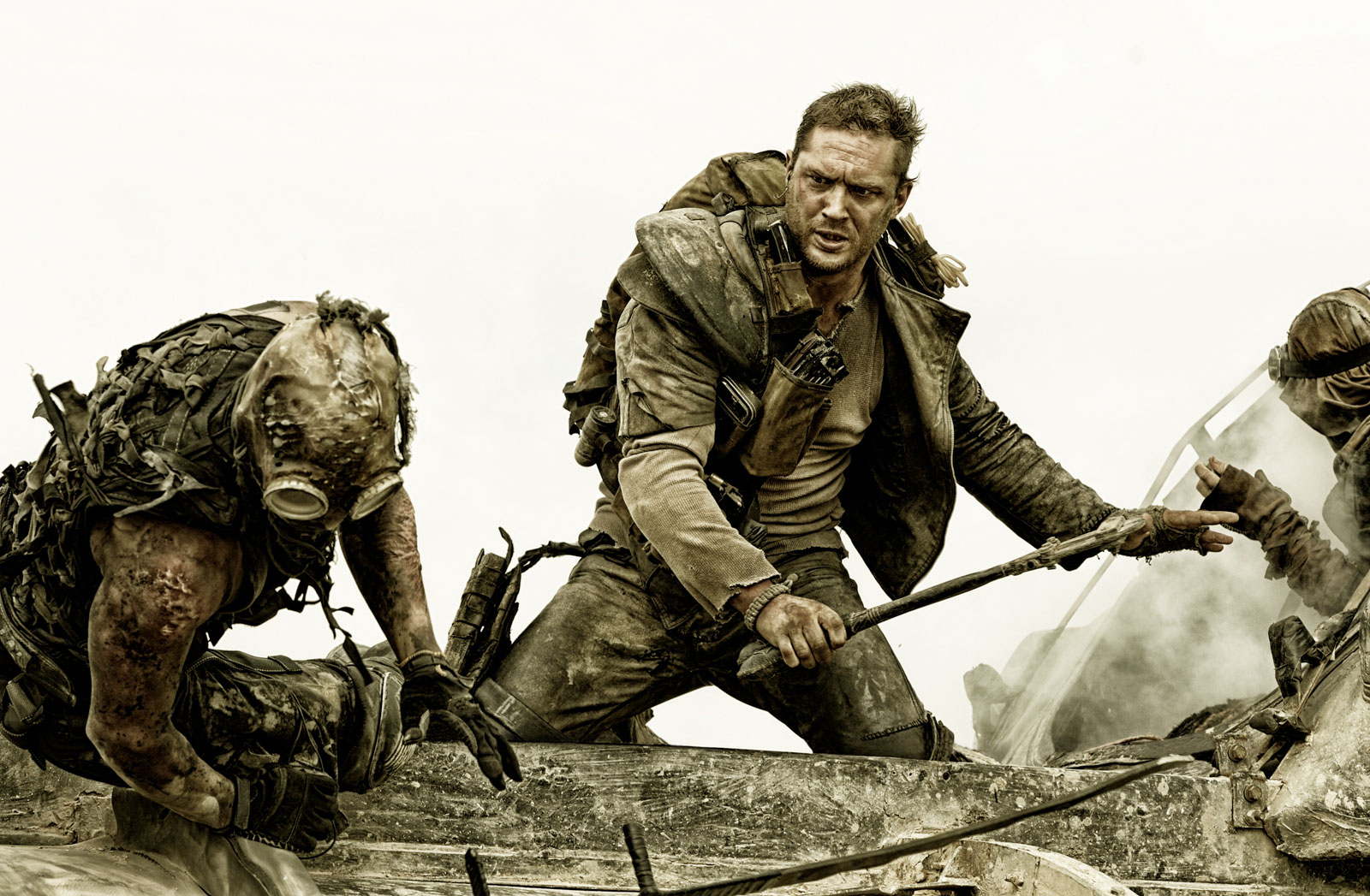
The stunts are unlike anything you’ve seen in any of the previous movies. The most destruction you found in Mad Max and Mad Max 2 was cars exploding and toppling over into deep sand dunes and rocky road pavements. In this movie, vehicular manslaughter is the least of the destruction found in the film. In one of the first action sequences, an entire armada of Joe’s fleet follows Furiosa into a giant sand storm of extremely windy proportions. In another scene, gang members viciously chase Furiosa’s truck in a tightly-cornered crevice of mountains. In another, a flunkie gets blinded by gunfire, puts cloth around his bleeding eyes, then fires blindly at Max and his gang like a crack-happy trigger maniac. For crying out loud, there’s one underling in the film that uses a guitar flamethrower.

Yes. That’s right. A guitar flamethrower.

It’s obvious that the film is ridiculous and absurd in the most gleeful of ways. Yet, what I like so much is that in between all of the over-the-top and in-your-face action, there’s actually a purpose and a reason for actors being in the movie. Yes ladies and gentlemen: this is an action movie that has actual acting in it. Hardy replaces Mel Gibson’s role with hardened machismo and stiffness to his gesture, and while Max is still mostly a flat character, Hardy portrays him with a sort of intrigue to him that makes you curious about his history, even though we already know most of it. Theron, however, impresses me the most. She’s incredibly versatile in the film, being a firm and uncompromising action heroine in one moment, and an emotionally exhausted and stricken survivor in another. She’s honestly the real lead in the film, with Max being more of a supporting character to Furosia’s rebellion against Immortan Joe. The film is really empowering to females, and that’s an incredibly rare thing, especially for an action movie.

By now, you’ve hopefully gotten the idea of what the movie is like and whether you’d be interested in this sort of thing or not. The film definitely has its flaws, but by God, the movie is just so freaking entertaining. I can’t sum up the film any better than that. Now go get your movie ticket. There’s a flaming guitar that you need to see.

Tagged , , , , , , , , , , , , , , , , , , , , , , , , , , , , ,

“MAD MAX 2” Review (✫✫✫)

Where is your home, Max? 

I’m convinced that George Miller’s Mad Max series is an excuse to blow rugged vehicles up in spectacular fashion. Not that’s a bad thing. Crashes and explosions are exhilarating, after all, when done convincingly and used conservatively. That’s a big reason why most action filmmakers don’t succeed at what they do: they fail to produce anything new or different. They’re the same thing over and over again until the experience stops being entertaining and becomes more mind-numbing. It’s almost like an anesthetic exercise rather than an example of entertainment.

But with Mad Max 2, it’s action that actually matters. The setting is convincing. The premise is solid. The cars, costumes, and props all add to the surrealism of this post-apocalyptic environment. And then characters are placed into this desperate environment, this eerie spread of gloom and hopelessness where we watch as these human beings react to the same problem they are all facing: survival.

Taking place years after the first Mad Max, Mad Max 2 follows the world after an energy crisis consumes the Earth, and petroleum becomes a rare commodity. Some survivors form communities in order to build up each other’s chances of survival. Others join a gang lead by the vicious ringleader Humungus (Kjell Nilsson) that hunt and kill landscape scavengers.

However, one man stands among them, neither beggar or hunter, a man set apart from the rest of the world in his own search for peace and survival.

His name is Max Rotansky (Mel Gibson), and he lost his human spirit after he lost his wife and child in a hit and run years ago before the energy crisis.

With writer-director George Miller returning from the first Mad Max film, Miller seems to have a clearer idea of what he wants Mad Max to be: a high-octane, ridiculous action movie that refutes stereotypes and expectations. The film is spectacular in more ways than one, and most of it is for the reasons that made the first Mad Max mildly entertaining.

One of the things that Miller does as a director is remain adamant about using practical effects in his films. I am in 100% support of this decision, because practical effects, however over-the-top, always makes the most convincing effects. This was one of the few things that I enjoyed about the first Mad Max, in that the stunt and chase sequences were so seemingly absurd and ridiculous, and yet they weren’t, because they were all shot in real time. The car chases were authentic. The bikes and automobiles flying over bridges and crashing spectacularly were authentic. The explosions were authentic. Everything in that movie challenges what could be achieved visually, and not in the computer-animated graphic variety that Tron did. It challenged what shapes vehicles could crash into and how big it could explode afterward. It challenged the scope of destruction in an action picture, and what stakes could be built on top of that.

Mad Max 2 does the same thing Mad Max does in the destructive, chaotic nature of vehicular manslaughter, but with one key difference. It has a better development of the world it’s trying to create.

Don’t get me wrong: a lot of the problems from the first movie persist for this one. Max is still mostly a one-dimensional character with little more expression than the scowl on his face. The plot is straightforward and without many revelations or surprises in them. And the villain, however interesting, is extremely cartoonish. Humungus is essentially a beefed up Jason Voorhees, and his interest extends just about that far as well.

But from what I’ve come to understand about the Mad Max series is that the story isn’t supposed to come from the characters. It’s coming from the scenery all around them, this desperate and depraved world that Miller is illustrating as a warning to mankind’s nature. We didn’t get the sense of this world in the first Mad Max because it still felt like society was intact: that there were cities and townspeople still going on about their somewhat normal lives. In this film, there is no such thing as a normal life. Cities and towns have been reduced to war zones and rubble. People live in buses and tents instead of houses. Plentiful grassy plains have been replaced with desert sands. A regular meal consists of a can of beans if you’re lucky. And for whatever humans are left to survive, their form of currency is oil and water. This world is the definition of desperate.

This in turn, makes Max Rotanksy a perfect protagonist for the film, despite his neutrality as a character. It allows you to absorb the film with your own eyes, not clouded by the emotions of another character.

What we have left is an effective action movie that lets the audience carry the film’s weight just as much as the cast and crew does. It’s rare to find an action movie like this, where the viewer actively engages and thinks like the film’s characters do. Usually action movies tell viewers to turn off their brains and be drowned in an orgy of explosions and testosterone. This movie does something different. This movie asks viewers what an action movie is, what it is supposed to be, and what it can be. And at the center of it all is one lonely man; a slave to the roads that he was born from.

Tagged , , , , , , , , , , , , , , , , , , , , ,

“MAD MAX” Review (✫✫)

You people are mad, alright. 

Sometimes I watch a movie and I wonder what purpose it’s supposed to serve in the world of cinema. Mad Max is one of those movies.

I’m not saying its either good or bad. I’m saying I don’t know what it’s supposed to be doing. Is it supposed to be social commentary? If so, the film actually needs to comment about something. Is it supposed to be a character study? The character needs to be either unique or fascinating then, but Mad Max himself is neither. Is it supposed to be just plain, dumb old entertainment? Well, by that logic, isn’t the film supposed to be entertaining?

The plot takes place in a semi-post-apocalyptic future where the police force’s power is dwindled and resourced into a new unit called the Main Force Patrol, which monitors highway crime like a cop and a speed detector. The best of these MFP’s is Max Rockatansky (Mel Gibson), a highly-skilled driver who has a beloved wife and child at his home.

One day, after driving a murderous criminal into a barrel roll and an explosion after a high speed chase, Max is pursued by the criminal’s gang followers as they prepare to take on Max and the rest of the MFP. These guys do anything and everything to get under Max’s skin, from assaulting his friend Goose (Steve Bisley), to terrorizing a small town, to even killing Max’s wife and child. Now on a quest for vengeance, Max goes on a hunting spree, tracking down every gang member involved, not stopping until every single one of them paid for what they’ve done.

I know that paragraph sounds like the premise of the film, but really the two paragraphs I just typed could also count as a plot synopsis too. Oopsie! Did I spoil it much? I don’t think so. After all, is it still a spoiler if you see the so-called “twist” coming from a mile away?

The biggest problem I find with Mad Max is that there is too much buildup and not enough payoff. In the above synopsis I provided, it sounds like the perfect setup for an excellent movie. Yet in retrospect, I more or less described the entire plot of the film in less than 164 words. What happens in this movie? Just about what I described above, and little else. There’s no complex emotion with the film, no sense of urgency or immediacy to make us care for the movie or what’s going on in it. No, instead we get a bleak, lifeless film that sounds like a great studio pitch, but the final product doesn’t extend much further beyond the pitch itself. I think the studio execs involved were more fascinated with the idea itself than they were with carrying out the idea.

Oh, don’t get me wrong: Mel Gibson is as good in the role as the character will allow him to be. But the other part of this movie’s flimsiness is that the protagonist is as flat as the movie’s plot is. What’s the most interesting thing about Max Rockatansky? He’s a father and a husband. That’s it. He doesn’t have the charisma of James Bond, the grit of Harry Callahan, or even the smugness of Han Solo. No, Max Rockatansky has no defining characteristics as the lead protagonist: he’s just supposed to pose in his leather jacket next to his car with a big gun, and apparently that’s all he needs to be called an action hero.

Again, I ask: why did this movie have to get made? What purpose does it serve? Well, I read on a forum that writer-director George Miller wrote the movie after working in a hospital emergency room, supposedly inspired by the car crash victims he tended to. That’s all fine and dandy, but how does that translate into a film? The movie doesn’t have any clear motivations of what it wants to be, no clear idea as to what its themes are or how to express those themes. I didn’t get from the movie that Miller was trying to tell a cautionary tale about high-speed driving. In fact, I didn’t get much of anything from the picture. I just got a stereotypical action hero and his arc of vengeance that has been done better in numerous other movies before Mad Max. 

I’ll give the film one point, and one point only, for the stunts. With Miller being adamant about using 100 percent practical effects, everything you see on the screen genuinely happened. Cars barrel rolling and crashing spectacularly into other cars on the highway. Motorbikes flying off of bridges with the paint and metal ripping off of their surfaces. Vehicles blowing up in large, spectacular fashion. All of it was done with practical effects, and the film achieved the greatest visual result from it. Now if only the rest of the film could be just as practical.

Tagged , , , , , , , , , , , , , , , , , , ,