Tag Archives: Adventure

“STAR WARS: RETURN OF THE JEDI” Review (✫✫✫1/2)

Balance to the force, there is at last.

This is it, the moment that everything has been building up to: the conclusion of George Lucas’ Star Wars trilogy. Just like the last few movies, Return of the Jedi is a strong sci-fi feature that focuses on its character’s development just as much as it does on its mythology and visual effects. I’ve grown fond of Star Wars and its sequel The Empire Strikes Back, and Return of the Jedi is no different. The only disappointment is that it has to end.

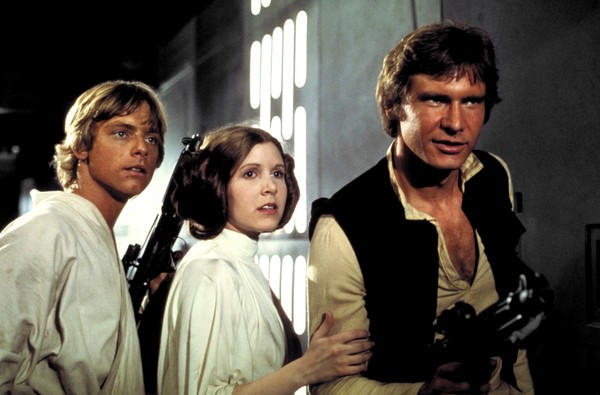
Taking place after The Empire Strikes Back when Han Solo (Harrison Ford) is frozen in carbonite and Darth Vader (James Earl Jones) reveals he is Luke’s (Mark Hamill) father, Return of the Jedi sees our heroes as the Galactic Rebellion comes to its most crucial moment. As the Empire works to rebuild its infamous Death Star and the rebellion works to counterattack the Empire, both sides mount up their efforts as they have one last chance to defeat their enemies, either freeing or enslaving the galaxy for all eternity.

Out of any of the other Star Wars movies, Return of the Jedi is the most exhilarating, an exciting action romp that contains rebels and stormtroopers shooting at each other, chase sequences through forests, and lightsaber duels that are arguably the best out of the series. We’ve witnessed over and over again how visually ambitious the Star Wars saga is. Here is another demonstration of how groundbreaking the Star Wars movies really are.

Take the film’s climax as an example. As the film gains momentum, we switch around to multiple scenes at once and the stakes that characters are faced with in the heat of the moment. We switch to an epic space battle where rebellion cruisers and imperial spacecrafts are firing and flying at each other all at once. We switch to a ground scene where rebels are breaking into an imperial base before they are suddenly captured and fired upon. We switch to a dark room, where two jedi are staring tensely at each other, waiting for the other to make the first move against them.

This is something all of the Star Wars movies handle well, which is perspective. We have our main conflict between Luke and Darth Vader, certainly, but they’re not the only ones in the scope here. We also have Han and Leia’s romance, 3PO’s humorous cowardice, R2’s curious sense of adventure, and Chewbacca’s loyalty and brutishness. We have a comprehensive understanding of all of these characters, their motivations and aspirations, and we sympathize with them when they’re in the midst of tragedy. It’s rare to have this much character diversity and not have it fleet in its focus, but Return of the Jedi succeeds in being emotionally balanced and meaningful. If The Empire Strikes Back is the buildup, Return of the Jedi is the payoff.

There are a few elements that don’t work as well with this picture. The beginning sequence, for instance, ran a little longer than it should have, and could have been edited down to about ten minutes as opposed to the 25 minutes it took up. On the opposite end, the final battle, while thrilling and climactic, was equally too long and took up the better half of the picture. The introduction of some teddy bear-sized aliens called Ewoks definitely did not help the picture either. These squatty little freaks speak in such incomprehensible and annoying sounds that they make Chewbacca look like he speaks English. The fact that these midget-sized creatures had a fight scene was almost laughable to me.

But the film’s flaws are miniscule compared to it’s sheer and massive successes. Yes, the runtime was too long, but it at least kept me interested throughout most of it. The action was engaging, the chemistry of the cast was genuine, and George Lucas ultimately gave a fitting conclusion to one of cinema’s most cherished trilogies. We can forgive him for the Ewoks.

Tagged , , , , , , , , , , , , , , , , , , , , , , , , , , , , , , , , , , , , , , ,

“STAR WARS: THE EMPIRE STRIKES BACK” Review (✫✫✫✫)

The Galactic rebellion intensifies.

How do you improve upon perfection? The second installment in the Star Wars series, The Empire Strikes Back, answers this question with profound confidence, wiping away any doubt with the swift of a lightsaber and the influence of the force. It’s hard to imagine that at one point, creator George Lucas doubted the impact his series would hold. And now here stands The Empire Strikes Back, not only every bit as strong as its predecessor, but also cementing its influence on cinema forever.

Taking place a few years after the events of Star Wars, The Empire Strikes Back follows its core characters as they continue the intensified conflict against the empire. Darth Vader (James Earl Jones) is viciously in pursuit after Luke Skywalker (Mark Hamill). Han Solo (Harrison Ford) has a debt he desperately needs to pay off from a criminal overlord. Princess Leia (Carrie Fisher) has a war she’s still trying to fight. And while all of this is going on, Luke receives a message from his long-deceased friend, Ben Kenobi (Alec Guinness), telling him to go to the Dagobah system to train with the only Jedi master left in existence. Now all on separate paths towards their destinies, these rebels and friends must complete their own journeys as they continue to fight the empire and save the galaxy from its evil clutches.

After the massive success of Star Wars, you’d wonder how on Earth George Lucas would be able to provide a follow up to his science-fiction saga. Yes, he had created these wonderful characters, but character appeal can only last for so long. You have to give them something to do to test the strength of their resolve and the changes that they go through. For the sequel to work, Lucas needed to not only reproduce his memorable heroes: he needed a story just as compelling to allow them to grow and evolve.

Thankfully, Lucas delivers just that alongside director Irvin Kershner and screenwriters Leigh Brackett and Lawrence Kasdan. One improvement that The Empire Strikes Back has upon its predecessor is in the scope of its storytelling; in the stakes that it sets up and in the challenges it pits against its characters. That’s perhaps the most noticeable way in how this movie excels, is in its buildup and anticipation.

Take, for instance, the dynamic that pits Luke Skywalker against Darth Vader. As the movie builds, you quickly realize how similar Luke and Vader are to each other, and how dangerous of a path Luke is on if he isn’t careful. Luke is training to become a jedi. So was Vader, at one point. Luke is very strong in the force. So is Vader. Luke wants to get powerful fast so he can protect his friends. So did Vader, before he turned to the dark side. The parallels this movie draws on its protagonist and antagonist are very strong, and Kershner is effective in highlighting the conflict going on inside of Luke. It shows that if Luke isn’t careful, the greatest thing he will lose is not his friends, but his soul.

The other characters are just as great as they were the first time we became acquainted with them. Han Solo is still the smug, over-confident rebel, Leia is still the stubborn and headstrong leader that gives a good name to female protagonists. Darth Vader, however, is just as imposing and fearful as he was when we first met him. I would argue even more so, given more of the history we learn about him in this movie. When listening to him, I had forgotten how pivotal James Earl Jones was in his character conception, how his voice lends so much to his performance and his agony. It isn’t just the deepness of Jones’ voice that perfectly encapsulates Darth Vader: it’s in the sincerity of his words, how he says some lines with intensity and quietly utters others in softness. In the first movie, we got a great introduction to Darth Vader as a villain. Here, we’re beginning to understand him as a character, and Jones continues to be pivotal as that comprehension continues to be constructed.

What of the technical elements? Read my first review. You know what I think of its technical elements. The landscapes are vast and barren, contributing to a deep sense of loneliness and vulnerability. The action is exciting and suspenseful, teaming our heroes up against near impossible tasks, then having them find solutions in the most creative and dynamic ways possible. John Williams’ score doesn’t even need any elaboration. Can’t you remember the emotions you felt the first time you saw the words “Star Wars” on the screen and heard the horns blasting proudly in harmony?

This movie is just as strong as the first film was in its production value. Yet, production value means nothing without a strong arc for our characters to go through, and The Empire Strikes Back has that in spades. On the surface, it’s another sci-fi action blockbuster not too dissimilar to its first entry. In deeper insight, it’s a character conflict on how these heroes and villains react to stakes rising and how similar they are in their struggle and in their pain.

There are other characters and story elements that I would like to talk about, but doing so would cheat you of the experience and take away the enjoyment of seeing it for yourself. Star Wars was a masterpiece. The Empire Strikes Back, even more so.

Tagged , , , , , , , , , , , , , , , , , , , , , , , , , , , , , , , , , , , , , , , , , , , ,

“STAR WARS” Review (✫✫✫✫)

The force is strong with George Lucas.

What is your favorite piece of science fiction of all time? Nine times out of ten, most people’s answer will be Star Wars. Not Star Trek. Not Terminator. Not Alien, or Blade Runner, or Metropolis, or 2001: A Space Odyssey. It’s always Star Wars. Why is that?

I think it’s because, unlike Gene Roddenberry, James Cameron, Ridley Scott, Fritz Lang, and yes, even the great Stanley Kubrick, George Lucas succeeded in making characters that were not only believable, but loveable. We didn’t just accept them. We embraced them as we found a piece of ourselves in each of them. If I bring up the name David Bowman, many of you might ask “Who?” If I mention Nyota Uhura, most of you would stare at me in puzzlement. But if I mention the letters and numbers of C-3PO and R2-D2, your ears would most likely perk up in excitement as you realize I’m talking about Star Wars.

That’s what happened to me in my small living room in Brownsville, Texas when I was just a little boy. When the opening credits and theme song for Star Wars opened up, my attention was immediately caught. When the vast imperial fighter boarded the small rebel ship and the tall figure of Darth Vader (James Earl Jones) entered the deck, I stared at the screen in bewilderment and amazement. But when those two geeky droids entered the frame, as R2 slid around beeping and 3PO clumsily blundered about, I knew I had found something special, as we all did when Star Wars hit the theaters in 1977.

The droids escape the rebel ship and soon land on the dusty planet of Tatooine, where they are soon captured and sold to a small plantation family outside of the city. It is here where we meet our hero Luke Skywalker (Mark Hamill), and we watch as he grows from being a desert farmer to a jedi warrior.

After spending years apart from this picture, I wondered if its appeal would still hold up to today’s standards. Yes, I had grown up with the characters, but that was when I was a child. I had grown away from many things as I grew into adulthood. Would I grow away from Star Wars too?

The answer is no, I didn’t, and I don’t think anyone can grow away from Star Wars. Star Wars appeals to a very specific part of the moviegoing experience: imagination. Yes, plenty of science-fiction films existed prior to the release of Star Wars, but none left the impact on the genre that Star Wars did. And every time I view Star Wars, watching as the droids beep and the aliens groan and the stormtroopers march, I ask what was it that this movie had that all of the others didn’t? My answer is the same every time: George Lucas.

From the writing to the visual design, George Lucas was heavily involved with the film’s concept and creation. How could Lucas come up with such creative and dynamic characters? From the droids to the humans, every character is completely fascinating and appealing, reaching a deep part of our mind from when we were excited at those swashbuckling serials we read when we were kids. It’s almost childlike in its appeal, and its heroes and villains alike are people we learn to root for not because we are asked to as viewers, but because we want to as fans.

Luke is the well-intentioned hero of the story, the knight in shining armor so to speak that is looking for his own adventure out there, all while trying to help anyone he can along the way. 3PO and R2 are the Abbott and Costello of robots here, and provide some of the more comedic moments of the picture without trying too hard or seeming exaggerated. Then there’s Darth Vader, whose visual scope and deep, imposing voice sets a new standard of villainy altogether. James Earl Jones wasn’t a relatively popular actor before Star Wars’ release. Yet, when Star Wars hit the theater, Jones’ personification of the character summoned such a powerful sense of intimidation for Darth Vader that it emboldened his status as a movie villain forever.

In retrospect, these characters don’t do anything in Star Wars that other characters haven’t done in other movies before. A princess is captured, a dashing hero (or two) comes in to save her, a climactic duel builds between its two leads, and somewhere, in one place or another, an explosion happens.

Doesn’t that sound like something you’ve seen before? Indeed, in most classic westerns and swashbuckling pictures, this was the template for your typical motion picture. What places Star Wars above the standard is its characters, in their funny, witty remarks, their moments of lighthearted comedy, and their deepened sense of adventure that survives past the stars and beyond. Yes, the cast gets credit for servicing their characters well, but not as much credit as the man who created the characters.

The other technical elements of the motion picture are astounding and contribute to the overall vision of this science-fiction fantasy. The visual effects were groundbreaking for its time, its elaborate art direction, set design, costuming and make up creating this authentic and aged environment that makes it feel like an age long lost. The technology and the weapons they use make for some of the most exciting action sequences, with one light saber battle between two jedi in the movie serving as one of its high points. And the musical composition by John Williams is simply beautiful, with the horns and the strings switching from moments of ease and reflection to moments of excitement and anticipation. Williams demonstrated his mastery of handling different aesthetics from his Academy Award-winning score for Jaws. Here is another film where he arguably contributed just as much to the film as its creator did.

But a film can be technically well made and fail on the whole. What makes Lucas’ work stand out is, once again, his characters. We share the young farmer’s dreams as he wants to travel to different worlds and become a jedi. We share the droid’s frustration at each other as their situation quickly crumbles into shambles, and we share the rebel’s fear and gloom as the shadowy figure of Darth Vader approaches them. This is a film that is strong in both production and concept, as it makes us deeply care for the characters that exist from a long time ago in a galaxy far, far away.

Tagged , , , , , , , , , , , , , , , , , , , , , , , , , , , , , , , , , , , , , , ,

“SPECTRE” Review (✫✫✫)

Back to Bond, baby.

The opening tracking shot in Spectre is masterfully filmed and beautifully consistent, following our subjects smoothly through the chaos of a celebratory crowd like an artist’s hand running down his sculpture. What follows after that is a film less consistent, less smooth, and less artistic, but to hell with being artistic. This is a fun movie.

Following up a few months after Skyfall, Spectre places our hero, James Bond, a.k.a. 007 (Once again portrayed by Daniel Craig) in the middle of a hidden conspiracy of overthrowing the world government and taking over the planet. We can’t go a few decades without Bond dealing with one of those every once in a while, now can’t we?

This time, Bond is after the villainous organization called S.P.E.C.T.R.E., which we’re never told what it stands for in the film (Although in Dr. No, it stood for Special Executive for Counter-intelligence, Terrorism, Revenge and Extortion). At first, Bond doesn’t know exactly what he’s looking for, only having a clue by the deceased M (Judi Dench) to go by. But as he continues to investigate the organization further and further, he finds deeper connections to S.P.E.C.T.R.E. in his enemies from the past, until finally, he finds the deepest connection to S.P.E.C.T.R.E. of all: himself.

What do you think of when you think of James Bond? When I think of Bond, I think of a movie icon who is the penultimate vision of the masculine fantasy. He’s physically astute and sexually appealing. He’s smooth, suave, and has a way with words that is both comforting and edgy. He drinks a lot, but he can hold his liquor. He can fire a gun better than any marksman, throw a punch better than most fighters. He dresses up in nice suits and bow ties, although he does a great job at mucking them up on missions. When I think of Bond, I think of a character that women secretly desire and men not-so-secretly idolize. If he were any more larger than life, he would be a superhero.

Spectre continues the trend of Bond being a stylish action hero, and it continues the trend well. I mentioned in my lead that the film isn’t very artistic. That’s because it doesn’t need to be. After the impressive tracking shot at the beginning, Bond gets into a firefight, dodges a falling building, chases a suspect through the streets, gets into a fist fight, then highjacks a helicopter after it flips over on its axis in the air. And it’s not even the first 15 minutes.

This is something I’m impressed by in a lot of Bond movies, which is the action sequences. Minus the mediocrity of Quantum of Solace, the most recent Bond films have always found new ways to make old conventions interesting. For instance, how many times have you seen Bond take a sip of a martini? How many times have we seen him charm a young woman into the bedroom? How many times have we seen him get into chase, fighting, and action sequences involving all sorts of weaponry and vehicular manslaughter? You think we’d get sick of it by now, and yet, the series has lasted past 24 films. The series is doing something right.

I think part of it is because of how well Craig inherits the role of of James Bond. Sean Connery is always going to be regarded as the most significant Bond actor, because he was the first to take on the role and the one to exemplify most of Bond’s characteristics. Yet, Craig is nearly equal in iconic status because he too portrays Bond with multiple layers, and he does all of those layers well. He’s charming and sincere when he needs to be, manipulative and deceptive when otherwise.

Most impressive to me is that, even in the action sequences, the biggest thing I notice is Craig’s mannerisms. Not the explosions. Not the gunfire. Not the people he’s punching in the face. I’m noticing Craig. Why? Because I’m buying him as a character, not as an actor. I see the anger in his face when someone hits him and he’s getting ready to hit back. I see the cold calculation in his eyes as he’s deciding which targets to shoot first. I’m noticing the surprise on his face as his eyes widen, the panic that sets in when he’s discovered, and the fear piercing through his body when someone he loves is in danger. It’s hard to notice someone’s performance in the middle of an action sequence. Craig makes it seem like a cakewalk.

Of course, director Sam Mendes is also credited for the style of the film as well, with the action and the incredible set pieces making up for most of the excitement of the film. Yet, I’m a little disappointed that, after making one of the most definitive Bond films ever in Skyfall, Mendes reverted to a few conventions of the franchise that worked against it.

Take the characters as a primary example. Who do we have here? A secretive baddie hiding in the shadows, a big, burly baddie that walks and fights like a tank, a figure from Bond’s past that ushers him a profound warning, and the Bond girl, who is as beautiful and striking as ever. Their actors deliver just what is expected of them and what has been delivered before. The secretive baddie hides in the shadows, the big, burly baddie beats up Bond before he is killed, the figure from his past dies, and the girl hooks up with Bond. Not very original, now is it?

And this isn’t a criticism so much as it is a notice. Casino Royale and Skyfall were significant entries to the series because they saw Bond not as an action hero, but as a human being, dealing with his own hurts and pains by taking it out on the mission and his enemies. Here, Bond goes back to hero mode while we just tag along for the ride. That’s not necessarily a bad thing, but when you’re used to seeing one thing, it’s a little bit of a let down to see the franchise take a step back on itself.

In the end, Spectre is like Bond’s rebuilt Ashton Martin after it blew up in Skyfall: It may have the same frame, but it doesn’t have the same ride.

Tagged , , , , , , , , , , , , , , , , , , , , , , , , , , , , ,

“THE MARTIAN” Review (✫✫✫)

Again with this, Matt?

Hollywood has spent too much money trying to bring Matt Damon home. I’m sorry, but someone had to say it. Our first venture to bring him home was in Steven Spielberg’s Saving Private Ryan. Then, we brought him home from Syriana. His most recent attempt was in last year’s Christopher Nolan epic Interstellar. And now we have The Martian.

Don’t worry, it’s a good movie. The story is thorough, the visual effects are convincing, and Damon does a great job evoking tension and sympathy from his viewers. I swear to God though, if he gets himself trapped on another distant planet or war zone anytime soon, I’m leaving his ass behind and joining a traveling circus with Jimmy Kimmel.

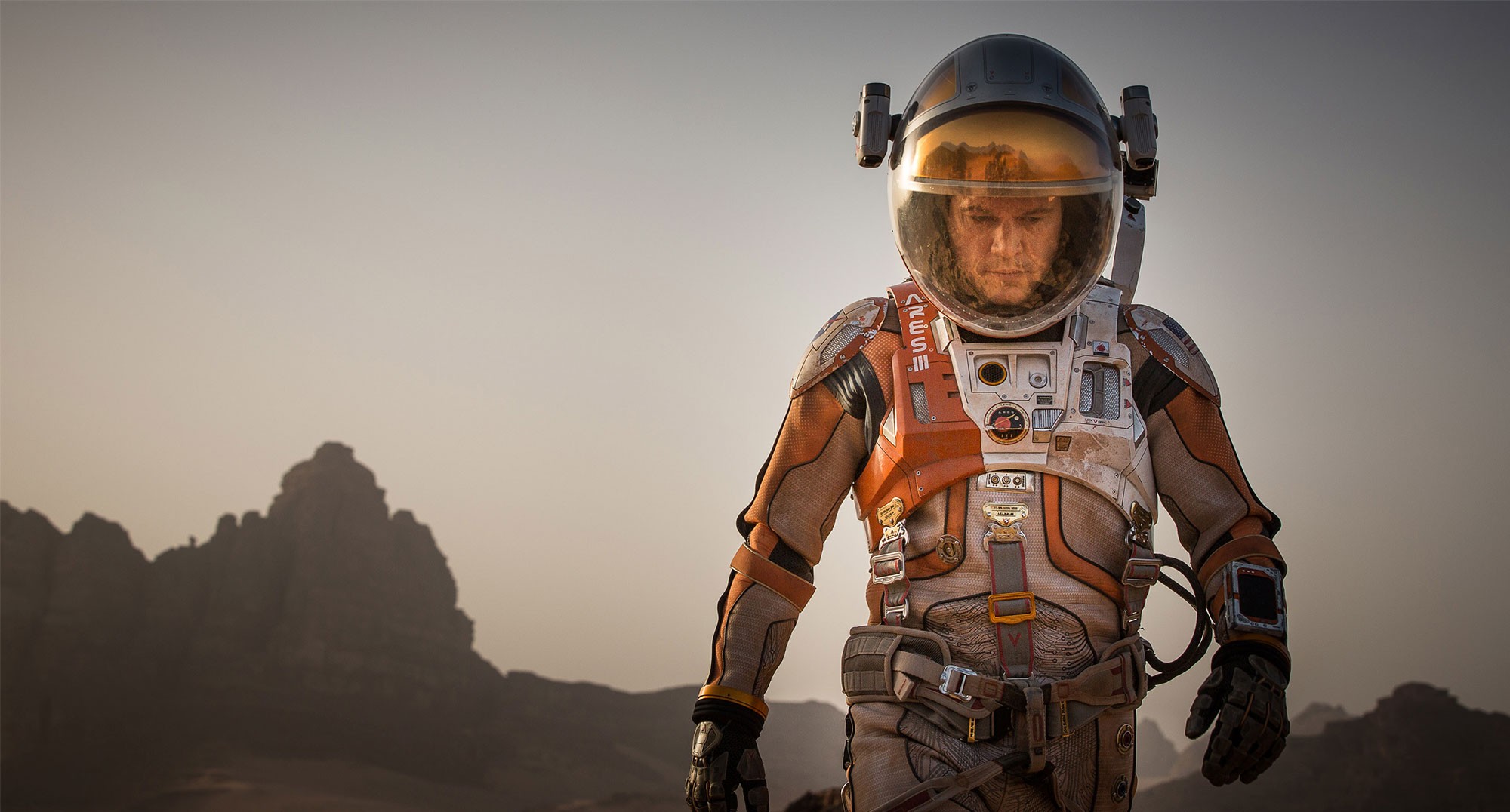
Based on the novel of the same name, The Martian tells the story of the Ares III crew, an astronaut team sent to scout and research the planet Mars. While there, the team gets hit by an intense sand storm and is forced to initiate an emergency evacuation from the planet. While making their escape, however, one of their teammates, Mark Watney (Matt Damon), is struck by debris and separated from his team. Believing he was killed, his teammates board the ship and launch away from the planet.

The Ares III team forgot to account for one thing, however. Mark Watney is played by Matt Damon, so of course he’s going to survive. He didn’t last through war zones, conspiracy theories, and elaborate heists just to let one planet do him in.

Now alone on a planet that is incapable of sustaining life, Mark Watney needs to figure out how to survive and eventually escape from the planet Mars.

This film is directed by Ridley Scott. You can see that as either a good or bad thing depending on what part of his filmography you’re looking at. It’s true, he’s known for science-fiction classics including Alien and Blade Runner, as well as the Academy Award-winning Gladiator. But in recent years, he’s also been responsible for a number of duds. For example, has anyone seen, and liked, Robin Hood, The Counselor, and Exodus: Gods and Kings?

Well, don’t worry dear reader: Scott is back in his prime, and he orchestrates his environments beautifully here. However, I don’t think it’s necessarily just because of him. This world was crafted from the mind of author Andy Weir, who before writing The Martian was a software engineer for Sandia National Laboratories, AOL Inc. and Blizzard Entertainment. When he originally published The Martian on his website, he conducted extensive research on Mars’ geography, astrodynamics, and botany to make the book as scientifically accurate as possible.

By the time Ridley Scott and writer Drew Godard read the book, they didn’t have to adapt it so much as reproduce it.

The thing I love most about The Martian is the research that went into it. When it starts, you think this is going to be another survival story in space, not too dissimilar to Gravity or Apollo 13. The surprising thing, though, is that The Martian isn’t so much thrilling as it is fascinating.

Picture being stuck on a planet with no water, no oxygen, and no food. Seems hopeless, right? And indeed it is, but Watney was trained for environments like this. He adapts. He learns to deal with what he is given. So how does he react to having no water, oxygen, or food? He creates his own water by super-heating Mars’ humidity, he tears apart NASA machinery to stockpile on oxygen resources, and he learns to artificially grow his own potato garden by planting them in (don’t vomit) his own feces.

These are just a few of the problems Watney faces in the film. How does he create transportation? How is he going to communicate with NASA? What does he do if a sandstorm blows open a hole in his space station? What if his crops suddenly die out? What if he runs out of oxygen? What then?

This is how the film builds tension: by throwing impossible survival situations at our poor hero and watching as he dissects for a solution. Does his methods get outlandish? Of course they do, but they are reasonably outlandish, and that’s because of the reality Weir grounded Watney in while writing his novel.

Scott’s visual prowess lends well to the film’s scientific applications. In terms of scale, this film operates on a smaller budget than his other recent films (Robin Hood and Exodus: Gods and Kings’ budgets were $200 million and $145 million, respectively. The Martian’s was $108 million). Yet, in comparison, I’m inclined to say this is his most visually authentic film yet. The reason is because of Scott’s use of practical effects. For science-fiction films, it’s so easy to place your character in front of a blue screen and plaster generic Mars footage in the background. That wasn’t good enough for Scott. For the background alone, he went and filmed the production in the Wadi Rum Valley in Jordan, which has the appropriate sandy landscapes and shade of red that is accurate to the geography of Mars. He constructed 20 sets for the many areas Watney traverses. His production crew grew legitimate potato crops so they could capture the process of photosynthesis on film. For any other director, they would have settled for the easy way out, plastering CGI around your actor and having them react to what isn’t there. That wouldn’t do The Martian justice. Scott knew that and created the best visuals possible for a movie that deserved it.

I have one gripe with the film, and that is its climax, which ironically is supposed to be the high point of the film. I can’t say exactly what happens with the end, but I will say it went on for too long. By the time we arrive at the climax, we know what’s going to happen to Watney. What kind of a movie would this be if it ended any other way than what we were expecting? The thing is that Scott treats us as if we’re too oblivious to it, and he draws it out to a ridiculous length in an attempt to further thrill his audience. It doesn’t work. By the time the ending rolled around, I was looking at my watch, wondering how much longer this scene was going to drag out. Climaxes aren’t supposed to do that. They’re supposed to keep you further engaged with the film: not waiting, impatiently wondering when its going to end.

So does Mark Watney survive? You tell me. He is played by Matt Damon.

Tagged , , , , , , , , , , , , , , , , , , , , , , , , , , , , , , ,

“STRAIGHT OUTTA COMPTON” Review (✫✫✫✫)

The biography of the boyz in the hood. 

Perception is reality.

That’s a motto my newsroom lives and dies by. That’s also a truth that the boys from Straight Outta Compton live and die by. The only difference between us is that we experience it figuratively: they experience it literally.

We witness this early in Straight Outta Compton; as early as the first scene, in fact. Eric Wright, a.k.a. Eazy E (Jason Mitchell) confronts his cousins, who hasn’t paid him yet for the dope that he sold them a few weeks ago. Suddenly, like an Earthquake striking a town, the police ram into the house and start raiding it, arresting any African-American they can find in there. E slips out of the window and onto the roof just in time. He’s survived. For now.

We switch to a less tense scene. Andre Young, a.k.a. Dr. Dre (Corey Hawkins) is sitting on his bedroom floor, listening to classic funk and R&B records on his record player. Dre isn’t like the others in the streets. He doesn’t want to sling dope or be in a gang. He just wants to produce beats and music: a mozart to his suburbs.

His mother Verna (Lisa Renee Pitts), however, isn’t so enthused about his career path. He has a family and a daughter to care for, and he isn’t going to do it sitting on the floor listening to a record player, DJ’ing for a club at night. Dre, however, has his mind set. His future doesn’t lie in cleaning toilets and taking fast food orders. It lies in a DJ mixer and a pair of headphones. Dre knows what he needs to do.

Meanwhile, on the other side of Compton, O’Shea Jackson, a.k.a. Ice Cube (played by his own son, O’Shea Jackson Jr.) is sitting on a bus waiting to go to school. He sees the white kids in another school yard, all dressed in nice clothes, all with newly-bought school supplies and slick cars. Meanwhile, Cube sits in his creaky bus seat, looking at his clothes he probably wore yesterday, and his worn pencil and notepad, which is the only school supplies he has.

He takes his pencil and notepad and starts writing.

These three men, alongside Lorenzo Patterson, a.k.a. MC Ren (Aldis Hodge) and Antoine Carraby, a.k.a. DJ Yella (Neil Brown Jr.) make up the notorious hip-hop group N.W.A. The last two words stand for “With Attitude.” You can imagine what the letter “N” stands for.

Here is a film that, by any standards, is morally despicable. I go on and on in some of my reviews how movies are either incredibly violent, shamelessly sexual, or blatantly vulgar. This movie is all of those things and more. F-words fly out of their mouths like bullets in an uzi. Nude and scantily-clad women flock to these rappers in herds. In some scenes, they engage in sexual intercourse with many attendants watching, all with drugs and alcohol present. Police and gang violence is also present in the film, with crips, bloods, and officers shoving, punching, shooting, assaulting, and harassing each other in very violent, confrontational fashions.

Do not be fooled. This is not an easy film to watch, and if you don’t have a strong moral compass, you will get lost in the violent, sexual, promiscuous, profane, and blatantly explicit content you will find in this motion picture. If you hate hip-hop, you will hate Straight Outta Compton.

That being said, Straight Outta Compton is one of the most compelling films I’ve seen so far this year. The movie is more than the problems it poses. In fact, I’m happy that the film shows the content that it does in the film. It shows the destructive lifestyle these people experience, both on and off the streets, and they confront very real issues that hits them hard at home and at heart. The most significant issue that the movie covers is, of course, police violence. In one of my favorite scenes from the film, one of the police officers that was harassing these young men was not white, but black. My jaw dropped as he continued to berate these men as they were walking away: “Listen to your master!” he said, referring to their white manager.

What I love most about this movie, though, is that it isn’t biased. It isn’t pro-police or anti-police or pro-gangs or anti-gangs. It shows the ugliness of every side of Compton, whether it exists on a badge or on a bandana. Police cruelty is an obvious focus of the film, because it’s a recurring theme in hip-hop and rap culture. I was pleasantly surprised, though, to find at how much the film delved into hood culture and how damaging it is to these young men’s lives. The biggest instances of cruelty came from record producer Suge Knight, portrayed here by R. Marcus Taylor, whose business tactics include physical intimidation, humiliation, fear, confrontation, and violence. If the movie is anything to go by on how the real events transpired, Suge is a monster. He is painted as nothing less than the Godfather of suffering in this movie.

The parallels this movie draws on is ingenious, and director F. Gary Gray is exemplary in realizing the African-American struggle in a poverty-stricken neighborhood and in their aspiration to escape from it. Jackson does very well in portraying his father, and demonstrates the same snarl and attitude with such accuracy that it made me laugh at how similar he looked to his father. Hawkins is passionate and driven in portraying Dre, and while he physically looks smaller than the real-life Dr. Dre, his performance and his versatility in emotion more than makes up for lacking in physical similarities.

The greatest performance, however, comes from Jason Mitchell. In hindsight, he is the character with the most problems. He’s egotistical, he objectifies women, he betrays his friends, he resorts to violence, and he flourishes in the most destructive lifestyle as he bathes himself in a plethora of drugs, alcohol, and sex. In comparison to his N.W.A. companions, he is the most flawed character. But with his flaws comes his emotions to those flaws, his own moments of self-reflection that makes him think back at his decisions, his career, and the life that he’s trapped in. E goes through many emotions in this film, from fear, to anger, to happiness, to sadness, to heartbreak, and Mitchell portrays all of those emotions perfectly. If he doesn’t deserve the Academy Award for best supporting actor, he definitely deserves a nomination.

But at the heart of this movie is the struggle, the struggle that these five young men go through together, apart, individually, and inseparably. Their struggle being not having enough money. Their struggle being having too much money. Their struggle of not having a place in the world, and their struggle of what to do after establishing their place in the world. Like hip-hop, this movie will stir some major controversy for its content and for what messages it sends to its younger viewers. But it’s important to understand that this movie doesn’t set out to prove who is right and wrong. This movie sets out to show a reality. This movie sets out to show their reality.

Tagged , , , , , , , , , , , , , , , , , , , , , , , , , , , , , , , , , ,

“MISSION IMPOSSIBLE: ROGUE NATION” Review (✫✫1/2)

More like a city, or a gated community.

I’m really starting to get sick of these action movies. I know, I know, how do I get sick of action? Well, have you ever seen a television episode over, and over, and over again to the point where it frustrated you just to look at it? That’s where I’m at with these action movies that are getting recycled summer after summer after summer.

I was really hoping Mission Impossible: Rogue Nation wasn’t going to be another recycled action pic. Truthfully, I wasn’t expecting it. The film is at a 93% from critics on RottenTomatoes, while users rate it at a 91%. Metacritic users rate it an 8 out of 10. Cinemascore polls it at an A-. Everyone around me seems to be fervently enjoying the action romp that is Mission Impossible. Everyone, that is, except me.

So what happened? Simply put, I think audiences were expecting something different from me. I’ve seen four of these movies now before watching Mission Impossible: Rogue Nation, and with each one, I got something different. The first Mission Impossible pitted a younger Ethan Hunt against two opposing spy agencies, along with the gravity of seeing his entire team get killed on a deadly mission. The third Mission Impossible found Hunt breaking out of retirement to rescue his wife, who was held captive at the hands of a cruel terrorist threat. The fourth Mission Impossible found Ethan dealing with his wife’s death after the events of MI3. We won’t count Mission Impossible II, because that’s not a real Mission Impossible movie.

With Mission Impossible: Rogue Nation, Ethan Hunt (once again, portrayed by Tom Cruise) is pitted against both his own government and yet another secret spy agency named the Syndicate, comprised of insurgent IMF agents labeled as either missing or dead. That’s it. He has no personal investment in the story, no driving emotional force that focuses on him and him only. At one point in the movie, one of his closest friends gets kidnapped by the syndicate and he starts freaking out about it. Right. How many times did someone get kidnapped in your other movies, Ethan?

His supporting characters includes most of his crew from the fourth Mission Impossible. Ving Rhames is back as Vincent, returning once again to help Ethan Hunt since their first mission in the original Mission Impossible. The comedic relief Benji is once again portrayed by self-employed funny man Simon Pegg. Jeremy Renner returns as William Brandt, acting as Ethan’s voice of reason against all of his crazy ideas of stunts. Considering Cruise does all of his own stunts, I think Renner needs to be his voice of reason off-screen as well.

The first thing you need to know about Mission Impossible: Rogue Nation is that the visuals do not disappoint. The one thing every movie in the series is most known for is its spectacle, and Rogue Nation keeps the tradition going strong. In one fight scene early in the film, Ethan was fighting a swarm of syndicate agents while handcuffed at both his wrists and ankles. In another, he’s quietly struggling against a sniper on top of a German opera production while the performance is still going on. My favorite is probably when he has to hold his breath under water for six minutes in what is essentially an underwater hard drive as he switches out two data disks. It’s important to note, Cruise actually trained with a diving specialist in order to hold his breath under water for three minutes. The sequence we see in the film was actually shot in one take with no edits.

The stunts we see in the film are impressive to say the least. The danger with a fifth entry, however, is that I’ve been impressed four times already. Whatever stunts are to come, I’m already expecting. And since I’ve seen these crazy stunts in four movies now, the effect is dulled before I even see it.

For instance, the big stunt people were excited for in this movie specifically was a sequence where Cruise is holding on outside of an airplane while it is taking off. Impressive as it was, it was the very first scene in the movie. Since I’ve already seen the trailer, I know Cruise survives this sequence, otherwise why would we even have a movie? How am I supposed to feel tension and excitement in a scene where I already know what’s going to happen?

The cast is appropriate, but ineffective. They serve the same roles they’ve done from other movies and that’s about it. How is Tom Cruise as Ethan Hunt? The same he’s been for four movies now. How is Jeremy Renner? About as good as he was in Ghost Protocol, except now he’s less interesting because he doesn’t have the investment and guilt he had in Ghost Protocol. Pegg is the same. Rhames is the same. The only characters that are different are the new characters, which includes its baddie played by Sean Harris and its discount Bond girl played by Rebecca Ferguson. Again, what do these characters have to offer that we haven’t seen before? The late Phillip Seymour-Hoffman did a better job manipulating and pushing Ethan past his limits in the J.J. Abrams-directed Mission Impossible III than Harris did in this movie. And Ferguson? Did she not see Emmanuelle Béart in her brilliantly deceptive performance in the original Mission Impossible?

I caught myself saying one thing over and over again during the film: “I’ve seen this before.” For a movie series that’s lasted past five films, that’s not a good thing. Funny, this movie is written and directed by Christopher McQuarrie, who is responsible for writing The Usual Suspects and Edge of Tomorrow and directing Jack Reacher, all films with their own unique interest and personality. Now he has made Mission Impossible: Rogue Nation, and like Ethan’s assigned missions, his movie blew up in my face after it gave me what it was supposed to.

Tagged , , , , , , , , , , , , , , , , , , , , , , , , , , , , , , , , , , , , , , ,

“MISSION IMPOSSIBLE: GHOST PROTOCOL” Review (✫✫✫1/2)

Pray for Tom Cruise’s sanity.

There is something seriously wrong with Tom Cruise if he is not pissing his pants while scaling up the world’s tallest building in Dubai. In Mission Impossible: Ghost Protocol, he shows he’s more daring by stumping a feat that he matched in MI2 where he free-climbed up a canyon wearing nothing but a safety harness. This time, he’s climbing up the Burj Khalifa building in Dubai, which happens to be the world’s tallest building at a whopping 829 meters. That’s the equivalent of three Eiffel towers.

What is wrong with him?

This feat, among others, demonstrates that Mission Impossible: Ghost Protocol is by far one of the most visually spectacular of all the Mission Impossible movies. It’s also one of the more entertaining ones as well. Like the other Mission Impossible movies, there is never a dull moment, and never a thrill wasted. There is appeal in every scene of every shot, whether it is a ridiculous chase/action sequence, a precise line of exposition, a humorous exchange of dialogue between characters, or Cruise pulling off yet another stupidly insane stunt that would probably kill anyone else. Mission Impossible: Ghost Protocol is the definition of great moviemaking.

Mission Impossible: Ghost Protocol takes place a few years after the events of the third Mission Impossible. Ethan Hunt (Tom Cruise), who was previously happily married to his wife, Julie (Michelle Monoghan), is now incarcerated and in a federal prison in Moscow, Russia. What he’s doing there, we have no idea. Not until later in the movie.

He is broken out of prison with the help of two IMF agents: agents Carter (Paula Patton) and Benji (Simon Pegg), who you would remember as the dorky, but funny, computer geek we saw in Mission Impossible III. They are ordered to break Hunt out of prison for one reason: assistance on an upcoming mission where they have to break into the Kremlin to discover the identity of “Cobalt”, a global criminal who intends to start an international nuclear war in order to issue a new era of peace. His idea is similar to Ozymandias’ in the 2009 film Watchmen: before humanity can be saved, there first needs to be something to save them from. That is, at least, what “Cobalt” believes.

Here is a film where the visual spectacle and design of the film overwhelms the story that is being told. In the two previous Mission Impossible movies, that was a weakness. Here though, I applaud it for its ambition in visual spectacle and for its audacity to impress the audience in sheer spirit and style alone. Besides the climbing of the Burf Khalifa sequence, I can name many other sequences that really impressed me, such as the prison break scene in Moscow, the breaking into the Kremlin, a chase scene between Ethan and “Cobalt” in Dubai, and a final spectacular fight sequence that takes place in a car lot in India. I was so impressed by all of these sequences that I went back to the theater to watch it again just for those scenes alone.

Don’t think for a second, however, that just because the story is secondary to the action, it doesn’t mean it cannot hold up on its own. One thing I was initially worried about with this movie was how it would handle being a sequel to Mission Impossible III, which I thought was a fine way to end the franchise on a happy note. How they tie that movie into this one is brilliant, and there are many moments where we can pick up what happened to Ethan and Julie in between the events of MI3 and Ghost Protocol. This is where the film’s emotional appeal comes from. Ethan is trying to recover from what happened with him and Julie in the past, and as husbands and lovers, we can sympathize with Ethan and his problems. It isn’t tear-wrenching, but it doesn’t need to be. It gets a response from its viewers, and it doesn’t need an explosion and a falling building to get it. As a movie that is action-focused, it impresses me that the movie focuses on all the areas that it needs to: not just the ones that will bring it the biggest bucks.

Cruise, of course, is as slick, cool, and crazy as he always is, and comes back to this movie with the same charm and charisma that made him an icon in the original “Mission Impossible” movies. Paula Patton, who is most known in supporting roles like “Déjà Vu”, “Precious” and recently “Jumping The Broom” plays here yet another supporting role who is just as effective in other movies as she is here. She is smart, ambitious, and incredibly passionate, who puts in everything she can into every shot. And, if I may say so, she looks damn good while doing it.

Two actors who I felt had great presence in the film: Benji, played by Simon Pegg, and a new character named Brandt, played by Jeremy Renner from The Hurt Locker. I loved both of them in this movie. If Cruise and Patton provided the action-packed, exciting moments in the movie, these two provided the comedic relief. I can remember countless lines of dialogue from them both that made me and everyone else in the theater laugh. One especially funny scene was basically a re-enactment of the iconic dangling scene from the first Mission Impossible movie. Was it exciting, suspenseful, and nerve-wracking? Yes, but Benj’s oblivious comments combined with Brandt’s agitated responses culminated for a very funny moment that started off very unnerving and heart-pounding. Few films have the capacity to be able to switch from one tone to another; this film does it with surprising efficiency.

Perhaps the most surprising thing about this film is that this is the director’s first live-action film. Director Brad Bird is famous for animated critical successes such as The Iron Giant, The Incredibles, and Ratatouille, but no live-action films prior to Mission Impossible. How was he able to make this and make it look so amazing? Mission Impossible: Ghost Protocol is visually spectacular, sharply humorous, and relentlessly spirited and invigorating. It may not be the best Mission Impossible, but it is definitely the best sequel.

Tagged , , , , , , , , , , , , , , , , , , , , , , , , , , , , ,

“MISSION IMPOSSIBLE III” Review (✫✫✫)

Your mission, should you choose to accept it. 

Finally, we can forgive Tom Cruise for the disaster that was Mission Impossible II. This is the perfect example of a solid action movie, a film that has suspense, excitement, romance, and intrigue: a Hollywood blockbuster that has a nice balance of everything you can ask for. There is a moment in Mission Impossible III where we feel for Ethan Hunt not as another movie action hero, but as a human being, who has emotions and worries that any other normal human being would possess. The way Cruise portrays him in this movie is very realistic. Think about it: if you were out there, stealing nuclear devices, kidnapping black arms dealers, and saving the world every ten seconds, wouldn’t you be worried about your wife who knew nothing of your double life back at home?

Apparently now retired, we catch former IMF agent Ethan Hunt (Tom Cruise) as he is happily engaged to Julie (Michelle Monoghan) a nurse who is studying to be a doctor. For once, Ethan is experiencing a sense of normalcy. He’s experiencing what it is like to be a husband, and what it is like to love. No explosions, no excitement, and no lives at risk. Ethan, for once, is just a normal guy who is in love with a beautiful woman. He is experiencing happiness.

Happiness for Ethan, however, doesn’t last long, and he soon finds himself shoved right back into the profession he wants to retire from. When told by his superior, John (Billy Cudrup) that Ethan’s apprentice, Lindsey (Kerri Russell) was captured and tortured by criminals while spying on black arms dealer Owen Davian (Phillip Seymour Hoffman), Ethan feels that he has no choice but to go back into the field so he can save his friend from certain demise.

This film, like the other Mission Impossible movies, sports strong performances. The cast is just as strong as any other movie, and I think you can argue that they are the strongest in this one. Cruise, for instance, doesn’t play a paragon of an action hero. Here, he plays a human being, flesh and blood, emotion for emotion, merely molded to look like an action hero. Despite his skills and experience, he can’t be everywhere at once. He can’t be with his wife and take care of her and go off to save the world at the same time.

At some point, whether he’d like to or not, he has to leave one world in order to take care of the other.

I however, wouldn’t leave Julie alone with a creep like Davian for a second if I had known he would pay her a visit. This dude seriously scares me. Phillip Seymour Hoffman, who is a very skilled actor, is perhaps the subtlest in this movie, and plays a ruthless criminal who is just plain mean, evil, cruel, and antagonizing. I have met few antagonists who are as patronizing and as threatening as this guy is. Here is a guy that puts many other movie villains to shame, including those in the first Mission Impossible. Here is a guy who scares you just by staring bleakly into your eyes. He doesn’t need to speak to you: his eyes do all the talking, the eyes that say that he’s going to kill the person you love most, and he’s going to do it in front of you while you’re watching.

This film doesn’t go as deep into those politics of things as some may like it to, but I don’t think it is necessary. Mission Impossible III is fun. I say that as a simple statement, but there is nothing simple about this movie. This movie has earned the title of Mission Impossible from the stunts and visuals alone. I can easily name eight scenes on the top of my head that truly impressed me. Perhaps the most memorable moment for me was an assault between IMF agents and trained ex-military assassins on a bridge near New York. This scene was nerve-wracking, exciting, and worrisome for multiple reasons. Perhaps the biggest is because everything was happening all at once.

Cars were blowing up. Pieces of the bridge were falling apart. Innocent people were caught confused and afraid in the crossfire. Agents were getting shot. Assasins were breaking a prisoner out of an armed jeep. And here is Ethan, running around, avoiding gunfire and explosions, trying desperately to grasp the situation and take control of it. The reason this movie is so successful is because, like the other movies in this series, they push the limits of what they can achieve. There is not a single moment in this film where a thrill is wasted. It’s all there, and it is just as effective as it was in the first Mission Impossible.

The action overwhelms the plot a little bit in the third act of this movie, but other than that, the film is almost perfectly balanced. Director J.J. Abrams and screenwriters Roberto Orci and Alex Kurtzman have found a nice combination involving stellar action sequences, funny dialogue, memorable characters, and heartfelt emotion. Have I mentioned before how I hate emotionless action movies? I have no complaint with Mission Impossible III. Its heart is in the right place, and it knows its characters as well as its action. That’s a rare treatment for action movies. It’s a treatment that should be given to them more often.

Tagged , , , , , , , , , , , , , , , , , , , , , , , ,

“MISSION IMPOSSIBLE II” Review (✫✫)

So ridiculous, it can only happen in a movie.

I wonder what it would be like to write action scenes in a screenplay. Not briefly, mind you, but over an extended period of time. We are so used to these action movies that contain nothing but wall-to-wall action, violence, exploding, shooting, stabbing, kicking, punching, and body-dropping all over the place. Few of those movies have worthwhile plot or dialogue to them, which are the main tools a screenwriter uses when writing their screenplay. I imagine writing an action movie for them would be a nightmare. There’s nothing interesting to write about except for who dies next.

I feel especially sorry, then, for screenwriter Robert Towne, who is normally known for his smart, driving plots found in movies like Chinatown, The Firm, indeed, even the first Mission Impossible, now stuck to writing about nothing but explosions, gunfire, broken bones, ribs, limbs, and jaws, with a little twinge of intrigue placed somewhere in this muck of explosions and action. Mission Impossible II is not the movie that the first Mission Impossible was. The first Mission Impossible had memorable characters, iconic situations, and an in-depth and mysterious plot that kept your interest for every second of that movie. Its sequel Mission Impossible II has nothing the first one had except for its action. The characters, while likable, are also disposable, and lack any emotional conviction to make me really care for anyone for a long period of time. The plot is utterly pointless. Like this movie, it exists only to provide reason for the action, rather than the other way around.

MI2 follows agent Ethan Hunt’s (Tom Cruise) pursuit of an ex-IMF agent named Sean Ambrose (Dougray Scott), who is impersonating Hunt through the same face-masks from the first film. What is Ambrose after, and what does Hunt’s identity have to do with it? He is after a harmful chemical known as “Chimera”, a terrible virus that infects the host in a matter of hours, takes his cells, eats them, and kills the host as slowly and painfully as possible. The doctor who made this is named Vladmir Nekhorvich (Rade Serbegija), and he has been a close friend of Hunt’s for some unknown period of time now (Although he keeps calling him “Dimitri”, for some  reason).

This film is directed by John Woo, who is mostly known for his ridiculous, overly-long, overly-explosive action scenes in his movies. His action scenes are so ridiculous, that he makes Michael Bay shrivel up in his seat. This movie is no exception. Mission Impossible II is just as explosive, outlandish, insane, exhilarating and visually stellar as any other John Woo movie is, and that includes movies such as Broken Arrow and Face/Off.

On one hand, this is a good thing, considering Woo makes some incredible action sequences at some moments in this movie. I remember one scene where Tom is fighting off countless professional assassins in a chemical building while trying to destroy a sample of “Chimera” in the process. That gunfight was insane. Cruise was fighting off countless assassins with grenades, Uzi-Subs, and M-104’s, and what does Tom have to fight off against them? A pistol. It is these impossible odds that stacks up the action scenes to incredible heights, and makes for very entertaining, exciting moments in this movie.

Unfortunately, Woo focuses too much on the action. The difference between this film and his earlier film Face/Off is that Face/Off had a smart, original, and fascinating plot, while Mission Impossible II just copies elements from other action films. Stop me if you’ve seen any of this before: A) A Bond-type action hero that beats bad guys to a pulp and always gets the girl, all while looking incredibly sexy to the female audience with his long hair flowing freely in the wind, B) The hero falling madly in love with a woman who is just as sexy to the male population as the hero is to the female, C) The hero eventually having to rescue the damsel from distress, D) The sinister villain is introduced and narrates a plan so ridiculous, it can only happen in movies, E) An excruciating length of a 40 minute action sequence takes place, F) The villain dies at the end of the movie, and G) The hero and his lover kiss at the end of the movie and walk into the sunset in a “Happily Ever After” kind of concluding tone.

Could that entire paragraph be technically considered a spoiler? No, it can’t, because we’ve all seen that movie before. Is it really so surprising that the villain dies, and the woman is saved from danger at the end of the movie? Is it really so shocking? You might enjoy seeing the same thing over and over again, but I can’t stand it. I can’t stand movies that have a method to it. I can’t stand movies that follow formulas. Granted, I don’t want a movie where the villain lives and the hero dies with his love next to him, but geez, throw something unpredictable in there. Action without point is no action at all. It is just headaches.

That’s not to say that the strong points still don’t hold up to what we expect them to be. I already said the action is amazing, and it is. The music has definitely improved from the last movie, and Hans Zimmer inserts a nice rock twist to the famous theme that made the series iconic by right. Cruise especially shines in this movie just as much as he did in the first movie. In the first sequence he’s introduced in, Cruise makes an impossible rock climb over a canyon in nothing but a sleeveless shirt and a waist pouch with gripping dust in it. Remember something here: that’s not CGI, and that’s not a stunt double. Cruise is doing his own stunts, meaning he actually free-climbed up this deathly-high slab of rock. I think he secretly has a death wish for pulling off stunts as stupidly risky as this, but I hold my respect to him for having the audacity to even think about pulling off a stunt like that. It is moments like that that really impresses the audience, and what I think, makes Cruise a very credible and successful actor. He’s willing to pull off whatever he can in order to impress the audience.

But the strong points of this film pales to the weaknesses. Mission Impossible II is all style, and no substance. It has plenty of action, explosions, and body counts to overwhelm you with, but it lacks interest and consistency in between the action scenes with its stupid dialogue, and its plot that is as incredulous and predictable as any other action film can be. I’ve said before that I don’t mind action films as long as they are good ones. This is an ambitious one, but it’s too similar to other action movies to say it’s a “good” one. In the end, this movie to me is like a magician trying to con you at the circus. He shows off its tricks to you, but when he’s done, he turns and says to you “Sorry kid, no refunds”.

Tagged , , , , , , , , , , , , , , , , , , , , , , , , , , , , , , ,