Author Archives: David Dunn

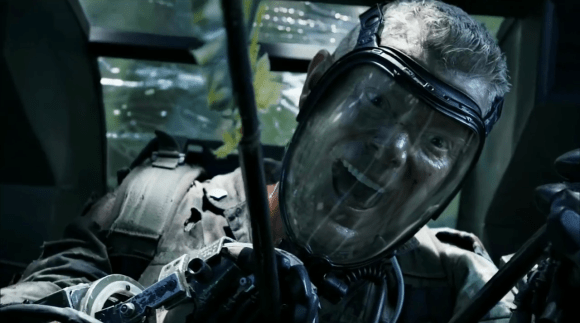
Stephen Lang is going to be in ‘Avatar 2’. And ‘3’. And ‘4’. And ‘5’.

Please tell me this is a joke.

Good God. This is not a joke. It’s real.

Speaking with Empire magazine, writer-director James Cameron made a shocking reveal about his Avatar sequels. Reportedly working on four additions to the franchise, Cameron said that each movie would not feature a different villain, but rather all of them will have the same antagonist: Colonel Quaritch.

You know, Stephen Lang.

THE GUY WHO DIED AT THE END OF THE FIRST MOVIE.

SOURCE: 20th Century Fox

Saying that the sequels will feature a lot of the same characters from the first installment, Cameron said the idea is to place them in different settings in pursuit of this grander journey.

“There’s not a new villain every time,” Cameron said. “Same guy. Same m———- through all four movies. He is so good and he just gets better. I know Stephen Lang is gonna knock this out of the park.”

I–

Wait–

What?

HOW DOES THIS EVEN WORK?!

We watched the guy get two poisonous arrows SHOT THROUGH HIS CHEST and collapse under a giant metal suit.

DOES HIS MIND BECOME AN ARTIFICIAL INTELLIGENCE AND HAUNT THE NA’VI IN THEIR SLEEP???

I’m sorry for being ecstatic, but I am just… so… confused. Cameron has brought characters back from death before in other movies, most notably from Terminator and its sequel. But there it makes sense because the T-800 is a freaking robot. What is Quaritch’s excuse? He’s secretly an undercover angel?

Ultimately, I’m going to try and give Cameron the benefit of the doubt on this one. He’s a well-versed filmmaker and storyteller, and he hasn’t significantly failed us before. But signing on a dead character as the lead villain for all of its sequels? That seems really forced. As a passionate fan for the original Avatar, I’ll admit this concerns me on which direction they’re deciding to take for the franchise’s future.

What do you think? Are you looking forward to Stephen Lang’s return to Avatar, or do you wish he stayed buried beneath Pandora? Comment below, let me know.

– David Dunn

SOURCE: Empire, Collider

Milla Jovovich Cast as ‘HellBoy’ Villain

Things are heating up for Universal’s Hellboy reboot. And what else could be hotter than Milla Jovovich?

A report recently came out that Resident Evil star Milla Jovovich will be portraying the villain for the Hellboy reboot. More specifically, she will be portraying Nimue, named specifically in the project’s updated title, Hellboy: Rise of the Blood Queen. She is joined by co-stars David Harbour as Hellboy and Ian McShane as Professor Broom.

This casting news is… interesting, to say the least. While the Resident Evil films are largely terrible, overblown, cliche-ridden travesties, Jovovich was one of the few highlights in that series and gave the sci-fi zombie-action genre the vicious heroine that it deserved. I’m sure for Hellboy her role will be significantly toned down and given more finesse (with better CGI, hopefully). Still, it will be interesting to see her take on a villain role for a change. This will either be a career maker or breaker for her slate.

The film is being directed by Neil Marshall, most known for “Game of Thrones” and The Descent fame, and is reportedly aiming for an R rating. It is expected to be released in 2018.

– David Dunn

SOURCE: Deadline, Bloody Disgusting

White House, You’re Fired

After a series of shocking firings and resignations, President Donald Trump took his boldest step yet in firing the White House.

No, not the White House staff. The actual White House.

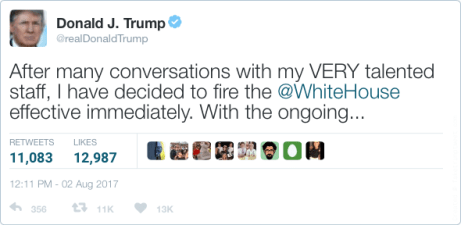
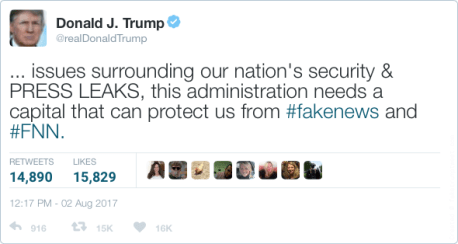
After openly calling the White House “a real dump” earlier this week, Trump fired the White House due to dissatisfaction with the décor and for suspected assistance in leaking to the press. Trump took to Twitter to voice his dissatisfaction with the inanimate object’s performance:

The announcement came after the sudden removal of communications director Anthony Scaramucci, who was employed at the White House for less than two weeks. Other staffers fired or resigned during Trump’s tenure include press secretary Sean Spicer, chief of staff Reince Priebus, FBI director James Comey, national security adviser Michael Flynn, attorney Preet Bharara, director of ethics Walter Shaub, communications director Michael Dubke, and attorney general Sally Yates.

With the administration now in the market for a new place of residence, it is unclear where exactly they plan to relocate during this transition period. However, Russian president Vladimir Putin offered the Kremlin as sanction for the sitting president, releasing a statement saying that he’d “be happy” to help his American comrades during this time.

The White House could not be reached for comment. Wait, sorry, guess I need to differentiate that now. The president’s office could not be reached for comment. The White House building itself, however, is very distraught, saying it wasn’t expecting to get fired after serving presidents for more than 200 years.

Meanwhile, the physical staff inside the White House are equally concerned and confused with the announcement. Chief of staff John Kelly said that while he respects the president’s decision, he doesn’t understand “how you can fire a building, unless you’re physically setting fire to it.” Kelly could not confirm if that was what the president really meant or not.

At a press briefing for the announcement, press secretary Sarah Huckabee Sanders couldn’t give a clear answer when asked about the nation’s future relationship with the White House, saying to reporters in the room “I… I don’t even know anymore.”

The White House is expected to fully vacate from the lawn by mid 2020.

– David Dunn

Disclaimer: This piece is satire and is not an accurate representation of current events.
Tagged , , ,

“DUNKIRK” Review (✫✫)

SOURCE: Warner Bros.

One week, one day, one hour.

It seems sacrilegious to criticize the masterful Christopher Nolan on film. Still, nearly no one else is going to say this, so I will: Dunkirk sucks. In an age where there is no shortage of compelling war dramas, Dunkirk is confusing, lapsed, and misplaced in its direction. If that was painful for you to read, imagine how painful it was for me to type.

Retelling the events of the Dunkirk evacuation during World War II in 1940, Dunkirk follows British soldiers from three different battlegrounds: the land, the sea, and the sky. Exhausted after weeks of fighting in Dunkirk, British and French troops are cut off and surrounded by the German army, shooting down their ships and any support that can come through to rescue them. By every account, the Allies are in a dire situation. It’s not until British citizens, not soldiers, board their own sea boats and venture out themselves to rescue their soldiers. In a hastily collaborated effort to save their families and friends at war, about 80 sailor boats saved the lives of over 300,000 soldiers during the battle of Dunkirk. That is an incredible story, one that I’m sure the British retell with pride and patriotism.

The film stars Fionn Whitehead, Harry Styles, James D’Arcy, Kenneth Branagh, Cillian Murphy, Mark Rylance, and Tom Hardy. I identify the cast by their real names instead of their characters because that’s all you’re going to recognize them by. While strong characters are present in most of Nolan’s wider filmography, Dunkirk’s heroes are mostly forgettable on and off the battlefield. That’s because they meander from crisis to crisis, reacting as they go, only rarely having time to slow down for us to care about them or invest in their plights. If you’re going into Dunkirk expecting a lot of buildup to the character’s backstory, chances are you’re going to be disappointed. They’re not as fleshed out as Nolan’s other cinematic heroes are.

That being said, I understand why this is the case in the context of this film. It’s because Nolan wasn’t trying to write compelling characters for Dunkirk. He was trying to write compelling scenarios, and the character’s purposes were more or less meant as surrogates for us to project ourselves onto in order to be more immersed in the chaos on-screen. It’s been done before in film, and it’s been done well. Eraserhead had a mostly silent protagonist so we could more easily digest the confusion and horror the character was experiencing, while Boyhood had a mostly flat lead just so we could more accessibly relive our own childhood memories and nostalgia.

Nolan attempted to use surrogate characters for the same purposes in Dunkirk, and for the most part, he succeeded. That’s because the details he takes away from the people, he invests into the battlefield, and man are the battle scenes visceral. I’ve heard millions of gunshots from hundreds of other films during my career, yet the first time I heard that loud, ear-piercing BANG in the theater from this movie, I immediately forgot everything else I experienced and was immersed in the moment of tension and paranoia during wartime. There’s a lot of scenes like that in Dunkirk, where the action and sound mixing is so sudden and unexpected that it immediately places you in the moment. My favorite scenes probably happened closer to the beginning, where soldiers were in rows quietly waiting to board a life vessel, only to hear a high-pitched hum slowly crescendo into an ear-piercing screech. The soldiers lifted their heads, their eyes widened in panic, and then they ducked down, bracing for impact. I don’t have to tell you what happens next.

The action, the sound, and the production value are all truly the most immersive elements in Dunkirk, and they all need to be praised for their usage in this film. If Nolan had stuck strictly to those elements and put the soldiers through disaster after disaster in a linear path, then he would have a solid, powerful film on his hands.

The problems come in with Nolan’s writing, more specifically with how he chooses to sequence the film’s events. In the film, the three perspectives Dunkirk focuses on all take place in different scopes of time, with the land being one week, the sea being one day, and the air being one hour. If the film followed their stories chronologically, then you would follow these perspectives in descending order from land to sea to sky.

The issue is Nolan starts and ends these narratives at the same time, with each of their stories being intertwined against each other just so they get equal screen time. This makes the film so convoluted, because even though each of the stories takes place at different times, they’re edited to look like they’re all happening at once. Because of this, similar events will repeat twice, the passage of time will go from night to day and then back to night, and then other times essential transitions are cut out altogether. The editing is so jarring and disjointed that it immediately removes us from the picture, forcing us to put our thinking caps on and piece events together like a puzzle instead of simply letting the experience wash over us.

I know, I know, confusing narratives are Nolan’s staple. Except that with his other films, the complexity leads to a point and purpose for their larger narrative. The dreams layered on top of each other in Inception illustrated the scope and stakes of what the characters were really dealing with. The dueling narratives in The Prestige put us in the middle of this warring rivalry between two conniving magicians. And the reverse narrative in Memento put us in Leonard’s shoes to show us the mental instability he dealt with everyday.

Complex narratives led to a larger payoff with Nolan’s other films. With Dunkirk, however, there is no payoff to the nonlinear storytelling. It’s just there to unnecessarily frustrate us and distract us from the larger spectacle going on.

The critics have more or less made up their minds on this one, however, with many calling Dunkirk one of the greatest war films ever made, with some even saying it’s Christopher Nolan’s best film. I expect moviegoing audiences to be more divided on the topic. Dunkirk sports amazing set pieces and action sequences, and it sure knows how to blow stuff up in spectacular PG-13 fashion. But the investment is gone. The care isn’t present. And no matter how much I want to like this movie, I can’t help but get pulled out of the experience every time another jarring cut removes me from the scene. Better war films, such as Saving Private Ryan or Hacksaw Ridge, understand investment and how to involve its audiences in the tragedies of war. Those films are victories for WWII cinema. Dunkirk is a suicide bomber.

Tagged , , , ,

“WAR FOR THE PLANET OF THE APES” Review (✫✫✫✫)

SOURCE: 20th Century Fox

All hail Caesar.

We fade in on a series of words. Rise. Dawn. War. Perhaps these words could have been used to describe every conflict in human history. In this context however, they refer to the apes, who were once the inferior species on the planet, now becoming so powerful and so many that they’ve pushed humanity on the verge of extinction. The sad part is that it was never in the ape’s intentions to do so. Nature has simply taken its course.

In this penultimate moment building up over the course of several years, War for the Planet of the Apes finds the ape leader Caesar (Andy Serkis) picking up the pieces of his broken life. War with the humans ravages the ape’s home day by day. Apes are dying every week from the attacks. And no matter how much Caesar pushes for peace, the humans keep pushing back for war. Like any general during wartime, Caesar is stuck in a cycle of violence, and he’s powerless to do anything about it.

One day, the ape’s forest home is raided and they are forced to flee from the carnage. The apes band together and find a new, safe location miles away from the humans in the desert. Caesar, however, cannot forget or forgive the deaths that the humans have caused. Now determined to avenge his fallen brethren, Caesar sets out alone to find the man who killed them and finally end this insufferable war.

I never expected to get so wrapped up into a movie about talking monkeys fighting against human beings. I especially didn’t expect to be rooting against my own species. Yet, that’s exactly what happened when I watched War for the Planet of the Apes, an epic and emotional conclusion to this prequel trilogy that functions as a summer blockbuster, a war drama, and a somber tragedy all at once. Few films reach the depth and the complexion that War for the Planet of the Apes reaches, even fewer that belong to a franchise.

First things first: Andy Serkis as Caesar. Holy cow. Serkis has always been a powerhouse actor in motion-capture performances, with his roles ranging from the cowardly and bipolar Gollum in Lord of the Rings to the angry giant monster in King Kong. With Caesar, however, he’s always displayed an intimacy and acuteness to the character that makes him believable not just as an ape, but as a husband, father, and leader struggling with the consequences of war. With Rise and Dawn of the Planet of the Apes, Serkis displays how accurate he can be in portraying animalistic behaviors. With War however, he displays that alongside the emotional gravity that is attached to Caesar, the internal conflict of an ape who longs for peace but is pursuing it through fields of dead bodies, human and ape alike. This is simply a masterful performance delivered by the talented Andy Serkis. If he does not get nominated for an Oscar for this performance, then he deserves a special achievement statuette at the very least.

The character is also written extremely well, just like all of the characters are in this epic. Reportedly sitting in a theater for hours just for the purpose of watching movies, director Matt Reeves and writer Mark Bomback pulls inspiration from any source they could find, from Bridge on the River Kawaii to Francis Ford Coppola’s Apocalypse Now. There really are a lot of similarities between War for the Planet of the Apes and other war dramas. The crippling effects on an established society, the murderous instinct that grows within its soldiers, the post-traumatic stress that comes from battle, even the God complexes that some generals amass victory after victory. This truly is a layered film, filled with a plethora of ideas and conflicts that make all the characters and their struggles interesting. A movie about talking animals has no business being this compelling or thought-provoking, yet War for the Planet of the Apes swiftly earns its title as the best Planet of the Apes movie out of the series.

The visual effects, of course, are as spectacular as they’ve always been. Not just with the explosions and action sequences, but also with its animation of the apes, their movements, and how they look and feel like real mutated animals. Viewers cried foul play a few years back when Dawn of the Planet of the Apes lost the best visual effects Oscar to Christopher Nolan’s Interstellar. I genuinely believe this film has a better chance of nabbing the award than Dawn does, mostly because its job is so much harder. While the effects team still has to adapt the ape’s movements and mannerisms (even more this time, because the film almost entirely focuses on the ape’s perspective), they also have to animate the ape’s strained emotions and facial expressions. Capturing the intimacy of that is hard, especially in animated form. Yet when the ape’s tear up, cry, snort their nostrils in anger, or smile, it feels like a real animal is in front of you performing these movements, not a visual effects artist from behind a computer screen.

You should be aware that War for the Planet of the Apes is not an action film, even though it is marketed to look like one. I saw a lot of kids in the screening I attended, and many of them were restless and anxious because there wasn’t a lot of movement happening on-screen. That doesn’t mean that the film is boring, but it does mean that it takes time to build up its story and illustrate the emotions that characters are experiencing. Because it takes this time to invest in itself, War for the Planet of the Apes ends up becoming a masterful picture, equal parts powerful, emotional, and morally conflicting. I knew there had to be some reason why it’s main protagonist was named after a Shakespearean tragedy.

Tagged , , , ,

Disney Rolls Out The Magic Carpet For ‘Aladdin’

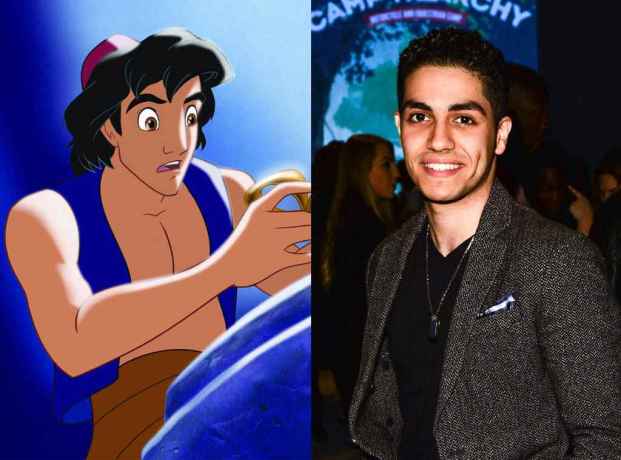
A whole new world is opening up for Disney, and it’s coming in the form of Mena Massoud.

A lot happened this past weekend at D23. Stan Lee, Oprah Winfrey, and Mark Hamill were awarded Disney Legends, new footage of Avengers: Infinity War and Kingdom Hearts III was revealed, and they even revealed a new Star Wars theme park opening at Disney Land.

SOURCE: Celebrity Insider

However, of all of these developments, perhaps none was more major than the casting announcement for Disney’s upcoming live-action remake of Aladdin. After reportedly struggling to cast the title role for more than four months, Disney announced that Canadian actor Mena Massoud was cast as Aladdin, Naomi Scott was cast as Jasmine, and Will Smith was cast as Genie.

This casting news is significant for quite a few reasons. First of all, with Massoud being of Egyptian descent and Scott being of Indian descent, they both physically fit the profiles perfectly for Aladdin and Jasmine alike. Considering more than half of Hollywood films are whitewashed (See Ghost In The Shell, Prince of Persia, Argo, etc.), it’s refreshing to see Disney expanding upon diversity while at the same time staying true to the source material.

Also, you’ve probably never heard of Massoud or Scott outside of this announcement. That’s because Disney specifically aimed for lesser-known talent for their leads, and Massoud and Scott have both had limited exposure in the industry. Massoud was most known for playing a supporting role in the 2015 mystery series “Open Heart”, while Scott was most known for portraying the Pink Ranger in this year’s Power Rangers. Seeing Disney give these breakout stars a shot like this really heartens me to the future of their live-action remakes, showing that not only are they expanding on their ethnic representation, but also on their talent as well.

Still don’t know how I feel about Will Smith playing the Genie though. If he doesn’t break it down and perform a rap like “The Fresh Prince of Bel-Arabia” or something, I’m going to be extremely disappointed.

What do you guys think? Are you excited for Disney’s casting announcement, or do you want to rub the magic lamp so you can wish this development away? Comment below, let me know.

– David Dunn

SOURCE: Variety, Access Hollywood

“SPIDER-MAN: HOMECOMING” Review (✫✫1/2)

The spectacular Spider-millennial.

In the day and age of the modern superhero, Spider-Man has always been for fans of many ages. The Tobey Maguire movies were for the adults, while the Andrew Garfield movies were for teenagers. The third actor to reboot the franchise for the second time in less than 10 years, Tom Holland now swings into theaters with Spider-Man: Homecoming, a version that’s sillier, more lighthearted, and definitely aimed at the kiddos. You’re welcome to read that as either a compliment or a criticism. 

After tussling with Captain America and crew in Captain America: Civil War, Peter Parker (Tom Holland) is sent back to Queens by Tony Stark (Robert Downey Jr.), who says he’ll call him when he’s ready for his next mission. Two months later, Parker is still sifting through boring high school life as he continues to go to class, get picked on by bullies, blush around cute girls, and wait eagerly for the school day to end. When the bell finally does ring and he’s out of school, he rushes towards the closest street alley he can find, suits up in his nifty new suit designed by Stark, and swings into action as your friendly neighborhood Spider-Man.

The first thing I want to point out here is that I like Tom Holland a lot. Perhaps more than any actor before him, Holland embodies the characteristics of both Peter Parker and Spider-Man to a “T.” Peter’s social awkwardness and nerdiness, his integrity and good intentions, his black-and-white sense of morality and how he wants to make the world a safer place. When he’s out of the suit, Holland is required to portray the adolescent teenager, whose biggest challenges are passing your classes and talking to your high school crush. Holland is down-to-earth and believable in the role and very much feels like the most grounded Peter Parker to date. In the company of Maguire and Garfield, that is no small feat to accomplish.

Of course, Holland is also expected to play Spider-Man as well, and he exercises surprising finesse when he puts on the mask. There was one scene in the movie where a bystander spots Spidey on a rooftop, and he asks him to do a backflip, to which Spidey complies. Knowing that his acrobatics is what helped Holland land the role in the first place, I knew that it was very possible that he performed the stunt on his own, and he didn’t need wire support to do it. Embodying that kind of physicality for the role is what makes him fitting for Spider-Man, and seeing him physically take on the same challenges as the web-slinger puts the audience in Holland’s shoes, making the action feel more immediate and immersive.

Holland was great as Spider-Man in Captain America: Civil War, and he’s just as great as him here. There’s one problem though: Holland is only half of the equation. The other part comes with the director in how he thinks the character should be portrayed. This is where things start getting sticky, because I don’t think director Jon Watts knew exactly how to handle Spider-Man’s second reboot and make him different from previous counterparts. It’s understandable, I suppose. The Maguire and Garfield movies both had their serious and lighthearted moments, and to make Holland stand apart from them might have been challenging without seeming like he was copying other filmmaker’s ideas.

Still, you have to stay true to the character, and there are some changes to Spider-Man here that just plain doesn’t make sense. In one chase scene, Spider-Man is after a getaway van with a pair of weapons dealers in it, and the action feels so clumsy that it comes off as slapstick. Spidey is being dragged along the floor, banging against garbage cans and mailboxes, web-slinging over buildings, crash-landing into pools, and at one point even playing fetch with a dog. The scene felt so removed from the acrobatic action that I’m used to that for a second I felt like I was watching a Looney Tunes cartoon rather than a Spider-Man movie.

Also, I hate that Iron Man is in this movie. Hate, hate, hate it. He’s not in the movie much, unlike the trailers will have you believe, but in the scenes that he is in he immediately takes control and switches focus away from Holland’s Spider-Man. In every moment that Spider-Man is in trouble, Iron Man swoops in to save the day. He falls into a lake, Iron Man saves him. A ship is splitting apart, Iron Man saves him. Imagine if another hero just swept in when Maguire was stopping the train in Spider-Man 2, or when Garfield dived to save falling bystanders off of a bridge in Amazing Spider-Man. Heroes have to answer for their choices and consequences in their stories, and Peter isn’t allowed to experience either in Homecoming. Tony didn’t have a “get out of jail free card” when he was stuck in a terrorist hellhole in Iron Man. Spidey doesn’t deserve a crutch just because he’s 15 years old.

Everything else from the movie is functional and little else. The writing is uninspired and demonstrates why having a large writing team doesn’t always equal better content (Homecoming had six writers, including Watts). The score by Michael Giacchino is fun and upbeat, but lacks the dramatic overtones that is prevalent in his previous compositions. And the visual effects are… inconsistent. Some parts look amazing, like when Spidey and the super villain Vulture (Michael Keaton) are fighting on top of the Staten Island Ferry. Other times they can’t close a door without looking like it’s from a video game. I remind you that Marvel just made one billion dollars from Captain America: Civil War last year, and this is their follow-up.

In the end, Spider-Man: Homecoming is fun but forgettable. It isn’t unique when it comes to its MCU peers, which is a shame because Spider-Man has many unique elements regarding his story. His immature, reckless use of his powers, the ironic tragedy surrounding his choices, his loyalty to the loved ones he cares about, the idea that even small people can become big heroes. All of that is shoved to the side in the place of cartoonish action where our young hero zips, zooms, and trips over himself when he doesn’t have a responsible adult to chaperone him. This was supposed to be a triumphant return to form for the character: his homecoming. Ha. More like the player’s bench.

Tagged , , , ,

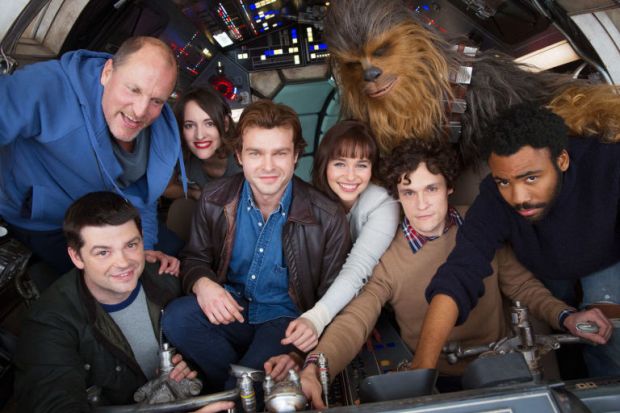
Han Solo Switches Directors

Whoa. Now that was unexpected.

In a surprise move this week, Lucasfilm fired directors Phil Lord and Chris Miller from the Han Solo spinoff movie, citing creative differences as the primary motivator. Lord and Miller, who previously directed 21 Jump Street and The Lego Movie, were reportedly approaching the film in a loose, improvisational comedic style, while Han Solo producers were wanting them to strictly follow what was on the script page.

In short, the “creative differences” were that Lord and Miller wanted to be creative, whereas Lucasfilm didn’t want them to be.

Yesterday, their replacement was announced as Academy Award-winning director Ron Howard, most known for films such as Apollo 13, The Da Vinci Code, Frost/Nixon, and A Beautiful Mind. Howard is to oversee the remaining four weeks of filming with an additional five weeks of reshoots.

“I’m beyond grateful to add my voice to the Star Wars Universe after being a fan since [1977],” Howard tweeted. “I hope to honor the great work already done and help deliver on the promise of a Han Solo film.”

SOURCE: Walt Disney Studios Motion Pictures

Few things to note here. First of all, I have uncompromising support in Ron Howard and his abilities to direct Han Solo. From Night Shift all the way to Rush, Howard has been a mostly consistent filmmaker with expertise on directing both actors and on-set production. To me, Ron Howard directing a Star Wars movie is the stuff of dreams, and I’m very excited to see where exactly this will lead for both the franchise and Howard alike.

That being said, with how viciously things ended between Lord, Miller, and the film’s producers, I am concerned with how much influence the studio has over Han Solo and how that might affect production. Studio interference has been a major problem in Hollywood for a long time now, from Alien 3 all the way to the most recent Fantastic Four. When filmmakers have this sharp of a disagreement on their properties, that doesn’t usually spell out a good sign for the production overall.

Also, it’s especially strange that they just now decided to fire Lord and Miller when they’ve been working on the film for five months. There’s been other productions in the past where they’ve changed out actors, writers, cinematographers, even composers in the middle of filming. But switching out directors halfway through production is extremely uncommon. With Lucasfilm making that decision almost near the film’s completion tells me that they never had a grounded conversation with Lord and Miller on where exactly they intended to take Han Solo. And if the producers don’t have a clear idea of what their film is supposed to be, then usually no one does.

What do you think? Do you think the director switch is a good thing for Han Solo, or should Lucasfilm have kept on Lord and Miller? Comment below, let me know.

– David Dunn

SOURCE: The Hollywood Reporter, StarWars.com

“WONDER WOMAN” Review (✫✫✫✫)

SOURCE: Warner Bros. Pictures

Superman’s got nothing on this woman.

In an industry as sexist as Hollywood, Wonder Woman is a blessing both to the cinema and to gender equality, a film that propels its female protagonist as not only just as capable as the men around her, but in many scenes, is better suited for more difficult tasks. Even before watching the movie, Wonder Woman has faced scrutiny just for being a female superhero in a male-dominated genre. How is it that by 2017, we’ve already had six Batmans, three Supermans, Spider-Mans, Hulks, and Punishers, but we’re just now getting our first Wonder Woman on film? If that isn’t an example of under-the-radar sexism in Hollywood, then what is?

In this prequel to Wonder Woman’s debut in Batman V. Superman: Dawn of Justice, Wonder Woman follows Diana (Gal Gadot), an Amazonian born on the hidden island of Themyscira, where hundreds of her Amazonian sisters live, play, and train into fierce warriors. As a child, her mother Hippolyta (Connie Nielsen) tells her stories about how the island was created after Zeus stopped his son Ares, the God of War, for corrupting the souls of mankind. With his dying breath, Zeus created the island that Diana and her Amazonian sisters live on now, and they’ve been at peace ever since.

One day, Diana witnesses a plane crash-landing into the ocean. After diving into the sea to save the pilot’s life, Diana finds out the pilot’s name is Steve Trevor (Chris Pine), and she learns that he’s fighting in a devastating world war to end all wars. Rationalizing that Ares is somehow behind this, Diana suits up in her island’s sacred armor, lasso, shield, and God-Killer sword and sets out with Steve Trevor to find and kill Ares, saving all of mankind from destruction in the process.

If you’ve been keeping up with the DC Cinematic Universe as of late, then you know the series has been struggling for quite some time. Man of Steel, for instance, was extremely divisive among its fans, with a seemingly equal amount of viewers both loving and hating it. Batman V. Superman was just all around terrible and you’d be hard pressed to find anyone that actually did enjoy it. Suicide Squad was equally polarizing, but it at least had some great performances and fun action to go along with it. Overall though, the DCEU has been very inconsistent with their properties and its core fan base is equally questioning their commitment to the series. At this point, the future of the DCEU is looking very uncertain.

The best praise that I can give Wonder Woman is that it works as a rebirth for the DCEU: a clean slate, if you would. That’s because Wonder Woman breathes new life into the franchise, telling an epic story brimming with action, adventure, excitement, heart, humor, and relevance. In a day and age filled with cold, bleak, heartless blockbusters, Wonder Woman is a breath of fresh air we all desperately needed.

The heroic tag-team behind this success is the dynamic duo Patty Jenkins and Gal Gadot, the film’s director and lead respectively. Jenkins, who’s last time directing a feature film was with 2003’s Monster, comes forward here as a master storyteller, handling both visually spectacular scenes and emotionally grounded moments with a surprising amount of finesse. The action, of course, is fast-paced and enthralling, with Wonder Woman charging through German soldiers and toppling over buildings like the aftermath of a Superman battle. Yet, I’m more impressed by the moments leading up to the action, the softer scenes revealing Diana’s character and her finding her place in a constantly shifting world ruled by male conflict and ego.

In her first scenes adjusting to life on Earth, Diana is coerced to try on big, clumpy, awkward dresses to conceal herself in a mostly conservative society. When she accidentally wanders into a war room, all of the men in there suddenly stop conversation to ask why a woman was in their presence. My favorite of these scenes involves Steve’s secretary Etta explaining to Diana what a secretary is. “I go where he tells me to go, and I do what he tells me to do,” Patty says. “Where I come from, that’s called slavery,” Diana responds.

But it isn’t just ideas of feminism and gender equality that Jenkins elaborates upon. This is also an expansive drama on the decreasing human condition, man’s capacity for violence and conflict, and ultimately loss of innocence. Through battlefields and warzones, Diana feels like a child fighting for ideals she believes in, yet are hopelessly obsolete in the face of bullets and bomb fire. If you live in a world where your ideas don’t exist, what do you then? Do you change with the rest of the world, or do you stand firm in yourself, waiting for the world to change with you instead?

Gadot remains emotionally persistent throughout the picture, hitting all of the right notes that she needs to at the right moments. We got an early look at her talents in Batman V. Superman: Dawn of Justice, where she was one of the few saving graces of the picture. Here she is on full display, not only embracing the rough physicality of the character, but also her courage, loyalty, honesty, perseverance, and goodness. She’s not just a strong action hero: she’s a strong character, fleshed out with her own dreams, ideas, aspirations, and insecurities. We need more superheroes as compelling as Wonder Woman in the movies, regardless if they are male or female.

This is quite simply one of the best superhero films ever made, let alone one of the best DC films. I put it right up there with The Dark Knight and Superman II, albeit for clearly different reasons. In a world where our entertainment revolves around chauvinism and sexual domination, Wonder Woman stands proud, strong, and adamant in that women can be just as empowering in our media as men can be. And so it is.

The greatest moment of this picture comes when our heroes are walking through the trenches of No Man’s Land, an explosive hellhole where there’s death and destruction in every which way and direction. In this moment, Diana desperately wants to help the people suffering around her, but the men tell her that it’s impossible. That’s why it’s called No Man’s Land, because no man can cross it. But a woman could, and she did.


Tagged , , ,

“ALIEN: COVENANT” Review (✫✫1/2)

SOURCE: 20th Century Fox

Alien Covenant, kinda.

Before going in to watch Alien: Covenant, I was confused as to whether it was intended as a sequel to the 2012 science-fiction epic Prometheus or just a newly rebooted prequel to the Alien franchise. After I left the theater, I was still confused on what Alien: Covenant was supposed to be, and I’m pretty sure director Ridley Scott was equally confused while making it as well. At different times, Alien: Covenant wants to be a Prometheus sequel, an Alien prequel, and an Alien reboot all at once. In spreading itself thin, it misses all three marks. Although it remains to be intriguing and mildly entertaining, Alien: Covenant fails to stick out much in our minds. The most positive thing I can say is that it isn’t Alien: Resurrection.

Taking place after the events of Prometheus, Alien: Covenant follows the crew aboard the colonization ship Covenant, looking to begin new life on a remote planet called Origae-6. As the crew are traveling, they are suddenly woken up to discover a new planet in the system; one much closer to them that has the same hemisphere and plant life as Earth does. Curious to see if they could safely colonize on this planet instead, the Covenant crew lands on the mysterious planet to investigate, only to discover something that might lead to their violent, blood-soaked ends rather than new beginnings.

With this being the sixth film in the Alien franchise now, it isn’t hard to see why the series is getting tired. Let’s walk through the plots of each of them:

Introduction: Human crew members are in cryogenic stasis on a spaceship heading somewhere, usually with an android accompanying them.

Setup: Something goes wrong, crew members wake up, travel to mysterious planet.

Complication: Crew members discover threatening alien after it kills a few of them, panic ensues.

Climax: Brave female protagonist convinces crew that alien is too dangerous to live and must be destroyed.

Resolution: Bloodshed ensues, alien is killed, at least one crewmember survives, usually the brave female.

In five sentences, I’ve essentially covered what happens in six two-hour movies. That alone should show you how repetitive the series is getting.

But just because all of the movies have the same plots, it doesn’t mean they’re automatically doomed from the start. Look at Prometheus. That film covers the same ground that every other Alien movie has before it, and yet, it feels like a different experience. That’s because it took a different approach to the series and its characters. Alien was a survival-horror experience set inside the claustrophobic setting of a spaceship. Prometheus was an exploration of our origins and how that ties in to greater ideas involving religion and creationism. While Alien: Covenant didn’t have to be as ambitious as Prometheus was, it did have to make itself unique to the rest of its cinematic counterparts. Instead, all it feels like is a retread, and the entertainment value is siphoned from seeing Aliens violently dismember human beings on-screen.

I know Prometheus also had its dissenters, but the strength that movie had going for it was its thought-provoking ideas and how they impacted the characters around them. If you were frustrated by Prometheus, chances are you will not be able to even stomach the implausibilities in Alien: Covenant.

Take, for instance, the first of this movie’s alien pregnancies. They were not done by the Facehuggers in Alien or the Engineers in Prometheus. No, here they are done by black flower pollen flying into one explorer’s nose and into another’s ears. That’s how it’s done now, I guess. Alien had Facehuggers, Prometheus had Engineers, and Alien: Covenant has ear and nose plant sex. At least the porn parody will have plenty of inspiration to pull from.

Some scenes like that are just silly and illogical, while others are just outright bad or laughable. In the first chestburst scene in this movie, an Alien pops out from a guys back and goes on to attack the other crew members on board. Yet, one girl is so bad at reacting that it felt like she belonged in a Looney Tunes cartoon rather than an Alien movie. First she opens the door to the infirmary where the alien was at, and it would have been simple enough to just leave it in there and starve it to death. Then she slips on a puddle of blood right before shooting, and missing, the alien. And just when the alien escapes and starts attacking her, she fires wildly in every which way and direction, eventually shooting a barrel of fuel, exploding and killing herself, her on-board companion, the alien, and destroying the crew’s only means of leaving the planet. The scene was meant to be scary, yet I couldn’t stop laughing from how terribly it was executed.

The conflicting thing about this movie is that while some scenes are done very poorly, others are done exceptionally. Katherine Waterston, for instance, is outstanding as the lead. Early on in her introduction, we grasp a sense of the tragedy the character is facing, and her tearful portrayal of a woman going through loss and anguish shows how hard Waterston tried for this film. Most other actresses would hear they’re being cast in a Alien movie and would just phone in the performance for the spectacle of the visual effects. Waterston put in the extra effort, and she deserves to be recognized as an action heroine alongside the likes of Ellen Ripley, even if the movie doesn’t deserve the same recognition.

I also really liked Michael Fassbender in the movie as well. In Prometheus, he played the manipulative android David, while in Alien: Covenant he plays another android named Walter. I can’t go too much into his character without fear of spoilers, but he shares an interesting relationship with another character that builds into a conflict of duality between the two. In my favorite scene from the film, Walter is speaking to another android and discussing the unorthodox nature of artificial intelligence. From the intelligent dialogue, to the intriguing points raised, to the steady camerawork, to the subliminal differences between the two character’s performances, this was a fantastic scene that demonstrated how great of an actor Fassbender really is. I’m excited to see what he brings in future installments, although I don’t know where exactly you can take the character from here.

The movie, of course, has the best visual effects out of any Alien movie so far. That, however, is slight praise since that’s also the case with any franchise film produced today. The problem is that Scott never centralizes all of the elements together to make a compelling Alien movie, making the series canon more muddled and confusing rather than streamlined and fluid. The script is incoherent and illogical. The editing makes for some disjointed sequences that fails to make the movie consistently scary or interesting. Even the alien, while looking more intimidating than its previous counterparts, fails to invoke the same sense of fear and dread from its previous installments.

In a strange way though, Alien: Covenant accurately reflects Ridley Scott’s career as a whole. Sometimes he hits home runs, like the original Alien, Blade Runner, and Gladiator. Other times his films are catastrophic, like The Counselor or Exodus: Gods and Kings. Alien: Covenant falls in the middle ground, and that’s the best way to describe Scott’s filmography: the middle ground. Not to mention Scott is planning on making four more Alien films after this. I’m sitting here wondering when we’re finally going to get to LV-426. Surely the round trip didn’t take this long to get there.


Tagged , , , , ,