
I think I collectively speak for everyone when I ask “What the hell is going on?” Earlier this year, the Writers Guild of America announced its intention to strike for the first time in 15 years following a fallout of negotiations with their producers. Then just last month, the Screen Actors Guild did the same thing and announced their own strike against the Alliance of Motion Picture and Television Producers. It’s the first time actors have gone on strike in 40 years, and the first time both actors and writers were on strike together in 60 years.
And here I was, thinking COVID-19 would be the most damaging thing to the film industry in the 21st century. Turns out greedy Hollywood producers were the deadliest virus of them all.
What compelled these unions to strike? Like with anything else going on in the entertainment industry, it’s complicated, and unfortunately, neither of them are boycotting just for one singular reason. Both SAG-AFTRA and the WGA have several issues that went on unaddressed by their peers, and it just reached a boiling point where both felt that the only way their voices would be heard is if they stopped working altogether. It’s frustrating, but understandable. The only other actions guild members could take at this point would be to take their lattes and avocado toasts and start throwing them at studio executives. Hell, maybe I’d join em’.
I’ll start with the Writers Guild since their strike has been going on longer. For starters, they weren’t being paid fairly. They never are. The only reason the previous 2008 strike ended was because writers were promised residual payments for television programs streaming online. Even then, that deal came with major concessions, including residual payments only kicking in after a 17-day period and zero jurisdiction over reality TV, animation, and DVD residuals. Still, it was considered a major win for Hollywood writers back in the day and allowed for more union writers to be hired at fairer rates.
I remember that strike when it began in 2007. I was a freshman entering high school, and I was watching my television screens flooded with images of writers and their picket signs. I remember being confused, thinking to myself “They have the best jobs in the world — they get to tell stories! What could they possibly be striking about?” I didn’t understand enough about the struggles of living day-to-day as a writer, and I wouldn’t understand until I watched Daniel Snyder’s phenomenal documentary film Dreams On Spec.

The film follows three aspiring screenwriters as they struggle to get their scripts picked up to be made into movies. Those writers include Deborah, who’s buried under bills and struggling to pay rent, Joe, a middle-aged father who cares for his Autistic daughter, and David, who works as a talent agent assistant. Spoiler alert: the only one whose screenplay gets picked up is David’s, and it was made into the 2006 mockumentary horror film Behind The Mask: The Rise of Leslie Vernon.
Hollywood has notoriously undervalued its writers for a long, long time, so it doesn’t surprise me that this continues to be the case. This has always been baffling to me, because writers are arguably the most important role in any film. They’re responsible for every significant story beat that happens in a screenplay. They’re responsible for crafting the characters, their moods, personalities, flaws, and motivations. They’re responsible for the words they speak and what emotions they experience. They’re responsible for what happens to them and how they react to forces beyond their control. And they’re responsible for the adventure they experience and how they’ve personally changed by the end of it all.
My screenwriting professor used to say “You can make a bad movie from a good script, but you can’t make a good movie from a bad script.” Those words have always resonated with me because those words are true. Everything that goes on in a film revolves around its script. Without it, you don’t have a movie to show, let alone a story to tell.
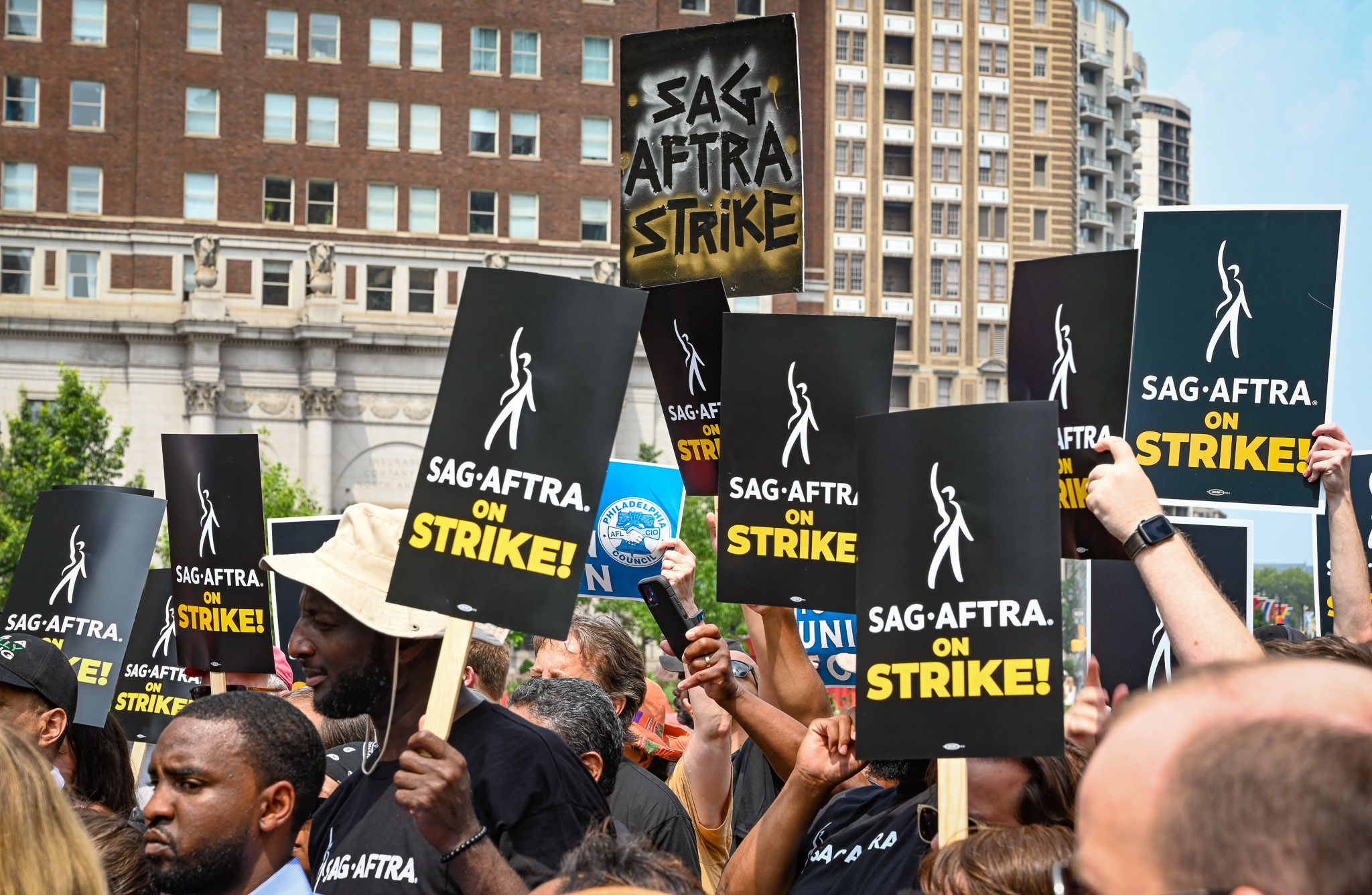
Actors are arguably just as important as writers are. If writers are responsible for what the characters say, then actors are responsible for how they say it and how they bring these characters to life. And bizarrely enough, they too are being undervalued by the Hollywood elites for both similar and different reasons.
For one thing, actors are also not being fairly compensated for residual payments, especially across streaming platforms. How on Earth was this an issue for writers 15 years ago, and the AMPTP still hasn’t learned its lesson? For another thing, SAG-AFTRA members want to limit the use of self-taping auditions since the severity of COVID-19 has died down considerably. This also makes sense not just from an actor’s perspective, but a humanistic one too. I concede that I do conduct phone interviews on occasion, but when I’m interviewing someone for an important story, I always choose in-person meetings. That’s because that personal interaction is essential to understanding who they are and what value they can bring to your story. If I can understand that as a community reporter, how the hell can Hollywood execs not understand this after 30-plus years in the industry?
But the grossest issue by far, and what ultimately led to the SAG-AFTRA striking, was the use of artificial intelligence. You see, one idea the AMTP proposed was using A.I. to scan background actors’ faces, pay them for one day’s work, and after they’ve finished working for ONE DAY, they would relieve them of their duty and use their likeness to replicate background actors. Think about that for a second. They’re trying to remove real people from real film productions and replace them with a freaking program.
Considering background actors are one of the lowest-paid movie jobs by far ($178 per day, according to SAG-AFTRA), the cost savings are minimal, but the consequences are huge. Not only are you slowly phasing out real people working on your production (imagine a film where all of the background extras are the CGI monstrosities from The Flash), but that also means studios would own actors’ faces. If a background actor somehow made a big break and wanted to star in a major blockbuster movie down the road, they can’t because a different film studio would own their likeness. This sounds more and more like a seriously messed up “Black Mirror” episode by the minute, and the scariest part by far is that nobody is talking about this nearly as much as they should be.

Keep in mind that when SAG-AFTRA voted unanimously to go on strike, they weren’t going on strike for billionaire stars like Robert Downey Jr., Samuel L. Jackson, Scarlett Johansson, Chris Pratt, or Tom Cruise. They went on strike for everyone else in their movies, the people you see walking around in the background but never see their faces. People have a misconception that just because they know a few successful Hollywood stars that every actor must be filthy rich and swimming in money, and that’s just not the case. Far, far more people in the film industry are living paycheck to paycheck rather than in these multi-million-dollar mansions that some people fantasize about. That’s also why SAG-AFTRA unanimously voted to strike, because every actor has been there before and they know how brutal the business can be.
Needless to say, these concurring strikes have also resulted in delays across multiple studio productions. Spider-Man: Beyond The Spider-Verse has shut down production, as has the second season of “The Last Of Us.” Mission Impossible: Dead Reckoning Part 2 has also stopped filming, and many upcoming films may be pushing back their releases since actors can’t contractually promote their upcoming movies. The cast of Oppenheimer literally walked out of its premiere the same day the strike was launched. The film to have been affected the most, however, is Deadpool 3. Here is a film that literally BEGAN production right when the writer’s strike started, and it was forced to shut down production only two months in after the actor’s strike was authorized. If at least one joke about either of the strikes isn’t going to be in the final movie, I’m going to be extremely disappointed.
Only God knows how long these strikes will last. The longest-running writer’s strike was five months in 1988, while the longest-running actor’s strike lasted for six months in 2000. The most recent strikes resulted in over $2.1 billion in economic losses, and that was just for three months. The current writer’s strike is about to pass that milestone, so it’s reasonable to assume that the losses will be even greater this time around.
The solution to avoiding greater losses and delays is simple — pay your talent what they’re worth. Their demands are not outrageous. Seriously. If people are rewatching certain movies or binging certain TV series, actors and writers should be fairly compensated for those views because they’re the ones who brought those stories to life. Yes, producers and studios serve a vital role in film production too, but their value only goes as far as the dollar amount they provide. The plain and simple fact is that money alone does not make a movie — people do. And in an industry where the average Hollywood producer makes millions upon millions of dollars, it’s insane to not sacrifice a little bit of that so your writers and actors can live a little more comfortably, or even decently.
Pay your damn writers and actors. Maybe you could fire David Zaslav and use his salary.
– David Dunn
 DAVID DUNN