Tag Archives: Thriller

“DAREDEVIL” Review (✫✫✫)

What is the man without fear afraid of?  

We open on a still, quiet shot, a haunting frame of a rat walking over a pool of blood dripping in front of a church.  As we pan up the window frame, with quick flashbacks cutting in and out as the music crescendos, we reach the top, helicopter spotlights shining on a wounded man in a devil costume grasping onto the holy cross.  This is easily the film’s master shot, and its influence quite possibly lasts throughout the rest of the film, even if nothing else ever comes to live up with this establishing shot.

The man we are looking at is Daredevil, and unless you read the comics, you would never have guessed that he’s blind. Growing up as a young boy in Hell’s Kitchen, Matthew Murdock (Ben Affleck) was the son of former boxer Jack “The Devil” Murdock (David Keith), nicknamed for his brutal fighting style towards his opponents. One day while skating past a construction site, Matt got in the way of a truck carrying barrels of radioactive chemicals when a bar suddenly punctures the metal, spilling the lethal chemical into young Matt’s eyes.

He lost his vision, but what he gained changed him forever. When he woke up in a hospital bed the next day, all of his senses were enhanced to superhuman levels. He could feel the fabrics of his eye bandages without even touching them. He could smell the aroma of bleach permeating off of the tiles in the hallway outside of his room. He could hear the sound of construction work, the cars beeping and the heartbeats of other human beings from miles away. But most impressively, his sense of sound gave him a “radar sense”, allowing him to form images of the people and things that he saw in front of him. He wasn’t just a boy any longer: he became a living sonar.

After witnessing the death of his father (I guess “hearing” his death if you want to get technical), Matt vows to never be afraid of the things he can’t see. To find the killer and bring him to justice. To seek justice, one way or another. To become Daredevil.

Here is a film that has an irresistible sense of style, a movie that takes us through its lavish stunts, choreography, and fight sequences and makes them exhilarating to sit through. It is really exciting, seeing these characters pulling off these crazy, mind-blowing leaps and bounds over buildings, in bars, and on rooftops as they fight each other with lightning-quick movements, attacks and reflexes. It’s even more fascinating seeing it from Daredevil’s perspective, watching bullets fly past him while he slides on railing, flips over tables, and knocks criminals out with his staff and nunchuks. Most would probably view these scenes as silly or preposterous, with characters flying from building to building as if they were in The Matrix. My response? I don’t really care. The fight scenes are choreographed and filmed in a very specific way to where its enjoyable, almost as if the laws of physics don’t matter in a movie like this. You more or less watch it for the joy of seeing the sensational effects rather than criticizing how preposterous and unrealistic it looks.

Oh yes, the action is excellent. Compared to the action, the performances are… inconsistent. Not bad, mind you, just inconsistent, and not all of it is entirely the actors fault. Affleck at least does a good job to keep us interested in between the sensational fight scenes, and even offers some very nice emotional moments where his character experiences both fear and vulnerability. Michael Clarke Duncan, most known as the pure-hearted and innocent miracle-maker in The Green Mile plays here the antonym of that role, a kingpin so foul and villanous that its shocking to see him make the transition. The highlight performance is in breakout actor Collin Ferrel as a hitman named Bullseye, and his presence on the screen is infectious. He is terrifying, his motions, speech and mannerisms forming this character who is so set on making his jobs perfect that he will kill anyone that makes him do something as simple as missing. He is mortifying, and definitely not the kind of guy you want to sit next to on a plane. The only actress I didn’t care much for in this movie was Jennifer Garner, who played a love interest of Matt’s named Elektra, but we’ll get a more into that in a bit.

For simple entertainment, the movie is acceptable. The fight scenes are great, the actors are fitting in their roles and the story advances in a form of pulpy comic book violence, the kind you expect to see when you open a Frank Miller comic and see two superhuman acrobats fighting all over the page.

The problems don’t start at the fight scenes or in its cast: they start at the hands of writer-director Mark Steven Johnson, and that’s a problem because those are two areas that should be the strongest in any film. Johnson, who directed the critically-favorable Simon Birch before this obviously has his “rookie” cap on because the film is so lopsided. It’s so freakingly inconsistent, so much so to the point where I can name an equal number of scenes that I liked side-by-side with the scenes that I disliked.

Do I really need to write out a list? The script switches from serious to silly. So does the acting. The tone can’t decide whether it wants to be dark and dreary or smirking and tongue-in-cheek. I mentioned early in this review that we were introduced with a dark, mesmerizing shot that hooked our attention to the screen. Would you take this movie just as seriously, however, if I told you that there was scene later in the movie where blind lawyer Matt Murdock was kung-fu-fighting against Elektra at a children’s park in broad daylight in public? Probably not, no.

Look, in the eyes of a critic (and I’m not talking about myself), this movie failed. The tone is off-beat, the acting is off-kilter, the scripting is inconsistent, and on that note, so are the visuals. And yet here I stand, giving this movie a marginal positive rating.  Why?  Because I liked it, that’s why. Because I sat down, looked at the movie, compared the good side-by-side with the bad, and ultimately, the good won me over.

I know that won’t be the same case for other viewers, and others are likely to hate the movie for its silliness, for its half-completed visuals, for its inconsistent scripting, filming, editing, and even acting. That’s fine. Different movies appeal to different tastes, and Daredevil won’t appeal to all of them. In the genre of superhero movies, there are many obviously superior to this one,  including the recently-released Spider-man and X-men movies.  If we are going to admit what it is worse than, however, let’s not be forget that Batman and Robin and Howard The Duck also exists. No, that last one was not a typo.
Tagged , , , , , , , , , , , , , , , , , , , , , , , , , ,

“RUSH” Review (✫✫✫✫)

Don’t think.  Don’t pause.  Just drive.  

I couldn’t have thought of a better title for the movie Rush, because that’s exactly what it is: an unstoppable and uncontrollable rush of energy, excitement, and gravitas, a movie that starts on a high note and simply refuses to let up all the way through.  I hear a lot of complaints that there are biographical movies that are more concerned with cashing in on people’s legacies rather than making an authentic account of a person’s true story, such as Jobs or The Iron Lady.  Here is a break from all of that, a refreshing and ideal account of two racers who live every moment of their life trying to figure out how to beat the other guy, while understanding that their symbiotic relationship is what made them both great racers in the first place.

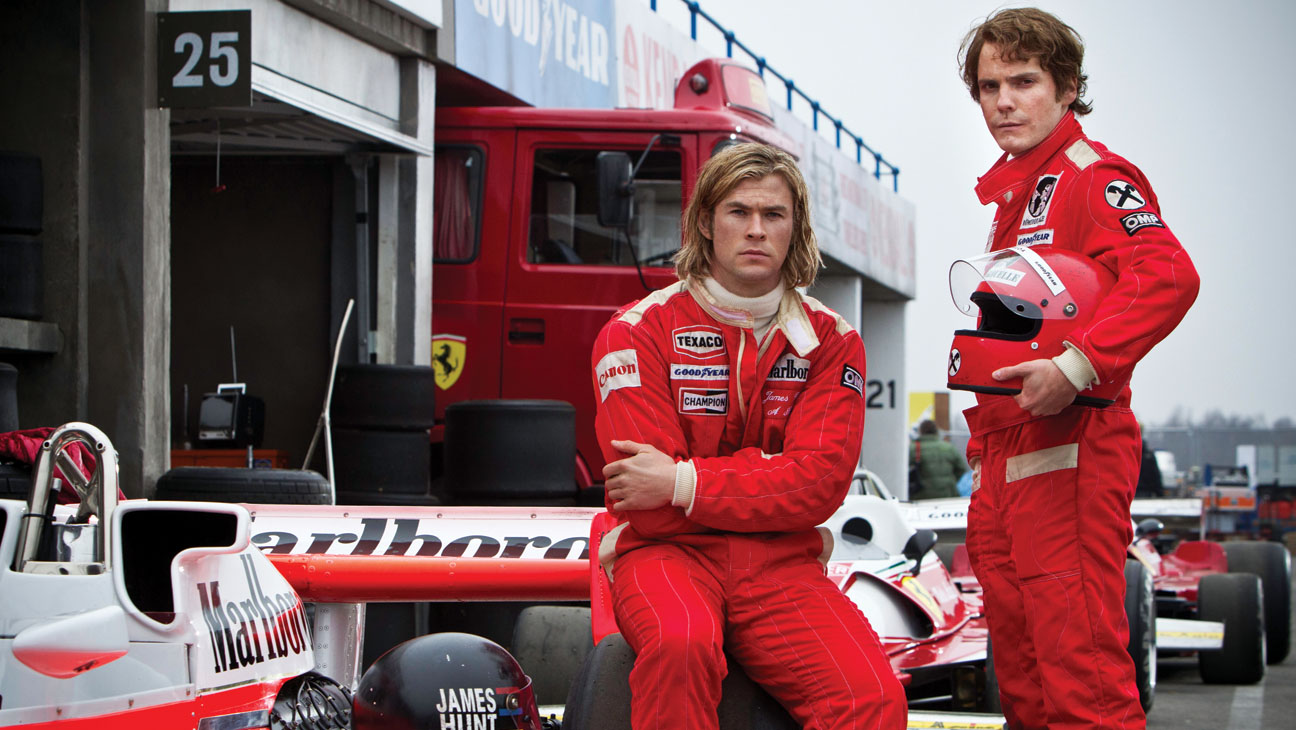
Focusing on the 1976 Formula One Grand Prix season, Rush follows the story of two different racers, both with polar opposite personalities and complexions.  James Hunt (Chris Hemsworth) is a hard-headed racer who races with passion instead of brains, and a playboy who drinks a lot, smokes a lot, and sleeps with beautiful women, a lot.  Nicki Lauda (Daniel Bruhl) is a intelligent, smart, and crafty german who is just as focused and analytical as he is rude and ignorant. The film chronicles the contempt they feel for each other and the mutual respect that makes them strive to be better than the other man.

Before you go and see this picture, I encourage you to go online and google the names “James Hunt” and “Nicki Lauda” and look at their images.  Got it?  Okay, now that you’ve done that, go and watch the movie.

If you actually took the time to open up another tab and look at the images, you will be just as shocked as I was.  Comparing the sight of Lauda and Hunt with that of Bruhl and Hemsworth isn’t comparing them at all: they look exactly like the same characters, from the red jackets around their back to the color and hairstyles that we see on their heads.

I love it when movies do this: when movies are so accurate to the real-life figures that they copy their appearance so accurately, it is nearly impossible to differentiate from them.  We’ve seen this from The Fighter in 2009, and recently from Daniel Day-Lewis in Lincoln.

Here is yet another example of a movie that is compelled by truth and driven by accuracy, pun intended.  Rush is exhilarating.  Exciting.  Edgy.  Anticipative.  Emotional.  True.  Everything about this movie is a heart-pounding, sweat-pouring adventure, and what’s truly impressive is not that the movie makes us feel this way: its the fact that it really happened, and that really director Ron Howard is just documenting it rather than retelling it.

One of the highlights in the film are easily its lead actors.  Not only do Hemsworth and Bruhl look exactly like the people they are portraying: they act like them too, with their rivalry and their edginess apparent in every fraction of a scene.  Sometimes their clashes are funny, like the dialogue bits between Mark Zuckerberg and Eduardo Saverin in The Social Network, while at other times its strikingly serious like the James Braddock/Max Baer rivalry in Cinderella Man.  Whatever the situations, these actors do well at remaining in tense situations and they never, ever break their character.  Hemsworth is energetic, lively, and egotistical as Hunt, a man whose only loves are beautiful women and racing.  Bruhl is equally as egotistical, but he’s got a sly smartness about him you can’t help but appreciate.  There’s one great scene where Hunt calls Lauda a rat and he responds by saying “You think I’m hurt that you call me a rat, Hunt?  Rats are ugly, but they are smart.  Intelligent.  I am proud of that.”

The film doesn’t slow down at their performances, however, and filmmaker Ron Howard (Apollo 13, A Beautiful Mind) and screenwriter Peter Morgan (The Queen, Frost/Nixon) are quick to follow up on the pace of these two fine actors.  The guys who made Fast And Furious could take a hint or two from this movie. Morgan and Howard not only succeed in making the movie exciting and suspenseful through key moments in races, press conferences and private, vulnerable moments when these racers are all by their lonesomes: they’ve managed to make it gripping and relevant, a grounded drama thats equal parts and insightful into these two men’s lives that we feel like we’re witnessing their story upfront in the pit, not viewing it from far away on the sidelines.

Oh, I could go on all day praising this film and how all the elements culminate into a near masterpiece.  The soundtrack by Hans Zimmer is tense, unsettling, and noble, defining these men’s relationship just as well as the movie does.  The editing is tight, crisp, and clean at the hands of collaborators Daniel Hanley and Mike Hill.  For Pete’s sake, even the cinematography by Anthony Mantle was so good at capturing emotions and details so intimate, Howard would probably have missed some of them if Mantle wasn’t there to point them out.

Bottom line: Rush is entirely, unforgettably awesome.  It’s a strong and powerful tale about two passionate racers who knew what they were after and were willing to sacrifice whatever they could to go after it.  We see why they want to beat each other.  We understand who they are and why they are racing.  We know what makes them tick and we want to see them make it through every pulsating moment of the film in order to accomplish their dreams.  Trust me, you’re going to want to sit in on this race.  Oh, and bring your seatbelt.  You’re going to need it.

Tagged , , , , , , , , , , , , , , , , , , , , , , , , , , , , , , , , , , , ,

“THE BOURNE LEGACY” Review (✫1/2)

This movie has the wrong title.

The Bourne Legacy is a misconstrued mess, an absolute miscalculation and train wreck of a film that it has no business being made into a movie in the first place.  I hated this idea months before this was released, and I hate it even more now after having seen it.  Who, in their right minds, thought it was a good idea to make a Bourne movie without Jason Bourne???  That was my biggest concern going into the movie.  Believe me though, fellow moviegoers: that is the least of your worries.

Taking place shortly after the events of The Bourne Ultimatum, The Bourne Legacy shows the repercussions of Bourne’s actions, how it affects Treadstone, and what marks it leaves on the people involved.  Erik Byer (Edward Norton) is a government official who was directly involved with the affairs of Treadstone during its days of operation.  Shortly after Jason Bourne escapes their custody, however, Byer believes that all of the agents now are a potential threat to the government, and is convinced that he needs to shut the project down in order to protect themselves.  By “shut the project down”, I really mean kill all of the agents in the field.

One of these agents is Aaron Cross (Jeremy Renner), an experienced field agent who is carrying out a mission in Alaska for Treadstone when the order was released.  While taking refuge in a wooden cabin with another fellow agent out in Alaska, they are suddenly attacked by robot jets, and Cross barely escapes with his life intact.  Surviving only because of the medication he is on (Treadstone agents are required to take two pills, a blue one for physical boosting, and a green one for mental boosting), Cross looked into his stash to realize that he only has a couple days worth of medication left.  Now low on food, supplies, and ammunition, Cross must now find a way to get back to America and survive against Treadstone long enough to find a way to counterattack their onslaught.

Let me start with the most obvious flaw here: Tony Gilroy.  Looking at his filmography, you would think he would be the best man for the job here.  He was credited as co-writer for the three previous Bourne movies, he wrote and directed the Oscar-winning drama-thriller Michael Clayton as well as the 2008 caper film Duplicity.  I enjoyed all of those movies, and thinking that this one would be the same, made the mistake of thinking that it would be just as good.

Trust me, this couldn’t be any more of a dissapointment.  Everything wrong with this movie has everything to do with Gilroy’s script and direction, which couldn’t be more forced, erratic, confusing, and half-lapsed than this.

The problems start with the premise: a Jason Bourne movie without Jason Bourne is a bad enough idea.  But let’s take a step back here and try to be open with this.  Let’s just say, for facetious effort, that Aaron Cross’ story is just as fascinating and compelling as Bourne’s is.  What are the conflicts?  In his first three movies, Jason Bourne’s struggle was against his morality, identity, and the confronting of his past.  What is Cross’ magnificent, epic struggle?  Survival by trying to find a green pill.  If this movie dwelved any more into the conflict than it did, I would have said Cross was a junkie.

“Funny”, I think.  “I don’t remember these pills being used in the original trilogy”.  Correction: I vaguely remember them.  In a brief flashback sequence in The Bourne Ultimatum, I remember Jason Bourne taking a blue and green pill during his initiation into Treadstone (this memory is hazy though).  Bourne obviously didn’t need to take the pills further because his body adapted to the drugs.  Here, Cross is dependent on the drugs like a junkie is on cocaine, and if he doesn’t get his daily dose of the green pill, he’ll apparently revert to the level of intelligence of Forest Gump, according to him.

Okay, that’s fine.  Jason Bourne isn’t in the movie, check.  Super pills gives Cross super powers, check.  I would be able to buy the premise and its characters if A) it were handled well, or B) it was anywhere near as smart, interesting, or even remotely readable as it was to The Bourne Identity.  Here, instead of intelligence we get confusion, instead of cleverness we get forced easter eggs to earlier movies, and instead of interest we get on-the-nose, ham-fisted writing.  The editing in this film is choppy, leaping all over the place, jumping from one timeline to another, one flashback to the next, and it becomes so repetitive and convoluted throughout the picture that by halfway through I stopped caring about it.

Oh, I don’t deny Jeremy Renner is a knockout in this role.  Neither do I deny the talents of Rachel Weisz, Edward Norton, and especially not Joan Allen or Albert Finney.  All of the performances are great, but the story is a complete wreck, and Gilroy clearly has no idea how to handle his premise or the cast he’s been given for this.  What more proof do you need, besides this convoluted script, an uninteresting story, and a tedious chase sequence at the end with a sharply abrupt cliffhanger?

This is exactly the reason why I hate sequels.  When done well, like the original Bourne trilogy, they are compelling, brilliant expansions furthering the story set up by the first one.  When done like this however, they are nothing but forced, awkward, nonsensical garbage.

Again, I ask this: why did this movie have to get made?  The Bourne Legacy is exactly what you expect it to be, a Bourne movie without Jason Bourne, equally without the compelling character drama or real conflict in it. And now they’re talking about a possible sequel to this mess.  Only if Jason comes back and kills Aaron Cross.  That’s the only way they can redeem themselves at this point.

Tagged , , , , , , , , , , , , , , , , , , , , , , , ,

“NOW YOU SEE ME” Review (✫✫✫)

And now you don’t.  

We open on a black screen, similar to how a magician opens up his show behind the secrecy of a red curtain.  A deck of cards can be heard flipping through the background with the presence of a calm, cool, and serene voice to accompany them.  “Pick a card”, he says.  “Any card”.  But before his volunteer can pick a card, he is quick to remind her “But look closely.  Because the closer you look, the less you will actually see”.

The words of a true magician, and the fact that he flipped this deck and actually picked the card I choose impressed me even more.  This character is named Atlas, who is played by Jesse Eisenberg, and he is a street magician on such a skill level to where he can make skyscrapers light up in the night.  As he impresses a crowd of ongoing viewers, one stands in the audience with a hood over his head quietly observing Atlas.  We can’t see his face and we don’t know who he is, but he carries a card in his pocket, and leaves it for Mr. Atlas at the end of the performance.

Atlas isn’t the only magician to receive special treatment: three other magicians have also been observed by this strange visitor and have been left cards for each of them.  There is the mentalist Meritt McKinney (Woody Harrelson), the pickpocket Jack Wilder (Dave Franco), and the escape artist Henly Reeves (Isla Fisher).  All four of these talented magicians have been recruited by a secret cult called “The Eye” to carry out a secret mission for them.  One year later, they come together in their first show as “The Four Horsemen”: and during their show, they rob a bank all the way in Paris while still performing in Las Vegas.

The FBI are called in to investigate, and they bring in Agent Dylan Rhodes (Mark Ruffalo) to arrest and interrogate the four horsemen.  Pressing as he is, the horsemen are equally as clever and deceptive.  Henly is spinning chairs, McKinney keeps reading his mind, and Atlas ends the interrogation by taking off his handcuffs and snapping them onto Rhodes.  The rest of the film shows Rhodes chasing the four horsemen, trying to figure out their plot, and to stop them before they succeed.

This film is all about style over substance, a movie that is more concerned with tricks and showcase over character depth and dimension.  Do I care about dimension, however, if the film is more than fun enough to take it over?  The success of movies do not just come from how deep or complex they are.  They also come from how well-made the picture is, how sharply the cut is edited, and how cleverly the narrative is structured.

And boy, if Now You See Me is anything, its definitely clever.  Directed by Lois Letterier (Transporter 2, The Incredible Hulk) and written by screenwriters Ed Solomon (Men In Black) and Boaz Yakin (Remember The Titans), Now You See Me is a movie driven to the brim with its cleverness, its wit, deceit, and effervescent charm in its characters, in what they do, and how they do it.  In many ways, this movie reminds me of caper films such as Oceans Eleven and The Italian Job: its a movie where characters cleverly trick and deceive their pursuers and expose them to their traps and their decisive plans.  They don’t use muscle, brawn, or big guys with guns to get what they want: they use their wits, their brains, and their thievingly cunning plans to accomplish their goals in the plot.

Of course, these plans weren’t inherently inspired by the four horsemen in themselves: someone from the shadows has helped them with this plan, and is always monitoring these horsemen from shadows of secrecy.  Tonally, the film achieves what it desires, and throughout the conniving plot we’re always wondering a key mystery: who is the fifth horseman?  Why did he enlist in the help of these four?  Who could it possibly be?  Is it one of the FBI or Interpol, pretending to be on one side while coyly playing for the other?  Or is it another mystery card player, one who has hidden behind a long-aged myth and has hidden himself from all cards in the field?

This isn’t just a caper film: it is a complex and fascinating mystery, and the cast of characters is all the rogues gallery in this police questioning.   Mark Ruffallo does well as Dylan Rhodes, and in small moments of intimate revealings he shows a man who was once a boy who will always hate those in higher power oppressing the helpless underdogs.  Michael Caine and Morgan Freeman make great cameos, and each play a role we don’t normally see from them, Caine being an antagonistic money monger and Freeman being an observant expose’ of schemes.  Eisenberg, as always, is a knockout in anything he does.  Here his character combines both the social awkward and invertedness of The Social Network, and the coy, cool, sleek confidence of Brad Pitt from Oceans Eleven.  Don’t ask me how he does it, okay?  He just does.

And this is a film that has been bombasted by critics.  For what?  A few quotes I pulled from Rottentomatoes:  “Overcooked, overcomplicated and underinteresting, this heist caper turns into a mess”, one critic said. “Complicated nonsense”, and “…a flimsy plot whose logic disappears faster than a rabbit in a hat”.

There is some truth here.  Yes, the film is overcomplicated.  Yes, it is elaborate and sometimes distracting.  Yes the characters are one-note and thinly written.  And yes, the twist ending is dangerous enough to make the entire narrative collapse on itself, let alone offering the threat of plot holes.

In other words, I’ll admit I don’t understand everything by the end of the picture.  And that’s precisely the point.  There isn’t any fun with a trick that has been exposed: the fun comes in with those trying to figure it out.

Tagged , , , , , , , , , , , , , , , , , , , , , , , ,

“TRANCE” Review (✫✫✫1/2)

The pocket watch is mightier than the magnum.  

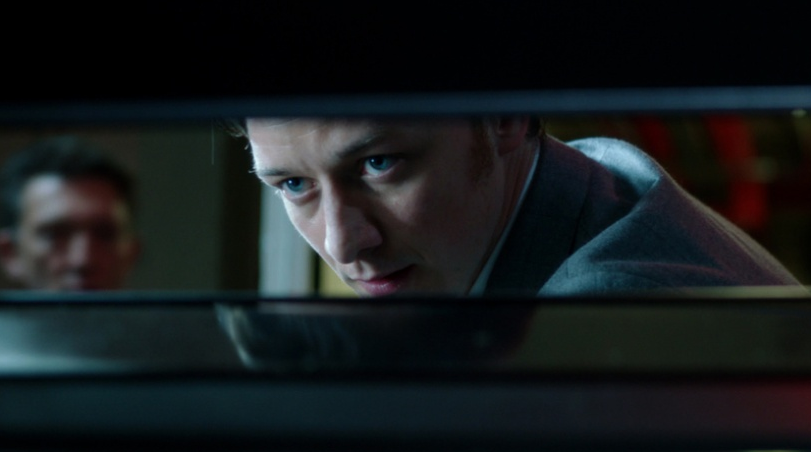
Trance is a fantastic art film, a mesmerizing and fascinating thriller that uses twists, turns, hallucinations, and narrow corridors as its tools to build suspense, and dialogue and performances to form sympathy for its characters.  Its surreal, twisted, strange, nonlinear, and non-conventional, but to dust with conventionality.  This is a great picture.

As the film fades in, we are introduced to Simon Newton (James McAvoy), an art auctioneer who takes us through the ropes of what his job entails.  He tells us of the extensive steps it takes to reserve a painting, the protocols his employers tell him to do when putting a painting up for auction and what steps he must take if a robbery takes place.  Their most valuable item is a painting by Francisco Goya called “Witches In The Air”, and his employers gave him precise instructions on how to preserve the painting if thieves do happen to come into the auction in an attempt to steal it.

Sure enough, thieves break into the auction and attempt to steal the painting.  This troop is lead by one named Franck (Vincent Cassel), and he is determined and headstrong into getting that painting.  Right before Simon puts the painting away, however, Franck cuts him off, a brief struggle happens between them, and Simon is knocked out, with Franck leaving with the stolen painting in tow.

When Simon wakes up, he realizes he lost his memory from the past two weeks.  When he’s finally released from the hospital, Franck pays him an unwelcome visit.  Turns out, all that Franck got on the day of the heist was just the frame of the painting, whereas the real article itself was transported to an alternative location.  Torturing him by peeling back his fingernails, Franck comes to find out Simon truthfully does not remember where he put the painting.  So he tries a different method of extracting information, one that involves psychology and hypnotherapy at the hands of one named Dr. Elizabeth Lamb (Rosario Dawson).  Together, they attempt to probe Simon’s mind, and begin their search for the painting Simon has kept hidden from them.

Here is a film that knows what it wants, a movie that knows its characters, their motivations, its story, and precisely how to tell it.  Director Danny Boyle, who is nearly a master at experimental cinema (if you don’t believe me, look at his hallucination sequences in Slumdog Millionaire or 127 Hours) does something very rare here: he intertwines and meshes characteristics of a narrative film with that of art and experimental cinema, making a truly absorbing, gripping, and fascinating experience.

Let me make something clear here, however: I hate experimental cinema.  Nine times out of ten they don’t make any sense, they seem relevant only to those making them, and they elicit a confused response rather than an emotional one from its audience.  Here though, the result is much different.  Everything is crystal-clear and fluid, the visuals dynamic and expressive, the editing cut together neatly and crisply. It’s like a mind game of cat-and-mouse, except the cat is willing to seek out help and the mouse is more lethal than both cats are lead to believe.

Oh believe me, my attention was unadverted throughout the entire picture.  While I didn’t understand everything immediately in the film, I understood what I needed to in the moment and the plot filled in the rest for me as time went on.  And what did I understand, more than anything else?  That these are sinful characters, decrepit criminals that lie, cheat, and connive their way to success and to financial gain.  Cassel was aggressive and talented as Franck, and while his character was despicable and loathsome at first, a softer side of him was later revealed so that the audience could come to terms with his character.  Dawson is as beautiful and motivated as ever, and while she too was at first a sympathetic figure, she later reveals a darker side to her character that even I didn’t expect.  I’m not even going to go into James McAvoy.  His performance was so specific and so wide-ranged that I was compelled to care for his character while at the same time hating him.

And yes, in case you didn’t pick up on it, the movie is deserving in its R rating.  It is violent, bloody, disturbing, graphic, and it has its vast share of nudity and sexuality, with some of the violence and sex combining in many gruesome scenes.  If this were any other picture, I would take off points for that.  But like Pulp Fiction and Taxi DriverTrance is a film that uses its bleak content as a tool to tell a story and define character, to show an encompassing yet tragic story of three fatally flawed individuals who will torture, manipulate, and kill to get whatever they want.  You have to watch a movie like this long enough to realize the point when it stops being a thriller and starts forming into something greater: when it starts forming into art.

Tagged , , , , , , , , , , , , , , , , , , , , , , , , ,

“WHITE HOUSE DOWN” Review (✫✫1/2)

You’d be crazy running for a second term, Mr. President.  

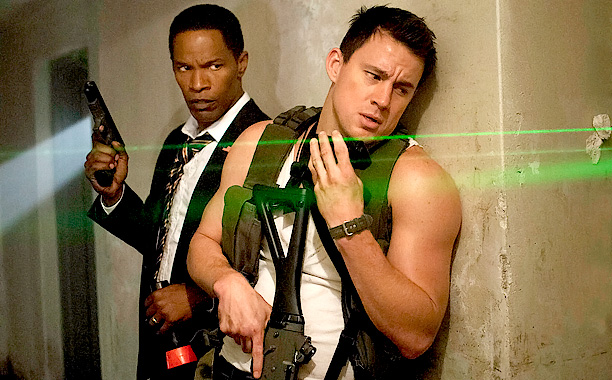
Now here’s a movie that would give President Obama a heart attack.  White House Down, much like a film released earlier this film called Olympus Has Fallen are both about the same thing.  The white house is under attack by a group of professional terrorists, the president is in danger, and our brawn yet brave hero must step in to save him.  All you need is a ripped shirt, a clean-shaven face, and a lot of guns on this guy (not just automatic) and you’re all set.

Unfortunately, that’s all the information I can give you.  This movie is so thinly written that that’s the deepest I can go without giving any spoilers.  The only other information I can provide that could give you any clue on to what this movie is like is that the brawn, brutish hero is played by Channing Tatum,  the president is played by Jamie Foxx, and Tatum owns a daughter portrayed by the sweet and talented Joey King.

I’m going to get this out of the way: Channing Tatum should never play the lead in any movie ever.  He cannot act.  There is no sincerity in his voice, no fluid movement of his body, no expression on his face to show he’s feeling anything except for when he’s shooting at something.  The fullest his acting capability reaches in the movie is the eyedrops you see in his cornea when he’s “crying” for his daughter. I’m not even kidding.  His acting is so terrible, the only use Tatum is in the movie is to provide meat for the female viewers in the audience.

(And I will admit my jealousy here: I will never look as good as Channing Tatum does.  I don’t think its possible for any man to).

Where was I again?  Ah yes, Tatum’s acting.  As always he is a stiff, awkward, and uncomfortable actor, a perfect reason why he should never be the lead character in a movie.  Admittedly though, the dialogue isn’t helping him much.  His best lines in the movie involve something like: “You have to go out there and be President”, or “If this guy keeps making those sounds, I’m going to start looking at him.”

If the above description makes this movie sound appealing to you, you should see it.  White House Down is a big case of what-you-see-is-what-you-get: a movie filled to the brim with excessive action, big explosions, cheesy dialogue, and mediocre acting, with the minor exception of Jamie Foxx, who has the most patriotic and humorous dialogue out of any other character in the movie.  In one scene, he’s reciting the history of America so beautifully to his secretary of defense over the phone that one could mistaken him as a Lincoln who underwent skin surgery.  In another scene, he’s following Tatum up an elevator shaft to evade capture when this exchange happens between them:

Foxx: What you do, I do.

(Channing Tatum ninja moves across elevator).

Foxx: I ain’t doing that.

Foxx’s character was the most appealing, the most intelligent, and the most charismatic character out of the entire movie.  Everyone other character was overly charismatic and grossly unrealistic.  One radical baddie is so stereotypical and so overpumped with tattoos, facial hair, ego, and steroids that I expected him to rip off his skin and reveal that he’s the Terminator.  A tour guide portrayed by Nicholas Wright is more worried about fine china and precious artifacts than he is about his own life and well being.  Tatum’s daughter, however, is probably the most frustrating.  She comes off as annoying, careless, and extremely absent-minded in this film.  You might say this is because she’s a child, but tell me something: how realistic is it that a teenage girl like this is smart enough to run her own youtube channel and know more about the white house than the tour guide, and yet, she doesn’t know when to stay in the bathroom or to leave a building when its going to blow up?

I remember an argument I had with a friend of mine in my first year of college.  He was an experienced videographer who understood more about the film industry than any of the professors did in that department.  We were arguing about the differences between film and art, and he told me a direct yet simple statement:

“Film is not an art” he argued.  “Film is a business.”

While I desperately want to prove him wrong through films such as Inception, Life Of Pi and Beasts Of The Southern Wild, it is movies like White House Down that remind me that the industry does in fact exist and operate like a business intended for profit.  At least Roland Emmerich didn’t release this film in 3-D: that wouldn’t have helped my side of the argument one bit.

Tagged , , , , , , , , , , , , , , , , , , , , ,

“THE LAST STAND” Review (✫✫)

Stuff blowin’ up real good in Redneck City. 

The Last Stand is an actioneer’s action movie, a film so overstuffed with explosions, gunshots, profanity and testosterone that it might have been more appropriate as a video game rather than a movie. I had a friend of mine describe the movie as being “The guyest guy guy movie you’re ever going to see”. That much is true. Whether its the best one, or even a good one, is up to you.

Sheriff Ray Owens (Arnold Schwarzeneggar) has been the sheriff of Summertown for many years now after having quit his profession of being a cop in Los Angeles.  Summertown is a quiet place, a small town where crimes range from the Mayor parking his car in a fire lane to deputies firing at slabs of meat during lunch time.  In a small, quiet town such as this, Ray finds little excitement in his day to day routines and he is perfectly fine with that.

But one day, he receives unwelcome news from the FBI: a nation-wide criminal named Gabriel Cortez (Eduardo Noriega) escaped from the FBI’s hands and is fast on his way to the Mexican border, where he will be out of the FBI’s reach.  The only thing blocking his path: Summertown, which also sits on the United States border to Mexico.  Owens now has to rise up to the challenge to defend his home.  To defend its citizens.  This is the last stand.

This is Arnold’s first lead role after his 10 year hiatus as California’s governor.  Before that hiatus, Arnold was a standout in a slew of memorable action roles, including (but not limited to) Predator, Total Recall, True Lies, Last Action Hero, and my personal favorite, The Terminator and its sequel.  All of those movies are memorable, exciting, suspenseful, and sport great blockbuster entertainment.

Now look at The Last Stand.  This movie cannot help but look shoddy compared to those titles because of its plot, its only inconsistently funny and exciting, and whats worse, it depends on the forumula of repetitive action.  Wonderful.  We certainly don’t get enough of those, now do we?

Let’s take a deeper look at Arnold real quick.  The man has had a great career.  Before going into office, he was asked to be in these tense, highly riveting action roles, and he was damn good in all of them.  Now, he’s been dilluted to just standing tall and read lines as everyone else turns to him asking what to do when a drug cartel is ready to tear through his town.  Guys, come on.  This is the 42nd governor of California, not Angus MacGyver.

The rest of the characters aren’t really that helpful or compelling.  Zach Gilford portrays Officer Jerry, a guy who wants to see more action than he does but then gets his nose broke by the recoil of a gun.  Luis Guzman plays as a chubby mexican officer, and he’s so stereotypical he might as well have been portrayed by Anthony Anderson.  Rodrigo Santoro and Jaimie Alexander share a forced romantic conflict in the middle of all the bullets and gunfire, and while they’re coincidentally dodging all of the bullets amist their kissing, all I could think to myself was “Hey kids!  Find a shower!”

The worst miscalculation, however, is in the film’s villains: Eduardo Noriega as Gabriel Cortez and Rodrigo Santoro as his goatee, ponytail lackey.   Noriega is worthless as the main villain, and is just stuck to driving a car recklessly for more than two-thirds of the movie until the last 20 minutes where the climax calls for a chase scene.  But even worse is his lackey, who seems completely lacking basic motivation of reasoning behind his actions.

Take a look at the only three things he does in the movie: kill a farmer, build a bridge over to Mexico, and strike a raid across Arnold’s town.  Explain to me A) Why he killed the farmer and clued the detectives into his plan, considering the construction of the bridge was nowhere near the farmland, B) How the bridge to Mexico only took around 24 hours to complete, C) Why waste resources building a bridge when he can just bring in a helicopter for the escape, and D) What is the relevance for attacking the town when it means nothing toward Cortez’s escape?  His actions seem senseless, almost like his decisions are delegated by the script just for the sake of action sequences and explosions.  Why must an action film like this seem so mindless, so pointless in its structure and so artificial in its writing?

The film’s most entertaining character is a man named Lewis Dinkam, portrayed by Jackass star Johnny Knoxville.  Highlight, embolden, and underline Jackass.  This guy is the opitimy of stupid, most of it portrayed humorously so.  This guy is an absolute psycho, shooting off pistols and machine guns named “Betty” and “Nazi Killer” with his pajamas on and tearing off electric polls by climbing them and chainsawing the electric wire.  Is he the smartest character in the bunch?  No, but he is the funniest, although I don’t understand why he’s wearing a woolly hat in the middle of the summer.

Ultimately, I’m at a loss with The Last Stand.  There’s no doubt entertainment value here, but it is severrely misguided, almost like a misfired Colt.  Half of the film is used to just set up its premise with predictable scripting and bad acting, while the other half is used for repetitive and monotonous action, gunshots, and F-bombs.

“But David”, one fellow viewer pointed to me, “That’s entertainment!  People need entertainment because real life sucks!”  This is true that people need entertainment, and The Last Stand will satisfy some viewers.  For others however, they will be left yearning for a better story, more original action, and a more worthwhile experience.  In the meantime, what you see is what you get: if its action you want, boy oh boy, it action what you’re going to get.

Tagged , , , , , , , , , , , , , , , , , ,

“AMERICAN PSYCHO” Review (✫)

Sex, murder, and the decrease of the human condition.  

American Psycho is a vile, sickening experience, a gruesome and aching film incapable of human thought, feeling, comfort, or emotion.  This shouldn’t come as too much of a surprise considering the book in which it is based on inspired this same controversy.  Regardless, its achievement cannot be denied: the filmmakers have somehow concocted an experience as brutal, uncomfortable, disturbing, half-lapsed, misogynic, and morally reprehensible as this that they’ve come to completely disconnect with their audience.  I rarely feel this upset about a movie like this.

American Psycho follows the story of Patrick Bateman (Christian Bale), a successful businessman who works in his high-level office by day and parties fiendishly with his friends by night.  On the surface, Bateman looks like a normal upper-class bachelor.  He eats out at expensive restaurants, drinks exquisite martinis, has sex with beautiful women, enjoys swearing gleefully with his friends, and listens to a variety of experimental music.  In appearance, Bateman is the visible representation of the upper class: stoic, upright, eloquent, fashionable, and spoiled.

As the plot progresses, however, we come to understand more about the darker side of Bateman’s personality.  He doesn’t just have sex with beautiful women: he mutilates them.  He tortures them and fantasizes about killing them in horrible ways and playing with their bodies after he’s done dismembering them.  His kitchen pantry contains axes, blades, and tools he uses for his killings.  He draws his victims in a notebook he leaves at work.  A female head sits next to his ice cream in the freezer.  If there wasn’t wine in his alcohol bottles, it would probably be blood.

Ugh.  Just talking about the premise nauseates me.  Why do we need to experience this?  Bateman is a sickening character, a man who would dismember the head of one unfortunate female and chew off the genitals of another.  Why?  For what purpose?  His motivations are never explained in the movie and his reasonings for murdering women are a mystery to us.  Is there a reason for this?  Is there a reason for being so non-inclusive with your audience? Why must everything be shrouded in secrecy?

This is the film’s biggest problem, besides the violence and the sexuality: Patrick Bateman is a deplorable character, difficult to understand and impossible to sympathize with.  You might think its impossible to sympathize with a murderer of women anyway, but it isn’t really.  We’ve ben asked to sympathize with deplorable characters before, including a psychotic war veteran in Taxi Driver to ruthless murderers and drug dealers in Goodfellas.  Sympathy and interest worked with those characters because one character was struggling to find a line of morality and righteousness to follow, and another was hesitant and even regretful over the actions that he’s done.

Bateman doesn’t regret his decisions nor chooses to change them.  He kills instinctively, almost like he’s trying to prove some territorial point to the people around him.  To put it out there in gruesome, violent fashions like this though is just torturous.  Who wants to sit there, eyes on the screen, watching him laughing as a petite blond girl in front of him cries pleading for her life?

But American Psycho isn’t just sickening, repulsive, and pungnent: the film’s logic is half-lapsed, incomplete, and flawed, incomprehensible to the viewer and extremely frustrating to those trying to figure out.

I’ll give you an example.  There’s one scene where’s Bateman is chasing one of his victims through the hallways of a hotel, half naked, screaming manically, and revving his chainsaw like Leatherface from Texas Chainsaw Massacre. Someone explain to me how no one from the hotel hallway heard the ruckus from outside their rooms, or anyone from the two floors above and beneath him?  Here you have Jack Torrence running through the hallways screaming at the top of his lungs with a lawn mower, and nobody even bothers to call the police.  What?  Are the wooden doors sound-proof?  Who knows, maybe they’re afraid of poking their heads out the door so that they won’t get their heads chopped off.

Due to a revelation revealed later on in the plot, one could argue this is a “dream sequence”, or a “vision” Bateman had.  But how is there any way to know?  With Bateman’s maniacal, wretched mind, dreams feels like reality and reality feels like dreams.  How is there any way to read the subtext when you’ve made your narrative so damn hard to figure out?

And this is a movie that is being hailed as a dark comedy.  A comedy for what, exactly?  The film is two graphic hours of bloody, sickening, gruesome violence and pornography.  When, at any point, is it set up to inspire laughs?  In movies like Pulp Fiction and Fight Club we are at least given subtle moments of clever dialogue to clue us in to the humor, and even though stomach-curling things are happening on screen, we are able to suspend that  briefly in order to enjoy the humor.

American Psycho is not subtle, smart, clever, humorous, or any of the related adjectives.  There’s a point director Mary Harron is trying to express through the film, but that point is convoluted, vague and shockingly illiterate.  As a result, what we’re ultimately watching is an idle, pointless, and misconstrued film, and our reward for watching is hours of punishment, nudity, sexual immorality, blood, torture, macabre violence, and sickening indecency.  To be fairly honest, I probably need a second viewing in order to fully understand the picture, but the plain fact is that the movie doesn’t deserve a second viewing.  If I end the film feeling as punished and as mutilated as Bateman’s unfortunate victims, why on earth would I want to subject myself to that again?

At the end of the film, Bateman himself admits that he finds neither closure nor catharsis for his bloody, violent, sexually immoral and murderous journey.  For that matter, neither do we.

Tagged , , , , , , , , , , , , , , , , , , , , ,

“WATCHMEN” Review (✫✫)

Bad content, bad timing, and a bad comedian, all five minutes before midnight.   

Watchmen is a misguided and misunderstood film, a movie that will sharply divide the fans for both the original graphic novel and fans of the superhero movie sub genre, period.  On one hand, what we have here is compelling superhero drama.  The characters are fleshed out, their motivations are clearly understood, and we’re rooting for a few of them once we understand that their intentions are pure.  For everyone else, however, we grow to despise their character arc, we become annoyed with their conventions, and some characters are just downright despicable.  And how come some of them aren’t even wearing pants?  Didn’t they know jeans were invented way back in 1873?

Watchmen is based around the graphic novel of the same name by artist Dave Gibbons and writer Alan Moore (who demanded his name be left completely out of the credits, convinced that a movie adaptation of his novel was impossible).  Both the graphic novel and the film adaptation surrounds a group of retired superheroes called “The Watchmen” who are brought out of retirement when they learn that one of their own has been murdered by being thrown out of his own the window and landing on the concrete pavement, his blood staining the smiley pin on his jacket.

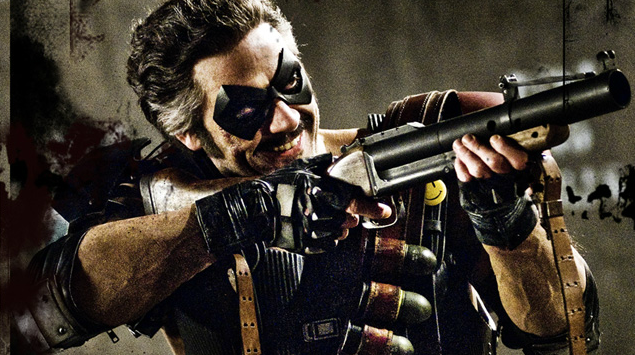
The one who has been murdered is Edward Blake, aka “The Comedian” (Jeffrey Dean Morgan).  The first Watchman to learn of Blake’s murder is a fedora-wearing culprit known as Rorschach (Jackie Eerie Haley), who wears a ink-blot shape-shifting mask which makes his name appropriate.  He develops a theory that someone is gunning for masked heroes, so he sets out to warn his other fellow watchmen: Dan Dreiberg (Patrick Wilson), aka a Batman rip-off called Night Owl, Sally Jupiter (Malin Akerman) aka Silk Spectre, Adrian Veidt (Matthew Goode) aka Ozymandias, to whom his secret identity is known to the world, and John Osterman, aka Doctor Manhattan (Billy Crudrup), who is the only one with super powers, apparently being able to conduct anything his mind can imagine.

Here is a movie that is, at parts, a compelling character study and a fascinating crime drama.  That is because unlike other action movies, Watchmen is based heavily on character and story, not relentless action and CGI.  The film delves deep into the histories and origins of each individual watchman, and while at times the exposition may be drawn out and a bit boring, the rest of the time it is undeniably gripping and attentive.

Cudrup was ghastly and stoic as Doctor Manhattan, a man slowly losing his humanity but doesn’t know what to quite do about it.  Malin Akerman had a sort of spunk and wit to her as Laurie Jupiter, and in one emotionally stirring moment we experience all of her dread and desperation through her cries of anguish and defeat.  I especially liked Jackie Earle Haley as the cold, calculated, and unforgiving vigilante known as Rorschach.  I think he is the most fascinating character out of the bunch.  He has a rashness, a raspy, hurt, and pained voice behind his every narration, and we can tell that this is man who has had a pained past.  I would have hoped that the movie would delve deeper into his past than it did, but that’s besides the point.  Haley is so intimidating in his performance, the alternate title for this movie could have been called Watchmen: The Journal of Rorschach.

There are parts of this movie that are undeniably surreal and fascinating.  For the rest of the movie, however, the emotion and the mythology becomes redundant, and we lose interest because of its slow pacing and its drawn-out monologue.  This surprises me, because the director is Zack Snyder, and he is the same man who made the the visually and emotionally appealing 300 prior to this.  How is it that he goes from the provocative, epic, and entertaining veins of 300 to something as drawn-out and overly-philosophical as this?

Part of this, I think, has to be his dependency on the original comic.  One of his tactics when filming 300 was using the original graphic novel as both the storyboard and script for the production.  He has been reported to have used that same tactic here for Watchmen, with a few minor edits of the script by screenwriters David Hayater and Alex Tse.  How could this tactic work for 300 and yet backfire on him for Watchmen?  Simple: the answer lies with the page length.  300 had a total of 88 pages, while Watchmen had a total of 416.  Surely, Zack Snyder must’ve thought at some point he’d lose his audience with the overuse of exposition?

Whether he thought about it or not, he went through with it anyways: what we have here is a note-for-note, page-by-page adaptation that copies its story as simple as a copy-and-paste edit on Microsoft word.  For that, he loses points for unoriginality and innovation.

I feel like I’m watching two different movies here: two halves of one whole.  One half of the movie is dark and mesmerizing, is well acted, emotional and motivated, and sports plenty of visually beauitful scenes at the helm of the film’s director, Zack Snyder.

The other half of this movie is filled with content so bleak, graphic, and unnecessary that I’m shocked Zack Snyder didn’t turn it into a porno.  Maybe he did and we don’t even know it: Doctor Manhattan is naked through more than half of the film (and yes, we see every angle of his shining blue huevos), there’s an overly-prolonged sex scene between Night Owl and Silk Spectre, and you could have cut half of the Comedian’s scenes in the movie and make him more appealing to the audience.  Seriously: someone explain to me how having a guy rape a woman and then shoot another he impregnated supposed to make him a sympathetic figure?

Someone in theory could make an opposing argument by saying “But David!  That was in the comic book!”  Yes, but should that have been in the comic book, let alone in the movie?  I’ll answer that for you: No.  It shouldn’t have.  If it doesn’t advance story or define character, then what was the point for having it in there in the first place?  If the superhero genre is a big, beaming smiley face, Watchmen is the blood stain covering the eyelid: distracting, unsettling, and unnecessary.

Tagged , , , , , , , , , , , , , , , , , ,

“ARGO” Review (✫✫✫✫)

“Argo”: The science-fiction epic that didn’t exist

In 1980, political instability and rebellion shook the grounds of Iran, a once prosperous city run dry by the greed and evil of its former shah, Mohammad Pahlavi.  When the U.S. agreed to house Pahlavi in southern California after he contracted cancer, the Iranian people stormed the U.S. Embassy in a furious rage and took everybody inside hostage.  Only six Americans escaped with their well-beings intact.

This is the true story of Argo, a political thriller based on the Iranian hostage crisis of 1980.  After barely escaping the U.S. embassy just before it is overran by Iranians, the Americans flee and take refuge inside Canadain Ambassador Ken Taylor’s (Victor Garber) house as social and political stability continues to crumble outside of the Taylor household. They remain stuck there for 69 days.

Enter the CIA. The intelligence agency plots ways to try and rescue the Americans and get them home to safety, but no luck. Their best ideas involve riding bicycles and meeting them at the border with gatorade. All hope seems lost until Tony Mendez (Ben Affleck) hatches the idea of disguising the American’s as a film crew scouting for locations out in Iran. As the Secretary of State asks Tony Mendez, “You got any better bad idea than this?”

“This is the best bad idea we have sir. By far.”

Here is a movie that knows how to utilize suspense and tension to the fullest effect. Similarly to how Kathryn Bigelow sets up the stakes of the film within the establishing shot of the 2009 best picture winner The Hurt Locker, Argo similarly sets up its stakes with a tense, horrifying sequence of the Iranians overrunning the U.S. Embassy in the beginning shot. They jump over walls and tear down the gates as they storm through the front lawn. They break through doors and windows as they charge into the building, screaming as they hold up picket signs and crow bars. They bind their hostages in rope and cloth as they grab and shake them all while screaming into their ears and breaking furniture around them. In the world of film, the goal is to put audiences into the scene, into the moment of the picture. We are not just put into the environment of Iran in Argo: we are immersed in it.

At the same time though, this is a movie that knows how to expertly balance drama with humor and comedy. Two essential roles in this movie help achieve this: John Goodman as make-up artist John Chambers, and Alan Arkin as movie producer Lester Seigel. These two are the C-3PO and R2-D2 of filmmakers, a duo who argue and bicker over the smallest, funniest of details. In one scene where they were looking over scripts for the operation, Lester complains as to how they are all of poor quality.

John: “We’re making a fake movie here.”

Lester: “If we’re making a fake movie, I want it to be a fake hit.”

This is one of those rarities of films where it transcends merely being labeled as a “movie” and has graduated to being something as an “experience”.  Argo is a tense, nerve-wracking film.  It keeps you on the edge of your seat, cringing, waiting, teeth chattering, spine tingling with every tense moment of the film pulsating through your entire body.  Ben Affleck directs this film with alluring precision, utilizing jump-cuts and precise cutaways to the greatest effect during this American horror that is a true story.

Very few films match the precision and craftmanship that this film possesses.  Combine that with the film’s smart, witty dialogue, as well as its great spirit for humanity, and what you have is one of, if not, the best drama film of the year.

Tagged , , , , , , , , , , , , , , ,