Tag Archives: Suspense

“WHIPLASH” Review (✫✫✫✫)

You won’t know what hit you.

I was a junior in high school when my dad took me out to a cabin in Montana for a “vacation.” I put “vacation” in quotations because we practiced music for nearly three hours every single day. I was a tuba player back then, and I practiced with my dad so I could make it into the All-Region band. One day, I wasn’t playing a single measure correctly. The notes I was supposed to play were on the downbeat, and I kept playing them on the upbeat. My dad made me play that verse over, and over, and over, and over again. He would get frustrated at me, yell at me, and push me harder and harder until I played that verse perfectly 100 times. I played that same frothy, infuriating verse for all three hours that day.

I say this to show you that the stuff you see in Whiplash isn’t fiction. It’s as feasible as the music you see, as vibrant as the drum beats you hear in a song, and as real as the passion that drives any musician, writer, and aspiring artist out there. Whiplash is special not just because it’s unique, but because it carries an uncanny truth for those who aspire to greatness. Perfection is never good enough. You’re pushing yourself over the edge just as much as the people around you are.

The kid aspiring to greatness in this story is Andrew Neiman (Miles Teller), a mild-mannered college musician who aspires to be the next Charlie Parker or Buddy Rich on the drums. The man he thinks can make him great is Terrence Fletcher (J.K. Simmons), a brilliant but brash and at times violent instructor who will throw a chair at you if you’re either rushing or dragging the tempo.

If you think I’m saying that figuratively, I’m not. That literally happens to Neiman during his first rehearsal with Fletcher in the movie.

Neiman aims to be the best drummer out in the world. Fletcher aims to be the best instructor in the world. These two men and their intense passions for their goals builds into a riveting, thrilling, and emotionally vigorous journey that is more involving and exciting than most of the year’s biggest action blockbusters. Yes, I am placing this above the likes of Transformers, Godzilla, and Guardians of the Galaxy. It’s that good.

How is it that this movie leaves such a lasting impact, when most people haven’t seen it, let alone heard about it? One of the biggest reasons, I think, is conflict. This is writer/director Damien Chazelle’s sophomore effort into film, his debut feature being the 2009 jazz film Guy and Madeline on a Park Bench. Both films are about jazz musicians, both are about people aspiring to other’s aspirations, and both are about never being good enough for those end goals.

There, however, is a sharp difference in tone between both pictures. One is a romantic drama about two lovers struggling to reconnect after slowly growing apart from each other. The other is an unconventional thriller that poses two musicians opposite one another to build a steady sense of unease and tension between the two. The result is a severely nail-biting, teeth-grating, and heart-pounding experience because of it.

Again, going back to conflict. My college screenwriting professor once told us that conflict is what compels story, and character’s struggling with conflict compels their development in the story. I am reminded of this no better than when I watch Whiplash, and that’s just because Chazelle sets up conflict really well in the movie. In the film, Neiman is desperate to prove himself as a musician. He moves his bed out of his dorm room in the place of a drum set. When he goes to sleep, he listens to the music that he’s practicing in his ipod. When he knows he’s not playing fast enough, he pushes harder until his hand bleeds. When his hand bleeds, he puts a bandaid on and keeps playing. When his bandaid falls off, he presses his hand in ice water, turning the clean liquid into an ugly shade of red.

Yet, despite all of his passion and initiative, Fletcher continues to press him and push him harder not necessarily to make him a better musician, but just because it’s never good enough for him. The level of intensity Fletcher shows in the movie makes you wonder where all of this anger comes from. Did he have his own version of Fletcher when he was a music major in college?

Which brings me to the next point: the performances. Teller and Simmons give two of the best performances out of the year in their roles, fully inhabiting their characters to the point where we become entranced in full immersion. Teller, who before this has starred in a string of bad raunchy comedies (Project X, 21 and Over, That Awkard Moment), re-establishes himself as a finer actor here. He shows that he has more acting chops than he lets on and proves that he’s more than just a pretty face. Simmons is on a whole another level. He was so scary, intimidating and maddening as this arrogant, hard-headed music professor that he made wind ensemble feel like drill camp.

I can only name one moment I didn’t like in the film, and that is that the ending is far too abrupt. It’s a perfect film otherwise. Chazelle wrote and directed this film as a reaction to writer’s block, and while he pulled inspiration from being a drummer in high school, I think the film is universal as far as its language and messages go. We are both Neiman and Fletcher for the things that we are passionate about. We aspire to do great things, and we beat ourselves up when we don’t do those great things. We will push ourselves to and over the edge when we don’t measure up to our own expectations. But what’s the point of doing all of those great things if you’ve lost the joy in doing them? I quote my dad, who has always pushed me in a better way than Fletcher has: “You don’t have to be number one to be amazing.”

Post-script: In defense of my dad, some people might say he was going too hard on me, or that I didn’t deserve all of the strain that he would put me through. You would be wrong. I made third chair in the Texas All State band because he didn’t give up on me.
Tagged , , , , , , , , , , , , , , , , , , , , , , , , , , , ,

“THE HOBBIT: THE BATTLE OF THE FIVE ARMIES” Review (✫✫✫)

And the Dwarf King: The Battle for Himself. 

Here it is, at last: the end of Peter Jackson’s Hobbit trilogy. It hasn’t arrived without it’s challenges. Originally, the series was supposed to be directed by Hellboy director Guillermo del Toro before he dropped out and let Peter Jackson hop back in the director’s chair. Then, Jackson decided to turn it from two movies into three because he wanted to “expand the story.” Then in April, he decided to retitle the third film from There and Back Again to The Battle of the Five Armies. Every indication from the production of this film has shown that the movie was going to be either the weakest entry or the most unnecessary film out of the series. Jackson, however, has overcome every obstacle in his path and made a film that is just as exciting, enduring, and memorable as any other film in the series. Jackson’s persistence is something to be admired.

Picking up after that horrible cliffhanger of an ending we got from The Desolation of Smaug, The Battle of the Five Armies opens with Smaug the Dragon (Benedict Cumberbatch) laying waste to the village of Laketown shortly after he was set free by Bilbo Baggins (Martin Freeman) and Thorin Oakenshield (Richard Armitage). After setting the village on fire and killing many of the villagers, Bard the bowman (Luke Evans) escapes from prison, climbs the highest tower he can find, and kills the dragon with the black arrow he inherited from his father.

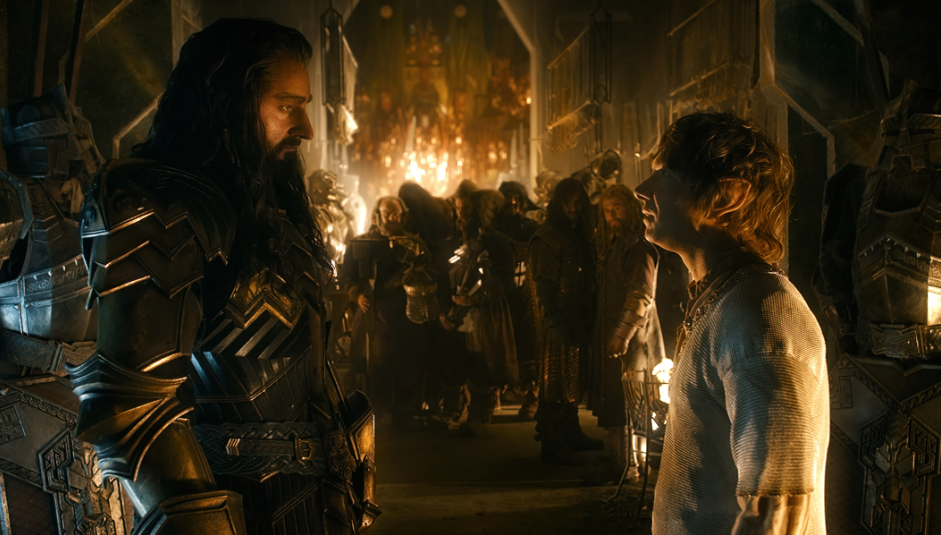
With Smaug dead, the dwarves have taken possession of the Lonely Mountain. However, something strange is happening to Thorin. He has become more greedy, violent, and eager to find the Arkenstone in the chamber and become the next king of the mountain. Bilbo has noticed his new attitude, and finds it disturbingly similar to that of Smaug’s personality. As tensions grow inside the mountains, things heat up with elven, eagle, orc, and human armies assembling outside of the mountains as well. Now with the four armies gathering to take the mountain from the dwarves, Thorin gathers his own dwarf (and hobbit) army to protect their inheritance and keep it from unworthy hands.

The third movie in any trilogy is always the most crucial. It either makes or breaks the series, making it just as memorable as The Lord of the Rings trilogy, or as half-baked as the Matrix trilogy. Part of me wonders why they even had to make a third movie at all, and why they couldn’t just combine this with The Desolation of Smaug. That was originally the plan, after all, but I guess if they did that, they would run the risk of shoehorning two plots into one film.

Honestly though, I don’t know if it would have been that big of an issue. The Hobbit: The Battle of Five Armies offers exactly what the title suggests: a battle which is bigger and bolder than any other fight in the Lord of the Rings movies. Yes, that includes the final siege on Sauron in Return of the King and the fight against Smaug in Desolation of Smaug. The scale and scope is bigger here than any other Lord of the Rings movie, with elves, dwarves, eagles, orcs, villagers, trolls, wizards, spirits, and a hobbit crashing, slashing, and colliding into each other like nobody’s business. This is the most action-packed Lord of the Rings movie yet, with it’s final lengthy action sequence clocking in at about over an hour.

Some of the action runs rampant and gets repetitive now and then. In one scene, for instance, Legolas the elf fights against an orc on a tumbling castle. The scene ran for well over 20 minutes, with them clashing swords and fists against each other, and I sat there wondering to myself “Why couldn’t he just trip him off and be done with it?”

But here’s the interesting thing: no matter how long the action ran, it kept me engaged. If this were a Michael Bay or a John Woo picture, the action would have ran wild and I would have gotten bored about 10 minutes into it. But Jackson is more talented than most filmmakers. He understands that in order for your audience to be invested in the action, they need to be invested in the characters first, because what’s the point of having characters go through these epic fights if you don’t care about them?

With this movie, I noticed that the character I cared most for was not Bilbo Baggins, but Thorin Oakenshield. He has the most interesting arc out of any other character in the movie, spending one half of the film fighting orcs, and the other half fighting himself. His character in the film reminds me a lot of Gollum: his conflict isn’t so much with others trying to take the things precious to him, but with himself in how the things he values most changes him. He especially serves a crucial part in the film’s final climatic battle scene, which is so nerve-wrecking and heart-pounding that it brought me just as much excitement as the climax in Return of the King did. The impressive part? Return of the King’s climax featured an entire armada of warriors, while The Battle of the Five Armies’ climax only needed two.

All in all, The Battle of the Five Armies did to The Hobbit what The Return of the King did to The Lord of the Rings: it wrapped it up nicely into a tight, satisfying conclusion, bringing excitement, emotion, and resolution to these characters that we’ve cared so much for so long now. Granted, it didn’t do as well as The Return of the King did with this, and I personally would have wished that Jackson would have made it less messy and cluttered than it already was. Does that ultimately matter, though, if I had fun watching it? Let’s just be glad that Bilbo made it there and back again in one piece.

Tagged , , , , , , , , , , , , , , , , , , , , , , , , , , , , , , , , , , , , , , , ,

“THE HOBBIT: THE DESOLATION OF SMAUG” Review (✫✫✫)

Be honest, Mr. Smaug: do you need a breath mint?

The Hobbit: The Desolation of Smaug is both one of the most satisfying and maddening films of the year. It’s visually splendid, illustrating the joys and perils of the world of Middle-Earth as finely as any movie before it did. It’s emotionally versatile, being comical and lighthearted at certain moments and then treacherous and gloomy in others. The performances are sound, with CGI characters being just as memorable as the live ones. Everything in the film was perfect up until it came to it’s end, which ended on a cliffhanger so big that a slackwire artist couldn’t tightrope across it.

Taking place shortly after the events of An Unexpected Journey, The Hobbit: The Desolation of Smaug continues the journey of Gandalf the Grey (Ian McKellan), Thorin Oakenshield (Richard Armitage), his troop of dwarves, and the slight hobbit Bilbo Baggins (Martin Freeman). After narrowly escaping the clutches of the white orc Azog (Manu Bennett), Bilbo and the rest of the dwarves venture on towards the Lonely Mountains, only having a few days left until the secret entrance closes, leaving them forever locked outside of the Lonely Mountains.

Bilbo, however, has greater concerns if the dwarves do manage to get inside. Deep within the twisty lairs of the mountain lies an endless sea of gold and jewels, and asleep among these riches is the vicious Smaug (Benedict Cumberbatch), a violent, terrifying dragon that formerly laid waste to the dwarves’ land and took their possessions all for himself. If the company does manage to get inside the mountains, Smaug will be waiting there for Bilbo, and there will be a massive conflict between the 100-foot tall fire-breathing dragon and the small, terrified hobbit.

One of the things I love about The Lord of the Rings movies is that the stakes are set up really well in them. Peter Jackson, who has been writing/producing/directing/godfathering the series since The Fellowship of the Ring has proven time and time again how well he can make depth-defying set pieces and visual spectacles, all while raising the emotional stakes of the movie.

Here is yet another example of what Peter Jackson can do in a movie. Visually, the film is unparalleled. There were many moments in the film that I recalled for being either visually spectacular or heart-poundingly exciting. One of them was a eerily creepy fight scene where Bilbo and the dwarves were fighting off an army of spiders in a cursed forest. Another was a chase scene where the crew was stuck in a line of barrels while falling down a waterfall. Other instances in the film include when the dwarves encountered a giant who could transform into a bear, or when Gandalf confronted an early confrontation of Sauron in his own castle. And don’t even get me started on when we meet Smaug for the first time. Jackson’s visual prowess excels just as much as his emotional involvement, and with each of his movies, he always seeks how to outdo himself from his last effort. I’d say he’s outdone himself tremendously here: the look of the film shows just that.

The performances are just as refined as the action and visual effects are. Martin Freeman was just as charismatic and loveable as he was the first time he was Bilbo in An Unexpected Journey, and Ian McKellen once again does well as the wise, ambitious, righteously-driven wizard Gandalf. And Richard Armitage has gained traction as Thorin Oakenshield since the first movie, showing that he can be more than the brutish tough guy. He’s a more vulnerable, more fleshed-out character here, with deep desires and hidden intentions showing that perhaps will be explored more in the third installment.

My favorite character by far, however, wasn’t even from a live performance. Benedict Cumberbatch was frightening, fearsome, and daunting as the terrible Smaug, his articulate, vocabulary-filled speech lining up perfectly with his sinister, seething voice. The visual spectacle of Smaug is perfect, with the dragon leaning luminously over his small, feeble enemies, while his long, slender, scaly arms and body lunge across the dungeon like an elongated spider. But the vocal performance is what makes him convincing, what makes him more than just a CGI creation and a terrifying villain in his own right. The minute I heard Smaug speaking to a shaking Bilbo, I had shivers run down my spine. The entire time he was speaking to Bilbo in mysterious anecdotes and sinister undertones, I was on the edge of my seat. When he started to attack, I clutched my mouth and stared endlessly at the screen, wondering and hoping for the fate of these characters in Smaug’s way.

In An Unexpected Journey, Bilbo benefits from being a more active protagonist than that of Frodo. Here we have Smaug, a giant, fearsome beast that is more actively sinister and spiteful than the stillness of Sauron from The Lord of the Rings.

Everything in the film is refined to the quality of film that you’d recall from The Lord of the Rings trilogy. My only regret is the copout, cliffhanger of an ending that inspired my theater to erupt into boos and groans. I hate it when movies do this to me. They put in so much effort to make a great film up until the last five minutes, where they pull the rug from under you and say “Sorry, that’s all for now! See you next year!” What was Peter Jackson thinking when he went with this ending? At the end of each Lord of the Rings movie, it ended with some form of closure and assurance that the adventure would continue into the next installment, but you didn’t know how it was going to pan out. It kept us intrigued, and it kept us wondering what would happen next. With this movie, it sets itself up to where we already know how it’s going to end: we just don’t get the payoff along with it.

I quote J.R.R. Tolkien: “Books ought to have good endings.” The same should be said for movies.

Tagged , , , , , , , , , , , , , , , , , , , , , , , , , , , , , , , ,

“INTERSTELLAR” Review (✫✫✫1/2)

A space odyssey led by Christopher Nolan. 

The first time I watched Christopher Nolan’s Interstellar, I knew I had found something special, but didn’t know if I fully comprehended everything I saw. I just finished watching it a second time, and now I understand I’m not supposed to comprehend everything I saw. Interstellar is mesmerizing and breathtaking, a highly ambitious and exhilarating journey taking you through the far reaches of time, space, planets, wormholes, black holes, stars, and anything else in space that you can think of. But just like space, it is also vast and daring, reaching for a vision that it cannot possibly hope to grasp. That’s okay. It’s better to aim for too much rather than too little.

Based off of an idea conceived by theoretical physicist Kip Thorne, Interstellar takes place in the distant future, where the Earth is slowly dying and the only source of sustainable food is by growing corn. Cooper (Matthew McConaughey), is an aerospace engineer-turned-farmer just trying to make it day to day with his small family, consisting of his father-in-law Donald (John Lithgow), his son Tom (Timothée Chalamet), and his daughter Murphy (Mackenzie Foy). Like the great astronauts Neil Armstrong and Buzz Aldrin, Cooper dared greater things in his younger years. He wanted to fly. He wanted to explore. He wanted to traverse and discover new spaces that he hasn’t seen before. Now he’s only concerned about making sure his family survives.

One day, him and Murph discover a secret space station that has been hiding NASA, which has been operating in secret since the world state of health has declined over the years. When Cooper finds out that the Earth will soon be unable to sustain life and that his daughter’s generation will be the Earth’s last, Cooper is recruited on a daring space mission to find a new planet that is able to sustain and save the human race.

Written and directed by Christopher Nolan, Interstellar is a testament to the quality of film that Nolan is consistent in making. It has all of the elements that you appreciate in all of his films. It has a grounded, human story intertwined in a brilliantly woven, thought-provoking plot. It has well-rounded, relatable characters that you root for and admire deeply. It has incredibly breathtaking visuals, created with the same visual and cinematic sense of style that is unique only to Nolan’s movies. And it has plot twists the size of Mount Everest, taking complete 180 turnarounds when you least expect it. You will not see the end of this movie coming.

Interstellar is up to par with many of Nolan’s other works, including The Prestige, Inception and The Dark Knight. If I’d continue on about those qualities, however, I’d be writing the same review for those films. It’s easy to write about the things you’ve already seen: I’d like to write about how this film is different from Nolan’s past work.

For one thing, the performances are the best they’ve ever been in any of Nolan’s films, and the heart of this film’s emotion comes from that of Matthew McConaughey. I love how his character is represented in this film, and I especially love how McConaughey handles him. He isn’t handled as a bold science-fiction action hero similar to the likes of Han Solo from Star Wars or James Kirk from Star Trek. He’s more human than hero, a vulnerable and quietly suffering man who just wants to go home to his daughter, but knows he has a greater duty in fighting for the Earth’s survival. I’ve always appreciated the humanity Nolan has always instilled in his characters, but somehow McConaughey reaches an emotional depth much deeper than that of his predecessors. I like seeing McConaughey jumping from such polar opposite roles as this from Dallas Buyers Club, yet giving the same dedication and credibility to both characters. He has proven himself to be an extremely versatile actor, whether it be for small, independent films like Dallas Buyers Club, or big Hollywood productions such as Interstellar.

I am also led to believe that this is the most scientifically accurate out of any of Nolan’s other films. Working closely with Kip Thorne on how accurate the film would be, Nolan worked hard to realize both his vision and Thorne’s, abiding by Thorne’s recommendations and notations as closely as possible. His representation of a wormhole in space. His portrayal of relativity to time and space. Thorne has gone on record to say that there is one major scene demonstrating high artistic freedom, and that is when Cooper visits a planet that has “ice clouds”. This film is intensely interesting and fascinating, and the coolest part to me is knowing that most of this was reviewed by a well-known physicist who has deemed it all possible.

Side note: please excuse me for using the word “coolest.”

There are a few weaknesses to mention. As a Nolan film, it is expected to be extremely complicated, and I admit to needing to see the film multiple times to even begin to understand it. I know many others will have a harder time at understanding it than I did. There were a few slow lulls in the film that detracted from its steady pace, and there were severe sound mixing issues at the beginning of the film that I noticed almost immediately. I’m no sound expert, but when the music is so loud that I can’t even hear what a character is saying, I think you need to fix something before you release the film.

I think it was the third act that really sold me on this film, the last half of the story that compelled me to believe that this was a very memorable journey, and it was. I won’t go into the particulars for the sake of spoilers, but I will say that Nolan is a master at orchestrating thrilling and tense-heavy climaxes. Sure, I would like that to persist throughout the rest of the movie, but I won’t complain. I appreciate Nolan’s ambition, if I appreciate nothing else.

Tagged , , , , , , , , , , , , , , , , , , , , , , , , , , , , ,

“GONE GIRL” Review (✫✫✫1/2)

Gone Girl

What happened to Amy Dunne?

When I started watching Gone Girl, I had no idea what happened between Nick Dunne and his wife Amy. Now I have finished the movie, and I still have no idea what happened between the two of them.

Gone Girl is a very strong psychological thriller, packaging the essential elements of tension, grit, and confusion to make an extremely fascinating, yet equally frustrating, watch. Imagine you’re driving on a highway, except you take a wrong turn. Then you take another wrong turn. Then you take another, then another, and then another after that. Gone Girl is that highway, taking you through so many twists and turns that you don’t know which way you’re going anymore. The only problem is that there’s no end destination when you get off of the highway.

Based on the book of the same name by Gillian Flynn, Gone Girl starts with Nick Dunne (Ben Affleck) coming home to see his living room torn apart and his wife Amy (Rosamund Pike) missing. There are a few details that disturb him upon this discovery. The glass table is smashed in. Chairs are overturned. A blood splatter can be spotted above the stove in the kitchen. Suddenly, Nick finds himself swept into a media frenzy as everyone everywhere cries out “Where’s Amy?” as he and Amy’s parents work to find Amy and bring her back home.

Yet, in the midst of all of this media attention, people start to recognize strange things about Nick. He’s behaving oddly for someone who has just lost his wife. A woman outside of a press conference takes a selfie with him and posts it online. He smiles at the conference when people take his picture. And as police discover Amy’s diary and uncover incriminating evidence about Nick’s marriage with Amy, people start to ask one question: did Nick Dunne kill his wife?

Let me start by saying this: there’s no way to expect anything from this film. The minute you think Gone Girl is going in a specific direction, it does a reversal and goes in the complete opposite direction, setting you on another prediction track until it does another reversal. There are many factors contributing to these twists, the biggest one being the writing contributions of Gillian Flynn. Flynn, who wrote the original book, was adamant about being involved in writing the screenplay for David Fincher’s adaptation, and she’s a good sport as far as working with him. Even though there are a few differences conceptually from the book, the work remains a whole emotionally, and lets off this gnawing paranoia on both characters as we question who is the victim and who is the perpetrator. This movie is like a game of cat and mouse, except no one really knows who is the cat or mouse.

The writing is ingenious, but the real star of this show is David Fincher. Fincher, who is no stranger to mind-bending plots (1997’s The Game, 1999’s Fight Club, and 2007’s Zodiac), incorporates elements from all of his movies into this one mind-bending thriller. It has plot twists as big as those in The Game, the pseudo/suicidal/mind trickery in Fight Club, the dark, disturbing realism in Zodiac, and the broad, expressive shots, angles, and edits from The Social Network. I like this about Fincher films, that they’re so distinct in visual style that you can almost instantly tell that it’s a David Fincher film.

Example: In the opening sequence of The Social Network, we capture the essence of the scenery as a lonely Mark Zuckerberg trots back to his dorm. We get a sense of the campus he’s on, the bridges, the buildings, the sidewalks, the trees. We not only feel the physical surroundings around him, but also the life that’s in it, almost like the scenery is breathing around him. Fincher did the same thing during The Girl With The Dragon Tattoo, and he did it again with Gone Girl. When he’s not filming a scene where there’s a tense exchange of dialogue between characters, he’s quietly viewing the scenery all around him, telling a story with silent images just as much as he does with outspoken characters.

More than what he does shot-wise though, I’m impressed with how he handles his cast. Look at the names associated with this film. Ben Affleck. Rosamund Pike. Tyler Perry. Neil Patrick Harris. Are any of these names what you’d expect to see in an intricate crime-thriller, let alone give a decent performance? I mean, the last memorable role Perry had since dressing up in drag as Madea is Alex Cross, and that was about as complacent as an action movie can get. Neil Patrick Harris’ most serious movie role is as himself in Harold and Kumar. Rosamund Pike is most known as a Bond girl. Affleck’s acting career is self-explanatory. I looked at all of these actors cast in these roles, and I couldn’t help but wonder what they were doing in a Fincher film.

Then I saw what he did with them, and I couldn’t see anyone else in their roles. Perry played Dunne’s attorney Tanner Bolt, and he was so smug and straightforward that he could lend Robert Downey Jr. a few tips for The Judge. Harris steps so wonderfully into a role he’s never played before, and Pike is exemplary too, though I won’t exactly specify how. Affleck to me was the most interesting. He uses awkward lulls, blank expressions, and his sterile voice just like he did during some of his bad performances in past movies. It’s not a bad performance though. Fincher is just using Affleck’s natural reactions to lend details to Nick Dunne’s character, like how he could be smiling in pictures while his wife is missing, or why he sounds so unconvincing when he gives a speech about how he loves his wife to ongoing listeners. Fincher uses both Affleck’s strengths and weaknesses as an actor to the film’s advantage, and that goes the same for everyone else in the film.

I liked many things from this film. The cinematography, the editing, the thought-provoking plot, Fincher’s masterful direction of the film and it’s cast all culminated into a jaw-dropping experience. My only regret about this film is it’s ending. I won’t spoil it for you, but I will say that it ends in the same way that it begins, posing questions and vague thoughts so that the audience may fill it with their wild imaginations. I realize Fincher and Flynn did not intend to have a straightforward, clear-cut ending, but I have a stubborn need for closure. Films are supposed to provide answers to the questions they’ve already posed to you. Gone Girl does not provide an answer. It provides a question.

Tagged , , , , , , , , , , , , , , , , , , , , , ,

“SIN CITY: A DAME TO KILL FOR” Review (✫)

Can you kill me too while you’re so busy at it? Thanks. 

There’s a character early on in Sin City: A Dame To Kill For that describes the city as a place “where you go in with your eyes open, or you don’t come out at all.” He’s wrong. I went in and out with my eyes fully open. I only wished that I kept them closed.

Oh, where to begin with this. Sin City: A Dame To Kill For is, in a word, messy – a neo-noir thriller as confusing as a detective’s murder case and more violent, putrid and horrific than a crime scene. The only brains this movie has are the ones that it blows out of peoples’ heads.

The plot takes place sometime within the Sin City universe. The question is when? I honestly don’t know, and I don’t think the movie knows either. It’s part prequel, part sequel and part in-betweenuel that cuts to wherever and whenever it wants to.

Like the first movie, there are three main stories the plot revolves around and, likewise, three main characters to sympathize with. You have a young Dwight McCarthy (Josh Brolin), who, before he met Jackie Boy, was obsessing over a rich housewife named Ava (Eva Green). There’s Johnny (Joseph Gordon-Levitt), an overly-cocky poker player who wants to come to Sin City and beat the king of all cards himself — Senator Roark (Powers Boothe). And then there’s Nancy (Jessica Alba), who is still coping with John Hartigan’s (Bruce Willis) suicide at the end of Sin City.

Following this easy enough? Good, because that’s all the explanation you’re going to get. The biggest problem with Sin City: A Dame To Kill For is that it’s so convoluted. Stories are meshed, mixed and thrown together without any sense of connection or correlation to its plot, and the entire time while I was watching it, I kept wondering where these stories were taking place and why I should care. Some movies do well with intertwining narratives, such as Pulp Fiction or Crash. This is not one of them.

A good example of this is in the very first scene of the film. Marv (Mickey Rourke), the hard-headed thug who was framed for the murder of Goldie in the first movie, wakes up next to two crashed cars with no memory of how he got there. He goes through mundane dialogue for five minutes in his obviously exaggerated thuggish accent, then the movie cuts to the story and almost completely forgets about him.

My first thought after watching this: why was that scene necessary? As the movie continued its runtime, I continued to ask this question in my head until I realized that none of it was necessary, that it was just a continuous farce of violence and delinquency that the kids who play Grand Theft Auto would just drool over.

This movie is definitely violent. That’s to be expected, I know, especially when you remember how violent the first one was. There is, however, a stark difference in how the violence is used in each movie. In the first Sin City, the violence was both shocking and satirical, at times being so disturbing that you can’t help but reel back from it, and at other times being so exaggerated that I laughed at it. Whether it was positive or negative, however, I at least felt something.

Here, nothing is felt. Here, we just look at all shades of black, red and white among severed body parts while we plod through the final act like it’s a homework assignment rather than the climactic ending that it deserves to be.

I’ll admit to having disliked the first Sin City. Does that matter? I give credit and criticism equally where it is due, and even though both Sin City’s are equally violent and despicable, the first one was at least more intriguing and had more cohesiveness both as a whole story and as smaller, separate narratives. This one fell flat, crumbled to pieces and was about as clear as a muddy window pane. Maybe that’s why Marv couldn’t remember anything at the beginning of this movie – he realized what he signed up for, and he tried to forget all about it.

Tagged , , , , , , , , , , , , , , , , , , , , , , , , , , , , , , ,

“SIN CITY” Review (✫✫)

“There ain’t no sunshine when she’s gone.”

You’re either going to love or hate Sin City. There’s no getting around that fact. Like the movies directed by Quentin Tarantino or Eli Roth, Sin City is a movie specific to its own tastes, and doesn’t care much about the opinions opposite of it. It’s a violent, gross, disgusting and putrid film full of the stuff that would make a Catholic priest faint. If that sounds like something you would like, by all means, be my guest and have at it. If you are repulsed by my description of the film, I certainly don’t blame you.

Based off of the comic book series by Frank Miller, Sin City is a film that follows four separate stories that (mostly) intertwine together. John Hartigan (Bruce Willis) is an aged police officer who is viciously pursuing child rapist Roark Jr. (Nick Stahl). Marv (Mickey Rourke) is a rough-around-the-edges thug who is framed for the murder of a prostitute he slept with named Goldie (Jamie King). And Dwight (Clive Owen) is a private investigator who gets pulled into a turf war, risking the lives of cops and prostitutes alike.

What do all of these stories have in common? They all started because of a woman, and these men go out to kill because they love their woman. Or, at least, whatever constitutes as love in this universe, in which case it’s a one-night stand.

It’s so difficult to review a movie like Sin City. Why? Because it’s not for people like me, that’s why. I don’t like watching movies like Sin City. I don’t like watching blood and violence for the sake of blood and violence, or watching sex and nudity for the sake of sex and nudity. It’s hard to be non-biased with movies like these because I watch moments where a naked woman walks out with bare breasts and all, and I can’t help but imagine the director thinking “Hey, let’s have this actress naked in this scene, because boobs.”

Sin City is aggressively, unnecessarily violent. How violent? So violent that the least bloody scene in the movie came from Quentin Tarantino. That’s how bad it gets. Red, white, black and yellow blood splatter across the screen like Jackson Pollock was making a painting. Severed heads and body parts are frequently cut off and thrown around in the film like missing pieces to a G.I. Joe. Those body parts include testicles, by the way, on multiple occasions. And don’t even get me started on the absurdity of its kills. In one scene, Marv gets beaten, stabbed, shot, and crashed his car into a lake and still gets up to pursue Goldie’s killer. Good God, are these guys made of kevlar or something?

Remind you, I have no problem with violence in movies, but here it’s just far too absurd and disgusting to be able to fully stomach. When it’s used to illustrate an emotion or a point in movies like Pulp Fiction or Taxi Driver, I praise its purpose and its usage. Here, it illustrates no emotion or urgency. It’s a glorified selling point for a really long, disgusting, stupid movie.

I did like the visualization of Sin City. That, and its opening scene. I liked it’s black-and-white style, it’s sense of contrast and expert use of shadow and lighting. It gave it a strong reminiscent feeling of the classic neo-noir films that inspired the original Sin City comic books, the ones that have the snazzy saxophone playing in the background as two lovers stand on a balcony, telling each other that they love each other and that they never want to leave each other. The film itself, in fact, functions as a parody of the neo-noir genre: characters stand on balconies, docks, outrun police cars, smoke cigarettes and talk in thickly exaggerated accents to the point where it can’t be taken seriously.

Realize, however, that this wasn’t on accident; director Robert Rodriguez wanted you to see how he exaggerated details so you would understand that him and Frank Miller were lightly poking fun at the genre, all while at the same time suggesting delicate homages to it as well. I like that they tried to reach for a deeper effort with the film, even though their intentions were smarter than the film itself was.

So what’s my end consensus? Is it a movie that you should see or skip? I’ll leave that decision in your hands. For now, I have done my job in telling you what the movie is like, and I will wash my hands clean from it. I have church in the morning.

Tagged , , , , , , , , , , , , , , , , , , , , , , , , , , , , , , , ,

“GUARDIANS OF THE GALAXY” Review (✫✫✫)


A  lovable group of space idiots.

Now here’s a movie I wasn’t expecting to be any good. No matter how you phrased it to me, I went into James Gunn’s Guardians of the Galaxy completely expecting to hate it. None of the heroes were as popular or as interesting as the other characters Marvel had to sport in its universe, it’s a sci-fi buccaneering adventure about an evil race intent on destroying/ruling the galaxy (I wonder where we’ve seen that before), and on top of all that, and it has a talking raccoon and a tree as two of it’s main characters. Believe me, I went into this movie fully expecting to dislike it on all counts. Turns out I was wrong on all of them.

Based on the Marvel comics superhero team of the same name, Guardians of the Galaxy follows a whole slew of space misfits as their futures suddenly become entangled because of one blasted macguffin: the infinity stone, an object we’ve been introduced to in earlier movies in the form of the tesseract and the aether in The Avengers and Thor: The Dark World. Peter Quill (Chris Pratt) is a Han Solo-ish kind of scavenger who steals items of value and sells them to buyers. Gamora (Zoe Saldana) is a trained assassin and adoptive daughter of a cruel omnipotent being called Thanos (Josh Brolin). Drax (Dave Bautista) is a brutish warrior who seeks vengeance against Thanos after the death of his family. And then Rocket and Groot (voiced by Bradley Cooper and Vin Diesel, respectively) are a bounty-hunting duo who travel together. Remember me mentioning the talking raccoon and tree? This is them, although Groot’s speech is merely limited to “I am Groot.”

Sounds like a lot of characters to deal with, I know, but don’t worry: the movie does a better job at explaining them than I did. Their fates become intertwined  with that of Ronan (Lee Pace), a vicious hunter who will stop at nothing until he has taken the infinity stone for himself and uses it to destroy his enemies. It’s up to Quill, Rocket, and the rest of the troupe to rise up and defend the galaxy from Ronan and the threat he holds with the infinity stone.

Written and directed by James Gunn, the wacko that directed the 2010 satire film Super, Guardians of the Galaxy is a wacky, oddballish film, a movie that doubles both as a sci-fi blockbuster actioneer and as a space comedy parodying… well, itself really. The biggest concern I had with this movie was how it was going to handle itself, because it really had everything working against it. Think about it: talking animals and trees, a copy-and-paste space plot, and a director whose work before this was a line of small-budget independent films. How on earth was any of this going to work?

Better than I expected, apparently. The best thing about Guardians of the Galaxy is that it doesn’t take itself seriously. It’s so irreverent, so shameless and so unabashed that it might as well be a clown throwing pies at its own face. There were many moments in the film where it called itself out on the flaws that I was prepared to criticize it for (such as it’s hammy one-liners or it’s talking animals), then it turned around making fun of itself because of it (Drax boasting about his reflexes when figures of speech go over his head, or Rocket asking Quill what a raccoon is.)

It just loves to make fun of itself, so much so that I want to call this a comedy more than science-fiction.

To make the comedy work though, you need a cast of equal caliber to make it work. And I’ll be completely honest here: the cast was exceptional. Even the cast members who I don’t like, consisting of Bautista and Diesel, gave performances that surprised me, effectively portraying their characters in a uniquely charismatic light that made them stand out from the obvious sci-fi fanfare. (One argument someone might pose to me is that Diesel’s job was easier because he only had to say three words over and over again. Believe me, his character wasn’t that simple.)

The element that stands out the most in the film is ironically the one I was most worried about: Rocket. Oh my gosh, was this guy a big ball of laughter. Cooper was excellent in voice performance, shooting out snazzy, snarky, sarcastic one-liners like he’s a New York taxi driver.

But it’s not just his voice performance that I love so much about the character. It’s how he’s animated and modeled too, with animators giving him life through his detailed, intricate emotions and movements as a CGI character. Rocket is much more than just another Guardian. He is, in many ways, the life of the film: a living, breathing embodiment of emotion, sentiment, sarcasm, hilarity and attitude. Every attitude that the film is, at least.

There’s no way to get out of the film’s silliness, but you shouldn’t let that stop you from enjoying it. Believe me, I tried. I went in fully equipped and prepared to blast this movie with a negative review, and I came out instead feeling like a kid after he finished watching his favorite Saturday morning cartoon.

Tagged , , , , , , , , , , , , , , , , , , , , , , , , , , , , , , , , , , , ,

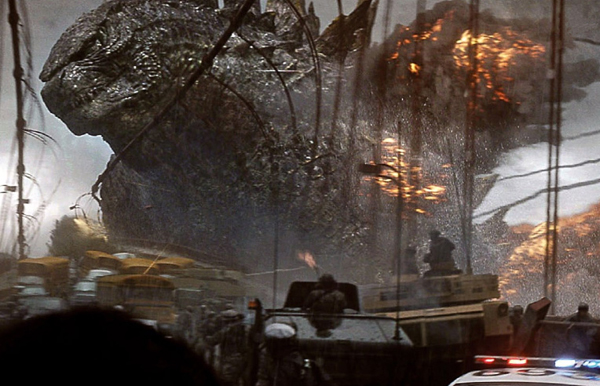
“GODZILLA” (2014) Review (✫✫1/2)

Should have been called “Mutos” if you ask me. 

There are two questions that always come into my head every time I watch a reboot: Is it different from the original, and is it necessary? The answer to both is usually no, it isn’t. Why would it be? Most studios just cash in on the name of their franchise and re-brand it, rather than coming up with an original take of their story, breathing life and energy into a franchise that has since been left stale. Perfect example: did anyone find Roland Emmerich’s 1998 version of Godzilla to be even remotely tolerable?

With this new version of Godzilla, I can say that it at least succeeded as a reboot in that it is different from the original. Whether that is a good different is something I’m still struggling with. I feel like I’m one of the helpless human beings running away from all the giant monster ruckus going on in the middle of Japan: I’m in the middle of a disarray of loud noise and violence, and while I’m fascinated by what is going on, I’m ultimately distraught because these giant monsters are destroying the things that I love.

Directed by Gareth Edwards, the writer/director behind 2010’s Monsters, Godzilla stars Aaron Taylor Johnson as Ford, a lieutenant who just came back from his service in the Navy. His wife and child (portrayed by Elizabeth Olsen and Carson Bolde) are more than eager to have their family whole again, and couldn’t be happier to see him when he finally comes home.

Only one problem: Ford’s father, Joe (Bryan Cranston) just got arrested in Japan for intrusion on private property. You see, about fifteen years ago, poor Joe was dutifully working as an engineer for a power plant in Japan. After scanning some strange readings off of the richter scale, he witnesses the death of his wife as the power plant quickly collapses before him.

Everyone around Joe believes that what he witnessed was a massive earthquake, including his son Ford. Joe doesn’t believe that it was an accident, and thinks there’s something much more sinister afoot than what everyone thinks. As Joe and his son continue to investigate the evidence he’s collected, they begin to become more aware of a giant conspiracy that the Japanese governments are working to hide, and soon, they come into contact with the biggest and most dangerous secret of all: a giant monster, the king of all beasts nicknamed “Godzilla”.

Looking back at this film, I am reminded by not how much I enjoyed this movie, but how much Peter Jackson’s King Kong got right as a remake. When reboots are done right, they are like King Kong: they are smart, clever, well-structured stories that are exciting, involving, and pay delicate homages to the source material. When they go wrong, they are like Emmerich’s Godzilla: explosions of CGI and visual effects garbage that go in every direction except for to the point.

With this new Godzilla, it takes steps to be a unique monster-sized reboot, but whether it reached the top of the staircase is another thing to be decided. I liked a lot of things about this movie. Edwards does a good job balancing the destruction with the human interest. Godzilla himself is a sight to see. The fights between him and these Cloverfield-like monsters called “Mutos” are a thing of classic Godzilla fandom. And Bryan Cranston was a clear emotional standout in the movie, giving a invested performance that was more than what the movie deserved.

One my biggest gripes with the movie is this: Godzilla isn’t in it. Or at least, not as much as I would like him to be. When you watch monster movies like King Kong or Jurassic Park, you get an overwhelming sensation of the scope and size of the creature’s presence, of the ground shaking when they take a step, or their shadows lurking over you as they quietly stalk their prey. I’m frustrated not by Godzilla’s physical appearance, but rather how infrequently he appears during the movie. The Godzilla movie has a total run time of 123 minutes, and where is he during the most of it? Swimming around in an ocean, spikes popping out, chasing monsters smaller than him that he could have easily killed 30 minutes ago.

Granted, I know what Edwards was trying to accomplish here. In an interview with Entertainment Tonight, Cranston compared the film to Steven Spielberg’s 1970 classic film Jaws, in that it doesn’t immediately show the monster, but its tension and presence could always be felt in it.

There, however, is one big reason why that doesn’t work with this movie. The shark in Jaws is a 300-foot shark lurking and sneaking through it’s quiet habitat in the waters. Godzilla is a 9,000 ton monster stomping his way through cities. I don’t think subtlety is supposed to be part of its nature.

As far as it’s lead goes, Taylor-Johnson is stock, a plain and uninteresting cutout of a soldier whose character is so one-note that he might as well be a cowbell instrument. For Pete’s sake, if you’re going to go to use the Hollywood hero archetype, can you at least get someone who is good at it? I could easily see someone like Tom Cruise or Jude Law in Taylor-Johnson’s role and succeed just as much at doing it. In fact, I almost prefer it. His emotions aren’t subtle, he doesn’t do a good job at expression, and at times he recites lines so casually that we could possibly be fooled into thinking that he was reading off of a cue card.

I went back and forth on whether or not I liked this movie, juggling around the things in my head that I did and didn’t like in the film. Ultimately though, if I’m having this hard of a time understanding what the movie was supposed to be, then usually so did the film itself. Godzilla is a decent reboot, restarting the franchise with a modern twist that I know many film aficionados will appreciate, but it should have been more. More as in better acting. More as in better handling, and more as in more of the freaking monster, period. Either way, the movie didn’t leave its mark on me, and when I talk to fans of the franchise since it’s debut, they too indicate that they prefer the original over the reboot. Hey, at least Godzilla had more screen time.

Tagged , , , , , , , , , , , , , , , , , , , , , , ,

“DAWN OF THE PLANET OF THE APES” Review (✫✫✫1/2)

The predator and the prey are one and the same.

It all started with the eyes.

Looking deeply into them, we see the angry, vicious, relentless energy behind them, as hungry as an animal and as wild as a beast. A somewhat appropriate description, because these are the eyes of the ape Caesar (Andy Serkis), the intelligent primate we’ve come to know from Rise of the Planet of the Apes. As we continue looking at his eyes, his steady, violent stare, we see his army of followers climbing on branches behind him.

He drops his hand, motioning them to attack.

After we see this powerful, expressive opening sequence, we are taken through this epic journey that is Dawn of the Planet of the Apes, a compelling and exciting survivalist-drama that looks at the human-primate condition from two different perspectives, as if they are two sides to one coin. The leader of the apes is Caesar, who now has his own family in his wife Cornelia (Judy Greer) and his son Blue Eyes (Nick Thurston). The leader of a band of human survivors is Malcolm (Jason Clarke), who also has his own family in Ellie (Keri Russel) and his teenage son Alex (Kodi Smit-McPhee).

Both of these band’s stories take place years after the virus attack that destroyed the most of humanity years ago, which we got a glimpse at the end of Rise of the Planet of the Apes. Both sides have lost loved ones in the wake of the disaster. Both sides do not trust the other. Yet, as Caesar and Malcolm share close encounters with each other, they slowly begin to understand and see that their races are not so different from each other. As the human-primate war rages on, Caesar and Malcolm must combine their efforts to protect each of their families, and seek out peace between their established societies.

Remembering fondly of how I enjoyed seeing the ape empire’s beginnings and relishing in the context of human-animal abuse in Rise, I went into this movie knowing it had a strong foundation to build it’s story on, hoping that they wouldn’t fail. Not only did director Matt Reeves not fail in telling his story of Dawn; he expanded further upon the Planet of the Apes story in detail, action and commentary than I estimated him to. His film ended up being better than Rupert Wyatt’s film in spades.

Firstly, let’s talk about the similarities between each film. Rick Jaffa and Amanda Silver, the writing/producing team behind Rise, returns yet again to contribute to Dawn’s story and to the production of this film. In many ways, I argue that both are better in this film than they were in the last one.. The plot of the first movie was an involving, interesting and emotionally compelling sci-fi thriller, a story that showed the worst of humanity and their cruel mistreatment of animals. Here, this movie has a more of a political facet in its structure, a drama that shows each race as a mirror of the other. It shows a civil anarchy blooming in the heart of each race.

The characters are compelling and have genuine interactions with each other, from Caesar confronting Malcolm on staying away from their home, to intimate scenes when Alex interacts with Caesar’s new baby boy. What I liked so much, however, is director Matt Reeves details not only to these emotions, but the visual display of the story in itself.

Being no stranger to visual effects or emotions with a filmography including Cloverfield and Let Me In, Reeves is skillful in making an exciting action movie while at the same time making a involving apocalyptic thriller. It surprising with this film that the basis of the film wasn’t grounded in action or ridiculous CGI stunts, but rather, in small, intimate moments of conversation and ape-sign-language that characters share with each other. It’s nice to see a big-budget blockbuster movie reaching for more intimate, personal situations, rather than the billion-dollar-sized explosions of garbage you’d see from the Transformers movies.

I do have a criticism in the movie in that the human characters were mostly boring. I have a rule of thumb that if I can’t remember a character’s name by the end of the movie, then that character is mostly forgettable. By the end of the film, I only remembered Malcolm’s name. I called Keri Russel’s character “Keri Russel” in the film while I labeled Smit-McPhee as a Jay Baruchel rip-off. I even looked at Gary Oldman’s character in the film and smirked in my head, “Well, hello there, Commissioner Gordon! Did you end up surviving the nuclear fallout in The Dark Knight Rises?”

What I realize though is that the humans aren’t supposed to be the main anchor of the film. The apes are center focus here, and this is really their story, figuring out their emotions, finding their identities, and realizing their faults as they look at human beings and see themselves deep within.

I think I realized this was a masterful film when it approached its final minutes, when we once again returned to the eyes of Caesar that we saw at the beginning of the movie. Only this time, they weren’t as aggressive as they were before. These were not the eyes of the predator, the hunter eagerly waiting to hunt his prey. No, these eyes were solemn and sad, as if they were looking at a bleak, grim future, one they were powerless to stop.

Tagged , , , , , , , , , , , , , , , , , , , , , , , , , , , , , , , , , , ,