Tag Archives: Survival

“SIN CITY” Review (✫✫)

“There ain’t no sunshine when she’s gone.”

You’re either going to love or hate Sin City. There’s no getting around that fact. Like the movies directed by Quentin Tarantino or Eli Roth, Sin City is a movie specific to its own tastes, and doesn’t care much about the opinions opposite of it. It’s a violent, gross, disgusting and putrid film full of the stuff that would make a Catholic priest faint. If that sounds like something you would like, by all means, be my guest and have at it. If you are repulsed by my description of the film, I certainly don’t blame you.

Based off of the comic book series by Frank Miller, Sin City is a film that follows four separate stories that (mostly) intertwine together. John Hartigan (Bruce Willis) is an aged police officer who is viciously pursuing child rapist Roark Jr. (Nick Stahl). Marv (Mickey Rourke) is a rough-around-the-edges thug who is framed for the murder of a prostitute he slept with named Goldie (Jamie King). And Dwight (Clive Owen) is a private investigator who gets pulled into a turf war, risking the lives of cops and prostitutes alike.

What do all of these stories have in common? They all started because of a woman, and these men go out to kill because they love their woman. Or, at least, whatever constitutes as love in this universe, in which case it’s a one-night stand.

It’s so difficult to review a movie like Sin City. Why? Because it’s not for people like me, that’s why. I don’t like watching movies like Sin City. I don’t like watching blood and violence for the sake of blood and violence, or watching sex and nudity for the sake of sex and nudity. It’s hard to be non-biased with movies like these because I watch moments where a naked woman walks out with bare breasts and all, and I can’t help but imagine the director thinking “Hey, let’s have this actress naked in this scene, because boobs.”

Sin City is aggressively, unnecessarily violent. How violent? So violent that the least bloody scene in the movie came from Quentin Tarantino. That’s how bad it gets. Red, white, black and yellow blood splatter across the screen like Jackson Pollock was making a painting. Severed heads and body parts are frequently cut off and thrown around in the film like missing pieces to a G.I. Joe. Those body parts include testicles, by the way, on multiple occasions. And don’t even get me started on the absurdity of its kills. In one scene, Marv gets beaten, stabbed, shot, and crashed his car into a lake and still gets up to pursue Goldie’s killer. Good God, are these guys made of kevlar or something?

Remind you, I have no problem with violence in movies, but here it’s just far too absurd and disgusting to be able to fully stomach. When it’s used to illustrate an emotion or a point in movies like Pulp Fiction or Taxi Driver, I praise its purpose and its usage. Here, it illustrates no emotion or urgency. It’s a glorified selling point for a really long, disgusting, stupid movie.

I did like the visualization of Sin City. That, and its opening scene. I liked it’s black-and-white style, it’s sense of contrast and expert use of shadow and lighting. It gave it a strong reminiscent feeling of the classic neo-noir films that inspired the original Sin City comic books, the ones that have the snazzy saxophone playing in the background as two lovers stand on a balcony, telling each other that they love each other and that they never want to leave each other. The film itself, in fact, functions as a parody of the neo-noir genre: characters stand on balconies, docks, outrun police cars, smoke cigarettes and talk in thickly exaggerated accents to the point where it can’t be taken seriously.

Realize, however, that this wasn’t on accident; director Robert Rodriguez wanted you to see how he exaggerated details so you would understand that him and Frank Miller were lightly poking fun at the genre, all while at the same time suggesting delicate homages to it as well. I like that they tried to reach for a deeper effort with the film, even though their intentions were smarter than the film itself was.

So what’s my end consensus? Is it a movie that you should see or skip? I’ll leave that decision in your hands. For now, I have done my job in telling you what the movie is like, and I will wash my hands clean from it. I have church in the morning.
Tagged , , , , , , , , , , , , , , , , , , , , , , , , , , , , , , , ,

“GODZILLA” (2014) Review (✫✫1/2)

Should have been called “Mutos” if you ask me. 

There are two questions that always come into my head every time I watch a reboot: Is it different from the original, and is it necessary? The answer to both is usually no, it isn’t. Why would it be? Most studios just cash in on the name of their franchise and re-brand it, rather than coming up with an original take of their story, breathing life and energy into a franchise that has since been left stale. Perfect example: did anyone find Roland Emmerich’s 1998 version of Godzilla to be even remotely tolerable?

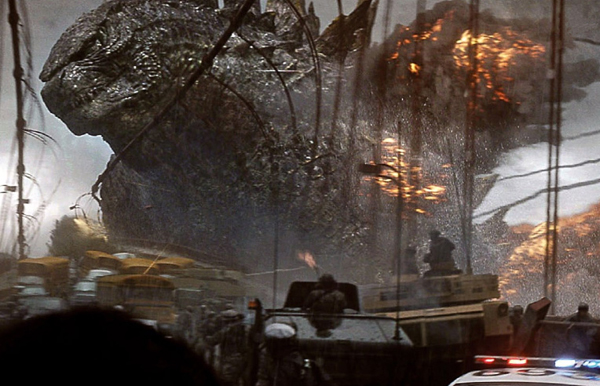
With this new version of Godzilla, I can say that it at least succeeded as a reboot in that it is different from the original. Whether that is a good different is something I’m still struggling with. I feel like I’m one of the helpless human beings running away from all the giant monster ruckus going on in the middle of Japan: I’m in the middle of a disarray of loud noise and violence, and while I’m fascinated by what is going on, I’m ultimately distraught because these giant monsters are destroying the things that I love.

Directed by Gareth Edwards, the writer/director behind 2010’s Monsters, Godzilla stars Aaron Taylor Johnson as Ford, a lieutenant who just came back from his service in the Navy. His wife and child (portrayed by Elizabeth Olsen and Carson Bolde) are more than eager to have their family whole again, and couldn’t be happier to see him when he finally comes home.

Only one problem: Ford’s father, Joe (Bryan Cranston) just got arrested in Japan for intrusion on private property. You see, about fifteen years ago, poor Joe was dutifully working as an engineer for a power plant in Japan. After scanning some strange readings off of the richter scale, he witnesses the death of his wife as the power plant quickly collapses before him.

Everyone around Joe believes that what he witnessed was a massive earthquake, including his son Ford. Joe doesn’t believe that it was an accident, and thinks there’s something much more sinister afoot than what everyone thinks. As Joe and his son continue to investigate the evidence he’s collected, they begin to become more aware of a giant conspiracy that the Japanese governments are working to hide, and soon, they come into contact with the biggest and most dangerous secret of all: a giant monster, the king of all beasts nicknamed “Godzilla”.

Looking back at this film, I am reminded by not how much I enjoyed this movie, but how much Peter Jackson’s King Kong got right as a remake. When reboots are done right, they are like King Kong: they are smart, clever, well-structured stories that are exciting, involving, and pay delicate homages to the source material. When they go wrong, they are like Emmerich’s Godzilla: explosions of CGI and visual effects garbage that go in every direction except for to the point.

With this new Godzilla, it takes steps to be a unique monster-sized reboot, but whether it reached the top of the staircase is another thing to be decided. I liked a lot of things about this movie. Edwards does a good job balancing the destruction with the human interest. Godzilla himself is a sight to see. The fights between him and these Cloverfield-like monsters called “Mutos” are a thing of classic Godzilla fandom. And Bryan Cranston was a clear emotional standout in the movie, giving a invested performance that was more than what the movie deserved.

One my biggest gripes with the movie is this: Godzilla isn’t in it. Or at least, not as much as I would like him to be. When you watch monster movies like King Kong or Jurassic Park, you get an overwhelming sensation of the scope and size of the creature’s presence, of the ground shaking when they take a step, or their shadows lurking over you as they quietly stalk their prey. I’m frustrated not by Godzilla’s physical appearance, but rather how infrequently he appears during the movie. The Godzilla movie has a total run time of 123 minutes, and where is he during the most of it? Swimming around in an ocean, spikes popping out, chasing monsters smaller than him that he could have easily killed 30 minutes ago.

Granted, I know what Edwards was trying to accomplish here. In an interview with Entertainment Tonight, Cranston compared the film to Steven Spielberg’s 1970 classic film Jaws, in that it doesn’t immediately show the monster, but its tension and presence could always be felt in it.

There, however, is one big reason why that doesn’t work with this movie. The shark in Jaws is a 300-foot shark lurking and sneaking through it’s quiet habitat in the waters. Godzilla is a 9,000 ton monster stomping his way through cities. I don’t think subtlety is supposed to be part of its nature.

As far as it’s lead goes, Taylor-Johnson is stock, a plain and uninteresting cutout of a soldier whose character is so one-note that he might as well be a cowbell instrument. For Pete’s sake, if you’re going to go to use the Hollywood hero archetype, can you at least get someone who is good at it? I could easily see someone like Tom Cruise or Jude Law in Taylor-Johnson’s role and succeed just as much at doing it. In fact, I almost prefer it. His emotions aren’t subtle, he doesn’t do a good job at expression, and at times he recites lines so casually that we could possibly be fooled into thinking that he was reading off of a cue card.

I went back and forth on whether or not I liked this movie, juggling around the things in my head that I did and didn’t like in the film. Ultimately though, if I’m having this hard of a time understanding what the movie was supposed to be, then usually so did the film itself. Godzilla is a decent reboot, restarting the franchise with a modern twist that I know many film aficionados will appreciate, but it should have been more. More as in better acting. More as in better handling, and more as in more of the freaking monster, period. Either way, the movie didn’t leave its mark on me, and when I talk to fans of the franchise since it’s debut, they too indicate that they prefer the original over the reboot. Hey, at least Godzilla had more screen time.

Tagged , , , , , , , , , , , , , , , , , , , , , , ,

“DAWN OF THE PLANET OF THE APES” Review (✫✫✫1/2)

The predator and the prey are one and the same.

It all started with the eyes.

Looking deeply into them, we see the angry, vicious, relentless energy behind them, as hungry as an animal and as wild as a beast. A somewhat appropriate description, because these are the eyes of the ape Caesar (Andy Serkis), the intelligent primate we’ve come to know from Rise of the Planet of the Apes. As we continue looking at his eyes, his steady, violent stare, we see his army of followers climbing on branches behind him.

He drops his hand, motioning them to attack.

After we see this powerful, expressive opening sequence, we are taken through this epic journey that is Dawn of the Planet of the Apes, a compelling and exciting survivalist-drama that looks at the human-primate condition from two different perspectives, as if they are two sides to one coin. The leader of the apes is Caesar, who now has his own family in his wife Cornelia (Judy Greer) and his son Blue Eyes (Nick Thurston). The leader of a band of human survivors is Malcolm (Jason Clarke), who also has his own family in Ellie (Keri Russel) and his teenage son Alex (Kodi Smit-McPhee).

Both of these band’s stories take place years after the virus attack that destroyed the most of humanity years ago, which we got a glimpse at the end of Rise of the Planet of the Apes. Both sides have lost loved ones in the wake of the disaster. Both sides do not trust the other. Yet, as Caesar and Malcolm share close encounters with each other, they slowly begin to understand and see that their races are not so different from each other. As the human-primate war rages on, Caesar and Malcolm must combine their efforts to protect each of their families, and seek out peace between their established societies.

Remembering fondly of how I enjoyed seeing the ape empire’s beginnings and relishing in the context of human-animal abuse in Rise, I went into this movie knowing it had a strong foundation to build it’s story on, hoping that they wouldn’t fail. Not only did director Matt Reeves not fail in telling his story of Dawn; he expanded further upon the Planet of the Apes story in detail, action and commentary than I estimated him to. His film ended up being better than Rupert Wyatt’s film in spades.

Firstly, let’s talk about the similarities between each film. Rick Jaffa and Amanda Silver, the writing/producing team behind Rise, returns yet again to contribute to Dawn’s story and to the production of this film. In many ways, I argue that both are better in this film than they were in the last one.. The plot of the first movie was an involving, interesting and emotionally compelling sci-fi thriller, a story that showed the worst of humanity and their cruel mistreatment of animals. Here, this movie has a more of a political facet in its structure, a drama that shows each race as a mirror of the other. It shows a civil anarchy blooming in the heart of each race.

The characters are compelling and have genuine interactions with each other, from Caesar confronting Malcolm on staying away from their home, to intimate scenes when Alex interacts with Caesar’s new baby boy. What I liked so much, however, is director Matt Reeves details not only to these emotions, but the visual display of the story in itself.

Being no stranger to visual effects or emotions with a filmography including Cloverfield and Let Me In, Reeves is skillful in making an exciting action movie while at the same time making a involving apocalyptic thriller. It surprising with this film that the basis of the film wasn’t grounded in action or ridiculous CGI stunts, but rather, in small, intimate moments of conversation and ape-sign-language that characters share with each other. It’s nice to see a big-budget blockbuster movie reaching for more intimate, personal situations, rather than the billion-dollar-sized explosions of garbage you’d see from the Transformers movies.

I do have a criticism in the movie in that the human characters were mostly boring. I have a rule of thumb that if I can’t remember a character’s name by the end of the movie, then that character is mostly forgettable. By the end of the film, I only remembered Malcolm’s name. I called Keri Russel’s character “Keri Russel” in the film while I labeled Smit-McPhee as a Jay Baruchel rip-off. I even looked at Gary Oldman’s character in the film and smirked in my head, “Well, hello there, Commissioner Gordon! Did you end up surviving the nuclear fallout in The Dark Knight Rises?”

What I realize though is that the humans aren’t supposed to be the main anchor of the film. The apes are center focus here, and this is really their story, figuring out their emotions, finding their identities, and realizing their faults as they look at human beings and see themselves deep within.

I think I realized this was a masterful film when it approached its final minutes, when we once again returned to the eyes of Caesar that we saw at the beginning of the movie. Only this time, they weren’t as aggressive as they were before. These were not the eyes of the predator, the hunter eagerly waiting to hunt his prey. No, these eyes were solemn and sad, as if they were looking at a bleak, grim future, one they were powerless to stop.

Tagged , , , , , , , , , , , , , , , , , , , , , , , , , , , , , , , , , , ,

“RISE OF THE PLANET OF THE APES” Review (✫✫✫)

Hey, apes are people too. 

Be honest: how many of you were expecting this one to be good? I know I certainly didn’t. After seeing how poorly the earlier Planet of the Apes movies were faring (I’m looking at you, Tim Burton), here I was expecting another downtrodden experience that was trying to milk whatever it could left from the utters of its franchise. Why wouldn’t I expect that? The same thing has been done with the Jaws series alongside every conceivable Friday the 13th movie ever made. Believe me, I wasn’t expecting a good movie when I heard that this movie was called Rise of the Planet of the Apes. It honestly felt more like it was falling to me.

Here, however, is the rare occasion where a prequel/reboot actually contributes to the franchise rather than taking away from it. Taking place years before the events of the very first Planet of the Apes film, Rise tells the story of Will Rodman (James Franco), a scientist who is developing a potential cure for alzheimer’s deep within his lab. After testing it on multiple chimpanzees and noticing an effect in increased intelligence, one of them goes berserk, attacks her caretakers, then is killed in self-defense. The scientists are ordered to terminate the project and kill any ape left within the vicinity.

It is during his routine inspection where he discovers a small baby chimp deep within the cell of the female ape that was killed earlier. Knowing that the baby would die if he remained there, Will took the little baby home and raised him as his own.

As the years progress, we notice that the baby chimp shares the same characteristics as his mother did when she was in the labs. Both of them displayed feats of great intelligence and memorization. Both developed abilities to read, write and comprehend speech. Both learned the skill of being able to do sign language. Most impressive was their ability to convey, understand and express emotions, almost like they’re human themselves. As the small chimp named Caesar (Andy Serkis) grows out of his adolescence and into adult apehood, he begins to notice a darker side of humanity and plots a way to set himself and his fellow apes free from mankind’s grasp.

Here is a film that, by every definition, should not have been good. It had everything working against it. It’s the prequel to a film series that hasn’t had a good film since 1968. It’s the seventh film in a franchise that has long since lost its influence. And it’s centered around a main character who isn’t even human, an ape who, for more than half of the film, can’t even talk.

Believe me, I went into this film fully expecting to hate it. Turns out that it’s quite the opposite. Rise of the Planet of the Apes demonstrates exactly what a hollywood blockbuster is supposed to be, a smart, involving and intelligently made film that is equal parts exciting as it is relevant. Director Rupert Wyatt, who made the 2008 film The Escapist prior to Rise, is careful and delicate with the pacing of his film. Starting off on a very dramatic and touching note, we go through what can mostly be seen as a science-fiction drama about the relationship between the guy who plays Harry Osborn and his little ape-friend, until all hell breaks loose and the beginning of the human-ape war spawns itself.

I exaggerate a little bit, but you get my point. There isn’t a lot of action in the movie, or at least, not as much as you’d expect it to be Instead, there are a lot of small, intimate moments where Caesar and Will’s beings clash into each other, either bonding in very genuine, heartfelt moments or rubbing off of each other as starkly as their conflicting races are. This is a dialogue-driven movie, with Will and Caesar each questioning the decisions they make and how they should should both respond as the result of it.

A lot of things don’t really blow up in the movie, to be honest. But when it does, ohhhh boy, is it exciting. My favorite scene in the movie had to be when Caesar and his primate army broke out of a preservation facility in new york and pierced their way right through the heart of the city, almost like it’s the American revolution and it’s George Washington leading the charge.

At the absolute heart of this film, however, is Caesar, portrayed here by actor Andy Serkis. If you don’t recognize the name, you don’t deserve to call yourself a cinephile. Serkis is most known for a slew of CGI performances, ranging from Gollum in The Lord of the Rings to the titular ape in Peter Jackson’s King Kong. Great as he was as Gollum, I’m tempted to say that this is his best performance yet. When you watch the film, notice the differences at how he carries himself as an ape and as a slightly-more evolved ape. In early scenes, he’s just walking around like a regular animal, with his elongated arms carrying himself as he “oohs” and “ahhs” while rubbing the back of his head. As the movie continues on, Caesar’s evolvement is apparent, and you notice his regular instinctual appearance has been replaced with a tall, stark, and grim figure, bleakfully looking on at a society that he has lost all faith in. Gollum was a character he concieved entirely from his own inspiration, while King Kong was one he concieved from studying the natural behavior of apes. He does both here with Caesar, and successfully portrays a character who is not just an ape, but a super ape, one who is evolving to something much more dangerous at an alarming and vengeful pace.

The only complaint I will issue with this movie is its ending, which is so melodramatic and sappy that it could have been used for an “Animal Planet” commercial. Why did they have to do this? Who says a movie needs to end on an optimistic note? Why do we need to have a happy ending? Who says we can’t end on a bleak, grim note, foreshadowing on a downtrodden spiral of war, doom and apocalypse? We all know that this can only end one way anyway. The franchise isn’t called “Planet of the Humans”, after all.

Tagged , , , , , , , , , , , , , , , , , , , , , , , , , , , ,

“HOW TO TRAIN YOUR DRAGON” Review (✫✫✫✫)

Step one: Don’t get eaten by a nightfury.

How To Train Your Dragon is a pure joy, a complete and captivating wonder that reaches the inner child in you, touches it, and fills you with such inexplicable excitement and adventure that you almost feel like you can do anything. I was initially worried about this movie going in to it: how many other movies have attempted the human-pet budding romance E.T. did so wonderfully all those magical years ago, and failed? Well, there’s nothing to fear here, fellow reader. In their long line of successes, failures and mismatches, How To Train Your Dragon easily ranks among DreamWorks’ best work.

We open up on a grand battle on the land of Berk, an island where the vikings are as stubborn and hard-headed as the metal helmets they wear on their heads. But this battle isn’t against other vikings, mind you: it’s against dragons, giant, dangerous beasts that tear through the sky and spit fire like its flu season for them. For the vikings, killing a dragon is like the starting point for becoming a man. It’s their form of puberty I suppose, next to the endless gorges of food and testosterone that they throw and shout about at each other.

One Berk citizen, however, is a little more hopeless than other vikings: Hiccup (Jay Baruchel), a smart, inventive but helplessly clumsy little fellow that will reach for a pencil when he’s supposed to reach for an axe. Fate turned an eye to him when in the midst of the battle, he captured a “nightfury”, a sleek black dragon whose fast speed and blue fire makes him the most deadly dragon out in the field of battle. However, against his better judgement, Hiccup decides not to kill the nightfury after discovering that he was injured during the battle. Now, while slowly helping him back to health and back to being able to fly, Hiccup discovers the truth about the dragon race, and how similar he is to them and their personalities.

Taking a look at the past animated movies DreamWorks has helped produce, you realize how much of a mixed bag they put out there to their audience. Look at the best they’ve had to offer, such as Shrek and Kung Fu Panda. Now look at the worst they’ve had to offer, such as Shark Tale and Shrek The Third. And don’t even get me started on Bee Movie. Looking at their filmoraphy, and looking at how much they’ve done wrong mixed with their right, I was expecting a very artificial, forgettable experience.

Boy, was I wrong, and boy was I glad to be wrong. The very first detail you notice in How To Train Your Dragon is it’s animation, how crisp and refined it is in detail, and how authentic it makes everything look. In the opening sequence, for instance, we shift through the dark clouds and sea as we approach the land of Berk, and it was so atmospheric that I felt like I myself was flying over the ocean surface when I first saw it. Later in the film, you look at vikings talking to each other in the dining hall, and the rock floors and the wood detailing look so real that you can almost reach out and touch it.

But I know what you’re really after. You’re not after what the waves, clouds and wood looks like. Nuh uh. You’re interested in how the dragons look, how exhilarating the fight scenes are and how exciting it is when you see a dragon spread his wings for the first time.

Let me assure you, fellow reader: the action could not be any more exciting. The dragons are all colorful, lifelike and filled with variety, their wings spread out in glorious, anthropomorphic detail. When they fly, they soar at supersonic speeds, dodging mountains, flipping through the air, and skydiving towards valleys like they are swimming in an endless sea of clouds and sky.

I especially liked the chemistry Hiccup shares with the nighfury, who he later names Toothless in the movie. Did I really just say that? That I liked the chemistry between two fictional, fake, animated characters? Yes I did, because these characters are neither fake nor artificial: they’re genuine, sharing real, heartfelt emotions with each other in ways almost no other animated film captures in movies. When Hiccup touches Toothless’ snout for the first time, you feel conflicted emotions between each other as they struggle to trust one another. When Toothless saves Hiccup from certain death from the dangers of the skies, you feel their relationship growing as they form a closer bond with each other. But when an all-out war spawns in between the vikings and the dragons, it’s Hiccup and Toothless that remain strong through it all, their friendship so compelling that it almost feels like connecting with a long-lost brother, not too disimilar to how Boo and Sully interact in Monsters Inc. 

My only regret with this movie is that it won’t be the best animated film of the year. With Toy Story 3 releasing just around the corner, and considering Pixar’s track record, it’s doubtful to see How To Train Your Dragon trump years of animated fandom and cherishment, especially when we’ve had years to grow with these characters. Shame, because this movie has great, fluid animation, an involving story, and memorable characters just like Toy Story does. If Toy Story 3 wasn’t coming out in June, I am positive that How To Train Your Dragon would win the best animated feature award at the Oscars.

Tagged , , , , , , , , , , , , , , , , , , , , , , , , , , , , , , , , , , , , ,

“X-MEN: DAYS OF FUTURE PAST” Review (✫✫✫✫)

The next stage in superhero cinema evolution. 

X-men: Days of Future Past ranks among the best superhero sequels I’ve ever seen, one I would instantly compare to that of Spider-man 2 or The Dark Knight. There were so many things that needed to be done, so many risks that needed to be taken, and so many ways this movie could have failed. It didn’t. From the opening sequence to its last breathtaking moment, my mind was blown and the comic-book nerd in me was absolutely filled with joy. The movie did more than simply expand the franchise: it redefined it.

We open on a post-apocalyptic future that hasn’t been this catastrophic since James Cameron’s 1984 film The Terminator. Years after X-men: The Last Stand took place, humans are now being hunted by the same weapons they created in the first place: the Sentinels, a coalition of dangerously armed robots who can track and exterminate any mutant they can find on planet earth. Amongst the ruins of battered buildings and fallen icons, the human race has now been collected into a sort of concentration camps: all that’s left for the mutants then is the mass graves filled with the dead bodies of their kin.

Lifelong frenemies Charles Xavier (Patrick Stewart) and Magneto (Ian McKellan) collaborate on a plan they would like to enact. Besides having the ability to phase through walls and objects, Kitty Pryde (Ellen Page) has recently developed the ability to transfer someone’s consciousness into their younger bodies in the past, allowing them to change the future and avoid the unfortunate outcomes that might become of them. Kitty has been able to use this ability on multiple occasions now to save her friends, but now Professor X and Magneto want to go back into the past (1970, to be exact) to prevent the event that triggered this horrifying future and save human and mutantkind as they know it.

Problem is, Kitty can only send someone back a few days or weeks at a time. Any further than that and she risks tearing apart the mind of the person she’s sending back to the point beyond repair. Luckily, Wolverine (played by Hugh Jackman, who else?) has the ability to heal himself at a faster rate. So Professor X and Magneto decide to send Wolverine back into the past to coerce their younger selves (portrayed by James McAvoy and Michael Fassbender, respectively) to stop the triggering event and save the future.

Serving as a sequel to both X-men: First Class and X-men: The Last Stand, and incorporating characters and actors from both translations, X-men: Days of Future Past is, in a word, a game changer. It brings in all of its key players, from the original cast members and its most revered director Bryan Singer, to the newcomers who’ve newly defined their roles, including McAvoy as Xavier and Fassbender as Magneto. Everyone meshes so perfectly with each other, especially Jackman once again, who essentially has to react to characters from two different time zones. There hasn’t been a cast this big since Joss Whedon’s The Avengers, and I’m tempted to say the movie is better because of it.

Do I really want to stand here though, and compare Days of Future Past to that of The Avengers? Yes I do. The Avengers was a bold, brave step forward in comic book evolution, combining characters from five different movies to make a superhero epic that hadn’t been tried before. Days of Future Past follows that same model, bringing in characters from six of its movies, but the end result is vastly different. There’s a much deeper plot going on here, a vastly intelligent and contemplative story that elaborates on its recurring themes of racism and, once again, bringing in the consequences of discrimination to the forefront. I loved X2 for this very reason, for it being more than just a comic book movie and focusing itself more as a political thriller with comic book elements thrown into the mix. This movie is that to, like, the tenth power.

Oh yes, this movie will fill comic fans with glee everywhere. Similar to the small little easter eggs that can be picked up in other Marvel movies (Note: The Doctor Strange reference in The Winter Soldier), this movie too has sweet little moments that comic fans can pluck from the ground and take a moment and appreciate the aroma. My favorite had to be a moment where a mutant named Peter (Evan Peters), who can run at supersonic speeds, rests in an elevator with the younger Magneto as he’s helping him escape from prison, and makes a comment about his long-lost father. That’s just the tip of the Bobby Drake-iceberg. There’s so many moments I can pull from that filled me with joy and happiness, while others filled me with dread and angst. The film orchestrates its emotions wonderfully, and in every fabric of the film I felt what I was supposed to feel.

I’m going to go out on a limb and say this is the best X-men movie in the series so far. Bold claim, I know, but it deserves it. From its first moment to its last, Days of Future Past is completely, utterly, fascinatingly mind-blowing and involving. From its quietly hinted-at themes of xenophobia and extermination to its climactic action scenes where we don’t see how on earth our heroes can win, Days of Future Past combines the best parts of all of the movies and makes itself the best entry out of them. Many audiences have recently been experiencing superhero movie fatigue, with movies such as Man of Steel and The Amazing Spider-man 2 recently being met with mixed reaction amongst audiences and in the box office. Days of Future Past is one of those movies that restores your faith in the genre.

Tagged , , , , , , , , , , , , , , , , , , , , , , , , , , , , , , , , , , , , , , , , , , , , , , , , , , , , ,

“X-MEN: THE LAST STAND” Review (✫✫✫)

How can you “cure” what was intended as a gift?

There’s an obvious danger with the production of second sequels made with planned trilogies: how do you keep things fresh and interesting and make sure none of the material isn’t stretched out or forced? For many trilogies, the third entry is the one filmmakers are usually least concerned about. Why should they be? They’ve already made their biggest impact with the first two films and people will go and see it anyway, so why should they extend any effort? I like to call this “the trilogy curse,” and it explains why so many second sequels end up letting down their entire franchise (*cough* Terminator 3 *cough*).

The best thing that can be said for X-men: The Last Stand is that it does a good job avoiding the trilogy curse. While some may be frustrated by the liberties it took and the deviations it made from the source material, I for one found it to be very liberating. It changes things up a bit, made things different, and did one huge thing that many comic book movies can’t do: it made it unpredictable. Because of this, the stakes were higher, the action was more involving, and it made you invest yourself more in the characters rather than waiting for everyone to hold hands in the end for that “happily ever after” ending many films get trapped into. X-men: The Last Stand accomplished something important: it proved that comic-book movies can deviate from their source material and still be good.

After saving both human and mutantkind at the shrouded site where Wolverine (Hugh Jackman) gained his metal claws and lost his memory many years ago, X-men: The Last Stand takes place as the X-men still try to cope with the death of their beloved Jean Grey (Famke Jannsen), who sacrificed herself to save her friends as she became engulfed by a sea of raging waters. Most affected by this is her boyfriend Scott “Cyclops” Summers (James Marsden), who can still hear her voice in his head as he sits in their bedroom reminiscing about her.

The X-men, however, have a much more pressing issue at hand: a company called Worthington Labs has recently invented a mutation antibody that basically attacks mutant cells and nullifies them. The public dubbed it as a “cure,” and it essentially turns mutants into regular human beings, forever granting themselves the life of normalcy they’ve so long desired. Of course, this new invention stirs up quite a controversy among the mutant community, especially regarding Magneto (Ian McKellan) and his extremist brotherhood of mutants. When mutants come to terms with this cure and what it means for all of them, they must make a decision of whether or not to fight against the cure, or fight for humanity’s survival at all.

The first out of the X-men series not to be directed by Bryan Singer, filmmaker Brett Ratner (The Rush Hour series) steps in to fill in the reigns of Singer’s mostly definitive first two installments. How does he do? Well, the good news is that he holds his own pretty well, and makes a movie that he can call all his own. Ratner poses an important question here that I think the other two films mostly sidesteps: if you have an unwanted gift, should you keep it? For me when I watched the movie, I saw an image deeper than that of a mutant standing in line to take a shot that would take away their powers. I saw a pregnant teenager waiting in line for an abortion for that baby that she never intended to have in the first place, or an image of a man going in for a gender change because he doesn’t feel comfortable in his current body.

Controversial? Yes, but that’s how the film intends for it to be. Much like its predecessors, The Last Stand handles its political side well, and is being more ambitious by taking a different spin from the standard supremacist/racism themes that they explored in the earlier installments.

The cast is good, but that’s standard at this point. We expect Jackman to be good as Wolverine. We expect Patrick Stewart and McKellan to be convincing as the leaders for their own specific causes. We expect Storm (Halle Berry) to be the strong female hero that she is, and we expect Iceman (Shawn Ashmore) to be the kind-hearted, considerate teenager while Rogue (Anna Paquin) remains the estranged and desperately shy mutant who continuously questions keeping her abilities. The one we should notice more than anyone else is Janssen as Jean Grey. Yes, she’s back, and she has a much more villainous spin on her that comic fans may or may not be happy to see. She’s much more versatile in this movie, bouncing brilliantly in between angry and hateful to scared and grief-stricken. Without giving too much away, I really liked her role in this movie as both a protagonist and antagonist, and I think X-men fans will be just as pleased with her performance as well.

The only thing I don’t like with this movie is its climax. The buildup earlier in the film was so much better, with the backstory of Jean Grey, Professor X and Magneto culminating so ingeniously into a plot where all the danger was real and there was no way to predict who lived and who died. Another great scene with excellent buildup was when Wolverine went searching for Jean, fighting a small group of mutants within the confusion of a lush, maze-like forest. The final fight, however, could not have been more standard and one-note if it tried. It plays out exactly as you would predict it to, dragging out into a disarray of violence and loud noises until finally it ends in explosions and agonizing screams. Enough already. The rest of the movie did a good job building up anticipation: did you really have to give in right before the end?

Still, I had fun with this movie. I know “fun” is a very loose term that can be used within the film community, especially when you’re speaking about a potential deal breaker such as this. Still, I’m going to say it: this movie was fun. Why am I saying that? Because I enjoyed it, that’s why. I genuinely liked it. I liked the big, boisterous action scenes orchestrated on a grander scale in which I don’t think would have been possible six years ago. I liked the darker, more thematic moments between characters where they took time to build up the stakes and what was on the line here. Mostly however, I liked how it humanized the mutants, and made them genuine flesh-and-blood human beings that could be killed and harmed. It didn’t immunize them from death because of their fans’ love for them: it made them mortal, and it presented a real, legitimate threat in the film because of that.

I know many people who are going to disagree with me, and that there will be many who love these characters too much to be able to see them get killed off and just be okay with it. Let me set the news down with you easily: if you’re that bothered by seeing a character’s death in a movie, maybe you shouldn’t be watching that movie in the first place. These filmmakers set out to make a convincing movie where the threat was imminent and real: not to please the comic-book die hard who gets frustrated if a comic book character’s hair isn’t the right color. Maybe that was Ratner’s second goal beyond making a good sequel, to see how many changes he could make before the fans starting writing death threats to his home mailbox.

Tagged , , , , , , , , , , , , , , , , , , , , , , , , , , , , , , , , , , , , , , , , , , ,

“X2” Review (✫✫✫1/2)

A social commentary disguised as an action blockbuster.

X2 is science-fiction brilliance, a sequel that is relentlessly exciting, smartly written, intelligently designed, and jam-packed with so many involving action scenes and stunning visual effects that it could potentially work as a stand-alone movie, rather than a direct sequel to its predecessor X-men. Like Lord of the Rings and Harry Potter, this movie serves as an expansion for the universe that it is in and as an opportunity to provide fan service to its dedicated readers and lovers of the iconic source material. I’m not very much for sequels, and I definitely don’t want this to become a superhero monopoly, but if we have to have sequels packaged with every superhero installment in the near future, more filmmakers should pull inspiration from X2.

X2 picks up just short of a few months after X-men originally left off. After the combined efforts of the X-men defeated Erik Lenshurr, a.k.a. “Magneto” (Ian McKellan), and imprisoned him within a special plastic cell (Countering his ability to manipulate metal), the X-men go about their (ab)normal lives as teachers at Xavier’s School for Gifted Youngsters, educating mutants on how to control their powers and not be afraid of who they are. Only Logan, a.k.a. Wolverine (Hugh Jackman) sets out to Canada to seek out answers for his long-forgotten past, and even then he comes up empty: the lab where he was supposedly experimented on has long since been abandoned.

Soon, however, a new figure from everyone’s past re-emerges: William Stryker (Brian Cox), a government official who has experimented on mutants for as long as mutants existed. After pitching his program to the President and revealing that Xavier’s School For Gifted Youngsters is a front to the X-men operation, the X-men and the Brotherhood of Mutants must band together to save each other from Stryker’s plot, and quite potentially the rest of mutant kind with them as well.

Directed and co-written by Bryan Singer, who also directed X2’s predecessor X-men, X2 is a highly involving, irreverently fascinating superhero epic. Functioning just as much as a political thriller as it does a superhero action flick, Singer is careful to deliberate and balance everything effectively in the movie, from its themes of xenophobia and racism to its highly-exciting action sequences where mutants go flying, flipping, and teleporting in every which way and under.

Funny, the first time Singer tried X-men, balance was a problem for him. He put a greater emphasis on the action and the visuals of the mutant’s powers more than what they meant for them individually, quite possibly because that’s more of what the audience wants to see anyway. Here, balance is not an issue. He does a great job at both not only giving us a healthy dose of action-packed sequences of grandeur and excitement: he also does a great job giving us heartfelt, genuine emotion, showing these character’s internal reactions just as much as their external.

Example: After escaping from an attack on themselves and the rest of the X-men earlier in the movie, Wolverine takes himself and a small group of mutants to Bobby “Iceman” Drake’s (Shawn Ashmore) home, where he’s forced to essentially come out to his family that he is, in fact, a mutant. After seeing the emotion and disparity of his family reeling in with the shocking revelation of Bobby’s abilities, the police pull up to the house, and an explosive battle results between these X-men and the officers.

See, this is what I’m talking about: there isn’t a single moment in the movie where the action outweighs the drama, or the drama outweighs the action. For every scene where something emotionally weighty or significant is revealed, there is another scene where something exciting or thrilling happens that jump-starts your interest all over again. Whether it’s a scene involving dialogue between characters, a narrator giving exposition on a conniving plot, or another scene where some sort of grand, explosive battle takes place doesn’t matter. It’s always moving, it’s always doing something different, it always keeps up its interest and it is never boring.

I’m very happy with this movie. In a world where so many sequels make the mistake of replacing genuine emotion with an overdose of action and visual effects, X2 is a clear standout. While not necessarily perfect, and still incapable of escaping from some of the cheesy, ham-fisted moments that I rued in the first movie, it definitely stepped up its game as a far as drama goes, and has deeper contexts to offer regarding the xenophobia/racism issue that inspired the series as a whole since its comic book creation. In that sense, X2 is more than a superhero blockbuster. It’s a social commentary on judging another person for who they are and the destructive consequences that can come from it as a result.

Tagged , , , , , , , , , , , , , , , , , , , , , , , , , , , , , , , , , , , , , , , ,

“GRAVITY” Review (✫✫✫✫)

“In space, no one can hear you scream”

We fade in on a list of statistics about space as the edgy synthesizer music builds in the background.  The earth rotates at a speed of about 1000 miles per hour.  The temperature is about -273 degrees celsius.  There’s no gravity.  No oxygen.  No air pressure to carry sound. No one to hear you scream or cry for help. Nothing to save you if your suit fails to sustain you. Nothing to stop your momentum if you’re flying in the wrong direction. If you get into trouble out in space, you are all alone. Life in space is impossible.

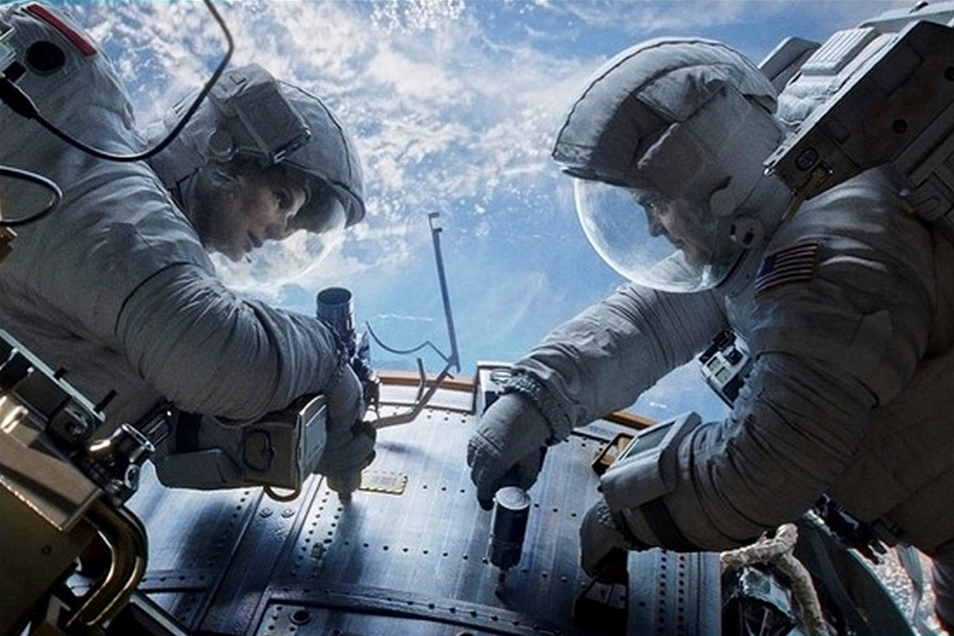
This sort of tension and desperation is felt on an emotional level so intense in Alfonso Cuaron’s Gravity that I feel like I’m in space experiencing the same things that these characters are experiencing, not watching the chaos unfold from mission control.  The plot follows three astronauts who are working on repairing a satellite in orbit. Dr. Ryan Stone (Sandra Bullock) is a mission specialist who is working hard at repairing the satellite on her very first space mission. Lieutenant Matt Kowalski (George Clooney) is an experienced space veteran who is retiring after this final expedition.  Shariff Dasari (Paul Sharma) is a flight engineer who carries a photo of him, his wife, and child inside his suit.  Early into their mission, the team gets a warning from mission control, saying that there is debris from a missile strike on a Russian satellite orbiting the earth, but that it shouldn’t collide with their trajectory.

Now if that isn’t a case of foreshadowing, I don’t know what is.  Eventually, the debris sets off a chain reaction of destruction, and it eradicates the shuttle that they came on.  Shariff is killed, Kowalski loses communication with mission control, and Stone is left desperately hanging on to her life as she floats aimlessly away from their space module. When Stone and Kowalski eventually meet up again, they have to race against time and fate as their oxygen levels continue to deplete, and need to find a way home before they are truly lost in space forever.

Man oh man, where to start.  Gravity is a film for a generation, a picture that is so convincing and so believable in its approach that its nearly impossible to think that it wasn’t even filmed in space.  It is visually stunning, emotionally gratifying, immensely captivating, and surprisingly involving, a picture that latches you on in its first shot and doesn’t let you go until hours after you’ve left the theater.

Who is responsible for this feeling of attachment and interest?  Why that is director Alfonso Cuaron, of course, who co-wrote the script with his son Jonas. Cuaron, who is most known for his mainstream films including Children Of Men and the third Harry Potter movie outdoes himself here. Not only has he made a compelling and visually breathtaking science-fiction film that visually challenges that of Avatar and Inception: he’s also made a emotionally captivating story with the human interest equivalent of Argo or Captain Phillips.

Oh, I’m not saying he isn’t already a great director: lord knows he’s delivered as much visual and emotional appeal as he did with Children Of Men and Prisoner of Azkaban.  But Gravity is head and shoulders above anything else he’s done in his entire career. Why? Everything in the movie is immaculate and intentional, from the physics and dangers of space to characters emotions and complexions. Look at the delicacy and the concentration on Cuaron’s shots. Look at how well he orchestrates a scene, whether a large, imposing space station is crumbling all around Earth’s orbit, or a astronaut is just awkwardly fitting herself in tight corridors around a space station. In each shot, there is interest, there is intricacy, and there is involvement. Whether its a big, intimidating destruction scene or a small conversation between characters doesn’t matter. The interest remains, and its boy does it keep your attention.

Visually, the film is unparalleled, hooking you on with all of its space-station grandeur and elegant scenery of earth from outer space. Part of this no doubt goes to the visual effects team led by supervisor Tim Webber, but a large accreditation needs to be made to cinematographer Emmanuel Lubeski, who collaborated on Cuaron’s other films including Children of Men and Y Tu Mama Tambien. Lubeski, who was nominated for an Oscar a few years ago for Terrence Malick’s Tree Of Life returns with the same artistry and craftsmanship that made him an artist in his own right. The camerawork in the film evokes a feeling of both reprehension and serenity, the same eerie feeling you get when you watch the slow, steady moments building up in Stanley Kubrick’s 2001: A Space Odyssey. It works in conjunction with the film’s plot and with Cuaron’s handling of it, a marriage of collaboration so essential that its doubtful anyone could be as fluid or as controlling as Lubeski is, not even Wally Phister’s steady, reliable camerawork from Christopher Nolan’s Inception or Dark Knight trilogy.

High praise, I know, but it’s well deserved. The visual effects alone have not made this movie. It’s Lubeski’s intricate framing and filming that not only captured these great shots, but intensified them, evoking the anxiety and unease of space just as much as the visual effects and sequencing does.

Bullock and Clooney are affectionate and grounded in their performances, pun intended.  Going in to the movie, I was really worried that the both of them were going to phone in their roles and just let the visuals take over, much like the Michael Bay/Roland Emmerich action movies you see nowadays. Boy, was I wrong. Their characters are real, charismatic and likable people in their own right, people who you’d probably like to sit with and share a conversation with over at Starbucks. Their chemistry is infectious with each other, as memorable and dynamic as the relationship Tom Hanks and Kevin Bacon shared with their crew mates during Ron Howard’s Apollo 13. You don’t only care for these characters because of their situation: you care for them because they are human beings, because they have hopes, dreams, and letdowns of their own and you want to see them make it through all of it.

This is what I love most about the movie: not just that it handles itself well as a science-fiction movie, but it handles itself well as human drama, period.

This is seriously one of the best films of the year. I’m not saying that because it is science-fiction. I’m saying that because it is seriously one of the best films of the year.  Under a different director, a different writer, cinematographer, composer, or even under a different cast, this film could have failed.  It’s hard to take a movie that takes place in an enclosed, blocked off environment separated from society with only one or two characters and make it interesting, and the filmmakers here have accomplished that in spades.

But Gravity is much more than a survival film.  It’s more than a science-fiction film.  It’s an epic and emotional story about an astronaut trying to survive, a woman trying to cope with living, reality, and tragedy, and the unhindered spirit that pushes her to keep living, even when all of the forces of nature tells her that she can’t. It blurs the line between science fiction and science reality and is quite possibly the best space movie I’ve ever seen.

Tagged , , , , , , , , , , , , , , , , , , , , , , , , ,