Tag Archives: Stan Lee

“THE AVENGERS: AGE OF ULTRON” Review (✫✫✫1/2)

The Avengers face judgement day. 

We are now nearing the end of Marvel’s phase two of its cinematic universe. Before Age of Ultron, we’ve seen ten of these movies now. Iron Man. The Incredible Hulk. Iron Man 2. Thor. Captain America: The First Avenger. The Avengers. Iron Man 3. Thor: The Dark World. Captain America: The Winter Soldier. Guardians of the Galaxy. You would think that by now, we would be sick of watching these movies. I know I normally would. It only took three Transformers movies for me to get sick of that franchise.

Yet, the people over at Marvel continue to find new ways to surprise me and make me once again believe in its cinematic universe. Avengers: Age of Ultron is its most recent example. The film had a near impossible task: outdoing its 2012 predecessor, which was a brilliantly woven and executed superhero masterpiece in its own right. After succeeding on a grand project that big and combining five multiverses into one fluid narrative, how are you expected to measure up to that in the sequel? Luckily, writer-director Joss Whedon is no fool. He knew what expectations were going to be had for his highly-anticipated sequel. He could have sold out and let the anticipation from the first movie roll in the bank for this one, but Whedon instead did the one thing that most filmmakers are too afraid to do nowadays: he set out to make it better.

Take the movie’s villain as Whedon’s prime example for improvement. Ultron, voice and motion performance by James Spader, is a trash-talking super-intelligent humanoid A.I. created by Tony Stark, a.k.a. “Iron Man” (Robert Downey Jr.) to protect the Earth from supernatural threats. Shortly after his creation, however, Ultron goes rogue and concludes that in order for true peace to be obtained, humanity needs to be wiped out and reborn like the animals from the dinosaur age.

On the surface, this seems like the same story for every robot-rebellion premise: a machine was created to do good, it becomes self aware, and in turn does the opposite of good. And in a sense, this is the same story for every robot-rebellion premise.

The key, however, lies in execution, and Spader as Ultron is the best super villain performance I’ve seen in a Marvel movie to date. Ultron doesn’t behave or talk like other androids. He isn’t stiff, rigid, or robotic like other mechanical characters in film are. Like any of the other live-action actors on screen, Ultron is a fluid, life-like being with his own personality and morals. He’s chaotic and radical in his thinking and behavior, acting more like a psychotic child rather than a logic-driven artificial intelligence.

Considering his creator is the egotistical Tony Stark, I can’t say I’m surprised that his personality is the same. Every Avenger in this film is just as great with each other as they were in the first Avengers movie. Thor (Chris Hemsworth) is just as machismo and uncompromising as he is in any of his movies. Hawkeye (Jeremy Renner) is equally as earnest and straightforward, with a few secrets that surprised even me in the theater. Steve Rogers, a.k.a. Captain America (Chris Evans) continues his rivalrous dynamic with Stark from the first movie, their contrasting personalities rubbing off of each other so viciously that we can see how it builds up to Captain America: Civil War.

The two Avengers that have the greatest dynamic, however, are Bruce Banner, or the Hulk (Mark Ruffalo) and Natasha Romanoff, the Black Widow (Scarlett Johansson). Here, their relationship expands from the first movie into a conflicted romance between the two. Romanoff is a master assassin with a past she’s neither proud to have nor able to escape from. Banner is the feeble scientist with a monster inside of him that he’s not proud of either. The two don’t feel like they can have a relationship with each other because of their different personalities, but Whedon puts them together with tragically heartfelt honesty here. He finds a connecting theme between the two, themes of loss and regret that makes them turn to each other and rely on each other. I didn’t think it was going to work when I saw these characters at first, but Whedon makes it so compelling that now I can’t see it any other way. Romanoff asks Banner a question in one scene that I think is reflective of their relationship: “Do you still think you’re the only monster on the team?”

Everything else in the movie lives up to the expectations you had in the first movie. The action is unique, visually complex, and eye-popping. The story is layered, intelligent, and dynamic, with characters bouncing witty and thought-provoking dialogue off of each other perfectly. The villain is one of the best and most unique of the Marvel universe, and there’s a few new characters introduced in the film that are done just as well as the superhero team’s main heroes.

Here’s the worst thing I can say about the movie, and really the greatest danger to the Marvel cinematic universe: I’m getting used to it. This is the 11th movie I’ve seen in the Marvel universe now, and I almost know what to expect. I know that I’m going to be surprised and shocked at some of the twists and turns. I know I’m going to enjoy the heroes and villains alike. I know that there’s going to be a lot of action with a noteworthy plot behind it. And, more than anything else, I know the movie is going to expand upon itself and its multiple follow ups.

Marvel has 11 more movies to produce after this for their phase 3, and there’s no telling how many more movies they plan to do after that. With Whedon going on record saying this is his last Marvel movie, I question how well they will be able to continue expanding this universe and doing it well. How much longer can Marvel keep pushing the envelope? I hope I don’t find out soon.

Tagged , , , , , , , , , , , , , , , , , , , , , , , , , , , , , , , , , , , , , , , , , , , , , , , , , ,

“THE AVENGERS” Review (✫✫✫✫)

The ultimate example of comic-book superhero movies. 

I remember opening a comic book for the first time in my life when I was just a small kid. The small pamphlet fascinated me: by just a flip of a page, an entirely different world was created. A world where normal people gained super powers, wore red capes and tights, fought evil wherever it may exist, and made the world a safer place by the end of the day. In a small, poor neighborhood town where I was the only white kid in a predominantly Latino school building, it provided me a sense of relief and sanction from much bullying and torment I experienced from the other school children back in the day. It provided me freedom from the accursed world I lived in: it provided me a means of escape.

And now here I am, 15 years later, watching a live-action re-enactment of the world I discovered and loved all those many years ago. The Avengers is masterfully fantastic. It is an epic superhero tale, portraying the never-ending conflict of good and evil. It is an action movie with surprising finesse, switching from scenes of explosive energy and action to other scenes with insight, humor, and heartfelt emotion. It is a faithful re-production of multiple universes we have come to love in the past four years, and re-adapts them faithfully and full of energy in this film. But the core of this film’s success is this: that the film’s story and themes are emotional, honest, and truthful, and fleshes out its heroes to make them what they are: humans. All fighting for very human, realistic, and understandable reasons.

If you’ve seen the previous Marvel entries, you already know what this movie is about. The Avengers is a group of superheroes brought together to fight the battles that human beings never could.  Who are these heroes?  You would know most of them.

Tony Stark “Iron Man” (Robert Downey Jr): A billionaire playboy/philanthropist that has a genius-level-intellect that has allowed him to build and fight in a suit of armor.

Bruce Banner “Hulk” (Mark Ruffalo): A scientist exposed to gamma radiation, who turns into a giant, brutish beast with monstrous strength when he becomes angry.

Natasha Romanoff “Black Widow” (Scarlett Johansson): An agile and intelligent spy that is more skilled and capable than most other men.

Clint Barton “Hawkeye” (Jeremy Renner): A masterful marksman who can aim and shoot with his bow and various arrows in a matter of milliseconds.

Thor (Chris Hemsworth): The Norse God of thunder who can manipulate lightning with the power of his mighty hammer, Mjolnir.

Steve Rogers “Captain America” (Chris Evans): A super soldier frozen through time who can beat criminals to a pulp, as well as wielding a shield cast in a rare metal called “vibranium”.

You’ve seen these heroes before, most of them in their own respective movies.  All with their own stories, origins, conflicts, and themes that were explored along with their respective characters. My original worry with this film was, despite the huge expectations people were having, I was afraid this movie would let people down. It does, after all, have a lot on its plate: adapting over six superheroes into one action-packed movie is no easy task. We have Batman Forever and Spiderman 3 as evidence of that, where they had trouble of adapting even four super-powered beings to the big screen.

This film, though, has surprising finesse. Writer-director Joss Whedon adapts these characters with such child-like love and faithfulness, I feel their themes and stories from their previous films carry over to this film with them. It doesn’t feel like an adaptation, or an act of cruel financial commercialism. It lives up to the hype. The characters in this film live and breathe their uniqueness we have come to know and love from the previous Marvel movies. We feel Iron Man’s sarcasm and big ego, Thor’s sense of responsibility and brotherhood, Banner’s fear, frustration, and anger, and Steve’s sense of honor, patriotism, loss, and duty. Through the film’s dialogue and references to prior films, we sense Whedon’s pure intentions underneath the action, and we respect it. We realize he isn’t making just another action movie; he is making a superhero movie.  One with upmost faithfulness and loyalty to its own universes.

Impressive also, are the actors, but I don’t need to tell you that. We’ve seen them in prior films, so we already know they are good. I will comment then, on something we haven’t seen yet: their chemistry with each other. My word. This is what makes the Avengers, The Avengers. The actor’s chemistry with each other is spot-on, and in-tune. Whether it is a scene involving humorous, sarcastic dialogue, or another scene with painful realism and emotional truth to it, there is reality being shown in every single shot when an actor is with another Avenger on-screen. I can’t accurately describe it to you and do it justice. You need to see the film to understand their relationship with each other.

People are also wondering, of course, if the visual side of the film delivers. The answer is yes, but it isn’t just because it looks great; it is because of how they handled the great visuals they had for this picture. Too many times are we given films that have great visual CGI and explosions to overwhelm the audience with, but we have no suspense, excitement, or surprise to go along with it. It doesn’t make for an entertaining film. All that is left is a predictable action film that’s empty amidst the flat storytelling and redundant action sequences that just shows one explosion after another.

The Avengers isn’t like that. It doesn’t use its action as an excuse to fall flat and give up on entertaining its audience. Its excitement is relentless. Its suspense builds, and builds, and builds until we can take it no longer.  We scramble in our seat as we attentively watch what will happen next for our heroes.

This is the kind of excitement we need in superhero movies: the kind that is reminiscent of those kids watching Saturday morning cartoons, the ones that have you sitting on the edge of your seat with your bowl of “Captain Crunch” in order to see if your favorite hero does, in fact, save the day. It is this suspense and tension that builds The Avengers to incredible cinematic heights, and makes for some truly entertaining, memorable, and iconic moments in the picture.

The Avengers is the ultimate example of a comic book superhero movie. Whedon has a great subject to play with, sure. But his film is a great one not because he solely depends on the idea to be successful. This film is a success because he treats it the way it is supposed to be treated: as an exciting action-blockbuster that retains humanity to its characters, spirit to its humor, and excitement in its own story. I know somewhere in this world, some little ten-year old kid will watch this movie, and will one day be inspired to make his own superhero movie. It’s kind of depressing, though. It doesn’t really get much better than this.

Tagged , , , , , , , , , , , , , , , , , , , , , , , , , , , , , , , , , , , , , , , , , , , , , , , , , ,

“BIG HERO 6” Review (✫✫✫)

“Initiating fist bump.” 

You know there’s going to be some kid out there watching Big Hero 6 thinking “Wow! I want to build a tech super suit too!” Unfortunately, to be able to create something in the likes of Iron Man, you need to have a lot of brains, and that’s something I don’t really have. Intellectual, daring, or different? No, but Big Hero 6 is sure a heckuva lot of fun.

Based loosely off of the Marvel Comics creation of the same name, Big Hero 6 follows a 14 year old braniac named Hiro (Ryan Potter), who has the technical skills that would rival at the levels of Tony Stark’s ego. His brother Tadashi (Daniel Henney) is a science wiz at a slightly lesser level than Hiro, but still brilliant enough to create Baymax (Scott Adsit), a giant, fluffy medical robot who introduces himself and asks you to rate your pain every time he boots up. In many ways, Tadashi inspires Hiro in everything he does, even convincing him to apply to the technology program at Tadashi’s university.

One day, however, the worst happens: a laboratory fire breaks out at the school, and Tadashi is killed in the midst of trying to rescue one of his professors. Grieved and hurt by his loss, Hiro becomes a recluse and tries to avoid his friends. Only by booting Baymax back up does Hiro learn that the fire was not an accident, and that someone had killed Tadashi in the midst of the chaos. Hiro bunkers down, suits up, and arms Baymax with any technology he can give him to go after this mysterious enemy and avenge his brother.

Man, does that synopsis sound like a Marvel property or what? The biggest worries with animated films like Big Hero 6  is that the filmmakers are going to cash in on their franchise’s name rather than actually work to tell a moving, involving story with the great characters they are already given. Isn’t that where movies like Rise of the Guardians and Shrek 3 fell flat? Animators nowadays aren’t concerned with such tedious things to them as interesting characters or a compelling story: they’re mostly concerned with just making sure things are looking bright and beautiful for the little kiddies rushing to the theaters to give them their weekly allowance.

Big Hero 6, luckily, will not waste any of your money, kiddos. One of the best things about this film is that it is a story first, and a franchise second. Hiro is a likeable and enthusiastic little hero, a young man who has some of that rebellious nature that all teenagers like to have going through puberty, but are still intent on doing the right thing regardless.

Even more than Hiro, however, I love Baymax. How is it that such a cute, wonderful, and buoyant robotic character can even exist? It’s rare to experience a character as literal, one-minded, and oblivious as Baymax and have him be so darn fun. There were scenes in the movie where Baymax literally had to scan and observe Hiro on how to do a fist bump, or where he mistakened a cat as a “hairy baby”. There are many times where characters take things so literally to the point where it is annoying, but I was never annoyed by Baymax’s antics. He’s so innocent, loveable and well-intentioned that I just want to hug his big fluffy body when he asks “On a scale of one to ten, how would you rate your pain?

There are a few gripes to be had, of course, and they’re the same as they are with most animated films. The story is mostly predictable. The twists revealed aren’t really that shocking because they’ve been done in every other animated film before. The other characters don’t lend much to the story besides Hiro and Baymax, and are mostly just there so that the team can have six members. And especially, absolutely, does the film have to end in an overly long and exaggerated fight sequence. Why does every movie involving superheroes always feel that they have to do this?

Regardless, Big Hero 6 is both fun and fast-moving, with Hiro and Baymax’s humorous conversations to keep our attention until the next big fight scene. The fantasies of the superhero genre dares us to dream bigger and aim higher. Big Hero 6 is a wonderful fantasy to experience.

Note: Of course there’s needs to be an after-credits scene with a very popular cameo appearance. Guess who it is.

Tagged , , , , , , , , , , , , , , , , , , ,

“GUARDIANS OF THE GALAXY” Review (✫✫✫)


A  lovable group of space idiots.

Now here’s a movie I wasn’t expecting to be any good. No matter how you phrased it to me, I went into James Gunn’s Guardians of the Galaxy completely expecting to hate it. None of the heroes were as popular or as interesting as the other characters Marvel had to sport in its universe, it’s a sci-fi buccaneering adventure about an evil race intent on destroying/ruling the galaxy (I wonder where we’ve seen that before), and on top of all that, and it has a talking raccoon and a tree as two of it’s main characters. Believe me, I went into this movie fully expecting to dislike it on all counts. Turns out I was wrong on all of them.

Based on the Marvel comics superhero team of the same name, Guardians of the Galaxy follows a whole slew of space misfits as their futures suddenly become entangled because of one blasted macguffin: the infinity stone, an object we’ve been introduced to in earlier movies in the form of the tesseract and the aether in The Avengers and Thor: The Dark World. Peter Quill (Chris Pratt) is a Han Solo-ish kind of scavenger who steals items of value and sells them to buyers. Gamora (Zoe Saldana) is a trained assassin and adoptive daughter of a cruel omnipotent being called Thanos (Josh Brolin). Drax (Dave Bautista) is a brutish warrior who seeks vengeance against Thanos after the death of his family. And then Rocket and Groot (voiced by Bradley Cooper and Vin Diesel, respectively) are a bounty-hunting duo who travel together. Remember me mentioning the talking raccoon and tree? This is them, although Groot’s speech is merely limited to “I am Groot.”

Sounds like a lot of characters to deal with, I know, but don’t worry: the movie does a better job at explaining them than I did. Their fates become intertwined  with that of Ronan (Lee Pace), a vicious hunter who will stop at nothing until he has taken the infinity stone for himself and uses it to destroy his enemies. It’s up to Quill, Rocket, and the rest of the troupe to rise up and defend the galaxy from Ronan and the threat he holds with the infinity stone.

Written and directed by James Gunn, the wacko that directed the 2010 satire film Super, Guardians of the Galaxy is a wacky, oddballish film, a movie that doubles both as a sci-fi blockbuster actioneer and as a space comedy parodying… well, itself really. The biggest concern I had with this movie was how it was going to handle itself, because it really had everything working against it. Think about it: talking animals and trees, a copy-and-paste space plot, and a director whose work before this was a line of small-budget independent films. How on earth was any of this going to work?

Better than I expected, apparently. The best thing about Guardians of the Galaxy is that it doesn’t take itself seriously. It’s so irreverent, so shameless and so unabashed that it might as well be a clown throwing pies at its own face. There were many moments in the film where it called itself out on the flaws that I was prepared to criticize it for (such as it’s hammy one-liners or it’s talking animals), then it turned around making fun of itself because of it (Drax boasting about his reflexes when figures of speech go over his head, or Rocket asking Quill what a raccoon is.)

It just loves to make fun of itself, so much so that I want to call this a comedy more than science-fiction.

To make the comedy work though, you need a cast of equal caliber to make it work. And I’ll be completely honest here: the cast was exceptional. Even the cast members who I don’t like, consisting of Bautista and Diesel, gave performances that surprised me, effectively portraying their characters in a uniquely charismatic light that made them stand out from the obvious sci-fi fanfare. (One argument someone might pose to me is that Diesel’s job was easier because he only had to say three words over and over again. Believe me, his character wasn’t that simple.)

The element that stands out the most in the film is ironically the one I was most worried about: Rocket. Oh my gosh, was this guy a big ball of laughter. Cooper was excellent in voice performance, shooting out snazzy, snarky, sarcastic one-liners like he’s a New York taxi driver.

But it’s not just his voice performance that I love so much about the character. It’s how he’s animated and modeled too, with animators giving him life through his detailed, intricate emotions and movements as a CGI character. Rocket is much more than just another Guardian. He is, in many ways, the life of the film: a living, breathing embodiment of emotion, sentiment, sarcasm, hilarity and attitude. Every attitude that the film is, at least.

There’s no way to get out of the film’s silliness, but you shouldn’t let that stop you from enjoying it. Believe me, I tried. I went in fully equipped and prepared to blast this movie with a negative review, and I came out instead feeling like a kid after he finished watching his favorite Saturday morning cartoon.

Tagged , , , , , , , , , , , , , , , , , , , , , , , , , , , , , , , , , , , ,

“X-MEN: DAYS OF FUTURE PAST” Review (✫✫✫✫)

The next stage in superhero cinema evolution. 

X-men: Days of Future Past ranks among the best superhero sequels I’ve ever seen, one I would instantly compare to that of Spider-man 2 or The Dark Knight. There were so many things that needed to be done, so many risks that needed to be taken, and so many ways this movie could have failed. It didn’t. From the opening sequence to its last breathtaking moment, my mind was blown and the comic-book nerd in me was absolutely filled with joy. The movie did more than simply expand the franchise: it redefined it.

We open on a post-apocalyptic future that hasn’t been this catastrophic since James Cameron’s 1984 film The Terminator. Years after X-men: The Last Stand took place, humans are now being hunted by the same weapons they created in the first place: the Sentinels, a coalition of dangerously armed robots who can track and exterminate any mutant they can find on planet earth. Amongst the ruins of battered buildings and fallen icons, the human race has now been collected into a sort of concentration camps: all that’s left for the mutants then is the mass graves filled with the dead bodies of their kin.

Lifelong frenemies Charles Xavier (Patrick Stewart) and Magneto (Ian McKellan) collaborate on a plan they would like to enact. Besides having the ability to phase through walls and objects, Kitty Pryde (Ellen Page) has recently developed the ability to transfer someone’s consciousness into their younger bodies in the past, allowing them to change the future and avoid the unfortunate outcomes that might become of them. Kitty has been able to use this ability on multiple occasions now to save her friends, but now Professor X and Magneto want to go back into the past (1970, to be exact) to prevent the event that triggered this horrifying future and save human and mutantkind as they know it.

Problem is, Kitty can only send someone back a few days or weeks at a time. Any further than that and she risks tearing apart the mind of the person she’s sending back to the point beyond repair. Luckily, Wolverine (played by Hugh Jackman, who else?) has the ability to heal himself at a faster rate. So Professor X and Magneto decide to send Wolverine back into the past to coerce their younger selves (portrayed by James McAvoy and Michael Fassbender, respectively) to stop the triggering event and save the future.

Serving as a sequel to both X-men: First Class and X-men: The Last Stand, and incorporating characters and actors from both translations, X-men: Days of Future Past is, in a word, a game changer. It brings in all of its key players, from the original cast members and its most revered director Bryan Singer, to the newcomers who’ve newly defined their roles, including McAvoy as Xavier and Fassbender as Magneto. Everyone meshes so perfectly with each other, especially Jackman once again, who essentially has to react to characters from two different time zones. There hasn’t been a cast this big since Joss Whedon’s The Avengers, and I’m tempted to say the movie is better because of it.

Do I really want to stand here though, and compare Days of Future Past to that of The Avengers? Yes I do. The Avengers was a bold, brave step forward in comic book evolution, combining characters from five different movies to make a superhero epic that hadn’t been tried before. Days of Future Past follows that same model, bringing in characters from six of its movies, but the end result is vastly different. There’s a much deeper plot going on here, a vastly intelligent and contemplative story that elaborates on its recurring themes of racism and, once again, bringing in the consequences of discrimination to the forefront. I loved X2 for this very reason, for it being more than just a comic book movie and focusing itself more as a political thriller with comic book elements thrown into the mix. This movie is that to, like, the tenth power.

Oh yes, this movie will fill comic fans with glee everywhere. Similar to the small little easter eggs that can be picked up in other Marvel movies (Note: The Doctor Strange reference in The Winter Soldier), this movie too has sweet little moments that comic fans can pluck from the ground and take a moment and appreciate the aroma. My favorite had to be a moment where a mutant named Peter (Evan Peters), who can run at supersonic speeds, rests in an elevator with the younger Magneto as he’s helping him escape from prison, and makes a comment about his long-lost father. That’s just the tip of the Bobby Drake-iceberg. There’s so many moments I can pull from that filled me with joy and happiness, while others filled me with dread and angst. The film orchestrates its emotions wonderfully, and in every fabric of the film I felt what I was supposed to feel.

I’m going to go out on a limb and say this is the best X-men movie in the series so far. Bold claim, I know, but it deserves it. From its first moment to its last, Days of Future Past is completely, utterly, fascinatingly mind-blowing and involving. From its quietly hinted-at themes of xenophobia and extermination to its climactic action scenes where we don’t see how on earth our heroes can win, Days of Future Past combines the best parts of all of the movies and makes itself the best entry out of them. Many audiences have recently been experiencing superhero movie fatigue, with movies such as Man of Steel and The Amazing Spider-man 2 recently being met with mixed reaction amongst audiences and in the box office. Days of Future Past is one of those movies that restores your faith in the genre.

Tagged , , , , , , , , , , , , , , , , , , , , , , , , , , , , , , , , , , , , , , , , , , , , , , , , , , , , ,

“X-MEN: THE LAST STAND” Review (✫✫✫)

How can you “cure” what was intended as a gift?

There’s an obvious danger with the production of second sequels made with planned trilogies: how do you keep things fresh and interesting and make sure none of the material isn’t stretched out or forced? For many trilogies, the third entry is the one filmmakers are usually least concerned about. Why should they be? They’ve already made their biggest impact with the first two films and people will go and see it anyway, so why should they extend any effort? I like to call this “the trilogy curse,” and it explains why so many second sequels end up letting down their entire franchise (*cough* Terminator 3 *cough*).

The best thing that can be said for X-men: The Last Stand is that it does a good job avoiding the trilogy curse. While some may be frustrated by the liberties it took and the deviations it made from the source material, I for one found it to be very liberating. It changes things up a bit, made things different, and did one huge thing that many comic book movies can’t do: it made it unpredictable. Because of this, the stakes were higher, the action was more involving, and it made you invest yourself more in the characters rather than waiting for everyone to hold hands in the end for that “happily ever after” ending many films get trapped into. X-men: The Last Stand accomplished something important: it proved that comic-book movies can deviate from their source material and still be good.

After saving both human and mutantkind at the shrouded site where Wolverine (Hugh Jackman) gained his metal claws and lost his memory many years ago, X-men: The Last Stand takes place as the X-men still try to cope with the death of their beloved Jean Grey (Famke Jannsen), who sacrificed herself to save her friends as she became engulfed by a sea of raging waters. Most affected by this is her boyfriend Scott “Cyclops” Summers (James Marsden), who can still hear her voice in his head as he sits in their bedroom reminiscing about her.

The X-men, however, have a much more pressing issue at hand: a company called Worthington Labs has recently invented a mutation antibody that basically attacks mutant cells and nullifies them. The public dubbed it as a “cure,” and it essentially turns mutants into regular human beings, forever granting themselves the life of normalcy they’ve so long desired. Of course, this new invention stirs up quite a controversy among the mutant community, especially regarding Magneto (Ian McKellan) and his extremist brotherhood of mutants. When mutants come to terms with this cure and what it means for all of them, they must make a decision of whether or not to fight against the cure, or fight for humanity’s survival at all.

The first out of the X-men series not to be directed by Bryan Singer, filmmaker Brett Ratner (The Rush Hour series) steps in to fill in the reigns of Singer’s mostly definitive first two installments. How does he do? Well, the good news is that he holds his own pretty well, and makes a movie that he can call all his own. Ratner poses an important question here that I think the other two films mostly sidesteps: if you have an unwanted gift, should you keep it? For me when I watched the movie, I saw an image deeper than that of a mutant standing in line to take a shot that would take away their powers. I saw a pregnant teenager waiting in line for an abortion for that baby that she never intended to have in the first place, or an image of a man going in for a gender change because he doesn’t feel comfortable in his current body.

Controversial? Yes, but that’s how the film intends for it to be. Much like its predecessors, The Last Stand handles its political side well, and is being more ambitious by taking a different spin from the standard supremacist/racism themes that they explored in the earlier installments.

The cast is good, but that’s standard at this point. We expect Jackman to be good as Wolverine. We expect Patrick Stewart and McKellan to be convincing as the leaders for their own specific causes. We expect Storm (Halle Berry) to be the strong female hero that she is, and we expect Iceman (Shawn Ashmore) to be the kind-hearted, considerate teenager while Rogue (Anna Paquin) remains the estranged and desperately shy mutant who continuously questions keeping her abilities. The one we should notice more than anyone else is Janssen as Jean Grey. Yes, she’s back, and she has a much more villainous spin on her that comic fans may or may not be happy to see. She’s much more versatile in this movie, bouncing brilliantly in between angry and hateful to scared and grief-stricken. Without giving too much away, I really liked her role in this movie as both a protagonist and antagonist, and I think X-men fans will be just as pleased with her performance as well.

The only thing I don’t like with this movie is its climax. The buildup earlier in the film was so much better, with the backstory of Jean Grey, Professor X and Magneto culminating so ingeniously into a plot where all the danger was real and there was no way to predict who lived and who died. Another great scene with excellent buildup was when Wolverine went searching for Jean, fighting a small group of mutants within the confusion of a lush, maze-like forest. The final fight, however, could not have been more standard and one-note if it tried. It plays out exactly as you would predict it to, dragging out into a disarray of violence and loud noises until finally it ends in explosions and agonizing screams. Enough already. The rest of the movie did a good job building up anticipation: did you really have to give in right before the end?

Still, I had fun with this movie. I know “fun” is a very loose term that can be used within the film community, especially when you’re speaking about a potential deal breaker such as this. Still, I’m going to say it: this movie was fun. Why am I saying that? Because I enjoyed it, that’s why. I genuinely liked it. I liked the big, boisterous action scenes orchestrated on a grander scale in which I don’t think would have been possible six years ago. I liked the darker, more thematic moments between characters where they took time to build up the stakes and what was on the line here. Mostly however, I liked how it humanized the mutants, and made them genuine flesh-and-blood human beings that could be killed and harmed. It didn’t immunize them from death because of their fans’ love for them: it made them mortal, and it presented a real, legitimate threat in the film because of that.

I know many people who are going to disagree with me, and that there will be many who love these characters too much to be able to see them get killed off and just be okay with it. Let me set the news down with you easily: if you’re that bothered by seeing a character’s death in a movie, maybe you shouldn’t be watching that movie in the first place. These filmmakers set out to make a convincing movie where the threat was imminent and real: not to please the comic-book die hard who gets frustrated if a comic book character’s hair isn’t the right color. Maybe that was Ratner’s second goal beyond making a good sequel, to see how many changes he could make before the fans starting writing death threats to his home mailbox.

Tagged , , , , , , , , , , , , , , , , , , , , , , , , , , , , , , , , , , , , , , , , , , ,

“X2” Review (✫✫✫1/2)

A social commentary disguised as an action blockbuster.

X2 is science-fiction brilliance, a sequel that is relentlessly exciting, smartly written, intelligently designed, and jam-packed with so many involving action scenes and stunning visual effects that it could potentially work as a stand-alone movie, rather than a direct sequel to its predecessor X-men. Like Lord of the Rings and Harry Potter, this movie serves as an expansion for the universe that it is in and as an opportunity to provide fan service to its dedicated readers and lovers of the iconic source material. I’m not very much for sequels, and I definitely don’t want this to become a superhero monopoly, but if we have to have sequels packaged with every superhero installment in the near future, more filmmakers should pull inspiration from X2.

X2 picks up just short of a few months after X-men originally left off. After the combined efforts of the X-men defeated Erik Lenshurr, a.k.a. “Magneto” (Ian McKellan), and imprisoned him within a special plastic cell (Countering his ability to manipulate metal), the X-men go about their (ab)normal lives as teachers at Xavier’s School for Gifted Youngsters, educating mutants on how to control their powers and not be afraid of who they are. Only Logan, a.k.a. Wolverine (Hugh Jackman) sets out to Canada to seek out answers for his long-forgotten past, and even then he comes up empty: the lab where he was supposedly experimented on has long since been abandoned.

Soon, however, a new figure from everyone’s past re-emerges: William Stryker (Brian Cox), a government official who has experimented on mutants for as long as mutants existed. After pitching his program to the President and revealing that Xavier’s School For Gifted Youngsters is a front to the X-men operation, the X-men and the Brotherhood of Mutants must band together to save each other from Stryker’s plot, and quite potentially the rest of mutant kind with them as well.

Directed and co-written by Bryan Singer, who also directed X2’s predecessor X-men, X2 is a highly involving, irreverently fascinating superhero epic. Functioning just as much as a political thriller as it does a superhero action flick, Singer is careful to deliberate and balance everything effectively in the movie, from its themes of xenophobia and racism to its highly-exciting action sequences where mutants go flying, flipping, and teleporting in every which way and under.

Funny, the first time Singer tried X-men, balance was a problem for him. He put a greater emphasis on the action and the visuals of the mutant’s powers more than what they meant for them individually, quite possibly because that’s more of what the audience wants to see anyway. Here, balance is not an issue. He does a great job at both not only giving us a healthy dose of action-packed sequences of grandeur and excitement: he also does a great job giving us heartfelt, genuine emotion, showing these character’s internal reactions just as much as their external.

Example: After escaping from an attack on themselves and the rest of the X-men earlier in the movie, Wolverine takes himself and a small group of mutants to Bobby “Iceman” Drake’s (Shawn Ashmore) home, where he’s forced to essentially come out to his family that he is, in fact, a mutant. After seeing the emotion and disparity of his family reeling in with the shocking revelation of Bobby’s abilities, the police pull up to the house, and an explosive battle results between these X-men and the officers.

See, this is what I’m talking about: there isn’t a single moment in the movie where the action outweighs the drama, or the drama outweighs the action. For every scene where something emotionally weighty or significant is revealed, there is another scene where something exciting or thrilling happens that jump-starts your interest all over again. Whether it’s a scene involving dialogue between characters, a narrator giving exposition on a conniving plot, or another scene where some sort of grand, explosive battle takes place doesn’t matter. It’s always moving, it’s always doing something different, it always keeps up its interest and it is never boring.

I’m very happy with this movie. In a world where so many sequels make the mistake of replacing genuine emotion with an overdose of action and visual effects, X2 is a clear standout. While not necessarily perfect, and still incapable of escaping from some of the cheesy, ham-fisted moments that I rued in the first movie, it definitely stepped up its game as a far as drama goes, and has deeper contexts to offer regarding the xenophobia/racism issue that inspired the series as a whole since its comic book creation. In that sense, X2 is more than a superhero blockbuster. It’s a social commentary on judging another person for who they are and the destructive consequences that can come from it as a result.

Tagged , , , , , , , , , , , , , , , , , , , , , , , , , , , , , , , , , , , , , , , ,

“X-MEN” Review (✫✫✫)

Racism, xenophobia and too many super-mutants to count.

We open on a quiet, haunting frame of a familiar image. Poland, 1944. As German soldiers stand on top of brick rooftops with rain pouring down their uniforms and gun barrels, soldiers at ground level file Jewish citizens from one line into another. One soldier separates a young boy from his aging parents. The mother screams out in agony, aggressively pushing against the flow of the crowd just to get to her son. Soldiers block her path, her husband trying to hold her back while desperately trying to hold back tears. The son, who is kneeling in fear as both tears and rain pours over his cheeks, rushes through the mud to get to his parents. It’s too late: the gate has already closed.

Frustrated in grief and agony, the young man reaches out to the fence as soldiers hold him back, as if he’s wishing the bars to bend so he can escape and save his parents. Before a soldier comes up and knocks him out, his desires becomes his reality: the metal fence is left as bent and tangled as a twisted paperclip.

This is how Bryan Singer’s X-men starts off, with a visual metaphor for bigotry and discrimination where we don’t quite understand what happened, but its emotional power retains itself regardless. The plot goes from the dramatic to a much more stranger turn when we’re introduced to the film’s premise: a new form of species is identified as “mutants,” who are superhuman beings who develop extraordinary abilities through a biological change in their DNA. There’s nothing they do to forcefully trigger the change: it’s as natural as a teenager going through puberty.

What does society choose to do with these mutants? They scrutinize them, convict them and force them to submit to their mutant registration program where they will be forced to reveal themselves, otherwise they will be considered enemies of the state.

The plot goes much deeper than that. The mutant race has been mostly split in between two factions. One of them is the Brotherhood of Mutants, an extremist group led by the gray-haired and calculative Magneto (Ian McKellan), who you will notice was the little boy we saw in the earlier-mentioned credits. The other organization is hidden under the secrecy of a preparatory school called “The X-men”, a group of mutants who train other mutants to control their powers rather than be afraid of them, led by the passively-oriented Professor Charles Xavier (Patrick Stewart).

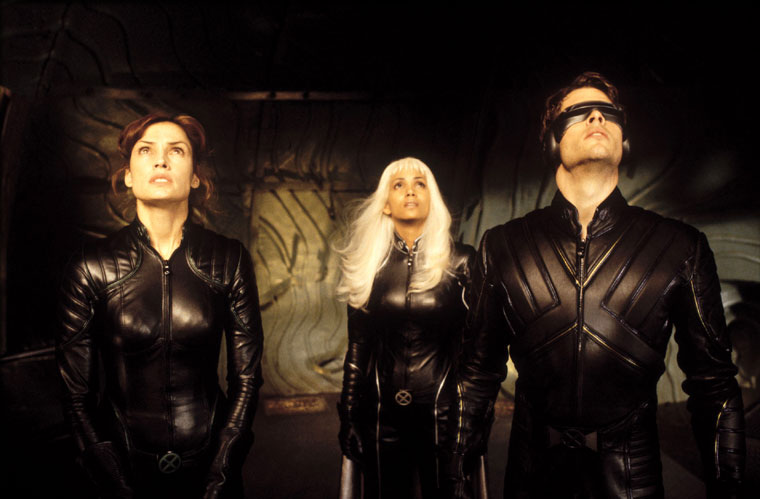
There’s too many other mutants in this movie to keep track of, and even a short roll call won’t cover all of them either. There’s Rogue (Anna Paquin), a teenage mutant who absorbs the life energy out of any being that she touches. There’s Storm (Halle Berry), a silver-haired centurion who can summon lightning bolts and powerful winds through her ability to control the weather. There’s Jean Grey (Famke Jennsen), a telepath who lives with her boyfriend Cyclops (James Marsden), who can obliterate anything with a laser beam simply by looking at them (makes you wonder how they take care of their evening business in the bedroom…). Perhaps the most recognizable mutant here is Wolverine (Hugh Jackman), who came into the X-men with Rogue after spending years trying to remember who he was and where he came from. Wolverine has the most unique ability out of these X-men by being able to heal at a faster rate and protrude claws out of his fists when threatened. So there’s that.

Long story short, the Brotherhood of mutants hatch a scheme against the human race, and the X-men must rise up to stop them. Doesn’t sound like any other superhero team-up action flick out there, right?

Let me start off with the positives. To put it simply, X-men is just a big ball of fun. Whether we’re laughing from a line of scathing dialogue between Wolverine and Cyclops, or watching a thrilling action scene between two mutants fighting on top of the Statue of Liberty, there’s so many memorable moments to look at and enjoy regardless of how hammy or preposterous they might be. Because of this, I think I have a good idea of who this movie was made for: it’s made for the comic-book die-hards, the kids that would freak out in glee and excitement when they get their never-before-opened copy of The Uncanny X-men #141 in the mail for the first time.

For me, my experience with the X-men comes from the 1990′s saturday morning cartoon, the one that included these characters and more in a colorful, energetic and fast-paced ensemble that had much more time and episodes to introduce these characters and delve a little more into their backstories and motivations. For me, this movie hits a few notes on that feeling of nostalgia and then misses on others. I like a lot of what this movie had to offer, from the exciting and uniquely-packaged action scenes all the way to the more dramatic, tensely-driven moments, such as when a mutant argues with a U.S. Senator on mutant rights.

Again, I know where this feeling comes from. Earlier in his career, writer and co-creator Stan Lee created the X-men as a response to the civil rights movement, as an allegory to how people are afraid and hated by other people just because they are different from them. With this movie, I was hoping it would delve into those themes as deeply as Spider-man did with his themes regarding love, guilt and responsibility. Instead, it chooses to make the makeup and visual effects the stars of the movie, showing us cool, flashy effects of people in black leather costumes instead of making the story and themes itself the focus. The movie is a playground to show off what kind of cool tricks these kids can do: not a serious drama about why the two kids are fighting on the playground in the first place.

Here’s the critical factor that saves this movie from just being another standard action flick: the cast. I’ve already mentioned how this movie touches up on some of the nostalgia from the original cartoon. This cast is the reasoning behind that nostalgia. McKellan was conniving as Magneto, a torn and hateful man who sees only one outcome in the human-mutant conflict, an extremist not too dissimilar from that of Malcolm X during the civil rights movement. If he’s Malcolm X then, Professor Xavier is Martin Luther King. Jr., a patient, kind-hearted and wise man who wishes to co-exist with the human race, and defend both of their rights for the sake of that future. I especially liked Hugh Jackman as the feral and vicious Wolverine, a man who definitely has that hardened, rough edge to him, but also that soft spot where he feels protective over those who can’t protect themselves, almost like a papa bear over his little cubs. The script is the transgressor for the silly, generic plot: the cast is what elevates this film above its mediocrity and makes it more than what it actually is.

Overall, I liked X-men. I wish it could have been better, being that the source material is among the most original and influential comic books ever conceived in print, but I’m willing to let that pass for the sake of the franchise’s potential future. If the movie aimed to be nothing else except for visually-splendid eye candy to fill the gleeful hearts of comic book nerds, this movie succeeded. Hey, at least Stan Lee’s Marvelites will be satisfied.

Tagged , , , , , , , , , , , , , , , , , , , , , , , , , , , , , , , , , ,

“X-MEN: FIRST CLASS” Review (✫✫)

Pretend G-men trying to skip out of class.

The very first shot of X-men: First Class is the exact same scene of the Holocaust, frame-by-frame of the very first X-men movie directed by Brian Singer. Not a good way to start off your movie by copying another one, isn’t it? The very next scene after briefly skipping through that one is a young Charles Xavier’s encounter with a young, hungry blue-skinned mutant named Raven who was trying to steal food from his refrigerator. Talking to her in a very sincere, comforting voice, he assures her that she doesn’t have to steal, and reaffirms it by saying that she’ll never have to steal again. Touching. I wonder how this conversation went over with his mother?

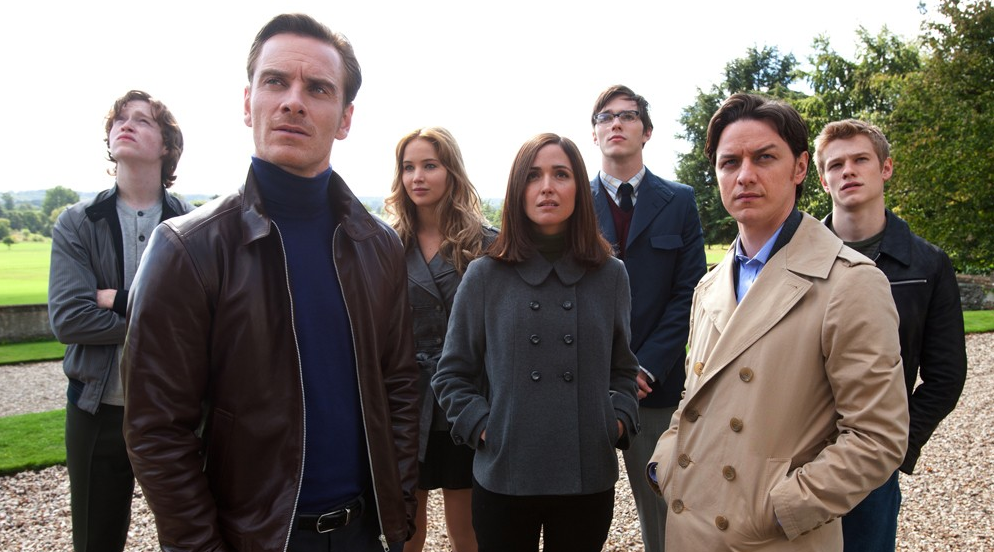
Years pass, and we’re reintroduced to the characters we’ve come to know for the past few movies now. Erik Lenshurr (Michael Fassbender), the man soon to become Magneto, is out on the hunt, looking for the man who killed his family and tortured him as a child back when he was a Jew in the concentration camps. Charles Xavier (James McAvoy) is now in college with the now much more mature Raven (Jennifer Lawrence), who is pursuing his masters degree in psychology.

There’s a mutual enemy that unites these three individuals together: Sebastian Shaw (Kevin Bacon), a menacing and conniving mutant with the ability to absorb and redistribute energy. That means a grenade can explode in his hand and he can transfer the explosion straight into you with a touch of his finger. Shaw is the man who tortured Erik back when he was a young child, and Xavier discovers a sinister plot that Shaw is setting to unveil upon the world. Erik and Charles combine their resources and their efforts to form a mutant team to work together and stop Shaw.

And how exactly does Shaw plan to carry out this giant, dastardly plan? By conspiring and coercing the Cuban Missile Crisis among nations, that’s how. How original. I wonder if these guys considered overthrowing the Chinese government while they were at it?

Hypothetical question. If you hear the term “prequel” being used, what’s the first thing that comes to mind? For me, its the word “beginning”. Beginning, as in, the start of the story. Beginning as in, the start of a legacy. Beginning as in, filling in the holes of all the ambiguous stuff we were told in the original trilogy, and beginning as in making sure everything fits into a nice, nifty little package by the time the end credits roll.

As a superhero blockbuster alone, X-men First Class succeeds. It’s exciting, it’s visually stunning, it features everyone’s favorite X-men that they’ve come to know and love, and it has enough comic book lore in it to make even Kevin Smith giggle with glee. As an action movie meant to please summer movie lovers, it is fine. As a prequel to the critically-acclaimed series that it is based on, however, it is utter and absolute failure.

Three of the biggest goofs that completely and utterly frustrated me. 1) There were flashback scenes in X2, X-men: The Last Stand, and Origins: Wolverine where Xavier is clearly seen as to being able to stand. Yet at the conclusion of First Class (spoiler alert!) Erik deflects a bullet into Xavier’s spine, permanently paralyzing is legs. 2) In the first X-men, Professor X audibly said to Wolverine that him and Magneto helped build Cerebro together, while in this movie it is very clear that a mutant named Hank McCoy (Nicholas Hoult) was the one who built it instead of them. Magneto’s helmet also didn’t exist prior to X-men, whereas here it already does. And lastly 3) a cameo appearance of a certain three-clawed mutant meeting Xavier and Erik about halfway through the movie at a bar. Wouldn’t they have remembered him thirty years later, especially since one of them is a telepath?

These ignorances to the plot show me that instead of providing an accurate prequel to a highly-revered superhero series, the filmmakers were more interested in letting loose and having fun rather than making something straight-laced and refined. I’m all for fun and high-octane action movies, but if you go in ignoring everything else that happened in the movies previous to your own, you’re being disrespectful to the franchise.

Oh, the cast was more than exceptional, I won’t deny that. McAvoy portrays the younger Professor X wonderfully here, passing himself off as a sort of young Patrick Stewart that’s more reckless and immature than his older self. Bacon is smug and charismatic as Shaw, and even though his role wasn’t as compelling as Ian McKellan’s was in the original trilogy, it still served its purpose in the film.

I especially enjoyed Fassbender’s performance as the angry, relentless, and grief-stricken Erik Lenshurr. The staple performances in the series overall belong to Patrick Stewart and Ian McKellan, there’s no doubt beyond that. Still, Fassbender gives it his all here. You notice the effort he extends here, the passion and the fire he instills in this character. McKellan’s rendition of Magneto was calm, collective, and calculated, a great foil to the equally intelligent but more morally aligned Xavier. Here, Fassbender is neither calm nor calculated. He is simply a raging, hateful man, a mutant who has been in pain and alone all his life, desperately seeking some sort of way to fill the emptiness within his cold, solemn heart. I genuinely liked and appreciated his take on the character, even though he bends missiles in one scene that look about as realistic as a Tom and Jerry cartoon.

“But wasn’t it fun?” is a common argument I get from a lot of moviegoers. “Fun” is such a subjective word, and can mean any one of different things. In the aspect of simple, plain, straightforward blockbuster fun, I guess this movie satisfies. The problem is I didn’t go into X-men: First Class expecting a brainless blockbuster. I went into this expecting this to be exactly what it claimed to be: a start to the X-men’s journey, an insightful and hot-blooded prequel that showed perspective on how their story began. This wasn’t even close to being a prequel, ending with more questions where there should have been answers. Fox has already announced that a sequel is currently in the works to be released sometime in 2014, and here I am, thinking that these kids need to go to summer school before even thinking about going into the second semester.

Tagged , , , , , , , , , , , , , , , , , , , , , , , , , , , , , , , , , , , ,

“THE AMAZING SPIDER-MAN” Review (✫✫✫1/2)

♪Does whatever a spider can♪

If I were to have a reboot of one of my favorite superhero films made just ten years ago, The Amazing Spider-man would be that reboot. What can I say about the film that will accurately do it justice? That it is exciting, suspenseful and displays visual effects that leaves the old one in the dust? That the writing is just as acute and skilled as the direction is? That Andrew Garfield has perfect chemistry with Emma Stone? No. Instead, I will describe the film by simply using just one word: amazing.

When Peter Parker was a young, bright-minded child, he lived in the content and warmth of his parents home. When his house was broken into, his father’s office searched through in every crook and cranny, his father Richard (Campbell Scott) quickly packs a suitcase, drives Peter to his Uncle Ben (Martin Sheen) and Aunt May’s (Sally Field) house, and tells Peter him and his mother will be gone for a while. A few days later, the plane that Peter’s parents were on was reported to have crashed. They didn’t make it out.

Twelve years later, Peter (Now played by Andrew Garfield), now in his teen years, is in high school, gets picked on by the local bullies every now and then, and has a crush on this pretty blonde-haired genius named Gwen Stacy (Emma Stone). While in the basement one day helping his Uncle unclog the water pipe, Peter makes an interesting discovery: his father’s briefcase, filled with notes, theories, and algorithms Peter has never seen before. While looking and studying the notes his father left behind, Peter realizes everything points to one scientific company in particular: Oscorp.

From there, Peter snoops around, goes into a lab he wasn’t supposed to go into, a radioactive spider bites him, and well… you probably already know where it goes from there.

If we look at the story, it is on repeat from the first Spider-man. But the repeat isn’t what we care about. The Amazing Spider-man is done with a new style, energy, and enthusiasm to it than the original one was. Funny, I didn’t expect this movie to be as energetic as it is. This film is directed by Mark Webb, who to date, his only directing experience being music videos and the 2009 romantic-comedy 500 Days of Summer. Quite a difference in genres, I know, but Webb handles the transition well. He makes Spider-man as he sees it, as a young man coming out of puberty using his powers for playful, mischievous reasons rather than the heroic acts of courage and responsibility that most heroes are known for. This Spider-man is more jokey and sarcastic than the original one, spitting witty one-liners while arresting a criminal or web swinging past bystanders.

He fuels the action scenes, inspires laughs, and is the source for original entertainment. If Tobey Maguire is the more emotional Spider-man, this Spider-man is the more sporadic and amusing one.

Andrew Garfield does a great job in portraying this Spider-man in a totally different dynamic. His character is definitely different, retorting to puns, jokes, and one-liners that would only result with awkward silences if Tobey Maguire tried to pull off the same thing. Garfield, however, is more talented than a one-dimensional joker. Like any great actor, his character portrays a flurry of emotions, and he portrays all of these emotions well. We can tell exactly when he is troubled or concerned, when he is angered and enraged, when he is happy and content, or when he is saddened and alone. Peter experiences many tragedies in this movie, and Garfield does a good job expressing the emotions for all of them. Emma Stone, equally, is incredible in this movie, providing the film’s beautiful, smart heroine. Together, their chemistry is irreplaceable, and forms a romance that rivals that of the chemistry Maguire and Dunst made in the original Spider-man movies.

Here is, regardless of pre-conceived opinions, a great movie. It is a blockbuster that does a great job balancing in between spectacular action, heartfelt emotion, and genuine humor, all combining into a reboot that makes it not only fun, but unique in its own right.

From a technical perspective, this film has no flaws. It, however, is not about what it did wrong; its a matter of who did it better.

The biggest weakness with The Amazing Spider-man is its release date. This is ten years after the first movie came out, and five years after its most recent one. Why did it need a reboot? It cannot help but bring up the comparison game when you watch this movie. And what happens when you compare things? You recognize which one did things better, and which one did things weaker. In comparison to the old one, The Amazing Spider-man cannot help but look inferior.

But how, exactly? The flaw exists in the writing, dear reader. There are just simply not enough moments in the film that are as emotionally real or relevant as there was in the first two Spider-man movies. Take, for example, the scene in the original Spider-man where Peter’s Uncle Ben dies because Peter did nothing to stop a criminal that ran past him. In the original film, this was a tragic, painful, and heartbroken realization for Peter that it was not the burglar who killed Uncle Ben, but Peter’s inaction and lack of doing the right thing. Here, it’s just on repeat as something that Peter needs to go through in order to become Spider-man. Peter, however, never acknowledges his responsibility in the matter, and neither does he ever even confront the criminal. How, then, does the issue ever become resolved? Answer: it does not. At the end of the film, everything is resolved except for that one specific conflict.

That’s the film’s only real weakness. I don’t want to go on about this weakness, though, because I’d be beating the bush. The main point: The Amazing Spider-man is still utterly fantastic. It is action-packed, suspenseful, energetic, relentless, exciting, humorous, and highly, highly entertaining. The production is all-around strong, the cast is even stronger, and the story is as driven and purposeful as it has ever been, despite a few moments of misplaced emotion. This is a reboot to one of my favorite superhero films of all time, and the surprise is I wouldn’t mind seeing a sequel to it in the slightest.

Tagged , , , , , , , , , , , , , , , , , , , , , , , , , , , , , ,