Tag Archives: Satire

“TEENAGE MUTANT NINJA TURTLES (2014)” Review (✫)

Thankfully, they’re not aliens. 

Teenage Mutant Ninja Turtles is in complete and utter shambles, a movie that can’t decide on what it wants to be and not much better on how it wants to accomplish that. At times, it’s a loud and obnoxious action movie that takes its characters and their situations seriously. At other times, it’s so campy and immature it might as well be the Nickelodeon cartoon series. Wait, I take that back, that’s a dishonor to the Nickelodeon cartoon series. I don’t know what sort of movie I was expecting out of something titled Teenage Mutant Ninja Turtles, but I would have taken anything over this travesty.

Based (somewhat) on Kevin Eastman and Peter Laird’s comic-book creations, Teenage Mutant Ninja Turtles follows the story of April O’Neil (Megan Fox), a struggling news reporter who is looking to uncover the criminal conspiracy of the Foot Clan, a team of specialized military-trained soldiers who fight for their master, Shredder (Tohoru Masamune). Shredder is tyrannical Japanese warlord who wants nothing more but to rule New York City, and like all dark and obscure bad guys, he’ll stop at nothing until he gets what he’s after. But April’s not alone in this fight; she also has her pet rat and turtles by her side, her little friends she’s cared for since they were experimented on by her father when she was just a little girl.

…What? Yes, dear readers, they changed the origin story. After Mr. O’Neil discovered how the dangerous turtle weapons were going to be used for destructive purposes, he sets his lab ablaze, killing himself and destroying all of his hard work. Just before the turtles could be destroyed, however, April saves her small friends from the fire and they escape into the sewers. (Question: Since the fire is so hot that it consumes her father nearly instantly, how is it that  6-year old April manages to not only get into the lab, but also avoid the fire, grab the turtles, get out of the lab, and get back onto the pavement with a little ash makeup spread onto her face for good measure?)

As years pass, the rat and turtles mature into giant-sized humanoid creatures who teach themselves the art of ninjutsu, thanks to a book they fished out of the garbage and the convenience the script allowed them. The rat named Splinter (Tony Shalhoub) trained his sons Leonardo (Johnny Knoxville), Raphael (Alan Ritchson), Donatello (Jeremy Howard) and Michelangelo (Noel Fisher), knowing one day that they would need to fight the Shredder and defend New York City.

Where do I even begin with this? For starters, the script is unreliable, an immature, idiotic and thinly-written-and-thought-out mess that has plot holes the size of Swiss cheese and is as convenient as the dollar store. I could be cheap and pick apart the small things in the story, like what compelled the scientists to pick turtles as their experiments of mass destruction?

That, however, is too easy. It’s much more fun to pick apart the bigger holes in the plot, including:

  1. The fact that there is no way that Splinter, as a regular lab rat, could know anything about the Shredder or what he was plotting for him and the turtles.
  2. That since Shredder is a highly-skilled ninja, there is no reason why his foot clan shouldn’t be at least slightly trained in the arts either.
  3. That to convince her editor-in-chief that there are living, fighting humanoid ninja turtles in New York City she shows her a picture of a turtle she pulled off of Google images, not the pictures she took on her smart phone.
  4. That since Shredder is after the mutagen in the turtles’ blood, he wouldn’t spare Raphael and abandon him after he beat him to a pulp and cracked his shell.
  5. That to rescue his brothers when they were kidnapped halfway through the movie that Raphael, April and her camera man Vernon (Will Arnett) drive to rescue them in the snow mountains that apparently exist 50 minutes outside of Manhattan.

Oh yes, this script is a mess, and the actors do a nice job at making it even more laughable through their complacent, boring and plastic performances that could be played better by action figures. Any actor who was not a CGI character was completely wasted in a sea of bad dialogue and bland delivery, looking like victims to the screenplay and to the movie that they’re playing in. William Fichtner is hesitantly the best performance as an evil scientist, but his character is so plainly forgettable that it is almost completely wasted. Arnett is more charismatic and smirking as the camera man, but the dialogue he sputters is so unbelievably written at times that it hardly matters. (Ex. When told that your city’s vigilantes are giant turtles, is your first reaction to seriously ask if they’re aliens? I’m frankly surprised he didn’t laugh when April told him her crazy story.)

But the worst performance of the film is Megan Fox’s. Oh. My. God. What is she doing in the movie industry? Her performance was both disinterested and disingenuous, her expression looking as stiff and uncomfortable as if she came out of a facelift surgery. Fox is not a good actress. I say it again: Fox is not a good actress. Good-looking, yes, but looks only make half of a character, and she doesn’t fit April in neither appearance or spirit. In the 1990 film we had Judith Hoag portraying April, and boy, did she bring energy and enthusiasm to the character. Now we have Fox reading a teleprompter to replace the performance, and I start wondering if it would be better if April was recast as a Barbie doll in the movie.

Yes, the turtles, Splinter and Shredder look cool, and there’s a very sweet action sequence where they are sliding down the snow mountains that I will admit to have enjoyed. But in a visually-dominated industry, visual effects are a compliment I’m recycling at this point. Visual effects and fight scenes are wasted if you have a terrible plot, and in this case, where the bad guy’s master plan is to intoxicate a city with a poisonous gas by smashing a tower over it (an idea stolen from The Amazing Spider-man, by the way), I’m not inclined to say that the movie has much good of anything.

I know there is an audience for Teenage Mutant Ninja Turtles, and the majority of them will probably be under 12. The ones over that age will have grown up with the franchise, and will be looking for some sort of nostalgic experience to remind them of what it was like to grow up with the ninja turtles. I too went in hoping to feel some sort of nostalgia, but as the movie went on, I continued to notice that all of my hopes were running down the sewer.

Tagged , , , , , , , , , , , , , , , , , , , , , , , , , , , , , , , , , ,

“GUARDIANS OF THE GALAXY” Review (✫✫✫)


A  lovable group of space idiots.

Now here’s a movie I wasn’t expecting to be any good. No matter how you phrased it to me, I went into James Gunn’s Guardians of the Galaxy completely expecting to hate it. None of the heroes were as popular or as interesting as the other characters Marvel had to sport in its universe, it’s a sci-fi buccaneering adventure about an evil race intent on destroying/ruling the galaxy (I wonder where we’ve seen that before), and on top of all that, and it has a talking raccoon and a tree as two of it’s main characters. Believe me, I went into this movie fully expecting to dislike it on all counts. Turns out I was wrong on all of them.

Based on the Marvel comics superhero team of the same name, Guardians of the Galaxy follows a whole slew of space misfits as their futures suddenly become entangled because of one blasted macguffin: the infinity stone, an object we’ve been introduced to in earlier movies in the form of the tesseract and the aether in The Avengers and Thor: The Dark World. Peter Quill (Chris Pratt) is a Han Solo-ish kind of scavenger who steals items of value and sells them to buyers. Gamora (Zoe Saldana) is a trained assassin and adoptive daughter of a cruel omnipotent being called Thanos (Josh Brolin). Drax (Dave Bautista) is a brutish warrior who seeks vengeance against Thanos after the death of his family. And then Rocket and Groot (voiced by Bradley Cooper and Vin Diesel, respectively) are a bounty-hunting duo who travel together. Remember me mentioning the talking raccoon and tree? This is them, although Groot’s speech is merely limited to “I am Groot.”

Sounds like a lot of characters to deal with, I know, but don’t worry: the movie does a better job at explaining them than I did. Their fates become intertwined  with that of Ronan (Lee Pace), a vicious hunter who will stop at nothing until he has taken the infinity stone for himself and uses it to destroy his enemies. It’s up to Quill, Rocket, and the rest of the troupe to rise up and defend the galaxy from Ronan and the threat he holds with the infinity stone.

Written and directed by James Gunn, the wacko that directed the 2010 satire film Super, Guardians of the Galaxy is a wacky, oddballish film, a movie that doubles both as a sci-fi blockbuster actioneer and as a space comedy parodying… well, itself really. The biggest concern I had with this movie was how it was going to handle itself, because it really had everything working against it. Think about it: talking animals and trees, a copy-and-paste space plot, and a director whose work before this was a line of small-budget independent films. How on earth was any of this going to work?

Better than I expected, apparently. The best thing about Guardians of the Galaxy is that it doesn’t take itself seriously. It’s so irreverent, so shameless and so unabashed that it might as well be a clown throwing pies at its own face. There were many moments in the film where it called itself out on the flaws that I was prepared to criticize it for (such as it’s hammy one-liners or it’s talking animals), then it turned around making fun of itself because of it (Drax boasting about his reflexes when figures of speech go over his head, or Rocket asking Quill what a raccoon is.)

It just loves to make fun of itself, so much so that I want to call this a comedy more than science-fiction.

To make the comedy work though, you need a cast of equal caliber to make it work. And I’ll be completely honest here: the cast was exceptional. Even the cast members who I don’t like, consisting of Bautista and Diesel, gave performances that surprised me, effectively portraying their characters in a uniquely charismatic light that made them stand out from the obvious sci-fi fanfare. (One argument someone might pose to me is that Diesel’s job was easier because he only had to say three words over and over again. Believe me, his character wasn’t that simple.)

The element that stands out the most in the film is ironically the one I was most worried about: Rocket. Oh my gosh, was this guy a big ball of laughter. Cooper was excellent in voice performance, shooting out snazzy, snarky, sarcastic one-liners like he’s a New York taxi driver.

But it’s not just his voice performance that I love so much about the character. It’s how he’s animated and modeled too, with animators giving him life through his detailed, intricate emotions and movements as a CGI character. Rocket is much more than just another Guardian. He is, in many ways, the life of the film: a living, breathing embodiment of emotion, sentiment, sarcasm, hilarity and attitude. Every attitude that the film is, at least.

There’s no way to get out of the film’s silliness, but you shouldn’t let that stop you from enjoying it. Believe me, I tried. I went in fully equipped and prepared to blast this movie with a negative review, and I came out instead feeling like a kid after he finished watching his favorite Saturday morning cartoon.

Tagged , , , , , , , , , , , , , , , , , , , , , , , , , , , , , , , , , , , ,

Dear Twitter: I’m Sorry

Dear Twitter.com,

Hi. I know it’s been a long time. How have you been? Good, I hope. I know things haven’t been the same since, well, you know. I know we’ve been through a lot together, I know that you hold some things against me and I’ve equally held some things against you, but for at least the next few moments, I want to put that behind us just so I can talk to you.

I remember the first time that we met each other. It was August 2012, when my entertainment editor at the time told me that I needed to get a twitter account. The idea infuriated me. “Twitter?!” I thought. “Who wants to deal with that bull4#5+?!”

But I remained open to the idea. I knew for my new job as the film critic that I had to build a social media presence that would help me in my audience syndication, similar to how Roger Ebert and Richard Roeper developed their presence and identities on the blogosphere. But the idea intimidated me. I was never a sociable guy in high school and I wasn’t much better in college. How could I possibly succeed at being social on a site I knew nothing about?

Then I met you. Boy, was my world turned upside down. I was instantly attracted to how neat and clean your format looked, how bright and colorful your pages were and how each tweet was as legible as a line of text messages. But it wasn’t just how you looked: your assets were tantalizing, your tutorial simplistic and ideal and your interface user-friendly. I knew from the moment I met you that we had something special, something that no other blogger could ever match. You and I were more than a team; we were star-crossed lovers, taking down the blogosphere one tweet at a time.

At least, that’s what we both thought. It was good the first few months, with you filling up my feed with content and with me tweeting out stories and pictures as if I knew what I was doing. Soon though, we both started doing things that set both of us on edge, and I don’t think we’ve been the same ever since.

For instance, you would always punish me for writing a tweet longer than 140 characters, and always asserting me with the answer “No” when I told you to publish it. I would yell at you for telling me no and shout at you about why the hell it was 140 characters instead of 140 words. You said that the tweet would be long and unappealing. I told you that your rants were long and unappealing.

We said hurtful things to each other, and our passion and love for each other was all but gone. In short, the reality of the romance quickly set in, and while we kept trying with each other, things just weren’t working out between us.

You remember how things went from there. After talking for a long while, we decided to go our separate ways and see other tweeters.

I’m not going to lie to you, the experience really hurt me. Do you know what bothered me the most though? It wasn’t the fact that you were mean to me. It wasn’t the fact that you were strict or stiff about the boundaries of our relationship. It wasn’t even the fact that you criticized me for any tweet that was over 15 words. It was the fact that you never let me know how you truly feel.

Please don’t lie, it’s the truth. You never talked to me about why the tweets couldn’t be over 140 characters. You never talked to me about what was wrong with you when I had five bars of WiFi, or why it took so long to upload a small file photo. You never even talked to me about your needs, about what you wanted in our relationship and why I wasn’t satisfying you in the ways I was supposed to.

I was not hurt that you were seeing other tweeters. I was hurt because you never talked to me about why. Why did you never talk to me?

It doesn’t matter. I miss you, and I want to give this a second shot. I know, I know, you’re scared and you don’t want this to fail a second time. Let me assure you: I know my mistakes. We didn’t agree on the character limit or the picture space. So what? I don’t care about that. I want to make this work, and I’m willing to work on my mistakes if it means being with you again. This isn’t a joke, and this isn’t me pranking you. I feel like I can make this work. I need you.

If you want to give this a second shot, you can reach me at my twitter handle @dDUnn87. Funny, huh? Exchanging twitter handles just like when we first met.

I won’t pressure you with anything more. I just wanted you to know that I miss you and I want to give this a second shot. Please reach me if you want to as well. I hope you do.

Truly yours,

David Anthony Dunn

P.S.: I saw you online today. You looked lovely.

Tagged , , , , , , , , , , ,

“22 JUMP STREET” Review (✫✫✫1/2)

Doing the same thing over again isn’t such a bad thing after all.

22 Jump Street is the exact same film 21 Jump Street was, but with one key difference: it’s self-awareness. While 21 Jump Street was just aimlessly spastic and immature, 22 Jump Street uses that same spasm and immaturity and chooses to make fun of itself for the sake of the audience. 22 Jump Street isn’t laughing with the audience: it’s laughing at the audience laughing at itself, and it is infinitely funnier because of that.

22 Jump Street takes place after Captain Dickson (Ice Cube) tells Schmidt (Jonah Hill) and Jenko (Channing Tatum) that they’re about to go undercover at college. After a student died at the hands of a lethal new drug called WyFy, their job once again is to infiltrate the dealers, find the supplier and bring them to justice. Resuming their cover identities as brothers, they slowly try to adapt to college as they continue to search for the supplier who is providing for the whole operation.

“Waitaminute,” you might ask. “Isn’t this what happened in the first movie?” Yes, but like I said, the movie is more aware of itself than by just simply repeating what it did the first time around. This time, Tatum is the guy who is getting accepted and friendly with everyone around campus, while Hill is more or less left to go and sip wine with the art students.

Like I said, the film is on repeat from the plot with the first movie — similar characters, similar jokes, similar order of events. For Pete’s sake, even the run time is the same, with both films clocking in at about 1 hour and 50 minutes.

But like I always say, the repeat isn’t what matters. What matters is how they handle that repeat, whether it genuinely is a funnier, more refreshing take of the original rather than just a rehash. And let me tell you, even though it has Tatum and Hill in it, neither of which I’ve ever found particularly funny, I’ve never laughed harder.

These two guys are hilarious in the movie. Tatum is good as Jenko, a smug older jock who loves to drink beer, play football and show off his physique through physical feats that make me ashamed of my own body. Hill was even better. Whether he was getting into character as a Mexican mobster, trying to impress some girl or desperately trying to figure out how to drive a ferrari, he was clumsy, expressive and hilarious all at once, expertly becoming the likeable underdog needed for a film like this.

Great as Hill and Tatum are though, they are not the highlights of the film. The real stars of this movie are directors Phil Lord and Christopher Miller, both of whom recently directed The Lego Movie together. Lord and Miller, who also helmed the first film, seem to have a much more fleshed out idea of what they wanted Jump Street to be this time around. The first movie was just a loud, blatant action-comedy, shooting in every which way and direction with no clear aim or focus. Here, the aim couldn’t be more clear. From hearing bits of scathing dialogue — “We’re going to do the same thing all over again” from the captain — to the hilarious end credits spoofing every movie that had laughs and a gun, we can tell their goal with this was to slam the idea of sequels, to make fun of the problems that exist in them, then immerse themselves in that zone of making fun of themselves for the sake of our enjoyment.

I’ve had a complete blast with this movie. In every moment of the film I was either smiling, laughing my head off, or catching my breath, preparing myself for the many laughs to follow. I kept tossing around in my head whether I liked this movie or loved it, whether it was a truly definitive piece of comedy or just something fun to laugh at. I’ve concluded that it is both. 22 Jump Street is a big ball of action-packed comedic fun, a great sequel that has funny jokes, charismatic characters and wonderful self-irreverence. It’s an improvement upon the original in almost every way and will no doubt be a big problem to the studios once they realize they’re going to have to make a second sequel.

Tagged , , , , , , , , , , , , , , , , , , , , , , , , , , , , , , , , , ,

“21 JUMP STREET” Review (✫1/2)

Two 30-year old cops pretending to be in high school.

21 Jump Street is a film that pretends to be a parody on action-comedies and instead collapses under its own pretension. It’s a silly, stupid, obnoxious film, a movie that feels like a kid poking a wet willy into your ear and refusing to stop because you’re laughing inexplicably for some reason. Is it possible to feel this annoyed, or for that matter, this violated? Apparently so. This is a movie that is okay with constant profanity, blatant stereotypes and unfunny penis jokes to the point where it feels like these cops are pretending to be in elementary rather than high school.

As much as they’d like to make you believe, 21 Jump Street is not an expansion of the original television show it was based on. This movie follows an entirely new duo, this one much more clumsier and haphazard than the Johnny Depp-Peter DeLuise relationship in the original show. Morton Schmidt (Jonah Hill) and Greg Jenko (Channing Tatum) are a dysfunctional pair of police officers that can’t shoot a gun or recite the miranda rights worth a damn. Schmidt plays the fat kid stereotype who can barely do a leg lift in the morning while Jenko is the strong-but-stupid stereotype that looks at answer choices on a test like they’re written in Chinese. Together, this lopsided duo plans to pursue a life of stopping crime as police officers. Little did they know that they’re starting duties included patrolling the town park, honking their horns and yelling at kids to not feed the ducks in the pond. Hey, you’ve got to start somewhere, right?

Well believe it or not, they mess even that up too. When arresting a gangster for cocaine possession, the gangster is eventually let go because he was not read his miranda rights. The duo is since transferred to this secret operation of undercover police work, located at a nice little chapel addressed at 21 Jump Street.

Sounds like a nice revisitation of the good old days with Johnny Depp, right? No. It isn’t. Whatever you hear about 21 Jump Street please hear this: that this is a complete deviation from the source material, and has been meat-processed through the unfortunate action-comedy formula into another recycled blockbuster.

Oh boy, where do I begin. First of all, let me start by looking at the most important part of the film: it’s leads. Hill and Tatum both served as executive producers for the film while Hill himself holds a story credit to the film. You would expect that, considering both of them have acted in comedies before this, that they would understand that most important element in comedies it the characters. With these two portrayals, they’re okay, but they’re only as good as their stereotypes will let them be. Jonah Hill is sheepish and clumsy while Channing Tatum is moody and stupid, and their characters don’t get much more expressive, or memorable, than that.

Oh no, they don’t go into an inch of smart or sincere territory, and their silly, childish interactions prove it. In one scene, Channing Tatum was whacking and tea-bagging Jonah Hill while he’s on the bed talking to a girl on the phone. In another, they’re fighting in the middle of a stage production while Hill is attached to a harness and Tatum is throwing plastic rocks and trees at him. Watching this duo makes me miss the smartly ironic and genuine chemistry that was shared in between comedic greats such as Jack Lemmon and Walter Mathau in Grumpy Old Men, or Steve Martin and John Candy in Plains, Trains and Automobiles. That’s better than the hopelessly slapstick mess we have here, at least.

There is another issue we have at stake here: that this is not an adaptation, doing more disservice to itself by linking it to the source material that it was inspired by in the first place. The original television show was a crime drama about a group of teenagers trying to prove themselves as cops and as heroes. The movie is an action-comedy that deconstructs that idea and makes fun of it before killing it off at the start of the film’s climax, though I won’t say exactly how. All I will say is that fans of the show will be extremely disappointed by this new outing, and even if they won’t be, they’re going to have to let go an important part of the show in order to enjoy this new one.

None of that is really important though. The actors, the faithfulness, nothing. The most important question is this: did it make me laugh?

Kind of. Most of the time my face was as plain as a checker board, erroneously letting the stupidity and immaturity of the film rub off of me as I continued to tolerate its runtime. There were a few fun, clever moments in the film, but seeing them was as rare as Jenko getting a C on his chemistry exam.

I will also admit that I’m not much into raunchy humor, but why would I be? It’s cliche and cheap. It’s plastic, mundane and annoying, butting its head in the way of genuine, clever humor birthed by dialogue and satire, rather than the jumbled action and sex jokes we have to deal with in this movie. Plus, when your best joke involves a police officer shooting off a guy’s penis, and then watching him grab it with his mouth trying to reattach it, I think there’s something seriously wrong with this films humor.

I do predict that this movie will fare well with audiences though. Why? Because this is what people want, that’s why. When I ask for John Hughes, I get Adam Sandler. When I cry for Ridley Scott, I get Paul W.S. Anderson. When I praise Inception, I log onto box office mojo to discover that Transformers: Revenge of The Fallen grossed ten million more than it.

The more I think about this movie, the more frustrated I become. This movie has little to no redeeming factors, the phrase “it was fun” being its only flimsy crutch. There will be no doubt people who will defend it, and these are the people who also enjoy raunchy sex jokes, Channing Tatum’s mug and Jonah Hill’s clumsy failings. When other action comedies exist out there such as Scott Pilgrim and Zombieland, why on earth would I waste my time seeing this? If 21 Jump Street was supposed to assault me as much as it did, I wasn’t read my miranda rights.

Tagged , , , , , , , , , , , , , , , , , , , , , , , , , , ,

“HER” Review (✫✫1/2)

What on earth did I just watch?

How do you fall in love with a computer program? Throughout the entire runtime of Her, that’s the only thought that was peaking through my mind. I wasn’t thinking about Joaquin Phoenix’s deliberate performance. I wasn’t thinking about how sweet and serene Scarlett Johansson’s voice sounded. I didn’t think about how clever the story was or how passionate Spike Jonze’s direction was. The only thing I was thinking about was how hard it must be to maintain a relationship with a piece of machinery. Can you imagine how awkward those morning encounters must be?

Taking place in the not-too-distant future, Her follows the story of Theodore Twombly (Joaquin Phoenix), an introvert and manic depressive who writes love letters for a living and has recently gone through a divorce with his wife Catherine (Rooney Mara). Theodore is not in the most stable mindset as the movie begins, and as an effort to feel less lonely, he purchases an artificial intelligence who names herself “Samantha” (Scarlett Johanson) to help him with his everyday needs. What goes from there is a grand journey of self-discovery, identity and romance as these two gradually come closer with each other and eventually fall in love.

For those of you who have seen the movie, does that paragraph just about do it justice? I could go deeper into the plot synopsis, but why would I? From just those three sentences, half of you have already decided whether you would like the movie or not. There are, no doubt, some introspective and provocative thinkers out there who will find joy and enchantment with this story, while other viewers will watch it and ask themselves what on earth they just watched.

For me, I went in an open book. I knew that the movie had an opportunity to woo me, that it was a strange and outlandish idea to begin with, but that the idea doesn’t matter as long as it was handled and carried out well. How did the movie do with that?

Eh. I’d rather watch 1 Night In Paris. 

Like its central idea, Her is a strange movie, a surreal and against-the-grain picture that challenges a lot of misconceptions about love and relationships. While I like that and think it has a lot of great ideas to offer its viewers, I find them so hard to focus on while we’re watching Joaquin Phoenix having sex with a machine.

Yes, there are sex scenes in the movie, although I hesitate to even call them that. There are two that we actually see, but from their conversations we actually infer that there were plenty more.

The first one isn’t really a sex scene, but more or less a copycat of phone sex with Scarlett Johansson’s voice (which I’ll admit, didn’t bother me that much at all). The second one, however, was out of this world weird, with Samantha hiring a surrogate (prostitute) for Theodore to have pretend sex with. They’re trying to justify it by saying that she isn’t a prostitute and that she’s just trying to be a part of their experience, but that argument is null and void. She’s provided sexual services in exchange for something else. She’s a prostitute.

Don’t get me wrong: there are many emotional moments that the movie handled surprisingly well, and there’s an undeniable sweetness and sentiment to the story that can’t help but be noticed. Despite her being a machine, Samantha has a surprising amount of layers to her, being an in-depth and interesting character and love interest in her own right, while the human characters contribute the more grounded relationships that make more sense than that of Samantha’s (Including a recently-divorced Rooney Mara and Amy Adams, who offer very interesting parallels to Twombly’s exotic love story).

Joaquin Phoenix, however, is the flesh and blood of the film. His performance is nothing less than exemplary, playing this shy introvert so convincingly that its hard to imagine that he at one point portrayed Johnny Cash. His character reminds me of many of cinema’s most memorable introverts, ranging from the autistic-yet-brilliant Raymond Babbit in Rain Man to the hyper-obsessive and socially distant Mark Zuckerberg in The Social Network, or the paranoid John Forbes Nash Jr. in A Beautiful Mind. All of those movies focused on characters that struggled romantically and socially, and how much they struggled with their identity and being themselves. I love it when movies reach into characters that deep and personally, and if the film focused more on Twobly’s personality rather than that of his love and attraction to his operating system, the movie could have ended up being way more successful.

I can’t help but keep thinking about how small Her’s audience will be. In this day and age, art films are getting harder and harder to advertise and appeal to mainstream moviegoing audiences, and this movie is definitely no exception. I know the film’s premise doesn’t matter as much as how well that premise is handled, but there are some movies that just can’t get away from their bizarre ideas. Case in point: did anyone really expect Quentin Dupieux’s Rubber to be a good movie?

I stress this again: the main character is in love with a computer program. If you can buy that and get over that to enjoy the movie, good for you. But there are no doubt others who will not enjoy this picture, and I can’t help but think that they will be a more sane person because of it.

Tagged , , , , , , , , , , , , , , , , ,

“THE WORLD’S END” Review (✫✫✫)

These poor dims have had too much to drink.

We’ve all known that kid somewhere in our high school years. Yes, you know who I’m talking about. That kid. That kid as in, the troublemaker. The smart talker. The womanizer. The drinker. The guy who turns heads and raises eyebrows, the guy whose only concerned with having a good time and not much else. They act on impulse, spontaneity, paying no second thoughts to doubt or common sense. They don’t think about their future or what they’re going to do after high school. They don’t live in the future. They live in the moment.

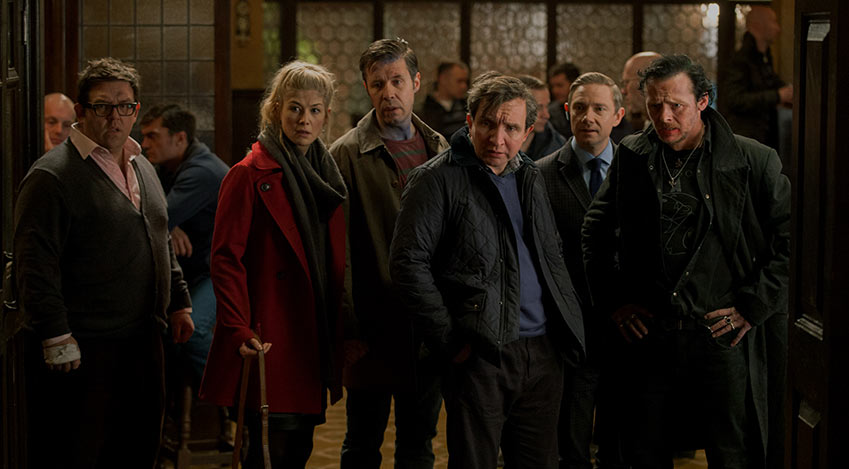
That same trouble-making, lady-loving, drink-guzzling, bad-mouthed rebel is known in this movie as Gary King (Simon Pegg), a poor old sap in rehab who misses the old days and just wants them back again. In order to do this, he reaches out to his old british friends from high school to go and complete “The Golden Mile”, a long pub crawl of twelve different pubs in his old town of Newhaven, where the crawl ends at the most popular pub of all, appropriately called “The Worlds End.”

His friends are now all estranged successful businessmen, but they all lack the energy and perhaps foolhardy excitement that Gary loves to constantly express. Perhaps the best of his friends, however, is one Andy Knighly (Nick Frost), a once-cheerful young fellow, now an old, depressed office worker trying to win back the affections of his wife and children. The last thing he needs is to go on this trip with Gary, but if there’s one thing Andy knows, its that you don’t say no to the King.

They go to their hometown where they started the Golden Mile, and they notice a lot of things have changed since they were last there. Why? Well, that’s because alien robots have taken the town over.

……WHAT?!?!?!? No, dear reader, I am not drunk. Alien robots took over Newhaven, and Gary King discovers this by knocking one’s head off after he slid on his own urine in the bathroom. When he recoups with his friends later on at the bar, they decide that they need to keep going on their route so as not to raise suspicion, and later quietly slip out of town. Sounds pretty simple, right? Not when you have four drunk guys traveling along a total fool. Good luck with that, fellas.

Co-written and directed by Edgar Wright, The World’s End is the birth child of an unofficial trilogy of Pegg, Wright, and Frost’s previous work together, including Shaun Of The Dead and Hot Fuzz. For those who’ve seen those previous movies and are expecting a pompous, outlandish experience just like those pictures, you’re not far off. The World’s End is, by every definition, a ridiculous, ludicrous, and far-out experience, a preposterous and purposefully silly picture to the point where it surpasses being stupid and starts being funny. It’s like those older television skits by Monty Python: they undeniably immature and stupid by nature, but there’s an inherent wit and silliness to them that can’t help but make them so much fun.

Case in point: Simon Pegg and Nick Frost’s chemistry. In the past, their character’s relationship involved a budding romance in a cheesy “You’ve Got A Friend In Me” type of ordeal. Here, the relationship is more strained, almost like Frost is a babysitter and its his turn to supervise little baby Simon so he doesn’t eat sand from the playground. Their characters are hilarious because they’re polar opposites: because Pegg plays the ambitious, over-the-top party boy while Frost is the more conserved, more easily frustrated business man.  Remember the chemistry between John Candy and Steve Martin in Planes, Trains, and Automobiles, where the frustrated business guy (Martin) keeps having to monitor the guy (Candy) who is oblivious, foolish and hopeless? Same case here, although the roles are more or less switched between the two actors.

And then the robots. Oh my God, are they hilarious. In Shaun Of The Dead we had zombies, and in Hot Fuzz we had crooked cops. Now, we have supernatural alien robots, although they hilariously keep insisting that they are not robots because they have sentiment and free will. Anyhow, the funniest thing is how the group reacts to them, tearing off their body parts, whacking themselves with their arms, legs, and anything else they can pull off of their bodies. It’s like someone combined the Lego minifigures with Whack-A-Mole and then decided to throw blue kool-aid somewhere into the mix. Just trust me, it gets messy.

I’m overanalyzing this. The question I should be answering is this: did it make me laugh? The answer: Yes it did, consistently and abundantly, and what’s even more important is that it had something more to offer than simply entertainment. It had a deeper message to tell its audience, and instead of celebrating foolishness and drunkenness, it decided to touch upon a deeper subject involving friendship and true happiness.

I won’t spoil the segment for you, because for me it was the best scene out of the whole movie. I will say this though: most movies, including Project X, 21 And Over, and the dreaded Hangover series take alcoholism and play it out like its fun, like a big party with no consequences or repercussions to the people involved with them. This movie had the opportunity to play it out in that same fashion, but it chose a different direction. It decided to take alcoholism and show it in a more realistic light, maybe even a tragic one. This sequence genuinely touched me, as well as the conversation two characters shared about their life and what exactly they mean to each other. It did more than entertained me: it genuinely surprised me.

As far as comedy and drama goes, I can name a number of films this year that have both made me laugh harder and feel more, among them including the explicit Don Jon, the tamer Monsters University and the other horror-comedy Warm Bodies. Should I take off points, however, if the movie doesn’t match up to the standard of other pictures? The point is that this is a good movie. It had more to offer than just pointless swearing and debauchery: the movie is funny, touching, and original, and there’s a lot of moral truth to it, aside from all of the alien robots mucking everything up.

Tagged , , , , , , , , , , , , , , , , , , , , , , , , , , ,

“AMERICAN HUSTLE” Review (✫✫✫)

FBI trying to hustle politicians by hustling con artists.

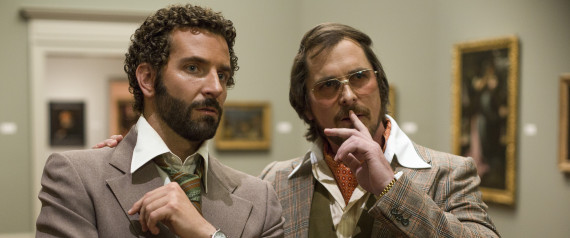
“We’re always conning other people,” says a slurred, yet sure voice in the background. “It’s in our nature. We even con ourselves.” These words are coming from the mouth that belongs to Irving Rosenfeld (Christian Bale), a con artist who quickly learned what it meant to grow up and survive in a harsh economy. Irving is the sort of guy you wouldn’t want to interact with out in public. He is grossly out of shape, he smells of old hairspray and cologne, his crafty eyes hide behind a dark pair of shades, and his diet consists of nothing but beer, fast food and cigars. From an outward appearance, Irving doesn’t really make a good impression. But man, can that guy talk a good game.

After rushing through Irving’s very brief childhood, we are quickly introduced to Sydney Prosser (Amy Adams), a woman in her mid-thirties whose beauty is both ageless and captivating. Despite his nauseating physical appearance, Sydney almost instantly falls in love with Irving, and Irving falls in love with her too. So much so that he discloses his illegal business with her, asking her to become a part of him scamming other people out of their hard-earned cash and checks.

That’s all I’m going to get into as far as the plot synopsis goes. Believe me, I haven’t even gotten to the surface of it. There’s an FBI agent trying to catch them named Richie DiMaso (Bradley Cooper), there’s a New Jersey mayor played by Jeremy Renner somewhere in the mix, Irving has a son and a wife he’s committed to named Rosalyn (Jennifer Lawrence). There’s even a mobster somewhere in this movie where an actor makes a cameo appearance, but I won’t spoil the surprise by revealing who it is (hint hint: He’s got some bad ideas in his head).

Point being: this is a smart movie. It’s funny, original, intelligent, and thoughtful, an observant portrait that looks at the moral and financial struggles of these characters and what impact their actions have on the people in their lives. Part of this, no doubt, is because of the cast’s mastery at delivery. Part of it is also because its writer-director is equally as funny, original, intelligent, and thoughtful as the story is. David O’Russell, who was nominated for best directing and writing Oscars for the past few years now (For Silver Linings Playbook last year and The Fighter in 2010), returns yet again with the same wit, charm, and complexion that made his previous films both unique and entertaining.

The dialogue is authentic, almost like it pops off of the pages of the screenplay just as much as it does in the movie. How though? This is, after all, a work of fiction, right? Wrong. The plot is just is like Irving’s deceptions: they’re only half fake. The movie is based on the real-life ASCAM sting operations of the late 1970’s, in which the FBI arrested over 31 individuals of congress and 7 were convicted of bribery and conspiracy. That sort of realism translates brilliantly to the screen, and makes the conversations characters share feel so personal. Make no mistake, fellow reader: this is, in every definition, a heist picture, because everyone is all after something and are willing to manipulate everyone in order to get to it first.

The cast is unforgettable. So much so that I can’t even pick a favorite among them. Bale is as talented as ever in this movie, a brilliant and dedicated method actor who has immersed himself so much into a role that its hard to imagine that at one point he was Patrick Bateman or Bruce Wayne. Lawrence and Adams are excellent female leads, and are great at expressing how conflicted Irving feels towards the both of them as lovers. Renner is great as the New Jersey mayor, a loving and kind-hearted man, father, and husband who just wants the best for everybody, but ends up making the wrong decisions in trying to do so. If I had to pick a favorite, it would probably be Bradley Cooper, only because he is so passionate and wacky that he could have been redone as a cartoon character. Like I said though, I can’t pick one. This cast is so talented and skilled in their roles that to pick one performance over another would be considered a sin. They are just as responsible for bringing this story to life as David O’Russell is.

This movie has all of the elements of being Oscar-worthy material: a great story, dialogue, characters, direction, and a great cast that fills these figures with vibrant energy and personality. The only real problem with this movie is the setup, and that’s unfortunate because that’s one of the most important parts of any movie.

Let me provide an example: when I first watched Goodfellas, what absorbed me into that picture was the first 15 minutes, a little italian boy learning about the mafia as a child, and the first narration we hear being “Ever since I can remember, I’ve always wanted to be a gangster.” Another one? In the opening scene of There Will Be Blood, we see a touching yet tragic portrait of a man seeing one of his workers die in an oil deposit, leaving behind an infant who can’t even speak, and Daniel Plainview deciding, against his better judgement, to adopt him as his own. Do I even need to mention Up?

All of those pictures started off with a bang because they gave us a perspective into the character’s history before getting into the meat of the story. Not that there needs to be a “How-to” guide for making opening sequences, but American Hustle literally flashes Irving’s childhood for about a minute before throwing us into the plot. I’m all for “show-don’t-tell” stories where they’re all situational, strictly limited to being set in their own present (Such as The King’s Speech or Black Hawk Down), but this one felt too much like being thrown into cold water when you can’t even swim.

Despite my views, I know critics already have their opinions established on this movie. They’re going to say its a masterpiece. That it is masterfully written and acted (which it is) and that it is going going to be nominated for multiple Academy Awards (which it will be as well). What critics won’t realize is the movie itself might be a con, making people believe that it is better than it actually is.

Well, if it is a scam, and David O’Russell is the con artist, then all I’m going to say is that he did a damn good job at it.

Post-script: For you irresponsible parents that are considering taking your teenagers to see this movie, don’t. The MPAA rated this movie R for “pervasive language, some sexual content and brief violence.” The violence is very brief and honestly not a large problem. The sexual content, however, is profuse because of Irving’s two sexual partners, and the movie has no shame for showing us any of it. I noticed over 100 F-words.

Tagged , , , , , , , , , , , , , , , , , , , , , , , , , , ,

“DON JON” Review (✫✫✫)

Oh, Donnie boy…

 “There’s only a few things I really care about in life,” a rich, deep boston voice says as we look at him staring  at his bright laptop screen shirtless in a dark room. “My body, my pad, my ride, my family, my church, my boys, my girls, and my porn.”

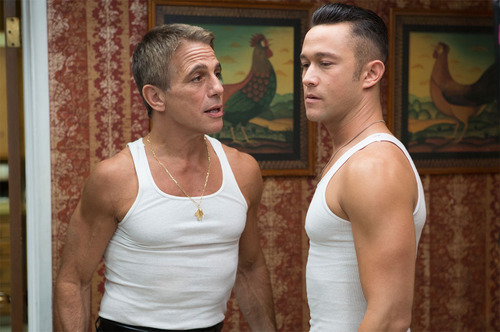
That last one doesn’t really belong there, but whatever, its in there.  The man we are looking at is Joe Martello (Joseph Gordon-Levitt), a thick, cut, and strongly appealing young man who has a slick, black haircut and a grin on his face that looks like he just finished up business in the bedroom.  His friends call him “The Don” because he’s able to score “dimes” on the weekends, which is another way of saying “That woman is a ten!”

One night in the bar, Donnie meets the best dime he’s ever seen: Barbara Sugarman (Scarlett Johansson), a beautiful blonde bombshell that turns heads and raises attention everywhere she goes.  To Donnie, this is simply another case of trying to score a hot night, but Barbara isn’t that easy.  She wants something more meaningful than just a one-night stand: she wants an affectionate, fairytale relationship, the cheesy kind you see in those unbearable romantic comedies starring Anne Hathaway and Channing Tatum.

So Donnie takes a deep breath and waits it out, hoping for her to come around eventually and give him the chance to slip under the covers with her.  The more time he spends with her, however, the more his addiction to pornography gets in the way and stops him from having a more meaningful relationship.  Now conflicted between his feelings between Barbara and his dependency on pornography, Donnie needs to figure out which is more important to him before she leaves him and all he has left is his laptop and his internet wifi.

Before I continue, let me issue a short disclaimer.  If you do not like R rated movies, do not watch this movie.  If you don’t like looking at nudity, do not watch this movie.  If you don’t like swearing, do not watch this movie.  And if you don’t like movies about sex, DEFINITELY do not watch this movie.  This is a picture stuffed to the mouthful with sex, nudity, T&A, F-words, censored and uncensored pornography to the point where I believe it deserved, and should have been rated, NC-17.

The only reason I issue this warning is because I know my readers, and the majority of my readers do not appreciate sexually explicit films that make jokes about the male/female anatomy and what goes on inside the bedroom.  Their views are warranted, and in many ways I share many of those same views with my readers.  I, however, am not as close-minded to this idea if it means not enjoying Don Jon, and believe me, that is a very hard thing to do.

That’s probably the worst word I could have used to describe this picture just now, but nevermind.  Don Jon is good.  Very good.  How good?  So good that it made me, a conservative reviewer who hates excessive nudity, enjoy it very, very much.  Trust me, I am not easy to please.  If you don’t believe me, you will when I tell you I rated The Hangover as the worst picture of 2009.

I find it interesting how effective Gordon-Levitt is here as a filmmaker.  His writing is fresh, fun, and original, exercising dialogue that is both clever and witty while at the same time being deeply meaningful and expressive.  The cast is equally brilliant, as their charismatic portrayals breathe life into these characters in ways that not even an animated rendition could do.

What I find more interesting, however, is how Gordon-Levitt handles this film as a director, using space and situations in his film to define Jon’s character and to show what sort of emotional state he’s in.

For instance, look at how he shows Jon’s everyday routine.  When Jon wakes up in the morning, he cleans his room the best way a bachelor knows how, he drives to Church, he goes to confession, he eats lunch with his family, he works out at the gym, he goes to a club to meet some beautiful lady, and then he ends his nights watching a skimpy porn video.

Got it?  Okay, now look at the variations of this same routine shown throughout the film.  At first its just the same thing over and over again, but later as Jon’s character changes, so does how he behaves during his routines.  When he’s depressed, his room get messy.  When he’s excited, he sings to Marky Mark in the car.  When he’s optimistic, he exercises with other people when he goes to the gym.  But what remains consistent in all of these sequences is him going to confessional and confessing his sins to the Catholic Priest he’s never met, hoping one day to have a clean slate in the eyes of the father.

I don’t think this movie is about a man struggling with his addiction to pornography.  I think this movie is about a man struggling between his lusts and sexual desires and the guilt he silently feels he needs to be redeemed from.  Think about it for a second.  Why else would he go to Church so frequently despite his promiscuous lifestyle?  He’s a grown man, he knows he doesn’t have to go to church if he doesn’t want to.  So why does he go so frequently even though his lifestyle isn’t congruent to that of a catholic?  There’s a deepness developing silently to Don Jon that can only be barely noticed, and if you don’t look out for it, it will slip you past you.

There’s obviously the negative element of watch a movie about pornography, and I would be the first to agree with you.  Even though the pornography is at times censored, its still there, and we can’t help but visualize everything because we’re seeing a rendition of it on the screen.

Still, since we’re talking about pornography, let me retaliate with another film that is also about addiction: a 2011 film titled Shame, starring Michael Fassbender and directed by Steve McQueen.  Like Don Jon, Shame is about a man who holds an unsatiated lust for porn and sex, and his life sinks into a swamp of sadness and depression because of his unsatiated hunger.  Unlike Don Jon, however, Shame is downtrodden, depressing, sickening, despicable, ugly, demeaning, and has no redeeming qualities whatsoever, outside of the acting and the composition.

Don Jon is different.  Unlike Shame, it is upbeat, energetic and joyous, and even though there are dramatic moments in the movie, there is never a moment that feels ugly, sickening, or unclean.  Don Jon is a stylish, articulate, and simply brilliant dramedy.  It is not only a film filled with clever dialogue and solid character development: it actually has a good, wholesome message to take away from the story, something to make you appreciate the small things in life that you never really notice.  I know some people are going to look at this movie from a first glance and ask “Why would I want to watch a feature-length pornography?”  Believe me, fellow reader, if this film can even be categorized as a pornography, its probably the best of its kind.

On a closing note, please don’t tell my mother.

Tagged , , , , , , , , , , , , , , , , , , , , , , ,

“THE GREAT GATSBY” Review (✫✫✫)

Nice to see you again, old sport.  

When you sit and think about the character of Jay Gatsby, there is never a simple answer to define him and his purpose in The Great Gatsby.  Some people have cited him as a post-modern interpretation of Romeo And Juliet, in the aspect that the character is going through a romantic struggle that always ends in nothing but tragedy.  Others have viewed him as a representation of the roaring twenties, as a pioneer who emboldens and defines the industrial image of the 1920’s and their status as they faded away into the 1930’s.  Others see him more like an enigma, an image of the upper class and the bleak loneliness that comes with it.  Whatever you believe to see, Jay Gatsby is no simple character.  For all we know, he could be one or none of these things.  Or all of them.

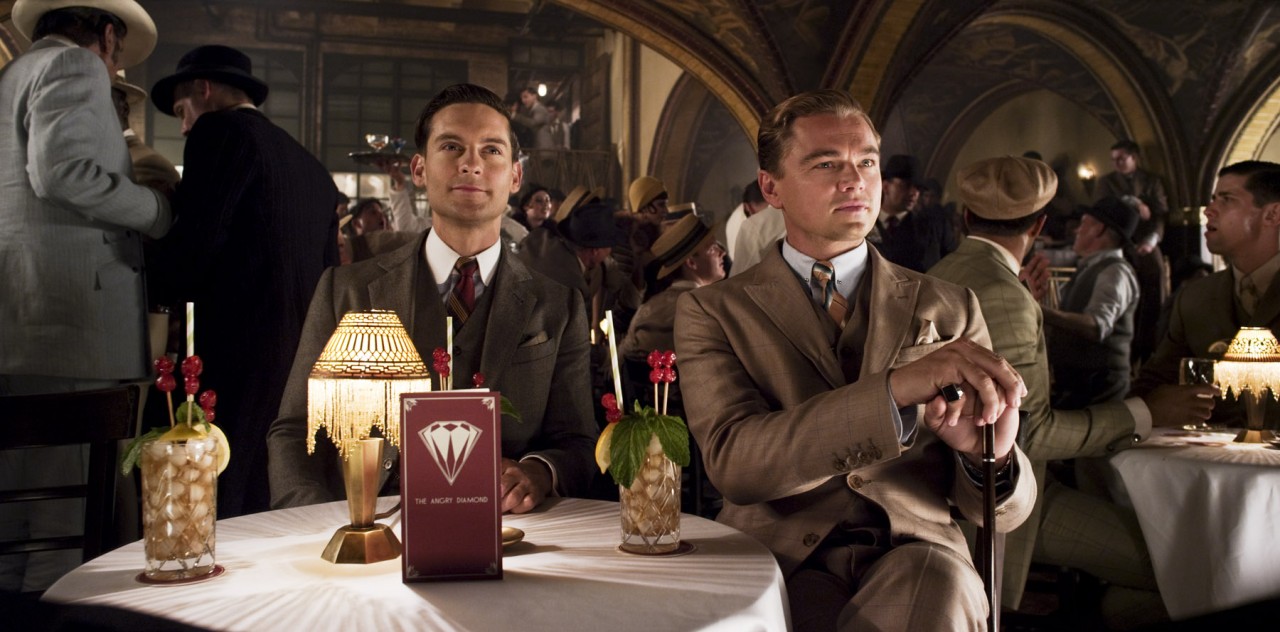
The fact that this film knows, respects, and acknowledges that makes me appreciate this movie, and hope that others can appreciate it too through DiCaprio’s performance and the mythology being revisited here.  Those who read the book should already know the story: a 1920’s bond salesman and struggling writer named Nick Carraway (Tobey Maguire) moves into New York city, where he learns of his rich next door “neighbor” named Jay Gatsby (Leonardo DiCaprio).

I put “neighbor” in quotations because Nick never actually sees Jay Gatsby in the beginning of the film.  All he ever sees of his estranged, self-secluded neighbor is a man looking behind some curtains and holding lavish parties in his mansion in the cool of midnight.  All he ever hears of him is scandalous rumors and war stories about a man many people haven’t met either.  The more Nick lives in his lonely little house, the more he questions if Mr. Gatsby even exists.

Eventually, Mr. Gatsby of course does introduce himself, but not as the host of the party, but rather, as a humble servant who offers Nick a drink on a plate of beverages.  As Nick becomes more familiar with Mr. Gatsby and his lifestyle, he soon learns the truth of Mr. Gatsby’s past and the reasons he really came to New York.

When I first heard of another Great Gatsby picture being made, my first reaction was excitement and anticipation.  How could it not be?  From the creative mind of F. Scott Fitzgerald and the many politics and emotions he makes you feel in his novel, it sounded like this movie was going to be a home run for both fans and non-fans of the book.

Then I learned that Baz Lurhmann was writing and directing.  And then bowed my head and uttered a long, dubious groaaannnn.  Lurhmann, who is most known for directing 1996’s Romeo + Juliet and 2008’s Australia, is commonly remembered as a director who abuses style over substance.  With the previous films I just mentioned, not only are they silly, soupy, and sappy menial dramas: they fail to even attain interest, and are extremely forgettable in a line of much better romantic dramas, including Titanic and the 1968 Romeo And Juliet by Franco Zeffirelli.

Note: Okay, I’ll admit I haven’t seen his 2001 film Moulin Rouge!.  Does it matter though, when out of his entire filmography, that’s the only film he can really brag about?  

The beginning of The Great Gatsby, much like Luhrmann’s other pictures, also suffers from this case of style over substance, with its overly boisterous parties and distracting art sequences making no coherent sense or adding anything to the picture overall.  What I found interesting, however, is that the first act barely matters.  When Jay Gatsby is finally introduced, the film takes a sharp turn of interest and invigorates the audience with new energy, almost like the character changes the entire tone of the film simply by him just being there.

I imagine this is the kind of Jay Gatsby that Fitzgerald would have wanted cast: the type that dresses in nice suits, stands straight with his chin up, and one who enters a room with such stillness that you could hear a penny drop.  The casting directors knew that their casting decision would be crucial to the film, and I think Fitzgerald would be pleased with the end result.  DiCaprio hits every single note dead-on this fascinating character, and just by sheer appearance, demeanor and dialect does he inhabit the character of Jay Gatsby and allow audiences to slip into his conscience and feel what he is feeling.

Oh, I won’t deny everyone else is good in this movie.  Joel Edgerton is effective as the antagonist, and even though he’s an industrial pioneer much like Gatsby is, he has such a hateful energy about him that makes you just want to run him over with a yellow beetle.  Carey Mulligan is good as Gatsby’s love interest, and perfectly shows all the innocence and indecisiveness of her character in the midst of all the ruckus.  Maguire, as well, is perfect as Nick Carraway, not as a character in himself, but as a silent observer, a passive voice who quietly watches over the scene, acting as the audience’s eyes and ears in this third-person narrative.  But its DiCaprio who sucks us in, DiCaprio who winds us up and plays us like a record as he asks us to sit through this tender, emotionally captivating journey that serves as a metaphor for the wealthy and for the industrial era.

And don’t worry, I’ll give Luhrmann credit too.  This film would not have survived without his writing or directing, as he has such reverence for the book and a great fear from deviating from it that the movie functions more as a love letter to Fitzgerald than it does as a strict book-to-movie adaptation.

Regardless, there’s only one person who shines the most here.  DiCaprio made this movie, and through his performance we were able to identify with a character that struggles with his past, his wealth, his love, and the deepening sadness that he hides behinds his warm, welcoming smile.

Tagged , , , , , , , , , , , , , , , , , , , , , , , , , , , , , , , ,