Tag Archives: Romance

“THE GREAT GATSBY” Review (✫✫✫)

Nice to see you again, old sport.  

When you sit and think about the character of Jay Gatsby, there is never a simple answer to define him and his purpose in The Great Gatsby.  Some people have cited him as a post-modern interpretation of Romeo And Juliet, in the aspect that the character is going through a romantic struggle that always ends in nothing but tragedy.  Others have viewed him as a representation of the roaring twenties, as a pioneer who emboldens and defines the industrial image of the 1920’s and their status as they faded away into the 1930’s.  Others see him more like an enigma, an image of the upper class and the bleak loneliness that comes with it.  Whatever you believe to see, Jay Gatsby is no simple character.  For all we know, he could be one or none of these things.  Or all of them.

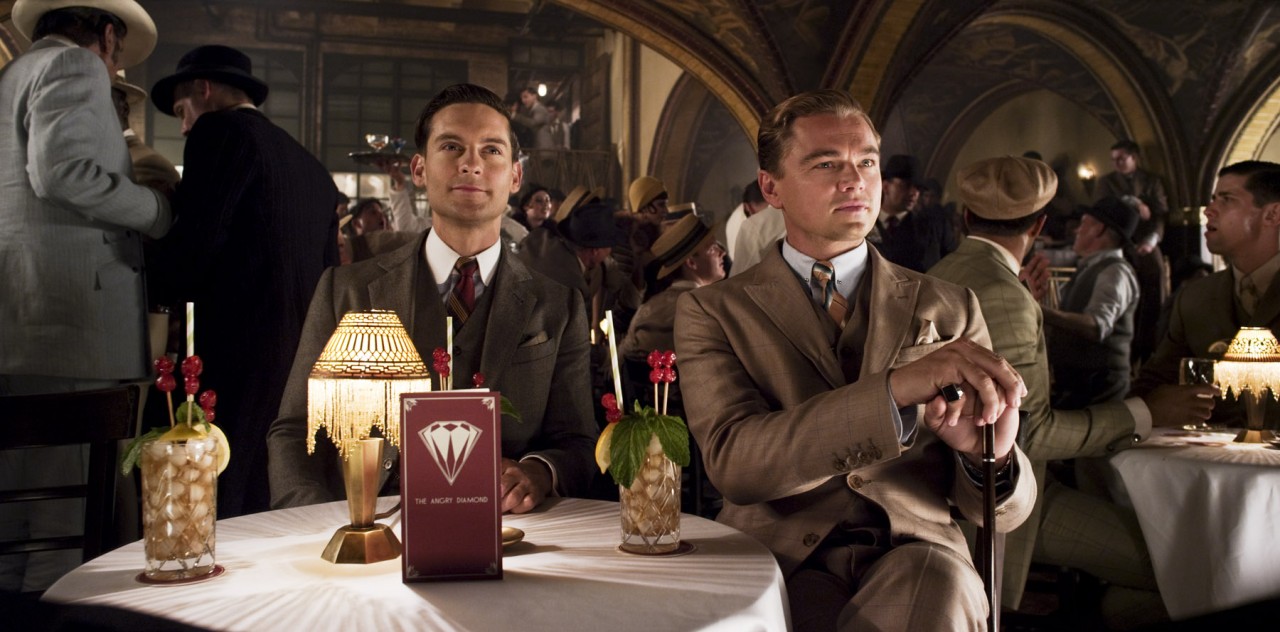
The fact that this film knows, respects, and acknowledges that makes me appreciate this movie, and hope that others can appreciate it too through DiCaprio’s performance and the mythology being revisited here.  Those who read the book should already know the story: a 1920’s bond salesman and struggling writer named Nick Carraway (Tobey Maguire) moves into New York city, where he learns of his rich next door “neighbor” named Jay Gatsby (Leonardo DiCaprio).

I put “neighbor” in quotations because Nick never actually sees Jay Gatsby in the beginning of the film.  All he ever sees of his estranged, self-secluded neighbor is a man looking behind some curtains and holding lavish parties in his mansion in the cool of midnight.  All he ever hears of him is scandalous rumors and war stories about a man many people haven’t met either.  The more Nick lives in his lonely little house, the more he questions if Mr. Gatsby even exists.

Eventually, Mr. Gatsby of course does introduce himself, but not as the host of the party, but rather, as a humble servant who offers Nick a drink on a plate of beverages.  As Nick becomes more familiar with Mr. Gatsby and his lifestyle, he soon learns the truth of Mr. Gatsby’s past and the reasons he really came to New York.

When I first heard of another Great Gatsby picture being made, my first reaction was excitement and anticipation.  How could it not be?  From the creative mind of F. Scott Fitzgerald and the many politics and emotions he makes you feel in his novel, it sounded like this movie was going to be a home run for both fans and non-fans of the book.

Then I learned that Baz Lurhmann was writing and directing.  And then bowed my head and uttered a long, dubious groaaannnn.  Lurhmann, who is most known for directing 1996’s Romeo + Juliet and 2008’s Australia, is commonly remembered as a director who abuses style over substance.  With the previous films I just mentioned, not only are they silly, soupy, and sappy menial dramas: they fail to even attain interest, and are extremely forgettable in a line of much better romantic dramas, including Titanic and the 1968 Romeo And Juliet by Franco Zeffirelli.

Note: Okay, I’ll admit I haven’t seen his 2001 film Moulin Rouge!.  Does it matter though, when out of his entire filmography, that’s the only film he can really brag about?  

The beginning of The Great Gatsby, much like Luhrmann’s other pictures, also suffers from this case of style over substance, with its overly boisterous parties and distracting art sequences making no coherent sense or adding anything to the picture overall.  What I found interesting, however, is that the first act barely matters.  When Jay Gatsby is finally introduced, the film takes a sharp turn of interest and invigorates the audience with new energy, almost like the character changes the entire tone of the film simply by him just being there.

I imagine this is the kind of Jay Gatsby that Fitzgerald would have wanted cast: the type that dresses in nice suits, stands straight with his chin up, and one who enters a room with such stillness that you could hear a penny drop.  The casting directors knew that their casting decision would be crucial to the film, and I think Fitzgerald would be pleased with the end result.  DiCaprio hits every single note dead-on this fascinating character, and just by sheer appearance, demeanor and dialect does he inhabit the character of Jay Gatsby and allow audiences to slip into his conscience and feel what he is feeling.

Oh, I won’t deny everyone else is good in this movie.  Joel Edgerton is effective as the antagonist, and even though he’s an industrial pioneer much like Gatsby is, he has such a hateful energy about him that makes you just want to run him over with a yellow beetle.  Carey Mulligan is good as Gatsby’s love interest, and perfectly shows all the innocence and indecisiveness of her character in the midst of all the ruckus.  Maguire, as well, is perfect as Nick Carraway, not as a character in himself, but as a silent observer, a passive voice who quietly watches over the scene, acting as the audience’s eyes and ears in this third-person narrative.  But its DiCaprio who sucks us in, DiCaprio who winds us up and plays us like a record as he asks us to sit through this tender, emotionally captivating journey that serves as a metaphor for the wealthy and for the industrial era.

And don’t worry, I’ll give Luhrmann credit too.  This film would not have survived without his writing or directing, as he has such reverence for the book and a great fear from deviating from it that the movie functions more as a love letter to Fitzgerald than it does as a strict book-to-movie adaptation.

Regardless, there’s only one person who shines the most here.  DiCaprio made this movie, and through his performance we were able to identify with a character that struggles with his past, his wealth, his love, and the deepening sadness that he hides behinds his warm, welcoming smile.
Tagged , , , , , , , , , , , , , , , , , , , , , , , , , , , , , , , ,

“PITCH PERFECT” Review (✫✫)

Special appearance from the cast of “Glee”!  

Pitch Perfect is a predictable, formulaic film, a movie enveloped in its conventions, forcing in cliche characters, and bolstered only by its joyous music, which cannot help but seem misplaced in a movie like this.  It’s the sort of movie that doesn’t deserve the word “perfect” in its title.  I’d offer an alternative title, something shorter and more subtle such as simply Pitch, but I’ll advise against that for the fear of people mispronouncing it.

The story begins on a young and rebellious Beca Mitchell (Anna Kendrick), an aspiring DJ who dreams to one day become as popular as Skrillex or David Guetta (80’s kids, look them up on wikipedia).  Her father however, who just happens to be a professor at Barden University, encourages her to become more immersed in her education and to get more involved on campus.  Beca hates school and hates socializing even more, but will put up with it because her father will help her out with her DJ career if things don’t pan out at school like he wants them to.

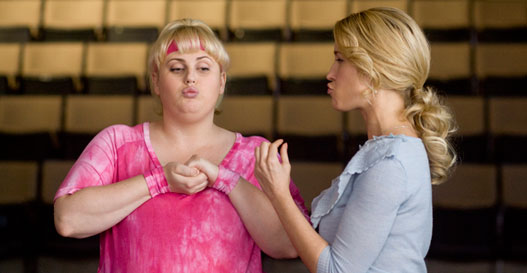
She gets a job as an intern at a radio station, and ends up joining the Bellas, a group of diversified female singers who all compete at an acappella competition at the end of the year.  These girls are Aubrey (Anna Camp), the snotty, stuck-up leader of the Bellas, Chloe (Brittney Snow), the more civil and more approachable Bella out of the group, and Fat Amy (Rebel Wilson), a woman who is determined to throw herself out there despite her weight and her unattractive appearance.  Just so you know, I’m not calling her “Fat Amy” on purpose.  That is the specific name she instructed the Bellas to call her when they mistakingly called her “Amy”.  I’ll bet her mother is proud of that, hearing her daughter wanting to be called Fat.

The Bellas were disqualified from the last competition because Aubrey vomited all over the front row of the audience last year (believe me, that wasn’t a pretty sight to see).  Aubrey, as a result, is even more strict about protocol, behavior, and song selection than before, and so now she functions as a sort of an acappella Hitler to these poor college girls who are just trying to find their place at this university.

Let me say something here: there is something seriously wrong with your picture if your best comedy comes from a girl called Fat Amy and the worst involves girls swimming in pools of vomit.  That’s not figurative, by the way, that is a literal reoccurring joke in the picture.  This is perhaps the biggest problem with the picture over everything else: the comedy is not funny.  It is not original, clever, precise, or even remotely well-written.  It is unbelievable, insincere, forced, and extremely ham-fisted.

Why do I say this?  Because not a single laugh was genuine.  Nothing was funny.  The jokes all involve typical cliches or moronic conventions, things you can find easily on a television network like ABC or Nickelodeon.  What other examples do I need to give, besides the vomit jokes?  How about awkward parents, preachy life lessons, bad singing, rapping, stereotypes, hazing and topics about sex?  I’ll thought I was watching a musical here, not an episode of “Kids In The Hall”.  

Oh yes, this film is not funny, but even worse are its characters, who are so unbelievable and overly-dramatized that they can only be in a movie.  These girls are an annoying, rambunctious sort, a group of absent-minded drama queens who worry only about what tradition they uphold or which boys they are sleeping with.  I know they’re meant to be seen as overly-expressive college archetypes, but for Pete’s sake, at least try to be more creative.  “High School Musical” had more interesting characters than this.

Anna Camp is both spoiled and paranoid, a woman who is an over-exaggerated negative picture of sorority girls.  Snow is meager, idle, and useless, there only to inspire Beca to join the Bellas, but not much else since she’s so passive when confronting Aubrey.  Kendrick is good as Beca, but not really that compelling, and even when she first appears on screen we get a sense that the script is going to force us through some deep, meaningful character romance even though it isn’t really that deep or meaningful.  The most compelling and talented actress here is Rebel Wilson as Fat Amy, who is so spirited and so enthusiastic in her role that she ends up more appealing than any of the other sorority brats in this movie.  Her attitude and her humor was uplifting and energetic, and I wouldn’t be surprised if she served as a sort of inspiration for overweight girls everywhere.  Dare I say I was turned on by her energy?  No, but she was close.  Really close.

Ultimately, Pitch Perfect is a flat, typical experience.  It provides nothing we haven‘t seen before and its immature handling only reveals more of its desperate copycat nature.  Why, then, am I giving it two stars when it’s story clearly deserves one?  That is because of the music.  If the movie accomplishes nothing else (and it doesn’t), it has the most beautiful covers and acappellas I’ve ever heard, even better than what most of what the TV show “Glee” produces.  There was one great moment where Kendrick even does an original acappella with only her voice, hands, and a plastic cup to use at her instruments.  That does not happen by insincere chance, fellow readers.  That is genuine, passionate talent, one that is evidenced in every beautiful note in these acappellas (although I don’t understand how a woman is capable of singing in baritone.  That’s another issue though).

Oh boy, am I going to get roasted for this.  What, I wonder, do people find so entertaining about this movie?  Look, I don’t expect a perfect film.  I don’t go into these things expecting to dislike them from the outset.  All I ask is that you have good singing, a solid story, and appealing characters for me to appreciate.  Here, the singing is incredible, but the dialogue is flat, the story is predictable, and the characters are more annoying and high-strung than the Kardashians.  Pitch please.

Tagged , , , , , , , , , , , , , , , , , , , , , , , , ,

“TRANCE” Review (✫✫✫1/2)

The pocket watch is mightier than the magnum.  

Trance is a fantastic art film, a mesmerizing and fascinating thriller that uses twists, turns, hallucinations, and narrow corridors as its tools to build suspense, and dialogue and performances to form sympathy for its characters.  Its surreal, twisted, strange, nonlinear, and non-conventional, but to dust with conventionality.  This is a great picture.

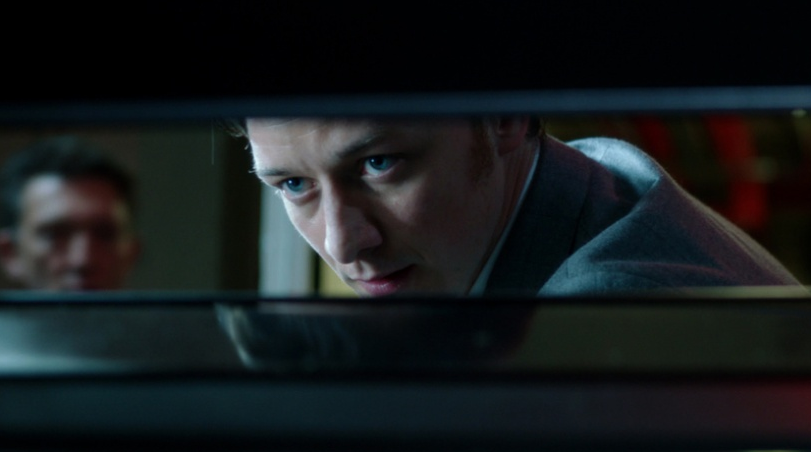
As the film fades in, we are introduced to Simon Newton (James McAvoy), an art auctioneer who takes us through the ropes of what his job entails.  He tells us of the extensive steps it takes to reserve a painting, the protocols his employers tell him to do when putting a painting up for auction and what steps he must take if a robbery takes place.  Their most valuable item is a painting by Francisco Goya called “Witches In The Air”, and his employers gave him precise instructions on how to preserve the painting if thieves do happen to come into the auction in an attempt to steal it.

Sure enough, thieves break into the auction and attempt to steal the painting.  This troop is lead by one named Franck (Vincent Cassel), and he is determined and headstrong into getting that painting.  Right before Simon puts the painting away, however, Franck cuts him off, a brief struggle happens between them, and Simon is knocked out, with Franck leaving with the stolen painting in tow.

When Simon wakes up, he realizes he lost his memory from the past two weeks.  When he’s finally released from the hospital, Franck pays him an unwelcome visit.  Turns out, all that Franck got on the day of the heist was just the frame of the painting, whereas the real article itself was transported to an alternative location.  Torturing him by peeling back his fingernails, Franck comes to find out Simon truthfully does not remember where he put the painting.  So he tries a different method of extracting information, one that involves psychology and hypnotherapy at the hands of one named Dr. Elizabeth Lamb (Rosario Dawson).  Together, they attempt to probe Simon’s mind, and begin their search for the painting Simon has kept hidden from them.

Here is a film that knows what it wants, a movie that knows its characters, their motivations, its story, and precisely how to tell it.  Director Danny Boyle, who is nearly a master at experimental cinema (if you don’t believe me, look at his hallucination sequences in Slumdog Millionaire or 127 Hours) does something very rare here: he intertwines and meshes characteristics of a narrative film with that of art and experimental cinema, making a truly absorbing, gripping, and fascinating experience.

Let me make something clear here, however: I hate experimental cinema.  Nine times out of ten they don’t make any sense, they seem relevant only to those making them, and they elicit a confused response rather than an emotional one from its audience.  Here though, the result is much different.  Everything is crystal-clear and fluid, the visuals dynamic and expressive, the editing cut together neatly and crisply. It’s like a mind game of cat-and-mouse, except the cat is willing to seek out help and the mouse is more lethal than both cats are lead to believe.

Oh believe me, my attention was unadverted throughout the entire picture.  While I didn’t understand everything immediately in the film, I understood what I needed to in the moment and the plot filled in the rest for me as time went on.  And what did I understand, more than anything else?  That these are sinful characters, decrepit criminals that lie, cheat, and connive their way to success and to financial gain.  Cassel was aggressive and talented as Franck, and while his character was despicable and loathsome at first, a softer side of him was later revealed so that the audience could come to terms with his character.  Dawson is as beautiful and motivated as ever, and while she too was at first a sympathetic figure, she later reveals a darker side to her character that even I didn’t expect.  I’m not even going to go into James McAvoy.  His performance was so specific and so wide-ranged that I was compelled to care for his character while at the same time hating him.

And yes, in case you didn’t pick up on it, the movie is deserving in its R rating.  It is violent, bloody, disturbing, graphic, and it has its vast share of nudity and sexuality, with some of the violence and sex combining in many gruesome scenes.  If this were any other picture, I would take off points for that.  But like Pulp Fiction and Taxi DriverTrance is a film that uses its bleak content as a tool to tell a story and define character, to show an encompassing yet tragic story of three fatally flawed individuals who will torture, manipulate, and kill to get whatever they want.  You have to watch a movie like this long enough to realize the point when it stops being a thriller and starts forming into something greater: when it starts forming into art.

Tagged , , , , , , , , , , , , , , , , , , , , , , , , ,

“THIS MEANS WAR” Review (✫1/2)

Spy vs Spy in the most imbecilic way possible.

I hate formula movies.  I hate em, I hate em, I hate em.  They are predictable, repetitive, and annoying in nature, deafening and forgettable by default.  It doesn’t matter what genre its from: if it follows the formula, premise, or plot-line of another film, it is automatically doomed for failure.  You’ve never heard of Mac and Me because it isn’t E.T., and you don’t remember The Mummy because it isn’t Indiana Jones.  Why on earth, then, would we remember this when we already have movies like Rush Hour, Lethal Weapon, and Men In Black?

This Means War is one of those movies that follows its formula so strictly, it treats its premise like its their only chance of survival.  Imagine the movie like the sinking Titanic, and the small plank of wood (the formula) is the actor’s only hope of survival.  Director McG should have actually seen Titanic though: the plank of wood didn’t have the strength to support its two leads.  What makes McG think that here it would support three?

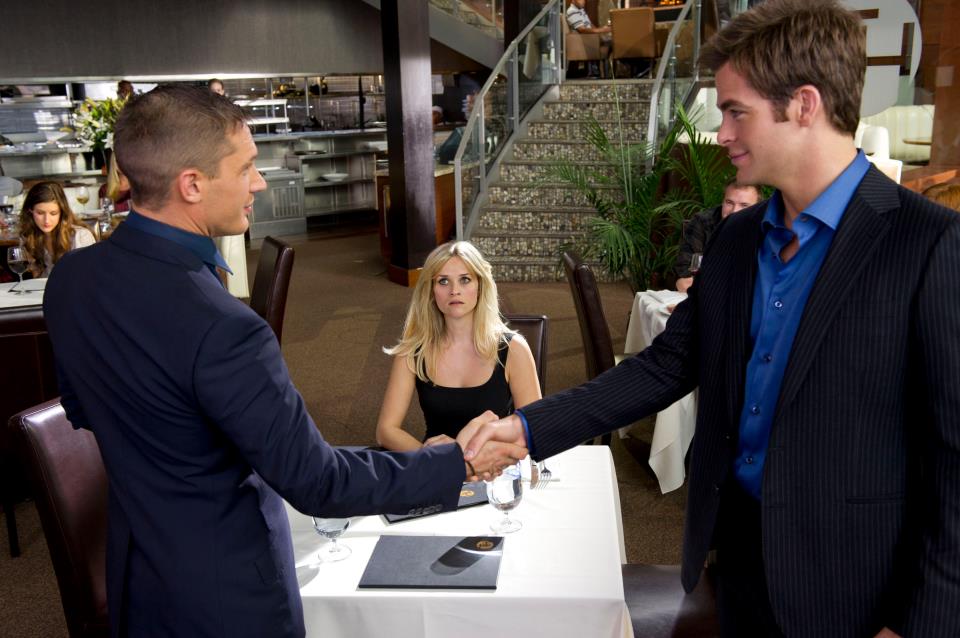
This Means War follows the story of two CIA agents: partners, allies, goody-goody beer buddies.  FDR (Chris Pine) is an active womanizer who is always on the lookout for new jailbait.  Tuck (Tom Hardy) is his less-lucky friend who is divorced, has a son, and struggles to even find a date.  Lauren (Reese Witherspoon) is a bold, intelligent, and beautiful product-testing agent who struggles to find love.  Oh boy.

These are our characters: one of them a pleasure-seeking playboy and the other two romantically hopeless until they discover online dating.  And when Tuck arranges for a date online with the beautiful, yet oblivious, Lauren, their date leads to another coincidence encounter that could only happen in a movie: FDR, who just happened to be looking for a video in the rental store when he ran into Lauren.  From there, you can predict what the movie is: a spy-romantic-action-“comedy” about two expert CIA agents fighting over the same girl.

Har har har, hee hee hee.  How original.  Hasn’t this been done before?  How many times have we seen movies, television shows, novels, and even comic books about competing love interests?  I’m all for the buddy-cop-turns-rivalrous-romance gag, but the material in the story must be funny and/or clever in order for it to back up its lack of originality.

Expect none of that humor, wit, or emotion in this movie.  This Means War is mind-numbing, a sterile, unfunny, and idiotic film that tries to win us over with confidence and charisma, but instead rubs us off with immaturity and annoyance.  There’s no reason to care for these characters.  The emotion is artificial.  All of the jokes are unfunny, and they dilute to topics as silly and insignificant as alcohol in a baby’s bottle, or sex jokes involving Cheetos.  No, that was not a typo.  Think of how many jokes you can make about a small, orange, stubby-shaped object.  I’ll bet Chester was happy to hear about the product placement, though.

The greatest hinderance of this movie is its writing, where every single line of dialogue carries over its insincerity and its dependency on its paper-thin premise.  The dialogue is so shockingly dumbfounded that I wanted to rub my fingernails on the chalkboard owned to whoever taught these screenwriters how to write.  The smartest lines of dialogue in the film include something like “What do you do when you don’t know what to do?” or “You have the intelligence of a fifteen year old boy!”.  Well, at least we’re on the same page here.

The only redeeming factor of this movie is the cast, who at times deliver their lines with whimsicality and good humor.  Even then though, their roles are wasted.  Their characters are so stupid, half-witted, and immature that they could only be artificial.  Take, for instance, Reese Witherspoon’s character.  How is it that a woman like her gets all of these advances and radical emotional changes from both of these guys, yet she continues to remain so clueless and oblivious like she’s out on a first date?  Explosions go off and these guys go kung-fu on each other and you still think they’re just travel agents?  Sorry, I’m not buying that.

Do I really need to elaborate any more here?  I’ve already said why This Means War is terrible, and I hope my point is made.  The chemistry is flat, plastic, and unbelievable, the dialogue, even more so.  The plot is stock, unoriginal, and lifeless.  The visual effects are so bad, you can see the CG on a car when it goes flying from an explosion.  The villains, especially, are extremely lackluster and uninspired.  What is more stock, for instance, than a Russian baddie trying to get revenge at two secret agents who killed his brother?

This, from the same guy who gave us We Are Marshall.  What happened to McG?  He was so great with that film, filling it with so much life and emotion.  Terminator Salvation, preposterous as it may be, was also darkly atmospheric and marginally entertaining.  Now, he’s here scraping the bottom of the barrel with This Means War, giving us no sanctuary from conventionalism, but instead, wooden planks to float on it.  Let it sink, McG.  Please.  Let it sink.

Tagged , , , , , , , , , , , , , , , , , , ,

“WALL-E” Review (✫✫✫✫)

A little robot proves that emotion isn’t a malfunction after all.

If there is any film that shows a greater maturity can be reached with something as simple as a children’s film, WALL-E proves that very point perfectly.  It’s everything you’d expect from a Pixar movie and more.  Yes, the animation is gleaming and beautiful.  Yes, the story is touching and poignant.  And yes, the main character is as funny and entertaining as he is sympathetic and lovable.  But oh, is this film much more than being just a simple kids movie.  Much more.

Taking place on planet Earth in a dystopian future, WALL-E (Ben Burns) is the last of a line of robots tasked with cleaning up the earth after the human race left it in a state of filth and desolation.  After they left centuries ago onboard a space ship called the AXIOM, WALL-E is the last active robot who continues to engage in his duties day in and day out on planet earth.  During all of his time on earth, however, he begins to develop something some technicians might call a “malfunction”.  He begins to develop a conscious: a heart.

Time passes as days turn into years, and on one day just like any other, WALL-E encounters EVE (Elissa Knight), a probing bot tasked with retrieving something on planet earth for the AXIOM to analyze.  WALL-E cannot help but feel infatuated by EVE, and their meeting launches into a space adventure of involving, epic, and emotional proportions.

You need to see this film just for the plain simple fact of seeing it.  WALL-E is a bright, beautiful, stylish, and visually stellar film that astonishes the audience through its rich amounts of animation, colors, computer graphics, and textures.  There’s quality in the environments in WALL-E, a vibrant and lively texture that makes the world of WALL-E not only great to look at, but also make it look real. Whether WALL-E is traveling on the chaotic and anxious AXIOM, working on the desperate, garbage-infested planet Earth, floating over the lonely, dusty surfaces of the moon, or flying peacefully through the stars in outer space, WALL-E is great to look at because of its authentic, detailed computer animation.  WALL-E is a great-looking film.

More than that though, I’m impressed by the story and the themes that are being expressed to us through those visuals.  Written and directed by Andrew Stanton, the same man who wrote and directed Finding Nemo, WALL-E is a space adventure filled to the brim with imagination and creativity.  You would typically expect this considering this is Pixar, but even by those standards Stanton outdoes himself.  Similar to Finding Nemo, Stanton once again manages to make a story that is not only funny and light-hearted, but also deep and significant to its audience.  In this story Stanton develops a nice theme of consumerism and environmentalism, though he does it in a subtle way to which it doesn’t overwhelm the story or annoy the audience.  He does this through simple scenes where we see an American flag sitting on a cherished historical landmark long ago, but a slow pan reveals an advertisement for an upcoming BUY N’ LARGE mall coming soon.  Stanton is effective here as a storyteller, as he deliberately uses pace, subtext, and soft, quiet moments to make the greatest impact upon his audience.

And finally, there are the characters, who are written and animated here with such life and uniqueness that it is hard to forget them once you leave the theater.  EVE is a determined, upbeat, and enthralling spherical robot who is just as intimidating and confrontational as she is enthusiastic and sincere.  A small robot named MO is such a clean freak that he will stalk you around an entire space station if your shoes aren’t clean.  And then there is WALL-E, the robot who is so curious, clumsy, funny, brave, heartfelt, and full of wonderment that his heart is as full as any flesh-and-blood human being’s can be.

Again, the majesty and craftsmanship of WALL-E is to be admired.  To the younger audience, it is a children’s film about a curious little robot exploring the universe and finding love.  You wouldn’t be wrong if you made that assessment, but that’s only the surface of the story.  To the older audiences, WALL-E is a fantasizing and amazing story encompassing the totality of human nature, the preservation of the environment, and what would become of planet Earth if humanity does not take care of their home.  Kids will like the movie because WALL-E is quirky, funny and lovable.  Adults will appreciate it for the deeper intentions.

Tagged , , , , , , , , , , , ,

“LES MISERABLES” Review (✫✫✫1/2)

An opera of unexpectedly epic proportions.  

The first thing that crossed my mind while watching Tom Hooper’s Les Miserables is that this entire story is based around truth.  Not a true story, mind you, but rather the truth about 1800’s great Britain.  In that time period, the country was engulfed in sadness, desperation, and revolution.  The rich outmatched the poor.  The sick and the hungry dominated the streets.  Employment was scarce.  In times like these, misery seemed to inhabit every dark corner, and God was hard to find in the shrinking light.

Perhaps this is also a metaphor for today’s world, but that’s besides the point.  Les Miserables shocked me with its energy, its spirit, and its mature handling of its subject matter.  If the film industry was a railroad, and the train is Les Miserables, Tom Hooper is the conductor, and he’s taking me through a roller-coaster of emotions that range from shock, to sadness, to grief, to anger, to loss, to laughter, and ultimately, to happiness.  How was I supposed to know that I would begin the film with a sulk as low as Russell Crowe’s beard and end the film with a smile beaming as brightly as the sun?

This is the kind of film that Les Miserables is: the kind that finds the light shining through the cracks in the concrete.  Based on both the original novel by Victor Hugo and the subsequent musical by Claude Schonberg, Les Miserables follows the story of Jean Valjean (Hugh Jackman), a convicted criminal in 1815, Great Britain who was put away nine years ago for stealing a loaf of bread.  After being released from prison and breaking parole, Javert (Russell Crowe) is tasked with finding him and imprisoning him once again.

But somewhere along the way, Jean’s hardened heart changes. He encounters Fantine (Anne Hathaway), a sick prostitute mother who greatly fears for what will become of her daughter Cosette (Isabelle Allen). After hearing her dying wish pleading for Cosette’s safety, Jean vows to find Cosette and raise her in the world as if she were his own child.

This is an emotion-stirring epic that is vast and grand beyond all comprehension. Directed by Tom Hooper, Oscar-winner for 2010’s The King’s Speech, Les Miserables is a movie that juggles emotional tensity with visual splendor and grandeur, with Hooper’s dignified set pieces shining brightly all over the place in a broadly dignified fashion.  The opening sequence in itself is bold and spectacular, beginning deep in British seawaters and lifting itself out of the water to show a view of British prisoners pulling a ship into the bay.  With the visua effects, there is a great historical context within this picture, focusing attentively to many issues in 1800’s France, including criminal treatment, poverty, child neglect and the French revolution.

At the same time though, this movie thrives as an aesthetic piece, with these characters conveying their thoughts and emotions through their powerful performances and voices through the film.  Russell Crowe is upright and stoic as Javert, a man committed to law and order to the point where it is almost inhumane and cruel.  Anne Hathaway is affectionate and masterful as Fantine, and her character is one of the more tragic characterizations I’ve come across in recent cinema.

Hugh Jackman, however, steals the show as Jean Valjean. He is a man who has experienced cruelty and unfairness firsthand and has hardened his heart so much just so he can survive in this world. But he is also a man who has gone through a change, a man who experienced a kindness and love that no one has shown him for so long. Jackman is brilliant in the lead role, and a powerful spiritual connotation is told through his fantastic, emotional journey through the perilous land of France.

Admittedly, the film is at times overly expressive, and the music is also overwhelming to the story. The plain and simple fact is that there’s too much of it in the picture: 98% of all of the performances in the film involve singing and music, and only one or two lines are spoken through lines of actual dialogue in this movie. Won’t people get tired of hearing just relentless music numbers one after the other?

But the important thing is that Les Miserables has the emotion to match the dramatic tension that is heard through the music. As far as story and character goes, Les Miserables is unparalleled, and draws in its viewer through the drama and tragedies the characters are experiencing.  I’ll admit, balance is an issue, and people might have trouble staying interested in a two-and-a-half hour musical.

This isn’t just a musical though. This is an opera of unexpectedly epic proportions.

Tagged , , , , , , , , , , , , , , , , , , , , ,