Tag Archives: Reboot

“THE BOURNE LEGACY” Review (✫1/2)

This movie has the wrong title.

The Bourne Legacy is a misconstrued mess, an absolute miscalculation and train wreck of a film that it has no business being made into a movie in the first place.  I hated this idea months before this was released, and I hate it even more now after having seen it.  Who, in their right minds, thought it was a good idea to make a Bourne movie without Jason Bourne???  That was my biggest concern going into the movie.  Believe me though, fellow moviegoers: that is the least of your worries.

Taking place shortly after the events of The Bourne Ultimatum, The Bourne Legacy shows the repercussions of Bourne’s actions, how it affects Treadstone, and what marks it leaves on the people involved.  Erik Byer (Edward Norton) is a government official who was directly involved with the affairs of Treadstone during its days of operation.  Shortly after Jason Bourne escapes their custody, however, Byer believes that all of the agents now are a potential threat to the government, and is convinced that he needs to shut the project down in order to protect themselves.  By “shut the project down”, I really mean kill all of the agents in the field.

One of these agents is Aaron Cross (Jeremy Renner), an experienced field agent who is carrying out a mission in Alaska for Treadstone when the order was released.  While taking refuge in a wooden cabin with another fellow agent out in Alaska, they are suddenly attacked by robot jets, and Cross barely escapes with his life intact.  Surviving only because of the medication he is on (Treadstone agents are required to take two pills, a blue one for physical boosting, and a green one for mental boosting), Cross looked into his stash to realize that he only has a couple days worth of medication left.  Now low on food, supplies, and ammunition, Cross must now find a way to get back to America and survive against Treadstone long enough to find a way to counterattack their onslaught.

Let me start with the most obvious flaw here: Tony Gilroy.  Looking at his filmography, you would think he would be the best man for the job here.  He was credited as co-writer for the three previous Bourne movies, he wrote and directed the Oscar-winning drama-thriller Michael Clayton as well as the 2008 caper film Duplicity.  I enjoyed all of those movies, and thinking that this one would be the same, made the mistake of thinking that it would be just as good.

Trust me, this couldn’t be any more of a dissapointment.  Everything wrong with this movie has everything to do with Gilroy’s script and direction, which couldn’t be more forced, erratic, confusing, and half-lapsed than this.

The problems start with the premise: a Jason Bourne movie without Jason Bourne is a bad enough idea.  But let’s take a step back here and try to be open with this.  Let’s just say, for facetious effort, that Aaron Cross’ story is just as fascinating and compelling as Bourne’s is.  What are the conflicts?  In his first three movies, Jason Bourne’s struggle was against his morality, identity, and the confronting of his past.  What is Cross’ magnificent, epic struggle?  Survival by trying to find a green pill.  If this movie dwelved any more into the conflict than it did, I would have said Cross was a junkie.

“Funny”, I think.  “I don’t remember these pills being used in the original trilogy”.  Correction: I vaguely remember them.  In a brief flashback sequence in The Bourne Ultimatum, I remember Jason Bourne taking a blue and green pill during his initiation into Treadstone (this memory is hazy though).  Bourne obviously didn’t need to take the pills further because his body adapted to the drugs.  Here, Cross is dependent on the drugs like a junkie is on cocaine, and if he doesn’t get his daily dose of the green pill, he’ll apparently revert to the level of intelligence of Forest Gump, according to him.

Okay, that’s fine.  Jason Bourne isn’t in the movie, check.  Super pills gives Cross super powers, check.  I would be able to buy the premise and its characters if A) it were handled well, or B) it was anywhere near as smart, interesting, or even remotely readable as it was to The Bourne Identity.  Here, instead of intelligence we get confusion, instead of cleverness we get forced easter eggs to earlier movies, and instead of interest we get on-the-nose, ham-fisted writing.  The editing in this film is choppy, leaping all over the place, jumping from one timeline to another, one flashback to the next, and it becomes so repetitive and convoluted throughout the picture that by halfway through I stopped caring about it.

Oh, I don’t deny Jeremy Renner is a knockout in this role.  Neither do I deny the talents of Rachel Weisz, Edward Norton, and especially not Joan Allen or Albert Finney.  All of the performances are great, but the story is a complete wreck, and Gilroy clearly has no idea how to handle his premise or the cast he’s been given for this.  What more proof do you need, besides this convoluted script, an uninteresting story, and a tedious chase sequence at the end with a sharply abrupt cliffhanger?

This is exactly the reason why I hate sequels.  When done well, like the original Bourne trilogy, they are compelling, brilliant expansions furthering the story set up by the first one.  When done like this however, they are nothing but forced, awkward, nonsensical garbage.

Again, I ask this: why did this movie have to get made?  The Bourne Legacy is exactly what you expect it to be, a Bourne movie without Jason Bourne, equally without the compelling character drama or real conflict in it. And now they’re talking about a possible sequel to this mess.  Only if Jason comes back and kills Aaron Cross.  That’s the only way they can redeem themselves at this point.
Tagged , , , , , , , , , , , , , , , , , , , , , , , ,

“SNOW WHITE AND THE HUNTSMAN” Review (✫✫✫)

And thank you, Thor, for keeping up appearances.

Take a deep breath and say it with me: Snow White And The Huntsman.  Doesn’t sound very promising, does it?  Like most fantasy films, Snow White And The Huntsman seemed set up for failure.  It’s centered around a very popular character portrayed by Bella Swan, the film is based around a fairy tale known universally in every person’s mind, and it seemed tempted to fall for a formula and let down its audience.  Believe me, that was the movie I was expecting when I went into the theater.  The movie, however, is much better than the title suggests.

Based on the famous original fairy tale by brothers Grimm, Snow White And The Huntsmanfollows the story of Snow White (Kirsten Stewart), a kind and beautiful princess of the land Tabor who would one day inherit the kingdom and the throne from her father King Magnus (Noah Huntley).  Before she was born, the narrator tells us that her mother pricked her fingers on a rose outside of her castle, with three drops of blood staining the snow.  Her mother told herself that she wanted a daughter as white as the snow, lips as red as the blood, and a spirit as strong and defiant as the rose she prickled.

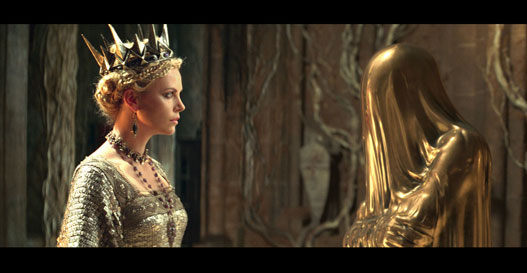
This opening sequence was both fascinating and revealing, a deeper introspect into Snow White’s history that I don’t believe has been visited before.  Her mother eventually died giving birth to Snow White, and so King Magnus marries a strikingly beautiful woman named Ravenna (Charlize Theron), whom he rescued from a dark army made out of glass soldiers that tried to invade his kingdom.  Magnus is so stricken by Ravenna’s beauty, in fact, that she becomes his queen in less than two days.

You already know where this is going, don’t you?  Ravenna is, in fact, the dark and conniving witch leader of the dark army.  After killing Magnus in his bed, she takes Snow White, forces her into the upstairs dungeon, and seizes power over the kingdom as the newly appointed Queen of Tabor.

Years past, and the kingdom of Tabor falls into desolation and poverty.  Snow White has now become of age to become the new queen of Tabor, and has been blessed with the gift of kindness that will ultimately dethrone Ravenna from the throne.  Snow White eventually escapes from the dungeon, flees from Ravenna, and escapes into the dark forest, a place where people slowly lose their sanity and, in time, their life.

Raevenna cannot go to this place to kill Snow White, so she hires somebody who can: a huntsman by the name of Eric (Chris Hemsworth), a man who lost his wife to death’s hand long ago.  Nothing could convince this angry, tired old drunk to take this job willingly, but he takes the job nonetheless in the hopes of that the evil witch can revive his dead wife with her dark powers.  And so the adventures of Snow White and the Huntsman begin.

The biggest thing Snow White And The Huntsman has going for it is two things: its visuals and its handling of the premise, in that exact order.  Rubert Sanders, who is making his director debut through this picture, is very smart and very careful with his visuals, using very precise and expertly-detailed CGI in things like the Magic Mirror or in the dark army made out of glass.  But it isn’t just the visuals that makes the picture what it is: Sanders is smart enough to make the visuals mean something, and just like the camera he’s using to record the picture, the visuals are a tool he uses to tell a story and to instill some deeper meaning in the audience.

Take, for example, how Sanders uses the color of white in the picture.  The color itself only appears three times in the picture: once where Snow White rides and abandons a white horse on the beach, another time where she encounters and caresses a magnificent and beautiful white stag, and the last one being where she dies and is resurrected while being in a white funeral dress.  Go back and look at the pictures again and try to look at it through a more symbolic scope.  I promise you, if you see the picture as I do, you will see a princess abandoning her kingdom, returning to her kingdom, and finally, becoming the queen and leader that the kingdom deserves.

To find such complexion in a picture as this was both shocking and surprising, and the cast delivers just as much as the visuals do. Charlize Theron was menacing, evil, and conniving as the dark witch, and gives a stellar performance that would have had the animated version relieving in her pants.  Stewart, shockingly, is very grounded in her take as Snow White, and embodies everything her mother says she has: strength, beauty, courage, kindness, and heart, and this especially shows in the last half hour of the picture.  Hemsworth was equally as emotional and convincing as the huntsman named Eric, although there are a few brief moments where he breaks character and acts more like Thor from The Avengers.

There was another Snow White movie released earlier this year called Mirror Mirror, and it starred the lovely Lily Collins and Julia Roberts in roles opposite Stewart and Theron.  That movie was too silly and immature for its own good.  Here, we have the opposite problem: this film is dreary, dark, sullen, and bleak, a movie that for the first half of its runtime, fills us with dread, angst,  and sorrow.  Starkly different tone from the whimsical, uplifting veins of the original Disney classic don’t you think?  Whatever happened to Doc, Grumpy, Happy, Sleepy, Bashful, Sneezy, and Dopey?

Still, its a good movie.  When there is color in the picture, it reaches out to you in striking detail, the cast is extremely strong, and the visuals and the camera angles combine to make a very provocative picture and a very sharp visual experience.  All you need left is Mjolnir and the rest of the Avengers, and you’ll be all set.

Tagged , , , , , , , , , , , , , , , , , , , , , ,

“STAR TREK” (2009) Review (✫✫✫✫)

To go where no Trekkie has gone before.  

When I first heard about J.J. Abrams rebooting the Star Trek series with another movie outing, my immediate reaction was rolling my eyes.  “Not ANOTHER Star Trek movie!” I remember thinking.  Indeed, wasn’t that everybody’s reaction?  Star Trek lived and had its time, and it seemed like the only people who would enjoy this new release were the Trekkies that were faithful to the series since episode one.

Nothing, however, would have prepared me for how immersive and fantastic this new movie is.  It’s more than just another Star Trek movie: its a science-fiction epic.  It’s an energetic and revamped take on a series that severely needed a new direction.  The story is original, the characters are fresh, and the vision is as bold and fearless as it possibly can be. Its success doesn’t just rely on CGI and visual effects (although believe me, it doesn’t fail in either category).  It’s one of those rare treasures where the characters and their dialogue is more appealing than the action scenes we have to go through every twenty minutes.

The plot originated from an idea that was had way back in 1968.  Back when the series was first spawning its popularity, original creator Gene Rodenberry started early writing for a prequel to his own science-fiction series.  But just like superhero movies Watchmen and Sam Rami’s Spider-man, it was stuck in development hell until finally creative writing team Roberto Orci and Alex Kurtzman were hired to write the script for the new mysterious Star Trek prequel.

This was a smart move.  They are the same writers behind movies as successful as Mission Impossible III, Transformers, and Eagle Eye, and their proficiency as writers shines here more than ever.  They compose a story as brilliant as it is exciting, a plot that is as action-packed, captivating, explosive, humorous, and in-cheek as possibly can be.  They do more than just adapt this universe: they pay tribute to it.  They pay homage to the classic series, pulling inspiration and ideas from all corners of the galaxy in the Star Trek universe.  We can tell this through tidbits of plot and dialogue that Orci and Kurtzman insert throughout the movie that reveal intimate details of the Star Trek universe we might not have known before, such as how Kirk came to become enrolled in Star Fleet, the origins of Spock, or how James McCoy got his famous nickname “Bones”.

This isn’t just another action film where the characters are just shoved aside for the action and explosions: Orci and Kurtzman are just as careful with developing character and dialogue as they are story.

Still though, if we have Orci and Kurtzman to thank for the vision, we have director J.J. Abrams to thank for the realization of it.  To date, this is only his second time in the director’s chair (his first being Mission Impossible III), but his skills as a filmmaker shine here of blockbuster-esque proportions.  Every minute of this film is fueled by both ambition and excitement, with every minute being tense, exciting, funny, exhilerating, and action-packed all at once.  Nothing is ever dull or boring or repetitious in this film: every second is filled with character appeal and visual spectacle that hasn’t been matched since George Lucas’ Star Wars series, or recently James Cameron’s Avatar.  I cannot recall a single moment in the film where I was bored or irritated.

If we’re talking about science-fiction epics, it flat out doesn’t get much better than this.  Star Trek is a great movie for many reasons, both obvious and not obvious.  The obvious reasons would involve its visual effects, make-up, and art direction.  The film is obviously visually ambitious, and like the U.S.S. Enterprise, transports you to many worlds of visual color, dazzle, fantasy, and wonder that is ever-present in the constantly-changing genre of sci-fi.  Another obvious reason would probably involve the performances: Chris Pine and Zachary Quinto do a great job at portraying the next-generation versions of James Kirk and Spock, and their chemistry with each other reflects their rivalrous spirit with both great tension and comedy.  Eric Bana also, deserves great props as the lead antagonist.  He portrays a villain so passionate and deadly that I pray the Wrath of Khan would never have to face him.

But those reasons makes the movie succeed: what makes the movie thrive are the unexpected reasons.  And those reasons are writers Orci and Kurtzman and director J.J. Abrams.  I’m not saying their careers don’t precede them: I’ve enjoyed Mission Impossible III and Eagle Eye, and I absolutely love the first Transformers movie (although the second one made me want to gouge my eyes out with a toothpick).

But the caliber of this work goes far beyond what was expected for them.  It’s typical to expect a good product from a good team: it’s rare to see exceptional work of this caliber from that exact same team.

Take this from a guy who isn’t a Trekkie.  I’ve seen a few episodes of “Star Trek” in the past, but I never became interested enough to follow the series as a direct fan.  Watching this movie makes me wonder what I might have been missing out on.

Tagged , , , , , , , , , , , , , , , , , , , ,

“OZ: THE GREAT AND POWERFUL” Review (✫✫✫)

Follow the yellow brick road down the rabbit hole.  

I was five years old when I saw Victor Fleming’s The Wizard Of Oz for the first time in my life. I remember that exact moment like it was yesterday. My mother held me in her lap, our dog Sandy lay in mine, my father was laying on his couch sipping a cup coffee, and they would both tell me all the wonderful memories they have of watching that movie growing up. Those memories would eventually become mine as I now recount all of the joyous times I was transported to Oz every time I watched that fantasy classic. I would eventually go on to name that film as one of  best movies ever made.

Now here I am, 15 years later, recounting my memories of watching the original and am now watching its prequel Oz: The Great and Powerful”and judging it with the same fairness as I did with the original. My verdict? It’s a good prequel, but Oz fell a little too far down the rabbit hole if you know what I mean.

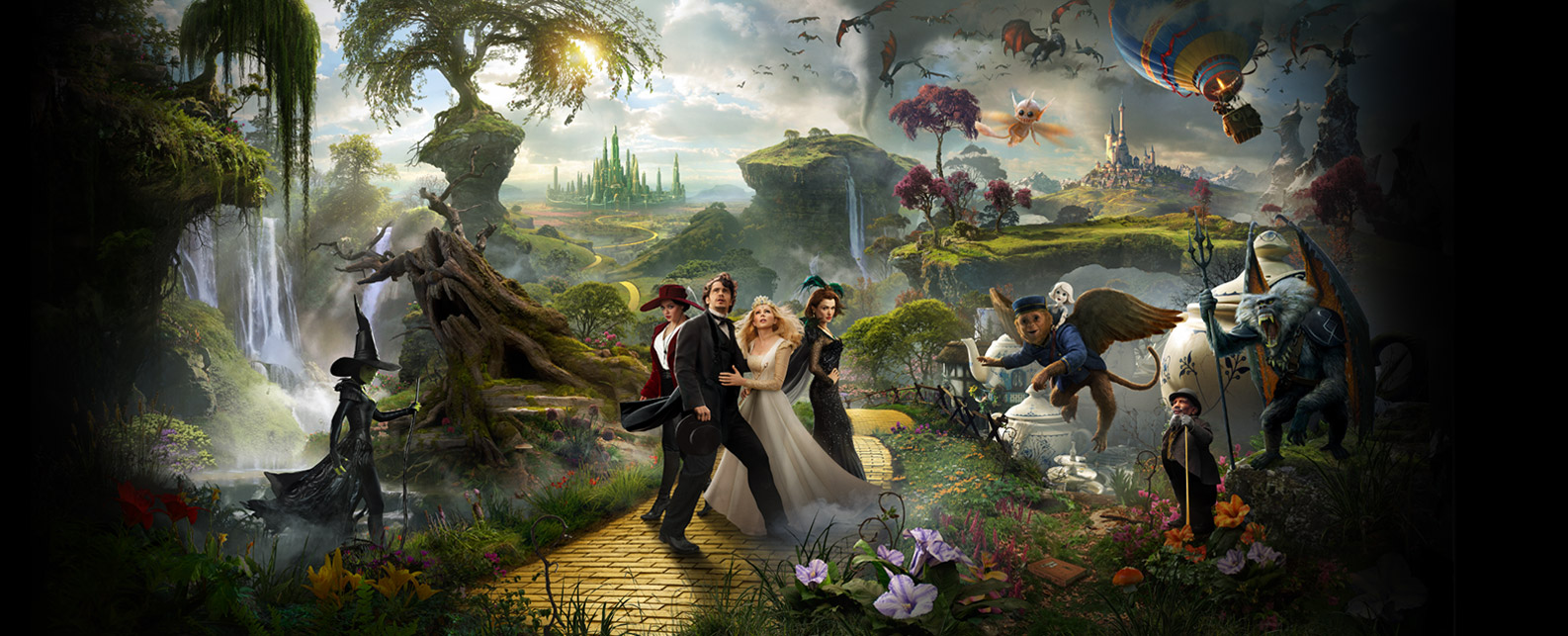
Preceding the events of the fantasy classic The Wizard Of Oz by whatever-something-amount-of-years, Oz: The Great and Powerful follows the story of Oscar Diggs (James Franco), a struggling magician in a traveling circus who dreams of rising above mediocrity and amounting to greatness in the world.

Unfortunately, Diggs is also a crook and a womanizer. When he escapes a few enraged circus freaks by stealing a hot air balloon, he’s gets trapped in a whirling tornado that transports him to a place he’s never seen — Oz, the wonderful land of munchkins, emeralds and yellow brick roads. It is here where Diggs discovers he’s part of an ancient prophecy: that a wizard named after the land of Oz will descend onto the land, and free the people from the tyranny and evil of the Wicked Witch of the West.

Here is a movie that functions as an appropriate prequel, a good movie that actually fits into the magnificent story of The Wizard Of Oz  and makes it work within the established timeline. Co-Written by Tony award-winning writer David Lindsay-Abaire (who wrote both his stage and screen adaptations of Rabbit Hole), the plot in Oz: The Great and Powerful can be defined in adjectives to the first movie: traditional. Imaginary. Creative. Dynamic. Classic. Every piece fits into this puzzle, and ultimately adds up to what is a straightforward prequel that provides background for the first movie, even if it wasn’t needed before.

The cast is strong here as well, with James Franco shining the most out of a cast list that consists mostly of women. Here he portrays a spirited man, a man full of charisma and humor that makes the screen vibrate with his very presence. Both his energy, his passion and his kindness is contagious with other characters, and the end result is a near-flawless chemistry with every character on-screen (with the exclusion of the Wicked Witch of the West, who I felt was severely miscast in this film. I dare not spoil it though by telling you who it is).

As a movie and as a prequel, this film succeeds. The plot is enjoyable, the cast is skilled in both vocal and physical performance and the visual effects reach out and dazzle you with its many bright colors and details that instantly transport you to a land of fantasy and wonder (Even though it is a little too resemblant of the art direction in Tim Burton’s Alice In Wonderland).

The biggest problem with the film, however, is its balance. Director Sam Raimi (who is most known for the Evil Dead and Spider-man trilogies) is the visual effects master behind this film, but unfortunately, he depends too much on it. The most enjoyable moments of this film involved Oscar displaying his joy and humor through his energetic and witty dialogue with other characters, which was both affectionate and entertaining at the same time. Everything else was overdone, and at times Raimi depends on the visual aspect of his film as if its the only thing it has going for it.

The last 40 minutes of the film especially becomes so redundant and prolonged, dragging out a scene of conflict between the munchkins and the witches just to provide action and flashy effects. This part of the film doesn’t seem to have purpose or motivation in mind, and the reptition of visual effects and CGI eventually becomes dizzying and nauseating.

My recommendation: Don’t go into this movie expecting it to be the masterpiece that The Wizard Of Oz is. You’re setting yourself up for disappointment and inevitable failure. Instead, see Oz: The Great and Powerful for what it is: a charming, ambient and lively prequel to the original fantasy classic made 74 years after its original release. When looking through that perspective, the return to Oz couldn’t be more glorious, even though the yellow brick road now looks more like a green screen rather than a stage set.

Tagged , , , , , , , , , , , , , , , , , , , ,