Tag Archives: Psychological

“AMERICAN HUSTLE” Review (✫✫✫)

FBI trying to hustle politicians by hustling con artists.

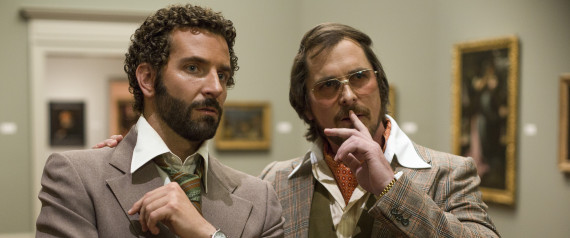
“We’re always conning other people,” says a slurred, yet sure voice in the background. “It’s in our nature. We even con ourselves.” These words are coming from the mouth that belongs to Irving Rosenfeld (Christian Bale), a con artist who quickly learned what it meant to grow up and survive in a harsh economy. Irving is the sort of guy you wouldn’t want to interact with out in public. He is grossly out of shape, he smells of old hairspray and cologne, his crafty eyes hide behind a dark pair of shades, and his diet consists of nothing but beer, fast food and cigars. From an outward appearance, Irving doesn’t really make a good impression. But man, can that guy talk a good game.

After rushing through Irving’s very brief childhood, we are quickly introduced to Sydney Prosser (Amy Adams), a woman in her mid-thirties whose beauty is both ageless and captivating. Despite his nauseating physical appearance, Sydney almost instantly falls in love with Irving, and Irving falls in love with her too. So much so that he discloses his illegal business with her, asking her to become a part of him scamming other people out of their hard-earned cash and checks.

That’s all I’m going to get into as far as the plot synopsis goes. Believe me, I haven’t even gotten to the surface of it. There’s an FBI agent trying to catch them named Richie DiMaso (Bradley Cooper), there’s a New Jersey mayor played by Jeremy Renner somewhere in the mix, Irving has a son and a wife he’s committed to named Rosalyn (Jennifer Lawrence). There’s even a mobster somewhere in this movie where an actor makes a cameo appearance, but I won’t spoil the surprise by revealing who it is (hint hint: He’s got some bad ideas in his head).

Point being: this is a smart movie. It’s funny, original, intelligent, and thoughtful, an observant portrait that looks at the moral and financial struggles of these characters and what impact their actions have on the people in their lives. Part of this, no doubt, is because of the cast’s mastery at delivery. Part of it is also because its writer-director is equally as funny, original, intelligent, and thoughtful as the story is. David O’Russell, who was nominated for best directing and writing Oscars for the past few years now (For Silver Linings Playbook last year and The Fighter in 2010), returns yet again with the same wit, charm, and complexion that made his previous films both unique and entertaining.

The dialogue is authentic, almost like it pops off of the pages of the screenplay just as much as it does in the movie. How though? This is, after all, a work of fiction, right? Wrong. The plot is just is like Irving’s deceptions: they’re only half fake. The movie is based on the real-life ASCAM sting operations of the late 1970’s, in which the FBI arrested over 31 individuals of congress and 7 were convicted of bribery and conspiracy. That sort of realism translates brilliantly to the screen, and makes the conversations characters share feel so personal. Make no mistake, fellow reader: this is, in every definition, a heist picture, because everyone is all after something and are willing to manipulate everyone in order to get to it first.

The cast is unforgettable. So much so that I can’t even pick a favorite among them. Bale is as talented as ever in this movie, a brilliant and dedicated method actor who has immersed himself so much into a role that its hard to imagine that at one point he was Patrick Bateman or Bruce Wayne. Lawrence and Adams are excellent female leads, and are great at expressing how conflicted Irving feels towards the both of them as lovers. Renner is great as the New Jersey mayor, a loving and kind-hearted man, father, and husband who just wants the best for everybody, but ends up making the wrong decisions in trying to do so. If I had to pick a favorite, it would probably be Bradley Cooper, only because he is so passionate and wacky that he could have been redone as a cartoon character. Like I said though, I can’t pick one. This cast is so talented and skilled in their roles that to pick one performance over another would be considered a sin. They are just as responsible for bringing this story to life as David O’Russell is.

This movie has all of the elements of being Oscar-worthy material: a great story, dialogue, characters, direction, and a great cast that fills these figures with vibrant energy and personality. The only real problem with this movie is the setup, and that’s unfortunate because that’s one of the most important parts of any movie.

Let me provide an example: when I first watched Goodfellas, what absorbed me into that picture was the first 15 minutes, a little italian boy learning about the mafia as a child, and the first narration we hear being “Ever since I can remember, I’ve always wanted to be a gangster.” Another one? In the opening scene of There Will Be Blood, we see a touching yet tragic portrait of a man seeing one of his workers die in an oil deposit, leaving behind an infant who can’t even speak, and Daniel Plainview deciding, against his better judgement, to adopt him as his own. Do I even need to mention Up?

All of those pictures started off with a bang because they gave us a perspective into the character’s history before getting into the meat of the story. Not that there needs to be a “How-to” guide for making opening sequences, but American Hustle literally flashes Irving’s childhood for about a minute before throwing us into the plot. I’m all for “show-don’t-tell” stories where they’re all situational, strictly limited to being set in their own present (Such as The King’s Speech or Black Hawk Down), but this one felt too much like being thrown into cold water when you can’t even swim.

Despite my views, I know critics already have their opinions established on this movie. They’re going to say its a masterpiece. That it is masterfully written and acted (which it is) and that it is going going to be nominated for multiple Academy Awards (which it will be as well). What critics won’t realize is the movie itself might be a con, making people believe that it is better than it actually is.

Well, if it is a scam, and David O’Russell is the con artist, then all I’m going to say is that he did a damn good job at it.

Post-script: For you irresponsible parents that are considering taking your teenagers to see this movie, don’t. The MPAA rated this movie R for “pervasive language, some sexual content and brief violence.” The violence is very brief and honestly not a large problem. The sexual content, however, is profuse because of Irving’s two sexual partners, and the movie has no shame for showing us any of it. I noticed over 100 F-words.

Tagged , , , , , , , , , , , , , , , , , , , , , , , , , , ,

“ALL IS LOST” Review (✫)

All Is Lost? You have no idea. 

I’m about to save you twelve dollars and about two hours of your life. Robert Redford lives.

Frustrated? Good. You’re supposed to feel frustrated, because that’s all the movie makes you feel. Out of all of the survival movies you will ever see, expect All Is Lost to be a bare, boring, and mindlessly pointless experience.

Here is the premise of the movie: Robert Redford is on a boat, trying to survive against storms at sea.

That’s it. That’s as much depth and interest as you’re going to get with this film’s premise. Make no mistake fellow reader: All Is Lost is aggressively bad. It is the most boring film of the year. It is the most forgettable film of the year. If the Academy Awards had an award for Most Mundane Picture of The Year, All Is Lost wouldn’t only be the winner of the category, it would be the only film nominated.

And yet, strangely enough, the movie has been mostly well-received by critics. The movie has a 94 percent rating on Rottentomatoes and an 88 percent on Metacritic, so there will be no shortage of people trying to defend it. Here are the most popular arguments defending the movie:

“The film is great at latching your attention despite limited dialogue.”

It’s true that the first 20 minutes are exciting enough to do a good job at latching you’re attention. The other hour and a half, however, could not be more repetitive or frustrating. Only two lines of dialogue are spoken throughout the film: “This is Virginia Gene with an S.O.S. call, over?” and profanity. That’s it. The rest of the movie is Redford staring out into an empty ocean with a deep, dreary melody playing in the background. Oh boy! Music! That sure will keep us interested!

“J.C. Chandor was masterful as a writer/director.”

It’s hard to make an argument that he even wrote this. The screenplay was a little more than 31 pages, barely any material to substantiate a feature-length motion picture. Chandor, who is most known for the intelligent and conversational Margin Call in 2011, was great as a writer, making an intelligent, well-crafted picture filled with character depth, dialogue and dimension. Now, he has reverted to making All Is Lost. Why? What convinced him to step out of his comfort zone as a writer? With the clever, intelligent and enticing dialogue now missing from Margin Call, his sense of style is just as absent, and it gives the film an empty feeling that feels like it’s just half complete. It’s better, in fact, to describe the movie as a feature-length short film, meaning it’s a 30-minute television special stretched out to feature length simply to enhance profit.

“Robert Redford was incredible in the movie.”

Yes, I see Redford is in the movie. Thank you for pointing out the obvious. He is completely and utterly useless. Notice with the plot synopsis, I never called him by his character name. That is because his character doesn’t have a name, credited as “Our Man” on the international movie database. Redford is not acting here. He is modeling, staging and positioning himself in meager, idle positions and actions as Chandor commands him to flip from one side of the boat to another. The character is so impersonal, so thinly written and so emotionally bleak that there is little reason to care about him or be motivated by his journey. So thanks, Chandor, for casting Redford in a character nobody gives two rips about.

Compare this to any survival movie written and produced in the past 30 years. JawsCast Away127 HoursThe GreyGravity. Look at all of those movies and try to remember the emotions you felt while watching them. What is it about those movies that latched everyone’s attention? What captivated audiences and compelled them to care for these characters to survive?

That’s exactly it: Characters. We cared about Chief Brody when his son barely missed the shark’s jaws. We care about Chuck and Wilson because Chuck needs to get home to his girlfriend Kelly. We care about Aaron Ralston because of how estranged he was with his family, with John Ottoway when we realize his wife is dying, or with Doctor Stone when we realize what became of her daughter.

We care about these characters not because of their situations, but because of their inner turmoils that compelled them to keep living: They all had something to live for.

What reason does Robert Redford have to live for? We are told nothing except for that he’s “Our Man.” Riiiiiiight.

It’s movies like Jaws and Cast Away that keeps us away from the ocean, but it’s movies like All Is Lost that keeps us away from the movie theater. All Is Lost? You have no idea.

Tagged , , , , , , , , , , , , , ,

“THE BOURNE LEGACY” Review (✫1/2)

This movie has the wrong title.

The Bourne Legacy is a misconstrued mess, an absolute miscalculation and train wreck of a film that it has no business being made into a movie in the first place.  I hated this idea months before this was released, and I hate it even more now after having seen it.  Who, in their right minds, thought it was a good idea to make a Bourne movie without Jason Bourne???  That was my biggest concern going into the movie.  Believe me though, fellow moviegoers: that is the least of your worries.

Taking place shortly after the events of The Bourne Ultimatum, The Bourne Legacy shows the repercussions of Bourne’s actions, how it affects Treadstone, and what marks it leaves on the people involved.  Erik Byer (Edward Norton) is a government official who was directly involved with the affairs of Treadstone during its days of operation.  Shortly after Jason Bourne escapes their custody, however, Byer believes that all of the agents now are a potential threat to the government, and is convinced that he needs to shut the project down in order to protect themselves.  By “shut the project down”, I really mean kill all of the agents in the field.

One of these agents is Aaron Cross (Jeremy Renner), an experienced field agent who is carrying out a mission in Alaska for Treadstone when the order was released.  While taking refuge in a wooden cabin with another fellow agent out in Alaska, they are suddenly attacked by robot jets, and Cross barely escapes with his life intact.  Surviving only because of the medication he is on (Treadstone agents are required to take two pills, a blue one for physical boosting, and a green one for mental boosting), Cross looked into his stash to realize that he only has a couple days worth of medication left.  Now low on food, supplies, and ammunition, Cross must now find a way to get back to America and survive against Treadstone long enough to find a way to counterattack their onslaught.

Let me start with the most obvious flaw here: Tony Gilroy.  Looking at his filmography, you would think he would be the best man for the job here.  He was credited as co-writer for the three previous Bourne movies, he wrote and directed the Oscar-winning drama-thriller Michael Clayton as well as the 2008 caper film Duplicity.  I enjoyed all of those movies, and thinking that this one would be the same, made the mistake of thinking that it would be just as good.

Trust me, this couldn’t be any more of a dissapointment.  Everything wrong with this movie has everything to do with Gilroy’s script and direction, which couldn’t be more forced, erratic, confusing, and half-lapsed than this.

The problems start with the premise: a Jason Bourne movie without Jason Bourne is a bad enough idea.  But let’s take a step back here and try to be open with this.  Let’s just say, for facetious effort, that Aaron Cross’ story is just as fascinating and compelling as Bourne’s is.  What are the conflicts?  In his first three movies, Jason Bourne’s struggle was against his morality, identity, and the confronting of his past.  What is Cross’ magnificent, epic struggle?  Survival by trying to find a green pill.  If this movie dwelved any more into the conflict than it did, I would have said Cross was a junkie.

“Funny”, I think.  “I don’t remember these pills being used in the original trilogy”.  Correction: I vaguely remember them.  In a brief flashback sequence in The Bourne Ultimatum, I remember Jason Bourne taking a blue and green pill during his initiation into Treadstone (this memory is hazy though).  Bourne obviously didn’t need to take the pills further because his body adapted to the drugs.  Here, Cross is dependent on the drugs like a junkie is on cocaine, and if he doesn’t get his daily dose of the green pill, he’ll apparently revert to the level of intelligence of Forest Gump, according to him.

Okay, that’s fine.  Jason Bourne isn’t in the movie, check.  Super pills gives Cross super powers, check.  I would be able to buy the premise and its characters if A) it were handled well, or B) it was anywhere near as smart, interesting, or even remotely readable as it was to The Bourne Identity.  Here, instead of intelligence we get confusion, instead of cleverness we get forced easter eggs to earlier movies, and instead of interest we get on-the-nose, ham-fisted writing.  The editing in this film is choppy, leaping all over the place, jumping from one timeline to another, one flashback to the next, and it becomes so repetitive and convoluted throughout the picture that by halfway through I stopped caring about it.

Oh, I don’t deny Jeremy Renner is a knockout in this role.  Neither do I deny the talents of Rachel Weisz, Edward Norton, and especially not Joan Allen or Albert Finney.  All of the performances are great, but the story is a complete wreck, and Gilroy clearly has no idea how to handle his premise or the cast he’s been given for this.  What more proof do you need, besides this convoluted script, an uninteresting story, and a tedious chase sequence at the end with a sharply abrupt cliffhanger?

This is exactly the reason why I hate sequels.  When done well, like the original Bourne trilogy, they are compelling, brilliant expansions furthering the story set up by the first one.  When done like this however, they are nothing but forced, awkward, nonsensical garbage.

Again, I ask this: why did this movie have to get made?  The Bourne Legacy is exactly what you expect it to be, a Bourne movie without Jason Bourne, equally without the compelling character drama or real conflict in it. And now they’re talking about a possible sequel to this mess.  Only if Jason comes back and kills Aaron Cross.  That’s the only way they can redeem themselves at this point.

Tagged , , , , , , , , , , , , , , , , , , , , , , , ,

“NOW YOU SEE ME” Review (✫✫✫)

And now you don’t.  

We open on a black screen, similar to how a magician opens up his show behind the secrecy of a red curtain.  A deck of cards can be heard flipping through the background with the presence of a calm, cool, and serene voice to accompany them.  “Pick a card”, he says.  “Any card”.  But before his volunteer can pick a card, he is quick to remind her “But look closely.  Because the closer you look, the less you will actually see”.

The words of a true magician, and the fact that he flipped this deck and actually picked the card I choose impressed me even more.  This character is named Atlas, who is played by Jesse Eisenberg, and he is a street magician on such a skill level to where he can make skyscrapers light up in the night.  As he impresses a crowd of ongoing viewers, one stands in the audience with a hood over his head quietly observing Atlas.  We can’t see his face and we don’t know who he is, but he carries a card in his pocket, and leaves it for Mr. Atlas at the end of the performance.

Atlas isn’t the only magician to receive special treatment: three other magicians have also been observed by this strange visitor and have been left cards for each of them.  There is the mentalist Meritt McKinney (Woody Harrelson), the pickpocket Jack Wilder (Dave Franco), and the escape artist Henly Reeves (Isla Fisher).  All four of these talented magicians have been recruited by a secret cult called “The Eye” to carry out a secret mission for them.  One year later, they come together in their first show as “The Four Horsemen”: and during their show, they rob a bank all the way in Paris while still performing in Las Vegas.

The FBI are called in to investigate, and they bring in Agent Dylan Rhodes (Mark Ruffalo) to arrest and interrogate the four horsemen.  Pressing as he is, the horsemen are equally as clever and deceptive.  Henly is spinning chairs, McKinney keeps reading his mind, and Atlas ends the interrogation by taking off his handcuffs and snapping them onto Rhodes.  The rest of the film shows Rhodes chasing the four horsemen, trying to figure out their plot, and to stop them before they succeed.

This film is all about style over substance, a movie that is more concerned with tricks and showcase over character depth and dimension.  Do I care about dimension, however, if the film is more than fun enough to take it over?  The success of movies do not just come from how deep or complex they are.  They also come from how well-made the picture is, how sharply the cut is edited, and how cleverly the narrative is structured.

And boy, if Now You See Me is anything, its definitely clever.  Directed by Lois Letterier (Transporter 2, The Incredible Hulk) and written by screenwriters Ed Solomon (Men In Black) and Boaz Yakin (Remember The Titans), Now You See Me is a movie driven to the brim with its cleverness, its wit, deceit, and effervescent charm in its characters, in what they do, and how they do it.  In many ways, this movie reminds me of caper films such as Oceans Eleven and The Italian Job: its a movie where characters cleverly trick and deceive their pursuers and expose them to their traps and their decisive plans.  They don’t use muscle, brawn, or big guys with guns to get what they want: they use their wits, their brains, and their thievingly cunning plans to accomplish their goals in the plot.

Of course, these plans weren’t inherently inspired by the four horsemen in themselves: someone from the shadows has helped them with this plan, and is always monitoring these horsemen from shadows of secrecy.  Tonally, the film achieves what it desires, and throughout the conniving plot we’re always wondering a key mystery: who is the fifth horseman?  Why did he enlist in the help of these four?  Who could it possibly be?  Is it one of the FBI or Interpol, pretending to be on one side while coyly playing for the other?  Or is it another mystery card player, one who has hidden behind a long-aged myth and has hidden himself from all cards in the field?

This isn’t just a caper film: it is a complex and fascinating mystery, and the cast of characters is all the rogues gallery in this police questioning.   Mark Ruffallo does well as Dylan Rhodes, and in small moments of intimate revealings he shows a man who was once a boy who will always hate those in higher power oppressing the helpless underdogs.  Michael Caine and Morgan Freeman make great cameos, and each play a role we don’t normally see from them, Caine being an antagonistic money monger and Freeman being an observant expose’ of schemes.  Eisenberg, as always, is a knockout in anything he does.  Here his character combines both the social awkward and invertedness of The Social Network, and the coy, cool, sleek confidence of Brad Pitt from Oceans Eleven.  Don’t ask me how he does it, okay?  He just does.

And this is a film that has been bombasted by critics.  For what?  A few quotes I pulled from Rottentomatoes:  “Overcooked, overcomplicated and underinteresting, this heist caper turns into a mess”, one critic said. “Complicated nonsense”, and “…a flimsy plot whose logic disappears faster than a rabbit in a hat”.

There is some truth here.  Yes, the film is overcomplicated.  Yes, it is elaborate and sometimes distracting.  Yes the characters are one-note and thinly written.  And yes, the twist ending is dangerous enough to make the entire narrative collapse on itself, let alone offering the threat of plot holes.

In other words, I’ll admit I don’t understand everything by the end of the picture.  And that’s precisely the point.  There isn’t any fun with a trick that has been exposed: the fun comes in with those trying to figure it out.

Tagged , , , , , , , , , , , , , , , , , , , , , , , ,

“TRANCE” Review (✫✫✫1/2)

The pocket watch is mightier than the magnum.  

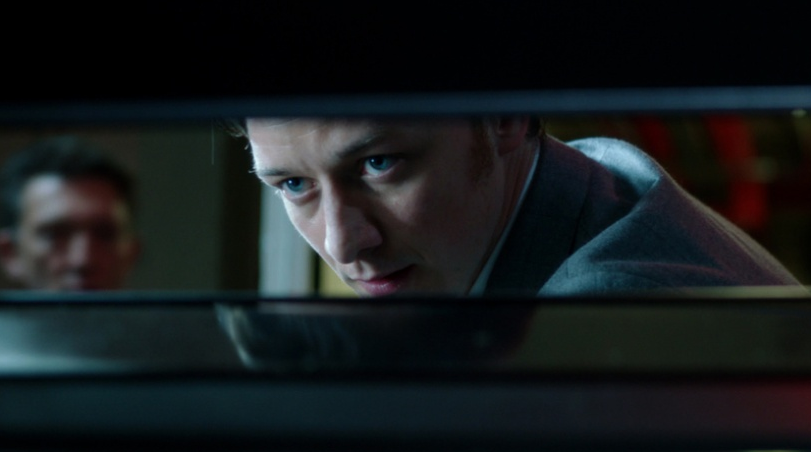
Trance is a fantastic art film, a mesmerizing and fascinating thriller that uses twists, turns, hallucinations, and narrow corridors as its tools to build suspense, and dialogue and performances to form sympathy for its characters.  Its surreal, twisted, strange, nonlinear, and non-conventional, but to dust with conventionality.  This is a great picture.

As the film fades in, we are introduced to Simon Newton (James McAvoy), an art auctioneer who takes us through the ropes of what his job entails.  He tells us of the extensive steps it takes to reserve a painting, the protocols his employers tell him to do when putting a painting up for auction and what steps he must take if a robbery takes place.  Their most valuable item is a painting by Francisco Goya called “Witches In The Air”, and his employers gave him precise instructions on how to preserve the painting if thieves do happen to come into the auction in an attempt to steal it.

Sure enough, thieves break into the auction and attempt to steal the painting.  This troop is lead by one named Franck (Vincent Cassel), and he is determined and headstrong into getting that painting.  Right before Simon puts the painting away, however, Franck cuts him off, a brief struggle happens between them, and Simon is knocked out, with Franck leaving with the stolen painting in tow.

When Simon wakes up, he realizes he lost his memory from the past two weeks.  When he’s finally released from the hospital, Franck pays him an unwelcome visit.  Turns out, all that Franck got on the day of the heist was just the frame of the painting, whereas the real article itself was transported to an alternative location.  Torturing him by peeling back his fingernails, Franck comes to find out Simon truthfully does not remember where he put the painting.  So he tries a different method of extracting information, one that involves psychology and hypnotherapy at the hands of one named Dr. Elizabeth Lamb (Rosario Dawson).  Together, they attempt to probe Simon’s mind, and begin their search for the painting Simon has kept hidden from them.

Here is a film that knows what it wants, a movie that knows its characters, their motivations, its story, and precisely how to tell it.  Director Danny Boyle, who is nearly a master at experimental cinema (if you don’t believe me, look at his hallucination sequences in Slumdog Millionaire or 127 Hours) does something very rare here: he intertwines and meshes characteristics of a narrative film with that of art and experimental cinema, making a truly absorbing, gripping, and fascinating experience.

Let me make something clear here, however: I hate experimental cinema.  Nine times out of ten they don’t make any sense, they seem relevant only to those making them, and they elicit a confused response rather than an emotional one from its audience.  Here though, the result is much different.  Everything is crystal-clear and fluid, the visuals dynamic and expressive, the editing cut together neatly and crisply. It’s like a mind game of cat-and-mouse, except the cat is willing to seek out help and the mouse is more lethal than both cats are lead to believe.

Oh believe me, my attention was unadverted throughout the entire picture.  While I didn’t understand everything immediately in the film, I understood what I needed to in the moment and the plot filled in the rest for me as time went on.  And what did I understand, more than anything else?  That these are sinful characters, decrepit criminals that lie, cheat, and connive their way to success and to financial gain.  Cassel was aggressive and talented as Franck, and while his character was despicable and loathsome at first, a softer side of him was later revealed so that the audience could come to terms with his character.  Dawson is as beautiful and motivated as ever, and while she too was at first a sympathetic figure, she later reveals a darker side to her character that even I didn’t expect.  I’m not even going to go into James McAvoy.  His performance was so specific and so wide-ranged that I was compelled to care for his character while at the same time hating him.

And yes, in case you didn’t pick up on it, the movie is deserving in its R rating.  It is violent, bloody, disturbing, graphic, and it has its vast share of nudity and sexuality, with some of the violence and sex combining in many gruesome scenes.  If this were any other picture, I would take off points for that.  But like Pulp Fiction and Taxi DriverTrance is a film that uses its bleak content as a tool to tell a story and define character, to show an encompassing yet tragic story of three fatally flawed individuals who will torture, manipulate, and kill to get whatever they want.  You have to watch a movie like this long enough to realize the point when it stops being a thriller and starts forming into something greater: when it starts forming into art.

Tagged , , , , , , , , , , , , , , , , , , , , , , , , ,

“AMERICAN PSYCHO” Review (✫)

Sex, murder, and the decrease of the human condition.  

American Psycho is a vile, sickening experience, a gruesome and aching film incapable of human thought, feeling, comfort, or emotion.  This shouldn’t come as too much of a surprise considering the book in which it is based on inspired this same controversy.  Regardless, its achievement cannot be denied: the filmmakers have somehow concocted an experience as brutal, uncomfortable, disturbing, half-lapsed, misogynic, and morally reprehensible as this that they’ve come to completely disconnect with their audience.  I rarely feel this upset about a movie like this.

American Psycho follows the story of Patrick Bateman (Christian Bale), a successful businessman who works in his high-level office by day and parties fiendishly with his friends by night.  On the surface, Bateman looks like a normal upper-class bachelor.  He eats out at expensive restaurants, drinks exquisite martinis, has sex with beautiful women, enjoys swearing gleefully with his friends, and listens to a variety of experimental music.  In appearance, Bateman is the visible representation of the upper class: stoic, upright, eloquent, fashionable, and spoiled.

As the plot progresses, however, we come to understand more about the darker side of Bateman’s personality.  He doesn’t just have sex with beautiful women: he mutilates them.  He tortures them and fantasizes about killing them in horrible ways and playing with their bodies after he’s done dismembering them.  His kitchen pantry contains axes, blades, and tools he uses for his killings.  He draws his victims in a notebook he leaves at work.  A female head sits next to his ice cream in the freezer.  If there wasn’t wine in his alcohol bottles, it would probably be blood.

Ugh.  Just talking about the premise nauseates me.  Why do we need to experience this?  Bateman is a sickening character, a man who would dismember the head of one unfortunate female and chew off the genitals of another.  Why?  For what purpose?  His motivations are never explained in the movie and his reasonings for murdering women are a mystery to us.  Is there a reason for this?  Is there a reason for being so non-inclusive with your audience? Why must everything be shrouded in secrecy?

This is the film’s biggest problem, besides the violence and the sexuality: Patrick Bateman is a deplorable character, difficult to understand and impossible to sympathize with.  You might think its impossible to sympathize with a murderer of women anyway, but it isn’t really.  We’ve ben asked to sympathize with deplorable characters before, including a psychotic war veteran in Taxi Driver to ruthless murderers and drug dealers in Goodfellas.  Sympathy and interest worked with those characters because one character was struggling to find a line of morality and righteousness to follow, and another was hesitant and even regretful over the actions that he’s done.

Bateman doesn’t regret his decisions nor chooses to change them.  He kills instinctively, almost like he’s trying to prove some territorial point to the people around him.  To put it out there in gruesome, violent fashions like this though is just torturous.  Who wants to sit there, eyes on the screen, watching him laughing as a petite blond girl in front of him cries pleading for her life?

But American Psycho isn’t just sickening, repulsive, and pungnent: the film’s logic is half-lapsed, incomplete, and flawed, incomprehensible to the viewer and extremely frustrating to those trying to figure out.

I’ll give you an example.  There’s one scene where’s Bateman is chasing one of his victims through the hallways of a hotel, half naked, screaming manically, and revving his chainsaw like Leatherface from Texas Chainsaw Massacre. Someone explain to me how no one from the hotel hallway heard the ruckus from outside their rooms, or anyone from the two floors above and beneath him?  Here you have Jack Torrence running through the hallways screaming at the top of his lungs with a lawn mower, and nobody even bothers to call the police.  What?  Are the wooden doors sound-proof?  Who knows, maybe they’re afraid of poking their heads out the door so that they won’t get their heads chopped off.

Due to a revelation revealed later on in the plot, one could argue this is a “dream sequence”, or a “vision” Bateman had.  But how is there any way to know?  With Bateman’s maniacal, wretched mind, dreams feels like reality and reality feels like dreams.  How is there any way to read the subtext when you’ve made your narrative so damn hard to figure out?

And this is a movie that is being hailed as a dark comedy.  A comedy for what, exactly?  The film is two graphic hours of bloody, sickening, gruesome violence and pornography.  When, at any point, is it set up to inspire laughs?  In movies like Pulp Fiction and Fight Club we are at least given subtle moments of clever dialogue to clue us in to the humor, and even though stomach-curling things are happening on screen, we are able to suspend that  briefly in order to enjoy the humor.

American Psycho is not subtle, smart, clever, humorous, or any of the related adjectives.  There’s a point director Mary Harron is trying to express through the film, but that point is convoluted, vague and shockingly illiterate.  As a result, what we’re ultimately watching is an idle, pointless, and misconstrued film, and our reward for watching is hours of punishment, nudity, sexual immorality, blood, torture, macabre violence, and sickening indecency.  To be fairly honest, I probably need a second viewing in order to fully understand the picture, but the plain fact is that the movie doesn’t deserve a second viewing.  If I end the film feeling as punished and as mutilated as Bateman’s unfortunate victims, why on earth would I want to subject myself to that again?

At the end of the film, Bateman himself admits that he finds neither closure nor catharsis for his bloody, violent, sexually immoral and murderous journey.  For that matter, neither do we.

Tagged , , , , , , , , , , , , , , , , , , , , ,

“MEMENTO” Review (✫✫✫✫)

Like solving a puzzle backwards and then back together.

I’ve never been so attentive to a plot in a way that I was with Christopher Nolan’s Memento.  I’ve never been so immersed, so mesmerized, so hypnotized by the plot, by the narrative, by the structure, and by the character himself and everything he has to struggle with.  When I asked a friend of mine what it was like watching Memento, he said to me “It’s like reading a book, except chapter one is the epilogue, the epilogue is chapter two, and chapter one is sprawled out throughout the book until it reaches the end of the book, which in reality, is the beginning.”

I know, I know, it sounds confusing.  But believe me, the structure of storytelling in this film only adds to the fascination that I feel for the main character.  The film begins with a photograph, a small photo showing a dead body lying on the ground with his brains blown out.  The man holding it shakes it a couple of times, but after a couple of seconds the celluloid fades to white, as if it just came out of the camera stock.

Blood shifts along the ground.  Glass forms back together.  A bullet floats off of the ground and enters itself back into the chamber of a gun.  As the man fires it and cocks it, the corpse he shot on the ground lifts his head, blood flows from the ground back into his head, and his glasses form back together just in time for him to shout “NO!” at the man in front of him before he points the gun at him.

If you’re confused at this, don’t be.  This sequence is shown in reverse, inverted from the normal time stream of what would normally be happening in this situation.  Even though the scene plays backwards, we understand the basic points of it: a man shoots someone and takes a picture of his dead body.

Consider this an outline for the rest of the film.  Leonard Shelby (Guy Pearce) is a man who struggles with short-term memory loss.  He suffers from this condition after sustaining a severe injury from an unknown assailant who stormed inside his house, slammed his head against the mirror, raped his wife, and then killed her while he was passed out.

Fast forward to the present as Leonard suffers from his current condition.  He remembers who he was, where he came from, and how he got to the place he’s now at, but due to his condition he is incapable of making new memories.  Depite this, he’s now on a quest to find the man who killed his wife and stole his memory by leaving himself notes, taking photographs, and marking tattoos on his body to serve as his reminders that his irreversible memory condition won’t allow him to remember.

Written and directed by Christopher Nolan, the same guy who made the 1998 neo-noir film FollowingMemento is the sort of movie that can define a career.  This is a plot as heavy, thick, and deceptive as they come, a clever and concise thriller that is exciting and interesting in every pulse-pounding moment of the film.  Much of this has to do with the film’s structure, and Nolan’s expert timing with the film’s plot.

Take, for instance, his decision to structure the story in reverse order.  Many would look at this and think that this would lead to a confusing, convoluted story.  I think that’s the opposite of what we see here.  Imagine it like you’re watching a police detective working at the scene of a crime: he always starts at the end, but if he follows the right path, he’ll always end up where the story began.  That’s exactly how Memento plays out, and the payoff at the end (beginning?) couldn’t have been greater when all is revealed by the film’s conclusion.

Another thing that makes this film stand out is Guy Pearce.  Here he portrays a disturbed man, a man haunted by his past and by his situation so much that it taints his mind like it does the blood on his jacket.  I heard from a friend that the role was originally intended to be portrayed by an A-lister like Brad Pitt or Aaron Eckhart, but Nolan eventually opted for a lesser-known actor that would bring as much energy and enthusiasm to the role.  His decision was a smart one.  Guy Pearce is perfect as Leonard, capturing the right amount of turmoil and paranoia that comes with people taunted by mental disorders while at the same time retaining the emotion that shows that he is a confused, misunderstood man.

But again, his struggle only leads back to the films structure.  And no matter how Nolan formats his story, I’m surprised at how much it holds up despite the unstable nature of the film’s narrative.

I challenge you to study the plot in this film.  Not to just watch it and react to it, but to look into it and analyze it.  Observe the film as Nolan transitions from one scene to another.  Try to find one plot hole in this film.  Not four, not three, not even two.  One.  I’ll bet you $100 bucks that you won’t find a single plothole in this film.  Not one.

If you think you found one, I bet you $150 that someone can find an opposing argument, and $200 that you’ll end up being wrong.

I keep twisting this film inside and out.  I keep going back to it, looking through it, rewatching it, trying to pick it apart and find any possible flaw I can point out with this movie.  I cannot.  Every single frame of every single second in Memento is tense, fascinating, and mesmerizing, capturing both your attention and your mind early in the film and refusing to let go until the very last slide of the end credits roll.  It’s one of those movies you watch that as soon as you’re done watching it, you go back to the theater just so you can experience it again.

Tagged , , , , , , , , , , , , ,