Tag Archives: Prequel

“THE HOBBIT: THE DESOLATION OF SMAUG” Review (✫✫✫)

Be honest, Mr. Smaug: do you need a breath mint?

The Hobbit: The Desolation of Smaug is both one of the most satisfying and maddening films of the year. It’s visually splendid, illustrating the joys and perils of the world of Middle-Earth as finely as any movie before it did. It’s emotionally versatile, being comical and lighthearted at certain moments and then treacherous and gloomy in others. The performances are sound, with CGI characters being just as memorable as the live ones. Everything in the film was perfect up until it came to it’s end, which ended on a cliffhanger so big that a slackwire artist couldn’t tightrope across it.

Taking place shortly after the events of An Unexpected Journey, The Hobbit: The Desolation of Smaug continues the journey of Gandalf the Grey (Ian McKellan), Thorin Oakenshield (Richard Armitage), his troop of dwarves, and the slight hobbit Bilbo Baggins (Martin Freeman). After narrowly escaping the clutches of the white orc Azog (Manu Bennett), Bilbo and the rest of the dwarves venture on towards the Lonely Mountains, only having a few days left until the secret entrance closes, leaving them forever locked outside of the Lonely Mountains.

Bilbo, however, has greater concerns if the dwarves do manage to get inside. Deep within the twisty lairs of the mountain lies an endless sea of gold and jewels, and asleep among these riches is the vicious Smaug (Benedict Cumberbatch), a violent, terrifying dragon that formerly laid waste to the dwarves’ land and took their possessions all for himself. If the company does manage to get inside the mountains, Smaug will be waiting there for Bilbo, and there will be a massive conflict between the 100-foot tall fire-breathing dragon and the small, terrified hobbit.

One of the things I love about The Lord of the Rings movies is that the stakes are set up really well in them. Peter Jackson, who has been writing/producing/directing/godfathering the series since The Fellowship of the Ring has proven time and time again how well he can make depth-defying set pieces and visual spectacles, all while raising the emotional stakes of the movie.

Here is yet another example of what Peter Jackson can do in a movie. Visually, the film is unparalleled. There were many moments in the film that I recalled for being either visually spectacular or heart-poundingly exciting. One of them was a eerily creepy fight scene where Bilbo and the dwarves were fighting off an army of spiders in a cursed forest. Another was a chase scene where the crew was stuck in a line of barrels while falling down a waterfall. Other instances in the film include when the dwarves encountered a giant who could transform into a bear, or when Gandalf confronted an early confrontation of Sauron in his own castle. And don’t even get me started on when we meet Smaug for the first time. Jackson’s visual prowess excels just as much as his emotional involvement, and with each of his movies, he always seeks how to outdo himself from his last effort. I’d say he’s outdone himself tremendously here: the look of the film shows just that.

The performances are just as refined as the action and visual effects are. Martin Freeman was just as charismatic and loveable as he was the first time he was Bilbo in An Unexpected Journey, and Ian McKellen once again does well as the wise, ambitious, righteously-driven wizard Gandalf. And Richard Armitage has gained traction as Thorin Oakenshield since the first movie, showing that he can be more than the brutish tough guy. He’s a more vulnerable, more fleshed-out character here, with deep desires and hidden intentions showing that perhaps will be explored more in the third installment.

My favorite character by far, however, wasn’t even from a live performance. Benedict Cumberbatch was frightening, fearsome, and daunting as the terrible Smaug, his articulate, vocabulary-filled speech lining up perfectly with his sinister, seething voice. The visual spectacle of Smaug is perfect, with the dragon leaning luminously over his small, feeble enemies, while his long, slender, scaly arms and body lunge across the dungeon like an elongated spider. But the vocal performance is what makes him convincing, what makes him more than just a CGI creation and a terrifying villain in his own right. The minute I heard Smaug speaking to a shaking Bilbo, I had shivers run down my spine. The entire time he was speaking to Bilbo in mysterious anecdotes and sinister undertones, I was on the edge of my seat. When he started to attack, I clutched my mouth and stared endlessly at the screen, wondering and hoping for the fate of these characters in Smaug’s way.

In An Unexpected Journey, Bilbo benefits from being a more active protagonist than that of Frodo. Here we have Smaug, a giant, fearsome beast that is more actively sinister and spiteful than the stillness of Sauron from The Lord of the Rings.

Everything in the film is refined to the quality of film that you’d recall from The Lord of the Rings trilogy. My only regret is the copout, cliffhanger of an ending that inspired my theater to erupt into boos and groans. I hate it when movies do this to me. They put in so much effort to make a great film up until the last five minutes, where they pull the rug from under you and say “Sorry, that’s all for now! See you next year!” What was Peter Jackson thinking when he went with this ending? At the end of each Lord of the Rings movie, it ended with some form of closure and assurance that the adventure would continue into the next installment, but you didn’t know how it was going to pan out. It kept us intrigued, and it kept us wondering what would happen next. With this movie, it sets itself up to where we already know how it’s going to end: we just don’t get the payoff along with it.

I quote J.R.R. Tolkien: “Books ought to have good endings.” The same should be said for movies.

Tagged , , , , , , , , , , , , , , , , , , , , , , , , , , , , , , , ,

“THE HOBBIT: AN UNEXPECTED JOURNEY” Review (✫✫✫✫)

A journey J.R.R. Tolkien would want to go on. 

The Hobbit: An Unexpected Journey is the story I first experienced when I saw The Lord Of The Rings: The Fellowship Of The Ring for the first time. Like The Wizard Of Oz or Harry Potter and The Sorcerer’s Stone, it’s a sweeping fantasy about ordinary characters getting thrown into extraordinary circumstances. So if hobbits, dwarves, wizards, and fire-breathing dragons constituted as “ordinary” in this universe, imagine the extraordinary circumstances that they go through.

Serving as a prequel to the J.R.R. fantasy epic The Lord Of The RingsThe Hobbit tells the story of Bilbo Baggins (Martin Freeman), a relaxed and easygoing hobbit who doesn’t like to do much throughout the day except for eat, sleep, and smoke his pipe every now and then. One day, he gets a visit from a mysterious stranger named Gandalf (Ian McKellen), an elderly wizard who is looking for shelter and a young companion to go on an adventure with. Much against Bilbo’s wishes, Gandalf not only stays in his small village home: he invites an entire company of dwarves, who proceed to wreck Bilbo’s house and eat everything in his fridge.

After having a nervous breakdown and cleaning up his entire house, Bilbo overhears Gandalf and the small dwarf brigade’s plans. Ages ago, the dwarves‘ prized possession, the Lonely Mountain, was overtaken by a vicious fire-breathing dragon named Smaug, who destroyed their village and stole the castle and all of it’s gold for his own desires.

After being betrayed by their allies, the elves, and being left to fight for their land all by themselves, the dwarves are determined to travel back to the mountain and fight for their home. Bilbo must make a decision of continuing to live on his normal, uneventful life, or to reach out, travel with the dwarves, and seek out adventure the likes of which he’s never experienced before.

Remembering that it was only a few years ago when I originally fell in love with The Lord of the Rings: The Fellowship of the RingThe Hobbit: An Unexpected Journey is a prequel that hits on all of the right notes, and then some more that I wasn’t expecting. In comparison to it’s elder companion, The Hobbit is uncanny. It has a wide verse of characters, each one being unique and memorable both in appearance and personality. It has a dynamic and involving story, ripe with exposition and emotion, retaining your full attention despite the lengthy run time. And it has highly stylized set pieces and visual spectacles that excite the eyes and overwhelm the mind. Do not mistaken Peter Jackson’s intentions here: he was inspired by Lord of the Rings when he was making The Hobbit.

And yet, there are so many differences from The Hobbit to The Lord of the Rings. One of the biggest, I think, would be it’s protagonist. Bilbo is different from Frodo, his nephew in Lord of the Rings whom Elijah Wood inhabited so wonderfully. They’re similar, of course, in that they are small hobbits not necessarily fit for fighting, but are clever, creative, and courageous nonetheless.

And yet, Bilbo is so much more than Frodo is. He’s funnier, for one thing, a bumbling, clumsy little hobbit that reminds me so much of the antics between Pippin and Merry in the original movies. He’s also more outgoing, a more active protagonist doing more in the film than just holding a ring and trekking long miles. He does so much in the film, sneaking around trolls, fighting Orcs, going through traps and mazes, and having a first-hand involvement in many of the film’s biggest fights. My particular favorite scene is one where he is talking to a fan favorite from The Lord of the Rings about the possession of a mysterious gold, rounded object. Hint: His favorite word is “precious.”

My point in saying all of this is that Bilbo is a dynamic character in his own right, and Martin Freeman handles the character very well. In the previous movie trilogy, Freeman had four hobbit inspirations to pull from, and instead of following just one of them, he took characteristics from all of them and made a character all his own. That took great talent and risk, and Freeman’s efforts paid off, making a character that I think is the most memorable and charismatic hobbit out of all of them.

Without a doubt, the best film in the series is Return of the King. This film is perhaps the second best. Sure, at times it might suffer from a slight overdose on exposition, but doesn’t all of the films? The Hobbit: An Unexpected Journey is an adventurous, ambitious gamble of a film, and it makes me believe once again in the power that a wizard, a slew of dwarves, and a brave little hobbit can have.

Tagged , , , , , , , , , , , , , , , , , , , , , , , , , , , , , ,

“SIN CITY: A DAME TO KILL FOR” Review (✫)

Can you kill me too while you’re so busy at it? Thanks. 

There’s a character early on in Sin City: A Dame To Kill For that describes the city as a place “where you go in with your eyes open, or you don’t come out at all.” He’s wrong. I went in and out with my eyes fully open. I only wished that I kept them closed.

Oh, where to begin with this. Sin City: A Dame To Kill For is, in a word, messy – a neo-noir thriller as confusing as a detective’s murder case and more violent, putrid and horrific than a crime scene. The only brains this movie has are the ones that it blows out of peoples’ heads.

The plot takes place sometime within the Sin City universe. The question is when? I honestly don’t know, and I don’t think the movie knows either. It’s part prequel, part sequel and part in-betweenuel that cuts to wherever and whenever it wants to.

Like the first movie, there are three main stories the plot revolves around and, likewise, three main characters to sympathize with. You have a young Dwight McCarthy (Josh Brolin), who, before he met Jackie Boy, was obsessing over a rich housewife named Ava (Eva Green). There’s Johnny (Joseph Gordon-Levitt), an overly-cocky poker player who wants to come to Sin City and beat the king of all cards himself — Senator Roark (Powers Boothe). And then there’s Nancy (Jessica Alba), who is still coping with John Hartigan’s (Bruce Willis) suicide at the end of Sin City.

Following this easy enough? Good, because that’s all the explanation you’re going to get. The biggest problem with Sin City: A Dame To Kill For is that it’s so convoluted. Stories are meshed, mixed and thrown together without any sense of connection or correlation to its plot, and the entire time while I was watching it, I kept wondering where these stories were taking place and why I should care. Some movies do well with intertwining narratives, such as Pulp Fiction or Crash. This is not one of them.

A good example of this is in the very first scene of the film. Marv (Mickey Rourke), the hard-headed thug who was framed for the murder of Goldie in the first movie, wakes up next to two crashed cars with no memory of how he got there. He goes through mundane dialogue for five minutes in his obviously exaggerated thuggish accent, then the movie cuts to the story and almost completely forgets about him.

My first thought after watching this: why was that scene necessary? As the movie continued its runtime, I continued to ask this question in my head until I realized that none of it was necessary, that it was just a continuous farce of violence and delinquency that the kids who play Grand Theft Auto would just drool over.

This movie is definitely violent. That’s to be expected, I know, especially when you remember how violent the first one was. There is, however, a stark difference in how the violence is used in each movie. In the first Sin City, the violence was both shocking and satirical, at times being so disturbing that you can’t help but reel back from it, and at other times being so exaggerated that I laughed at it. Whether it was positive or negative, however, I at least felt something.

Here, nothing is felt. Here, we just look at all shades of black, red and white among severed body parts while we plod through the final act like it’s a homework assignment rather than the climactic ending that it deserves to be.

I’ll admit to having disliked the first Sin City. Does that matter? I give credit and criticism equally where it is due, and even though both Sin City’s are equally violent and despicable, the first one was at least more intriguing and had more cohesiveness both as a whole story and as smaller, separate narratives. This one fell flat, crumbled to pieces and was about as clear as a muddy window pane. Maybe that’s why Marv couldn’t remember anything at the beginning of this movie – he realized what he signed up for, and he tried to forget all about it.

Tagged , , , , , , , , , , , , , , , , , , , , , , , , , , , , , , ,

“DAWN OF THE PLANET OF THE APES” Review (✫✫✫1/2)

The predator and the prey are one and the same.

It all started with the eyes.

Looking deeply into them, we see the angry, vicious, relentless energy behind them, as hungry as an animal and as wild as a beast. A somewhat appropriate description, because these are the eyes of the ape Caesar (Andy Serkis), the intelligent primate we’ve come to know from Rise of the Planet of the Apes. As we continue looking at his eyes, his steady, violent stare, we see his army of followers climbing on branches behind him.

He drops his hand, motioning them to attack.

After we see this powerful, expressive opening sequence, we are taken through this epic journey that is Dawn of the Planet of the Apes, a compelling and exciting survivalist-drama that looks at the human-primate condition from two different perspectives, as if they are two sides to one coin. The leader of the apes is Caesar, who now has his own family in his wife Cornelia (Judy Greer) and his son Blue Eyes (Nick Thurston). The leader of a band of human survivors is Malcolm (Jason Clarke), who also has his own family in Ellie (Keri Russel) and his teenage son Alex (Kodi Smit-McPhee).

Both of these band’s stories take place years after the virus attack that destroyed the most of humanity years ago, which we got a glimpse at the end of Rise of the Planet of the Apes. Both sides have lost loved ones in the wake of the disaster. Both sides do not trust the other. Yet, as Caesar and Malcolm share close encounters with each other, they slowly begin to understand and see that their races are not so different from each other. As the human-primate war rages on, Caesar and Malcolm must combine their efforts to protect each of their families, and seek out peace between their established societies.

Remembering fondly of how I enjoyed seeing the ape empire’s beginnings and relishing in the context of human-animal abuse in Rise, I went into this movie knowing it had a strong foundation to build it’s story on, hoping that they wouldn’t fail. Not only did director Matt Reeves not fail in telling his story of Dawn; he expanded further upon the Planet of the Apes story in detail, action and commentary than I estimated him to. His film ended up being better than Rupert Wyatt’s film in spades.

Firstly, let’s talk about the similarities between each film. Rick Jaffa and Amanda Silver, the writing/producing team behind Rise, returns yet again to contribute to Dawn’s story and to the production of this film. In many ways, I argue that both are better in this film than they were in the last one.. The plot of the first movie was an involving, interesting and emotionally compelling sci-fi thriller, a story that showed the worst of humanity and their cruel mistreatment of animals. Here, this movie has a more of a political facet in its structure, a drama that shows each race as a mirror of the other. It shows a civil anarchy blooming in the heart of each race.

The characters are compelling and have genuine interactions with each other, from Caesar confronting Malcolm on staying away from their home, to intimate scenes when Alex interacts with Caesar’s new baby boy. What I liked so much, however, is director Matt Reeves details not only to these emotions, but the visual display of the story in itself.

Being no stranger to visual effects or emotions with a filmography including Cloverfield and Let Me In, Reeves is skillful in making an exciting action movie while at the same time making a involving apocalyptic thriller. It surprising with this film that the basis of the film wasn’t grounded in action or ridiculous CGI stunts, but rather, in small, intimate moments of conversation and ape-sign-language that characters share with each other. It’s nice to see a big-budget blockbuster movie reaching for more intimate, personal situations, rather than the billion-dollar-sized explosions of garbage you’d see from the Transformers movies.

I do have a criticism in the movie in that the human characters were mostly boring. I have a rule of thumb that if I can’t remember a character’s name by the end of the movie, then that character is mostly forgettable. By the end of the film, I only remembered Malcolm’s name. I called Keri Russel’s character “Keri Russel” in the film while I labeled Smit-McPhee as a Jay Baruchel rip-off. I even looked at Gary Oldman’s character in the film and smirked in my head, “Well, hello there, Commissioner Gordon! Did you end up surviving the nuclear fallout in The Dark Knight Rises?”

What I realize though is that the humans aren’t supposed to be the main anchor of the film. The apes are center focus here, and this is really their story, figuring out their emotions, finding their identities, and realizing their faults as they look at human beings and see themselves deep within.

I think I realized this was a masterful film when it approached its final minutes, when we once again returned to the eyes of Caesar that we saw at the beginning of the movie. Only this time, they weren’t as aggressive as they were before. These were not the eyes of the predator, the hunter eagerly waiting to hunt his prey. No, these eyes were solemn and sad, as if they were looking at a bleak, grim future, one they were powerless to stop.

Tagged , , , , , , , , , , , , , , , , , , , , , , , , , , , , , , , , , , ,

“RISE OF THE PLANET OF THE APES” Review (✫✫✫)

Hey, apes are people too. 

Be honest: how many of you were expecting this one to be good? I know I certainly didn’t. After seeing how poorly the earlier Planet of the Apes movies were faring (I’m looking at you, Tim Burton), here I was expecting another downtrodden experience that was trying to milk whatever it could left from the utters of its franchise. Why wouldn’t I expect that? The same thing has been done with the Jaws series alongside every conceivable Friday the 13th movie ever made. Believe me, I wasn’t expecting a good movie when I heard that this movie was called Rise of the Planet of the Apes. It honestly felt more like it was falling to me.

Here, however, is the rare occasion where a prequel/reboot actually contributes to the franchise rather than taking away from it. Taking place years before the events of the very first Planet of the Apes film, Rise tells the story of Will Rodman (James Franco), a scientist who is developing a potential cure for alzheimer’s deep within his lab. After testing it on multiple chimpanzees and noticing an effect in increased intelligence, one of them goes berserk, attacks her caretakers, then is killed in self-defense. The scientists are ordered to terminate the project and kill any ape left within the vicinity.

It is during his routine inspection where he discovers a small baby chimp deep within the cell of the female ape that was killed earlier. Knowing that the baby would die if he remained there, Will took the little baby home and raised him as his own.

As the years progress, we notice that the baby chimp shares the same characteristics as his mother did when she was in the labs. Both of them displayed feats of great intelligence and memorization. Both developed abilities to read, write and comprehend speech. Both learned the skill of being able to do sign language. Most impressive was their ability to convey, understand and express emotions, almost like they’re human themselves. As the small chimp named Caesar (Andy Serkis) grows out of his adolescence and into adult apehood, he begins to notice a darker side of humanity and plots a way to set himself and his fellow apes free from mankind’s grasp.

Here is a film that, by every definition, should not have been good. It had everything working against it. It’s the prequel to a film series that hasn’t had a good film since 1968. It’s the seventh film in a franchise that has long since lost its influence. And it’s centered around a main character who isn’t even human, an ape who, for more than half of the film, can’t even talk.

Believe me, I went into this film fully expecting to hate it. Turns out that it’s quite the opposite. Rise of the Planet of the Apes demonstrates exactly what a hollywood blockbuster is supposed to be, a smart, involving and intelligently made film that is equal parts exciting as it is relevant. Director Rupert Wyatt, who made the 2008 film The Escapist prior to Rise, is careful and delicate with the pacing of his film. Starting off on a very dramatic and touching note, we go through what can mostly be seen as a science-fiction drama about the relationship between the guy who plays Harry Osborn and his little ape-friend, until all hell breaks loose and the beginning of the human-ape war spawns itself.

I exaggerate a little bit, but you get my point. There isn’t a lot of action in the movie, or at least, not as much as you’d expect it to be Instead, there are a lot of small, intimate moments where Caesar and Will’s beings clash into each other, either bonding in very genuine, heartfelt moments or rubbing off of each other as starkly as their conflicting races are. This is a dialogue-driven movie, with Will and Caesar each questioning the decisions they make and how they should should both respond as the result of it.

A lot of things don’t really blow up in the movie, to be honest. But when it does, ohhhh boy, is it exciting. My favorite scene in the movie had to be when Caesar and his primate army broke out of a preservation facility in new york and pierced their way right through the heart of the city, almost like it’s the American revolution and it’s George Washington leading the charge.

At the absolute heart of this film, however, is Caesar, portrayed here by actor Andy Serkis. If you don’t recognize the name, you don’t deserve to call yourself a cinephile. Serkis is most known for a slew of CGI performances, ranging from Gollum in The Lord of the Rings to the titular ape in Peter Jackson’s King Kong. Great as he was as Gollum, I’m tempted to say that this is his best performance yet. When you watch the film, notice the differences at how he carries himself as an ape and as a slightly-more evolved ape. In early scenes, he’s just walking around like a regular animal, with his elongated arms carrying himself as he “oohs” and “ahhs” while rubbing the back of his head. As the movie continues on, Caesar’s evolvement is apparent, and you notice his regular instinctual appearance has been replaced with a tall, stark, and grim figure, bleakfully looking on at a society that he has lost all faith in. Gollum was a character he concieved entirely from his own inspiration, while King Kong was one he concieved from studying the natural behavior of apes. He does both here with Caesar, and successfully portrays a character who is not just an ape, but a super ape, one who is evolving to something much more dangerous at an alarming and vengeful pace.

The only complaint I will issue with this movie is its ending, which is so melodramatic and sappy that it could have been used for an “Animal Planet” commercial. Why did they have to do this? Who says a movie needs to end on an optimistic note? Why do we need to have a happy ending? Who says we can’t end on a bleak, grim note, foreshadowing on a downtrodden spiral of war, doom and apocalypse? We all know that this can only end one way anyway. The franchise isn’t called “Planet of the Humans”, after all.

Tagged , , , , , , , , , , , , , , , , , , , , , , , , , , , ,

“X-MEN: DAYS OF FUTURE PAST” Review (✫✫✫✫)

The next stage in superhero cinema evolution. 

X-men: Days of Future Past ranks among the best superhero sequels I’ve ever seen, one I would instantly compare to that of Spider-man 2 or The Dark Knight. There were so many things that needed to be done, so many risks that needed to be taken, and so many ways this movie could have failed. It didn’t. From the opening sequence to its last breathtaking moment, my mind was blown and the comic-book nerd in me was absolutely filled with joy. The movie did more than simply expand the franchise: it redefined it.

We open on a post-apocalyptic future that hasn’t been this catastrophic since James Cameron’s 1984 film The Terminator. Years after X-men: The Last Stand took place, humans are now being hunted by the same weapons they created in the first place: the Sentinels, a coalition of dangerously armed robots who can track and exterminate any mutant they can find on planet earth. Amongst the ruins of battered buildings and fallen icons, the human race has now been collected into a sort of concentration camps: all that’s left for the mutants then is the mass graves filled with the dead bodies of their kin.

Lifelong frenemies Charles Xavier (Patrick Stewart) and Magneto (Ian McKellan) collaborate on a plan they would like to enact. Besides having the ability to phase through walls and objects, Kitty Pryde (Ellen Page) has recently developed the ability to transfer someone’s consciousness into their younger bodies in the past, allowing them to change the future and avoid the unfortunate outcomes that might become of them. Kitty has been able to use this ability on multiple occasions now to save her friends, but now Professor X and Magneto want to go back into the past (1970, to be exact) to prevent the event that triggered this horrifying future and save human and mutantkind as they know it.

Problem is, Kitty can only send someone back a few days or weeks at a time. Any further than that and she risks tearing apart the mind of the person she’s sending back to the point beyond repair. Luckily, Wolverine (played by Hugh Jackman, who else?) has the ability to heal himself at a faster rate. So Professor X and Magneto decide to send Wolverine back into the past to coerce their younger selves (portrayed by James McAvoy and Michael Fassbender, respectively) to stop the triggering event and save the future.

Serving as a sequel to both X-men: First Class and X-men: The Last Stand, and incorporating characters and actors from both translations, X-men: Days of Future Past is, in a word, a game changer. It brings in all of its key players, from the original cast members and its most revered director Bryan Singer, to the newcomers who’ve newly defined their roles, including McAvoy as Xavier and Fassbender as Magneto. Everyone meshes so perfectly with each other, especially Jackman once again, who essentially has to react to characters from two different time zones. There hasn’t been a cast this big since Joss Whedon’s The Avengers, and I’m tempted to say the movie is better because of it.

Do I really want to stand here though, and compare Days of Future Past to that of The Avengers? Yes I do. The Avengers was a bold, brave step forward in comic book evolution, combining characters from five different movies to make a superhero epic that hadn’t been tried before. Days of Future Past follows that same model, bringing in characters from six of its movies, but the end result is vastly different. There’s a much deeper plot going on here, a vastly intelligent and contemplative story that elaborates on its recurring themes of racism and, once again, bringing in the consequences of discrimination to the forefront. I loved X2 for this very reason, for it being more than just a comic book movie and focusing itself more as a political thriller with comic book elements thrown into the mix. This movie is that to, like, the tenth power.

Oh yes, this movie will fill comic fans with glee everywhere. Similar to the small little easter eggs that can be picked up in other Marvel movies (Note: The Doctor Strange reference in The Winter Soldier), this movie too has sweet little moments that comic fans can pluck from the ground and take a moment and appreciate the aroma. My favorite had to be a moment where a mutant named Peter (Evan Peters), who can run at supersonic speeds, rests in an elevator with the younger Magneto as he’s helping him escape from prison, and makes a comment about his long-lost father. That’s just the tip of the Bobby Drake-iceberg. There’s so many moments I can pull from that filled me with joy and happiness, while others filled me with dread and angst. The film orchestrates its emotions wonderfully, and in every fabric of the film I felt what I was supposed to feel.

I’m going to go out on a limb and say this is the best X-men movie in the series so far. Bold claim, I know, but it deserves it. From its first moment to its last, Days of Future Past is completely, utterly, fascinatingly mind-blowing and involving. From its quietly hinted-at themes of xenophobia and extermination to its climactic action scenes where we don’t see how on earth our heroes can win, Days of Future Past combines the best parts of all of the movies and makes itself the best entry out of them. Many audiences have recently been experiencing superhero movie fatigue, with movies such as Man of Steel and The Amazing Spider-man 2 recently being met with mixed reaction amongst audiences and in the box office. Days of Future Past is one of those movies that restores your faith in the genre.

Tagged , , , , , , , , , , , , , , , , , , , , , , , , , , , , , , , , , , , , , , , , , , , , , , , , , , , , ,

“X-MEN: FIRST CLASS” Review (✫✫)

Pretend G-men trying to skip out of class.

The very first shot of X-men: First Class is the exact same scene of the Holocaust, frame-by-frame of the very first X-men movie directed by Brian Singer. Not a good way to start off your movie by copying another one, isn’t it? The very next scene after briefly skipping through that one is a young Charles Xavier’s encounter with a young, hungry blue-skinned mutant named Raven who was trying to steal food from his refrigerator. Talking to her in a very sincere, comforting voice, he assures her that she doesn’t have to steal, and reaffirms it by saying that she’ll never have to steal again. Touching. I wonder how this conversation went over with his mother?

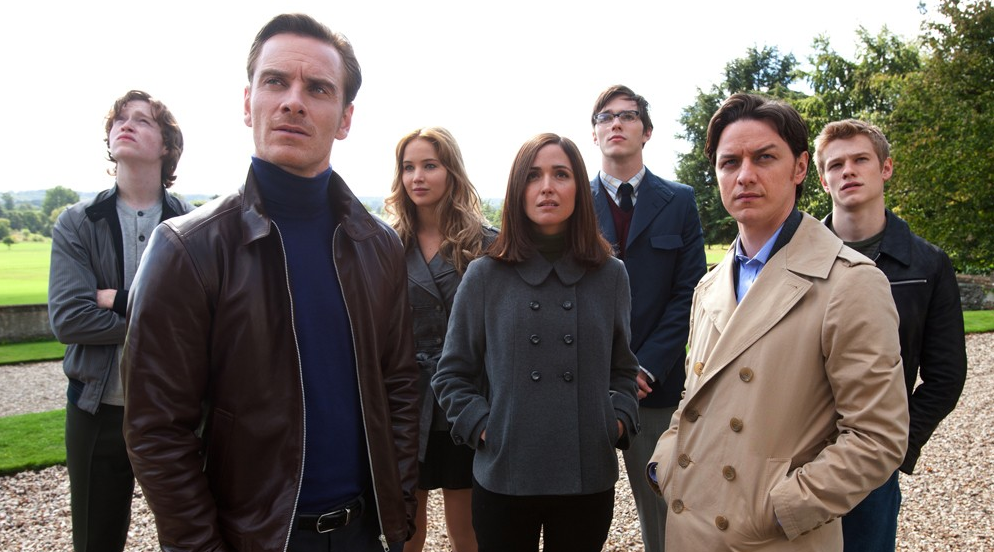
Years pass, and we’re reintroduced to the characters we’ve come to know for the past few movies now. Erik Lenshurr (Michael Fassbender), the man soon to become Magneto, is out on the hunt, looking for the man who killed his family and tortured him as a child back when he was a Jew in the concentration camps. Charles Xavier (James McAvoy) is now in college with the now much more mature Raven (Jennifer Lawrence), who is pursuing his masters degree in psychology.

There’s a mutual enemy that unites these three individuals together: Sebastian Shaw (Kevin Bacon), a menacing and conniving mutant with the ability to absorb and redistribute energy. That means a grenade can explode in his hand and he can transfer the explosion straight into you with a touch of his finger. Shaw is the man who tortured Erik back when he was a young child, and Xavier discovers a sinister plot that Shaw is setting to unveil upon the world. Erik and Charles combine their resources and their efforts to form a mutant team to work together and stop Shaw.

And how exactly does Shaw plan to carry out this giant, dastardly plan? By conspiring and coercing the Cuban Missile Crisis among nations, that’s how. How original. I wonder if these guys considered overthrowing the Chinese government while they were at it?

Hypothetical question. If you hear the term “prequel” being used, what’s the first thing that comes to mind? For me, its the word “beginning”. Beginning, as in, the start of the story. Beginning as in, the start of a legacy. Beginning as in, filling in the holes of all the ambiguous stuff we were told in the original trilogy, and beginning as in making sure everything fits into a nice, nifty little package by the time the end credits roll.

As a superhero blockbuster alone, X-men First Class succeeds. It’s exciting, it’s visually stunning, it features everyone’s favorite X-men that they’ve come to know and love, and it has enough comic book lore in it to make even Kevin Smith giggle with glee. As an action movie meant to please summer movie lovers, it is fine. As a prequel to the critically-acclaimed series that it is based on, however, it is utter and absolute failure.

Three of the biggest goofs that completely and utterly frustrated me. 1) There were flashback scenes in X2, X-men: The Last Stand, and Origins: Wolverine where Xavier is clearly seen as to being able to stand. Yet at the conclusion of First Class (spoiler alert!) Erik deflects a bullet into Xavier’s spine, permanently paralyzing is legs. 2) In the first X-men, Professor X audibly said to Wolverine that him and Magneto helped build Cerebro together, while in this movie it is very clear that a mutant named Hank McCoy (Nicholas Hoult) was the one who built it instead of them. Magneto’s helmet also didn’t exist prior to X-men, whereas here it already does. And lastly 3) a cameo appearance of a certain three-clawed mutant meeting Xavier and Erik about halfway through the movie at a bar. Wouldn’t they have remembered him thirty years later, especially since one of them is a telepath?

These ignorances to the plot show me that instead of providing an accurate prequel to a highly-revered superhero series, the filmmakers were more interested in letting loose and having fun rather than making something straight-laced and refined. I’m all for fun and high-octane action movies, but if you go in ignoring everything else that happened in the movies previous to your own, you’re being disrespectful to the franchise.

Oh, the cast was more than exceptional, I won’t deny that. McAvoy portrays the younger Professor X wonderfully here, passing himself off as a sort of young Patrick Stewart that’s more reckless and immature than his older self. Bacon is smug and charismatic as Shaw, and even though his role wasn’t as compelling as Ian McKellan’s was in the original trilogy, it still served its purpose in the film.

I especially enjoyed Fassbender’s performance as the angry, relentless, and grief-stricken Erik Lenshurr. The staple performances in the series overall belong to Patrick Stewart and Ian McKellan, there’s no doubt beyond that. Still, Fassbender gives it his all here. You notice the effort he extends here, the passion and the fire he instills in this character. McKellan’s rendition of Magneto was calm, collective, and calculated, a great foil to the equally intelligent but more morally aligned Xavier. Here, Fassbender is neither calm nor calculated. He is simply a raging, hateful man, a mutant who has been in pain and alone all his life, desperately seeking some sort of way to fill the emptiness within his cold, solemn heart. I genuinely liked and appreciated his take on the character, even though he bends missiles in one scene that look about as realistic as a Tom and Jerry cartoon.

“But wasn’t it fun?” is a common argument I get from a lot of moviegoers. “Fun” is such a subjective word, and can mean any one of different things. In the aspect of simple, plain, straightforward blockbuster fun, I guess this movie satisfies. The problem is I didn’t go into X-men: First Class expecting a brainless blockbuster. I went into this expecting this to be exactly what it claimed to be: a start to the X-men’s journey, an insightful and hot-blooded prequel that showed perspective on how their story began. This wasn’t even close to being a prequel, ending with more questions where there should have been answers. Fox has already announced that a sequel is currently in the works to be released sometime in 2014, and here I am, thinking that these kids need to go to summer school before even thinking about going into the second semester.

Tagged , , , , , , , , , , , , , , , , , , , , , , , , , , , , , , , , , , , ,

“NEED FOR SPEED” Review (✫✫)

Needs more brains if you ask me.

Need For Speed is one of those movies that feels like pressing on the gas pedal. You get a good kick out of it at first, but it doesn’t take long for it to run on empty.

Based loosely on the video game series of the same name, Need For Speed stars Aaron Paul (Breaking Bad’s Jesse Pinkman) as Tobey Marshall, a car mechanic whose prowess at street racing precedes that of Dom Toretto from Fast and Furious. When Tobey’s closest friend Pete (Harrison Gilbertson) is killed in a race against his wealthy rival Dino Brewster (Dominic Cooper), Marshall sets out in a race across the country to find Brewster and make him pay for what he has done.

Directed by Scott Waugh, the filmmaker behind the 2011 war drama Act Of Valor, Need For Speed is a typical Hollywood sports car movie with the typical ingredients you’d expect: a lot of action, few brains, even less wit and an over-dependence on formulaic Hollywood cheese

The screenplay is unbearably generic, to the point where groaning in disbelief is almost a reflex. In the first 20 minutes, we get every racing movie cliché you could possibly find in the handbook, from the underdog street racer stereotype to the prolifically rich and jerk of a rival to the underdog getting framed for a crime that he didn’t commit, seeking revenge on his transgressor. I wonder where we’ve seen that before?

Oh, is this movie bad. From the movie’s first scenes to its very last, it’s a predictable farce that can be easily foreseeable if you’ve seen any street racing movie ever. Case in point: Would I be really giving away any spoilers if I offer that A) Marshall makes it into the final race, B) He beats Brewster in a tedious scene that’s supposed to be the climax and C) He gets a beautiful girl in his arms? Please look at that, and tell me that doesn’t remind you of The Fast and the Furious franchise.

The movie might have been decent if the performances were worth anything more than a ukulele pick. Look at all of the names that are in this movie: Dominic Cooper, Imogen Poots, Michael Keaton, Aaron Paul. All great and talented actors, whose versatility of projects range from Batman and 28 Weeks Later to Captain America: The First Avenger and “Breaking Bad”. Their roles in this movie are wasted because they are mostly shoved aside for the (dis)pleasure of preposterous stunts, relentless engine revving and unbearably bad CGI animation. The fire effects that can be seen in one scene are so laughably bad that the video game looks more realistic.

The only thing I give the movie credit for is its third act, which is surprisingly affectionate. Dare I say that it may be poetic? No, that would be giving the movie too much credit. Still, it carries a very humble message about it, a grounded and reassuring statement that everything is going to be all right, even if things don’t initially seem that way. This end scene was surprisingly touching and relevant, elevating the movie above its mediocrity, although temporarily.

That still doesn’t change what we have here, though. Need For Speed is a predictable, standard, run-of-the-mill action farce with no surprises or original ideas. It’s almost like playing a video game, except you’re watching the filmmaker play it for you.

Tagged , , , , , , , , , , , , , , , , , , , , , , , , , ,

“MONSTERS UNIVERSITY” Review (✫✫✫)

Class is now in session.  Please open your fright books to page 237. 

Boy, will this bring back memories for you when you’re seventy.  Monsters University does a rare thing with its premise that Pixar does with all of their movies: it incorporates real-world ideas and principles and relates them to the simplistic joys of a kids movie.  Pixar isn’t alien to this concept: with WALL-E, you witness the effects of industrialism, with Up and Toy Story 3, the truth of loss and growing up.  With Monsters University, we are given yet another truth, a truth about changing dreams and the pursuit of a higher education.  It’s not as potent as Monsters Inc., but that’s another issue.

Taking place years before the events of Monsters Inc.Monsters University opens on a young Mike Wazowski (Billy Crystal), a punky little eyeball who dreams of growing up to be a scarer for Monsters Incorporated.  His gateway into that dream lies in Monsters University, a college mostly known for its Scaring Program.  This college is intimidating, a buidling filled with dark curtains, creaky floors, and echoed hallways, the perfect place for Scare students.  I’d hate to see what the Art Department looks like on this campus.

So Mike Wazoswki immerses himself in his studies and in his bookwork, determined to be the best scarer at the University.  There’s only one obstacle in his way: James P. Sullivan (John Goodman), a cocky, overly-confident jock who thinks getting through college is about a big name and a big roar, which is about the only two things he’s got.  In their first semester at Monsters University, Sully is showing Mike up in every single scare opportunity, and Mike shows Sully up on every test and oral exam.  Monsters University chronicles their adventures together, from their chance introduction, to their rivalrous exchanges between each other, and finally, the unlikely friendship that forms in between them.

Here is a movie that features the typical staples of a Pixar film: a good concept with a well-written plot, all forming together with fluid animation and wonderful voice-acting.  Directed and co-written by Dan Scalon (The other two writers being Robert Baird and original Monsters Inc. writer Daniel Geirson), Monsters University is a story that combines clever, witty humor with that of a conventional, enjoyable story, even if it is at times a tad predictable.  It’s easy to appreciate the humor in the film: even the names of Monster fraternities are enough to utter a chuckle.  Admit it: how can you not smile when hearing the names “Roar-Omega-Roar”, or “Oozma Kappa”?

This is the kind of cleverness in Monsters University: the kind that takes real-world truths and facts and parodies them in a children’s cartoon.  I’ve always appreciated this about Pixar: they’ve always made their work smarter and more profound than other animated films, therefore allowing adults to enjoy their films just as much as the kiddies do.  Whenever you see a slug-like monster rushing at slug-like speed trying to get to class, or seeing a brush0like monster put paint in his hair and go “Ker-Splat!” on a canvas, the cleverness and the humor cannot help but shine through the brightly-colored and textured animation in this film.  Here, the monsters come in all shape, sizes, and breeds in University, and they plop, bang, clang, sneak, slither, and scare in all forms chaos and hilarity on the screen.  Crystal and Goodman, of course, need no comment about the liveliness of their roles.  You only need to see the first Monsters movie to understand how perfect they are in their voice acting.

The important thing to remember here is that Monsters University is not Monsters Inc., and I mean that sincerely as a compliment.  There is no doubt bits and pieces of Inc. that we can piece together in University; it’s charisma is intact, its wit and cleverness in-diminishable, and it cares just as much for its characters as Inc. does.

What its missing, then, is not intelligence or technical efficiency: what its missing is heart.  Or at least, as much as Monsters Inc. has.  To illustrate my point, I bring up a pivotal scene from the original Monsters movie: remember the scene where Sully had to say goodbye to Boo?  Do you remember the scene where he frightened her?  Do you remember Sully playing with her in her room, telling her in his deep baritone voice “Kitty has to go”?  Do you remember that when her door was torn to shreds, he kept one little piece as his reminder of Boo?  And do you remember Mike piecing the door back together, turning it on, and letting Sully open it to find a little girl whispering “Kitty” on the other side?  Do you remember the emotion?  The heartbreak? The happiness?

That “Aww” moment in Monsters Inc. is nowhere to be found in University.  I’m not saying there isn’t emotion in there: there are plenty of deep and convincing moments of well-made drama between characters, and they are done well enough for us to be compelled to care for them.  I’m saying the emotion isn’t done as well, or as effectively, as it was in Inc. to the point where I felt a deeper connection to the characters, almost as if I was in the room saying goodbye to my best imaginary friend.  Someone might think I’m being unfair by comparing this prequel to the original, but that’s the game Pixar is playing here.  Didn’t they know people would automatically look to the original when trying to decide which one is their favorite?

But I digress.  Monsters University is fun, intelligent, and dare I say it, relevant entertainment.  The animation is as stellar as always, it makes its characters compelling, it sets them up properly in line for their inevitable trip to Inc., and it makes a funny connection in between the audience and their own college years.  I strongly recommend you sign up to join the student body at Monsters University.  Just make sure you stay away from the Art Department.

Tagged , , , , , , , , , , , , , ,

“STAR TREK” (2009) Review (✫✫✫✫)

To go where no Trekkie has gone before.  

When I first heard about J.J. Abrams rebooting the Star Trek series with another movie outing, my immediate reaction was rolling my eyes.  “Not ANOTHER Star Trek movie!” I remember thinking.  Indeed, wasn’t that everybody’s reaction?  Star Trek lived and had its time, and it seemed like the only people who would enjoy this new release were the Trekkies that were faithful to the series since episode one.

Nothing, however, would have prepared me for how immersive and fantastic this new movie is.  It’s more than just another Star Trek movie: its a science-fiction epic.  It’s an energetic and revamped take on a series that severely needed a new direction.  The story is original, the characters are fresh, and the vision is as bold and fearless as it possibly can be. Its success doesn’t just rely on CGI and visual effects (although believe me, it doesn’t fail in either category).  It’s one of those rare treasures where the characters and their dialogue is more appealing than the action scenes we have to go through every twenty minutes.

The plot originated from an idea that was had way back in 1968.  Back when the series was first spawning its popularity, original creator Gene Rodenberry started early writing for a prequel to his own science-fiction series.  But just like superhero movies Watchmen and Sam Rami’s Spider-man, it was stuck in development hell until finally creative writing team Roberto Orci and Alex Kurtzman were hired to write the script for the new mysterious Star Trek prequel.

This was a smart move.  They are the same writers behind movies as successful as Mission Impossible III, Transformers, and Eagle Eye, and their proficiency as writers shines here more than ever.  They compose a story as brilliant as it is exciting, a plot that is as action-packed, captivating, explosive, humorous, and in-cheek as possibly can be.  They do more than just adapt this universe: they pay tribute to it.  They pay homage to the classic series, pulling inspiration and ideas from all corners of the galaxy in the Star Trek universe.  We can tell this through tidbits of plot and dialogue that Orci and Kurtzman insert throughout the movie that reveal intimate details of the Star Trek universe we might not have known before, such as how Kirk came to become enrolled in Star Fleet, the origins of Spock, or how James McCoy got his famous nickname “Bones”.

This isn’t just another action film where the characters are just shoved aside for the action and explosions: Orci and Kurtzman are just as careful with developing character and dialogue as they are story.

Still though, if we have Orci and Kurtzman to thank for the vision, we have director J.J. Abrams to thank for the realization of it.  To date, this is only his second time in the director’s chair (his first being Mission Impossible III), but his skills as a filmmaker shine here of blockbuster-esque proportions.  Every minute of this film is fueled by both ambition and excitement, with every minute being tense, exciting, funny, exhilerating, and action-packed all at once.  Nothing is ever dull or boring or repetitious in this film: every second is filled with character appeal and visual spectacle that hasn’t been matched since George Lucas’ Star Wars series, or recently James Cameron’s Avatar.  I cannot recall a single moment in the film where I was bored or irritated.

If we’re talking about science-fiction epics, it flat out doesn’t get much better than this.  Star Trek is a great movie for many reasons, both obvious and not obvious.  The obvious reasons would involve its visual effects, make-up, and art direction.  The film is obviously visually ambitious, and like the U.S.S. Enterprise, transports you to many worlds of visual color, dazzle, fantasy, and wonder that is ever-present in the constantly-changing genre of sci-fi.  Another obvious reason would probably involve the performances: Chris Pine and Zachary Quinto do a great job at portraying the next-generation versions of James Kirk and Spock, and their chemistry with each other reflects their rivalrous spirit with both great tension and comedy.  Eric Bana also, deserves great props as the lead antagonist.  He portrays a villain so passionate and deadly that I pray the Wrath of Khan would never have to face him.

But those reasons makes the movie succeed: what makes the movie thrive are the unexpected reasons.  And those reasons are writers Orci and Kurtzman and director J.J. Abrams.  I’m not saying their careers don’t precede them: I’ve enjoyed Mission Impossible III and Eagle Eye, and I absolutely love the first Transformers movie (although the second one made me want to gouge my eyes out with a toothpick).

But the caliber of this work goes far beyond what was expected for them.  It’s typical to expect a good product from a good team: it’s rare to see exceptional work of this caliber from that exact same team.

Take this from a guy who isn’t a Trekkie.  I’ve seen a few episodes of “Star Trek” in the past, but I never became interested enough to follow the series as a direct fan.  Watching this movie makes me wonder what I might have been missing out on.

Tagged , , , , , , , , , , , , , , , , , , , ,