Tag Archives: Novel

“GONE GIRL” Review (✫✫✫1/2)

Gone Girl

What happened to Amy Dunne?

When I started watching Gone Girl, I had no idea what happened between Nick Dunne and his wife Amy. Now I have finished the movie, and I still have no idea what happened between the two of them.

Gone Girl is a very strong psychological thriller, packaging the essential elements of tension, grit, and confusion to make an extremely fascinating, yet equally frustrating, watch. Imagine you’re driving on a highway, except you take a wrong turn. Then you take another wrong turn. Then you take another, then another, and then another after that. Gone Girl is that highway, taking you through so many twists and turns that you don’t know which way you’re going anymore. The only problem is that there’s no end destination when you get off of the highway.

Based on the book of the same name by Gillian Flynn, Gone Girl starts with Nick Dunne (Ben Affleck) coming home to see his living room torn apart and his wife Amy (Rosamund Pike) missing. There are a few details that disturb him upon this discovery. The glass table is smashed in. Chairs are overturned. A blood splatter can be spotted above the stove in the kitchen. Suddenly, Nick finds himself swept into a media frenzy as everyone everywhere cries out “Where’s Amy?” as he and Amy’s parents work to find Amy and bring her back home.

Yet, in the midst of all of this media attention, people start to recognize strange things about Nick. He’s behaving oddly for someone who has just lost his wife. A woman outside of a press conference takes a selfie with him and posts it online. He smiles at the conference when people take his picture. And as police discover Amy’s diary and uncover incriminating evidence about Nick’s marriage with Amy, people start to ask one question: did Nick Dunne kill his wife?

Let me start by saying this: there’s no way to expect anything from this film. The minute you think Gone Girl is going in a specific direction, it does a reversal and goes in the complete opposite direction, setting you on another prediction track until it does another reversal. There are many factors contributing to these twists, the biggest one being the writing contributions of Gillian Flynn. Flynn, who wrote the original book, was adamant about being involved in writing the screenplay for David Fincher’s adaptation, and she’s a good sport as far as working with him. Even though there are a few differences conceptually from the book, the work remains a whole emotionally, and lets off this gnawing paranoia on both characters as we question who is the victim and who is the perpetrator. This movie is like a game of cat and mouse, except no one really knows who is the cat or mouse.

The writing is ingenious, but the real star of this show is David Fincher. Fincher, who is no stranger to mind-bending plots (1997’s The Game, 1999’s Fight Club, and 2007’s Zodiac), incorporates elements from all of his movies into this one mind-bending thriller. It has plot twists as big as those in The Game, the pseudo/suicidal/mind trickery in Fight Club, the dark, disturbing realism in Zodiac, and the broad, expressive shots, angles, and edits from The Social Network. I like this about Fincher films, that they’re so distinct in visual style that you can almost instantly tell that it’s a David Fincher film.

Example: In the opening sequence of The Social Network, we capture the essence of the scenery as a lonely Mark Zuckerberg trots back to his dorm. We get a sense of the campus he’s on, the bridges, the buildings, the sidewalks, the trees. We not only feel the physical surroundings around him, but also the life that’s in it, almost like the scenery is breathing around him. Fincher did the same thing during The Girl With The Dragon Tattoo, and he did it again with Gone Girl. When he’s not filming a scene where there’s a tense exchange of dialogue between characters, he’s quietly viewing the scenery all around him, telling a story with silent images just as much as he does with outspoken characters.

More than what he does shot-wise though, I’m impressed with how he handles his cast. Look at the names associated with this film. Ben Affleck. Rosamund Pike. Tyler Perry. Neil Patrick Harris. Are any of these names what you’d expect to see in an intricate crime-thriller, let alone give a decent performance? I mean, the last memorable role Perry had since dressing up in drag as Madea is Alex Cross, and that was about as complacent as an action movie can get. Neil Patrick Harris’ most serious movie role is as himself in Harold and Kumar. Rosamund Pike is most known as a Bond girl. Affleck’s acting career is self-explanatory. I looked at all of these actors cast in these roles, and I couldn’t help but wonder what they were doing in a Fincher film.

Then I saw what he did with them, and I couldn’t see anyone else in their roles. Perry played Dunne’s attorney Tanner Bolt, and he was so smug and straightforward that he could lend Robert Downey Jr. a few tips for The Judge. Harris steps so wonderfully into a role he’s never played before, and Pike is exemplary too, though I won’t exactly specify how. Affleck to me was the most interesting. He uses awkward lulls, blank expressions, and his sterile voice just like he did during some of his bad performances in past movies. It’s not a bad performance though. Fincher is just using Affleck’s natural reactions to lend details to Nick Dunne’s character, like how he could be smiling in pictures while his wife is missing, or why he sounds so unconvincing when he gives a speech about how he loves his wife to ongoing listeners. Fincher uses both Affleck’s strengths and weaknesses as an actor to the film’s advantage, and that goes the same for everyone else in the film.

I liked many things from this film. The cinematography, the editing, the thought-provoking plot, Fincher’s masterful direction of the film and it’s cast all culminated into a jaw-dropping experience. My only regret about this film is it’s ending. I won’t spoil it for you, but I will say that it ends in the same way that it begins, posing questions and vague thoughts so that the audience may fill it with their wild imaginations. I realize Fincher and Flynn did not intend to have a straightforward, clear-cut ending, but I have a stubborn need for closure. Films are supposed to provide answers to the questions they’ve already posed to you. Gone Girl does not provide an answer. It provides a question.

Tagged , , , , , , , , , , , , , , , , , , , , , ,

“THE FAULT IN OUR STARS” Review (✫✫✫✫)

And the stars have never shone brighter.

The Fault In Our Stars is one of the most magical films you will ever see. It is also one of the most tragic, heartbreaking, funny, genuine, and real films you will ever see. It does exactly what the book does, and exactly what movies are supposed to do: it sweeps you away, transporting you, making you forget about your own reality and immerses you into the reality of these fictional characters that don’t seem so fictional. While I was watching the movie, someone in the audience leaned over to me and asked if this was a true story. “No, but it deserves to be,” I thought to myself.

Based off of the highly popular book of the same name by John Green, The Fault In Our Stars follows the story of Hazel Grace Lancaster (Shailene Woodley), a spirited, spunky, and sarcastic teenager who loves to read books, watch horrible reality TV shows, and question everything her parents tell her to do. Augustus Waters (Ansel Elgort) is another spirited, spunky, and sarcastic teenager who loves to watch movies, play video games, and ponder the many questions about the universe. Hazel and Gus are both like any regular teenager but with one significant difference: they’re cancer survivors.

Note that I said survivors. They’ve had cancer in the past, Hazel in her lungs and Gus in his right leg, but both have since moved on from their ordeals to try and tackle their lives as any other teenager would. Because of Hazel’s lungs, she has to carry around a respiratory machine (Oxygen tank instead? Machine sounds intensive) with her everywhere she goes, and what would seem like a simple task to anyone else (I.e. standing up, or walking a flight of stairs), nearly exhausts Hazel after doing so. Gus, on the other hand, has a prosthetic replacing his right leg in exchange for being cancer free.

One day, they both meet each other at a cancer support group meeting. Hazel notices Gus having a bounce to his step, despite only having one full leg. Gus notices Hazel’s beautiful face even though she’s deoxygenated. As they continue to meet and see each other, they soon realize that they have a special relationship with each other, one that no “normal” human being could ever possess.

From a first glance, some people may look at this movie and see it as an overly optimistic tween romance, where two characters fall in love, and their love beats all things, including their ailments. I know I did when I first heard about it, and why wouldn’t I? Romantic dramedies have a way of underemphasizing conflicts just so characters can have happy endings. As a result, we get movies that are more cheesy and insincere than they are genuine and heartfelt, much like those ungodly Nicholas Sparks movies.

But The Fault In Our Stars is different. It is not manipulative of it’s emotions and it doesn’t downplay the severity of character’s problems. It’s honest and up front about the challenges these teenagers face, and doesn’t shy away from the severity of it just because they’re children. In fact, Hazel Grace herself dispels the notion at the beginning of the film, saying to her listeners “That wouldn’t be the truth. This is the truth. Sorry.”

I know, I’m late on writing this review. Why am I writing this in October, when the movie has already come out on DVD? I was waiting, dear reader. Waiting to read the book and see not only how faithful the movie was to it’s source material, but also to it’s emotions. I’ve said it before, and I’ll say it again: you can bend the plot of the original story, but you cannot bend the emotions and still remain faithful.

Now I have read the book, and I can tell you firsthand from my experience that the movie held up to the book on both counts. The Fault In Our Stars is a breathtaking experience: touching, deliberate, and beautiful all at once. To say it’s faithful to the book is an understatement. It’s quite possibly one of the best book-to-movie adaptations I’ve ever seen.

The things that work so well in the movie are the same things that work so well in the book: the writing and the characters. At the heart of the entire story, movie and book included, is Hazel Grace, who is such a fascinating and singular character that it makes me sad to think that she doesn’t exist. Hazel isn’t like other cancer-ridden characters. She neither has an overly defeatist attitude of her ailment, or an overly optimistic perspective one either. She’s in the neutral realm, seeing her sickness as a part of her no matter what she does, and choosing to accept it because she’s more or less forced to.

And yet, she’s so much more than her sickness. In many ways, she’s just like any other regular teenager. She has a favorite book. A favorite author. A favorite show. A favorite food. A crush. And like any other teenager her age, she’s bursting with opinions, hopes, fears, and desires, all of which combine to make a completely fascinating, involving and passionate character. We quickly learn to love Hazel not because she has cancer, but because she is unique.

On that note, let me talk about Augustus. Can I just say that I love this kid? Gus is filled with spirit and enthusiasm, having a bounce to his step that contrasts with Hazel’s shy trotting. I find it interesting that even though I don’t like it when characters are unrealistically happy, here Gus is almost nothing but happy. He thinks it’s cool that he has a metal prosthetic leg, seeing it as him being half-cyborg. He likes video games, zombies, and heroism, seeing himself as one of the brave movie heroes who sacrifices himself for the sake of the people he loves. In many ways, that’s who he is: the hero of the movie, bringing all of the love and affection he could for the woman he loves. He’s so great in the film, he could have a movie all to himself if he wanted to.

You’ll notice that I’ve referred to both of these persons by their characters, not by the actors that portray them. That’s because Woodley and Elgort slip so wonderfully into their roles that they’ve completely disappeared into them. I didn’t think about The Descendants when I saw Woodley tear up and cry, or when she picked up her BiPAP and exhausted herself walking up the stairs. I didn’t think of Divergent when Elgort so tenderly cared to her needs, or sweetly telling her that he would be honored to have his heart broken by her. I saw these actors and was so immersed into their performances that I no longer thought about what they were and thought more about who they were. These two are not Shailene Woodley and Ansel Elgort. They are Hazel Grace Lancaster and Augustus Waters.

Everything else in this movie was made to near perfection. The screenplay by Scott Neustadter and Michael Weber adapted the story and emotions wonderfully from the book. The camera work by Ben Richardson was elegant and harmonic, much like the great work he did with 2012’s Beasts of the Southern Wild. And director Josh Boone guides the actors through the blissfully tragic story created by John Green, whose wondrous words were what made this entire movie possible.

That ends the review with one question: which is better? The book, or the movie? Neither. I could argue that the book is better because it has more content, or I could argue the movie is better because it brought the story to life visually. Both arguments are pointless. They are both two different mediums, but they both tell the same wonderful story.

Tagged , , , , , , , , , , , , , , , , , , , , , , , , ,

“HOW TO TRAIN YOUR DRAGON” Review (✫✫✫✫)

Step one: Don’t get eaten by a nightfury.

How To Train Your Dragon is a pure joy, a complete and captivating wonder that reaches the inner child in you, touches it, and fills you with such inexplicable excitement and adventure that you almost feel like you can do anything. I was initially worried about this movie going in to it: how many other movies have attempted the human-pet budding romance E.T. did so wonderfully all those magical years ago, and failed? Well, there’s nothing to fear here, fellow reader. In their long line of successes, failures and mismatches, How To Train Your Dragon easily ranks among DreamWorks’ best work.

We open up on a grand battle on the land of Berk, an island where the vikings are as stubborn and hard-headed as the metal helmets they wear on their heads. But this battle isn’t against other vikings, mind you: it’s against dragons, giant, dangerous beasts that tear through the sky and spit fire like its flu season for them. For the vikings, killing a dragon is like the starting point for becoming a man. It’s their form of puberty I suppose, next to the endless gorges of food and testosterone that they throw and shout about at each other.

One Berk citizen, however, is a little more hopeless than other vikings: Hiccup (Jay Baruchel), a smart, inventive but helplessly clumsy little fellow that will reach for a pencil when he’s supposed to reach for an axe. Fate turned an eye to him when in the midst of the battle, he captured a “nightfury”, a sleek black dragon whose fast speed and blue fire makes him the most deadly dragon out in the field of battle. However, against his better judgement, Hiccup decides not to kill the nightfury after discovering that he was injured during the battle. Now, while slowly helping him back to health and back to being able to fly, Hiccup discovers the truth about the dragon race, and how similar he is to them and their personalities.

Taking a look at the past animated movies DreamWorks has helped produce, you realize how much of a mixed bag they put out there to their audience. Look at the best they’ve had to offer, such as Shrek and Kung Fu Panda. Now look at the worst they’ve had to offer, such as Shark Tale and Shrek The Third. And don’t even get me started on Bee Movie. Looking at their filmoraphy, and looking at how much they’ve done wrong mixed with their right, I was expecting a very artificial, forgettable experience.

Boy, was I wrong, and boy was I glad to be wrong. The very first detail you notice in How To Train Your Dragon is it’s animation, how crisp and refined it is in detail, and how authentic it makes everything look. In the opening sequence, for instance, we shift through the dark clouds and sea as we approach the land of Berk, and it was so atmospheric that I felt like I myself was flying over the ocean surface when I first saw it. Later in the film, you look at vikings talking to each other in the dining hall, and the rock floors and the wood detailing look so real that you can almost reach out and touch it.

But I know what you’re really after. You’re not after what the waves, clouds and wood looks like. Nuh uh. You’re interested in how the dragons look, how exhilarating the fight scenes are and how exciting it is when you see a dragon spread his wings for the first time.

Let me assure you, fellow reader: the action could not be any more exciting. The dragons are all colorful, lifelike and filled with variety, their wings spread out in glorious, anthropomorphic detail. When they fly, they soar at supersonic speeds, dodging mountains, flipping through the air, and skydiving towards valleys like they are swimming in an endless sea of clouds and sky.

I especially liked the chemistry Hiccup shares with the nighfury, who he later names Toothless in the movie. Did I really just say that? That I liked the chemistry between two fictional, fake, animated characters? Yes I did, because these characters are neither fake nor artificial: they’re genuine, sharing real, heartfelt emotions with each other in ways almost no other animated film captures in movies. When Hiccup touches Toothless’ snout for the first time, you feel conflicted emotions between each other as they struggle to trust one another. When Toothless saves Hiccup from certain death from the dangers of the skies, you feel their relationship growing as they form a closer bond with each other. But when an all-out war spawns in between the vikings and the dragons, it’s Hiccup and Toothless that remain strong through it all, their friendship so compelling that it almost feels like connecting with a long-lost brother, not too disimilar to how Boo and Sully interact in Monsters Inc. 

My only regret with this movie is that it won’t be the best animated film of the year. With Toy Story 3 releasing just around the corner, and considering Pixar’s track record, it’s doubtful to see How To Train Your Dragon trump years of animated fandom and cherishment, especially when we’ve had years to grow with these characters. Shame, because this movie has great, fluid animation, an involving story, and memorable characters just like Toy Story does. If Toy Story 3 wasn’t coming out in June, I am positive that How To Train Your Dragon would win the best animated feature award at the Oscars.

Tagged , , , , , , , , , , , , , , , , , , , , , , , , , , , , , , , , , , , , ,

“X-MEN: DAYS OF FUTURE PAST” Review (✫✫✫✫)

The next stage in superhero cinema evolution. 

X-men: Days of Future Past ranks among the best superhero sequels I’ve ever seen, one I would instantly compare to that of Spider-man 2 or The Dark Knight. There were so many things that needed to be done, so many risks that needed to be taken, and so many ways this movie could have failed. It didn’t. From the opening sequence to its last breathtaking moment, my mind was blown and the comic-book nerd in me was absolutely filled with joy. The movie did more than simply expand the franchise: it redefined it.

We open on a post-apocalyptic future that hasn’t been this catastrophic since James Cameron’s 1984 film The Terminator. Years after X-men: The Last Stand took place, humans are now being hunted by the same weapons they created in the first place: the Sentinels, a coalition of dangerously armed robots who can track and exterminate any mutant they can find on planet earth. Amongst the ruins of battered buildings and fallen icons, the human race has now been collected into a sort of concentration camps: all that’s left for the mutants then is the mass graves filled with the dead bodies of their kin.

Lifelong frenemies Charles Xavier (Patrick Stewart) and Magneto (Ian McKellan) collaborate on a plan they would like to enact. Besides having the ability to phase through walls and objects, Kitty Pryde (Ellen Page) has recently developed the ability to transfer someone’s consciousness into their younger bodies in the past, allowing them to change the future and avoid the unfortunate outcomes that might become of them. Kitty has been able to use this ability on multiple occasions now to save her friends, but now Professor X and Magneto want to go back into the past (1970, to be exact) to prevent the event that triggered this horrifying future and save human and mutantkind as they know it.

Problem is, Kitty can only send someone back a few days or weeks at a time. Any further than that and she risks tearing apart the mind of the person she’s sending back to the point beyond repair. Luckily, Wolverine (played by Hugh Jackman, who else?) has the ability to heal himself at a faster rate. So Professor X and Magneto decide to send Wolverine back into the past to coerce their younger selves (portrayed by James McAvoy and Michael Fassbender, respectively) to stop the triggering event and save the future.

Serving as a sequel to both X-men: First Class and X-men: The Last Stand, and incorporating characters and actors from both translations, X-men: Days of Future Past is, in a word, a game changer. It brings in all of its key players, from the original cast members and its most revered director Bryan Singer, to the newcomers who’ve newly defined their roles, including McAvoy as Xavier and Fassbender as Magneto. Everyone meshes so perfectly with each other, especially Jackman once again, who essentially has to react to characters from two different time zones. There hasn’t been a cast this big since Joss Whedon’s The Avengers, and I’m tempted to say the movie is better because of it.

Do I really want to stand here though, and compare Days of Future Past to that of The Avengers? Yes I do. The Avengers was a bold, brave step forward in comic book evolution, combining characters from five different movies to make a superhero epic that hadn’t been tried before. Days of Future Past follows that same model, bringing in characters from six of its movies, but the end result is vastly different. There’s a much deeper plot going on here, a vastly intelligent and contemplative story that elaborates on its recurring themes of racism and, once again, bringing in the consequences of discrimination to the forefront. I loved X2 for this very reason, for it being more than just a comic book movie and focusing itself more as a political thriller with comic book elements thrown into the mix. This movie is that to, like, the tenth power.

Oh yes, this movie will fill comic fans with glee everywhere. Similar to the small little easter eggs that can be picked up in other Marvel movies (Note: The Doctor Strange reference in The Winter Soldier), this movie too has sweet little moments that comic fans can pluck from the ground and take a moment and appreciate the aroma. My favorite had to be a moment where a mutant named Peter (Evan Peters), who can run at supersonic speeds, rests in an elevator with the younger Magneto as he’s helping him escape from prison, and makes a comment about his long-lost father. That’s just the tip of the Bobby Drake-iceberg. There’s so many moments I can pull from that filled me with joy and happiness, while others filled me with dread and angst. The film orchestrates its emotions wonderfully, and in every fabric of the film I felt what I was supposed to feel.

I’m going to go out on a limb and say this is the best X-men movie in the series so far. Bold claim, I know, but it deserves it. From its first moment to its last, Days of Future Past is completely, utterly, fascinatingly mind-blowing and involving. From its quietly hinted-at themes of xenophobia and extermination to its climactic action scenes where we don’t see how on earth our heroes can win, Days of Future Past combines the best parts of all of the movies and makes itself the best entry out of them. Many audiences have recently been experiencing superhero movie fatigue, with movies such as Man of Steel and The Amazing Spider-man 2 recently being met with mixed reaction amongst audiences and in the box office. Days of Future Past is one of those movies that restores your faith in the genre.

Tagged , , , , , , , , , , , , , , , , , , , , , , , , , , , , , , , , , , , , , , , , , , , , , , , , , , , , ,

“12 YEARS A SLAVE” Review (✫✫✫✫)

Over a decade of injustice and cruelty.

12 Years A Slave is quite possibly the best film of the year.

It is also the most disturbing.

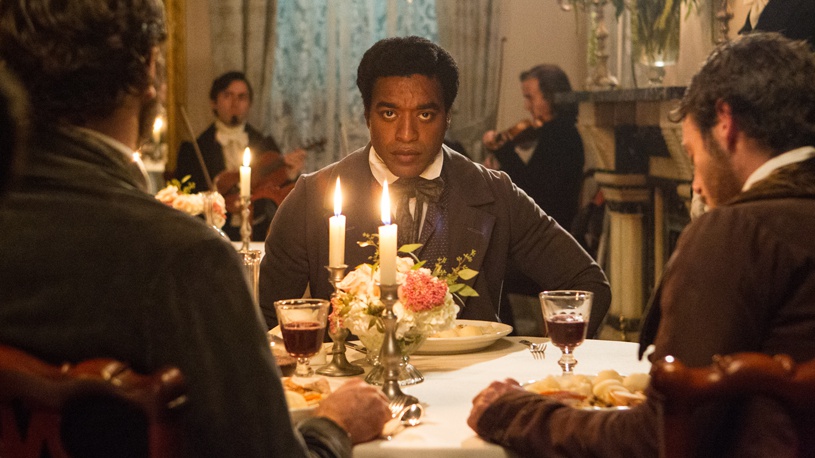
Based off the 1853 autobiography of the same name, 12 Years A Slave follows the true story of Solomon Northup (Chiwetel Ejiofor), a free black man who lives with his family and plays the violin in Saratoga, New York.

One evening, he becomes acquainted with two young gentlemen who claim to be circus performers looking to hire him for a one-night gig. When he wakes up the next morning, he is in chains, and realizes that he was drugged, kidnapped and sold into slavery by his captors. During his years as a slave, Northup goes from one owner to the next, from a kindhearted owner named William Ford (Benedict Cumberbatch) to a cruel, racist and mean-spirited pig named Edwin Epps (Michael Fassbender), who presents the greatest trials he must face if he is ever to survive.

12 Years A Slave is a film that not only lives up to all of its built-up hype and expectations: in many ways, it exceeds them.

Its quality as a work of art is so striking and powerful that it can be compared to other historical tragedies, including The Pianistand Schindler’s List.

Director Steve McQueen, who made the morally reprehensible and eerily bleak film Shame back in 2011, redeems himself here as a filmmaker. McQueen, in collaboration with cinematographer Sean Bobbitt, is not only masterful with framing his articulate, beautiful shots with 12 Years A Slave, but also brilliant with orchestrating scenes between his actors, showing us the bleak realism and truth of the slavery years in America.

Ejiofor, who portrays Northup in 12 Years A Slave is endlessly captivating. In moments where you think he might just be phoning it in, or just going along with the motions, he surprises you and releases an emotional intensity in ways no other actor has this year, not even Forest Whitaker in Lee Daniels’ The Butler. Newcomer Lupita Nyong’o plays a young female slave in this movie so passionately that you forget she’s an actress and slip into her character’s tragedy as a human being more than you do as a movie character.

Most noticeable perhaps is Michael Fassbender as Edwin Epps, who is so hateful and so spiteful in this role that all of the audience’s energy, anger and frustration is focused on him and his sadistic acts. Fassbender was brilliant in his portrayal, and I sincerely hope that he at least gets an Academy Award nomination for his performance.

Every other aspect of this film can be praised endlessly. The script by John Ridley, who wrote Three Kings in 1999, was endlessly emotional and captivating. The score by Hans Zimmer was quiet, humble and breathtakingly beautiful, encompassing both the truth and tragedy of Northup’s heartbreaking story.

However, let there be a strong word of caution: 12 Years A Slave will elicit violent reactions from its audiences. You will laugh. You will weep. You will grind your teeth in anger and frustration, maddened by the many years of cruelty, prejudice and barbarism that no human being should ever have to experience. But it compels you to care for the character, to reach deep down in your heart to feel what he is feeling, to experience compassion and sympathy in ways almost no other film can do, not even with Schindler’s List. 

And let this be a testament to the film’s quality: at the end of the showing, there was a white man who could be heard weeping in the back of the theater. In between his hiccups, tears and hysterical reactions, he turned toward the black viewer sitting next to him, shook her hand and after introducing himself said to her, “I’m so sorry for what my race did to your ancestors.”

That man felt a powerful feeling of guilt and shame for the things that he saw in 12 Years A Slave.

That man was me.

Tagged , , , , , , , , , , , , , , , , , , , , , , , , , , , , , , , , , , , , , , , ,

“THE GREAT GATSBY” Review (✫✫✫)

Nice to see you again, old sport.  

When you sit and think about the character of Jay Gatsby, there is never a simple answer to define him and his purpose in The Great Gatsby.  Some people have cited him as a post-modern interpretation of Romeo And Juliet, in the aspect that the character is going through a romantic struggle that always ends in nothing but tragedy.  Others have viewed him as a representation of the roaring twenties, as a pioneer who emboldens and defines the industrial image of the 1920’s and their status as they faded away into the 1930’s.  Others see him more like an enigma, an image of the upper class and the bleak loneliness that comes with it.  Whatever you believe to see, Jay Gatsby is no simple character.  For all we know, he could be one or none of these things.  Or all of them.

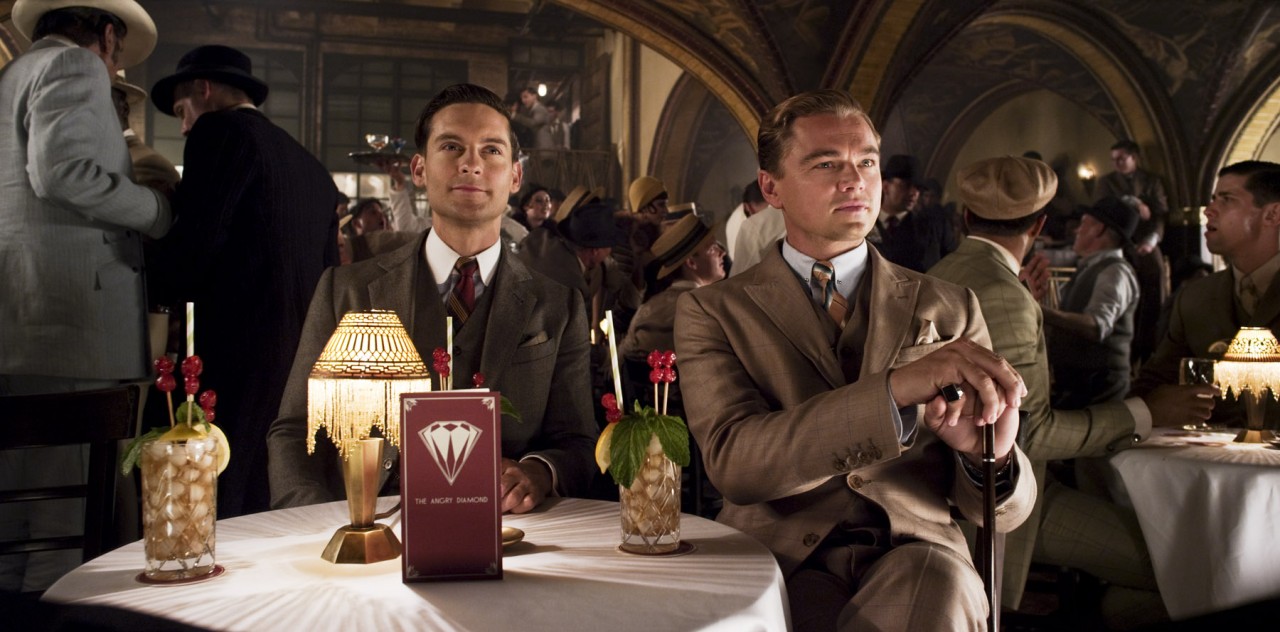
The fact that this film knows, respects, and acknowledges that makes me appreciate this movie, and hope that others can appreciate it too through DiCaprio’s performance and the mythology being revisited here.  Those who read the book should already know the story: a 1920’s bond salesman and struggling writer named Nick Carraway (Tobey Maguire) moves into New York city, where he learns of his rich next door “neighbor” named Jay Gatsby (Leonardo DiCaprio).

I put “neighbor” in quotations because Nick never actually sees Jay Gatsby in the beginning of the film.  All he ever sees of his estranged, self-secluded neighbor is a man looking behind some curtains and holding lavish parties in his mansion in the cool of midnight.  All he ever hears of him is scandalous rumors and war stories about a man many people haven’t met either.  The more Nick lives in his lonely little house, the more he questions if Mr. Gatsby even exists.

Eventually, Mr. Gatsby of course does introduce himself, but not as the host of the party, but rather, as a humble servant who offers Nick a drink on a plate of beverages.  As Nick becomes more familiar with Mr. Gatsby and his lifestyle, he soon learns the truth of Mr. Gatsby’s past and the reasons he really came to New York.

When I first heard of another Great Gatsby picture being made, my first reaction was excitement and anticipation.  How could it not be?  From the creative mind of F. Scott Fitzgerald and the many politics and emotions he makes you feel in his novel, it sounded like this movie was going to be a home run for both fans and non-fans of the book.

Then I learned that Baz Lurhmann was writing and directing.  And then bowed my head and uttered a long, dubious groaaannnn.  Lurhmann, who is most known for directing 1996’s Romeo + Juliet and 2008’s Australia, is commonly remembered as a director who abuses style over substance.  With the previous films I just mentioned, not only are they silly, soupy, and sappy menial dramas: they fail to even attain interest, and are extremely forgettable in a line of much better romantic dramas, including Titanic and the 1968 Romeo And Juliet by Franco Zeffirelli.

Note: Okay, I’ll admit I haven’t seen his 2001 film Moulin Rouge!.  Does it matter though, when out of his entire filmography, that’s the only film he can really brag about?  

The beginning of The Great Gatsby, much like Luhrmann’s other pictures, also suffers from this case of style over substance, with its overly boisterous parties and distracting art sequences making no coherent sense or adding anything to the picture overall.  What I found interesting, however, is that the first act barely matters.  When Jay Gatsby is finally introduced, the film takes a sharp turn of interest and invigorates the audience with new energy, almost like the character changes the entire tone of the film simply by him just being there.

I imagine this is the kind of Jay Gatsby that Fitzgerald would have wanted cast: the type that dresses in nice suits, stands straight with his chin up, and one who enters a room with such stillness that you could hear a penny drop.  The casting directors knew that their casting decision would be crucial to the film, and I think Fitzgerald would be pleased with the end result.  DiCaprio hits every single note dead-on this fascinating character, and just by sheer appearance, demeanor and dialect does he inhabit the character of Jay Gatsby and allow audiences to slip into his conscience and feel what he is feeling.

Oh, I won’t deny everyone else is good in this movie.  Joel Edgerton is effective as the antagonist, and even though he’s an industrial pioneer much like Gatsby is, he has such a hateful energy about him that makes you just want to run him over with a yellow beetle.  Carey Mulligan is good as Gatsby’s love interest, and perfectly shows all the innocence and indecisiveness of her character in the midst of all the ruckus.  Maguire, as well, is perfect as Nick Carraway, not as a character in himself, but as a silent observer, a passive voice who quietly watches over the scene, acting as the audience’s eyes and ears in this third-person narrative.  But its DiCaprio who sucks us in, DiCaprio who winds us up and plays us like a record as he asks us to sit through this tender, emotionally captivating journey that serves as a metaphor for the wealthy and for the industrial era.

And don’t worry, I’ll give Luhrmann credit too.  This film would not have survived without his writing or directing, as he has such reverence for the book and a great fear from deviating from it that the movie functions more as a love letter to Fitzgerald than it does as a strict book-to-movie adaptation.

Regardless, there’s only one person who shines the most here.  DiCaprio made this movie, and through his performance we were able to identify with a character that struggles with his past, his wealth, his love, and the deepening sadness that he hides behinds his warm, welcoming smile.

Tagged , , , , , , , , , , , , , , , , , , , , , , , , , , , , , , , ,

“LIFE OF PI” Review (✫✫✫)

A boy, a boat, and his bengal tiger.  

If there is any film that will stick out in your mind more than any other film in 2012, its going to be Life Of Pi.  How could it not be?  With spectacular visuals, daring execution, and a solid story, Life Of Pi may very well be one of the most memorable experiences of the year, even though that doesn’t strictly mean it is of the highest standard in movies.

Based on the novel of the same name by Yann Martel, Life Of Pi follows the story of Pi “Piscine” Patel (Suraj Sharma), a young indian boy who is a believer in many religions, including Hinduism, Christianity, and Islam.  To Pi, all of these religions lead to the same path: a greater understanding and relationship with God.  In one wonderful moment of the film, he described faith like a mansion, with room for both belief and doubt on every floor.

Besides being a follower of many faiths, Pi’s family also runs a local zoo in India, an exotic place filled with vibrant species and animals of all kinds.  Most significant to Pi is a 450-pound bengal tiger named Richard Parker, who got his name after the hunter tha caught him switched the names around by accident, with the hunter’s name appearing on the sheet as “Thirsty”.  The name stuck on Richard Parker ever since.

Eventually, the day has come where Pi’s family can no longer support themselves in India and have to move themselves and the animals to Canada, where they can hopefully find a living and start anew.  But when the ship his family and livestock are on crashes and sinks into the Pacific Ocean, Pi ends up stranded on a lifeboat all alone with Richard Parker. Now, armed with little more than a life-vest and the clothes on his back, Pi must find a way to not only co-exist with Richard Parker, but to also find a way to tame him and stay alive in the lonely abyss of the ocean.

The best thing about this movie is its faithfulness to the original novel, in how it portrays Pi as a strange, introverted, religiously diverse human being but also a spiritually focused young adult.  Pi’s story is a unique one, with the film dwelving into his story with such emotional maturity and observation, that we cannot help but understand Pi and his spiritual connection to God.

I especially loved one line Pi said to a friend at one point at the film, but when looking at it through a closer lens, maybe he was saying it more to himself:

“Even when God seemed to have abandoned me, he was watching.  Even when he seemed indifferent to my suffering, he was watching. And when I was beyond all hope of saving, he gave me rest. Then he gave me a sign to continue my journey.”

I also like the connection Pi shares with this 450-pound man-eating animal named Richard Parker: dare I say they have chemistry with one another? Yes I can, because the tiger is rendered here with such precision and detail that he actually looks like a living, breathing man-eating animal, not just another CGI creation. The rest of the movie is no exception, as it takes us  through many wonderfully dazzling visual moments that are just as impressive as when we watched James Cameron’s Titanic for the first time.

Here is, truthfully, a genuinely good movie.  The score is settling, ambient, and beautiful.  The visuals are transcendent, amazing, and stunning.  And the underlying context Ang Lee adapts from Yann Martel’s novel retains its strength, as Lee knows how to balance emotional relevance with visual splendor.

Unfortunately, the greatest strength of this film is also its greatest weakness: it follows too closely to the original novel.  Thinking back to when I read the book back in high school, I remember a story that was ambitious, daring, creative, deep, emotional, spiritual, and unique all at once.  It wasn’t just another survival-fantasy-advenure: it was a spiritual journey that has as much to do with faith and God as it does with friendship and sacrifice.

The movie doesn’t reach into this idea as deeply as the book does.  That’s to be expected, considering books are typically more in-depth than their movie counterparts.  Still though.  Haven’t other book-to-movie adaptations benefitted moreover their novel counterparts when they branched out and embraced other possibilities the original writers didn’t?

I bring two other novel adaptations from earlier this year as an example: The Hobbit and The Hunger Games.  Those movies, unlike Life Of Pi don’t just retell their stories: they rework them.  They change it to better fit their narrative, and they expand upon the stories they are helping to re-create within their own cinematic universes.

Life Of Pi doesn’t do that.  It relies too heavily on its novel-based counterpart, it refuses to branch out any more than the pages of Yann Martel’s novel will allow it to, and it has one of the slowest beginnings ever known to mankind.  The scenes where an older Pi converses with a young novelist searching for a story were especially unnecessary: why not just replace thirty-minutes of exposition with a simple narrative voice-over?

Again, I will stress this: Life Of Pi is the most memorable film of the year.  That does not mean that it is the best film of the year, and that does not mean that everybody will enjoy it.  It just simply means that when somebody watches the movie, it will mean something to them.  Whether that’s a good or bad thing remains to be seen.

Still though, to have a movie that actually says something for a change is significant enough.  Take the ocean Pi is trying to survive itself as an example.  One could say it is symbolic to everyone’s spiritual journeys in life: there are quiet moments, and then there are chaotic ones.  But your journey is never truly complete, even if you do end up washing onto the shore.

Tagged , , , , , , , , , , , , , , , , , , , ,