Bad content, bad timing, and a bad comedian, all five minutes before midnight.
Watchmen is a misguided and misunderstood film, a movie that will sharply divide the fans for both the original graphic novel and fans of the superhero movie sub genre, period. On one hand, what we have here is compelling superhero drama. The characters are fleshed out, their motivations are clearly understood, and we’re rooting for a few of them once we understand that their intentions are pure. For everyone else, however, we grow to despise their character arc, we become annoyed with their conventions, and some characters are just downright despicable. And how come some of them aren’t even wearing pants? Didn’t they know jeans were invented way back in 1873?
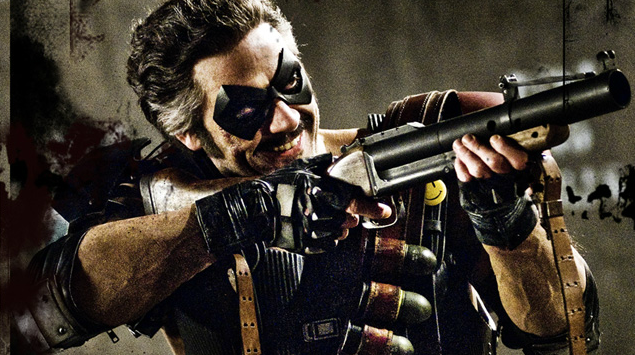
Watchmen is based around the graphic novel of the same name by artist Dave Gibbons and writer Alan Moore (who demanded his name be left completely out of the credits, convinced that a movie adaptation of his novel was impossible). Both the graphic novel and the film adaptation surrounds a group of retired superheroes called “The Watchmen” who are brought out of retirement when they learn that one of their own has been murdered by being thrown out of his own the window and landing on the concrete pavement, his blood staining the smiley pin on his jacket.
The one who has been murdered is Edward Blake, aka “The Comedian” (Jeffrey Dean Morgan). The first Watchman to learn of Blake’s murder is a fedora-wearing culprit known as Rorschach (Jackie Eerie Haley), who wears a ink-blot shape-shifting mask which makes his name appropriate. He develops a theory that someone is gunning for masked heroes, so he sets out to warn his other fellow watchmen: Dan Dreiberg (Patrick Wilson), aka a Batman rip-off called Night Owl, Sally Jupiter (Malin Akerman) aka Silk Spectre, Adrian Veidt (Matthew Goode) aka Ozymandias, to whom his secret identity is known to the world, and John Osterman, aka Doctor Manhattan (Billy Crudrup), who is the only one with super powers, apparently being able to conduct anything his mind can imagine.
Here is a movie that is, at parts, a compelling character study and a fascinating crime drama. That is because unlike other action movies, Watchmen is based heavily on character and story, not relentless action and CGI. The film delves deep into the histories and origins of each individual watchman, and while at times the exposition may be drawn out and a bit boring, the rest of the time it is undeniably gripping and attentive.
Cudrup was ghastly and stoic as Doctor Manhattan, a man slowly losing his humanity but doesn’t know what to quite do about it. Malin Akerman had a sort of spunk and wit to her as Laurie Jupiter, and in one emotionally stirring moment we experience all of her dread and desperation through her cries of anguish and defeat. I especially liked Jackie Earle Haley as the cold, calculated, and unforgiving vigilante known as Rorschach. I think he is the most fascinating character out of the bunch. He has a rashness, a raspy, hurt, and pained voice behind his every narration, and we can tell that this is man who has had a pained past. I would have hoped that the movie would delve deeper into his past than it did, but that’s besides the point. Haley is so intimidating in his performance, the alternate title for this movie could have been called Watchmen: The Journal of Rorschach.
There are parts of this movie that are undeniably surreal and fascinating. For the rest of the movie, however, the emotion and the mythology becomes redundant, and we lose interest because of its slow pacing and its drawn-out monologue. This surprises me, because the director is Zack Snyder, and he is the same man who made the the visually and emotionally appealing 300 prior to this. How is it that he goes from the provocative, epic, and entertaining veins of 300 to something as drawn-out and overly-philosophical as this?
Part of this, I think, has to be his dependency on the original comic. One of his tactics when filming 300 was using the original graphic novel as both the storyboard and script for the production. He has been reported to have used that same tactic here for Watchmen, with a few minor edits of the script by screenwriters David Hayater and Alex Tse. How could this tactic work for 300 and yet backfire on him for Watchmen? Simple: the answer lies with the page length. 300 had a total of 88 pages, while Watchmen had a total of 416. Surely, Zack Snyder must’ve thought at some point he’d lose his audience with the overuse of exposition?
Whether he thought about it or not, he went through with it anyways: what we have here is a note-for-note, page-by-page adaptation that copies its story as simple as a copy-and-paste edit on Microsoft word. For that, he loses points for unoriginality and innovation.
I feel like I’m watching two different movies here: two halves of one whole. One half of the movie is dark and mesmerizing, is well acted, emotional and motivated, and sports plenty of visually beauitful scenes at the helm of the film’s director, Zack Snyder.
The other half of this movie is filled with content so bleak, graphic, and unnecessary that I’m shocked Zack Snyder didn’t turn it into a porno. Maybe he did and we don’t even know it: Doctor Manhattan is naked through more than half of the film (and yes, we see every angle of his shining blue huevos), there’s an overly-prolonged sex scene between Night Owl and Silk Spectre, and you could have cut half of the Comedian’s scenes in the movie and make him more appealing to the audience. Seriously: someone explain to me how having a guy rape a woman and then shoot another he impregnated supposed to make him a sympathetic figure?
Someone in theory could make an opposing argument by saying “But David! That was in the comic book!” Yes, but should that have been in the comic book, let alone in the movie? I’ll answer that for you: No. It shouldn’t have. If it doesn’t advance story or define character, then what was the point for having it in there in the first place? If the superhero genre is a big, beaming smiley face, Watchmen is the blood stain covering the eyelid: distracting, unsettling, and unnecessary.

 DAVID DUNN