Tag Archives: Mystery

“DAWN OF THE PLANET OF THE APES” Review (✫✫✫1/2)

The predator and the prey are one and the same.

It all started with the eyes.

Looking deeply into them, we see the angry, vicious, relentless energy behind them, as hungry as an animal and as wild as a beast. A somewhat appropriate description, because these are the eyes of the ape Caesar (Andy Serkis), the intelligent primate we’ve come to know from Rise of the Planet of the Apes. As we continue looking at his eyes, his steady, violent stare, we see his army of followers climbing on branches behind him.

He drops his hand, motioning them to attack.

After we see this powerful, expressive opening sequence, we are taken through this epic journey that is Dawn of the Planet of the Apes, a compelling and exciting survivalist-drama that looks at the human-primate condition from two different perspectives, as if they are two sides to one coin. The leader of the apes is Caesar, who now has his own family in his wife Cornelia (Judy Greer) and his son Blue Eyes (Nick Thurston). The leader of a band of human survivors is Malcolm (Jason Clarke), who also has his own family in Ellie (Keri Russel) and his teenage son Alex (Kodi Smit-McPhee).

Both of these band’s stories take place years after the virus attack that destroyed the most of humanity years ago, which we got a glimpse at the end of Rise of the Planet of the Apes. Both sides have lost loved ones in the wake of the disaster. Both sides do not trust the other. Yet, as Caesar and Malcolm share close encounters with each other, they slowly begin to understand and see that their races are not so different from each other. As the human-primate war rages on, Caesar and Malcolm must combine their efforts to protect each of their families, and seek out peace between their established societies.

Remembering fondly of how I enjoyed seeing the ape empire’s beginnings and relishing in the context of human-animal abuse in Rise, I went into this movie knowing it had a strong foundation to build it’s story on, hoping that they wouldn’t fail. Not only did director Matt Reeves not fail in telling his story of Dawn; he expanded further upon the Planet of the Apes story in detail, action and commentary than I estimated him to. His film ended up being better than Rupert Wyatt’s film in spades.

Firstly, let’s talk about the similarities between each film. Rick Jaffa and Amanda Silver, the writing/producing team behind Rise, returns yet again to contribute to Dawn’s story and to the production of this film. In many ways, I argue that both are better in this film than they were in the last one.. The plot of the first movie was an involving, interesting and emotionally compelling sci-fi thriller, a story that showed the worst of humanity and their cruel mistreatment of animals. Here, this movie has a more of a political facet in its structure, a drama that shows each race as a mirror of the other. It shows a civil anarchy blooming in the heart of each race.

The characters are compelling and have genuine interactions with each other, from Caesar confronting Malcolm on staying away from their home, to intimate scenes when Alex interacts with Caesar’s new baby boy. What I liked so much, however, is director Matt Reeves details not only to these emotions, but the visual display of the story in itself.

Being no stranger to visual effects or emotions with a filmography including Cloverfield and Let Me In, Reeves is skillful in making an exciting action movie while at the same time making a involving apocalyptic thriller. It surprising with this film that the basis of the film wasn’t grounded in action or ridiculous CGI stunts, but rather, in small, intimate moments of conversation and ape-sign-language that characters share with each other. It’s nice to see a big-budget blockbuster movie reaching for more intimate, personal situations, rather than the billion-dollar-sized explosions of garbage you’d see from the Transformers movies.

I do have a criticism in the movie in that the human characters were mostly boring. I have a rule of thumb that if I can’t remember a character’s name by the end of the movie, then that character is mostly forgettable. By the end of the film, I only remembered Malcolm’s name. I called Keri Russel’s character “Keri Russel” in the film while I labeled Smit-McPhee as a Jay Baruchel rip-off. I even looked at Gary Oldman’s character in the film and smirked in my head, “Well, hello there, Commissioner Gordon! Did you end up surviving the nuclear fallout in The Dark Knight Rises?”

What I realize though is that the humans aren’t supposed to be the main anchor of the film. The apes are center focus here, and this is really their story, figuring out their emotions, finding their identities, and realizing their faults as they look at human beings and see themselves deep within.

I think I realized this was a masterful film when it approached its final minutes, when we once again returned to the eyes of Caesar that we saw at the beginning of the movie. Only this time, they weren’t as aggressive as they were before. These were not the eyes of the predator, the hunter eagerly waiting to hunt his prey. No, these eyes were solemn and sad, as if they were looking at a bleak, grim future, one they were powerless to stop.

Tagged , , , , , , , , , , , , , , , , , , , , , , , , , , , , , , , , , , ,

“22 JUMP STREET” Review (✫✫✫1/2)

Doing the same thing over again isn’t such a bad thing after all.

22 Jump Street is the exact same film 21 Jump Street was, but with one key difference: it’s self-awareness. While 21 Jump Street was just aimlessly spastic and immature, 22 Jump Street uses that same spasm and immaturity and chooses to make fun of itself for the sake of the audience. 22 Jump Street isn’t laughing with the audience: it’s laughing at the audience laughing at itself, and it is infinitely funnier because of that.

22 Jump Street takes place after Captain Dickson (Ice Cube) tells Schmidt (Jonah Hill) and Jenko (Channing Tatum) that they’re about to go undercover at college. After a student died at the hands of a lethal new drug called WyFy, their job once again is to infiltrate the dealers, find the supplier and bring them to justice. Resuming their cover identities as brothers, they slowly try to adapt to college as they continue to search for the supplier who is providing for the whole operation.

“Waitaminute,” you might ask. “Isn’t this what happened in the first movie?” Yes, but like I said, the movie is more aware of itself than by just simply repeating what it did the first time around. This time, Tatum is the guy who is getting accepted and friendly with everyone around campus, while Hill is more or less left to go and sip wine with the art students.

Like I said, the film is on repeat from the plot with the first movie — similar characters, similar jokes, similar order of events. For Pete’s sake, even the run time is the same, with both films clocking in at about 1 hour and 50 minutes.

But like I always say, the repeat isn’t what matters. What matters is how they handle that repeat, whether it genuinely is a funnier, more refreshing take of the original rather than just a rehash. And let me tell you, even though it has Tatum and Hill in it, neither of which I’ve ever found particularly funny, I’ve never laughed harder.

These two guys are hilarious in the movie. Tatum is good as Jenko, a smug older jock who loves to drink beer, play football and show off his physique through physical feats that make me ashamed of my own body. Hill was even better. Whether he was getting into character as a Mexican mobster, trying to impress some girl or desperately trying to figure out how to drive a ferrari, he was clumsy, expressive and hilarious all at once, expertly becoming the likeable underdog needed for a film like this.

Great as Hill and Tatum are though, they are not the highlights of the film. The real stars of this movie are directors Phil Lord and Christopher Miller, both of whom recently directed The Lego Movie together. Lord and Miller, who also helmed the first film, seem to have a much more fleshed out idea of what they wanted Jump Street to be this time around. The first movie was just a loud, blatant action-comedy, shooting in every which way and direction with no clear aim or focus. Here, the aim couldn’t be more clear. From hearing bits of scathing dialogue — “We’re going to do the same thing all over again” from the captain — to the hilarious end credits spoofing every movie that had laughs and a gun, we can tell their goal with this was to slam the idea of sequels, to make fun of the problems that exist in them, then immerse themselves in that zone of making fun of themselves for the sake of our enjoyment.

I’ve had a complete blast with this movie. In every moment of the film I was either smiling, laughing my head off, or catching my breath, preparing myself for the many laughs to follow. I kept tossing around in my head whether I liked this movie or loved it, whether it was a truly definitive piece of comedy or just something fun to laugh at. I’ve concluded that it is both. 22 Jump Street is a big ball of action-packed comedic fun, a great sequel that has funny jokes, charismatic characters and wonderful self-irreverence. It’s an improvement upon the original in almost every way and will no doubt be a big problem to the studios once they realize they’re going to have to make a second sequel.

Tagged , , , , , , , , , , , , , , , , , , , , , , , , , , , , , , , , , ,

“21 JUMP STREET” Review (✫1/2)

Two 30-year old cops pretending to be in high school.

21 Jump Street is a film that pretends to be a parody on action-comedies and instead collapses under its own pretension. It’s a silly, stupid, obnoxious film, a movie that feels like a kid poking a wet willy into your ear and refusing to stop because you’re laughing inexplicably for some reason. Is it possible to feel this annoyed, or for that matter, this violated? Apparently so. This is a movie that is okay with constant profanity, blatant stereotypes and unfunny penis jokes to the point where it feels like these cops are pretending to be in elementary rather than high school.

As much as they’d like to make you believe, 21 Jump Street is not an expansion of the original television show it was based on. This movie follows an entirely new duo, this one much more clumsier and haphazard than the Johnny Depp-Peter DeLuise relationship in the original show. Morton Schmidt (Jonah Hill) and Greg Jenko (Channing Tatum) are a dysfunctional pair of police officers that can’t shoot a gun or recite the miranda rights worth a damn. Schmidt plays the fat kid stereotype who can barely do a leg lift in the morning while Jenko is the strong-but-stupid stereotype that looks at answer choices on a test like they’re written in Chinese. Together, this lopsided duo plans to pursue a life of stopping crime as police officers. Little did they know that they’re starting duties included patrolling the town park, honking their horns and yelling at kids to not feed the ducks in the pond. Hey, you’ve got to start somewhere, right?

Well believe it or not, they mess even that up too. When arresting a gangster for cocaine possession, the gangster is eventually let go because he was not read his miranda rights. The duo is since transferred to this secret operation of undercover police work, located at a nice little chapel addressed at 21 Jump Street.

Sounds like a nice revisitation of the good old days with Johnny Depp, right? No. It isn’t. Whatever you hear about 21 Jump Street please hear this: that this is a complete deviation from the source material, and has been meat-processed through the unfortunate action-comedy formula into another recycled blockbuster.

Oh boy, where do I begin. First of all, let me start by looking at the most important part of the film: it’s leads. Hill and Tatum both served as executive producers for the film while Hill himself holds a story credit to the film. You would expect that, considering both of them have acted in comedies before this, that they would understand that most important element in comedies it the characters. With these two portrayals, they’re okay, but they’re only as good as their stereotypes will let them be. Jonah Hill is sheepish and clumsy while Channing Tatum is moody and stupid, and their characters don’t get much more expressive, or memorable, than that.

Oh no, they don’t go into an inch of smart or sincere territory, and their silly, childish interactions prove it. In one scene, Channing Tatum was whacking and tea-bagging Jonah Hill while he’s on the bed talking to a girl on the phone. In another, they’re fighting in the middle of a stage production while Hill is attached to a harness and Tatum is throwing plastic rocks and trees at him. Watching this duo makes me miss the smartly ironic and genuine chemistry that was shared in between comedic greats such as Jack Lemmon and Walter Mathau in Grumpy Old Men, or Steve Martin and John Candy in Plains, Trains and Automobiles. That’s better than the hopelessly slapstick mess we have here, at least.

There is another issue we have at stake here: that this is not an adaptation, doing more disservice to itself by linking it to the source material that it was inspired by in the first place. The original television show was a crime drama about a group of teenagers trying to prove themselves as cops and as heroes. The movie is an action-comedy that deconstructs that idea and makes fun of it before killing it off at the start of the film’s climax, though I won’t say exactly how. All I will say is that fans of the show will be extremely disappointed by this new outing, and even if they won’t be, they’re going to have to let go an important part of the show in order to enjoy this new one.

None of that is really important though. The actors, the faithfulness, nothing. The most important question is this: did it make me laugh?

Kind of. Most of the time my face was as plain as a checker board, erroneously letting the stupidity and immaturity of the film rub off of me as I continued to tolerate its runtime. There were a few fun, clever moments in the film, but seeing them was as rare as Jenko getting a C on his chemistry exam.

I will also admit that I’m not much into raunchy humor, but why would I be? It’s cliche and cheap. It’s plastic, mundane and annoying, butting its head in the way of genuine, clever humor birthed by dialogue and satire, rather than the jumbled action and sex jokes we have to deal with in this movie. Plus, when your best joke involves a police officer shooting off a guy’s penis, and then watching him grab it with his mouth trying to reattach it, I think there’s something seriously wrong with this films humor.

I do predict that this movie will fare well with audiences though. Why? Because this is what people want, that’s why. When I ask for John Hughes, I get Adam Sandler. When I cry for Ridley Scott, I get Paul W.S. Anderson. When I praise Inception, I log onto box office mojo to discover that Transformers: Revenge of The Fallen grossed ten million more than it.

The more I think about this movie, the more frustrated I become. This movie has little to no redeeming factors, the phrase “it was fun” being its only flimsy crutch. There will be no doubt people who will defend it, and these are the people who also enjoy raunchy sex jokes, Channing Tatum’s mug and Jonah Hill’s clumsy failings. When other action comedies exist out there such as Scott Pilgrim and Zombieland, why on earth would I waste my time seeing this? If 21 Jump Street was supposed to assault me as much as it did, I wasn’t read my miranda rights.

Tagged , , , , , , , , , , , , , , , , , , , , , , , , , , ,

“THE AMAZING SPIDER-MAN” Review (✫✫✫1/2)

♪Does whatever a spider can♪

If I were to have a reboot of one of my favorite superhero films made just ten years ago, The Amazing Spider-man would be that reboot. What can I say about the film that will accurately do it justice? That it is exciting, suspenseful and displays visual effects that leaves the old one in the dust? That the writing is just as acute and skilled as the direction is? That Andrew Garfield has perfect chemistry with Emma Stone? No. Instead, I will describe the film by simply using just one word: amazing.

When Peter Parker was a young, bright-minded child, he lived in the content and warmth of his parents home. When his house was broken into, his father’s office searched through in every crook and cranny, his father Richard (Campbell Scott) quickly packs a suitcase, drives Peter to his Uncle Ben (Martin Sheen) and Aunt May’s (Sally Field) house, and tells Peter him and his mother will be gone for a while. A few days later, the plane that Peter’s parents were on was reported to have crashed. They didn’t make it out.

Twelve years later, Peter (Now played by Andrew Garfield), now in his teen years, is in high school, gets picked on by the local bullies every now and then, and has a crush on this pretty blonde-haired genius named Gwen Stacy (Emma Stone). While in the basement one day helping his Uncle unclog the water pipe, Peter makes an interesting discovery: his father’s briefcase, filled with notes, theories, and algorithms Peter has never seen before. While looking and studying the notes his father left behind, Peter realizes everything points to one scientific company in particular: Oscorp.

From there, Peter snoops around, goes into a lab he wasn’t supposed to go into, a radioactive spider bites him, and well… you probably already know where it goes from there.

If we look at the story, it is on repeat from the first Spider-man. But the repeat isn’t what we care about. The Amazing Spider-man is done with a new style, energy, and enthusiasm to it than the original one was. Funny, I didn’t expect this movie to be as energetic as it is. This film is directed by Mark Webb, who to date, his only directing experience being music videos and the 2009 romantic-comedy 500 Days of Summer. Quite a difference in genres, I know, but Webb handles the transition well. He makes Spider-man as he sees it, as a young man coming out of puberty using his powers for playful, mischievous reasons rather than the heroic acts of courage and responsibility that most heroes are known for. This Spider-man is more jokey and sarcastic than the original one, spitting witty one-liners while arresting a criminal or web swinging past bystanders.

He fuels the action scenes, inspires laughs, and is the source for original entertainment. If Tobey Maguire is the more emotional Spider-man, this Spider-man is the more sporadic and amusing one.

Andrew Garfield does a great job in portraying this Spider-man in a totally different dynamic. His character is definitely different, retorting to puns, jokes, and one-liners that would only result with awkward silences if Tobey Maguire tried to pull off the same thing. Garfield, however, is more talented than a one-dimensional joker. Like any great actor, his character portrays a flurry of emotions, and he portrays all of these emotions well. We can tell exactly when he is troubled or concerned, when he is angered and enraged, when he is happy and content, or when he is saddened and alone. Peter experiences many tragedies in this movie, and Garfield does a good job expressing the emotions for all of them. Emma Stone, equally, is incredible in this movie, providing the film’s beautiful, smart heroine. Together, their chemistry is irreplaceable, and forms a romance that rivals that of the chemistry Maguire and Dunst made in the original Spider-man movies.

Here is, regardless of pre-conceived opinions, a great movie. It is a blockbuster that does a great job balancing in between spectacular action, heartfelt emotion, and genuine humor, all combining into a reboot that makes it not only fun, but unique in its own right.

From a technical perspective, this film has no flaws. It, however, is not about what it did wrong; its a matter of who did it better.

The biggest weakness with The Amazing Spider-man is its release date. This is ten years after the first movie came out, and five years after its most recent one. Why did it need a reboot? It cannot help but bring up the comparison game when you watch this movie. And what happens when you compare things? You recognize which one did things better, and which one did things weaker. In comparison to the old one, The Amazing Spider-man cannot help but look inferior.

But how, exactly? The flaw exists in the writing, dear reader. There are just simply not enough moments in the film that are as emotionally real or relevant as there was in the first two Spider-man movies. Take, for example, the scene in the original Spider-man where Peter’s Uncle Ben dies because Peter did nothing to stop a criminal that ran past him. In the original film, this was a tragic, painful, and heartbroken realization for Peter that it was not the burglar who killed Uncle Ben, but Peter’s inaction and lack of doing the right thing. Here, it’s just on repeat as something that Peter needs to go through in order to become Spider-man. Peter, however, never acknowledges his responsibility in the matter, and neither does he ever even confront the criminal. How, then, does the issue ever become resolved? Answer: it does not. At the end of the film, everything is resolved except for that one specific conflict.

That’s the film’s only real weakness. I don’t want to go on about this weakness, though, because I’d be beating the bush. The main point: The Amazing Spider-man is still utterly fantastic. It is action-packed, suspenseful, energetic, relentless, exciting, humorous, and highly, highly entertaining. The production is all-around strong, the cast is even stronger, and the story is as driven and purposeful as it has ever been, despite a few moments of misplaced emotion. This is a reboot to one of my favorite superhero films of all time, and the surprise is I wouldn’t mind seeing a sequel to it in the slightest.

Tagged , , , , , , , , , , , , , , , , , , , , , , , , , , , , , ,

“DAREDEVIL” Review (✫✫✫)

What is the man without fear afraid of?  

We open on a still, quiet shot, a haunting frame of a rat walking over a pool of blood dripping in front of a church.  As we pan up the window frame, with quick flashbacks cutting in and out as the music crescendos, we reach the top, helicopter spotlights shining on a wounded man in a devil costume grasping onto the holy cross.  This is easily the film’s master shot, and its influence quite possibly lasts throughout the rest of the film, even if nothing else ever comes to live up with this establishing shot.

The man we are looking at is Daredevil, and unless you read the comics, you would never have guessed that he’s blind. Growing up as a young boy in Hell’s Kitchen, Matthew Murdock (Ben Affleck) was the son of former boxer Jack “The Devil” Murdock (David Keith), nicknamed for his brutal fighting style towards his opponents. One day while skating past a construction site, Matt got in the way of a truck carrying barrels of radioactive chemicals when a bar suddenly punctures the metal, spilling the lethal chemical into young Matt’s eyes.

He lost his vision, but what he gained changed him forever. When he woke up in a hospital bed the next day, all of his senses were enhanced to superhuman levels. He could feel the fabrics of his eye bandages without even touching them. He could smell the aroma of bleach permeating off of the tiles in the hallway outside of his room. He could hear the sound of construction work, the cars beeping and the heartbeats of other human beings from miles away. But most impressively, his sense of sound gave him a “radar sense”, allowing him to form images of the people and things that he saw in front of him. He wasn’t just a boy any longer: he became a living sonar.

After witnessing the death of his father (I guess “hearing” his death if you want to get technical), Matt vows to never be afraid of the things he can’t see. To find the killer and bring him to justice. To seek justice, one way or another. To become Daredevil.

Here is a film that has an irresistible sense of style, a movie that takes us through its lavish stunts, choreography, and fight sequences and makes them exhilarating to sit through. It is really exciting, seeing these characters pulling off these crazy, mind-blowing leaps and bounds over buildings, in bars, and on rooftops as they fight each other with lightning-quick movements, attacks and reflexes. It’s even more fascinating seeing it from Daredevil’s perspective, watching bullets fly past him while he slides on railing, flips over tables, and knocks criminals out with his staff and nunchuks. Most would probably view these scenes as silly or preposterous, with characters flying from building to building as if they were in The Matrix. My response? I don’t really care. The fight scenes are choreographed and filmed in a very specific way to where its enjoyable, almost as if the laws of physics don’t matter in a movie like this. You more or less watch it for the joy of seeing the sensational effects rather than criticizing how preposterous and unrealistic it looks.

Oh yes, the action is excellent. Compared to the action, the performances are… inconsistent. Not bad, mind you, just inconsistent, and not all of it is entirely the actors fault. Affleck at least does a good job to keep us interested in between the sensational fight scenes, and even offers some very nice emotional moments where his character experiences both fear and vulnerability. Michael Clarke Duncan, most known as the pure-hearted and innocent miracle-maker in The Green Mile plays here the antonym of that role, a kingpin so foul and villanous that its shocking to see him make the transition. The highlight performance is in breakout actor Collin Ferrel as a hitman named Bullseye, and his presence on the screen is infectious. He is terrifying, his motions, speech and mannerisms forming this character who is so set on making his jobs perfect that he will kill anyone that makes him do something as simple as missing. He is mortifying, and definitely not the kind of guy you want to sit next to on a plane. The only actress I didn’t care much for in this movie was Jennifer Garner, who played a love interest of Matt’s named Elektra, but we’ll get a more into that in a bit.

For simple entertainment, the movie is acceptable. The fight scenes are great, the actors are fitting in their roles and the story advances in a form of pulpy comic book violence, the kind you expect to see when you open a Frank Miller comic and see two superhuman acrobats fighting all over the page.

The problems don’t start at the fight scenes or in its cast: they start at the hands of writer-director Mark Steven Johnson, and that’s a problem because those are two areas that should be the strongest in any film. Johnson, who directed the critically-favorable Simon Birch before this obviously has his “rookie” cap on because the film is so lopsided. It’s so freakingly inconsistent, so much so to the point where I can name an equal number of scenes that I liked side-by-side with the scenes that I disliked.

Do I really need to write out a list? The script switches from serious to silly. So does the acting. The tone can’t decide whether it wants to be dark and dreary or smirking and tongue-in-cheek. I mentioned early in this review that we were introduced with a dark, mesmerizing shot that hooked our attention to the screen. Would you take this movie just as seriously, however, if I told you that there was scene later in the movie where blind lawyer Matt Murdock was kung-fu-fighting against Elektra at a children’s park in broad daylight in public? Probably not, no.

Look, in the eyes of a critic (and I’m not talking about myself), this movie failed. The tone is off-beat, the acting is off-kilter, the scripting is inconsistent, and on that note, so are the visuals. And yet here I stand, giving this movie a marginal positive rating.  Why?  Because I liked it, that’s why. Because I sat down, looked at the movie, compared the good side-by-side with the bad, and ultimately, the good won me over.

I know that won’t be the same case for other viewers, and others are likely to hate the movie for its silliness, for its half-completed visuals, for its inconsistent scripting, filming, editing, and even acting. That’s fine. Different movies appeal to different tastes, and Daredevil won’t appeal to all of them. In the genre of superhero movies, there are many obviously superior to this one,  including the recently-released Spider-man and X-men movies.  If we are going to admit what it is worse than, however, let’s not be forget that Batman and Robin and Howard The Duck also exists. No, that last one was not a typo.

Tagged , , , , , , , , , , , , , , , , , , , , , , , , , ,

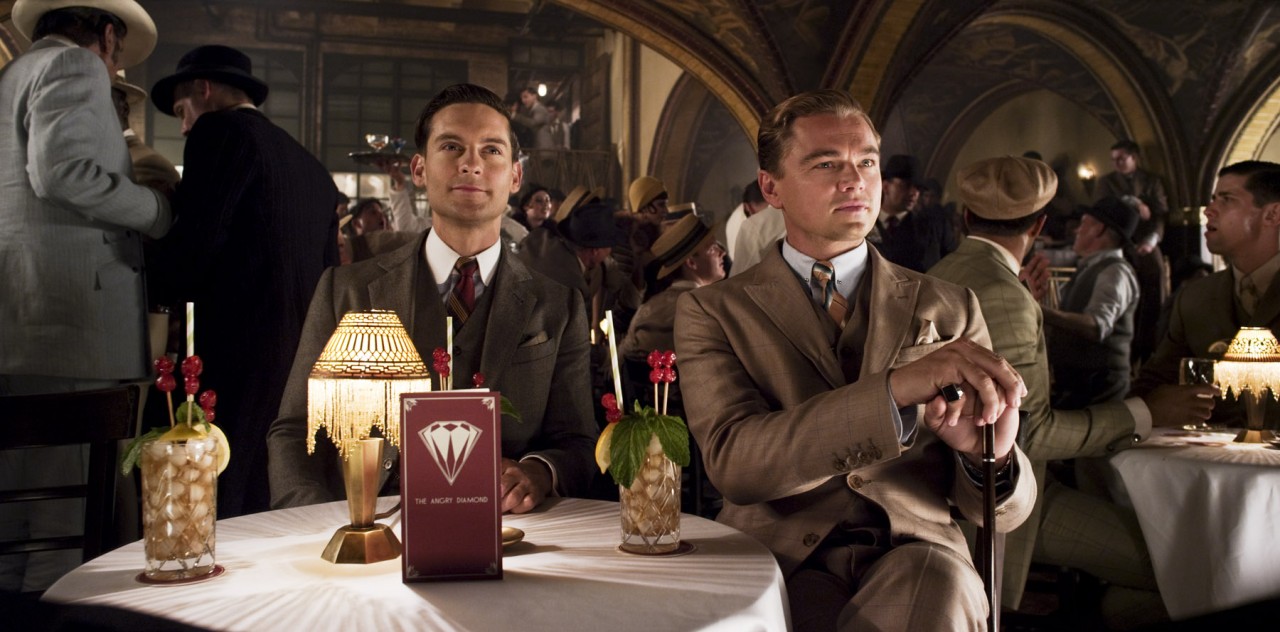
“THE GREAT GATSBY” Review (✫✫✫)

Nice to see you again, old sport.  

When you sit and think about the character of Jay Gatsby, there is never a simple answer to define him and his purpose in The Great Gatsby.  Some people have cited him as a post-modern interpretation of Romeo And Juliet, in the aspect that the character is going through a romantic struggle that always ends in nothing but tragedy.  Others have viewed him as a representation of the roaring twenties, as a pioneer who emboldens and defines the industrial image of the 1920’s and their status as they faded away into the 1930’s.  Others see him more like an enigma, an image of the upper class and the bleak loneliness that comes with it.  Whatever you believe to see, Jay Gatsby is no simple character.  For all we know, he could be one or none of these things.  Or all of them.

The fact that this film knows, respects, and acknowledges that makes me appreciate this movie, and hope that others can appreciate it too through DiCaprio’s performance and the mythology being revisited here.  Those who read the book should already know the story: a 1920’s bond salesman and struggling writer named Nick Carraway (Tobey Maguire) moves into New York city, where he learns of his rich next door “neighbor” named Jay Gatsby (Leonardo DiCaprio).

I put “neighbor” in quotations because Nick never actually sees Jay Gatsby in the beginning of the film.  All he ever sees of his estranged, self-secluded neighbor is a man looking behind some curtains and holding lavish parties in his mansion in the cool of midnight.  All he ever hears of him is scandalous rumors and war stories about a man many people haven’t met either.  The more Nick lives in his lonely little house, the more he questions if Mr. Gatsby even exists.

Eventually, Mr. Gatsby of course does introduce himself, but not as the host of the party, but rather, as a humble servant who offers Nick a drink on a plate of beverages.  As Nick becomes more familiar with Mr. Gatsby and his lifestyle, he soon learns the truth of Mr. Gatsby’s past and the reasons he really came to New York.

When I first heard of another Great Gatsby picture being made, my first reaction was excitement and anticipation.  How could it not be?  From the creative mind of F. Scott Fitzgerald and the many politics and emotions he makes you feel in his novel, it sounded like this movie was going to be a home run for both fans and non-fans of the book.

Then I learned that Baz Lurhmann was writing and directing.  And then bowed my head and uttered a long, dubious groaaannnn.  Lurhmann, who is most known for directing 1996’s Romeo + Juliet and 2008’s Australia, is commonly remembered as a director who abuses style over substance.  With the previous films I just mentioned, not only are they silly, soupy, and sappy menial dramas: they fail to even attain interest, and are extremely forgettable in a line of much better romantic dramas, including Titanic and the 1968 Romeo And Juliet by Franco Zeffirelli.

Note: Okay, I’ll admit I haven’t seen his 2001 film Moulin Rouge!.  Does it matter though, when out of his entire filmography, that’s the only film he can really brag about?  

The beginning of The Great Gatsby, much like Luhrmann’s other pictures, also suffers from this case of style over substance, with its overly boisterous parties and distracting art sequences making no coherent sense or adding anything to the picture overall.  What I found interesting, however, is that the first act barely matters.  When Jay Gatsby is finally introduced, the film takes a sharp turn of interest and invigorates the audience with new energy, almost like the character changes the entire tone of the film simply by him just being there.

I imagine this is the kind of Jay Gatsby that Fitzgerald would have wanted cast: the type that dresses in nice suits, stands straight with his chin up, and one who enters a room with such stillness that you could hear a penny drop.  The casting directors knew that their casting decision would be crucial to the film, and I think Fitzgerald would be pleased with the end result.  DiCaprio hits every single note dead-on this fascinating character, and just by sheer appearance, demeanor and dialect does he inhabit the character of Jay Gatsby and allow audiences to slip into his conscience and feel what he is feeling.

Oh, I won’t deny everyone else is good in this movie.  Joel Edgerton is effective as the antagonist, and even though he’s an industrial pioneer much like Gatsby is, he has such a hateful energy about him that makes you just want to run him over with a yellow beetle.  Carey Mulligan is good as Gatsby’s love interest, and perfectly shows all the innocence and indecisiveness of her character in the midst of all the ruckus.  Maguire, as well, is perfect as Nick Carraway, not as a character in himself, but as a silent observer, a passive voice who quietly watches over the scene, acting as the audience’s eyes and ears in this third-person narrative.  But its DiCaprio who sucks us in, DiCaprio who winds us up and plays us like a record as he asks us to sit through this tender, emotionally captivating journey that serves as a metaphor for the wealthy and for the industrial era.

And don’t worry, I’ll give Luhrmann credit too.  This film would not have survived without his writing or directing, as he has such reverence for the book and a great fear from deviating from it that the movie functions more as a love letter to Fitzgerald than it does as a strict book-to-movie adaptation.

Regardless, there’s only one person who shines the most here.  DiCaprio made this movie, and through his performance we were able to identify with a character that struggles with his past, his wealth, his love, and the deepening sadness that he hides behinds his warm, welcoming smile.

Tagged , , , , , , , , , , , , , , , , , , , , , , , , , , , , , , , ,

“THE BOURNE LEGACY” Review (✫1/2)

This movie has the wrong title.

The Bourne Legacy is a misconstrued mess, an absolute miscalculation and train wreck of a film that it has no business being made into a movie in the first place.  I hated this idea months before this was released, and I hate it even more now after having seen it.  Who, in their right minds, thought it was a good idea to make a Bourne movie without Jason Bourne???  That was my biggest concern going into the movie.  Believe me though, fellow moviegoers: that is the least of your worries.

Taking place shortly after the events of The Bourne Ultimatum, The Bourne Legacy shows the repercussions of Bourne’s actions, how it affects Treadstone, and what marks it leaves on the people involved.  Erik Byer (Edward Norton) is a government official who was directly involved with the affairs of Treadstone during its days of operation.  Shortly after Jason Bourne escapes their custody, however, Byer believes that all of the agents now are a potential threat to the government, and is convinced that he needs to shut the project down in order to protect themselves.  By “shut the project down”, I really mean kill all of the agents in the field.

One of these agents is Aaron Cross (Jeremy Renner), an experienced field agent who is carrying out a mission in Alaska for Treadstone when the order was released.  While taking refuge in a wooden cabin with another fellow agent out in Alaska, they are suddenly attacked by robot jets, and Cross barely escapes with his life intact.  Surviving only because of the medication he is on (Treadstone agents are required to take two pills, a blue one for physical boosting, and a green one for mental boosting), Cross looked into his stash to realize that he only has a couple days worth of medication left.  Now low on food, supplies, and ammunition, Cross must now find a way to get back to America and survive against Treadstone long enough to find a way to counterattack their onslaught.

Let me start with the most obvious flaw here: Tony Gilroy.  Looking at his filmography, you would think he would be the best man for the job here.  He was credited as co-writer for the three previous Bourne movies, he wrote and directed the Oscar-winning drama-thriller Michael Clayton as well as the 2008 caper film Duplicity.  I enjoyed all of those movies, and thinking that this one would be the same, made the mistake of thinking that it would be just as good.

Trust me, this couldn’t be any more of a dissapointment.  Everything wrong with this movie has everything to do with Gilroy’s script and direction, which couldn’t be more forced, erratic, confusing, and half-lapsed than this.

The problems start with the premise: a Jason Bourne movie without Jason Bourne is a bad enough idea.  But let’s take a step back here and try to be open with this.  Let’s just say, for facetious effort, that Aaron Cross’ story is just as fascinating and compelling as Bourne’s is.  What are the conflicts?  In his first three movies, Jason Bourne’s struggle was against his morality, identity, and the confronting of his past.  What is Cross’ magnificent, epic struggle?  Survival by trying to find a green pill.  If this movie dwelved any more into the conflict than it did, I would have said Cross was a junkie.

“Funny”, I think.  “I don’t remember these pills being used in the original trilogy”.  Correction: I vaguely remember them.  In a brief flashback sequence in The Bourne Ultimatum, I remember Jason Bourne taking a blue and green pill during his initiation into Treadstone (this memory is hazy though).  Bourne obviously didn’t need to take the pills further because his body adapted to the drugs.  Here, Cross is dependent on the drugs like a junkie is on cocaine, and if he doesn’t get his daily dose of the green pill, he’ll apparently revert to the level of intelligence of Forest Gump, according to him.

Okay, that’s fine.  Jason Bourne isn’t in the movie, check.  Super pills gives Cross super powers, check.  I would be able to buy the premise and its characters if A) it were handled well, or B) it was anywhere near as smart, interesting, or even remotely readable as it was to The Bourne Identity.  Here, instead of intelligence we get confusion, instead of cleverness we get forced easter eggs to earlier movies, and instead of interest we get on-the-nose, ham-fisted writing.  The editing in this film is choppy, leaping all over the place, jumping from one timeline to another, one flashback to the next, and it becomes so repetitive and convoluted throughout the picture that by halfway through I stopped caring about it.

Oh, I don’t deny Jeremy Renner is a knockout in this role.  Neither do I deny the talents of Rachel Weisz, Edward Norton, and especially not Joan Allen or Albert Finney.  All of the performances are great, but the story is a complete wreck, and Gilroy clearly has no idea how to handle his premise or the cast he’s been given for this.  What more proof do you need, besides this convoluted script, an uninteresting story, and a tedious chase sequence at the end with a sharply abrupt cliffhanger?

This is exactly the reason why I hate sequels.  When done well, like the original Bourne trilogy, they are compelling, brilliant expansions furthering the story set up by the first one.  When done like this however, they are nothing but forced, awkward, nonsensical garbage.

Again, I ask this: why did this movie have to get made?  The Bourne Legacy is exactly what you expect it to be, a Bourne movie without Jason Bourne, equally without the compelling character drama or real conflict in it. And now they’re talking about a possible sequel to this mess.  Only if Jason comes back and kills Aaron Cross.  That’s the only way they can redeem themselves at this point.

Tagged , , , , , , , , , , , , , , , , , , , , , , , ,

“NOW YOU SEE ME” Review (✫✫✫)

And now you don’t.  

We open on a black screen, similar to how a magician opens up his show behind the secrecy of a red curtain.  A deck of cards can be heard flipping through the background with the presence of a calm, cool, and serene voice to accompany them.  “Pick a card”, he says.  “Any card”.  But before his volunteer can pick a card, he is quick to remind her “But look closely.  Because the closer you look, the less you will actually see”.

The words of a true magician, and the fact that he flipped this deck and actually picked the card I choose impressed me even more.  This character is named Atlas, who is played by Jesse Eisenberg, and he is a street magician on such a skill level to where he can make skyscrapers light up in the night.  As he impresses a crowd of ongoing viewers, one stands in the audience with a hood over his head quietly observing Atlas.  We can’t see his face and we don’t know who he is, but he carries a card in his pocket, and leaves it for Mr. Atlas at the end of the performance.

Atlas isn’t the only magician to receive special treatment: three other magicians have also been observed by this strange visitor and have been left cards for each of them.  There is the mentalist Meritt McKinney (Woody Harrelson), the pickpocket Jack Wilder (Dave Franco), and the escape artist Henly Reeves (Isla Fisher).  All four of these talented magicians have been recruited by a secret cult called “The Eye” to carry out a secret mission for them.  One year later, they come together in their first show as “The Four Horsemen”: and during their show, they rob a bank all the way in Paris while still performing in Las Vegas.

The FBI are called in to investigate, and they bring in Agent Dylan Rhodes (Mark Ruffalo) to arrest and interrogate the four horsemen.  Pressing as he is, the horsemen are equally as clever and deceptive.  Henly is spinning chairs, McKinney keeps reading his mind, and Atlas ends the interrogation by taking off his handcuffs and snapping them onto Rhodes.  The rest of the film shows Rhodes chasing the four horsemen, trying to figure out their plot, and to stop them before they succeed.

This film is all about style over substance, a movie that is more concerned with tricks and showcase over character depth and dimension.  Do I care about dimension, however, if the film is more than fun enough to take it over?  The success of movies do not just come from how deep or complex they are.  They also come from how well-made the picture is, how sharply the cut is edited, and how cleverly the narrative is structured.

And boy, if Now You See Me is anything, its definitely clever.  Directed by Lois Letterier (Transporter 2, The Incredible Hulk) and written by screenwriters Ed Solomon (Men In Black) and Boaz Yakin (Remember The Titans), Now You See Me is a movie driven to the brim with its cleverness, its wit, deceit, and effervescent charm in its characters, in what they do, and how they do it.  In many ways, this movie reminds me of caper films such as Oceans Eleven and The Italian Job: its a movie where characters cleverly trick and deceive their pursuers and expose them to their traps and their decisive plans.  They don’t use muscle, brawn, or big guys with guns to get what they want: they use their wits, their brains, and their thievingly cunning plans to accomplish their goals in the plot.

Of course, these plans weren’t inherently inspired by the four horsemen in themselves: someone from the shadows has helped them with this plan, and is always monitoring these horsemen from shadows of secrecy.  Tonally, the film achieves what it desires, and throughout the conniving plot we’re always wondering a key mystery: who is the fifth horseman?  Why did he enlist in the help of these four?  Who could it possibly be?  Is it one of the FBI or Interpol, pretending to be on one side while coyly playing for the other?  Or is it another mystery card player, one who has hidden behind a long-aged myth and has hidden himself from all cards in the field?

This isn’t just a caper film: it is a complex and fascinating mystery, and the cast of characters is all the rogues gallery in this police questioning.   Mark Ruffallo does well as Dylan Rhodes, and in small moments of intimate revealings he shows a man who was once a boy who will always hate those in higher power oppressing the helpless underdogs.  Michael Caine and Morgan Freeman make great cameos, and each play a role we don’t normally see from them, Caine being an antagonistic money monger and Freeman being an observant expose’ of schemes.  Eisenberg, as always, is a knockout in anything he does.  Here his character combines both the social awkward and invertedness of The Social Network, and the coy, cool, sleek confidence of Brad Pitt from Oceans Eleven.  Don’t ask me how he does it, okay?  He just does.

And this is a film that has been bombasted by critics.  For what?  A few quotes I pulled from Rottentomatoes:  “Overcooked, overcomplicated and underinteresting, this heist caper turns into a mess”, one critic said. “Complicated nonsense”, and “…a flimsy plot whose logic disappears faster than a rabbit in a hat”.

There is some truth here.  Yes, the film is overcomplicated.  Yes, it is elaborate and sometimes distracting.  Yes the characters are one-note and thinly written.  And yes, the twist ending is dangerous enough to make the entire narrative collapse on itself, let alone offering the threat of plot holes.

In other words, I’ll admit I don’t understand everything by the end of the picture.  And that’s precisely the point.  There isn’t any fun with a trick that has been exposed: the fun comes in with those trying to figure it out.

Tagged , , , , , , , , , , , , , , , , , , , , , , , ,

“TRANCE” Review (✫✫✫1/2)

The pocket watch is mightier than the magnum.  

Trance is a fantastic art film, a mesmerizing and fascinating thriller that uses twists, turns, hallucinations, and narrow corridors as its tools to build suspense, and dialogue and performances to form sympathy for its characters.  Its surreal, twisted, strange, nonlinear, and non-conventional, but to dust with conventionality.  This is a great picture.

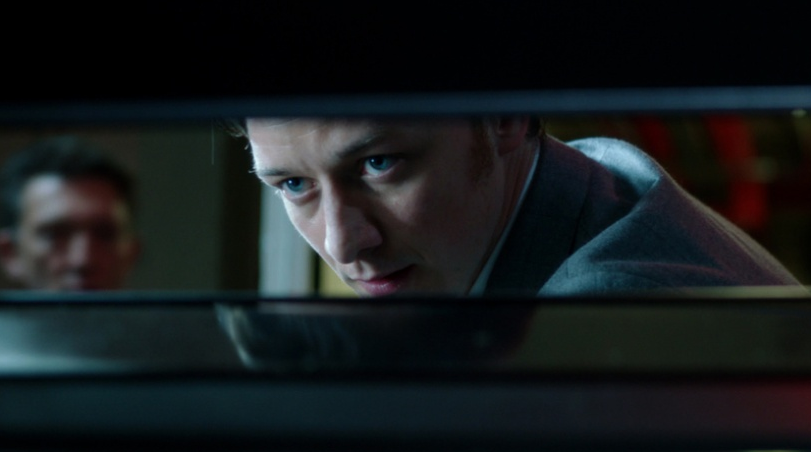
As the film fades in, we are introduced to Simon Newton (James McAvoy), an art auctioneer who takes us through the ropes of what his job entails.  He tells us of the extensive steps it takes to reserve a painting, the protocols his employers tell him to do when putting a painting up for auction and what steps he must take if a robbery takes place.  Their most valuable item is a painting by Francisco Goya called “Witches In The Air”, and his employers gave him precise instructions on how to preserve the painting if thieves do happen to come into the auction in an attempt to steal it.

Sure enough, thieves break into the auction and attempt to steal the painting.  This troop is lead by one named Franck (Vincent Cassel), and he is determined and headstrong into getting that painting.  Right before Simon puts the painting away, however, Franck cuts him off, a brief struggle happens between them, and Simon is knocked out, with Franck leaving with the stolen painting in tow.

When Simon wakes up, he realizes he lost his memory from the past two weeks.  When he’s finally released from the hospital, Franck pays him an unwelcome visit.  Turns out, all that Franck got on the day of the heist was just the frame of the painting, whereas the real article itself was transported to an alternative location.  Torturing him by peeling back his fingernails, Franck comes to find out Simon truthfully does not remember where he put the painting.  So he tries a different method of extracting information, one that involves psychology and hypnotherapy at the hands of one named Dr. Elizabeth Lamb (Rosario Dawson).  Together, they attempt to probe Simon’s mind, and begin their search for the painting Simon has kept hidden from them.

Here is a film that knows what it wants, a movie that knows its characters, their motivations, its story, and precisely how to tell it.  Director Danny Boyle, who is nearly a master at experimental cinema (if you don’t believe me, look at his hallucination sequences in Slumdog Millionaire or 127 Hours) does something very rare here: he intertwines and meshes characteristics of a narrative film with that of art and experimental cinema, making a truly absorbing, gripping, and fascinating experience.

Let me make something clear here, however: I hate experimental cinema.  Nine times out of ten they don’t make any sense, they seem relevant only to those making them, and they elicit a confused response rather than an emotional one from its audience.  Here though, the result is much different.  Everything is crystal-clear and fluid, the visuals dynamic and expressive, the editing cut together neatly and crisply. It’s like a mind game of cat-and-mouse, except the cat is willing to seek out help and the mouse is more lethal than both cats are lead to believe.

Oh believe me, my attention was unadverted throughout the entire picture.  While I didn’t understand everything immediately in the film, I understood what I needed to in the moment and the plot filled in the rest for me as time went on.  And what did I understand, more than anything else?  That these are sinful characters, decrepit criminals that lie, cheat, and connive their way to success and to financial gain.  Cassel was aggressive and talented as Franck, and while his character was despicable and loathsome at first, a softer side of him was later revealed so that the audience could come to terms with his character.  Dawson is as beautiful and motivated as ever, and while she too was at first a sympathetic figure, she later reveals a darker side to her character that even I didn’t expect.  I’m not even going to go into James McAvoy.  His performance was so specific and so wide-ranged that I was compelled to care for his character while at the same time hating him.

And yes, in case you didn’t pick up on it, the movie is deserving in its R rating.  It is violent, bloody, disturbing, graphic, and it has its vast share of nudity and sexuality, with some of the violence and sex combining in many gruesome scenes.  If this were any other picture, I would take off points for that.  But like Pulp Fiction and Taxi DriverTrance is a film that uses its bleak content as a tool to tell a story and define character, to show an encompassing yet tragic story of three fatally flawed individuals who will torture, manipulate, and kill to get whatever they want.  You have to watch a movie like this long enough to realize the point when it stops being a thriller and starts forming into something greater: when it starts forming into art.

Tagged , , , , , , , , , , , , , , , , , , , , , , , , ,

“AMERICAN PSYCHO” Review (✫)

Sex, murder, and the decrease of the human condition.  

American Psycho is a vile, sickening experience, a gruesome and aching film incapable of human thought, feeling, comfort, or emotion.  This shouldn’t come as too much of a surprise considering the book in which it is based on inspired this same controversy.  Regardless, its achievement cannot be denied: the filmmakers have somehow concocted an experience as brutal, uncomfortable, disturbing, half-lapsed, misogynic, and morally reprehensible as this that they’ve come to completely disconnect with their audience.  I rarely feel this upset about a movie like this.

American Psycho follows the story of Patrick Bateman (Christian Bale), a successful businessman who works in his high-level office by day and parties fiendishly with his friends by night.  On the surface, Bateman looks like a normal upper-class bachelor.  He eats out at expensive restaurants, drinks exquisite martinis, has sex with beautiful women, enjoys swearing gleefully with his friends, and listens to a variety of experimental music.  In appearance, Bateman is the visible representation of the upper class: stoic, upright, eloquent, fashionable, and spoiled.

As the plot progresses, however, we come to understand more about the darker side of Bateman’s personality.  He doesn’t just have sex with beautiful women: he mutilates them.  He tortures them and fantasizes about killing them in horrible ways and playing with their bodies after he’s done dismembering them.  His kitchen pantry contains axes, blades, and tools he uses for his killings.  He draws his victims in a notebook he leaves at work.  A female head sits next to his ice cream in the freezer.  If there wasn’t wine in his alcohol bottles, it would probably be blood.

Ugh.  Just talking about the premise nauseates me.  Why do we need to experience this?  Bateman is a sickening character, a man who would dismember the head of one unfortunate female and chew off the genitals of another.  Why?  For what purpose?  His motivations are never explained in the movie and his reasonings for murdering women are a mystery to us.  Is there a reason for this?  Is there a reason for being so non-inclusive with your audience? Why must everything be shrouded in secrecy?

This is the film’s biggest problem, besides the violence and the sexuality: Patrick Bateman is a deplorable character, difficult to understand and impossible to sympathize with.  You might think its impossible to sympathize with a murderer of women anyway, but it isn’t really.  We’ve ben asked to sympathize with deplorable characters before, including a psychotic war veteran in Taxi Driver to ruthless murderers and drug dealers in Goodfellas.  Sympathy and interest worked with those characters because one character was struggling to find a line of morality and righteousness to follow, and another was hesitant and even regretful over the actions that he’s done.

Bateman doesn’t regret his decisions nor chooses to change them.  He kills instinctively, almost like he’s trying to prove some territorial point to the people around him.  To put it out there in gruesome, violent fashions like this though is just torturous.  Who wants to sit there, eyes on the screen, watching him laughing as a petite blond girl in front of him cries pleading for her life?

But American Psycho isn’t just sickening, repulsive, and pungnent: the film’s logic is half-lapsed, incomplete, and flawed, incomprehensible to the viewer and extremely frustrating to those trying to figure out.

I’ll give you an example.  There’s one scene where’s Bateman is chasing one of his victims through the hallways of a hotel, half naked, screaming manically, and revving his chainsaw like Leatherface from Texas Chainsaw Massacre. Someone explain to me how no one from the hotel hallway heard the ruckus from outside their rooms, or anyone from the two floors above and beneath him?  Here you have Jack Torrence running through the hallways screaming at the top of his lungs with a lawn mower, and nobody even bothers to call the police.  What?  Are the wooden doors sound-proof?  Who knows, maybe they’re afraid of poking their heads out the door so that they won’t get their heads chopped off.

Due to a revelation revealed later on in the plot, one could argue this is a “dream sequence”, or a “vision” Bateman had.  But how is there any way to know?  With Bateman’s maniacal, wretched mind, dreams feels like reality and reality feels like dreams.  How is there any way to read the subtext when you’ve made your narrative so damn hard to figure out?

And this is a movie that is being hailed as a dark comedy.  A comedy for what, exactly?  The film is two graphic hours of bloody, sickening, gruesome violence and pornography.  When, at any point, is it set up to inspire laughs?  In movies like Pulp Fiction and Fight Club we are at least given subtle moments of clever dialogue to clue us in to the humor, and even though stomach-curling things are happening on screen, we are able to suspend that  briefly in order to enjoy the humor.

American Psycho is not subtle, smart, clever, humorous, or any of the related adjectives.  There’s a point director Mary Harron is trying to express through the film, but that point is convoluted, vague and shockingly illiterate.  As a result, what we’re ultimately watching is an idle, pointless, and misconstrued film, and our reward for watching is hours of punishment, nudity, sexual immorality, blood, torture, macabre violence, and sickening indecency.  To be fairly honest, I probably need a second viewing in order to fully understand the picture, but the plain fact is that the movie doesn’t deserve a second viewing.  If I end the film feeling as punished and as mutilated as Bateman’s unfortunate victims, why on earth would I want to subject myself to that again?

At the end of the film, Bateman himself admits that he finds neither closure nor catharsis for his bloody, violent, sexually immoral and murderous journey.  For that matter, neither do we.

Tagged , , , , , , , , , , , , , , , , , , , , ,